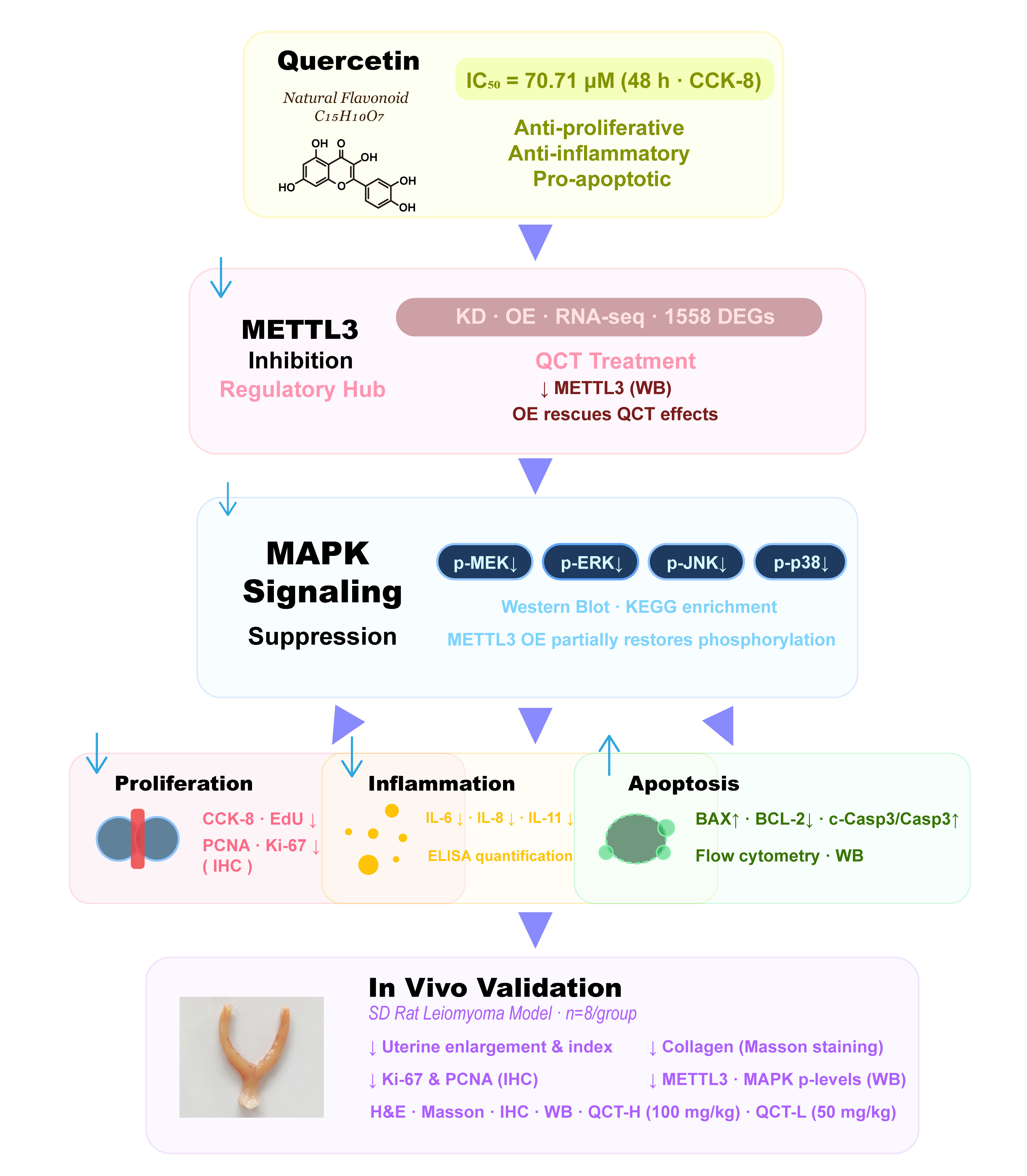
Quercetin Suppresses Uterine Leiomyoma Progression by Modulating METTL3-Mediated MAPK Signaling

 ,
, Abstract
Share and Cite
Luo, W.; Yang, X.; Liu, Y.; Qiu, T.; Ren, H.; Zuo, J.; Chen, Z.; Shi, S.; Li, D. Quercetin Suppresses Uterine Leiomyoma Progression by Modulating METTL3-Mediated MAPK Signaling. Int. J. Mol. Sci. 2026, 27, 4586. https://doi.org/10.3390/ijms27104586
Luo W, Yang X, Liu Y, Qiu T, Ren H, Zuo J, Chen Z, Shi S, Li D. Quercetin Suppresses Uterine Leiomyoma Progression by Modulating METTL3-Mediated MAPK Signaling. International Journal of Molecular Sciences. 2026; 27(10):4586. https://doi.org/10.3390/ijms27104586
Chicago/Turabian StyleLuo, Wenting, Xuan Yang, Yu Liu, Tiantian Qiu, Hui Ren, Jiheng Zuo, Zongshun Chen, Shuoshuo Shi, and Donghua Li. 2026. "Quercetin Suppresses Uterine Leiomyoma Progression by Modulating METTL3-Mediated MAPK Signaling" International Journal of Molecular Sciences 27, no. 10: 4586. https://doi.org/10.3390/ijms27104586
APA StyleLuo, W., Yang, X., Liu, Y., Qiu, T., Ren, H., Zuo, J., Chen, Z., Shi, S., & Li, D. (2026). Quercetin Suppresses Uterine Leiomyoma Progression by Modulating METTL3-Mediated MAPK Signaling. International Journal of Molecular Sciences, 27(10), 4586. https://doi.org/10.3390/ijms27104586