Review

Marine-Derived Bacillus and Their Potential as Probiotics

by
Natasha B. Bambridge
1,
Yaoying Lu
1,
Horst Joachim Schirra
1,2 and
Yunjiang Feng
1,2,*
1
Institute for Biomedicine and Glycomics, Griffith University, Parklands Drive, Gold Coast, QLD 4222, Australia
2
School of Environment and Science, Griffith University, 170 Kessels Road, Brisbane, QLD 4111, Australia
*
Author to whom correspondence should be addressed.
Int. J. Mol. Sci. 2026, 27(10), 4352; https://doi.org/10.3390/ijms27104352
Submission received: 12 March 2026 / Revised: 7 May 2026 / Accepted: 7 May 2026 / Published: 13 May 2026

Abstract

The marine environment is an underutilised resource in probiotic research despite its potential for unique and beneficial microbes. Bacterial probionts derived from the ocean are emerging in the probiotic research field as an area of interest. Bacillus species (spp.) are Gram-positive, endospore-forming bacteria. Due to their unique resilience and their generally recognised as safe (GRAS) status, they have gained traction as putative probiotics. Existing large-scale reviews into the probiotic potential of Bacillus spp. have focused on terrestrial species, with limited attention given to marine-derived species. This review aims to address this gap by evaluating marine-derived Bacillus spp. with a focus on their diversity, origins, sources and demonstrated potential as probionts.

1. Introduction

The marine environment is composed of many ecosystems, which are habitats to a variety of uniquely adapted organisms, including microbes [1,2,3]. Marine-derived microbes, specifically bacteria, have many useful applications, including as potential probiotics [2,4]. Probiotics, as defined by the World Health Organisation (WHO), are “live microorganisms that, when administered in adequate amounts, confer a health benefit on the host” [5,6]. In recent years, advancements in probiotic research have been motivated by antibiotic resistance, a public health threat observed in clinical isolates of bacteria that has been reported to have caused 1.14 million deaths in 2021 [7]. Probiotics present an alternative to antibiotics by preventing illness through a proactive approach [8]. This is achieved through a multi-mechanism approach involving pathogen modulation, immunity boosting and improved digestion, with the main result being an improvement to the animal’s health [8].
To be considered a probiotic: a microbe must meet certain essential criteria [4]. These include the microbe being non-pathogenic, non-resistant to antibiotics and able to survive and colonise the extreme environment of the digestive system [4,9]. Another desirable trait of a potential probiotic is the ability to confer benefits to the host, including immune and digestive enzyme production, pathogen mediation, and immune system modulation [4]. The most common form of microorganism utilised as probiotics is bacteria [6]. Lactic acid bacteria, namely, Lactobacillus and Bifidobacterium, are currently the most utilised probiotics as they originate from food fermentation or within the human and animal gut microbiomes [6,8,10,11,12]. Despite their wide usage, these bacteria are not optimal probiotics as they are easily impaired by the gastrointestinal (GI) tract and have little capability to colonise the gut [8,10,12]. Recently, investigations have focused on other bacterial families, including species from the genus Bacillus [8,11,12,13,14,15]. Bacillus is a Gram-positive, endospore-forming bacterial genus within the larger Firmicutes phylum [8,10,11,12,14,16]. The increased interest in Bacillus spp. is linked to their better storage properties and capability to survive in the gut [6,8,16,17]. Bacillus spp. is generally safe for human use, shows limited antibiotic resistance and promotes many significant health benefits [8].
While there have been reviews investigating Bacillus as a probiotic previously, these reviews have focused on terrestrial species [1,8,10,11,14,15,17,18]. This article aims to fill that gap by examining the present research on marine-derived Bacillus species in the past five years, with a specific emphasis on their applications to the probiotic field.
Two databases were utilised in this research: SCOPUS and ScienceDirect. A literature search of these two databases, using the search term “Marine-derived” and “Bacillus” with the inclusion criteria of peer-reviewed, English-only and journal articles, yielded 2025 results. This number was reduced to 1309 by restricting publication years to 2020 to 2025. The search was further refined to include articles in which “Bacillus” appeared in the title or abstract, while excluding articles that included “Lactobacillus” and “Paenibacillus” or “Tubercle Bacillus”, resulting in 723 papers. Articles focused on terrestrial Bacillus or reclassified as non-Bacillus were also eliminated. This resulted in 178 articles being included in this review, with an additional 39 articles cited for Supporting Information when the information could not be sourced from the original articles.

2. Marine-Derived Bacillus Diversity

2.1. Presence of Marine-Derived Bacillus Species and Their Associated Strains

Bacillus is a diverse genus of bacteria with hundreds of different taxonomically unique species. Within the literature, there were 33 different identified species and 40 unidentified species of Bacillus with a total of 525 strains reported (Table S1). Out of these strains, 17.3% (91) were identified as putative probiotics. Bacillus cereus was the most prevalent species identified in the literature: 38.4% (197) of all reported marine-derived isolates, but only 12.4% (11) were identified as putative probiotics (Table 1). B. subtilis encompassed 18.5% (97) of all reported marine-derived strains. However, 27.0% (24) were identified in the literature as probiotics, making it the most prevalent species in that field. Other commonly researched species, including B. velezensis (27), B. licheniformis (27), B. pumilus (20), and B. amyloliquefaciens (19), exhibited probiotic potential in 8, 10, 3 and 8 strains, respectively.

2.2. Geographic and Oceanic Origins

Overall, within the literature, 33 countries were identified as the origins of marine-derived Bacillus, with 514 strains naming a specific country (Table S1). Asia is the largest contributor to the research, with 88% of all reported marine-derived Bacillus spp. and 86.5% of probiotics originating from Asia (Table 2). China is the origin of 54.7% (287) of these marine-derived strains and 62.4% (197) originated from the Paracel Islands within the South China Sea [19]. India was the origin of 16.4% (86) and the other 19.3% (89) originated from various Asian countries. In terms of probiotics, China was the origin of 44.9% (40) of putative probiotics, while India produced 23.6% (21).
Regarding oceanographic locations, the Pacific and India Oceans were the origins of 54.9% (288) and 21.3% (112) of all reported marine-derived Bacillus within the literature (Table 2). The South China Sea was the origin for 45.3% (238) of all literature isolates and 82.6% of all Pacific Ocean isolates. The Indian Ocean had a wider diversity of sea sources, with 25.9% (29) originating from the Bay of Bengal, 20.5% (23) from the Persian Gulf, 17.9% (20) from the Laccadive Sea and 13.4% from the Arabian Sea (15). In terms of probiotics, there was an even distribution (18) between the Indian and Pacific Oceans, with no other oceans contributing to this research (Table 2). Most of the probiotics were from the South China Sea (7) and the Bay of Bengal (11).

2.3. Sources

The marine environment is a thriving ecosystem consisting of water, sediments and an abundant flora and fauna species. Almost half of the Bacillus bacterial isolates identified in the literature originated from seawater (24.0%) or sediments (22.9%) (Table 3 and Table S1). However, other important sources of marine-derived Bacillus are corals (11.2%), plants (8.6%), algae (7.6%), fish (7.0%) and sponges (6.5%). Several Bacillus species, including B. firmus [20], B subtilis [21], B. licheniformis [21], B. pumilus [21], B. cereus [21], and B. siamensis [1,22], were isolated from different coral species. These included Anthogorgia Caerulea [1,22], Scleractinia spp. [23], Acropora digitifera [24], Palythoa spp. [21], and Leptogorgia rigida [20].
While water and sediments are the key sources of Bacillus spp., there are no probiotics isolated from seawater, and only seven are isolated from sediments (Table 3). Fish (34.8%) and aquaculture (23.6%) are the most common probiotic sources. Of all the strains isolated from these sources, 83.9% and 95.5% are used as probiotics, respectively. A variety of fish have been utilised to source probiotics, including: Epinephalus sp. (21.6%) [25,26,27,28,29], Dicentrarchus sp. (16.2%) [30,31,32], Lates calcarifer (8.1%) [33,34] and Scopthalmus maximus (8.1%) [35,36,37]. Centroscyllium fabricii, the black dogfish [38], and Chiloscyllium plagiosum, the white bamboo shark [39,40], were also used to isolate B. amyloliquefaciens strains BTS33 and GB-9. Isolates from invertebrates have also demonstrated probiotic potential (10.1%). Specifically, B. baekryungensis MS1 [41], B. licheniformis XW15, B. subtilis ZF3 and B. subtilis DB1 [42] isolated from a sediment in an Apostichopus japonicus aquaculture tank all displayed probiotic effects. One probiotic has been identified in coral, B. tequilensis Bt-Co [43], four in plants, none in algae and two in sponges. All the plant-related probiotics were isolated from mangroves despite seagrass being the main source of marine-derived Bacillus [19,44,45,46].

3. Marine-Derived Bacillus as Potential Probionts

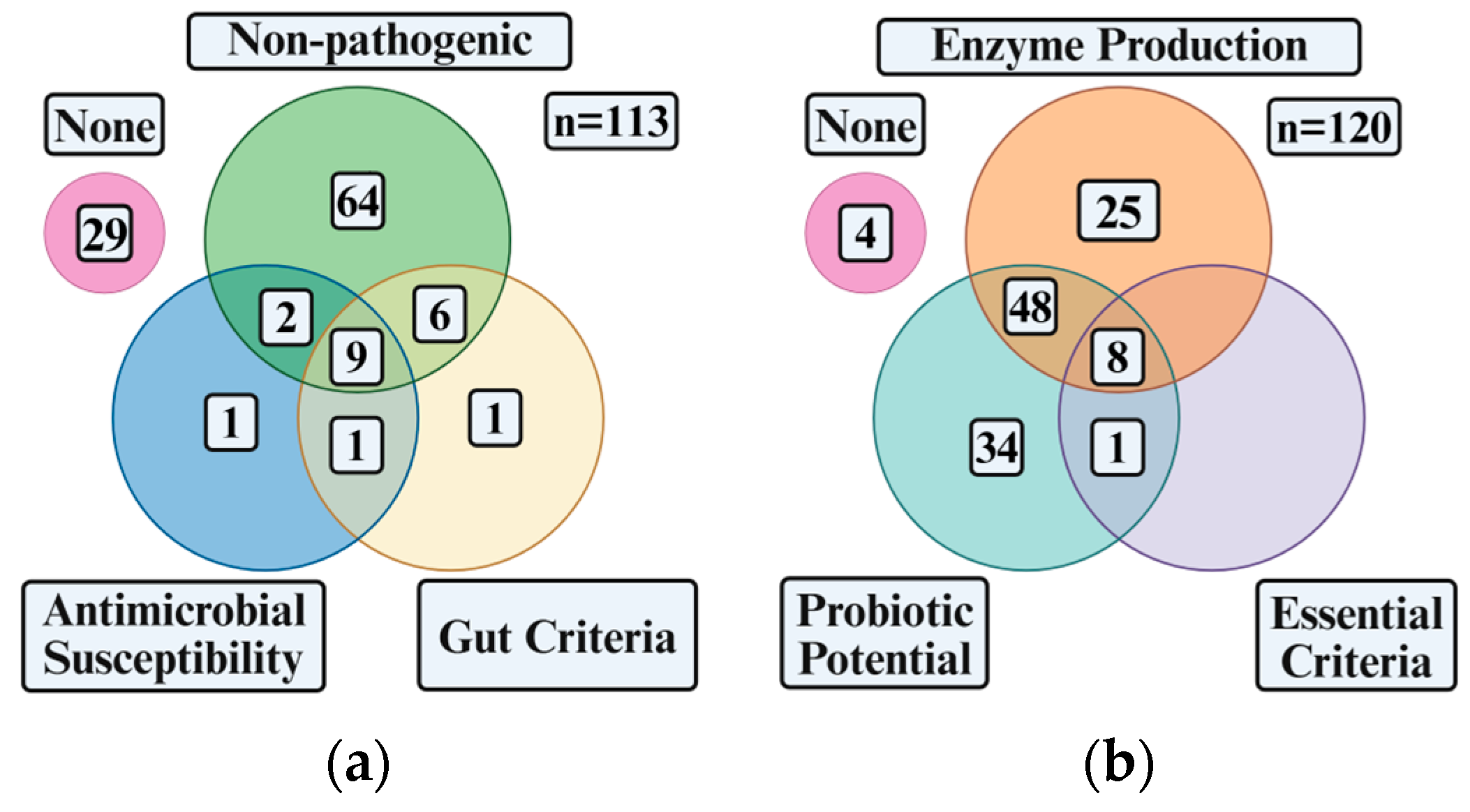
As a necessity, any potential probiotic microbes must meet several criteria involving safety and function [4,9,47]. Safety is determined by eliminating potentially pathogenic microbes and those which may contribute to an increase in antibiotic resistance genes (ARG) [4,9,47]. Functionality is assessed by assessing a putative probiotic’s capability to survive in and colonise the gastrointestinal (GI) system [4,9,47]. Additional desirable criteria like immunomodulation or digestion are assessed through enzyme activity [4,9,47]. While there are 525 strains reported, only 21.5% (113) were assessed for a minimum of one essential probiotic criterion (Figure 1a). Only 17.3% (91) of these strains were identified as potential probiotics. Of the 91 strains, 9.9% (9) have met all the essential criteria (Figure 1a, Table 4): these strains are non-pathogenic, not antibiotic resistant and have demonstrated gut survivability. Within those that have met all the essential criteria, 88.9% (8) have been tested for enzyme production (Figure 1b, Table 4).
Only one, SYNSEA, a Lactobacillus and B. subtilis consortium from an unspecified fish [48], has been commercialised. The other eight Bacillus spp. have significant potential to be utilised as commercial probiotics (Table 4). Additional strains partially met the probiotic criteria, as shown in Table 5.

3.1. Investigations into Pathogenicity

Bacillus spp. have the potential to be pathogenic, especially strains like B. cereus and B. anthracis [49]. According to the European Food Safety Authority (EFSA), any putative probiotic Bacillus spp. must undergo in vivo testing to confirm safety or demonstrate that the cells are non-cytotoxic [50]. This is commonly evaluated through hemolytic activity assays. Bacterial species exhibiting β-hemolytic activity are considered pathogenic due to their ability to lyse red blood cells, whereas those displaying γ-hemolytic activity are regarded as non-pathogenic [28]. For members of the B. cereus species, they must undergo whole genome sequencing (WGS) to eliminate the presence of enterotoxin-coding genes (TCG), including nhe, hbl, and cytK, and cereulide synthase (ces) [50]. Marine-derived Bacillus were evaluated for their potential pathogenic effects in 15 distinct species and 90 strains (Table 6 and Table S2). Out of the 90 strains, 88.8% (80) were classified as non-pathogenic, <1% (5) required further testing and <1% (5) were considered pathogenic. B. cereus CH, HB, and WH from farmed A. japonicus [9] and B. aerius from the Marchika Lagoon [49] demonstrated β-hemolytic activity on blood agar, and the B. cereus strains contained 143 (CH), 140 (HB), and 141 (WH) virulence factors (VF) [9]. B. cereus G1–11 had γ-hemolysis and no mortality in animal trials but possessed toxin-coding genes nhe and hbl, excluding it as a potential probiotic [25]. Meanwhile, B. subtilis subsp. inaquosorum BSXE-2102 also possessed the same phenotypic traits and a TCG (hly-III) [51]. Due to the status of B. subtilis as GRAS and no evidence of the gene in the phenotype of the bacteria, it is classified as non-pathogenic.
As the most prevalent species in the probiotic literature, B. subtilis accounted for 26.7% (23) of non-pathogenic strains. Strains ABP1 and ABP2 both demonstrated γ-hemolysis, increased survival rates and reduced inflammation when administered as putative probiotics to Oncorhynchus mykiss [31]. B. subtilis BSXE-2102 was also identified as a potential probiotic as it increased survival rates when administered as a feed probiotic to Penaeus vannamei, as well as protected the animals from Vibrio parahaemolyticus infection [52]. A genomic analysis revealed that the presence of certain VFs, which can be associated with pathogenicity, played a beneficial role in the microbe’s effectiveness as a probiotic [52]. Of the 50 VFs, several genes, including 1 dltA, 1 fbpaA and 1 fliP, are associated with cell adherence [52]. In pathogenic bacteria, these traits are associated with infection risks, but in probiotics, they aid in gut colonisation [52].

3.2. Analysis of Antibiotic Resistance

Antibiotic resistance is the key driving factor behind probiotic advancement, and yet only 10.9% (57) of all reported marine-derived Bacillus strains have been investigated for their resistance, and only 24.8% (13) of the investigated strains met the EFSA standard. The EFSA states that phenotypic antimicrobial susceptibility testing is sufficient for microorganisms that do not exhibit acquired resistance [50]. However, for microorganisms that are typically susceptible but show resistance in phenotypic assays, whole-genome sequencing (WGS) is required to examine the genome for novel antimicrobial-resistant genes (ARGs) [50]. If such ARGs are identified, the strain is not considered eligible for use as a probiotic [50]. Eight commonly used antibiotics (Table S3) are recommended by EFSA, representing different antibiotic families. Out of the 57 strains, B. subtilis BSXE-2102 subsp. inaquosorum, isolated from Litopaneaus vannamei aquaculture [53], and Bacillus sp. PM8313, isolated from wild Pagrus major, were the only microbes found to be susceptible to all the recommended drugs and deemed safe for use as probiotics [54]; six microbes, including B. velezensis PGSAK01, B. subtilis subsp. stercoris PGSAK05, B. velezensis PGSAK17, B. subtilis PGSAK1 [28], Bacillus sp. RCS1 [25] and B. cereus G1–11 [25], were tested against alternative antibiotics within the same drug family and passed the standard, while five isolates, including B. subtilis subsp. inaquosorum M1 [51], B. licheniformis Ba4 [26], B. licheniformis [55], B. aryabhattai NM1-A2 [56,57] and B. safensis SDG14 [49], were validated through genomic sequencing. An additional five isolates were considered borderline, missing chloramphenicol or clindamycin from the panel. Another 37 needed further testing due to missing antibiotics, or in the case of B. cereus RCS3, there was resistance to vancomycin and doxycycline, which require further genomic analysis [58].

3.3. Gut Criteria

For a microbe to be considered as a potential probiotic, it must remain viable in the digestive tract, with the desired concentrations of bacteria in the GI tract being between ≥106 and ≥108 CFU/g [59,60]. The concentration of probiotics within the gut is dependent on the microbe’s ability to survive in the harsh conditions of the GI system and upon its capacity to colonise the intestine [59]. To survive the gut, a bacterial candidate must demonstrate a high tolerance to low pH and exposure to bile [59]. For colonisation, it must demonstrate the ability to adhere to the intestinal mucosa [52,61]. Out of 525 marine-derived Bacillus strains, 10.5% (55) have been tested for the ability to survive the gut and 3.6% (19) were tested for their ability to adhere to the gut (Table 7).

3.3.1. Gut Survivability

Out of the 55 strains tested against this criterion, 38.2% (21) demonstrated the ability to survive a pH ≤ 3 and a bile salt concentration of at least 0.3% (Table 7). Some isolates required further testing, 20% (11) were missing either a pH tolerance test or a bile tolerance test, while 41.8% (23) failed as they were unable to survive in these conditions. Currently, there is no universally accepted standard for pH tolerance. The acidity of gastric juices varies significantly, with human stomach acid reaching a pH as low as 1.5 [52,59]. Survival in low pH is vital for putative probiotics, so a microbe that is able to survive in a pH of 3 or lower is considered acceptable for use as a probiotic. Overall, 21 isolates could survive in pH ≤ 3, including species B. pumilus [62], B. safensis [49,63], B. subtilis [28,51], B. velezensis [28], B. haynesii [64], and Bacillus sp. RCS1 [65]. Only six of the isolates were isolated from sources unrelated to the animal GI tract, including B. aerius S-4, B. altitudinus S-5, B. pumilus G-1 [4], B. inaquosorum M1 [51], B. haynesii CD223 [64] and B. tequilensis Bt-CO [43]. The widest pH tolerance was observed in four isolates originating from the hybrid grouper [28]. B velezensis PGSAK01, B. stercosis PGSAKA05, B. velezensis PGSAK17 and B. subtilis PGSAK19 all had pH tolerance between 1 and 10 [28]. PGSAK01, PGSAK05 and PGSAK17 had higher growth rates between pH 4 and 9, while PGSAK19 had a higher growth rate between pH 2 and 9 [28]. All of the isolates had the best growth at a more neutral pH between 6 and 8, indicating potential survival in the duodenum. While the stomach’s low acidity can impact the bacteria’s survival, bile possesses detergent-like characteristics, which further complicates the viability of bacteria [59].
There is no standard test to determine bile tolerance, but the generally accepted procedure is to test the bacteria’s survival in 0.3% bile salts [15,52,59]. The strains B. sp. RCS1 and B. cereus RCS3, both isolated from Rachycentron canadum, tolerated 0.5% bile salts for 3 h with a survivability of 54.06 and 65.38%, respectively [58]. Another species, B. velezensis D-18, demonstrated tolerance to 10% L. Calcarifer bile for 1.5 h [66]. Other tests utilised to assess acidity and bile tolerance involve examining tolerance to simulated intestinal (SIJ) or gastric juices (SGJ). B. subtilis subsp. inaquosorum M1 showed a survival rate of 65.67% in SIJ [51], while B. tequilensis Bt-CO was able to survive with a rate of 94.37% in SIJ and 92.59% in SGJ. Bacillus sp. KRF was tested for its tolerances to SGJ and SIJ in both vegetative and spore form [54,67]. The vegetative cells had much lower survival rates, 4.74 ± 0.68% and 3.64 ± 0.42%, respectively, while the spores had survival rates of 66.85 ± 4.07 and 5.96 ± 0.24% [67].
Temperature is not always considered in assessing gut survival, but through storage, processing and delivery, probiotics are exposed to varied temperatures, which may affect their viability [59,60,68]. Thermotolerant organisms have a higher survival rate when exposed to these variations and thus are better for industry use as probiotics [60]. If a bacterium was unable to survive at temperatures associated with life, 30–40°C, then they were excluded as being probiotics. The temperature tolerance varied depending on the strain. The lowest tolerated temperate was 15°C from Pagrus major-derived Bacillus sp. PM8313 [54], while the highest tolerated temperature was 100°C for five isolates, two from Rachycentron canadum (Bacillus sp. RCS1 and B. cereus RCS3) [58,65] and three from the gut of the hybrid grouper (B. velezensis PGSAK01, B. velezensis PGSAK17 and B. subtilis PGSAK19) [28]. Sixty-five percentage had a tolerance between 30 and 50°C and an optimum temperature tolerance between 30 and 40°C.

3.3.2. Gut Colonisation

Overall, 19 (<1%) isolates were investigated for some form of colonisation capacity (Table 7). Of these 17 (89.5%) demonstrated the potential to adhere to the gut, while two (10.5%) were unable to adhere to the gut. Similarly to survivability, there is no current standardised method for examining cell adhesion within the gut [61]. However, current methods involve assessing auto-aggregation abilities and hydrophobicity or direct adhesion to cell lines [52,61]. Good adhesion is observed when auto-aggregation is over 50% [69,70,71] and hydrophobicity is over 30% [70] or cell adhesion is over 5% [61,72]. The highest auto-aggregation percentages were observed in B. cereus G1–11, which initially had moderate adhesion (<30%) during the first 5 h but increased highly to 93.83% after 24 h [25]. Comparatively, Bacillus sp. RCS1 and B. cereus RCS2 had initial auto-aggregation (<40%) at 3 h but rose to 80.6 ± 0.13% at the 24 h mark [58]. G1–11 also had the highest hydrophobicity (>90%), indicating the ability to adhere to intestinal mucosa, while B. pumilus A97 isolated from Trachinotus ovatus had a hydrophobicity level of 45.05% with xylene, 46.63% with chloroform and 45.38% with ethyl acetate [62]. Some strains have demonstrated adherence to cell lines even when they have poor auto-aggregation. B. safensis SDG14 demonstrated low auto-aggregation (18.4%) but relatively high cell adherence to Hep-2 Cell lines (45.54%), which indicates that it does have potential as a probiotic [73].

3.4. Enzyme Production

Digestive enzymes released by putative probiotics include carbohydrases, lipases, proteases, and peptidases. Releasing these digestive enzymes can confer benefits by increasing digestion, improving intestinal health, and modulating the gut microbiome [8,11,74]. Out of the 525 species, 13.1% (69) were documented as releasing a digestive-related enzyme. The digestive enzymes of particular interest were amylases, proteases, and lipases, which were produced across 12 different identified species (Table 8). Cellulase was also observed in seven different species. B. subtilis strains exhibited the highest enzyme production, with carbohydrases observed in 18 strains, lipases in seven, proteases in 18 and cellulase in 10. Enzyme activity varied between species. For example, B. subtilis SMF1, B. licheniformis LMF1 and B. siamensis DL3 all showed significantly higher protease and lipase activities (p < 0.05) but no significant alteration in the amylase activity when applied at 1 × 10⁹ CFU/g [75]. Multi-strain combination enhanced enzyme modulation: a mixture of B. amyloliquefaciens BN06, B subtilis WN07 and P. megaterium CT03 (1:1:1 ratio) resulted in significantly higher α-amylase and protease activity (p < 0.05) [46].
Only 78.8% (46) of all marine-derived Bacillus strains were examined for antioxidant-related enzymes, with 75.0% demonstrating activity. Antioxidant enzyme activity was reported across 12 Bacillus species (Table 8). Superoxide dismutase (SOD) activities were examined in 29 strains, catalase (CAT) in 19, and other oxidoreductase enzymes in four. B. subtilis was the most investigated, with eight strains exhibiting SOD activity, five showing CAT and two expressing other oxidoreductases. In B. subtilis W2Z, an increased dosage of probionts elevated the SOD and CAT activities in the hemolymph and hepatopancreas, while significantly reducing malondialdehyde (MDA) level [76]. Another strain, B. subtilis AAHM01, followed a similar trend with the addition of an increase in the activity of oxidoreductase and glutathione peroxidase [34]. Collectively, these findings demonstrate that marine-derived Bacillus spp. have the capability to reduce oxidative stress and improve host health [34,76]. Other immune-related enzymes, including lysozyme (LZM), alkaline phosphatase (AKP), acid phosphatase (ACP), transferases, and additional innate immune-related (II) enzymes, were documented in 10 Bacillus species (Table 9). LZM, AKP and ACP were the most frequently reported, occurring in 22, 19 and 21 strains, respectively. Again, B. subtilis was the most researched species, with seven strains exhibiting LZM activity, five showing AKP activity, and six exhibiting ACP activity. LZM is a key enzyme in the innate immune response due to its innate ability to kill pathogens [77]. A study on B. velezensis D-18, a putative probiotic, found that the bacteria boosted the bactericidal effects by increasing the LZM and the nitric oxide activities in Dicentrarchus Labrax [77]. Enhanced phagocytotic abilities have also been observed in B. cereus LS2, attributed to increased ACP and AKP levels [78].

4. Conclusions and Discussion

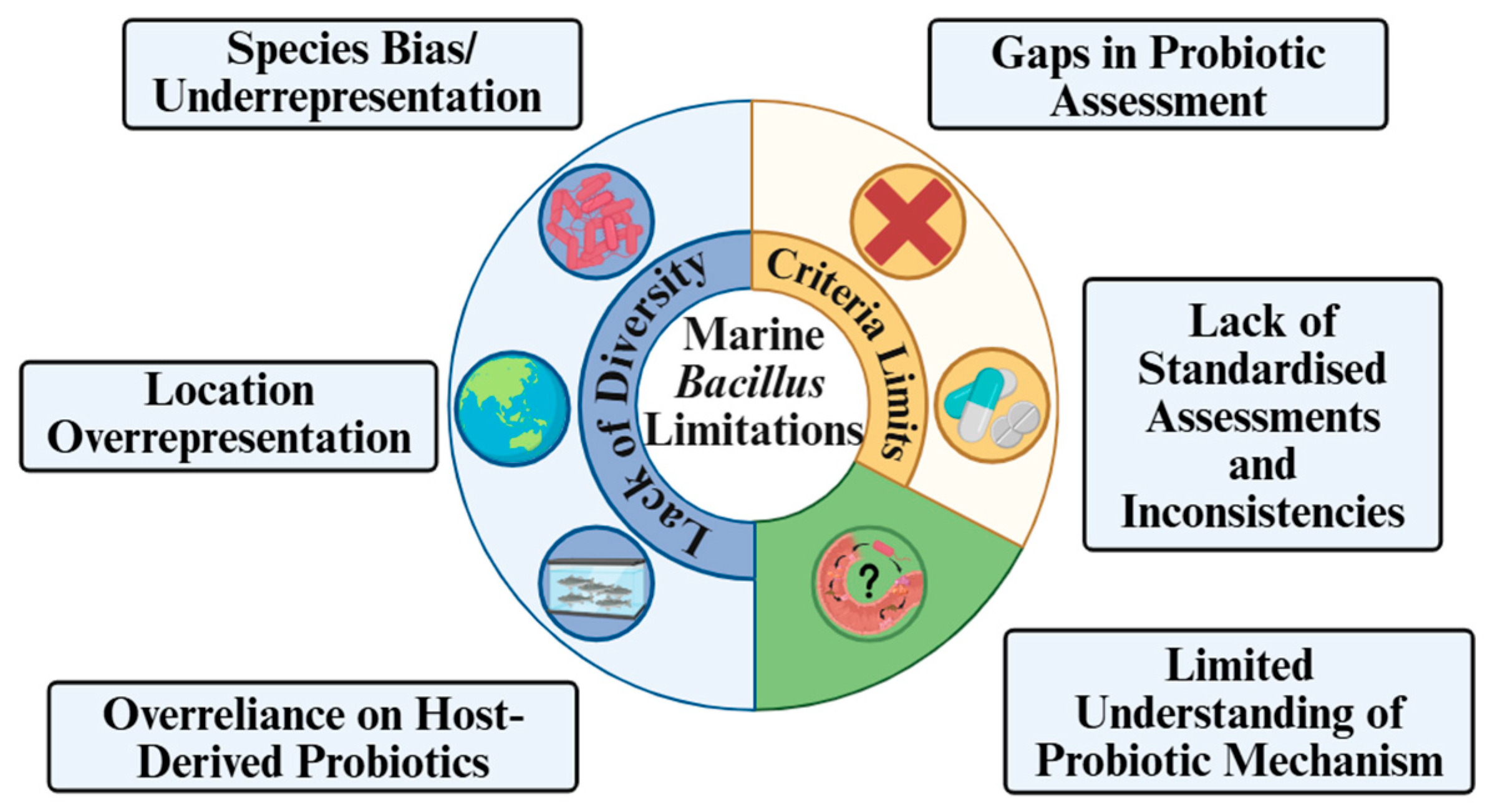
The current review concludes that marine-derived Bacillus spp. isolates are predominately members of the B. cereus species, originating from China or the Pacific Ocean and typically sourced from seawater or sediments. Probiotic Bacillus strains are generally B. subtilis, also largely originating from China, and are more likely isolated from non-ocean marine sources such as farmed fish or aquaculture systems. Between 2020 and 2025, 525 marine-derived Bacillus strains were identified, yet only 91 strains were identified as probiotics. Of these 91 putative probiotic strains, only nine fulfilled all essential and desirable criteria required for potential commercialisation, and just one has been commercialised. An additional 33 non-probiotic strains met at least one of the criteria, highlighting the potential of marine-derived Bacillus spp. as probiotic candidates. Despite this promise, several key limitations are identified, which largely constrain the progress in the field (Figure 2).

4.1. Lack of Diversity

4.1.1. Species Bias and Underrepresentation in Marine-Derived Bacillus Research

Of the 33 Bacillus species identified in the literature, less than half (45.5%, 15) have been investigated for their probiotic potential. Many of the unexamined species have very little research available, highlighting a clear knowledge gap, where these species may hold probiotic potential but have not been investigated beyond their original industry. Additionally, B. cereus is notably overrepresented in the current marine-derived Bacillus research, but only 0.06% (11) of isolates were identified as putative probiotics (Table 1). This is likely due to the potential pathogenicity associated with B. cereus, which limits its application in probiotic settings [9]. In contrast, B. subtilis was highly represented in probiotic research despite a moderate 27% success rate, largely due to the safety of B. subtilis [79]. However, other species show promising potential and may warrant greater attention. For instance, 50% of B. safensis and 40% of B. pumilus isolates were found to have probiotic characteristics. Further research into these species is recommended, as they may prove to be better probiotic candidates than B. subtilis. The need for further investigation is even more pronounced for less common species such as B. australimaris [80], B. infantis [16,81] and B. stratosphericus [1,82]. To date, only ten strains from these uncommon species have been investigated for their probiotic potential. Expanding the research base for these understudied species can help to identify species with superior probiotic capabilities and clarify the applications for which they are best suited.

4.1.2. Location Overrepresentation and the Need for Broader Oceanic Exploration

Currently, China leads research on marine-derived Bacillus species (54.7%) and marine-derived probiotic research (44.9%) (Table 2). Consequently, most reported marine-derived Bacillus spp. originated from the South China Sea (45.3%), meaning they are sourced from similar environments and habitats. While investigating microhabitat variation is valuable for understanding how environmental origins can impact biological activities, there is a clear need to expand exploration into other oceanic locations, including the Arctic, Atlantic and Southern Oceans. These oceans have different ecosystems, which may yield microbes better suited for different industries and probiotic applications. The Southern and Arctic Oceans are particularly cold, which may create uniquely tolerate species to cold environments. Even investigations into different regions within the Pacific Ocean could potentially produce interesting Bacillus species with unique potential. Australia is surrounded by ecologically diverse seas, including the Coral, Timor, and Tasman Seas. Within the Coral Sea is the Great Barrier Reef, the world’s largest coral ecosystem, and an almost completely unexplored territory of unique probionts. Explorations into these untapped regions could lead to the discovery of novel Bacillus strains with probiotic potential.

4.1.3. Overreliance on Host-Derived Strains in Probiotic Studies

While most of the marine-derived Bacillus strains originate from seawater, sediments and marine plants, these species are not being commonly utilised in probiotic research. Within probiotic research, more than half (57.2%) originated from farmed fish (34.1%) or the aquaculture environment (23.1%) (Table 2). This is connected to the overrepresentation of China, which contributes 44.0% (40) of the putative probiotic strains. It is common practice in aquaculture to use host-derived probiotics as they are convenient, effective and reduce costs associated with research. Gut-derived strains are ideal as they likely have an innate capacity to survive in the gut and reduce the risks associated with the introduction of microbes to the flock. However, this also means that species from more unconventional marine sources remain under-explored despite their potential value. Ocean-derived Bacillus represent a promising but largely untapped resource, as they often originate from extreme marine environments that confer unique physiological traits, including tolerance to varied temperatures, pH, and saline environments. Investigating these ocean-sourced Bacillus spp., both as food-supplemented and water additives, may yield uniquely tolerant bacteria.
Additionally, 97.8% of the putative probiotics were investigated in their efficacy in aquaculture, while only two studies investigated the effects of a marine-derived Bacillus species in goats [40] and pigs [83]. The focus on aquaculture is likely linked to their salinity tolerance, which makes them ideal candidates for this industry. However, limiting the species to aquaculture prevents the potential of the probiotics from being fully assessed. With the generally recognised safety of Bacillus species, further investigations into their application in agriculture across both livestock and plants could potentially yield valuable outcomes, as these environments also require hardy bacteria. Additionally, applications for humans are also a possibility once the essential probiotic criteria have been more stringently assessed and more evidence of safety within animals has been gathered.

4.2. Criteria Limitations

4.2.1. Gaps in Probiotic Assessment of Marine-Derived Bacillus

Only 22.1% of the literature-reported marine-derived Bacillus have been evaluated for at least one essential probiotic criterion and just 17.3% were identified as putative probiotics. Of the 91 putative probiotic strains, only nine (Figure 1a) met all the essential criteria, with eight of these strains demonstrating enzyme-producing capabilities (Figure 1b). Most studies focused on identifying pathogenicity (75%) or enzyme production (70.8%). To date, only one commercial probiotic has utilised a marine-derived Bacillus species: SYNSEA, a mixture of Lactobacillus and B. subtilis isolated from fish and commercialised by SYNBIO Tech Inc. (Kaohsiung City, Taiwan) [48]. The fact that only one product has reached commercialisation out of 525 identified marine-derived Bacillus strains highlights the substantial untapped potential of marine-derived Bacillus. Given that only ten strains meet all the criteria, significant gaps remain to ensure that each putative probiotic is assessed against all the essential criteria. This is crucial to advance promising microbes to commercialisation. Beyond probiotic-focused research, there were also strains outside of the probiotics field which met at least one probiotic criterion. Of these, four were non-pathogenic, one met the EFSA standard, and 25 were assessed for enzyme activities. These isolates may represent promising candidates and warrant further investigation for their probiotic potential.

4.2.2. Lack of Standardised Assessments and Inconsistencies

Despite the need for robustly defined criteria and standardised testing, the probiotic research field lacks clear standards for many criteria. Antimicrobial resistance was investigated in 57 studies, but only 13 strains met the EFSA standards. This indicates a significant gap in how antibiotic resistance is evaluated and accepted in potential probiotics. A key contributing factor is the absence of an international standard for determining whether to accept or reject a bacterial candidate based on its antibiotic resistance. Establishing such an international standard is challenging due to regional differences in antibiotic resistance. Currently, the most comprehensive standards are those provided by the EFSA and the CSLI standards. To ensure consistency in assessment, adopting the EFSA standards is an appropriate approach, as they are both comprehensive and freely available to researchers. Additionally, as genomic studies become more widely accessible, incorporating this process may assist in identifying ARGs prior to phenotypic testing. This approach could reduce the need for unnecessary antibiotics exposure and ensure that assessments more accurately reflect the genetic resistance potential of isolates.
Furthermore, methodologies and accepted standards related to bacterial survivability and colonisation vary significantly. When assessing hydrophobicity, the solvents used vary between studies and the cell lines used to examine adhesion are not consistent. For both pH, bile and adherence, there is a lack of defined standards, which creates a challenge when comparing studies. Due to variability in animal gut pH, researchers should clearly define their parameters for acceptance in their research. Regarding bile content, the current accepted tolerance is 0.3% bile salts and thus should be incorporated into research methods [15,52,59]. In terms of measuring probiotic colonisation capacity, auto-aggregation and hydrophobicity models are currently accepted and have been validated as appropriated methods [70]. However, better defining what constitutes a good result would ensure easier comparison between studies. When possible, observing adherence to Caco-2 cell lines with a comparative microbe may prove to be a better method as they simulate the GI tract more effectively [47,61]. Assessing the ability of a microbe to survive and colonise the GI tract is vital to determining whether it will be effective in vivo, so creating clear methods and standards is important to ensuring the quality of the probiotic product [59,60].

4.3. Limited Insights into Metabolite-Driven Probiotic Mechanisms

While probiotic research has extensively investigated the excretion of enzymes and their effects on the biological responses of host animals, limited research has been conducted on small-molecule metabolites excreted by these probiotics. Bacillus species are known to release metabolites with diverse bioactivities [1]. These metabolites may play a significant role in probiotic-associated health benefits. Although research has been conducted on host genomics and the microbiome, studies on host metabolomics remain limited. Metabolomics is important because, similarly to genomics, upregulations and downregulations of certain metabolites can provide insight into the mechanistic pathways through which probiotics exert their effects. Overall, a substantial gap remains in the chemical and mechanistic understanding of probiotic function. This gap could be filled through metabolite isolation and identification, paired with metabolomic research.

Supplementary Materials

The following supporting information can be downloaded at: https://www.mdpi.com/article/10.3390/ijms27104352/s1.

Author Contributions

Conceptualisation, N.B.B., Y.L. and Y.F.; methodology, N.B.B.; formal analysis, N.B.B.; investigation, N.B.B.; writing—original draft preparation, N.B.B.; writing—review and editing, N.B.B., Y.L., Y.F. and H.J.S.; visualisation, N.B.B.; supervision, Y.F., Y.L. and H.J.S. All authors have read and agreed to the published version of the manuscript.

Funding

This research received no external funding.

Data Availability Statement

No new data were created or analysed in this study.

Acknowledgments

We acknowledge that this research was conducted on the lands of Yugarabul, Yuggera, Jagera and Turrbal peoples. We pay our respects to Elders past and present and extend that respect to all Aboriginal and Torres Strait Islander Peoples. Sovereignty was never ceded: always was, always will be Aboriginal and Torres Strait Islander Lands.

Conflicts of Interest

The authors declare no conflicts of interest.

Abbreviations

The following abbreviations are used in this manuscript:
ACPAcid Phosphatase
AKPAlkaline Phosphatase
ARGAntimicrobial-Resistant Gene
CATCatalase
CFUColony Forming Units
EFSAEuropean Food Safety Authority
GIGastrointestinal
GRASGenerally Recognised as Safe
LZMLysozyme
SIJSimulated Intestinal Juices
SGJSimulated Gastric Juices
SODSuperoxide Dismutase
VFVirulence Factors
WGSWhole Genome Sequencing
WHOWorld Health Organisation

References

  1. Xiao, S.; Chen, N.; Chai, Z.; Zhou, M.; Xiao, C.; Zhao, S.; Yang, X. Secondary Metabolites from Marine-Derived Bacillus: A Comprehensive Review of Origins, Structures, and Bioactivities. Mar. Drugs 2022, 20, 567. [Google Scholar] [CrossRef] [Scilit]
  2. Nweze, J.A.; Mbaoji, F.N.; Huang, G.; Li, Y.; Yang, L.; Zhang, Y.; Huang, S.; Pan, L.; Yang, D. Antibiotics development and the potentials of marine-derived compounds to stem the tide of multidrug-resistant pathogenic bacteria, fungi, and protozoa. Mar. Drugs 2020, 18, 145. [Google Scholar] [CrossRef] [Scilit] [PubMed]
  3. Rani, A.; Saini, K.C.; Bast, F.; Varjani, S.; Mehariya, S.; Bhatia, S.K.; Sharma, N.; Funk, C. A review on microbial products and their perspective application as antimicrobial agents. Biomolecules 2021, 11, 1860. [Google Scholar] [CrossRef] [Scilit]
  4. Sultana, R.; Joseph, I. Marine protease-producing bacteria as potential probionts for advancing mariculture. Biocatal. Agric. Biotechnol. 2024, 61, 103392. [Google Scholar] [CrossRef] [Scilit]
  5. Hill, C.; Guarner, F.; Reid, G.; Gibson, G.R.; Merenstein, D.J.; Pot, B.; Morelli, L.; Canani, R.B.; Flint, H.J.; Salminen, S.; et al. Expert consensus document: The International Scientific Association for Probiotics and Prebiotics consensus statement on the scope and appropriate use of the term probiotic. Nat. Rev. Gastroenterol. Hepatol. 2014, 11, 506–514. [Google Scholar] [CrossRef] [Scilit]
  6. Bajagai, Y.S.; Klieve, A.V.; Dart, P.J.; Bryden, W.L. Probiotics in animal nutrition—Production, impact and regulation. In Animal Production and Health Paper; Food and Agricutlural Organisation of the United Nations: Rome, Italy, 2016. [Google Scholar]
  7. WHO Global Antimicrobial Resistance and Use Surveillance System (GLASS). Global Antibiotic Resistance Surveillance Report 2025; World Health Organization: Geneva, Switzerland, 2025; Available online: https://www.who.int/publications/i/item/9789240116337 (accessed on 23 January 2026).
  8. Ghosh, T. Recent advances in the probiotic application of the Bacillus as a potential candidate in the sustainable development of aquaculture. Aquaculture 2025, 594, 741432. [Google Scholar] [CrossRef] [Scilit]
  9. Zhao, X.; Li, R.; Dang, H.; Wang, L.; Fu, S.; Ding, J. Comparison of whole genome sequences of three Bacillus cereus strains reveals the food safety risks of Apostichopus japonicus in China. Aquac. Rep. 2021, 20, 100649. [Google Scholar] [CrossRef] [Scilit]
  10. Zhao, N.; Yu, T.; Yan, F. Probiotic role and application of thermophilic Bacillus as novel food materials. Trends Food Sci. Technol. 2023, 138, 1–15. [Google Scholar] [CrossRef] [Scilit]
  11. Gabadage, T.; Wijesekara, S.; Galkanda-Arachchige, H.S.C. Effectiveness of Bacillus as a probiotic to improve the growth, survival, and feed conversion ratio in aquaculture: A meta-analysis. J. Appl. Aquac. 2023, 36, 457–477. [Google Scholar] [CrossRef] [Scilit]
  12. Cao, J.; Yu, Z.; Liu, W.; Zhao, J.; Zhang, H.; Zhai, Q.; Chen, W. Probiotic characteristics of Bacillus coagulans and associated implications for human health and diseases. J. Funct. Foods 2020, 64, 103643. [Google Scholar] [CrossRef] [Scilit]
  13. Nicolas, G.M. Secondary Metabolites from Bacillus spp. probiotics as potential treatments for multidrug-resistant pathogens: A comprehensive review. Curr. Res. Microb. Sci. 2025, 8, 100392. [Google Scholar] [CrossRef] [Scilit]
  14. Dai, H.; Ma, L.; Xu, Z.; Soteyome, T.; Yuan, L.; Yang, Z.; Jiao, X.-A. Invited review: Role of Bacillus licheniformis in the dairy industry—Friends or foes? J. Dairy Sci. 2024, 107, 7520–7532. [Google Scholar] [CrossRef] [Scilit]
  15. Ramlucken, U.; Lalloo, R.; Roets, Y.; Moonsamy, G.; van Rensburg, C.J.; Thantsha, M.S. Advantages of Bacillus-based probiotics in poultry production. Livest. Sci. 2020, 241, 104215. [Google Scholar] [CrossRef] [Scilit]
  16. Arslan, N.P.; Azad, F.; Orak, T.; Budak-Savas, A.; Ortucu, S.; Dawar, P.; Baltaci, M.O.; Ozkan, H.; Esim, N.; Taskin, M. A review on bacteria-derived antioxidant metabolites: Their production, purification, characterization, potential applications, and limitations. Arch. Pharmacal Res. 2025, 48, 253–292. [Google Scholar] [CrossRef] [Scilit]
  17. Kuebutornye, F.K.A.; Abarike, E.D.; Lu, Y. A review on the application of Bacillus as probiotics in aquaculture. Fish Shellfish Immunol. 2019, 87, 820–828. [Google Scholar] [CrossRef] [Scilit]
  18. Hlordzi, V.; Kuebutornye, F.K.; Afriyie, G.; Abarike, E.D.; Lu, Y.; Chi, S.; Anokyewaa, M.A. The use of Bacillus species in maintenance of water quality in aquaculture: A review. Aquac. Rep. 2020, 18, 100503. [Google Scholar] [CrossRef] [Scilit]
  19. Ren, W.; Li, P.; Wang, X.; Che, Y.; Long, H.; Zhang, X.; Cai, X.; Huang, A.; Zeng, Y.; Xie, Z. Cross-habitat distribution pattern of Bacillus communities and their capacities of producing industrial hydrolytic enzymes in Paracel Islands: Habitat-dependent differential contributions of the environment. J. Environ. Manag. 2022, 323, 116252. [Google Scholar] [CrossRef] [Scilit]
  20. Liao, X.; Dong, W.; Chen, X.; Zheng, X.; Chen, Z.; Huang, R.; Wei, J.; Zhang, X. Biodiversity and antifouling activity of microbes associated with gorgonian corals Leptogorgia rigida and Menella kanisa from the South China Sea. Mar. Environ. Res. 2024, 202, 106783. [Google Scholar] [CrossRef] [Scilit] [PubMed]
  21. Anitha, A.; Kumar, V.J.R.; Anjana, J.C.; Prabhakaran, M.P.; Preena, P.G. Exploring the microbial diversity of zoanthids: A gateway to novel marine natural products and biotechnological breakthroughs. Biologia 2024, 80, 369–388. [Google Scholar] [CrossRef] [Scilit]
  22. Gao, C.; Chen, X.; Yu, L.; Jiang, L.; Pan, D.; Jiang, S.; Gan, Y.; Liu, Y.; Yi, X. New 24-Membered Macrolactins Isolated from Marine Bacteria Bacillus siamensis as Potent Fungal Inhibitors against Sugarcane Smut. J. Agric. Food Chem. 2021, 69, 4392–4401. [Google Scholar] [CrossRef] [Scilit]
  23. Kim, H.Y.; Do, H.-Y.; Park, S.; Kim, K.W.; Min, D.; Lee, E.-Y.; Shim, D.; Cho, S.Y.; Park, J.O.; Lee, C.S.; et al. 2,4,6-Triphenyl-1-hexene, an Anti-Melanogenic Compound from Marine-Derived Bacillus sp. APmarine135. Mar. Drugs 2024, 22, 72. [Google Scholar] [CrossRef] [Scilit]
  24. Bhagwat, P.V.; Ravindran, C.; Irudayarajan, L. Beneficial properties of mucus in coral adaptations and ecological interactions. Mar. Biol. 2024, 171, 46. [Google Scholar] [CrossRef] [Scilit]
  25. Xie, G.; Zhu, Y.; Zhong, Z.; Du, Q.; Wu, Y.; Xing, K.; Zhang, M.; Shu, H. Functional genomic characterization unveils probiotic features of Bacillus cereus G1-11 isolated from the gut of the hybrid grouper (Epinephelus fuscoguttatus♀ × E. lanceolatus♂). LWT 2023, 184, 115088. [Google Scholar] [CrossRef] [Scilit]
  26. Jin, Y.; Chen, C.; Ai, C.; Song, W.; Zhao, J. Development of probiotic complex based on the synthetic microbial community and probiotic effects in farming Yunlong grouper. Aquaculture 2024, 586, 740708. [Google Scholar] [CrossRef] [Scilit]
  27. Xie, G.; Chen, X.; Feng, Y.; Yu, Z.; Lu, Q.; Li, M.; Ye, Z.; Lin, H.; Yu, W.; Shu, H. Effects of Dietary Multi-Strain Probiotics on Growth Performance, Antioxidant Status, Immune Response, and Intestinal Microbiota of Hybrid Groupers (Epinephelus fuscoguttatus× E. lanceolatus ♂). Microorganisms 2024, 12, 1358. [Google Scholar] [CrossRef] [Scilit]
  28. Amoah, K.; Cai, J.; Huang, Y.; Wang, B.; Shija, V.M.; Wang, Z.; Jin, X.; Cai, S.; Lu, Y.; Jian, J. Identification and characterization of four Bacillus species from the intestine of hybrid grouper (Epinephelus fuscoguttatus♀ × E. lanceolatus♂), their antagonistic role on common pathogenic bacteria, and effects on intestinal health. Fish Shellfish Immunol. 2024, 152, 109795. [Google Scholar] [CrossRef] [Scilit] [PubMed]
  29. Zhang, B.-Y.; Nie, Q.-J.; Xu, J.-M.; Cai, G.-H.; Ye, J.-D.; Jin, T.; Yang, H.-L.; Sun, Y.-Z. Preventive and reparative potentials of heat-inactivated and viable commensal Bacillus pumilus SE5 in ameliorating the adverse impacts of high soybean meal in grouper (Epinephelus coioides). Fish Shellfish Immunol. 2024, 153, 109846. [Google Scholar] [CrossRef] [Scilit]
  30. Santos, R.A.; Mariz-Ponte, N.; Martins, N.; Magalhães, R.; Jerusik, R.; Saavedra, M.J.; Peres, H.; Oliva-Teles, A.; Serra, C.R. In vitro modulation of gilthead seabream (Sparus aurata L.) leukocytes by Bacillus spp. extracellular molecules upon bacterial challenge. Fish Shellfish Immunol. 2022, 121, 285–294. [Google Scholar] [CrossRef] [Scilit]
  31. Docando, F.; Nuñez-Ortiz, N.; Serra, C.; Arense, P.; Enes, P.; Oliva-Teles, A.; Díaz-Rosales, P.; Tafalla, C. Mucosal and systemic immune effects of Bacillus subtilis in rainbow trout (Oncorhynchus mykiss). Fish Shellfish Immunol. 2022, 124, 142–155. [Google Scholar] [CrossRef] [Scilit]
  32. Rangel, F.; Monteiro, M.; Santos, R.; Ferreira-Martins, D.; Cortinhas, R.; Gasco, L.; Gai, F.; Pousão-Ferreira, P.; Couto, A.; Oliva-Teles, A.; et al. Novel chitinolytic Bacillus spp. increase feed efficiency, feed digestibility, and survivability to Vibrio anguillarum in European seabass fed with diets containing Hermetia illucens larvae meal. Aquaculture 2024, 579, 740258. [Google Scholar] [CrossRef] [Scilit]
  33. Ghanei-Motlagh, R.; Gharibi, D.; Mohammadian, T.; Khosravi, M.; Mahmoudi, E.; Zarea, M.; Menanteau-Ledouble, S.; El-Matbouli, M. Feed supplementation with quorum quenching probiotics with anti-virulence potential improved innate immune responses, antioxidant capacity and disease resistance in Asian seabass (Lates calcarifer). Aquaculture 2021, 535, 736345. [Google Scholar] [CrossRef] [Scilit]
  34. Jafarzadeh, F.; Roomiani, L.; Dezfoulnejad, M.C.; Baboli, M.J.; Sary, A.A. Harnessing paraprobiotics and postbiotics for enhanced immune function in Asian seabass (Lates calcarifer): Insights into pattern recognition receptor signaling. Fish Shellfish Immunol. 2024, 151, 109725. [Google Scholar] [CrossRef] [Scilit] [PubMed]
  35. Lv, C.; Kong, Q.; Yu, Z.; Feng, W.; Zhao, K.; Sun, Z. Medium optimization of three marine probiotics and their application in the culture of Sebastes schlegelii. Microb. Pathog. 2025, 204, 107599. [Google Scholar] [CrossRef] [Scilit]
  36. Dang, Y.; Sun, Y.; Zhou, Y.; Men, X.; Wang, B.; Li, B.; Ren, Y. Effects of probiotics on growth, the toll-like receptor mediated immune response and susceptibility to Aeromonas salmonicida infection in rainbow trout Oncorhynchus mykiss. Aquaculture 2022, 561, 738668. [Google Scholar] [CrossRef] [Scilit]
  37. Yu, G.; Zhao, S.; Ou, W.; Ai, Q.; Zhang, W.; Mai, K.; Zhang, Y. Host-associated Bacillus velezensis T20 improved disease resistance and intestinal health of juvenile turbot (Scophthalmus maximus). Aquac. Rep. 2024, 35, 101927. [Google Scholar] [CrossRef] [Scilit]
  38. D’ROse, V.; Bhat, S.G. Whole genome sequence analysis enabled affirmation of the probiotic potential of marine sporulater Bacillus amyloliquefaciens BTSS3 isolated from Centroscyllium fabricii. Gene 2023, 864, 147305. [Google Scholar] [CrossRef] [Scilit]
  39. Zhang, W.; Wei, L.; Xu, R.; Lin, G.; Xin, H.; Lv, Z.; Qian, H.; Shi, H. Evaluation of the Antibacterial Material Production in the Fermentation of Bacillus amyloliquefaciens-9 from Whitespotted Bamboo Shark (Chiloscyllium plagiosum). Mar. Drugs 2020, 18, 119. [Google Scholar] [CrossRef] [Scilit]
  40. Li, Y.; Jiang, N.; Zhang, W.; Lv, Z.; Liu, J.; Shi, H. Bacillus amyloliquefaciens-9 reduces somatic cell count and modifies fecal microbiota in lactating goats. Mar. Drugs 2021, 19, 404. [Google Scholar] [CrossRef] [Scilit]
  41. Liu, B.; Zhou, W.; Wang, H.; Li, C.; Wang, L.; Li, Y.; Wang, J. Bacillus baekryungensis MS1 regulates the growth, non-specific immune parameters and gut microbiota of the sea cucumber Apostichopus japonicus. Fish Shellfish Immunol. 2020, 102, 133–139. [Google Scholar] [CrossRef] [Scilit]
  42. Feng, Z.; Song, X.; Zhao, L.; Zhu, W. Isolation of probiotics and their effects on growth, antioxidant and non-specific immunity of sea cucumber Apostichopus japonicus. Fish Shellfish Immunol. 2020, 106, 1087–1094. [Google Scholar] [CrossRef] [Scilit] [PubMed]
  43. Ge, X.; Pan, J.; Mo, K.; Chen, H.; Sun, J.; Huang, H.; Zhang, Y.; Mai, K.; Gu, H.; Hu, Y. The versatility of Bacillus tequilensis Bt-CO as an additive: Antagonizing pathogens, enhancing immunity, promoting intestinal health, and optimizing gut microbiota of tilapia. Anim. Nutr. 2025, 23, 502–515. [Google Scholar] [CrossRef] [Scilit]
  44. Li, F.; Xie, Y.; Guo, M.; Liu, Y.; Tong, T.; Zhang, Q.; Kong, W. Effects of dietary Bacillus cereus supplementation on the growth performance, serum physiology and biochemistry, Nrf2, TLR/NF-κB signaling pathways, and intestinal health of juvenile coho salmon (Oncorhynchus kisutch). Aquac. Rep. 2024, 36, 102177. [Google Scholar] [CrossRef] [Scilit]
  45. Guo, M.; Meng, L.; Li, F.; Liu, Y.; Zhang, Z.; Zhang, Q.; Kong, W. Effects of dietary Bacillus pumilus on the growth, intestinal health, lipid metabolism, and mTOR signaling pathway of juvenile coho salmon (Oncorhynchus kisutch). Water Biol. Secur. 2025, 4, 100313. [Google Scholar] [CrossRef] [Scilit]
  46. Saravanan, K.; Sivaramakrishnan, T.; Praveenraj, J.; Kiruba-Sankar, R.; Haridas, H.; Kumar, S.; Varghese, B. Effects of single and multi-strain probiotics on the growth, hemato-immunological, enzymatic activity, gut morphology and disease resistance in Rohu, Labeo rohita. Aquaculture 2021, 540, 736749, Correction in Aquaculture 2021, 543, 737039. [Google Scholar] [CrossRef] [Scilit]
  47. Vasiljevic, T.; Shah, N.P. Probiotics—From Metchnikoff to bioactives. Int. Dairy J. 2008, 18, 714–728. [Google Scholar] [CrossRef] [Scilit]
  48. Lee, J.-W.; Chiu, S.-T.; Wang, S.-T.; Liao, Y.-C.; Chang, H.-T.; Ballantyne, R.; Lin, J.-S.; Liu, C.-H. Dietary SYNSEA probiotic improves the growth of white shrimp, Litopenaeus vannamei and reduces the risk of Vibrio infection via improving immunity and intestinal microbiota of shrimp. Fish Shellfish Immunol. 2022, 127, 482–491. [Google Scholar] [CrossRef] [Scilit] [PubMed]
  49. Saidumohamed, B.E.; Bhat, S.G. Indian oil sardine (Sardinella longiceps) gut derived Bacillus safensis SDG14 with enhanced probiotic competence for food and feed applications. Food Res. Int. 2021, 150, 110475. [Google Scholar] [CrossRef] [Scilit]
  50. EFSA Panel on Additives and Products or Substances used in Animal Feed (FEEDAP); Rychen, G.; Aquilina, G.; Azimonti, G.; Bampidis, V.; de Lourdes Bastos, M.; Bories, G.; Chesson, A.; Cocconcelli, P.S.; Flachowsky, G.; et al. Guidance on the characterisation of microorganisms used as feed additives or as production organisms. EFSA J. 2018, 16, e05206. [Google Scholar] [CrossRef] [Scilit]
  51. Zhu, X.-K.; Hu, R.-G.; Cong, W.; Kang, Y.-H.; Wang, L.-Y.; Yang, T.; Li, S. Isolation and characterization of a marine strain: Bacillus inaquosorum, and its feeding effects on Sebastes schlegelii as feed additive. Aquaculture 2025, 606, 742556. [Google Scholar] [CrossRef] [Scilit]
  52. Tuomola, E.; Crittenden, R.; Playne, M.; Isolauri, E.; Salminen, S. Quality assurance criteria for probiotic bacteria. Am. J. Clin. Nutr. 2001, 73, 393s–398s. [Google Scholar] [CrossRef] [Scilit] [PubMed]
  53. Qin, G.; Wang, D.; Luo, K.; Liu, Y.; Xie, Y.; Wang, M.; Li, C.; Fan, R.; Tian, X. Evaluation of probiotic properties and safety of a Bacillus strain for shrimp farming: Integrating in vitro testing, genomic analysis and in vivo validation. Microbiol. Res. 2025, 297, 128179. [Google Scholar] [CrossRef] [Scilit] [PubMed]
  54. Jang, W.J.; Lee, K.-B.; Jeon, M.-H.; Lee, S.-J.; Hur, S.W.; Lee, S.; Lee, B.-J.; Lee, J.M.; Kim, K.-W.; Lee, E.-W. Characteristics and biological control functions of Bacillus sp. PM8313 as a host-associated probiotic in red sea bream (Pagrus major) aquaculture. Anim. Nutr. 2023, 12, 20–31. [Google Scholar] [CrossRef] [Scilit] [PubMed]
  55. Jiao, L.; Feng, X.; Jin, S.; Xie, J.; Guo, X.; Ma, R. Transcriptome analysis of Cryptocaryon irritans tomont responding to Bacillus licheniformis treatment. Fish Shellfish Immunol. 2023, 140, 108943. [Google Scholar] [CrossRef] [Scilit]
  56. Kashif, M.; Sang, Y.; Mo, S.; Rehman, S.U.; Khan, S.; Khan, M.R.; He, S.; Jiang, C. Deciphering the biodesulfurization pathway employing marine mangrove Bacillus aryabhattai strain NM1-A2 according to whole genome sequencing and transcriptome analyses. Genomics 2023, 115, 110635. [Google Scholar] [CrossRef] [Scilit]
  57. Sun, H.; Wei, R.; Yin, K.; Meng, D.; Wu, S.; Bai, H.; Li, Z.; Kashif, M.; Liang, Z.; Chen, S.; et al. Discovery and interaction of four key biosynthetic enzymes under co-regulation for dopamine biosynthesis with marine Meyerozyma guilliermondii GXDK6 and Bacillus aryabhattai NM1-A2. Int. J. Biol. Macromol. 2025, 309, 142821. [Google Scholar] [CrossRef] [Scilit]
  58. Amenyogbe, E.; Huang, J.-s.; Chen, G.; Wang, W.-z. Probiotic Potential of Indigenous (Bacillus sp. RCS1, Pantoea agglomerans RCS2, and Bacillus cereus strain RCS3) Isolated From Cobia Fish (Rachycentron canadum) and Their Antagonistic Effects on the Growth of Pathogenic Vibrio alginolyticus, Vibrio harveyi, Streptococcus iniae, and Streptococcus agalactiae. Front. Mar. Sci. 2021, 8, 672213. [Google Scholar] [CrossRef] [Scilit]
  59. Wendel, U. Assessing Viability and Stress Tolerance of Probiotics—A Review. Front. Microbiol. 2021, 12, 818468. [Google Scholar] [CrossRef] [Scilit]
  60. Bussarin, K.; Kumar, R.S. Microbial and Processing Criteria for Production of Probiotics: A Review. Food Technol. Biotechnol. 2006, 44, 9. [Google Scholar]
  61. Blum, S.; Reniero, R.; Schiffrin, E.; Crittenden, R.; Mattila-Sandholm, T.; Ouwehand, A.; Salminen, S.; von Wright, A.; Saarela, M.; Saxelin, M.; et al. Adhesion studies for probiotics: Need for validation and refinement. Trends Food Sci. Technol. 1999, 10, 405–410. [Google Scholar] [CrossRef] [Scilit]
  62. Liu, S.; Wang, S.; Cai, Y.; Li, E.; Ren, Z.; Wu, Y.; Guo, W.; Sun, Y.; Zhou, Y. Beneficial effects of a host gut-derived probiotic, Bacillus pumilus, on the growth, non-specific immune response and disease resistance of juvenile golden pompano, Trachinotus ovatus. Aquaculture 2020, 514, 734446. [Google Scholar] [CrossRef] [Scilit]
  63. Huynh-Phuoc, V.; Ly, T.Q.; Purbiantoro, W.; Ngo, H.V.T.; Afonso, F.; Vu, N.U.; Cheng, T.-C. Bacillus safensis isolated from white-leg shrimp, Penaeus vannamei in Taiwan with antagonistic activity against common Vibrio pathogens. Biocatal. Agric. Biotechnol. 2022, 44, 102477. [Google Scholar] [CrossRef] [Scilit]
  64. Rahman, M.M.; Paul, S.I.; Rahman, A.; Haque, S.; Ador, A.A.; Foysal, J.; Islam, T.; Rahman, M. Suppression of Streptococcosis and Modulation of the Gut Bacteriome in Nile Tilapia (Oreochromis niloticus) by the Marine Sediment Bacteria Bacillus haynesii and Advenella mimigardefordensis. Microbiol. Spectr. 2022, 10, e02542-22. [Google Scholar] [CrossRef] [Scilit]
  65. Amenyogbe, E.; Zhang, J.-d.; Huang, J.-s.; Chen, G. The efficiency of indigenous isolates Bacillus sp. RCS1 and Bacillus cereus RCS3 on growth performance, blood biochemical indices and resistance against Vibrio harveyi in cobia fish (Rachycentron canadum) juveniles. Aquac. Rep. 2022, 25, 101241. [Google Scholar] [CrossRef] [Scilit]
  66. Monzon-Atienza, L.; Bravo, J.; Torrecillas, S.; Montero, D.; Canales, A.F.G.-D.; de la Banda, I.G.; Galindo-Villegas, J.; Ramos-Vivas, J.; Acosta, F. Isolation and Characterization of a Bacillus velezensis D-18 Strain, as a Potential Probiotic in European Seabass Aquaculture. Probiotics Antimicrob. Proteins 2021, 13, 1404–1412. [Google Scholar] [CrossRef] [Scilit]
  67. Jang, W.J.; Lee, S.-J.; Jeon, M.-H.; Kim, T.-Y.; Lee, J.M.; Hasan, T.; Lee, H.-T.; Park, J.-H.; Lee, B.-J.; Hur, S.W.; et al. Characterization of a Bacillus sp. KRF-7 isolated from the intestine of rockfish and effects of dietary supplementation with mannan oligosaccharide in rockfish aquaculture. Fish Shellfish Immunol. 2021, 119, 182–192. [Google Scholar] [CrossRef] [Scilit]
  68. Fenster, K.; Freeburg, B.; Hollard, C.; Wong, C.; Laursen, R.R.; Ouwehand, A.C. The Production and Delivery of Probiotics: A Review of a Practical Approach. Microorganisms 2019, 7, 83. [Google Scholar] [CrossRef] [Scilit] [PubMed]
  69. Darmastuti, A.; Hasan, P.N.; Wikandari, R.; Utami, T.; Rahayu, E.S.; Suroto, D.A. Adhesion Properties of Lactobacillus plantarum Dad-13 and Lactobacillus plantarum Mut-7 on Sprague Dawley Rat Intestine. Microorganisms 2021, 9, 2336. [Google Scholar] [CrossRef] [Scilit] [PubMed]
  70. Del Re, B.; Sgorbati, B.; Miglioli, M.; Palenzona, D. Adhesion, autoaggregation and hydrophobicity of 13 strains of Bifidobacterium longum. Lett. Appl. Microbiol. 2000, 31, 438–442. [Google Scholar] [CrossRef] [Scilit]
  71. Escamilla-Montes, R.; Luna-González, A.; Flores-Miranda, M.d.C.; Álvarez-Ruiz, P.; Fierro-Coronado, J.A.; Sánchez-Ortiz, A.C.; Ávila-Leal, J. Isolation and Characterization of Potential Probiotic Bacteria Suitable for Mollusk Larvae Cultures. Thai J. Veter-Med. 2015, 45, 11–21. [Google Scholar] [CrossRef] [Scilit]
  72. Duary, R.K.; Rajput, Y.S.; Batish, V.K.; Grover, S. Assessing the adhesion of putative indigenous probiotic lactobacilli to human colonic epithelial cells. Indian J. Med. Res. 2011, 134, 664–671. [Google Scholar] [CrossRef] [Scilit]
  73. E.S., B.; Bhat, S.G. Bacteriocins BaCf3 and BpSl14 with Anticancer and Antibiofilm Potential from Probiotic Bacillus amyloliquefaciens BTSS3 and Bacillus pumilus SDG14 Isolated from Gut of Marine Fishes: Enhanced Production, Purification and Characterization; Cochin University of Science and Technology: Cochin, Kerala, India, 2017. [Google Scholar]
  74. Song, M.; Zhang, S.; Zhang, Z.; Guo, L.; Liang, W.; Li, C.; Wang, Z. Bacillus coagulans restores pathogen-induced intestinal dysfunction via acetate–FFAR2–NF-κB–MLCK–MLC axis in Apostichopus japonicus. mSystems 2024, 9, e0060224. [Google Scholar] [CrossRef] [Scilit] [PubMed]
  75. Ye, Y.; Yu, D.; Liu, Q.; Ma, S.; Zhang, M.; Zhao, M.; Xu, J.; Yu, J. Nutritional composition of fresh carcass of turbot fed with Bacillus subtilis SMF1, B. licheniformis LMF1 and B. siamensis DL3 and its relationship with intestinal flora. Anim. Feed. Sci. Technol. 2023, 300, 115627. [Google Scholar] [CrossRef] [Scilit]
  76. Zhang, Z.-L.; Li, J.-J.; Xing, S.-W.; Lu, Y.-P.; Zheng, P.-H.; Li, J.-T.; Hao, C.-G.; Xu, J.-R.; Xian, J.-A.; Zhang, L.-M.; et al. A newly isolated strain of Bacillus subtilis W2Z exhibited probiotic effects on juvenile red claw crayfish, Cherax quadricarinatus. Aquaculture 2024, 585, 740700. [Google Scholar] [CrossRef] [Scilit]
  77. Monzón-Atienza, L.; Bravo, J.; Fernández-Montero, Á.; Charlie-Silva, I.; Montero, D.; Ramos-Vivas, J.; Galindo-Villegas, J.; Acosta, F. Dietary supplementation of Bacillus velezensis improves Vibrio anguillarum clearance in European sea bass by activating essential innate immune mechanisms. Fish Shellfish Immunol. 2022, 124, 244–253, Correction in Fish Shellfish Immunol. 2022, 125, 292. [Google Scholar] [CrossRef] [Scilit]
  78. Shao, Y.; Wang, C.; Lu, T.; Jiang, J.; Li, C.; Wang, X. Dietary Bacillus cereus LS2 protects juvenile sea cucumber Apostichopus japonicus against Vibrio splendidus infection. Fish Shellfish Immunol. 2023, 143, 109237. [Google Scholar] [CrossRef] [Scilit]
  79. Galano, M.; van den Dungen, M.W.; van Rij, T.; Abbas, H.E. Safety evaluation of food enzymes produced by a safe strain lineage of Bacillus subtilis. Regul. Toxicol. Pharmacol. 2021, 126, 105030. [Google Scholar] [CrossRef] [Scilit] [PubMed]
  80. Padayao, F.R.P.A.; Acosta, O.B.L.; Ramos, R.I.; Sanchez, R.M.T.S.; Padayao, M.H.R.A.; Yee, J.C.; Arakawa, K.; Quilantang, N.G. Bioactivity screening and chemical profiling of Halymenia durvillei fermented by indigenous seaweed-associated Bacillus species. Microbe 2025, 8, 100491. [Google Scholar] [CrossRef] [Scilit]
  81. Prashar, C.; Devkar, H.; Vandana, V.; Kona, M.P.; Singh, O.P.; Das, R.; Vashisht, K.; Thakur, N.; Pandey, K.C. Potent targeted larvicidal activities of marine-derived Bacillus sp. bacterial extracts on mosquito vectors. Sci. Rep. 2025, 15, 8094. [Google Scholar] [CrossRef] [Scilit]
  82. Wang, W.; Park, K.-H.; Lee, J.; Oh, E.; Park, C.; Kang, E.; Lee, J.; Kang, H. A new thiopeptide antibiotic, micrococcin P3, from a marine-derived strain of the bacterium Bacillus stratosphericus. Molecules 2020, 25, 4383. [Google Scholar] [CrossRef] [Scilit]
  83. Prieto, M.L.; O’SUllivan, L.; Tan, S.P.; McLoughlin, P.; Hughes, H.; O’DOnovan, O.; Rea, M.C.; Kent, R.M.; Cassidy, J.P.; Gardiner, G.E.; et al. Evaluation of the efficacy and safety of a marine-derived Bacillus strain for use as an in-feed probiotic for newly weaned pigs. PLoS ONE 2014, 9, e88599. [Google Scholar] [CrossRef] [Scilit]
Figure 1. Marine-derived Bacillus assessment criteria: (a) Venn diagram of the literature-reported marine-derived Bacillus strains assessed against essential probiotic criteria, categorised by “Non-pathogenicity”, “Antimicrobial susceptibility”, and “Gut Criteria” (survivability and colonisation); strains failing all assessments are denoted as “None”. (b) Venn diagram of marine-derived Bacillus strains evaluated for “Enzyme Production”, “Essential Criteria” and “Probiotic Potential”.
Ijms 27 04352 g001
Figure 2. Overview of key limitations in current marine-derived Bacillus probiotic research, highlighting constraints related to “Lack of Diversity” (blue), “Criteria Limits” (yellow), and “Limited Understanding of Probiotic Mechanisms” (green).
Ijms 27 04352 g002
Table 1. Count of marine-derived Bacillus strains reported within the literature between 2020 and 2025 and their applications.
Bacillus StrainNo. of Strains Used in Other ApplicationsNo. of Strains Used as Probiotics
B. altitudinus112
B. amyloliquefaciens163
B. cereus18611
B. firmus82
B. licheniformis1512
B. pumilus128
B. safensis105
B. subtilis7324
B. velezensis198
Other Bacillus spp.5010
Unidentified Bacillus sp.346
Table 2. Geographic and oceanographic origins of marine-derived Bacillus strains.
GeographicOceanographic
ContinentNo. of Strains ReportedNo. of Probiotic StrainsOceanNo. of Strains ReportedNo. of Probiotic Strains
Africa80Arctic20
Antarctica10Atlantic270
Asia46279Indian11220
China28740Bay of Bengal2911
India8621Laccadive Sea200
Europe207Pacific28818
North America115South China Sea2387
South America110Southern10
Oceania10Unspecified10
Table 3. Source of marine-derived Bacillus strains.
SourceNo. of Strains ReportedNo. of Probiotic Strains SourceNo. of Strains ReportedNo. of Probiotic Strains
Algae382Mollusks53
Aquaculture2221Plants 455
Collection55Seawater 1260
Coral591Sediments1200
Crustacean117Sponges362
Fish3731Unknown30
Invertebrates169
Table 4. List of the 9 marine-derived Bacillus strains which met all essential criteria as probiotics.
Bacillus StrainsNon-PathogenicAntimicrobial SusceptibilityGut CriteriaEnzyme Production
B. safensis SDG14-
Bacillus sp. RCS1
Bacillus sp. PM8313
B. velezensis PGSAK01
B. stercoris PGSAK05
B. velezensis PGSAK17
B. subtilis PGSAK19
B. subtilis BSXE-2102
SYNSEATM
✓: Criteria Met, -: Not Tested.
Table 5. Breakdown of marine-derived Bacillus strains against different probiotic criteria.
Probiotic CriteriaNo. of Strains Used in Other ApplicationsNo. of Strains Used as Probiotics
Non-pathogenic Bacillus476
Antimicrobial Susceptible Bacillus 112
Gut Criteria019
Enzyme Production2556
Total43391
Table 6. Marine-derived Bacillus species assessed for pathogenicity.
Bacillus StrainsNon-Pathogenic Species
Reported as Probiotics
Non-Pathogenic Species Reported in Other ApplicationsPathogenic Species
B. aerius001
B. altitudinus100
B. amyloliquefaciens300
B. baekryungensis100
B. cereus704
B. haynesii100
B. firmus200
B. licheniformis1000
B. pumilus600
B. safensis500
B. siamensis300
B. subtilis2120
B. tequilensis100
B. thuringiensis100
B. velezensis820
Unidentified Bacillus sp. 600
Table 7. Marine-derived Bacillus tested for gut-related criteria.
CriteriaMet CriterionFurther Testing RequiredFailedTotal Tested
Gut Survival21112355
Gut Colonisation172019
Table 8. Distribution of species that produce digestive and antioxidant enzymes.
Bacillus StrainsCarbohydrasesLipasesProteasesCellullaseSODCATOther
B. altitudinus0001---
B. amyloliquefaciens7175-1-
B. baekryungensis----111
B. cereus8564432
B. halotolerans4123---
B. licheniformis3533330
B. pumilus4120111
B. safensis1120101
B. siamensis0110100
B. subtilis187179852
B. tequilensis1110111
B. thuringiensis1110111
B. velezensis5220421
Unidentified Bacillus sp. 1222413
Table 9. Distribution of immune-related enzyme-producing capabilities by species.
Bacillus SpeciesLZMACPAKPTransferaseII
B. baekryungensis01101
B. cereus12301
B. licheniformis53300
B. pumilus22210
B. safensis00020
B. siamensis11120
B. subtilis75620
B. tequilensis11100
B. velezensis34400
Unidentified Bacillus sp. 20000
Disclaimer/Publisher’s Note: The statements, opinions and data contained in all publications are solely those of the individual author(s) and contributor(s) and not of MDPI and/or the editor(s). MDPI and/or the editor(s) disclaim responsibility for any injury to people or property resulting from any ideas, methods, instructions or products referred to in the content.