Unravelling Pea–Ascochyta Blight Interaction and Its Implications for Pea Breeding



Abstract
1. Introduction
2. The Pea–Ascochyta Blight Pathosystem
2.1. Ascochyta Blight as a Multi-Species Complex
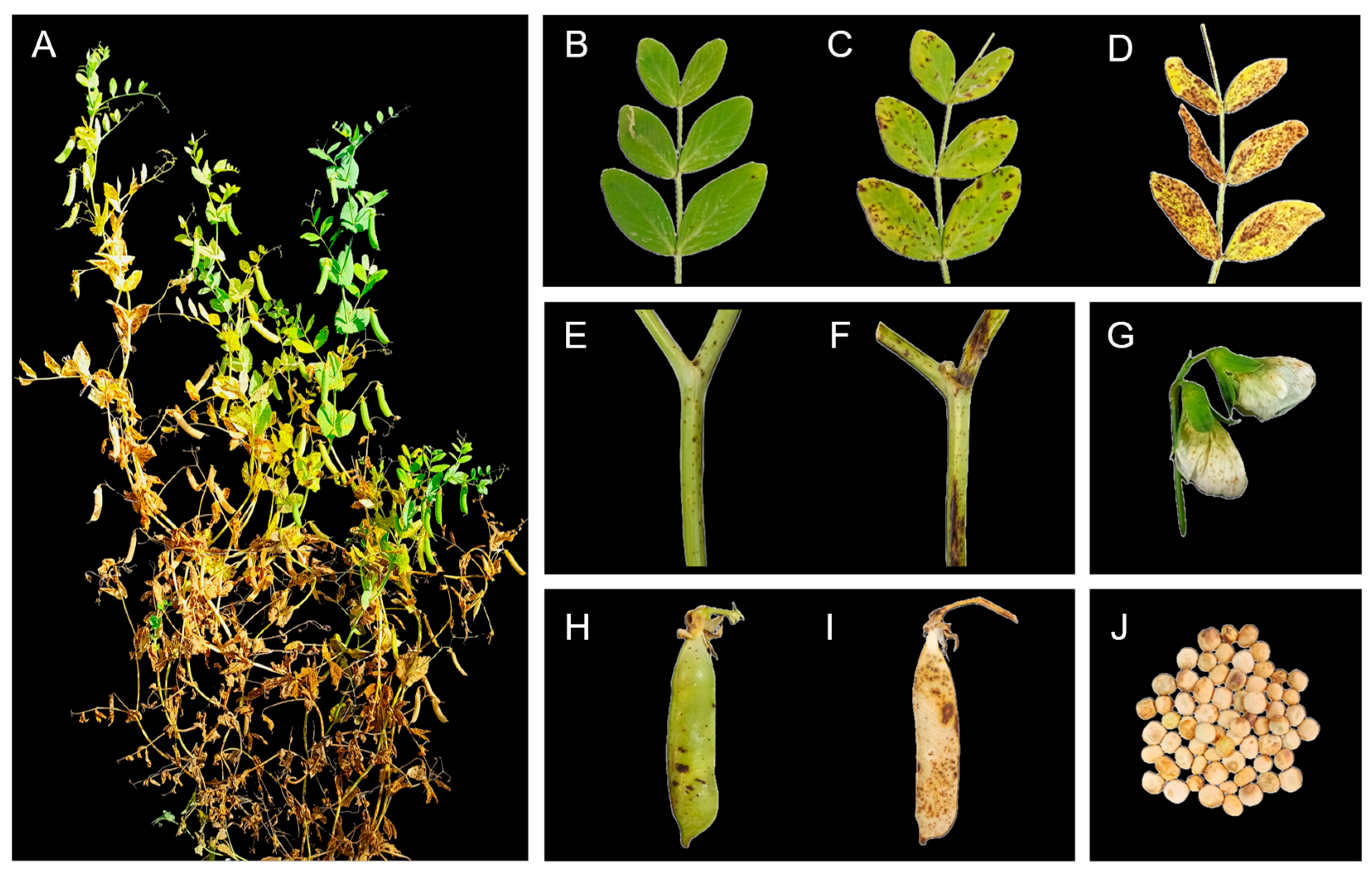
2.2. Symptomatology and Epidemiology
2.3. Field Management of Ascochyta Blight Disease
3. Assessment of Pea Response to Ascochyta Blight
3.1. Disease Phenotyping
3.1.1. Phenotyping Strategies
3.1.2. Variables and Scales
3.2. Reported Sources of Resistance in Pisum Germplasm
3.3. Inoculum Composition as a Determinant of Pea Response to Ascochyta Blight
3.4. Field Resistance as a Composite Phenotype
3.4.1. Architectural Traits as Sources of Bias
3.4.2. Phenology as a Source of Bias
4. Physiological Basis of Pea Resistance to Ascochyta Blight
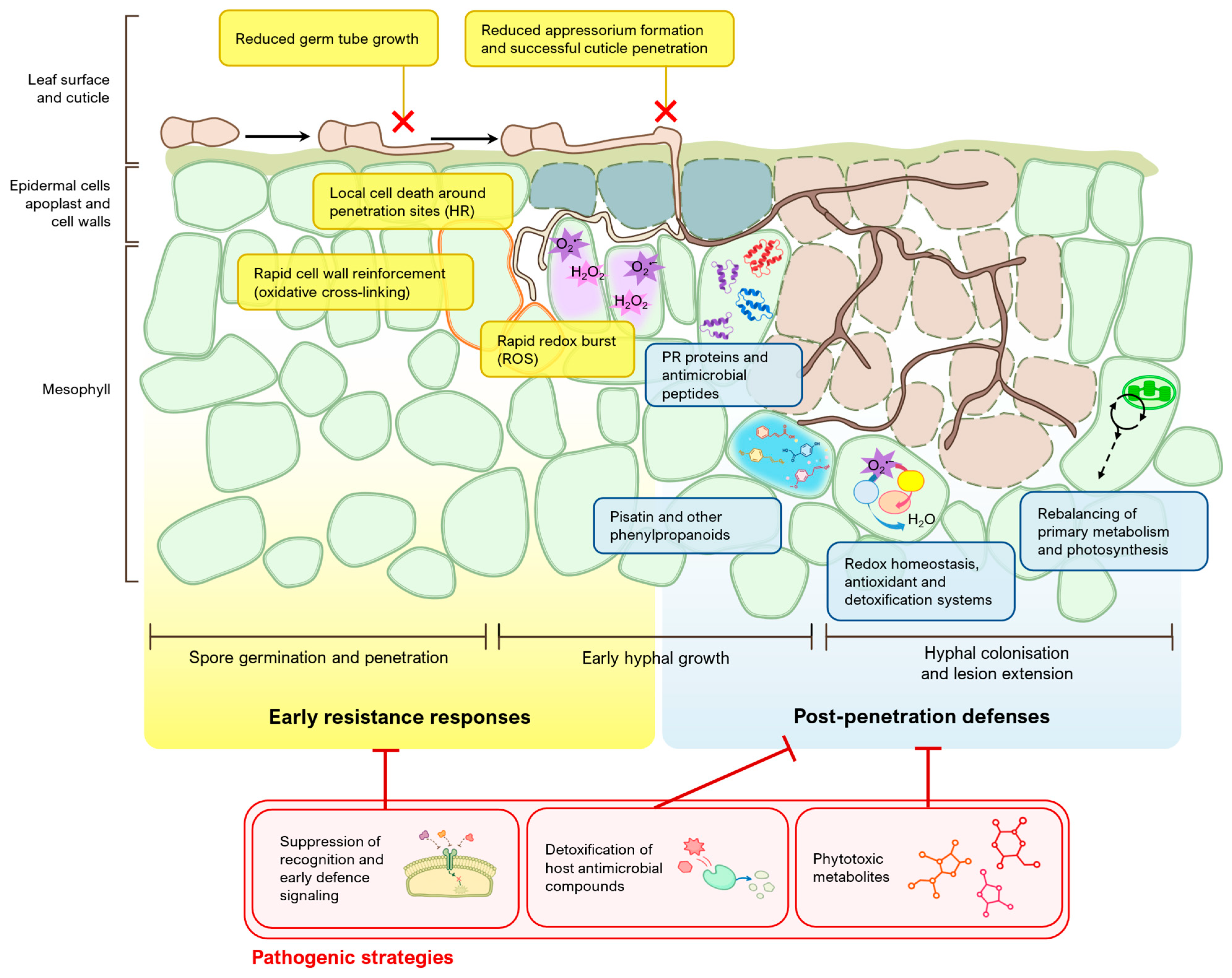
4.1. Early Resistance Responses
4.2. Multi-Component Post-Penetration Defense
4.3. Pathogenic Strategies of Ascochyta Blight Fungi
4.4. Potential Breeding Value of Physiological Resistance
5. Genetic Architecture of Pea Resistance to Ascochyta Blight
5.1. Genetic Evidence for Resistance to Didymella pinodes
5.2. Genetic Evidence for Resistance to Other Ascochyta Blight Pathogens
5.3. Consistency and Stability of Resistance Loci
6. The Pea–Ascochyta Blight Pathosystem at the Molecular Scale: Biochemical Insights and Omics Approaches
6.1. Targeted Biochemical Insights
6.2. Genomic Resources
6.3. Transcriptomics
6.4. Proteomics
6.5. Metabolomics
7. Molecular Breeding for Ascochyta Blight Resistance in Pea
7.1. Marker-Assisted Selection
7.2. Genomic Selection
7.3. Definition of Breeding Targets
7.4. Integrated Disease Management as a Framework for Deploying Genetic Resistance
7.5. Challenges in Molecular Breeding for Ascochyta Blight Resistance
8. Concluding Remarks: Priorities for the Present and Future of Breeding for Ascochyta Blight Resistance
Author Contributions
Funding
Institutional Review Board Statement
Informed Consent Statement
Data Availability Statement
Conflicts of Interest
Abbreviations
| MAS | marker-assisted selection |
| GS | genomic selection |
| SDHIs | succinate dehydrogenase inhibitors |
| DMIs | demethylation inhibitors |
| QoIs | quinone outside inhibitors |
| MoA | mode of action |
| EC50 | half maximal effective concentration |
| USDA | United States Department of Agriculture |
| VIR | N.I. Vavilov All-Russian Institute of Plant Genetic Resources |
| ICARDA | International Center for Agricultural Research in the Dry Areas |
| CCs | controlled conditions |
| DR | disease rate |
| DS | disease severity |
| AUDPC | area under the disease progress curve |
| CPVO | Community Plant Variety Office |
| ROS | reactive oxygen species |
| PR | pathogenesis-related |
| QTL/QTLs | quantitative trait locus/loci |
| RAPD | random amplified polymorphic DNA |
| RFLP | restriction fragment length polymorphism |
| AFLP | amplified fragment length polymorphism |
| STS | sequence-tagged site |
| RIL | recombinant inbred line |
| SSR | simple sequence repeat |
| SNP | single-nucleotide polymorphism |
| GWAS | heterogeneous inbred family |
| MTA | marker–trait association |
| DArT | Diversity Arrays Technology |
| MDAF | meta disease architecture frost |
| RGA | resistance gene analogue |
| MAP | mitogen-activated protein |
| CAZyme | carbohydrate-active enzyme |
| DEGs | differentially expressed genes |
| ABA | abscisic acid |
| RNA-seq | RNA sequencing |
| BSR-Seq | bulk segregant RNA sequencing |
| 2-DE | two-dimensional electrophoresis |
| LEA | late embryogenesis abundant |
| LC-MS/MS | liquid chromatography–tandem mass spectroscopy |
| LC-MS | liquid chromatography–mass spectroscopy |
| G×E | genotype-by-environment |
| GBS | genotyping-by-sequencing |
References
- Zhang, H.; Sun, H.; Tang, Z.; Wang, G. Integrated Agronomy of Pea (Pisum sativum L.): A Review on Cultivation, Harvesting, and Storage for Sustainable Agriculture. Front. Plant Sci. 2025, 16, 1670445. [Google Scholar] [CrossRef]
- Wu, D.-T.; Li, W.-X.; Wan, J.-J.; Hu, Y.-C.; Gan, R.-Y.; Zou, L. A Comprehensive Review of Pea (Pisum sativum L.): Chemical Composition, Processing, Health Benefits, and Food Applications. Foods 2023, 12, 2527. [Google Scholar] [CrossRef]
- FAOSTAT. Available online: https://www.fao.org/faostat/en/#home (accessed on 22 March 2026).
- Ditzler, L.; Van Apeldoorn, D.F.; Pellegrini, F.; Antichi, D.; Bàrberi, P.; Rossing, W.A.H. Current Research on the Ecosystem Service Potential of Legume Inclusive Cropping Systems in Europe. A Review. Agron. Sustain. Dev. 2021, 41, 26. [Google Scholar] [CrossRef]
- Tivoli, B.; Beasse, C.; Lemarchand, E.; Masson, E. Effect of Ascochyta Blight (Mycosphaerella pinodes) on Yield Components of Single Pea (Pisum sativum) Plants under Field Conditions. Ann. Appl. Biol. 1996, 129, 207–216. [Google Scholar] [CrossRef]
- McDonald, G.K.; Peck, D. Effects of Crop Rotation, Residue Retention and Sowing Time on the Incidence and Survival of Ascochyta Blight and Its Effect on Grain Yield of Field Peas (Pisum sativum L.). Field Crops Res. 2009, 111, 11–21. [Google Scholar] [CrossRef]
- Davidson, J.A.; Gossen, B.D.; Chen, W. Ascochyta Complex. In Compendium of Pea Diseases and Pests; APS Press: St. Paul, MN, USA, 2021; pp. 30–36. [Google Scholar]
- Khan, T.N.; Timmerman-Vaughan, G.M.; Rubiales, D.; Warkentin, T.D.; Siddique, K.H.M.; Erskine, W.; Barbetti, M.J. Didymella pinodes and Its Management in Field Pea: Challenges and Opportunities. Field Crops Res. 2013, 148, 61–77. [Google Scholar] [CrossRef]
- Fonseka, D.L.; Markell, S.G.; Zaccaron, M.L.; Ebert, M.K.; Pasche, J.S. Ascochyta Blight in North Dakota Field Pea: The Pathogen Complex and Its Fungicide Sensitivity. Front. Plant Sci. 2023, 14, 1165269. [Google Scholar] [CrossRef] [PubMed]
- Rubiales, D.; Barilli, E.; Rispail, N. Breeding for Biotic Stress Resistance in Pea. Agriculture 2023, 13, 1825. [Google Scholar] [CrossRef]
- Richard, B.; Jumel, S.; Rouault, F.; Tivoli, B. Influence of Plant Stage and Organ Age on the Receptivity of Pisum sativum to Mycosphaerella pinodes. Eur. J. Plant Pathol. 2012, 132, 367–379. [Google Scholar] [CrossRef]
- Richard, B.; Bussière, F.; Langrume, C.; Rouault, F.; Jumel, S.; Faivre, R.; Tivoli, B. Effect of Pea Canopy Architecture on Microclimate and Consequences on Ascochyta Blight Infection under Field Conditions. Eur. J. Plant Pathol. 2013, 135, 509–524. [Google Scholar] [CrossRef]
- Carpenter, M.A.; Goulden, D.S.; Woods, C.J.; Thomson, S.J.; Kenel, F.; Frew, T.J.; Cooper, R.D.; Timmerman-Vaughan, G.M. Genomic Selection for Ascochyta Blight Resistance in Pea. Front. Plant Sci. 2018, 9, 1878. [Google Scholar] [CrossRef]
- Jha, U.C.; Sharma, K.D.; Nayyar, H.; Parida, S.K.; Siddique, K.H.M. Breeding and Genomics Interventions for Developing Ascochyta Blight Resistant Grain Legumes. Int. J. Mol. Sci. 2022, 23, 2217. [Google Scholar] [CrossRef] [PubMed]
- Barilli, E.; Cobos, M.J.; Rubiales, D. Clarification on Host Range of Didymella pinodes the Causal Agent of Pea Ascochyta Blight. Front. Plant Sci. 2016, 7, 592. [Google Scholar] [CrossRef]
- Bretag, T.W.; Keane, P.J.; Price, T.V. The Epidemiology and Control of Ascochyta Blight in Field Peas: A Review. Aust. J. Agric. Res. 2006, 57, 883–902. [Google Scholar] [CrossRef]
- Tivoli, B.; Banniza, S. Comparison of the Epidemiology of Ascochyta Blights on Grain Legumes. In Ascochyta Blights of Grain Legumes; Tivoli, B., Baranger, A., Muehlbauer, F.J., Cooke, B.M., Eds.; Springer Netherlands: Dordrecht, 2007; pp. 59–76. ISBN 978-1-4020-6064-9. [Google Scholar]
- Gossen, B.D.; Hwang, S.F.; Conner, R.L.; Chang, K.F. Managing the ascochyta blight complex on field pea in western Canada. Prairie Soils Crops J. 2011, 4, 135–141. [Google Scholar]
- Davidson, J.A.; Hartley, D.; Priest, M.; Krysinska-Kaczmarek, M.; Herdina; McKay, A.; Scott, E.S. A New Species of Phoma Causes Ascochyta Blight Symptoms on Field Peas (Pisum sativum) in South Australia. Mycologia 2009, 101, 120–128. [Google Scholar] [CrossRef]
- Li, Y.P.; You, M.P.; Khan, T.N.; Finnegan, P.M.; Barbetti, M.J. First Report of Phoma herbarum on Field Pea (Pisum sativum) in Australia. Plant Dis. 2011, 95, 1590. [Google Scholar] [CrossRef] [PubMed]
- Tran, H.S.; You, M.P.; Lanoiselet, V.; Khan, T.N.; Barbetti, M.J. First Report of Phoma glomerata Associated with the Ascochyta Blight Complex on Field Pea (Pisum sativum) in Australia. Plant Dis. 2014, 98, 427. [Google Scholar] [CrossRef]
- Onfroy, C.; Tivoli, B.; Corbière, R.; Bouznad, Z. Cultural, Molecular and Pathogenic Variability of Mycosphaerella pinodes and Phoma medicaginis var. pinodella Isolates from Dried Pea (Pisum sativum) in France. Plant Pathol. 1999, 48, 218–229. [Google Scholar] [CrossRef]
- Owati, A.; Agindotan, B.; Burrows, M. Characterization of Fungal Species Associated with Ascochyta Blight of Dry Pea in Montana and North America and Development of a Differential Medium for Their Detection. Plant Health Prog. 2020, 21, 262–271. [Google Scholar] [CrossRef]
- Aveskamp, M.M.; De Gruyter, J.; Woudenberg, J.H.C.; Verkley, G.J.M.; Crous, P.W. Highlights of the Didymellaceae: A Polyphasic Approach to Characterise Phoma and Related Pleosporalean Genera. Stud. Mycol. 2010, 65, 1–60. [Google Scholar] [CrossRef] [PubMed]
- Skoglund, L.G.; Harveson, R.M.; Chen, W.; Dugan, F.; Schwartz, H.F.; Markell, S.G.; Porter, L.; Burrows, M.L.; Goswami, R. Ascochyta Blight of Peas. Plant Health Prog. 2011, 12, 29. [Google Scholar] [CrossRef]
- Chen, Q.; Jiang, J.R.; Zhang, G.Z.; Cai, L.; Crous, P.W. Resolving the Phoma Enigma. Stud. Mycol. 2015, 82, 137–217. [Google Scholar] [CrossRef]
- Chen, Q.; Hou, L.W.; Duan, W.J.; Crous, P.W.; Cai, L. Didymellaceae Revisited. Stud. Mycol. 2017, 87, 105–159. [Google Scholar] [CrossRef]
- Hou, L.W.; Groenewald, J.Z.; Pfenning, L.H.; Yarden, O.; Crous, P.W.; Cai, L. The Phoma-like Dilemma. Stud. Mycol. 2020, 96, 309–396. [Google Scholar] [CrossRef]
- Didymella pinodes | EPPO Global Database. Available online: https://gd.eppo.int/taxon/MYCOPI (accessed on 22 March 2026).
- Didymella pinodella | EPPO Global Database. Available online: https://gd.eppo.int/taxon/PHOMMP (accessed on 22 March 2026).
- Ascochyta pisi | EPPO Global Database. Available online: https://gd.eppo.int/taxon/ASCOPI (accessed on 22 March 2026).
- Ascochyta koolunga | EPPO Global Database. Available online: https://gd.eppo.int/taxon/PHOMKO (accessed on 22 March 2026).
- Mycobank. Available online: https://www.mycobank.org/ (accessed on 22 March 2026).
- Beasse, C.; Ney, B.; Tivoli, B. Effects of Pod Infection by Mycosphaerella pinodes on Yield Components of Pea (Pisum sativum). Ann. Appl. Biol. 1999, 135, 359–367. [Google Scholar] [CrossRef]
- Sakar, D.; Muehlbauer, F.J.; Kraft, J.M. Techniques of Screening Peas for Resistance to Phoma medicaginis var. pinodella. Crop Sci. 1982, 22, 988–992. [Google Scholar] [CrossRef]
- Šišić, A.; Baćanović-Šišić, J.; Gamba, F.M.; Finckh, M.R. Didymella pinodella: An Important Pea Root Rot Pathogen in France to Watch Out For? J. Fungi 2024, 10, 44. [Google Scholar] [CrossRef]
- Šišić, A.; Oberhänsli, T.; Baćanović-Šišić, J.; Hohmann, P.; Finckh, M.R. A Novel Real Time PCR Method for the Detection and Quantification of Didymella pinodella in Symptomatic and Asymptomatic Plant Hosts. J. Fungi 2021, 8, 41. [Google Scholar] [CrossRef] [PubMed]
- Salam, M.U.; Galloway, J.; Diggle, A.J.; MacLeod, W.J.; Maling, T. Predicting Regional-Scale Spread of Ascospores of Didymella pinodes Causing Ascochyta Blight Disease on Field Pea. Australas. Plant Pathol. 2011, 40, 640–647. [Google Scholar] [CrossRef]
- Bretag, T.; Price, T.; Keane, P. Importance of Seed-Borne Inoculum in the Etiology of the Ascochyta Blight Complex of Field Peas (Pisum sativum L.) Grown in Victoria. Aust. J. Exp. Agric. 1995, 35, 525. [Google Scholar] [CrossRef]
- Sivachandra Kumar, N.T.; Banniza, S. Assessment of the Effect of Seed Infection with Ascochyta pisi on Pea in Western Canada. Front. Plant Sci. 2017, 8, 933. [Google Scholar] [CrossRef]
- Bretag, T.W.; Keane, P.J.; Price, T.V. Effect of Sowing Date on the Severity of Ascochyta Blight in Field Peas (Pisum sativum L.) Grown in the Wimmera Region of Victoria. Aust. J. Exp. Agric. 2000, 40, 1113–1119. [Google Scholar] [CrossRef]
- Lonergan, E.; Pasche, J.; Skoglund, L.; Burrows, M. Sensitivity of Ascochyta Species Infecting Pea, Lentil, and Chickpea to Boscalid, Fluxapyroxad, and Prothioconazole. Plant Dis. 2015, 99, 1254–1260. [Google Scholar] [CrossRef]
- Bowness, R.; Gossen, B.D.; Chang, K.-F.; Goswani, R.; Willenborg, C.J.; Holtz, M.; Strelkov, S.E. Sensitivity of Mycosphaerella pinodes to Pyraclostrobin Fungicide. Plant Dis. 2016, 100, 192–199. [Google Scholar] [CrossRef]
- Wise, K.A.; Bradley, C.A.; Markell, S.; Pasche, J.; Delgado, J.A.; Goswami, R.S.; Gudmestad, N.C. Sensitivity of Ascochyta rabiei Populations to Prothioconazole and Thiabendazole. Crop Prot. 2011, 30, 1000–1005. [Google Scholar] [CrossRef]
- Owati, A.; Agindotan, B.; Burrows, M. Development and Application of Real-Time and Conventional SSR-PCR Assays for Rapid and Sensitive Detection of Didymella pisi Associated with Ascochyta Blight of Dry Pea. Plant Dis. 2019, 103, 2751–2758. [Google Scholar] [CrossRef]
- Kitchen, J.L.; Van Den Bosch, F.; Paveley, N.D.; Helps, J.; Van Den Berg, F. The Evolution of Fungicide Resistance Resulting from Combinations of Foliar-Acting Systemic Seed Treatments and Foliar-Applied Fungicides: A Modeling Analysis. PLoS ONE 2016, 11, e0161887. [Google Scholar] [CrossRef]
- Liu, N.; Xu, S.; Yao, X.; Zhang, G.; Mao, W.; Hu, Q.; Feng, Z.; Gong, Y. Studies on the Control of Ascochyta Blight in Field Peas (Pisum sativum L.) Caused by Ascochyta pinodes in Zhejiang Province, China. Front. Microbiol. 2016, 7, 481. [Google Scholar] [CrossRef]
- Gudero Mengesha, G.; Terefe, H.; Yae, A.J.; Arato, A.A.; Betire, M.G.; Samuel Shago, T.; Bires, Z.F.; Borano, B.B.; Abebe, S.M. Integration of Host Resistance and Fungicides Reduced Ascochyta Blight Pressure and Minimised Yield Loss in Field Pea (Pisum sativum L.) in Southern Ethiopia. Acta Agric. Scand. Sect. B—Soil Plant Sci. 2022, 72, 971–986. [Google Scholar] [CrossRef]
- Kraft, J.M.; Dunne, B.; Goulden, D.; Armstrong, S. A Search for Resistance in Peas to Mycosphaerella pinodes. Plant Dis. 1998, 82, 251–253. [Google Scholar] [CrossRef]
- Conner, R.L.; Gossen, B.D.; Hwang, S.F.; Chang, K.F.; McRae, K.B.; Penner, W.C. Field Assessment of Partial Resistance to Mycosphaerella Blight in Pisum Subspecies Accessions. Can. J. Plant Sci. 2012, 92, 289–296. [Google Scholar] [CrossRef]
- Timmerman-Vaughan, G.M.; Frew, T.J.; Russell, A.C.; Khan, T.; Butler, R.; Gilpin, M.; Murray, S.; Falloon, K. QTL Mapping of Partial Resistance to Field Epidemics of Ascochyta Blight of Pea. Crop Sci. 2002, 42, 2100–2111. [Google Scholar] [CrossRef]
- Zimmer, R.C.; Sabourin, D. Determining Resistance Reactions of Field Pea Cultivars at the Seedling Stage to Mycosphaerella pinodes. Phytopathology 1986, 76, 878. [Google Scholar] [CrossRef]
- Clulow, S.A.; Lewis, B.G.; Matthews, P. A Pathotype Classification for Mycosphaerella pinodes. J. Phytopathol. 1991, 131, 322–332. [Google Scholar] [CrossRef]
- Prioul, S.; Onfroy, C.; Tivoli, B.; Baranger, A. Controlled Environment Assessment of Partial Resistance to Mycosphaerella pinodes in Pea (Pisum sativum L.) Seedlings. Euphytica 2003, 131, 121–130. [Google Scholar] [CrossRef]
- Setti, B.; Bencheikh, M.; Henni, J.; Neema, C. Effect of Pea Cultivar, Pathogen Isolate, Inoculum Concentration and Leaf Wetness Duration on Ascochyta Blight Caused by Mycosphaerella pinodes. Phytopathol. Mediterr. 2009, 47, 214–222. [Google Scholar]
- Boros, L.; Wawer, A. Garden Pea Varietal Susceptibility to Mycosphaerella pinodes and Its Effect on Yield Components of Single Plants. J. Fruit Ornam. Plant Res. 2009, 70, 37–47. [Google Scholar] [CrossRef]
- Lee, R.C.; Grime, C.R.; O’Driscoll, K.; Khentry, Y.; Farfan-Caceres, L.M.; Tahghighi, H.; Kamphuis, L.G. Field Pea (Pisum sativum) Germplasm Screening for Seedling Ascochyta Blight Resistance and Genome-Wide Association Studies Reveal Loci Associated with Resistance to Peyronellaea pinodes and Ascochyta koolunga. Phytopathology 2023, 113, 265–276. [Google Scholar] [CrossRef]
- Joshi, S.; Pandey, B.R.; Rosewarne, G. Characterization of Field Pea (Pisum sativum) Resistance against Peyronellaea pinodes and Didymella pinodella That Cause Ascochyta Blight. Front. Plant Sci. 2022, 13, 976375. [Google Scholar] [CrossRef]
- Onfroy, C.; Baranger, A.; Tivoli, B. Biotic Factors Affecting the Expression of Partial Resistance in Pea to Ascochyta Blight in a Detached Stipule Assay. Eur. J. Plant Pathol. 2007, 119, 13–27. [Google Scholar] [CrossRef]
- Annan, E.N.; Nyamesorto, B.; Yan, Q.; McPhee, K.; Huang, L. Optimized High Throughput Ascochyta Blight Screening Protocols and Immunity to A. pisi in Pea. Pathogens 2023, 12, 494. [Google Scholar] [CrossRef]
- Osuna-Caballero, S.; Olivoto, T.; Jiménez-Vaquero, M.A.; Rubiales, D.; Rispail, N. RGB Image-Based Method for Phenotyping Rust Disease Progress in Pea Leaves Using R. Plant Methods 2023, 19, 86. [Google Scholar] [CrossRef] [PubMed]
- Ray, P.; Chandran, D. Spray Inoculation and Image Analysis-Based Quantification of Powdery Mildew Disease Severity on Pea Leaves. MethodsX 2024, 13, 102980. [Google Scholar] [CrossRef]
- Leclerc, M.; Jumel, S.; Hamelin, F.M.; Treilhaud, R.; Parisey, N.; Mammeri, Y. Imaging with Spatio-Temporal Modelling to Characterize the Dynamics of Plant-Pathogen Lesions. PLoS Comput. Biol. 2023, 19, e1011627. [Google Scholar] [CrossRef] [PubMed]
- Xu, A.G.; Warkentin, T.D.; Greeniaus, M.T.; Zimmer, R.C. Genotypic Variability in Seedborne Infection of Field Pea by Mycosphaerella pinodes and Its Relation to Foliar Disease Severity. Can. J. Plant Pathol. 1996, 18, 370–374. [Google Scholar] [CrossRef]
- Jha, A.B.; Gali, K.K.; Tar’an, B.; Warkentin, T.D. Fine Mapping of QTLs for Ascochyta Blight Resistance in Pea Using Heterogeneous Inbred Families. Front. Plant Sci. 2017, 8, 765. [Google Scholar] [CrossRef] [PubMed]
- Roger, C.; Tivoli, B. Spatio-temporal Development of Pycnidia and Perithecia and Dissemination of Spores of Mycosphaerella pinodes on Pea (Pisum sativum). Plant Pathol. 1996, 45, 518–528. [Google Scholar] [CrossRef]
- Fondevilla, S.; Krezdorn, N.; Rubiales, D.; Rotter, B.; Winter, P. Bulked Segregant Transcriptome Analysis in Pea Identifies Key Expression Markers for Resistance to Peyronellaea pinodes. Sci. Rep. 2022, 12, 18159. [Google Scholar] [CrossRef]
- Česnulevičienė, R.; Gaurilčikienė, I.; Ramanauskienė, J. Control of Ascochyta Blight (Ascochyta Complex) in Pea under Lithuanian Conditions. Zemdirb.-Agric. 2014, 101, 101–108. [Google Scholar] [CrossRef]
- Lyall, L.H.; Wallen, V.R. The Inheritance of Resistance to Ascochyta pisi Lin. in Peas. Can. J. Plant Sci. 1958, 38, 215–218. [Google Scholar] [CrossRef]
- Gfeller, F.; Wallen, V.R. Note on the Creamette Field Pea. Can. J. Plant Sci. 1961, 41, 872–873. [Google Scholar] [CrossRef]
- Ali, S.; Nitschke, L.; Dube, A.; Krause, M.; Cameron, B. Selection of Pea Lines for Resistance to Pathotypes of Ascochyta pinodes, A. pisi and Phoma medicaginis var. pinodella. Aust. J. Agric. Res. 1978, 29, 841–849. [Google Scholar] [CrossRef]
- Xue, A.G.; Warkentin, T.D. Partial Resistance to Mycosphaerella pinodes in Field Pea. Can. J. Plant Sci. 2001, 81, 535–540. [Google Scholar] [CrossRef]
- Zhang, R.; Hwang, S.; Chang, K.; Gossen, B.D.; Strelkov, S.E.; Turnbull, G.D.; Blade, S.F. Genetic Resistance to Mycosphaerella pinodes in 558 Field Pea Accessions. Crop Sci. 2006, 46, 2409–2414. [Google Scholar] [CrossRef]
- Francis, C.; Khan, T.; Priliouk, L.; Gorfu, D.; Beijiga, G. Screening of Peas of Vavilov Institute and ICARDA for Black Spot Resistance. In Proceedings of the New Approaches and Techniques in Breeding Sustainable Fodder Crops and Amenity Grasses; N. I. Vavilov All-Russian Institute of Plant Industry: St. Petersburg, Russia, 2000; pp. 242–244. [Google Scholar]
- Wroth, J.M. Possible Role for Wild Genotypes of Pisum spp. to Enhance Ascochyta Blight Resistance in Pea. Aust. J. Exp. Agric. 1998, 38, 469. [Google Scholar] [CrossRef]
- Gurung, A.M.; Pang, E.C.K.; Taylor, P.W.J. Examination of Pisum and Lathyrus Species as Sources of Ascochyta Blight Resistance for Field Pea (Pisum sativum). Australas. Plant Pathol. 2002, 31, 41. [Google Scholar] [CrossRef]
- Fondevilla, S.; ÅVila, C.M.; Cubero, J.I.; Rubiales, D. Response to Mycosphaerella pinodes in a Germplasm Collection of Pisum spp. Plant Breed. 2005, 124, 313–315. [Google Scholar] [CrossRef]
- Jha, A.B.; Warkentin, T.D.; Gurusamy, V.; Tar’an, B.; Banniza, S. Identification of Mycosphaerella Blight Resistance in Wild Pisum Species for Use in Pea Breeding. Crop Sci. 2012, 52, 2462–2468. [Google Scholar] [CrossRef]
- Tran, H.S.; Li, Y.P.; You, M.P.; Khan, T.N.; Pritchard, I.; Barbetti, M.J. Temporal and Spatial Changes in the Pea Black Spot Disease Complex in Western Australia. Plant Dis. 2014, 98, 790–796. [Google Scholar] [CrossRef]
- Tran, H.S.; You, M.P.; Khan, T.N.; Barbetti, M.J. Relative Host Resistance to Black Spot Disease in Field Pea (Pisum sativum) Is Determined by Individual Pathogens. Plant Dis. 2015, 99, 580–587. [Google Scholar] [CrossRef] [PubMed]
- Groupe d’Étude et de contrôle des Variétés et des Semences [GEVES]. Harmonization of Resistance Test to Diseases for DUS Testing—2: Final Report of the Project (June 2012–June 2015); Community Plant Variety Office [CPVO]: Angers, France, 2015.
- Wallen, V.R. The Identification and Distribution of Physiologic Races of Ascochyta pisi Lib. in Canada. Can. J. Plant Sci. 1957, 37, 337–341. [Google Scholar] [CrossRef]
- Wroth, J.M. Variation in Pathogenicity among and within Mycosphaerella pinodes Populations Collected from Field Pea in Australia. Can. J. Bot. 1998, 76, 1955–1966. [Google Scholar]
- Banniza, S.; Hashemi, P.; Warkentin, T.D.; Vandenberg, A.; Davis, A.R. The Relationships among Lodging, Stem Anatomy, Degree of Lignification, and Resistance to Mycosphaerella Blight in Field Pea (Pisum sativum). Can. J. Bot. 2005, 83, 954–967, Erratum in Can. J. Plant. Sci. 2005, 83, 1365. [Google Scholar] [CrossRef]
- Zhang, J.X.; Fernando, W.G.D.; Xue, A.G. Virulence and Genetic Variability Among Isolates of Mycosphaerella pinodes. Plant Dis. 2003, 87, 1376–1383. [Google Scholar] [CrossRef]
- Protocol for Tests on Distinctness, Uniformity and Stability: Pisum sativum L. Sensu Lato; Community Plant Variety Office [CPVO]: Angers, France, 2020.
- Pea: Test Guidelines; International Union for the Protection of New Varieties of Plants [UPOV]: Geneva, Switzerland, 2022.
- 2025 Victorian and Tasmanian Crop Sowing Guide; Grains Research and Development Corporation [GRDC]: Barton, Australia, 2024.
- 2022 Pulse and Soybean Variety Guide; Manitoba Pulse & Soybean Growers: Carman, MB, Canada, 2022.
- Varieties of Grain Crops 2025; SaskSeed: Saskatoon, SK, Canada, 2025.
- Su, H.; Hwang, S.F.; Chang, K.F.; Conner, R.L.; Howard, R.J.; Turnbull, G.D. Variations in Virulence and Genome of Mycosphaerella pinodes Isolates from Field Peas in Central Alberta, Canada. J. Plant Dis. Prot. 2006, 113, 53–60. [Google Scholar] [CrossRef]
- Dutt, A.; Andrivon, D.; Jumel, S.; Le Roy, G.; Baranger, A.; Leclerc, M.; Le May, C. Life History Traits and Trade-offs between Two Species of the Ascochyta Blight Disease Complex of Pea. Plant Pathol. 2020, 69, 1108–1124. [Google Scholar] [CrossRef]
- Parihar, A.K.; Kumar, J.; Gupta, D.S.; Lamichaney, A.; Naik Sj, S.; Singh, A.K.; Dixit, G.P.; Gupta, S.; Toklu, F. Genomics Enabled Breeding Strategies for Major Biotic Stresses in Pea (Pisum sativum L.). Front. Plant Sci. 2022, 13, 861191. [Google Scholar] [CrossRef]
- Schoeny, A.; Jumel, S.; Rouault, F.; Le May, C.; Tivoli, B. Assessment of Airborne Primary Inoculum Availability and Modelling of Disease Onset of Ascochyta Blight in Field Peas. Eur. J. Plant Pathol. 2007, 119, 87–97. [Google Scholar] [CrossRef]
- Omri Ben Youssef, N.; Chaar, H.; Bessaidi, Z.; Halila, I.; Jammezi, N.; Mbazia, A.; Kharrat, M.; Le May, C. Temporal and Spatial Dynamics of Ascochyta Blight Caused by Ascochyta fabae Speg. In Faba Bean Fields in Tunisia. Australas. Plant Pathol. 2021, 50, 179–192. [Google Scholar] [CrossRef]
- Fondevilla, S.; Almeida, N.F.; Satovic, Z.; Rubiales, D.; Vaz Patto, M.C.; Cubero, J.I.; Torres, A.M. Identification of Common Genomic Regions Controlling Resistance to Mycosphaerella pinodes, Earliness and Architectural Traits in Different Pea Genetic Backgrounds. Euphytica 2011, 182, 43–52. [Google Scholar] [CrossRef]
- Wang, T.F.; Gossen, B.D.; Slinkard, A.E. Lodging Increases Severity and Impact of Mycosphaerella Blight on Field Pea. Can. J. Plant Sci. 2006, 86, 855–863. [Google Scholar] [CrossRef]
- Castro-Urrea, F.A.; Urricariet, M.P.; Stefanova, K.T.; Li, L.; Moss, W.M.; Guzzomi, A.L.; Sass, O.; Siddique, K.H.M.; Cowling, W.A. Accuracy of Selection in Early Generations of Field Pea Breeding Increases by Exploiting the Information Contained in Correlated Traits. Plants 2023, 12, 1141. [Google Scholar] [CrossRef] [PubMed]
- Tar’an, B.; Warkentin, T.; Somers, D.J.; Miranda, D.; Vandenberg, A.; Blade, S.; Woods, S.; Bing, D.; Xue, A.; DeKoeyer, D.; et al. Quantitative Trait Loci for Lodging Resistance, Plant Height and Partial Resistance to Mycosphaerella Blight in Field Pea (Pisum sativum L.). Theor. Appl. Genet. 2003, 107, 1482–1491. [Google Scholar] [CrossRef] [PubMed]
- Jha, A.B.; Tar’an, B.; Stonehouse, R.; Warkentin, T.D. Identification of QTLs Associated with Improved Resistance to Ascochyta Blight in an Interspecific Pea Recombinant Inbred Line Population. Crop Sci. 2016, 56, 2926–2939. [Google Scholar] [CrossRef]
- Boutet, G.; Lavaud, C.; Lesné, A.; Miteul, H.; Pilet-Nayel, M.-L.; Andrivon, D.; Lejeune-Hénaut, I.; Baranger, A. Five Regions of the Pea Genome Co-Control Partial Resistance to D. pinodes, Tolerance to Frost, and Some Architectural or Phenological Traits. Genes 2023, 14, 1399. [Google Scholar] [CrossRef]
- Le May, C.; Ney, B.; Lemarchand, E.; Schoeny, A.; Tivoli, B. Effect of Pea Plant Architecture on Spatiotemporal Epidemic Development of Ascochyta Blight (Mycosphaerella pinodes) in the Field. Plant Pathol. 2009, 58, 332–343. [Google Scholar] [CrossRef]
- Martins, L.B.; Balint-Kurti, P.; Reberg-Horton, S.C. Genome-Wide Association Study for Morphological Traits and Resistance to Peryonella pinodes in the USDA Pea Single Plant plus Collection. G3 Genes Genomes Genet. 2022, 12, jkac168. [Google Scholar] [CrossRef]
- McDonald, M.R.; Gossen, B.D.; Kora, C.; Parker, M.; Boland, G. Using Crop Canopy Modification to Manage Plant Diseases. Eur. J. Plant Pathol. 2013, 135, 581–593. [Google Scholar] [CrossRef]
- Shen, Y.; Syrovy, L.D.; Johnson, E.N.; Warkentin, T.D.; Ha, T.; De Silva, D.; Shirtliffe, S.J. Optimizing Seeding Ratio for Semi-Leafless and Leafed Pea Mixture with Precise UAV Quantification of Crop Lodging. Agronomy 2022, 12, 1532. [Google Scholar] [CrossRef]
- Xue, A.G.; Warkentin, T.D.; Kenaschuk, E.O. Effects of Timings of Inoculation with Mycosphaerella pinodes on Yield and Seed Infection of Field Pea. Can. J. Plant Sci. 1997, 77, 685–689. [Google Scholar] [CrossRef]
- Le May, C.; Jumel, S.; Schoeny, A.; Tivoli, B. Ascochyta Blight Development on a New Winter Pea Genotype Highly Reactive to Photoperiod under Field Conditions. Field Crops Res. 2009, 111, 32–38. [Google Scholar] [CrossRef]
- Hwang, S.-F.; Chang, K.-F.; Conner, R.L.; Gossen, B.D.; Turnbull, G.D. Plant Age and Timing of Epidemic Initiation Affect Mycosphaerella Blight in Field Pea. J. Plant Dis. Prot. 2012, 119, 15–23. [Google Scholar] [CrossRef]
- Davidson, J.A.; Krysinska-Kaczmarek, M.; Wilmshurst, C.J.; McKay, A.; Herdina; Scott, E.S. Distribution and Survival of Ascochyta Blight Pathogens in Field-Pea-Cropping Soils of Australia. Plant Dis. 2011, 95, 1217–1223. [Google Scholar] [CrossRef]
- Timmerman-Vaughan, G.M.; Frew, T.J.; Butler, R.; Murray, S.; Gilpin, M.; Falloon, K.; Johnston, P.; Lakeman, M.B.; Russell, A.; Khan, T. Validation of Quantitative Trait Loci for Ascochyta Blight Resistance in Pea (Pisum sativum L.), Using Populations from Two Crosses. Theor. Appl. Genet. 2004, 109, 1620–1631. [Google Scholar] [CrossRef]
- Prioul, S.; Frankewitz, A.; Deniot, G.; Morin, G.; Baranger, A. Mapping of Quantitative Trait Loci for Partial Resistance to Mycosphaerella pinodes in Pea (Pisum sativum L.), at the Seedling and Adult Plant Stages. Theor. Appl. Genet. 2004, 108, 1322–1334. [Google Scholar] [CrossRef] [PubMed]
- Clulow, S.A.; Lewis, B.G.; Matthews, P. Expression of Resistance to Mycosphaerella pinodes in Pisum sativum. Plant Pathol. 1992, 41, 362–369. [Google Scholar] [CrossRef]
- Carrillo, E.; Rubiales, D.; Pérez-de-Luque, A.; Fondevilla, S. Characterization of Mechanisms of Resistance against Didymella pinodes in Pisum spp. Eur. J. Plant Pathol. 2013, 135, 761–769. [Google Scholar] [CrossRef]
- Suzuki, T.; Maeda, A.; Hirose, M.; Ichinose, Y.; Shiraishi, T.; Toyoda, K. Ultrastructural and Cytological Studies on Mycosphaerella pinodes Infection of the Model Legume Medicago truncatula. Front. Plant Sci. 2017, 8, 1132. [Google Scholar] [CrossRef]
- Tran, H.S.; You, M.P.; Khan, T.N.; Barbetti, M.J. Infection Process of Phoma koolunga on Stem and Leaf Tissue of Resistant and Susceptible Field Pea (Pisum sativum). Plant Pathol. 2017, 66, 212–222. [Google Scholar] [CrossRef]
- Robinson, T.J.; Wood, R.K.S. Factors Affecting Accumulation of Pisatin by Pea Leaves. Physiol. Plant Pathol. 1976, 9, 285–297. [Google Scholar] [CrossRef]
- George, H.L.; VanEtten, H.D. Characterization of Pisatin-Inducible Cytochrome P450s in Fungal Pathogens of Pea That Detoxify the Pea Phytoalexin Pisatin. Fungal Genet. Biol. 2001, 33, 37–48. [Google Scholar] [CrossRef]
- Turetschek, R.; Desalegn, G.; Epple, T.; Kaul, H.-P.; Wienkoop, S. Key Metabolic Traits of Pisum sativum Maintain Cell Vitality during Didymella pinodes Infection: Cultivar Resistance and the Microsymbionts’ Influence. J. Proteom. 2017, 169, 189–201. [Google Scholar] [CrossRef]
- Vad, K.; Mikkelsen, J.; Collinge, D.B. Induction, Purification and Characterization of Chitinase Isolated from Pea Leaves Inoculated with Ascochyta pisi. Planta 1991, 184, 24–29. [Google Scholar] [CrossRef]
- Lai, F.-M.; DeLong, C.; Mei, K.; Wignes, T.; Fobert, P.R. Analysis of the DRR230 Family of Pea Defensins: Gene Expression Pattern and Evidence of Broad Host-Range Antifungal Activity. Plant Sci. 2002, 163, 855–864. [Google Scholar] [CrossRef]
- Castillejo, M.Á.; Curto, M.; Fondevilla, S.; Rubiales, D.; Jorrín, J.V. Two-Dimensional Electrophoresis Based Proteomic Analysis of the Pea (Pisum sativum) in Response to Mycosphaerella pinodes. J. Agric. Food Chem. 2010, 58, 12822–12832. [Google Scholar] [CrossRef] [PubMed]
- Ranjbar Sistani, N.; Kaul, H.-P.; Desalegn, G.; Wienkoop, S. Rhizobium Impacts on Seed Productivity, Quality, and Protection of Pisum sativum upon Disease Stress Caused by Didymella pinodes: Phenotypic, Proteomic, and Metabolomic Traits. Front. Plant Sci. 2017, 8, 1961. [Google Scholar] [CrossRef] [PubMed]
- Ranjbar Sistani, N.; Desalegn, G.; Kaul, H.-P.; Wienkoop, S. Seed Metabolism and Pathogen Resistance Enhancement in Pisum sativum During Colonization of Arbuscular Mycorrhizal Fungi: An Integrative Metabolomics-Proteomics Approach. Front. Plant Sci. 2020, 11, 872. [Google Scholar] [CrossRef] [PubMed]
- Shiraishi, T. Suppression of Defense Response Related to Plant Cell Wall. Jpn. Agric. Res. Q. JARQ 2013, 47, 21–27. [Google Scholar] [CrossRef]
- Agudo-Jurado, F.J.; Reveglia, P.; Rubiales, D.; Evidente, A.; Barilli, E. Status of Phytotoxins Isolated from Necrotrophic Fungi Causing Diseases on Grain Legumes. Int. J. Mol. Sci. 2023, 24, 5116. [Google Scholar] [CrossRef]
- Kim, W.; Chen, W. Phytotoxic Metabolites Produced by Legume-Associated Ascochyta and Its Related Genera in the Dothideomycetes. Toxins 2019, 11, 627. [Google Scholar] [CrossRef]
- Evidente, A.; Capasso, R.; Abouzeid, M.A.; Lanzetta, R.; Vurro, M.; Bottalico, A. Three New Toxic Pinolidoxins from Ascochyta pinodes. J. Nat. Prod. 1993, 56, 1937–1943. [Google Scholar] [CrossRef]
- Evidente, A.; Lanzetta, R.; Capasso, R.; Vurro, M.; Botralico, A. Pinolidoxin, a Phytotoxic Nonenolide from Ascochyta pinodes. Phytochemistry 1993, 34, 999–1003. [Google Scholar] [CrossRef]
- Barilli, E.; Reveglia, P.; Rodriguez-Mena, S.; Yuste-Jiménez, J.E.; Lecce, L.; Rubiales, D. Production of Specialized Metabolites by Ascochyta pinodes in the Interaction with Pea (Pisum sativum): First In Planta Report of Pinolidoxin. SSRN 2025. [Google Scholar] [CrossRef]
- Cimmino, A.; Andolfi, A.; Fondevilla, S.; Abouzeid, M.A.; Rubiales, D.; Evidente, A. Pinolide, a New Nonenolide Produced by Didymella pinodes, the Causal Agent of Ascochyta Blight on Pisum Sativum. J. Agric. Food Chem. 2012, 60, 5273–5278. [Google Scholar] [CrossRef] [PubMed]
- Kiba, A.; Miyake, C.; Toyoda, K.; Ichinose, Y.; Yamada, T.; Shiraishi, T. Superoxide Generation in Extracts from Isolated Plant Cell Walls Is Regulated by Fungal Signal Molecules. Phytopathology 1997, 87, 846–852. [Google Scholar] [CrossRef]
- Toyoda, K.; Yasunaga, E.; Niwa, M.; Ohwatari, Y.; Nakashima, A.; Inagaki, Y.; Ichinose, Y.; Shiraishi, T. H2O2 Production by Copper Amine Oxidase, a Component of the Ecto-Apyrase (ATPase)-Containing Protein Complex(Es) in the Pea Cell Wall, Is Regulated by an Elicitor and a Suppressor from Mycosphaerella pinodes. J. Gen. Plant Pathol. 2012, 78, 311–315. [Google Scholar] [CrossRef]
- Fondevilla, S.; Rotter, B.; Krezdorn, N.; Jüngling, R.; Winter, P.; Rubiales, D. Identification of Genes Involved in Resistance to Didymella pinodes in Pea by deepSuperSAGE Transcriptome Profiling. Plant Mol. Biol. Report. 2014, 32, 258–269. [Google Scholar] [CrossRef]
- Wroth, J.M. Evidence Suggests That Mycosphaerella pinodes Infection of Pisum sativum Is Inherited as a Quantitative Trait. Euphytica 1999, 107, 193–204. [Google Scholar] [CrossRef]
- Williams, J.G.K.; Kubelik, A.R.; Livak, K.J.; Rafalski, J.A.; Tingey, S.V. DNA Polymorphisms Amplified by Arbitrary Primers Are Useful as Genetic Markers. Nucleic Acids Res. 1990, 18, 6531–6535. [Google Scholar] [CrossRef]
- Botstein, D.; White, R.L.; Skolnick, M.; Davis, R.W. Construction of a Genetic Linkage Map in Man Using Restriction Fragment Length Polymorphisms. Am. J. Hum. Genet. 1980, 32, 314–331. [Google Scholar]
- Vos, P.; Hogers, R.; Bleeker, M.; Reijans, M.; Lee, T.V.D.; Hornes, M.; Friters, A.; Pot, J.; Paleman, J.; Kuiper, M.; et al. AFLP: A New Technique for DNA Fingerprinting. Nucleic Acids Res. 1995, 23, 4407–4414. [Google Scholar] [CrossRef] [PubMed]
- Olson, M.; Hood, L.; Cantor, C.; Botstein, D. A Common Language for Physical Mapping of the Human Genome. Science 1989, 245, 1434–1435. [Google Scholar] [CrossRef] [PubMed]
- Fondevilla, S.; Satovic, Z.; Rubiales, D.; Moreno, M.T.; Torres, A.M. Mapping of Quantitative Trait Loci for Resistance to Mycosphaerella pinodes in Pisum sativum subsp. syriacum. Mol. Breed. 2008, 21, 439–454. [Google Scholar] [CrossRef]
- Weber, J.L.; May, P.E. Abundant Class of Human DNA Polymorphisms Which Can Be Typed Using the Polymerase Chain Reaction. Am. J. Hum. Genet. 1989, 44, 388–396. [Google Scholar]
- Fondevilla, S.; Küster, H.; Krajinski, F.; Cubero, J.I.; Rubiales, D. Identification of Genes Differentially Expressed in a Resistant Reaction to Mycosphaerella pinodes in Pea Using Microarray Technology. BMC Genom. 2011, 12, 28. [Google Scholar] [CrossRef] [PubMed]
- Brookes, A.J. The Essence of SNPs. Gene 1999, 234, 177–186. [Google Scholar] [CrossRef]
- Carrillo, E.; Satovic, Z.; Aubert, G.; Boucherot, K.; Rubiales, D.; Fondevilla, S. Identification of Quantitative Trait Loci and Candidate Genes for Specific Cellular Resistance Responses against Didymella pinodes in Pea. Plant Cell Rep. 2014, 33, 1133–1145. [Google Scholar] [CrossRef]
- Prioul-Gervais, S.; Deniot, G.; Receveur, E.-M.; Frankewitz, A.; Fourmann, M.; Rameau, C.; Pilet-Nayel, M.-L.; Baranger, A. Candidate Genes for Quantitative Resistance to Mycosphaerella pinodes in Pea (Pisum sativum L.). Theor. Appl. Genet. 2007, 114, 971–984. [Google Scholar] [CrossRef]
- Kreplak, J.; Madoui, M.-A.; Cápal, P.; Novák, P.; Labadie, K.; Aubert, G.; Bayer, P.E.; Gali, K.K.; Syme, R.A.; Main, D.; et al. A Reference Genome for Pea Provides Insight into Legume Genome Evolution. Nat. Genet. 2019, 51, 1411–1422. [Google Scholar] [CrossRef]
- Rastogi, K.B.; Saini, S.S. Inheritance of Resistance to Pea Blight (Ascochyta pinodella) and Induction of Resistance in Pea (Pisum sativum L.). Euphytica 1984, 33, 9–11. [Google Scholar] [CrossRef]
- Dirlewanger, E.; Isaac, P.G.; Ranade, S.; Belajouza, M.; Cousin, R.; De Vienne, D. Restriction Fragment Length Polymorphism Analysis of Loci Associated with Disease Resistance Genes and Developmental Traits in Pisum sativum L. Theor. Appl. Genet. 1994, 88, 17–27. [Google Scholar] [CrossRef]
- Timmerman-Vaughan, G.M.; Moya, L.; Frew, T.J.; Murray, S.R.; Crowhurst, R. Ascochyta Blight Disease of Pea (Pisum sativum L.): Defence-Related Candidate Genes Associated with QTL Regions and Identification of Epistatic QTL. Theor. Appl. Genet. 2016, 129, 879–896. [Google Scholar] [CrossRef]
- Toyoda, K.; Shiraishi, N.; Yoshioka, H.; Yamada, T.; Ichinose, Y.; Oku, H. Regulation of Polyphosphoinositide Metabolism in Pea Plasma Membranes by Elicitor and Suppressor from a Pea Pathogen, Mycosphaerella pinodes. Plant Cell Physiol. 1992, 33, 445–452. [Google Scholar] [CrossRef]
- Rao Uppalapati, S.; Toyoda, K.; Yasuhiro, I.; Ichinose, Y.; Shiraishi, T. Differential Regulation of MBP Kinases by a Glycoproptein Elicitor and a Polypeptide Suppressor from Mycosphaerella pinodes in Pea. Physiol. Mol. Plant Pathol. 2004, 64, 17–25. [Google Scholar] [CrossRef]
- Kiba, A.; Toyoda, K.; Yoshioka, K.; Tsujimura, K.; Takahashi, H.; Ichinose, Y.; Takeda, T.; Kato, T.; Shiraishi, T. A Pea NTPase, PsAPY1, Recognizes Signal Molecules from Microorganisms. J. Gen. Plant Pathol. 2006, 72, 238–246. [Google Scholar] [CrossRef]
- Kato, T.; Shiraishi, T.; Toyoda, K.; Saitoh, K.; Satoh, Y.; Tahara, M.; Yamada, T.; Oku, H. Inhibition of ATPase Activity in Pea Plasma Membranes by Fungal Suppressors from Mycosphaerella pinodes and Their Peptide Moieties. Plant Cell Physiol. 1993, 34, 439–445. [Google Scholar] [CrossRef] [PubMed]
- Amano, M.; Toyoda, K.; Ichinose, Y.; Yamada, T.; Shiraishi, T. H+-Translocating Activity in Proteoliposomes Reconstituted with Pea Plasma Membrane ATPase and Its Inhibition by Fungal Suppressor from Mycosphaerella pinodes. Jpn. J. Phytopathol. 1995, 61, 369–375. [Google Scholar] [CrossRef]
- Tran, H.S.; You, M.P.; Barbetti, M.J. Expression of Defence-related Genes in Stems and Leaves of Resistant and Susceptible Field Pea (Pisum sativum) during Infection by Phoma koolunga. Plant Pathol. 2018, 67, 156–166. [Google Scholar] [CrossRef]
- Cruickshank, I.A.M.; Perrin, D.R. Isolation of a Phytoalexin from Pisum sativum L. Nature 1960, 187, 799–800. [Google Scholar] [CrossRef] [PubMed]
- Heath, M.C.; Wood, R.K.S. Role of Inhibitors of Fungal Growth in the Limitation of Leaf Spots Caused by Ascochyta pisi and Mycosphaerella pinodes. Ann. Bot. 1971, 35, 475–491. [Google Scholar] [CrossRef]
- Yamada, T. Suppression of Pisatin, Phenylalanine Ammonia-Lyase mRNA, and Chalcone Synthase mRNA Accumulation by a Putative Pathogenicity Factor from the Fungus Mycosphaerella pinodes. Mol. Plant. Microbe Interact. 1989, 2, 256. [Google Scholar] [CrossRef]
- De Wit-Elshove, A. Breakdown of Pisatin by Some Fungi Pathogenic to Pisum sativum. Neth. J. Plant Pathol. 1968, 74, 44–47. [Google Scholar] [CrossRef]
- De Wit-Elshove, A.; Fuchs, A. The Influence of the Carbohydrate Source on Pisatin Breakdown by Fungi Pathogenic to Pea (Pisum sativum). Physiol. Plant Pathol. 1971, 1, 17–24. [Google Scholar] [CrossRef]
- Rubiales, D.; Fondevilla, S. Future Prospects for Ascochyta Blight Resistance Breeding in Cool Season Food Legumes. Front. Plant Sci. 2012, 3, 27. [Google Scholar] [CrossRef]
- Mahmood, U.; Li, X.; Fan, Y.; Chang, W.; Niu, Y.; Li, J.; Qu, C.; Lu, K. Multi-Omics Revolution to Promote Plant Breeding Efficiency. Front. Plant Sci. 2022, 13, 1062952. [Google Scholar] [CrossRef]
- Sindhu, A.; Ramsay, L.; Sanderson, L.-A.; Stonehouse, R.; Li, R.; Condie, J.; Shunmugam, A.S.K.; Liu, Y.; Jha, A.B.; Diapari, M.; et al. Gene-Based SNP Discovery and Genetic Mapping in Pea. Theor. Appl. Genet. 2014, 127, 2225–2241. [Google Scholar] [CrossRef]
- Tayeh, N.; Aubert, G.; Pilet-Nayel, M.-L.; Lejeune-Hénaut, I.; Warkentin, T.D.; Burstin, J. Genomic Tools in Pea Breeding Programs: Status and Perspectives. Front. Plant Sci. 2015, 6, 1037. [Google Scholar] [CrossRef]
- Tayeh, N.; Aluome, C.; Falque, M.; Jacquin, F.; Klein, A.; Chauveau, A.; Bérard, A.; Houtin, H.; Rond, C.; Kreplak, J.; et al. Development of Two Major Resources for Pea Genomics: The GenoPea 13.2K SNP Array and a High-density, High-resolution Consensus Genetic Map. Plant J. 2015, 84, 1257–1273. [Google Scholar] [CrossRef] [PubMed]
- Yang, T.; Liu, R.; Luo, Y.; Hu, S.; Wang, D.; Wang, C.; Pandey, M.K.; Ge, S.; Xu, Q.; Li, N.; et al. Improved Pea Reference Genome and Pan-Genome Highlight Genomic Features and Evolutionary Characteristics. Nat. Genet. 2022, 54, 1553–1563. [Google Scholar] [CrossRef] [PubMed]
- Ogaji, Y.O.; Lee, R.C.; Sawbridge, T.I.; Cocks, B.G.; Daetwyler, H.D.; Kaur, S. De Novo Long-Read Whole-Genome Assemblies and the Comparative Pan-Genome Analysis of Ascochyta Blight Pathogens Affecting Field Pea. J. Fungi 2022, 8, 884. [Google Scholar] [CrossRef]
- Liu, C.; Han, X.; Steenwyk, J.L.; Shen, X.-X. Temporal Transcriptomics Provides Insights into Host–pathogen Interactions: A Case Study of Didymella pinodella and Disease-Resistant and Disease-Susceptible Pea Varieties. Crop Health 2023, 1, 5. [Google Scholar] [CrossRef]
- Liu, N.; Liu, C.; Song, Y.; Han, X.; Zhang, G.; Feng, Z.; Wang, B.; Bu, Y.; Ou, J.; Gong, Y. Genome and Transcriptome Analysis of Ascochyta pisi Provides Insights into the Pathogenesis of Ascochyta Blight of Pea. Microbiol. Spectr. 2023, 11, e04488-22. [Google Scholar] [CrossRef]
- Badet, T.; Croll, D. The Rise and Fall of Genes: Origins and Functions of Plant Pathogen Pangenomes. Curr. Opin. Plant Biol. 2020, 56, 65–73. [Google Scholar] [CrossRef]
- Wang, X.; Li, N.; Li, W.; Gao, X.; Cha, M.; Qin, L.; Liu, L. Advances in Transcriptomics in the Response to Stress in Plants. Glob. Med. Genet. 2020, 07, 030–034. [Google Scholar] [CrossRef]
- Fondevilla, S.; Fernández-Romero, M.D.; Satovic, Z.; Rubiales, D. Expressional and Positional Candidate Genes for Resistance to Peyronellaea pinodes in Pea. Euphytica 2018, 214, 236. [Google Scholar] [CrossRef]
- Liu, Y.; Lu, S.; Liu, K.; Wang, S.; Huang, L.; Guo, L. Proteomics: A Powerful Tool to Study Plant Responses to Biotic Stress. Plant Methods 2019, 15, 135. [Google Scholar] [CrossRef]
- Castillejo, M.-Á.; Fondevilla-Aparicio, S.; Fuentes-Almagro, C.; Rubiales, D. Quantitative Analysis of Target Peptides Related to Resistance Against Ascochyta Blight (Peyronellaea pinodes) in Pea. J. Proteome Res. 2020, 19, 1000–1012. [Google Scholar] [CrossRef]
- Yan, S.; Bhawal, R.; Yin, Z.; Thannhauser, T.W.; Zhang, S. Recent Advances in Proteomics and Metabolomics in Plants. Mol. Hortic. 2022, 2, 17. [Google Scholar] [CrossRef] [PubMed]
- Desalegn, G.; Turetschek, R.; Kaul, H.-P.; Wienkoop, S. Microbial Symbionts Affect Pisum sativum Proteome and Metabolome under Didymella pinodes Infection. J. Proteom. 2016, 143, 173–187. [Google Scholar] [CrossRef] [PubMed]
- Kumar, R.; Bohra, A.; Pandey, A.K.; Pandey, M.K.; Kumar, A. Metabolomics for Plant Improvement: Status and Prospects. Front. Plant Sci. 2017, 8, 1302. [Google Scholar] [CrossRef]
- Makhumbila, P.; Rauwane, M.; Muedi, H.; Figlan, S. Metabolome Profiling: A Breeding Prediction Tool for Legume Performance under Biotic Stress Conditions. Plants 2022, 11, 1756. [Google Scholar] [CrossRef]
- Stałanowska, K.; Railean, V.; Pomastowski, P.; Pszczółkowska, A.; Okorski, A.; Lahuta, L.B. Seeds Priming with Bio-Silver Nanoparticles Protects Pea (Pisum sativum L.) Seedlings Against Selected Fungal Pathogens. Int. J. Mol. Sci. 2024, 25, 11402. [Google Scholar] [CrossRef]
- Reveglia, P.; Rodriguez-Mena, S.; Yuste-Jiménez, J.E.; Lecce, L.; Rubiales, D.; Barilli, E. Pinolidoxin Production by Ascochyta pinodes during Pea Infection: Insights from In Planta Metabolomics. Physiol. Mol. Plant Pathol. 2026, 103244. [Google Scholar] [CrossRef]
- Kim, W.; Peever, T.L.; Park, J.-J.; Park, C.-M.; Gang, D.R.; Xian, M.; Davidson, J.A.; Infantino, A.; Kaiser, W.J.; Chen, W. Use of Metabolomics for the Chemotaxonomy of Legume-Associated Ascochyta and Allied Genera. Sci. Rep. 2016, 6, 20192. [Google Scholar] [CrossRef]
- Kumar, J.; Choudhary, A.K.; Solanki, R.K.; Pratap, A. Towards Marker-assisted Selection in Pulses: A Review. Plant Breed. 2011, 130, 297–313. [Google Scholar] [CrossRef]
- Jha, A.B.; Gali, K.K.; Banniza, S.; Warkentin, T.D. Validation of SNP Markers Associated with Ascochyta Blight Resistance in Pea. Can. J. Plant Sci. 2019, 99, 243–249. [Google Scholar] [CrossRef]
- Collard, B.C.Y.; Mackill, D.J. Marker-Assisted Selection: An Approach for Precision Plant Breeding in the Twenty-First Century. Philos. Trans. R. Soc. B Biol. Sci. 2008, 363, 557–572. [Google Scholar] [CrossRef]
- Meuwissen, T.H.E.; Hayes, B.J.; Goddard, M.E. Prediction of Total Genetic Value Using Genome-Wide Dense Marker Maps. Genetics 2001, 157, 1819–1829. [Google Scholar] [CrossRef]
- Desta, Z.A.; Ortiz, R. Genomic Selection: Genome-Wide Prediction in Plant Improvement. Trends Plant Sci. 2014, 19, 592–601. [Google Scholar] [CrossRef]
- Crossa, J.; Pérez-Rodríguez, P.; Cuevas, J.; Montesinos-López, O.; Jarquín, D.; De Los Campos, G.; Burgueño, J.; González-Camacho, J.M.; Pérez-Elizalde, S.; Beyene, Y.; et al. Genomic Selection in Plant Breeding: Methods, Models, and Perspectives. Trends Plant Sci. 2017, 22, 961–975. [Google Scholar] [CrossRef]
- Barbetti, M.J.; Khan, T.N.; Pritchard, I.; Lamichhane, J.R.; Aubertot, J.-N.; Corrales, D.C.; You, M.P. Challenges With Managing Disease Complexes During Application of Different Measures Against Foliar Diseases of Field Pea. Plant Dis. 2021, 105, 616–627. [Google Scholar] [CrossRef]
- Juliana, P.; Poland, J.; Huerta-Espino, J.; Shrestha, S.; Crossa, J.; Crespo-Herrera, L.; Toledo, F.H.; Govindan, V.; Mondal, S.; Kumar, U.; et al. Improving Grain Yield, Stress Resilience and Quality of Bread Wheat Using Large-Scale Genomics. Nat. Genet. 2019, 51, 1530–1539. [Google Scholar] [CrossRef] [PubMed]
- Annicchiarico, P.; Nazzicari, N.; Pecetti, L.; Romani, M.; Russi, L. Pea Genomic Selection for Italian Environments. BMC Genom. 2019, 20, 603. [Google Scholar] [CrossRef] [PubMed]
- Crosta, M.; Nazzicari, N.; Pecetti, L.; Notario, T.; Romani, M.; Ferrari, B.; Cabassi, G.; Annicchiarico, P. Genomic Selection for Pea Grain Yield and Protein Content in Italian Environments for Target and Non-Target Genetic Bases. Int. J. Mol. Sci. 2025, 26, 2991. [Google Scholar] [CrossRef]
- Schoeny, A.; Menat, J.; Darsonval, A.; Rouault, F.; Jumel, S.; Tivoli, B. Effect of Pea Canopy Architecture on Splash Dispersal of Mycosphaerella pinodes Conidia. Plant Pathol. 2008, 57, 1073–1085. [Google Scholar] [CrossRef]
- Tivoli, B.; Calonnec, A.; Richard, B.; Ney, B.; Andrivon, D. Current Knowledge on Plant/Canopy Architectural Traits That Reduce the Expression and Development of Epidemics. Eur. J. Plant Pathol. 2013, 135, 471–478. [Google Scholar] [CrossRef]
- Tafesse, E.G.; Warkentin, T.D.; Bueckert, R.A. Canopy Architecture and Leaf Type as Traits of Heat Resistance in Pea. Field Crops Res. 2019, 241, 107561. [Google Scholar] [CrossRef]
- Béasse, C.; Ney, B.; Tivoli, B. A Simple Model of Pea (Pisum sativum) Growth Affected by Mycosphaerella pinodes. Plant Pathol. 2000, 49, 187–200. [Google Scholar] [CrossRef]
- Beeck, C.P.; Wroth, J.M.; Falk, D.E.; Khan, T.; Cowling, W.A. Two Cycles of Recurrent Selection Lead to Simultaneous Improvement in Black Spot Resistance and Stem Strength in Field Pea. Crop Sci. 2008, 48, 2235–2244. [Google Scholar] [CrossRef]
- Adhikari, K.N.; Khan, T.N.; Stefanova, K.; Pritchard, I. Recurrent Breeding Method Enhances the Level of Blackspot (Didymella pinodes (Berk. & Blox.) Vestergr.) Resistance in Field Pea (Pisum sativum L.) in Southern Australia. Plant Breed. 2014, 133, 508–514. [Google Scholar] [CrossRef]
- Annan, E.N.; Mwanza, C.; Lucas, B.; Yan, Q.; Huang, L. Interspecific Interactions and Host Background Influence the Population Dynamics of the Species Causing the Ascochyta Blight Complex in Pea. Plant Pathol. 2025, 74, 1878–1890. [Google Scholar] [CrossRef]
- Moussart, A.; Tivoli, B.; Lemarchand, E.; Deneufbourg, F.; Roi, S.; Sicard, G. Role of Seed Infection by the Ascochyta Blight Pathogen of Dried Pea (Mycosphaerella pinodes) in Seedling Emergence, Early Disease Development and Transmission of the Disease to Aerial Plant Parts. Eur. J. Plant Pathol. 1998, 104, 93–102. [Google Scholar] [CrossRef]
- Xue, A.G. Effect of Seed-Borne Mycosphaerella pinodes and Seed Treatments on Emergence, Foot Rot Severity, and Yield of Field Pea. Can. J. Plant Pathol. 2000, 22, 248–253. [Google Scholar] [CrossRef]
- Davidson, J.A.; Wilmshurst, C.J.; Scott, E.S.; Salam, M.U. Relationship between Ascochyta Blight on Field Pea (Pisum sativum) and Spore Release Patterns of Didymella pinodes and Other Causal Agents of Ascochyta Blight. Plant Pathol. 2013, 62, 1258–1270. [Google Scholar] [CrossRef]
- Hwang, S.F.; Conner, R.L.; Chang, K.F.; Gossen, B.D.; Su, H.; Howard, R.J.; Turnbull, G.D. Impact of Seeding Rate and Depth on Mycosphaerella Blight and Seed Yield of Field Pea. Can. J. Plant Sci. 2006, 86, 845–853. [Google Scholar] [CrossRef]
- Fernández-Aparicio, M.; Amri, M.; Kharrat, M.; Rubiales, D. Intercropping Reduces Mycosphaerella pinodes Severity and Delays Upward Progress on the Pea Plant. Crop Prot. 2010, 29, 744–750. [Google Scholar] [CrossRef]
- Salam, M.U.; MacLeod, W.J.; Maling, T.; Prichard, I.; Seymour, M.; Barbetti, M.J. A Meta-Analysis of Severity and Yield Loss from Ascochyta Blight on Field Pea in Western Australia. Australas. Plant Pathol. 2011, 40, 591–600. [Google Scholar] [CrossRef]
- Salam, M.U.; Galloway, J.; MacLeod, W.J.; Davidson, J.A.; Seymour, M.; Pritchard, I.; Salam, K.P.; Diggle, A.J.; Maling, T. G1 Blackspot Manager Model Predicts the Maturity and Release of Ascospores in Relation to Ascochyta Blight on Field Pea. Australas. Plant Pathol. 2011, 40, 621–631. [Google Scholar] [CrossRef]
- Salam, M.U.; MacLeod, W.J.; Pritchard, I.; Seymour, M.; Davidson, J.A.; Salam, K.P.; Galloway, J.; McMurray, L.S.; Lindbeck, K.D.; Richardson, H. G2 Blackspot Manager Model to Guide Field Pea Sowing for Southern Australia in Relation to Ascochyta Blight Disease. Australas. Plant Pathol. 2011, 40, 632–639. [Google Scholar] [CrossRef]
- 2025 South Australian Crop Sowing Guide; Grains Research and Development Corporation [GRDC]: Barton, Australia, 2024.
- Davidson, J.A.; Walela, C.; Day, S.; Roberts, P.; McMurray, L. Evaluation of Economic Fungicide Strategies for Control of Ascochyta Blight in Field Pea in Southern Australia. Australas. Plant Pathol. 2022, 51, 495–505. [Google Scholar] [CrossRef]
- Tivoli, B.; Baranger, A.; Avila, C.M.; Banniza, S.; Barbetti, M.; Chen, W.; Davidson, J.; Lindeck, K.; Kharrat, M.; Rubiales, D.; et al. Screening Techniques and Sources of Resistance to Foliar Diseases Caused by Major Necrotrophic Fungi in Grain Legumes. Euphytica 2006, 147, 223–253. [Google Scholar] [CrossRef]
- Sari, H.; Sari, D.; Eker, T.; Toker, C. De Novo Super-Early Progeny in Interspecific Crosses Pisum sativum L. × P. fulvum Sibth. et Sm. Sci. Rep. 2021, 11, 19706. [Google Scholar] [CrossRef] [PubMed]



| EEPO Reference Name 1 | Current Name 2 | Nomenclatural Synonyms 3 | Taxonomic Synonyms 4 |
|---|---|---|---|
| Ascochyta pisi | Ascochyta pisi Lib. | Ascochyta pisi var. pisi Septoria leguminum var. pisorum Ascospora pisi Ascochyta pisi f. pisi | Ascochyta pisicola Depazea pisicola Didymella pisi |
| Ascochyta koolunga | Ascochyta koolunga (Davidson, Hartley, Priest, Krysinska-Kaczmarek, Herdina, McKay & Scott) L.W. Hou, L. Cai & Crous | Phoma koolunga | – |
| Didymella pinodella | Didymella pinodella (L.K. Jones) Qian Chen & L. Cai | Ascochyta pinodella Phoma medicaginis var. pinodella Phoma pinodella Peynorellaea pinodella | Phoma trifolii |
| Didymella pinodes | Didymella pinodes (Berk. & A. Bloxam) Petr. | Sphaeria pinodes Sphaerella pinodes Mycosphaerella pinodes Didymellina pinodes Ascochyta pinodes Peyronellaea pinodes | – |
| Pathogen | Experimental Conditions 1 | Accession Number | Current Name | Taxon | Reported Resistance 2 | Scale 3 | Ref. 4 |
|---|---|---|---|---|---|---|---|
| A. pisi (race C) | CCs (seedling) | − | Rondo | P. sativum | 1 | DR 0–3 | [81] |
| − | Nina | P. sativum | 1 | ||||
| − | Madonna | P. sativum | 1 | ||||
| A. pisi (race II) | CCs (seedling) | − | Ottawa A-100 | P. sativum | A-1 | DR Leaves: A–E Stems: 1–5 (according to [82]) | [69] |
| A. pisi (races I, III) | CCs (seedling) | − | Century (Creamette) | P. sativum | “Moderately resistant” | DR Leaves: A–E Stems: 1–5 (according to [82]) | [70] |
| A. koolunga | CCs (seedling) | ATC 866 | − | P. sativum | Leaflets: 155.9 | AUDPC Overall leaflets 344; Overall stem 410 | [80] |
| ATC 864 | − | P. sativum | Stem: 114.4 | ||||
| ATC1490 | − | P. sativum | 0.19 | DR relative to Kaspa | [57] | ||
| ATC1667 | − | P. sativum | 0.21 | ||||
| D. pinodella | CCs (seedling) | − | Kaspa | P. sativum | Leaflets: 136.8 | AUDPC Overall leaflets 344; Overall stem 265 | [80] |
| ATC 866 | − | P. sativum | Stem: 64.3 | ||||
| − | 10HP249-11HO-7 | P. sativum | 1 | DR 0–9 (according to [72]) | [58] | ||
| − | OZP1305 | P. sativum | 1 | ||||
| − | ID89-1 | P. sativum | 1.3 | DR Foot rot 0–5 | [35] | ||
| − | WA110-42 | P. sativum | 1.3 | ||||
| PI 429348 | − | P. sativum | 1.3 | ||||
| PI 429349 | − | P. sativum | 1.3 | ||||
| − | 74SN3 | P. sativum | 1.3 | ||||
| − | Fenn | P. sativum | 1.3 | ||||
| PI 429349 | − | P. sativum | 1.3 | ||||
| − | 74SN3 | P. sativum | 1.3 | ||||
| D. pinodes | Field | JI 1006 | − | P. fulvum | Strong early resistance | Not reported | [83] |
| JI 1012 | − | P. fulvum | Strong early resistance | Not reported | [75] | ||
| PI 142441 | − | P. sativum | 25.0% | % DS Check Radley 24% | [49] | ||
| PI 142442 | − | P. sativum | 22.5% | ||||
| PI 381132 | Prusian Blue | P. sativum | 26.5% | ||||
| PI 404221 | Melkosemiannyj 2 | P. sativum | 24.0% | ||||
| PI 413691 | − | P. sativum | 25.5% | ||||
| Field (Artificially inoculated) | − | Radley | P. sativum | Leaves: 22.5%; Stems: 5.4%; Pods: 4.8%; Seeds: 19% | % DS | [72] | |
| − | Carneval | P. sativum | Pods: 3% | ||||
| PI 601513 | Danto | P. sativum | Pods: 6.5% | ||||
| − | Majoret | P. sativum | Seeds: 15.5% | ||||
| − | Miko | P. sativum | Seeds: 12% | ||||
| − | Yellowhead | P. sativum | Pods: 2%; Seeds: 13% | ||||
| PI 273605 | − | P. sativum | Pods: 2%; Seeds: 0.5% | ||||
| CCs (seedlings) | IPIP201831 | DP | P. sativum | 2.6 | DR 0–5 (according to [66]) | [22] | |
| IPIP201683 | FP | P. sativum | 2.3 | ||||
| − | Melrose | P. sativum | 2.7 | ||||
| − | 11HP302-12HO-1 | P. sativum | 2 | DR 0–9 (according to [72]) | [58] | ||
| − | 06P822-(F5)-BSR-3 | P. sativum | Leaflets: 48.8 | AUDPC Overall leaflets 235; Overall stem 244 | [80] | ||
| − | Dundale | P. sativum | Leaflets: 51.8 | ||||
| ATC 2312 | − | P. sativum | Stem: 68 | ||||
| JI 252 | − | P. sativum | Stem: Resistant | DR 0–5 | [53] | ||
| JI 103 | − | P. sativum | Stem: Resistant | ||||
| JI 190 | SA 1160 | P. sativum | Stem: 1.94, Leaves: 4.71 | DR 0–7 | [83] | ||
| ATC1498 | − | P. sativum | 0.04 | DR relative to Kaspa | [57] | ||
| ATC3759 | − | P. sativum | 0.16 | ||||
| CCs (seedlings) + field | − | CDC Striker | P. sativum | CCs: 4.6, Field: 1.9 | DR 0–5 (according to [66]) Check CDC Striker CCs: 4.6; Field: 1.9 | [78] | |
| IFPI 3232 | P651 | P. fulvum | CCs: 2.8, Field: 1.9 | ||||
| JI 1006 | − | P. fulvum | CCs: 3.2, Field: 1.4 | ||||
| PI 595936 | − | P. fulvum | CCs: 3.2, Field 1.7 | ||||
| PI 344538 | − | P. sat. elatius | CCs: 2.7, Field: 1.6 | ||||
| W6 15017 | − | P. fulvum | CCs: 3.3, Field: 1.0 | ||||
| PI 560061 | − | P. fulvum | CCs: 3.2, Field: 1.0 | ||||
| PI 344005 | P18 | P. sat. elatius | CCs: 2.3, Field: 18% | CCs: DR 0–5 (according to [66]) Field: %DS Check Radley CCs: 3.7; Field: 23% | [77] | ||
| IFPI 3232 | P651 | P. fulvum | CCs: 1.2, Field: 5% | ||||
| IFPI 3253 | P658 | P. fulvum | CCs: 2.2, Field: 10% | ||||
| IFPI 3260 | P660 | P. fulvum | CCs: 2.4, Field: 17% | ||||
| IFPI 3261 | P661 | P. fulvum | CCs: 2.4, Field: 10% | ||||
| IFPI 3280 | P665 | P. fulvum | CCs: 2.0, Field: 18% | ||||
| IFPI 3341 | P672 | P. sat. elatius | CCs: 1.6, Field: 19% | ||||
| IFPI 3334 | P670 | P. sat. elatius | CCs: 1.0, Field: 12% | ||||
| JI 1006 | − | P. fulvum | CCs: 1.8, Field: 5% | ||||
| CCs + field | PI 860323 | − | P. sativum | CCs: 1.0; Field: 0.2 | CCs: DR 0–4 Field: DR 0–9 (according to [72]) | [73] | |
| PI 203069 | − | P. sativum | CCs: 1.0; Field: 0.9 | ||||
| PI 275826 | − | P. sativum | CCs: 0.8; Field: 1.3 | ||||
| PI 269821 | William Massey | P. sativum | CCs: 1.0; Field: 1.2 | ||||
| W6 15287 | Marx 272 | P. sativum | CCs: 1.0; Field: 1.3 | ||||
| D. pinodes + A. pisi (mixed) | Field (seedling and adult) | − | Cob-192/75 | P. sativum | Seedling: R; Adult: I | Susceptible (S)/ /Intermediate (I)/ /Resistant (R) | [71] |
| JI 411 | Cobri | P. sativum | Seedling: R; Adult: I | ||||
| JI 513 | Olympic A Sharpes | P. sativum | Seedling: R; Adult: I | ||||
| JI 584 | Recette-C-4 | P. sativum | Seedling: R; Adult: I | ||||
| JI 494 | Sharpes-20065 | P. sativum | Seedling: R; Adult: I | ||||
| JI 580 | Sun Valley | P. sativum | Seedling: R; Adult: I | ||||
| JI 573 | − | P. sativum | Seedling: R; Adult: I | ||||
| PI 17901 | − | P. sativum | Seedling: R; Adult: I | ||||
| PI 163131 | Matar | P. sativum | Seedling: R; Adult: I | ||||
| JI 569 | − | P. sativum | Seedling: R; Adult: I | ||||
| PI 236493 | Lamprecht #375 | P. sativum | Seedling: R; Adult: I | ||||
| PI 166159 | − | P. sativum | Seedling: R; Adult: I |
| Locus | LG | Consensus Region 1 | Associated Marker(s) 2 | Population/Panel | Experimental Conditions | Ref. |
|---|---|---|---|---|---|---|
| − | LG I | − | SilicoDArT-4661533 (SilicoDArT) | 6 RIL populations | CC | [57] |
| Mb-II | LG II | − | ccta2 (AFLP) | Carneval × MP1401 (RIL) | Field | [99] |
| MpII.1 | − | sut1_SNP1 (SNP)/OPRS4_699 (RAPD) | P665 × Messire (RIL) | Field | [143] | |
| mpIII-1 | LG III | MDAF.3.1 (Dp.3.2) | E08-980 (RAPD) | JI296 × DP (RIL) | CCs + field | [111] |
| MpIII.1 | OPW5387 (RAPD); OPM6598 (RAPD) | P665 × Messire (RIL) | Field | [139] | ||
| Asc3.2 | MDAF.3.1 | M3P2-418 (AFLP); J12-1400 (RAPD) | A26 × Rovar (F2-derived) | Field | [110] | |
| MpIII.5 | Dp.3.9 | agpl1_SNP2 (SNP)/MSU515_SNP3 (SNP) | P665 × Messire (RIL) | CCs | [143] | |
| MpIII.3_DRl_05 | MDAF.3.2 | AA175 (SSR) | P665 × Messire (RIL) | Field | [141] | |
| MpIII.3_DRst_05 | AA175 (SSR) | P665 × Messire (RIL) | Field | [141] | ||
| MpIII.3_DS_05 | AA175 (SSR) | P665 × Messire (RIL) | Field | [141] | ||
| MpIII.3_DRst_06 | OPAI14_1273 (RAPD)/OPAI14_1353 (RAPD) | P665 × Messire (RIL) | Field | [141] | ||
| MpIII.3_DS_06 | AA175 (SSR) | P665 × Messire (RIL) | Field | [141] | ||
| Asc3.1 | P10-711 (RAPD) | A88 × Rovar (F2-derived) | Field | [51] | ||
| mpIII-3 | MDAF.3.2 (Dp.3.3) | V03-1000 (RAPD); PSMPSAA175 (SSR) | JI296 × DP (RIL) | CCs + field | [111] | |
| abIII-1 | PsC8780p118 (SNP); PsC22609p103 (SNP) | Alfetta × P651 (RIL) | CCs + field | [100] | ||
| mpIII-4 | − | F09-1900 (RAPD) | JI296 × DP (RIL) | CCs + field | [111] | |
| mpIII-5 | − | PSMPSAA374a (SSR) | JI296 × DP (RIL) | Field | [111] | |
| − | − | S5LG3_198269966 (SNP) | GWAS panel | CCs | [103] | |
| Mb-IV | LG IV | − | cccc1 (AFLP) | Carneval × MP1401 (RIL) | Field | [99] |
| abI-IV-2.1 | − | Sc1762_271077 (SNP) | Alfetta × P651 (HIF) | Field | [65] | |
| abI-IV-2.2 | − | Sc33287_25420 (SNP) | Alfetta × P651 (HIF) | Field | [65] | |
| MpV.2 | LG V | MDAF.5.2 | OPM4_490 (RAPD)/OPK6_887 (RAPD) | P665 × Messire (RIL) | CCs | [143] |
| MpV.3 | agpl1_SNP2 (SNP)/MSU515_SNP3 (SNP) | P665 × Messire (RIL) | CCs | [143] | ||
| mpVa-1 | PSMPSAA163.2 (SSR) | JI296 × DP (RIL) | CCs + field | [111] | ||
| Asc5.1 | MDAF.5.2 (Dp.5.2–Dp.5.3) | sAFP2P2c (AFLP) | 88 × Rovar; A26 × Rovar (F2-derived) | Field | [51] | |
| mpVI-1 | LG VI | MDAF.6.2 (Dp.6.2) | G04-950 (RAPD) | JI296 × DP (RIL) | CCs | [111] |
| Mb-VI | − | acct1 (AFLP) | Carneval × MP1401 (RIL) | Field | [99] | |
| − | − | S1LG6_26051507 (SNP) | GWAS panel | CCs | [103] | |
| − | − | S1LG6_369964198 (SNP) | GWAS panel | CCs | [103] | |
| mpVII-1 | LG VII | Dp.7.1 | PSMPSAA399 (SSR) | JI296 × DP (RIL) | CCs + field | [111] |
| Asc7.2 | Dp.7.3 | S15-1330 (RAPD); M3P8-199 (AFLP) | A26 × Rovar (F2-derived) | Field | [110] | |
| mpVII-2 | Z17-550 (RAPD) | JI296 × DP (RIL) | Field | [111] | ||
| − | − | S7LG7_336950420 (SNP) | GWAS panel | CCs | [103] | |
| − | − | S7LG7_37540311 (SNP) | GWAS panel | CCs | [103] |
Disclaimer/Publisher’s Note: The statements, opinions and data contained in all publications are solely those of the individual author(s) and contributor(s) and not of MDPI and/or the editor(s). MDPI and/or the editor(s) disclaim responsibility for any injury to people or property resulting from any ideas, methods, instructions or products referred to in the content. |
© 2026 by the authors. Licensee MDPI, Basel, Switzerland. This article is an open access article distributed under the terms and conditions of the Creative Commons Attribution (CC BY) license.
Share and Cite
Jiménez-Vaquero, M.A.; Rubiales, D. Unravelling Pea–Ascochyta Blight Interaction and Its Implications for Pea Breeding. Int. J. Mol. Sci. 2026, 27, 4174. https://doi.org/10.3390/ijms27104174
Jiménez-Vaquero MA, Rubiales D. Unravelling Pea–Ascochyta Blight Interaction and Its Implications for Pea Breeding. International Journal of Molecular Sciences. 2026; 27(10):4174. https://doi.org/10.3390/ijms27104174
Chicago/Turabian StyleJiménez-Vaquero, Manuel Alejandro, and Diego Rubiales. 2026. "Unravelling Pea–Ascochyta Blight Interaction and Its Implications for Pea Breeding" International Journal of Molecular Sciences 27, no. 10: 4174. https://doi.org/10.3390/ijms27104174
APA StyleJiménez-Vaquero, M. A., & Rubiales, D. (2026). Unravelling Pea–Ascochyta Blight Interaction and Its Implications for Pea Breeding. International Journal of Molecular Sciences, 27(10), 4174. https://doi.org/10.3390/ijms27104174