


Spectroscopic Identification and Characterization of Three Rotamers of m-Ethoxyphenol: Combined REMPI, MATI, and Quantum Chemical Study
 , , and
Abstract
1. Introduction
2. Results
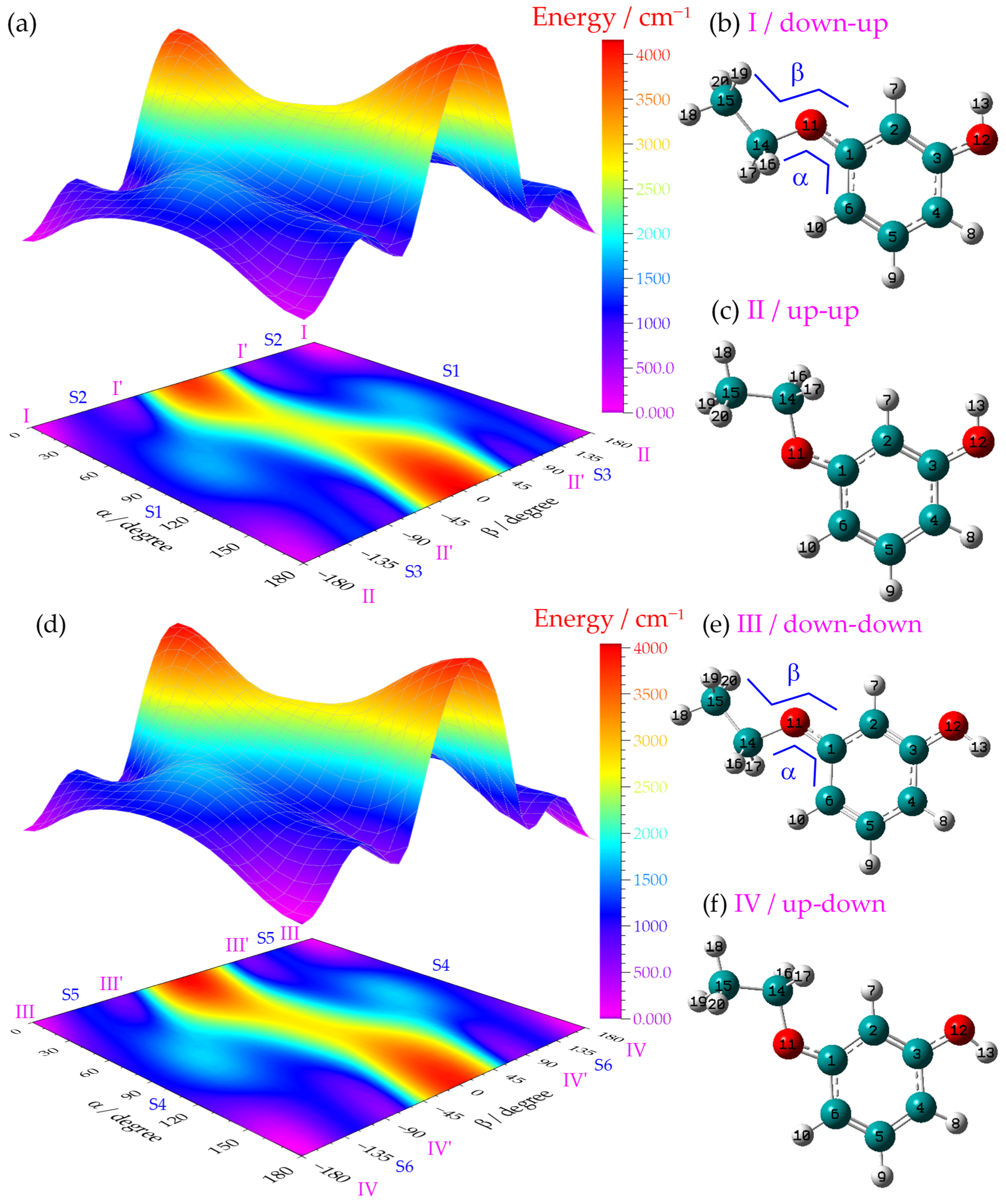
2.1. Theoretical Conformational Landscape of m-Ethoxyphenol
2.2. Vibronic and Hole-Burning Spectra
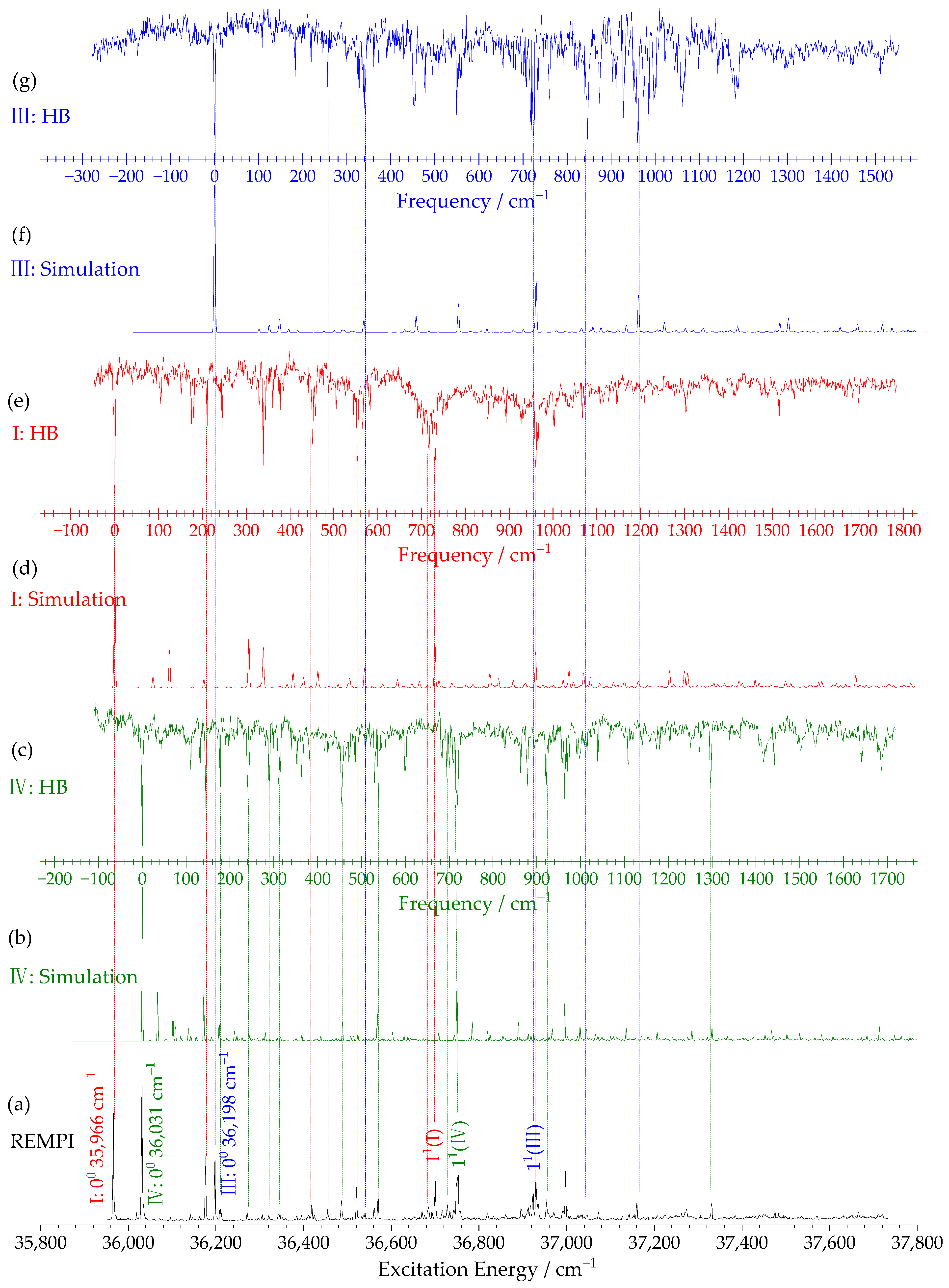
- Ground-state energies: The relative ZPEs (Table 1) predict rotamer IV as the most stable, with rotamers I and III lying slightly higher (48–90 cm−1). Using the Boltzmann distribution, the expected intensity ratio of the 000 bands is IV:I:III ≈ 1:0.8:0.77, consistent with the experimental REMPI intensities.
- Franck–Condon simulations: Figure 2b,d,f display the simulated S1 ← S0 vibronic spectra of rotamers IV, I, and III, calculated at the TD-B3PW91/aug-cc-pVTZ level. The excellent agreement between experimental and simulated spectra for each rotamer provides strong support for the assignment.
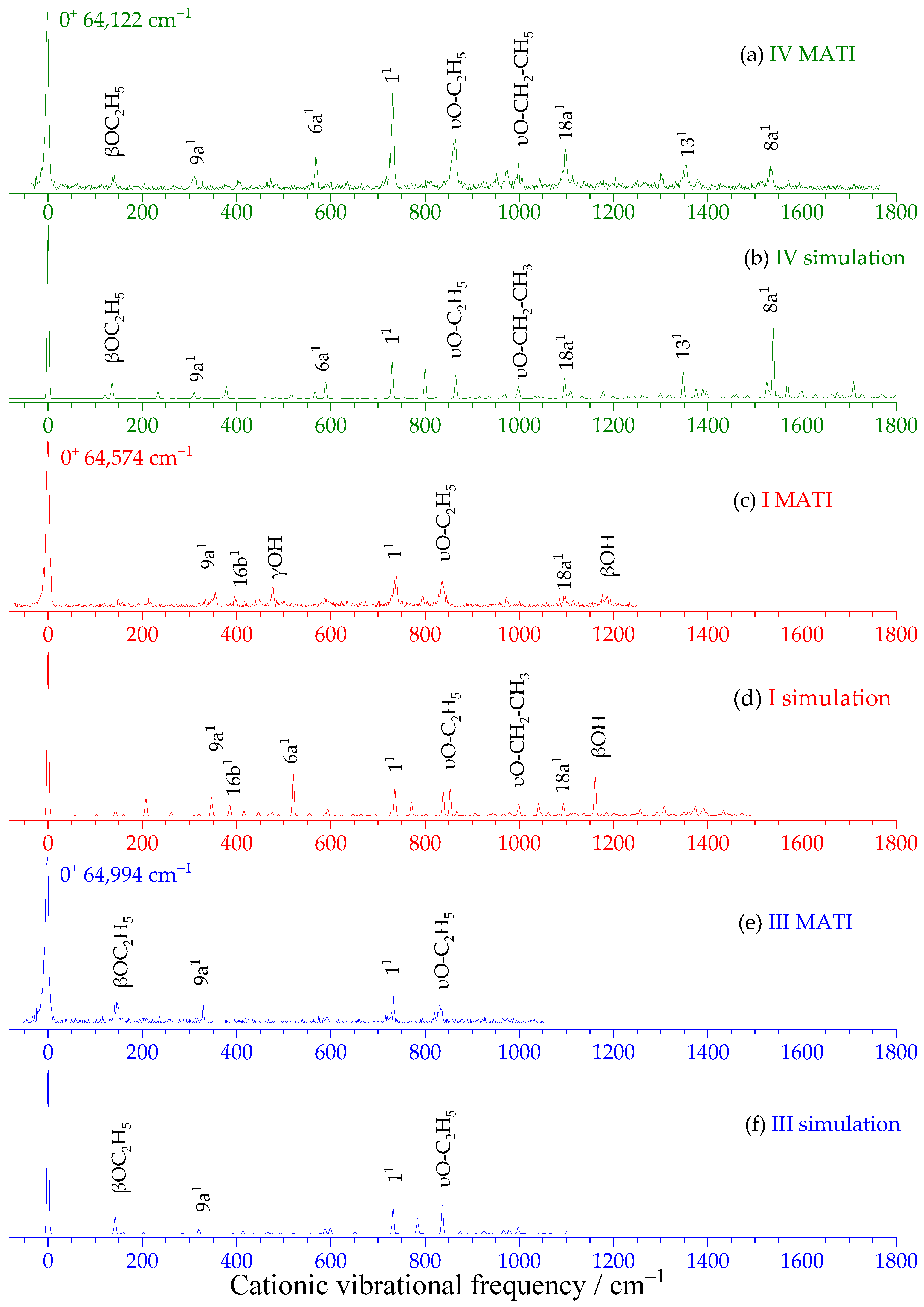
- Ionization energies: As detailed in Section 2.3, the experimentally determined IEs and their relative ordering (IV < I < III) match theoretical predictions.
- Rotamer II absence: Simulated Franck–Condon factors for rotamer II were found to be extremely small, indicating negligible S1 ← S0 transition probability (See Figure S2). This parallels observations for resorcinol or its cluster with CO and water [42,43] and m-methoxyphenol [34,36], where the analogous high-energy rotamer (with both substituents oriented unfavorably) is not observed experimentally due to steric hindrance.
2.3. Cationic Spectra and Ionization Energies
3. Discussion
3.1. Structural Changes upon Electronic Excitation and Ionization
- Upon S1 ← S0 excitation: The benzene ring undergoes slight expansion, with C–C bond lengths increasing by 0.013–0.039 Å. This is consistent with the π* ← π electronic excitation, which weakens the bonding character of the ring carbon–carbon bonds. Concurrently, the C–O bonds (C1–O11 and C3–O12) shorten slightly (by 0.006–0.011 Å), indicating increased double-bond character due to electron redistribution.
- Upon D0 ← S1 ionization: The benzene ring contracts, with C–C bond lengths decreasing by 0.019–0.043 Å relative to the S1 state. The removal of an electron restores and even strengthens the π-bonding character of the cationic ring. The C–O bonds shorten substantially (by 0.030–0.044 Å), reflecting the increased electron density withdrawal toward the positively charged ring. The O11–C14 bond elongates (by 0.033–0.038 Å), suggesting weakening of this bond in the cation.
- Substituent geometry: The C6–C1–O11 bond angle deviates by approximately 4° from the ideal sp2 angle of 120°, suggesting a weak non-covalent interaction between the lone-pair electrons of the ethoxy oxygen and the adjacent hydrogen atoms on the benzene ring. This interaction induces a slight geometric distortion at the substitution site—a feature common to all three rotamers.
- Hydroxyl group orientation: The angular geometry of the hydroxyl group remains nearly unchanged upon S1 ← S0 excitation (Δ < 0.5°), but undergoes a small reorientation (≈3.5°) upon D0 ← S1 ionization, reflecting altered electron density distribution in the cationic state.
3.2. Comparison with m-Methoxyphenol: Substituent Effects
3.3. Absence of Rotamer II
- Franck–Condon factors: The simulated Franck–Condon factors for the S1 ← S0 transition of rotamer II were found to be extremely small (see Supporting Information Figure S2). This is in sharp contrast to rotamers I, III, and IV, where the origin band dominates the spectrum. Such a low Franck–Condon factor for the origin transition would make rotamer II undetectable under typical experimental conditions.
- Steric hindrance: In rotamer II, both the hydroxyl hydrogen and the ethoxy group are oriented “upward” (pointing toward the same side of the ring), creating steric repulsion between the ethoxy and hydroxyl groups. This steric strain elevates the ground-state energy and may also distort the excited-state geometry, further reducing Franck–Condon factors.
4. Materials and Methods
4.1. Experimental Methods
4.2. Theoretical Methods
5. Conclusions
Supplementary Materials
Author Contributions
Funding
Institutional Review Board Statement
Informed Consent Statement
Data Availability Statement
Acknowledgments
Conflicts of Interest
References
- Martinez, S.J.; Alfano, J.C.; Levy, D.H. Rotationally resolved fluorescence excitation spectra of phenol and 4-ethylphenol in a supersonic jet. J. Mol. Spectrosc. 1992, 152, 80–88. [Google Scholar] [CrossRef]
- Song, K.; Hayes, J.M. Supersonic jet spectra of p-alkylphenols. J. Mol. Spectrosc. 1989, 134, 82–97. [Google Scholar] [CrossRef]
- Patwari, G.N.; Doraiswamy, S.; Wategaonkar, S. Spectroscopy and IVR in the S 1 State of Jet-Cooled p -Alkoxyphenols. J. Phys. Chem. A 2000, 104, 8466–8474. [Google Scholar] [CrossRef]
- Fidy, J.; Laberge, M.; Ullrich, B.; Polgar, L.; Szeltner, Z.; Gallay, J.; Vincent, M. Tryptophan rotamers that report the conformational dynamics of proteins. Pure Appl. Chem. 2001, 73, 415–419. [Google Scholar] [CrossRef]
- Dian, B.C.; Longarte, A.; Winter, P.R.; Zwier, T.S. The dynamics of conformational isomerization in flexible biomolecules. I. Hole-filling spectroscopy of N-acetyl tryptophan methyl amide and N-acetyl tryptophan amide. J. Chem. Phys. 2004, 120, 133–147. [Google Scholar] [CrossRef]
- Meyer, E.A.; Castellano, R.K.; Diederich, F. Interactions with aromatic rings in chemical and biological recognition. Angew. Chem. Int. Ed. Engl. 2003, 42, 1210–1250. [Google Scholar] [CrossRef]
- Breen, P.J.; Bernstein, E.R.; Secor, H.V.; Seeman, J.I. Spectroscopic observation and geometry assignment of the minimum energy conformations of methoxy-substituted benzenes. J. Am. Chem. Soc. 1989, 111, 1958–1968. [Google Scholar] [CrossRef]
- Muller-Dethlefs, K.; Schlag, E.W. High-Resolution Zero Kinetic Energy (ZEKE) Photoelectron Spectroscopy of Molecular Systems. Annu. Rev. Phys. Chem. 1991, 42, 109–136. [Google Scholar] [CrossRef]
- Müller-Dethlefs, K.; Schlag, E.W. Chemical Applications of Zero Kinetic Energy (ZEKE) Photoelectron Spectroscopy. Angew. Chem. Int. Ed. 1998, 37, 1346–1374. [Google Scholar] [CrossRef]
- Ketkov, S.Y.; Tzeng, S.Y.; Rychagova, E.A.; Kalakutskaya, L.V.; Fuss, M.; Braunschweig, H.; Tzeng, W.-B. Rydberg state mediated multiphoton ionization of (η7-C7H7)(η5-C5H5)Cr: DFT-supported experimental insights into the molecular and electronic structures of excited sandwich complexes. Phys. Chem. Chem. Phys. 2019, 21, 9665–9671. [Google Scholar] [CrossRef]
- Owusu-Ansah, E.; Cairns, E.; Shi, Y. Characterization of Si atomic transitions using pulsed electric discharge and resonance-enhanced multiphoton ionization techniques. J. Anal. At. Spectrom. 2017, 32, 2423–2432. [Google Scholar] [CrossRef]
- Silva, W.R.; Fitian, M.; Yang, D.-S. Probing La and Ce Excited-State Reactivity with Resonant Two-Photon Ionization Spectroscopy. J. Phys. Chem. A 2022, 126, 7613–7620. [Google Scholar] [CrossRef]
- Zhang, Z.; Wang, Z.; Wang, Q.; Ma, X.; Wang, Z.; Hua, Z.; Yao, G.; Yang, X.; Sun, Z.; Qin, Z.; et al. Photoionization cross sections measurements of the excited states of lutetium and ytterbium in the near threshold region. J. Chem. Phys. 2024, 160, 164201. [Google Scholar] [CrossRef]
- Hua, Z.; Deng, J.; Sun, Z.; Yang, X.; Qin, Z.; Zheng, X. Spectroscopic signatures of the S0, S1, and D0 states of indan: An experimental and theoretical investigation. J. Photochem. Photobiol. A Chem. 2025, 461, 116175. [Google Scholar] [CrossRef]
- Qin, Z.; Ma, N.; Ren, Y.; Zheng, X.; Yao, G.; Zhang, X.; Cui, Z. Analysis of the S1 ← S0 and D0 ← S1 spectra in m-bromofluorobenzene via resonance-enhanced multiphoton ionization and slow electron velocity-map imaging spectroscopy. J. Quant. Spectrosc. Radiat. Transf. 2019, 224, 107–113. [Google Scholar] [CrossRef]
- Harthcock, C.; Zhang, J.; Kong, W.; Mitsui, M.; Ohshima, Y. Electronic spectra and excited-state dynamics of acridine and its hydrated clusters. J. Chem. Phys. 2017, 146, 134311. [Google Scholar] [CrossRef]
- Choi, C.M.; Choi, D.H.; Heo, J.; Kim, N.J.; Kim, S.K. Ultraviolet-ultraviolet hole burning spectroscopy in a quadrupole ion trap: Dibenzo18crown-6 complexes with alkali metal cations. Angew. Chem. Int. Ed. 2012, 51, 7297–7300. [Google Scholar] [CrossRef] [PubMed]
- Kang, H.; Féraud, G.; Dedonder-Lardeux, C.; Jouvet, C. New Method for Double-Resonance Spectroscopy in a Cold Quadrupole Ion Trap and Its Application to UV-UV Hole-Burning Spectroscopy of Protonated Adenine Dimer. J. Phys. Chem. Lett. 2014, 5, 2760–2764. [Google Scholar] [CrossRef] [PubMed]
- Yoo, I.T.; Jeong, J.; Eun, H.J.; Yun, J.; Heo, J.; Kim, N.J. Conformation-Selective Ultraviolet-Ultraviolet Hole Burning Spectra of Ubiquitin Ions in a Cryogenic Ion Trap. J. Phys. Chem. Lett. 2024, 15, 7398–7402. [Google Scholar] [CrossRef]
- Kalal, B.; Maity, S. Non-Traditional Excited-State Deactivation in N-Containing Chromophores: A Combined Spectroscopic and Computational Study. J. Phys. Chem. Lett. 2026, 17, 69–76. [Google Scholar] [CrossRef] [PubMed]
- Singh, S.K.; Mishra, K.K.; Sharma, N.; Das, A. Direct Spectroscopic Evidence for an n→π* Interaction. Angew. Chem. Int. Ed. Engl. 2016, 55, 7801–7805. [Google Scholar] [CrossRef]
- Wang, S.; Shi, Y.; Jakubek, Z.J.; Barnett, M.; Simard, B.; Müller-Dethlefs, K.; Liu, C.-P.; Lee, Y.-P. Nonresonant two-photon mass analyzed threshold ionization and zero kinetic energy photoelectron investigation of the 2B1 ground state of CH2CO+ and CD2CO+. J. Chem. Phys. 2002, 117, 6546–6555. [Google Scholar] [CrossRef]
- Ketkov, S.Y.; Tzeng, S.-Y.; Rychagova, E.A.; Lukoyanov, A.N.; Markin, G.V.; Tzeng, W.-B. Intriguing methylation effects in cobaltocene revealed by high-resolution MATI spectroscopy and ab initio calculations of (η5-C5H4Me)2Co. J. Chem. Phys. 2025, 163, 214302. [Google Scholar] [CrossRef]
- Ketkov, S.Y.; Tzeng, S.-Y.; Rychagova, E.A.; Lukoyanov, A.N.; Tzeng, W.-B. Effect of a single methyl substituent on the electronic structure of cobaltocene studied by computationally assisted MATI spectroscopy. Phys. Chem. Chem. Phys. 2024, 26, 1046–1056. [Google Scholar] [CrossRef]
- Ketkov, S.Y.; Tzeng, S.-Y.; Rychagova, E.A.; Markin, G.V.; Makarov, S.G.; Tzeng, W.-B. Laser spectroscopic and computational insights into unexpected structural behaviours of sandwich complexes upon ionization. Dalton Trans. 2021, 50, 10729–10736. [Google Scholar] [CrossRef] [PubMed]
- Ketkov, S.Y.; Tzeng, S.-Y.; Wu, P.-Y.; Markin, G.V.; Tzeng, W.-B. DFT-Supported Threshold Ionization Study of Chromium Biphenyl Complexes: Unveiling the Mechanisms of Substituent Influence on Redox Properties of Sandwich Compounds. Chemistry 2017, 23, 13669–13675. [Google Scholar] [CrossRef] [PubMed]
- Shi, Y.J.; Wang, S.; Jakubek, Z.J.; Simard, B. A vacuum ultraviolet laser single-photon zero kinetic energy photoelectron spectroscopic study of the 2 E 3/2 ground electronic state of CH 3 Br +. Can. J. Chem. 2004, 82, 1077–1082. [Google Scholar] [CrossRef]
- Lin, J.; Lin, J.L.; Tzeng, W.B. Mass analyzed threshold ionization spectroscopy of N-deuterium substituted indoline cation: Isotope effect on the electronic transition, ionization and molecular vibration. Chem. Phys. Lett. 2003, 371, 662–669. [Google Scholar] [CrossRef]
- Lin, J.; Lin, J.L.; Tzeng, W.B. Mass analyzed threshold ionization spectroscopy of deuterium substituted N-methylaniline and N-ethylaniline cations: Isotope effect on transition energy and large amplitude vibrations. Chem. Phys. 2003, 295, 97–107. [Google Scholar] [CrossRef]
- Wu, L.; Liu, Y.; Zhang, C.; Li, S.; Dixon, D.A.; Yang, D.-S. Mass-analyzed threshold ionization of an excited state of lanthanum dioxide. J. Chem. Phys. 2012, 137, 34307. [Google Scholar] [CrossRef]
- Wu, L.; Zhang, C.; Krasnokutski, S.A.; Yang, D.-S. Mass-analyzed threshold ionization and structural isomers of M3O4 (M = Sc, Y, and La). J. Chem. Phys. 2012, 137, 84312. [Google Scholar] [CrossRef]
- Wu, L.; Roudjane, M.; Yang, D.-S. Structure and Bonding of Sc3C2 and La3C2 Clusters from MATI Spectroscopy and Theoretical Calculations. J. Phys. Chem. A 2025, 129, 9019–9026. [Google Scholar] [CrossRef]
- Nyambo, S.; Zhang, Y.; Yang, D.-S. Reactions of La and Ce with Propylamine: Formation and Threshold Ionization of Lanthanide Imido Radicals. J. Phys. Chem. A 2025, 129, 5570–5578. [Google Scholar] [CrossRef]
- Ullrich, S.; Geppert, W.D.; Dessent, C.E.H.; Müller-Dethlefs, K. Observation of Rotational Isomers I: A ZEKE and Hole-Burning Spectroscopy Study of 3-Methoxyphenol. J. Phys. Chem. A 2000, 104, 11864–11869. [Google Scholar] [CrossRef]
- Geppert, W.D.; Ullrich, S.; Dessent, C.E.H.; Müller-Dethlefs, K. Observation of Rotational Isomers II: A ZEKE and Hole-Burning Spectroscopy Study of Hydrogen-Bonded 3-Methoxyphenol·Water Clusters. J. Phys. Chem. A 2000, 104, 11870–11876. [Google Scholar] [CrossRef]
- Wilke, M.; Schneider, M.; Wilke, J.; Ruiz-Santoyo, J.A.; Campos-Amador, J.J.; González-Medina, M.E.; Álvarez-Valtierra, L.; Schmitt, M. Rotationally resolved electronic spectroscopy study of the conformational space of 3-methoxyphenol. J. Mol. Struct. 2017, 1140, 59–66. [Google Scholar] [CrossRef]
- Zheng, Q.; Fang, T.I.; Zhang, B.; Bih Tzeng, W. Mass-analyzed Threshold Ionization Spectroscopy of Rotamers of p -ethoxyphenol Cations and Configuration Effect. Chin. J. Chem. Phys. 2009, 22, 649–654. [Google Scholar] [CrossRef][Green Version]
- Li, C.; Su, H.; Tzeng, W.B. Rotamers of p-methoxyphenol cation studied by mass analyzed threshold ionization spectroscopy. Chem. Phys. Lett. 2005, 410, 99–103. [Google Scholar] [CrossRef]
- Xu, Y.; Tzeng, S.Y.; Shivatare, V.; Takahashi, K.; Zhang, B.; Tzeng, W.B. Identification of four rotamers of m-methoxystyrene by resonant two-photon ionization and mass analyzed threshold ionization spectroscopy. J. Chem. Phys. 2015, 142, 124314. [Google Scholar] [CrossRef] [PubMed]
- Qin, X.; Duan, C.; Zhao, Y.; Li, C.; Jia, S. Study of Vibronic and Cationic Features of m-Diethoxybenzene via REMPI, Hole-Burning, and MATI Spectroscopy. Int. J. Mol. Sci. 2025, 26, 11818. [Google Scholar] [CrossRef]
- Li, S.; Zhao, Y.; Hu, F.; Jiao, Y.; Zhao, J.; Li, C. The stable conformations and vibronic and cation spectroscopy of 2-ethoxybenzonitrile. J. Mol. Struct. 2023, 1293, 136278. [Google Scholar] [CrossRef]
- Geppert, W.D.; Dessent, C.E.H.; Müller-Dethlefs, K. ZEKE and Hole-Burning Spectroscopy of the Rotational Isomers of Resorcinol·CO. J. Phys. Chem. A 1999, 103, 9687–9692. [Google Scholar] [CrossRef]
- Geppert, W.D.; Dessent, C.E.H.; Ullrich, S.; Müller-Dethlefs, K. Observation of Hydrogen-Bonded Rotational Isomers of the Resorcinol·Water Complex. J. Phys. Chem. A 1999, 103, 7186–7191. [Google Scholar] [CrossRef]
- Varsanyi, G. Assignments of Vibrational Spectra of Seven Hundred Benzene Derivatives; Wiley: New York, NY, USA, 1974. [Google Scholar]
- Varsanyi, G.; Szoke, S. Vibrational Spectra of Benzene Derivatives; Academic Press: New York, NY, USA; London, UK, 1969. [Google Scholar]
- Gerhards, M.; Unterberg, C.; Schumm, S. Structure and vibrations of dihydroxybenzene cations and ionization potentials of dihydroxybenzenes studied by mass analyzed threshold ionization and infrared photoinduced Rydberg ionization spectroscopy as well as ab initio theory. J. Chem. Phys. 1999, 111, 7966–7975. [Google Scholar] [CrossRef]
- Schneider, M.; Wilke, M.; Hebestreit, M.-L.; Ruiz-Santoyo, J.A.; Álvarez-Valtierra, L.; Yi, J.T.; Meerts, W.L.; Pratt, D.W.; Schmitt, M. Rotationally resolved electronic spectroscopy of the rotamers of 1,3-dimethoxybenzene. Phys. Chem. Chem. Phys. 2017, 19, 21364–21372. [Google Scholar] [CrossRef] [PubMed]
- Zhao, Y.; Jin, Y.; Hao, J.; Yang, Y.; Wang, L.; Li, C.; Jia, S. Rotamers of p-isopropylphenol studied by hole-burning resonantly enhanced multiphoton ionization and mass analyzed threshold ionization spectroscopy. Spectrochim. Acta A Mol. Biomol. Spectrosc. 2019, 207, 328–336. [Google Scholar] [CrossRef]
- Li, S.; Zhao, Y.; Jiao, Y.; Zhao, J.; Li, C.; Jia, S. Vibronic and Cationic Features of 2-Fluorobenzonitrile and 3-Fluorobenzonitrile Studied by REMPI and MATI Spectroscopy and Franck-Condon Simulations. Molecules 2023, 28, 4702. [Google Scholar] [CrossRef]
- Li, N.; Li, S.; Wang, L.; Wang, H.; Zhao, J.; Li, C. Vibrational spectra of 2-cyanophenol cation studied by the mass analyzed threshold ionization technique. Chem. Phys. Lett. 2022, 792, 139402. [Google Scholar] [CrossRef]
- Frisch, M.J.; Trucks, G.W.; Schlegel, H.B.; Scuseria, G.E.; Robb, M.A.; Cheeseman, J.R.; Scalmani, G.; Barone, V.; Mennucci, B.; Petersson, G.A.; et al. Gaussian 16 Revision C.01; Gaussian Inc.: Wallingford, CT, USA, 2016. [Google Scholar]
- Perdew, J.P.; Burke, K.; Wang, Y. Generalized gradient approximation for the exchange-correlation hole of a many-electron system. Phys. Rev. B 1996, 54, 16533–16539, Erratum in Phys. Rev. B 1998, 57, 14999. [Google Scholar] [CrossRef]
- Becke, A.D. Density-functional thermochemistry. III. The role of exact exchange. J. Chem. Phys. 1993, 98, 5648–5652. [Google Scholar] [CrossRef]
- Dunning, T.H. Gaussian basis sets for use in correlated molecular calculations. I. The atoms boron through neon and hydrogen. J. Chem. Phys. 1989, 90, 1007–1023. [Google Scholar] [CrossRef]
- Bauernschmitt, R.; Ahlrichs, R. Treatment of electronic excitations within the adiabatic approximation of time dependent density functional theory. Chem. Phys. Lett. 1996, 256, 454–464. [Google Scholar] [CrossRef]
- Laury, M.L.; Boesch, S.E.; Haken, I.; Sinha, P.; Wheeler, R.A.; Wilson, A.K. Harmonic vibrational frequencies: Scale factors for pure, hybrid, hybrid meta, and double-hybrid functionals in conjunction with correlation consistent basis sets. J. Comput. Chem. 2011, 32, 2339–2347. [Google Scholar] [CrossRef]
- Curtiss, L.A.; Redfern, P.C.; Raghavachari, K. Gaussian-4 theory. J. Chem. Phys. 2007, 126, 84108. [Google Scholar] [CrossRef]
- Montgomery, J.A.; Frisch, M.J.; Ochterski, J.W.; Petersson, G.A. A complete basis set model chemistry. VI. Use of density functional geometries and frequencies. J. Chem. Phys. 1999, 110, 2822–2827. [Google Scholar] [CrossRef]
- Guo, M.; He, R.; Dai, Y.; Shen, W.; Li, M.; Zhu, C.; Lin, S.H. Franck-Condon simulation of vibrationally resolved optical spectra for zinc complexes of phthalocyanine and tetrabenzoporphyrin including the Duschinsky and Herzberg-Teller effects. J. Chem. Phys. 2012, 136, 144313. [Google Scholar] [CrossRef]
- Santoro, F.; Lami, A.; Improta, R.; Bloino, J.; Barone, V. Effective method for the computation of optical spectra of large molecules at finite temperature including the Duschinsky and Herzberg-Teller effect: The Qx band of porphyrin as a case study. J. Chem. Phys. 2008, 128, 224311. [Google Scholar] [CrossRef] [PubMed]

| Rotamer | B3LYP/6-311++G(d,p) | B3PW91/6-311++G(d,p) | B3LYP/aug-cc-pVTZ | B3PW91/aug-cc-pVTZ |
|---|---|---|---|---|
| I/down-up | 58 | 61 | 47 | 48 |
| II/up-up | 226 | 226 | 200 | 198 |
| III/down-down | 90 | 90 | 66 | 65 |
| IV/up-down | 0 | 0 | 0 | 0 |
| I’ | 644 | 620 | 639 | 628 |
| II’ | 839 | 813 | 823 | 810 |
| III’ | 678 | 652 | 663 | 649 |
| IV’ | 593 | 569 | 596 | 585 |
| I | IV | III | Assignment b | ||||||
|---|---|---|---|---|---|---|---|---|---|
| Energy | Shift | Calc. | Energy | Shift | Calc. | Energy | Shift | Calc. | |
| 35,966 | 0 | 0 | 36,031 | 0 | 0 | 36,198 | 0 | 0 | 00 |
| 36,176 | 145 | 140 | βOC2H5 | ||||||
| 36,177 | 211 | 204 | 10a1 | ||||||
| 36,210 | 179 | βOC2H5δOC2H5 | |||||||
| 36,271 | 239 | 238 | 10b1 | ||||||
| 36,455 | 257 | τCH3 | |||||||
| 36,320 | 289 | βOC2H52 | |||||||
| 36,346 | 315 | βOC2H52δOC2H5 | |||||||
| 36,305 | 339 | 339 | 36,538 | 340 | 339 | 9a1 | |||
| 36,417 | 451 | 463 | 36,486 | 455 | 457 | 36,652 | 454 | 457 | 6b1 |
| 36,519 | 553 | 570 | 36,570 | 539 | 536 | 36,747 | 549 | 553 | 6a1 |
| 36,698 | 732 | 731 | 36,750 | 719 | 718 | 36,922 | 724 | 730 | 11 |
| 36,953 | 922 | 935 | 18b1 | ||||||
| 36,927 | 961 | 960 | 36,995 | 964 | 964 | 37,158 | 960 | 962 | 121 |
| 37,330 | 1299 | 1300 | 131 | ||||||
| Isomer | S0 Relative Energy | D0 Relative Energy | IE | ||||||
|---|---|---|---|---|---|---|---|---|---|
| G4 | CBS-QB3 | G4 | CBS-QB3 | Exp. | G4 | Error | CBS-QB3 | Error | |
| I | 50 | 50 | 718 | 714 | 64,574 | 64,373 | −201 | 65,116 | 542 |
| II | 207 | 203 | 0 | 0 | 63,497 | 64,249 | |||
| III | 70 | 65 | 1183 | 1112 | 64,994 | 64,817 | −177 | 65,500 | 506 |
| IV | 0 | 0 | 198 | 187 | 64,122 | 63,902 | −220 | 64,639 | 517 |
| I | IV | III | Assignment b | |||
|---|---|---|---|---|---|---|
| Exp. | Calc. | Exp. | Calc. | Exp. | Calc. | |
| 141 | 136 | 146 | 142 | βOC2H5 | ||
| 355 | 347 | 311 | 310 | 330 | 320 | 9a1 |
| 395 | 396 | 16b1 | ||||
| 476 | 476 | γOH | ||||
| 568 | 566 | 6a1 | ||||
| 739 | 736 | 731 | 730 | 733 | 732 | 11 |
| 836 | 823 | 865 | 865 | 830 | 837 | νO-C2H5 |
| 998 | 998 | νO-CH2-CH3 | ||||
| 1098 | 1094 | 1098 | 1096 | 18a1 | ||
| 1176 | 1161 | βOH | ||||
| 1354 | 1347 | 131 | ||||
| 1532 | 1539 | 8a1 | ||||
| Rotamer | m-Ethoxyphenol a | m-Methoxyphenol b | ΔE1 | ΔIE | ||
|---|---|---|---|---|---|---|
| E1 | IE | E1 | IE | |||
| I | 35,966 | 64,574 | 35,974 | 65,228 | −8 | −654 |
| IV | 36,031 | 64,122 | 36,034 | 64,741 | −3 | −619 |
| III | 36,198 | 64,994 | 36,202 | 65,648 | −4 | −654 |
Disclaimer/Publisher’s Note: The statements, opinions and data contained in all publications are solely those of the individual author(s) and contributor(s) and not of MDPI and/or the editor(s). MDPI and/or the editor(s) disclaim responsibility for any injury to people or property resulting from any ideas, methods, instructions or products referred to in the content. |
© 2026 by the authors. Licensee MDPI, Basel, Switzerland. This article is an open access article distributed under the terms and conditions of the Creative Commons Attribution (CC BY) license.
Share and Cite
Qin, X.; Zhao, Y.; Zhang, K.; Wang, R.; Ji, Z.; Li, C.; Jia, S. Spectroscopic Identification and Characterization of Three Rotamers of m-Ethoxyphenol: Combined REMPI, MATI, and Quantum Chemical Study. Int. J. Mol. Sci. 2026, 27, 4166. https://doi.org/10.3390/ijms27104166
Qin X, Zhao Y, Zhang K, Wang R, Ji Z, Li C, Jia S. Spectroscopic Identification and Characterization of Three Rotamers of m-Ethoxyphenol: Combined REMPI, MATI, and Quantum Chemical Study. International Journal of Molecular Sciences. 2026; 27(10):4166. https://doi.org/10.3390/ijms27104166
Chicago/Turabian StyleQin, Xiateng, Yan Zhao, Keke Zhang, Rui Wang, Zhonghua Ji, Changyong Li, and Suotang Jia. 2026. "Spectroscopic Identification and Characterization of Three Rotamers of m-Ethoxyphenol: Combined REMPI, MATI, and Quantum Chemical Study" International Journal of Molecular Sciences 27, no. 10: 4166. https://doi.org/10.3390/ijms27104166
APA StyleQin, X., Zhao, Y., Zhang, K., Wang, R., Ji, Z., Li, C., & Jia, S. (2026). Spectroscopic Identification and Characterization of Three Rotamers of m-Ethoxyphenol: Combined REMPI, MATI, and Quantum Chemical Study. International Journal of Molecular Sciences, 27(10), 4166. https://doi.org/10.3390/ijms27104166

