Article

A Computational Investigation of the 15N Chemical Shift Behavior of Strychnos Alkaloids

by
Valentin A. Semenov
1,
Leonid B. Krivdin
1 and
Gary E. Martin
2,*
1
A. E. Favorsky Irkutsk Institute of Chemistry, Siberian Branch of the Russian Academy of Sciences, Favorsky St. 1, 664033 Irkutsk, Russia
2
Department of Chemistry and Biochemistry, Seton Hall University, 400 South Orange Ave., South Orange, NJ 07079, USA
*
Author to whom correspondence should be addressed.
Int. J. Mol. Sci. 2026, 27(9), 3840; https://doi.org/10.3390/ijms27093840
Submission received: 3 April 2026 / Revised: 23 April 2026 / Accepted: 24 April 2026 / Published: 26 April 2026

Abstract

Members of the broad family of Strychnos alkaloids have been the favorite molecules for the development and evaluation of new NMR methods for many years, including the establishment of the 1H-15N two-dimensional NMR methods. The present study is an effort to computationally evaluate the 15N chemical shift behavior of eight members of this structurally diverse group of indole alkaloids. The molecules range from relatively “simple” strychnine and brucine and their respective N-oxides to molecules as complex as vinorelbine, a synthetic analog used in cancer chemotherapy, and sungucine, a naturally occurring complex dimeric member of the family. The 20 15N chemical shifts in this study afforded a CMAE of 2.96 ppm and an RMSD of 3.50 ppm, with the data affording a correlation coefficient, r = 0.997.

1. Introduction

“Strychnine!” Woodward began a seminal account of the total synthesis of the complex indole alkaloid strychnine published in Tetrahedron [1] in 1963 with that single exclamation. In an earlier paper Woodward referred to the strychnine using the following quote: “The tangled skein of atoms which constitutes its molecule provided a fascinating structural problem which was pursued intensively during the century just past, and was solved finally only within the last decade” [2]. All of this work was, of course, before the development of modern pulsed NMR techniques and far preceded the development of two-dimensional (2D) NMR techniques that are now routinely employed to solve complex chemical structure problems. Well, after the development of 2D NMR methods that routinely focus on the 1H and 13C nuclei, it became possible to study 15N at natural abundance [3,4]. In the intervening years, numerous reviews and chapters appeared on various aspects and applications of 15N NMR in small molecules including alkaloids by a number of authors, to which readers are referred for more details [5,6,7,8,9,10,11,12,13].
Strychnine has been employed for many years by one of the authors of this paper as a test compound for the development and evaluation of new heteronuclear 1H-13C, 1H-15N, and homonuclear 13C-13C NMR two-dimensional (2D) techniques. The compound is readily available globally, which allowed authors to directly reproduce reported experimental results using new NMR experiments in their own laboratories prior to embarking on the elucidation of unknown structures using such methods. Thus, the choice of strychnine (1) as a model compound for early investigations of long-range 1H-15N HMBC was a logical choice. More recently, with the development of the LR-HSQMBC experiment in 2014 [14], even longer-range 1H-15N correlations that would be obliterated by the magnitude calculation processing used with HMBC data can be observed [15].
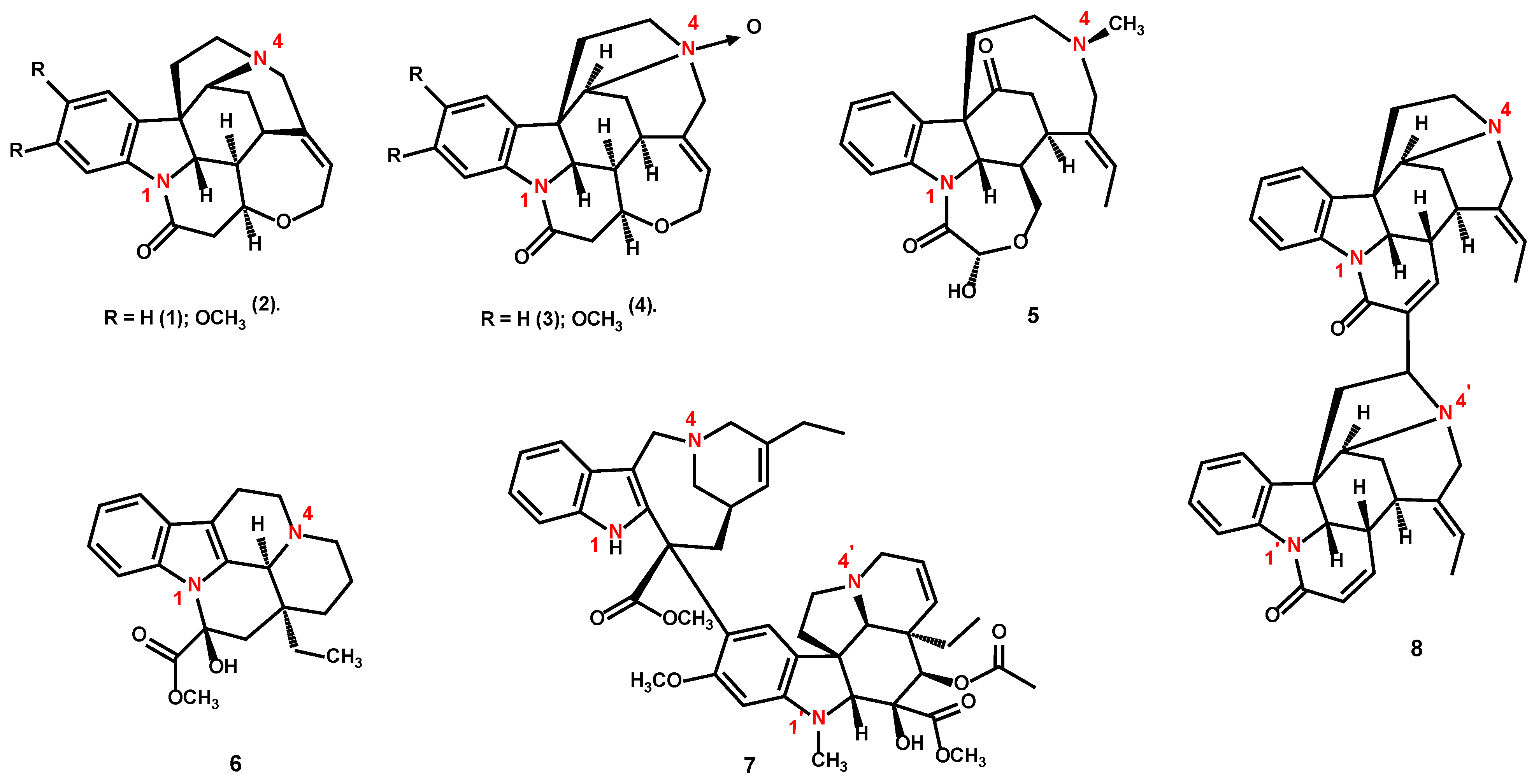
Given the importance of nitrogen in molecules ranging from pharmaceuticals to alkaloids, it was appropriate to initiate an investigation into the applicability of 15N chemical shift calculation methodology for the prediction of 15N chemical shifts. Taking into account the frequent usage of Strychnos alkaloids as model compounds for the development and evaluation of new two-dimensional (2D) NMR experiments, these were again a logical choice for this investigation. The ensemble of Strychnos alkaloids used in this investigation is shown in Scheme 1.

2. Results and Discussion

The interpretation of the NMR spectra of Strychnos alkaloids, each containing several asymmetric centers, is a difficult and sometimes challenging task. In the series of Strychnos alkaloids, 18, investigated in this study, there are a large number of hydrogen and carbon atoms that have a similar stereoelectronic environment and, as a result, very similar or even equivalent NMR chemical shifts. Very often, 1H NMR spectra of such alkaloids present superposition of several individual multiplets of the second or even higher order providing complicated unresolved patterns, which are sometimes very difficult to analyze. This is even more difficult in the light of magnetic nonequivalence of protons located in the axial and equatorial positions of condensed cyclic compounds, the latter providing the general constitution of monoterpene indole alkaloids. Unambiguous interpretation of NMR spectra is a guiding thread in the spectral interpretation of natural products using an array of homo- and heteronuclear 2D-NMR techniques [13,16,17], including techniques like the newly reported i-HMBC experiment [18] and anisotropic NMR methods to resolve stereochemical concerns [19,20,21,22].
In some cases, certain spectral inconsistencies and ambiguities may occur that can be resolved only using heteronuclear correlations involving the 15N nucleus. The knowledge of characteristic ranges of 15N NMR chemical shifts obtained using high-level theoretical calculations could significantly simplify this task, as demonstrated in this paper. The present study continues our series of papers [23,24,25,26] dealing with the stereochemical analysis of natural bisindole alkaloids.
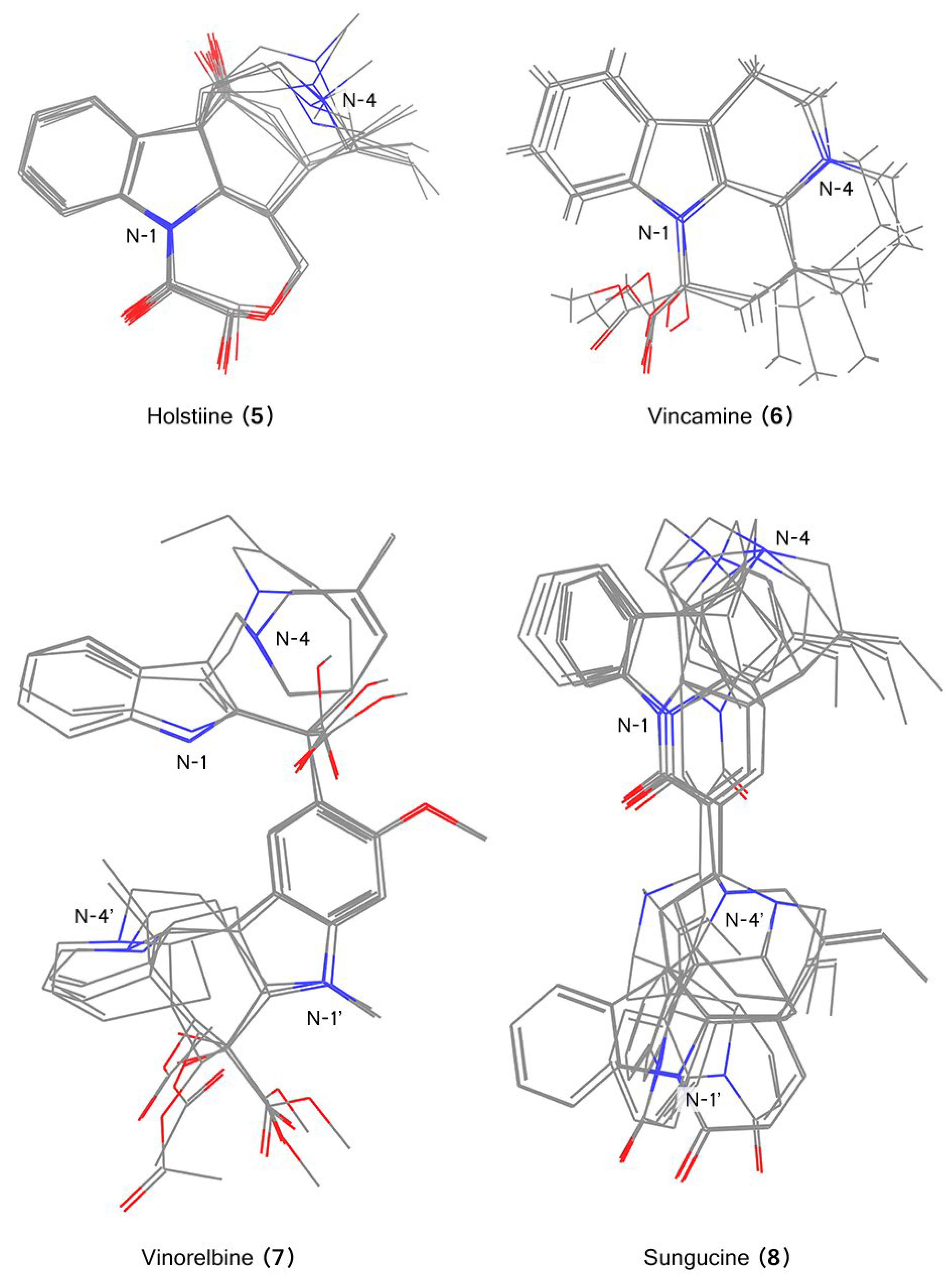
At the initial stage of this study, we performed a conformational scrutiny of 18, which revealed several groups of low-energy conformers for each of the alkaloids from this series. Details of the conformational search, optimization of geometric parameters, and calculation of shielding constants are provided in Materials and Methods. The spatial structures of the most interesting low-energy groups of conformers of compounds 58 are presented in Figure 1, while Cartesian coordinates of all calculated structures are given in Supplementary Materials.
It is well known that averaged 1H NMR signals in solution are determined by a set of the most probable conformers [27,28]. Therefore, as a rule, when modeling NMR chemical shifts, the values of shielding constants weighted according to the Boltzmann distribution are used with individual coefficients depending on the free energy of each of the conformers. However, it has recently been convincingly shown that even the prototypically rigid strychnine 1 exhibits conformational dynamics on the NMR timescale [29]. Therefore, for the monomeric alkaloids 16, the averaged structural parameters resulting from this rapid exchange are well known, and we relied on the known averaged conformations, which provide an appropriate basis for 15N chemical shift calculations. Since the proportion of minor conformers is typically less than 10%, their contribution to the averaged 15N chemical shift is within the computational error. For this reason, in this study, no Boltzmann averaging of 15N NMR chemical shifts was performed, and the saturated ring conformations in compounds 16 were predetermined when constructing the spatial structures of the molecules. The conformational distribution of compounds 7 and 8 primarily represents the distribution of their static rotamers around the C-16′–C-17′ bond, as shown in Figure 1.
Calculations of the free energies of those rotamers performed at the M06-2X/pecG-2 level have shown that corresponding rotation barriers were up to 15 kcal/mol. According to the Eyring Equation (1), the lifetime of each rotamer at 298 K is about 16 ms. The difference in the 15N chemical shifts in various rotamers is up to 30 ppm, which at a frequency of 41 MHz (at B0 = 9.4 T) for 15N corresponds to Δν ≈ 1200 Hz. At the same time, the actual lifetimes of rotamers are an order of magnitude higher than the threshold of rapid exchange in the 15N NMR time scale (being 0.13 ms), which means that no conformational averaging exists. Each rotamer gives individual, non-averaging signals, and the experimental spectrum is a superposition of the spectra of all rotamers present in the sample [27]. Thus, a standard Boltzmann averaging procedure, which assumes rapid interconversion and is routinely applied to flexible systems, is physically inapplicable to the studied alkaloids 7 and 8. It follows that there is no point in performing correlation analysis of calculated NMR chemical shifts for untrue conformers.
It should also be noted that for molecules of this size, i.e., having more than 40–50 non-hydrogen atoms, the systematic error in calculating the relative free energies at the DFT level, which is of the order of 0.5–1.0 kcal/mol, is comparable to the difference in energy that could lead to a significant redistribution of populations, or even exceed them. In this regard, instead of the mathematically unjustified Boltzmann averaging, we applied here a strategy of the “manual” selection of rotamers, with the main criterion of the best correlation between calculated and experimental 15N NMR chemical shifts, rather than thermodynamic reasoning. Calculated 15N NMR chemical shifts in all found low-energy conformers of 18 are provided in Table S1, see Supplemental Materials.
In the next step, geometric parameters of all groups of favorable conformers in the series of all alkaloids 18 were refined using the higher-level optimization within the framework of DFT using the Minnesota functional M06-2X. To describe atomic orbitals, we used our newest basis set pecG-2. This basis set was specially optimized to find the most accurate equilibrium geometry by taking into account interatomic bond lengths.
Next, for the optimized structures of all conformers in the series of 18, the shielding constants together with the corresponding NMR chemical shifts were calculated within the GIAO-PBE0/pecS-2//aug-pecS-2 scheme. Calculation of shielding constants was performed using effective basis sets of the pecS-2 family, optimized for calculations of large synthetic organic molecules and natural products. Since for the nitrogen atom it is necessary to more accurately account for the atomic orbitals describing its lone pair, in this case, the aug-pecS-2 basis set was used, the latter extended by diffuse functions to describe the regions of spin density being far from the nucleus, see Materials and Methods (Part 3). The influence of solvation effects, which are particularly pronounced for 15N NMR chemical shifts, was accounted for using the framework of Tomasi’s Polarizable Continuum Model, IEF-PCM.
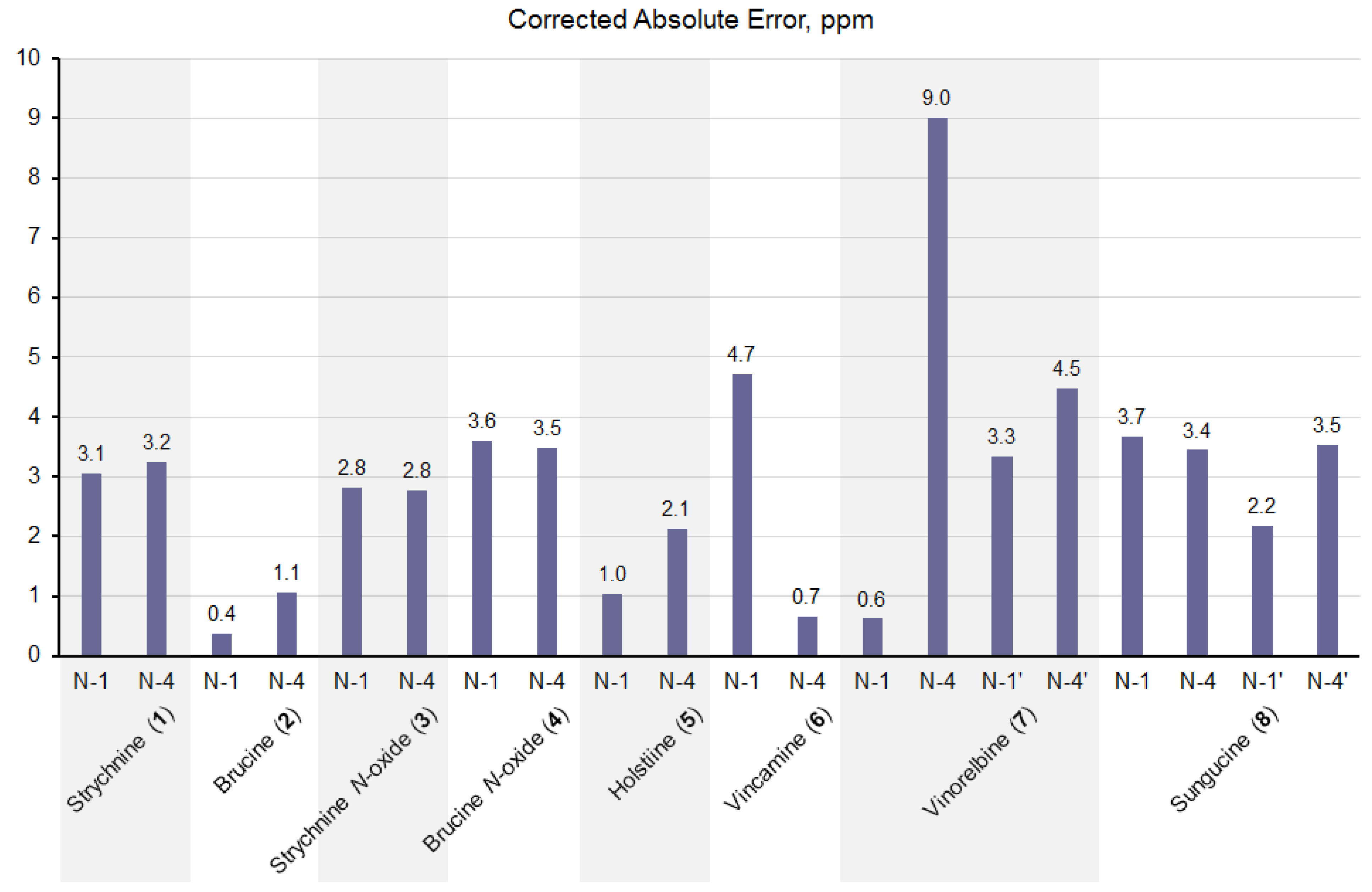
Calculated 15N NMR chemical shifts were then used for the correlation with known experimental data. For establishing the stereochemistry of 18, we applied our general workflow, originally proposed for the analysis of stereochemically rich natural products [30]. This estimation was performed for all conformers of compounds 18 using the well-known statistical descriptors, such as Corrected Mean Absolute Error (CMAE), Root Mean Square Deviation (RMSD), and Pearson correlation coefficient, evaluated accordingly with the Equations (2)–(4), see Materials and Methods. The results of the performed calculations based on CMAE are exemplified in Figure 2.
As shown by these data, a good correlation was obtained between the calculated and the experimental 15N NMR chemical shifts for 18. The average absolute deviation was found to be in the range of 0.7–4.5 ppm, which is a very good result compared with the data we obtained previously for small nitrogen-containing organic compounds [31,32,33]. The only questionable issue concerns the interpretation of the signal, which can be assigned to the N-4 atom in vinorelbine (7); this point will be discussed in more detail below.
Table 1 shows the calculated 15N NMR chemical shifts for each nitrogen atom in compounds 18, as compared to available experimental data. For clarity, relative deviations are given with their signs taken into account.
It should also be noted that for all eight Strychnos-type analogs studied in this paper, the established absolute configurations of their asymmetric centers located on carbons and nitrogens were found to be in good agreement with the present results. As has already been mentioned, the only clearly identified ambiguity was associated with the signal of the N-4 atom in vinorelbine (7). Since the N-4 atom in the quinolizidine C/D system of Strychnos alkaloids almost always adopts the 4R configuration, in the present study, we considered that the eight-membered C/E ring “inherited” the same 4R configuration from the quinolizidine C/D system. However, for all of the calculated low-energy conformers 7ac (see Supporting Information for coordinates), the upfield deviation of the N-4 chemical shift is about +(9.0–9.9) ppm. An important clarification to be made here is that the absence of conformational averaging between rotamers around the C-16′–C-17′ bond does not at all imply the absence of low-frequency dynamic vibrations in the framework of stable conformations of the eight-membered C/E ring within each of the rotamers of 7. The C/E ring exhibits fast, low-barrier bending motions occurring on the 10−9–10−12 second range of the NMR time scale. A stable-state DFT calculation searching for a single minimum on the PES does not adequately estimate this type of fast averaging. We believe that this limitation likely explains the persistent upfield bias of the calculated N-4 chemical shift in all of the C/E conformations ac of 7.
To exclude the possibility of an incorrect assignment of the N-4 atom configuration in vinorelbine 7, we attempted to optimize the 4S diastereomer at the M06-2X/pecG-2 level. All optimization attempts converged on the 4R configuration, indicating that the 4S diastereomer does not correspond to a local minimum on the PES. This is consistent with the severe steric constraints imposed by the eight-membered C/E ring and with the biogenetic hypothesis, according to which the N-4 atom of the C/D quinolizidine system of Strychnos alkaloids usually adopts the 4R configuration. Therefore, the consistent upfield bias of the calculated N-4 chemical shift is indeed explained by the dynamic lability of the eight-membered ring and not by an error in the determination of the N-4 configuration.
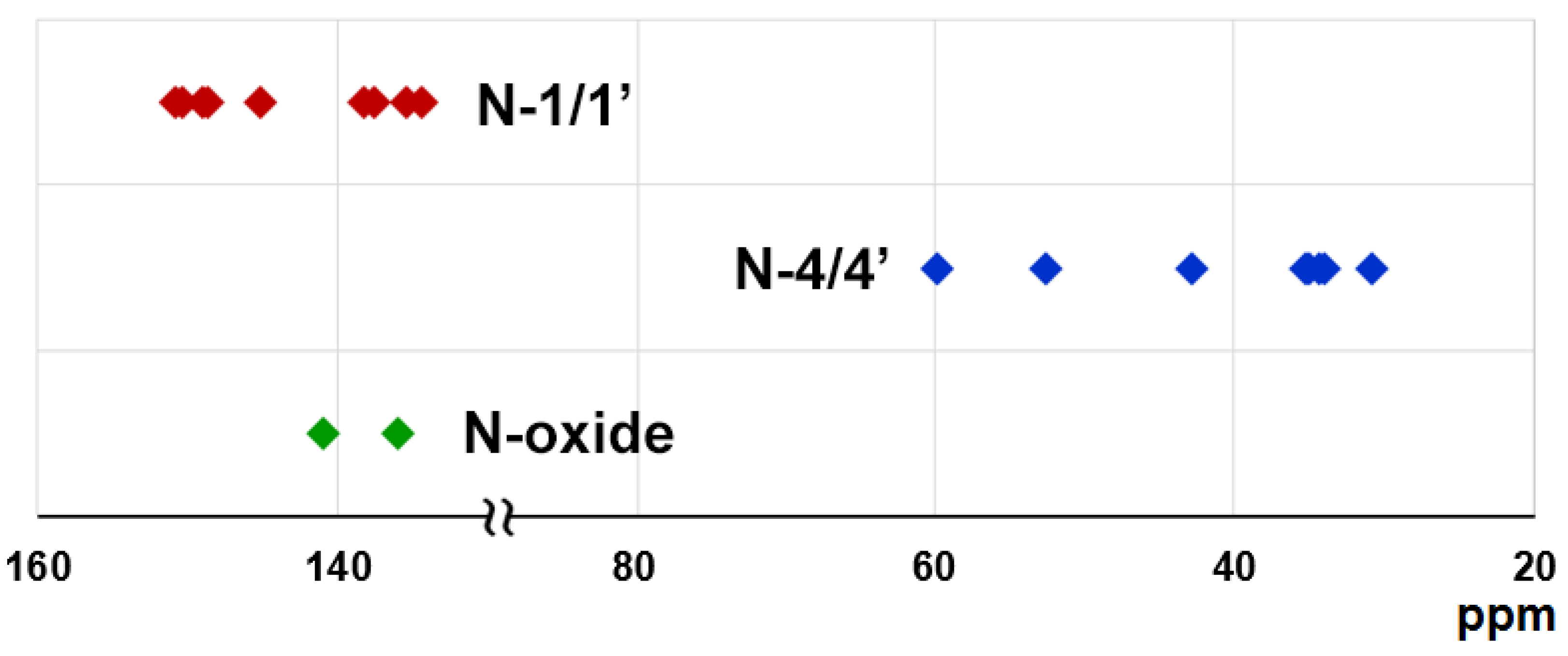
Further, based on the calculated 15N NMR chemical shifts in alkaloids 18, a diagram showing the characteristic ranges of nitrogen shifts was created for the nitrogen atoms N-1/1′, N-4/4′, as well as for the oxide nitrogen atom in the N⟶O stereoelectronic state (see Figure 3). Overall, despite the fairly “predictable” nature of the high-field nitrogen atom of the amine-type N-4/4′, the scatter of 15N NMR chemical shift values was more than 30 ppm, which warrants a more detailed study.
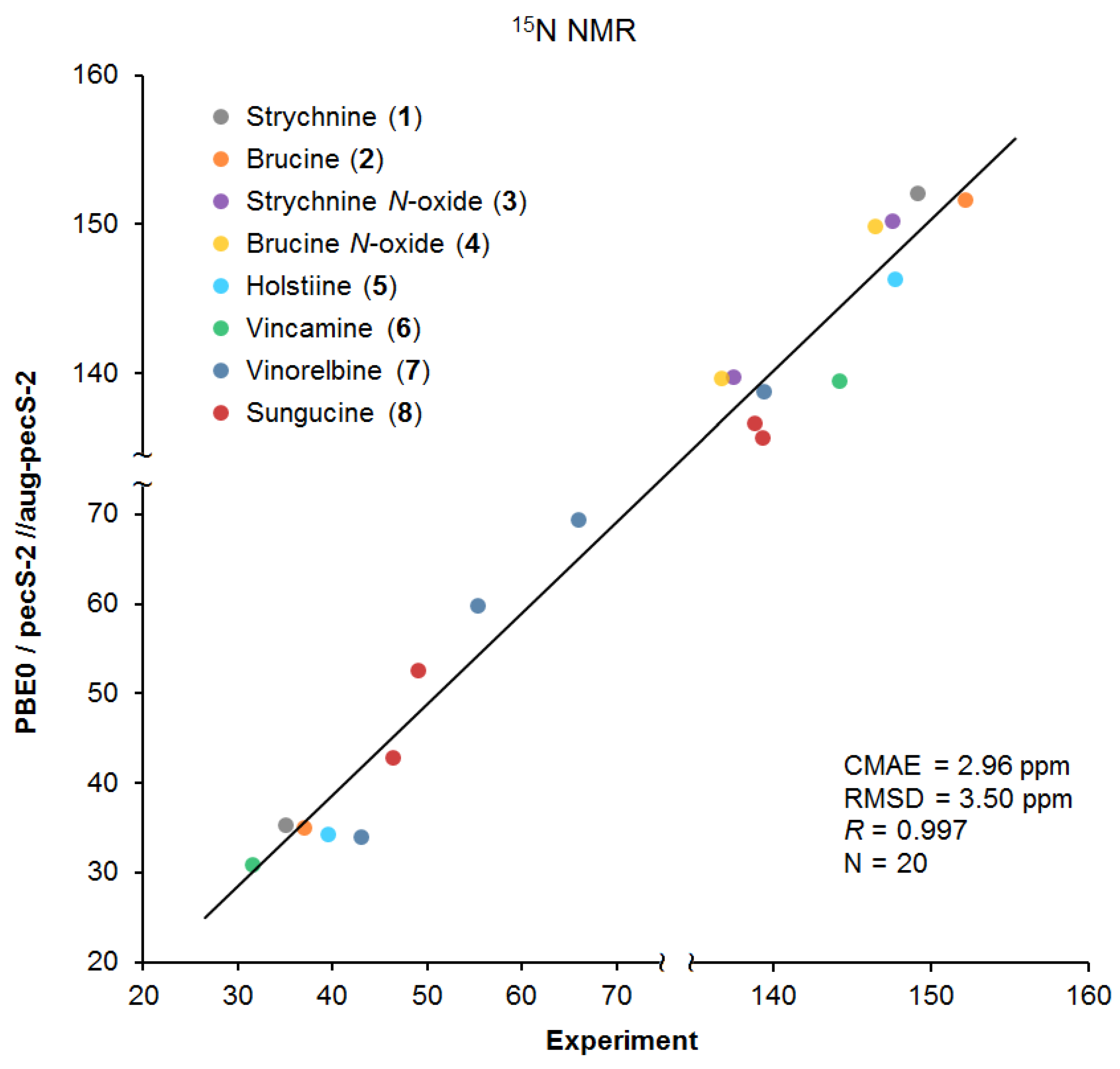
As a final illustration, Figure 4 displays a correlation graph of experimental and calculated 15N NMR chemical shifts in the series of 18. These results demonstrate acceptable accuracy of the proposed calculation protocol for the stereochemical analysis of natural Strychnos-type alkaloids. The observed integral errors CMAE (evaluated here for the most probable conformers) do not exceed 3 ppm, which is approximately 2% of the entire range of the observed 15N NMR chemical shifts. The RMSD is 3.5 ppm, and the correlation coefficient is very close to one. The complete set of experimental and calculated 15N NMR chemical shifts is provided in Table S1, see Supporting Information.

3. Materials and Methods

3.1. Conformational Search and Optimization of Geometric Parameters

The initial conformational search of alkaloids 18 was performed using the OPLS3 force field in the liquid phase of a particular solvent, employing the MacroModel module implemented in the Schrödinger Maestro package [38]. During this search, approximately 105 steps were performed to identify the most probable conformers/rotamers. Subsequently, the unique conformations of the alkaloids were identified and subjected to further geometry optimization using the Gaussian 09 code [39] at the M06-2X/pecG-2 level [40,41]. In this study, we utilized new, efficient pecG-2 basis sets of atomic orbital exponentials for geometric parameter optimization. These basis sets were generated in our laboratory using the simultaneous property-energy-consistent (PEC) algorithm [42], which aims to minimize the molecular energy gradient relative to interatomic bond lengths. The performance of these basis sets was previously tested using both theoretical data and experimental gas-electron diffraction data relative to other popular basis sets commonly used for geometry optimization of molecular structures, including natural products [43,44]. The solvation effect of each particular solvent was accounted for using the IEF-PCM model developed by Tomasi [45,46].

3.2. Modeling (Calculation) of Shielding Constants

Calculations of 15N NMR isotropic magnetic shielding constants and corresponding chemical shifts were carried out at the GIAO-DFT level in the liquid phase of a particular solvent using the Gaussian 09 program. In these calculations, we employed the one-parameter hybrid functional PBE0 [47], which was used in combination with Rusakov’s basis sets aug-pecS-2 on the nitrogen atoms and pecS-2 on the rest of the atoms [48,49,50]. The solvation effect of each particular solvent in all NMR calculations was taken into account within the IEF-PCM model.
To take into account systematic errors of calculated chemical shifts, we have established correlations between their experimental chemical shifts (x) and isotropic magnetic shielding constants (y), which were further used to find the linear correlation equations of the y = ax + b type. The parameters a and b were then used for recalculating theoretical chemical shifts using the equation δrecalc = (σcalcb)/a.
The average lifetimes of conformers were calculated as the reciprocal of the rate constant of the interconformational transition:
τ =   1 k = 1 k B T h · e G R T
where k is the rate constant of the interconformational transition; kB is the Boltzmann constant; T is the temperature at observed transition conditions; h is Planck’s constant; ΔG is the free energy of activation of an interconformational transition; R is the universal gas constant.
Corrected Mean Absolute Errors (CMAE) were calculated as:
C M A E =   i = 1 n δ e x p σ c a l c b a n
where σcalc are the unscaled shielding constants for each of the n nuclei in the molecule, while a and b are the slope and intercept of the linear regression σcalc = exp + b.
The Root-Mean-Square Deviations (RMSD) were evaluated as:
R M S D = i = 1 n ( δ e x p δ c a l c ) 2 n
where δexp and δcalc are accordingly, experimental and scaled chemical shifts in each of the n nuclei.
The Pearson correlation coefficients r were calculated as
r ( δ e x p , δ c a l c ) = i = 1 n ( δ e x p i = 1 n δ e x p n ) ( δ c a l c i = 1 n δ c a l c n ) i = 1 n ( δ e x p i = 1 n δ e x p n ) 2 i = 1 n ( δ c a l c i = 1 n δ c a l c n ) 2
where δexp and δcalc are the experimental and scaled NMR chemical shifts in each of the n nuclei, respectively.

4. Conclusions

In the present study, we have computationally evaluated the behavior of 15N NMR chemical shifts in eight members of the structurally diverse group of indole alkaloids, ranging from relatively simple strychnine and brucine and their N-oxides to much larger molecules vinorelbine and sungucine. For this purpose, a strategy of the “manual” selection of rotamers, with the main criterion of the best correlation between calculated and experimental 15N NMR chemical shifts, was applied rather than thermodynamic reasoning.
A very good correlation was obtained between the calculated and experimental 15N NMR chemical shifts in the series of 18. The average absolute deviation was found to be in the range of 0.7–4.5 ppm, which is a very good result compared with the data we obtained previously for small nitrogen-containing organic compounds. It followed that observed integral errors CMAE (evaluated for the most probable conformers of this series) did not exceed 3 ppm, which is approximately 2% of the entire range of observed 15N NMR chemical shifts. At that, the RMSD was 3.5 ppm.
The only clear ambiguity was associated with the signal of the N-4 atom in vinorelbine (7). For all of the calculated low-energy conformers of this alkaloid, the upfield deviation of the N-4 chemical shift was found to be of about +(9.0–9.9) ppm. We believe that this is due to the high dynamical mobility of the eight-membered C/E ring, which cannot be fully taken into account when calculating the stable states. Despite the fairly predictable nature of the high-field nitrogen atom of the amine-type N-4/4′, the range of 15N NMR chemical shifts was found to exceed 30 ppm.

Supplementary Materials

The following supporting information can be downloaded at: https://www.mdpi.com/article/10.3390/ijms27093840/s1.

Author Contributions

Investigation, methodology, visualization, writing—original draft preparation—V.A.S.; resources, validation, data curation, writing—review and editing, supervision—G.E.M.; data curation, writing—review and editing, supervision, project administration—L.B.K. All authors have read and agreed to the published version of the manuscript.

Funding

This research received no external funding.

Data Availability Statement

The original contributions presented in this study are included in the article and Supplementary Materials. Further inquiries can be directed to the corresponding author.

Acknowledgments

All calculations were performed at Irkutsk Supercomputer Center of the Siberian Branch of the Russian Academy of Sciences using the HPC cluster “Academician V.M. Matrosov” (http://hpc.icc.ru, accessed on 12 April 2026) and at A.E. Favorsky Irkutsk Institute of Chemistry using the facilities of Baikal Analytical Center (http://ckp-rf.ru/ckp/3050, accessed on 12 April 2026).

Conflicts of Interest

The authors declare no conflicts of interest.

References

  1. Woodward, R.B.; Cava, M.P.; Ollis, W.D.; Hunger, A.; Daeniker, H.U.; Schenker, K. The total synthesis of strychnine. Tetrahedron 1963, 19, 247–288. [Google Scholar] [CrossRef]
  2. Woodward, R.B.; Cava, M.P.; Ollis, W.D.; Hunger, A.; Daeniker, H.U.; Schenker, K. The total synthesis of strychnine. J. Am. Chem. Soc. 1954, 76, 4749–4751. [Google Scholar] [CrossRef]
  3. Martin, G.E.; Crouch, R.C.; Sharaf, M.H.M.; Schiff, P.L., Jr. H-15N Direct and long-range heteronuclear shift correlation techniques—Potential applications. In Proceedings of the 34th Annual Meeting of the American Society of Pharmacognosy, San Diego, CA, USA, 18–22 July 1993. Poster #101. [Google Scholar]
  4. Uzawa, J.; Utumi, H.; Koshino, H.; HInomoto, T.; Anzai, K. Fungerin, a new antifungal alkaloid from Fusarium sp. In Proceedings of the 32nd NMR Conference, Tokyo, Japan, 4–6 November 1993; pp. 147–150. Biosci. Biotechn. Biochem. 1996, 60, 2081–2083. [Google Scholar]
  5. Martin, G.E.; Crouch, R.C. Inverse-detected 2D NMR applications in alkaloid chemistry. In Modern Methods of Plant Analysis. Volume 15: Alkaloids; Linskens, H.-F., Jackson, J.F., Eds.; Springer: New York, NY, USA, 1994; pp. 23–87. [Google Scholar]
  6. Martin, G.E.; Hadden, C.E. Long-range 1H-15N heteronuclear shift correlation at natural abundance. J. Nat. Prod. 2000, 63, 543–585. [Google Scholar] [CrossRef]
  7. Marek, R.; Lycka, A. 15N NMR spectroscopy in structural analysis. Curr. Org. Chem. 2002, 6, 35–66. [Google Scholar] [CrossRef]
  8. Martin, G.E.; Williams, A.J. Long-range 1H-15N heteronuclear shift correlation. Annu. Rep. NMR Spectrosc. 2005, 55, 1–119. [Google Scholar]
  9. Marek, R.; Lycka, A.; Kolehmainen, E.; Sievanen, E.; Tousek, J. 15N NMR spectroscopy in structural analysis: An update (2001–2005). Curr. Org. Chem. 2007, 11, 1154–1205. [Google Scholar] [CrossRef]
  10. Martin, G.E.; Solntseva, M.; Williams, A.J. Applications of 15N NMR spectroscopy in alkaloid chemistry. In Modern Alkaloids: Structure Isolation, Synthesis and Biology; Fattorusso, E., Taglialatela-Scafati, O., Eds.; Wiley-VCH Verlag GmbH: Weinheim, Germany, 2008; pp. 409–471. [Google Scholar]
  11. Martin, G.E.; Williams, A.J. Long-range 1H-15N 2-D NMR spectroscopy for chemical structure elucidation and confirmation. In Encyclopedia of NMR; Harris, R.K., Wasylishen, R.E., Eds.; Wiley: Hoboken, NJ, USA, 2012; Volume 4, pp. 2423–2435. [Google Scholar]
  12. Martin, G.E.; Williams, A.J. Application of 1H-15N long-range heteronuclear shift correlation and 15N NMR in alkaloid chemistry. Annu. Rep. NMR Spectrosc. 2015, 84, 1–76. [Google Scholar]
  13. Saurí, J.; Williams, A.J.; Martin, G.E. Nuclear magnetic resonance experiments applicable to the elucidation and characterization of nitrogenous natural products: 1H-15N heteronuclear shift correlation methods. In Modern NMR Approaches to the Structure Elucidation of Natural Products. Volume 2: Data Acquisition and Applications to Compound Classes; Willliams, A.J., Martin, G.E., Rovnyak, D., Eds.; Royal Society of Chemistry: London, UK, 2017; pp. 71–116. [Google Scholar]
  14. Williamson, R.T.; Buevich, A.V.; Martin, G.E.; Parella, T. LR-HSQMBC: A high sensitivity technique to probe very long-range heteronuclear coupling pathways. J. Org. Chem. 2014, 79, 3887–3894. [Google Scholar] [CrossRef]
  15. Williamson, R.T.; Buevich, A.V.; Martin, G.E. Using LR-HSQMBC to observe long-range 1H-15N correlations. Tetrahedron Lett. 2014, 55, 3365–3366. [Google Scholar] [CrossRef]
  16. Saurí, J.; Martin, G.E. NMR experiments applicable to the elucidation and characterization of alkaloid structures. Part I: Direct 1H-13C heteronuclear shift correlation and establishing contiguous protonated carbon spin systems. In Modern NMR Approaches to the Structure Elucidation of Natural Products; Williams, A., Martin, G., Rovnyak, D., Eds.; RSC: London, UK, 2016; Volume 2, pp. 315–357. [Google Scholar]
  17. Saurí, J.; Martin, G.E. NMR experiments applicable to the elucidation and characterization of alkaloid structures—Part II. Advanced techniques for the identification of adjacent carbons using H2BC, 1,1-ADEQUATE and variants. In Modern NMR Approaches to the Structure Elucidation of Natural Products; Williams, A., Martin, G., Rovnyak, D., Eds.; RSC: London, UK, 2016; Volume 2, pp. 358–402. [Google Scholar]
  18. Wang, Y.; Fan, A.; Cohen, R.D.; Del Poggetto, G.; Huang, Z.; Tang, H.; Martin, G.E.; Sherer, E.C.; Reibarkh, M.; Wang, X. Unequivocal identification of two-bond heteronuclear correlations by i-HMBC to facilitate the elucidation of complex natural product structures at nanomole scale. Nat. Commun. 2023, 14, 1842. [Google Scholar] [CrossRef]
  19. Liu, Y.; Saurí, J.; Mevers, E.; Peczuh, M.W.; Heimstra, H.; Clardy, J.; Martin, G.E.; Williamson, R.T. Unequivocal determination of complex molecular structures using anisotropic NMR measurements. Science 2017, 356, 6333. [Google Scholar] [CrossRef]
  20. Liu, Y.; Navarro-Vázquez, A.; Gil, R.R.; Griesinger, C.; Martin, G.E.; Williamson, R.T. Application of anisotropic NMR parameters to the confirmation of molecular structure. Nat. Protoc. 2019, 14, 217–247. [Google Scholar] [CrossRef]
  21. Recchia, M.J.J.; Cohen, R.D.; Liu, Y.; Sherer, E.C.; Cool, L.G.; Harper, J.K.; Martin, G.E.; Williamson, R.T. One-shot’ measurement of residual chemical shift anisotropy using poly-γ-L-glutamate as an alignment medium. Org. Lett. 2020, 22, 8850–8854. [Google Scholar] [CrossRef]
  22. Liu, Y.; Martin, G.E.; Li, G.-W.; Lei, X.; Williamson, R.T. Anisotropic NMR methods: Orthogonal verification of novel and complex natural product structures. In Residual Dipolar Couplings: Principles and Applications, New Developments in NMR; Yao, L., Vögeli, B., Eds.; RSC: London, UK, 2024; Chapter 13; Volume 31, pp. 306–369. [Google Scholar]
  23. Grigoriev, D.A.; Semenov, V.A.; Angenot, L.; Krivdin, L.B. Stereochemical and NMR computational study of some natural dimeric bisindole alkaloids. Int. J. Quantum. Chem. 2024, 124, e27323. [Google Scholar] [CrossRef]
  24. Grigoriev, D.A.; Semenov, V.A.; Angenot, L.; Krivdin, L.B. Configurational and conformational studies of quinolizidine and beta-carboline moieties in the Corynanthe-Tryptamine alkaloids. Int. J. Quantum Chem. 2025, 125, e70008. [Google Scholar] [CrossRef]
  25. Grigoriev, D.A.; Semenov, V.A.; Angenot, L.; Massiot, G.; Krivdin, L.B. Stereochemical analysis of natural products: Alkaloids from the root bark of Strychnos panganensis. Mendeleev Commun. 2025, 35, 732–735. [Google Scholar] [CrossRef]
  26. Grigoriev, D.A.; Semenov, V.A.; Angenot, L.; Krivdin, L.B. Stereochemical analysis of natural products: Bisindole alkaloids of the Strychnos-Strychnos type. Int. J. Mol. Sci. 2026, 27, 337. [Google Scholar] [CrossRef]
  27. Perczel, A.; Császár, A.G. Toward direct determination of conformations of protein building units from multidimensional NMR experiments part II: A theoretical case study of formyl-L-valine amide. Chemistry 2001, 7, 1069–1083. [Google Scholar] [CrossRef]
  28. Navarro-Vázquez, A. When not to rely on Boltzmann populations. Automated CASE-3D structure elucidation of hyacinthacines through chemical shift differences. Magn. Reson. Chem. 2020, 58, 139–144. [Google Scholar] [CrossRef]
  29. Schmidt, M.; Reinscheid, F.; Sun, H.; Abromeit, H.; Scriba, G.K.E.; Sönnichsen, F.D.; John, M.; Reinscheid, U.M. Hidden Flexibility of Strychnine. Eur. J. Org. Chem. 2014, 2014, 1147–1150. [Google Scholar] [CrossRef]
  30. Semenov, V.A.; Krivdin, L.B. Simple and versatile scheme for the stereochemical identification of natural products and diverse organic compounds with multiple asymmetric centers. J. Phys. Chem. A 2021, 125, 10359−10372. [Google Scholar] [CrossRef]
  31. Semenov, V.A.; Samultsev, D.O.; Krivdin, L.B. Calculation of 15N NMR chemical shifts in a diversity of Nitrogen-containing compounds using composite method approximation at the DFT, MP2, and CCSD levels. J. Phys. Chem. A 2019, 123, 8417–8426. [Google Scholar] [CrossRef]
  32. Semenov, V.A.; Samultsev, D.O.; Krivdin, L.B. DFT computational schemes for 15N NMR chemical shifts of the condensed nitrogen-containing heterocycles. Magn. Reson. Chem. 2019, 57, 346–358. [Google Scholar] [CrossRef]
  33. Samultsev, D.O.; Semenov, V.A.; Krivdin, L.B. On the accuracy factors and computational cost of the GIAO-DFT calculation of 15N NMR chemical shifts of amides. Magn. Reson. Chem. 2017, 55, 1015–1021. [Google Scholar] [CrossRef] [PubMed]
  34. Hadden, C.E.; Kaluzny, B.D.; Robins, R.H.; Martin, G.E. Effects of N-Oxidation on the 15N chemical shifts in the strychnos alkaloids strychnine and brucine. Magn. Reson. Chem. 1999, 37, 325–327. [Google Scholar] [CrossRef]
  35. Martin, G.E. Long-range 1H-15N two-dimensional heteronuclear shift correlation of the alkaloid vincamine at natural abundance. J. Heterocycl. Chem. 1997, 34, 695–699. [Google Scholar] [CrossRef]
  36. Martin, G.E.; Crouch, R.C. Long-range 1H-15N heteronuclear couplings in the bis-indole anticancer drug navelbine. J. Heterocycl. Chem. 1995, 32, 1839–1842. [Google Scholar] [CrossRef]
  37. Martin, G.E.; Crouch, R.C.; Andrews, C.W. 15N chemical shifts and long-range 1H-15N coupling pathways of selected strychnos alkaloids. J. Heterocycl. Chem. 1995, 32, 1759–1766. [Google Scholar] [CrossRef]
  38. Schrodinger. Release 2018-1: Maestro; Schrodinger, LLC.: New York, NY, USA, 2018; Available online: https://www.schrodinger.com (accessed on 12 April 2026).
  39. Frisch, M.J.; Trucks, G.W.; Schlegel, H.B.; Scuseria, G.E.; Robb, M.A.; Cheeseman, J.R.; Scalmani, G.; Barone, V.; Mennucci, B.; Petersson, G. GAUSSIAN 09, Revision, C.01; Gaussian, Inc.: Wallingford, CT, USA, 2009; Available online: http://www.gaussian.com (accessed on 12 April 2026).
  40. Zhao, Y.; Truhlar, D.G. The M06 suite of density functionals for main group thermochemistry, thermochemical kinetics, noncovalent interactions, excited states, and transition elements: Two new functionals and systematic testing of four M06-class functionals and 12 other functionals. Theor. Chem. Acc. 2008, 120, 215–241, Erratum in Theor. Chem. Acc. 2008, 119, 525.. [Google Scholar]
  41. Rusakov, Y.Y.; Rusakova, I.L. Getaway from the geometry factor error in the molecular property calculations: Efficient pecG-n (n = 1, 2) basis sets for the geometry optimization of molecules containing light p elements. J. Chem. Theory Comput. 2024, 20, 6661–6673. [Google Scholar] [CrossRef]
  42. Rusakov, Y.Y.; Rusakova, I.L. An efficient method for generating property-energy consistent basis sets. New pecJ-n (n = 1, 2) basis sets for high-quality calculations of indirect nuclear spin-spin coupling constants involving 1H, 13C, 15N, and 19F nuclei. Phys. Chem. Chem. Phys. 2021, 23, 14925–14939. [Google Scholar] [CrossRef] [PubMed]
  43. Rusakov, Y.Y.; Semenov, V.A.; Rusakova, I.L. Quelling the geometry factor effect in quantum chemical calculations of 13C NMR chemical shifts with the aid of the pecG-n (n = 1, 2) basis sets. Int. J. Mol. Sci. 2024, 25, 10588. [Google Scholar] [CrossRef]
  44. Rusakov, Y.Y.; Nikurashina, Y.A.; Rusakova, I.L. On the utmost importance of the geometry factor of accuracy in the quantum chemical calculations of 31P NMR chemical shifts: New efficient pecG-n (n = 1, 2) basis sets for the geometry optimization procedure. J. Chem. Phys. 2024, 160, 084109. [Google Scholar] [CrossRef]
  45. Tomasi, J.; Mennucci, B.; Cances, E. The IEF version of the PCM solvation method: An overview of a new method addressed to study molecular solutes at the QM ab initio level. J. Mol. Struct. THEOCHEM 1999, 464, 211–226. [Google Scholar] [CrossRef]
  46. Tomasi, J.; Mennucci, B.; Cammi, R. Quantum mechanical continuum solvation models. Chem. Rev. 2005, 105, 2999–3093. [Google Scholar] [CrossRef]
  47. Adamo, C.; Barone, V. Toward chemical accuracy in the computation of NMR shieldings: The PBE0 model. Chem. Phys. Lett. 1998, 298, 113–119. [Google Scholar] [CrossRef]
  48. Rusakov, Y.Y.; Rusakova, I.L. New pecS-n (n = 1, 2) basis sets for quantum chemical calculations of the NMR chemical shifts of H, C, N, and O nuclei. J. Chem. Phys. 2022, 156, 244112. [Google Scholar] [CrossRef]
  49. Rusakov, Y.Y.; Rusakova, I.L. An unusual way of augmenting one-electron basis sets: New aug-pecS-n (n = 1, 2) basis sets for H, C, N, and O atoms for NMR shielding constant calculations that require extra diffuse functions. J. Chem. Phys. 2025, 162, 164111. [Google Scholar] [CrossRef] [PubMed]
  50. Rusakov, Y.Y.; Semenov, V.A.; Rusakova, I.L. On the efficiency of the Density Functional Theory (DFT)-based computational protocol for 1H and 13C Nuclear Magnetic Resonance (NMR) chemical shifts of natural products: Studying the accuracy of the pecS-n (n = 1, 2) Basis Sets. Int. J. Mol. Sci. 2023, 24, 14623. [Google Scholar] [CrossRef]
Scheme 1. Structures and enumeration of the studied Strychnos alkaloids: strychnine (1); brucine (2) and their respective N-oxides (3 and 4); holstiine (5); vincamine (6); vinorelbine (7); and sungucine (8).
Ijms 27 03840 sch001
Figure 1. Conformational behavior and main conformer groups of the studied Strychnos alkaloids 58.
Ijms 27 03840 g001
Figure 2. Distribution diagram of absolute deviations of 15N NMR chemical shifts, calculated at the (GIAO-DFT)PBE0/aug-pecS-2 level for alkaloids 18.
Ijms 27 03840 g002
Figure 3. Characteristic ranges of calculated 15N NMR chemical shifts for particular nitrogen types in Strychnos alkaloids 18.
Ijms 27 03840 g003
Figure 4. Correlation plot of calculated vs. experimental 15N NMR chemical shifts (ppm) of 18. The points corresponding to each compound are represented by different colors provided in the plots. All correlation parameters are evaluated for the entire series of 18.
Ijms 27 03840 g004
Table 1. 15N NMR chemical shifts (ppm) of 18, calculated at the GIAO-PBE0/aug-pecS-2 level as compared to experiment.
CompoundNitrogen aChemical ShiftsDeviation
CalculatedExperimental b
Strychnine (1)N-1150.8148.0−2.8
N-435.235.0−0.2
Brucine (2)N-1150.4151.0+0.6
N-435.137.0+1.9
Strychnine N-oxide (3)N-1149.0146.4−2.6
N-4138.6136.3−2.3
Brucine N-oxide (4)N-1148.6145.3−3.3
N-4138.5135.5−3.0
Holstiine (5)N-1145.1146.5+1.4
N-434.339.5+5.2
Vincamine (6)N-1138.3143.0+4.7
N-430.831.5+0.7
Vinorelbine (7)N-1137.6138.2+0.6
N-434.043.0+9.0
N-1′69.366.0−3.3
N-4′59.855.3−4.5
Sungucine (8) cN-1134.4138.1+3.7
N-452.549.1−3.4
N-1′135.4137.6+2.2
N-4′42.946.4+3.5
a See Scheme 1 for the enumeration of nitrogen atoms. b Experimental data are taken from references [34,35,36,37]. c Sungucine (8) 15N chemical shift data are reported here for the first time.
Disclaimer/Publisher’s Note: The statements, opinions and data contained in all publications are solely those of the individual author(s) and contributor(s) and not of MDPI and/or the editor(s). MDPI and/or the editor(s) disclaim responsibility for any injury to people or property resulting from any ideas, methods, instructions or products referred to in the content.