Article

Spectroscopic Identification and Characterization of Three Rotamers of m-Ethoxyphenol: Combined REMPI, MATI, and Quantum Chemical Study

1
State Key Laboratory of Quantum Optics Technologies and Devices, Institute of Laser Spectroscopy, Shanxi University, Taiyuan 030006, China
2
Department of Physics and Electronics Engineering, Jinzhong University, Jinzhong 030619, China
3
Collaborative Innovation Center of Extreme Optics, Shanxi University, Taiyuan 030006, China
*
Author to whom correspondence should be addressed.
Int. J. Mol. Sci. 2026, 27(10), 4166; https://doi.org/10.3390/ijms27104166
Submission received: 27 March 2026 / Revised: 4 May 2026 / Accepted: 5 May 2026 / Published: 7 May 2026

Abstract

Rotational isomers (rotamers) of substituted aromatic molecules exhibit distinct physicochemical properties that are fundamental to understanding their reactivity and biological functions. However, resolving individual rotamers spectroscopically remains challenging due to their similar transition energies and overlapping spectral features. Herein, we report the conformer-specific identification and characterization of three stable rotamers of m-ethoxyphenol using a combination of resonance-enhanced multiphoton ionization (REMPI), hole-burning (HB) spectroscopy, and mass-analyzed threshold ionization (MATI) techniques, complemented by high-level quantum chemical calculations at the B3PW91/aug-cc-pVTZ and G4 levels of theory. The S1 ← S0 electronic origins of rotamers I, IV, and III were determined to be 35,966 ± 2, 36,031 ± 2, and 36,198 ± 2 cm−1, respectively, while their corresponding adiabatic ionization energies (IEs) were precisely measured as 64,574 ± 5, 64,122 ± 5, and 64,994 ± 5 cm−1. The vibrational spectra of both the S1 excited state and the D0 cationic ground state were assigned, with most active modes corresponding to in-plane benzene ring vibrations. Structural analysis reveals that the benzene ring undergoes slight expansion upon S1 ← S0 excitation and contraction upon D0 ← S1 ionization, while the overall molecular geometry remains remarkably similar across all three electronic states, a key factor underlying the excellent agreement between experimental and simulated Franck–Condon spectra. Comparison with m-methoxyphenol demonstrates that the stronger electron-donating ability of the ethoxy group leads to systematically lower excitation and ionization energies. The distinct spectroscopic fingerprints established herein provide a definitive reference for identifying specific m-ethoxyphenol rotamers in future studies of this molecule and its complexes.

1. Introduction

Phenolic derivatives constitute a fundamental class of compounds with widespread importance in biological systems, pharmaceutical chemistry, and materials science. As the base chromophore of the essential amino acid tyrosine, phenol and its substituted derivatives have attracted sustained research interest due to their pivotal role in ultraviolet (UV) absorption processes that underlie photochemical and photobiological phenomena [1,2]. Among these derivatives, alkoxyphenols—bearing both hydroxyl and alkoxy substituents—are particularly intriguing because both functional groups can participate in chemical reactions through electron donation to the aromatic ring [3]. The rotational flexibility about the single bonds connecting these substituents to the benzene ring gives rise to multiple rotational isomers, or rotamers, which can coexist in chemical samples and exhibit distinct physicochemical properties [4,5].
The existence of multiple rotamers poses both opportunities and challenges. While rotamers may display markedly different chemical reactivity and biological activity [6], their similar molecular structures lead to electronic excitation energies (E1) and ionization energies (IEs) that differ by only tens to hundreds of wavenumbers [7]. Conventional spectroscopic techniques such as infrared (IR), Raman, or fluorescence emission spectroscopy generally lack the resolution to disentangle the overlapping spectral features arising from different rotamers in a mixture. This limitation necessitates the application of conformer-specific spectroscopic methods combined with supersonic molecular beam cooling, which isolates individual rotamers in a low-temperature environment and suppresses conformational interconversion [8,9].
Resonance-enhanced multiphoton ionization (REMPI) spectroscopy coupled with time-of-flight (TOF) mass spectrometry provides a powerful approach for recording vibronic spectra of mass-selected species [10,11,12,13,14,15]. However, even with mass selectivity, spectra of mixtures containing multiple rotamers can be congested due to overlapping vibronic transitions, as different rotamers share the same mass. Hole-burning (HB) spectroscopy addresses this limitation by optically selecting individual conformers, enabling unambiguous assignment of vibronic bands to specific rotamers [16,17,18,19,20,21]. For investigating cationic state properties, mass-analyzed threshold ionization (MATI) spectroscopy offers unique advantages [22,23,24,25,26]. This technique combines the high resolution of zero-kinetic energy (ZEKE) photoelectron spectroscopy with mass selectivity [27], allowing precise determination of adiabatic IEs and vibrational frequencies of selected rotamer cations. The MATI method has proven particularly valuable for studying isotopes [28,29], molecular clusters [30,31,32], and radicals [33] due to its mass-resolving capability.
meta-Ethoxyphenol (m-ethoxyphenol, C6H4(OH)(OC2H5)) presents an interesting case for conformational analysis. With both hydroxyl and ethoxy groups attached to the benzene ring in a meta relationship, multiple stable rotamers can arise from different orientations of these substituents. The ethoxy group itself possesses two rotationally flexible bonds (O–CH2 and CH2–CH3), further enriching the conformational landscape. Previous studies on related molecules have established important precedents. Ullrich et al. thoroughly characterized three rotamers of m-methoxyphenol using ZEKE and hole-burning spectroscopy [34,35], while Wilke et al. employed rotationally resolved electronic spectroscopy to elucidate the conformational space of the same molecule [36]. For para-substituted analogues, Zheng et al. investigated p-ethoxyphenol rotamers using MATI spectroscopy [37], and Li et al. studied p-methoxyphenol cations [38]. These investigations demonstrate that alkoxy substitution systematically lowers excitation and ionization energies, with the magnitude of the shift correlating with the electron-donating strength of the substituent.
In this work, we present a comprehensive spectroscopic investigation of m-ethoxyphenol rotamers using complementary techniques: potential energy surface (PES) scanning to identify stable conformers, REMPI spectroscopy combined with HB to resolve vibronic spectra of individual rotamers, and MATI spectroscopy to precisely determine adiabatic IEs and characterize cationic vibrations. High-level quantum chemical calculations at the B3PW91/aug-cc-pVTZ and G4 levels support experimental assignments and provide insights into structural changes accompanying electronic excitation and ionization. By comparing our results with those for m-methoxyphenol [34,35,36], we elucidate the influence of ethoxy versus methoxy substitution on molecular properties. The conformer-specific spectroscopic fingerprints established herein serve as essential references for future studies of m-ethoxyphenol-containing systems, including molecular clusters and complexes relevant to atmospheric chemistry and materials science.

2. Results

2.1. Theoretical Conformational Landscape of m-Ethoxyphenol

The ground-state potential energy surface (PES) of m-ethoxyphenol was systematically explored by scanning two key torsional angles of the ethoxy group: α (∠C6–C1–O11–C14) and β (∠C1–O11–C14–C15), as defined in Figure 1. It is well known that the hydroxyl group exhibits only two stable in-plane orientations (0° and 180°). A 180° rotation around the C–O bond from one orientation to the other entails an energy barrier of over 1000 cm−1 (see Figure S1), rendering this process negligible at room temperature. For the up (0°) and down (180°) orientations of the hydroxyl group, PES calculations were performed at the B3LYP/6-311++G(d,p) level. Figure 1a,d show the PES obtained by scanning the two torsional angles of the ethoxy group with the OH group in the up and down orientations, respectively. Eight local minima were identified on each PES. The two lowest-energy minima on PES (a) correspond to conformers I (b) and II (c). Their analogous structures with the methyl group oriented out of the aromatic plane are denoted as I’ and II’, respectively. Similarly, the two dominant low-lying conformers on PES (d) are labeled III (e) and IV (f), along with their out-of-plane methyl analogs III’ and IV’. Atomic labeling is shown for the four representative stable rotamers illustrated herein.
To facilitate comparison with the well-characterized m-methoxyphenol system, the naming convention for rotamers I–IV has been kept consistent with that in the referenced literature [34,35,36,39,40]. Table 1 presents the relative zero-point energies (ZPEs) of all rotamers calculated using four different theoretical methods: B3LYP/6-311++G(d,p), B3PW91/6-311++G(d,p), B3LYP/aug-cc-pVTZ, and B3PW91/aug-cc-pVTZ. Rotamer IV consistently exhibits the lowest ZPE across all methods, in excellent agreement with the conformational preferences observed for m-methoxyphenol [34,36].
Rotamers I’, II’, III’, and IV’ lie significantly higher in energy (≥569 cm−1 above rotamer IV). According to the Maxwell–Boltzmann distribution, the ground-state populations of these high-energy rotamers are negligible under supersonic jet expansion conditions [41]. Consequently, subsequent discussion focuses on the four low-energy rotamers I–IV. Based on the behavior of m-methoxyphenol, where rotamer II was not experimentally observable due to its higher energy and steric hindrance [34,36], we anticipated that only rotamers I, III, and IV would be detectable in our experiments.

2.2. Vibronic and Hole-Burning Spectra

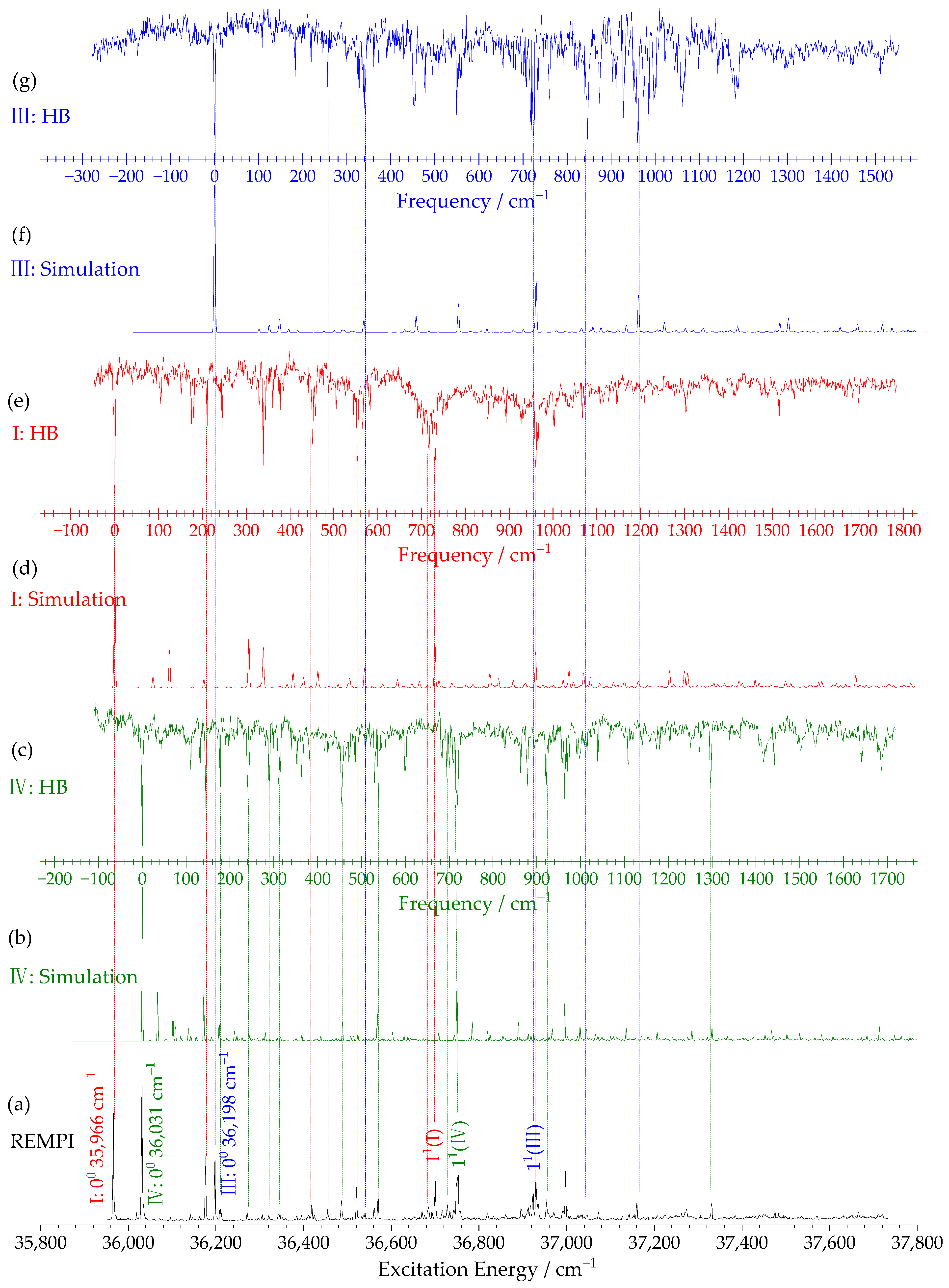
Figure 2 presents the two-color resonance-enhanced two-photon ionization (2C-R2PI) spectrum of m-ethoxyphenol in the region near its S1 ← S0 electronic transition. The ionization laser was fixed at 33,393 cm−1 to avoid fragmentation of larger clusters into the monomer mass channel. The 2C-R2PI technique offers the advantage of accurately reflecting S1 ← S0 transition intensities by increasing the ionization laser intensity to ionize most molecules in the resonantly excited S1 state.
The HB spectra (Figure 2c,e,g) confirm the presence of three distinct rotamers. With the probe laser fixed at the origin of a selected rotamer, the burn laser wavelength is scanned. When the burn laser is resonant with any energy level of the probed rotamer, that rotamer is depleted, leading to a significant decrease in the probe signal. The resulting dips correspond to the vibrational energy levels of the targeted rotamer. All prominent vibronic features in the REMPI spectrum exhibit corresponding holes, unequivocally demonstrating that three stable rotamers of m-ethoxyphenol coexist in the supersonic molecular beam.
The assignment of these three rotamers to specific structures (I, IV, and III) was achieved through comprehensive consideration of multiple theoretical and experimental criteria:
  • Ground-state energies: The relative ZPEs (Table 1) predict rotamer IV as the most stable, with rotamers I and III lying slightly higher (48–90 cm−1). Using the Boltzmann distribution, the expected intensity ratio of the 000 bands is IV:I:III ≈ 1:0.8:0.77, consistent with the experimental REMPI intensities.
  • Franck–Condon simulations: Figure 2b,d,f display the simulated S1 ← S0 vibronic spectra of rotamers IV, I, and III, calculated at the TD-B3PW91/aug-cc-pVTZ level. The excellent agreement between experimental and simulated spectra for each rotamer provides strong support for the assignment.
  • Ionization energies: As detailed in Section 2.3, the experimentally determined IEs and their relative ordering (IV < I < III) match theoretical predictions.
  • Rotamer II absence: Simulated Franck–Condon factors for rotamer II were found to be extremely small, indicating negligible S1 ← S0 transition probability (See Figure S2). This parallels observations for resorcinol or its cluster with CO and water [42,43] and m-methoxyphenol [34,36], where the analogous high-energy rotamer (with both substituents oriented unfavorably) is not observed experimentally due to steric hindrance.
Table 2 lists the observed S1 state vibrational bands, their frequency shifts relative to the origin, calculated frequencies, and tentative vibrational assignments for each rotamer. Vibrational modes are labeled according to Wilson’s notation for benzene derivatives as adapted by Varsanyi and Szoke [44,45]. Most active vibrations correspond to in-plane benzene ring deformation modes and substituent-sensitive bending motions.
Notably, the benzene ring breathing vibration (mode 11) appears at distinctly different frequencies for the three rotamers: 732, 719, and 724 cm−1 for rotamers I, IV, and III, respectively. This sensitivity to the relative orientation of the substituents underscores the utility of HB spectroscopy for distinguishing closely related rotamers.

2.3. Cationic Spectra and Ionization Energies

Prior to the MATI experiments, adiabatic IEs of the four low-energy rotamers were calculated using the high-level composite methods G4 and CBS-QB3, which are known to provide reliable energetics for small to medium-sized molecules. Table 3 presents the relative energies of the S0 and D0 states, the calculated IEs, and the experimental IEs, together with the theoretical errors.
The calculations consistently predict rotamer IV as the most stable in the S0 state, while rotamer II becomes the most stable in the D0 state—a reversal analogous to that observed for resorcinol [42,43,46] and m-methoxyphenol [34,36]. The calculated IEs follow the order II < IV < I < III, with rotamer II showing the lowest IE.
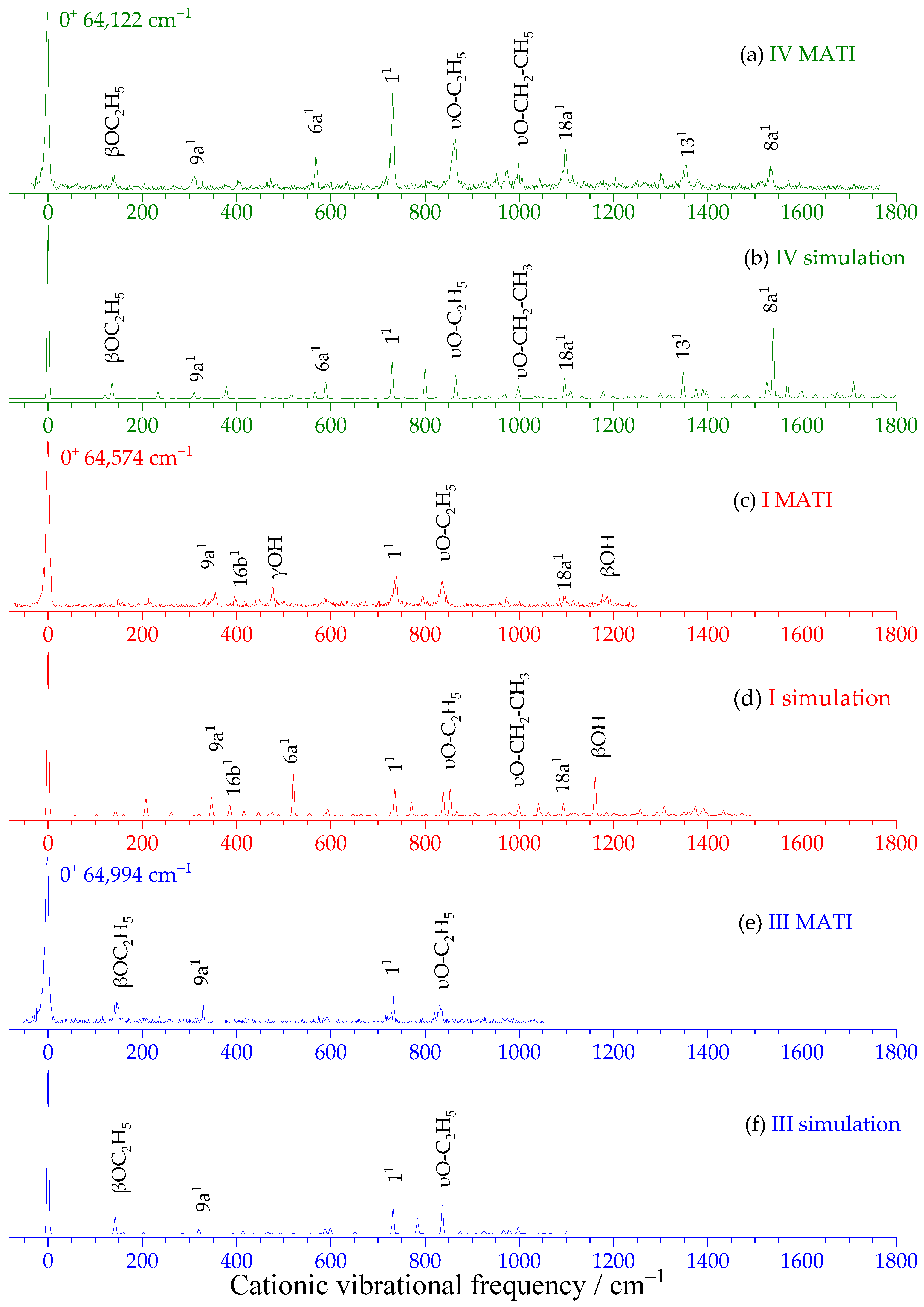
Figure 3 displays the MATI spectra of rotamers IV (a), I (c) and III (e), recorded via their respective S1 ← S0 00 origins (36,031, 35,966 and 36,198 cm−1). The simulated D0 ← S1 vibronic spectra at the B3PW91/aug-cc-pVTZ level (scaling factor 0.98) are shown in Figure 3b, Figure 3d and Figure 3f for rotamers IV, I and III, respectively.
From the sharp 00 bands in the MATI spectra, the adiabatic IEs were precisely determined as: Rotamer IV: 64,122 ± 5 cm−1; Rotamer I: 64,574 ± 5 cm−1; and Rotamer III: 64,994 ± 5 cm−1. The measured IE trend (IV < I < III) is fully consistent with G4 calculations. All deviations remain below 0.3%, demonstrating reliable computational performance for ionization energy evaluation. The distinct IE values serve as definitive fingerprints for identifying specific m-ethoxyphenol rotamer cations.
Table 4 presents the measured vibration assignments for the D0-state cations. The spectra exhibit rich vibrational structure, reflecting the influence of conformational differences on cationic vibrational properties.

3. Discussion

3.1. Structural Changes upon Electronic Excitation and Ionization

The excellent agreement between experimental and simulated vibronic spectra (Figure 2 and Figure 3) indicates that the theoretical methods employed (B3PW91/aug-cc-pVTZ for S0 and D0 states; TD-B3PW91/aug-cc-pVTZ for S1 state) reliably describe the molecular and spectral properties of m-ethoxyphenol. Tables S1–S3 present the optimized geometric parameters for rotamers IV, I and III in the S0, S1, and D0 states, respectively, along with changes upon electronic excitation and ionization.
Several important trends emerge from the structural analysis:
  • Upon S1 ← S0 excitation: The benzene ring undergoes slight expansion, with C–C bond lengths increasing by 0.013–0.039 Å. This is consistent with the π* ← π electronic excitation, which weakens the bonding character of the ring carbon–carbon bonds. Concurrently, the C–O bonds (C1–O11 and C3–O12) shorten slightly (by 0.006–0.011 Å), indicating increased double-bond character due to electron redistribution.
  • Upon D0 ← S1 ionization: The benzene ring contracts, with C–C bond lengths decreasing by 0.019–0.043 Å relative to the S1 state. The removal of an electron restores and even strengthens the π-bonding character of the cationic ring. The C–O bonds shorten substantially (by 0.030–0.044 Å), reflecting the increased electron density withdrawal toward the positively charged ring. The O11–C14 bond elongates (by 0.033–0.038 Å), suggesting weakening of this bond in the cation.
  • Substituent geometry: The C6–C1–O11 bond angle deviates by approximately 4° from the ideal sp2 angle of 120°, suggesting a weak non-covalent interaction between the lone-pair electrons of the ethoxy oxygen and the adjacent hydrogen atoms on the benzene ring. This interaction induces a slight geometric distortion at the substitution site—a feature common to all three rotamers.
  • Hydroxyl group orientation: The angular geometry of the hydroxyl group remains nearly unchanged upon S1 ← S0 excitation (Δ < 0.5°), but undergoes a small reorientation (≈3.5°) upon D0 ← S1 ionization, reflecting altered electron density distribution in the cationic state.
Remarkably, the overall molecular geometry remains very similar across all three electronic states for each rotamer. This structural similarity underlies the excellent Franck–Condon overlap observed in both S1 ← S0 and D0 ← S1 transitions, explaining the dominance of the origin bands and the good agreement between experimental and simulated spectra.
Although the optimized torsional angles of the ethoxy group do not show significant variations across the S0, S1, and D0 electronic states (as summarized in Tables S1–S3), the torsional potential energy surface (see Figure 1) exhibits multiple local minima separated by low energy barriers, indicating that the ethoxy group is highly flexible. Consequently, the low-frequency torsional motion of the ethoxy group cannot be adequately described by the harmonic approximation, and a global scaling factor derived from high-frequency vibrational modes is expected to have limited accuracy for these torsional modes. This anharmonicity is a direct consequence of the shallow and multi-minimum nature of the potential energy surface governing the ethoxy rotation. The present torsional scan provides explicit evidence of this anharmonic behavior, and we therefore caution that the vibrational assignments involving the ethoxy group in Table 2 and Table 4 should be considered as tentative, pending more rigorous theoretical treatments (e.g., full anharmonic calculations) in future studies.

3.2. Comparison with m-Methoxyphenol: Substituent Effects

Table 5 compares the E1 and IE values of m-ethoxyphenol (this work) with those of the corresponding rotamers of m-methoxyphenol [34,36].
Both E1 and IE of m-ethoxyphenol are consistently lower than those of the corresponding m-methoxyphenol rotamers. The E1 values differ by only 3–8 cm−1, while the IE differences are substantial (619–654 cm−1). This trend directly reflects the slightly stronger electron-donating ability of the ethoxy group (OC2H5) relative to methoxy (OCH3): the longer alkyl chain enhances the inductive effect, increasing electron density on the benzene ring and the entire molecular framework. Consequently, less energy is required to promote a π electron to the π* orbital (S1 ← S0 excitation) and to remove a valence electron (ionization) in m-ethoxyphenol.
The much larger effect on IE compared to E1 can be rationalized by considering the nature of the two processes. S1 ← S0 excitation involves promotion of an electron within the π system, while ionization completely removes an electron. The cation experiences the full inductive effect of the ethoxy group, whereas the neutral excited state benefits only partially from the enhanced electron donation.

3.3. Absence of Rotamer II

The calculations predict rotamer II to lie 198–226 cm−1 above rotamer IV in the S0 state (Table 1), which would suggest a non-negligible population under supersonic jet conditions. Yet, no spectroscopic features attributable to rotamer II were observed in either REMPI or HB experiments. This absence parallels observations for m-methoxyphenol [34,36], resorcinol [42,43,46], m-dimethoxybenzene [47] and m-diethoxybenzene [40].
Two factors likely contribute to the non-observability of rotamer II:
  • Franck–Condon factors: The simulated Franck–Condon factors for the S1 ← S0 transition of rotamer II were found to be extremely small (see Supporting Information Figure S2). This is in sharp contrast to rotamers I, III, and IV, where the origin band dominates the spectrum. Such a low Franck–Condon factor for the origin transition would make rotamer II undetectable under typical experimental conditions.
  • Steric hindrance: In rotamer II, both the hydroxyl hydrogen and the ethoxy group are oriented “upward” (pointing toward the same side of the ring), creating steric repulsion between the ethoxy and hydroxyl groups. This steric strain elevates the ground-state energy and may also distort the excited-state geometry, further reducing Franck–Condon factors.
The absence of rotamer II underscores an important caveat in conformational analysis: the relative intensities of origin bands in electronic spectra do not necessarily reflect ground-state populations, as differing Franck–Condon factors can dramatically affect transition probabilities.

4. Materials and Methods

4.1. Experimental Methods

meta-Ethoxyphenol (≥98% purity, Shanghai TCL Chemical Co., Ltd., Shanghai, China) was used without further purification. The sample was heated to approximately 150 °C to achieve sufficient vapor pressure and seeded in 3 bar of krypton carrier gas. The gas mixture was expanded into a vacuum through a pulsed nozzle (General Valve, Series 9, 0.5 mm orifice, Parker Hannifin Corporation, Cleveland, OH, USA) operating at 10 Hz. The resulting supersonic molecular beam passed through a skimmer (1 mm diameter) located 15 mm downstream from the nozzle, entering the ionization chamber where it intersected perpendicularly with the laser beams. Typical background pressures were ~10−4 Pa in the source chamber and ~10−6 Pa in the ionization chamber.
Two tunable dye lasers (Sirah, CBR-D-24 and Precision Scan-D, Sirah GmbH, Göttingen, Germany) pumped by a Q-switched Nd:YAG laser (Quantel, Qsmart 850, Les Ulis, Essonne, France) provided the UV radiation for two-color resonant two-photon excitation. The appropriate laser dyes (Rhodamine 6G, Coumarin 153, Exciton Inc., Dayton, OH, USA) were selected based on the expected S1 ← S0 excitation and ionization energy ranges. The output of both dye lasers was frequency-doubled using BBO crystals. A delay/pulse generator (Stanford Research Systems, DG535, Sunnyvale, CA, USA) controlled the timing between the two laser pulses, typically set to 0–10 ns for an optimal two-color signal.
For REMPI experiments, the ion extraction plates were configured as follows: the first plate was grounded, while the second and third plates (separated by 0.7 cm) were biased with pulsed electric fields of +500 V and +400 V, respectively, to accelerate photoionized ions toward the microchannel plate (MCP) detector.
For MATI experiments, a two-pulse field ionization scheme was employed [16,17]. Approximately 18 ns after the laser pulses, a pulsed electric field of −0.55 V cm−1 was applied to reject prompt ions produced by direct photoionization. After a delay of about 11.8 μs, a second pulsed electric field of +143 V cm−1 was applied to field-ionize molecules in high Rydberg states. The resulting threshold ions were then accelerated and passed through a 48 cm field-free drift tube before detection by the MCP detector. An electrostatic lens assembly was used to focus ions from different spatial positions, enhancing signal intensity.
Ion signals were processed by a multichannel scaler (Stanford Research Systems, SR430, Sunnyvale, CA, USA), accumulating data over 300 laser shots per data point. Laser wavelengths were calibrated using a wavemeter (HighFinesse WS-7, HighFinesse GmbH, Offenburg, Germany).
For hole-burning experiments, the burn laser was fired ~200 ns before the probe laser [40,48]. The probe wavelength was fixed at a selected REMPI peak (e.g., the electronic origin), while the pump wavelength was scanned. When the burn laser wavelength is resonant with any energy level of the probed rotamer, it leads to a significant decrease in the probe signal. Ions generated by the burn laser were rejected by appropriate timing and gating of the detector. The resulting dips correspond to the vibrational energy levels of the targeted rotamer. More experimental details are available in our previous publications [40,41,48,49,50].

4.2. Theoretical Methods

All quantum chemical calculations were performed using the GAUSSIAN 16 program package [51]. Potential energy surface scanning of the ethoxy group torsional angles α (∠C6–C1–O11–C14) and β (∠C1–O11–C14–C15) was conducted at the B3LYP/6-311++G(d,p) level, scanning both angles in 10° steps. This level provides an excellent balance of computational efficiency and accuracy for conformational exploration. For identified stable rotamers, geometry optimizations and harmonic vibrational frequency calculations were performed at higher levels. The neutral ground state S0 and the cationic ground state D0 were calculated using the B3PW91 hybrid functional [52,53] with the aug-cc-pVTZ basis set [54]. The first electronically excited state S1 was calculated using time-dependent DFT (TD-DFT) at the same B3PW91/aug-cc-pVTZ level [55]. All calculated harmonic vibrational frequencies were scaled by a factor of 0.98 to correct for systematic errors arising from basis set incompleteness, neglect of electron correlation, and vibrational anharmonicity [56].
Adiabatic ionization energies were also calculated using the composite methods G4 [57] and CBS-QB3 [58], which are known to provide reliable thermochemical data for small to medium-sized molecules. The IE was obtained as the difference in zero-point corrected total energies between the optimized cation D0 and the corresponding neutral S0. Vibronic spectra for S1 ← S0 and D0 ← S1 transitions were simulated within the Franck–Condon approximation, including Duschinsky rotation and Herzberg–Teller effects where appropriate [59,60]. Simulated spectra were convoluted with Gaussian line shapes (FWHM = 3.6 cm−1 for S1 spectra, 4.8 cm−1 for D0 spectra) to facilitate comparison with experimental data.

5. Conclusions

In this work, we have systematically characterized the rotamers of m-ethoxyphenol using a combination of high-resolution spectroscopic techniques and quantum chemical calculations. The main findings are summarized as follows:
Conformational identification: Three stable rotamers of m-ethoxyphenol were unambiguously identified in a supersonic molecular beam using REMPI and hole-burning spectroscopy. Based on ground-state energies, Franck–Condon simulations, and ionization energy measurements, these were assigned as rotamers I, IV, and III following the nomenclature established for m-methoxyphenol. The fourth low-energy rotamer (II) was not experimentally observed, attributed to unfavorable Franck–Condon factors for its S1 ← S0 transition and a lower ground-state population.
The electronic excitation energies for the S1 ← S0 origin transitions were precisely determined as 35,966 ± 2 cm−1 for rotamer I, 36,031 ± 2 cm−1 for rotamer IV, and 36,198 ± 2 cm−1 for rotamer III. Accurate adiabatic ionization energies (IEs) were obtained via MATI spectroscopy, yielding values of 64,574 ± 5 cm−1 for rotamer I, 64,122 ± 5 cm−1 for rotamer IV, and 64,994 ± 5 cm−1 for rotamer III. The distinct IE values serve as definitive fingerprints for identifying specific m-ethoxyphenol rotamer cations.
Complete vibrational assignments were established for both the S1 excited state and the D0 cationic ground state for all three rotamers. Most active modes correspond to in-plane ring vibrations and substituent-sensitive bending motions. The benzene ring breathing mode (11) exhibits characteristic frequencies that distinguish both rotamers and electronic states.
Quantum chemical calculations reveal that the benzene ring undergoes slight expansion upon S1 ← S0 excitation and contraction upon D0 ← S1 ionization, while the overall molecular geometry remains remarkably similar across all three electronic states. This structural similarity underlies the excellent Franck–Condon overlap observed experimentally.
The conformer-specific spectroscopic data presented herein provide a comprehensive foundation for understanding the photophysical and photochemical properties of m-ethoxyphenol. These results will facilitate future studies of this molecule and its derivatives, including hydrogen-bonded clusters and complexes relevant to atmospheric chemistry and materials science.

Supplementary Materials

The following supporting information can be downloaded at: https://www.mdpi.com/article/10.3390/ijms27104166/s1.

Author Contributions

Conceptualization, C.L., Z.J. and S.J.; software, Y.Z.; formal analysis, X.Q. and C.L.; investigation, K.Z., R.W. and X.Q.; writing—original draft preparation, X.Q.; writing—review and editing, X.Q. and C.L.; visualization, X.Q. and C.L.; supervision, C.L., Z.J. and S.J.; project administration, C.L. and S.J.; funding acquisition, C.L., Y.Z. and S.J. All authors have read and agreed to the published version of the manuscript.

Funding

This research was funded by the National Natural Science Foundation of China (Grant Nos. 12241408 and 61575115), PCSIRT (Grant No. IRT_17R70), 111 project (Grant No. D18001), and Shanxi Provincial Natural Science Foundation (Grant No. 202303021222265).

Institutional Review Board Statement

Not applicable.

Informed Consent Statement

Not applicable.

Data Availability Statement

The original contributions presented in this study are included in the article/Supplementary Material. Further inquiries can be directed to the corresponding authors.

Acknowledgments

All contributors who provided help during the research have been listed.

Conflicts of Interest

The authors declare no conflicts of interest.

References

  1. Martinez, S.J.; Alfano, J.C.; Levy, D.H. Rotationally resolved fluorescence excitation spectra of phenol and 4-ethylphenol in a supersonic jet. J. Mol. Spectrosc. 1992, 152, 80–88. [Google Scholar] [CrossRef]
  2. Song, K.; Hayes, J.M. Supersonic jet spectra of p-alkylphenols. J. Mol. Spectrosc. 1989, 134, 82–97. [Google Scholar] [CrossRef]
  3. Patwari, G.N.; Doraiswamy, S.; Wategaonkar, S. Spectroscopy and IVR in the S 1 State of Jet-Cooled p -Alkoxyphenols. J. Phys. Chem. A 2000, 104, 8466–8474. [Google Scholar] [CrossRef]
  4. Fidy, J.; Laberge, M.; Ullrich, B.; Polgar, L.; Szeltner, Z.; Gallay, J.; Vincent, M. Tryptophan rotamers that report the conformational dynamics of proteins. Pure Appl. Chem. 2001, 73, 415–419. [Google Scholar] [CrossRef]
  5. Dian, B.C.; Longarte, A.; Winter, P.R.; Zwier, T.S. The dynamics of conformational isomerization in flexible biomolecules. I. Hole-filling spectroscopy of N-acetyl tryptophan methyl amide and N-acetyl tryptophan amide. J. Chem. Phys. 2004, 120, 133–147. [Google Scholar] [CrossRef]
  6. Meyer, E.A.; Castellano, R.K.; Diederich, F. Interactions with aromatic rings in chemical and biological recognition. Angew. Chem. Int. Ed. Engl. 2003, 42, 1210–1250. [Google Scholar] [CrossRef]
  7. Breen, P.J.; Bernstein, E.R.; Secor, H.V.; Seeman, J.I. Spectroscopic observation and geometry assignment of the minimum energy conformations of methoxy-substituted benzenes. J. Am. Chem. Soc. 1989, 111, 1958–1968. [Google Scholar] [CrossRef]
  8. Muller-Dethlefs, K.; Schlag, E.W. High-Resolution Zero Kinetic Energy (ZEKE) Photoelectron Spectroscopy of Molecular Systems. Annu. Rev. Phys. Chem. 1991, 42, 109–136. [Google Scholar] [CrossRef]
  9. Müller-Dethlefs, K.; Schlag, E.W. Chemical Applications of Zero Kinetic Energy (ZEKE) Photoelectron Spectroscopy. Angew. Chem. Int. Ed. 1998, 37, 1346–1374. [Google Scholar] [CrossRef]
  10. Ketkov, S.Y.; Tzeng, S.Y.; Rychagova, E.A.; Kalakutskaya, L.V.; Fuss, M.; Braunschweig, H.; Tzeng, W.-B. Rydberg state mediated multiphoton ionization of (η7-C7H7)(η5-C5H5)Cr: DFT-supported experimental insights into the molecular and electronic structures of excited sandwich complexes. Phys. Chem. Chem. Phys. 2019, 21, 9665–9671. [Google Scholar] [CrossRef]
  11. Owusu-Ansah, E.; Cairns, E.; Shi, Y. Characterization of Si atomic transitions using pulsed electric discharge and resonance-enhanced multiphoton ionization techniques. J. Anal. At. Spectrom. 2017, 32, 2423–2432. [Google Scholar] [CrossRef]
  12. Silva, W.R.; Fitian, M.; Yang, D.-S. Probing La and Ce Excited-State Reactivity with Resonant Two-Photon Ionization Spectroscopy. J. Phys. Chem. A 2022, 126, 7613–7620. [Google Scholar] [CrossRef]
  13. Zhang, Z.; Wang, Z.; Wang, Q.; Ma, X.; Wang, Z.; Hua, Z.; Yao, G.; Yang, X.; Sun, Z.; Qin, Z.; et al. Photoionization cross sections measurements of the excited states of lutetium and ytterbium in the near threshold region. J. Chem. Phys. 2024, 160, 164201. [Google Scholar] [CrossRef]
  14. Hua, Z.; Deng, J.; Sun, Z.; Yang, X.; Qin, Z.; Zheng, X. Spectroscopic signatures of the S0, S1, and D0 states of indan: An experimental and theoretical investigation. J. Photochem. Photobiol. A Chem. 2025, 461, 116175. [Google Scholar] [CrossRef]
  15. Qin, Z.; Ma, N.; Ren, Y.; Zheng, X.; Yao, G.; Zhang, X.; Cui, Z. Analysis of the S1 ← S0 and D0 ← S1 spectra in m-bromofluorobenzene via resonance-enhanced multiphoton ionization and slow electron velocity-map imaging spectroscopy. J. Quant. Spectrosc. Radiat. Transf. 2019, 224, 107–113. [Google Scholar] [CrossRef]
  16. Harthcock, C.; Zhang, J.; Kong, W.; Mitsui, M.; Ohshima, Y. Electronic spectra and excited-state dynamics of acridine and its hydrated clusters. J. Chem. Phys. 2017, 146, 134311. [Google Scholar] [CrossRef]
  17. Choi, C.M.; Choi, D.H.; Heo, J.; Kim, N.J.; Kim, S.K. Ultraviolet-ultraviolet hole burning spectroscopy in a quadrupole ion trap: Dibenzo18crown-6 complexes with alkali metal cations. Angew. Chem. Int. Ed. 2012, 51, 7297–7300. [Google Scholar] [CrossRef] [PubMed]
  18. Kang, H.; Féraud, G.; Dedonder-Lardeux, C.; Jouvet, C. New Method for Double-Resonance Spectroscopy in a Cold Quadrupole Ion Trap and Its Application to UV-UV Hole-Burning Spectroscopy of Protonated Adenine Dimer. J. Phys. Chem. Lett. 2014, 5, 2760–2764. [Google Scholar] [CrossRef] [PubMed]
  19. Yoo, I.T.; Jeong, J.; Eun, H.J.; Yun, J.; Heo, J.; Kim, N.J. Conformation-Selective Ultraviolet-Ultraviolet Hole Burning Spectra of Ubiquitin Ions in a Cryogenic Ion Trap. J. Phys. Chem. Lett. 2024, 15, 7398–7402. [Google Scholar] [CrossRef]
  20. Kalal, B.; Maity, S. Non-Traditional Excited-State Deactivation in N-Containing Chromophores: A Combined Spectroscopic and Computational Study. J. Phys. Chem. Lett. 2026, 17, 69–76. [Google Scholar] [CrossRef] [PubMed]
  21. Singh, S.K.; Mishra, K.K.; Sharma, N.; Das, A. Direct Spectroscopic Evidence for an n→π* Interaction. Angew. Chem. Int. Ed. Engl. 2016, 55, 7801–7805. [Google Scholar] [CrossRef]
  22. Wang, S.; Shi, Y.; Jakubek, Z.J.; Barnett, M.; Simard, B.; Müller-Dethlefs, K.; Liu, C.-P.; Lee, Y.-P. Nonresonant two-photon mass analyzed threshold ionization and zero kinetic energy photoelectron investigation of the X ~ 2B1 ground state of CH2CO+ and CD2CO+. J. Chem. Phys. 2002, 117, 6546–6555. [Google Scholar] [CrossRef]
  23. Ketkov, S.Y.; Tzeng, S.-Y.; Rychagova, E.A.; Lukoyanov, A.N.; Markin, G.V.; Tzeng, W.-B. Intriguing methylation effects in cobaltocene revealed by high-resolution MATI spectroscopy and ab initio calculations of (η5-C5H4Me)2Co. J. Chem. Phys. 2025, 163, 214302. [Google Scholar] [CrossRef]
  24. Ketkov, S.Y.; Tzeng, S.-Y.; Rychagova, E.A.; Lukoyanov, A.N.; Tzeng, W.-B. Effect of a single methyl substituent on the electronic structure of cobaltocene studied by computationally assisted MATI spectroscopy. Phys. Chem. Chem. Phys. 2024, 26, 1046–1056. [Google Scholar] [CrossRef]
  25. Ketkov, S.Y.; Tzeng, S.-Y.; Rychagova, E.A.; Markin, G.V.; Makarov, S.G.; Tzeng, W.-B. Laser spectroscopic and computational insights into unexpected structural behaviours of sandwich complexes upon ionization. Dalton Trans. 2021, 50, 10729–10736. [Google Scholar] [CrossRef] [PubMed]
  26. Ketkov, S.Y.; Tzeng, S.-Y.; Wu, P.-Y.; Markin, G.V.; Tzeng, W.-B. DFT-Supported Threshold Ionization Study of Chromium Biphenyl Complexes: Unveiling the Mechanisms of Substituent Influence on Redox Properties of Sandwich Compounds. Chemistry 2017, 23, 13669–13675. [Google Scholar] [CrossRef] [PubMed]
  27. Shi, Y.J.; Wang, S.; Jakubek, Z.J.; Simard, B. A vacuum ultraviolet laser single-photon zero kinetic energy photoelectron spectroscopic study of the 2 E 3/2 ground electronic state of CH 3 Br +. Can. J. Chem. 2004, 82, 1077–1082. [Google Scholar] [CrossRef]
  28. Lin, J.; Lin, J.L.; Tzeng, W.B. Mass analyzed threshold ionization spectroscopy of N-deuterium substituted indoline cation: Isotope effect on the electronic transition, ionization and molecular vibration. Chem. Phys. Lett. 2003, 371, 662–669. [Google Scholar] [CrossRef]
  29. Lin, J.; Lin, J.L.; Tzeng, W.B. Mass analyzed threshold ionization spectroscopy of deuterium substituted N-methylaniline and N-ethylaniline cations: Isotope effect on transition energy and large amplitude vibrations. Chem. Phys. 2003, 295, 97–107. [Google Scholar] [CrossRef]
  30. Wu, L.; Liu, Y.; Zhang, C.; Li, S.; Dixon, D.A.; Yang, D.-S. Mass-analyzed threshold ionization of an excited state of lanthanum dioxide. J. Chem. Phys. 2012, 137, 34307. [Google Scholar] [CrossRef]
  31. Wu, L.; Zhang, C.; Krasnokutski, S.A.; Yang, D.-S. Mass-analyzed threshold ionization and structural isomers of M3O4 (M = Sc, Y, and La). J. Chem. Phys. 2012, 137, 84312. [Google Scholar] [CrossRef]
  32. Wu, L.; Roudjane, M.; Yang, D.-S. Structure and Bonding of Sc3C2 and La3C2 Clusters from MATI Spectroscopy and Theoretical Calculations. J. Phys. Chem. A 2025, 129, 9019–9026. [Google Scholar] [CrossRef]
  33. Nyambo, S.; Zhang, Y.; Yang, D.-S. Reactions of La and Ce with Propylamine: Formation and Threshold Ionization of Lanthanide Imido Radicals. J. Phys. Chem. A 2025, 129, 5570–5578. [Google Scholar] [CrossRef]
  34. Ullrich, S.; Geppert, W.D.; Dessent, C.E.H.; Müller-Dethlefs, K. Observation of Rotational Isomers I: A ZEKE and Hole-Burning Spectroscopy Study of 3-Methoxyphenol. J. Phys. Chem. A 2000, 104, 11864–11869. [Google Scholar] [CrossRef]
  35. Geppert, W.D.; Ullrich, S.; Dessent, C.E.H.; Müller-Dethlefs, K. Observation of Rotational Isomers II: A ZEKE and Hole-Burning Spectroscopy Study of Hydrogen-Bonded 3-Methoxyphenol·Water Clusters. J. Phys. Chem. A 2000, 104, 11870–11876. [Google Scholar] [CrossRef]
  36. Wilke, M.; Schneider, M.; Wilke, J.; Ruiz-Santoyo, J.A.; Campos-Amador, J.J.; González-Medina, M.E.; Álvarez-Valtierra, L.; Schmitt, M. Rotationally resolved electronic spectroscopy study of the conformational space of 3-methoxyphenol. J. Mol. Struct. 2017, 1140, 59–66. [Google Scholar] [CrossRef]
  37. Zheng, Q.; Fang, T.I.; Zhang, B.; Bih Tzeng, W. Mass-analyzed Threshold Ionization Spectroscopy of Rotamers of p -ethoxyphenol Cations and Configuration Effect. Chin. J. Chem. Phys. 2009, 22, 649–654. [Google Scholar] [CrossRef][Green Version]
  38. Li, C.; Su, H.; Tzeng, W.B. Rotamers of p-methoxyphenol cation studied by mass analyzed threshold ionization spectroscopy. Chem. Phys. Lett. 2005, 410, 99–103. [Google Scholar] [CrossRef]
  39. Xu, Y.; Tzeng, S.Y.; Shivatare, V.; Takahashi, K.; Zhang, B.; Tzeng, W.B. Identification of four rotamers of m-methoxystyrene by resonant two-photon ionization and mass analyzed threshold ionization spectroscopy. J. Chem. Phys. 2015, 142, 124314. [Google Scholar] [CrossRef] [PubMed]
  40. Qin, X.; Duan, C.; Zhao, Y.; Li, C.; Jia, S. Study of Vibronic and Cationic Features of m-Diethoxybenzene via REMPI, Hole-Burning, and MATI Spectroscopy. Int. J. Mol. Sci. 2025, 26, 11818. [Google Scholar] [CrossRef]
  41. Li, S.; Zhao, Y.; Hu, F.; Jiao, Y.; Zhao, J.; Li, C. The stable conformations and vibronic and cation spectroscopy of 2-ethoxybenzonitrile. J. Mol. Struct. 2023, 1293, 136278. [Google Scholar] [CrossRef]
  42. Geppert, W.D.; Dessent, C.E.H.; Müller-Dethlefs, K. ZEKE and Hole-Burning Spectroscopy of the Rotational Isomers of Resorcinol·CO. J. Phys. Chem. A 1999, 103, 9687–9692. [Google Scholar] [CrossRef]
  43. Geppert, W.D.; Dessent, C.E.H.; Ullrich, S.; Müller-Dethlefs, K. Observation of Hydrogen-Bonded Rotational Isomers of the Resorcinol·Water Complex. J. Phys. Chem. A 1999, 103, 7186–7191. [Google Scholar] [CrossRef]
  44. Varsanyi, G. Assignments of Vibrational Spectra of Seven Hundred Benzene Derivatives; Wiley: New York, NY, USA, 1974. [Google Scholar]
  45. Varsanyi, G.; Szoke, S. Vibrational Spectra of Benzene Derivatives; Academic Press: New York, NY, USA; London, UK, 1969. [Google Scholar]
  46. Gerhards, M.; Unterberg, C.; Schumm, S. Structure and vibrations of dihydroxybenzene cations and ionization potentials of dihydroxybenzenes studied by mass analyzed threshold ionization and infrared photoinduced Rydberg ionization spectroscopy as well as ab initio theory. J. Chem. Phys. 1999, 111, 7966–7975. [Google Scholar] [CrossRef]
  47. Schneider, M.; Wilke, M.; Hebestreit, M.-L.; Ruiz-Santoyo, J.A.; Álvarez-Valtierra, L.; Yi, J.T.; Meerts, W.L.; Pratt, D.W.; Schmitt, M. Rotationally resolved electronic spectroscopy of the rotamers of 1,3-dimethoxybenzene. Phys. Chem. Chem. Phys. 2017, 19, 21364–21372. [Google Scholar] [CrossRef] [PubMed]
  48. Zhao, Y.; Jin, Y.; Hao, J.; Yang, Y.; Wang, L.; Li, C.; Jia, S. Rotamers of p-isopropylphenol studied by hole-burning resonantly enhanced multiphoton ionization and mass analyzed threshold ionization spectroscopy. Spectrochim. Acta A Mol. Biomol. Spectrosc. 2019, 207, 328–336. [Google Scholar] [CrossRef]
  49. Li, S.; Zhao, Y.; Jiao, Y.; Zhao, J.; Li, C.; Jia, S. Vibronic and Cationic Features of 2-Fluorobenzonitrile and 3-Fluorobenzonitrile Studied by REMPI and MATI Spectroscopy and Franck-Condon Simulations. Molecules 2023, 28, 4702. [Google Scholar] [CrossRef]
  50. Li, N.; Li, S.; Wang, L.; Wang, H.; Zhao, J.; Li, C. Vibrational spectra of 2-cyanophenol cation studied by the mass analyzed threshold ionization technique. Chem. Phys. Lett. 2022, 792, 139402. [Google Scholar] [CrossRef]
  51. Frisch, M.J.; Trucks, G.W.; Schlegel, H.B.; Scuseria, G.E.; Robb, M.A.; Cheeseman, J.R.; Scalmani, G.; Barone, V.; Mennucci, B.; Petersson, G.A.; et al. Gaussian 16 Revision C.01; Gaussian Inc.: Wallingford, CT, USA, 2016. [Google Scholar]
  52. Perdew, J.P.; Burke, K.; Wang, Y. Generalized gradient approximation for the exchange-correlation hole of a many-electron system. Phys. Rev. B 1996, 54, 16533–16539, Erratum in Phys. Rev. B 1998, 57, 14999. [Google Scholar] [CrossRef]
  53. Becke, A.D. Density-functional thermochemistry. III. The role of exact exchange. J. Chem. Phys. 1993, 98, 5648–5652. [Google Scholar] [CrossRef]
  54. Dunning, T.H. Gaussian basis sets for use in correlated molecular calculations. I. The atoms boron through neon and hydrogen. J. Chem. Phys. 1989, 90, 1007–1023. [Google Scholar] [CrossRef]
  55. Bauernschmitt, R.; Ahlrichs, R. Treatment of electronic excitations within the adiabatic approximation of time dependent density functional theory. Chem. Phys. Lett. 1996, 256, 454–464. [Google Scholar] [CrossRef]
  56. Laury, M.L.; Boesch, S.E.; Haken, I.; Sinha, P.; Wheeler, R.A.; Wilson, A.K. Harmonic vibrational frequencies: Scale factors for pure, hybrid, hybrid meta, and double-hybrid functionals in conjunction with correlation consistent basis sets. J. Comput. Chem. 2011, 32, 2339–2347. [Google Scholar] [CrossRef]
  57. Curtiss, L.A.; Redfern, P.C.; Raghavachari, K. Gaussian-4 theory. J. Chem. Phys. 2007, 126, 84108. [Google Scholar] [CrossRef]
  58. Montgomery, J.A.; Frisch, M.J.; Ochterski, J.W.; Petersson, G.A. A complete basis set model chemistry. VI. Use of density functional geometries and frequencies. J. Chem. Phys. 1999, 110, 2822–2827. [Google Scholar] [CrossRef]
  59. Guo, M.; He, R.; Dai, Y.; Shen, W.; Li, M.; Zhu, C.; Lin, S.H. Franck-Condon simulation of vibrationally resolved optical spectra for zinc complexes of phthalocyanine and tetrabenzoporphyrin including the Duschinsky and Herzberg-Teller effects. J. Chem. Phys. 2012, 136, 144313. [Google Scholar] [CrossRef]
  60. Santoro, F.; Lami, A.; Improta, R.; Bloino, J.; Barone, V. Effective method for the computation of optical spectra of large molecules at finite temperature including the Duschinsky and Herzberg-Teller effect: The Qx band of porphyrin as a case study. J. Chem. Phys. 2008, 128, 224311. [Google Scholar] [CrossRef] [PubMed]
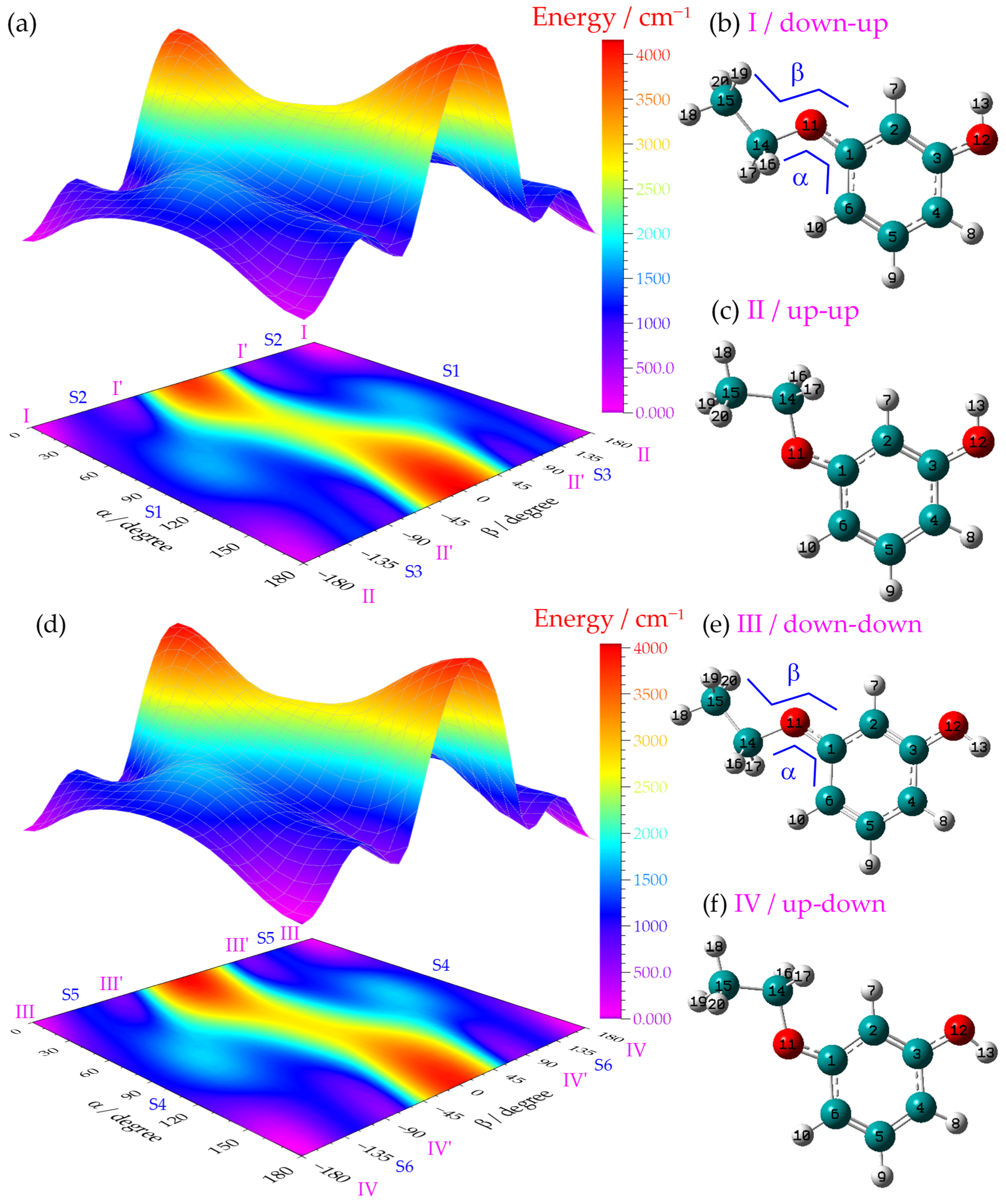
Figure 1. Potential energy surfaces (a,d) obtained by scanning two torsional angles, α, β, of the ethoxy group while fixing the hydroxyl orientation (up or down). On each surface, eight local minima are identified. The two lowest-energy rotamers on surface (a) are labeled as I (b) and II (c), and their counterparts with the methyl group protruding out of the ring plane are denoted as I’ and II’, respectively. Similarly, the two lowest-energy conformers on surface (d) are labeled as III (e) and IV (f), with their out-of-plane methyl variants designated as III’ and IV’. ∠β. The relative energies of the six saddle points S1–S6 are 1113, 1124, 1359, 1082, 1182, and 1085 cm−1, respectively, relative to rotamer IV. The four conformers I, II, III, and IV, optimized at the B3LYP/6-311++G(d,p) level (see Table 1 in the main text), have relative energies of 58, 226, 90, and 0 cm−1, respectively. Atomic labels are provided in the four stable conformers shown.
Ijms 27 04166 g001
Figure 2. (a) Two-color R2PI spectrum near the S1 ← S0 00 electronic transition. (b,d,f) Simulated S1 ← S0 vibronic spectra of rotamers IV, I, and III, respectively, at the TD-B3PW91/aug-cc-pVTZ level (scaling factor 0.98). (c,e,g) Hole-burning spectra of rotamers IV, I, and III, respectively. The bands at 35,966 ± 2, 36,031 ± 2, and 36,198 ± 2 cm−1 are assigned as the S1 ← S0 origins of rotamers I, IV, and III. The x-axis represents excitation energy (cm−1) for (a) and vibrational frequency shift (cm−1) relative to the origin band for (bg).
Ijms 27 04166 g002
Figure 3. MATI spectra of m-ethoxyphenol rotamers IV (a), I (c) and III (e) via the S1 00 level, along with theoretical simulations (b,d,f) at the B3PW91/aug-cc-pVTZ level with harmonic frequencies scaled by 0.98. The adiabatic ionization energies (0+ bands) are determined as 64,122 ± 5, 64,574 ± 5 and 64,994 ± 5 cm−1 for rotamers IV, I, and III, respectively.
Ijms 27 04166 g003
Table 1. Calculated relative zero-point energies (ZPEs) of the m-ethoxyphenol rotamers in the S0 ground state (cm−1) a.
RotamerB3LYP/6-311++G(d,p)B3PW91/6-311++G(d,p)B3LYP/aug-cc-pVTZB3PW91/aug-cc-pVTZ
I/down-up58614748
II/up-up226226200198
III/down-down90906665
IV/up-down0000
I’644620639628
II’839813823810
III’678652663649
IV’593569596585
a The ground-state ZPE values of rotamer IV calculated by the four methods are as follows: B3PW91/6-311++G(d,p): −461.096815 Hartree; B3LYP/6-311++G(d,p): −461.280991 Hartree; B3PW91/aug-cc-pVTZ: −461.142351 Hartree; B3LYP/aug-cc-pVTZ: −461.327201 Hartree.
Table 2. Experimental and theoretical vibrational frequencies (cm−1) of the m-ethoxyphenol rotamers in the S1 excited state, with tentative vibration assignments a.
IIVIIIAssignment b
EnergyShiftCalc.EnergyShiftCalc.EnergyShiftCalc.
35,9660036,0310036,1980000
36,176145140 βOC2H5
36,177211204 10a1
36,210179 βOC2H5δOC2H5
36,271239238 10b1
36,455257 τCH3
36,320289 βOC2H52
36,346315 βOC2H52δOC2H5
36,305339339 36,5383403399a1
36,41745146336,48645545736,6524544576b1
36,51955357036,57053953636,7475495536a1
36,69873273136,75071971836,92272473011
36,953922935 18b1
36,92796196036,99596496437,158960962121
37,33012991300 131
a Experimental values are shifts from the origin bands at 35,966 ± 2, 36,031 ± 2, and 36,198 ± 2 cm−1 for the respective rotamers. Theoretical vibrational frequencies at the TD-B3PW91/aug-cc-pVTZ level, scaled by 0.98. b Vibrations of the substituents: ν, stretching vibration; β, in-plane bending; γ, out-of-plane bending; τ, CH3 rotation; δ, other bending.
Table 3. Calculated relative energies of the S0 and D0 states and ionization energies of the m-ethoxyphenol rotamers from G4 and CBS-QB3 calculations (Unit: cm−1) a,b.
IsomerS0 Relative EnergyD0 Relative EnergyIE
G4CBS-QB3G4CBS-QB3Exp.G4ErrorCBS-QB3Error
I505071871464,57464,373−20165,116542
II20720300 63,497 64,249
III70651183111264,99464,817−17765,500506
IV0019818764,12263,902−22064,639517
a S0 state energies of rotamer IV: G4(0 K) = −461.052005 Hartree, CBS-QB3(0 K) = −460.530971 Hartree. b D0 state energies of rotamer II: G4(0 K) = −460.761746 Hartree, CBS-QB3(0 K) = −460.237304 Hartree.
Table 4. Experimental and theoretical vibrational frequencies (cm−1) of the m-ethoxyphenol rotamer cations, together with their tentative assignments a,b.
IIVIIIAssignment b
Exp.Calc.Exp.Calc.Exp.Calc.
141136146142βOC2H5
3553473113103303209a1
395396 16b1
476476 γOH
568566 6a1
73973673173073373211
836823865865830837νO-C2H5
998998 νO-CH2-CH3
1098109410981096 18a1
11761161 βOH
13541347 131
15321539 8a1
a Calculated values are obtained from the B3PW91/aug-cc-PVTZ calculations scaled by 0.98. b Vibrations of the substituents: ν, stretching vibration; β, in-plane bending; γ, out-of-plane bending.
Table 5. Comparison of S1 ← S0 excitation energies (E1) and adiabatic ionization energies (IE) for m-ethoxyphenol and m-methoxyphenol rotamers (cm−1).
Rotamerm-Ethoxyphenol am-Methoxyphenol bΔE1ΔIE
E1IEE1IE
I35,96664,57435,97465,228−8−654
IV36,03164,12236,03464,741−3−619
III36,19864,99436,20265,648−4−654
a This work. b Refs. [34,36].
Disclaimer/Publisher’s Note: The statements, opinions and data contained in all publications are solely those of the individual author(s) and contributor(s) and not of MDPI and/or the editor(s). MDPI and/or the editor(s) disclaim responsibility for any injury to people or property resulting from any ideas, methods, instructions or products referred to in the content.