From Structure to Function of Promoters and 5′UTRs in Maize

 , , and
Abstract
1. Introduction
2. Promoters
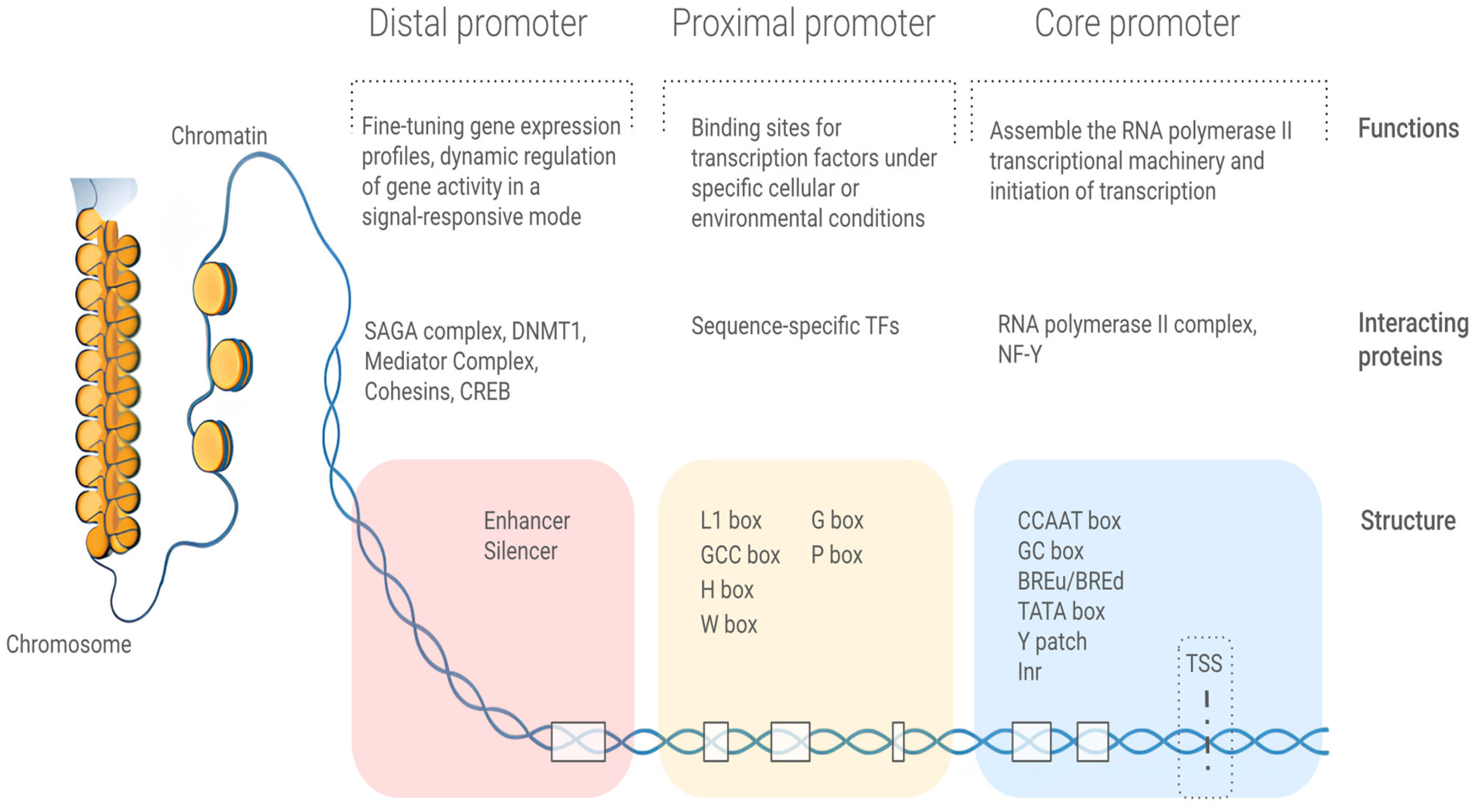
2.1. Structural Features of Promoter Organization in Maize
2.1.1. Core Promoter Region
2.1.2. Proximal and Distal Promoter Regions
2.2. Applications of Promoter Diversity for Maize Genetic Engineering
2.2.1. Constitutive Promoters

| References | Specification | Promoter | Type |
|---|---|---|---|
| [80,81,82,83,84,85] | constitutive | ZmUbi1, PGNpr1, rubi3, H2B, Gos2 | Plant constitutive |
| [86,87,88] | constitutive | CaMV 35S, FMV, CmYLCV, CsVMV | Viral constitutive |
| [89] | embryo and leaves | Zm-PLTP | Tissue-specific |
| [90] | embryo | OLE, EAP1, LTP2 | |
| [91] | root | p8463, p5023, p1534, p8531, p6629 | |
| [92] | endosperm | LWM | |
| [93] | embryo | globulin-1 | |
| [94] | silk tissues | p1-R2R3-MYB | |
| [95] | pollen | ZmSTK2_USP | |
| [96] | wound-inducible | MPI | Inducible |
| [97] | senescence-inducible | Zm(PSEE1) | |
| [89] | auxin-inducible | Zm-Axig1 | |
| [98] | drought and salinity | ZmGAPP | |
| [99] | abscisic acid-inducible | ABA-inducible | |
| [100] | chimeric | superpromoter | Synthetic |
| [101] | chimeric | A27znGlb1 | |
| [102] | synthetic abscisic acid-response | ZmDRO1 | |
| [103] | bidirectional | BDP |
2.2.2. Tissue-Specific and Inducible Promoters
2.2.3. Synthetic Promoters
3. 5′ Untranslated Regions
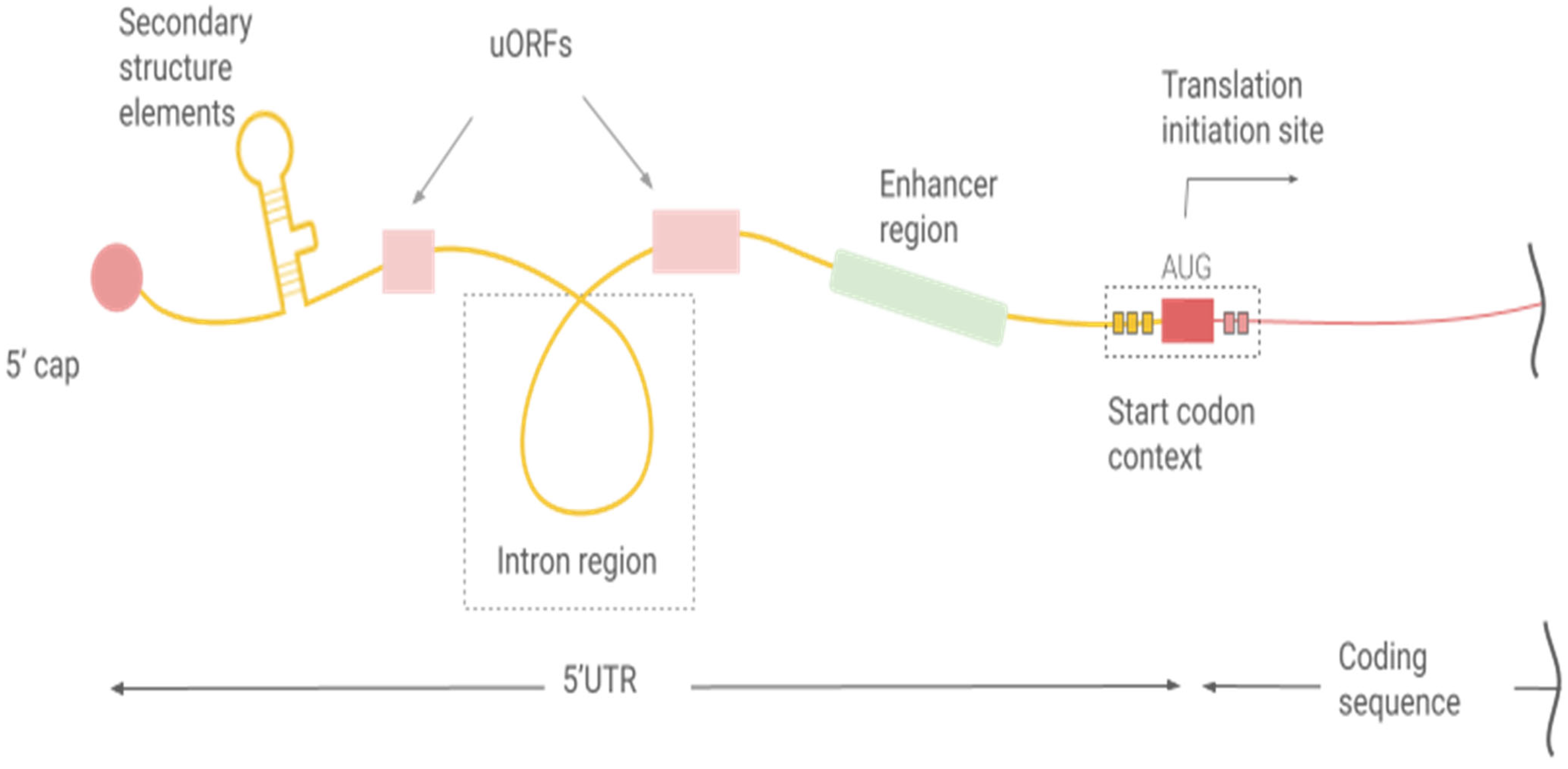
3.1. The Functional Roles of the 5′UTR
3.2. 5′ Capping
3.3. uORFs
3.4. RNA Secondary Structure
3.5. Introns
3.6. Translation Enhancers
3.7. Start Codon Context Sequence
4. Conclusions
Author Contributions
Funding
Data Availability Statement
Conflicts of Interest
References
- Erdmann, R.M.; Picard, C.L. RNA-Directed DNA Methylation. PLoS Genet. 2020, 16, e1009034. [Google Scholar] [CrossRef] [PubMed]
- Chekanova, J.A. Long Non-Coding RNAs and Their Functions in Plants. Curr. Opin. Plant Biol. 2015, 27, 207–216. [Google Scholar] [CrossRef] [PubMed]
- Rai, M.I.; Alam, M.; Lightfoot, D.A.; Gurha, P.; Afzal, A.J. Classification and Experimental Identification of Plant Long Non-Coding RNAs. Genomics 2019, 111, 997–1005. [Google Scholar] [CrossRef] [PubMed]
- Prall, W.; Sharma, B.; Gregory, B.D. Transcription Is Just the Beginning of Gene Expression Regulation: The Functional Significance of RNA-Binding Proteins to Post-Transcriptional Processes in Plants. Plant Cell Physiol. 2019, 60, 1939–1952. [Google Scholar] [CrossRef]
- Barrett, L.W.; Fletcher, S.; Wilton, S.D. Regulation of Eukaryotic Gene Expression by the Untranslated Gene Regions and Other Non-Coding Elements. Cell. Mol. Life Sci. 2012, 69, 3613–3634. [Google Scholar] [CrossRef]
- Maher, K.A.; Bajic, M.; Kajala, K.; Reynoso, M.; Pauluzzi, G.; West, D.A.; Zumstein, K.; Woodhouse, M.; Bubb, K.; Dorrity, M.W.; et al. Profiling of Accessible Chromatin Regions across Multiple Plant Species and Cell Types Reveals Common Gene Regulatory Principles and New Control Modules. Plant Cell 2018, 30, 15–36. [Google Scholar] [CrossRef]
- Araujo, P.R.; Yoon, K.; Ko, D.; Smith, A.D.; Qiao, M.; Suresh, U.; Burns, S.C.; Penalva, L.O.F. Before It Gets Started: Regulating Translation at the 5′ UTR. Int. J. Genom. 2012, 2012, 475731. [Google Scholar] [CrossRef]
- Chen, F.; Cocaign-Bousquet, M.; Girbal, L.; Nouaille, S. 5’UTR Sequences Influence Protein Levels in Escherichia Coli by Regulating Translation Initiation and mRNA Stability. Front. Microbiol. 2022, 13, 1088941. [Google Scholar] [CrossRef]
- Ambaye, T.G.; Vaccari, M.; Bonilla-Petriciolet, A.; Prasad, S.; van Hullebusch, E.D.; Rtimi, S. Emerging Technologies for Biofuel Production: A Critical Review on Recent Progress, Challenges and Perspectives. J. Environ. Manag. 2021, 290, 112627. [Google Scholar] [CrossRef]
- Fahad, S.; Bajwa, A.A.; Nazir, U.; Anjum, S.A.; Farooq, A.; Zohaib, A.; Sadia, S.; Nasim, W.; Adkins, S.; Saud, S.; et al. Crop Production under Drought and Heat Stress: Plant Responses and Management Options. Front. Plant Sci. 2017, 8, 1147. [Google Scholar] [CrossRef]
- Liu, J.; Fernie, A.R.; Yan, J. The Past, Present, and Future of Maize Improvement: Domestication, Genomics, and Functional Genomic Routes toward Crop Enhancement. Plant Commun. 2020, 1, 100010. [Google Scholar] [CrossRef] [PubMed]
- Hernandez-Garcia, C.M.; Finer, J.J. Identification and Validation of Promoters and Cis-Acting Regulatory Elements. Plant Sci. 2014, 217–218, 109–119. [Google Scholar] [CrossRef] [PubMed]
- Dao, L.T.M.; Spicuglia, S. Transcriptional Regulation by Promoters with Enhancer Function. Transcription 2018, 9, 307–314. [Google Scholar] [CrossRef] [PubMed]
- Kumari, S.; Ware, D. Genome-Wide Computational Prediction and Analysis of Core Promoter Elements across Plant Monocots and Dicots. PLoS ONE 2013, 8, e79011. [Google Scholar] [CrossRef]
- Singh, R.; Ming, R.; Yu, Q. Comparative Analysis of GC Content Variations in Plant Genomes. Trop. Plant Biol. 2016, 9, 136–149. [Google Scholar] [CrossRef]
- Brooks, E.G.; Elorriaga, E.; Liu, Y.; Duduit, J.R.; Yuan, G.; Tsai, C.-J.; Tuskan, G.A.; Ranney, T.G.; Yang, X.; Liu, W. Plant Promoters and Terminators for High-Precision Bioengineering. BioDesign Res. 2023, 5, 13. [Google Scholar] [CrossRef]
- Jores, T.; Tonnies, J.; Wrightsman, T.; Buckler, E.S.; Cuperus, J.T.; Fields, S.; Queitsch, C. Synthetic Promoter Designs Enabled by a Comprehensive Analysis of Plant Core Promoters. Nat. Plants 2021, 7, 842–855. [Google Scholar] [CrossRef]
- Nuccio, M.L. A Brief History of Promoter Development for Use in Transgenic Maize Applications. Methods Mol. Biol. 2018, 1676, 61–93. [Google Scholar] [CrossRef]
- Das, S.; Bansal, M. Variation of Gene Expression in Plants Is Influenced by Gene Architecture and Structural Properties of Promoters. PLoS ONE 2019, 14, e0212678. [Google Scholar] [CrossRef]
- Mora, A.; Sandve, G.K.; Gabrielsen, O.S.; Eskeland, R. In the Loop: Promoter-Enhancer Interactions and Bioinformatics. Brief. Bioinform. 2016, 17, 980–995. [Google Scholar] [CrossRef]
- Valen, E.; Sandelin, A. Genomic and Chromatin Signals Underlying Transcription Start-Site Selection. Trends Genet. 2011, 27, 475–485. [Google Scholar] [CrossRef] [PubMed]
- Haberle, V.; Stark, A. Eukaryotic Core Promoters and the Functional Basis of Transcription Initiation. Nat. Rev. Mol. Cell Biol. 2018, 19, 621–637. [Google Scholar] [CrossRef] [PubMed]
- Mejía-Guerra, M.K.; Li, W.; Galeano, N.F.; Vidal, M.; Gray, J.; Doseff, A.I.; Grotewold, E. Core Promoter Plasticity Between Maize Tissues and Genotypes Contrasts with Predominance of Sharp Transcription Initiation Sites. Plant Cell 2015, 27, 3309–3320. [Google Scholar] [CrossRef] [PubMed]
- Loganantharaj, R. Discriminating TATA Box from Putative TATA Boxes in Plant Genome. Int. J. Bioinform. Res. Appl. 2006, 2, 36–51. [Google Scholar] [CrossRef]
- Savinkova, L.K.; Sharypova, E.B.; Kolchanov, N.A. On the Role of TATA Boxes and TATA-Binding Protein in Arabidopsis Thaliana. Plants 2023, 12, 1000. [Google Scholar] [CrossRef]
- Brázda, V.; Bartas, M.; Bowater, R.P. Evolution of Diverse Strategies for Promoter Regulation. Trends Genet. 2021, 37, 730–744. [Google Scholar] [CrossRef]
- Molina, C.; Grotewold, E. Genome Wide Analysis of Arabidopsis Core Promoters. BMC Genom. 2005, 6, 25. [Google Scholar] [CrossRef]
- Civán, P.; Svec, M. Genome-Wide Analysis of Rice (Oryza sativa L. Subsp. Japonica) TATA Box and Y Patch Promoter Elements. Genome 2009, 52, 294–297. [Google Scholar] [CrossRef]
- Srivastava, R.; Rai, K.M.; Srivastava, M.; Kumar, V.; Pandey, B.; Singh, S.P.; Bag, S.K.; Singh, B.D.; Tuli, R.; Sawant, S.V. Distinct Role of Core Promoter Architecture in Regulation of Light-Mediated Responses in Plant Genes. Mol. Plant 2014, 7, 626–641. [Google Scholar] [CrossRef]
- Bernard, V.; Brunaud, V.; Lecharny, A. TC-Motifs at the TATA-Box Expected Position in Plant Genes: A Novel Class of Motifs Involved in the Transcription Regulation. BMC Genom. 2010, 11, 166. [Google Scholar] [CrossRef]
- Yamamoto, Y.Y.; Ichida, H.; Matsui, M.; Obokata, J.; Sakurai, T.; Satou, M.; Seki, M.; Shinozaki, K.; Abe, T. Identification of Plant Promoter Constituents by Analysis of Local Distribution of Short Sequences. BMC Genom. 2007, 8, 67. [Google Scholar] [CrossRef] [PubMed]
- Sanchez-Muñoz, R.; Bonfill, M.; Cusidó, R.M.; Palazón, J.; Moyano, E. Advances in the Regulation of In Vitro Paclitaxel Production: Methylation of a Y-Patch Promoter Region Alters BAPT Gene Expression in Taxus Cell Cultures. Plant Cell Physiol. 2018, 59, 2255–2267. [Google Scholar] [CrossRef] [PubMed]
- Porto, M.S.; Pinheiro, M.P.N.; Batista, V.G.L.; dos Santos, R.C.; de Albuquerque Melo Filho, P.; de Lima, L.M. Plant Promoters: An Approach of Structure and Function. Mol. Biotechnol. 2013, 56, 38–49. [Google Scholar] [CrossRef]
- Lagrange, T.; Kapanidis, A.N.; Tang, H.; Reinberg, D.; Ebright, R.H. New Core Promoter Element in RNA Polymerase II-Dependent Transcription: Sequence-Specific DNA Binding by Transcription Factor IIB. Genes Dev. 1998, 12, 34–44. [Google Scholar] [CrossRef] [PubMed]
- Laloum, T.; De Mita, S.; Gamas, P.; Baudin, M.; Niebel, A. CCAAT-Box Binding Transcription Factors in Plants: Y so Many? Trends Plant Sci. 2013, 18, 157–166, Erratum in Trends Plant Sci. 2013, 18, 594–595. [Google Scholar] [CrossRef]
- Gatta, R.; Mantovani, R. NF-Y Affects Histone Acetylation and H2A.Z Deposition in Cell Cycle Promoters. Epigenetics 2011, 6, 526–534. [Google Scholar] [CrossRef]
- Donati, G.; Gatta, R.; Dolfini, D.; Fossati, A.; Ceribelli, M.; Mantovani, R. An NF-Y-Dependent Switch of Positive and Negative Histone Methyl Marks on CCAAT Promoters. PLoS ONE 2008, 3, e2066, Correction in PLoS ONE 2014, 9, e102282. [Google Scholar] [CrossRef]
- Xiong, Y.; Ren, Y.; Li, W.; Wu, F.; Yang, W.; Huang, X.; Yao, J. NF-YC12 Is a Key Multi-Functional Regulator of Accumulation of Seed Storage Substances in Rice. J. Exp. Bot. 2019, 70, 3765–3780. [Google Scholar] [CrossRef]
- Nielsen, S.J.; Præstegaard, M.; Ørgensen, H.F.J.; Clark, B.F.C. Different Sp1 Family Members Differentially Affect Transcription from the Human Elongation Factor 1 A-1 Gene Promoter. Biochem. J. 1998, 333, 511–517. [Google Scholar] [CrossRef]
- Kadonaga, J.T.; Jones, K.A.; Tjian, R. Promoter-Specific Activation of RNA Polymerase II Transcription by Sp1. Trends Biochem. Sci. 1986, 11, 20–23. [Google Scholar] [CrossRef]
- Yamamoto, Y.Y.; Ichida, H.; Abe, T.; Suzuki, Y.; Sugano, S.; Obokata, J. Differentiation of Core Promoter Architecture between Plants and Mammals Revealed by LDSS Analysis. Nucleic Acids Res. 2007, 35, 6219–6226. [Google Scholar] [CrossRef] [PubMed]
- Burke, T.W.; Kadonaga, J.T. Drosophila TFIID Binds to a Conserved Downstream Basal Promoter Element That Is Present in Many TATA-Box-Deficient Promoters. Genes Dev. 1996, 10, 711–724. [Google Scholar] [CrossRef] [PubMed]
- Burke, T.W.; Kadonaga, J.T. The Downstream Core Promoter Element, DPE, Is Conserved from Drosophila to Humans and Is Recognized by TAFII60 of Drosophila. Genes Dev. 1997, 11, 3020–3031. [Google Scholar] [CrossRef] [PubMed]
- Biłas, R.; Szafran, K.; Hnatuszko-Konka, K.; Kononowicz, A.K. Cis-Regulatory Elements Used to Control Gene Expression in Plants. Plant Cell Tissue Organ Cult. 2016, 127, 269–287. [Google Scholar] [CrossRef]
- Yamamoto, Y.Y.; Yoshioka, Y.; Hyakumachi, M.; Obokata, J. Characteristics of Core Promoter Types with Respect to Gene Structure and Expression in Arabidopsis thaliana. DNA Res. 2011, 18, 333–342. [Google Scholar] [CrossRef]
- Yang, E.J.Y.; Maranas, C.J.; Nemhauser, J.L. A Comparative Analysis of Stably Expressed Genes across Diverse Angiosperms Exposes Flexibility in Underlying Promoter Architecture. G3 2023, 13, jkad206. [Google Scholar] [CrossRef]
- Hoang, X.L.T.; Nhi, D.N.H.; Thu, N.B.A.; Thao, N.P.; Tran, L.-S.P. Transcription Factors and Their Roles in Signal Transduction in Plants under Abiotic Stresses. Curr. Genom. 2017, 18, 483–497. [Google Scholar] [CrossRef]
- Li, C.; Ng, C.K.-Y.; Fan, L.-M. MYB Transcription Factors, Active Players in Abiotic Stress Signaling. Environ. Exp. Bot. 2015, 114, 80–91. [Google Scholar] [CrossRef]
- Rushton, P.J.; Somssich, I.E.; Ringler, P.; Shen, Q.J. WRKY Transcription Factors. Trends Plant Sci. 2010, 15, 247–258. [Google Scholar] [CrossRef]
- Abdullah-Zawawi, M.-R.; Ahmad-Nizammuddin, N.-F.; Govender, N.; Harun, S.; Mohd-Assaad, N.; Mohamed-Hussein, Z.-A. Comparative Genome-Wide Analysis of WRKY, MADS-Box and MYB Transcription Factor Families in Arabidopsis and Rice. Sci. Rep. 2021, 11, 19678. [Google Scholar] [CrossRef]
- Kaur, A.; Pati, P.K.; Pati, A.M.; Nagpal, A.K. In-Silico Analysis of Cis-Acting Regulatory Elements of Pathogenesis-Related Proteins of Arabidopsis thaliana and Oryza sativa. PLoS ONE 2017, 12, e0184523. [Google Scholar] [CrossRef] [PubMed]
- Ahmar, S.; Gruszka, D. Study of Brassinosteroid Signaling Genes in Rice Provides Insight Into Mechanisms Which Regulate Their Expression. Front. Genet. 2022, 13, 953458. [Google Scholar] [CrossRef] [PubMed]
- Lescot, M.; Déhais, P.; Thijs, G.; Marchal, K.; Moreau, Y.; Van de Peer, Y.; Rouzé, P.; Rombauts, S. PlantCARE, a Database of Plant Cis-Acting Regulatory Elements and a Portal to Tools for in Silico Analysis of Promoter Sequences. Nucleic Acids Res. 2002, 30, 325–327. [Google Scholar] [CrossRef] [PubMed]
- Higo, K.; Ugawa, Y.; Iwamoto, M.; Korenaga, T. Plant Cis-Acting Regulatory DNA Elements (PLACE) Database: 1999. Nucleic Acids Res. 1999, 27, 297–300. [Google Scholar] [CrossRef]
- Tian, F.; Yang, D.-C.; Meng, Y.-Q.; Jin, J.; Gao, G. PlantRegMap: Charting Functional Regulatory Maps in Plants. Nucleic Acids Res. 2020, 48, D1104–D1113. [Google Scholar] [CrossRef]
- Jin, X.; Bai, C.; Bassie, L.; Nogareda, C.; Romagosa, I.; Twyman, R.M.; Christou, P.; Zhu, C. ZmPBF and ZmGAMYB Transcription Factors Independently Transactivate the Promoter of the Maize (Zea mays) β-Carotene Hydroxylase 2 Gene. New Phytol. 2019, 222, 793–804. [Google Scholar] [CrossRef]
- Schmitz, R.J.; Grotewold, E.; Stam, M. Cis-Regulatory Sequences in Plants: Their Importance, Discovery, and Future Challenges. Plant Cell 2021, 34, 718–741. [Google Scholar] [CrossRef]
- Voichek, Y.; Hristova, G.; Mollá-Morales, A.; Weigel, D.; Nordborg, M. Widespread Position-Dependent Transcriptional Regulatory Sequences in Plants. Nat. Genet. 2024, 56, 2238–2246. [Google Scholar] [CrossRef]
- Andersson, R.; Sandelin, A. Determinants of Enhancer and Promoter Activities of Regulatory Elements. Nat. Rev. Genet. 2020, 21, 71–87. [Google Scholar] [CrossRef]
- Beernink, B.M.; Vogel, J.P.; Lei, L. Enhancers in Plant Development, Adaptation and Evolution. Plant Cell Physiol. 2025, 66, 461–476. [Google Scholar] [CrossRef]
- Marand, A.P.; Eveland, A.L.; Kaufmann, K.; Springer, N.M. Cis-Regulatory Elements in Plant Development, Adaptation, and Evolution. Annu. Rev. Plant Biol. 2023, 74, 111–137. [Google Scholar] [CrossRef] [PubMed]
- Oka, R.; Zicola, J.; Weber, B.; Anderson, S.N.; Hodgman, C.; Gent, J.I.; Wesselink, J.-J.; Springer, N.M.; Hoefsloot, H.C.J.; Turck, F.; et al. Genome-Wide Mapping of Transcriptional Enhancer Candidates Using DNA and Chromatin Features in Maize. Genome Biol. 2017, 18, 137. [Google Scholar] [CrossRef] [PubMed]
- Ricci, W.A.; Lu, Z.; Ji, L.; Marand, A.P.; Ethridge, C.L.; Murphy, N.G.; Noshay, J.M.; Galli, M.; Mejía-Guerra, M.K.; Colomé-Tatché, M.; et al. Widespread Long-Range Cis-Regulatory Elements in the Maize Genome. Nat. Plants 2019, 5, 1237–1249, Correction in Nat. Plants 2020, 6, 328. [Google Scholar] [CrossRef] [PubMed]
- Louwers, M.; Bader, R.; Haring, M.; van Driel, R.; de Laat, W.; Stam, M. Tissue- and Expression Level-Specific Chromatin Looping at Maize b1 Epialleles. Plant Cell 2009, 21, 832–842. [Google Scholar] [CrossRef]
- Sidorenko, L.; Li, X.; Tagliani, L.; Bowen, B.; Peterson, T. Characterization of the Regulatory Elements of the Maize P-Rr Gene by Transient Expression Assays. Plant Mol. Biol. 1999, 39, 11–19. [Google Scholar] [CrossRef]
- Clark, R.M.; Wagler, T.N.; Quijada, P.; Doebley, J. A Distant Upstream Enhancer at the Maize Domestication Gene tb1 Has Pleiotropic Effects on Plant and Inflorescent Architecture. Nat. Genet. 2006, 38, 594–597. [Google Scholar] [CrossRef]
- van der Geest, A.H.; Hall, T.C. The Beta-Phaseolin 5’ Matrix Attachment Region Acts as an Enhancer Facilitator. Plant Mol. Biol. 1997, 33, 553–557. [Google Scholar] [CrossRef]
- Hily, J.-M.; Singer, S.D.; Yang, Y.; Liu, Z. A Transformation Booster Sequence (TBS) from Petunia Hybrida Functions as an Enhancer-Blocking Insulator in Arabidopsis thaliana. Plant Cell Rep. 2009, 28, 1095–1104. [Google Scholar] [CrossRef]
- Singer, S.D.; Cox, K.D. A Gypsy-like Sequence from Arabidopsis thaliana Exhibits Enhancer-Blocking Activity in Transgenic Plants. J. Plant Biochem. Biotechnol. 2013, 22, 35–42. [Google Scholar] [CrossRef]
- Jores, T.; Mueth, N.A.; Tonnies, J.; Char, S.N.; Liu, B.; Grillo-Alvarado, V.; Abbitt, S.; Anand, A.; Deschamps, S.; Diehn, S.; et al. Small DNA Elements Can Act as Both Insulators and Silencers in Plants. Plant Cell 2025, 37, koaf084. [Google Scholar] [CrossRef]
- Lewis, J.J.; Geltman, R.C.; Pollak, P.C.; Rondem, K.E.; Van Belleghem, S.M.; Hubisz, M.J.; Munn, P.R.; Zhang, L.; Benson, C.; Mazo-Vargas, A.; et al. Parallel Evolution of Ancient, Pleiotropic Enhancers Underlies Butterfly Wing Pattern Mimicry. Proc. Natl. Acad. Sci. USA 2019, 116, 24174–24183. [Google Scholar] [CrossRef] [PubMed]
- Fagny, M.; Kuijjer, M.L.; Stam, M.; Joets, J.; Turc, O.; Rozière, J.; Pateyron, S.; Venon, A.; Vitte, C. Identification of Key Tissue-Specific, Biological Processes by Integrating Enhancer Information in Maize Gene Regulatory Networks. Front. Genet. 2020, 11, 606285. [Google Scholar] [CrossRef] [PubMed]
- Marand, A.P.; Chen, Z.; Gallavotti, A.; Schmitz, R.J. A Cis-Regulatory Atlas in Maize at Single-Cell Resolution. Cell 2021, 184, 3041–3055.e21. [Google Scholar] [CrossRef] [PubMed]
- Zheng, G.M.; Wu, J.W.; Li, J.; Zhao, Y.J.; Zhou, C.; Ren, R.C.; Wei, Y.M.; Zhang, X.S.; Zhao, X.Y. The Chromatin Accessibility Landscape during Early Maize Seed Development. Plant J. 2025, 121, e70073. [Google Scholar] [CrossRef]
- Parvathaneni, R.K.; Bertolini, E.; Shamimuzzaman, M.; Vera, D.L.; Lung, P.-Y.; Rice, B.R.; Zhang, J.; Brown, P.J.; Lipka, A.E.; Bass, H.W.; et al. The Regulatory Landscape of Early Maize Inflorescence Development. Genome Biol. 2020, 21, 165. [Google Scholar] [CrossRef]
- Dai, X.; Tu, X.; Du, B.; Dong, P.; Sun, S.; Wang, X.; Sun, J.; Li, G.; Lu, T.; Zhong, S.; et al. Chromatin and Regulatory Differentiation between Bundle Sheath and Mesophyll Cells in Maize. Plant J. 2022, 109, 675–692. [Google Scholar] [CrossRef]
- Marand, A.P.; Jiang, L.; Gomez-Cano, F.; Minow, M.A.A.; Zhang, X.; Mendieta, J.P.; Luo, Z.; Bang, S.; Yan, H.; Meyer, C.; et al. The Genetic Architecture of Cell Type-Specific Cis Regulation in Maize. Science 2025, 388, eads6601. [Google Scholar] [CrossRef]
- Kocaoglan, E.G.; Radhakrishnan, D.; Nakayama, N. Synthetic Developmental Biology: Molecular Tools to Re-Design Plant Shoots and Roots. J. Exp. Bot. 2023, 74, 3864–3876. [Google Scholar] [CrossRef]
- Schledzewski, K.; Mendel, R.R. Quantitative Transient Gene Expression: Comparison of the Promoters for Maize polyubiquitin1, Rice actin1, Maize-derivedEmu andCaMV 35S in Cells of Barley, Maize and Tobacco. Transgenic Res. 1994, 3, 249–255. [Google Scholar] [CrossRef]
- Ransom, C.; Balan, V.; Biswas, G.; Dale, B.; Crockett, E.; Sticklen, M. Heterologous Acidothermus Cellulolyticus 1,4-β-Endoglucanase E1 Produced Within the Corn Biomass Converts Corn Stover Into Glucose. Appl. Biochem. Biotecnol. 2007, 137, 207–219. [Google Scholar] [CrossRef]
- Rasco-Gaunt, S.; Liu, D.; Li, C.; Doherty, A.; Hagemann, K.; Riley, A.; Thompson, T.; Brunkan, C.; Mitchell, M.; Lowe, K.; et al. Characterisation of the Expression of a Novel Constitutive Maize Promoter in Transgenic Wheat and Maize. Plant Cell Rep. 2003, 21, 569–576. [Google Scholar] [CrossRef]
- Hood, E.E.; Bailey, M.R.; Beifuss, K.; Magallanes-Lundback, M.; Horn, M.E.; Callaway, E.; Drees, C.; Delaney, D.E.; Clough, R.; Howard, J.A. Criteria for High-Level Expression of a Fungal Laccase Gene in Transgenic Maize. Plant Biotechnol. J. 2003, 1, 129–140. [Google Scholar] [CrossRef] [PubMed]
- Gray, B.N.; Bougri, O.; Carlson, A.R.; Meissner, J.; Pan, S.; Parker, M.H.; Zhang, D.; Samoylov, V.; Ekborg, N.A.; Michael Raab, R. Global and Grain-Specific Accumulation of Glycoside Hydrolase Family 10 Xylanases in Transgenic Maize (Zea mays). Plant Biotechnol. J. 2011, 9, 1100–1108. [Google Scholar] [CrossRef] [PubMed]
- Shi, J.; Gao, H.; Wang, H.; Renee Lafitte, H.; Archibald, R.L.; Yang, M.; Hakimi, S.M.; Mo, H.; Habben, J.E. ARGOS8 Variants Generated by CRISPR-Cas9 Improve Maize Grain Yield under Field Drought Stress Conditions. Plant Biotechnol. J. 2017, 15, 207–216. [Google Scholar] [CrossRef] [PubMed]
- Wu, J.; Lawit, S.J.; Weers, B.; Sun, J.; Mongar, N.; Van Hemert, J.; Melo, R.; Meng, X.; Rupe, M.; Clapp, J.; et al. Overexpression of zmm28 Increases Maize Grain Yield in the Field. Proc. Natl. Acad. Sci. USA 2019, 116, 23850–23858. [Google Scholar] [CrossRef]
- Bradford, M.M. Analysis of Cis-Sequence of Subgenomic Transcript Promoter from the Figwort Mosaic Virus and Comparison of Promoter Activity with the Cauliflower Mosaic Virus Promoters in Monocot and Dicot Cells. Virus Res. 2002, 90, 47–62. [Google Scholar] [CrossRef]
- Stavolone, L.; Kononova, M.; Pauli, S.; Ragozzino, A.; de Haan, P.; Milligan, S.; Lawton, K.; Hohn, T. Cestrum Yellow Leaf Curling Virus (CmYLCV) Promoter: A New Strong Constitutive Promoter for Heterologous Gene Expression in a Wide Variety of Crops. Plant Mol. Biol. 2003, 53, 703–713. [Google Scholar] [CrossRef]
- Verdaguer, B.; de Kochko, A.; Beachy, R.N.; Fauquet, C. Isolation and Expression in Transgenic Tobacco and Rice Plants, of the Cassava Vein Mosaic Virus (CVMV) Promoter. Plant Mol. Biol. 1996, 31, 1129–1139. [Google Scholar] [CrossRef]
- Lowe, K.; La Rota, M.; Hoerster, G.; Hastings, C.; Wang, N.; Chamberlin, M.; Wu, E.; Jones, T.; Gordon-Kamm, W. Rapid Genotype “independent” Zea mays L. (maize) Transformation via Direct Somatic Embryogenesis. Vitr. Cell. Dev. Biol.-Plant 2018, 54, 240–252. [Google Scholar] [CrossRef]
- Shen, B.; Allen, W.B.; Zheng, P.; Li, C.; Glassman, K.; Ranch, J.; Nubel, D.; Tarczynski, M.C. Expression of ZmLEC1 and ZmWRI1 Increases Seed Oil Production in Maize. Plant Physiol. 2010, 153, 980–987. [Google Scholar] [CrossRef]
- Li, Y.; Liu, X.; Chen, R.; Tian, J.; Fan, Y.; Zhou, X. Genome-Scale Mining of Root-Preferential Genes from Maize and Characterization of Their Promoter Activity. BMC Plant Biol. 2019, 19, 584. [Google Scholar] [CrossRef] [PubMed]
- Naqvi, S.; Zhu, C.; Farre, G.; Ramessar, K.; Bassie, L.; Breitenbach, J.; Perez Conesa, D.; Ros, G.; Sandmann, G.; Capell, T.; et al. Transgenic Multivitamin Corn through Biofortification of Endosperm with Three Vitamins Representing Three Distinct Metabolic Pathways. Proc. Natl. Acad. Sci. USA 2009, 106, 7762–7767. [Google Scholar] [CrossRef] [PubMed]
- Belanger, F.C.; Kriz, A.L. Molecular Characterization of the Major Maize Embryo Globulin Encoded by the Glb1 Gene 1. Plant Physiol. 1989, 91, 636–643. [Google Scholar] [CrossRef] [PubMed]
- Cocciolone, S.M.; Nettleton, D.; Snook, M.E.; Peterson, T. Transformation of Maize with the p1 Transcription Factor Directs Production of Silk Maysin, a Corn Earworm Resistance Factor, in Concordance with a Hierarchy of Floral Organ Pigmentation. Plant Biotechnol. J. 2005, 3, 225–235. [Google Scholar] [CrossRef]
- Wang, H.; Fan, M.; Wang, G.; Zhang, C.; Shi, L.; Wei, Z.; Ma, W.; Chang, J.; Huang, S.; Lin, F. Isolation and Characterization of a Novel Pollen-Specific Promoter in Maize (Zea mays L.). Genome 2017, 60, 485–495. [Google Scholar] [CrossRef]
- Breitler, J.C.; Cordero, M.J.; Royer, M.; Meynard, D.; San Segundo, B.; Guiderdoni, E. The −689/+197 Region of the Maize Protease Inhibitor Gene Directs High Level, Wound-Inducible Expression of the cry1B Gene Which Protects Transgenic Rice Plants from Stemborer Attack. Mol. Breed. 2001, 7, 259–274. [Google Scholar] [CrossRef]
- Robson, P.R.H.; Donnison, I.S.; Wang, K.; Frame, B.; Pegg, S.E.; Thomas, A.; Thomas, H. Leaf Senescence Is Delayed in Maize Expressing the Agrobacterium IPT Gene under the Control of a Novel Maize Senescence-Enhanced Promoter. Plant Biotechnol. J. 2004, 2, 101–112. [Google Scholar] [CrossRef]
- Hou, J.; Jiang, P.; Qi, S.; Zhang, K.; He, Q.; Xu, C.; Ding, Z.; Zhang, K.; Li, K. Isolation and Functional Validation of Salinity and Osmotic Stress Inducible Promoter from the Maize Type-II H+-Pyrophosphatase Gene by Deletion Analysis in Transgenic Tobacco Plants. PLoS ONE 2016, 11, e0154041. [Google Scholar] [CrossRef]
- Streatfield, S.J.; Bray, J.; Love, R.T.; Horn, M.E.; Lane, J.R.; Drees, C.F.; Egelkrout, E.M.; Howard, J.A. Identification of Maize Embryo-Preferred Promoters Suitable for High-Level Heterologous Protein Production. GM Crops 2010, 1, 162–172. [Google Scholar] [CrossRef]
- Lee, L.-Y.; Kononov, M.E.; Bassuner, B.; Frame, B.R.; Wang, K.; Gelvin, S.B. Novel Plant Transformation Vectors Containing the Superpromoter. Plant Physiol. 2007, 145, 1294–1300. [Google Scholar] [CrossRef]
- Shepherd, C.T.; Paul Scott, M. Construction and Evaluation of a Maize (Zea mays) Chimaeric Promoter with Activity in Kernel Endosperm and Embryo. Biotechnol. Appl. Biochem. 2009, 52, 233–243. [Google Scholar] [CrossRef] [PubMed][Green Version]
- Feng, X.; Jia, L.; Cai, Y.; Guan, H.; Zheng, D.; Zhang, W.; Xiong, H.; Zhou, H.; Wen, Y.; Hu, Y.; et al. ABA-Inducible DEEPER ROOTING 1 Improves Adaptation of Maize to Water Deficiency. Plant Biotechnol. J. 2022, 20, 2077–2088. [Google Scholar] [CrossRef] [PubMed]
- Kumar, S.; AlAbed, D.; Whitteck, J.T.; Chen, W.; Bennett, S.; Asberry, A.; Wang, X.; DeSloover, D.; Rangasamy, M.; Wright, T.R.; et al. A Combinatorial Bidirectional and Bicistronic Approach for Coordinated Multi-Gene Expression in Corn. Plant Mol. Biol. 2015, 87, 341–353. [Google Scholar] [CrossRef] [PubMed]
- Feike, D.; Korolev, A.V.; Soumpourou, E.; Murakami, E.; Reid, D.; Breakspear, A.; Rogers, C.; Radutoiu, S.; Stougaard, J.; Harwood, W.A.; et al. Characterizing Standard Genetic Parts and Establishing Common Principles for Engineering Legume and Cereal Roots. Plant Biotechnol. J. 2019, 17, 2234–2245. [Google Scholar] [CrossRef]
- Lu, A.; Diehn, S.; Cigan, M. Maize Protein Expression. In Recent Advancements in Gene Expression and Enabling Technologies in Crop Plants; Springer: Berlin/Heidelberg, Germany, 2015; pp. 3–40. [Google Scholar] [CrossRef]
- McElroy, D.; Blowers, A.D.; Jenes, B.; Wu, R. Construction of Expression Vectors Based on the Rice Actin 1 (Act1) 5′ Region for Use in Monocot Transformation. Mol. Gen. Genet. MGG 1991, 231, 150–160. [Google Scholar] [CrossRef]
- May, D.B., 3rd; Pfotenhauer, A.C.; Concha, B.L.; Li, L.; Jones, S.M.; Harbison, S.A.; Martin, L.H.; Clark, L.A.; Occhialini, A.; Stewart, C.N., Jr.; et al. Toward a Monocot SynBio Toolkit: Assessing Regulatory Element Performance and Eudicot Compatibility. Plant Cell Rep. 2025, 44, 196. [Google Scholar] [CrossRef]
- Ali, S.; Kim, W.-C. A Fruitful Decade Using Synthetic Promoters in the Improvement of Transgenic Plants. Front. Plant Sci. 2019, 10, 493712. [Google Scholar] [CrossRef]
- Yasmeen, E.; Wang, J.; Riaz, M.; Zhang, L.; Zuo, K. Designing Artificial Synthetic Promoters for Accurate, Smart, and Versatile Gene Expression in Plants. Plant Commun. 2023, 4, 100558. [Google Scholar] [CrossRef]
- Khan, A.; Nasim, N.; Pudhuvai, B.; Koul, B.; Upadhyay, S.K.; Sethi, L.; Dey, N. Plant Synthetic Promoters: Advancement and Prospective. Agriculture 2023, 13, 298. [Google Scholar] [CrossRef]
- Cai, Y.-M.; Kallam, K.; Tidd, H.; Gendarini, G.; Salzman, A.; Patron, N.J. Rational Design of Minimal Synthetic Promoters for Plants. Nucleic Acids Res. 2020, 48, 11845–11856. [Google Scholar] [CrossRef]
- Aysha, J.; Noman, M.; Wang, F.; Liu, W.; Zhou, Y.; Li, H.; Li, X. Synthetic Promoters: Designing the Cis Regulatory Modules for Controlled Gene Expression. Mol. Biotechnol. 2018, 60, 608–620. [Google Scholar] [CrossRef]
- Liu, L.; Gallagher, J.; Arevalo, E.D.; Chen, R.; Skopelitis, T.; Wu, Q.; Bartlett, M.; Jackson, D. Enhancing Grain-Yield-Related Traits by CRISPR–Cas9 Promoter Editing of Maize CLE Genes. Nat. Plants 2021, 7, 287–294. [Google Scholar] [CrossRef]
- Shamloo-Dashtpagerdi, R.; Razi, H.; Aliakbari, M.; Lindlöf, A.; Ebrahimi, M.; Ebrahimie, E. A Novel Pairwise Comparison Method for in Silico Discovery of Statistically Significant Cis-Regulatory Elements in Eukaryotic Promoter Regions: Application to Arabidopsis. J. Theor. Biol. 2015, 364, 364–376. [Google Scholar] [CrossRef] [PubMed]
- Liu, X.; Li, S.; Yang, W.; Mu, B.; Jiao, Y.; Zhou, X.; Zhang, C.; Fan, Y.; Chen, R. Synthesis of Seed-Specific Bidirectional Promoters for Metabolic Engineering of Anthocyanin-Rich Maize. Plant Cell Physiol. 2018, 59, 1942–1955. [Google Scholar] [CrossRef] [PubMed]
- Liu, X.; Yang, W.; Li, Y.; Li, S.; Zhou, X.; Zhao, Q.; Fan, Y.; Lin, M.; Chen, R. The Intergenic Region of the Maize Defensin-like Protein Genes Def1 and Def2 Functions as an Embryo-Specific Asymmetric Bidirectional Promoter. J. Exp. Bot. 2016, 67, 4403–4413. [Google Scholar] [CrossRef] [PubMed]
- Stege, J.T.; Guan, X.; Ho, T.; Beachy, R.N.; Barbas, C.F., 3rd. Controlling Gene Expression in Plants Using Synthetic Zinc Finger Transcription Factors. Plant J. 2002, 32, 1077–1086. [Google Scholar] [CrossRef]
- Eisenhut, P.; Mebrahtu, A.; Moradi Barzadd, M.; Thalén, N.; Klanert, G.; Weinguny, M.; Sandegren, A.; Su, C.; Hatton, D.; Borth, N.; et al. Systematic Use of Synthetic 5′-UTR RNA Structures to Tune Protein Translation Improves Yield and Quality of Complex Proteins in Mammalian Cell Factories. Nucleic Acids Res. 2020, 48, e119. [Google Scholar] [CrossRef]
- De Nijs, Y.; De Maeseneire, S.L.; Soetaert, W.K. 5′ Untranslated Regions: The next Regulatory Sequence in Yeast Synthetic Biology. Biol. Rev. 2020, 95, 517–529. [Google Scholar] [CrossRef]
- Pan, Y.-Y.; Rui, C.; Zhu, L.; Wang, H.; Huang, D.-F.; Lang, Z.-H. Utilizing Modified ubi1 Introns to Enhance Exogenous Gene Expression in Maize (Zea mays L.) and Rice (Oryza sativa L.). J. Integr. Agric. 2016, 15, 1716–1726. [Google Scholar] [CrossRef]
- Hardy, E.C.; Balcerowicz, M. Untranslated yet indispensable—UTRs Act as Key Regulators in the Environmental Control of Gene Expression. J. Exp. Bot. 2024, 75, 4314–4331. [Google Scholar] [CrossRef]
- Cenik, C.; Derti, A.; Mellor, J.C.; Berriz, G.F.; Roth, F.P. Genome-Wide Functional Analysis of Human 5’ Untranslated Region Introns. Genome Biol. 2010, 11, R29. [Google Scholar] [CrossRef] [PubMed]
- Lin, Z.; Li, W.-H. Evolution of 5’ Untranslated Region Length and Gene Expression Reprogramming in Yeasts. Mol. Biol. Evol. 2012, 29, 81–89. [Google Scholar] [CrossRef] [PubMed]
- Christensen, A.H.; Sharrock, R.A.; Quail, P.H. Maize Polyubiquitin Genes: Structure, Thermal Perturbation of Expression and Transcript Splicing, and Promoter Activity Following Transfer to Protoplasts by Electroporation. Plant Mol. Biol. 1992, 18, 675–689. [Google Scholar] [CrossRef] [PubMed]
- Mardanova, E.S.; Zamchuk, L.A.; Ravin, N.V. The 5′-Untranslated Region of the Maize Alcohol Dehydrogenase Gene Provides Efficient Translation of mRNA in Plants under Stress Conditions. Mol. Biol. 2007, 41, 914–919. [Google Scholar] [CrossRef]
- Zheng, H.; Lin, S.; Zhang, Q.; Lei, Y.; Zhang, Z. Functional Analysis of 5’ Untranslated Region of a TIR-NBS-Encoding Gene from Triploid White Poplar. Mol. Genet. Genom. 2009, 282, 381–394. [Google Scholar] [CrossRef]
- Srivastava, A.K.; Lu, Y.; Zinta, G.; Lang, Z.; Zhu, J.-K. UTR-Dependent Control of Gene Expression in Plants. Trends Plant Sci. 2018, 23, 248–259. [Google Scholar] [CrossRef]
- Liu, B.; Liu, X.; Sun, M.; Sun, Y.; Liu, D.; Hao, L.; Tao, Y. Analysis of the 5′ Untranslated Region Length-Dependent Control of Gene Expression in Maize: A Case Study with the ZmLAZ1 Gene Family. Genes 2024, 15, 994. [Google Scholar] [CrossRef]
- Jiménez-González, A.S.; Fernández, N.; Martínez-Salas, E.; Sánchez de Jiménez, E. Functional and Structural Analysis of Maize hsp101 IRES. PLoS ONE 2014, 9, e107459. [Google Scholar] [CrossRef]
- Furuichi, Y. Discovery of m(7)G-Cap in Eukaryotic mRNAs. Proc. Jpn. Acad. Ser. B Phys. Biol. Sci. 2015, 91, 394–409. [Google Scholar] [CrossRef]
- Daffis, S.; Szretter, K.J.; Schriewer, J.; Li, J.; Youn, S.; Errett, J.; Lin, T.-Y.; Schneller, S.; Zust, R.; Dong, H.; et al. 2′-O Methylation of the Viral mRNA Cap Evades Host Restriction by IFIT Family Members. Nature 2010, 468, 452–456. [Google Scholar] [CrossRef]
- Despic, V.; Jaffrey, S.R. mRNA Ageing Shapes the Cap2 Methylome in Mammalian mRNA. Nature 2023, 614, 358–366. [Google Scholar] [CrossRef] [PubMed]
- Xiao, C.; Li, Q.; Wu, S.; Zhang, F.; Zhang, H.; Zhang, C.; Cai, Z.; Xia, Y. mRNAs of Plants and Green Algae Lack the m7G Cap-1 Structure. New Phytol. 2025, 246, 396–401. [Google Scholar] [CrossRef] [PubMed]
- Borden, K.L.B.; Volpon, L. The Diversity, Plasticity, and Adaptability of Cap-Dependent Translation Initiation and the Associated Machinery. RNA Biol. 2020, 17, 1239–1251. [Google Scholar] [CrossRef] [PubMed]
- Dinkova, T.D.; Márquez-Velázquez, N.A.; Aguilar, R.; Lázaro-Mixteco, P.E.; de Jiménez, E.S. Tight Translational Control by the Initiation Factors eIF4E and eIF(iso)4E Is Required for Maize Seed Germination. Seed Sci. Res. 2011, 21, 85–93. [Google Scholar] [CrossRef]
- Yamasaki, S.; Suzuki, A.; Yamano, Y.; Kawabe, H.; Ueno, D.; Demura, T.; Kato, K. Identification of 5’-Untranslated Regions That Function as Effective Translational Enhancers in Monocotyledonous Plant Cells Using a Novel Method of Genome-Wide Analysis. Plant Biotechnol. 2018, 35, 365–373. [Google Scholar] [CrossRef]
- Echevarría-Zomeño, S.; Yángüez, E.; Fernández-Bautista, N.; Castro-Sanz, A.B.; Ferrando, A.; Castellano, M.M. Regulation of Translation Initiation under Biotic and Abiotic Stresses. Int. J. Mol. Sci. 2013, 14, 4670–4683. [Google Scholar] [CrossRef]
- Godet, A.-C.; David, F.; Hantelys, F.; Tatin, F.; Lacazette, E.; Garmy-Susini, B.; Prats, A.-C. IRES Trans-Acting Factors, Key Actors of the Stress Response. Int. J. Mol. Sci. 2019, 20, 924. [Google Scholar] [CrossRef]
- Cui, Y.; Rao, S.; Chang, B.; Wang, X.; Zhang, K.; Hou, X.; Zhu, X.; Wu, H.; Tian, Z.; Zhao, Z.; et al. AtLa1 Protein Initiates IRES-Dependent Translation of WUSCHEL mRNA and Regulates the Stem Cell Homeostasis of Arabidopsis in Response to Environmental Hazards. Plant Cell Environ. 2015, 38, 2098–2114. [Google Scholar] [CrossRef]
- Yu, X.; Sharma, B.; Gregory, B.D. The Impact of Epitranscriptomic Marks on Post-Transcriptional Regulation in Plants. Brief. Funct. Genom. 2020, 20, 113–124. [Google Scholar] [CrossRef]
- Zhang, H.; Wang, Y.; Wu, X.; Tang, X.; Wu, C.; Lu, J. Determinants of Genome-Wide Distribution and Evolution of uORFs in Eukaryotes. Nat. Commun. 2021, 12, 1076, Correction in Nat. Commun. 2021, 12, 1076. [Google Scholar] [CrossRef]
- Dever, T.E.; Ivanov, I.P.; Hinnebusch, A.G. Translational Regulation by uORFs and Start Codon Selection Stringency. Genes. Dev. 2023, 37, 474–489. [Google Scholar] [CrossRef]
- Cymerman, M.A.; Saul, H.; Farhi, R.; Vexler, K.; Gottlieb, D.; Berezin, I.; Shaul, O. Plant Transcripts with Long or Structured Upstream Open Reading Frames in the NDL2 5’ UTR Can Escape Nonsense-Mediated mRNA Decay in a Reinitiation-Independent Manner. J. Exp. Bot. 2023, 74, 91–103. [Google Scholar] [CrossRef] [PubMed]
- Rahmani, F.; Hummel, M.; Schuurmans, J.; Wiese-Klinkenberg, A.; Smeekens, S.; Hanson, J. Sucrose Control of Translation Mediated by an Upstream Open Reading Frame-Encoded Peptide. Plant Physiol. 2009, 150, 1356–1367. [Google Scholar] [CrossRef] [PubMed]
- Causier, B.; Hopes, T.; McKay, M.; Paling, Z.; Davies, B. Plants Utilise Ancient Conserved Peptide Upstream Open Reading Frames in Stress-Responsive Translational Regulation. Plant Cell Environ. 2022, 45, 1229–1241. [Google Scholar] [CrossRef] [PubMed]
- von Arnim, A.G.; Jia, Q.; Vaughn, J.N.V. Regulation of Plant Translation by Upstream Open Reading Frames. Plant Sci. 2014, 214, 1–12. [Google Scholar] [CrossRef]
- Kim, B.-H.; Cai, X.; Vaughn, J.N.; von Arnim, A.G. On the Functions of the H Subunit of Eukaryotic Initiation Factor 3 in Late Stages of Translation Initiation. Genome Biol. 2007, 8, R60. [Google Scholar] [CrossRef]
- Lohmer, S.; Maddaloni, M.; Motto, M.; Salamini, F.; Thompson, R.D. Translation of the mRNA of the Maize Transcriptional Activator Opaque-2 Is Inhibited by Upstream Open Reading Frames Present in the Leader Sequence. Plant Cell 1993, 5, 65–73. [Google Scholar] [CrossRef]
- Lei, L.; Shi, J.; Chen, J.; Zhang, M.; Sun, S.; Xie, S.; Li, X.; Zeng, B.; Peng, L.; Hauck, A.; et al. Ribosome Profiling Reveals Dynamic Translational Landscape in Maize Seedlings under Drought Stress. Plant J. 2015, 84, 1206–1218. [Google Scholar] [CrossRef]
- Gage, J.L.; Mali, S.; McLoughlin, F.; Khaipho-Burch, M.; Monier, B.; Bailey-Serres, J.; Vierstra, R.D.; Buckler, E.S. Variation in Upstream Open Reading Frames Contributes to Allelic Diversity in Maize Protein Abundance. Proc. Natl. Acad. Sci. USA 2022, 119, e2112516119. [Google Scholar] [CrossRef]
- Procissi, A.; Piazza, P.; Tonelli, C. A Maize r1 Gene Is Regulated Post-Transcriptionally by Differential Splicing of Its Leader. Plant Mol. Biol. 2002, 49, 239–248. [Google Scholar] [CrossRef]
- Leppek, K.; Das, R.; Barna, M. Functional 5’ UTR mRNA Structures in Eukaryotic Translation Regulation and How to Find Them. Nat. Rev. Mol. Cell Biol. 2018, 19, 158–174, Correction in Nat. Rev. Mol. Cell Biol. 2018, 19, 673. [Google Scholar] [CrossRef]
- Bose, R.; Saleem, I.; Mustoe, A.M. Causes, Functions, and Therapeutic Possibilities of RNA Secondary Structure Ensembles and Alternative States. Cell Chem. Biol. 2024, 31, 17–35. [Google Scholar] [CrossRef]
- Yang, X.; Yu, H.; Duncan, S.; Zhang, Y.; Cheema, J.; Liu, H.; Benjamin Miller, J.; Zhang, J.; Kwok, C.K.; Zhang, H.; et al. RNA G-Quadruplex Structure Contributes to Cold Adaptation in Plants. Nat. Commun. 2022, 13, 6224. [Google Scholar] [CrossRef]
- Thomas, S.E.; Balcerowicz, M.; Chung, B.Y.-W. RNA Structure Mediated Thermoregulation: What Can We Learn from Plants? Front. Plant Sci. 2022, 13, 938570. [Google Scholar] [CrossRef]
- Kawaguchi, R.; Bailey-Serres, J. mRNA Sequence Features That Contribute to Translational Regulation in Arabidopsis. Nucleic Acids Res. 2005, 33, 955–965. [Google Scholar] [CrossRef]
- Kim, Y.; Lee, G.; Jeon, E.; Sohn, E.J.; Lee, Y.; Kang, H.; Lee, D.W.; Kim, D.H.; Hwang, I. The Immediate Upstream Region of the 5′-UTR from the AUG Start Codon Has a Pronounced Effect on the Translational Efficiency in Arabidopsis thaliana. Nucleic Acids Res. 2013, 42, 485–498. [Google Scholar] [CrossRef] [PubMed]
- Damiani, R.D.; Wessler, S.R. An Upstream Open Reading Frame Represses Expression of Lc, a Member of the R/B Family of Maize Transcriptional Activators. Proc. Natl. Acad. Sci. USA 1993, 90, 8244–8248. [Google Scholar] [CrossRef] [PubMed]
- Wang, L.; Wessler, S.R. Inefficient Reinitiation Is Responsible for Upstream Open Reading Frame–Mediated Translational Repression of the Maize R Gene. Plant Cell 1998, 10, 1733–1745. [Google Scholar] [CrossRef] [PubMed]
- Wang, L.; Wessler, S.R. Role of mRNA Secondary Structure in Translational Repression of the Maize Transcriptional ActivatorLc 1,2. Plant Physiol. 2001, 125, 1380–1387. [Google Scholar] [CrossRef]
- Titov, I.I.; Kochetov, A.V.; Kolchanov, N.A.; Sarai, A. Computer Analysis of mRNA Untranslated Regions of Hypoxia-Induced Corn Genes. In Proceedings of the Third International Conference on Bioinformatics of Genome Regulation and Structure (BGRS’2002), Novosibirsk, Russia, 14–20 July 2002; Volume 3, pp. 46–48. [Google Scholar]
- Mutsuro-Aoki, H.; Teramura, H.; Tamukai, R.; Fukui, M.; Kusano, H.; Schepetilnikov, M.; Ryabova, L.A.; Shimada, H. Dissection of a Rice OsMac1 mRNA 5’ UTR to Uncover Regulatory Elements That Are Responsible for Its Efficient Translation. PLoS ONE 2021, 16, e0253488. [Google Scholar] [CrossRef]
- Su, Z.; Tang, Y.; Ritchey, L.E.; Tack, D.C.; Zhu, M.; Bevilacqua, P.C.; Assmann, S.M. Genome-Wide RNA Structurome Reprogramming by Acute Heat Shock Globally Regulates mRNA Abundance. Proc. Natl. Acad. Sci. USA 2018, 115, 12170–12175. [Google Scholar] [CrossRef]
- Zhao, D.; Hamilton, J.P.; Hardigan, M.; Yin, D.; He, T.; Vaillancourt, B.; Reynoso, M.; Pauluzzi, G.; Funkhouser, S.; Cui, Y.; et al. Analysis of Ribosome-Associated mRNAs in Rice Reveals the Importance of Transcript Size and GC Content in Translation. G3 Genes|Genomes|Genet 2017, 7, 203–219. [Google Scholar] [CrossRef] [PubMed]
- Deng, H.; Cheema, J.; Zhang, H.; Woolfenden, H.; Norris, M.; Liu, Z.; Liu, Q.; Yang, X.; Yang, M.; Deng, X.; et al. Rice In Vivo RNA Structurome Reveals RNA Secondary Structure Conservation and Divergence in Plants. Mol. Plant 2018, 11, 607–622. [Google Scholar] [CrossRef] [PubMed]
- Yang, X.; Yu, H.; Sun, W.; Ding, L.; Li, J.; Cheema, J.; Ramirez-Gonzalez, R.; Zhao, X.; Martín, A.C.; Lu, F.; et al. Wheat in Vivo RNA Structure Landscape Reveals a Prevalent Role of RNA Structure in Modulating Translational Subgenome Expression Asymmetry. Genome Biol. 2021, 22, 326. [Google Scholar] [CrossRef] [PubMed]
- Chung, B.Y.W.; Simons, C.; Firth, A.E.; Brown, C.M.; Hellens, R.P. Effect of 5’UTR Introns on Gene Expression in Arabidopsis thaliana. BMC Genom. 2006, 7, 120. [Google Scholar] [CrossRef]
- Lim, C.S.; Wardell, S.J.T.; Kleffmann, T.; Brown, C.M. The Exon–intron Gene Structure Upstream of the Initiation Codon Predicts Translation Efficiency. Nucleic Acids Res. 2018, 46, 4575–4591. [Google Scholar] [CrossRef]
- Morello, L.; Gianì, S.; Troina, F.; Breviario, D. Testing the IMEter on Rice Introns and Other Aspects of Intron-Mediated Enhancement of Gene Expression. J. Exp. Bot. 2010, 62, 533–544. [Google Scholar] [CrossRef]
- Laxa, M. Intron-Mediated Enhancement: A Tool for Heterologous Gene Expression in Plants? Front. Plant Sci. 2017, 7, 227098. [Google Scholar] [CrossRef]
- Gallegos, J.E.; Rose, A.B. The Enduring Mystery of Intron-Mediated Enhancement. Plant Sci. 2015, 237, 8–15. [Google Scholar] [CrossRef]
- Samadder, P.; Sivamani, E.; Lu, J.; Li, X.; Qu, R. Transcriptional and Post-Transcriptional Enhancement of Gene Expression by the 5′ UTR Intron of Rice rubi3 Gene in Transgenic Rice Cells. Mol. Genet. Genom. 2008, 279, 429–439. [Google Scholar] [CrossRef]
- Rethmeier, N.; Seurinck, J.; Van Montagu, M.; Cornelissen, M. Intron-Mediated Enhancement of Transgene Expression in Maize Is a Nuclear, Gene-Dependent Process. Plant J. 1997, 12, 895–899. [Google Scholar] [CrossRef] [PubMed]
- Callis, J.; Fromm, M.; Walbot, V. Introns Increase Gene Expression in Cultured Maize Cells. Genes Dev. 1987, 1, 1183–1200. [Google Scholar] [CrossRef] [PubMed]
- Donath, M.; Mendel, R.; Cerff, R.; Martin, W. Intron-Dependent Transient Expression of the Maize GapA1 Gene. Plant Mol. Biol. 1995, 28, 667–676. [Google Scholar] [CrossRef] [PubMed]
- Vasil, V.; Clancy, M.; Ferl, R.J.; Vasil, I.K.; Hannah, L.C. Increased Gene Expression by the First Intron of Maize Shrunken-1 Locus in Grass Species. Plant Physiol. 1989, 91, 1575–1579. [Google Scholar] [CrossRef]
- Maas, C.; Laufs, J.; Grant, S.; Korfhage, C.; Werr, W. The Combination of a Novel Stimulatory Element in the First Exon of the Maize Shrunken-1 Gene with the Following Intron 1 Enhances Reporter Gene Expression up to 1000-Fold. Plant Mol. Biol. 1991, 16, 199–207. [Google Scholar] [CrossRef]
- Salgueiro, S.; Pignocchi, C.; Parry, M.A.J. Intron-Mediated gusA Expression in Tritordeum and Wheat Resulting from Particle Bombardment. Plant Mol. Biol. 2000, 42, 615–622. [Google Scholar] [CrossRef]
- Fan, Q.; Treder, K.; Miller, W.A. Untranslated Regions of Diverse Plant Viral RNAs Vary Greatly in Translation Enhancement Efficiency. BMC Biotechnol. 2012, 12, 22. [Google Scholar] [CrossRef]
- Basu, D.; South, P.F. Design and Analysis of Native Photorespiration Gene Motifs of Promoter Untranslated Region Combinations Under Short Term Abiotic Stress Conditions. Front. Plant Sci. 2022, 13, 828729. [Google Scholar] [CrossRef]
- Koziel, M.G.; Carozzi, N.B.; Desai, N. Optimizing Expression of Transgenes with an Emphasis on Post-Transcriptional Events. Plant Mol. Biol. 1996, 32, 393–405. [Google Scholar] [CrossRef]
- Omirulleh, S.; Abrahám, M.; Golovkin, M.; Stefanov, I.; Karabaev, M.K.; Mustárdy, L.; Mórocz, S.; Dudits, D. Activity of a Chimeric Promoter with the Doubled CaMV 35S Enhancer Element in Protoplast-Derived Cells and Transgenic Plants in Maize. Plant Mol. Biol. 1993, 21, 415–428. [Google Scholar] [CrossRef]
- Conner, T.; Flasinski, S.; Pang, S.; You, J. Chimeric Promoters Comprising a Rice Actin 1 Promoter and 35s Enhancer for Use in Plants. Patent US8436161B2, 7 May 2013. [Google Scholar]
- Guo, F.-X.; Yang, R.-X.; Yang, X.; Liu, J.; Wang, Y.-Z. Application of an Efficient Enhancer in Gene Function Research. Plants 2024, 13, 3120. [Google Scholar] [CrossRef]
- Akbergenov, R.Z.; Zhanybekova, S.S.; Kryldakov, R.V.; Zhigailov, A.; Polimbetova, N.S.; Hohn, T.; Iskakov, B.K. ARC-1, a Sequence Element Complementary to an Internal 18S rRNA Segment, Enhances Translation Efficiency in Plants When Present in the Leader or Intercistronic Region of mRNAs. Nucleic Acids Res. 2004, 32, 239–247. [Google Scholar] [CrossRef] [PubMed]
- Matsui, T.; Sawada, K.; Takita, E.; Kato, K. Compatibility of Translational Enhancers with Various Plant Species. Plant Biotechnol. 2015, 32, 309–316. [Google Scholar] [CrossRef][Green Version]
- Shatsky, I.N.; Dmitriev, S.E.; Terenin, I.M.; Andreev, D.E. Cap- and IRES-Independent Scanning Mechanism of Translation Initiation as an Alternative to the Concept of Cellular IRESs. Mol. Cells 2010, 30, 285–293. [Google Scholar] [CrossRef] [PubMed]
- Miras, M.; Miller, W.A.; Truniger, V.; Aranda, M.A. Non-Canonical Translation in Plant RNA Viruses. Front. Plant Sci. 2017, 8, 494. [Google Scholar] [CrossRef]
- Carino, E.J.; Scheets, K.; Allen Miller, W. The RNA of Maize Chlorotic Mottle Virus, an Obligatory Component of Maize Lethal Necrosis Disease, Is Translated via a Variant Panicum Mosaic Virus-Like Cap-Independent Translation Element. J. Virol. 2020, 94, e01005-20. [Google Scholar] [CrossRef]
- Kozak, M. An Analysis of 5’-Noncoding Sequences from 699 Vertebrate Messenger RNAs. Nucleic Acids Res. 1987, 15, 8125–8148. [Google Scholar] [CrossRef]
- Joshi, C.P.; Zhou, H.; Huang, X.; Chiang, V.L. Context Sequences of Translation Initiation Codon in Plants. Plant Mol. Biol. 1997, 35, 993–1001. [Google Scholar] [CrossRef]
- Shi, J.-J.; Cao, Y.; Lang, Q.-H.; Dong, Y.; Huang, L.-Y.; Yang, L.-J.; Li, J.-J.; Zhang, X.-X.; Wang, D.-Y. The Effect of the Nucleotides Immediately Upstream of the AUG Start Codon on the Efficiency of Translation Initiation in Sperm Cells. Plant Reprod. 2022, 35, 221–231. [Google Scholar] [CrossRef]
- Sugio, T.; Matsuura, H.; Matsui, T.; Matsunaga, M.; Nosho, T.; Kanaya, S.; Shinmyo, A.; Kato, K. Effect of the Sequence Context of the AUG Initiation Codon on the Rate of Translation in Dicotyledonous and Monocotyledonous Plant Cells. J. Biosci. Bioeng. 2010, 109, 170–173. [Google Scholar] [CrossRef]
- Kozak, M. Point Mutations Define a Sequence Flanking the AUG Initiator Codon That Modulates Translation by Eukaryotic Ribosomes. Cell 1986, 44, 283–292. [Google Scholar] [CrossRef] [PubMed]
- Kozak, M. Recognition of AUG and Alternative Initiator Codons Is Augmented by G in Position +4 but Is Not Generally Affected by the Nucleotides in Positions +5 and +6. EMBO J. 1997, 16, 2482–2492. [Google Scholar] [CrossRef] [PubMed]
- Gupta, P.; Rangan, L.; Venkata Ramesh, T.; Gupta, M. Comparative Analysis of Contextual Bias around the Translation Initiation Sites in Plant Genomes. J. Theor. Biol. 2016, 404, 303–311. [Google Scholar] [CrossRef] [PubMed]
- Wu, T.-Y.; Li, Y.-R.; Chang, K.-J.; Fang, J.-C.; Urano, D.; Liu, M.-J. Modeling Alternative Translation Initiation Sites in Plants Reveals Evolutionarily Conserved -Regulatory Codes in Eukaryotes. Genome Res. 2024, 34, 272–285. [Google Scholar] [CrossRef]
- Brophy, J.A.N.; Magallon, K.J.; Duan, L.; Zhong, V.; Ramachandran, P.; Kniazev, K.; Dinneny, J.R. Synthetic Genetic Circuits as a Means of Reprogramming Plant Roots. Science 2022, 377, 747–751. [Google Scholar] [CrossRef]
- Bhadouriya, S.L.; Karamchandani, A.N.; Nayak, N.; Mehrotra, S.; Mehrotra, R. Artificially Designed Synthetic Promoter for a High Level of Salt Induction Using a Cis-Engineering Approach. Sci. Rep. 2024, 14, 13657. [Google Scholar] [CrossRef]
- Nayak, N.; Mehrotra, S.; Karamchandani, A.N.; Santelia, D.; Mehrotra, R. Recent Advances in Designing Synthetic Plant Regulatory Modules. Front. Plant Sci. 2025, 16, 1567659. [Google Scholar] [CrossRef]
- Tu, X.; Mejía-Guerra, M.K.; Valdes Franco, J.A.; Tzeng, D.; Chu, P.-Y.; Shen, W.; Wei, Y.; Dai, X.; Li, P.; Buckler, E.S.; et al. Reconstructing the Maize Leaf Regulatory Network Using ChIP-Seq Data of 104 Transcription Factors. Nat. Commun. 2020, 11, 5089, Correction in Nat. Commun. 2023, 14, 1586. [Google Scholar] [CrossRef]
- Wang, Y.; Zhang, P.; Guo, W.; Liu, H.; Li, X.; Zhang, Q.; Du, Z.; Hu, G.; Han, X.; Pu, L.; et al. A Deep Learning Approach to Automate Whole-Genome Prediction of Diverse Epigenomic Modifications in Plants. New Phytol. 2021, 232, 880–897. [Google Scholar] [CrossRef]
- Deng, K.; Zhang, Q.; Hong, Y.; Yan, J.; Hu, X. iCREPCP: A Deep Learning-Based Web Server for Identifying Base-Resolution Cis-Regulatory Elements within Plant Core Promoters. Plant Commun. 2023, 4, 100455. [Google Scholar] [CrossRef]
- Fishman, V.; Kuratov, Y.; Shmelev, A.; Petrov, M.; Penzar, D.; Shepelin, D.; Chekanov, N.; Kardymon, O.; Burtsev, M. GENA-LM: A Family of Open-Source Foundational DNA Language Models for Long Sequences. Nucleic Acids Res. 2025, 53, gkae1310. [Google Scholar] [CrossRef]
- Barazandeh, S.; Ozden, F.; Hincer, A.; Seker, U.O.S.; Cicek, A.E. UTRGAN: Learning to Generate 5’ UTR Sequences for Optimized Translation Efficiency and Gene Expression. Bioinform. Adv. 2025, 5, vbaf134. [Google Scholar] [CrossRef]
- Zhang, H.; Liu, H.; Xu, Y.; Huang, H.; Liu, Y.; Wang, J.; Qin, Y.; Wang, H.; Ma, L.; Xun, Z.; et al. Deep Generative Models Design mRNA Sequences with Enhanced Translational Capacity and Stability. Science 2025, 390, eadr8470. [Google Scholar] [CrossRef]
- Yu, H.; Yang, H.; Sun, W.; Yan, Z.; Yang, X.; Zhang, H.; Ding, Y.; Li, K. An Interpretable RNA Foundation Model for Exploring Functional RNA Motifs in Plants. Nat. Mach. Intell. 2024, 6, 1616–1625. [Google Scholar] [CrossRef]


| Biological/Biotechnological Applications | Representative Maize Examples | Plant-Specific Occurrence | Element |
|---|---|---|---|
| Supports mRNA stability and translation efficiency | Cap-0 form | Cap-0 form | 5′ cap |
| Cap-independent translation under stress condition | ZmHsp101 gene | Few confirmed examples in plant cellular mRNAs | IRES |
| Fine-tuning gene expression | Maize drought-responsive genes | Common | uORFs |
| Translational control during environmental stimuli; design of synthetic regulatory UTRs | Structured 5′UTRs in ZmRab17 gene | Common | RNA secondary structure |
| Intron-mediated enhancement to increase transgene expression | Introns from Adh1 and Shrunken-1 genes | Common | Introns |
| Supports high-level gene expression | ZmUbi1 5′UTR | Identified in dicot and monocot plants | Translation enhancers |
| Optimization of translation initiation in gene constructs | Expected to follow the plant consensus sequence | Conserved among plants | Start codon context sequence |
Disclaimer/Publisher’s Note: The statements, opinions and data contained in all publications are solely those of the individual author(s) and contributor(s) and not of MDPI and/or the editor(s). MDPI and/or the editor(s) disclaim responsibility for any injury to people or property resulting from any ideas, methods, instructions or products referred to in the content. |
© 2026 by the authors. Licensee MDPI, Basel, Switzerland. This article is an open access article distributed under the terms and conditions of the Creative Commons Attribution (CC BY) license.
Share and Cite
Sytov, N.V.; Choob, V.V.; Nemomissa, S.; Mishin, A.S.; Perfilov, M.M. From Structure to Function of Promoters and 5′UTRs in Maize. Int. J. Mol. Sci. 2026, 27, 548. https://doi.org/10.3390/ijms27010548
Sytov NV, Choob VV, Nemomissa S, Mishin AS, Perfilov MM. From Structure to Function of Promoters and 5′UTRs in Maize. International Journal of Molecular Sciences. 2026; 27(1):548. https://doi.org/10.3390/ijms27010548
Chicago/Turabian StyleSytov, Nikita V., Vladimir V. Choob, Sileshi Nemomissa, Alexander S. Mishin, and Maxim M. Perfilov. 2026. "From Structure to Function of Promoters and 5′UTRs in Maize" International Journal of Molecular Sciences 27, no. 1: 548. https://doi.org/10.3390/ijms27010548
APA StyleSytov, N. V., Choob, V. V., Nemomissa, S., Mishin, A. S., & Perfilov, M. M. (2026). From Structure to Function of Promoters and 5′UTRs in Maize. International Journal of Molecular Sciences, 27(1), 548. https://doi.org/10.3390/ijms27010548