MMPs at Work: Deciphering Their Role in the Cellular Mechanisms of Orthodontic Tooth Movement
 , ,
, ,  and
and
Abstract
1. Introduction
Search Strategy
2. Actors Involved in Periodontium Remodelling
2.1. Main Cells
2.1.1. Fibroblasts
2.1.2. Osteoblasts
2.1.3. Osteocytes
2.1.4. Osteoclasts
2.2. Systemic Contributors
2.2.1. Immune System
2.2.2. Neurovascular System
2.3. MMPs
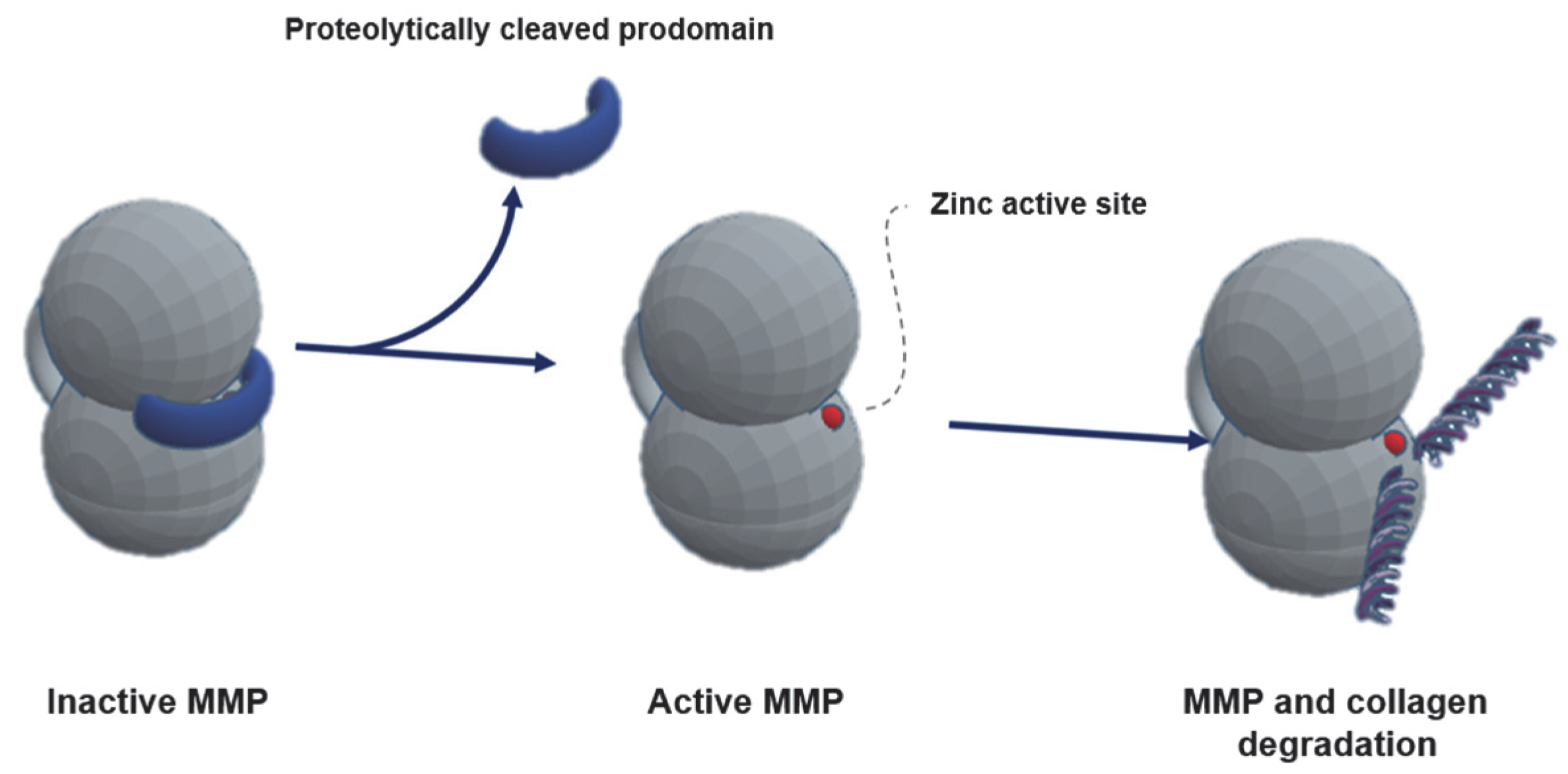
Secretion and Activation of MMPs
3. Role of MMPs in Orthodontic Tooth Movement
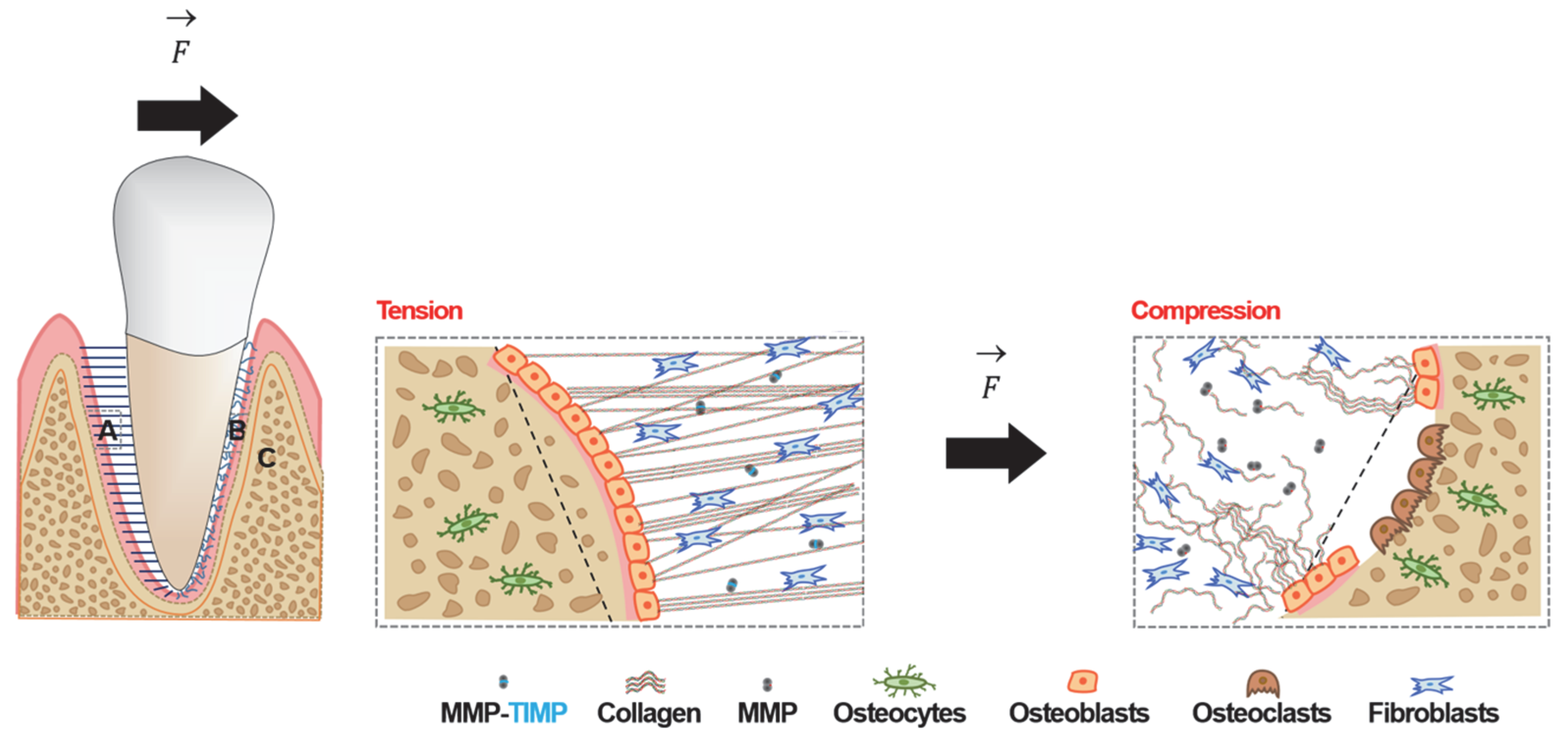
3.1. MMPs on the Resorption Side
3.1.1. In Vitro Evidence
- MMPs changes in PDL cells
- MMPs changes in bone cells
3.1.2. In Vivo Evidence
3.2. MMPs on the Apposition Side
3.2.1. In Vitro Evidence
- MMPs changes in PDL cells
- MMPs changes in bone cells
3.2.2. In Vivo Evidence
4. PDL (And Bone) Remodelling
4.1. Resorption Side/ECM Degradation
4.2. Apposition Side/Collagen Synthesis
4.3. Pathological Conditions
5. Clinical Implications
6. Conclusions
Supplementary Materials
Author Contributions
Funding
Data Availability Statement
Conflicts of Interest
Abbreviations
| BMPs | Bone morphogenetic proteins |
| BSPs | Bone sialoproteins |
| CGRP | Calcitonin gene-related peptide |
| COX-2 | Cyclooxygenase-2 |
| CTGF | Connective tissue growth factor |
| ECM | Extracellular matrix |
| FAK | Focal adhesion kinase |
| FGF | Fibroblast growth factor |
| GCF | Gingival crevicular fluid |
| HIF-1α | Hypoxia-induced transcription factor 1 alpha |
| IFN-γ | Gamma interferon |
| IGF-1 | Insulin-like growth factor 1 |
| ILs | Interleukins |
| M-CSF | Macrophage colony-stimulating factor |
| MMPs | Matrix metallopeptidases |
| NE | Norepinephrine |
| OPG | Osteoprotegerin |
| OPN | Osteopontin |
| OTM | Orthodontic tooth movement |
| PDGF | Platelet-derived growth factor |
| PDL | Periodontal ligament |
| PGE2 | Prostaglandin E2 |
| RANK | Receptor activator of nuclear factor kappa-B |
| RANKL | Receptor activator of nuclear factor kappa-B ligand |
| SP | Substance P |
| TGF-β | Transforming growth factor beta |
| TIMPs | Tissue inhibitors of matrix metallopeptidases |
| TNF-α | Tumour necrosis factor-alpha |
| VEGF | Vascular endothelial growth factor |
| VIP | Vasoactive intestinal polypeptide |
References
- Nagase, H.; Visse, R.; Murphy, G. Structure and function of matrix metalloproteinases and TIMPs. Cardiovasc. Res. 2006, 69, 562–573. [Google Scholar] [CrossRef]
- Cabral-Pacheco, G.A.; Garza-Veloz, I.; Castruita-De la Rosa, C.; Ramirez-Acuña, J.M.; Perez-Romero, B.A.; Guerrero-Rodriguez, J.F.; Martinez-Avila, N.; Martinez-Fierro, M.L. The Roles of Matrix Metalloproteinases and Their Inhibitors in Human Diseases. Int. J. Mol. Sci. 2020, 21, 9739. [Google Scholar] [CrossRef]
- Stamenkovic, I. Extracellular matrix remodelling: The role of matrix metalloproteinases. J. Pathol. 2003, 200, 448–464. [Google Scholar] [CrossRef] [PubMed]
- Asiry, M.A. Biological aspects of orthodontic tooth movement: A review of literature. Saudi J. Biol. Sci. 2018, 25, 1027–1032. [Google Scholar] [CrossRef]
- Schröder, A.; Käppler, P.; Nazet, U.; Jantsch, J.; Proff, P.; Cieplik, F.; Deschner, J.; Kirschneck, C. Effects of Compressive and Tensile Strain on Macrophages during Simulated Orthodontic Tooth Movement. Mediators Inflamm. 2020, 2020, 2814015. [Google Scholar] [CrossRef]
- Proffit, W.R.; Fields, H.W.; Sarver, D.M. Contemporary Orthodontics, 4th ed.; Elsevier Editora: Rio de Janeiro, Brazil, 2008; ISBN 978-85-352-2241-8. [Google Scholar]
- Li, Y.; Jacox, L.A.; Little, S.H.; Ko, C.C. Orthodontic tooth movement: The biology and clinical implications. Kaohsiung J. Med. Sci. 2018, 34, 207–214. [Google Scholar] [CrossRef] [PubMed]
- Bassett, C.A.L.; Becker, R.O. Generation of Electric Potentials by Bone in Response to Mechanical Stress. Science 1962, 137, 1063–1064. [Google Scholar] [CrossRef] [PubMed]
- Davidovitch, Z.; Finkelson, M.D.; Steigman, S.; Shanfeld, J.L.; Montgomery, P.C.; Korostoff, E. Electric currents, bone remodeling, and orthodontic tooth movement. Am. J. Orthod. 1980, 77, 14–32. [Google Scholar] [CrossRef]
- Chen, J.; Li, W.; Swain, M.V.; Ali Darendeliler, M.; Li, Q. A periodontal ligament driven remodeling algorithm for orthodontic tooth movement. J. Biomech. 2014, 47, 1689–1695. [Google Scholar] [CrossRef]
- Liu, J.; Chen, P.; Mehta, S.; Dutra, E.H.; Yadav, S. Dynamic changes in transcriptome during orthodontic tooth movement. Orthod. Craniofac. Res. 2023, 26, 73–81. [Google Scholar] [CrossRef]
- McCormack, S.W.; Witzel, U.; Watson, P.J.; Fagan, M.J.; Gröning, F. The Biomechanical Function of Periodontal Ligament Fibres in Orthodontic Tooth Movement. PLoS ONE 2014, 9, e102387. [Google Scholar] [CrossRef]
- Alikhani, M.; Sangsuwon, C.; Alansari, S.; Nervina, J.M.; Teixeira, C.C. Biphasic theory: Breakthrough understanding of tooth movement. J. World Fed. Orthod. 2018, 7, 82–88. [Google Scholar] [CrossRef]
- Andrade, I., Jr.; Sousa, A.B.D.S.; da Silva, G.G. New therapeutic modalities to modulate orthodontic tooth movement. Dent. Press J. Orthod. 2014, 19, 123–133. [Google Scholar] [CrossRef] [PubMed]
- Li, Y.; Zhan, Q.; Bao, M.; Yi, J.; Li, Y. Biomechanical and biological responses of periodontium in orthodontic tooth movement: Update in a new decade. Int. J. Oral Sci. 2021, 13, 20. [Google Scholar] [CrossRef]
- Kaku, M.; Yamauchi, M. Mechano-regulation of collagen biosynthesis in periodontal ligament. J. Prosthodont. Res. 2014, 58, 193–207. [Google Scholar] [CrossRef]
- Andrei, M.; Dinischiotu, A.; Didilescu, A.C.; Ionita, D.; Demetrescu, I. Periodontal materials and cell biology for guided tissue and bone regeneration. Ann. Anat. 2018, 216, 164–169. [Google Scholar] [CrossRef] [PubMed]
- Kaku, M.; Thant, L.; Dobashi, A.; Ono, Y.; Kitami, M.; Mizukoshi, M.; Arai, M.; Iwama, H.; Kitami, K.; Kakihara, Y.; et al. Multiomics analysis of cultured mouse periodontal ligament cell-derived extracellular matrix. Sci. Rep. 2024, 14, 354. [Google Scholar] [CrossRef] [PubMed]
- Thant, L.; Kaku, M.; Kakihara, Y.; Mizukoshi, M.; Kitami, M.; Arai, M.; Kitami, K.; Kobayashi, D.; Yoshida, Y.; Maeda, T.; et al. Extracellular Matrix-Oriented Proteomic Analysis of Periodontal Ligament Under Mechanical Stress. Front. Physiol. 2022, 13, 899699. [Google Scholar] [CrossRef]
- Eckes, B.; Nischt, R.; Krieg, T. Cell-matrix interactions in dermal repair and scarring. Fibrogenesis Tissue Repair 2010, 3, 4. [Google Scholar] [CrossRef]
- Yue, B. Biology of the Extracellular Matrix. J. Glaucoma 2014, 23, S20–S23. [Google Scholar] [CrossRef]
- Kechagia, J.Z.; Ivaska, J.; Roca-Cusachs, P. Integrins as biomechanical sensors of the microenvironment. Nat. Rev. Mol. Cell Biol. 2019, 20, 457–473. [Google Scholar] [CrossRef]
- Ziegler, N.; Alonso, A.; Steinberg, T.; Woodnutt, D.; Kohl, A.; Müssig, E.; Schulz, S.; Tomakidi, P. Mechano-transduction in periodontal ligament cells identifies activated states of MAP-kinases p42/44 and p38-stress kinase as a mechanism for MMP-13 expression. BMC Cell Biol. 2010, 11, 10. [Google Scholar] [CrossRef]
- Strohmeyer, N.; Bharadwaj, M.; Costell, M.; Fässler, R.; Müller, D.J. Fibronectin-bound α5β1 integrins sense load and signal to reinforce adhesion in less than a second. Nat. Mater. 2017, 16, 1262–1270, Erratum in Nat. Mater. 2018, 17, 103. [Google Scholar] [CrossRef] [PubMed]
- Henneman, S.; Von den Hoff, J.W.; Maltha, J.C. Mechanobiology of tooth movement. Eur. J. Orthod. 2008, 30, 299–306. [Google Scholar] [CrossRef] [PubMed]
- Feller, L.; Khammissa, R.A.G.; Schechter, I.; Moodley, A.; Thomadakis, G.; Lemmer, J. Periodontal Biological Events Associated with Orthodontic Tooth Movement: The Biomechanics of the Cytoskeleton and the Extracellular Matrix. Sci. World J. 2015, 2015, 894123. [Google Scholar] [CrossRef]
- Behm, C.; Nemec, M.; Weissinger, F.; Rausch, M.A.; Andrukhov, O.; Jonke, E. MMPs and TIMPs Expression Levels in the Periodontal Ligament during Orthodontic Tooth Movement: A Systematic Review of In Vitro and In Vivo Studies. Int. J. Mol. Sci. 2021, 22, 6967. [Google Scholar] [CrossRef] [PubMed]
- Sabane, A.; Patil, A.; Swami, V.; Nagarajan, P. Biology of Tooth Movement. Br. J. Med. Med. Res. 2016, 16, 1–10. [Google Scholar] [CrossRef]
- Jeon, H.H.; Yang, C.-Y.; Shin, M.K.; Wang, J.; Patel, J.H.; Chung, C.-H.; Graves, D.T. Osteoblast lineage cells and periodontal ligament fibroblasts regulate orthodontic tooth movement that is dependent on NF-kB activation. Angle Orthod. 2021, 91, 664–671. [Google Scholar] [CrossRef]
- Jiang, N.; Guo, W.; Chen, M.; Zheng, Y.; Zhou, J.; Kim, S.G.; Embree, M.C.; Song, S.; Marao, H.F.; Mao, J.J. Periodontal Ligament and Alveolar Bone in Health and Adaptation: Tooth Movement. Front. Oral Biol. 2016, 18, 1. [Google Scholar] [CrossRef]
- Canavarro, C.; Teles, R.P.; Capelli Junior, J. Matrix metalloproteinases -1, -2, -3, -7, -8, -12, and -13 in gingival crevicular fluid during orthodontic tooth movement: A longitudinal randomized split-mouth study. Eur. J. Orthod. 2013, 35, 652–658. [Google Scholar] [CrossRef]
- Ullrich, N.; Schröder, A.; Jantsch, J.; Spanier, G.; Proff, P.; Kirschneck, C. The role of mechanotransduction versus hypoxia during simulated orthodontic compressive strain—An in vitro study of human periodontal ligament fibroblasts. Int. J. Oral Sci. 2019, 11, 33. [Google Scholar] [CrossRef] [PubMed]
- Vijayashree, R.J.; Sivapathasundharam, B. The diverse role of oral fibroblasts in normal and disease. J. Oral Maxillofac. Pathol. 2022, 26, 6–13. [Google Scholar] [CrossRef]
- Clarke, B. Normal Bone Anatomy and Physiology. Clin. J. Am. Soc. Nephrol. 2008, 3, S131–S139. [Google Scholar] [CrossRef]
- Jin, C.H.; Chisato, M.; Yoshiko, I.; Hong, M.H.; Toshiyuki, S.; Etsuko, A.; Tatsuo, S. Interleukin 1 regulates the expression of osteopontin mRNA by osteoblasts. Mol. Cell. Endocrinol. 1990, 74, 221–228. [Google Scholar] [CrossRef]
- Capulli, M.; Paone, R.; Rucci, N. Osteoblast and osteocyte: Games without frontiers. Arch. Biochem. Biophys. 2014, 561, 3–12. [Google Scholar] [CrossRef] [PubMed]
- D’Oronzo, S.; Coleman, R.; Brown, J.; Silvestris, F. Metastatic bone disease: Pathogenesis and therapeutic options. J. Bone Oncol. 2019, 15, 100205. [Google Scholar] [CrossRef]
- Menton, D.N.; Simmons, D.J.; Chang, S.-L.; Orr, B.Y. From bone lining cell to osteocyte—An SEM study. Anat. Rec. 1984, 209, 29–39. [Google Scholar] [CrossRef]
- Ansari, N.; Sims, N.A. The Cells of Bone and Their Interactions. In Handbook of Experimental Pharmacology; Springer: Cham, Switzerland, 2019; Volume 262, pp. 1–25. [Google Scholar] [CrossRef]
- Manolagas, S.C. Birth and Death of Bone Cells: Basic Regulatory Mechanisms and Implications for the Pathogenesis and Treatment of Osteoporosis. Endocr. Rev. 2000, 21, 115–137. [Google Scholar] [CrossRef]
- Florencio-Silva, R.; Sasso, G.R.D.S.; Sasso-Cerri, E.; Simões, M.J.; Cerri, P.S. Biology of Bone Tissue: Structure, Function, and Factors That Influence Bone Cells. Biomed Res. Int. 2015, 2015, 421746. [Google Scholar] [CrossRef]
- Parfitt, A.M. Osteonal and hemi-osteonal remodeling: The spatial and temporal framework for signal traffic in adult human bone. J. Cell. Biochem. 1994, 55, 273–286. [Google Scholar] [CrossRef] [PubMed]
- Murshid, S.A. The role of osteocytes during experimental orthodontic tooth movement: A review. Arch. Oral Biol. 2017, 73, 25–33. [Google Scholar] [CrossRef]
- Dallas, S.L.; Prideaux, M.; Bonewald, L.F. The Osteocyte: An Endocrine Cell… and More. Endocr. Rev. 2013, 34, 658–690. [Google Scholar] [CrossRef] [PubMed]
- Bonewald, L.F. The amazing osteocyte. J. Bone Miner. Res. 2011, 26, 229–238. [Google Scholar] [CrossRef]
- Anderson, H.C. Matrix vesicles and calcification. Curr. Rheumatol. Rep. 2003, 5, 222–226. [Google Scholar] [CrossRef] [PubMed]
- Boyle, W.J.; Simonet, W.S.; Lacey, D.L. Osteoclast differentiation and activation. Nature 2003, 423, 337–342. [Google Scholar] [CrossRef] [PubMed]
- Kenkre, J.; Bassett, J. The bone remodelling cycle. Ann. Clin. Biochem. Int. J. Lab. Med. 2018, 55, 308–327. [Google Scholar] [CrossRef]
- Chaushu, S.; Klein, Y.; Mandelboim, O.; Barenholz, Y.; Fleissig, O. Immune Changes Induced by Orthodontic Forces: A Critical Review. J. Dent. Res. 2022, 101, 11–20. [Google Scholar] [CrossRef]
- He, D.; Kou, X.; Yang, R.; Liu, D.; Wang, X.; Luo, Q.; Song, Y.; Liu, F.; Yan, Y.; Gan, Y.; et al. M1-like Macrophage Polarization Promotes Orthodontic Tooth Movement. J. Dent. Res. 2015, 94, 1286–1294. [Google Scholar] [CrossRef]
- Kawai, T.; Matsuyama, T.; Hosokawa, Y.; Makihira, S.; Seki, M.; Karimbux, N.Y.; Goncalves, R.B.; Valverde, P.; Dibart, S.; Li, Y.P.; et al. B and T lymphocytes are the primary sources of RANKL in the bone resorptive lesion of periodontal disease. Am. J. Pathol. 2006, 169, 987–998. [Google Scholar] [CrossRef]
- Gao, Y.; Min, Q.; Li, X.; Liu, L.; Lv, Y.; Xu, W.; Liu, X.; Wang, H. Immune System Acts on Orthodontic Tooth Movement: Cellular and Molecular Mechanisms. Biomed Res. Int. 2022, 2022, 9668610. [Google Scholar] [CrossRef]
- Gong, D.; Shi, W.; Yi, S.; Chen, H.; Groffen, J.; Heisterkamp, N. TGFβ signaling plays a critical role in promoting alternative macrophage activation. BMC Immunol. 2012, 13, 31. [Google Scholar] [CrossRef]
- Ma, X.; Gao, Y.; Chen, Y.; Liu, J.; Yang, C.; Bao, C.; Wang, Y.; Feng, Y.; Song, X.; Qiao, S. M2-Type Macrophages Induce Tregs Generation by Activating the TGF-β/Smad Signalling Pathway to Promote Colorectal Cancer Development. Onco. Targets. Ther. 2021, 14, 5391–5402. [Google Scholar] [CrossRef] [PubMed]
- Miki, K.; Honma, S.; Ebara, S.; Kumamoto, K.; Murakami, S.; Wakisaka, S. Changes in the Distribution of Periodontal Nerve Fibers during Dentition Transition in the Cat. PLoS ONE 2015, 10, e0129826. [Google Scholar] [CrossRef]
- Park, H.-J.; Baek, K.H.; Lee, H.-L.; Kwon, A.; Hwang, H.R.; Qadir, A.S.; Woo, K.M.; Ryoo, H.-M.; Baek, J.-H. Hypoxia Inducible Factor-1α Directly Induces the Expression of Receptor Activator of Nuclear Factor-κB Ligand in Periodontal Ligament Fibroblasts. Mol. Cells 2011, 31, 573–578. [Google Scholar] [CrossRef] [PubMed]
- Dandajena, T.C.; Ihnat, M.A.; Disch, B.; Thorpe, J.; Currier, G.F. Hypoxia triggers a HIF-mediated differentiation of peripheral blood mononuclear cells into osteoclasts. Orthod. Craniofac. Res. 2012, 15, 1–9. [Google Scholar] [CrossRef] [PubMed]
- Huang, H.; Ma, L.; Kyrkanides, S. Effects of vascular endothelial growth factor on osteoblasts and osteoclasts. Am. J. Orthod. Dentofac. Orthop. 2016, 149, 366–373. [Google Scholar] [CrossRef]
- Fernández-Torres, J.; Martínez-Nava, G.A.; Gutiérrez-Ruíz, M.C.; Gómez-Quiroz, L.E.; Gutiérrez, M. Role of HIF-1α signaling pathway in osteoarthritis: A systematic review. Rev. Bras. Reumatol. 2017, 57, 162–173. [Google Scholar] [CrossRef]
- Mach, F.; Schönbeck, U.; Fabunmi, R.P.; Murphy, C.; Atkinson, E.; Bonnefoy, J.-Y.; Graber, P.; Libby, P. T Lymphocytes Induce Endothelial Cell Matrix Metalloproteinase Expression by a CD40L-Dependent Mechanism. Am. J. Pathol. 1999, 154, 229–238. [Google Scholar] [CrossRef]
- Cao, H.; Kou, X.; Yang, R.; Liu, D.; Wang, X.; Song, Y.; Feng, L.; He, D.; Gan, Y.; Zhou, Y. Force-induced Adrb2 in Periodontal Ligament Cells Promotes Tooth Movement. J. Dent. Res. 2014, 93, 1163–1169. [Google Scholar] [CrossRef]
- Jiao, K.; Niu, L.-N.; Li, Q.; Ren, G.; Zhao, C.; Liu, Y.; Tay, F.R.; Wang, M. β2-adrenergic signal transduction plays a detrimental role in subchondral bone loss of temporomandibular joint in osteoarthritis. Sci. Rep. 2015, 5, 12593. [Google Scholar] [CrossRef]
- Qiao, Y.; Wang, Y.; Zhou, Y.; Jiang, F.; Huang, T.; Chen, L.; Lan, J.; Yang, C.; Guo, Y.; Yan, S.; et al. The role of nervous system in adaptive response of bone to mechanical loading. J. Cell. Physiol. 2019, 234, 7771–7780. [Google Scholar] [CrossRef]
- Wang, L.; Zhao, R.; Shi, X.; Wei, T.; Halloran, B.P.; Clark, D.J.; Jacobs, C.R.; Kingery, W.S. Substance P stimulates bone marrow stromal cell osteogenic activity, osteoclast differentiation, and resorption activity in vitro. Bone 2009, 45, 309–320. [Google Scholar] [CrossRef]
- Hu, K.; Olsen, B.R. Vascular endothelial growth factor control mechanisms in skeletal growth and repair. Dev. Dyn. 2017, 246, 227–234. [Google Scholar] [CrossRef]
- Nilsson, M.; Heymach, J.V. Vascular Endothelial Growth Factor (VEGF) Pathway. J. Thorac. Oncol. 2006, 1, 768–770. [Google Scholar] [CrossRef]
- Caviedes-Bucheli, J.; Lopez-Moncayo, L.F.; Muñoz-Alvear, H.D.; Gomez-Sosa, J.F.; Diaz-Barrera, L.E.; Curtidor, H.; Munoz, H.R. Expression of substance P, calcitonin gene-related peptide and vascular endothelial growth factor in human dental pulp under different clinical stimuli. BMC Oral Health 2021, 21, 152. [Google Scholar] [CrossRef] [PubMed]
- Kato, J.; Wakisaka, S.; Kurisu, K. Immunohistochemical Changes in the Distribution of Nerve Fibers in the Periodontal Ligament during an Experimental Tooth Movement of the Rat Molar. Cells Tissues Organs 1996, 157, 53–62. [Google Scholar] [CrossRef] [PubMed]
- Nicolay, O.F.; Davidovitch, Z.; Shanfeld, J.L.; Alley, K. Substance P immunoreactivity in periodontal tissues during orthodontic tooth movement. Bone Miner. 1990, 11, 19–29. [Google Scholar] [CrossRef] [PubMed]
- Russell, F.A.; King, R.; Smillie, S.-J.; Kodji, X.; Brain, S.D. Calcitonin Gene-Related Peptide: Physiology and Pathophysiology. Physiol. Rev. 2014, 94, 1099–1142. [Google Scholar] [CrossRef]
- Sharma, R.; Preethi, N.; Sidana, A. Neurological mechanisms involved in orthodontic tooth movement: A contemporary review. Int. J. Contemp. Dent. Med. Rev. 2015, 2015, 250115. [Google Scholar]
- Castro-Vázquez, D.; Arribas-Castaño, P.; García-López, I.; Gutiérrez-Cañas, I.; Pérez-García, S.; Lamana, A.; Villanueva-Romero, R.; Cabrera-Martín, A.; Tecza, K.; Martínez, C.; et al. Vasoactive intestinal peptide exerts an osteoinductive effect in human mesenchymal stem cells. BioFactors 2024, 50, 1148–1160. [Google Scholar] [CrossRef]
- Elefteriou, F. Neuronal signaling and the regulation of bone remodeling. Cell. Mol. Life Sci. 2005, 62, 2339–2349. [Google Scholar] [CrossRef]
- Wang, Y.; Groeger, S.; Yong, J.; Ruf, S. Orthodontic Compression Enhances Macrophage M2 Polarization via Histone H3 Hyperacetylation. Int. J. Mol. Sci. 2023, 24, 3117. [Google Scholar] [CrossRef] [PubMed]
- He, H.; Chai, J.; Zhang, S.; Ding, L.; Yan, P.; Du, W.; Yang, Z. CGRP may regulate bone metabolism through stimulating osteoblast differentiation and inhibiting osteoclast formation. Mol. Med. Rep. 2016, 13, 3977–3984. [Google Scholar] [CrossRef]
- Qu, H.; Zhuang, Y.; Zhu, L.; Zhao, Z.; Wang, K. The effects of vasoactive intestinal peptide on RANKL-induced osteoclast formation. Ann. Transl. Med. 2021, 9, 127. [Google Scholar] [CrossRef] [PubMed]
- Hacopian, N.; Nik, T.H.; Ghahremani, M.H.; Rahimi, H.R.; Ostad, S.N. Effects of Continuous and Interrupted Forces on Gene Transcription in Periodontal Ligament Cells In Vitro. Acta Med. Iran. 2011, 49, 643–649. Available online: http://www.ncbi.nlm.nih.gov/pubmed/22071638 (accessed on 30 July 2024). [PubMed]
- Maltha, J.C.; Kuijpers-Jagtman, A.M. Mechanobiology of orthodontic tooth movement: An update. J. World Fed. Orthod. 2023, 12, 156–160. [Google Scholar] [CrossRef]
- Cui, N.; Hu, M.; Khalil, R.A. Biochemical and Biological Attributes of Matrix Metalloproteinases. Physiol. Behav. 2017, 176, 1–73. [Google Scholar] [CrossRef]
- Laronha, H.; Caldeira, J. Structure and Function of Human Matrix Metalloproteinases. Cells 2020, 9, 1076. [Google Scholar] [CrossRef]
- Laronha, H.; Carpinteiro, I.; Portugal, J.; Azul, A.; Polido, M.; Petrova, K.T.; Salema-Oom, M.; Caldeira, J. Challenges in Matrix Metalloproteinases Inhibition. Biomolecules 2020, 10, 717. [Google Scholar] [CrossRef]
- Molière, S.; Jaulin, A.; Tomasetto, C.-L.; Dali-Youcef, N. Roles of Matrix Metalloproteinases and Their Natural Inhibitors in Metabolism: Insights into Health and Disease. Int. J. Mol. Sci. 2023, 24, 10649. [Google Scholar] [CrossRef]
- Meikle, M.C.; Bord, S.; Hembry, R.M.; Compston, J.; Croucher, P.I.; Reynolds, J.J. Human osteoblasts in culture synthesize collagenase and other matrix metalloproteinases in response to osteotropic hormones and cytokines. J. Cell Sci. 1992, 103, 1093–1099. [Google Scholar] [CrossRef]
- Yang, W.-K.; Lee, W.; Kim, M.-R.; Son, H.-H. MMP and TIMP production in periodontal ligament fibroblasts stimulated by Prevotella nigrescens lipopolysaccharide. J. Korean Acad. Conserv. Dent. 2005, 30, 372–384. [Google Scholar] [CrossRef]
- Tallant, C.; Marrero, A.; Gomis-Rüth, F.X. Matrix metalloproteinases: Fold and function of their catalytic domains. Biochim. Biophys. Acta-Mol. Cell Res. 2010, 1803, 20–28. [Google Scholar] [CrossRef] [PubMed]
- Verma, R.P.; Hansch, C. Matrix metalloproteinases (MMPs): Chemical–biological functions and (Q)SARs. Bioorg. Med. Chem. 2007, 15, 2223–2268. [Google Scholar] [CrossRef] [PubMed]
- Mannello, F.; Medda, V. Nuclear localization of Matrix metalloproteinases. Prog. Histochem. Cytochem. 2012, 47, 27–58, Erratum in Prog. Histochem. Cytochem. 2013, 48, 99. [Google Scholar] [CrossRef]
- Klein, T.; Bischoff, R. Physiology and pathophysiology of matrix metalloproteases. Amino Acids 2011, 41, 271–290. [Google Scholar] [CrossRef]
- Davis, G.E.; Pintar Allen, K.A.; Salazar, R.; Maxwell, S.A. Matrix metalloproteinase-1 and -9 activation by plasmin regulates a novel endothelial cell-mediated mechanism of collagen gel contraction and capillary tube regression in three-dimensional collagen matrices. J. Cell Sci. 2001, 114, 917–930. [Google Scholar] [CrossRef]
- Suzuki, K.; Enghild, J.J.; Morodomi, T.; Salvesen, G.; Nagase, H. Mechanisms of activation of tissue procollagenase by matrix metalloproteinase 3 (stromelysin). Biochemistry 1990, 29, 10261–10270. [Google Scholar] [CrossRef]
- Nakamura, H.; Fujii, Y.; Ohuchi, E.; Yamamoto, E.; Okada, Y. Activation of the precursor of human stromelysin 2 and its interactions with other matrix metalloproteinases. Eur. J. Biochem. 1998, 253, 67–75. [Google Scholar] [CrossRef]
- Beklen, A.; Tüter, G.; Sorsa, T.; Hanemaaijer, R.; Virtanen, I.; Tervahartiala, T.; Konttinen, Y.T. Gingival tissue and crevicular fluid co-operation in adult periodontitis. J. Dent. Res. 2006, 85, 59–63. [Google Scholar] [CrossRef]
- Holopainen, J.M.; Moilanen, J.A.O.; Sorsa, T.; Kivelä-Rajamäki, M.; Tervahartiala, T.; Vesaluoma, M.H.; Tervo, T.M.T. Activation of Matrix Metalloproteinase-8 by Membrane Type 1-MMP and Their Expression in Human Tears after Photorefractive Keratectomy. Investig. Ophthalmol. Vis. Sci. 2003, 44, 2550–2556. [Google Scholar] [CrossRef] [PubMed]
- Knäuper, V.; Will, H.; López-Otin, C.; Smith, B.; Atkinson, S.J.; Stanton, H.; Hembry, R.M.; Murphy, G. Cellular Mechanisms for Human Procollagenase-3 (MMP-13) Activation. J. Biol. Chem. 1996, 271, 17124–17131. [Google Scholar] [CrossRef]
- Mirastschijski, U.; Lupše, B.; Maedler, K.; Sarma, B.; Radtke, A.; Belge, G.; Dorsch, M.; Wedekind, D.; McCawley, L.J.; Boehm, G.; et al. Matrix Metalloproteinase-3 is Key Effector of TNF-α-Induced Collagen Degradation in Skin. Int. J. Mol. Sci. 2019, 20, 5234. [Google Scholar] [CrossRef] [PubMed]
- Young, D.A.; Barter, M.J.; Wilkinson, D.J. Recent advances in understanding the regulation of metalloproteinases. F1000Research 2019, 8, 1–11. [Google Scholar] [CrossRef]
- Luchian, I.; Goriuc, A.; Sandu, D.; Covasa, M. The Role of Matrix Metalloproteinases (MMP-8, MMP-9, MMP-13) in Periodontal and Peri-Implant Pathological Processes. Int. J. Mol. Sci. 2022, 23, 1806. [Google Scholar] [CrossRef] [PubMed]
- Sato, H.; Takino, T.; Okada, Y.; Cao, J.; Shinagawa, A.; Yamamoto, E.; Seiki, M. A matrix metalloproteinase expressed on the surface of invasive tumour cells. Nature 1994, 370, 61–65. [Google Scholar] [CrossRef]
- Steenport, M.; Khan, K.M.F.; Du, B.; Barnhard, S.E.; Dannenberg, A.J.; Falcone, D.J. Matrix Metalloproteinase (MMP)-1 and MMP-3 Induce Macrophage MMP-9: Evidence for the Role of TNF-α and Cyclooxygenase-2. J. Immunol. 2009, 183, 8119–8127. [Google Scholar] [CrossRef]
- Dreier, R.; Wallace, S.; Fuchs, S.; Bruckner, P.; Grässel, S. Paracrine interactions of chondrocytes and macrophages in cartilage degradation: Articular chondrocytes provide factors that activate macrophage-derived pro-gelatinase B (pro-MMP-9). J. Cell Sci. 2001, 114, 3813–3822. [Google Scholar] [CrossRef]
- Hernández Ríos, M.; Sorsa, T.; Obregón, F.; Tervahartiala, T.; Valenzuela, M.A.; Pozo, P.; Dutzan, N.; Lesaffre, E.; Molas, M.; Gamonal, J. Proteolytic roles of matrix metalloproteinase (MMP)-13 during progression of chronic periodontitis: Initial evidence for MMP-13/MMP-9 activation cascade. J. Clin. Periodontol. 2009, 36, 1011–1017. [Google Scholar] [CrossRef]
- Baramova, E.N.; Bajou, K.; Remacle, A.; L’Hoir, C.; Krell, H.W.; Weidle, U.H.; Noel, A.; Foidart, J.M. Involvement of PA/plasmin system in the processing of pro-MMP-9 and in the second step of pro-MMP-2 activation. FEBS Lett. 1997, 405, 157–162. [Google Scholar] [CrossRef]
- Du, G.; Liu, C.; Li, X.; Chen, W.; He, R.; Wang, X.; Feng, P.; Lan, W. Induction of matrix metalloproteinase-1 by tumor necrosis factor-α is mediated by interleukin-6 in cultured fibroblasts of keratoconus. Exp. Biol. Med. 2016, 241, 2033–2041. [Google Scholar] [CrossRef]
- Ben David, D.; Reznick, A.Z.; Srouji, S.; Livne, E. Exposure to pro-inflammatory cytokines upregulates MMP-9 synthesis by mesenchymal stem cells-derived osteoprogenitors. Histochem. Cell Biol. 2008, 129, 589–597. [Google Scholar] [CrossRef]
- Gomes, L.R.; Terra, L.F.; Wailemann, R.A.M.; Labriola, L.; Sogayar, M.C. TGF-β1 modulates the homeostasis between MMPs and MMP inhibitors through p38 MAPK and ERK1/2 in highly invasive breast cancer cells. BMC Cancer 2012, 12, 26. [Google Scholar] [CrossRef]
- Chen, M.-S.; Lin, C.-Y.; Chiu, Y.-H.; Chen, C.-P.; Tsai, P.-J.; Wang, H.-S. IL-1β-Induced Matrix Metalloprotease-1 Promotes Mesenchymal Stem Cell Migration via PAR1 and G-Protein-Coupled Signaling Pathway. Stem Cells Int. 2018, 2018, 3524759. [Google Scholar] [CrossRef] [PubMed]
- Long, F. Building strong bones: Molecular regulation of the osteoblast lineage. Nat. Rev. Mol. Cell Biol. 2012, 13, 27–38. [Google Scholar] [CrossRef] [PubMed]
- Lin, J.-L.; Wang, M.J.; Lee, D.; Liang, C.-C.; Lin, S. Hypoxia-inducible factor-1α regulates matrix metalloproteinase-1 activity in human bone marrow-derived mesenchymal stem cells. FEBS Lett. 2008, 582, 2615–2619. [Google Scholar] [CrossRef]
- Ahn, J.K.; Koh, E.-M.; Cha, H.-S.; Lee, Y.S.; Kim, J.; Bae, E.-K.; Ahn, K.-S. Role of hypoxia-inducible factor-1 in hypoxia-induced expressions of IL-8, MMP-1 and MMP-3 in rheumatoid fibroblast-like synoviocytes. Rheumatology 2008, 47, 834–839. [Google Scholar] [CrossRef] [PubMed]
- Zhu, M.; Ma, Y.; Tang, M.; Pan, L.; Liu, W. Hypoxia-induced upregulation of matrix metalloproteinase 9 increases basement membrane degradation by downregulating collagen type IV alpha 1 chain. Physiol. Res. 2022, 71, 825–834. [Google Scholar] [CrossRef]
- Shan, Y.; You, B.; Shi, S.; Shi, W.; Zhang, Z.; Zhang, Q.; Gu, M.; Chen, J.; Bao, L.; Liu, D.; et al. Hypoxia-Induced Matrix Metalloproteinase-13 Expression in Exosomes from Nasopharyngeal Carcinoma Enhances Metastases. Cell Death Dis. 2018, 9, 382. [Google Scholar] [CrossRef]
- Noda, K.; Ishida, S.; Shinoda, H.; Koto, T.; Aoki, T.; Tsubota, K.; Oguchi, Y.; Okada, Y.; Ikeda, E. Hypoxia Induces the Expression of Membrane-Type 1 Matrix Metalloproteinase in Retinal Glial Cells. Investig. Ophthalmol. Vis. Sci. 2005, 46, 3817–3824. [Google Scholar] [CrossRef]
- Arpino, V.; Brock, M.; Gill, S.E. The role of TIMPs in regulation of extracellular matrix proteolysis. Matrix Biol. 2015, 44–46, 247–254. [Google Scholar] [CrossRef] [PubMed]
- Brew, K.; Nagase, H. The tissue inhibitors of metalloproteinases (TIMPs): An ancient family with structural and functional diversity. Biochim. Biophys. Acta-Mol. Cell Res. 2010, 1803, 55–71. [Google Scholar] [CrossRef] [PubMed]
- Xu, H.Y.; Nie, E.M.; Deng, G.; Lai, L.Z.; Sun, F.Y.; Tian, H.; Fang, F.C.; Zou, Y.G.; Wu, B.L.; Ou-Yang, J. Periostin is essential for periodontal ligament remodeling during orthodontic treatment. Mol. Med. Rep. 2017, 15, 1800–1806. [Google Scholar] [CrossRef] [PubMed][Green Version]
- Batra, J.; Robinson, J.; Soares, A.S.; Fields, A.P.; Radisky, D.C.; Radisky, E.S. Matrix metalloproteinase-10 (MMP-10) interaction with tissue inhibitors of metalloproteinases TIMP-1 and TIMP-2: Binding studies and crystal structure. J. Biol. Chem. 2012, 287, 15935–15946. [Google Scholar] [CrossRef]
- Bolcato-Bellemin, A.L.; Elkaim, R.; Abehsera, A.; Fausser, J.L.; Haikel, Y.; Tenenbaum, H. Expression of mRNAs Encoding for α and β Integrin Subunits, MMPs, and TIMPs in Stretched Human Periodontal Ligament and Gingival Fibroblasts. J. Dent. Res. 2000, 79, 1712–1716. [Google Scholar] [CrossRef]
- Cantarella, G.; Cantarella, R.; Caltabiano, M.; Risuglia, N.; Bernardini, R.; Leonardi, R. Levels of matrix metalloproteinases 1 and 2 in human gingival crevicular fluid during initial tooth movement. Am. J. Orthod. Dentofac. Orthop. 2006, 130, 568.e11–568.e16. [Google Scholar] [CrossRef]
- Jacobs, C.; Walter, C.; Ziebart, T.; Grimm, S.; Meila, D.; Krieger, E.; Wehrbein, H. Induction of IL-6 and MMP-8 in human periodontal fibroblasts by static tensile strain. Clin. Oral Investig. 2014, 18, 901–908. [Google Scholar] [CrossRef]
- Kook, S.-H.; Jang, Y.-S.; Lee, J.-C. Involvement of JNK-AP-1 and ERK-NF-κB signaling in tension-stimulated expression of Type I collagen and MMP-1 in human periodontal ligament fibroblasts. J. Appl. Physiol. 2011, 111, 1575–1583. [Google Scholar] [CrossRef]
- Li, Y.; Tang, L.; Duan, Y.; Ding, Y. Upregulation of MMP-13 and TIMP-1 expression in response to mechanical strain in MC3T3-E1 osteoblastic cells. BMC Res. Notes 2010, 3, 309. [Google Scholar] [CrossRef]
- Narimiya, T.; Wada, S.; Kanzaki, H.; Ishikawa, M.; Tsuge, A.; Yamaguchi, Y.; Nakamura, Y. Orthodontic tensile strain induces angiogenesis via type IV collagen degradation by matrix metalloproteinase-12. J. Periodontal Res. 2017, 52, 842–852. [Google Scholar] [CrossRef]
- Femiano, F.; Femiano, R.; Femiano, L.; Jamilian, A.; Rullo, R.; Perillo, L. Dentin caries progression and the role of metalloproteinases: An update. Eur. J. Paediatr. Dent. 2016, 17, 243–247. [Google Scholar] [PubMed]
- Lisboa, R.A.; Andrade, M.V.; Cunha-Melo, J.R. Toll-like receptor activation and mechanical force stimulation promote the secretion of matrix metalloproteinases 1, 3 and 10 of human periodontal fibroblasts via p38, JNK and NF-κB. Arch. Oral Biol. 2013, 58, 731–739. [Google Scholar] [CrossRef]
- Redlich, M.; Roos, H.; Reichenberg, E.; Zaks, B.; Grosskop, A.; Bar Kana, I.; Pitaru, S.; Palmon, A. The effect of centrifugal force on mRNA levels of collagenase, collagen type-I, tissue inhibitors of metalloproteinases and β-actin in cultured human periodontal ligament fibroblasts. J. Periodontal Res. 2004, 39, 27–32. [Google Scholar] [CrossRef]
- El-Awady, A.R.; Lapp, C.A.; Gamal, A.Y.; Sharawy, M.M.; Wenger, K.H.; Cutler, C.W.; Messer, R.L.W. Human periodontal ligament fibroblast responses to compression in chronic periodontitis. J. Clin. Periodontol. 2013, 40, 661–671. [Google Scholar] [CrossRef]
- He, Y.; Macarak, E.J.; Korostoff, J.M.; Howard, P.S. Compression and tension: Differential effects on matrix accumulation by periodontal ligament fibroblasts in vitro. Connect. Tissue Res. 2004, 45, 28–39. [Google Scholar] [CrossRef] [PubMed]
- Lisboa, R.A.; Lisboa, F.A.; De Castro Santos, G.; Andrade, M.V.M.; Cunha-Melo, J.R. Matrix metalloproteinase 2 activity decreases in human periodontal ligament fibroblast cultures submitted to simulated orthodontic force. Vitr. Cell. Dev. Biol. Anim. 2009, 45, 614–621. [Google Scholar] [CrossRef]
- Proff, P.; Reicheneder, C.; Faltermeier, A.; Kubein-Meesenburg, D.; Römer, P. Effects of mechanical and bacterial stressors on cytokine and growth-factor expression in periodontal ligament cells. J. Orofac. Orthop./Fortschritte Der Kieferorthopädie 2014, 75, 191–202. [Google Scholar] [CrossRef] [PubMed]
- Nettelhoff, L.; Grimm, S.; Jacobs, C.; Walter, C.; Pabst, A.M.; Goldschmitt, J.; Wehrbein, H. Influence of mechanical compression on human periodontal ligament fibroblasts and osteoblasts. Clin. Oral Investig. 2016, 20, 621–629. [Google Scholar] [CrossRef]
- Hsu, L.F.; Chang, B.E.; Tseng, K.J.; Liao, C.C.; Tsai, S.C.; Hsiao, H.Y.; Lin, S.C.; Liao, P.W.; Chen, Y.J.; Yao, C.C.J. Orthodontic force regulates metalloproteinase-3 promoter in osteoblasts and transgenic mouse models. J. Dent. Sci. 2022, 17, 331–337. [Google Scholar] [CrossRef]
- Mitsui, N.; Suzuki, N.; Koyama, Y.; Yanagisawa, M.; Otsuka, K.; Shimizu, N.; Maeno, M. Effect of compressive force on the expression of MMPs, PAs, and their inhibitors in osteoblastic Saos-2 cells. Life Sci. 2006, 79, 575–583. [Google Scholar] [CrossRef]
- Sanchez, C.; Gabay, O.; Salvat, C.; Henrotin, Y.E.; Berenbaum, F. Mechanical loading highly increases IL-6 production and decreases OPG expression by osteoblasts. Osteoarthr. Cartil. 2009, 17, 473–481. [Google Scholar] [CrossRef] [PubMed]
- Thomas, J.T.; Betsy, J.; Tuomas, W.; Sukumaran, A. Matrix Metalloproteinases (MMPs) in Periodontium: Is It a Boon or a Bane? In Advances in Gingival Diseases Conditions; Sufaru, I.G., Solomon, S.M., Gehrke, S.A., Eds.; IntechOpen Limited: London, UK, 2024; pp. 1–31. ISBN 978-0-85014-274-7. [Google Scholar]
- Bildt, M.M.; Bloemen, M.; Kuijpers-Jagtman, A.M.; Von den Hoff, J.W. Matrix metalloproteinases and tissue inhibitors of metalloproteinases in gingival crevicular fluid during orthodontic tooth movement. Eur. J. Orthod. 2009, 31, 529–535. [Google Scholar] [CrossRef]
- Cwalina-Sidor, I.; Hermanowicz, J.; Dargiewicz, E.; Gorodkiewicz, E.; Ołdak, Ł.; Nowosielska, M.; Hemanowicz, A.; Matuszczak, E. Leptin, fibronectin, MMP-1, and MMP-2 concentration in saliva during orthodontic treatment. Dent. Med. Probl. 2025, 62, 441–448. [Google Scholar] [CrossRef]
- Capelli, J., Jr.; Kantarci, A.; Haffajee, A.; Teles, R.P.; Fidel, R.; Figueredo, C.M. Matrix metalloproteinases and chemokines in the gingival crevicular fluid during orthodontic tooth movement. Eur. J. Orthod. 2011, 33, 705–711. [Google Scholar] [CrossRef]
- Apajalahti, S.; Sorsa, T.; Railavo, S.; Ingman, T. The in vivo Levels of Matrix Metalloproteinase-1 and -8 in Gingival Crevicular Fluid during Initial Orthodontic Tooth Movement. J. Dent. Res. 2003, 82, 1018–1022. [Google Scholar] [CrossRef]
- Sadeq, S.M.A.; Ansari, N.A.; Kadhem, Z.K.; Hussein, H.M. The Use of Salivary and Gingival Crevicular Fluid Biomarkers in Predicting Orthodontic Treatment Response. Clin. Cosmet. Investig. Dent. 2025, 17, 499–513. [Google Scholar] [CrossRef]
- Leonardi, R.; Talic, N.F.; Loreto, C. MMP-13 (collagenase 3) immunolocalisation during initial orthodontic tooth movement in rats. Acta Histochem. 2007, 109, 215–220. [Google Scholar] [CrossRef]
- Takahashi, I.; Nishimura, M.; Onodera, K.; Bae, J.-W.; Mitani, H.; Okazaki, M.; Sasano, Y.; Mitani, H. Expression of MMP-8 and MMP-13 Genes in the Periodontal Ligament during Tooth Movement in Rats. J. Dent. Res. 2003, 82, 646–651. [Google Scholar] [CrossRef] [PubMed]
- Ingman, T.; Apajalahti, S.; Mäntylä, P.; Savolainen, P.; Sorsa, T. Matrix metalloproteinase-1 and -8 in gingival crevicular fluid during orthodontic tooth movement: A pilot study during 1 month of follow-up after fixed appliance activation. Eur. J. Orthod. 2005, 27, 202–207. [Google Scholar] [CrossRef] [PubMed]
- Ribagin, L.S.; Rashkova, M.R. Matrix Metalloproteinase-8 and Interleukin-1β In Gingival Fluid of Children in the First Three Months Of Orthodontic Treatment With Fixed Appliances. Folia Med 2012, 54, 50–56. [Google Scholar] [CrossRef]
- Kredig, C.; Peuckert, E.; Schmidtmann, I.; Drechsler, T.; Erbe, C. Oral health in adolescents: Periodontal inflammatory biomarkers during orthodontic clear aligner therapy. Clin. Oral Investig. 2025, 29, 168. [Google Scholar] [CrossRef]
- de Pontouraude, M.A.; Von den Hoff, J.W.; Baan, F.; Bruggink, R.; Bloemen, M.; Bronkhorst, E.M.; Ongkosuwito, E.M. Highly variable rate of orthodontic tooth movement measured by a novel 3D method correlates with gingival inflammation. Clin. Oral Investig. 2021, 25, 1945–1952. [Google Scholar] [CrossRef]
- Grant, M.; Wilson, J.; Rock, P.; Chapple, I. Induction of cytokines, MMP9, TIMPs, RANKL and OPG during orthodontic tooth movement. Eur. J. Orthod. 2013, 35, 644–651. [Google Scholar] [CrossRef] [PubMed]
- Xu, X.; Zhang, Q.; Lv, Y.; Yu, T.; Chen, J.; Zeng, P.; Wang, L.; Liu, T.; Diao, H. Levels of matrix metalloproteinases in saliva during orthodontic tooth movement. Int. J. Clin. Exp. Med. 2020, 13, 1564–1571. [Google Scholar]
- Tsuji, K.; Uno, K.; Zhang, G.X.; Tamura, M. Periodontal ligament cells under intermittent tensile stress regulate mRNA expression of osteoprotegerin and tissue inhibitor of matrix metalloprotease-1 and -2. J. Bone Miner. Metab. 2004, 22, 94–103. [Google Scholar] [CrossRef]
- Saminathan, A.; Vinoth, K.J.; Wescott, D.C.; Pinkerton, M.N.; Milne, T.J.; Cao, T.; Meikle, M.C. The effect of cyclic mechanical strain on the expression of adhesion-related genes by periodontal ligament cells in two-dimensional culture. J. Periodontal Res. 2012, 47, 212–221. [Google Scholar] [CrossRef] [PubMed]
- Long, P.; Liu, F.; Piesco, N.P.; Kapur, R.; Agarwal, S. Signaling by mechanical strain involves transcriptional regulation of proinflammatory genes in human periodontal ligament cells in vitro. Bone 2002, 30, 547–552. [Google Scholar] [CrossRef] [PubMed]
- Chen, Y.J.; Jeng, J.H.; Chang, H.H.; Huang, M.Y.; Tsai, F.F.; Jane Yao, C.C. Differential regulation of collagen, lysyl oxidase and MMP-2 in human periodontal ligament cells by low- and high-level mechanical stretching. J. Periodontal Res. 2013, 48, 466–474. [Google Scholar] [CrossRef]
- Nichols, R.A.; Niagro, F.D.; Borke, J.L.; Cuenin, M.F. Mechanical stretching of mouse calvarial osteoblasts in vitro models changes in MMP-2 and MMP-9 expression at the bone-implant interface. J. Oral Implantol. 2016, 42, 138–144. [Google Scholar] [CrossRef]
- Taddei, S.R.d.A.; Moura, A.P.; Andrade, I.; Garlet, G.P.; Garlet, T.P.; Teixeira, M.M.; da Silva, T.A. Experimental model of tooth movement in mice: A standardized protocol for studying bone remodeling under compression and tensile strains. J. Biomech. 2012, 45, 2729–2735. [Google Scholar] [CrossRef]
- Lee, H.; Ibrahimi, L.; Azar, D.T.; Han, K.Y. The Role of Membrane-Type 1 Matrix Metalloproteinase–Substrate Interactions in Pathogenesis. Int. J. Mol. Sci. 2023, 24, 2183. [Google Scholar] [CrossRef]
- Lauer-Fields, J.L.; Juska, D.; Fields, G.B. Matrix metalloproteinases and collagen catabolism. Pept. Sci. 2002, 66, 19–32. [Google Scholar] [CrossRef]
- Nyman, J.S.; Lynch, C.C.; Perrien, D.S.; Thiolloy, S.; O’Quinn, E.C.; Patil, C.A.; Bi, X.; Pharr, G.M.; Mahadevan-Jansen, A.; Mundy, G.R. Differential effects between the loss of MMP-2 and MMP-9 on structural and tissue-level properties of bone. J. Bone Miner. Res. 2011, 26, 1252–1260. [Google Scholar] [CrossRef] [PubMed]
- Visse, R.; Nagase, H. Matrix Metalloproteinases and Tissue Inhibitors of Metalloproteinases. Circ. Res. 2003, 92, 827–839. [Google Scholar] [CrossRef]
- Liotta, L.A.; Tryggvason, K.; Garbisa, S.; Robey, P.G.; Abe, S. Partial purification and characterization of a neutral protease which cleaves type IV collagen. Biochemistry 1981, 20, 100–104. [Google Scholar] [CrossRef]
- Senior, R.M.; Griffin, G.L.; Fliszar, C.J.; Shapiro, S.D.; Goldberg, G.I.; Welgus, H.G. Human 92- and 72-kilodalton type IV collagenases are elastases. J. Biol. Chem. 1991, 266, 7870–7875. [Google Scholar] [CrossRef] [PubMed]
- Donnell, S.M.; Matrisian, L.M. Stromelysin in tumor progression and metastasis. Cancer Metastasis Rev. 1990, 9, 305–319. [Google Scholar] [CrossRef]
- Nicholson, R.; Murphy, G.; Breathnach, R. Human and rat malignant-tumor-associated mRNAs encode stromelysin-like metalloproteinases. Biochemistry 1989, 28, 5195–5203. [Google Scholar] [CrossRef] [PubMed]
- Boraschi-Diaz, I.; Mort, J.S.; Brömme, D.; Senis, Y.A.; Mazharian, A.; Komarova, S.V. Collagen type I degradation fragments act through the collagen receptor LAIR-1 to provide a negative feedback for osteoclast formation. Bone 2018, 117, 23–30. [Google Scholar] [CrossRef]
- Grimm, S.; Wolff, E.; Walter, C.; Pabst, A.M.; Mundethu, A.; Jacobs, C.; Wehrbein, H. Influence of clodronate and compressive force on IL-1β-stimulated human periodontal ligament fibroblasts. Clin. Oral Investig. 2020, 24, 343–350. [Google Scholar] [CrossRef]
- Kanzaki, H.; Chiba, M.; Shimizu, Y.; Mitani, H. Periodontal Ligament Cells Under Mechanical Stress Induce Osteoclastogenesis by Receptor Activator of Nuclear Factor κB Ligand Up-Regulation via Prostaglandin E2 Synthesis. J. Bone Miner. Res. 2002, 17, 210–220. [Google Scholar] [CrossRef]
- Li, X.; Okada, Y.; Pilbeam, C.C.; Lorenzo, J.A.; Kennedy, C.R.J.; Breyer, R.M.; Raisz, L.G. Knockout of the Murine Prostaglandin EP2 Receptor Impairs Osteoclastogenesis in Vitro. Endocrinology 2000, 141, 2054–2061. [Google Scholar] [CrossRef]
- Marahleh, A.; Kitaura, H.; Ohori, F.; Kishikawa, A.; Ogawa, S.; Shen, W.-R.; Qi, J.; Noguchi, T.; Nara, Y.; Mizoguchi, I. TNF-α Directly Enhances Osteocyte RANKL Expression and Promotes Osteoclast Formation. Front. Immunol. 2019, 10, 2925. [Google Scholar] [CrossRef] [PubMed]
- Kaku, M.; Motokawa, M.; Tohma, Y.; Tsuka, N.; Koseki, H.; Sunagawa, H.; Marquez Hernandes, R.A.; Ohtani, J.; Fujita, T.; Kawata, T.; et al. VEGF and M-CSF levels in periodontal tissue during tooth movement. Biomed. Res. 2008, 29, 181–187. [Google Scholar] [CrossRef] [PubMed]
- Divieti Pajevic, P.; Krause, D.S. Osteocyte regulation of bone and blood. Bone 2019, 119, 13–18. [Google Scholar] [CrossRef]
- Kobayashi, Y.; Maeda, K.; Takahashi, N. Roles of Wnt signaling in bone formation and resorption. Jpn. Dent. Sci. Rev. 2008, 44, 76–82. [Google Scholar] [CrossRef]
- Odagaki, N.; Ishihara, Y.; Wang, Z.; Hsu Hlaing, E.E.; Nakamura, M.; Hoshijima, M.; Hayano, S.; Kawanabe, N.; Kamioka, H. Role of Osteocyte-PDL Crosstalk in Tooth Movement via SOST/Sclerostin. J. Dent. Res. 2018, 97, 1374–1382. [Google Scholar] [CrossRef]
- Nugraha, A.P.; Ernawati, D.S.; Narmada, I.B.; Bramantoro, T.; Riawan, W.; Situmorang, P.C.; Nam, H.Y. RANK-RANKL-OPG expression after gingival mesenchymal stem cell hypoxia preconditioned application in an orthodontic tooth movement animal model. J. Oral Biol. Craniofacial Res. 2023, 13, 781–790. [Google Scholar] [CrossRef]
- Meikle, M.C. The tissue, cellular, and molecular regulation of orthodontic tooth movement: 100 years after Carl Sandstedt. Eur. J. Orthod. 2005, 28, 221–240. [Google Scholar] [CrossRef]
- Lindsey, M.L.; Zouein, F.A.; Tian, Y.; Padmanabhan Iyer, R.; de Castro Brás, L.E. Osteopontin is proteolytically processed by matrix metalloproteinase 9. Can. J. Physiol. Pharmacol. 2015, 93, 879–886. [Google Scholar] [CrossRef]
- Domon, S.; Shimokawa, H.; Matsumoto, Y.; Yamaguchi, S.; Soma, K. In situ hybridization for matrix metalloproteinase-1 and cathepsin K in rat root-resorbing tissue induced by tooth movement. Arch. Oral Biol. 1999, 44, 907–915. [Google Scholar] [CrossRef]
- Paiva, K.B.S.; Granjeiro, J.M. Matrix Metalloproteinases in Bone Resorption, Remodeling, and Repair. Prog. Mol. Biol. Transl. Sci. 2017, 148, 203–303. [Google Scholar]
- Ren, Y.; Hazemeijer, H.; de Haan, B.; Qu, N.; de Vos, P. Cytokine Profiles in Crevicular Fluid During Orthodontic Tooth Movement of Short and Long Durations. J. Periodontol. 2007, 78, 453–458. [Google Scholar] [CrossRef] [PubMed]
- Illsley, M.C.; Peacock, J.H.; McAnulty, R.J.; Yarnold, J.R. Increased collagen production in fibroblasts cultured from irradiated skin and effect of TGF-β1– clinical study. Br. J. Cancer 2000, 83, 650–654. [Google Scholar] [CrossRef] [PubMed]
- Juhl, P.; Bondesen, S.; Hawkins, C.L.; Karsdal, M.A.; Bay-Jensen, A.-C.; Davies, M.J.; Siebuhr, A.S. Dermal fibroblasts have different extracellular matrix profiles induced by TGF-β, PDGF and IL-6 in a model for skin fibrosis. Sci. Rep. 2020, 10, 17300. [Google Scholar] [CrossRef]
- Duan, X.; Ji, M.; Deng, F.; Sun, Z.; Lin, Z. Effects of connective tissue growth factor on human periodontal ligament fibroblasts. Arch. Oral Biol. 2017, 84, 37–44. [Google Scholar] [CrossRef] [PubMed]
- Yin, Y.; Han, Y.; Shi, C.; Xia, Z. IGF-1 regulates the growth of fibroblasts and extracellular matrix deposition in pelvic organ prolapse. Open Med. 2020, 15, 833–840. [Google Scholar] [CrossRef]
- Freiberger, H.; Grove, D.; Sivarajah, A.; Pinnell, S.R. Procollagen I Synthesis in Human Skin Fibroblasts: Effect of Culture Conditions on Biosynthesis. J. Investig. Dermatol. 1980, 75, 425–430. [Google Scholar] [CrossRef]
- Albaugh, V.L.; Mukherjee, K.; Barbul, A. Proline Precursors and Collagen Synthesis: Biochemical Challenges of Nutrient Supplementation and Wound Healing. J. Nutr. 2017, 147, 2011–2017. [Google Scholar] [CrossRef]
- Herchenhan, A.; Uhlenbrock, F.; Eliasson, P.; Weis, M.; Eyre, D.; Kadler, K.E.; Magnusson, S.P.; Kjaer, M. Lysyl Oxidase Activity Is Required for Ordered Collagen Fibrillogenesis by Tendon Cells. J. Biol. Chem. 2015, 290, 16440–16450. [Google Scholar] [CrossRef]
- Anastasi, G.; Cordasco, G.; Matarese, G.; Rizzo, G.; Nucera, R.; Mazza, M.; Militi, A.; Portelli, M.; Cutroneo, G.; Favaloro, A. An immunohistochemical, histological, and electron-microscopic study of the human periodontal ligament during orthodontic treatment. Int. J. Mol. Med. 2008, 21, 545–554. [Google Scholar] [CrossRef]
- Cho, M.; Lee, Y.L.; Garant, P.R. Localization of Fibronectin in Gingival Connective Tissue of the Beagle Dog. J. Periodontol. 1986, 57, 413–421. [Google Scholar] [CrossRef]
- Kapila, Y.L.; Lancero, H.; Johnson, P.W. The Response of Periodontal Ligament Cells to Fibronectin. J. Periodontol. 1998, 69, 1008–1019. [Google Scholar] [CrossRef]
- Norris, R.A.; Damon, B.; Mironov, V.; Kasyanov, V.; Ramamurthi, A.; Moreno-Rodriguez, R.; Trusk, T.; Potts, J.D.; Goodwin, R.L.; Davis, J.; et al. Periostin regulates collagen fibrillogenesis and the biomechanical properties of connective tissues. J. Cell. Biochem. 2007, 101, 695–711. [Google Scholar] [CrossRef]
- Gordon, J.A.R.; Tye, C.E.; Sampaio, A.V.; Underhill, T.M.; Hunter, G.K.; Goldberg, H.A. Bone sialoprotein expression enhances osteoblast differentiation and matrix mineralization in vitro. Bone 2007, 41, 462–473. [Google Scholar] [CrossRef]
- Li, Z.; Yu, M.; Jin, S.; Wang, Y.; Luo, R.; Huo, B.; Liu, D.; He, D.; Zhou, Y.; Liu, Y. Stress Distribution and Collagen Remodeling of Periodontal Ligament During Orthodontic Tooth Movement. Front. Pharmacol. 2019, 10, 1263. [Google Scholar] [CrossRef] [PubMed]
- Guo, Y.-C.; Yuan, Q. Fibroblast growth factor 23 and bone mineralisation. Int. J. Oral Sci. 2015, 7, 8–13. [Google Scholar] [CrossRef]
- Lau, K.-H.W.; Baylink, D.J.; Zhou, X.-D.; Rodriguez, D.; Bonewald, L.F.; Li, Z.; Ruffoni, D.; Müller, R.; Kesavan, C.; Sheng, M.H.C. Osteocyte-derived insulin-like growth factor I is essential for determining bone mechanosensitivity. Am. J. Physiol. Metab. 2013, 305, E271–E281. [Google Scholar] [CrossRef]
- Seddiqi, H.; Klein-Nulend, J.; Jin, J. Osteocyte Mechanotransduction in Orthodontic Tooth Movement. Curr. Osteoporos. Rep. 2023, 21, 731–742. [Google Scholar] [CrossRef]
- Halloran, D.; Durbano, H.W.; Nohe, A. Bone Morphogenetic Protein-2 in Development and Bone Homeostasis. J. Dev. Biol. 2020, 8, 19. [Google Scholar] [CrossRef] [PubMed]
- Ikegame, M.; Ishibashi, O.; Yoshizawa, T.; Shimomura, J.; Komori, T.; Ozawa, H.; Kawashima, H. Tensile Stress Induces Bone Morphogenetic Protein 4 in Preosteoblastic and Fibroblastic Cells, Which Later Differentiate into Osteoblasts Leading to Osteogenesis in the Mouse Calvariae in Organ Culture. J. Bone Miner. Res. 2001, 16, 24–32. [Google Scholar] [CrossRef]
- Wu, Y.; Zhang, Y.; Yin, Q.; Xia, H.; Wang, J. Platelet-derived growth factor promotes osteoblast proliferation by activating G-protein-coupled receptor kinase interactor-1. Mol. Med. Rep. 2014, 10, 1349–1354. [Google Scholar] [CrossRef]
- Yamaguchi, A.; Sakamoto, K.; Minamizato, T.; Katsube, K.; Nakanishi, S. Regulation of osteoblast differentiation mediated by BMP, Notch, and CCN3/NOV. Jpn. Dent. Sci. Rev. 2008, 44, 48–56. [Google Scholar] [CrossRef]
- Hughes, J.M.; Castellani, C.M.; Popp, K.L.; Guerriere, K.I.; Matheny, R.W.; Nindl, B.C.; Bouxsein, M.L. The Central Role of Osteocytes in the Four Adaptive Pathways of Bone’s Mechanostat. Exerc. Sport Sci. Rev. 2020, 48, 140–148. [Google Scholar] [CrossRef]
- Kovács, B.; Vajda, E.; Nagy, E.E. Regulatory Effects and Interactions of the Wnt and OPG-RANKL-RANK Signaling at the Bone-Cartilage Interface in Osteoarthritis. Int. J. Mol. Sci. 2019, 20, 4653. [Google Scholar] [CrossRef]
- Bu, R.; Borysenko, C.W.; Li, Y.; Cao, L.; Sabokbar, A.; Blair, H.C. Expression and function of TNF-family proteins and receptors in human osteoblasts. Bone 2003, 33, 760–770. [Google Scholar] [CrossRef]
- Huang, H.; Yang, R.; Zhou, Y. Mechanobiology of Periodontal Ligament Stem Cells in Orthodontic Tooth Movement. Stem Cells Int. 2018, 2018, 6531216. [Google Scholar] [CrossRef]
- Zhu, Y.; Gu, Y.; Jiang, C.; Chen, L. Osteonectin regulates the extracellular matrix mineralization of osteoblasts through P38 signaling pathway. J. Cell. Physiol. 2020, 235, 2220–2231. [Google Scholar] [CrossRef] [PubMed]
- Moriishi, T.; Ozasa, R.; Ishimoto, T.; Nakano, T.; Hasegawa, T.; Miyazaki, T.; Liu, W.; Fukuyama, R.; Wang, Y.; Komori, H.; et al. Osteocalcin is necessary for the alignment of apatite crystallites, but not glucose metabolism, testosterone synthesis, or muscle mass. PLoS Genet. 2020, 16, e1008586. [Google Scholar] [CrossRef] [PubMed]
- Wang, M.; Xia, F.; Wei, Y.; Wei, X. Molecular mechanisms and clinical management of cancer bone metastasis. Bone Res. 2020, 8, 30. [Google Scholar] [CrossRef]
- Rosset, E.M.; Bradshaw, A.D. SPARC/osteonectin in mineralized tissue. Matrix Biol. 2016, 52–54, 78–87. [Google Scholar] [CrossRef]
- Beck, G.R.; Zerler, B.; Moran, E. Phosphate is a specific signal for induction of osteopontin gene expression. Proc. Natl. Acad. Sci. USA 2000, 97, 8352–8357. [Google Scholar] [CrossRef]
- Vimalraj, S. Alkaline phosphatase: Structure, expression and its function in bone mineralization. Gene 2020, 754, 144855. [Google Scholar] [CrossRef]
- Cuoghi, O.A.; Topolski, F.; de Faria, L.P.; Ervolino, E.; Micheletti, K.R.; Miranda-Zamalloa, Y.M.; Moresca, R.; Moro, A.; de Mendonça, M.R. Correlation between pain and hyalinization during tooth movement induced by different types of force. Angle Orthod. 2019, 89, 788–796. [Google Scholar] [CrossRef]
- Meeran, N. Biological response at the cellular level within the periodontal ligament on application of orthodontic force—An update. J. Orthod. Sci. 2012, 1, 2–10. [Google Scholar] [CrossRef]
- Kurol, J.; Owman-Moll, P. Hyalinization and root resorption during early orthodontic tooth movement in adolescents. Angle Orthod. 1998, 88, 161–166. [Google Scholar]
- Krishnan, V.; Davidovitch, Z. Cellular, molecular, and tissue-level reactions to orthodontic force. Am. J. Orthod. Dentofac. Orthop. 2006, 129, 469.e1–469.e32. [Google Scholar] [CrossRef] [PubMed]
- Krishnan, V. Root Resorption with Orthodontic Mechanics: Pertinent Areas Revisited. Aust. Dent. J. 2017, 62, 71–77. [Google Scholar] [CrossRef] [PubMed]
- Lima, T.C.S.; Amaro, R.G.; Santos, L.C.M.; Coste, S.C.; Silva, E.F.; Barbato-Ferreira, D.A.; Colosimo, E.A.; Silva, T.A.; Bastos, J.V. Expression of matrix metalloproteinases 2 and 9 in replanted teeth with external root resorption: A cross-sectional study. Arch. Oral Biol. 2021, 129, 105194. [Google Scholar] [CrossRef]
- Holliday, L.S.; Vakani, A.; Archer, L.; Dolce, C. Effects of Matrix Metalloproteinase Inhibitors on Bone Resorption and Orthodontic Tooth Movement. J. Dent. Res. 2003, 82, 687–691. [Google Scholar] [CrossRef]
- Lee, S.-H.; Kim, K.-A.; Anderson, S.; Kang, Y.-G.; Kim, S.-J. Combined effect of photobiomodulation with a matrix metalloproteinase inhibitor on the rate of relapse in rats. Angle Orthod. 2016, 86, 206–213. [Google Scholar] [CrossRef] [PubMed]
- Li, Y.; Wang, W.; Li, L.; Khalil, R.A. MMPs and ADAMs/ADAMTS inhibition therapy of abdominal aortic aneurysm. Life Sci. 2020, 253, 117659. [Google Scholar] [CrossRef] [PubMed]
- Mannello, F.; Tonti, G.; Papa, S. Matrix Metalloproteinase Inhibitors as Anticancer Therapeutics. Curr. Cancer Drug Targets 2005, 5, 285–298. [Google Scholar] [CrossRef]
- Shiah, S.G.; Kao, Y.R.; Wu, F.Y.H.; Wu, C.W. Inhibition of Invasion and Angiogenesis by Zinc-Chelating Agent Disulfiram. Mol. Pharmacol. 2003, 64, 1076–1084. [Google Scholar] [CrossRef]
- Williams, J.M.; Zhang, J.; North, P.; Lacy, S.; Yakes, M.; Dahly-Vernon, A.; Roman, R.J. Evaluation of metalloprotease inhibitors on hypertension and diabetic nephropathy. Am. J. Physiol.-Ren. Physiol. 2011, 300, 983–998. [Google Scholar] [CrossRef] [PubMed]
- Kroon, A.M.; Taanman, J.W. Clonal expansion of T cells in abdominal aortic aneurysm: A role for doxycycline as drug of choice? Int. J. Mol. Sci. 2015, 16, 11178–11195. [Google Scholar] [CrossRef]
- Luan, Z.; Chase, A.J.; Newby, A.C. Statins inhibit secretion of metalloproteinases-1, -2, -3, and -9 from vascular smooth muscle cells and macrophages. Arterioscler. Thromb. Vasc. Biol. 2003, 23, 769–775. [Google Scholar] [CrossRef]
- Lai, T.J.; Hsu, S.F.; Li, T.M.; Hsu, H.C.; Lin, J.G.; Hsu, C.J.; Chou, M.C.; Lee, M.C.; Yang, S.F.; Fong, Y.C. Alendronate inhibits cell invasion and MMP-2 secretion in human chondrosarcoma cell line. Acta Pharmacol. Sin. 2007, 28, 1231–1235. [Google Scholar] [CrossRef]
- Tsai, C.S.; Luo, S.F.; Ning, C.C.; Lin, C.L.; Jiang, M.C.; Liao, C.F. Acetylsalicylic acid regulates MMP-2 activity and inhibits colorectal invasion of murine B16F0 melanoma cells in C57BL/6J mice: Effects of prostaglandin F2α. Biomed. Pharmacother. 2009, 63, 522–527. [Google Scholar] [CrossRef]
- Alblowi, J.A.; Farid, Z.S.; Attia, M.S. Comparative Study of Azithromycin Versus Doxycycline Effect on the Resistin Level in Periodontitis Patients with Type 2 Diabetes: A Randomized Controlled Clinical Trial. Cureus 2024, 16, e54849. [Google Scholar] [CrossRef]



| MMPs | Activation |
|---|---|
| MMP-1 Collagenase | Pro-MMP-9 |
| MMP-2 Gelatinase | Pro-MMP-13 |
| MMP-3 Stromelysin | Pro-MMP-1 Pro-MMP-9 Pro-MMP-13 |
| MMP-9 Gelatinase | Pro-MMP-13 |
| MMP-10 Stromelysin | Pro-MMP-1 Pro-MMP-8 Pro-MMP-9 |
| MMP-13 Collagenase | Pro-MMP-9 Pro-MMP-13 (self-activating mechanism) |
| MMP-14 Membrane-type MMPs | Pro-MMP-2 Pro-MMP-8 Pro-MMP-13 |
| MMPs | In Vitro Findings | Main Cell Sources | In Vivo Findings | References | |
|---|---|---|---|---|---|
| Collagenases | MMP-1 | C: ↑ in compressed fibroblasts and osteoblasts | Fibroblasts, osteoblasts | C: ↑ in GCF or not detected | [77,117,118,120,124,125,126,127,132,136,142,147,148,149,150] |
| T: ↑/↓/↔ in stretched fibroblasts | T: ↑ in GCF | ||||
| MMP-8 | C: ↑/↔ in compressed fibroblasts; ↔ in compressed osteoblasts | Fibroblasts, osteoblasts | C: ↑/↔ in GCF (and saliva) | [119,126,130,138,139,141,142,143,144,147,149] | |
| T: ↑ in stretched fibroblasts | |||||
| MMP-13 | C: ↑/↔ in compressed fibroblasts; ↑ in compressed osteoblasts | Fibroblasts, osteoblasts | ↑ in GCF on both sides | [23,121,126,129,132,133,137,140,141,147,153] | |
| T: ↑ in stretched fibroblasts and osteoblasts | |||||
| Gelatinases | MMP-2 | C: ↑/↓ in compressed fibroblasts; ↑ in compressed osteoblasts | Fibroblasts, osteoblasts | ↑ in GCF on both sides | [117,118,127,128,132,133,136,145,147,148,151,152] |
| T: ↑/↔ in stretched fibroblasts; ↓ in stretched osteoblasts | |||||
| MMP-9 | C: ↔ in compressed fibroblasts | Fibroblasts, osteoblasts, | ↑ in GCF (and saliva) on both sides | [117,126,137,139,145,146,147,149,152] | |
| T: ↔ in stretched fibroblasts or not detected; ↑ in stretched osteoblasts | |||||
| Stromelysins | MMP-3 | C: ↑ in compressed fibroblasts and osteoblasts | Fibroblasts, osteoblasts | ↑ in GCF on both sides | [124,131,137,147] |
| MMP-10 | C: ↑ in compressed fibroblasts | Fibroblasts | No consistent trend reported | [124,147] | |
| Membrane-type MMPs | MMP-14 | C: ↑ in compressed osteoblasts | Fibroblasts, osteoblasts | No consistent trend reported | [117,132] |
| T: ↔ in stretched fibroblasts | |||||
| MMP-16 | C: ↔ in compressed fibroblasts | Fibroblasts | No consistent trend reported | [126] | |
| Matrilysins | MMP-7 | C: ↔ in compressed fibroblasts | Fibroblasts | No consistent trend reported | [126,147] |
| Other MMPs | T: ↑ in stretched fibroblasts | Fibroblasts | C: ↑ in saliva of extraction-group individuals T: ↑ in GCF | [122,147] | |
| MMP-12 | |||||
Disclaimer/Publisher’s Note: The statements, opinions and data contained in all publications are solely those of the individual author(s) and contributor(s) and not of MDPI and/or the editor(s). MDPI and/or the editor(s) disclaim responsibility for any injury to people or property resulting from any ideas, methods, instructions or products referred to in the content. |
© 2026 by the authors. Licensee MDPI, Basel, Switzerland. This article is an open access article distributed under the terms and conditions of the Creative Commons Attribution (CC BY) license.
Share and Cite
Patrão, M.R.; Pereira, P.M.; Caldeira, J.; Salema-Oom, M. MMPs at Work: Deciphering Their Role in the Cellular Mechanisms of Orthodontic Tooth Movement. Int. J. Mol. Sci. 2026, 27, 542. https://doi.org/10.3390/ijms27010542
Patrão MR, Pereira PM, Caldeira J, Salema-Oom M. MMPs at Work: Deciphering Their Role in the Cellular Mechanisms of Orthodontic Tooth Movement. International Journal of Molecular Sciences. 2026; 27(1):542. https://doi.org/10.3390/ijms27010542
Chicago/Turabian StylePatrão, Mariana Ramos, Pedro Mariano Pereira, Jorge Caldeira, and Madalena Salema-Oom. 2026. "MMPs at Work: Deciphering Their Role in the Cellular Mechanisms of Orthodontic Tooth Movement" International Journal of Molecular Sciences 27, no. 1: 542. https://doi.org/10.3390/ijms27010542
APA StylePatrão, M. R., Pereira, P. M., Caldeira, J., & Salema-Oom, M. (2026). MMPs at Work: Deciphering Their Role in the Cellular Mechanisms of Orthodontic Tooth Movement. International Journal of Molecular Sciences, 27(1), 542. https://doi.org/10.3390/ijms27010542