

Dicer Deletion in the Ear Can Cut Most Neurons and Their Innervation of Hair Cells to Project to the Ear and the Brainstem

 ,
,  ,
,  and
and 
Abstract
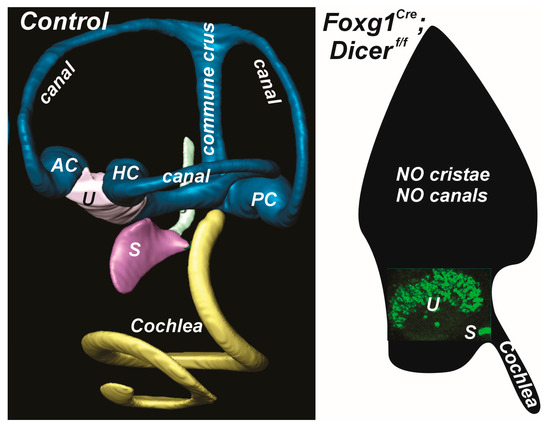
1. Introduction
2. Results
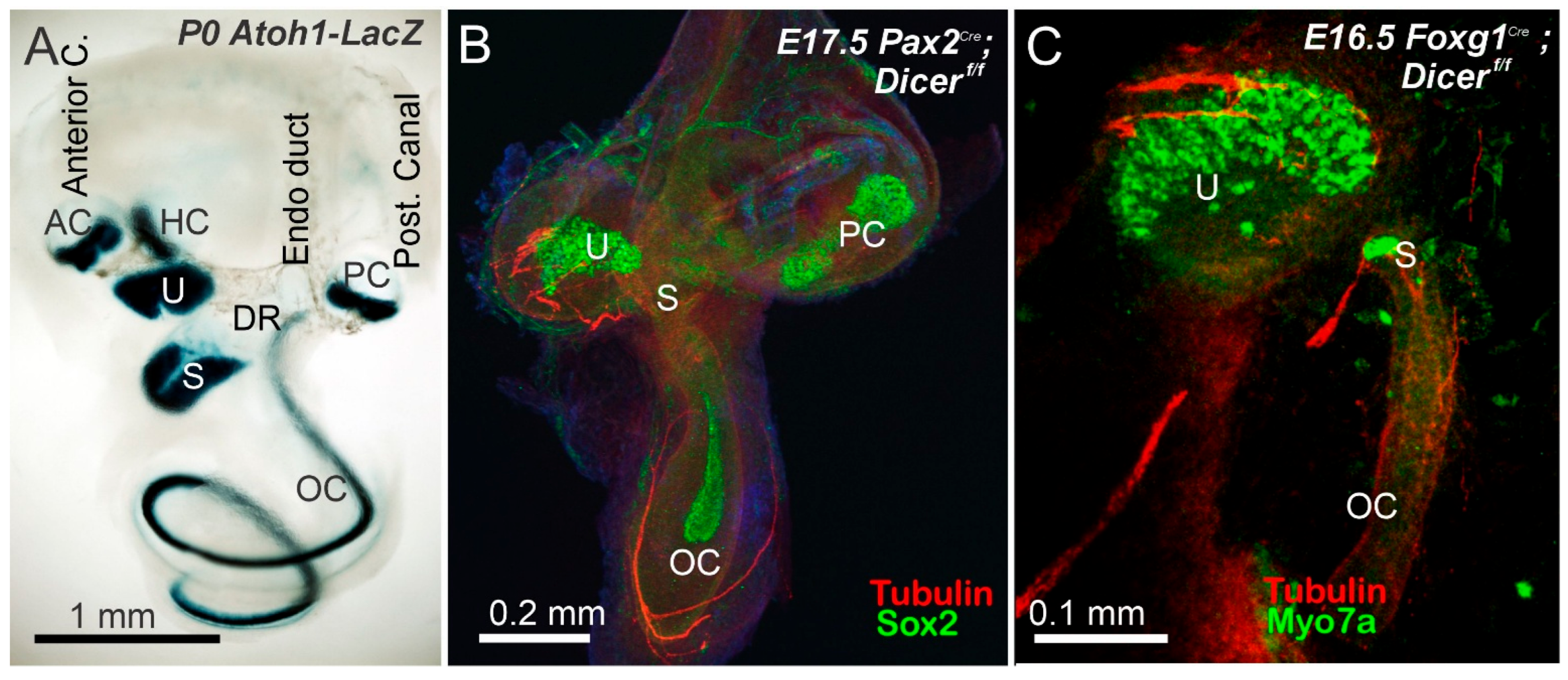
2.1. Dicer Deletion Results in the Loss of Most Vestibular Neurons
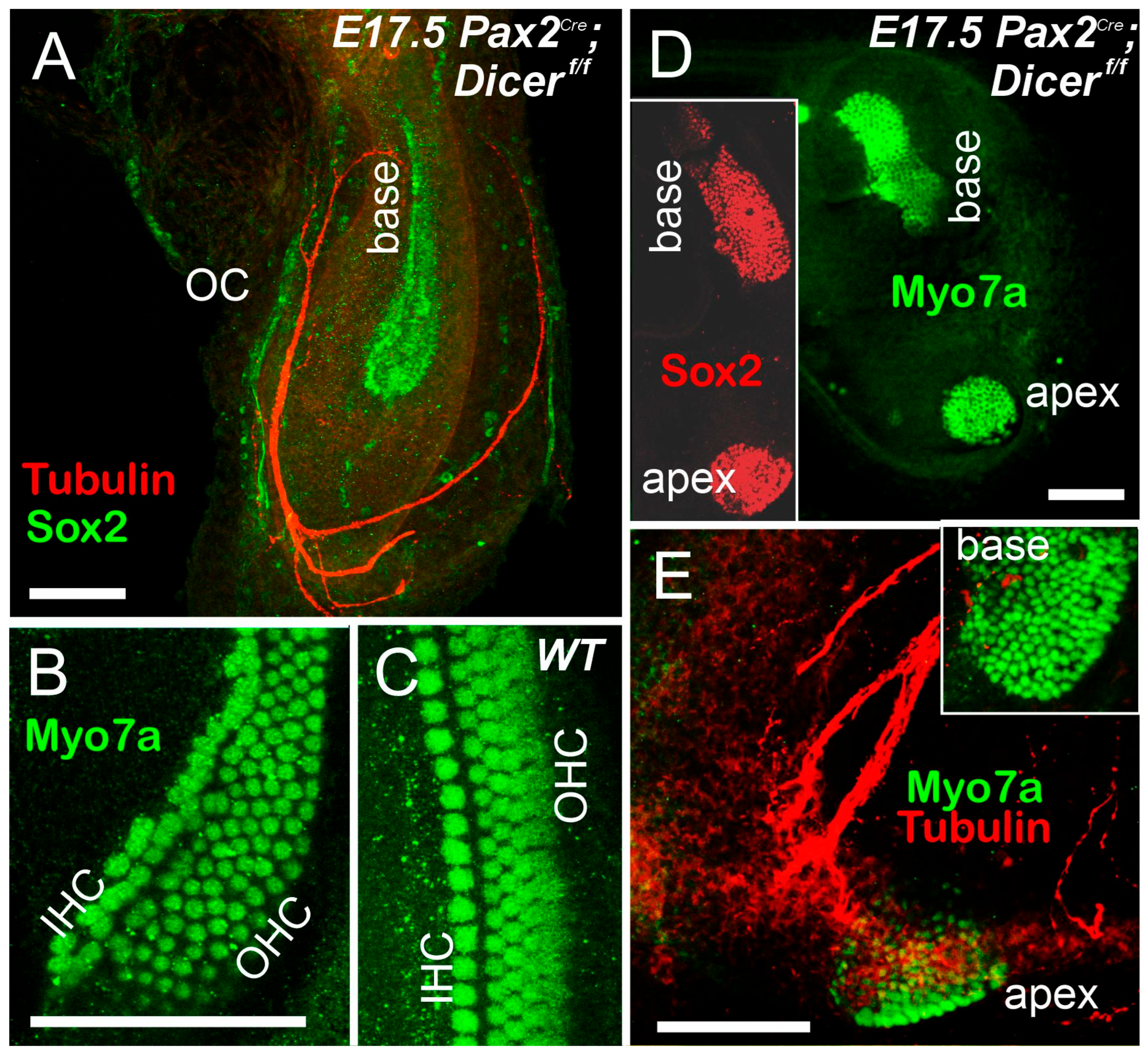
2.2. Dicer Requires Spiral Ganglion Neurons
2.3. Absence of Specific Hair Cells After Dicer Deletion
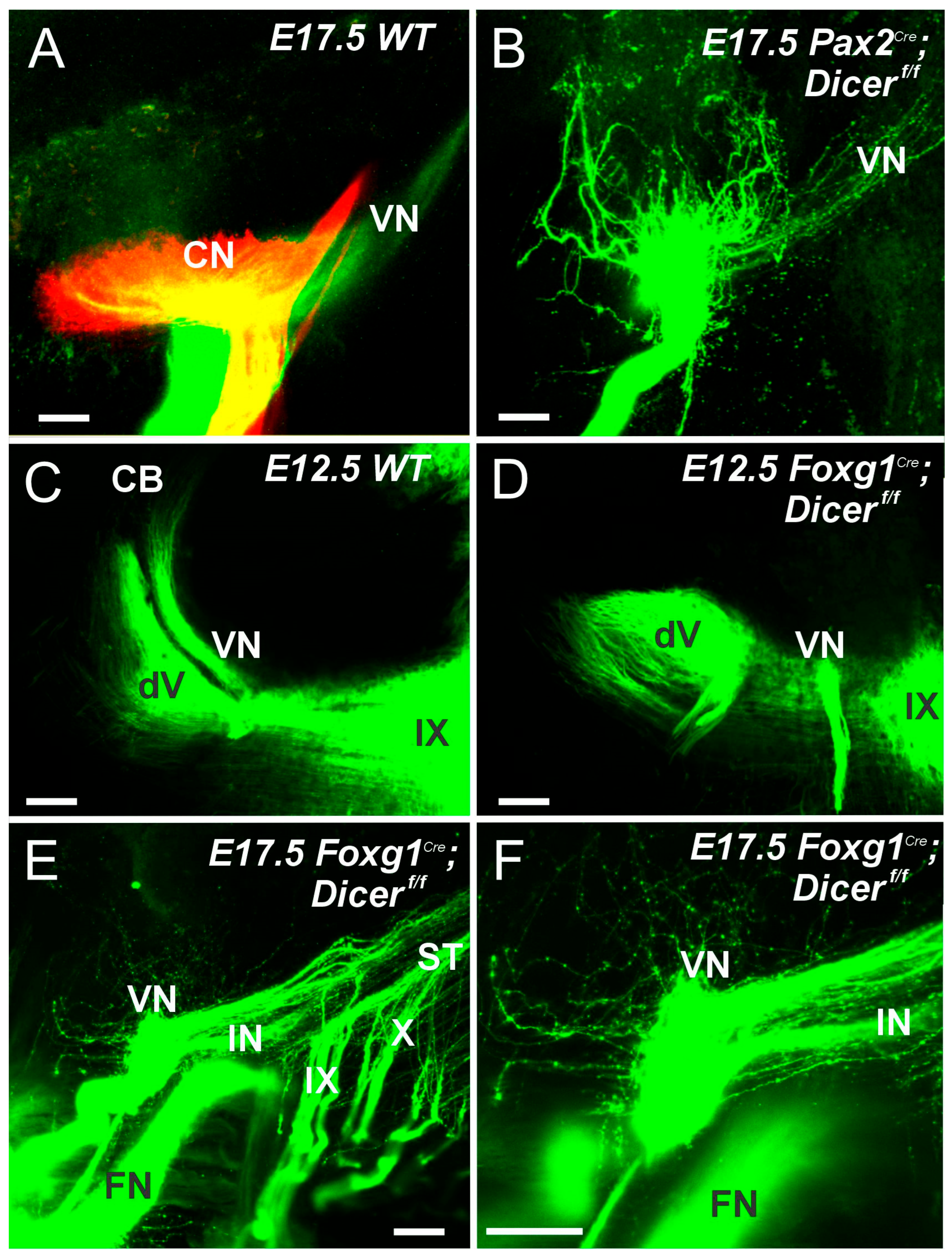
2.4. Vestibular Fibers Reach out to the Caudal Brainstem but Never Innervate the Cerebellum
3. Discussion
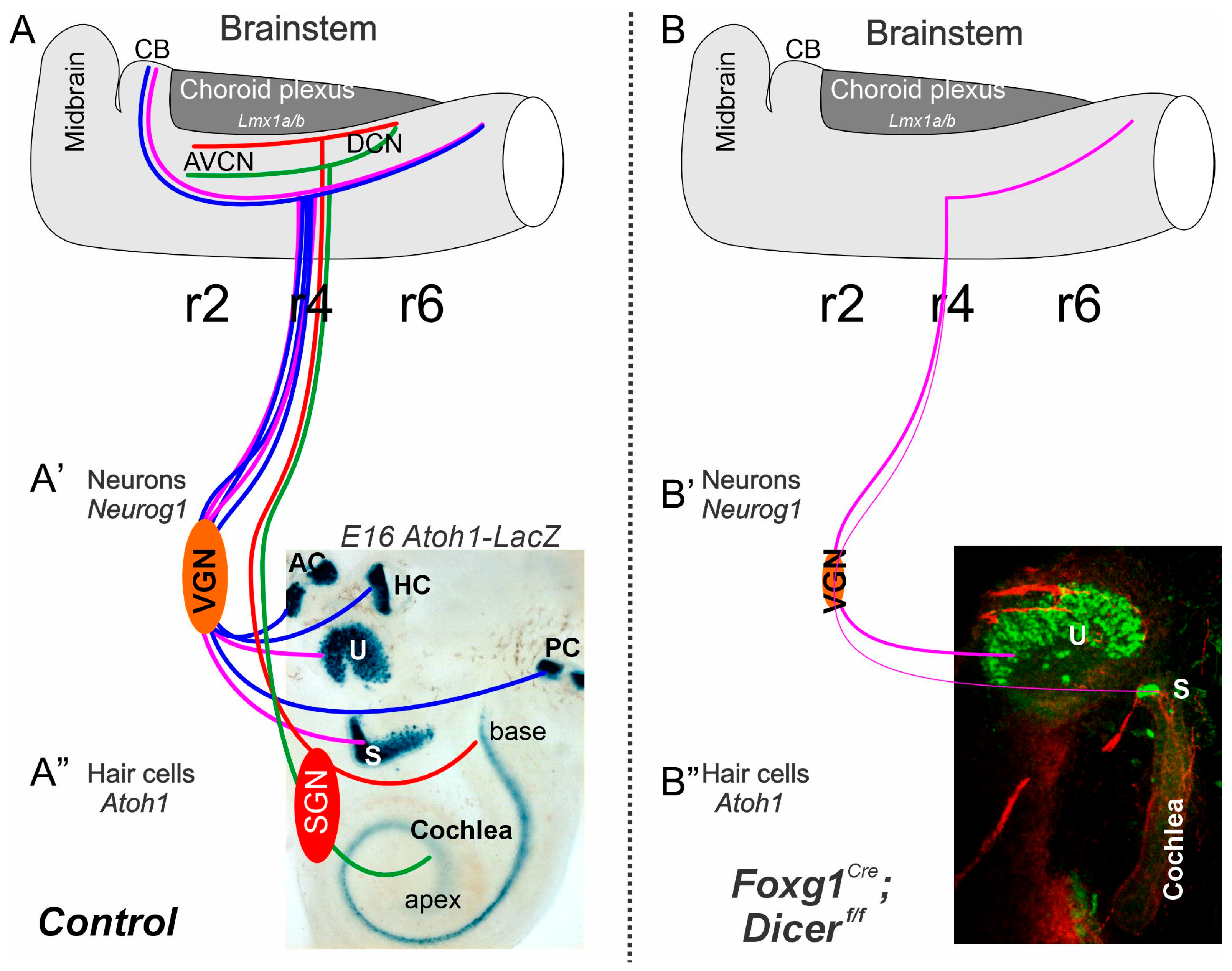
3.1. The Absence of Dicer Results in the Loss of Nearly All Ear Neurons
- Cell-Specific Functions of Dicer: Certain vestibular neurons may have a distinct set of survival pathways or compensatory mechanisms that allow them to thrive despite the loss of Dicer.
- Differential Expression of miRNAs: The small vestibular neurons innervating the utricle may be less dependent on specific microRNAs for their survival compared to other neurons. They may express distinct sets of miRNAs that confer resilience to the effects of Dicer deletion.
- Regional Differences: The utricle may provide unique environmental factors or signaling cues that promote the survival of these specific neurons, such as growth factors or extracellular matrix components that are not present in other areas of the vestibular system, such as Bdnf and Ntf3 [82].
- Developmental Timing: The timing of Dicer depletion may influence neuron survival. If Dicer is removed at a stage where specific small vestibular neurons have already formed critical connections or survival mechanisms, they might tolerate the loss better than others.
- Intrinsic Neuronal Properties: The intrinsic properties of these neurons, such as their metabolic demands or signaling pathways, could make them more resilient to stress induced by the lack of miRNA regulation.
3.2. Absence of Dicer Results in Differential Loss of Vestibular and Cochlear Hair Cells
3.3. The Absence of Rostral Projection Shows Fibers Toward the Caudal Brainstem
4. Materials and Methods
5. Conclusions
Supplementary Materials
Author Contributions
Funding
Institutional Review Board of Ethical Review
Copyright Clearance Center’s RightsLink
Data Availability Statement
Acknowledgments
Conflicts of Interest
References
- Pyott, S.J.; Pavlinkova, G.; Yamoah, E.N.; Fritzsch, B. Harmony in the molecular orchestra of hearing: Developmental mechanisms from the ear to the brain. Annu. Rev. Neurosci. 2024, 47, 1–20. [Google Scholar] [CrossRef]
- Yamoah, E.N.; Pavlinkova, G.; Fritzsch, B. Molecular Cascades That Build and Connect Auditory Neurons from Hair Cells to the Auditory Cortex. J. Exp. Neurol. 2025, 6, 111–120. [Google Scholar] [CrossRef]
- Petit, C.; Bonnet, C.; Safieddine, S. Deafness: From genetic architecture to gene therapy. Nat. Rev. Genet. 2023, 24, 665–686. [Google Scholar] [CrossRef]
- Lee, J.H.; Yamoah, E.N.; Kersigo, J.; Elliott, K.; LaRoda, N.; Pavlinkova, G.; Fritzsch, B. The segregation of Calb1, Calb2, and Prph neurons reveals distinct and mixed neuronal populations and projections to hair cells in the inner ear and central nuclei. Dev. Dyn. 2025, Epub ahead of printing. [Google Scholar] [CrossRef]
- Zine, A.; Fritzsch, B. Early steps towards hearing: Placodes and sensory development. Int. J. Mol. Sci. 2023, 24, 6994. [Google Scholar] [CrossRef] [PubMed]
- Macova, I.; Pysanenko, K.; Chumak, T.; Dvorakova, M.; Bohuslavova, R.; Syka, J.; Fritzsch, B.; Pavlinkova, G. Neurod1 is essential for the primary tonotopic organization and related auditory information processing in the midbrain. J. Neurosci. 2019, 39, 984–1004. [Google Scholar] [CrossRef] [PubMed]
- Matei, V.; Pauley, S.; Kaing, S.; Rowitch, D.; Beisel, K.W.; Morris, K.; Feng, F.; Jones, K.; Lee, J.; Fritzsch, B. Smaller inner ear sensory epithelia in Neurog1 null mice are related to earlier hair cell cycle exit. Dev. Dyn. 2005, 234, 633–650. [Google Scholar] [CrossRef]
- Elliott, K.L.; Pavlínková, G.; Chizhikov, V.V.; Yamoah, E.N.; Fritzsch, B. Development in the mammalian auditory system depends on transcription factors. Int. J. Mol. Sci. 2021, 22, 4189. [Google Scholar] [CrossRef]
- Banks, S.A.; Pierce, M.L.; Soukup, G.A. Sensational microRNAs: Neurosensory roles of the microRNA-183 family. Mol. Neurobiol. 2020, 57, 358–371. [Google Scholar] [CrossRef]
- Avraham, K.B.; Khalaily, L.; Noy, Y.; Kamal, L.; Koffler-Brill, T.; Taiber, S. The noncoding genome and hearing loss. Hum. Genet. 2022, 141, 323–333. [Google Scholar] [CrossRef] [PubMed]
- Taiber, S.; Gwilliam, K.; Hertzano, R.; Avraham, K.B. The Genomics of Auditory Function and Disease. Annu. Rev. Genom. Hum. Genet. 2022, 23, 275–299. [Google Scholar] [CrossRef]
- Weston, M.D.; Pierce, M.L.; Jensen-Smith, H.C.; Fritzsch, B.; Rocha-Sanchez, S.; Beisel, K.W.; Soukup, G.A. MicroRNA-183 family expression in hair cell development and requirement of microRNAs for hair cell maintenance and survival. Dev. Dyn. 2011, 240, 808–819. [Google Scholar] [CrossRef]
- Weston, M.D.; Pierce, M.L.; Rocha-Sanchez, S.; Beisel, K.W.; Soukup, G.A. MicroRNA gene expression in the mouse inner ear. Brain Res. 2006, 1111, 95–104. [Google Scholar] [CrossRef]
- Pierce, M.L.; Weston, M.D.; Fritzsch, B.; Gabel, H.W.; Ruvkun, G.; Soukup, G.A. MicroRNA-183 family conservation and ciliated neurosensory organ expression. Evol. Dev. 2008, 10, 106–113. [Google Scholar] [CrossRef]
- Im, H.; Song, Y.; Kim, J.K.; Park, D.-K.; Kim, D.-S.; Kim, H.; Shin, J.-O. Molecular regulation of palatogenesis and clefting: An integrative analysis of genetic, epigenetic networks, and environmental interactions. Int. J. Mol. Sci. 2025, 26, 1382. [Google Scholar] [CrossRef] [PubMed]
- Kim, H.; Lee, Y.-Y.; Kim, V.N. The biogenesis and regulation of animal microRNAs. Nat. Rev. Mol. Cell Biol. 2025, 26, 276–296. [Google Scholar] [CrossRef] [PubMed]
- Paturi, S.; Deshmukh, M.V. A glimpse of “Dicer Biology” through the structural and functional perspective. Front. Mol. Biosci. 2021, 8, 643657. [Google Scholar] [CrossRef]
- Vergani-Junior, C.A.; Tonon-da-Silva, G.; Inan, M.D.; Mori, M.A. DICER: Structure, function, and regulation. Biophys. Rev. 2021, 13, 1081–1090. [Google Scholar] [CrossRef] [PubMed]
- Zapletal, D.; Taborska, E.; Pasulka, J.; Malik, R.; Kubicek, K.; Zanova, M.; Much, C.; Sebesta, M.; Buccheri, V.; Horvat, F.; et al. Structural and functional basis of mammalian microRNA biogenesis by Dicer. Mol. Cell 2022, 82, 4064–4079.e4013. [Google Scholar] [CrossRef]
- Jee, D.; Lee, S.; Yang, D.; Rickert, R.; Shang, R.; Huangfu, D.; Lai, E.C. Human DICER1 hotspot mutation induces both loss and gain of miRNA function. Nat. Struct. Mol. Biol. 2025, 32, 2553–2563. [Google Scholar] [CrossRef]
- Slade, I.; Bacchelli, C.; Davies, H.; Murray, A.; Abbaszadeh, F.; Hanks, S.; Barfoot, R.; Burke, A.; Chisholm, J.; Hewitt, M. DICER1 syndrome: Clarifying the diagnosis, clinical features and management implications of a pleiotropic tumour predisposition syndrome. J. Med. Genet. 2011, 48, 273–278. [Google Scholar] [CrossRef]
- González, I.A.; Stewart, D.R.; Schultz, K.A.P.; Field, A.P.; Hill, D.A.; Dehner, L.P. DICER1 tumor predisposition syndrome: An evolving story initiated with the pleuropulmonary blastoma. Mod. Pathol. 2022, 35, 4–22. [Google Scholar] [CrossRef]
- Zapletal, D.; Kubicek, K.; Svoboda, P.; Stefl, R. Dicer structure and function: Conserved and evolving features. EMBO Rep. 2023, 24, e57215. [Google Scholar] [CrossRef]
- Saranya, S.; Prathiviraj, R.; Chellapandi, P. Evolutionary transitions of DNA replication origins between archaea and bacteria. J. Basic Microbiol. 2025, 65, e2400527. [Google Scholar] [CrossRef]
- Forterre, P. The last universal common ancestor of ribosome-encoding organisms: Portrait of LUCA. J. Mol. Evol. 2024, 92, 550–583. [Google Scholar] [CrossRef] [PubMed]
- Aderounmu, A.M.; Aruscavage, P.J.; Kolaczkowski, B.; Bass, B.L. Ancestral protein reconstruction reveals evolutionary events governing variation in Dicer helicase function. Elife 2023, 12, e85120. [Google Scholar] [CrossRef] [PubMed]
- Harfe, B.D.; McManus, M.T.; Mansfield, J.H.; Hornstein, E.; Tabin, C.J. The RNaseIII enzyme Dicer is required for morphogenesis but not patterning of the vertebrate limb. Proc. Natl. Acad. Sci. USA 2005, 102, 10898–10903. [Google Scholar] [CrossRef] [PubMed]
- Kersigo, J.; D’Angelo, A.; Gray, B.D.; Soukup, G.A.; Fritzsch, B. The role of sensory organs and the forebrain for the development of the craniofacial shape as revealed by Foxg1-cre-mediated microRNA loss. Genesis 2011, 49, 326–341. [Google Scholar] [CrossRef]
- Soukup, G.A.; Fritzsch, B.; Pierce, M.L.; Weston, M.D.; Jahan, I.; McManus, M.T.; Harfe, B.D. Residual microRNA expression dictates the extent of inner ear development in conditional Dicer knockout mice. Dev. Biol. 2009, 328, 328–341. [Google Scholar] [CrossRef]
- Van den Ackerveken, P.; Mounier, A.; Huyghe, A.; Sacheli, R.; Vanlerberghe, P.B.; Volvert, M.L.; Delacroix, L.; Nguyen, L.; Malgrange, B. The miR-183/ItgA3 axis is a key regulator of prosensory area during early inner ear development. Cell Death Differ. 2017, 24, 2054–2065. [Google Scholar] [CrossRef]
- Rosengauer, E.; Hartwich, H.; Hartmann, A.M.; Rudnicki, A.; Satheesh, S.V.; Avraham, K.B.; Nothwang, H.G. Egr2::cre mediated conditional ablation of dicer disrupts histogenesis of mammalian central auditory nuclei. PLoS ONE 2012, 7, e49503. [Google Scholar] [CrossRef]
- Riccomagno, M.M.; Martinu, L.; Mulheisen, M.; Wu, D.K.; Epstein, D.J. Specification of the mammalian cochlea is dependent on Sonic hedgehog. Genes Dev. 2002, 16, 2365–2378. [Google Scholar] [CrossRef]
- Ma, Q.; Anderson, D.J.; Fritzsch, B. Neurogenin 1 null mutant ears develop fewer, morphologically normal hair cells in smaller sensory epithelia devoid of innervation. J. Assoc. Res. Otolaryngol. 2000, 1, 129–143. [Google Scholar] [CrossRef]
- Jahan, I.; Kersigo, J.; Pan, N.; Fritzsch, B. Neurod1 regulates survival and formation of connections in mouse ear and brain. Cell Tissue Res. 2010, 341, 95–110. [Google Scholar] [CrossRef]
- Bouchard, M.; de Caprona, D.; Busslinger, M.; Xu, P.; Fritzsch, B. Pax2 and Pax8 cooperate in mouse inner ear morphogenesis and innervation. BMC Dev. Biol. 2010, 10, 89. [Google Scholar] [CrossRef]
- Burton, Q.; Cole, L.K.; Mulheisen, M.; Chang, W.; Wu, D.K. The role of Pax2 in mouse inner ear development. Dev. Biol. 2004, 272, 161–175. [Google Scholar] [CrossRef] [PubMed]
- Duncan, J.S.; Fritzsch, B. Continued expression of GATA3 is necessary for cochlear neurosensory development. PLoS ONE 2013, 8, e62046. [Google Scholar] [CrossRef]
- Chizhikov, V.V.; Iskusnykh, I.Y.; Fattakhov, N.; Fritzsch, B. Lmx1a and Lmx1b are redundantly required for the development of multiple components of the mammalian auditory system. Neuroscience 2021, 452, 247–264. [Google Scholar] [CrossRef] [PubMed]
- Fritzsch, B.; Weng, X.; Yamoah, E.N.; Qin, T.; Hui, C.C.; Lebrón-Mora, L.; Pavlinkova, G.; Sham, M.H. Irx3/5 Null Deletion in Mice Blocks Cochlea-Saccule Segregation and Disrupts the Auditory Tonotopic Map. J. Comp. Neurol. 2024, 532, e70008. [Google Scholar] [CrossRef] [PubMed]
- Maricich, S.M.; Xia, A.; Mathes, E.L.; Wang, V.Y.; Oghalai, J.S.; Fritzsch, B.; Zoghbi, H.Y. Atoh1-lineal neurons are required for hearing and for the survival of neurons in the spiral ganglion and brainstem accessory auditory nuclei. J. Neurosci. 2009, 29, 11123–11133. [Google Scholar] [CrossRef]
- Filova, I.; Pysanenko, K.; Tavakoli, M.; Vochyanova, S.; Dvorakova, M.; Bohuslavova, R.; Smolik, O.; Fabriciova, V.; Hrabalova, P.; Benesova, S. ISL1 is necessary for auditory neuron development and contributes toward tonotopic organization. Proc. Natl. Acad. Sci. USA 2022, 119, e2207433119. [Google Scholar] [CrossRef]
- Pavlinkova, G.; Xu, P.-X.; Cheah, K.S.; Yamoah, E.N.; Fritzsch, B. Regulatory Networks Driving the Specification, Differentiation, and Diversification of Neurons in the Mouse Inner Ear. JARO 2026, in press. [Google Scholar]
- Vermeiren, S.; Bellefroid, E.J.; Desiderio, S. Vertebrate sensory ganglia: Common and divergent features of the transcriptional programs generating their functional specialization. Front. Cell Dev. Biol. 2020, 8, 587699. [Google Scholar] [CrossRef] [PubMed]
- Xu, J.; Li, J.; Zhang, T.; Jiang, H.; Ramakrishnan, A.; Fritzsch, B.; Shen, L.; Xu, P.-X. Chromatin remodelers and lineage-specific factors interact to target enhancers to establish proneurosensory fate within otic ectoderm. Proc. Natl. Acad. Sci. USA 2021, 118, e2025196118. [Google Scholar] [CrossRef]
- Puligilla, C.; Dabdoub, A.; Brenowitz, S.D.; Kelley, M.W. Sox2 induces neuronal formation in the developing mammalian cochlea. J. Neurosci. 2010, 30, 714–722. [Google Scholar] [CrossRef] [PubMed]
- Steevens, A.R.; Sookiasian, D.L.; Glatzer, J.C.; Kiernan, A.E. SOX2 is required for inner ear neurogenesis. Sci. Rep. 2017, 7, 4086. [Google Scholar] [CrossRef] [PubMed]
- Dvorakova, M.; Macova, I.; Bohuslavova, R.; Anderova, M.; Fritzsch, B.; Pavlinkova, G. Early ear neuronal development, but not olfactory or lens development, can proceed without SOX2. Dev. Biol. 2020, 457, 43–56. [Google Scholar] [CrossRef]
- Liu, M.; Pereira, F.A.; Price, S.D.; Chu, M.-j.; Shope, C.; Himes, D.; Eatock, R.A.; Brownell, W.E.; Lysakowski, A.; Tsai, M.-J. Essential role of BETA2/NeuroD1 in development of the vestibular and auditory systems. Genes Dev. 2000, 14, 2839–2854. [Google Scholar] [CrossRef]
- Kim, W.-Y.; Fritzsch, B.; Serls, A.; Bakel, L.A.; Huang, E.J.; Reichardt, L.F.; Barth, D.S.; Lee, J.E. NeuroD-null mice are deaf due to a severe loss of the inner ear sensory neurons during development. Development 2001, 128, 417–426. [Google Scholar] [CrossRef]
- Pauley, S.; Wright, T.J.; Pirvola, U.; Ornitz, D.; Beisel, K.; Fritzsch, B. Expression and function of FGF10 in mammalian inner ear development. Dev. Dyn. Off. Publ. Am. Assoc. Anat. 2003, 227, 203–215. [Google Scholar] [CrossRef]
- Pauley, S.; Lai, E.; Fritzsch, B. Foxg1 is required for morphogenesis and histogenesis of the mammalian inner ear. Dev. Dyn. Off. Publ. Am. Assoc. Anat. 2006, 235, 2470–2482. [Google Scholar] [CrossRef]
- Gu, C.; Rodriguez, E.R.; Reimert, D.V.; Shu, T.; Fritzsch, B.; Richards, L.J.; Kolodkin, A.L.; Ginty, D.D. Neuropilin-1 conveys semaphorin and VEGF signaling during neural and cardiovascular development. Dev. Cell 2003, 5, 45–57. [Google Scholar] [CrossRef]
- Fritzsch, B.; Pauley, S.; Matei, V.; Katz, D.M.; Xiang, M.; Tessarollo, L. Mutant mice reveal the molecular and cellular basis for specific sensory connections to inner ear epithelia and primary nuclei of the brain. Hear. Res. 2005, 206, 52–63. [Google Scholar] [CrossRef]
- Fritzsch, B.; Tessarollo, L.; Coppola, E.; Reichardt, L.F. Neurotrophins in the ear: Their roles in sensory neuron survival and fiber guidance. Prog. Brain Res. 2004, 146, 265–278. [Google Scholar]
- Yang, T.; Kersigo, J.; Jahan, I.; Pan, N.; Fritzsch, B. The molecular basis of making spiral ganglion neurons and connecting them to hair cells of the organ of Corti. Hear. Res. 2011, 278, 21–33. [Google Scholar] [CrossRef]
- Fritzsch, B.; Elliott, K.L. Evolution and Development of the Inner Ear Efferent System: Transforming a Motor Neuron Population to Connect to the Most Unusual Motor Protein via Ancient Nicotinic Receptors. Front. Cell. Neurosci. 2017, 11, 114. [Google Scholar] [CrossRef]
- Fritzsch, B.; Dillard, M.; Lavado, A.; Harvey, N.L.; Jahan, I. Canal cristae growth and fiber extension to the outer hair cells of the mouse ear require Prox1 activity. PLoS ONE 2010, 5, e9377. [Google Scholar] [CrossRef]
- Bi, Z.; Ren, M.; Zhang, Y.; He, S.; Song, L.; Li, X.; Liu, Z. Revisiting the potency of Tbx2 expression in transforming outer hair cells into inner hair cells at multiple ages in vivo. J. Neurosci. 2024, 44, e1751232024. [Google Scholar] [CrossRef] [PubMed]
- Nichols, D.H.; Pauley, S.; Jahan, I.; Beisel, K.W.; Millen, K.J.; Fritzsch, B. Lmx1a is required for segregation of sensory epithelia and normal ear histogenesis and morphogenesis. Cell Tissue Res. 2008, 334, 339–358. [Google Scholar] [CrossRef] [PubMed]
- Fritzsch, B.; Signore, M.; Simeone, A. Otx1 null mutant mice show partial segregation of sensory epithelia comparable to lamprey ears. Dev. Genes Evol. 2001, 211, 388–396. [Google Scholar] [CrossRef]
- Huang, Y.; Hill, J.; Yatteau, A.; Wong, L.; Jiang, T.; Petrovic, J.; Gan, L.; Dong, L.; Wu, D.K. Reciprocal Negative Regulation Between Lmx1a and Lmo4 Is Required for Inner Ear Formation. J. Neurosci. 2018, 38, 5429–5440. [Google Scholar] [CrossRef]
- Tang, L.S.; Alger, H.M.; Pereira, F.A. COUP-TFI controls Notch regulation of hair cell and support cell differentiation. Development 2006, 133, 3683–3693. [Google Scholar] [CrossRef]
- García-Gómez, I.; Webber, J.L.; Soria-Izquierdo, B.; Clancy, J.C.; Duggan, A.; Zhou, Y.; Murphey, C.P.; Harriman, T.D.M.; Wang, J.; Cheatham, M.A.; et al. Targeted cell interconversions reveal inner hair cell control of organ of Corti cytoarchitecture. Sci. Adv. 2025, 11, eadz3944. [Google Scholar] [CrossRef]
- Kopecky, B.; Santi, P.; Johnson, S.; Schmitz, H.; Fritzsch, B. Conditional deletion of N-Myc disrupts neurosensory and non-sensory development of the ear. Dev. Dyn. 2011, 240, 1373–1390. [Google Scholar] [CrossRef] [PubMed]
- Schultz, J.A.; Zeller, U.; Luo, Z.X. Inner ear labyrinth anatomy of monotremes and implications for mammalian inner ear evolution. J. Morphol. 2017, 278, 236–263. [Google Scholar] [CrossRef]
- Fritzsch, B.; Schultze, H.P.; Elliott, K.L. The evolution of the various structures required for hearing in Latimeria and tetrapods. IBRO Neurosci. Rep. 2023, 14, 325–341, Erratum in IBRO Neurosci. Rep. 2023, 14, 428. [Google Scholar] [CrossRef] [PubMed]
- Pirvola, U.; Ylikoski, J.; Trokovic, R.; Hébert, J.M.; McConnell, S.K.; Partanen, J. FGFR1 is required for the development of the auditory sensory epithelium. Neuron 2002, 35, 671–680. [Google Scholar] [CrossRef]
- Yamoah, E.N.; Li, M.; Shah, A.; Elliott, K.L.; Cheah, K.; Xu, P.-X.; Phillips, S.; Young, S.M., Jr.; Eberl, D.F.; Fritzsch, B. Using Sox2 to alleviate the hallmarks of age-related hearing loss. Ageing Res. Rev. 2020, 59, 101042. [Google Scholar] [CrossRef]
- Kiernan, A.E.; Pelling, A.L.; Leung, K.K.; Tang, A.S.; Bell, D.M.; Tease, C.; Lovell-Badge, R.; Steel, K.P.; Cheah, K.S. Sox2 is required for sensory organ development in the mammalian inner ear. Nature 2005, 434, 1031–1035. [Google Scholar] [CrossRef] [PubMed]
- Bok, J.; Dolson, D.K.; Hill, P.; Rüther, U.; Epstein, D.J.; Wu, D.K. Opposing gradients of Gli repressor and activators mediate Shh signaling along the dorsoventral axis of the inner ear. Development 2007, 134, 1713–1722. [Google Scholar] [CrossRef]
- Bermingham, N.A.; Hassan, B.A.; Wang, V.Y.; Fernandez, M.; Banfi, S.; Bellen, H.J.; Fritzsch, B.; Zoghbi, H.Y. Proprioceptor pathway development is dependent on Math1. Neuron 2001, 30, 411–422. [Google Scholar] [CrossRef]
- Elliott, K.L.; Iskusnykh, I.Y.; Chizhikov, V.V.; Fritzsch, B. Ptf1a expression is necessary for correct targeting of spiral ganglion neurons within the cochlear nuclei. Neurosci. Lett. 2023, 806, 137244. [Google Scholar] [CrossRef]
- Filova, I.; Dvorakova, M.; Bohuslavova, R.; Pavlinek, A.; Elliott, K.L.; Vochyanova, S.; Fritzsch, B.; Pavlinkova, G. Combined Atoh1 and Neurod1 deletion reveals autonomous growth of auditory nerve fibers. Mol. Neurobiol. 2020, 57, 5307–5323. [Google Scholar] [CrossRef]
- Elliott, K.L.; Kersigo, J.; Pan, N.; Jahan, I.; Fritzsch, B. Spiral Ganglion Neuron Projection Development to the Hindbrain in Mice Lacking Peripheral and/or Central Target Differentiation. Front. Neural Circuits 2017, 11, 25. [Google Scholar] [CrossRef] [PubMed]
- Glover, J.; Fritzsch, B. Brains of primitive chordates. Encycl. Neurosci. 2009, 439–448. [Google Scholar] [CrossRef]
- Diaz, C.; Glover, J.C. The Vestibular Column in the Mouse: A Rhombomeric Perspective. Front. Neuroanat. 2021, 15, 806815. [Google Scholar] [CrossRef]
- Zheng, G.X.; Do, B.T.; Webster, D.E.; Khavari, P.A.; Chang, H.Y. Dicer-microRNA-Myc circuit promotes transcription of hundreds of long noncoding RNAs. Nat. Struct. Mol. Biol. 2014, 21, 585–590. [Google Scholar] [CrossRef] [PubMed]
- Ma, E.; MacRae, I.J.; Kirsch, J.F.; Doudna, J.A. Autoinhibition of human dicer by its internal helicase domain. J. Mol. Biol. 2008, 380, 237–243. [Google Scholar] [CrossRef]
- Li, Y.; Piatigorsky, J. Targeted deletion of Dicer disrupts lens morphogenesis, corneal epithelium stratification, and whole eye development. Dev. Dyn. Off. Publ. Am. Assoc. Anat. 2009, 238, 2388–2400. [Google Scholar] [CrossRef]
- Damiani, D.; Alexander, J.J.; O’Rourke, J.R.; McManus, M.; Jadhav, A.P.; Cepko, C.L.; Hauswirth, W.W.; Harfe, B.D.; Strettoi, E. Dicer inactivation leads to progressive functional and structural degeneration of the mouse retina. J. Neurosci. 2008, 28, 4878–4887. [Google Scholar] [CrossRef]
- Lee, Y.-Y.; Lee, H.; Kim, H.; Kim, V.N.; Roh, S.-H. Structure of the human DICER–pre-miRNA complex in a dicing state. Nature 2023, 615, 331–338. [Google Scholar] [CrossRef] [PubMed]
- Fariñas, I.; Jones, K.R.; Tessarollo, L.; Vigers, A.J.; Huang, E.; Kirstein, M.; de Caprona, D.C.; Coppola, V.; Backus, C.; Reichardt, L.F.; et al. Spatial shaping of cochlear innervation by temporally regulated neurotrophin expression. J. Neurosci. 2001, 21, 6170–6180. [Google Scholar] [CrossRef]
- Dabdoub, A.; Puligilla, C.; Jones, J.M.; Fritzsch, B.; Cheah, K.S.; Pevny, L.H.; Kelley, M.W. Sox2 signaling in prosensory domain specification and subsequent hair cell differentiation in the developing cochlea. Proc. Natl. Acad. Sci. USA 2008, 105, 18396–18401. [Google Scholar] [CrossRef]
- Kirjavainen, A.; Sulg, M.; Heyd, F.; Alitalo, K.; Ylä-Herttuala, S.; Möröy, T.; Petrova, T.V.; Pirvola, U. Prox1 interacts with Atoh1 and Gfi1, and regulates cellular differentiation in the inner ear sensory epithelia. Dev. Biol. 2008, 322, 33–45. [Google Scholar] [CrossRef]
- Pan, N.; Jahan, I.; Kersigo, J.; Duncan, J.S.; Kopecky, B.; Fritzsch, B. A novel Atoh1 “self-terminating” mouse model reveals the necessity of proper Atoh1 level and duration for hair cell differentiation and viability. PLoS ONE 2012, 7, e30358. [Google Scholar] [CrossRef] [PubMed]
- Tremblay, M.; Sanchez-Ferras, O.; Bouchard, M. GATA transcription factors in development and disease. Development 2018, 145, dev164384. [Google Scholar] [CrossRef]
- Luo, X.J.; Deng, M.; Xie, X.; Huang, L.; Wang, H.; Jiang, L.; Liang, G.; Hu, F.; Tieu, R.; Chen, R.; et al. GATA3 controls the specification of prosensory domain and neuronal survival in the mouse cochlea. Hum. Mol. Genet. 2013, 22, 3609–3623. [Google Scholar] [CrossRef]
- Morizet, D.; Foucher, I.; Mignerey, I.; Alunni, A.; Bally-Cuif, L. Notch signaling blockade links transcriptome heterogeneity in quiescent neural stem cells with reactivation routes and potential. Sci. Adv. 2025, 11, eadu3189. [Google Scholar] [CrossRef]
- Zhang, B.; Chen, S.-L.; Teng, X.; Han, Q.; Wu, T.; Yang, Z.; Liu, Y.; Xiang, K.; Sun, L. Function of Brain-Derived Neurotrophic Factor in the Vestibular-Cochlear System. Neurochem. Res. 2025, 50, 59. [Google Scholar] [CrossRef]
- Ege, T.; Bloom, C.R.; Zhou, M.; Liu, H.; Tao, L. Mapping of chromatin architecture and enhancer-promoter interactions in the cochlea. Front. Mol. Biosci. 2025, 12, 1683964. [Google Scholar] [CrossRef] [PubMed]
- Blinkiewicz, P.V.; Long, M.R.; Stoner, Z.A.; Ketchum, E.M.; Sheltz-Kempf, S.N.; Duncan, J.S. Gata3 is required in late proneurosensory development for proper sensory cell formation and organization. Sci. Rep. 2023, 13, 12573. [Google Scholar] [CrossRef]
- Maklad, A.; Fritzsch, B. The developmental segregation of posterior crista and saccular vestibular fibers in mice: A carbocyanine tracer study using confocal microscopy. Dev. Brain Res. 2002, 135, 1–17. [Google Scholar] [CrossRef]
- Ji, Y.R.; Tona, Y.; Wafa, T.; Christman, M.E.; Tourney, E.D.; Jiang, T.; Ohta, S.; Cheng, H.; Fitzgerald, T.; Fritzsch, B. Function of bidirectional sensitivity in the otolith organs established by transcription factor Emx2. Nat. Commun. 2022, 13, 6330. [Google Scholar] [CrossRef] [PubMed]
- Maklad, A.; Kamel, S.; Wong, E.; Fritzsch, B. Development and organization of polarity-specific segregation of primary vestibular afferent fibers in mice. Cell Tissue Res. 2010, 340, 303–321. [Google Scholar] [CrossRef] [PubMed]
- Ohyama, T.; Groves, A.K. Generation of Pax2-Cre mice by modification of a Pax2 bacterial artificial chromosome. Genesis 2004, 38, 195–199. [Google Scholar] [CrossRef] [PubMed]
- Hébert, J.M.; McConnell, S.K. Targeting of cre to the Foxg1 (BF-1) locus mediates loxP recombination in the telencephalon and other developing head structures. Dev. Biol. 2000, 222, 296–306. [Google Scholar] [CrossRef]
- Schmidt, H.; Fritzsch, B. Npr2 null mutants show initial overshooting followed by reduction of spiral ganglion axon projections combined with near-normal cochleotopic projection. Cell Tissue Res. 2019, 378, 15–32. [Google Scholar] [CrossRef]


Disclaimer/Publisher’s Note: The statements, opinions and data contained in all publications are solely those of the individual author(s) and contributor(s) and not of MDPI and/or the editor(s). MDPI and/or the editor(s) disclaim responsibility for any injury to people or property resulting from any ideas, methods, instructions or products referred to in the content. |
© 2026 by the authors. Licensee MDPI, Basel, Switzerland. This article is an open access article distributed under the terms and conditions of the Creative Commons Attribution (CC BY) license.
Share and Cite
Yamoah, E.N.; Pavlinkova, G.; Lee, J.H.; Kersigo, J.; Pierce, M.L.; Fritzsch, B. Dicer Deletion in the Ear Can Cut Most Neurons and Their Innervation of Hair Cells to Project to the Ear and the Brainstem. Int. J. Mol. Sci. 2026, 27, 539. https://doi.org/10.3390/ijms27010539
Yamoah EN, Pavlinkova G, Lee JH, Kersigo J, Pierce ML, Fritzsch B. Dicer Deletion in the Ear Can Cut Most Neurons and Their Innervation of Hair Cells to Project to the Ear and the Brainstem. International Journal of Molecular Sciences. 2026; 27(1):539. https://doi.org/10.3390/ijms27010539
Chicago/Turabian StyleYamoah, Ebenezer N., Gabriela Pavlinkova, Jeong Han Lee, Jennifer Kersigo, Marsha L. Pierce, and Bernd Fritzsch. 2026. "Dicer Deletion in the Ear Can Cut Most Neurons and Their Innervation of Hair Cells to Project to the Ear and the Brainstem" International Journal of Molecular Sciences 27, no. 1: 539. https://doi.org/10.3390/ijms27010539
APA StyleYamoah, E. N., Pavlinkova, G., Lee, J. H., Kersigo, J., Pierce, M. L., & Fritzsch, B. (2026). Dicer Deletion in the Ear Can Cut Most Neurons and Their Innervation of Hair Cells to Project to the Ear and the Brainstem. International Journal of Molecular Sciences, 27(1), 539. https://doi.org/10.3390/ijms27010539