AML Disparities Across Racial Ancestry Groups: A Spotlight on the NPM1 Mutations


Abstract
1. Introduction
2. External Factors Contributing to AML Disparities
2.1. Clinical Trials Enrollment
2.2. Socioeconomic Factors
2.3. Environmental Factors
3. Mutations and Prognosis in AML
3.1. Favorable Risk Group
3.2. Intermediate-Risk Category
3.3. Adverse-Risk Category
4. Racial Ancestry and AML Biology
5. Molecular Properties of NPM1
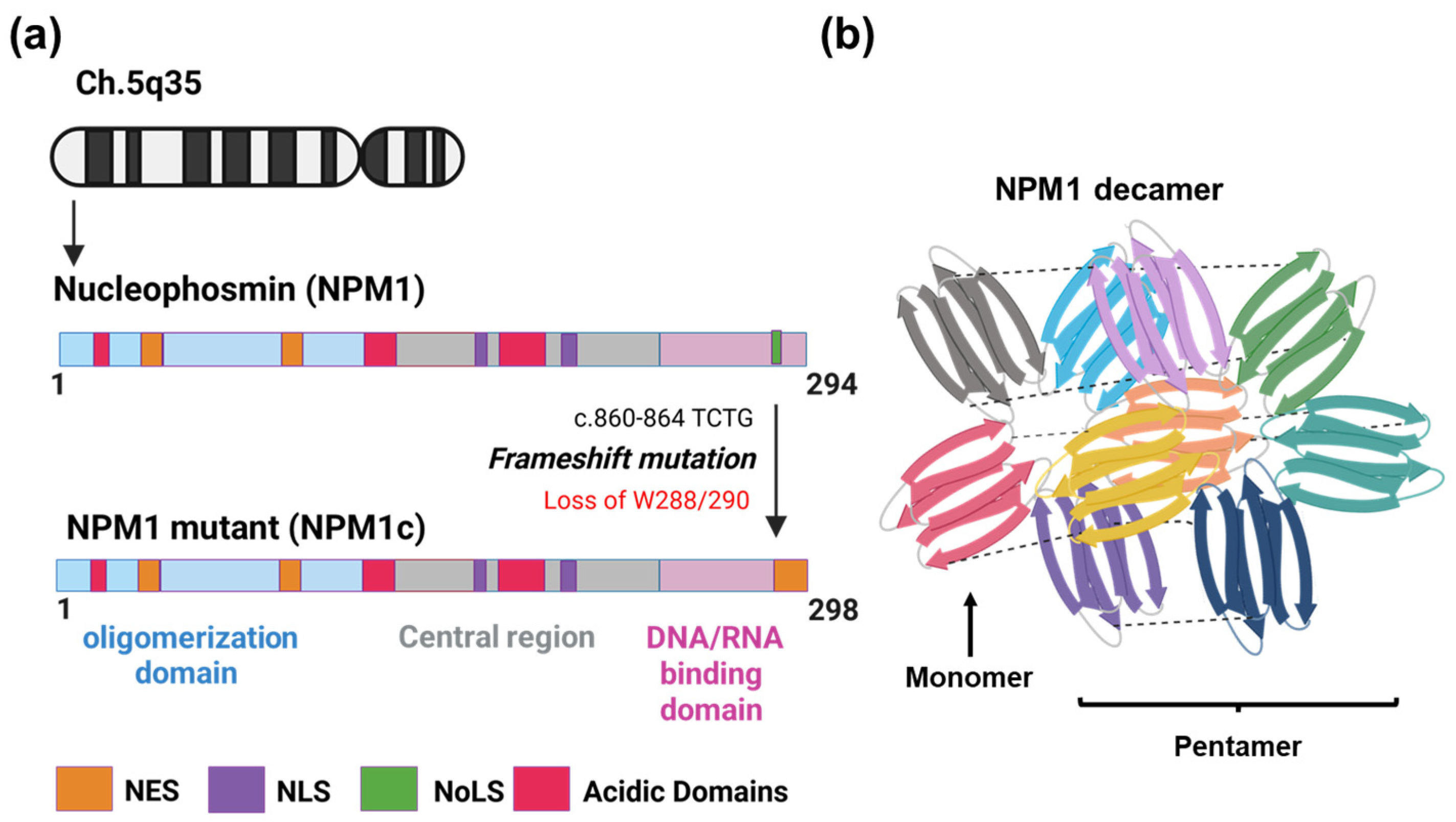
Structure of NPM1
6. Role of NPM1 in Nucleolar Organization
7. NPM1 in Genome Stability and DNA Repair
8. NPM1c in AML: Mutational Landscape and Functional Impacts
9. Therapeutic Implications and Strategies
10. Models to Investigate NPM1c in AML and Disease Progression
11. Conclusions
Author Contributions
Funding
Institutional Review Board Statement
Informed Consent Statement
Data Availability Statement
Acknowledgments
Conflicts of Interest
Abbreviations
| NHB | Non-Hispanic Black |
| NHW | Non-Hispanic White |
| NPM1 | Nucleophosmin 1 |
| AML | Acute myeloid leukemia |
| HSCT | Allogeneic hematopoietic stem cell transplant |
| ELN | European Leukemia Net |
| CN-AML | Cytogenetically normal AML |
| HOX | Homeobox genes |
| MRD | Measurable residual disease |
| CEBPα | CCAAT enhancer binding protein alpha |
| bZIP | Basic leucine zipper region |
| FLT3-ITD | FMS-like tyrosine kinase 3 internal tandem duplication |
| t-AML | Therapy-related AML |
| MDS | Myelodysplastic syndrome |
| CR1 | Complete remission |
| LLPS | Liquid–liquid phase separation |
| NES | Nuclear export signal |
| NLS | Nuclear localization signal |
| NoLS | Nucleolar localization signal |
| IDRs | Intrinsically disordered regions |
| APRs | Aggregation-prone regions |
| BER | Base excision repair |
| pNPM1 | Phosphorylated NPM1 |
| HRR | Homologous recombination repair |
| DSBs | DNA double-stranded break sites |
| TLS | Trans-lesion synthesis |
| NSCLC | Non-small cell lung cancer |
| NPM1c | Cytoplasmic NPM1 |
| PDXs | Patient-derived xenografts |
| HSCs | Hematopoietic stem cells |
References
- Bullinger, L.; Döhner, K.; Döhner, H. Genomics of Acute Myeloid Leukemia Diagnosis and Pathways. J. Clin. Oncol. 2017, 35, 934–946. [Google Scholar] [CrossRef] [Scilit] [PubMed]
- Döhner, H.; Wei, A.H.; Appelbaum, F.R.; Craddock, C.; DiNardo, C.D.; Dombret, H.; Ebert, B.L.; Fenaux, P.; Godley, L.A.; Hasserjian, R.P.; et al. Diagnosis and management of AML in adults: 2022 recommendations from an international expert panel on behalf of the ELN. Blood 2022, 140, 1345–1377. [Google Scholar] [CrossRef] [Scilit]
- Bhatnagar, B.; Kohlschmidt, J.; Mrózek, K.; Zhao, Q.; Fisher, J.L.; Nicolet, D.; Walker, C.J.; Mims, A.S.; Oakes, C.; Giacopelli, B.; et al. Poor Survival and Differential Impact of Genetic Features of Black Patients with Acute Myeloid Leukemia. Cancer Discov. 2020, 11, 626–637. [Google Scholar] [CrossRef] [Scilit]
- SEER*Explorer: An Interactive Website for SEER Cancer Statistics [Internet]. Surveillance Research Program, National Cancer Institute; 2 July 2025. Data Source(s): SEER Incidence Data, November 2024 Submission (1975–2022), SEER 21 Registries (Excluding Illinois). Expected Survival Life Tables by Socio-Economic Standards. Available online: https://seer.cancer.gov/statistics-network/explorer/ (accessed on 11 December 2025).
- Stiff, A.; Fornerod, M.; Kain, B.N.; Nicolet, D.; Kelly, B.J.; Miller, K.E.; Mrózek, K.; Boateng, I.; Bollas, A.; Garfinkle, E.A.R. Multiomic Profiling Identifies Predictors of Survival in African American Patients with Acute Myeloid Leukemia. Nat. Genet. 2024, 56, 2434–2446. [Google Scholar] [CrossRef] [Scilit]
- Unger, J.M.; Cook, E.; Tai, E.; Bleyer, A. The Role of Clinical Trial Participation in Cancer Research: Barriers, Evidence, and Strategies. In American Society of Clinical Oncology Educational Book; American Society of Clinical Oncology: Alexandria, VA, USA, 2016. [Google Scholar]
- Hamel, L.M.; Penner, L.A.; Albrecht, T.L.; Heath, E.; Gwede, C.K.; Eggly. Barriers to Clinical Trial Enrollment in Racial and Ethnic Minority Patients with Cancer. Cancer Control 2016, 23, 327–337. [Google Scholar] [CrossRef] [Scilit]
- Goel, S.; Negassa, A.; Ghalib, M.H.; Chaudhary, I.; Desai, K.; Shah, U.; Swami, U.; Cohen, B.; Maitra, R.; Mani, S. Outcomes Among Racial and Ethnic Minority Patients with Advanced Cancers in Phase 1 Trials: A Meta-Analysis. JAMA Netw. Open 2024, 7, e2421485. [Google Scholar] [CrossRef] [Scilit] [PubMed]
- Loeb, N.; Katsnelson, O.; Jain, A.; Tahvildar, P.; Teitelbaum, D.; Garcia-Horton, A. Race and age disparities in randomized trials of acute myeloid leukemia: A systematic review and meta-analysis. Blood Neoplasia 2025, 2, 100070. [Google Scholar] [CrossRef] [Scilit]
- Grant, S.R.; Lin, T.A.; Miller, A.B.; Mainwaring, W.; Espinoza, A.F.; Jethanandani, A.; Walker, G.V.; Smith, B.D.; Ashleigh Guadagnolo, B.; Jagsi, R.; et al. Racial and Ethnic Disparities Among Participants in US-Based Phase 3 Randomized Cancer Clinical Trials. JNCI Cancer Spectr. 2020, 4, pkaa060. [Google Scholar] [CrossRef] [Scilit]
- Duma, N.; Vera Aguilera, J.; Paludo, J.; Haddox, C.L.; Gonzalez Velez, M.; Wang, Y.; Leventakos, K.; Hubbard, J.M.; Mansfield, A.S.; Go, R.S.; et al. Representation of Minorities and Women in Oncology Clinical Trials: Review of the Past 14 Years. J. Oncol. Pract. 2018, 14, e1–e10. [Google Scholar] [CrossRef] [Scilit]
- Casey, M.; Odhiambo, L.; Aggarwal, N.; Shoukier, M.; Islam, K.M.; Cortes, J. Representation of the population in need for pivotal clinical trials in lymphomas. Blood 2023, 142, 846–855. [Google Scholar] [CrossRef] [Scilit] [PubMed]
- Hantel, A.; Luskin, M.R.; Garcia, J.S.; Stock, W.; DeAngelo, D.J.; Abel, G.A. Racial and ethnic enrollment disparities and demographic reporting requirements in acute leukemia clinical trials. Blood Adv. 2021, 5, 4352–4360. [Google Scholar] [CrossRef] [Scilit]
- Miranda-Galvis, M.; Tjioe, K.C.; Balas, E.A.; Agrawal, G.; Cortes, J.E. Disparities in survival of hematologic malignancies in the context of social determinants of health: A systematic review. Blood Adv. 2023, 7, 6466–6491. [Google Scholar] [CrossRef] [Scilit]
- Statler, A.; Hobbs, H.; Radivoyevitch, T.; Mukherjee, S.; Bell, K.; Advani, A.; Gerds, A.; Nazha, A.; Patel, B.; Carraway, H.; et al. Are Racial Disparities in Acute Myeloid Leukemia (AML) Clinical Trial Enrollment Associated with Comorbidities and/or Organ Dysfunction? Blood 2019, 134, 381. [Google Scholar] [CrossRef] [Scilit]
- Kirtane, K.; Lee, S.J. Racial and Ethnic Disparities in Hematologic Malignancies. Blood 2017, 130, 1699–1705. [Google Scholar] [CrossRef] [Scilit]
- Özdemir, B.C.; Dotto, G.P. Racial Differences in Cancer Susceptibility and Survival: More Than the Color of the Skin? Trends Cancer 2017, 3, 181–197. [Google Scholar] [CrossRef] [Scilit]
- Esnaola, N.F.; Ford, M.E. Racial differences and disparities in cancer care and outcomes: Where’s the rub? Surg. Oncol. Clin. N. Am. 2012, 21, 417–437. [Google Scholar] [CrossRef] [Scilit] [PubMed]
- Wang, X.; Gimotty, P.A.; Matthews, A.H.; Mamtani, R.; Luger, S.M.; Hexner, E.O.; Babushok, D.V.; McCurdy, S.R.; Frey, N.V.; Bruno, X.J.; et al. Evolving racial/ethnic disparities in AML survival in the novel therapy era. Blood Adv. 2025, 9, 533–544. [Google Scholar] [CrossRef] [Scilit]
- Ross, J.S.; Bradley, E.H.; Busch, S.H. Use of health care services by lower-income and higher-income uninsured adults. JAMA 2006, 295, 2027–2036. [Google Scholar] [CrossRef] [Scilit] [PubMed]
- Jindal, M.; Chaiyachati, K.H.; Fung, V.; Manson, S.M.; Mortensen, K. Eliminating health care inequities through strengthening access to care. Health Serv. Res. 2023, 58, 300–310. [Google Scholar] [CrossRef] [Scilit]
- Alam, S. Disparities in Mortality Among Acute Myeloid Leukemia-Related Hospitalizations. Cancer Med. 2022, 12, 3387–3394. [Google Scholar] [CrossRef] [Scilit] [PubMed]
- Byrne, M.M.; Halman, L.J.; Koniaris, L.G.; Cassileth, P.A.; Rosenblatt, J.D.; Cheung, M.C. Effects of Poverty and Race on Outcomes in Acute Myeloid Leukemia. Am. J. Clin. Oncol. 2011, 34, 297–304. [Google Scholar] [CrossRef] [Scilit]
- Abraham, I.E.; Patel, A.A.; Wang, H.; Galvin, J.P.; Frankfurt, O.; Liu, L.; Khan, I. Impact of Race on Outcomes in intermediate Risk Acute Myeloid Leukemia. Blood 2018, 132, 3603. [Google Scholar] [CrossRef] [Scilit]
- Bradley, T.; Kwon, D.; Monge, J.; Sekeres, M.; Chandhok, N.; Thomassen, A.; Swords, R.; Padron, E.; Lancet, J.; Talati, C.; et al. Molecular Characteristics and Outcomes in Hispanic and Non-Hispanic Patients with Acute Myeloid Leukemia. eJHaem 2022, 3, 1231–1240. [Google Scholar] [CrossRef] [Scilit]
- Hantel, A. Sociodemographic Associations with Uptake of Novel Therapies for Acute Myeloid Leukemia. Blood Cancer J. 2023, 13, 192. [Google Scholar] [CrossRef] [Scilit]
- Palmer, A.; Rauscher, G.; Abraham, I.; Burkart, M.; Dave, A.; Raptis, N.; Aleem, A.; Gannamani, V.; Erra, A.; Monick, S.; et al. Air pollutant impact on disease characteristics and outcomes in patients with acute myeloid leukemia. Blood Adv. 2024, 8, 4647–4650. [Google Scholar] [CrossRef] [Scilit]
- Poynter, J.N.; Richardson, M.; Roesler, M.; Blair, C.K.; Hirsch, B.; Nguyen, P.; Cioc, A.; Cerhan, J.R.; Warlick, E. Chemical exposures and risk of acute myeloid leukemia and myelodysplastic syndromes in a population-based study. Int. J. Cancer 2017, 140, 23–33. [Google Scholar] [CrossRef] [Scilit]
- Fircanis, S.; Merriam, P.; Khan, N.; Castillo, J.J. The relation between cigarette smoking and risk of acute myeloid leukemia: An updated meta-analysis of epidemiological studies. Am. J. Hematol. 2014, 89, E125–E132. [Google Scholar] [CrossRef] [Scilit]
- Strom, S.S.; Oum, R.; Elhor Gbito, K.Y.; Garcia-Manero, G.; Yamamura, Y. De novo acute myeloid leukemia risk factors: A Texas case-control study. Cancer 2012, 118, 4589–4596. [Google Scholar] [CrossRef] [Scilit]
- Maleki Behzad, M.; Abbasi, M.; Oliaei, I.; Ghorbani Gholiabad, S.; Rafieemehr, H. Effects of Lifestyle and Environmental Factors on the Risk of Acute Myeloid Leukemia: Result of a Hospital-based Case-Control Study. J. Res. Health Sci. 2021, 21, e00525. [Google Scholar] [CrossRef] [Scilit] [PubMed]
- Mrózek, K.; Kohlschmidt, J.; Blachly, J.S.; Nicolet, D.; Carroll, A.J.; Archer, K.J.; Mims, A.S.; Larkin, K.T.; Orwick, S.; Oakes, C.C.; et al. Outcome prediction by the 2022 European LeukemiaNet genetic-risk classification for adults with acute myeloid leukemia: An Alliance study. Leukemia 2023, 37, 788–798. [Google Scholar] [CrossRef] [Scilit] [PubMed]
- Sargas, C.; Ayala, R.; Larráyoz, M.J.; Chillón, M.C.; Rodriguez-Arboli, E.; Bilbao, C.; Prados de la Torre, E.; Martínez-Cuadrón, D.; Rodríguez-Veiga, R.; Boluda, B.; et al. Comparison of the 2022 and 2017 European LeukemiaNet risk classifications in a real-life cohort of the PETHEMA group. Blood Cancer J. 2023, 13, 77. [Google Scholar] [CrossRef] [Scilit]
- Ruhnke, L.; Bill, M.; Zukunft, S.; Eckardt, J.N.; Schäfer, S.; Stasik, S.; Hanoun, M.; Schroeder, T.; Fransecky, L.; Steffen, B.; et al. Validation of the revised 2022 European LeukemiaNet risk stratification in adult patients with acute myeloid leukemia. Blood Adv. 2025, 9, 1392–1404. [Google Scholar] [CrossRef] [Scilit]
- Sasaki, K.; Ravandi, F.; Kadia, T.; DiNardo, C.; Borthakur, G.; Short, N.; Jain, N.; Daver, N.; Jabbour, E.; Garcia-Manero, G.; et al. Prediction of survival with intensive chemotherapy in acute myeloid leukemia. Am. J. Hematol. 2022, 97, 865–876. [Google Scholar] [CrossRef] [Scilit] [PubMed]
- Boissel, N.; Renneville, A.; Biggio, V.; Philippe, N.; Thomas, X.; Cayuela, J.M.; Terre, C.; Tigaud, I.; Castaigne, S.; Raffoux, E.; et al. Prevalence, clinical profile, and prognosis of NPM mutations in AML with normal karyotype. Blood 2005, 106, 3618–3620. [Google Scholar] [CrossRef] [Scilit] [PubMed]
- Falini, B. NPM1-mutated acute myeloid leukemia: New pathogenetic and therapeutic insights and open questions. Am. J. Hematol. 2023, 98, 1452–1464. [Google Scholar] [CrossRef] [Scilit]
- Falini, B.; Brunetti, L.; Sportoletti, P.; Martelli, M.P. NPM1-mutated acute myeloid leukemia: From bench to bedside. Blood 2020, 136, 1707–1721. [Google Scholar] [CrossRef] [Scilit]
- Falini, B.; Sorcini, D.; Perriello, V.M.; Sportoletti, P. Functions of the native NPM1 protein and its leukemic mutant. Leukemia 2025, 39, 276–290. [Google Scholar] [CrossRef] [Scilit]
- Zarka, J.; Short, N.J.; Kanagal-Shamanna, R.; Issa, G.C. Nucleophosmin 1 Mutations in Acute Myeloid Leukemia. Genes 2020, 11, 649. [Google Scholar] [CrossRef] [Scilit] [PubMed]
- Shimony, S.; Stahl, M.; Stone, R.M. Acute Myeloid Leukemia: 2025 Update on Diagnosis, Risk-Stratification, and Management. Am. J. Hematol. 2025, 100, 860–891. [Google Scholar] [CrossRef] [Scilit]
- Chan, O.; Al Ali, N.; Tashkandi, H.; Ellis, A.; Ball, S.; Grenet, J.; Hana, C.; Deutsch, Y.; Zhang, L.; Hussaini, M.; et al. Mutations highly specific for secondary AML are associated with poor outcomes in ELN favorable risk NPM1-mutated AML. Blood Adv. 2024, 8, 1075–1083. [Google Scholar] [CrossRef] [Scilit]
- Bertoli, S.; Tavitian, S.; Bérard, E.; Mansat-De Mas, V.; Largeaud, L.; Gadaud, N.; Rieu, J.B.; Vergez, F.; Luquet, I.; Huguet, F.; et al. More Than 10% of NPM1-Mutated AML Relapses Occur after 5 Years from Complete Remission. Blood 2018, 132, 2802. [Google Scholar] [CrossRef] [Scilit]
- Perner, F.; Stein, E.M.; Wenge, D.V.; Singh, S.; Kim, J.; Apazidis, A.; Rahnamoun, H.; Anand, D.; Marinaccio, C.; Hatton, C.; et al. MEN1 mutations mediate clinical resistance to menin inhibition. Nature 2023, 615, 913–919. [Google Scholar] [CrossRef] [Scilit] [PubMed]
- Syed, Y.Y. Revumenib: First Approval. Drugs 2025, 85, 577–583. [Google Scholar] [CrossRef] [Scilit] [PubMed]
- Shayegi, N.; Kramer, M.; Bornhäuser, M.; Schaich, M.; Schetelig, J.; Platzbecker, U.; Röllig, C.; Heiderich, C.; Landt, O.; Ehninger, G.; et al. The level of residual disease based on mutant NPM1 is an independent prognostic factor for relapse and survival in AML. Blood 2013, 122, 83–92. [Google Scholar] [CrossRef] [Scilit] [PubMed]
- Balsat, M.; Renneville, A.; Thomas, X.; de Botton, S.; Caillot, D.; Marceau, A.; Lemasle, E.; Marolleau, J.P.; Nibourel, O.; Berthon, C.; et al. Postinduction Minimal Residual Disease Predicts Outcome and Benefit From Allogeneic Stem Cell Transplantation in Acute Myeloid Leukemia with NPM1 Mutation: A Study by the Acute Leukemia French Association Group. J. Clin. Oncol. 2017, 35, 185–193. [Google Scholar] [CrossRef] [Scilit]
- Su, L.; Shi, Y.Y.; Liu, Z.Y.; Gao, S.J. Acute Myeloid Leukemia with CEBPA Mutations: Current Progress and Future Directions. Front. Oncol. 2022, 12, 806137. [Google Scholar] [CrossRef] [Scilit]
- Tarlock, K.; Lamble, A.J.; Wang, Y.C.; Gerbing, R.B.; Ries, R.E.; Loken, M.R.; Brodersen, L.E.; Pardo, L.; Leonti, A.; Smith, J.L.; et al. CEBPA-bZip mutations are associated with favorable prognosis in de novo AML: A report from the Children’s oncology Group. Blood 2021, 138, 1137–1147, Erratum in Blood 2022, 139, 1601. [Google Scholar] [CrossRef] [Scilit]
- Taube, F.; Georgi, J.A.; Kramer, M.; Stasik, S.; Middeke, J.M.; Röllig, C.; Krug, U.; Krämer, A.; Scholl, S.; Hochhaus, A.; et al. CEBPA mutations in 4708 patients with acute myeloid leukemia: Differential impact of bZIP and TAD mutations on outcome. Blood 2022, 139, 87–103. [Google Scholar] [CrossRef] [Scilit]
- Larkin, K.T.; Nicolet, D.; Kelly, B.J.; Mrózek, K.; LaHaye, S.; Miller, K.E.; Wijeratne, S.; Wheeler, G.; Kohlschmidt, J.; Blachly, J.S.; et al. High early death rates, treatment resistance, and short survival of Black adolescents and young adults with AML. Blood Adv. 2022, 6, 5570–5581. [Google Scholar] [CrossRef] [Scilit]
- Prébet, T.; Boissel, N.; Reutenauer, S.; Thomas, X.; Delaunay, J.; Cahn, J.Y.; Pigneux, A.; Quesnel, B.; Witz, F.; Thépot, S.; et al. Acute Myeloid Leukemia with Translocation (8;21) or Inversion (16) in Elderly Patients Treated with Conventional Chemotherapy: A Collaborative Study of the French CBF-AML Intergroup. J. Clin. Oncol. 2009, 28, 4747–4753. [Google Scholar] [CrossRef] [Scilit]
- Han, S.Y.; Mrózek, K.; Voutsinas, J.; Wu, Q.; Morgan, E.A.; Vestergaard, H.; Ohgami, R.; Kluin, P.M.; Kristensen, T.K.; Pullarkat, S.; et al. Secondary cytogenetic abnormalities in core-binding factor AML harboring inv(16) vs t(8;21). Blood Adv. 2021, 5, 2481–2489. [Google Scholar] [CrossRef] [Scilit]
- Wang, L.H.; Zhou, C.L.; Zhang, X.W.; Chen, S.; Wang, M.; Wang, J.X. Prevalence and clinical significance of FLT3 internal tandem duplication mutation in acute leukemia. Zhonghua Xue Ye Xue Za Zhi 2004, 25, 393–396. [Google Scholar]
- Liu, H.; Yu, H.; Jia, H.Y.; Zhang, W.; Guo, C.J. Detection of FLT3 gene mutation in hematologic malignancies and its clinical significance. Zhongguo Shi Yan Xue Ye Xue Za Zhi 2007, 15, 709–713. [Google Scholar]
- Kelvin, J.M.; Jain, J.; Thapa, A.; Qui, M.; Birnbaum, L.A.; Moore, S.G.; Zecca, H.; Summers, R.J.; Switchenko, J.M.; Costanza, E.; et al. Constitutively synergistic multiagent drug formulations targeting MERTK, FLT3, and BCL-2 for treatment of AML. Pharm. Res. 2023, 40, 2133–2146. [Google Scholar] [CrossRef] [Scilit] [PubMed]
- Stone, R.M.; Mandrekar, S.J.; Sanford, B.L.; Laumann, K.; Geyer, S.; Bloomfield, C.D.; Thiede, C.; Prior, T.W.; Döhner, K.; Marcucci, G.; et al. Midostaurin plus Chemotherapy for Acute Myeloid Leukemia with a FLT3 Mutation. N. Engl. J. Med. 2017, 377, 454–464. [Google Scholar] [CrossRef] [Scilit]
- Perl, A.E.; Martinelli, G.; Cortes, J.E.; Neubauer, A.; Berman, E.; Paolini, S.; Montesinos, P.; Baer, M.R.; Larson, R.A.; Ustun, C.; et al. Gilteritinib or Chemotherapy for Relapsed or Refractory FLT3-Mutated AML. N. Engl. J. Med. 2019, 381, 1728–1740, Erratum in N. Engl. J. Med. 2022, 386, 1868. [Google Scholar] [CrossRef] [Scilit]
- Kiyoi, H.; Kawashima, N.; Ishikawa, Y. FLT3 mutations in acute myeloid leukemia: Therapeutic paradigm beyond inhibitor development. Cancer Sci. 2020, 111, 312–322. [Google Scholar] [CrossRef] [Scilit]
- Cortes, J. Quizartinib: A potent and selective FLT3 inhibitor for the treatment of patients with FLT3-ITD–positive AML. J. Hematol. Oncol. 2024, 17, 111. [Google Scholar] [CrossRef] [Scilit]
- Daver, N.; Schlenk, R.F.; Russell, N.H.; Levis, M.J. Targeting FLT3 mutations in AML: Review of current knowledge and evidence. Leukemia 2019, 33, 299–312. [Google Scholar] [CrossRef] [Scilit] [PubMed]
- Elyamany, G.; Awad, M.; Fadalla, K.; Albalawi, M.; Al Shahrani, M.; Al Abdulaaly, A. Frequency and Prognostic Relevance of FLT3 Mutations in Saudi Acute Myeloid Leukemia Patients. Adv. Hematol. 2014, 2014, 141360. [Google Scholar] [CrossRef] [Scilit] [PubMed]
- Qian, Z.; Joslin, J.M.; Tennant, T.R.; Reshmi, S.C.; Young, D.J.; Stoddart, A.; Larson, R.A.; Le Beau, M.M. Cytogenetic and Genetic Pathways in Therapy-Related Acute Myeloid Leukemia. Chem.-Biol. Interact. 2010, 184, 50–57. [Google Scholar] [CrossRef] [Scilit] [PubMed]
- DiNardo, C.D.; Tiong, I.S.; Quaglieri, A.; MacRaild, S.; Loghavi, S.; Brown, F.C.; Thijssen, R.; Pomilio, G.; Ivey, A.; Salmon, J.M.; et al. Molecular Patterns of Response and Treatment Failure After Frontline Venetoclax Combinations in Older Patients with AML. Blood 2020, 135, 791–803. [Google Scholar] [CrossRef] [Scilit] [PubMed]
- Gilead Sciences. A Phase 3, Randomized, Double-Blind, Placebo-Controlled Study Evaluating the Safety and Efficacy of Magrolimab Versus Placebo in Combination with Venetoclax and Azacitidine in Newly Diagnosed, Previously Untreated Patients with Acute Myeloid Leukemia Who Are Ineligible for Intensive Chemotherapy. 2021. Available online: https://onderzoekmetmensen.nl/en/node/54256/pdf (accessed on 11 December 2025).
- Aprea Therapeutics, Inc. 2021. Available online: https://ir.aprea.com/news-releases/news-release-details/aprea-therapeutics-announces-removal-fda-clinical-hold/#:~:text=About%20Aprea%20therapeutics%2C%20inc.&text=the%20Company’s%20lead%20product%20candidate,disclosure%20obligations%20under%20Regulation%20FD (accessed on 11 December 2025).
- Abraham, I.E.; Rauscher, G.H.; Patel, A.A.; Pearse, W.B.; Rajakumar, P.; Burkart, M.; Aleem, A.; Dave, A.; Bharadwaj, S.; Paydary, K.; et al. Structural racism is a mediator of disparities in acute myeloid leukemia outcomes. Blood 2022, 139, 2212–2226. [Google Scholar] [CrossRef] [Scilit]
- DiNardo, C.D.; Cortes, J.E. Mutations in AML: Prognostic and therapeutic implications. Hematol. Am. Soc. Hematol. Educ. Program 2016, 2016, 348–355. [Google Scholar] [CrossRef] [Scilit]
- Ogawa, S. Splicing factor mutations in AML. Blood 2014, 123, 3216–3217. [Google Scholar] [CrossRef] [Scilit]
- Ochi, Y.; Ogawa, S. Chromatin-Spliceosome Mutations in Acute Myeloid Leukemia. Cancers 2021, 13, 1232. [Google Scholar] [CrossRef] [Scilit]
- Fisher, J.B.; McNulty, M.; Burke, M.J.; Crispino, J.D.; Rao, S. Cohesin Mutations in Myeloid Malignancies. Trends Cancer 2017, 3, 282–293. [Google Scholar] [CrossRef] [Scilit]
- Greenblatt, S.M.; Nimer, S.D. Chromatin modifiers and the promise of epigenetic therapy in acute leukemia. Leukemia 2014, 28, 1396–1406. [Google Scholar] [CrossRef] [Scilit] [PubMed]
- Mahmood, O.; Saini, T.; Park, D.; Bekal, S.; Bal, I.; Saini, S.; Altai, T.; Fayed, Y.; Yan, Y.; Abdulhaq, H.; et al. Disparities in Genetic Profiles, Risk Stratification and Outcomes in Adults with Acute Myeloid Leukemia Comparing Patients of Hispanic and Non-Hispanic Ethnicity in Central California. Blood 2023, 142, 7423. [Google Scholar] [CrossRef] [Scilit]
- Eisfeld, A.K. Disparities in acute myeloid leukemia treatments and outcomes. Curr. Opin. Hematol. 2024, 31, 58–63. [Google Scholar] [CrossRef] [Scilit]
- Choi, Y.; Lee, J.-H.; Lee, J.-H.; Kim, D.-Y.; Lim, S.; Kim, S.-D.; Seol, M.; Seo, E.-J.; Park, S.-J.; Jang, S.; et al. Molecular Characterization of Normal Karyotype Acute Myeloid Leukemia: Role of the NPM1 Mutations. Blood 2009, 114, 4684. [Google Scholar] [CrossRef] [Scilit]
- Loke, J.; Buka, R.; Craddock, C. Allogeneic Stem Cell Transplantation for Acute Myeloid Leukemia: Who, When, and How? Front. Immunol. 2021, 12, 659595. [Google Scholar] [CrossRef] [Scilit] [PubMed]
- Fathi, A.; Perl, A.; Fell, G.; Jonas, B.; Ragon, B.; Mims, A.; Borate, U.; Mannis, G.; Quillen, K.; Stahl, M.; et al. Results from paradigm—A phase 2 randomized multi-center study comparing azacitidine and venetoclax to conventional induction chemotherapy for newly diagnosed fit adults with acute myeloid leukemia. Blood 2025, 146, 6. [Google Scholar] [CrossRef] [Scilit]
- Lee, H.H.; Kim, H.S.; Kang, J.Y.; Lee, B.I.; Ha, J.Y.; Yoon, H.J.; Lim, S.O.; Jung, G.; Suh, S.W. Crystal structure of human nucleophosmin-core reveals plasticity of the pentamer–pentamer interface. Proteins Struct. Funct. Bioinform. 2007, 69, 672–678. [Google Scholar] [CrossRef] [Scilit]
- Mitrea, D.M.; Grace, C.R.; Buljan, M.; Yun, M.K.; Pytel, N.J.; Satumba, J.; Nourse, A.; Park, C.G.; Madan Babu, M.; White, S.W.; et al. Structural Polymorphism in the N-Terminal Oligomerization Domain of NPM1. Proc. Natl. Acad. Sci. USA 2014, 111, 4466–4471. [Google Scholar] [CrossRef] [Scilit]
- Mitrea, D.M.; Cika, J.A.; Stanley, C.B.; Nourse, A.; Onuchic, P.L.; Banerjee, P.R.; Phillips, A.H.; Park, C.G.; Deniz, A.A.; Kriwacki, R.W. Self-interaction of NPM1 modulates multiple mechanisms of liquid-liquid phase separation. Nat. Commun. 2018, 9, 842. [Google Scholar] [CrossRef] [Scilit]
- Mitrea, D.M.; Kriwacki, R.W. Phase separation in biology; functional organization of a higher order. Annu. Rev. Biophys. 2018, 47, 285–305. [Google Scholar] [CrossRef] [Scilit] [PubMed]
- Zhang, H.; Chen, Q.; Zhang, Q.; Gan, H.; Li, H.; Chen, S.; Shan, H.; Pang, P.; He, H. DDX24 Mutation Alters NPM1 Phase Behavior and Disrupts Nucleolar Homeostasis in Vascular Malformations. Int. J. Biol. Sci. 2023, 19, 4123–4138. [Google Scholar] [CrossRef] [Scilit]
- Wang, X.; Hu, X.; Song, W.; Xu, H.; Xiao, Z.; Huang, R.; Bai, Q.; Zhang, F.; Chen, Y.; Liu, Y.; et al. Mutual dependency between lncRNA LETN and protein NPM1 in controlling the nucleolar structure and functions sustaining cell proliferation. Cell Res. 2021, 31, 664–683. [Google Scholar] [CrossRef] [Scilit]
- Saluri, M.; Leppert, A.; Gese, G.V.; Sahin, C.; Lama, D.; Kaldmäe, M.; Chen, G.; Elofsson, A.; Allison, T.M.; Arsenian-Henriksson, M.; et al. A grappling hook mechanism drives network assembly and chaperone function of NPM1 in response to stress. Nat. Commun. 2023, 14, 3132. [Google Scholar]
- Chen, E.C.; Shimony, S.; Luskin, M.R.; Stone, R.M. Biology and Management of Acute Myeloid Leukemia with Mutated NPM1. Am. J. Hematol. 2025, 100, 652–665. [Google Scholar] [CrossRef] [Scilit]
- Li, J.; Yan, S. Molecular mechanisms of nucleolar DNA damage checkpoint response. Trends Cell Biol. 2023, 33, 361–364. [Google Scholar] [CrossRef] [Scilit]
- Li, J.; Zhao, H.; McMahon, A.; Yan, S. APE1 assembles biomolecular condensates to promote the ATR-Chk1 DNA damage response in nucleolus. Nucleic Acids Res. 2022, 50, 10503–10525. [Google Scholar] [CrossRef] [Scilit]
- Di Matteo, A.; Franceschini, M.; Paiardini, A.; Grottesi, A.; Chiarella, S.; Rocchio, S.; Di Natale, C.; Marasco, D.; Vitagliano, L.; Travaglini-Allocatelli, C.; et al. Structural investigation of nucleophosmin interaction with the tumor suppressor Fbw7gamma. Oncogenesis 2017, 6, e379. [Google Scholar] [CrossRef] [Scilit] [PubMed]
- Poletto, M.; Lirussi, L.; Wilson, D.M., 3rd; Tell, G. Nucleophosmin modulates stability, activity, and nucleolar accumulation of base excision repair proteins. Mol. Biol. Cell 2014, 25, 1641–1652. [Google Scholar] [CrossRef] [Scilit] [PubMed]
- Taha, M.S.; Ahmadian, M.R. Nucleophosmin: A Nucleolar Phosphoprotein Orchestrating Cellular Stress Responses. Cells 2024, 13, 1266. [Google Scholar] [CrossRef] [Scilit]
- Traver, G.; Sekhar, K.R.; Crooks, P.A.; Keeney, D.S.; Freeman, M.L. Targeting NPM1 in irradiated cells inhibits NPM1 binding to RAD51, RAD51 foci formation and radiosensitizes NSCLC. Cancer Lett. 2021, 500, 220–227. [Google Scholar] [CrossRef] [Scilit] [PubMed]
- Penthala, N.R.; Crooks, P.A.; Freeman, M.L.; Sekhar, K.R. Development and validation of a novel assay to identify radiosensitizers that target nucleophosmin 1. Bioorg. Med. Chem. 2015, 23, 3681–3686. [Google Scholar] [CrossRef] [Scilit]
- Eirín-López, J.M.; Frehlick, L.J.; Ausió, J. Long-term evolution and functional diversification in the members of the nucleophosmin/nucleoplasmin family of nuclear chaperones. Genetics 2006, 173, 1835–1850. [Google Scholar] [CrossRef] [Scilit]
- Okuda, M.; Horn, H.F.; Tarapore, P.; Tokuyama, Y.; Smulian, A.G.; Chan, P.K.; Knudsen, E.S.; Hofmann, I.A.; Snyder, J.D.; Bove, K.E.; et al. Nucleophosmin/B23 is a target of CDK2/cyclin E in centrosome duplication. Cell 2000, 103, 127–140. [Google Scholar] [CrossRef] [Scilit]
- Lee, S.Y.; Park, J.H.; Kim, S.; Park, E.J.; Yun, Y.; Kwon, J. A proteomics approach for the identification of nucleophosmin and heterogeneous nuclear ribonucleoprotein C1/C2 as chromatin-binding proteins in response to DNA double-strand breaks. Biochem. J. 2005, 388, 7–15. [Google Scholar] [CrossRef] [Scilit]
- Liu, X.; Liu, Z.; Jang, S.W.; Ma, Z.; Shinmura, K.; Kang, S.; Dong, S.; Chen, J.; Fukasawa, K.; Ye, K. Sumoylation of nucleophosmin/B23 regulates its subcellular localization, mediating cell proliferation and survival. Proc. Natl. Acad. Sci. USA 2007, 104, 9679–9684. [Google Scholar] [CrossRef] [Scilit] [PubMed]
- Xu, R.; Yu, S.; Zhu, D.; Huang, X.; Xu, Y.; Lao, Y.; Tian, Y.; Zhang, J.; Tang, Z.; Zhang, Z.; et al. hCINAP regulates the DNA-damage response and mediates the resistance of acute myelocytic leukemia cells to therapy. Nat. Commun. 2019, 10, 3812. [Google Scholar] [CrossRef] [Scilit]
- Vascotto, C.; Fantini, D.; Romanello, M.; Cesaratto, L.; Deganuto, M.; Leonardi, A.; Radicella, J.P.; Kelley, M.R.; D’Ambrosio, C.; Scaloni, A.; et al. APE1/Ref-1 interacts with NPM1 within nucleoli and plays a role in the rRNA quality control process. Mol. Cell. Biol. 2011, 31, 2559–2574. [Google Scholar] [CrossRef] [Scilit]
- Komaniecka, N.; Porras, M.; Cairn, L.; Santas, J.A.; Ferreiro, N.; Penedo, J.C.; Bañuelos, S. Conformational Rearrangements Regulating the DNA Repair Protein APE1. Int. J. Mol. Sci. 2022, 23, 8015. [Google Scholar] [CrossRef] [Scilit]
- Lopez, D.J.; Rodriguez, J.A.; Banuelos, S. Molecular Mechanisms Regulating the DNA Repair Protein APE1: A Focus on Its Flexible N-Terminal Tail Domain. Int. J. Mol. Sci. 2021, 22, 6308. [Google Scholar] [CrossRef] [Scilit]
- López, D.J.; de Blas, A.; Hurtado, M.; García-Alija, M.; Mentxaka, J.; de la Arada, I.; Urbaneja, M.A.; Alonso-Mariño, M.; Bañuelos, S. Nucleophosmin interaction with APE1: Insights into DNA repair regulation. DNA Repair 2020, 88, 102809. [Google Scholar] [CrossRef] [Scilit]
- Izzo, A.; Akol, I.; Villarreal, A.; Lebel, S.; Garcia-Miralles, M.; Cheffer, A.; Bovio, P.; Heidrich, S.; Vogel, T. Nucleophosmin 1 cooperates with the methyltransferase DOT1L to preserve peri-nucleolar heterochromatin organization by regulating H3K27me3 levels and DNA repeats expression. Epigenetics Chromatin 2023, 16, 36. [Google Scholar] [CrossRef] [Scilit]
- Fava, L.L.; Schuler, F.; Sladky, V.; Haschka, M.D.; Soratroi, C.; Eiterer, L.; Demetz, E.; Weiss, G.; Geley, S.; Nigg, E.A.; et al. The PIDDosome activates p53 in response to centrosome loss. Nat. Cell Biol. 2017, 19, 486–496. [Google Scholar]
- Muranyi, A.; Ammer, T.; Kechter, A.; Rawat, V.P.S.; Sinha, A.; Gonzalez-Menendez, I.; Quintanilla-Martinez, L.; Azoitei, A.; Günes, C.; Mupo, A.; et al. Npm1 haploinsufficiency in collaboration with MEIS1 is sufficient to induce AML in mice. Blood Adv. 2023, 7, 351–364. [Google Scholar] [CrossRef] [Scilit] [PubMed]
- Simonetti, G.; Mengucci, C.; Padella, A.; Fonzi, E.; Picone, G.; Delpino, C.; Nanni, J.; De Tommaso, R.; Franchini, E.; Papayannidis, C.; et al. Integrated genomic-metabolic classification of acute myeloid leukemia defines a subgroup with NPM1 and cohesin/DNA damage mutations. Leukemia 2021, 35, 2813–2826. [Google Scholar] [CrossRef] [Scilit]
- Tyner, J.W.; Tognon, C.E.; Bottomly, D.; Wilmot, B.; Kurtz, S.E.; Savage, S.L.; Long, N.; Schultz, A.R.; Traer, E.; Abel, M.; et al. Genomic landscape of AML. Nature 2021, 584, 273–278. [Google Scholar]
- Heimbruch, K.E.; Meyer, A.E.; Agrawal, P.; Viny, A.D.; Rao, S. A cohesive look at leukemogenesis: The cohesin complex and other driving mutations in AML. Neoplasia 2021, 23, 337–347. [Google Scholar] [CrossRef] [Scilit] [PubMed]
- Bailey, G.D.; Qutob, H.M.H.; Akhtar, A.; Russell, N.H.; Seedhouse, C.H. DNA damage corrects the aberrant cytoplasmic localisation of nucleophosmin in NPM1 mutated acute myeloid leukaemia. Br. J. Haematol. 2019, 186, 343–347. [Google Scholar] [CrossRef] [Scilit] [PubMed]
- Balusu, R.; Fiskus, W.; Rao, R.; Chong, D.G.; Nalluri, S.; Mudunuru, U.; Ma, H.; Chen, L.; Venkannagari, S.; Ha, K.; et al. Targeting levels or oligomerization of nucleophosmin 1 induces differentiation and loss of survival of human AML cells with mutant NPM1. Blood 2011, 118, 3096–3106. [Google Scholar] [CrossRef] [Scilit]
- Datar, G.K.; Khabusheva, E.; Anand, A.; Beale, J.; Sadek, M.; Chen, C.W.; Potolitsyna, E.; Alcantara-Contessoto, N.; Liu, G.; De La Fuente, J.; et al. Nuclear Phase Separation Drives NPM1-mutant Acute Myeloid Leukemia. bioRxiv 2025. bioRxiv:2025.05.23.655671. [Google Scholar] [CrossRef] [Scilit]
- Genoveso, M.J.; Okuwaki, M.; Kato, K.; Nagata, K.; Kawaguchi, A. Nuclear reorganization by NPM1-mediated phase separation triggered by adenovirus core protein VII. Microbiol. Spectr. 2024, 12, e00416-24. [Google Scholar] [CrossRef] [Scilit]
- Genoveso, M.J.; Hisaoka, M.; Komatsu, T.; Wodrich, H.; Nagata, K.; Okuwaki, M. Formation of adenovirus DNA replication compartments and viral DNA accumulation sites by host chromatin regulatory proteins including NPM1. FEBS J. 2020, 287, 205–217. [Google Scholar] [CrossRef] [Scilit] [PubMed]
- Issa, G.C.; Aldoss, I.; DiPersio, J.; Cuglievan, B.; Stone, R.; Arellano, M.; Thirman, M.J.; Patel, M.R.; Dickens, D.S.; Shenoy, S.; et al. The menin inhibitor revumenib in KMT2A-rearranged or NPM1-mutant leukaemia. Nature 2023, 615, 920–924. [Google Scholar] [CrossRef] [Scilit]
- Uckelmann, H.J. Therapeutic targeting of preleukemia cells in a mouse model of NPM1 mutant acute myeloid leukemia. Science 2020, 367, 586–590. [Google Scholar] [CrossRef] [Scilit]
- Carotenuto, P.; Pecoraro, A.; Palma, G.; Russo, G.; Russo, A. Therapeutic Approaches Targeting Nucleolus in Cancer. Cells 2019, 8, 1090. [Google Scholar] [CrossRef] [Scilit] [PubMed]
- Hein, N.; Cameron, D.P.; Hannan, K.M.; Nguyen, N.N.; Fong, C.Y.; Sornkom, J.; Wall, M.; Pavy, M.; Cullinane, C.; Diesch, J.; et al. Inhibition of Pol I transcription treats murine and human AML by targeting the leukemia-initiating cell population. Blood 2017, 129, 2882–2895. [Google Scholar] [CrossRef] [Scilit]
- Dutil, J.; Chen, Z.; Monteiro, A.N.; Teer, J.K.; Eschrich, S.A. An Interactive Resource to Probe Genetic Diversity and Estimated Ancestry in Cancer Cell Lines. Cancer Res. 2019, 79, 1263–1273. [Google Scholar] [CrossRef] [Scilit]
- Ghandi, M.; Huang, F.W.; Jané-Valbuena, J.; Kryukov, G.V.; Lo, C.C.; McDonald, E.R., 3rd; Barretina, J.; Gelfand, E.T.; Bielski, C.M.; Li, H.; et al. Next-generation characterization of the Cancer Cell Line Encyclopedia. Nature 2019, 569, 503–508. [Google Scholar] [CrossRef] [Scilit]
- Salazar-Terreros, M.J.; Vernot, J.P. In Vitro and In Vivo Modeling of Normal and Leukemic Bone Marrow Niches: Cellular Senescence Contribution to Leukemia Induction and Progression. Int. J. Mol. Sci. 2022, 23, 7350. [Google Scholar] [CrossRef] [Scilit] [PubMed]
- Cucchi, D.G.J.; Groen, R.W.J.; Janssen, J.J.W.M.; Cloos, J. Ex vivo cultures and drug testing of primary acute myeloid leukemia samples: Current techniques and implications for experimental design and outcome. Drug Resist. Updates 2020, 53, 100730. [Google Scholar] [CrossRef] [Scilit] [PubMed]



| Non-Hispanic Whites NPM1c Frequency | Non-Hispanic Blacks NPM1c Frequency | Hispanic NPM1c Frequency | Non-Hispanic NPM1c Frequency | Outcomes | Therapy | |
|---|---|---|---|---|---|---|
| Bhatnagar et al. [3] | 38% (n = 777) | 25% (n = 72) | - | - | Worse OS in NHB patients | Intensive Chemotherapy |
| Andrew et al. [5] | 29.3% (n = 323) | 20% (n = 100) | - | - | Worse OS in NHB patients | Intensive Chemotherapy |
| Mahmood et al. [73] | - | - | 6.9% (n = 58) | 10.8% (n = 167) | No differences in survival | - |
| Abraham I et al. [24] | 47% (n = 59) | 31% (n = 18) | 25% (n = 17) | - | Better OS in NHW patients | Intensive or HMA treatment |
| Wang et al. [19] | 10% (n = 870) | 6% (n = 61) | 13% (n = 45) | - | Better OS in NHB patients | Venetoclax based low intensity induction therapy |
Disclaimer/Publisher’s Note: The statements, opinions and data contained in all publications are solely those of the individual author(s) and contributor(s) and not of MDPI and/or the editor(s). MDPI and/or the editor(s) disclaim responsibility for any injury to people or property resulting from any ideas, methods, instructions or products referred to in the content. |
© 2026 by the authors. Licensee MDPI, Basel, Switzerland. This article is an open access article distributed under the terms and conditions of the Creative Commons Attribution (CC BY) license.
Share and Cite
Sanaullah, S.A.; Vidi, P.-A.; Pardee, T.S. AML Disparities Across Racial Ancestry Groups: A Spotlight on the NPM1 Mutations. Int. J. Mol. Sci. 2026, 27, 510. https://doi.org/10.3390/ijms27010510
Sanaullah SA, Vidi P-A, Pardee TS. AML Disparities Across Racial Ancestry Groups: A Spotlight on the NPM1 Mutations. International Journal of Molecular Sciences. 2026; 27(1):510. https://doi.org/10.3390/ijms27010510
Chicago/Turabian StyleSanaullah, Sarvath Aafreen, Pierre-Alexandre Vidi, and Timothy S. Pardee. 2026. "AML Disparities Across Racial Ancestry Groups: A Spotlight on the NPM1 Mutations" International Journal of Molecular Sciences 27, no. 1: 510. https://doi.org/10.3390/ijms27010510
APA StyleSanaullah, S. A., Vidi, P.-A., & Pardee, T. S. (2026). AML Disparities Across Racial Ancestry Groups: A Spotlight on the NPM1 Mutations. International Journal of Molecular Sciences, 27(1), 510. https://doi.org/10.3390/ijms27010510