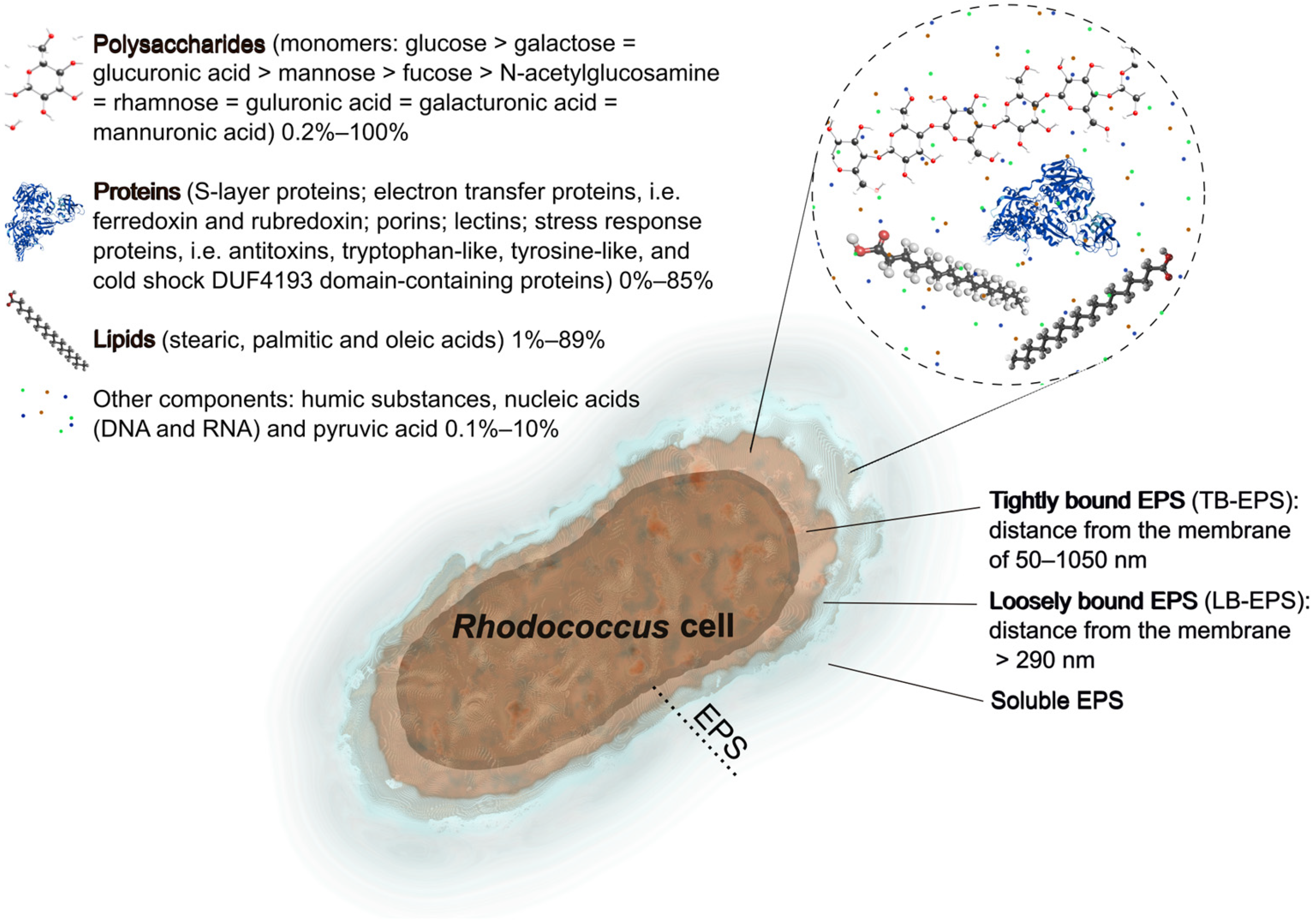
Extracellular Polymeric Substances Produced by Actinomycetes of the Genus Rhodococcus for Biomedical and Environmental Applications


Abstract
1. Introduction
2. Chemical Composition and Its Influence on Activities and Functions of EPSs
2.1. Carbohydrates (Exopolysaccharides)

| Species of Rhodococcus | Compound’s Name | Molecular Weight (Da) | Composition | Bioactivities | References |
|---|---|---|---|---|---|
| R. hoagii CECT555, R. erythropolis CECT3013, R. rhodochrous CECT5749, R. rhodnii CECT5750, R. coprophilus CECT5751 | No data | No data | Contain histo-blood group antigens A (monofucosyl and difucosyl oligosaccharides), B (oligosaccharides with terminal galactose), and Lewisy (difucosylated oligosaccharides) | Antiviral activity; binding norovirus virus-like particles | [42] |
| R. pyridinivorans ZZ47 | No data | No data | No data | Antibiofilm, anti-angiogenic, antioxidant agents | [6,43] |
| R. erythropolis HX-2 | HPS | 1.04 × 10⁶ | 79.24% carbohydrates, 5.2% proteins and 8.45% lipids; Glucose, galactose, fucose, mannose and glucuronic acid with a mass ratio of 27.29%, 24.83%, 4.79%, 26.66%, and 15.84% | Anticancer and viscosity agents | [8] |
| R. rhodochrous ATCC 53968 | No data | No data | Galactose, glucose, fucose, and glucuronic acid at a molar ratio of 3: 2: 2: 2 1.3% stearic acid, 4.1% palmitic acid, 5.8% pyruvic acid | Thickeners | [35] |
| R. erythropolis DSM 43215 | PLS-1 | 1.14 × 10⁶ | Glucose and mannose at a molar ratio of 1:1 3.3% of proteins | Anti-inflammatory agents | [41] |
| Rhodococcus strain 33 | No data | 1.05 × 10⁵ | Glucuronic acid, glucose, galactose and rhamnose at a molecular ratio of 1:1:1:2. | Adhesion; improving biodegradation | [44] |
| Rhodococcus strain 33 | 33 EPS; PS-33 | >2 × 10⁶ | D-galactose, D-glucose, D-mannose, D-glucuronic, pyruvic acids at a ratio of 1:1:1:1:1 | Improving hydrocarbon tolerance | [45] |
| R. erythropolis PR4 | FR2 | No data | d-galactose, d-glucose, d-mannose, pyruvic acid and d-glucuronic acid at a ratio of 1:1:1:1:1; 2.9% stearic acid and 4.3% palmitic acid | Improving hydrocarbon tolerance | [36] |
| R. erythropolis PR4 | FACEPS | No data | Glucose, N-acetylglucosamine, glucuronic acid, and fucose at a molar ratio of 2:1:1:1. | Improving hydrocarbon tolerance | [33] |
| R. rhodochrous 202 DSM and R. opacus 89 UMCS | No data | No data | 52.1% and 62.7% content of CHx groups | Heavy metal (Ni(II), Pb(II), Co(II), Cd(II) and Cr(VI)) sorption | [46] |
| R. opacus | BES.DM-GMA-TETA-EPS Microspheres | No data | No data | Pb(II) and Cd(II) sorption | [47] |
| R. erythropolis ACCC 10543 | RSF; NOC-1 | No data | Proteoglycan (glycoprotein) composed of polysaccharides (91.2%), protein (7.6%), and DNA (1.2%). | Flocculation | [16,48] |
| R. erythropolis S-1 and 260-2 | No data | No data | No data | Flocculation | [49,50] |
| R. rhodochrous R-202 | R-202 | 1.3 × 10⁶ | 62.86% of polysaccharide and 10.36% of protein. Mannose, glucose, and galactose at a molar ratio of 12:6:1. | Flocculation (effective at pH around 7 and in salt solutions) | [51] |
| R. opacus 89 UMCS | No data | 7.6 × 10⁵ | 64.6% polysaccharide 9.44% protein Mannose, glucose, and galactose. | Flocculation; Binding metal cations | [52] |
| Rhodococcus sp. (erythropolis) R3 | No data | 3.99 × 10⁵ | 84.6% protein and 15.2% sugar content | Flocculation | [53] |
| R. qingshengii QDR4-2 | QEPS | 9.450 × 10⁵ | Mannose and glucose at a molar ratio of 81.5:18.5 | Antioxidant agent; emulsification | [54] |
| R. rhodochrous ATCC 12674 | SM-1 EPS | No data | D-galactose, D-glucose, L-fucose, and D-glucuronic acid at a molar ratio of 6:3:2:4 1.2% stearic acid, 2.3% palmitic acid, and 10.3% pyruvic acid | Absorption | [55] |
| R. erythropolis Au-1 | No data | No data | No data | Emulsification | [56] |
| Rhodococcus sp. RHA1 (NRCC 6316) | No data | No data | Hexuronic acid and neutral glycose in the approximate ratio of 1:3. D-galactose, D-glucose, L-fucose, d-glucuronic acid at a ratio of 1:1:1:1 | No data | [57] |
| R. ruber C208 | No data | No data | Polysaccharides and proteins at a ratio of 2.5:1 | Adhesion | [58] |
| Rhodococcus sp. SJ | EOM | No data | No data | Resuscitation of nonculturable cells; improving degradation of polychlorobiphenyls | [59] |
2.2. Proteins
2.3. Lipids
2.4. Humic Substances
3. Biological Functions
4. Applications (Bioactivities)
4.1. Biomedicine
4.2. Bioremediation
4.3. Other Applications
5. Influence of Growth Conditions and Extraction Methods on Composition and Properties of Rhodococcus EPSs
| Rhodococcus Strains | EPS Name | Growth Conditions | Extraction Method | Purification Method | Yield of EPS | Reference |
|---|---|---|---|---|---|---|
| R. hoagii CECT555, R. erythropolis CECT3013, R. rhodochrous CECT5749, R. rhodnii CECT5750, R. coprophilus CECT5751 | No data | TSA or YEME medium, 26/30 °C, 200 rpm, overnight | Centrifugation 12,000× g; addition of 3 volumes of anhydrous ethanol; centrifugation 12,000× g, 20 min, 4 °C | Precipitation of proteins with TCA | No data | [42] |
| R. pyridinivorans ZZ47 | No data | TSB, 37 °C, 200 rpm, 24 h | Centrifugation, 10,000× g, 15 min, 4 °C; precipitation with 2 volumes of ethanol, 4 °C, 24 h; centrifugation 10,000× g, 20 min, 4 °C | Precipitation of proteins with TCA | 10.136 g/L | [6,43] |
| R. erythropolis HX-2 | HPS | Minimal salt medium (Na2HPO4 1.5, KH2PO4 3.48, (NH4)2SO4 4.0, MgSO4 0.7, yeast powder 0.01, 2% (v/v) sodium citrate culture), 25 °C, 72 h. | Heat, 90 °C, 15 min; centrifugation 10,000× g, 15 min, 4 °C; addition of 70% (w/v) TCA with a final concentration 15% (w/v), 4 °C, overnight; centrifugation 11,000× g, 20 min, 4 °C; precipitation with 3 volumes of 95% ethanol, 4 °C, 12 h; centrifugation 11,000× g, 20 min, 4 °C | Anion exchange chromatography on a DEAE-Cellulose DE-52 column; dialysis; gel filtration on a Sepharose CL-6B column | 6.365 g/L (crude EPS) | [8] |
| R. rhodochrous ATCC 53968 | No data | IB agar, 37 °C. | Shaking, 120 rpm, 10 min, 25 °C; centrifugation 10,000× g, 10 min; ethanol precipitation | Phenol/chloroform treatment; treatment with DNase I, RNase A, proteinase K, 37 °C, 16 h; dialysis | 0.017 g/g of cells | [35] |
| R. rhodochrous ATCC 12674 | SM-1 EPS | No data | [55] | |||
| R. erythropolis DSM 43215 | PLS-1 | Basal medium B with 1% (w/v) of a carbon source (n-alkanes, lower mono-, di- and trihydric alcohols, sugars), 30 °C, 24 h | Centrifugation; precipitation with 2 volumes of ethanol; washing with a small amount of 30% ethanol; dissolving in water; precipitation is repeated twice | Precipitation with 10% aqueous solution of N-cetyl-N, N, N-trimethylammonium bromide; washing with water and dissolving it in 5 M NaCl; dialysis, room temperature, 2 days; gel Filtration by Sepharose 4 B and 6 B columns | 0.003–1.935 g/L | [41] |
| Rhodococcus strain 33 | No data | Davis–Mingioti medium (1% n-hexadecane, yeast extract 0.1, K2HPO4 × 3H2O 4.8, KH2PO4 1.5, (NH4)2SO4 1.0, trisodium citrate × 2H2O 0.5, MgSO4 × 7H2O 0.2, trace elements), 20 °C. | No data | No data | No data | [44] |
| R. erythropolis PR4 | FR2, FACEPS | IB agar, 25 °C. | Centrifugation | CTAB method; ethanol precipitation; DEAE-Toyopearl 650 M column chromatography | No data | [33,36] |
| R. rhodochrous 202 DSM and R. opacus 89 UMCS | No data | Liquid medium (glucose 20, KH2PO4 2.0, K2HPO4 5.0, NH4Cl 0.5, NaCl 0.1, MgSO4 0.1, yeast extract 0.5), 26 °C, 130 rpm, 72 h | Centrifugation twice; concentration by a reverse osmosis process; centrifugation; filtration using a Durapore membrane (0.45 μm diameter of pore, Millipore, Burlington, USA); adding 95% ethanol, 72 h, 4 °C; centrifugation; precipitation is repeated twice | Dialysis, 4 °C, 3 days | No data | [46] |
| R. opacus | BES.DM-GMA-TETA-EPS Microspheres | No data | [47] | |||
| R. opacus 89 UMCS | No data | Liquid medium, 26 °C, 130 rpm, 10 days. | 0.266 ± 0.046 g/L | [52] | ||
| R. rhodochrous R-202 | R-202 | Liquid medium, 28 °C, 130 rpm, 5 days. | 0.273 ± 0.025 g/L | [51] | ||
| R. erythropolis ACCC 10543 | RSF; NOC-1 | Standard medium (sucrose 20.0; urea 4.0; yeast powder 1.0, NaCl 1.0, K2HPO4 5.0, KH2PO4 2.0, MgSO4 0.2), 30 °C, 130 rpm, 20 h | Centrifugation 6000 rpm, 4 °C, 10 min; adding two volumes of acetone or cold ethanol; centrifugation | Washing with ether | 1.600 g/L | [16] |
| R. qingshengii QDR4-2 | QEPS | MRS broth, 25 °C, 150 rpm, 72 h | Heat, 90 °C, 30 min; centrifugation 11,000× g, 4 °C, 10 min; concentration using a rotary evaporator (RE-52AA, Shyarong), 45 °C, −0.1 MPa; precipitation with 3 volumes of ethanol, 4 °C, overnight; centrifugation 11,000× g, 4 °C, 15 min. | Precipitation of proteins by adding 75% TCA (w/v) to a final concentration of 15%; centrifugation, 4 °C, 11,000× g, 30 min; DEAE cellulose-52 column chromatography | 3.850 g/L | [54] |
| R. erythropolis Au-1 | No data | Liquid nutrient medium (NaNO3 3.0, K2HPO4 2.0, KH2PO4 2.0, MgSO4 × 7H2O 0.5, Na3C6H5O7 × 2H2O 1.0, yeast extract 1.0, glycerol 20.0), 30 °C, 220 rpm, 5 days | Precipitation with 2 volumes of 96% ethanol | Reprecipitation from distilled water twice | 5.0 g/L | [56] |
| Rhodococcus sp. RHA1 (NRCC 6316) | No data | Brain heart infusion, 30 °C, 175 rpm | Centrifugation, 60 °C; addition of 90% aqueous phenol (60 °C); centrifugation, 5 min | Dialysis, 4 °C; treatment with RNase, DNase, proteinase K (37 °C, 4 h); low speed centrifugation; ultracentrifugation (105,000× g, 4 °C, 12 h) | 3.5% based on dry cell weight | [57] |
| R. ruber C208 | No data | Synthetic medium (NH4NO3 1.0, K2HPO4 1.0, MgSO4·7H2O 0.2, KCl 0.15, CaCl2·2H2O 0.1, microelements), 30 °C, 150 rpm | Incubation of removed film with 2% (v/v) aqueous SDS solution, 4 h; centrifugation 34,800× g, 10 min | Dialysis | No data | [58] |
| Rhodococcus sp. SJ | EOM | Lactate minimal medium, 30 °C, 160 rpm, 216 h | Centrifugation 8000 rpm, 15 min | Filtration, 0.22 μm membrane | No data | [59] |
6. Conclusions and Future Challenges
Author Contributions
Funding
Institutional Review Board Statement
Informed Consent Statement
Data Availability Statement
Acknowledgments
Conflicts of Interest
Abbreviations
| EPSs | Extracellular polymeric substances |
| TB | Tightly bound |
| TCA | Trichloroacetic acid |
| LB | Loosely bound |
| DPPH | Diphenylpicrylhydrazyl |
| PCBs | Polychlorinated biphenyls |
References
- Naseem, M.; Chaudhry, A.N.; Jilani, G.; Naz, F.; Alam, T.; Zhang, D.-M. Biosynthesis and characterization of extracellular polymeric substances from divergent microbial and ecological bioresources. Arab. J. Sci. Eng. 2024, 49, 9043–9052. [Google Scholar] [CrossRef]
- Wei, X.L.; Mo, S.Y.; Ali-Saeed, R.; Zeng, H. Isolation, structure, and biological activities of exopolysaccharides from actinomycetes: A review. Curr. Microbiol. 2025, 82, 45. [Google Scholar] [CrossRef]
- Shanshoury, A.; Allam, N.; Basiouny, E.; Azab, M. Optimization of exopolysaccharide production by soil actinobacterium Streptomyces plicatus under submerged culture conditions. Egypt. J. Exp. Biol. (Bot.) 2022, 18, 151–160. [Google Scholar] [CrossRef]
- Flemming, H.C.; Wingender, J. The biofilm matrix. Nat. Rev. Microbiol. 2010, 8, 623–633. [Google Scholar] [CrossRef]
- Krivoruchko, A.; Nurieva, D.; Luppov, V.; Kuyukina, M.; Ivshina, I. The lipid- and polysaccharide-rich extracellular polymeric substances of Rhodococcus support biofilm formation and protection from toxic hydrocarbons. Polymers 2025, 17, 1912. [Google Scholar] [CrossRef] [PubMed]
- Taşkaya, A.; Güvensen, N.C.; Güler, C.; Şanci, E.; Karabay, Ü. Exopolysaccharide from Rhodococcus pyridinivorans ZZ47 strain: Evaluation of biological activity and toxicity. J. Agric. Prod. 2023, 4, 63–71. [Google Scholar] [CrossRef]
- Atmakuri, A.; Yadav, B.; Tiwari, B.; Drogui, P.; Tyagi, R.D.; Wong, J.W.C. Nature’s architects: A comprehensive review of extracellular polymeric substances and their diverse applications. Waste Dispos. Sustain. Energy 2024, 6, 529–551. [Google Scholar] [CrossRef]
- Hu, X.; Li, D.; Qiao, Y.; Wang, X.; Zhang, Q.; Zhao, W.; Huang, L. Purification, characterization and anticancer activities of exopolysaccharide produced by Rhodococcus erythropolis HX-2. Int. J. Biol. Macromol. 2020, 145, 646–654. [Google Scholar] [CrossRef] [PubMed]
- Weathers, T.S.; Higgins, C.P.; Sharp, J.O. Enhanced biofilm production by a toluene-degrading Rhodococcus observed after exposure to perfluoroalkyl acids. Environ. Sci. Technol. 2015, 49, 5458–5466. [Google Scholar] [CrossRef]
- Freitas, F.; Alves, V.D.; Reis, M.A.M. Advances in bacterial exopolysaccharides: From production to biotechnological applications. Trends Biotechnol. 2011, 29, 388–398. [Google Scholar] [CrossRef]
- Finore, I.; Di Donato, P.; Mastascusa, V.; Nicolaus, B.; Poli, A. Fermentation technologies for the optimization of marine microbial exopolysaccharide production. Mar. Drugs 2014, 12, 3005–3024. [Google Scholar] [CrossRef]
- More, T.T.; Yadav, J.S.S.; Yan, S.; Tyagi, R.D.; Surampalli, R.Y. Extracellular polymeric substances of bacteria and their potential environmental applications. J. Environ. Manag. 2014, 144, 1–25. [Google Scholar] [CrossRef]
- Netrusov, A.I.; Liyaskina, E.V.; Kurgaeva, I.V.; Liyaskina, A.U.; Yang, G.; Revin, V.V. Exopolysaccharides producing bacteria: A review. Microorganisms 2023, 11, 1541. [Google Scholar] [CrossRef]
- Saito, S.; Kato, W.; Ikeda, H.; Katsuyama, Y.; Ohnishi, Y.; Imoto, M. Discovery of “heat shock metabolites” produced by thermotolerant actinomycetes in high-temperature culture. J. Antibiot. 2020, 73, 203–210. [Google Scholar] [CrossRef]
- Ivshina, I.B.; Kuyukina, M.S.; Krivoruchko, A.V. Extremotolerant Rhodococcus as an Important resource for environmental biotechnology. In Actinomycetes in Marine and Extreme Environments; CRC Press: Boca Raton, FL, USA, 2024; pp. 209–246. [Google Scholar] [CrossRef]
- Peng, L.; Yang, C.; Zeng, G.; Wang, L.; Dai, C.; Long, Z.; Liu, H.; Zhong, Y. Characterization and application of bioflocculant prepared by Rhodococcus erythropolis using sludge and livestock wastewater as cheap culture media. Appl. Microbiol. Biotechnol. 2014, 98, 6847–6858. [Google Scholar] [CrossRef] [PubMed]
- Ivshina, I.B. Current situation and challenges of specialized microbial resource centres in Russia. Microbiology 2012, 81, 509–516. [Google Scholar] [CrossRef]
- Cappelletti, M.; Presentato, A.; Piacenza, E.; Firrincieli, A.; Turner, R.J.; Zannoni, D. Biotechnology of Rhodococcus for the production of valuable compounds. Appl. Microbiol. Biotechnol. 2020, 104, 8567–8594. [Google Scholar] [CrossRef]
- Korshunova, I.; Pistsova, O.; Kuyukina, M.; Ivshina, I. The effect of organic solvents on the viability and morphofunctional properties of Rhodococcus. Applied Biochem. Microbiol. 2016, 52, 43–50. [Google Scholar] [CrossRef]
- Pátek, M.; Grulich, M.; Nešvera, J. Stress response in Rhodococcus strains. Biotechnol. Adv. 2021, 53, 107698. [Google Scholar] [CrossRef]
- Ivshina, I.; Kuyukina, M.; Krivoruchko, A.; Tyumina, E. The Rhodococcus ruber actinomycetes, key and universal biooxidizers of C2-C4 gaseous alkanes. Microbiology 2025, 94, 145–171. [Google Scholar] [CrossRef]
- Zhang, Z.; Li, Z.; Chen, X.; Nan, J.; Zu, Y.; Chen, F.; Liang, B.; Wang, A. Molecular insights into the response of nonelectroactive bacteria to electro-stimulation: Growth and metabolism regulation mechanism. ACS EST Eng. 2024, 4, 819–830. [Google Scholar] [CrossRef]
- Huang, L.; Jin, Y.; Zhou, D.; Liu, L.; Huang, S.; Zhao, Y.; Chen, Y. A review of the role of extracellular polymeric substances (EPS) in wastewater treatment systems. Int. J. Environ. Res. Public Health 2022, 19, 12191. [Google Scholar] [CrossRef]
- Pen, Y.; Zhang, Z.J.; Morales-García, A.L.; Mears, M.; Tarmey, D.S.; Edyvean, R.G.; Banwart, S.A.; Geoghegan, M. Effect of extracellular polymeric substances on the mechanical properties of Rhodococcus. Biochim. Biophys. Acta (BBA)-Biomembr. 2015, 1848, 518–526. [Google Scholar] [CrossRef]
- Mitchell, G.J.; Wiesenfeld, K.; Nelson, D.C.; Weitz, J.S. Critical cell wall hole size for lysis in gram-positive bacteria. J. R. Soc. Interface 2013, 10, 20120892. [Google Scholar] [CrossRef]
- Mai-Prochnow, A.; Clauson, M.; Hong, J.; Murphy, A.B. Gram positive and gram negative bacteria differ in their sensitivity to cold plasma. Sci. Rep. 2016, 6, 38610. [Google Scholar] [CrossRef]
- Eichner, H.; Wu, C.; Cammer, M.; Tran, E.N.; Hirst, T.R.; Paton, J.C.; Weiser, J.N. Intra-serotype variation of Streptococcus pneumoniae capsule and its quantification. Microbiol. Spectr. 2025, 13, e03087-24. [Google Scholar] [CrossRef]
- Iorhemen, O.T.; Hamza, R.A.; Zaghloul, M.S.; Tay, J.H. Aerobic granular sludge membrane bioreactor (AGMBR): Extracellular polymeric substances (EPS) analysis. Water Res. 2019, 156, 305–314. [Google Scholar] [CrossRef] [PubMed]
- Li, D.; Xi, H. Layered extraction and adsorption performance of extracellular polymeric substances from activated sludge in the enhanced biological phosphorus removal process. Molecules 2019, 24, 3358. [Google Scholar] [CrossRef] [PubMed]
- Simões, M.; Simões, L.C.; Vieira, M.J. A review of current and emergent biofilm control strategies. LWT-Food Sci. Technol. 2010, 43, 573–583. [Google Scholar] [CrossRef]
- Styazhkin, K.; Artemkina, I.; Zakshevskaya, L. Exogenous polymers of microorganisms from natural and technogenic ecosystems of oil production areas. Oilfield Eng. 2007, 1, 21–25. (In Russian) [Google Scholar]
- Botvinko, I. Exopolysaccharides of bacteria. Uspekhi Mikrobiol. (Adv. Microbiol.) 1985, 20, 79–122. (In Russian) [Google Scholar]
- Urai, M.; Yoshizaki, H.; Anzai, H.; Ogihara, J.; Iwabuchi, N.; Harayama, S.; Sunairi, M.; Nakajima, M. Structural analysis of mucoidan, an acidic extracellular polysaccharide produced by a pristane-assimilating marine bacterium, Rhodococcus erythropolis PR4. Carbohydr. Res. 2007, 342, 927–932. [Google Scholar] [CrossRef]
- Iwabuchi, N.; Sunairi, M.; Urai, M.; Itoh, C.; Anzai, H.; Nakajima, M.; Harayama, S. Extracellular polysaccharides of Rhodococcus rhodochrous S-2 stimulate the degradation of aromatic components in crude oil by indigenous marine bacteria. Appl. Environ. Microbiol. 2002, 68, 2337–2343. [Google Scholar] [CrossRef]
- Urai, M.; Anzai, H.; Iwabuchi, N.; Sunairi, M.; Nakajima, M. A novel viscous extracellular polysaccharide containing fatty acids from Rhodococcus rhodochrous ATCC 53968. Actinomycetologica 2004, 18, 15–17. [Google Scholar] [CrossRef]
- Urai, M.; Yoshizaki, H.; Anzai, H.; Ogihara, J.; Iwabuchi, N.; Harayama, S.; Sunairi, M.; Nakajima, M. Structural analysis of an acidic, fatty acid ester-bonded extracellular polysaccharide produced by a pristane-assimilating marine bacterium, Rhodococcus erythropolis PR4. Carbohydr. Res. 2007, 342, 933–942. [Google Scholar] [CrossRef]
- Szcześ, A.; Czemierska, M.; Jarosz-Wilkołazka, A. Calcium carbonate formation on mica supported extracellular polymeric substance produced by Rhodococcus opacus. J. Solid. State Chem. 2016, 242, 212–221. [Google Scholar] [CrossRef]
- Czaczyk, K.; Myszka, K. Biosynthesis of extracellular polymeric substances (EPS) and its role in microbial biofilm formation. Pol. J. Environ. Stud. 2007, 16, 799–806. [Google Scholar]
- Jurášková, D.; Ribeiro, S.C.; Silva, C.C. Exopolysaccharides produced by lactic acid bacteria: From biosynthesis to health-promoting properties. Foods 2022, 11, 156. [Google Scholar] [CrossRef] [PubMed]
- Wilkinson, J. The extracellular polysaccharides of bacteria. Bacteriol. Rev. 1958, 22, 46–73. [Google Scholar] [CrossRef]
- Rapp, P.; Beck, C.H.; Wagner, F. Formation of exopolysaccharides by Rhodococcus erythropolis and partial characterization of a heteropolysaccharide of high molecular weight. Eur. J. Appl. Microbiol. Biotechnol. 1979, 7, 67–78. [Google Scholar] [CrossRef]
- Santiso-Bellón, C.; Randazzo, W.; Carmona-Vicente, N.; Peña-Gil, N.; Cárcamo-Calvo, R.; Lopez-Navarro, S.; Navarro-Lleó, N.; Yebra, M.J.; Monedero, V.; Buesa, J.; et al. Rhodococcus spp. interacts with human norovirus in clinical samples and impairs its replication on human intestinal enteroids. Gut Microbes 2025, 17, 2469716. [Google Scholar] [CrossRef]
- Güvensen, N.C.; Alper, M.; Taşkaya, A. The evaluation of biological activities of exopolysaccharide from Rhodococcus pyridinivorans in vitro. Eur. J. Res. Dev. 2022, 2, 491–504. [Google Scholar] [CrossRef]
- Neu, T.R.; Poralla, K. An amphiphilic polysaccharide from an adhesive Rhodococcus strain. FEMS Microbiol. Lett. 1988, 49, 389–392. [Google Scholar] [CrossRef]
- Aizawa, T.; Neilan, B.A.; Couperwhite, I.; Urai, M.; Anzai, H.; Iwabuchi, N.; Nakajima, M.; Sunairi, M. Relationship between extracellular polysaccharide and benzene tolerance of Rhodococcus sp. 33. Actinomycetologica 2005, 19, 1–6. [Google Scholar] [CrossRef]
- Dobrowolski, R.; Szcześ, A.; Czemierska, M.; Jarosz-Wikołazka, A. Studies of cadmium(II), lead(II), nickel(II), cobalt(II) and chromium(VI) sorption on extracellular polymeric substances produced by Rhodococcus opacus and Rhodococcus rhodochrous. Bioresour. Technol. 2017, 225, 113–120. [Google Scholar] [CrossRef] [PubMed]
- Dobrowolski, R.; Krzyszczak, A.; Dobrzyńska, J.; Podkościelna, B.; Zięba, E.; Czemierska, M.; Jarosz-Wilkołazka, A.; Stefaniak, E.A. Extracellular polymeric substances immobilized on microspheres for removal of heavy metals from aqueous environment. Biochem. Eng. J. 2019, 143, 202–211. [Google Scholar] [CrossRef]
- Yang, H.; Xiao, J.; Wang, F.; Zhang, L. Adsorption–flocculation of Rhodococcus erythropolis on micro-fine hemalitic. J. Cent. South. Univ. 2013, 44, 874–879. [Google Scholar]
- Kurane, R.; Toeda, K.; Takeda, K.; Suzuki, T. Culture conditions for production of microbial flocculant by Rhodococcus erythropolis. Agric. Biol. Chem. 1986, 50, 2309–2313. [Google Scholar]
- Kurane, R.; Hatamochi, K.; Kakuno, T.; Kiyohara, M.; Hirano, M.; Taniguchi, Y. Production of a bioflocculant by Rhodococcus erythropolis S-1 grown on alcohols. Biosci. Biotechnol. Biochem. 1994, 58, 428–429. [Google Scholar] [CrossRef]
- Czemierska, M.; Szcześ, A.; Hołysz, L.; Wiater, A.; Jarosz-Wilkołazka, A. Characterisation of exopolymer R-202 isolated from Rhodococcus rhodochrous and its flocculating properties. Eur. Polym. J. 2017, 88, 21–33. [Google Scholar] [CrossRef]
- Czemierska, M.; Szcześ, A.; Pawlik, A.; Wiater, A.; Jarosz-Wilkołazka, A. Production and characterisation of exopolymer from Rhodococcus opacus. Biochem. Eng. J. 2016, 112, 143–152. [Google Scholar] [CrossRef]
- Guo, J.; Yang, C.; Zeng, G. Treatment of swine wastewater using chemically modified zeolite and bioflocculant from activated sludge. Bioresour. Technol. 2013, 143, 289–297. [Google Scholar] [CrossRef] [PubMed]
- Li, F.; Hu, X.; Li, J.; Sun, X.; Luo, C.; Zhang, X.; Li, H.; Lu, J.; Li, Y.; Bao, M. Purification, structural characterization, antioxidant and emulsifying capabilities of exopolysaccharide produced by Rhodococcus qingshengii QDR4-2. J. Polym. Environ. 2023, 31, 64–80. [Google Scholar] [CrossRef]
- Urai, M.; Anzai, H.; Iwabuchi, N.; Sunairi, M.; Nakajima, M. A novel moisture-absorbing extracellular polysaccharide from Rhodococcus rhodochrous SM-1. Actinomycetologica 2002, 16, 26–31. [Google Scholar] [CrossRef]
- Semeniuk, I.; Koretska, N.; Kochubei, V.; Lysyak, V.; Pokynbroda, T.; Karpenko, E.; Midyana, H. Biosynthesis and characteristics of metabolites of Rhodococcus erythropolis Au-1 strain. J. Microbiol. Biotechnol. Food Sci. 2022, 11, e4714. [Google Scholar] [CrossRef]
- Perry, M.; Maclean, L.; Patrauchan, M.; Vinogradov, E. The structure of the exocellular polysaccharide produced by Rhodococcus sp. RHA1. Carbohydr. Res. 2007, 342, 2223–2229. [Google Scholar] [CrossRef]
- Sivan, A.; Szanto, M.; Pavlov, V. Biofilm development of the polyethylene-degrading bacterium Rhodococcus ruber. Appl. Microbiol. Biotechnol. 2006, 72, 346–352. [Google Scholar] [CrossRef]
- Shi, J.; Dong, J.; Sun, F.; Dong, F.; Shen, C.; Su, X. Extracellular organic matter-mediated self-regulation of indigenous Rhodococcus sp. enhances PCB biodegradation under environmental stress: Self-recovery strategy for sustained bioremediation. Environ. Res. 2025, 285, 122716. [Google Scholar] [CrossRef]
- Neu, T.R.; Dengler, T.; Jann, B.; Poralla, K. Structural studies of an emulsion-stabilizing exopolysaccharide produced by an adhesive, hydrophobic Rhodococcus strain. J. Gen. Microbiol. 1992, 138, 2531–2537. [Google Scholar] [CrossRef]
- Leitch, R.; Richards, J. Structural analysis of the specific capsular polysaccharide of Rhodococcus equi serotype 1. Biochem. Cell Biol. 1990, 68, 778–789. [Google Scholar] [CrossRef]
- Masoud, H.; Richards, J. Structural elucidation of the specific capsular polysaccharide of Rhodococcus equi serotype 7. Carbohydr. Res. 1994, 252, 223–233. [Google Scholar] [CrossRef]
- Severn, W.; Richards, J. The structure of the specific capsular polysaccharide of Rhodococcus equi serotype 4. Carbohydr. Res. 1999, 320, 209–222. [Google Scholar] [CrossRef]
- Severn, W.; Richards, J. Structural analysis of the specific capsular polysaccharide of Rhodococcus equi serotype 2. Carbohydr. Res. 1990, 206, 311–332. [Google Scholar] [CrossRef] [PubMed]
- Chen, Y.; Wei, Q.; Wang, X.; Wu, Y.; Fu, C.; Wang, X.; Xu, H.; Li, L. Characterizing the contaminant-adhesion of a dibenzofuran degrader Rhodococcus sp. Microorganisms 2025, 13, 93. [Google Scholar] [CrossRef]
- Sutherland, I.W. Microbial exopolysaccharides-structural subtleties and their consequences. Pure Appl. Chem. 1997, 69, 1911–1918. [Google Scholar] [CrossRef]
- Tian, H.; Li, Y.; Chen, H.; Zhang, J.; Hui, M.; Xu, X.; Su, Q.; Smets, B.F. Aerobic biodegradation of quinoline under denitrifying conditions in membrane-aerated biofilm reactor. Environ. Pollut. 2023, 326, 121507. [Google Scholar] [CrossRef] [PubMed]
- Moura, M.N.; Martín, M.J.; Burguillo, F.J. A comparative study of the adsorption of humic acid, fulvic acid and phenol onto Bacillus subtilis and activated sludge. J. Hazard. Mater. 2007, 149, 42–48. [Google Scholar] [CrossRef]
- Tong, M.; Zhu, P.; Jiang, X.; Kim, H. Influence of natural organic matter on the deposition kinetics of extracellular polymeric substances (EPS) on silica. Colloids Surf. B Biointerfaces 2011, 87, 151–158. [Google Scholar] [CrossRef] [PubMed]
- Hommel, R.K. Formation and physiological role of biosurfactants produced by hydrocarbon-utilizing microorganisms: Biosurfactants in hydrocarbon utilization. Biodegradation 1990, 1, 107–119. [Google Scholar] [CrossRef]
- Kuyukina, M.S.; Bayandina, E.A.; Kostrikina, N.A.; Sorokin, V.V.; Mulyukin, A.L.; Ivshina, I.B. Adaptations of Rhodococcus rhodochrous biofilms to oxidative stress induced by copper(II) oxide nanoparticles. Langmuir 2025, 41, 1356–1367. [Google Scholar] [CrossRef]
- Mosharaf, M.; Tanvir, M.; Haque, M.; Haque, M.; Khan, M.; Molla, A.; Alam, M.Z.; Islam, M.; Talukder, M. Metal-adapted bacteria isolated from wastewaters produce biofilms by expressing proteinaceous curli fimbriae and cellulose nanofibers. Front. Microbiol. 2018, 9, 1334. [Google Scholar] [CrossRef]
- Zhao, H.-M.; Hu, R.-W.; Chen, X.-X.; Chen, X.-B.; Lü, H.; Li, Y.-W.; Li, H.; Mo, C.-H.; Cai, Q.-Y.; Wong, M.-H. Biodegradation pathway of di-(2-ethylhexyl) phthalate by a novel Rhodococcus pyridinivorans XB and its bioaugmentation for remediation of DEHP contaminated soil. Sci. Total Environ. 2018, 640, 1121–1131. [Google Scholar] [CrossRef]
- LeBlanc, J.C.; Gonçalves, E.R.; Mohn, W.W. Global response to desiccation stress in the soil actinomycete Rhodococcus jostii RHA1. Appl. Environ. Microbiol. 2008, 74, 2627–2636. [Google Scholar] [CrossRef]
- Gupta, J.; Rathour, R.; Singh, R.; Thakur, I.S. Production and characterization of extracellular polymeric substances (EPS) generated by a carbofuran degrading strain Cupriavidus sp. ISTL7. Bioresour. Technol. 2019, 282, 417–424. [Google Scholar] [CrossRef] [PubMed]
- Iwabuchi, N.; Sunairi, M.; Anzai, H.; Nakajima, M.; Harayama, S. Relationships between colony morphotypes and oil tolerance in Rhodococcus rhodochrous. Appl. Environ. Microbiol. 2000, 66, 5073–5077. [Google Scholar] [CrossRef]
- de Carvalho, C.C.; da Fonseca, M.M.R. Influence of reactor configuration on the production of carvone from carveol by whole cells of Rhodococcus erythropolis DCL14. J. Mol. Catal. B Enzym. 2002, 19, 377–387. [Google Scholar] [CrossRef]
- de Carvalho, C.C.; da Fonseca, M.M.R. Preventing biofilm formation: Promoting cell separation with terpenes. FEMS Microbiol. Ecol. 2007, 61, 406–413. [Google Scholar] [CrossRef] [PubMed]
- de Carvalho, C.C.C.R. Adaptation of Rhodococcus to organic solvents. In Biology of Rhodococcus; Alvarez, H.M., Ed.; Springer International Publishing: Cham, Switzerland, 2019; pp. 103–135. ISBN 978-3-030-11461-9. [Google Scholar]
- de Carvalho, C.C.; da Cruz, A.A.; Pons, M.-N.; Pinheiro, H.M.; Cabral, J.M.; da Fonseca, M.M.R.; Ferreira, B.S.; Fernandes, P. Mycobacterium sp., Rhodococcus erythropolis, and Pseudomonas putida behavior in the presence of organic solvents. Microsc. Res. Tech. 2004, 64, 215–222. [Google Scholar] [CrossRef]
- Huang, H.; Liu, Z.; Qiu, Y.; Wang, X.; Wang, H.; Xiao, H.; Lu, Z. Efficient electrotransformation of Rhodococcus ruber YYL with abundant extracellular polymeric substances via a cell wall-weakening strategy. FEMS Microbiol. Lett. 2021, 368, fnab049. [Google Scholar] [CrossRef]
- Tripathi, V.; Harding, W.; Willingham-Lane, J.; Hondalus, M. Conjugal transfer of a virulence plasmid in the opportunistic intracellular actinomycete Rhodococcus equi. J. Bacteriol. 2012, 194, 6790–6801. [Google Scholar] [CrossRef]
- Oguntade, A.S.; Al-Amodi, F.; Alrumayh, A.; Alobaida, M.; Bwalya, M. Anti-angiogenesis in cancer therapeutics: The magic bullet. J. Egypt. Natl. Cancer Inst. 2021, 33, 15. [Google Scholar] [CrossRef]
- d’Abzac, P.; Bordas, F.; Joussein, E.; van Hullebusch, E.D.; Lens, P.N.L.; Guibaud, G. Metal binding properties of extracellular polymeric substances extracted from anaerobic granular sludges. Environ. Sci. Pollut. Res. 2013, 20, 4509–4519. [Google Scholar] [CrossRef]
- Sheng, G.-P.; Yu, H.-Q.; Li, X.-Y. Extracellular polymeric substances (EPS) of microbial aggregates in biological wastewater treatment systems: A review. Biotechnol. Adv. 2010, 28, 882–894. [Google Scholar] [CrossRef]
- Whyte, L.; Slagman, S.; Pietrantonio, F.; Bourbonniere, L.; Koval, S.; Lawrence, J.; Inniss, W.; Greer, C. Physiological adaptations involved in alkane assimilation at a low temperature by Rhodococcus sp. strain Q15. Appl. Environ. Microbiol. 1999, 65, 2961–2968. [Google Scholar] [CrossRef] [PubMed]
- Takeda, M.; Kurane, R.; Nakamura, I. Localization of a biopolymer produced by Rhodococcus erythropolis grown on n-pentadecane. Agric. Biol. Chem. 1991, 55, 2665–2666. [Google Scholar] [CrossRef]
- Watkinson, R.J.; Morgan, P. Physiology of aliphatic hydrocarbon-degrading microorganisms. Biodegradation 1990, 1, 79–92. [Google Scholar] [CrossRef]
- Wolfaardt, G.M.; Lawrence, J.R.; Headley, J.V.; Robarts, R.D.; Caldwell, D.E. Microbial Exopolymers provide a mechanism for bioaccumulation of contaminants. Microb. Ecol. 1994, 27, 279–291. [Google Scholar] [CrossRef] [PubMed]
- Neu, T.R.; Marshall, K.C. Bacterial polymers: Physicochemical aspects of their interactions at interfaces. J. Biomater. Appl. 1990, 5, 107–133. [Google Scholar] [CrossRef] [PubMed]
- Sunairi, M.; Iwabuchi, N.; Yoshizawa, Y.; Murooka, H.; Morisaki, H.; Nakajima, M. Cell-surface hydrophobicity and scum formation of Rhodococcus rhodochrous strains with different colonial morphologies. J. Appl. Microbiol. 1997, 82, 204–210. [Google Scholar] [CrossRef]
- Crini, G. Recent developments in polysaccharide-based materials used as adsorbents in wastewater treatment. Prog. Polym. Sci. 2005, 30, 38–70. [Google Scholar] [CrossRef]
- Ivshina, I.; Kuyukina, M.; Kostina, L. Adaptive mechanisms of nonspecific resistance to heavy metal ions in alkanotrophic actinobacteria. Russ. J. Ecol. 2013, 44, 123–130. [Google Scholar] [CrossRef]
- Golysheva, A.A.; Litvinenko, L.V.; Ivshina, I.B. Diversity of mercury-tolerant microorganisms. Microorganisms 2025, 13, 1350. [Google Scholar] [CrossRef] [PubMed]
- Ivshina, I.B.; Kuyukina, M.S.; Litvinenko, L.V.; Golysheva, A.A.; Kostrikina, N.A.; Sorokin, V.V.; Mulyukin, A.L. Bioaccumulation of molybdate ions by alkanotrophic Rhodococcus leads to significant alterations in cellular ultrastructure and physiology. Ecotoxicol. Environ. Saf. 2024, 274, 116190. [Google Scholar] [CrossRef] [PubMed]
- Salehizadeh, H.; Shojaosadati, S. Extracellular biopolymeric flocculants: Recent trends and biotechnological importance. Biotechnol. Adv. 2001, 19, 371–385. [Google Scholar] [CrossRef]
- Zhang, Z.-Q.; Bo, L.; Xia, S.-q.; Wang, X.-j.; Yang, A. Production and application of a novel bioflocculant by multiple-microorganism consortia using brewery wastewater as carbon source. J. Environ. Sci. 2007, 19, 667–673. [Google Scholar] [CrossRef] [PubMed]
- Zhang, Y.; Zhang, J.; Zhang, L.; Li, L.; Pan, M.; Zheng, M.; Sun, S.; Liang, J. Binding stability of per-and polyfluoroalkyl substances to sludge extracellular polymeric substances drives increased environmental risks. J. Hazard. Mater. 2025, 496, 139320. [Google Scholar] [CrossRef]
- Cheng, Q.; Jiang, H.; Jin, Z.; Jiang, Y.; Hui, C.; Xu, L.; Zhao, Y.; Du, L. Effects of Fe2O3 nanoparticles on extracellular polymeric substances and nonylphenol degradation in river sediment. Sci. Total Environ. 2021, 770, 145210. [Google Scholar] [CrossRef]
- Guezennec, J.; Herry, J.M.; Kouzayha, A.; Bachere, E.; Mittelman, M.W.; Fontaine, M.N.B. Exopolysaccharides from unusual marine environments inhibit early stages of biofouling. Int. Biodeterior. Biodegrad. 2012, 66, 1–7. [Google Scholar] [CrossRef]
- Abdalla, A.K.; Ayyash, M.M.; Olaimat, A.N.; Osaili, T.M.; Al-Nabulsi, A.A.; Shah, N.P.; Holley, R. Exopolysaccharides as antimicrobial agents: Mechanism and spectrum of activity. Front. Microbiol. 2021, 12, 664395. [Google Scholar] [CrossRef]
- Stamler, R.A.; Kilcrease, J.; Kallsen, C.; Fichtner, E.J.; Cooke, P.; Heerema, R.J.; Randall, J.J. First report of Rhodococcus Isolates causing pistachio bushy top syndrome on ‘UCB-1’ rootstock in California and Arizona. Plant Dis. 2015, 99, 1468–1476, Erratum in Plant Dis. 2015, 101, 1686. [Google Scholar] [CrossRef]
- Dhami, N.K.; Reddy, M.S.; Mukherjee, A. Biomineralization of calcium carbonates and their engineered applications: A review. Front. Microbiol. 2013, 4, 314. [Google Scholar] [CrossRef] [PubMed]
- Braissant, O.; Cailleau, G.; Dupraz, C.; Verrecchia, E.P. Bacterially induced mineralization of calcium carbonate in terrestrial environments: The role of exopolysaccharides and amino acids. J. Sediment. Res. 2003, 73, 485–490. [Google Scholar] [CrossRef]
- Szcześ, A.; Czemierska, M.; Jarosz-Wilkołazka, A.; Magierek, E.; Chibowski, E.; Hołysz, L. Extracellular polymeric substance of Rhodococcus opacus bacteria effects on calcium carbonate formation. Physicochem. Probl. Miner. Process. 2018, 54, 142–150. [Google Scholar] [CrossRef]
- Lu, K.; Wang, X.; Zhou, Y.; Zhu, Q. Carbon source–dependent transcriptomic regulation and monosaccharide remodeling of exopolysaccharide biosynthesis in Pediococcus pceusentosa LL-07. BMC Microbiol. 2025, 25, 695. [Google Scholar] [CrossRef]
- Geyik, A.G.; Kılıç, B.; Çeçen, F. Extracellular polymeric substances (EPS) and surface properties of activated sludges: Effect of organic carbon sources. Environ. Sci. Pollut. Res. 2016, 23, 1653–1663. [Google Scholar] [CrossRef]
- Mor, R.; Sivan, A. Biofilm formation and partial biodegradation of polystyrene by the actinomycete Rhodococcus ruber: Biodegradation of polystyrene. Biodegradation 2008, 19, 851–858. [Google Scholar] [CrossRef]
- Sutherland, I.W. Bacterial exopolysaccharides. Adv. Microb. Physiol. 1972, 8, 143–213. [Google Scholar] [CrossRef]
- Shen, L.; Cheng, J.; Wang, J.; Cui, L.; Zhang, Y.; Liao, W.; Liu, Z.; Zhou, H.; Wu, X.; Li, J.; et al. Comparison of extraction methods for extracellular polymeric substances (EPS) and dynamic characterization of eps from sessile microorganisms during pyrite bioleaching. J. Environ. Chem. Eng. 2022, 10, 107922. [Google Scholar] [CrossRef]
- Kajander, E.O.; Çiftçioglu, N. Nanobacteria: An alternative mechanism for pathogenic intra-and extracellular calcification and stone formation. Proc. Natl. Acad. Sci. USA 1998, 95, 8274–8279. [Google Scholar] [CrossRef]
- Wicki, M.; Auckenthaler, A.; Felleisen, R.; Liniger, M.; Loutre, C.; Niederhauser, I.; Tanner, M.; Baumgartner, A. Improved detection of Rhodococcus coprophilus with a new quantitative PCR assay. Appl. Microbiol. Biotechnol. 2012, 93, 2161–2169. [Google Scholar] [CrossRef]

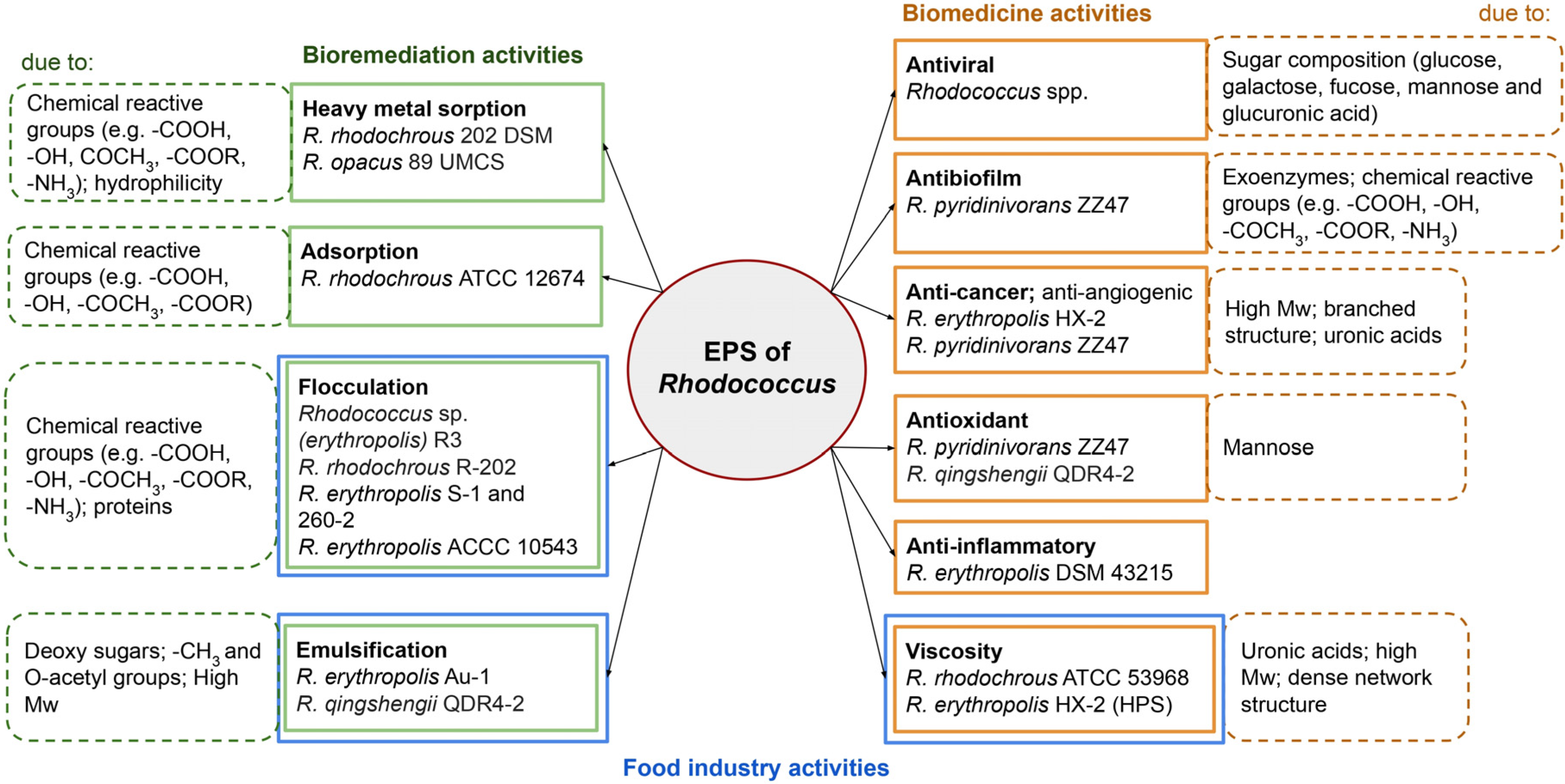
Disclaimer/Publisher’s Note: The statements, opinions and data contained in all publications are solely those of the individual author(s) and contributor(s) and not of MDPI and/or the editor(s). MDPI and/or the editor(s) disclaim responsibility for any injury to people or property resulting from any ideas, methods, instructions or products referred to in the content. |
© 2026 by the authors. Licensee MDPI, Basel, Switzerland. This article is an open access article distributed under the terms and conditions of the Creative Commons Attribution (CC BY) license.
Share and Cite
Krivoruchko, A.; Nurieva, D.; Ivshina, I. Extracellular Polymeric Substances Produced by Actinomycetes of the Genus Rhodococcus for Biomedical and Environmental Applications. Int. J. Mol. Sci. 2026, 27, 498. https://doi.org/10.3390/ijms27010498
Krivoruchko A, Nurieva D, Ivshina I. Extracellular Polymeric Substances Produced by Actinomycetes of the Genus Rhodococcus for Biomedical and Environmental Applications. International Journal of Molecular Sciences. 2026; 27(1):498. https://doi.org/10.3390/ijms27010498
Chicago/Turabian StyleKrivoruchko, Anastasiia, Daria Nurieva, and Irina Ivshina. 2026. "Extracellular Polymeric Substances Produced by Actinomycetes of the Genus Rhodococcus for Biomedical and Environmental Applications" International Journal of Molecular Sciences 27, no. 1: 498. https://doi.org/10.3390/ijms27010498
APA StyleKrivoruchko, A., Nurieva, D., & Ivshina, I. (2026). Extracellular Polymeric Substances Produced by Actinomycetes of the Genus Rhodococcus for Biomedical and Environmental Applications. International Journal of Molecular Sciences, 27(1), 498. https://doi.org/10.3390/ijms27010498