


Abstract
The genus Sambucus L. consists of about 29 recognized species (including 7 different genera that have berry fruit) distributed in all regions of the world. The most popular species are Sambucus nigra L., Sambucus cerulean Raf., and Sambucus javanica Blume, of which the European elderberry is widely used commercially. S. williamsii Hance (commonly known as Jiegumu) is endemic to China and is a valued variety of elderberry. S. nigra L. is one of the oldest medicinal plants. The herbal materials used in treatment and nutrition are its fruits, flowers, roots, leaves, and bark. Various parts of S. williamsii, including its fruit, flower, root, leaf, and stem, are also specifically used in Traditional Chinese Medicine. Additionally, berries and flowers of S. nigra L. have become a very popular inclusion in supplements, beverages, and foods in recent years. It is important that Sambucus plants are rich sources of various bioactive compounds, which determine their biological activities, such as antioxidant, antidiabetic, antimicrobial, and anti-inflammation. However, one of the most extensively studied species is S. nigra L. Among the different parts of this plant, the fruits and flowers are of particular interest due to their rich bioactive components. The aim of the present review is to provide and compare an overview of the cardioprotective potential of various parts not only of S. nigra L., but also of S. williamsii Hance, and their products in various models. Moreover, cardioprotective mechanisms of their main chemical constituents were demonstrated in this paper to provide a basis for further study and development.
1. Introduction
The genus Sambucus L. consists of about 29 recognized species (including 7 different genera that have berry fruit) distributed in all regions of the world and throughout most of the temperate and subtropical regions, for example, Europe, Asia, North America, North Africa, East and Southeast of Australia, and others. The most popular species are Sambucus nigra L. (its common names include black elder, elder, elderberry, European elderberry, European elder, and European black elderberry), Sambucus cerulean Raf. (blue elderberries), and Sambucus javanica Blume (Chinese elder), of which the European elderberry is widely used commercially. Moreover, S. nigra L. has three subspecies: S. nigra L. ssp. cerulea, S. nigra L. ssp. canadensis, and S. nigra L. nigra. It naturally occurs in most of Europe and in North Africa (Tunisia, Morocco, and Algeria) [1,2,3,4,5,6].
S. williamsii Hance (commonly known as Jiegumu) is endemic to China and is a valued variety of elderberry. It is also referred to as Jiegudan, Qianqianhuo, Xugumu, Tiesusan, and Maniasosao. In addition, Sambucus ebulus L. (dwarf elder) and Sambucus sieboldiana L. (Japanese red elder) are also often highly investigated [1,2,3,7,8,9,10].
Twelve Sambucus species have been used in ethnomedicine in various countries, including China, Iran, Turkey, Korea, and other countries. They have been applied in the treatment of herpes, chills, asthma, swelling, sinusitis, toothache, dropsy fever, headache, and others [4,11,12]. The traditional medicinal uses of Sambucus species involve various plant parts, including fruits, leaves, bark, flowers, and stems. For example, the berries and flowers have protective and therapeutic actions on diseases such as diabetes, constipation, cold, and flu. In addition, they have diuretic, catarrhal, and circulatory properties. The bark and leaves were found to have laxative, diuretic, and emetic actions. They are often applied in the treatment of diarrhea, rheumatism, cold, stomach aches, and constipation [7,13]. It is interesting that different parts of the Sambucus species have not only traditional medicinal applications, but also culinary applications. For example, their berry and flower extracts are an important component of various traditional drinks, including non-alcoholic and alcoholic beverages, tea, yoghourt, and ice cream. In addition, cakes and jams are also made from the berries of the Sambucus species. Their shoots and leaves may be used as vegetables when cooked [7,14,15,16].
S. nigra L. is one of the oldest medicinal plants. The herbal materials used in treatment and nutrition are its fruits, flowers, roots, leaves, and bark. Various parts of S. williamsii, including its fruit, flower, root, leaf, and stem, are also specifically used in Traditional Chinese Medicine. Additionally, berries and flowers of S. nigra L. have become a very popular inclusion in supplements, beverages, and foods in recent years [9,17,18]. Popular applications include syrups made from elderberry juice and tonics made by soaking the fruits in alcohol or water, freeze-dried materials, and the preparation of extracts for use in supplements. Elderberry products may also include tablets, lozenges, and gummies (as health supplements), and powdered fruits (as part of a drink mix). Moreover, they can be found as an ingredient in different food applications, including smoothies, energy drinks, kombuchas, juice, teas, and wine. Berries of S. nigra L. are also often used to make jellies and jams. Additionally, they can be used as a natural food dye in yogurt, kefir, meat products, and baked goods [17,19]. It was also shown that S. nigra L. flowers are natural flavouring components in non-alcoholic and alcoholic beverages, tea, and other food products, like ice cream and yoghurt [20]. More details about the application of S. nigra L. berries and flowers have been described in the review papers by Młynarczyk et al. [1] and Uhl and Mitechell [18]. It is interesting that S. williamsii has a taste profile characterized by a flat taste, sweetness, and bitterness [9].
Sambucus plants are rich sources of various bioactive compounds, which determine their biological activity, such as antioxidant, antidiabetic, antimicrobial, and anti-inflammation [7,21,22,23,24,25,26]. However, one of the most extensively studied species is S. nigra L. Among the different parts of this plant, the fruits and flowers are of particular interest due to their rich bioactive components [27,28].
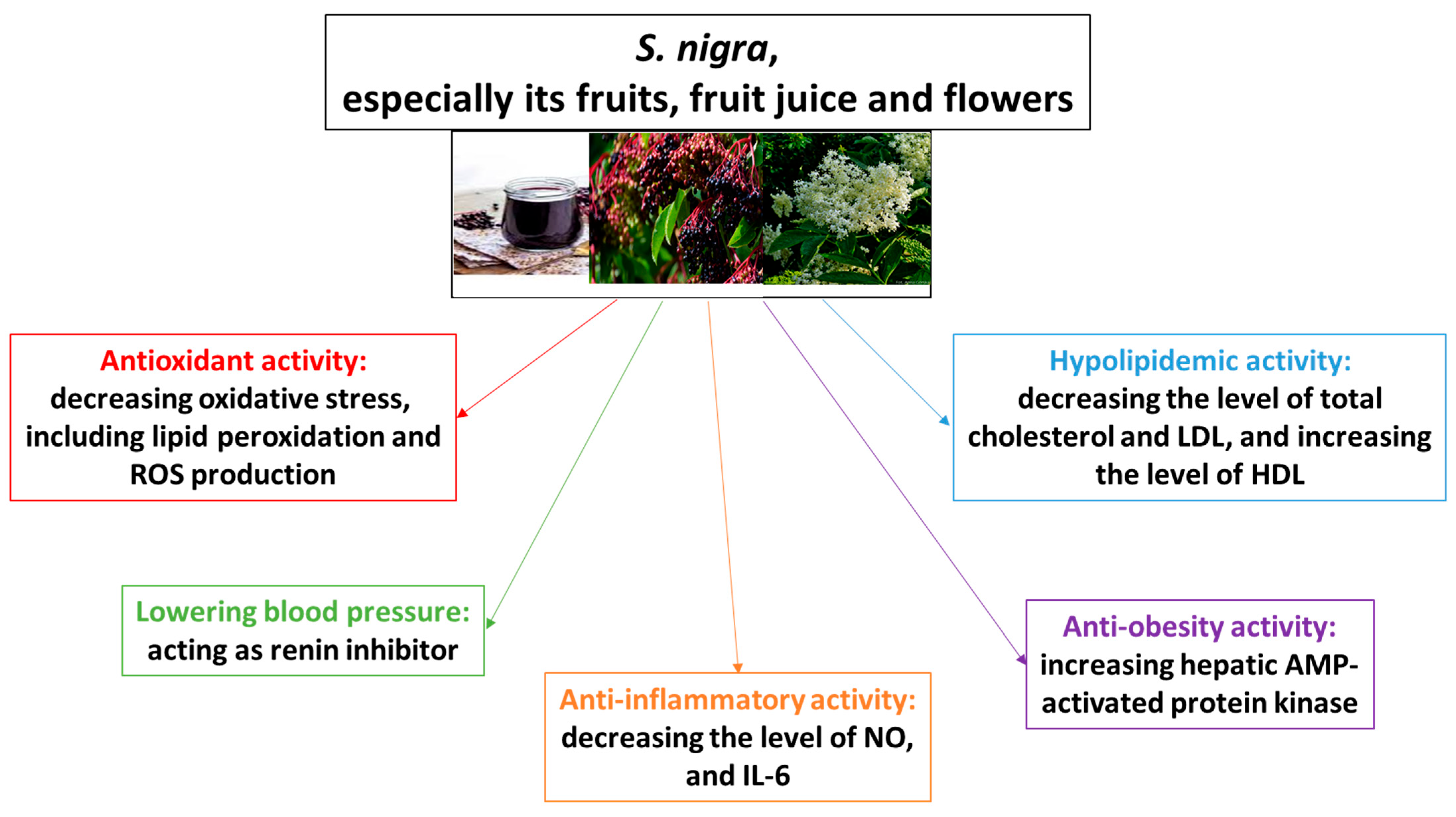
It is known that Sambucus plants are commonly appreciated for various potential pharmacological properties, such as immunostimulant, anti-cold, anti-flu, and also antiviral, antibacterial, or anticancer. Moreover, the potential anti-cold, anti-flu, and immunostimulant actions result in the popularity of Sambucus in dietary supplements; however, strong scientific evidence of their efficacy is still lacking. Therefore, for the first time, the aim of the present review is to provide and compare an overview of the cardioprotective potential of various parts not only of S. nigra L., but also of S. williamsii Hance, and their products in various models. In addition, cardioprotective mechanisms of their main chemical constituents were demonstrated in this paper to provide a basis for further study and development. Potential molecular mechanisms of cardioprotection by chemical compounds from various parts of S. nigra L. may include its antioxidant activity (measured by different markers of oxidative stress), anti-inflammatory activity (by decreasing the level of nitric oxide and interelukin-2), lowering blood pressure (acting as a renin inhibitor), hypolipidemic activity, and anti-obesity potential (by increasing hepatic AMP-activated protein kinase).
2. Research Methods
The published literature about S. nigra L., S. williamsii Hance, their products, and their main chemical compounds with cardioprotective properties was collected from various scientific databases (for example, ScienceDirect, Web of Science, SCOPUS, Web of Knowledge, PubMed, Elsevier, Google Scholar, and Sci Finder). The search terms comprised the terms “S. niger”, “S. williamsii”, and “cardioprotection” and their combinations. No time criteria were applied to the search, but recent papers were evaluated first. Papers were first selected based on their relevance to the title of the present manuscript, and the identified articles were screened by reading the abstract. Any relevant identified articles were summarized. The last search was run on 6 December 2025. About 276 articles were obtained from the searches, and only 111 were included in this review. The data extracted from each article were the following: the type of studied material (species, cultivar, solvents used for extraction, or other relevant data), methods used in the study/study design, number of replicates, the cardioprotective activity, and statistical significance. If the P values were not provided for individual data points, it was assumed that the results were significant, unless it was stated otherwise in the text.
The cardioprotective potential of various parts of S. nigra L., S. williamsii Hance, and their main chemical compounds in various in vitro and in vivo models was summarized, and current studies are discussed. Moreover, the collected data also provided insights into the potential use of Sambucus preparations, especially S. nigra fruits and flowers, in functional foods and supplements with promising cardioprotective potential.
3. Phytochemical Characteristic of Various Parts of S. nigra and S. williamsii
3.1. S. nigra
Various parts of S. nigra are a source of different chemical compounds, but their chemical composition depends on many factors, including environmental conditions, variety, processing method, and storage conditions. For example, the flowering period is important for flowers, and the degree of ripeness is important for fruits. The diversity in the chemical composition of different parts of S. nigra applies in particular to phenolic compounds, including flavonols and anthocyanins, and vitamins, especially vitamin C [29]. For example, 1 cup (145 g) of S. niger fruits is considered an excellent source (containing > 20% US Daily Value) not only of vitamin C (40%), but also dietary fiber (25%) [18].
3.1.1. Fruits
The fruits of S. nigra ripen at the turn of August and September, and their harvest is carried out in September and October. The colour of the fruit depends on the stage of its ripeness: at the beginning, the fruit is green, and when fully ripe, it is black and shiny [29].
The fruits of S. nigra contain about 80% water. The protein content of fresh fruit is approx. 2.8 g/100 g. This protein includes sixteen amino acids, nine of which are essential. Alanine, aspartic acid, and glutamic acid were identified as the dominant amino acids [1,2,3,29]. The fruit also contains about 18 g of sugars (including about 7.4 g of dietary fiber, especially pectin, protopectin, Ca-pectase, cellulose, pectin acid, and hemocellulose). The composition of sugars also includes simple sugars (especially glucose and fructose: 6.8–11.5 g of total sugars) [1,2,3,29]. Results of Veberic et al. [30] indicate that the content of total sugar ranged from 68.5 to 104.1 g/kg, depending on the selection and the cultivar. Authors also identified small amounts of sucrose (0.5–1.7 g/kg FW).
Fats are especially accumulated in the seeds of S. niger fruits (fat content—22.4%) and seed flour (fat content—16.0%). The major fatty acids are polyunsaturated fatty acids (75.1% of total fatty acids in seeds and 21.5% of total fatty acids in seed flour). For example, oleic acid (36.6 mg/kg fruits), linoleic acid (106 mg/kg fruits), and α-linolenic acid (61 mg/kg fruits) are present in the highest concentrations in seeds [1,2,3,20,29,31].
Organic acids constitute 1.0–1.3% of the fruit content, and citric acid was the most abundant. S. nigra fruits also include essential oils (about 0.01%), among about 53 chemical compounds, phenyl aldehydes (3.0–25.8% of the oil composition), and furfural (18%) predominate [1,2,3,29,30,31,32,33]. Moreover, lectins (about 0.1%) have been identified in S. nigra fruits. The mineral content (including Na, Ca, K, P, Fe, Mg, Mn, Zn, and Cu) represents 0.9–1.5% of the fruit mass. Moreover, S. niger fruits contain heavy metals such as cadmium and lead. Vitamin C content (6.0–132.1 mg/100 g) depends on the cultivar and the location. In addition, seed flour is a source of α-tocopherol. Other vitamins present in S. nigra fruits are vitamin B2, vitamin B6, folic acid, and biotin [1,2,3,20,29,34,35].
Interestingly, S. nigra fruits are an important source of phenolic compounds. In addition, their content in these fruits (364–1336 mg/100 g of fruit) is relatively high in comparison to other fruits. For example, the concentration of phenolic compounds in blackberries is about 248 mg/100 g of fruit, and in blueberries is about 525 mg/100 g of fruit [1,2,3,36,37,38,39]. The main group of phenolic compounds is anthocyanins (87.8–1816 mg/100 g of fruit), including cyanidin-3-glycoside, cyanidin-3-sambubioside, and cyanidin3-diglycoside [38]. The content of anthocyanins often increases as fruits ripen. Moreover, their content is dependent on the growing season [1,2,3,32,36]. Sources of anthocyanins are also various food products from S. nigra fruits, including juices, jams, and wines. For example, juices contain about 200 mg of anthocyanins/100 mL, while juice concentrate, about 411 mg/100 mL, and the predominant anthocyanin is cyanidin-3-sambubioside. Cyanidin-3-glucoside was identified as the most abundant anthocyanin in S. nigra fruit wine [1,2,3,40,41]. However, of the literature published on the analysis of anthocyanins using conventional methods, including HPLC, only 2% was published on S. nigra fruits [42].
Recently, results of Terzic et al. [42] have demonstrated that the contents of other phenolic compounds in S. nigra fruit wine (per mL) are also high (for example, 43.3 µg of quercetin, 17.7 µg of chlorogenic acid, and 52.5 µg of protocatechuic acid). Moreover, S. nigra fruit pomace is also very rich in anthocyanins, and it contains 75–98% of total anthocyanidins found in fresh fruits [1,2,3]. On the other hand, anthocyanidins are sensitive to different environmental factors, including light, temperature, pH, and others [43,44].
Various other phenolic compounds, including phenolic acids and flavonoids, were also identified in S. nigra fruits. Among phenolic acids, chlorogenic acid (10–32 mg/100 g of fruit) is an important acid. Other important phenolic acids are gentisic acid (2.2 µg/100 g of dry weight) and gallic acid (3.4 µg/100 g of dry weight). However, among flavonoids (approx. 186 mg/100 g of fruit), particular attention should be paid to quercetin (228.8 µg/100 g of dry weight) and rutin (813.1 µg/100 g of dry weight) [1,2,3,29,34]. It is worth noting that the content of anthocyanins and other phenolic compounds in various food products from S. nigra fruits depends on the technological conditions used or the degree of processing [1,2,3,29]. For example, various cooking methods, including baking, boiling, and steaming, could lead to a reduction in their content, and the recipe without thermal treatment could maximally preserve anthocyanin content [34,45]. Moreover, different processing techniques can also affect the stability of these bioactive compounds in S. nigra fruits [46,47].
In addition, Kaack et al. [32] observed that S. nigra fruit juices (processed using enzymatic treatment) have a lower average content of phenolic compounds compared to the juices produced without enzymatic treatment. Alcoholic fermentation of S. nigra fruits also causes changes in the content of various phenolic compounds. Results of Młynarczyk and Walkowiak-Tomczak [2] indicate that the hot-pressed S. nigra fruit juices have higher total content of bioactive compounds, including phenolic compounds (for example, anthocyanins), than the cold-pressed juices. In another paper, Młynarczyk and Walkowiak-Tomczak [3] evaluated the bioactive properties of selected commercial S. nigra products made from fruits and flowers (syrups, juices, jam, confiture, and mousse). The evaluation was based on measurements of antioxidant properties, total phenolic compounds, as well as anthocyanin content and profile. For example, the highest values of these parameters were shown by one of five juices, which was pressed from organic fruits.
More details about the chemical composition of the three subspecies of S. nigra fruits (S. nigra ssp. nigra, S. nigra ssp. canadensis, and S. nigra ssp. cerulea) are described in the review paper of Uhl and Mitchell [18]. For example, S. nigra ssp. canadensis fruits have a similar composition of phenolic compounds, but a lower concentration of anthocyanidins as compared with S. nigra ssp. nigra. In addition, a few unique phenolic compounds, including protocatechuic acid dihexoside (14.4–57.0 g/100 g FW) and 5-hydroxypyrogalloll (24.5 ± 22.4 g/100 g FW), have been identified only in S. nigra ssp. cerulea [18]. However, there are currently only a few or no available data on the macronutrient and micronutrient content of S. nigra ssp. canadensis and S. nigra ssp. cerulea [18].
Recently, Onolbaatar et al. [48] have compared the phytosterol and triterpenoid profiles of fruits and fruit-derived products of selected Sambucus plants, including S. nigra and S. racemose. They observed that elderberry fruits are rich sources of phytosterols, especially sitosterol (which represented up to 88% in red elder S. racemose), and triterpenoids (13.81 mg/g in S. nigra f. porphyrophylla cultivar Black Lace “Eva”). The phytochemical analysis showed that ursolic acid and oleanolic acids are the main triterpenoids in the extract from S. nigra fruits [48,49]. Among various fruit-derived products (jam, juice, syrup, and wine), jams had the highest concentration of phytosterols and triterpenoids (a total of 340 µg/g) [48].
3.1.2. Flowers
The literature data indicate that 100 g of S. niger flowers contains about 2–2.5% protein, various vitamins (vitamins B, vitamin A, and vitamin C (80–90 mg/100 g)), or minerals. They are also a source of various phenolic compounds, including phenolic acids (e.g., chlorogenic acid accounts for about 35% of all phenolic compounds), and flavonoids, such as quercetin (10% of all phenolic compounds), kaempferol, rutin, isoquercitrin, or astragaline. Other groups of phenolic compounds are flavanones, including naringenin, and flavanols, such as epicatechin, catechin, and procyanidin trimer [50,51]. In addition, fresh flowers are a source of triterpenes (oleanoic acid, ursolic acid, and α- and β-amarin) and phytosterols (β-sitosterol, stigmasterol, and campesterol). S. nigra flowers also include essential oils (about 58 compounds) [1,2,3,29]. However, the content of compounds in S. nigra flowers depends on storage conditions, soil conditions, climate, or the method of transporting the raw material for processing [1,2,3,8,29].
3.1.3. Leaves
Chemical analysis has found 100 g S. nigra leaves contain 3 g proteins, 200–3000 mg vitamin C, tannins, alkaloids, organic acids, aldehydes, or sluices [29]. The protein concentration is higher in the leaves than in the flowers [8].
3.1.4. Bark
It is important to note that the inedible part of S. nigra, its bark, is also abundant in biologically active compounds. However, the chemical composition of the bark is not fully understood, but it contains a certain amount of tannins. In addition, it contains glycosides, alkaloids, choline, saponins, essential oils, and sitosterols, including β-sitosterol [8,29].
3.2. S. williamsii
About 238 chemical compounds, including sugars, phenolic compounds, alkaloids, terpenoids, and other components, have been identified in various parts of S. williamsii, such as its fruits, leaves, stems, bark, and root. For example, aldehydes are the predominant constituents of S. williamsii oil. Moreover, 14 trace elements (Ca, K, Zn, Ba, Fe, Al, V, Cr, Ti, Cu, Sr, Mn, P, and Ni) and 17 amino acids (for example, serine, threonine, glycine, cysteine, alanine, valine, leucine, and others) also have been isolated from S. williamsii fruits, which contribute to the nutritional characteristics of its fruits [52,53]. In addition, various phenolic compounds have been identified in S. williamsii fruits. Stems and branches also are a source of phenolic compounds, for example, vanillin, acetovanillone, 4-hydroxy-benzoic acid, protocatechuic acid, and others [54]. Moreover, 34 terpenoids (sequiterpenoids, iridoid glycosides, and triterpenoids) have been identified in these parts of S. williamsii [55]. More details about the phytochemistry of S. williamsii are described by Lei et al. [9].
Main chemical compounds with cardioprotective potential of various parts of S. nigra and S. williamsii are demonstrated in Table 1.
Table 1.
Main chemical compounds with cardioprotecive potential of various parts of S. nigra and S. williamsii.
4. Cardioprotective Potential of Various Parts of S. nigra, S. williamsii, and Their Products (In Vitro and In Vivo Models)
Reviewing the literature indicates that various plant food products, like tea, cocoa, coffee, and others, exhibit cardiovascular protective action using many mechanisms of action [56,57,58,59]. Different health benefits associated with the consumption of berries are also demonstrated in epidemiological effects on CVDs. For example, various berries (such as sea buckthorn berries (Hippophae rhamnoides), aronia berries (Aronia melanocarpa), goji berry (Lycium barbarum), and others in forms of fresh berries, wine, juice, teas, and supplements) may play an important role in modulating hemostasis, including blood platelet functions [60,61]. However, the cardioprotective potential of berries is dependent on a range of factors, such as the type of berries, the form of consumption, and their bioactive composition, especially phenolic compounds: anthocyanidins, procyanidins, flavonols, and phenolic acids [62]. For example, these phenolic compounds may modulate blood platelet function by modifying the expression of blood platelet receptors and changing the activity of signaling enzymes. They also change the level of ROS [38]. More details about the implications of berries for human health are described in a few review papers [28,38,60,61].
Studies also indicate that S. nigra and S. williamsii have a protective action on the cardiovascular system in in vitro and in vivo models. For example, all parts of S. nigra, flowers, fruits, leaves, bark, and its food products, contain numerous bioactive compounds, mainly with antioxidant activities, which may determine its health-promoting properties, including cardioprotection action. For example, anthocyanins reduced risk factors for cardiovascular diseases (CVDs), including obesity associated with CVDs [38,63,64]. In addition, anthocyanin mixtures found in food, such as S. nigra fruits, had higher clinical efficacy than single anthocyanins [38].
4.1. S. nigra
Oxidative stress has been implicated in the pathogenesis of various cardiovascular diseases, including ischemic heart disease, hypertension, and others [22,65,66,67,68]. On the other hand, different plant preparations, including food products and supplements, have antioxidant potential. Studies based on various techniques, such as the 2,2-diphenyl-1-picrylhydrazyl (DPPH) radical scavenging method, the oxygen radical absorbance capacity (ORAC), and others, found that various parts of S. nigra and S. williamsii have antioxidant properties and that the key antioxidants are phenolic compounds that can help to reduce oxidative stress. For example, several in vitro studies indicate the antioxidant capacity of S. nigra extracts, especially extracts from fruits, based on DPPH and ORAC [69,70]. Młynarczyk et al. [1] also observed that S. nigra fruits are characterized by high antioxidant properties, which range from 82.1 to 89.2% of inhibition in relation to the DPPH radical. On the other hand, Duymus et al. [70] noted that the extract from S. nigra fruits has lower antiradical activity (towards DPPH) than ascorbic acid used as a standard. The IC50 value was 123 µg/mL for water extract, while it was 8 µg/mL for ascorbic acid. The results obtained by Espin et al. [71] demonstrated that commercial concentrates of S. nigra fruits have lower radical scavenger capacity towards DPPH compared to other tested sources of anthocyanins (for example, extracts from strawberries or blackthorn fruits).
Młynarczyk and Walkowiak-Tomczak [2] studied the antioxidant properties (using the ABTS (2,2′-azino-bis(3-ethylbenzothiazoline-6-sulfonic acid) radical) of S. nigra juices according to the fruit origin and cultivar, as well as various conditions of juices processing and preservation (with or without pasteurization). Juices were made from wild S. nigra fruits and from “Samyl”, “Haschberg”, and “Sampo” cultivars grown at plantations. Four variants of juice were prepared: cold-pressed, hot-pressed, pasteurized, and unpasteurized. The authors observed that the hot-pressed juices have higher antioxidant properties than cold-pressed juices.
It is interesting that S. nigra flowers often have higher antioxidant properties than other parts of this plant, such as leaves and fruits. For example, Kołodziej and Drożdżal [72] compared antioxidant properties of aqueous extracts of S. niger flowers and fruits harvested in 17 wild sites in Poland, and the effect of total phenolic compound content on antioxidant properties of the raw material was studied. They observed that S. nigra flowers contained a higher number of phenolic compounds than the fruits harvested in the same wild sites of their occurrence, and their content significantly depended on the wild site where they were harvested. In addition, the results proved a positive correlation between the content of phenolic compounds and the antioxidant properties of S. nigra raw material. Moreover, authors observed that S. nigra flowers have stronger DPPH radical inhibition activity (91.9–94.1%) in comparison to leaves (16.8–48.5%) and fruits (50.2–67.7%). In addition, according to Stoilova et al. [73], S. nigra flowers extract possesses greater radical scavenging properties in comparison to rutin.
The literature data indicate that S. nigra extract (15 mg/kg of bw) attenuates oxidative stress and inflammation in femoral ischemia [74], which is a major cause of cardiovascular diseases, with an increased rate of morbidity and mortality, pathogenetically characterized by redox imbalance, inflammation, and tissue damage. The authors investigated the effects of S. nigra fruit extract on the gastrocnemius muscle lesions induced by the experimental femoral ischemia. For example, the tested extract demonstrated beneficial antioxidant effects, decreasing the lipid peroxidation (measured by the level of malondialdehyde (MDA)) in muscle homogenates. This extract also showed anti-inflammatory effects through reducing interleukin-6 (IL-6).
Waldebauer et al. [75] observed that the extract of the lyophilized pomace of S. nigra fruits (50 µg/mL) has a cardiovascular action through increasing A23187-stimulated endothelial nitric oxide synthase (eNOS) activity in human endothelium-derived cell line EA.hy926. Moreover, authors noted that the major effective chemical compounds of the tested extract were di- and trihydroxylated triterpenic acids.
It was also found that salicylic acid (aspirin) is present in S. nigra fruits. This compound has long been used as an anti-inflammatory and antiplatelet agent. However, the use of salicylic acid for the prevention of CVDs is limited because its use increases the bleeding risk [10].
In addition, various preparations from S. nigra fruits also exhibited cardioprotective potential in in vivo animal models. For example, Dubey et al. [76] found that supplementation with anthocyanin-rich S. nigra extract reverses lipid peroxidation observed with dietary fish oil alone in BioF1B hamsters. Both liver and plasma thiobarbituric acid reactive substances (TBARSs) showed significant reductions upon supplementation with S. nigra extract in fish oil-fed BioF1B hamsters. Their findings also demonstrated that supplementation with S. nigra extract reverses hyperlipidemia.
The study of Ciocoiu et al. [77] investigated the effects of the association between the renin inhibitor and the polyphenolic extract from S. nigra fruits (a dosage of 0.046 g/kg body weight, every 2 days, for 8 weeks) on biochemical parameters and systolic and diastolic blood pressure within a Nω-nitro-L-arginine methyl ester (L-NAME)-induced experimental model of arterial hypertension in the Wistar white rats. They found that the total antioxidant capacity levels were significantly decreased in the group with arterial hypertension as compared to the control rats. A combination of a renin inhibitor (Aliskiren) and a tested fruit extract generated a superior antioxidant effect compared to administering the two separately. In addition, both systolic and diastolic pressure in rats with drug-induced hypertension were reduced by S. nigra extract.
The objective of the study of Farrell et al. [78] was to determine whether an anthocyanin-rich S. nigra fruit extract (13% anthocyanins) would protect against inflammation-related impairments in high-density lipoprotein (HDL) function and atherosclerosis in apoE(−/−) mice (a mouse model of hyperlipidemia and HDL dysfunction). The 10-week-old male apoE(−/−) mice were supplemented with 1.25% (w/w) S. nigra extract or a control diet for 6 weeks. After 6 weeks, serum lipids did not differ significantly between groups, while aspartate transaminase and fasting glucose were reduced in mice treated with plant extract. Moreover, hepatic and intestinal mRNA changes with tested extract-feeding were consistent with an improvement in HDL function (Apoa1, Pon1, Saa1, Lcat, Clu) and a reduction in hepatic cholesterol levels. In tested extract-fed mice, serum paraoxonase-1 (PON1) activity was significantly higher. Authors also observed significant reductions in total cholesterol content of the aorta of BEE-fed mice, indicating less atherosclerosis progression.
In another in vivo model, Millar et al. [79] studied the long-term consumption of S. nigra fruit extract on HDL function and atherosclerosis in apolipoprotein (apo) E(−/−) mice. ApoE(−/−) mice (n = 12) were fed a low-fat diet and supplemented with 0, 0.25%, or 1% (by weight) S. nigra fruit extract (about 37.5–150 mg anthocyanins per kg body weight) for 24 weeks. Authors noted that chronic supplementation with the tested fruit extract in apoE(−/−) mice dose-dependently improved HDL function.
Mauray et al. [80] investigated the impact of S. nigra fruit anthocyanin-rich extract (0.02%, for 2 weeks) supplementation on gene expression in the liver of apo E(−/−) mice, the widely used model of atherosclerosis. Their results indicate that a 2-week supplementation significantly reduced plasma total cholesterol and hepatic triglyceride levels, whereas the plasma antioxidant status remained unchanged. Moreover, transcriptional analysis, using microarrays, revealed that the expression of 2289 genes was significantly altered. The tested plant extract over-expressed genes involved in bile acid synthesis and cholesterol uptake into the liver and down-regulated the expression of pro-inflammatory genes.
Only a few clinical trials have been conducted on anthocyanins extracted from S. nigra fruits and have demonstrated positive action on CVDs. For example, Curtis et al. [81] determined the effect of chronic consumption of S. nigra fruit anthocyanins on the biomarkers of CVD risk. In this experiment, 26 healthy postmenopausal women were administered 500 g/day of anthocyanins for 12 weeks. Their results showed that the chronic intake of anthocyanins from S. nigra fruits is safe, but does not affect the biomarkers of CVD risk.
Another randomized study indicates that the administration of low doses of lyophilized S. nigra fruit juice (50 mL/day, for one week) has a limited effect on lowering serum lipids, cholesterol, and triglyceride levels in 34 healthy volunteers [82].
Nillson et al. [83] evaluated effects on cardiometabolic risk markers (including, blood pressure, blood concentration of lipids, inflammatory markers, and markers of oxidative stress) of 5 weeks intervention with a mixture of berries (150 g blueberries, 50 g blackcurrant, 50 g elderberry, 50 g lingonberries, 50 g strawberry, and 100 g tomatoes, daily), in healthy humans (n = 40). The daily amounts of total phenolic compounds and fiber from the berry beverage were 795 mg and 11 g, respectively. Authors observed that the berry supplementation reduces total- and low-density lipoprotein (LDL) cholesterol compared to the control beverage (water-based).
Recently, results of Alqudah et al. [84] found that dietary S. nigra fruits extract abrogates the effects of an obesogenic diet in a gut microbiota-dependent manner by preventing insulin resistance and reducing hepatic steatosis in mice. In addition, authors suggest that hydrocinnamic acid (as a key microbial metabolite, enriched in the portal vein plasma of S. nigra fruit-supplemented animals) potently activates hepatic AMP-activated protein kinase α, explaining its role in improved liver lipid homeostasis.
Figure 1 demonstrates that S. nigra exhibits protection on the cardiovascular system and CVDs through various mechanisms, including suppression of oxidative stress, regulation of lipid metabolism and inflammation, action as renin inhibitors, and others.
Figure 1.
Potential molecular mechanisms of cardioprotection by various parts of S. nigra and its products.
4.2. S. williamsii
Only a few papers indicate that preparations from various parts of S. williamsii have a positive action on risk factors of CVDs. For example, Su et al. [85] analyzed the antioxidant properties of flavonoids in four polar extracts of S. williamsii leaves (water, ethyl acetate, n-butanol, and chloroform), but the ethyl acetate extract has the highest scavenging activity. Fang et al. [86] also reported that the 70% ethanol extract of S. williamsii fruits has free radical scavenging capacity in vitro.
In addition, Liu [34] extracted and purified bioactive components from various parts of S. williamsii. The antioxidant and anti-inflammatory properties were also studied in vitro. S. williamsii lignans exhibited superior anti-inflammatory activity, and S. williamsii anthocyanins had the highest antioxidant potential.
Xiao et al. [52] suggested that various phenolic acids, including vanillic acid and ferulic acid isolated from the stem and root bark of S. williamsii, possess therapeutic effects against CVDs. According to Xiao et al. [52], terpenoids isolated from S. williamsii have also cardioprotective potential.
Recently, Sun et al. [87] observed that saponins presented in S. williamsii leaves reduce oxidative damage in mice.
Results of Lv et al. [88] indicate that linoleic acid from S. williamsii seed oil (1–4 g/kg bw) has hypolipidemic properties. This activity of linoleic acid was investigated in vivo using hyperlipidemia mice models fed with the linoleic acid at doses of 1, 2, and 4 g/kg bw. The authors observed that serum lipid levels were highly significantly improved. In addition, the DPPH free radical scavenging assay was used to determine its antioxidant activity of linoleic acid. IC50 of DPPH radical scavenging activity of linoleic acid was 61.92 mg/mL. In this experiment, linoleic acid was extracted by a high-pressure fluid.
Xiao et al. [51,52] investigated how the lignan-rich fraction from S. williamsii modulates lipid metabolism in menopausal women. Their results demonstrated that oral administration of this fraction (140 mg/kg and 280 mg/kg) for 10 weeks alleviates dyslipidemia and improves liver functions.
There is also one article about the cardioprotective potential of S. ebulus ripe fruits [89]. In this paper, the authors established the effect of S. ebulus L. fruit consumption on body weight, blood pressure, lipid profile, and antioxidant markers in healthy volunteers (n = 21). Participants consumed 200 mL of S. ebulus fruit infusion/day for a period of 30 days. The authors observed a significant decrease in triglycerides, total cholesterol, and LDL. Moreover, the HDL/LDL ratio increased by about 43%. Improved serum antioxidant capacity and total thiol levels were also noted.
5. Toxic Action and the Bioavailability of Bioactive Compounds
It is important that all parts of S. nigra, especially its older parts, can be toxic, for example, when ingested as fruits in high amounts due to the accumulation of cyanogenic glycosides. For example, sumbunigrin, holocalin, prusasin, and zierin metabolites have been isolated from S. nigra fruits [90] and flowers [91]. The highest amounts of sambunigrin (27.7–209.6 µg/g FW) are present in elder leaves compared to other parts of this plant [92]. Cyanogenic glycosides are toxic and life-threatening because they can be hydrolyzed, resulting in the release of cyanide. On the other hand, they are degraded during heat treatment. For example, the concentration of sambunigrin was reduced from 18.8 mg/kg in unprocessed fruits to 10.6 mg/kg in juice, 2.8 mg/kg in tea, and 0.8 mg/kg in liqueur [93].
Other toxic compounds present in various parts of S. nigra are lectins (in fruit—nigrin f; in bark—nigrin b-SNA V, SNA I; and seeds (nigrin s)) [58]. In addition, S. nigra contains the allergen Sam n1 [94].
However, based on various data, it is believed that the fruits of S. nigra can be safely consumed when ripe, dried, or cooked [95]. Moreover, the results of the safety of S. nigra fruits and flowers demonstrated no toxic action or side effects on the human body. S. nigra fruits and flowers are recognized by the US Food and Drug Administration (FDA) as a safe food additive, which is indicated by the GRAS (Generally Recognized As Safe) status. On the other hand, the European Medicines Agency (EMA) points to the safety of their use, but recommends limiting their use by children under 12 years of age and women during pregnancy and lactation [95,96]. It is also important to separate the seeds from the pulp when preparing S. nigra fruit products. This is because the ingested seeds contain ingredients that react with enzymes contained in the stomach, which secretes hydrocyanic acid [95,96].
Moreover, flowers of S. nigra L. have been approved by the Commission E of the General Federal Institute for Drugs and Medical Devices to treat flu and cold. For example, various products (especially as supplements, including OptiBerry IH141, Sinupret®, Sambucol®, Tretussin®, Sambuca-Well®, and others) containing not only S. nigra flowers, but also fruits have gained considerable popularity in Europe and North America. Recently, Festa et al. [97] have noted that elderberries may be a potential supplement to improve vascular function in a SARS-CoV-2 environment.
In the food industry, flowers are mainly used in dried form, mainly for the production of herbal teas. They are also often used to make alcoholic liquors [1,2,3,18,29,34,98,99].
Recently, Ferreira-Santos et al. [99] studied the effect of gastrointestinal digestion on the toxicity of extracts from S. nigra fruits and flowers. The digested and non-digested extracts had different effects on various cell lines. For example, the IC50 values were highest for normal cell lines (L929), indicating low toxicity, while lower values were noted for cancer cell lines (HT29 and HeLa).
Metabolism of phenolic compounds, especially anthocyanins, after oral administration of various S. nigra berry products, including juice, is often investigated. However, anthocyanins demonstrate low bioavailability compared with other phenolic compounds [100,101,102]: the peak plasma concentration is reached 6 h after consumption, and these concentrations remain in the micromolar range. For example, Netzel et al. [102] observed that S. niger fruit juice (400 mL, containing 722 mg of total anthocyanins) causes the urinary excretion of about 113 µg/h of these compounds in healthy people. In this study, in eight healthy subjects receiving a single oral dose of this juice, the pharmacokinetic parameters were obtained from 7 h urine excretion.
Anthocyanins are metabolized by conjugation in the intestinal and hepatic [102,103,104,105,106]. Most significantly, toxicological studies support the view that anthocyanins pose no threat to human health [107], and they are safe for consumption, even at higher doses [108]. Moreover, anthocyanins are able to cross the blood-brain barrier [108].
On the other hand, no research is available comparing the bioavailability of bioactive compounds in various S. niger food products, especially tablets, liquid preparations, and gummy, or products based on elderflowers. In addition, the bioavailability of bioactive compounds from S. nigra differs based on the delivery mechanism. Moreover, S. nigra preparations may be more inherently stable than others. For example, ascorbic acid is not stable in gummy preparations [18].
Only a few studies have assessed the toxicity of different parts of S. williamsii. For example, Zhang et al. [109,110] demonstrated that the toxicity rates of S. williamsii leaves and stems are 10%, 30%, and 89%, when S. williamsii content in the diet reaches 10%, 15%, and 20%, respectively. In this experiment, the toxicity was studied in mice. Recently, results of Zhang et al. [110] have indicated that S. williamsii seed oil is cytotoxic when the mass concentration of its volatile components exceeds 0.1 g/L. Unfortunately, as there is not yet any clinical evidence for the safety of S. williamsii, further research is needed to confirm this. In addition, toxicology studies on various parts of S. williamsii can offer valuable insights for its edible and medicinal uses, especially in humans.
There are also only a few papers about the pharmacokinetics of S. williamsii. For example, the result of Weng [111] demonstrated that morroniside in S. williamsii is rapidly absorbed and eliminated in rats, resulting in low bioavailability.
6. Concussions
Even though various studies on S. nigra and S. williamsii have long concentrated on their bioactive compounds and biological properties, there are still numerous gaps in understanding their cardioprotective action, and pharmacological trials for the discovery of new supplements and medicines as a promising strategy for preventing cardiovascular diseases and promoting their optimal cardioprotective function. For example, especially flowers and fruits of S. nigra or its food products, including fruit juices, contain numerous bioactive compounds, mainly with antioxidant activities, which may determine its health-promoting properties, including cardioprotection action, making them a very valuable pharmaceutical raw material, especially for the production of supplements and functional foods. In addition, the available literature also indicates that these compounds have anti-inflammatory and anti-obesity properties. However, it is not correct to prove the beneficial effects of various parts of S. nigra on the prevention and treatment of CVDs in humans, especially in studies with a large sample size. Therefore, there is a need for more comprehensive evidence-based clinical studies and data.
In particular, S. nigra phenolic compounds play an important role in cardioprotective mechanisms. However, other bioactive compounds, such as fiber, unsaturated fatty acids, phytosterols, and others, may also play a positive role in the prophylaxis and treatment of CVDs. While it is significant that these bioactive components exist, their mutual interaction is largely unknown. Again, this matter needs further experiments.
In addition, not only S. nigra, but also S. williamsii food products with cardioprotective potential should be studied further. Such studies should also examine this potential for the long term. The reports on the underlying cardioprotective mechanisms of action and the bio-constituents of S. nigra and S. williamsii associated with this activity are also limited. Moreover, there are no clinical experiments for the interactions of S. nigra and S. williamsii preparations with different drugs and supplements used in the prophylaxis and treatment of CVDs. Despite this, for the first time, this review paper indicates that especially S. nigra fruits, flowers, and its fruit juice may be new good candidates as functional foods with cardioprotective properties. S. nigra fruits, flowers, and fruit juice may be good candidates for functional foods with cardioprotective properties. However, well-established long-term clinical trials in this context should be a hot topic in the future. In addition, clinical validation and addressing toxicity concerns would provide a more comprehensive perspective on their potential use.
Funding
This research received no external funding.
Data Availability Statement
No new data were created or analyzed in this study. Data sharing is not applicable to this article.
Conflicts of Interest
The author declares no conflicts of interest.
Abbreviations
ABTS, 2,2′-azino-bis(3-ethylbenzothiazoline-6-sulfonic acid; CVDs, cardiovascular diseases; DPPH, 2,2-diphenyl-1-picrylhydrazyl; EMA, European Medical Agency; eNOS, endothelial nitric oxide synthase; FDA, Food and Drug Administration; GRAS, Generally Recognized As Safe; HDL, high-density lipoprotein; iNOS, inducible nitric oxide synthase; IL-6, interleukin-6; L-NAME, Nω-nitro-L-arginine methyl ester; LDL, low-density lipoprotein; MAPK, mitogen-activated protein kinase; MDA, malondialdehyde; NO, nitric oxide; ORAC, oxygen radical absorbance capacity; PON1, paraoxonase-1; ROS, reactive oxygen species; TBARS, thiobarbituric acid reactive substances.
References
- Młynarczyk, K.; Walkowiak-Tomczak, D.; Łysiak, G.P. Bioactive properties of Sambucus nigra L. as a functional ingredient for food and pharmaceutical industry. J. Funct. Foods 2018, 40, 377–390. [Google Scholar] [CrossRef] [Scilit]
- Młynarczyk, K.; Walkowiak-Tomczak, D. The effect of technological treatments and origin of raw material on the anti-oxidative activity and physicochemical properties of elderberry juice. Nauka Przyr. Technol. 2017, 11, 385–395. [Google Scholar]
- Młynarczyk, K.; Walkowiak-Tomczak, D. Evaluation of bioactive properties of selected elderberry products. Przem. Spoz. 2018, 8, 70–73. [Google Scholar]
- Amini, E.; Nasrollahi, F.; Sattarian, A.; Isazadeh-Araei, M.; Habibi, M. Systematic and molecular biological study of Sambucus L. (Caprifoliaceae) in Iran. Thaiszia J. Bot. 2019, 29, 133–150. [Google Scholar] [CrossRef] [Scilit]
- Fu, F.; Xu, M.; Li, W. Antiviral phytomedicine elderberry (Sambucus) will be Inhibition of 2019-nCoV. Authorea Prepr. 2020. [Google Scholar] [CrossRef] [Scilit]
- Silalahi, M.; Wakhidah, A.Z. Sambucus javanica reinw. Ex Blume Viburnaceae. In Ethnobotany of the Mountain Regions of Southeast Asia; Springer: Berlin/Heidelberg, Germany, 2021; pp. 40–41. [Google Scholar]
- Waswa, E.N.; Li, J.; Mkala, E.M.; Wanga, V.O.; Mutinda, E.S.; Nanjala, C.; Odago, W.O.; Katumo, D.M.; Gichua, M.K.; Gituru, R.W.; et al. Ethnobotany, phytochemistry, pharmacology, and toxicology of the genus Sambucus L. (Viburnaceae). J. Ethnopharmacol. 2022, 292, 115102. [Google Scholar] [CrossRef] [Scilit]
- Sala, G.; Pasta, S.; Maggio, A.; La Mantia, T. Sambucus nigra L. (fam. Viburnaceaea) in Sicily: Distribution, ecology, traditional use and therapeutic properties. Plants 2023, 12, 3457. [Google Scholar] [CrossRef] [Scilit]
- Lei, X.; Zhang, Y.; Wei, X.; Tang, Y.; Qu, Q.; Zhao, X.; Zhang, X.; Duan, X.; Song, X. Sambucus williamsii Hance: A comprehensive review of traditional uses, processing specifications, botany, phytochemistry, pharmacology, toxicology, and pharmacokinetics. J. Ethnopharm. 2024, 326, 117940. [Google Scholar] [CrossRef] [Scilit] [PubMed]
- Ren, Y.; Meyer, G.; Anderson, A.T.; Lauber, K.M.; Gallucci, J.C.; Gao, G.; Kinghorn, A.D. Development of potential therapeutic agents from black elderberries (the fruits of Sambucus nigra L.). Molecules 2024, 29, 2917. [Google Scholar] [CrossRef] [Scilit]
- Mans, D. The use of medicinal plants in Suriname. In Social Aspects of Health, Medicine and Disease in the Colonial and Post-Colonial Area; Routledge: London, UK, 2020; pp. 129–155. [Google Scholar]
- Tiboc Schnell, C.N.; Filip, G.A.; Decea, N.; Moldovan, R.; Opris, R.; Man, S.C.; Moldovan, B.; David, L.; Tabaran, F.; Olteanu, D.; et al. The impact of Sambucus nigra L. extract on inflammation, oxidative stress and tissue remodeling in a rat model of lipopolysaccharide-induced subacute rhinosinusitis. Inflammopharmacology 2021, 29, 753–769. [Google Scholar] [CrossRef] [Scilit]
- Thomas, A.L.; Byers, P.L.; Vincent, P.L.; Applequist, W.L.; Thomas, A.L. Medicinal attributes of American elderberry. In Medicinal and Aromatic Plants of North America; Mathe, A., Ed.; Springer: Cham, Switzerland, 2020; pp. 119–139. [Google Scholar]
- Agalar, H.G. Elderberry (Sambucus nigra L.). Nonvitamin Nonmineral Nutr. Suppl. 2018, 2, 211–215. [Google Scholar]
- Athearn, K.; Jarnagin, D.; Sarkhosh, A.; Popeone, J.; Sargent, S. Elderberry and elderflower (Sambucus spp.): Markets, establishment costs, and potential returns. Edis 2021, 2021, 1–7. [Google Scholar] [CrossRef] [Scilit]
- Najgebauer-Lejko, D.; Liszka, K.; Tabaszewska, M.; Domagała, J. Probiotic yoghurts with sea buckthorn, elderberry, and sloe fruit purees. Molecules 2021, 28, 2345. [Google Scholar] [CrossRef] [Scilit]
- Du, X.; Myracle, A.D. Development and evaluation of kefir products made with aronia or elderberry juice: Sensory and phytochemical characteristics. Int. Food Res. J. 2018, 25, 1373–1383. [Google Scholar]
- Uhl, K.; Mitchell, A.E. Elderberry, an ancient remedy: A comprehensive study of the bioactive compounds in three Sambucus nigra L. subspecies. Annu. Rev. Food Sci. 2024, 15, 27–51. [Google Scholar] [CrossRef]
- Cais-Sokolinska, D.; Walkowiak-Tomczak, D. Consumer-perception, nutritional, and functional studies of a yogurt with restructured elderberry juice. J. Dairy Sci. 2021, 104, 1318–1335. [Google Scholar] [CrossRef] [Scilit] [PubMed]
- Fazio, A.; Plastina, P.; Meijernik, J.; Witkamp, R.F.; Gabriele, B. Comparative analysis of seeds of wild fruits of Rubus and Sambucus species from Southern Italy: Fatty acids composition of the oil, total phenolic content, antioxidant and anti-inflammatory properties of the methanolic extracts. Food Chem. 2013, 140, 817–824. [Google Scholar] [CrossRef] [Scilit] [PubMed]
- Chen, F.; Liu, D.L.; Wang, W.; Lv, X.M.; Li, W.; Shao, L.D.; Wang, W.J. Bioactive triterpenoids from Sambucus javanica Blume. Nat. Prod. Res. 2020, 34, 2816–2821. [Google Scholar] [CrossRef] [Scilit]
- Chen, Q.M.; Maltagliati, A.J. NRf2 at the heart of oxidative stress and cardiac protection. Physiol. Genom. 2018, 50, 77–97. [Google Scholar] [CrossRef] [Scilit]
- Cvetanovic, A. Sambucus ebulus L., antioxidants and potential in disease. Pathology 2020, 1, 321–333. [Google Scholar]
- Abdramanov, A.; Massanyi, P.; Sarsembayeva, N.; Usenbayev, A.; Alimov, J.; Tvrda, E. The in vitro effect of elderberry (Sambucus nigra) extract on the activity and oxidative profile of bovine spermatozoa. J. Microbiol. Biotechnol. Food Sci. 2021, 1, 1319–1322. [Google Scholar] [CrossRef] [Scilit]
- Ghaffari, H.; Ataei-Pirkooh, A.; Mirghazanfari, S.M.; Barati, M. Inhibition of herpes simplex virus type 1 infection by Sambucus ebulus extract in vitro. Med. J. Islam. Repub. Iran 2021, 35, 9–11. [Google Scholar] [CrossRef] [Scilit] [PubMed]
- Neekhra, S.; Awasthi, H.; Singh, D.P. Beneficial effects of Sambucus nigra in chronic stress-induced neurobehavioral and biochemical perturbation in rodents. Pharmacogn. J. 2021, 13, 155–161. [Google Scholar] [CrossRef] [Scilit]
- Sanlier, N.; Ejder, Z.B.; Irmak, E. Are the effects of bioactive components on human health a myth?: Black elderberry (Sambucus nigra L.) from exotic fruits. Curr. Nutr. 2024, 13, 815–827. [Google Scholar] [CrossRef] [Scilit] [PubMed]
- Thorakkattu, P.; Jain, S.; Sivapragasam, N.; Maurya, A.; Tiwari, S.; Dwivedy, A.K.; Koirala, P.; Nirmal, N. Edible berries-an update on nutritional composition and health benefits-part II. Curr. Nutr. Rep. 2025, 14, 10. [Google Scholar] [CrossRef] [Scilit]
- Waszkiewicz-Robak, B.; Biller, E. Health benefits of elderberry. Probl. Hig. Epidemiol. 2018, 99, 217–224. [Google Scholar]
- Veberic, R.; Jakopic, J.; Stampar, F.; Schmitzer, V. European elderberry (Sambucus nigra L.) rich in sugars, organic acids, anthocyanins and selected polyphenols. Food Chem. 2009, 114, 511–515. [Google Scholar] [CrossRef] [Scilit]
- Kaack, K. Aroma composition and sensory quality of fruit juices processed from cultivars of elderberry (Sambucus nigra L.). Eur. Food Res. Technol. 2008, 227, 45–56. [Google Scholar] [CrossRef] [Scilit]
- Kaack, K.; Christensen, L.P.; Hughes, M.; Eder, R. Relationship between sensory quality and volatile compounds of elderflower (Sambucus nigra L.) extracts. Eur. Food Res. Technol. 2006, 223, 57–70. [Google Scholar] [CrossRef] [Scilit]
- Liu, D.; He, X.Q.; Wu, D.T.; Li, H.B.; Feng, Y.B.; Zou, L.; Gan, R.Y. Elderberry (Sambucus nigra L.): Bioactive compounds, health functions, and application. Agricult. Food Chem. 2022, 70, 4202–4220. [Google Scholar] [CrossRef] [Scilit]
- Liu, C.H. Study on Extraction and Activity of Active Components in Different Parts from Sambucus williamsii Hance. Master’s Thesis, Jilin Agricultural University, Changchun, China, 2018. [Google Scholar]
- Lee, J.; Finn, C.E. Anthocyanins and other polyphenolics in American elderberry (Sambucus canadensis) and European elderberry (S. nigra) cultivars. J. Sci. Food Agric. 2007, 87, 2665–2675. [Google Scholar] [CrossRef] [Scilit] [PubMed]
- Lee, S.G.; Vance, T.M.; Nam, T.G.; Kim, D.O.; Koo, S.I.; Chun, O.K. Contribution of anthocyanin composition to total antioxidant capacity of berries. Plant Foods Hum. Nutr. 2015, 70, 427–432. [Google Scholar] [CrossRef] [Scilit]
- Lee, Y.M.; Yoon, Y.; Yoom, H.; Park, H.M.; Song, S.; Yeum, K.J. Dietary anthocyanins against obesity an inflammation. Nutrients 2017, 9, 1089. [Google Scholar] [CrossRef] [Scilit]
- Olas, B. Berry phenolic antioxidants—Implications for human health? Front. Pharm. 2018, 9, 78. [Google Scholar] [CrossRef] [Scilit]
- Schmitzer, V.; Veberic, R.; Slatnar, A.; Stampar, F. Elderberry (Sambucus nigra L.) wine: A product reach in health promoting compounds. J. Agric. Food Chem. 2010, 58, 10143–10146. [Google Scholar] [CrossRef] [Scilit]
- Da Silva, R.F.R.; Barreira, J.C.M.; Heleno, S.A.; Barros, L.; Calhelha, R.C.; Ferreira, I.C.F.R. Anthocyanin profile of elderberry juice: A natural-based bioactive colouring ingredient with potential food application. Molecules 2019, 24, 2359. [Google Scholar] [CrossRef] [Scilit]
- Osman, A.G.; Avula, B.; Katragunta, K.; Ali, Z.; Chittiboyina, A.G.; Khan, I.A. Elderberry extracts: Characterization of the polyphenolic chemical composition, quality consistency, safety, adulteration, and attenuation of oxidative stress- and inflammation-induced health disorders. Molecules 2023, 28, 3148. [Google Scholar] [CrossRef] [Scilit]
- Terzic, M.; Majkic, T.; Beara, I.; Zengin, G.; Miljic, U.; Djurovic, S.; Mollica, A.; Radojkovic, M. Elderberry (Sambucus nigra L.) wine a novel potential functional food product. Food Biosci. 2022, 50, 102047. [Google Scholar] [CrossRef] [Scilit]
- Enaru, B.; Dretcanu, G.; Pop, T.D.; Stanila, A.; Diaconeasa, Z. Anthocyanins: Factors affecting their stability and degradation. Antioxidants 2021, 10, 1967. [Google Scholar] [CrossRef] [Scilit] [PubMed]
- Salvador, A.C.; Rocha, S.M.; Silvestre, A.J.D. Lipophilic phytochemicals from elderberries (Sambucus nigra L.): Influence of ripening, cultivar and season. Ind. Crops Prod. 2015, 71, 15–23. [Google Scholar] [CrossRef] [Scilit]
- Szaloki-Dorko, L.; Legradi, F.; Abranko, L.; Steger-Mate, M. Effects of food processing technology on valuable compounds in elderberry (Sambucus nigra L.) varieties. Acta Biol. Szeged. 2014, 58, 45–48. [Google Scholar]
- Ribeiro, A.M.; Estevinho, B.N.; Rocha, F. Edible films prepared with different biopolymers, containing polyphenols extracted from elderberry (Sambucus nigra L.), to protect food products and to improve food functionality. Food Bioprocess. Technol. 2020, 13, 1742–1754. [Google Scholar] [CrossRef] [Scilit]
- Christensen, L.P.; Kaack, K.; Frette, X.C. Selection of elderberry (Sambucus nigra L.) genotypes best suited for the preparation of elderflower extracts rich in flavonoids and phenolic acids. Eur. Food Res. Technol. 2008, 227, 293–305. [Google Scholar] [CrossRef] [Scilit]
- Onolbaatar, O.; Dashbaldan, S.; Paczkowski, C.; Szakiel, A. Fruit and fruit-derived products of selected Sambucus plants as a source of phytosterols and triterpenoids. Plants 2025, 14, 1490. [Google Scholar] [CrossRef] [Scilit] [PubMed]
- Glensk, M.; Czapinska, E.; Wozniak, M.; Ceremuga, I.; Wlodarczzyk, M.; Terlecki, G.; Ziolkowskia, P.; Seweryn, E. Triterpenoid acids as important antiproliferative constituents of Europeaen elderberry fruits. Nutr. Cancer 2017, 69, 643–651. [Google Scholar] [CrossRef] [Scilit]
- Mikulic-Petkovsek, M.; Samoticha, J.; Eler, K.; Stampar, F.; Veberic, R. Traditional elderflower beverages: A rich source of phenolic compounds with high antioxidant activity. J. Agric. Food Chem. 2015, 63, 1477–1487. [Google Scholar] [CrossRef] [Scilit]
- Xiao, H.H.; Zhang, Y.; Cooper, R.; Yao, X.S.; Wong, M.S. Phytochemicals and potential health effects of Sambucus williamsii Hance (Jiegumu). Chin. Med. 2016, 11, 36. [Google Scholar] [CrossRef] [Scilit]
- Xiao, H.H.; Lu, L.; Poon, C.C.W.; Chan, C.O.; Wang, L.J.; Zhu, Y.Y.; Zhou, L.P.; Cao, S.; Yu, W.X.; Wong, K.Y.; et al. The lignan-rich fraction from Sambucus williamsii Hance ameliorates dyslipidemia and insulin resistance and modulates gut microbiota composition in ovariectomized rats. Biomed. Pharmacother. 2021, 137, 111372. [Google Scholar] [CrossRef] [Scilit]
- Ma, Y.M.; Wu, H. Chemical constituents of Sambucus L. Chin. J. Org. Chem. 2012, 32, 2063–2072. [Google Scholar]
- Balkan, I.A.; Akulke, A.Z.I.; Bagatur, Y.; Telci, D.; Goren, A.C.; Kirmizibekmez, H.; Yesilada, E. Sambulin A and B, non-glycosidic iridoids from Sambucus ebulus, exert significant in vitro anti-inflammatory activity in LPS-induced RAW 264.7 macrophages via inhibition of MAPKs’s phosphorylation. J. Ethnopharmacol. 2017, 206, 347–352. [Google Scholar] [CrossRef] [Scilit]
- Appenteng, M.K.; Krueger, R.; Johnson, M.C.; Ingold, H.; Bell, R.; Thomas, A.L.; Greenlief, C.M. Cyanogenic glycocise analysis in American elderberry. Molecules 2021, 26, 1384. [Google Scholar] [CrossRef] [Scilit]
- Olas, B. Cardioprotective potential of berries of Schizandra chinensis Turcz. (Baill.), their components and food products. Nutrients 2023, 15, 592. [Google Scholar] [CrossRef] [Scilit]
- Olas, B. New light on changes in the number and function of blood platelets stimulated by of cocoa and its products. Front. Pharmacol. 2024, 15, 1366076. [Google Scholar] [CrossRef] [Scilit] [PubMed]
- Zhou, D.D.; Luo, M.; Shang, A.; Mao, Q.Q.; Li, B.Y.; Gan, R.Y.; Li, H.B. Antioxidant food components for the prevention and treatment of cardiovascular diseases: Effects, mechanisms, and clinical studies. Oxid. Med. Cell. Longev. 2021, 2021, 6627355. [Google Scholar] [CrossRef] [Scilit]
- Zhu, Y.; Ling, W.; Guo, H.; Song, F.; Ye, Q.; Zou, T.; Li, D.; Zhang, Y.; Xiao, Y.; Liu, F.; et al. Anti-inflammatory effects of purified dietary anthocyanin in adults with hypercholesterolemia: A randomized controlled trial. Nutr. Metab. Cardiovasc. Dis. 2013, 23, 843–849. [Google Scholar] [CrossRef] [Scilit] [PubMed]
- Olas, B. The multifunctionality of berries toward blood platelets and the role of berry phenolics in cardiovascular disorders. Platelets 2017, 28, 540–549. [Google Scholar] [CrossRef] [Scilit] [PubMed]
- Shunkai, H.; Yiting, X.; Shadrack, S.M.; Jianghao, Z.; Lingxiao, X.; Yezhi, W.; Fei, W.; Chongjiang, C.; Xiao, X.; Biao, Y. Lycium barbarum (goji berry): A comprehensive review of chemical composition, bioactive compounds, health-promoting activities, and applications in functional foods and beyond. Food Chem. 2025, 496, 146588. [Google Scholar] [CrossRef] [Scilit]
- Cheng, J.; Kondo, K.; Suzuki, Y.; Ikeda, Y.; Meng, X.; Umemura, K. Inhibitory effects of total flavones of Hippophae rhamnoides L. on thrombosis in mouse femoral artery and in vitro platelet aggregation. Life Sci. 2003, 72, 2263–2271. [Google Scholar] [CrossRef] [Scilit]
- Wallace, T.C.; Slavin, M.; Frankenfeld, C.L. Systematic review of anthocyanins and markers of cardiovascular disease. Nutrients 2016, 8, 32. [Google Scholar] [CrossRef] [Scilit]
- Guzik, T.J.; Touyz, R.M. Oxidative stress, inflammation, and vascular aging in hypertension. Hypertension 2017, 70, 660–667. [Google Scholar] [CrossRef] [Scilit]
- Dubois-Deruy, E.; Peugnet, V.; Turkieh, A.; Pinet, F. Oxidative stress in cardiovascular stress in cardiovascular diseases. Antioxidants 2000, 9, 864–879. [Google Scholar] [CrossRef] [Scilit]
- Kibel, A.; Lukinac, A.M.; Dambic, V.; Juric, J.; Selthofer-Relatic, K. Oxidative stress in ischemic heart disease. Oxid. Med. Cell. Longer. 2020, 2020, 6627144. [Google Scholar] [CrossRef] [Scilit]
- Zhao, S.; Cheng, C.K.; Zhang, C.L.; Huang, Y. Interplay between oxidative stress, cyclooxygenase, and prostanoids in cardiovascular diseases. Antioxid. Redox Signal. 2021, 34, 784–799. [Google Scholar] [CrossRef] [Scilit] [PubMed]
- Dominguez, R.; Zhang, L.; Rocchetti, G.; Lucini, L.; Pateiro, M.; Munekata, P.E.S.; Lorenzo, J.M. Elderberry (Sambucus nigra L.) as potential source of antioxidants. Characterization, optimization of extraction parameters and bioactive properties. Food Chem. 2020, 330, 127266. [Google Scholar] [CrossRef] [Scilit] [PubMed]
- Przybylska-Balcerek, A.; Szablewski, T.; Szwajkowska-Michałek, L.; Świderek, D.; Cegielska-Radziejewska, R.; Krejpcio, Z.; Suchowilska, E.; Tomczyk, Ł.; Stuper-Szablewska, L. Sambucus nigra extracts—Natural antioxidants and antimicrobial compounds. Molecules 2021, 26, 2910. [Google Scholar] [CrossRef] [Scilit]
- Duymus, H.G.; Goger, F.; Husnu Can Baser, K. In vitro antioxidant properties and anthocyanin compositions of elderberry extracts. Food Chem. 2014, 155, 112–119. [Google Scholar] [CrossRef] [Scilit] [PubMed]
- Espin, J.K.; Soler-Rivas, C.; Wichers, H.J.; Garcia-Viguera, C. Anthocyanin-based natural colorants: A new source of antiradical activity for foodstuff. J. Agric. Food Chem. 2000, 48, 1588–1592. [Google Scholar] [CrossRef] [Scilit]
- Kołodziej, B.; Drożdżal, K. Antioxidant properties of black elder flowers and berries harvested from the wild. Żywność Nauka Technol. Jakość 2011, 4, 36–44. [Google Scholar] [CrossRef] [Scilit]
- Stoilova, I.; Wilker, M.; Stoyanova, A.; Krastanov, A.; Stanchev, V. Antioxidant activity of extract from elder flower (Sambucus nigra L.). Herba Pol. 2007, 53, 45–54. [Google Scholar]
- Bidian, C.; Mitrea, D.R.; Tatomir, C.; Perde-Schrepler, M.; Lazar, C.; Chetan, I.; Bolfa, P.; David, L.; Clichici, S.; Filip, G.A.; et al. Vitis vinifera, L.; Sambucus nigra, L. extracts attenuate oxidative stress and inflammation in femoral ischemia. Farmacia 2021, 69, 59–67. [Google Scholar] [CrossRef] [Scilit]
- Waldbauer, K.; Seringer, G.; Sykora, C.; Dirsch, V.M.; Zehl, M.; Kopp, B. Evaluation of apricot, bilberry, and elderberry pomace constituents and their potential to enhance the endothelial nitric oxide synthase (eNOS) activity. Acs. Omega 2018, 3, 10545–10553. [Google Scholar] [CrossRef] [Scilit]
- Dubey, P.; Jayasooriya, A.P.; Cheema, S.K. Fish oil induced hyperlipidemia and oxidative stress in BioF1B hamsters is attenuated by elderberry extract. Appl. Physiol. Nutr. Metab. 2012, 37, 472–479. [Google Scholar] [CrossRef] [Scilit]
- Ciocoiu, M.; Badescu, M.; Badulescu, O.; Badescu, L. The beneficial effects on blood pressure, dysplipidemia and oxidative stress of Sambucus nigra extract associated with renin inhibitors. Pharm. Biol. 2016, 54, 3063–3067. [Google Scholar] [CrossRef] [Scilit]
- Farrell, N.; Norris, G.; Lee, S.G.; Chun, O.K.; Blesso, C.N. Anthocyanin-rich black elderberry extract improves markers of HDL function and reduces aortic cholesterol in hyperlipidemic mice. Food Funct. 2015, 6, 1278–1287. [Google Scholar] [CrossRef] [Scilit]
- Millar, C.L.; Norris, G.H.; Jiang, C.; Kry, J.; Vitols, A.; Garcia, C.; Park, Y.K.; Lee, J.Y.; Blesso, C.N. Long-term supplementation of black elderberries promotes hyperlipidemia, but reduces liver inflammation and improves HDL function and atherosclerotic plague stability in apolipoprotein E-knockout mice. Mol. Nutr. Food Res. 2018, 62, e1800404. [Google Scholar] [CrossRef] [Scilit] [PubMed]
- Mauray, A.; Felgines, C.; Morand, C.; Mazur, A.; Scalbert, A.; Milenkovic, D. Nutrigenomic analysis of the protective effects of bilberry anthocyanins-rich extract in apo e-deficient mice. Genes. Nutr. 2010, 5, 343–353. [Google Scholar] [CrossRef] [Scilit] [PubMed]
- Curtis, P.J.; Kroon, P.A.; Hollands, W.J.; Walls, R.; Jenkins, G.; Kay, C.D.; Cassidy, A. Cardiovascular disease risk biomarkers and liver and kidney function are not altered in postmenopausal women after ingesting an elderberry extract rich in anthocyanins for 12 weeks. J. Nutr. 2009, 139, 2266–2271. [Google Scholar] [CrossRef] [Scilit]
- Murkovic, M.; Abuja, P.; Bergmann, A.; Zirngast, A.; Adam, U.; Winklhofer-Roob, B.; Toplak, H. Effects of elderberry juice on fasting and postprandial serum lipids and low-density lipoprotein oxidation in healthy volunteers: A randomized, double-blind, placebo-controlled study. Eur. J. Clin. Nutr. 2004, 58, 244–249. [Google Scholar] [CrossRef] [Scilit] [PubMed]
- Nillsen, A.; Salo, I.; Plaza, M.; Bjorck, J. Effects of a mixed berry beverage on cognitive functions and cardiometabolic risk markers; A randomized cross-over study in healthy older adults. PLoS ONE 2017, 12, e0188173. [Google Scholar] [CrossRef] [Scilit]
- Alqudah, S.; DeLucia, B.; Osborn, L.J.; Markley, R.L.; Bobba, V.; Preston, S.M.; Thamidurai, T.; Nia, L.H.; Fulmer, C.G.; Sangwan, N.; et al. Gut microbial conversion of dietary elderberry extract to hydrocinnamic acid improves obesity-associated metabolic disorders. bioRxiv 2025, in press. [Google Scholar] [CrossRef] [Scilit]
- Su, X.F.; Yan, X.R.; Yan, G.Q. Extraction flavonoids from Sambucus williamsii Hance leaves and evaluation of antioxidant activities. Sci. Technol. Food Ind. 2016, 37, 242–247. [Google Scholar]
- Fang, Z.X.; Wu, J.; Pan, H.; Wang, X.Y. Study on scavenging DPPH free radical of ethanol extract from elderberry fruit in wudalianchi. Heilongjiang Sci. 2018, 9, 32–33. [Google Scholar]
- Sun, Y.J.; Liu, J.Y.; Li, Y.; You, L.X. Optimization of extraction process of total saponins from Sambucus williamsii Hance leaves and its antioxidant activity in mice. China Food Addit. 2022, 33, 44–50. [Google Scholar]
- Lv, H.; Chen, S.; Xu, X.; Zhu, M.; Zhao, W.; Liu, K.; Liu, K. Isolation of linoleic acid from Sambucus williamsii seed oil extracted by high pressure fluid and its antioxidant, antiglycemic, hypolipidemic activities. Int. J. Food Eng. 2015, 11, 383–391. [Google Scholar] [CrossRef] [Scilit]
- Ivanova, D.; Tasinov, O.; Kisielova-Kanewa, Y. Improved lipid profile and increased serum antioxidant capacity in healthy volunteers after Sambucus ebulus L. fruit infusion consumption. Int. J. Food Sci. Nutr. 2014, 6, 740–744. [Google Scholar] [CrossRef] [Scilit] [PubMed]
- Gray, A.M.; Abdel-Wahab, Y.H.A.; Flatt, P.R. The traditional plant treatment, Sambucus nigra (elder), exhibits insulin-like and insulin-releasing actions in vitro. J. Nutr. 2000, 130, 15–20. [Google Scholar] [CrossRef] [Scilit]
- Senica, M.; Stampar, F.; Veberic, R.; Mikulic-Petkovsek, M. The higher the better? Differences in phenolics and cyanogenic glycosides in Sambucus nigra leaves, flowers and berries from different altitudes. J. Sci. Food Agric. 2017, 97, 2623–2632. [Google Scholar] [CrossRef] [Scilit]
- Senica, M.; Stampar, F.; Veberic, R.; Mikulic-Petkovsek, M. Processed elderberry (Sambucus nigra L.) products. A beneficial or harmful food alternative? LWT-Food Sci. Technol. 2016, 72, 182–188. [Google Scholar] [CrossRef] [Scilit]
- Tejero, J.; Jimenez, P.; Quinto, E.J.; Cordoba-Diaz, D.; Garrosa, M.; Cordoba-Diaz, M.; Gayoso, M.J.; Girbes, T. Elderberries: A source of ribosome-inactivating proteins with lectin activity. Molecules 2015, 20, 2364–2387. [Google Scholar] [CrossRef] [Scilit]
- Jimenez, P.; Tejero, J.; Cordoba-Diaz, D.; Girbes, T. Differential sensitivity of D-galactose-binding lectins from fruits of dwarf elder (Sambucus ebulus L.) to a stimulated gastric fluid. Food Chem. 2013, 136, 794–902. [Google Scholar] [CrossRef] [Scilit]
- European Medicines Agency. Assessment Report on Sambucus nigra L., Flos (EMA/HMPC/611504/2016); Committee on Herbal Medicinal Products (HMPC): London, UK, 2018; Available online: https://www.ema.europa.eu/en/documents/herbal-report/final-assessment-report-sambucus-nigra-l-flos-revision-1_en.pdf (accessed on 20 May 2025).
- European Medicines Agency. Assessment Report on Sambucus nigra L., Fructus (EMA/HMPC/44208/2012); Committee on Herbal Medicinal Products (HMPC): London, UK, 2014; Available online: https://www.ema.europa.eu/en/documents/herbal-report/final-assessment-report-sambucus-nigra-l-fructus_en.pdf (accessed on 20 May 2025).
- Festa, J.; Singh, H.; Hussain, A.; da Boit, M. Elderberries as a potential supplement to improve vascular function in a SARS-CoV-2 environment. J. Food Biochem. 2022, 46, e14091. [Google Scholar] [CrossRef] [Scilit]
- Porter, R.S.; Bode, F.R. A review of the antiviral properties of black elder (Sambucus nigra L.) products. Phytother. Res. 2017, 31, 533–554. [Google Scholar] [CrossRef] [Scilit]
- Ferreira-Santos, P.; Nogueira, A.; Rocha, C.M.R.; Wilson, C.P.; Teixeira, J.A.; Botelho, C. Sambucus nigra flower and berry extracts for food and therapeutic applications: Effect of gastrointestinal digestion on in vitro and in vivo bioactivity and toxicity. Food Funct. 2022, 13, 6762–6776. [Google Scholar] [CrossRef] [Scilit] [PubMed]
- Fang, J. Bioavailability of anthocyanins. Drug Metab. Rev. 2014, 46, 508–520. [Google Scholar] [CrossRef] [Scilit] [PubMed]
- Fernandes, I.; Faria, A.; Calhau, C.; de Freitas, V.; Mateus, N. Bioavailability of anthocyanins and derivatives. J. Funct. Foods 2014, 7, 54–66. [Google Scholar] [CrossRef] [Scilit]
- Netzel, M.; Strass, G.; Herbst, M.; Dietrich, H.; Bitsch, R.; Bitsch, I.; Frank, T. The excretion and biological antioxidant activity of elderberry antioxidants in healthy humans. Food Res. Inter. 2005, 38, 905–910. [Google Scholar] [CrossRef] [Scilit]
- Hribar, U.; Poklar Ulrih, N. The metabolism of anthocyanins. Curr. Drug Metab. 2014, 15, 3–13. [Google Scholar] [CrossRef] [Scilit] [PubMed]
- Tian, L.; Tan, Y.; Chen, G.; Wang, G.; Sun, J.; Ou, S.; Chen, W.; Bai, W. Metabolism of anthocyanins and consequent effects on the gut microbiota. Crit. Rev. Food Sci. Nutr. 2019, 59, 982–991. [Google Scholar] [CrossRef] [Scilit]
- Olas, B.; Urbanska, K.; Brys, M. Selected food colourants with antiplatelet activity as promising compounds for the prophylaxis and treatment of thrombosis. Food Chem. Toxicol. 2020, 141, 111437. [Google Scholar] [CrossRef] [Scilit]
- Coultate, T.; Blackburn, R.S. Food colorants: Their past, present and future. Color. Technol. 2018, 134, 165–186. [Google Scholar] [CrossRef] [Scilit]
- Sigurdson, G.T.; Tang, P.; Giusti, M.M. Natural colorants: Food colorants from natural sources. Annu. Rev. Food Sci. Technol. 2017, 8, 261–280. [Google Scholar] [CrossRef] [Scilit] [PubMed]
- Kalt, W.; Blumberg, J.B.; McDonald, J.E.; Vinqvist-Tymchuk, M.R.; Fillmore, S.A.E.; Graf, B.A.; O’Leary, J.M.; Milbury, P.E. Identification of anthocyanins in the liver, eye, and brain of blueberry-fed pigs. J. Agric. Food Chem. 2008, 56, 705–712. [Google Scholar] [CrossRef] [Scilit] [PubMed]
- Zhang, H.L.; Han, C.X.; Yang, X.J.; Wang, M.C.; Yang, Q.E.; Bu, S.H. Study on chemical constituents and rat-killing activity of Sambucus williamsii. Acta Bot. Boreali. Occident. Sin. 2004, 24, 1523–1526. [Google Scholar]
- Zhang, W.G.; Lv, H.; Zhou, Z.L. Volatile components and cytotoxicity of Sambucus williamsii seed oil. J. Univ. Jinan Sci. Technol. 2022, 36, 115–118. [Google Scholar]
- Weng, H. Pharmacokinetic of the Sambucus williamsii Hance of morrosidie. Master’s Thesis, Heilongjiang University of Chinese Medicine, Harbin, China, 2016. [Google Scholar]

Disclaimer/Publisher’s Note: The statements, opinions and data contained in all publications are solely those of the individual author(s) and contributor(s) and not of MDPI and/or the editor(s). MDPI and/or the editor(s) disclaim responsibility for any injury to people or property resulting from any ideas, methods, instructions or products referred to in the content. |
© 2026 by the author. Licensee MDPI, Basel, Switzerland. This article is an open access article distributed under the terms and conditions of the Creative Commons Attribution (CC BY) license.