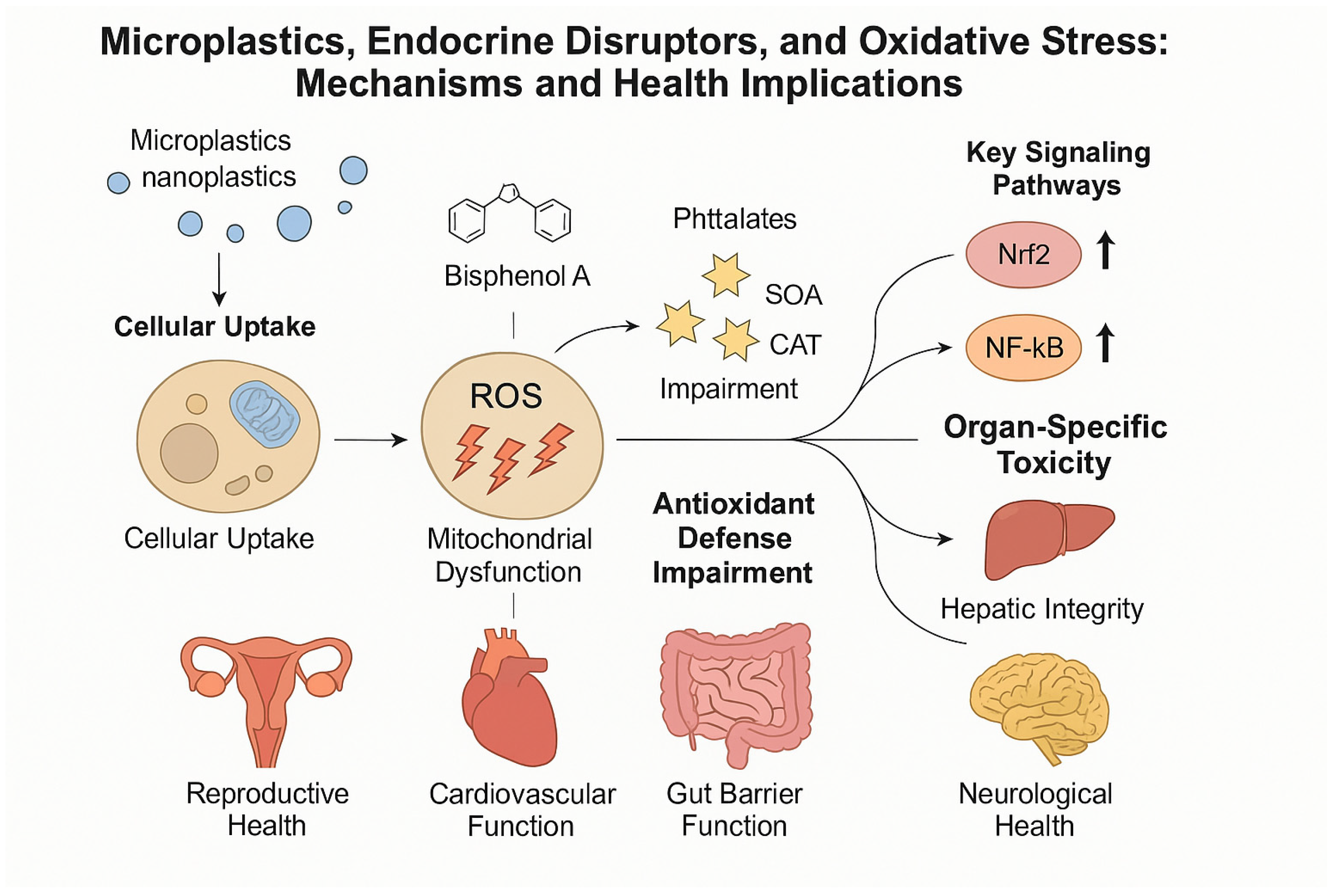
Microplastics, Endocrine Disruptors, and Oxidative Stress: Mechanisms and Health Implications


Abstract
1. Introduction
2. Presence of Micro- and Nanoplastics in Human Tissues
3. Impact of Microplastics on Multiple Organ Systems
3.1. Cardiovascular System
3.2. Nervous System
3.3. Reproductive System
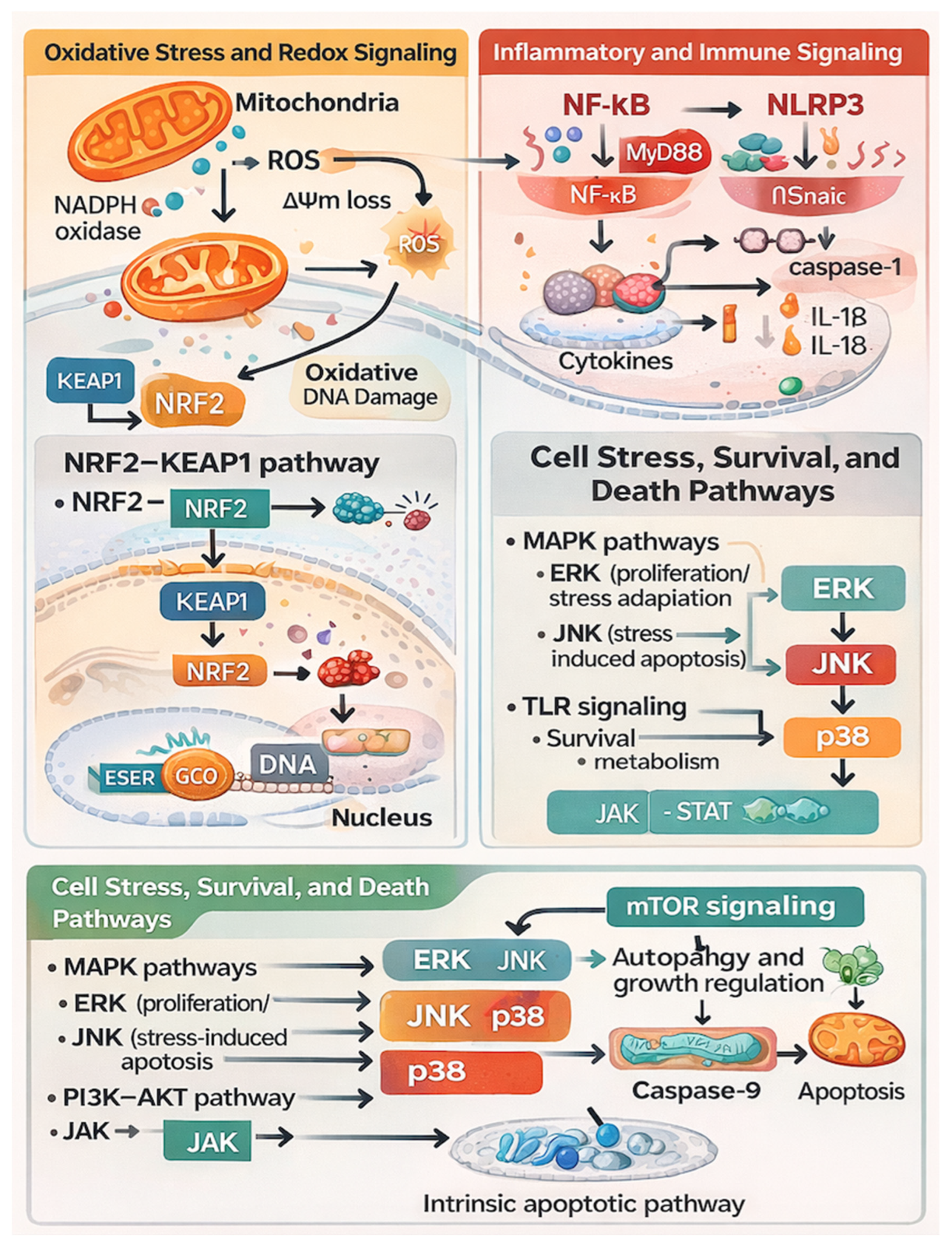
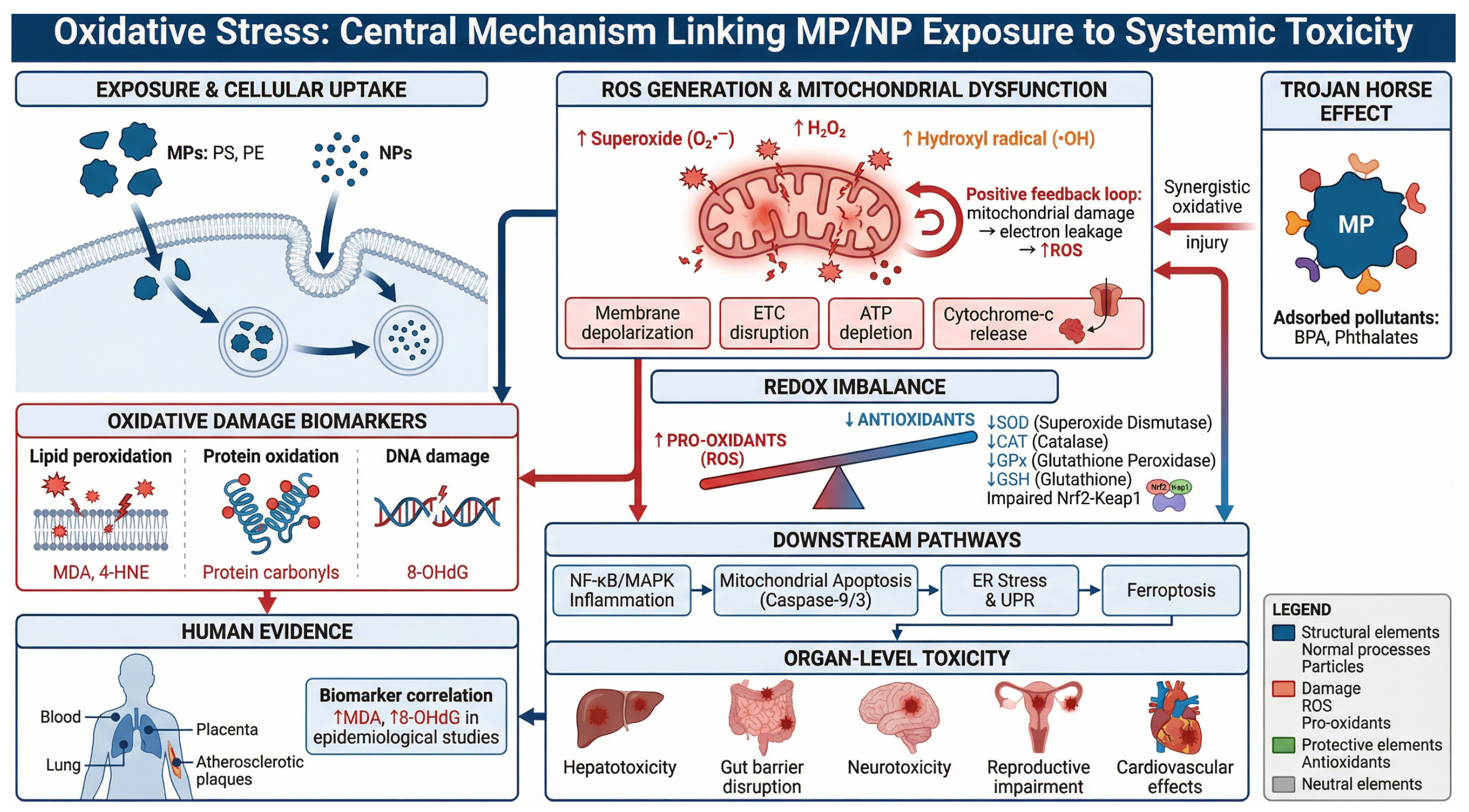
4. Mechanisms of Oxidative Stress Induced by Microplastics and EDCs
4.1. ROS Generation and Antioxidant Defense Impairment
4.2. Mitochondrial Dysfunction and Cell Death Pathways
4.3. Contributions of Associated Endocrine Disruptors
4.4. Endocrine Implications and Hormonal Disruption
4.5. Effect of Micro- and Nanonplastics and Endocrine Disruptors on Metabolome
5. Conclusions
Author Contributions
Funding
Data Availability Statement
Acknowledgments
Conflicts of Interest
Abbreviations
| ATF4 | activating transcription factor 4 |
| BPA | bisphenol A |
| CHOP | C/EBP-homologous protein |
| DNA | deoxyribonucleic acid |
| EDCs | endocrine-disrupting chemicals |
| eIF2α | eukaryotic Initiation Factor 2 alpha |
| ER | estrogen receptor |
| GnRH | gonadotropin-releasing hormone |
| HPG | hypothalamic–pituitary–gonadal |
| LH | luteinizing hormone |
| MPs | microplastics |
| NPs | nanoplastics |
| PERK | PKR-like ER Kinase |
| PPARs | peroxisome proliferator-activated receptors |
| ROS | reactive oxygen |
| LD | linear dichroism |
| 8-OHdG | 8-hydroxy-2′-deoxyguanosine |
References
- Ragusa, A.; Svelato, A.; Santacroce, C.; Catalano, P.; Notarstefano, V.; Carnevali, O.; Papa, F.; Rongioletti, M.C.A.; Baiocco, F.; Draghi, S.; et al. Plasticenta: First evidence of microplastics in human placenta. Environ. Int. 2021, 146, 106274. [Google Scholar] [CrossRef] [PubMed]
- Leslie, H.A.; van Velzen, M.J.M.; Brandsma, S.H.; Vethaak, A.D.; Garcia-Vallejo, J.J.; Lamoree, M.H. Discovery and quantification of plastic particle pollution in human blood. Environ. Int. 2022, 163, 107199. [Google Scholar] [CrossRef] [PubMed]
- Kadac-Czapska, K.; Jankowska-Steifer, E. Microplastics and oxidative stress—Current problems and prospects. Antioxidants 2024, 13, 579. [Google Scholar] [CrossRef] [PubMed]
- Wang, W.; Guan, J.; Feng, Y.; Liu, S.; Zhao, Y.; Xu, Y.; Xu, H.; Fu, F. Polystyrene microplastics induced ovarian toxicity in juvenile rats via oxidative stress and activation of the PERK–eIF2α–CHOP pathway. Toxics 2023, 11, 225. [Google Scholar]
- Gassman, N.R. Induction of oxidative stress by bisphenol A and its pleiotropic effects. Environ. Mol. Mutagen. 2017, 58, 60–71. [Google Scholar] [CrossRef]
- Brassea-Pérez, E.; Méndez-Hernández, E.; Lugo-Martínez, V.H.; García-Mosqueda, A.; Gómez-Oliván, L.M. Oxidative stress induced by phthalates in mammals: State of the art and potential biomarkers. Environ. Res. 2022, 206, 112636. [Google Scholar] [CrossRef]
- Yang, Y.; Chen, R.; Li, X.; Chen, X.; Chen, S. Microplastics exposure and endocrine disruption in mammals. Front. Endocrinol. 2023, 13, 1084236. [Google Scholar]
- Gao, C.; Liu, L.; Cai, X.; Qi, S.; Li, X. Oxidative stress, endocrine disturbance, and immune interference in humans in relation to serum bisphenol levels in a heavily industrialized area. Environ. Sci. Technol. 2021, 55, 1953–1963. [Google Scholar] [CrossRef]
- Cui, Y.; Wang, S.; Liu, J.; Zhao, L.; Gao, Y. Mitigating microplastic-induced organ damage: Mechanistic insights from the microplastic–macrophage axis. Redox Biol. 2025, 84, 103688. [Google Scholar] [CrossRef]
- de Sousa, A.K.A.; Pires, K.S.N.; Cavalcante, I.H.; Cavalcante, I.C.L.; Santos, J.D.; Queiroz, M.I.C.; Leite, A.C.R.; Crispim, A.C.; da Rocha Junior, E.R.; Aquino, T.M.; et al. Polystyrene microplastics exposure on human placental explants induces time-dependent cytotoxicity and oxidative stress. Front. Endocrinol. 2024, 15, 1481014. [Google Scholar] [CrossRef]
- Das, S.; Chatterjee, N.H.; Das, A.; Singh, A.; Ray, S. Exposure and toxicokinetics of microplastics in arthropods: Mechanisms and consequences. J. Hazard. Mater. 2025, 497, 139673. [Google Scholar] [CrossRef] [PubMed]
- Sobhani, Z.; Taylor, M.; Naderi, M. Protective effect of N-acetylcysteine against microplastic-induced toxicity in rats. Antioxidants 2021, 10, 1234. [Google Scholar]
- Hou, B.; Wang, F.; Liu, T.; Wang, Z. Reproductive toxicity of polystyrene microplastics: An in vivo experimental study in mice. J. Hazard. Mater. 2021, 404, 124028. [Google Scholar] [CrossRef] [PubMed]
- Cai, L.; Wang, J.; Peng, J.; Tan, Z.; Zhan, Z.; Tan, X. Microplastics exposure induces oxidative stress, inflammation, and endocrine disruption in mammals. Int. J. Mol. Sci. 2023, 24, 8456. [Google Scholar] [CrossRef]
- Görlach, A.; Bertram, K.; Hudecova, S.; Krizanova, O. Calcium and ROS: A mutual interplay. Redox Biol. 2015, 6, 260–271. [Google Scholar] [CrossRef]
- Gore, A.C.; Chappell, V.A.; Fenton, S.E.; Flaws, J.A.; Nadal, A.; Prins, G.S.; Toppari, J.; Zoeller, R.T. EDC-2: The Endocrine Society’s second scientific statement on endocrine-disrupting chemicals. Endocr. Rev. 2015, 36, E1–E150. [Google Scholar] [CrossRef]
- Wright, S.L.; Kelly, F.J. Plastic and human health: A micro issue? Environ. Sci. Technol. 2017, 51, 6634–6647. [Google Scholar] [CrossRef]
- Rochester, J.R. Bisphenol A and human health: A review of the literature. Reprod. Toxicol. 2013, 42, 132–155. [Google Scholar] [CrossRef]
- Campanale, C.; Massarelli, C.; Savino, I.; Locaputo, V.; Uricchio, V.F. A Detailed Review Study on Potential Effects of Microplastics and Additives of Concern on Human Health. Int. J. Environ. Res. Public Health 2020, 17, 1212. [Google Scholar] [CrossRef]
- Henkel, C.; Hüffer, T.; Hofmann, T. Polyvinyl Chloride Microplastics Leach Phthalates into the Aquatic Environment over Decades. Environ. Sci. Technol. 2022, 56, 14507–14516. [Google Scholar] [CrossRef]
- Gulizia, A.M.; Philippa, B.; Zacharuk, J.; Motti, C.A.; Vamvounis, G. Plasticiser Leaching from Polyvinyl Chloride Microplastics and the Implications for Environmental Risk Assessment. Mar. Pollut. Bull. 2023, 195, 115392. [Google Scholar] [CrossRef] [PubMed]
- Henkel, C.; Hüffer, T.; Peng, R.; Gao, X.; Ghoshal, S.; Hofmann, T. Photoaging Enhances the Leaching of di(2-ethylhexyl) Phthalate and Transformation Products from Polyvinyl Chloride Microplastics into Aquatic Environments. Commun. Chem. 2024, 7, 218. [Google Scholar] [CrossRef] [PubMed]
- Jin, R.; Li, H.; Li, X.; Shen, M. Research advances of micro/nanoplastics in groundwater: Occurrence, environmental impacts and control strategies. Environ Pollut. 2025, 383, 126899. [Google Scholar] [CrossRef] [PubMed]
- Bhagat, K.; Barrios, A.C.; Rajwade, K.; Kumar, A.; Oswald, J.; Apul, O.; Perreault, F. Aging of Microplastics Increases Their Adsorption Affinity towards Organic Contaminants. Chemosphere 2022, 298, 134238. [Google Scholar] [CrossRef]
- Jasinski, J.; Wilde, M.V.; Voelkl, M.; Jérôme, V.; Fröhlich, T.; Freitag, R.; Scheibel, T. Tailor-Made Protein Corona Formation on Polystyrene Microparticles and Its Effect on Epithelial Cell Uptake. ACS Appl. Mater. Interfaces 2022, 14, 47277–47287. [Google Scholar] [CrossRef]
- Luo, H.; Du, Q.; Zhong, Z.; Xu, Y.; Peng, J. Protein-Coated Microplastics Corona Complex: An Underestimated Risk of Microplastics. Sci. Total Environ. 2022, 851, 157948. [Google Scholar] [CrossRef]
- Lujic, T.; Mutic, T.; Simovic, A.; Vasovic, T.; Ivanovic, S.; Krstic Ristivojevic, M.; Jovanovic, V.; Cirkovic Velickovic, T. Protein Corona Stability and Removal from PET Microplastics: Analytical and Spectroscopic Evaluation in Simulated Intestinal Conditions. Foods 2025, 14, 3454. [Google Scholar] [CrossRef]
- Jenner, L.C.; Rotchell, J.M.; Bennett, R.T.; Cowen, M.; Tentzeris, V.; Sadofsky, L.R. Detection of microplastics in human lung tissue. Sci. Total Environ. 2022, 831, 154907. [Google Scholar] [CrossRef]
- Ragusa, A.; Notarstefano, V.; Svelato, A.; Belloni, A.; Gioacchini, G.; Blondeel, C.; Zucchelli, E.; De Luca, C.; D’avino, S.; Gulotta, A.; et al. Microplastics in human breast milk. Polymers 2022, 14, 2700. [Google Scholar] [CrossRef]
- Dzierżyński, E.; Blicharz-Grabias, E.; Komaniecka, I.; Panek, R.; Forma, A.; Gawlik, P.J.; Puźniak, D.; Flieger, W.; Choma, A.; Suśniak, K.; et al. Post-mortem evidence of microplastic bioaccumulation in human organs: Insights from advanced imaging and spectroscopic analysis. Arch. Toxicol. 2025, 99, 4051–4066. [Google Scholar] [CrossRef]
- Nihart, A.J.; Garcia, M.A.; El Hayek, E.; Liu, R.; Olewine, M.; Kingston, J.D.; Castillo, E.F.; Gullapalli, R.R.; Howard, T.; Bleske, B.; et al. Nanoplastic bioaccumulation in human brain and other organs. Nat. Med. 2025, 31, 1114–1119. [Google Scholar] [CrossRef] [PubMed]
- Marfella, R.; Prattichizzo, F.; Sardu, C.; Fulgenzi, G.; Graciotti, L.; Spadoni, T.; D’Onofrio, N.; Scisciola, L.; La Grotta, R.; Frigé, C.; et al. Microplastics and nanoplastics in atherosclerotic plaques and cardiovascular events. N. Engl. J. Med. 2024, 390, 900–910. [Google Scholar] [CrossRef] [PubMed]
- Liu, S.; Guo, J.; Liu, X.; Yang, R.; Wang, H.; Sun, Y.; Chen, B.; Dong, R. Detection of various microplastics in placentas, meconium, infant feces, breastmilk and infant formula: A pilot prospective study. Sci Total Environ. 2023, 854, 158699. [Google Scholar] [CrossRef] [PubMed]
- Braun, T.; Ehrlich, L.; Henrich, W.; Koeppel, S.; Lomako, I.; Schwabl, P.; Liebmann, B. Detection of microplastic in human placenta and meconium in a clinical setting. Pharmaceutics 2021, 13, 921. [Google Scholar] [CrossRef]
- Amato-Lourenço, L.F.; Carvalho-Oliveira, R.; Ribeiro Júnior, G.; Galvão, L.d.S.; Ando, R.A.; Mauad, T. Presence of airborne microplastics in human lung tissue. J. Hazard. Mater. 2021, 416, 126124. [Google Scholar] [CrossRef]
- Horvatits, T.; Tamminga, M.; Liu, B.; Sebode, M.; Carambia, A.; Fischer, L.; Püschel, K.; Huber, S.; Fischer, E.K. Microplastics detected in cirrhotic liver tissue. EBioMedicine 2022, 82, 104147. [Google Scholar] [CrossRef]
- Guo, X.; Wang, L.; Wang, X.; Li, D.; Wang, H.; Xu, H.; Liu, Y.; Kang, R.; Chen, Q.; Zheng, L.; et al. Discovery and analysis of microplastics in human bone marrow. J. Hazard. Mater. 2024, 15, 135266. [Google Scholar] [CrossRef]
- Hu, C.J.; Garcia, M.A.; Nihart, A.; Liu, R.; Yin, L.; Adolphi, N.; Gallego, D.F.; Kang, H.; Campen, M.J.; Yu, X. Microplastic presence in dog and human testis and its potential association with sperm count and weights of testis and epididymis. Toxicol. Sci. 2024, 200, 235–240. [Google Scholar] [CrossRef]
- Ibrahim, Y.S.; Tuan Anuar, S.; Azmi, A.A.; Khalik, W.M.A.W.M.; Lehata, S.; Hamzah, S.R.; Ismail, D.; Ma, Z.F.; Dzulkarnaen, A.; Zakaria, Z.; et al. Detection of microplastics in human colectomy specimens. JGH Open 2020, 5, 116–121. [Google Scholar] [CrossRef]
- Rotchell, J.M.; Jenner, L.C.; Chapman, E.; Bennett, R.T.; Bolanle, I.O.; Loubani, M.; Sadofsky, L.; Palmer, T.M. Detection of microplastics in human saphenous vein tissue using μFTIR: A pilot study. PLoS ONE 2023, 18, e0280594. [Google Scholar] [CrossRef]
- Ni, D.; Yu, K.; Yan, N.; Chen, X.; Xie, Q.; Yang, Y.; Jiang, W.; Yang, Y.; Zhang, J.; Ling, X. Characterization of microplastics in human follicular fluid and assessment of their potential impact on mouse oocyte maturation in vitro. Ecotoxicol. Environ. Saf. 2025, 291, 117796. [Google Scholar] [CrossRef] [PubMed]
- Montano, L.; Raimondo, S.; Piscopo, M.; Ricciardi, M.; Guglielmino, A.; Chamayou, S.; Gentile, R.; Gentile, M.; Rapisarda, P.; Conti, G.O.; et al. First evidence of microplastics in human ovarian follicular fluid: An emerging threat to female fertility. Ecotoxicol. Environ. Saf. 2025, 291, 117868. [Google Scholar] [CrossRef] [PubMed]
- He, P.; Wang, F.; Xi, G.; Li, Y.; Wang, F.; Wang, H.; Li, L.; Ma, X.; Han, Y.; Shi, Y. Association of microplastics in human cerebrospinal fluid with Alzheimer’s disease-related changes. J. Hazard. Mater. 2025, 494, 138748. [Google Scholar] [CrossRef]
- Mattsson, K.; Johnson, E.V.; Malmendal, A.; Linse, S.; Hansson, L.-A.; Cedervall, T. Brain damage and behavioural disorders in fish induced by plastic nanoparticles delivered through the food chain. Sci. Rep. 2017, 7, 11452. [Google Scholar] [CrossRef] [PubMed]
- Yong, C.Q.Y.; Valiyaveettil, S.; Tang, B.L. Toxicity of microplastics and nanoplastics in mammalian systems. Int. J. Environ. Res. Public Health 2020, 17, 1509. [Google Scholar] [CrossRef]
- Zhang, Y.; Kang, S.; Allen, S.; Allen, D.; Gao, T.; Sillanpää, M. Atmospheric microplastics: A review on current status and perspectives. Earth-Sci. Rev. 2020, 203, 103118. [Google Scholar] [CrossRef]
- Shi, X.; Wang, Y.; Xu, L. An overview of research on the association between microplastics and central nervous system disorders. Front. Public Health 2025, 13, 1629181. [Google Scholar] [CrossRef]
- Talaie, A.; Alaee, S.; Hosseini, E.; Rezania, S.; Tamadon, A. Toxicological effects of micro/nano-plastics on human reproductive health: A review. Toxicol. Lett. 2025, 412, 1–20. [Google Scholar] [CrossRef]
- Luo, T.; Zhang, Y.; Wang, C.; Wang, X.; Zhou, J.; Shen, M.; Zhao, Y.; Fu, Z.; Jin, Y. Maternal exposure to different sizes of polystyrene microplastics during gestation causes metabolic disorders in their offspring. Environ. Pollut. 2019, 255, 113122. [Google Scholar] [CrossRef]
- Sun, X.; Liang, J.; Zhu, M.; Zhao, Y.; Zhang, B. Microplastics in human tissues: Accumulation, biological effects, and health implications. J. Hazard. Mater. 2022, 424, 127560. [Google Scholar] [CrossRef]
- Umamaheswari, S.; Priyanka, M.P.; Hemalatha, D. Polystyrene microplastics induce dose- and time-dependent ROS-mediated apoptotic responses in zebrafish. Ecotoxicol. Environ. Saf. 2021, 220, 112377. [Google Scholar] [CrossRef]
- Peng, M.; Yang, J.; Shi, Y.; Liu, Y.; Zhang, H. Cellular and bioenergetic effects of polystyrene microplastics in intestinal cells. Environ. Pollut. 2023, 337, 122550. [Google Scholar] [CrossRef] [PubMed]
- Liang, B.; Zhong, Y.; Huang, Y.; Lin, X.; Chen, X. Polystyrene micro- and nanoplastics jointly induce intestinal damage via ROS-mediated apoptosis. Part. Fibre Toxicol. 2021, 18, 20. [Google Scholar] [CrossRef] [PubMed]
- Moorthy, S.; Kesavan, S.; Bhaskaran, S.; Balasubramanian, G.; Ambala, M.; Gogineni, K.K.; Palaparthi, E.C.; Rapeti, L.S.K.; Vivekanandan, V.; Periasamy, P. Evidence, mechanisms, and clinical implications of microplastics and nanoplastics as cardiovascular risk factors. Cureus 2025, 17, e85696. [Google Scholar] [CrossRef]
- Wang, Z.; Wang, Y.; Zhang, J.; Feng, G.; Miao, S.; Lu, R.; Tian, X.; Ye, Y. Antioxidant intervention against microplastic hazards: The role of NADPH oxidase activation. Antioxidants 2025, 14, 797. [Google Scholar] [CrossRef]
- Wu, H.; Xu, L.; Wang, J.; Yin, M.; Zhang, C. Oxidative stress mediated by TLR4/NOX2 signalling in uterine fibrosis induced by polystyrene microplastics. Sci. Total Environ. 2022, 838, 156502. [Google Scholar] [CrossRef]
- Ngo, V.; Duennwald, M.L. Nrf2 and Oxidative Stress: A General Overview of Mechanisms and Implications in Human Disease. Antioxidants 2022, 11, 2345. [Google Scholar] [CrossRef]
- Mohamed, M.M.A.; Yousri, N.A.; Khamis, N.H.; Abdel Hakim, S.A.B.; Elsayed, S.H.; Ali, E.A.E. Evaluation of polyethylene microplastics toxicity using Nrf2/ARE and MAPK/Nrf2 signaling pathways. Toxicol. Mech. Methods 2025, 35, 1118–1137. [Google Scholar] [CrossRef]
- Akbar, A.; Amin, F.; Batool, M.; Khatoon, A.; Ahmad, Z.; Atique, U. Sakuranetin counteracts polyethylene microplastics-induced toxicity by modulating the Nrf2/Keap1 pathway. J. King Saud Univ. Sci. 2024, 36, 102652. [Google Scholar] [CrossRef]
- Yue, S.; Chen, S.; Zhang, Y.; Chen, B.; Xu, T. Emerging threat of environmental microplastics: A comprehensive analysis of hepatic metabolic dysregulation and hepatocellular damage (Review). Int. J. Mol. Med. 2025, 56, 144. [Google Scholar] [CrossRef]
- Mahmud, F.; Sarker, D.B.; Jocelyn, J.A.; Sang, Q.-X.A. Molecular and Cellular Effects of Microplastics and Nanoplastics: Focus on Inflammation and Senescence. Cells 2024, 13, 1788. [Google Scholar] [CrossRef] [PubMed]
- Xu, M.; Halimu, G.; Zhang, Q.; Song, Y.; Fu, X.; Li, Y.; Li, Y.; Zhang, H. Internalization and toxicity: A preliminary study of effects of nanoplastic particles on human lung epithelial cell. Sci. Total Environ. 2022, 694, 133794. [Google Scholar] [CrossRef]
- Brookes, P.S.; Yoon, Y.; Robotham, J.L.; Anders, M.W.; Sheu, S.S. Calcium, ATP, and ROS: A mitochondrial love–hate triangle. Am. J. Physiol. Cell Physiol. 2004, 287, C817–C833. [Google Scholar] [CrossRef] [PubMed]
- Farag, A.A.; Youssef, H.S.; Sliem, R.E.; El Gazzar, W.B.; Nabil, N.; Mokhtar, M.M.; Marei, Y.M.; Ismail, N.S.; Radwaan, S.E.; Badr, A.M.; et al. Hematological consequences of polyethylene microplastics toxicity in male rats: Oxidative stress, genetic, and epigenetic links. Toxicology 2023, 492, 153545. [Google Scholar] [CrossRef]
- Sonavane, M.; Gassman, N.R. Bisphenol A co-exposure effects: A key factor in understanding BPA’s complex mechanism and health outcomes. Crit Rev Toxicol. 2019, 49, 371–386. [Google Scholar] [CrossRef]
- Nayak, D.; Jena, S.R.; Pal, A.; Das, B. Impact of bisphenol A on structure and function of mitochondria: A systematic review. Rev. Environ. Contam. Toxicol. 2022, 260, 10. [Google Scholar] [CrossRef]
- Nourian, A.; Soleimanzadeh, A.; Shalizar Jalali, A.; Najafi, G. Bisphenol-A analogue (bisphenol-S) exposure alters female reproductive tract and apoptosis/oxidative gene expression in blastocyst-derived cells. Iran. J. Basic Med. Sci. 2020, 23, 576–585. [Google Scholar] [CrossRef]
- Brehm, E.; Flaws, J.A. Bisphenol A effects on granulosa cell function via GPER-mediated pathways. Biol. Reprod. 2019, 101, 635–646. [Google Scholar] [CrossRef]
- Peretz, J.; Vrooman, L.; Ricke, W.A.; Hunt, P.A.; Ehrlich, S.; Hauser, R.; Padmanabhan, V.; Taylor, H.S.; Swan, S.H.; VandeVoort , C.A.; et al. Bisphenol A and reproductive toxicity: A systematic review. Environ. Health Perspect. 2014, 122, 775–786. [Google Scholar] [CrossRef]
- Rahman, M.S.; Kwon, W.S.; Pang, M.G. Effects of environmental BPA on male fertility. Mol. Cell. Endocrinol. 2015, 401, 44–52. [Google Scholar] [CrossRef]
- Wei, Y.; Zhang, M.; Song, J.; Wang, T.; Ma, Y.; Qin, L.; Li, J.; Qian, X.; Chen, J. Nephrotoxicity of Phthalates: A Review Based on Epidemiological and Toxicological Evidence. Toxics 2025, 13, 947. [Google Scholar] [CrossRef]
- Xu, Y.; Xu, Y.; Gu, W.; Zhou, X.; Wu, H.; Yang, X. Exploring the association bétáéin exposure to pesticides, polycyclic aromatic hydrocarbons, and phthalates and metabolic syndrome in National Health and Nutrition Examination Survey in the USA, 2007–2012: Utilizing a multi-step statistical strategy. BMC Public Health 2025, 25, 617. [Google Scholar] [CrossRef]



| Human Sample/Tissue | Polymer Types Identified | Particle Size Range | Detection Method | Key Findings | Reference |
|---|---|---|---|---|---|
| Whole blood | PET, PE, “polymers of styrene” (e.g., PS-related), PMMA (PP below LOQ) | ≥700 nm (method cut-off) | Double-shot Py–GC/MS | Plastics quantified in whole blood of healthy donors; demonstrates systemic internal exposure. | [2] |
| Placenta | PP (some particles identified by pigment only) | 5–10 µm | Raman microspectroscopy | Microplastic fragments found in fetal/maternal sides and membranes in a subset of placentas. | [1] |
| Placenta, meconium, infant feces, breast milk, infant formula | PE, PP, PS, PU and other common polymers | Mostly 5–500 µm | μFTIR, Raman | Demonstrated perinatal exposure: MPs in placenta and early-life matrices (meconium, infant stool, milk, formula). | [34] |
| Breast milk | Mainly PE, PVC, PP; pigmented fragments | ~2–12 µm (many 4–9 µm) | Raman microspectroscopy | MPs found in 26/34 samples; mostly irregular pigmented fragments. | [29,31] |
| Lung tissue (autopsy) | Mainly PE, PP | Particles < 5.5 µm; fibers 8.12–16.8 µm | Raman microspectroscopy | Polymeric particles/fibers observed in most samples examined, supporting inhalation-linked deposition. | [35] |
| Liver (cirrhosis case series), plus kidney and spleen | “Six different MP polymers” (not all specified in abstract) | 4–30 µm | Digestion + Nile Red staining/fluorescence microscopy + Raman | MPs detected in cirrhotic tissues but not in controls without underlying liver disease (within detection limits). | [36] |
| Carotid atherosclerotic plaque (atheroma) | PE; PVC (subset) | Not size-resolved in abstract (micro- and nanoplastics assessed) | Py–GC/MS + stable isotope analysis + electron microscopy | MNPs detected in plaque; presence associated with higher risk of subsequent MI/stroke/death in follow-up cohort. | [32] |
| Brain, liver, kidney (decedent tissues) | Primarily PE; other polymers present (lesser amounts) | EM verified nanoscale shard-like fragments in brain; full size distribution not limited to >5 µm due to multi-method approach | Py–GC/MS + ATR–FTIR + EM/EDS | Confirms MNPs in organs; brain shows higher PE proportion and higher concentrations; dementia cohort showed greater accumulation and cerebrovascular/immune-cell deposition. | [31] |
| Bone marrow | PE, PS, PVC, PA66, PP (plus additional polymers by LD-IR) | Majority <100 µm (LD-IR); morphology assessed by SEM | Py–GC/MS + LD-IR + SEM | MPs detected in all bone marrow samples; provides evidence of deep-tissue presence in hematopoietic compartment. | [37] |
| Testis (human; plus canine comparison) | 12 polymer types quantified; PE dominant (PVC/PET showed negative correlations with normalized testis weight in analyses) | Not size-resolved by Py–GC/MS | Py–GC/MS | MPs detected in all tested human testes; exploratory associations with reproductive parameters reported. | [38] |
| Colon tissue (colectomy specimens) | Polycarbonate, polyamide, PP (subset of analyzed filaments) | Not reported in abstract (reported as filaments/fibers; length characterized in study) | Digestion/filtration + stereo microscopy + micro-FTIR | MPs detected in all colectomy specimens; fibers dominated. | [39] |
| Saphenous vein tissue (pilot) | Alkyd resin, PVAc, nylon–EVA tie layer (others) | ≥5 µm (μFTIR size limitation) | μFTIR | MPs reported in most samples, but an Expression of Concern was issued; interpret cautiously. | [40] |
| Follicular fluid (human; ART patients) | LD-IR: multiple types (e.g., CPE, fluorosilicone rubber, PVC, etc.); Py–GC/MS confirmed PE/PP/PS/PVC in subset | 20–100 µm (LD-IR); Py–GC/MS not size-resolved | LD-IR + Py–GC/MS | MPs detected in follicular fluid; study also tested fluorescent MP beads in vitro and reported impaired oocyte maturation. | [41] |
| Follicular fluid (human; ART patients) | Polymer ID not reported in abstract (SEM/EDX approach) | <10 µm (mean ~4.48 µm) | SEM + EDX | MPs detected in most samples; reported correlation with FSH in this cohort. | [42] |
| Cerebrospinal fluid (CSF) | PP, PVC, PE, PS | Not reported in PubMed abstract | Not specified in PubMed abstract (journal article) | CSF microplastics reported; abundance correlated with bottled water frequency and CSF/serum albumin ratio; PE/PVC higher in amyloid-positive group in cohort. | [43] |
Disclaimer/Publisher’s Note: The statements, opinions and data contained in all publications are solely those of the individual author(s) and contributor(s) and not of MDPI and/or the editor(s). MDPI and/or the editor(s) disclaim responsibility for any injury to people or property resulting from any ideas, methods, instructions or products referred to in the content. |
© 2025 by the authors. Licensee MDPI, Basel, Switzerland. This article is an open access article distributed under the terms and conditions of the Creative Commons Attribution (CC BY) license.
Share and Cite
Kovacs, K.; Bodis, J.; Vass, R.A. Microplastics, Endocrine Disruptors, and Oxidative Stress: Mechanisms and Health Implications. Int. J. Mol. Sci. 2026, 27, 399. https://doi.org/10.3390/ijms27010399
Kovacs K, Bodis J, Vass RA. Microplastics, Endocrine Disruptors, and Oxidative Stress: Mechanisms and Health Implications. International Journal of Molecular Sciences. 2026; 27(1):399. https://doi.org/10.3390/ijms27010399
Chicago/Turabian StyleKovacs, Kalman, Jozsef Bodis, and Reka A. Vass. 2026. "Microplastics, Endocrine Disruptors, and Oxidative Stress: Mechanisms and Health Implications" International Journal of Molecular Sciences 27, no. 1: 399. https://doi.org/10.3390/ijms27010399
APA StyleKovacs, K., Bodis, J., & Vass, R. A. (2026). Microplastics, Endocrine Disruptors, and Oxidative Stress: Mechanisms and Health Implications. International Journal of Molecular Sciences, 27(1), 399. https://doi.org/10.3390/ijms27010399