
Natural Fatty Acids as Dual ACE2-Inflammatory Modulators: Integrated Computational Framework for Pandemic Preparedness
 , , and
Abstract
1. Introduction
2. Results
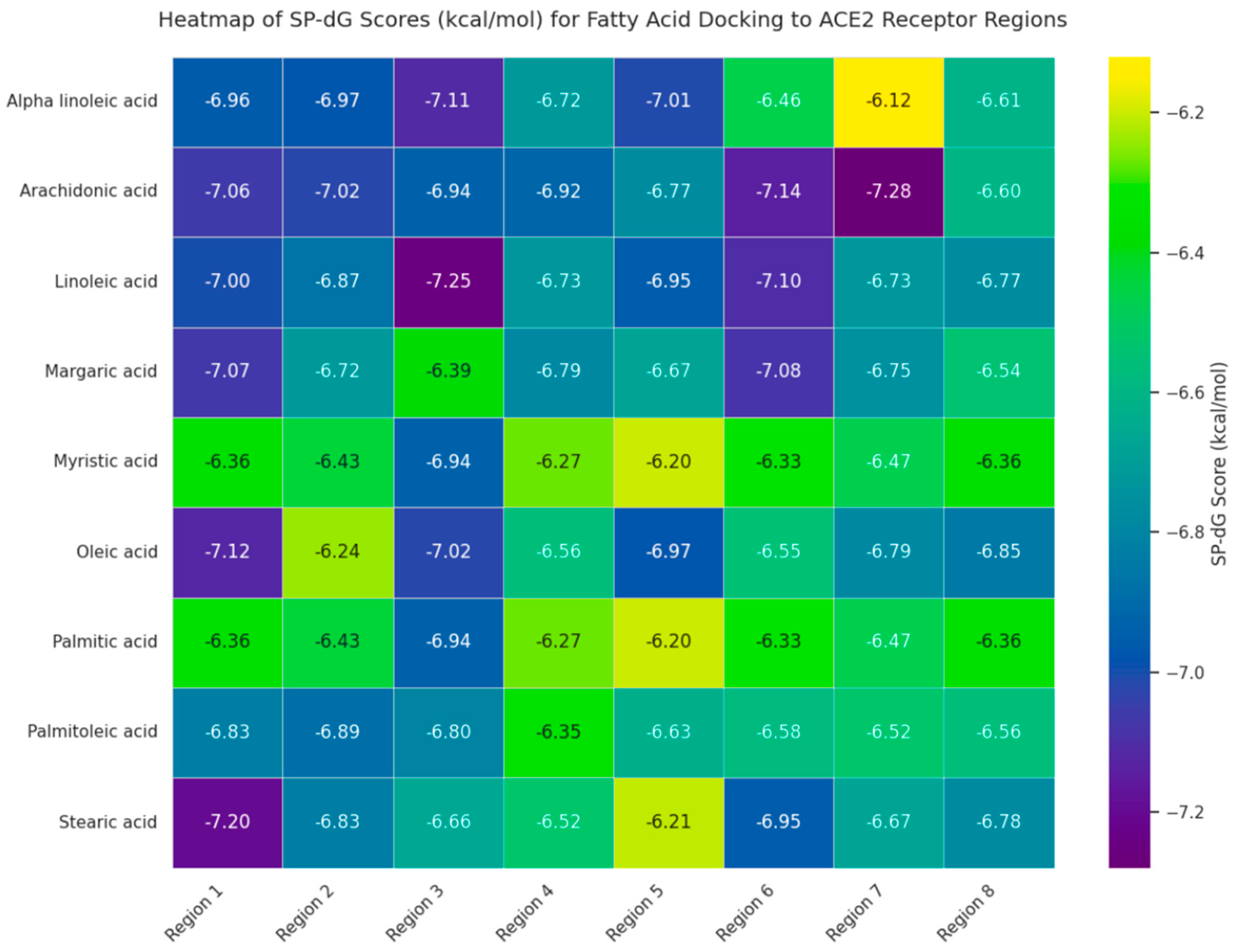
2.1. Molecular Docking: Binding Affinity Landscape and Regional Validation
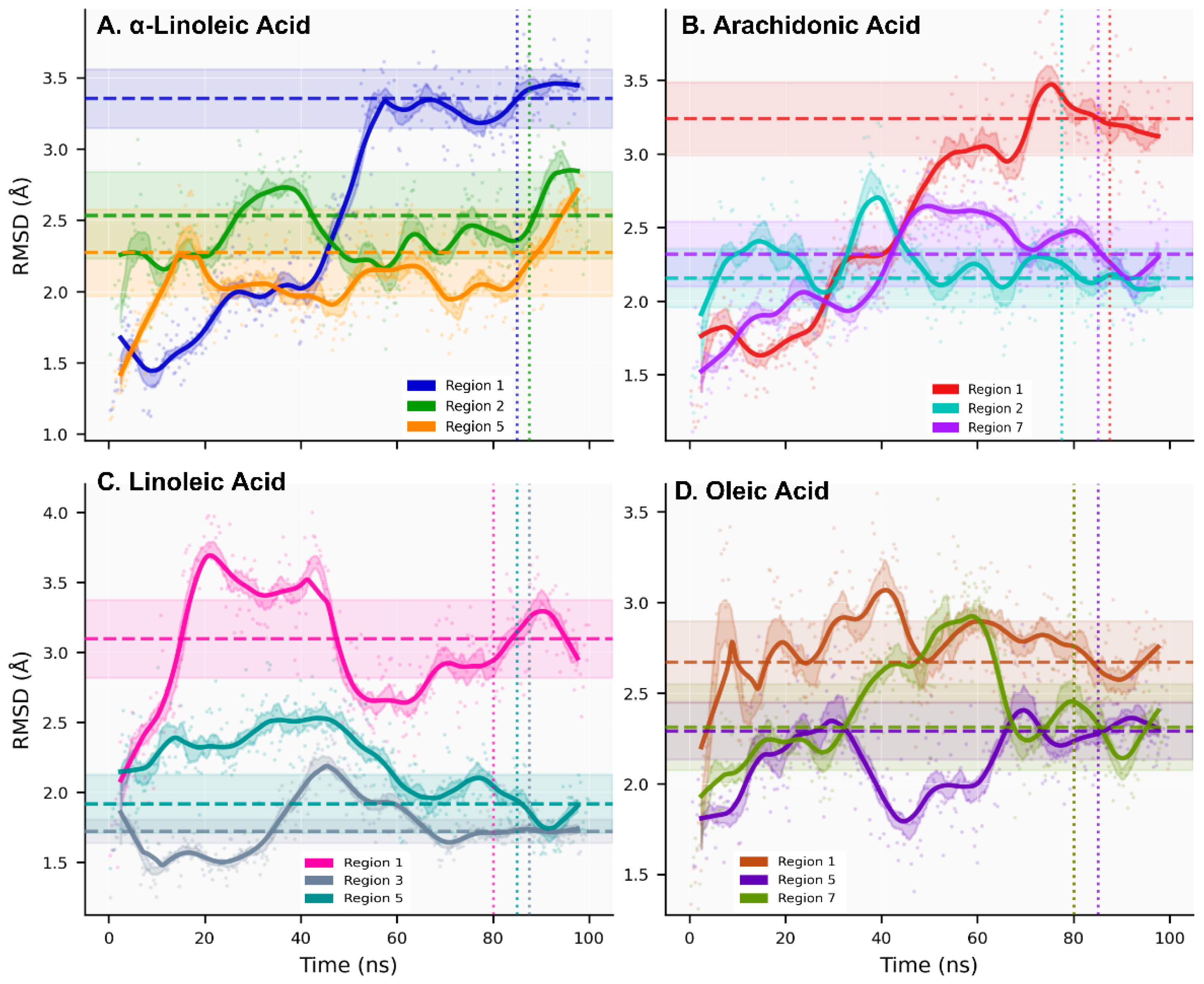
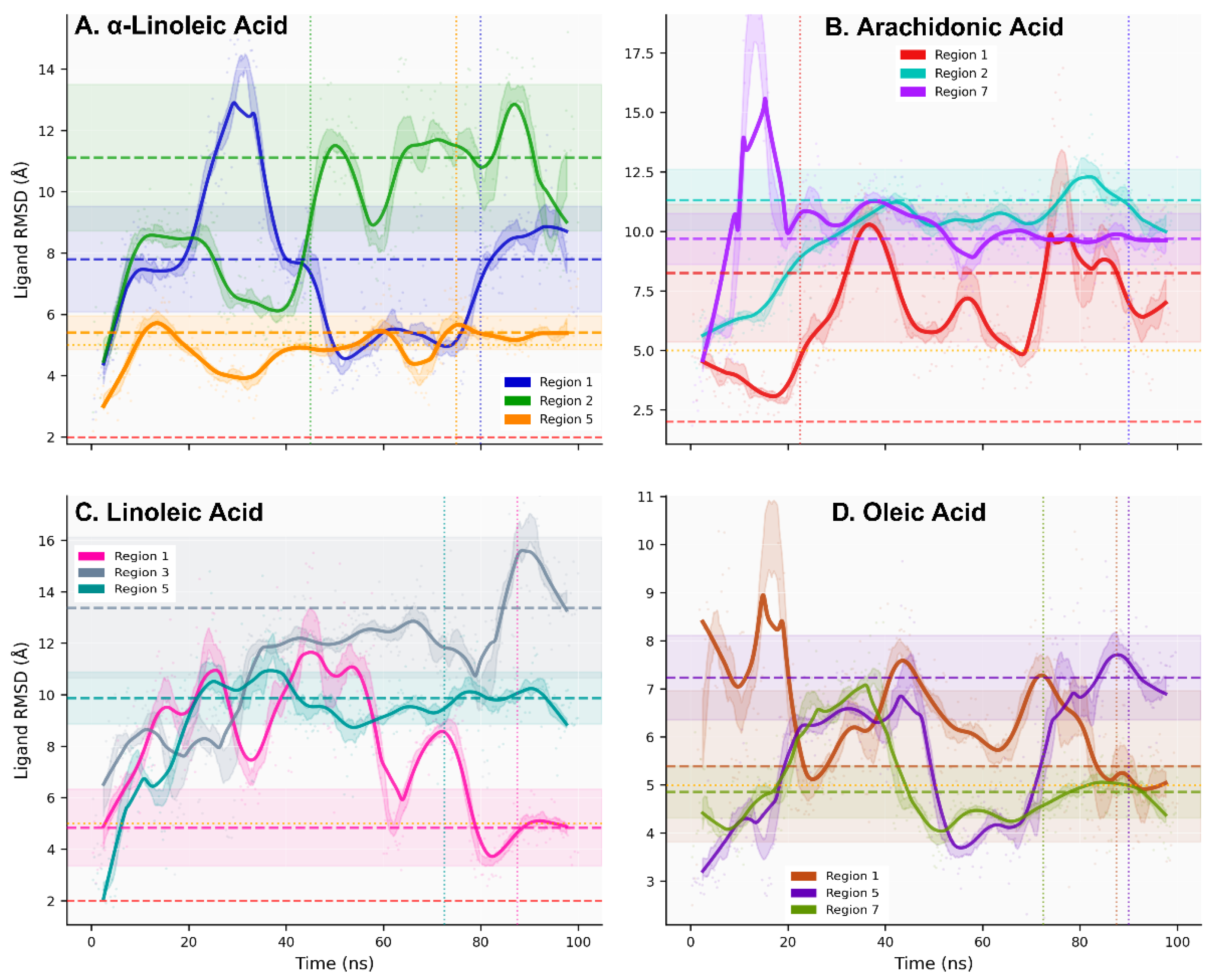
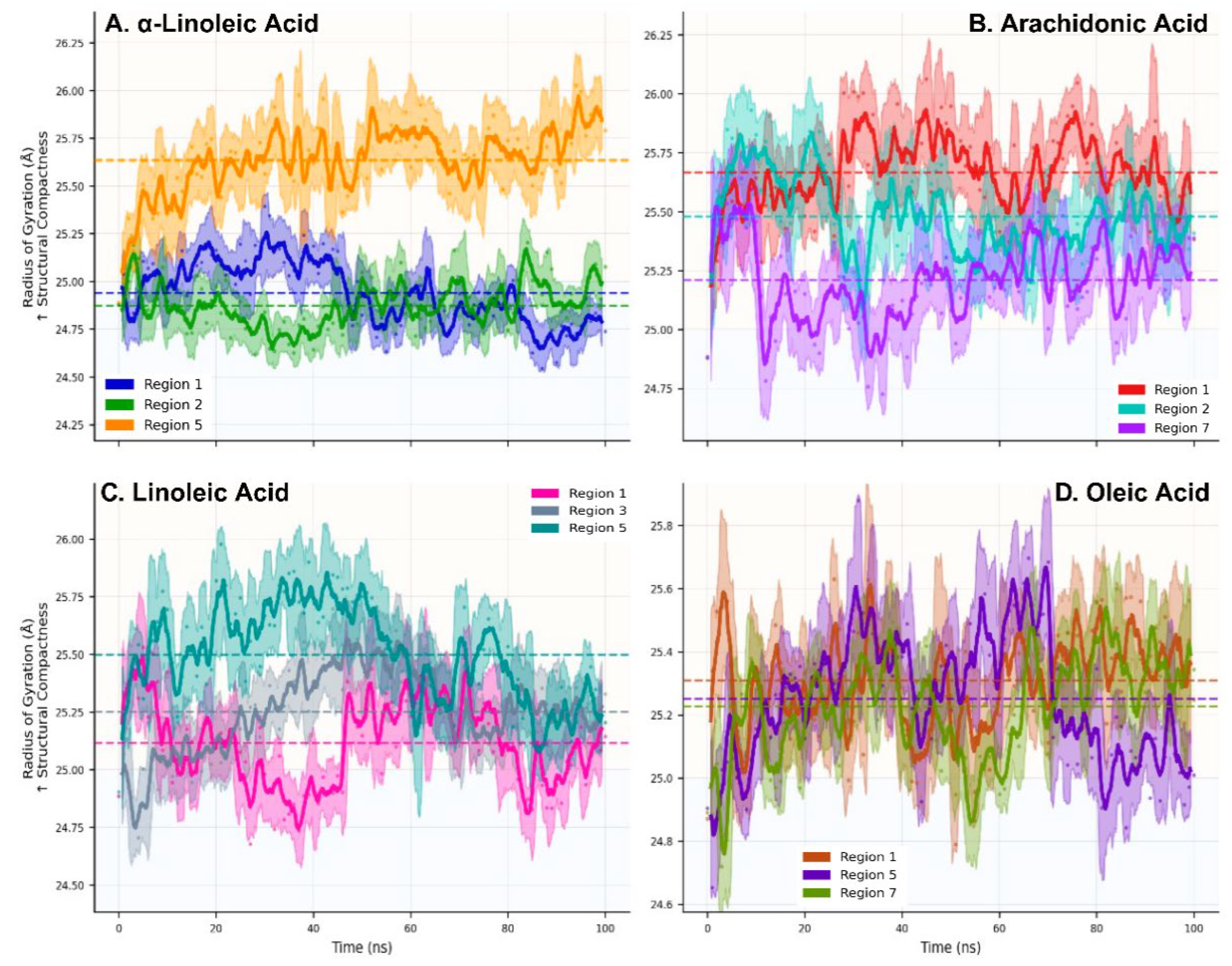
2.2. Molecular Dynamics Simulations: Conformational Stability and Dynamic Regimes
2.3. MM/PBSA Binding Energetics and Thermodynamic Hierarchy
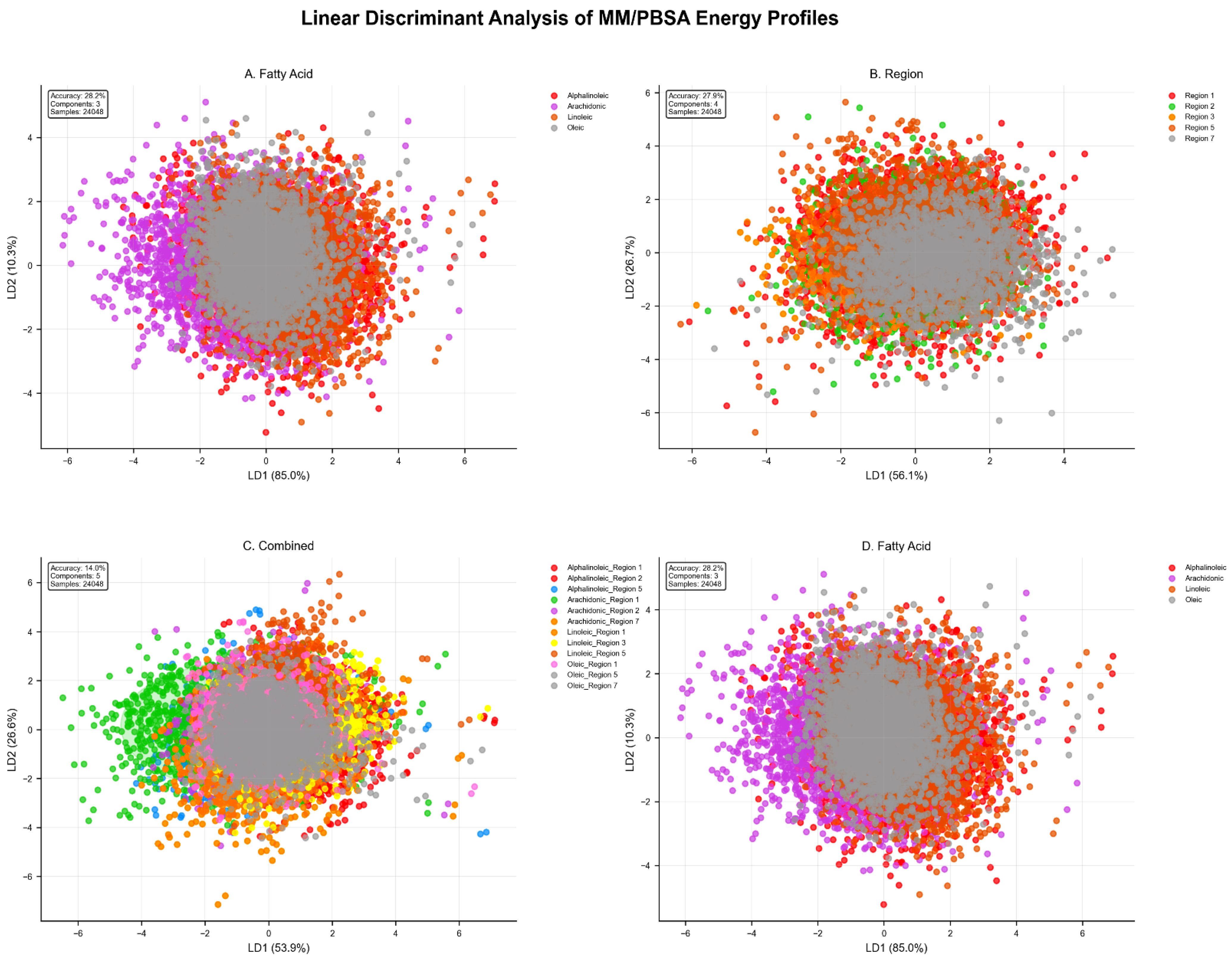
2.4. Linear Discriminant Analysis of MM/PBSA Energy Profiles
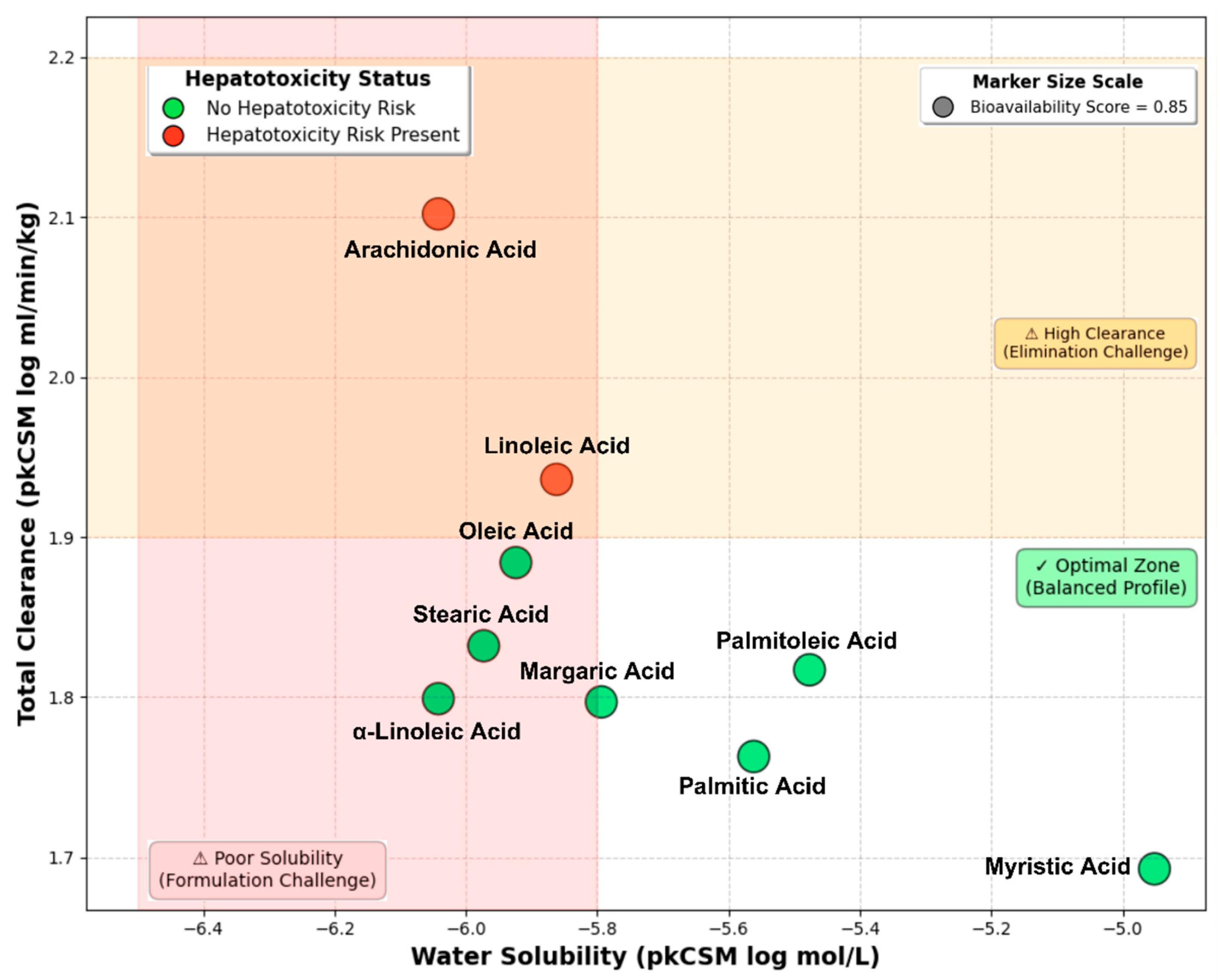
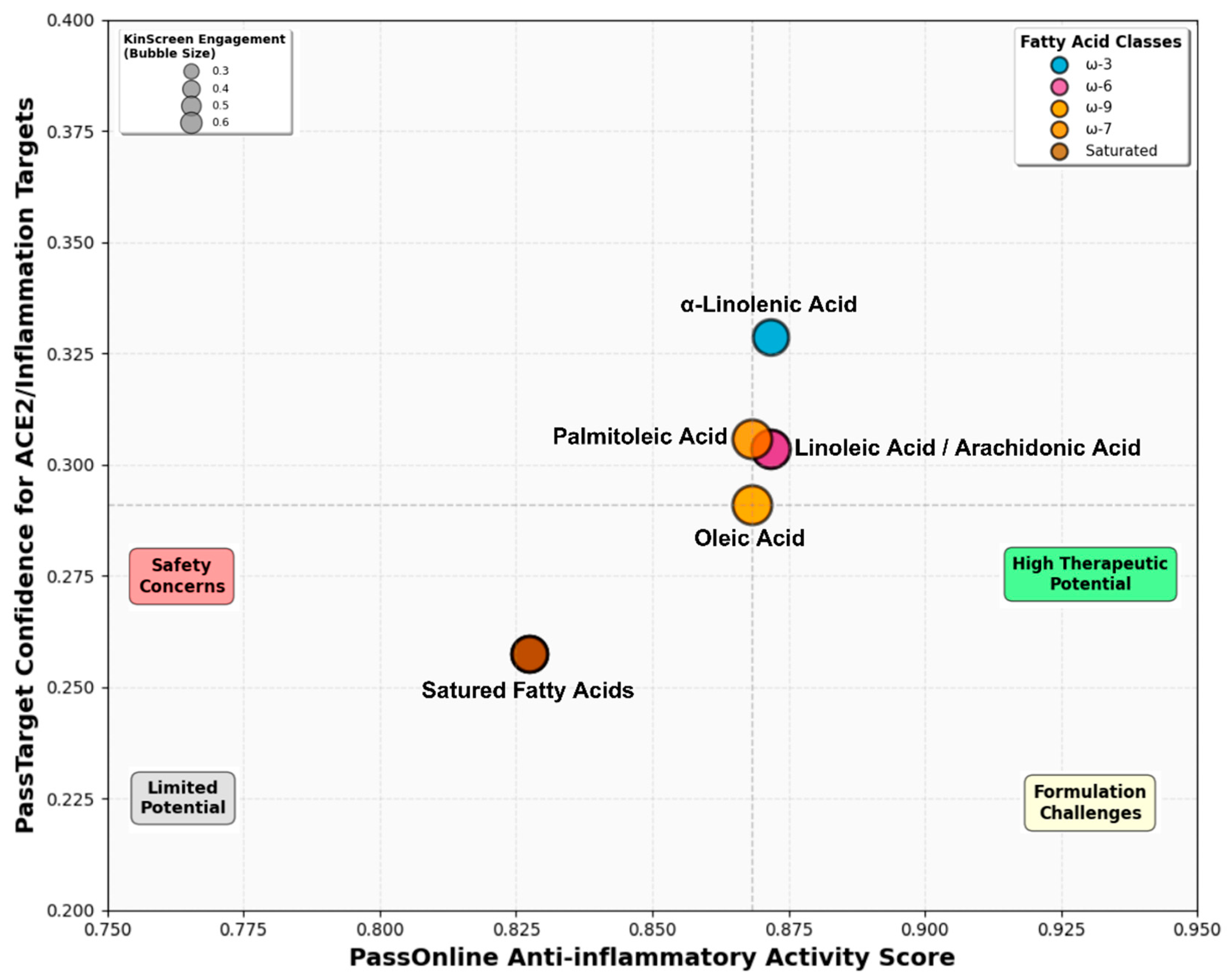
2.5. ADMET Profiling and Target Engagement Analysis
3. Discussion
4. Materials and Methods
4.1. Compound Selection and Preparation
4.2. Protein Selection and Preparation
4.3. Molecular Docking Protocol
4.4. Molecular Dynamics Simulations Protocol
4.5. Binding Free Energy Calculations
4.6. Linear Discriminant Analysis for Energy Component Discrimination
4.7. ADMET Analysis and Biological Activity Predictions
5. Conclusions
Supplementary Materials
Author Contributions
Funding
Institutional Review Board Statement
Informed Consent Statement
Data Availability Statement
Acknowledgments
Conflicts of Interest
Abbreviations
| ACE2 | Angiotensin-Converting Enzyme 2 |
| ARDS | Acute respiratory distress syndrome |
| RAAS | The renin–angiotensin–aldosterone system |
| ALA | Alpha-linolenic |
| ARA | Arachidonic |
| LA | Linoleic |
| OA | Oleic |
| Rg | Radius of Gyration |
| SASA | Solvent Accessible Surface Area |
| RMSD | Root-mean-square deviation |
| RMSF | Root Mean Square Fluctuation |
| MM/PBSA | Molecular Mechanics/Poisson-Boltzmann Surface Area |
References
- Ramon-Torrell, J.M. Perspective Chapter: Emerging Infectious Diseases as a Public Health Problem. In Global Health Security—Contemporary Considerations and Developments; Michaud, A., Stawicki, S.P., Izurieta, R., Eds.; IntechOpen: London, UK, 2023. [Google Scholar]
- Onoja, A.B. Emerging Viral Infections in Human Population. In Integrated Science of Global Epidemics; Rezaei, N., Ed.; Springer: Cham, Switzerland, 2023. [Google Scholar]
- Portela, R.; Borovnik, K.; Costa, C.M.; Grilo, I.R.; Pereira, P.M. High-Priority Pathogens: Where Do We Stand? In Nanotherapeutics for Infectious Diseases, 1st ed.; Batalha, I.L., Ed.; Jenny Stanford Publishing: New York, NY, USA, 2025. [Google Scholar]
- Batool, S.; Chokkakula, S.; Jeong, J.H.; Baek, Y.H.; Song, M.S. SARS-CoV-2 Drug Resistance and Therapeutic Approaches. Heliyon 2025, 11, e41980. [Google Scholar] [CrossRef]
- Pavan, M.; Moro, S. Lessons Learnt from COVID-19: Computational Strategies for Facing Present and Future Pandemics. Int. J. Mol. Sci. 2023, 24, 4401. [Google Scholar] [CrossRef]
- Niazi, S.K.; Mariam, Z. Computer-Aided Drug Design and Drug Discovery: A Prospective Analysis. Pharmaceuticals 2024, 17, 22. [Google Scholar] [CrossRef]
- Xu, W. Current Status of Computational Approaches for Small Molecule Drug Discovery. J. Med. Chem. 2024, 67, 18633–18636. [Google Scholar] [CrossRef]
- Guo, J.; Bai, Y.; Guo, Y.; Wang, M.; Ji, X.; Wang, Y. Drug Discovery for SARS-CoV-2 Utilizing Computer-Aided Drug Design Approaches. COVID 2025, 5, 32. [Google Scholar] [CrossRef]
- Que, H.; Chen, L.; Wei, X. SARS-CoV-2 Variants, Immune Escape, COVID-19 Vaccine, and Therapeutic Strategies. Sci. China Life Sci. 2023, 66, 406–410. [Google Scholar] [CrossRef]
- Xu, A.; Hong, B.; Lou, F.; Wang, S.; Li, W.; Shafqat, A.; An, X.; Zhao, Y.; Song, L.; Tong, Y.; et al. Sub-Lineages of the SARS-CoV-2 Omicron Variants: Characteristics and Prevention. MedComm 2022, 3, e172. [Google Scholar] [CrossRef] [PubMed]
- Alam, M.S. Insight into SARS-CoV-2 Omicron Variant Immune Escape Possibility and Variant Independent Potential Therapeutic Opportunities. Heliyon 2023, 9, e13285. [Google Scholar] [CrossRef]
- Lau, K.T.K.; Xiong, X.; Wong, C.K.H.; Au, I.C.H.; Lui, A.Y.C.; Tsai, G.Y.T.; Wu, T.; Li, L.; Lau, E.H.Y.; Cowling, B.J.; et al. Comparative Effectiveness of Antivirals and Monoclonal Antibodies for Treating COVID-19 Patients Infected with Omicron Variant: A Systematic Review and Network Meta-Analysis. Influenza Other Respir Viruses 2024, 18, e70065. [Google Scholar] [CrossRef]
- Tao, K.; Tzou, P.L.; Kosakovsky Pond, S.L.; Ioannidis, J.P.A.; Shafer, R.W. Susceptibility of SARS-CoV-2 Omicron Variants to Therapeutic Monoclonal Antibodies: Systematic Review and Meta-Analysis. Microbiol. Spectr. 2022, 10, e00926-22. [Google Scholar] [CrossRef]
- Im, K.-I.; Kim, N.; Lee, J.; Oh, U.-H.; Lee, H.-W.; Lee, D.-G.; Min, G.-J.; Lee, R.; Lee, J.; Kim, S.; et al. SARS-CoV-2-Specific T-Cell as a Potent Therapeutic Strategy against Immune Evasion of Emerging COVID-19 Variants. Int. J. Mol. Sci. 2024, 25, 10512. [Google Scholar] [CrossRef]
- Yoshimura, K.; Okada, Y.; Toya, S.; Asami, T.; Iwasaki, S. Morphological Aspect of the Angiotensin-Converting Enzyme 2. In Angiotensin; Pilowsky, P.M., Ed.; Academic Press: New York, NY, USA, 2023; pp. 389–417. [Google Scholar]
- Maranduca, M.A.; Tanase, D.M.; Cozma, C.T.; Dima, N.; Clim, A.; Pinzariu, A.C.; Serban, D.N.; Serban, I.L. The Impact of Angiotensin-Converting Enzyme-2/Angiotensin 1–7 Axis in Establishing Severe COVID-19 Consequences. Pharmaceuticals 2022, 14, 1906. [Google Scholar] [CrossRef]
- Caputo, I.; Bertoldi, G.; Driussi, G.; Cacciapuoti, M.; Calò, L.A. The RAAS Goodfellas in Cardiovascular System. J. Clin. Med. 2023, 12, 6873. [Google Scholar] [CrossRef]
- Jackson, C.B.; Farzan, M.; Chen, B.; Choe, H. Mechanisms of SARS-CoV-2 Entry into Cells. Nat. Rev. Mol. Cell Biol. 2022, 23, 3–20. [Google Scholar] [CrossRef] [PubMed]
- Ni, W.; Yang, X.; Yang, D.; Bao, J.; Li, R.; Xiao, Y.; Hou, C.; Wang, H.; Liu, J.; Yang, D.; et al. Role of Angiotensin-Converting Enzyme 2 (ACE2) in COVID-19. Crit. Care 2020, 24, 422. [Google Scholar] [CrossRef]
- Lan, J.; Ge, J.; Yu, J.; Shan, S.; Zhou, H.; Fan, S.; Zhang, Q.; Shi, X.; Wang, Q.; Zhang, L.; et al. Structure of the SARS-CoV-2 Spike Receptor-Binding Domain Bound to the ACE2 Receptor. Nature 2020, 581, 215–220. [Google Scholar] [CrossRef] [PubMed]
- Gao, X.; Zhang, S.; Gou, J.; Wen, Y.; Fan, L.; Zhou, J.; Zhou, G.; Xu, G.; Zhang, Z. Spike-Mediated ACE2 Down-Regulation Was Involved in the Pathogenesis of SARS-CoV-2 Infection. J. Infect. 2022, 85, 418–427. [Google Scholar] [CrossRef]
- Banu, N.; Panikar, S.S.; Riera Leal, L.; Riera Leal, A. Protective Role of ACE2 and Its Downregulation in SARS-CoV-2 Infection Leading to Macrophage Activation Syndrome: Therapeutic Implications. Life Sci. 2020, 256, 117905. [Google Scholar] [CrossRef]
- Lambert, D.W.; Yarski, M.; Warner, F.J.; Thornhill, P.; Parkin, E.T.; Smith, A.I.; Hooper, N.M.; Turner, A.J. Tumor Necrosis Factor-Alpha Convertase (ADAM17) Mediates Regulated Ectodomain Shedding of the Severe-Acute Respiratory Syndrome-Coronavirus (SARS-CoV) Receptor, Angiotensin-Converting Enzyme-2 (ACE2). J. Biol. Chem. 2005, 280, 30113–30119. [Google Scholar] [CrossRef]
- Heurich, A.; Hofmann-Winkler, H.; Gierer, S.; Liepold, T.; Jahn, O.; Pöhlmann, S. TMPRSS2 and ADAM17 Cleave ACE2 Differentially and Only Proteolysis by TMPRSS2 Augments Entry Driven by the Severe Acute Respiratory Syndrome Coronavirus Spike Protein. J. Virol. 2014, 88, 1293–1307. [Google Scholar] [CrossRef]
- Xu, Y.; Li, Y. MicroRNA-28-3p Inhibits Angiotensin-Converting Enzyme 2 Ectodomain Shedding in 293T Cells Treated with the Spike Protein of Severe Acute Respiratory Syndrome Coronavirus 2 by Targeting A Disintegrin and Metalloproteinase 17. Int. J. Mol. Med. 2021, 48, 189. [Google Scholar] [CrossRef]
- Silhol, F.; Sarlon, G.; Deharo, J.C.; Vaïsse, B. Downregulation of ACE2 Induces Overstimulation of the Renin–Angiotensin System in COVID-19: Should We Block the Renin–Angiotensin System? Hypertens. Res. 2020, 43, 854–856. [Google Scholar] [CrossRef]
- Cook, J.R.; Ausiello, J. Functional ACE2 Deficiency Leading to Angiotensin Imbalance in the Pathophysiology of COVID-19. Rev. Endocr. Metab. Disord. 2021, 23, 151–170. [Google Scholar] [CrossRef]
- Sansoè, G.; Aragno, M. New Viral Diseases and New Possible Remedies by Means of the Pharmacology of the Renin-Angiotensin System. J. Renin Angiotensin Aldosterone Syst. 2023, 2023, 3362391. [Google Scholar] [CrossRef] [PubMed]
- Jasiczek, J.; Doroszko, A.; Trocha, T.; Trocha, M. Role of the RAAS in Mediating the Pathophysiology of COVID-19. Pharmacol. Rep. 2024, 76, 475–486. [Google Scholar] [CrossRef]
- El-Arif, G.; Khazaal, S.; Farhat, A.; Harb, J.; Annweiler, C.; Wu, Y.; Cao, Z.; Kovacic, H.; Abi Khattar, Z.; Fajloun, Z.; et al. Angiotensin II Type I Receptor (AT1R): The Gate towards COVID-19-Associated Diseases. Molecules 2022, 27, 2048. [Google Scholar] [CrossRef]
- Bourgonje, A.R.; Abdulle, A.E.; Timens, W.; Hillebrands, J.L.; Navis, G.J.; Gordijn, S.J.; Bolling, M.C.; Dijkstra, G.; Voors, A.A.; Osterhaus, A.D.; et al. Angiotensin-Converting Enzyme 2 (ACE2), SARS-CoV-2 and the Pathophysiology of Coronavirus Disease 2019 (COVID-19). J. Pathol. 2020, 251, 228–248. [Google Scholar] [CrossRef]
- Gross, L.Z.F.; Sacerdoti, M.; Pietsch, A.; Zeuzem, S.; Leroux, A.E.; Biondi, R.M. ACE2, the Receptor That Enables Infection by SARS-CoV-2: Biochemistry, Structure, Allostery and Evaluation of the Potential Development of ACE2 Modulators. ChemMedChem 2020, 15, 1682–1690. [Google Scholar] [CrossRef]
- Hochuli, J.E.; Jain, S.; Melo-Filho, C.; Sessions, Z.L.; Bobrowski, T.; Choe, J.; Zheng, J.; Eastman, R.; Talley, D.C.; Rai, G.; et al. Allosteric Binders of ACE2 Are Promising Anti-SARS-CoV-2 Agents. ACS Pharmacol. Transl. Sci. 2022, 5, 468–478. [Google Scholar] [CrossRef]
- Wang, D.S.; Hayatshahi, H.S.; Jayasinghe-Arachchige, V.M.; Liu, J. Allosteric Modulation of Small Molecule Drugs on ACE2 Conformational Change upon Binding to SARS-CoV-2 Spike Protein. In Proceedings of the 2021 IEEE International Conference on Bioinformatics and Biomedicine (BIBM), virtual, 9–12 December 2021; pp. 2587–2594. [Google Scholar]
- Raghuvamsi, P.V.; Tulsian, N.K.; Samsudin, F.; Qian, X.; Purushotorman, K.; Yue, G.; Kozma, M.M.; Hwa, W.Y.; Lescar, J.; Bond, P.J.; et al. SARS-CoV-2 S Protein: ACE2 Interaction Reveals Novel Allosteric Targets. Elife 2021, 10, e63646. [Google Scholar] [CrossRef] [PubMed]
- Lu, J.; Sun, P.D. High Affinity Binding of SARS-CoV-2 Spike Protein Enhances ACE2 Carboxypeptidase Activity. J. Biol. Chem. 2020, 295, 18579–18588. [Google Scholar] [CrossRef]
- Towler, P.; Staker, B.; Prasad, S.G.; Menon, S.; Tang, J.; Parsons, T.; Ryan, D.; Fisher, M.; Williams, D.; Dales, N.A.; et al. ACE2 X-Ray Structures Reveal a Large Hinge-bending Motion Important for Inhibitor Binding and Catalysis. J. Biol. Chem. 2004, 279, 17996–18007. [Google Scholar] [CrossRef] [PubMed]
- Laurini, E.; Marson, D.; Aulic, S.; Fermeglia, M.; Pricl, S. Computational Alanine Scanning and Structural Analysis of the SARS-CoV-2 Spike Protein/Angiotensin-Converting Enzyme 2 Complex. ACS Nano 2020, 14, 11821–11830. [Google Scholar] [CrossRef]
- Guy, J.L.; Jackson, R.M.; Jensen, H.A.; Hooper, N.M.; Turner, A.J. Identification of Critical Active-Site Residues in Angiotensin-Converting Enzyme-2 (ACE2) by Site-Directed Mutagenesis. FEBS J. 2005, 272, 3512–3520. [Google Scholar] [CrossRef]
- Yan, R.; Zhang, Y.; Li, Y.; Xia, L.; Guo, Y.; Zhou, Q. Structural Basis for the Recognition of SARS-CoV-2 by Full-Length Human ACE2. Science 2020, 367, 1444–1448. [Google Scholar] [CrossRef]
- Lambert, D.W.; Clarke, N.E.; Hooper, N.M.; Turner, A.J. Calmodulin Interacts with Angiotensin-Converting Enzyme-2 (ACE2) and Inhibits Shedding of Its Ectodomain. FEBS Lett. 2008, 582, 385–390. [Google Scholar] [CrossRef]
- Pieroni, M.; Madeddu, F.; Di Martino, J.; Arcieri, M.; Parisi, V.; Bottoni, P.; Castrignanò, T. MD-Ligand-Receptor: A high-performance computing tool for characterizing ligand-receptor binding interactions in molecular dynamics trajectories. Int. J. Mol. Sci. 2023, 24, 11671. [Google Scholar] [CrossRef]
- Huang, K.; Luo, S.; Cong, Y.; Zhong, S.; Zhang, J.Z.H.; Duan, L. An accurate free energy estimator: Based on MM/PBSA combined with interaction entropy for protein–ligand binding affinity. Nanoscale 2020, 12, 10737–10750. [Google Scholar] [CrossRef]
- Moradi, S.; Nowroozi, A.; Aryaei Nezhad, M.; Jalali, P.; Khosravi, R.; Shahlaei, M. A review on description dynamics and conformational changes of proteins using combination of principal component analysis and molecular dynamics simulation. Comput. Biol. Med. 2024, 183, 109245. [Google Scholar] [CrossRef] [PubMed]
- Romero, J.A.; Putko, P.; Urbańczyk, M.; Kazimierczuk, K.; Zawadzka-Kazimierczuk, A. Linear discriminant analysis reveals hidden patterns in NMR chemical shifts of intrinsically disordered proteins. PLoS Comput. Biol. 2022, 18, e1010258. [Google Scholar] [CrossRef] [PubMed]
- Lubbe, L.; Cozier, G.E.; Oosthuizen, D.; Acharya, K.R.; Sturrock, E.D. ACE2 and ACE: Structure-based insights into mechanism, regulation and receptor recognition by SARS-CoV. Clin. Sci. 2020, 134, 2851–2871. [Google Scholar] [CrossRef]
- Dutta, K. Allosteric Site of ACE-2 as a Drug Target for COVID-19. ACS Pharmacol. Transl. Sci. 2022, 5, 179–182. [Google Scholar] [CrossRef]
- Shin, Y.-H.; Jeong, K.; Lee, J.; Lee, H.J.; Yim, J.; Kim, J.; Kim, S.; Park, S.B. Inhibition of ACE2-Spike Interaction by an ACE2 Binder Suppresses SARS-CoV-2 Entry. Angew. Chem. Int. Ed. Engl. 2022, 61, e202115695. [Google Scholar] [CrossRef] [PubMed]
- Trozzi, F.; Karki, N.; Song, Z.; Verma, N.; Kraka, E.; Zoltowski, B.D.; Tao, P. Allosteric control of ACE2 peptidase domain dynamics. Org. Biomol. Chem. 2022, 20, 3605–3618. [Google Scholar] [CrossRef]
- Li, Z.; Peng, M.; Chen, P.; Deng, K.; Yan, L.; Chen, S.; Hu, A.; Zhang, Y.; Peng, J.; Liu, J.; et al. Imatinib and methazolamide ameliorate COVID-19-induced metabolic complications via elevating ACE2 enzymatic activity and inhibiting viral entry. Cell Metab. 2022, 34, 424–440.E7. [Google Scholar] [CrossRef]
- Williams, J.K.; Wang, B.; Sam, A.; Hoop, C.L.; Case, D.A.; Baum, J. Molecular dynamics analysis of a flexible loop at the binding interface of the SARS-CoV-2 spike protein receptor-binding domain. Proteins 2022, 90, 1044–1053. [Google Scholar] [CrossRef]
- Offenbacher, A.R.; Iavarone, A.T.; Klinman, J.P. Hydrogen-deuterium exchange reveals long-range dynamical allostery in soybean lipoxygenase. J. Biol. Chem. 2018, 293, 1138–1148. [Google Scholar] [CrossRef] [PubMed]
- Kumawat, A.; Chakrabarty, S. Hidden electrostatic basis of dynamic allostery in a PDZ domain. Proc. Natl. Acad. Sci. USA 2017, 114, E5825–E5834. [Google Scholar] [CrossRef]
- Joshi, S.; Balasubramanian, N.; Vasam, G.; Jarajapu, Y.P.R. Angiotensin converting enzyme versus angiotensin converting enzyme-2 selectivity of MLN-4760 and DX600 in human and murine bone marrow-derived cells. Eur. J. Pharmacol. 2016, 774, 25–33. [Google Scholar] [CrossRef] [PubMed]
- Paiardi, G.; Ferraz, M.; Rusnati, M.; Wade, R.C. The accomplices: Heparan sulfates and N-glycans foster SARS-CoV-2 spike: ACE2 receptor binding and virus priming. Proc. Natl. Acad. Sci. USA 2024, 121, e2404892121. [Google Scholar] [CrossRef]
- Gong, Y.; Qin, S.; Dai, L.; Tian, Z. The glycosylation in SARS-CoV-2 and its receptor ACE2. Sig. Transduct. Target. Ther. 2021, 6, 396. [Google Scholar] [CrossRef] [PubMed]
- Oliveira, A.S.F.; Kearns, F.L.; Rosenfeld, M.A.; Casalino, L.; Tulli, L.; Berger, I.; Schaffitzel, C.; Davidson, A.D.; Amaro, R.E.; Mulholland, A.J. Allosteric modulation by the fatty acid site in the glycosylated SARS-CoV-2 spike. eLife 2025, 13, 97313. [Google Scholar] [CrossRef]
- Querido-Reis, L.; Mesquita, J.R.; Brancale, A.; Bassetto, M. Exploring the Fatty Acid Binding Pocket in the SARS-CoV-2 Spike Protein—Confirmed and Potential Ligands. J. Chem. Inf. Model. 2023, 63, 7282–7298. [Google Scholar] [CrossRef]
- Hernández Prada, J.A.; Ferreira, A.J.; Katovich, M.J.; Shenoy, V.; Qi, Y.; Santos, R.A.S.; Castellano, R.K.; Lampkins, A.J.; Gubala, V.; Ostrov, D.A.; et al. Structure-Based Identification of Small-Molecule Angiotensin-Converting Enzyme 2 Activators as Novel Antihypertensive Agents. Hypertension 2008, 51, 1157–1163. [Google Scholar] [CrossRef]
- Ghoula, M.; Naceri, S.; Sitruk, S.; Flatters, D.; Moroy, G.; Camproux, A.C. Identifying promising druggable binding sites and their flexibility to target the receptor-binding domain of SARS-CoV-2 spike protein. Comput. Struct. Biotechnol. J. 2023, 21, 2339–2351. [Google Scholar] [CrossRef]
- Damas, J.; Hughes, G.M.; Keough, K.C.; Painter, C.A.; Persky, N.S.; Corbo, M.; Hiller, M.; Koepfli, K.-P.; Pfenning, A.R.; Zhao, H.; et al. Broad host range of SARS-CoV-2 predicted by comparative and structural analysis of ACE2 in vertebrates. Proc. Natl. Acad. Sci. USA 2020, 117, 22311–22322. [Google Scholar] [CrossRef]
- MacGowan, S.A.; Barton, M.I.; Kutuzov, M.; Dushek, O.; van der Merwe, P.A.; Barton, G.J. Missense variants in human ACE2 strongly affect binding to SARS-CoV-2 Spike providing a mechanism for ACE2 mediated genetic risk in COVID-19: A case study in affinity predictions of interface variants. PLoS Comput. Biol. 2022, 18, e1009922. [Google Scholar] [CrossRef]
- Zhou, H.-X.; Pang, X. Electrostatic Interactions in Protein Structure, Folding, Binding, and Condensation. Chem. Rev. 2018, 118, 1691–1741. [Google Scholar] [CrossRef] [PubMed]
- Nilofer, C.; Sukhwal, A.; Mohanapriya, A.; Kangueane, P. Protein-protein interfaces are vdW dominant with selective H-bonds and (or) electrostatics towards broad functional specificity. Bioinformation 2017, 13, 164–173. [Google Scholar] [CrossRef] [PubMed]
- Grassmann, G.; Di Rienzo, L.; Gosti, G.; Leonetti, M.; Ruocco, G.; Miotto, M.; Milanetti, E. Electrostatic complementarity at the interface drives transient protein-protein interactions. Sci. Rep. 2023, 13, 10207. [Google Scholar] [CrossRef]
- Okazaki, K.-i.; Takada, S. Dynamic energy landscape view of coupled binding and protein conformational change: Induced-fit versus population-shift mechanisms. Proc. Natl. Acad. Sci. USA 2008, 105, 11182–11187. [Google Scholar] [CrossRef]
- Genheden, S.; Ryde, U. The MM/PBSA and MM/GBSA methods to estimate ligand-binding affinities. Expert Opin. Drug Discov. 2015, 10, 449–461. [Google Scholar] [CrossRef]
- Wang, C.; Greene, D.; Xiao, L.; Qi, R.; Luo, R. Recent Developments and Applications of the MMPBSA Method. Front. Mol. Biosci. 2018, 4, 87. [Google Scholar] [CrossRef]
- Michler, S.; Schäffmann, F.A.; Rabaa, D.; Volmer, J.; Hinderberger, D. Fatty acid binding to the human transport proteins FABP3, FABP4, and FABP5 from a Ligand’s perspective. J. Biol. Chem. 2024, 300, 107396. [Google Scholar] [CrossRef] [PubMed]
- Birchfield, A.S.; Musayev, F.N.; Castillo, A.J.; Zorn, G.; Fuglestad, B. Broad PFAS Binding with Fatty Acid Binding Protein 4 Is Enabled by Variable Binding Modes. JACS Au 2025, 5, 2469–2474. [Google Scholar] [CrossRef] [PubMed]
- Drover, V.A.; Nguyen, D.V.; Bastie, C.C.; London, E.; Sahoo, D.; Phillips, M.C. CD36 Mediates Both Cellular Uptake of Very Long Chain Fatty Acids and Their Intestinal Absorption in Mice. J. Biol. Chem. 2008, 283, 13108–13115. [Google Scholar] [CrossRef]
- Ehehalt, R.; Sparla, R.; Kulaksiz, H. Uptake of long chain fatty acids is regulated by dynamic interaction of FAT/CD36 with cholesterol/sphingolipid enriched microdomains (lipid rafts). BMC Cell Biol. 2008, 9, 45. [Google Scholar] [CrossRef]
- Black, P.N.; Sandoval, A.; Arias-Barrau, E.; DiRusso, C.C. Targeting the Fatty Acid Transport Proteins (FATP) to Understand the Mechanisms Linking Fatty Acid Transport to Metabolism. Immunol. Endocr. Metab. Agents Med. Chem. 2009, 9, 11–17. [Google Scholar] [CrossRef]
- Silverstein, R.L.; Febbraio, M. CD36, a Scavenger Receptor Involved in Immunity, Metabolism, Angiogenesis, and Behavior. Sci. Signal. 2009, 2, re3. [Google Scholar] [CrossRef]
- Yáñez, J.A.; Wang, S.W.J.; Knemeyer, J.W.; Wirth, M.A.; Alton, K.B. Intestinal lymphatic transport for drug delivery. Adv. Drug Deliv. Rev. 2011, 63, 923–942. [Google Scholar] [CrossRef] [PubMed]
- Zhang, Z.; Lu, Y.; Qi, J.; Wu, W. An update on oral drug delivery via intestinal lymphatic transport. Acta Pharm. Sin. B 2021, 11, 2449–2468. [Google Scholar] [CrossRef]
- Humeniuk, R.; Mathias, A.; Kirby, B.J.; Lutz, J.D.; Cao, H.; Osinusi, A.; Babusis, D.; Porter, D.; Wei, X.; Ling, J.; et al. Pharmacokinetic, Pharmacodynamic, and Drug-Interaction Profile of Remdesivir, a SARS-CoV-2 Replication Inhibitor. Clin. Pharmacokinet. 2021, 60, 569–583. [Google Scholar] [CrossRef]
- Gerhart, J.; Cox, D.S.; Singh, R.S.P.; Chan, P.L.S.; Rao, R.; Allen, R.; Shi, H.; Masters, J.C.; Damle, B. A Comprehensive Review of the Clinical Pharmacokinetics, Pharmacodynamics, and Drug Interactions of Nirmatrelvir/Ritonavir. Clin. Pharmacokinet. 2024, 63, 27–42. [Google Scholar] [CrossRef]
- Wu, B.; Luo, M.; Wu, F.; He, Z.; Li, Y.; Xu, T. Acute kidney injury associated with Remdesivir: A Comprehensive Pharmacovigilance Analysis of COVID-19 Reports in FAERS. Front. Pharmacol. 2022, 13, 692828. [Google Scholar] [CrossRef]
- Reslina, A.; Monita, F.; Sembiring, L. Acute Kidney Injury Incidence in COVID-19 Patients Receiving Remdesivir Therapy at Awal Bros Panam Hospital. Indones. J. Kidney Hypertens. 2024, 1, 12–19. [Google Scholar] [CrossRef]
- Wong, C.K.H.; Au, I.C.H.; Cheng, W.Y.; Man, K.K.C.; Lau, K.T.K.; Mak, L.Y.; Lui, S.L.; Chung, M.S.H.; Xiong, X.; Lau, E.H.Y.; et al. Remdesivir use and risks of acute kidney injury and acute liver injury among patients hospitalised with COVID-19: A self-controlled case series study. Aliment. Pharmacol. Ther. 2022, 56, 121–130. [Google Scholar] [CrossRef]
- Rivera, C.G.; Otto, A.O.; Zeuli, J.D.; Temesgen, Z. Hepatotoxicity of contemporary antiretroviral drugs. Curr. Opin. HIV AIDS 2021, 16, 279–285. [Google Scholar] [CrossRef]
- Tulubas, F.; Gurel, A.; Oran, M.; Topcu, B.; Caglar, V.; Uygur, E. The protective effects of ω-3 fatty acids on doxorubicin-induced hepatotoxicity and nephrotoxicity in rats. Toxicol. Ind. Health 2015, 31, 638. [Google Scholar] [CrossRef] [PubMed]
- Alhusen, S.K.A.; Hasan, A.F. Evaluating the renoprotective effects of omega-3-6-9 against cisplatin-induced nephrotoxicity in mice. J. Med. Life 2023, 16, 1756–1759. [Google Scholar] [CrossRef] [PubMed]
- McClements, D.J.; Rao, J. Food-Grade Nanoemulsions: Formulation, Fabrication, Properties, Performance, Biological Fate, and Potential Toxicity. Crit. Rev. Food Sci. Nutr. 2011, 51, 285–330. [Google Scholar] [CrossRef] [PubMed]
- Mahmood, A.; Haneef, R.; Al Meslamani, A.Z.; Bostanudin, M.F.; Sohail, M.; Sarfraz, M.; Arafat, M. Papain-Decorated Mucopenetrating SEDDS: A Tentative Approach to Combat Absorption Issues of Acyclovir via the Oral Route. Pharmaceutics 2022, 14, 1584. [Google Scholar] [CrossRef]
- Lopez-Toledano, M.A.; Thorsteinsson, T.; Daak, A.A.; Maki, K.C.; Johns, C.; Rabinowicz, A.L.; Sancilio, F.D. Minimal food effect for eicosapentaenoic acid and docosahexaenoic acid bioavailability from omega-3-acid ethyl esters with an Advanced Lipid Technologies™ (ALT®)-based formulation. J. Clin. Lipidol. 2017, 11, 394–405. [Google Scholar] [CrossRef]
- Khan, A.A.; Mudassir, J.; Mohtar, N.; Darwis, Y. Advanced drug delivery to the lymphatic system: Lipid-based nanoformulations. Int. J. Nanomed. 2013, 8, 2733–2744. [Google Scholar] [CrossRef]
- Kober, D.L.; Caballero Van Dyke, M.C.; Eitson, J.L.; Boys, I.N.; McDougal, M.B.; Rosenbaum, D.M.; Schoggins, J.W. Development of a mutant aerosolized ACE2 that neutralizes SARS-CoV-2 in vivo. mBio 2024, 15, e00768-24. [Google Scholar] [CrossRef]
- Sammons, R.M.; Bohanon, A.L.; Krowtha, A.; Dejong, A.; Cho, E.J.; Kaoud, T.S.; Dalby, K.N. High-Throughput Assay for Identifying Diverse Antagonists of the Binding Interaction between the ACE2 Receptor and the Dynamic Spike Proteins of SARS-CoV-2. ACS Infect. Dis. 2022, 8, 2259–2270. [Google Scholar] [CrossRef]
- Rice, G.I.; Thomas, D.A.; Grant, P.J.; Turner, A.J.; Hooper, N.M. Evaluation of angiotensin-converting enzyme (ACE), its homologue ACE2 and neprilysin in angiotensin peptide metabolism. Biochem. J. 2004, 383, 45–51. [Google Scholar] [CrossRef] [PubMed]
- Meyers, W.M.; Hong, R.J.; Sin, W.C.; Kim, C.S.; Haas, K. A cell-based assay for rapid assessment of ACE2 catalytic function. Sci. Rep. 2023, 13, 14123. [Google Scholar] [CrossRef]
- Price, G.; Patel, D.A. Drug Bioavailability. In StatPearls; StatPearls Publishing: Treasure Island, FL, USA, 2025. [Google Scholar]
- Pesaresi, A. Mixed and non-competitive enzyme inhibition: Underlying mechanisms and mechanistic irrelevance of the formal two-site model. J. Enzyme Inhib. Med. Chem. 2023, 38, 2245168. [Google Scholar] [CrossRef] [PubMed]
- Trask, A.J.; Groban, L.; Westwood, B.M.; Varagic, J.; Ganten, D.; Gallagher, P.E.; Chappell, M.C.; Ferrario, C.M. Inhibition of Angiotensin-Converting Enzyme 2 Exacerbates Cardiac Hypertrophy and Fibrosis in Ren-2 Hypertensive Rats. Am. J. Hypertens. 2010, 23, 687–693. [Google Scholar] [CrossRef]
- Carpenter, R.M.; Young, M.K.; Petri, W.A.O.; Lyons, G.R.; Gilchrist, C.; Carey, R.M.; Petri, W.A., Jr. Repressed Ang 1–7 in COVID-19 Is Inversely Associated with Inflammation and Coagulation. mSphere 2022, 7, e00220-22. [Google Scholar] [CrossRef] [PubMed]
- Buya, A.B.; Beloqui, A.; Memvanga, P.B.; Préat, V. Self-Nano-Emulsifying Drug-Delivery Systems: From the Development to the Current Applications and Challenges in Oral Drug Delivery. Pharmaceutics 2020, 12, 1194. [Google Scholar] [CrossRef]
- Andreano, E.; Paciello, I.; Marchese, S.; Donnici, L.; Pierleoni, G.; Piccini, G.; Manganaro, N.; Pantano, E.; Abbiento, V.; Pileri, P.; et al. Anatomy of Omicron BA.1 and BA.2 neutralizing antibodies in COVID-19 mRNA vaccinees. Nat. Commun. 2022, 13, 3375. [Google Scholar] [CrossRef]
- Planas, D.; Saunders, N.; Maes, P.; Guivel-Benhassine, F.; Planchais, C.; Buchrieser, J.; Bolland, W.H.; Porrot, F.; Staropoli, I.; Lemoine, F.; et al. Considerable escape of SARS-CoV-2 Omicron to antibody neutralization. Nature 2022, 602, 671–675. [Google Scholar] [CrossRef] [PubMed]
- Williams-Noonan, B.J.; Todorova, N.; Kulkarni, K.; Aguilar, M.-I.; Yarovsky, I. An Active Site Inhibitor Induces Conformational Penalties for ACE2 Recognition by the Spike Protein of SARS-CoV-2. J. Phys. Chem. B 2021, 125, 2533–2550. [Google Scholar] [CrossRef]
- Popping, S.; Nichols, B.E.; Appelman, B.; Biemond, J.J.; Vergouwe, M.; Rosendaal, F.R.; van der Valk, M.; de Bree, G.J.; Wiersinga, W.J.; Birnie, E.; et al. Health Outcomes and Cost-effectiveness of Monoclonal SARS-CoV-2 Antibodies as Pre-exposure Prophylaxis. JAMA Netw. Open 2023, 6, e2321985. [Google Scholar] [CrossRef] [PubMed]
- Ulrich, H.; Pillat, M.M.; Tárnok, A. Dengue Fever, COVID-19 (SARS-CoV-2), and Antibody-Dependent Enhancement (ADE): A Perspective. Cytom. A 2020, 97, 662–667. [Google Scholar] [CrossRef]
- Chimbo-Gándara, L.F.; Granda-Albuja, G.; Mora, J.R.; Llumiquinga, E.; Ruiz-Uriguen, M.; Machado, A.; Cisneros-Heredia, D.F.; Abreu-Naranjo, R.; Giampieri, F.; Tejera, E.; et al. Nutritional, Functional, and Safety Characterization of the Edible Larva of the South American Palm Weevil (Chontacuro) Rhynchophorus palmarum L. from Amazonian Ecuador. J. Food Compos. Anal. 2024, 134, 106507. [Google Scholar] [CrossRef]
- Espinosa, A.; Hidalgo, A.; Mayorga, E. Valor Nutricional y Caracterización de los Ácidos Grasos del Chontacuro Rhynchophorus palmarum L. InfoANALÍTICA 2020, 8, 127–138. [Google Scholar] [CrossRef][Green Version]
- El-Salous, A.; Moreno, L.Z.; Melendez, J.R.; Castro, E.; Espinoza, W.; Castillo, D.M.; Rodríguez, P.N.; Arcos, F. Sensory Acceptance, Microbiological, and Nutritional Properties of A Sausage-Like Meat Product Produced with Partial Inclusion of Rhynchophorus Palmarum Larvae. Curr. Res. Nutr. Food Sci. 2024, 12, 296–305. [Google Scholar] [CrossRef]
- Batalha, M.M.C.; Goulart, H.F.; Santana, A.E.G.; Barbosa, L.A.O.; Nascimento, T.G.; da Silva, M.K.H.; Dornelas, C.B.; Grillo, L.A.M. Chemical Composition and Antimicrobial Activity of Cuticular and Internal Lipids of the Insect Rhynchophorus palmarum. Arch. Insect Biochem. Physiol. 2020, 105, e21723. [Google Scholar] [CrossRef]
- Due, E.A.; Zabri, H.C.B.L.; Kouadio, J.P.E.N.; Kouamé, L.P. Fatty Acid Composition and Properties of Skin and Digestive Fat Content Oils from Rhynchophorus palmarum L. Larva. Afr. J. Biochem. Res. 2009, 3, 89–94. [Google Scholar]
- Vargas, G.E.; Espinoza, G.; Ruiz, C.; Rojas, R. Valor Nutricional de la Larva de Rhynchophorus palmarum L.: Comida Tradicional en la Amazonía Peruana. Rev. Soc. Quím. Perú 2013, 79, 64–70. [Google Scholar]
- Terés, S.; Barceló-Coblijn, G.; Benet, M.; Álvarez, R.; Bressani, R.; Halver, J.E.; Escribá, P.V. Oleic Acid Content Is Responsible for the Reduction in Blood Pressure Induced by Olive Oil. Proc. Natl. Acad. Sci. USA 2008, 105, 13811–13816. [Google Scholar] [CrossRef] [PubMed]
- Kim, K.-B.; Nam, Y.A.; Kim, H.S.; Hayes, A.W.; Lee, B.-M. α-Linolenic Acid: Nutraceutical, Pharmacological and Toxicological Evaluation. Food Chem. Toxicol. 2014, 70, 163–178. [Google Scholar] [CrossRef] [PubMed]
- Yi, T.; Li, S.-M.; Fan, J.-Y.; Fan, L.-L.; Zhang, Z.-F.; Luo, P.; Zhang, X.-J.; Wang, J.-G.; Zhu, L.; Zhao, Z.-Z.; et al. Comparative Analysis of EPA and DHA in Fish Oil Nutritional Capsules by GC-MS. Lipids Health Dis. 2014, 13, 190. [Google Scholar] [CrossRef]
- Hixson, S.M.; Sharma, B.; Kainz, M.J.; Wacker, A.; Arts, M.T. Production, Distribution, and Abundance of Long-Chain Omega-3 Polyunsaturated Fatty Acids: A Fundamental Dichotomy between Freshwater and Terrestrial Ecosystems. Environ. Rev. 2015, 23, 414–424. [Google Scholar] [CrossRef]
- Jokić, S.; Sudar, R.; Svilović, S.; Vidović, S.; Bilić, M.; Velić, D.; Jurković, V. Fatty Acid Composition of Oil Obtained from Soybeans by Extraction with Supercritical Carbon Dioxide. Czech J. Food Sci. 2013, 31, 116–125. [Google Scholar] [CrossRef]
- Kim, S.; Chen, J.; Cheng, T.; Gindulyte, A.; He, J.; He, S.; Li, Q.; Shoemaker, B.A.; Thiessen, P.A.; Yu, B.; et al. PubChem in 2021: New data content and improved web interfaces. Nucleic Acids Res. 2020, 49, D1388–D1395. [Google Scholar] [CrossRef]
- Hanwell, M.D.; Curtis, D.E.; Lonie, D.C.; Vandermeersch, T.; Zurek, E.; Hutchison, G.R. Avogadro: An advanced semantic chemical editor, visualization, and analysis platform. J. Cheminform. 2012, 4, 17. [Google Scholar] [CrossRef]
- Halgren, T. Merck molecular force field. I. Basis, form, scope, parameterization, and performance of MMFF94. J. Comp. Chem. 1996, 17, 490–519. [Google Scholar] [CrossRef]
- O’Boyle, N.M.; Banck, M.; James, C.A.; Morley, C.; Vandermeersch, T.; Hutchison, G.R. Open Babel: An open chemical toolbox. J. Cheminform. 2011, 3, 33. [Google Scholar] [CrossRef]
- Meng, E.C.; Goddard, T.D.; Pettersen, E.F.; Couch, G.S.; Pearson, Z.J.; Morris, J.H.; Ferrin, T.E. UCSF ChimeraX: Tools for structure building and analysis. Protein Sci. A Publ. Protein Soc. 2023, 32, e4792. [Google Scholar] [CrossRef]
- Emsley, P.; Lohkamp, B.; Scott, W.G.; Cowtan, K. Features and development of Coot. Acta Crystallogr. Sect. D Biol. Crystallogr. 2010, 66, 486–501. [Google Scholar] [CrossRef]
- Williams, C.J.; Headd, J.J.; Moriarty, N.W.; Prisant, M.G.; Videau, L.L.; Deis, L.N.; Verma, V.; Keedy, D.A.; Hintze, B.J.; Chen, V.B.; et al. MolProbity: More and better reference data for improved all-atom structure validation. Protein Sci. 2017, 27, 293–315. [Google Scholar] [CrossRef]
- Morris, G.M.; Huey, R.; Lindstrom, W.; Sanner, M.F.; Belew, R.K.; Goodsell, D.S.; Olson, A.J. AutoDock4 and AutoDockTools4: Automated docking with selective receptor flexibility. J. Comp. Chem. 2009, 30, 2785–2791. [Google Scholar] [CrossRef]
- Pinto, D.; Park, Y.J.; Beltramello, M.; Walls, A.C.; Tortorici, M.A.; Bianchi, S.; Jaconi, S.; Culap, K.; Zatta, F.; De Marco, A.; et al. Cross-neutralization of SARS-CoV-2 by a human monoclonal SARS-CoV antibody. Nature 2020, 583, 290–295. [Google Scholar] [CrossRef] [PubMed]
- Keturakis, V.; Narauskaitė, D.; Balion, Z.; Gečys, D.; Kulkovienė, G.; Kairytė, M.; Žukauskaitė, I.; Benetis, R.; Stankevičius, E.; Jekabsone, A. The Effect of SARS-CoV-2 Spike Protein RBD-Epitope on Immunometabolic State and Functional Performance of Cultured Primary Cardiomyocytes Subjected to Hypoxia and Reoxygenation. Int. J. Mol. Sci. 2023, 24, 16554. [Google Scholar] [CrossRef]
- Volkamer, A.; Griewel, A.; Grombacher, T.; Rarey, M. Analyzing the topology of active sites: On the prediction of pockets and subpockets. J. Chem. Inform. Model. 2010, 50, 2041–2052. [Google Scholar] [CrossRef]
- Volkamer, A.; Kuhn, D.; Grombacher, T.; Rippmann, F.; Rarey, M. Combining global and local measures for structure-based druggability predictions. J. Chem. Inform. Model. 2011, 52, 360–372. [Google Scholar] [CrossRef] [PubMed]
- Fabregat, A.; Jupe, S.; Matthews, L.; Sidiropoulos, K.; Gillespie, M.; Garapati, P.; Haw, R.; Jassal, B.; Korninger, F.; May, B.; et al. The reactome pathway knowledgebase. Nucleic Acids Res. 2017, 46, D649–D655. [Google Scholar] [CrossRef]
- Liu, T.; Lin, Y.; Wen, X.; Jorissen, R.N.; Gilson, M.K. BindingDB: A web-accessible database of experimentally determined protein-ligand binding affinities. Nucleic Acids Res. 2006, 35, D198–D201. [Google Scholar] [CrossRef]
- Bateman, A.; Martin, M.-J.; Orchard, S.; Magrane, M.; Ahmad, S.; Alpi, E.; Bowler-Barnett, E.H.; Britto, R.; Bye-A-Jee, H.; Cukura, A.; et al. UniProt: The Universal Protein Knowledgebase in 2023. Nucleic Acids Res. 2022, 51, D523–D531. [Google Scholar] [CrossRef]
- Bugnon, M.; Röhrig, U.F.; Goullieux, M.; Perez, M.A.S.; Daina, A.; Michielin, O.; Zoete, V. SwissDock. Major enhancements for small-molecule docking with Attracting Cavities and AutoDock Vina. Nucleic Acids Res. 2024, 52, W324–W332. [Google Scholar] [CrossRef]
- Grosdidier, A.; Zoete, V.; Michielin, O. SwissDock, a protein-small molecule docking web service based on EADock DSS. Nucleic Acids Res. 2011, 39, W270–W277. [Google Scholar] [CrossRef]
- Röhrig, U.F.; Goullieux, M.; Bugnon, M.; Zoete, V. Attracting Cavities 2.0: Improving the flexibility and robustness for small-molecule docking. J. Chem. Inf. Model. 2023, 63, 3925–3940. [Google Scholar] [CrossRef] [PubMed]
- Zoete, V.; Schuepbach, T.; Bovigny, C.; Chaskar, P.; Daina, A.; Röhrig, U.F.; Michielin, O. Attracting Cavities for Docking. Replacing the Rough Energy Landscape of the Protein by a Smooth Attracting Landscape. J. Comput. Chem. 2016, 37, 437–447. [Google Scholar] [CrossRef]
- Forli, S.; Huey, R.; Pique, M.E.; Sanner, M.F.; Goodsell, D.S.; Olson, A.J. Computational protein–ligand docking and virtual drug screening with the AutoDock suite. Nat. Protoc. 2016, 11, 905–919. [Google Scholar] [CrossRef] [PubMed]
- Wang, L.; Chambers, J.; Abel, R. Protein–Ligand Binding Free Energy Calculations with FEP+. In Biomolecular Simulations; Bonomi, M., Camilloni, C., Eds.; Humana: New York, NY, USA, 2019; Volume 2022. [Google Scholar]
- Wan, S.; Tresadern, G.; Pérez-Benito, L.; van Vlijmen, H.; Coveney, P.V. Accuracy and Precision of Alchemical Relative Free Energy Predictions with and without Replica-Exchange. Adv. Theory Simul. 2020, 3, 1900195. [Google Scholar] [CrossRef]
- Wang, S.; Sun, X.; Cui, W.; Yuan, S. MM/PB(GB)SA benchmarks on soluble proteins and membrane proteins. Front. Pharmacol. 2022, 13, 1018351. [Google Scholar] [CrossRef]
- Wolber, G.; Langer, T. LigandScout: 3-D pharmacophores derived from protein-bound ligands and their use as virtual screening filters. J. Chem. Inf. Model. 2005, 45, 160–169. [Google Scholar] [CrossRef]
- BIOVIA. Dassault Systèmes, Discovery Studio (Molecular Dockings); Dassault Systèmes: San Diego, CA, USA, 2024. [Google Scholar]
- Maestro; Release 2025-2; Schrödinger, LLC: New York, NY, USA, 2025.
- Adasme, M.F.; Linnemann, K.L.; Bolz, S.N.; Kaiser, F.; Salentin, S.; Haupt, V.J.; Schroeder, M. PLIP 2021: Expanding the scope of the protein–ligand interaction profiler to DNA and RNA. Nucleic Acids Res. 2021, 49, W530–W534. [Google Scholar] [CrossRef]
- R Core Team. R: A Language and Environment for Statistical Computing; R Foundation for Statistical Computing: Vienna, Austria, 2022. [Google Scholar]
- Shapiro, S.S.; Wilk, M.B. An analysis of variance test for normality (complete samples). Biometrika 1965, 52, 591–611. [Google Scholar] [CrossRef]
- Levene, H. Robust tests for equality of variances. In Contributions to Probability and Statistics: Essays in Honor of Harold Hotelling; Olkin, I., Ed.; Stanford University Press: Stanford, CA, USA, 1960; pp. 278–292. [Google Scholar]
- Cohen, J. Statistical Power Analysis for the Behavioral Sciences, 2nd ed.; Lawrence Erlbaum Associates: Hillsdale, NJ, USA, 1988. [Google Scholar]
- Abraham, M.J.; Murtola, T.; Schulz, R.; Páll, S.; Smith, J.C.; Hess, B.; Lindahl, E. GROMACS: High performance molecular simulations through multi-level parallelism from laptops to supercomputers. SoftwareX 2015, 1–2, 19–25. [Google Scholar] [CrossRef]
- Jo, S.; Kim, T.; Iyer, V.G.; Im, W. CHARMM-GUI: A web-based graphical user interface for CHARMM. J. Comp. Chem. 2008, 29, 1859–1865. [Google Scholar] [CrossRef]
- Lee, J.; Cheng, X.; Jo, S.; MacKerell, A.D.; Klauda, J.B.; Im, W. CHARMM-GUI Input Generator for NAMD, Gromacs, Amber, Openmm, and CHARMM/OpenMM Simulations using the CHARMM36 Additive Force Field. Biophy. J. 2016, 110, 641a. [Google Scholar] [CrossRef]
- Huang, J.; Rauscher, S.; Nawrocki, G.; Ran, T.; Feig, M.; De Groot, B.L.; Grubmüller, H.; MacKerell, A.D. CHARMM36m: An improved force field for folded and intrinsically disordered proteins. Nat. Methods 2016, 14, 71–73. [Google Scholar] [CrossRef]
- Klauda, J.B.; Venable, R.M.; Freites, J.A.; O’Connor, J.W.; Tobias, D.J.; Mondragon-Ramirez, C.; Vorobyov, I.; MacKerell, A.D., Jr.; Pastor, R.W. Update of the CHARMM All-Atom Additive Force Field for Lipids: Validation on Six Lipid Types. J. Phys. Chem. B 2010, 114, 7830–7843. [Google Scholar] [CrossRef]
- Bhattarai, A.; Pawnkar, S.; Miao, Y. Mechanism of Ligand Recognition by Human ACE2 Receptor. J. Phys. Chem. Lett. 2021, 12, 4814–4822. [Google Scholar] [CrossRef]
- Lin, F.Y.; MacKerell, A.D. Force Fields for Small Molecules. In Biomolecular Simulations; Bonomi, M., Camilloni, C., Eds.; Humana: New York, NY, USA, 2019; Volume 2022. [Google Scholar]
- Gong, X.; Zhang, Y.; Chen, J. Likely Overstabilization of Charge–Charge Interactions in CHARMM36m(w): A Case for a99SB-disp Water. J. Phys. Chem. B 2024, 128, 11554–11564. [Google Scholar] [CrossRef]
- Prusty, S.; Bruschweiler, R.; Cui, Q. Comparative Analysis of Polarizable and Nonpolarizable CHARMM Family Force Fields for Proteins with Flexible Loops and High Charge Density. J. Chem. Inf. Model. 2025, 65, 8304–8321. [Google Scholar] [CrossRef] [PubMed]
- Klauda, J.B.; Monje, V.; Kim, T.; Im, W. Improving the CHARMM Force Field for Polyunsaturated Fatty Chains. J. Phys. Chem. B 2012, 116, 9424–9431. [Google Scholar] [CrossRef]
- Lemkul, J.A.; Huang, J.; Roux, B.; MacKerell, A.D., Jr. An Empirical Polarizable Force Field Based on the Classical Drude Oscillator Model: Development History and Recent Applications. Chem. Rev. 2016, 116, 4983–5013. [Google Scholar] [CrossRef]
- Ren, P.; Wu, C.; Ponder, J.W. Polarizable Atomic Multipole-Based Molecular Mechanics for Organic Molecules. J. Chem. Theory Comput. 2011, 7, 3143–3161. [Google Scholar] [CrossRef]
- Vanommeslaeghe, K.; MacKerell, A.D., Jr. CHARMM additive and polarizable force fields for biophysics and computer-aided drug design. Biochim. Biophys. Acta Gen. Subj. 2015, 1850, 861–871. [Google Scholar] [CrossRef]
- Neria, E.; Fischer, S.; Karplus, M. Simulation of activation free energies in molecular systems. J. Chem. Phys. 1996, 105, 1902–1921. [Google Scholar] [CrossRef]
- Jo, S.; Cheng, X.; Lee, J.; Kim, S.; Park, S.-J.; Patel, D.S.; Beaven, A.H.; Lee, K.I.; Rui, H.; Park, S.; et al. CHARMM-GUI 10 years for biomolecular modeling and simulation. J. Comput. Chem. 2017, 38, 1114–1124. [Google Scholar] [CrossRef] [PubMed]
- Bussi, G.; Donadio, D.; Parrinello, M. Canonical sampling through velocity rescaling. J. Chem. Phys. 2007, 126, 014101. [Google Scholar] [CrossRef]
- Parrinello, M.; Rahman, A. Polymorphic transitions in single crystals: A new molecular dynamics method. J. Appl. Phys. 1981, 52, 7182–7190. [Google Scholar] [CrossRef]
- Verlet, L. Computer “Experiments” on Classical Fluids. I. Thermodynamical Properties of Lennard-Jones Molecules. Phys. Rev. 1967, 159, 98–103. [Google Scholar] [CrossRef]
- Steinbach, P.J.; Brooks, B.R. New spherical-cutoff methods for long-range forces in macromolecular simulation. J. Comput. Chem. 1994, 15, 667–683. [Google Scholar] [CrossRef]
- Darden, T.; York, D.; Pedersen, L. Particle mesh Ewald: An Nlog(N) method for Ewald sums in large systems. J. Chem. Phys. 1993, 98, 10089–10092. [Google Scholar] [CrossRef]
- Hess, B.; Bekker, H.; Berendsen, H.J.C.; Fraaije, J.G.E.M. LINCS: A linear constraint solver for molecular simulations. J. Comput. Chem. 1997, 18, 1463–1472. [Google Scholar] [CrossRef]
- Harvey, S.C.; Tan, R.K.-Z.; Cheatham, T.E., III. The flying ice cube: Velocity rescaling in molecular dynamics leads to violation of energy equipartition. J. Comput. Chem. 1998, 19, 726–740. [Google Scholar] [CrossRef]
- Al-Karmalawy, A.A.; Dahab, M.A.; Metwaly, A.M.; Elhady, S.S.; Elkaeed, E.B.; Eissa, I.H.; Darwish, K.M. Molecular Docking and Dynamics Simulation Revealed the Potential Inhibitory Activity of ACEIs Against SARS-CoV-2 Targeting the hACE2 Receptor. Front. Chem. 2021, 9, 661230. [Google Scholar] [CrossRef]
- Long, D.; Yang, D. Millisecond Timescale Dynamics of Human Liver Fatty Acid Binding Protein: Testing of its Relevance to the Ligand Entry Process. Biophys. J. 2010, 98, 3054–3061. [Google Scholar] [CrossRef][Green Version]
- Xiao, T.; Fan, J.-s.; Zhou, H.; Lin, Q.; Yang, D. Local Unfolding of Fatty Acid Binding Protein to Allow Ligand Entry for Binding. Angew. Chem. Int. Ed. 2016, 55, 6869–6872. [Google Scholar] [CrossRef]
- Buchli, B.; Waldauer, S.A.; Walser, R.; Hamm, P. Kinetic response of a photoperturbed allosteric protein. Proc. Natl. Acad. Sci. USA 2013, 110, 11725–11730. [Google Scholar] [CrossRef]
- Smolin, N.; Oleinikova, A.; Brovchenko, I.; Geiger, A.; Winter, R. Properties of Spanning Water Networks at Protein Surfaces. J. Phys. Chem. B 2005, 109, 10995–11005. [Google Scholar] [CrossRef]
- Sugita, Y.; Okamoto, Y. Replica-exchange molecular dynamics method for protein folding. Chem. Phys. Lett. 1999, 314, 141–151. [Google Scholar] [CrossRef]
- Bernardi, R.C.; Melo, M.C.R.; Schulten, K. Enhanced sampling techniques in molecular dynamics simulations of biological systems. Biochim. Biophys. Acta Gen. Subj. 2015, 1850, 872–877. [Google Scholar] [CrossRef]
- Wang, E.; Sun, H.; Wang, J.; Wang, Z.; Liu, H.; Zhang, J.Z.H.; Hou, T. End-Point Binding Free Energy Calculation with MM/PBSA and MM/GBSA: Strategies and Applications in Drug Design. Chem. Rev. 2019, 119, 9478–9558. [Google Scholar] [CrossRef]
- Vanhoof, M.J.M.; Croquet, B.; De Groote, I.; Vereecke, E.E. Principal component and linear discriminant analyses for the classification of hominoid primate specimens based on bone shape data. R. Soc. Open Sci. 2023, 10, 230950. [Google Scholar] [CrossRef]
- Lagunin, A.; Stepanchikova, A.; Filimonov, D.; Poroikov, V. PASS: Prediction of activity spectra for biologically active substances. Bioinformatics 2000, 16, 747–748. [Google Scholar] [CrossRef]
- Lagunin, A.; Filimonov, D.; Poroikov, V. Multi-targeted natural products evaluation based on biological activity prediction with PASS. Curr. Pharmaceut. Design 2010, 16, 1703–1717. [Google Scholar] [CrossRef] [PubMed]
- Pires, D.E.; Blundell, T.L.; Ascher, D.B. pkCSM: Predicting Small-Molecule Pharmacokinetic and Toxicity Properties Using Graph-Based Signatures. J. Med. Chem. 2015, 58, 4066–4072. [Google Scholar] [CrossRef] [PubMed]
- Myung, Y.; de Sá, A.G.C.; Ascher, D.B. Deep-PK: Deep learning for small molecule pharmacokinetic and toxicity prediction. Nucleic Acids Res. 2024, 52, W469–W475. [Google Scholar] [CrossRef] [PubMed]
- Daina, A.; Michielin, O.; Zoete, V. SwissADME: A free web tool to evaluate pharmacokinetics, drug-likeness and medicinal chemistry friendliness of small molecules. Sci. Rep. 2017, 7, 42717. [Google Scholar] [CrossRef]
- Rudik, A.; Dmitriev, A.; Lagunin, A.; Filimonov, D.; Poroikov, V. SOMP: Web server for in silico prediction of sites of metabolism for drug-like compounds. Bioinformatics 2015, 31, 2046–2048. [Google Scholar] [CrossRef]
- Filimonov, D.A.; Lagunin, A.A.; Gloriozova, T.A.; Rudik, A.V.; Druzhilovskii, D.S.; Pogodin, P.V.; Poroikov, V.V. Prediction of the biological activity spectra of organic compounds using the PASS online web resource. Chem. Heterocycl. Comp. 2014, 50, 444–457. [Google Scholar] [CrossRef]
- Pogodin, P.V.; Lagunin, A.A.; Filimonov, D.A.; Poroikov, V.V. PASS Targets: Ligand-based multi-target computational system based on a public data and naïve Bayes approach. SAR QSAR Environ. Res. 2015, 26, 783–793. [Google Scholar] [CrossRef]



| Fatty Acid | ACE2 Region | SP-dG (kcal/mol) | Key Hydrophobic Contacts | C–H Bonds | H-Bonds | Salt Bridges |
|---|---|---|---|---|---|---|
| α-Linolenic acid | 1 | −6.96 | PHE40, LEU73, PHE390, LEU391, ARG393 | — | LYS74 | LYS74 |
| 2 | −6.97 | LEU91, THR92, LEU95, VAL209, VAL212, PRO565 | ASN90 | LEU91 | — | |
| 5 | −7.01 | ILE291, PRO415, GLU435, PHE438, LYS441, HIS540 | — | THR445 | LYS441 | |
| Arachidonic acid | 1 | −7.06 | PHE40, LEU73, LEU100, PHE390, LEU391, ARG393 | LYS74 | LYS74 | — |
| 2 | −7.02 | LEU91, LEU95, VAL209, VAL212, PRO565 | — | TYR202 | — | |
| 7 | −7.28 | LEU91, LEU95, VAL209, VAL212, PRO565 | ASN90 | LEU91 | — | |
| Linoleic acid | 1 | −7.00 | LEU73, PHE390, LEU391, ARG393 | — | LYS74 | LYS74 |
| 3 | −7.25 | LEU156, LEU266 | LYS441 | LYS441 | — | |
| 5 | −6.95 | ILE291, ALA413, PHE438, ILE446 | — | — | ARG518 | |
| Oleic acid | 1 | −7.12 | PHE40, LEU73, LEU100, PHE390 | LYS74 | — | LYS74 |
| 5 | −6.97 | ILE291, ALA413, PHE438, ILE446 | — | — | ARG518 | |
| 7 | −6.79 | ILE291, LEU370, LEU410, ALA413, PHE438 | — | THR445 | — |
Disclaimer/Publisher’s Note: The statements, opinions and data contained in all publications are solely those of the individual author(s) and contributor(s) and not of MDPI and/or the editor(s). MDPI and/or the editor(s) disclaim responsibility for any injury to people or property resulting from any ideas, methods, instructions or products referred to in the content. |
© 2025 by the authors. Licensee MDPI, Basel, Switzerland. This article is an open access article distributed under the terms and conditions of the Creative Commons Attribution (CC BY) license.
Share and Cite
Lituma-González, W.D.; Ballaz, S.; Verma, T.; Sasikumar, J.M.; Lakshmanan, S. Natural Fatty Acids as Dual ACE2-Inflammatory Modulators: Integrated Computational Framework for Pandemic Preparedness. Int. J. Mol. Sci. 2026, 27, 402. https://doi.org/10.3390/ijms27010402
Lituma-González WD, Ballaz S, Verma T, Sasikumar JM, Lakshmanan S. Natural Fatty Acids as Dual ACE2-Inflammatory Modulators: Integrated Computational Framework for Pandemic Preparedness. International Journal of Molecular Sciences. 2026; 27(1):402. https://doi.org/10.3390/ijms27010402
Chicago/Turabian StyleLituma-González, William D., Santiago Ballaz, Tanishque Verma, J. M. Sasikumar, and Shanmugamurthy Lakshmanan. 2026. "Natural Fatty Acids as Dual ACE2-Inflammatory Modulators: Integrated Computational Framework for Pandemic Preparedness" International Journal of Molecular Sciences 27, no. 1: 402. https://doi.org/10.3390/ijms27010402
APA StyleLituma-González, W. D., Ballaz, S., Verma, T., Sasikumar, J. M., & Lakshmanan, S. (2026). Natural Fatty Acids as Dual ACE2-Inflammatory Modulators: Integrated Computational Framework for Pandemic Preparedness. International Journal of Molecular Sciences, 27(1), 402. https://doi.org/10.3390/ijms27010402