Figure 1.
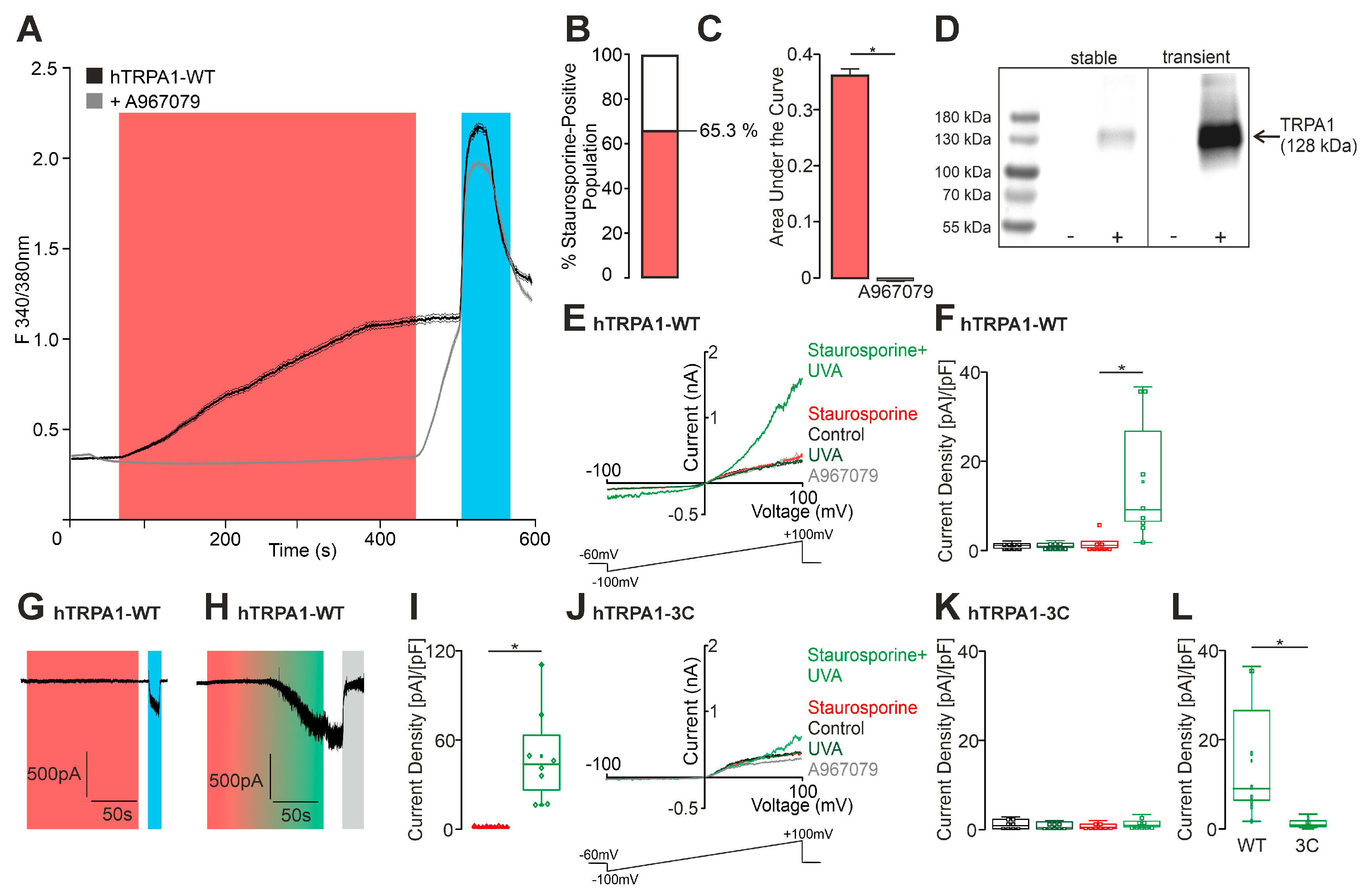
Staurosporine activates hTRPA1 in a UVA light-dependent manner. (A) Ratiometric calcium imaging of hTRPA1-expressing HEK293T cells showing the effect of staurosporine (100 nM, 360 s; red bar). The black trace represents the staurosporine condition (n = 1197, examined in 10 independent experiments), while the gray trace (n = 1037, examined in 10 independent experiments) shows the same protocol with concomitant application of the TRPA1 antagonist A967079. Carvacrol (300 µM, 60 s; blue bar) served as a positive control. Data are presented as mean ± S.E.M (shown as thin shaded traces). (B) Stacked bar chart summarizing the total population of hTRPA1-expressing HEK293T cells analyzed. The red portion indicates the fraction of cells responding to staurosporine. (C) Areas under the curve (AUCs) of staurosporine-evoked calcium responses (red) compared with co-application of A967079 (gray). Error bars represent S.E.M corresponding to data in panel A (ANOVA followed by Tukey’s HSD post hoc test). (D) Western blot analysis demonstrating TRPA1 expression in stably expressing HEK293 cells compared to parental HEK293 cells. TRPA1 expression in transiently transfected HEK293T cells is shown alongside the negative control (untransfected HEK293T). (E) Whole-cell patch clamp recordings using 500 ms voltage ramps from −100 to +100 mV during exposure to UVA light (dark green), staurosporine (100 nM; red trace, n = 7), and combined staurosporine + UVA light (green trace, n = 7). Each application lasted for 20 s. Mean capacitance: 12.9 ± 1.6 pF, mean access resistance: 8.7 ± 1.5 MΩs. (F) Current densities at −60 mV presented as box-and-scatter plots. A significant increase in current density was observed with the combined application of staurosporine and UVA light (n = 7, ANOVA with Tukey’s post hoc test). (G–I) Whole-cell patch clamp recordings of hTRPA1-expressing HEK293T cells at a holding potential of −60 mV with or without UVA light exposure. Mean capacitance: 13.9 ± 1.6 pF, mean access resistance: 7.5 ± 1.1 MΩ. (G) Staurosporine (100 nM, 120 s; red bar, n = 9) was applied before administration of carvacrol (300 µM; blue bar). (H) The experiment was repeated under UVA light illumination (red–green bar, n = 8). A967079 (100 nM; gray bar) was applied at the end of each experiment. (I) Box-and-scatter plot showing current densities for experiments in panels G and H, demonstrating a significant effect of UVA light on staurosporine responses (unpaired t-test). (J,K) The experiment shown in panel E was repeated using the ROS-insensitive TRPA1-3C mutant (n = 8). Mean capacitance: 16.8 ± 2.3 pF, mean access resistance: 8 ± 1.1 MΩ. (L) Box-and-scatter plot summarizing the responses of the mutant channel, demonstrating a significant reduction in staurosporine + UVA light-evoked currents compared with wild-type TRPA1 (unpaired t-test). * denotes p < 0.05. The box denotes the 50th percentile (median) as well as the 25th and 75th percentiles. The whiskers mark the 5th and 95 percentiles. Data points beyond the whiskers are outliers.
Figure 1.
Staurosporine activates hTRPA1 in a UVA light-dependent manner. (A) Ratiometric calcium imaging of hTRPA1-expressing HEK293T cells showing the effect of staurosporine (100 nM, 360 s; red bar). The black trace represents the staurosporine condition (n = 1197, examined in 10 independent experiments), while the gray trace (n = 1037, examined in 10 independent experiments) shows the same protocol with concomitant application of the TRPA1 antagonist A967079. Carvacrol (300 µM, 60 s; blue bar) served as a positive control. Data are presented as mean ± S.E.M (shown as thin shaded traces). (B) Stacked bar chart summarizing the total population of hTRPA1-expressing HEK293T cells analyzed. The red portion indicates the fraction of cells responding to staurosporine. (C) Areas under the curve (AUCs) of staurosporine-evoked calcium responses (red) compared with co-application of A967079 (gray). Error bars represent S.E.M corresponding to data in panel A (ANOVA followed by Tukey’s HSD post hoc test). (D) Western blot analysis demonstrating TRPA1 expression in stably expressing HEK293 cells compared to parental HEK293 cells. TRPA1 expression in transiently transfected HEK293T cells is shown alongside the negative control (untransfected HEK293T). (E) Whole-cell patch clamp recordings using 500 ms voltage ramps from −100 to +100 mV during exposure to UVA light (dark green), staurosporine (100 nM; red trace, n = 7), and combined staurosporine + UVA light (green trace, n = 7). Each application lasted for 20 s. Mean capacitance: 12.9 ± 1.6 pF, mean access resistance: 8.7 ± 1.5 MΩs. (F) Current densities at −60 mV presented as box-and-scatter plots. A significant increase in current density was observed with the combined application of staurosporine and UVA light (n = 7, ANOVA with Tukey’s post hoc test). (G–I) Whole-cell patch clamp recordings of hTRPA1-expressing HEK293T cells at a holding potential of −60 mV with or without UVA light exposure. Mean capacitance: 13.9 ± 1.6 pF, mean access resistance: 7.5 ± 1.1 MΩ. (G) Staurosporine (100 nM, 120 s; red bar, n = 9) was applied before administration of carvacrol (300 µM; blue bar). (H) The experiment was repeated under UVA light illumination (red–green bar, n = 8). A967079 (100 nM; gray bar) was applied at the end of each experiment. (I) Box-and-scatter plot showing current densities for experiments in panels G and H, demonstrating a significant effect of UVA light on staurosporine responses (unpaired t-test). (J,K) The experiment shown in panel E was repeated using the ROS-insensitive TRPA1-3C mutant (n = 8). Mean capacitance: 16.8 ± 2.3 pF, mean access resistance: 8 ± 1.1 MΩ. (L) Box-and-scatter plot summarizing the responses of the mutant channel, demonstrating a significant reduction in staurosporine + UVA light-evoked currents compared with wild-type TRPA1 (unpaired t-test). * denotes p < 0.05. The box denotes the 50th percentile (median) as well as the 25th and 75th percentiles. The whiskers mark the 5th and 95 percentiles. Data points beyond the whiskers are outliers.

Figure 2.
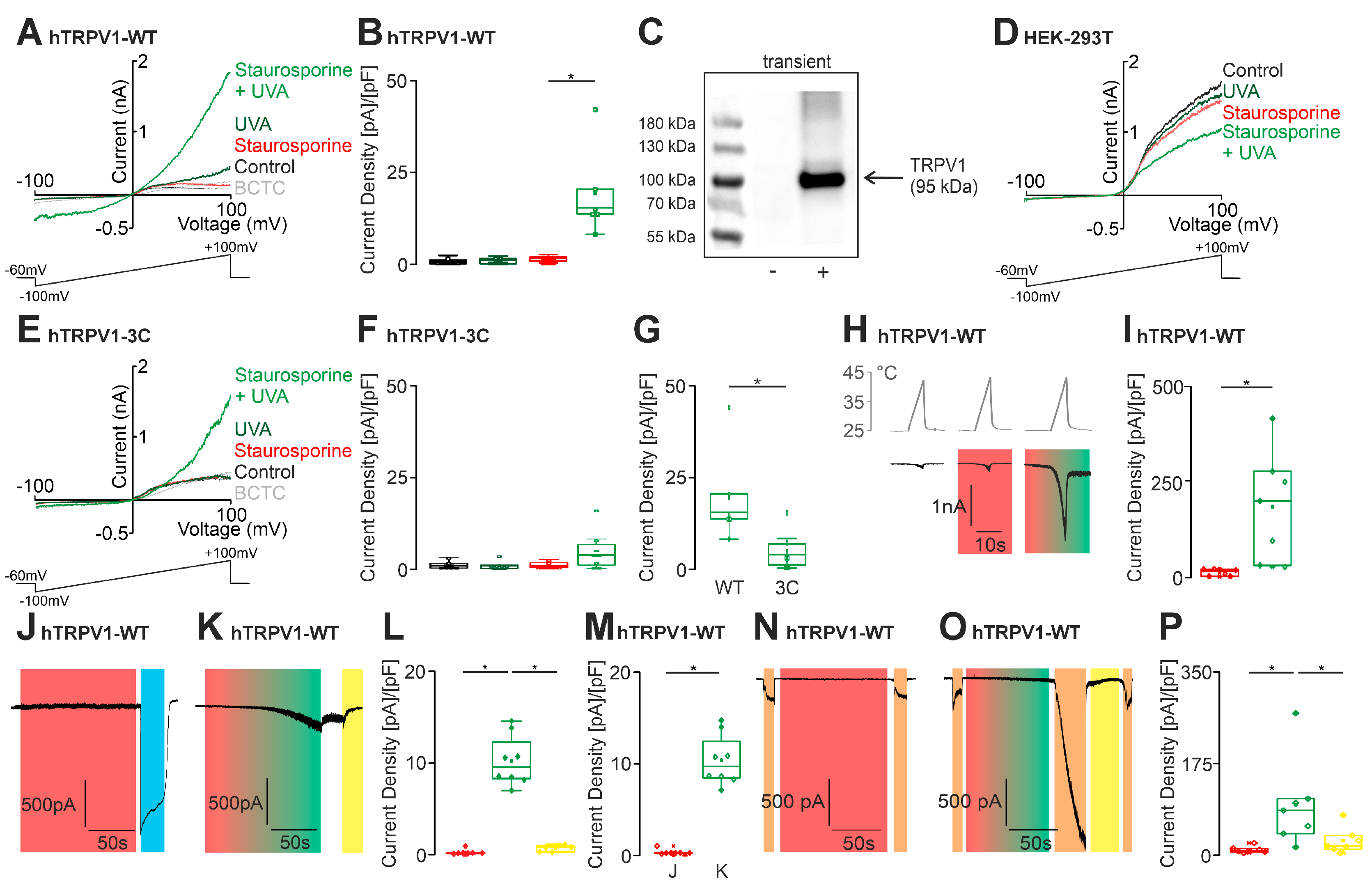
Staurosporine sensitizes hTRPV1 via ROS production. (A) Whole-cell recordings from hTRPV1-expressing HEK293T cells using voltage ramps from −100 to +100 mV. Cells were stimulated with UVA light alone (dark green), staurosporine (100 nM) alone (red trace, n = 8), or the combined application of staurosporine and UVA light (green trace, n = 8). Mean capacitance: 14.9 ± 2.1 pF, mean access resistance: 8.4 ± 1.6 MΩ. (B) Box-and-scatter plots of current densities at −60 mV corresponding to panel A. A significant increase in current density was observed with the combined staurosporine + UVA light stimulation (n = 8, ANOVA with Tukey’s post hoc test). (C) Western blot showing TRPV1 expression in transiently transfected HEK293T cells compared to untransfected HEK293T controls. (D) Voltage ramps (−100 to +100 mV) in parental HEK293T cells showing no changes in membrane currents upon administration of staurosporine and/or UVA light, using the same protocol as in panel A. Mean capacitance: 25.2 ± 2.6 pF, mean access resistance: 6.7 ± 1.2 MΩ. (E,F) The experiment described in panel A was repeated using the TRPV1-C158A/C767S/C387S mutant (n = 8). Mean capacitance: 15.5 ± 0.6 pF, mean access resistance: 7.9 ± 1.3 MΩ. (F) Box-and-scatter plots show no significant activation of the TRPV1-3C mutant by the combined application of staurosporine and UVA light (ANOVA with Tukey’s post hoc test). (G) Comparison of wild-type and TRPV1-3C mutant responses demonstrates a significant reduction in staurosporine + UVA light-evoked currents in the mutant channel (unpaired t-test). (H) Representative heat-ramp traces showing UVA light-dependent activation of hTRPV1 in the presence of staurosporine (red bar, n = 7). Staurosporine and UVA light were co-applied for 120 s (red-green bar, n = 7). Mean capacitance: 12.6 ± 2.1 pF, mean access resistance: 4.9 ± 0.6 MΩ. (I) Box-and-scatter plots corresponding to panel H (paired t-test). (J–M) Significant inward currents were observed during combined staurosporine + UVA-ligth application at a holding potential of –60 mV. Mean capacitance: 21.8 ± 4.2 pF, mean access resistance: 6.8 ± 0.9 MΩ−60 mV. (J) Staurosporine alone (100 nM, 120 s; red bar, n = 8). As a positive control the specific agonist capsaicin was applied (1 µM, 20 s, blue bar). (K) Same protocol with concurrent UVA light exposure (red-green bar); DTT was applied at the end of the protocol (yellow bar, n = 8). (L) Box-and-scatter plots of current densities corresponding to panel K (ANOVA with Tukey’s post hoc test). (M) Box-and-scatter plot of current densities from panels J and K (unpaired t-test). (N–P) Co-application of UVA light and staurosporine enhanced proton-evoked currents, an effect reversed by DTT. Mean capacitance: 17.5 ± 2.6 pF, mean access resistance: 7.4 ± 1.4 MΩ. (N) Staurosporine (red bar, 120 s) during repeated pH-evoked responses (10 s applications, pH 6.2; orange bars, n = 8). (O) Sensitization of pH-evoked currents during combined staurosporine + UVA light application (red-green bar, 90 s), which was prevented by DTT (yellow bar, 60 s; n = 8). (P) Box-and-scatter plots of current densities corresponding to panels M and N (ANOVA with Tukey’s post hoc test). * denotes p < 0.05. The box denotes the 50th percentile (median) as well as the 25th and 75th percentiles. The whiskers mark the 5th and 95 percentiles. Data points beyond the whiskers are outliers.
Figure 2.
Staurosporine sensitizes hTRPV1 via ROS production. (A) Whole-cell recordings from hTRPV1-expressing HEK293T cells using voltage ramps from −100 to +100 mV. Cells were stimulated with UVA light alone (dark green), staurosporine (100 nM) alone (red trace, n = 8), or the combined application of staurosporine and UVA light (green trace, n = 8). Mean capacitance: 14.9 ± 2.1 pF, mean access resistance: 8.4 ± 1.6 MΩ. (B) Box-and-scatter plots of current densities at −60 mV corresponding to panel A. A significant increase in current density was observed with the combined staurosporine + UVA light stimulation (n = 8, ANOVA with Tukey’s post hoc test). (C) Western blot showing TRPV1 expression in transiently transfected HEK293T cells compared to untransfected HEK293T controls. (D) Voltage ramps (−100 to +100 mV) in parental HEK293T cells showing no changes in membrane currents upon administration of staurosporine and/or UVA light, using the same protocol as in panel A. Mean capacitance: 25.2 ± 2.6 pF, mean access resistance: 6.7 ± 1.2 MΩ. (E,F) The experiment described in panel A was repeated using the TRPV1-C158A/C767S/C387S mutant (n = 8). Mean capacitance: 15.5 ± 0.6 pF, mean access resistance: 7.9 ± 1.3 MΩ. (F) Box-and-scatter plots show no significant activation of the TRPV1-3C mutant by the combined application of staurosporine and UVA light (ANOVA with Tukey’s post hoc test). (G) Comparison of wild-type and TRPV1-3C mutant responses demonstrates a significant reduction in staurosporine + UVA light-evoked currents in the mutant channel (unpaired t-test). (H) Representative heat-ramp traces showing UVA light-dependent activation of hTRPV1 in the presence of staurosporine (red bar, n = 7). Staurosporine and UVA light were co-applied for 120 s (red-green bar, n = 7). Mean capacitance: 12.6 ± 2.1 pF, mean access resistance: 4.9 ± 0.6 MΩ. (I) Box-and-scatter plots corresponding to panel H (paired t-test). (J–M) Significant inward currents were observed during combined staurosporine + UVA-ligth application at a holding potential of –60 mV. Mean capacitance: 21.8 ± 4.2 pF, mean access resistance: 6.8 ± 0.9 MΩ−60 mV. (J) Staurosporine alone (100 nM, 120 s; red bar, n = 8). As a positive control the specific agonist capsaicin was applied (1 µM, 20 s, blue bar). (K) Same protocol with concurrent UVA light exposure (red-green bar); DTT was applied at the end of the protocol (yellow bar, n = 8). (L) Box-and-scatter plots of current densities corresponding to panel K (ANOVA with Tukey’s post hoc test). (M) Box-and-scatter plot of current densities from panels J and K (unpaired t-test). (N–P) Co-application of UVA light and staurosporine enhanced proton-evoked currents, an effect reversed by DTT. Mean capacitance: 17.5 ± 2.6 pF, mean access resistance: 7.4 ± 1.4 MΩ. (N) Staurosporine (red bar, 120 s) during repeated pH-evoked responses (10 s applications, pH 6.2; orange bars, n = 8). (O) Sensitization of pH-evoked currents during combined staurosporine + UVA light application (red-green bar, 90 s), which was prevented by DTT (yellow bar, 60 s; n = 8). (P) Box-and-scatter plots of current densities corresponding to panels M and N (ANOVA with Tukey’s post hoc test). * denotes p < 0.05. The box denotes the 50th percentile (median) as well as the 25th and 75th percentiles. The whiskers mark the 5th and 95 percentiles. Data points beyond the whiskers are outliers.

Figure 3.
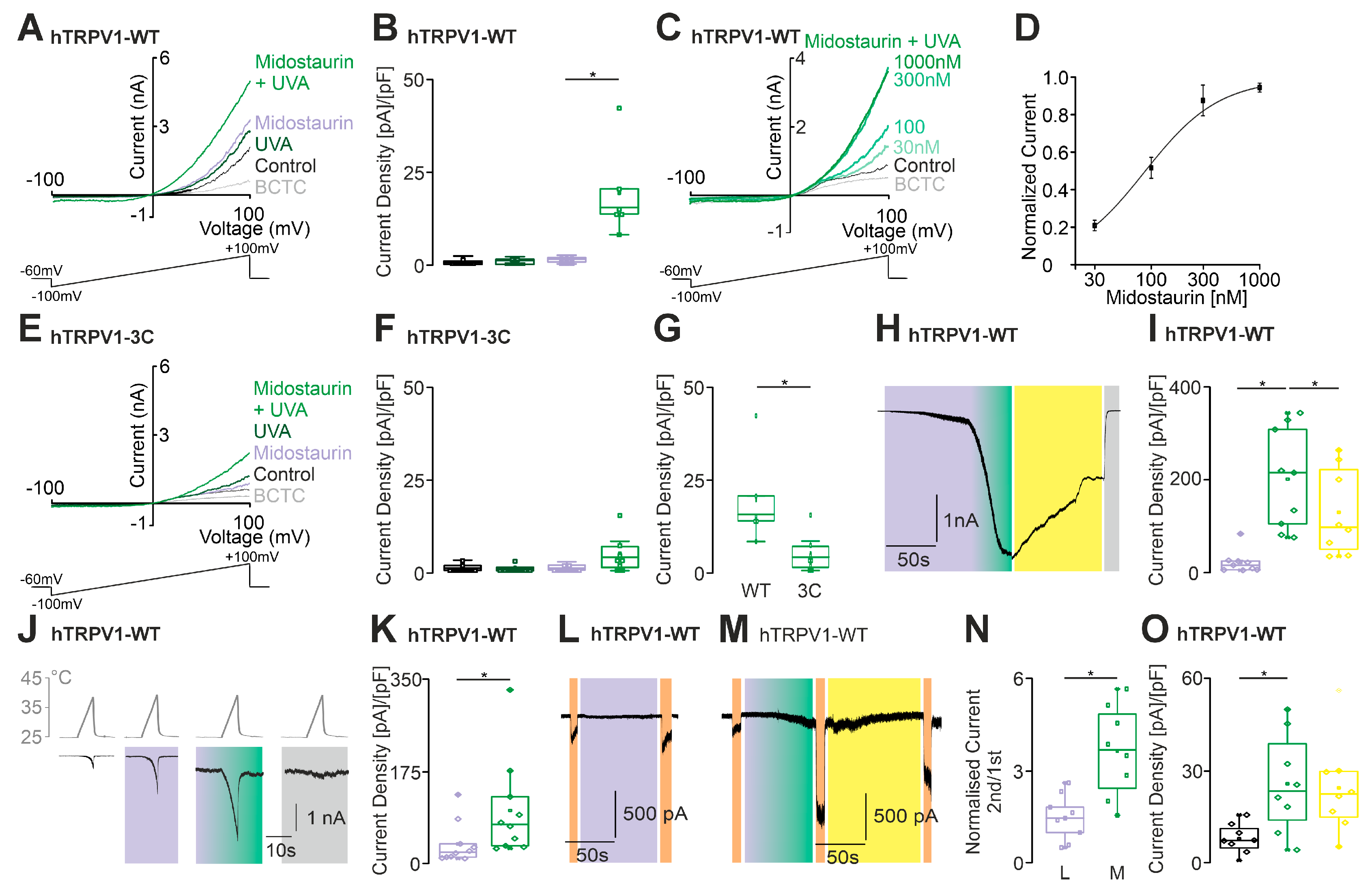
Midostaurin activates and sensitizes hTRPV1. (A) Whole-cell voltage–clamp recordings from hTRPV1-expressing HEK293T cells using voltage ramps from −100 to +100 mV. Cells were stimulated with UVA light alone (dark green), midostaurin (100 nM) alone (purple, n = 8), or midostaurin together with UVA light (green, n = 8). (B) Box-and-scatter plots of current densities at −60 mV corresponding to panel A. A significant increase in current density was observed for the combined midostaurin + UVA condition (ANOVA with Tukey’s post hoc test). (C) Increasing concentrations of midostaurin were applied during UVA light illumination (green traces; darker saturation indicates higher concentration, n = 8). The TRPV1 blocker BCTC (100 nM) was applied at the end (gray trace). (D) Concentration–response curve for midostaurin-induced activation of hTRPV1. Current amplitudes at +100 mV were normalized to the response evoked by 1000 µM midostaurin. The fitted curve represents a Hill model. (E–G) The experiment in panel A was repeated using the TRPV1-3C mutant (n = 6). (F) Box-and-scatter plots show no significant activation of the TRPV1-3C mutant by midostaurin + UVA light (ANOVA with Tukey’s post hoc test). (G) Comparison of wild-type and TRPV1-3C mutant responses reveals a significant reduction in midostaurin + UVA light-induced currents in the mutant (unpaired t-test). (H) Representative current trace showing UVA-dependent sensitization of midostaurin-induced currents (purple-green bar). DTT partially reversed the sensitization (yellow), and BCTC (100 nM; gry bar) completely inhibited the response (n = 9). (I) Box-and-scatter plots of current densities corresponding to panel H (ANOVA with Tukey’s post hoc test). (J,K) Heat-evoked currents in hTRPV1-expressing cells showing potentiation by midostaurin alone (purple bar) and by midostaurin + UVA light (purple–green bar, n = 10 each). BCTC (100 nM) abolished heat-evoked responses (gray). (K) Box-and-scatter plots corresponding to panel J (paired t-test). (L,M) Midostaurin alone (purple bar, 100 nM) or midostaurin + UVA light (purple-green bar) sensitized pH-evoked currents (pH 6.2; 10 s pulses, orange bars). Sensitization was partially reversible by DTT (10 mM; yellowbar, n = 9). (N) Box-and-scatter plots showing normalized pH-evoked currents corresponding to panels L and M. Second pH responses were normalized to the first pH pulse (unpaired t-test). (O) Box-and-scatter plots of current densities from the experiments shown in panel M (ANOVA with Tukey’s post hoc test). * denotes p < 0.05. The box denotes the 50th percentile (median) as well as the 25th and 75th percentiles. The whiskers mark the 5th and 95 percentiles. Data points beyond the whiskers are outliers.
Figure 3.
Midostaurin activates and sensitizes hTRPV1. (A) Whole-cell voltage–clamp recordings from hTRPV1-expressing HEK293T cells using voltage ramps from −100 to +100 mV. Cells were stimulated with UVA light alone (dark green), midostaurin (100 nM) alone (purple, n = 8), or midostaurin together with UVA light (green, n = 8). (B) Box-and-scatter plots of current densities at −60 mV corresponding to panel A. A significant increase in current density was observed for the combined midostaurin + UVA condition (ANOVA with Tukey’s post hoc test). (C) Increasing concentrations of midostaurin were applied during UVA light illumination (green traces; darker saturation indicates higher concentration, n = 8). The TRPV1 blocker BCTC (100 nM) was applied at the end (gray trace). (D) Concentration–response curve for midostaurin-induced activation of hTRPV1. Current amplitudes at +100 mV were normalized to the response evoked by 1000 µM midostaurin. The fitted curve represents a Hill model. (E–G) The experiment in panel A was repeated using the TRPV1-3C mutant (n = 6). (F) Box-and-scatter plots show no significant activation of the TRPV1-3C mutant by midostaurin + UVA light (ANOVA with Tukey’s post hoc test). (G) Comparison of wild-type and TRPV1-3C mutant responses reveals a significant reduction in midostaurin + UVA light-induced currents in the mutant (unpaired t-test). (H) Representative current trace showing UVA-dependent sensitization of midostaurin-induced currents (purple-green bar). DTT partially reversed the sensitization (yellow), and BCTC (100 nM; gry bar) completely inhibited the response (n = 9). (I) Box-and-scatter plots of current densities corresponding to panel H (ANOVA with Tukey’s post hoc test). (J,K) Heat-evoked currents in hTRPV1-expressing cells showing potentiation by midostaurin alone (purple bar) and by midostaurin + UVA light (purple–green bar, n = 10 each). BCTC (100 nM) abolished heat-evoked responses (gray). (K) Box-and-scatter plots corresponding to panel J (paired t-test). (L,M) Midostaurin alone (purple bar, 100 nM) or midostaurin + UVA light (purple-green bar) sensitized pH-evoked currents (pH 6.2; 10 s pulses, orange bars). Sensitization was partially reversible by DTT (10 mM; yellowbar, n = 9). (N) Box-and-scatter plots showing normalized pH-evoked currents corresponding to panels L and M. Second pH responses were normalized to the first pH pulse (unpaired t-test). (O) Box-and-scatter plots of current densities from the experiments shown in panel M (ANOVA with Tukey’s post hoc test). * denotes p < 0.05. The box denotes the 50th percentile (median) as well as the 25th and 75th percentiles. The whiskers mark the 5th and 95 percentiles. Data points beyond the whiskers are outliers.

Figure 4.
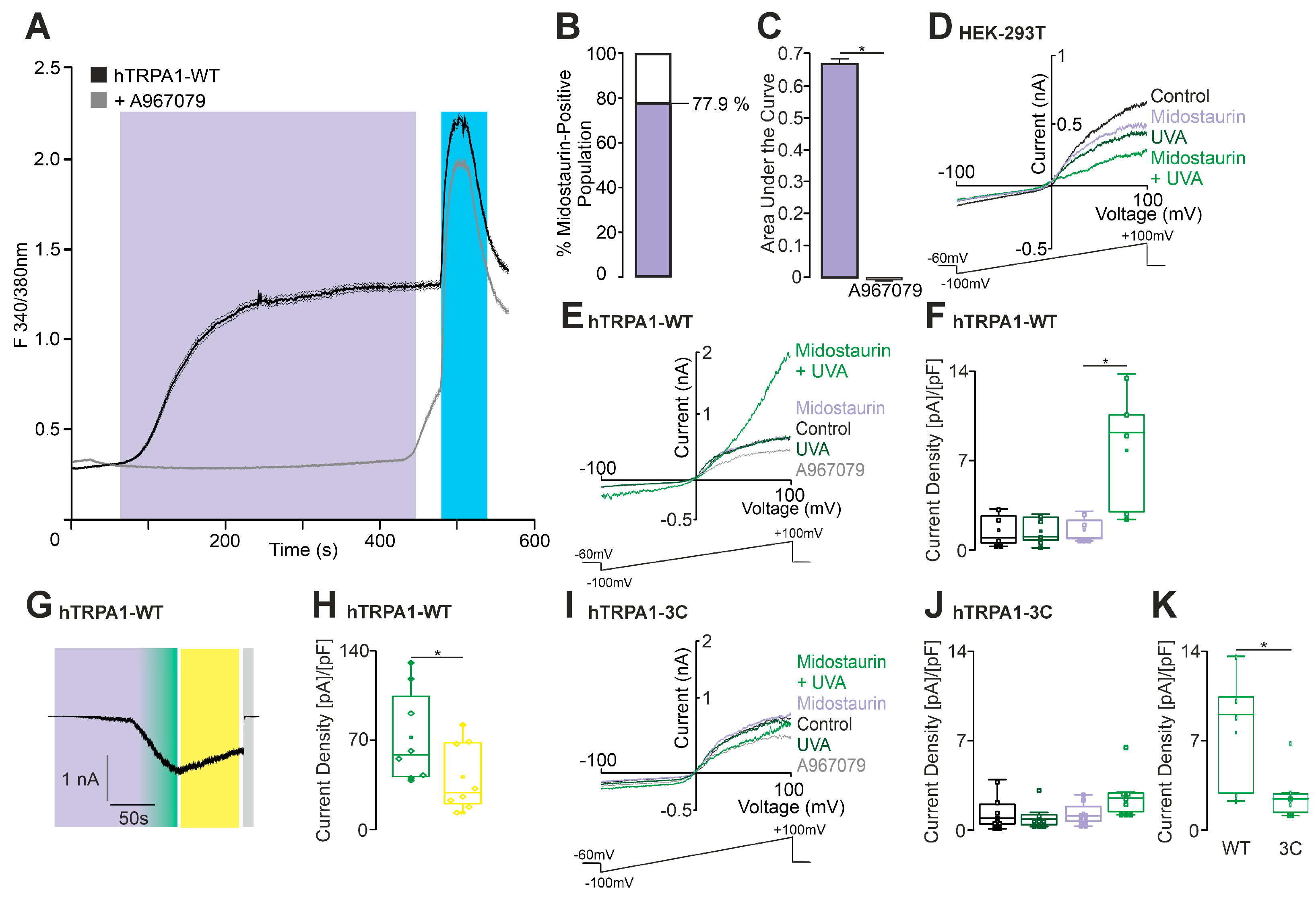
Midostaurin activates hTRPA1. (A) Ratiometric calcium imaging of hTRPA1-expressing HEK293T cells showing the effect of midostaurin (100 nM, 360 s; purple bar). The black trace shows the midostaurin condition (n = 839, examined in eight independent experiments), while the gray trace (n = 996, examined in eight independent experiments) represents the same protocol with concomitant application of the TRPA1-antagonist A967079. Carvacrol (300 µM, 60 s; blue bar) served as a positive control. Data are presented as mean ± S.E.M., shown as thin shaded traces. (B) Stacked bar chart summarizing the total hTRPA1-expressing HEK293T cell population analyzed. The purple portion indicates the fraction of cells responding to midostaurin. (C) Areas under the curve (AUCs) of midostaurin-evoked calcium signals (purple) compared with co-application of A967079 (gray). Error bars represent S.E.M. (ANOVA followed by Tukey’s HSD post hoc test; corresponds to data in panel A). (D) Voltage ramps (−100 to +100 mV) in parental HEK293T cells showing no change in membrane currents during application of midostaurin and/or UVA light. Mean capacitance: 18.1 ± 3.8 pF, mean access resistance: 6.2 ± 0.2 MΩ. (E) Whole-cell recordings from hTRPA1-expressing HEK293T cells using voltage ramps from −100 to +100 mV. Cells were stimulated with UVA light alone (dark green), midostaurin (100 nM) alone (purple, n = 8), or midostaurin together with UVA light (green, n = 8). Mean capacitance: 14.5 ± 2 pF, mean access resistance: 8.1 ± 0.7 MΩ. (F) Box-and-scatter plots showing current densities at −60 mV, corresponding to panel E. The combination of midostaurin + UVA light elicited a significant increase in current density (ANOVA with Tukey’s post hoc test). (G) Representative current trace showing potentiation of midostaurin-evoked inward currents by UVA light. Midostaurin (100 nM) was applied for 80 s (purple bar), followed by combined midostaurin + UVA light for 50 s (purple-green bar). Sensitization was partially reversible by DTT (10 mM; yellow bar). A967079 (100 nM; gray bar, n = 8) inhibited the response. Mean capacitance: 12.4 ± 1.2 pF, mean access resistance: 4.1 ± 0.9 MΩ. (H) Box-and-scatter plots showing current densities from panel G, demonstrating a significant effect of DTT on midostaurin + UVA light responses (paired t-test). (I,J) The experiment in panel E was repeated on the TRPA1-3C mutant (n = 6). Mean capacitance: 20.5 ± 2.1 pF, mean access resistance: 8.9 ± 1.4 MΩ. (J) Box-and-scatter plots show no significant activation of the TRPA1-3C mutant by midostaurin + UVA light (ANOVA with Tukey’s post hoc test). (K) Comparison of wild-type and TRPA1-3C mutant responses shows a significant reduction in midostaurin + UVA light-evoked currents in the mutant (unpaired t-test). * denotes p < 0.05. The box denotes the 50th percentile (median) as well as the 25th and 75th percentiles. The whiskers mark the 5th and 95 percentiles. Data points beyond the whiskers are outliers.
Figure 4.
Midostaurin activates hTRPA1. (A) Ratiometric calcium imaging of hTRPA1-expressing HEK293T cells showing the effect of midostaurin (100 nM, 360 s; purple bar). The black trace shows the midostaurin condition (n = 839, examined in eight independent experiments), while the gray trace (n = 996, examined in eight independent experiments) represents the same protocol with concomitant application of the TRPA1-antagonist A967079. Carvacrol (300 µM, 60 s; blue bar) served as a positive control. Data are presented as mean ± S.E.M., shown as thin shaded traces. (B) Stacked bar chart summarizing the total hTRPA1-expressing HEK293T cell population analyzed. The purple portion indicates the fraction of cells responding to midostaurin. (C) Areas under the curve (AUCs) of midostaurin-evoked calcium signals (purple) compared with co-application of A967079 (gray). Error bars represent S.E.M. (ANOVA followed by Tukey’s HSD post hoc test; corresponds to data in panel A). (D) Voltage ramps (−100 to +100 mV) in parental HEK293T cells showing no change in membrane currents during application of midostaurin and/or UVA light. Mean capacitance: 18.1 ± 3.8 pF, mean access resistance: 6.2 ± 0.2 MΩ. (E) Whole-cell recordings from hTRPA1-expressing HEK293T cells using voltage ramps from −100 to +100 mV. Cells were stimulated with UVA light alone (dark green), midostaurin (100 nM) alone (purple, n = 8), or midostaurin together with UVA light (green, n = 8). Mean capacitance: 14.5 ± 2 pF, mean access resistance: 8.1 ± 0.7 MΩ. (F) Box-and-scatter plots showing current densities at −60 mV, corresponding to panel E. The combination of midostaurin + UVA light elicited a significant increase in current density (ANOVA with Tukey’s post hoc test). (G) Representative current trace showing potentiation of midostaurin-evoked inward currents by UVA light. Midostaurin (100 nM) was applied for 80 s (purple bar), followed by combined midostaurin + UVA light for 50 s (purple-green bar). Sensitization was partially reversible by DTT (10 mM; yellow bar). A967079 (100 nM; gray bar, n = 8) inhibited the response. Mean capacitance: 12.4 ± 1.2 pF, mean access resistance: 4.1 ± 0.9 MΩ. (H) Box-and-scatter plots showing current densities from panel G, demonstrating a significant effect of DTT on midostaurin + UVA light responses (paired t-test). (I,J) The experiment in panel E was repeated on the TRPA1-3C mutant (n = 6). Mean capacitance: 20.5 ± 2.1 pF, mean access resistance: 8.9 ± 1.4 MΩ. (J) Box-and-scatter plots show no significant activation of the TRPA1-3C mutant by midostaurin + UVA light (ANOVA with Tukey’s post hoc test). (K) Comparison of wild-type and TRPA1-3C mutant responses shows a significant reduction in midostaurin + UVA light-evoked currents in the mutant (unpaired t-test). * denotes p < 0.05. The box denotes the 50th percentile (median) as well as the 25th and 75th percentiles. The whiskers mark the 5th and 95 percentiles. Data points beyond the whiskers are outliers.

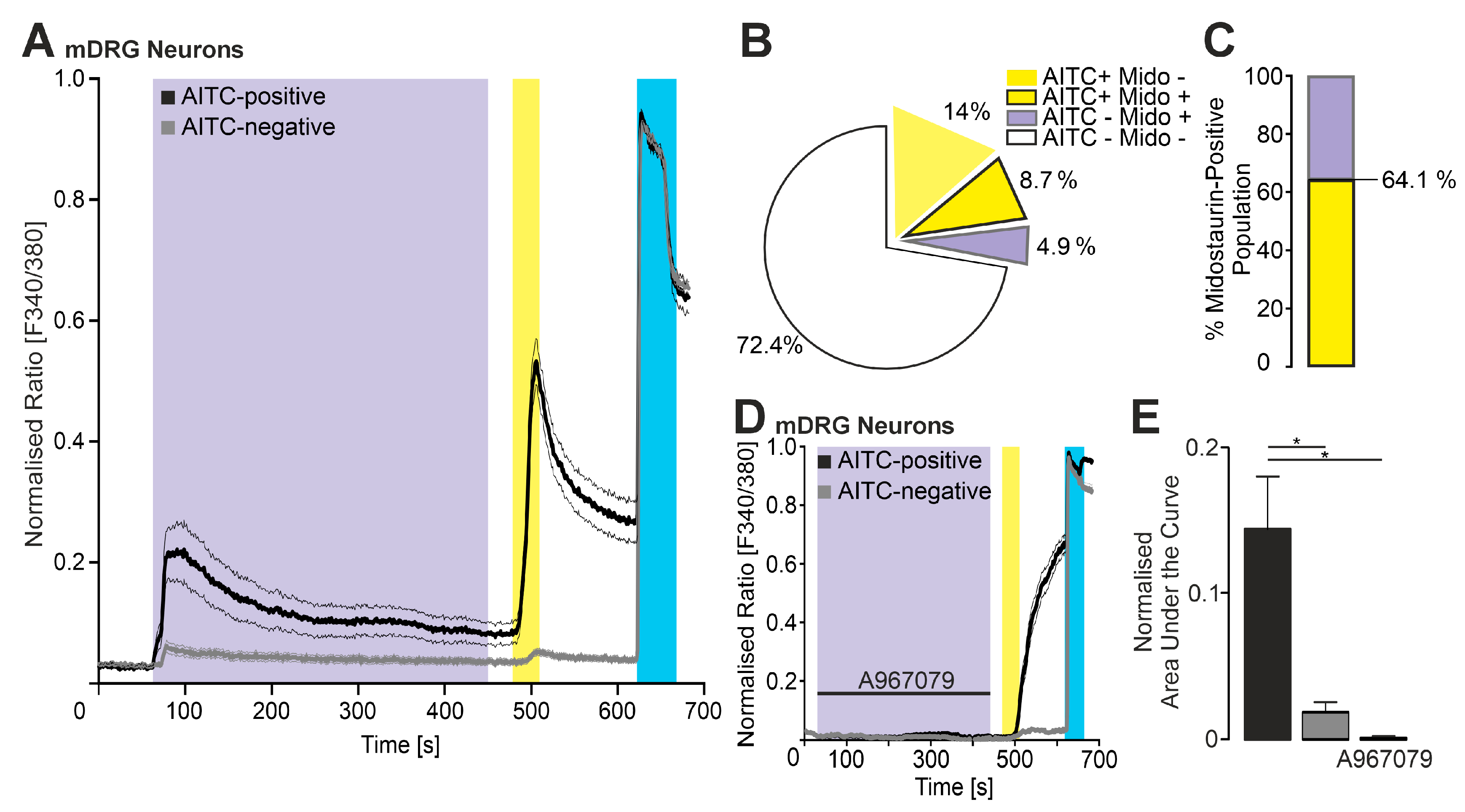
Figure 5.
Midostaurin activates mouse DRG neurons in a TRPA1-dependent manner. (A) Ratiometric calcium imaging showing midostaurin-induced increase in intracellular calcium (100 nM, 360 s; purple bar) in mouse DRG neurons (mDRGs). Neurons were classified based on their response to the TRPA1 agonist AITC (100 µM, 20 s; yellow bar) in TRPA1-expressing mDRGs (n = 65 cells in total, black trace) and non-TRPA1-expressing mDRGs (n = 221, from 7 independent measurements). Potassium chloride (60 mM, 60 s; blue bar) was applied as a positive control. (B) Pie chart summarizing the total population of mDRGs responding to AITC and/or midostaurine or irresponsive to both. (C) Stacked bar chart showing the whole proportion of midostaurine-responsive DRG neurons sorted by responsiveness to AITC. (D) Coapplication of midostaurine and the TRPA1-selective antagonist A967079 verifies TRPA1-dependent activation of mouse DRG neurons by midostaurin (black: AITC-positive mDRGs, n = 208; gray: AITC-negative mDRGs, n = 535, from 4 independent measurements). (E) Quantification of normalized areas under the curve (AUC) for midostaurin-evoked calcium responses under different conditions: AITC-positive neurons (black), AITC-negative neurons (gray), and midostaurin + A967079 (purple/gray). Error bars represent S.E.M. (ANOVA followed by Tukey’s HSD post hoc test; corresponds to data in panel A). * denotes p < 0.05. The box denotes the 50th percentile (median) as well as the 25th and 75th percentiles. The whiskers mark the 5th and 95 percentiles. Data points beyond the whiskers are outliers.
Figure 5.
Midostaurin activates mouse DRG neurons in a TRPA1-dependent manner. (A) Ratiometric calcium imaging showing midostaurin-induced increase in intracellular calcium (100 nM, 360 s; purple bar) in mouse DRG neurons (mDRGs). Neurons were classified based on their response to the TRPA1 agonist AITC (100 µM, 20 s; yellow bar) in TRPA1-expressing mDRGs (n = 65 cells in total, black trace) and non-TRPA1-expressing mDRGs (n = 221, from 7 independent measurements). Potassium chloride (60 mM, 60 s; blue bar) was applied as a positive control. (B) Pie chart summarizing the total population of mDRGs responding to AITC and/or midostaurine or irresponsive to both. (C) Stacked bar chart showing the whole proportion of midostaurine-responsive DRG neurons sorted by responsiveness to AITC. (D) Coapplication of midostaurine and the TRPA1-selective antagonist A967079 verifies TRPA1-dependent activation of mouse DRG neurons by midostaurin (black: AITC-positive mDRGs, n = 208; gray: AITC-negative mDRGs, n = 535, from 4 independent measurements). (E) Quantification of normalized areas under the curve (AUC) for midostaurin-evoked calcium responses under different conditions: AITC-positive neurons (black), AITC-negative neurons (gray), and midostaurin + A967079 (purple/gray). Error bars represent S.E.M. (ANOVA followed by Tukey’s HSD post hoc test; corresponds to data in panel A). * denotes p < 0.05. The box denotes the 50th percentile (median) as well as the 25th and 75th percentiles. The whiskers mark the 5th and 95 percentiles. Data points beyond the whiskers are outliers.






 ,
,