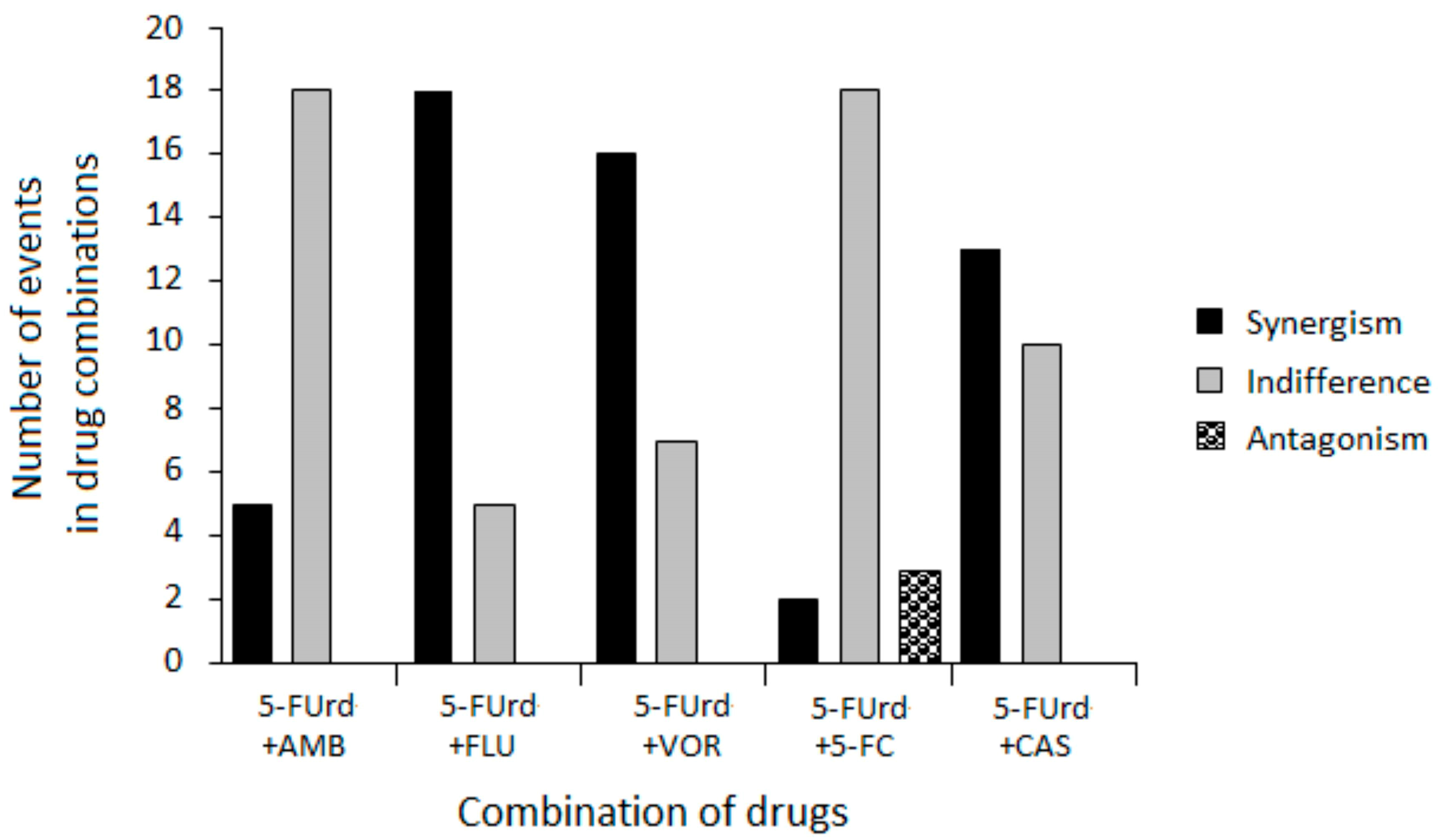
In Vitro Evaluation of 5-Fluorouridine as an Adjuvant to Antifungal Drugs and Molecular Insights into Resistance to This Compound in Candida Species
Abstract
1. Introduction
2. Results and Discussion
3. Materials and Methods
3.1. Microorganisms and Compounds
3.2. Antifungal Susceptibility Testing
3.3. Determination of Fractional Inhibitory Concentration Index (FICI)
3.4. Efflux Pump Activity
4. Conclusions
Author Contributions
Funding
Institutional Review Board Statement
Informed Consent Statement
Data Availability Statement
Conflicts of Interest
References
- Lass-Flörl, C.; Kanj, S.S.; Govender, N.P.; Thompson, G.R., 3rd; Ostrosky-Zeichner, L.; Govrins, M.A. Invasive candidiasis. Nat. Rev. Dis. Primers 2024, 10, 20. [Google Scholar] [CrossRef]
- McCarty, T.P.; White, C.M.; Pappas, P.G. Candidemia and Invasive Candidiasis. Infect. Dis. Clin. N. Am. 2021, 35, 389–413. [Google Scholar] [CrossRef]
- Schroeder, J.A.; Wilson, C.M.; Pappas, P.G. Invasive Candidiasis. Infect. Dis. Clin. N. Am. 2025, 39, 93–119. [Google Scholar] [CrossRef]
- Abdel-Hamid, R.M.; El-Mahallawy, H.A.; Abdelfattah, N.E.; Wassef, M.A. The impact of increasing non-albicans Candida trends on diagnostics in immunocompromised patients. Braz. J. Microbiol. 2023, 54, 2879–2892. [Google Scholar] [CrossRef]
- Sadeghi, G.; Ebrahimi-Rad, M.; Mousavi, S.F.; Shams-Ghahfarokhi, M.; Razzaghi-Abyaneh, M. Emergence of non-Candida albicans species: Epidemiology, phylogeny and fluconazole susceptibility profile. J. Mycol. Med. 2018, 28, 51–58. [Google Scholar] [CrossRef] [PubMed]
- Puumala, E.; Fallah, S.; Robbins, N.; Cowen, L.E. Advancements and challenges in antifungal therapeutic development. Clin. Microbiol. Rev. 2024, 37, e00142-23. [Google Scholar] [CrossRef]
- Lee, Y.; Puumala, E.; Robbins, N.; Cowen, L.E. Antifungal Drug Resistance: Molecular Mechanisms in Candida albicans and Beyond. Chem. Rev. 2021, 121, 3390–3411. [Google Scholar] [CrossRef] [PubMed]
- Neoh, C.F.; Slavin, M.A. Reassessment of the role of combination antifungal therapy in the current era. Curr. Opin. Infect. Dis. 2024, 37, 443–450. [Google Scholar] [CrossRef] [PubMed]
- Kriegl, L.; Egger, M.; Boyer, J.; Hoenigl, M.; Krause, R. New treatment options for critically important WHO fungal priority pathogens. Clin. Microbiol. Infect. 2025, 31, 922–930. [Google Scholar] [CrossRef]
- Carrillo-Muñoz, A.J.; Finquelievich, J.; Tur-Tur, C.; Eraso, E.; Jauregizar, N.; Quindós, G.; Giusiano, G. Combination antifungal therapy: A strategy for the management of invasive fungal infections. Rev. Esp. Quimioter. 2014, 27, 141–158. [Google Scholar]
- Cui, J.; Ren, B.; Tong, Y.; Dai, H.; Zhang, L. Synergistic combinations of antifungals and anti-virulence agents to fight against Candida albicans. Virulence 2015, 6, 362–371. [Google Scholar] [CrossRef]
- Khalifa, H.O.; Majima, H.; Watanabe, A.; Kamei, K. In Vitro Characterization of Twenty-One Antifungal Combinations against Echinocandin-Resistant and -Susceptible Candida glabrata. J. Fungi 2021, 7, 108. [Google Scholar] [CrossRef]
- Liu, S.; Hou, Y.; Chen, X.; Gao, Y.; Li, H.; Sun, S. Combination of fluconazole with non-antifungal agents: A promising approach to cope with resistant Candida albicans infections and insight into new antifungal agent discovery. Int. J. Antimicrob. Agents 2014, 43, 395–402. [Google Scholar] [CrossRef]
- Lu, H.; Shrivastava, M.; Whiteway, M.; Jiang, Y. Candida albicans targets that potentially synergize with fluconazole. Crit. Rev. Microbiol. 2021, 47, 323–337. [Google Scholar] [CrossRef]
- Bezerra, L.P.; Silva, A.F.; Santos-Oliveira, R.; Alencar, L.M.; Amaral, J.L.; Neto, N.A.; Silva, R.G.; Belém, M.O.; de Andrade, C.R.; Oliveira, J.T.; et al. Combined antibiofilm activity of synthetic peptides and antifungal drugs against Candida spp. Future Microbiol. 2022, 17, 1133–1146. [Google Scholar] [CrossRef]
- Parker, R.A.; Gabriel, K.T.; Graham, K.D.; Butts, B.K.; Cornelison, C.T. Antifungal Activity of Select Essential Oils against Candida auris and Their Interactions with Antifungal Drugs. Pathogens 2022, 11, 821. [Google Scholar] [CrossRef] [PubMed]
- Vitale, R.G. Role of Antifungal Combinations in Difficult to Treat Candida Infections. J. Fungi 2021, 7, 731. [Google Scholar] [CrossRef]
- Lenarczyk, E.; Oleksiak, D.; Janeczko, M. Antifungal Activity of 5-Fluorouridine Against Candida albicans and Candida parapsilosis Based on Virulence Reduction. Molecules 2025, 30, 2735. [Google Scholar] [CrossRef] [PubMed]
- Huang, C.Y.; Chen, Y.C.; Wu-Hsieh, B.A.; Fang, J.M.; Chang, Z.F. The Ca-loop in thymidylate kinase is critical for growth and contributes to pyrimidine drug sensitivity of Candida albicans. J. Biol. Chem. 2019, 294, 10686–10697. [Google Scholar] [CrossRef]
- Zhu, P.; Li, Y.; Guo, T.; Liu, S.; Tancer, R.J.; Hu, C.; Zhao, C.; Xue, C.; Liao, G. New antifungal strategies: Drug combination and co-delivery. Adv. Drug Deliv. Rev. 2023, 198, 114874. [Google Scholar] [CrossRef] [PubMed]
- Diekema, D.; Arbefeville, S.; Boyken, L.; Kroeger, J.; Pfaller, M. The changing epidemiology of healthcare-associated candidemia over three decades. Diagn. Microbiol. Infect. Dis. 2012, 73, 45–48. [Google Scholar] [CrossRef]
- Dawoud, A.M.; Saied, S.A.; Torayah, M.M.; Ramadan, A.E.; Elaskary, S.A. Antifungal susceptibility and virulence determinants profile of candida species isolated from patients with candidemia. Sci. Rep. 2024, 14, 11597. [Google Scholar] [CrossRef]
- Tkaczyk, M.; Kuśka-Kielbratowska, A.; Fiegler-Rudol, J.; Niemczyk, W.; Mertas, A.; Skaba, D.; Wiench, R. The Prevalence and Drug Susceptibility of Candida Species and an Analysis of Risk Factors for Oral Candidiasis-A Retrospective Study. Antibiotics 2025, 14, 876. [Google Scholar] [CrossRef]
- Du, H.; Bing, J.; Hu, T.; Ennis, C.L.; Nobile, C.J.; Huang, G. Candida auris: Epidemiology, biology, antifungal resistance, and virulence. PLoS Pathog. 2020, 16, e1008921. [Google Scholar] [CrossRef]
- Eix, E.F.; Nett, J.E. Candida auris: Epidemiology and Antifungal Strategy. Annu. Rev. Med. 2025, 76, 57–67. [Google Scholar] [CrossRef]
- Olender, A.; Bogut, A.; Dąbrowski, W.; Pietrzak, D.J.; Szukała, M.; Wójtowicz-Bobin, M.; Kubera, D.; Dróżdż, A.; Stepulak, A.; Gagoś, M. Analysis of Antifungal Drug Resistance Among Candida Spp. and Other Pathogenic Yeasts Isolated from Patients in Eastern Poland: Diagnostic Problems. Infect. Drug Resist. 2025, 18, 2187–2199. [Google Scholar] [CrossRef] [PubMed]
- Lagunes, L.; Rello, J. Invasive candidiasis: From mycobiome to infection, therapy, and prevention. Eur. J. Clin. Microbiol. Infect. Dis. 2016, 35, 1221–1226. [Google Scholar] [CrossRef]
- Yousfi, H.; Cassagne, C.; Ranque, S.; Rolain, J.M.; Bittar, F. Repurposing of Ribavirin as an Adjunct Therapy against Invasive Candida Strains in an In Vitro Study. Antimicrob. Agents Chemother. 2019, 63, e00263-19. [Google Scholar] [CrossRef] [PubMed]
- Zhang, M.; Yan, H.; Lu, M.; Wang, D.; Sun, S. Antifungal activity of ribavirin used alone or in combination with fluconazole against Candida albicans is mediated by reduced virulence. Int. J. Antimicrob. Agents 2020, 55, 105804, Erratum in Int. J. Antimicrob. Agents 2020, 55, 105917. [Google Scholar] [CrossRef] [PubMed]
- Wang, Y.; Yan, H.; Li, J.; Zhang, Y.; Wang, Z.; Sun, S. Antifungal activity and potential mechanism of action of caspofungin in combination with ribavirin against Candida albicans. Int. J. Antimicrob. Agents 2023, 61, 106709. [Google Scholar] [CrossRef]
- Sigera, L.S.M.; Denning, D.W. Flucytosine and its clinical usage. Ther. Adv. Infect. Dis. 2023, 10, 20499361231161387. [Google Scholar] [CrossRef]
- Schwarz, P.; Dromer, F.; Lortholary, O.; Dannaoui, E. In vitro interaction of flucytosine with conventional and new antifungals against Cryptococcus neoformans clinical isolates. Antimicrob. Agents Chemother. 2003, 47, 3361–3364. [Google Scholar] [CrossRef]
- Fioriti, S.; Brescini, L.; Pallotta, F.; Canovari, B.; Morroni, G.; Barchiesi, F. Antifungal Combinations against Candida Species: From Bench to Bedside. J. Fungi 2022, 8, 1077. [Google Scholar] [CrossRef]
- Dannaoui, E.; Lortholary, O.; Dromer, F. In vitro evaluation of double and triple combinations of antifungal drugs against Aspergillus fumigatus and Aspergillus terreus. Antimicrob. Agents Chemother. 2004, 48, 970–978. [Google Scholar] [CrossRef]
- Vermes, A.; Guchelaar, H.J.; Dankert, J. Flucytosine: A review of its pharmacology, clinical indications, pharmacokinetics, toxicity and drug interactions. J. Antimicrob. Chemother. 2000, 46, 171–179. [Google Scholar] [CrossRef] [PubMed]
- Ryder, N.S.; Leitner, I. Synergistic interaction of terbinafine with triazoles or amphotericin B against Aspergillus species. Med. Mycol. 2001, 39, 91–95. [Google Scholar] [CrossRef]
- Mosquera, J.; Sharp, A.; Moore, C.B.; Warn, P.A.; Denning, D.W. In vitro interaction of terbinafine with itraconazole, fluconazole, amphotericin B and 5-flucytosine against Aspergillus spp. J. Antimicrob. Chemother. 2002, 50, 189–194. [Google Scholar] [CrossRef]
- Bidaud, A.; Schwarz, P.; Chowdhary, A.; Dannaou, E. In Vitro Antifungal Combination of Terbinafine with Itraconazole against Isolates of Trichophyton Species. Antimicrob. Agents Chemother. 2022, 66, e01449-21. [Google Scholar] [CrossRef] [PubMed]
- Biancalana, F.S.; Lyra, L.; Schreiber, A.Z. In vitro evaluation of the type of interaction obtained by the combination of terbinafine and itraconazole, voriconazole, or amphotericin B against dematiaceous molds. Antimicrob. Agents Chemother. 2011, 55, 4485–4487. [Google Scholar] [CrossRef]
- Meletiadis, J.; Mouton, J.W.; Meis, J.F.; Verweij, P.E. In vitro drug interaction modeling of combinations of azoles with terbinafine against clinical Scedosporium prolificans isolates. Antimicrob. Agents Chemother. 2003, 47, 106–117. [Google Scholar] [CrossRef] [PubMed]
- Vishwakarma, M.; Haider, T.; Soni, V. Update on fungal lipid biosynthesis inhibitors as antifungal agents. Microbiol. Res. 2024, 278, 127517. [Google Scholar] [CrossRef] [PubMed]
- Greenhalgh, D.A.; Parish, J.H. Effects of 5-fluorouracil on cytotoxicity and RNA metabolism in human colonic carcinoma cells. Cance. Chemother. Pharmacol. 1989, 25, 37–44. [Google Scholar] [CrossRef]
- Yusefi, M.; Shameli, K.; Jahangirian, H.; Teow, S.Y.; Umakoshi, H.; Saleh, B.; Rafiee-Moghaddam, R.; Webster, T.J. The Potential Anticancer Activity of 5-Fluorouracil Loaded in Cellulose Fibers Isolated from Rice Straw. Int. J. Nanomed. 2020, 15, 5417–5432. [Google Scholar] [CrossRef]
- Lamberti, M.; Porto, S.; Marra, M.; Zappavigna, S.; Grimaldi, A.; Feola, D.; Pesce, D.; Naviglio, S.; Spina, A.; Sannolo, N.; et al. 5-Fluorouracil induces apoptosis in rat cardiocytes through intracellular oxidative stress. J. Exp. Clin. Cancer Res. 2012, 31, 60. [Google Scholar] [CrossRef]
- Focaccetti, C.; Bruno, A.; Magnani, E.; Bartolini, D.; Principi, E.; Dallaglio, K.; Bucci, E.O.; Finzi, G.; Sessa, F.; Noonan, D.M.; et al. Effects of 5-fluorouracil on morphology, cell cycle, proliferation, apoptosis, autophagy and ROS production in endothelial cells and cardiomyocytes. PLoS ONE 2015, 10, e0115686. [Google Scholar] [CrossRef]
- Midena, E.; Lazzarini, D.; Catania, A.G.; Moretto, E.; Fregona; Parrozzani, R. Cytostatic and cytotoxic effects of 5-fluorouracil on human corneal epithelial cells and keratocytes. Cornea 2013, 32, 338–344. [Google Scholar] [CrossRef]
- Armstrong, R.D.; Takimoto, C.H.; Cadman, E.C. Fluoropyrimidine-mediated changes in small nuclear RNA. J. Biol. Chem. 1986, 261, 21–24. [Google Scholar] [CrossRef]
- Kanzawa, F.; Hoshi, A.; Kuretani, K. Mechanism of cytotoxicity of 5-fluorouracil: Distinction between the irreversible cytotoxic effect of 5-fluorouridine and the reversible cytotoxic effect of 5-fluoro-2’-deoxyuridine on murine lymphoma L5178Y cells in culture. J. Cancer Res. Clin. Oncol. 1980, 98, 85–90. [Google Scholar] [CrossRef] [PubMed]
- Heimer, R.; Sartorelli, A.C. RNA polymerase II transcripts as targets for 5-fluorouridine cytotoxicity: Antagonism of 5-fluorouridine actions by alpha-amanitin. Cancer Chemother. Pharmacol. 1989, 24, 80–86. [Google Scholar] [CrossRef] [PubMed]
- Armstrong, R.D.; Cadman, E. 5’-Deoxy-5-fluorouridine selective toxicity for human tumor cells compared to human bone marrow. Cancer Res. 1983, 43, 2525–2528. [Google Scholar]
- Guinea, J.; Sánchez-Somolinos, M.; Cuevas, O.; Peláez, T.; Bouza, E. Fluconazole resistance mechanisms in Candida krusei: The contribution of efflux-pumps. Med. Mycol. 2006, 44, 575–578. [Google Scholar] [CrossRef] [PubMed]
- Vega-Chacón, Y.; de Albuquerque, M.C.; Pavarina, A.C.; Goldman, G.H.; Mima, E.G.O. Verapamil inhibits efflux pumps in Candida albicans, exhibits synergism with fluconazole, and increases survival of Galleria mellonella. Virulence 2021, 12, 231–243. [Google Scholar] [CrossRef] [PubMed]
- Holmes, A.R.; Cardno, T.S.; Strouse, J.J.; Ivnitski-Steele, I.; Keniya, M.V.; Lackovic, K.; Monk, B.C.; Sklar, L.A.; Cannon, R.D. Targeting efflux pumps to overcome antifungal drug resistance. Future Med. Chem. 2016, 8, 1485–1501. [Google Scholar] [CrossRef]
- CLSI M27-A3; Reference Method for Broth Dilution Antifungal Susceptibility Testing of Yeasts, 3rd ed. Clinical and Laboratory Standards Institute (CLSI): Berwyn, PA, USA, 2008.
- Khabnadideh, S.; Rezaei, Z.; Pakshir, K.; Zomorodian, K.; Ghafari, N. Synthesis and antifungal activity of benzimidazole, benzotriazole and aminothiazole derivatives. Res. Pharm. Sci. 2012, 7, 65–72. [Google Scholar]
- Odds, F.C. Synergy, antagonism, and what the chequerboard puts between them. J. Antimicrob. Chemother. 2003, 52, 1. [Google Scholar] [CrossRef] [PubMed]


| Candida Species | MIC (µg/mL) | |||||
|---|---|---|---|---|---|---|
| 5-FUrd | AMB | FLU | VOR | 5-FC | CAS | |
| C. albicans ATCC 10231 | 0.4 | 3.2 | 204.8 | 102.4 | 0.4 | 0.4 |
| C. auris ATCC MYA-5001 | 409.6 | 409.6 | 1.6 | 0.4 | 1.6 | 0.8 |
| C. albicans ATCC 90028 | 0.8 | 204.8 | 409.6 | 102.4 | 102.4 | 0.8 |
| C. albicans ATCC 90029 | 204.8 | 204.8 | 409.6 | 409.6 | 204.8 | 6.4 |
| C. glabrata ATCC 15126 | 12.8 | 12.8 | 6.4 | 0.05 | 0.02 | 0.05 |
| C. krusei ATCC 14243 | 6.4 | 12.8 | 25.6 | 0.4 | 12.8 | 0.8 |
| C. parapsilosis ATCC 22099 | 0.2 | 12.8 | 6.4 | 1.6 | 12.8 | 0.8 |
| C. tropicalis ATCC 13803 | 51.2 | 6.4 | 12.6 | 0.4 | 0.05 | 0.05 |
| C. lusitaniae ATCC 34449 | 51.2 | 12.8 | 1.6 | 0.02 | 0.05 | 0.4 |
| C. kefyr ATCC 204093 | 51.2 | 51.2 | 0.1 | 0.8 | 0.4 | 0.8 |
| C. norvegensis ATCC 22977 | 25.6 | 6.4 | 51.2 | 0.8 | 25.6 | 0.8 |
| Candida Species | Drug Combination | FICA | FICB | FICI | Interpretation |
|---|---|---|---|---|---|
| C. albicans ATCC 10231 | 5-FUrd + AMB 5-FUrd + FLU 5-FUrd + VOR 5-FUrd + 5-FC 5-FUrd + CAS | 1 0.03 0.03 2 0.125 | 1 0.25 0.25 1 0.25 | 2 0.28 0.28 3 0.375 | Indifference Synergism Synergism Indifference Synergism |
| C. albicans ATCC 90028 | 5-FUrd + AMB 5-FUrd + FLU 5-FUrd + VOR 5-FUrd + 5-FC 5-FUrd + CAS | 1 0.25 0.125 0.5 0.125 | 1 0.015 0.062 1 0.5 | 2 0.265 0.187 1.5 0.65 | Indifference Synergism Synergism Indifference Indifference |
| C. glabrata ATCC 15126 | 5-FUrd + AMB 5-FUrd + FLU 5-FUrd + VOR 5-FUrd + 5-FC 5-FUrd + CAS | 0.5 0.5 1 0.25 0.125 | 0.5 1 1 0.5 1 | 1 1.5 2 0.75 1.125 | Indifference Indifference Indifference Indifference Indifference |
| C. krusei ATCC 14243 | 5-FUrd + AMB 5-FUrd + FLU 5-FUrd + VOR 5-FUrd + 5-FC 5-FUrd + CAS | 2 0.5 1 0.5 0.125 | 1 0.5 1 0.25 0.5 | 3 1 2 0.75 0.625 | Indifference Indifference Indifference Indifference Indifference |
| C. parapsilosis ATCC 22099 | 5-FUrd +AMB 5-FUrd + FLU 5-FUrd + VOR 5-FUrd + 5-FC 5-FUrd + CAS | 0.5 1 1 1 0.5 | 0.25 2 2 0.5 0.5 | 0.75 3 3 1.5 1 | Indifference Indifference Indifference Indifference Indifference |
| C. tropicalis ATCC 13803 | 5-FUrd +AMB 5-FUrd + FLU 5-FUrd + VOR 5-FUrd + 5-FC 5-FUrd + CAS | 1 0.5 1 0.25 0.031 | 1 2 1 1 0.5 | 2 2.5 2 1.25 0.531 | Indifference Indifference Indifference Indifference Indifference |
| C. lusitaniae ATCC 34449 | 5-FUrd +AMB 5-FUrd + FLU 5-FUrd + VOR 5-FUrd + 5-FC 5-FUrd + CAS | 1 1 1 1 1 | 1 2 2 2 1 | 2 3 3 3 2 | Indifference Indifference Indifference Indifference Indifference |
| C. kefyr ATCC 204093 | 5-FUrd +AMB 5-FUrd + FLU 5-FUrd + VOR 5-FUrd + 5-FC 5-FUrd + CAS | 1 1 1 0.125 0.031 | 0.5 3 1 0.5 0.1 | 1.5 4 2 0.625 0.131 | Indifference Indifference Indifference Indifference Synergism |
| C. norvegensis ATCC 22977 | 5-FUrd +AMB 5-FUrd + FLU 5-FUrd + VOR 5-FUrd + 5-FC 5-FUrd + CAS | 1 1 1 1 0.062 | 1 1 1 0.25 0.1 | 2 2 2 1.25 0.162 | Indifference Indifference Indifference Indifference Synergism |
| Number of Clinical C. albicans Strain | MIC (µg/mL) | |||||
|---|---|---|---|---|---|---|
| 5-FUrd | AMB | FLU | VOR | 5-FC | CAS | |
| 1 | 0.1 | 1.6 | 409.6 | 204.8 | 0.1 | 0.8 |
| 2 | 0.1 | 25.6 | 409.6 | 204.8 | 0.4 | 0.4 |
| 3 | 0.1 | 12.8 | 3.2 | 102.4 | 0.1 | 0.2 |
| 4 | 0.2 | 51.2 | 409.6 | 204.8 | 0.2 | 0.2 |
| 5 | 0.4 | 12.8 | 204.8 | 409.6 | 0.8 | 0.8 |
| 6 | 0.4 | 25.6 | 409.6 | 204.8 | 0.4 | 0.2 |
| 7 | 0.4 | 25.6 | 409.6 | 204.8 | 0.4 | 0.4 |
| 8 | 0.4 | 51.2 | 204.8 | 204.8 | 0.4 | 0.4 |
| 9 | 0.4 | 1.6 | 409.6 | 204.8 | 0.8 | 1.6 |
| 10 | 12.8 | 1.6 | 0.8 | 0.1 | 0.1 | 0.4 |
| 11 | 1.6 | 51.2 | 409.6 | 51.2 | 1.6 | 3.2 |
| 12 | 12.8 | 12.8 | 3.2 | 0.1 | 0.1 | 0.8 |
| 13 | 0.1 | 25.6 | 409.6 | 204.8 | 0.4 | 0.4 |
| 14 | 0.2 | 25.6 | 409.6 | 204.8 | 0.4 | 0.4 |
| 15 | 0.8 | 12.8 | 409.6 | 204.8 | 0.4 | 0.8 |
| 16 | 0.4 | 25.6 | 409.6 | 204.8 | 0.4 | 0.8 |
| 17 | 12.8 | 25.6 | 12.5 | 12.5 | 0.4 | 1.6 |
| 18 | 1.6 | 12.8 | 6.4 | 12.8 | 0.8 | 0.2 |
| 19 | 1.6 | 12.8 | 12.8 | 102.4 | 0.4 | 0.2 |
| 20 | 0.1 | 51.2 | 409.6 | 204.8 | 0.4 | 0.8 |
| 21 | 0.8 | 51.2 | 409.6 | 204.8 | 0.8 | 0.8 |
| 22 | 0.8 | 51.2 | 409.6 | 409.6 | 0.8 | 0.8 |
| 23 | 12.8 | 12.8 | 1.6 | 0.4 | 0.1 | 0.1 |
| Number of Clinical C. albicans Strain | Drug Combination | FICA | FICB | FICI | Interpretation |
|---|---|---|---|---|---|
| 1 | 5-FUrd + AMB 5-FUrd + FLU 5-FUrd + VOR 5-FUrd + 5-FC 5-FUrd + CAS | 1 0.2 0.2 2 0.1 | 1 0.015 0.015 1 0.25 | 2 0.215 0.215 3 0.35 | Indifference Synergism Synergism Indifference Synergism |
| 2 | 5-FUrd + AMB 5-FUrd + FLU 5-FUrd + VOR 5-FUrd + 5-FC 5-FUrd + CAS | 0.5 0.1 0.5 0.5 0.25 | 0.5 0.25 0.25 1 0.1 | 1 0.35 0.75 1.5 0.35 | Indifference Synergism Indifference Indifference Synergism |
| 3 | 5-FUrd + AMB 5-FUrd + FLU 5-FUrd + VOR 5-FUrd + 5-FC 5-FUrd + CAS | 1 0.5 0.25 0.5 0.1 | 1 1 0.125 0.5 0.2 | 2 1.5 0.37 1 0.3 | Indifference Indifference Synergism Indifference Synergism |
| 4 | 5-FUrd + AMB 5-FUrd + FLU 5-FUrd + VOR 5-FUrd + 5-FC 5-FUrd + CAS | 1 0.25 0.5 1 0.25 | 0.5 0.015 0.015 2 0.1 | 1.5 0.265 0.515 3 0.35 | Indifference Synergism Indifference Indifference Synergism |
| 5 | 5-FUrd + AMB 5-FUrd + FLU 5-FUrd + VOR 5-FUrd + 5-FC 5-FUrd + CAS | 0.5 0.125 0.125 2 0.125 | 0.5 0.015 0.007 2 0.25 | 1 0.14 0.132 4 0.375 | Indifference Synergism Synergism Indifference Synergism |
| 6 | 5-FUrd + AMB 5-FUrd + FLU 5-FUrd + VOR 5-FUrd + 5-FC 5-FUrd + CAS | 0.5 0.125 0.25 1 0.125 | 1 0.007 0.015 1 0.25 | 1.5 0.132 0.265 2 0.375 | Indifference Synergism Synergism Indifference Synergism |
| 7 | 5-FUrd + AMB 5-FUrd + FLU 5-FUrd + VOR 5-FUrd + 5-FC 5-FUrd + CAS | 0.25 0.125 0.5 0.5 1 | 1 0.25 0.015 0.5 1 | 1.25 0.375 0.515 1 2 | Indifference Synergism Indifference Indifference Indifference |
| 8 | 5-FUrd + AMB 5-FUrd + FLU 5-FUrd + VOR 5-FUrd + 5-FC 5-FUrd + CAS | 1 0.125 0.25 1 1 | 0.5 0.015 0.015 2 1 | 1.5 0.14 0.265 3 2 | Indifference Synergism Synergism Indifference Indifference |
| 9 | 5-FUrd + AMB 5-FUrd + FLU 5-FUrd + VOR 5-FUrd + 5-FC 5-FUrd + CAS | 0.125 0.25 0.25 1 0.125 | 0.5 0.008 0.0156 2 0.25 | 0.625 0.258 0.265 3 0.375 | Indifference Synergism Synergism Indifference Synergism |
| 10 | 5-FUrd + AMB 5-FUrd + FLU 5-FUrd + VOR 5-FUrd + 5-FC 5-FUrd + CAS | 0.5 1 1 0.0625 0.0156 | 0.0156 1 1 0.2 0.25 | 0.515 2 2 0.262 0.265 | Indifference Indifference Indifference Synergism Synergism |
| 11 | 5-FUrd + AMB 5-FUrd + FLU 5-FUrd + VOR 5-FUrd + 5-FC 5-FUrd + CAS | 0.006 0.003 0.006 0.003 0.003 | 0.015 0.007 0.015 0.031 0.125 | 0.021 0.01 0.021 0.034 0.128 | Synergism Synergism Synergism Synergism Synergism |
| 12 | 5-FUrd + AMB 5-FUrd + FLU 5-FUrd + VOR 5-FUrd + 5-FC 5-FUrd + CAS | 0.5 0.25 0.5 1 0.25 | 0.25 0.52 0.1 1 0.5 | 0.75 0.77 0.6 2 0.75 | Indifference Indifference Indifference Indifference Indifference |
| 13 | 5-FUrd + AMB 5-FUrd + FLU 5-FUrd + VOR 5-FUrd + 5-FC 5-FUrd + CAS | 0.25 0.25 0.25 0.5 0.25 | 0.25 0.015 0.015 1 0.25 | 0.5 0.265 0.265 1.5 0.5 | Synergism Synergism Synergism Indifference Synergism |
| 14 | 5-FUrd + AMB 5-FUrd + FLU 5-FUrd + VOR 5-FUrd + 5-FC 5-FUrd + CAS | 0.5 0.25 0.25 0.5 0.25 | 0.5 0.031 0.03 0.25 0.25 | 1 0.281 0.28 0.75 0.5 | Indifference Synergism Synergism Indifference Synergism |
| 15 | 5-FUrd + AMB 5-FUrd + FLU 5-FUrd + VOR 5-FUrd + 5-FC 5-FUrd + CAS | 1 0.5 0.125 2 1 | 1 0.031 0.061 2 1 | 2 0.531 0.186 4 2 | Indifference Indifference Synergism Indifference Indifference |
| 16 | 5-FUrd + AMB 5-FUrd + FLU 5-FUrd + VOR 5-FUrd + 5-FC 5-FUrd + CAS | 0.5 0.125 0.5 1 1 | 0.5 0.125 0.031 4 1 | 1 0.25 0.531 5 0.5 | Indifference Synergism Indifference Antagonism Indifference |
| 17 | 5-FUrd + AMB 5-FUrd + FLU 5-FUrd + VOR 5-FUrd + 5-FC 5-FUrd + CAS | 0.004 0.004 0.004 0.5 1 | 0.25 0.25 0.25 2 1 | 0.254 0.254 0.254 2.5 2 | Synergism Synergism Synergism Indifference Indifference |
| 18 | 5-FUrd + AMB 5-FUrd + FLU 5-FUrd + VOR 5-FUrd + 5-FC 5-FUrd + CAS | 1 0.25 0.25 0.5 0.25 | 2 0.125 0.031 0.25 0.1 | 3 0.375 0.281 0.75 0.31 | Indifference Synergism Synergism Indifference Synergism |
| 19 | 5-FUrd + AMB 5-FUrd + FLU 5-FUrd + VOR 5-FUrd + 5-FC 5-FUrd + CAS | 1 0.25 0.25 1 1 | 1 0.25 0.062 2 1 | 2 0.5 0.312 3 2 | Indifference Synergism Synergism Indifference Indifference |
| 20 | 5-FUrd + AMB 5-FUrd + FLU 5-FUrd + VOR 5-FUrd + 5-FC 5-FUrd + CAS | 0.25 0.12 0.05 1 0.5 | 0.031 0.015 0.015 4 0.5 | 0.281 0.135 0.065 5 1 | Synergism Synergism Synergism Antagonism Indifference |
| 21 | 5-FUrd + AMB 5-FUrd + FLU 5-FUrd + VOR 5-FUrd + 5-FC 5-FUrd + CAS | 1 0.25 0.25 2 1 | 0.062 0.015 0.031 4 1 | 1.062 0.265 0.281 6 2 | Indifference Synergism Synergism Antagonism Indifference |
| 22 | 5-FUrd + AMB 5-FUrd + FLU 5-FUrd + VOR 5-FUrd + 5-FC 5-FUrd + CAS | 0.25 0.062 0.062 1 0.25 | 0.25 0.015 0.015 1 0.25 | 0.5 0.077 0.077 2 0.5 | Synergism Synergism Synergism Indifference Synergism |
| 23 | 5-FUrd + AMB 5-FUrd + FLU 5-FUrd + VOR 5-FUrd + 5-FC 5-FUrd + CAS | 1 0.5 0.5 0.5 1 | 1 0.5 0.5 0.5 1 | 2 1 1 1 2 | Indifference Indifference Indifference Indifference Indifference |
| Candida Strain | MIC (µg/mL) | |||||
|---|---|---|---|---|---|---|
| CCCP (µg/mL) | Verapamil (µg/mL) | |||||
| 0 | 5 | 10 | 0 | 5 | 10 | |
| C. albicans ATCC 90029 | 204.8 | 204.8 | 204.8 | 204.6 | 204.8 | 204.8 |
| C. auris ATCC MYA-5001 | 409.6 | 409.6 | 409.6 | 409.8 | 409.6 | 409.6 |
| C. glabrata ATCC 15126 | 12.8 | 12.8 | 12.8 | 12.8 | 12.8 | 12.8 |
| C. krusei ATCC 14243 | 6.4 | 0.4 (↓) | 0.1 (↓) | 6.4 | 3.2 (↓) | 1.6 (↓) |
| C. tropicalis ATCC 13803 | 51.2 | 51.2 | 51.2 | 51.2 | 51.2 | 51.2 |
| C. lusitaniae ATCC 34449 | 51.2 | 51.2 | 25.6 (↓) | 51.2 | 51.2 | 51.2 |
| C. kefyr ATCC 204093 | 51.2 | 51.2 | 51.2 | 51.2 | 51.2 | 25.6 (↓) |
| C. norvegensis ATCC 22977 | 25.6 | 25.6 | 25.6 | 25.6 | 25.6 | 25.6 |
| C. albicans clinical isolate no. 10 | 12.8 | 12.8 | 12.8 | 12.8 | 12.8 | 12.8 |
| C. albicans clinical isolate no. 12 | 12.8 | 12.8 | 12.8 | 12.8 | 12.8 | 12.8 |
| C. albicans clinical isolate no. 17 | 12.8 | 12.8 | 12.8 | 12.8 | 12.8 | 12.8 |
| C. albicans clinical isolate no. 23 | 12.8 | 12.8 | 12.8 | 12.8 | 12.8 | 12.8 |
Disclaimer/Publisher’s Note: The statements, opinions and data contained in all publications are solely those of the individual author(s) and contributor(s) and not of MDPI and/or the editor(s). MDPI and/or the editor(s) disclaim responsibility for any injury to people or property resulting from any ideas, methods, instructions or products referred to in the content. |
© 2025 by the authors. Licensee MDPI, Basel, Switzerland. This article is an open access article distributed under the terms and conditions of the Creative Commons Attribution (CC BY) license.
Share and Cite
Janeczko, M.; Lenarczyk, E. In Vitro Evaluation of 5-Fluorouridine as an Adjuvant to Antifungal Drugs and Molecular Insights into Resistance to This Compound in Candida Species. Int. J. Mol. Sci. 2026, 27, 171. https://doi.org/10.3390/ijms27010171
Janeczko M, Lenarczyk E. In Vitro Evaluation of 5-Fluorouridine as an Adjuvant to Antifungal Drugs and Molecular Insights into Resistance to This Compound in Candida Species. International Journal of Molecular Sciences. 2026; 27(1):171. https://doi.org/10.3390/ijms27010171
Chicago/Turabian StyleJaneczko, Monika, and Ewa Lenarczyk. 2026. "In Vitro Evaluation of 5-Fluorouridine as an Adjuvant to Antifungal Drugs and Molecular Insights into Resistance to This Compound in Candida Species" International Journal of Molecular Sciences 27, no. 1: 171. https://doi.org/10.3390/ijms27010171
APA StyleJaneczko, M., & Lenarczyk, E. (2026). In Vitro Evaluation of 5-Fluorouridine as an Adjuvant to Antifungal Drugs and Molecular Insights into Resistance to This Compound in Candida Species. International Journal of Molecular Sciences, 27(1), 171. https://doi.org/10.3390/ijms27010171