Adams–Oliver Syndrome: A Comprehensive Literature Review of Clinical, Nutritional, Genetic, and Molecular Aspects with Nursing Care Considerations

 , , , , and
Abstract
1. Introduction
2. Methods
3. Genetic and Molecular Basis of Adams–Oliver Syndrome
3.1. Overview of AOS-Associated Genes and Inheritance Patterns
3.2. Molecular Functions of Key AOS-Related Proteins
3.2.1. ARHGAP31
3.2.2. RBPJ
3.2.3. NOTCH1
3.2.4. DLL4
3.2.5. EOGT
3.2.6. DOCK6
4. Adams–Oliver Syndrome: Clinical Presentation and Diagnostic Criteria
4.1. Limb Anomalies
4.2. Skin Anomalies
4.3. Heart Anomalies
4.4. Brain Anomalies
4.5. Nutritional Issues
4.6. Other Anomalies
5. Prognosis in Adams–Oliver Syndrome
6. A Multidisciplinary Framework for the Comprehensive Management of Adams–Oliver Syndrome

| Medical Specialty | Role in AOS Management |
|---|---|
| Medical Genetics | Confirmatory diagnosis through genetic testing. Determine inheritance pattern. Provide genetic counseling for the family regarding recurrence risk. |
| Pediatrics | Central coordination of care. Monitoring of overall health, growth, and development. |
| Cardiology | Systematic screening at diagnosis with echocardiography for congenital heart defects, especially in cases with NOTCH1 mutations. Long-term follow-up for cardiac anomalies. |
| Dermatology | Management of aplasia cutis congenita. Conservative wound care (dressings, infection prevention). Surgical consultation for large or persistent scalp defects. |
| Orthopedics | Assessment and management of terminal transverse limb defects. |
| Neurology | Evaluation for central nervous system anomalies, especially in DOCK6-related AOS. Management of seizures and monitoring of psychomotor development. |
| Ophthalmology | Screening for ocular anomalies, especially in DOCK6-related AOS. Management of visual deficits. |
| Nutrition and Dietetics | Early nutritional screening and assessment. Continuous nutritional monitoring. Management of feeding difficulties. Ensuring adequate nutrient intake to support growth and development. |
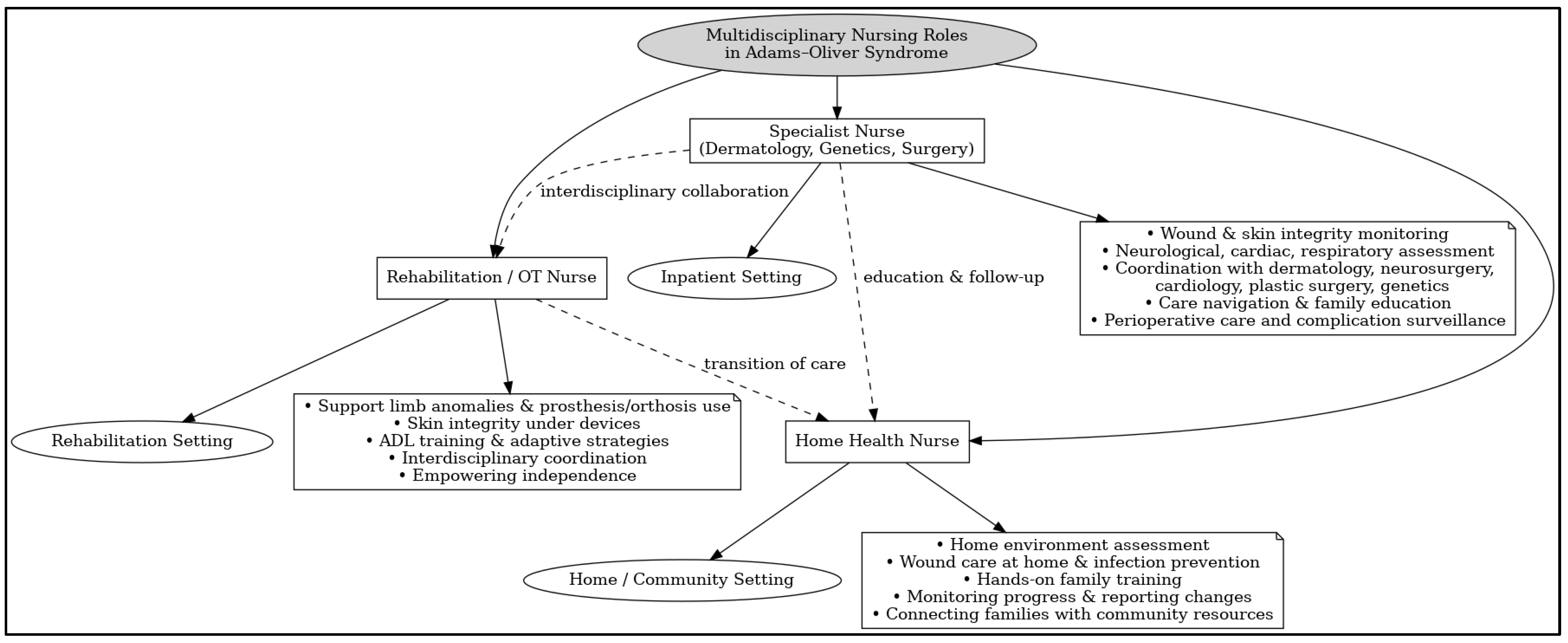
| Specialized Nursing | Advanced wound care for aplasia cutis congenita. Pre- and post-operative management for surgical interventions. Proactive pain assessment and management. Collaboration with rehabilitation and occupational therapy to implement functional goals and adaptive strategies. Management of prostheses/orthoses and monitoring of skin integrity. Ensuring a safe transition to the home environment with ongoing care. Comprehensive family education on all aspects of care. Providing psychosocial support and connection to advocacy groups. |
6.1. Genetic Counseling
6.2. Early Diagnosis
6.3. Interventions for Aplasia Cutis Congenita Treatment
6.4. Nutritional Management
6.5. Specialized Nursing Care
6.5.1. Nursing Roles in the Management of Aplasia Cutis Congenita
6.5.2. Nursing Roles in Rehabilitation and Occupational Therapy
6.5.3. Nursing Roles in Home Healthcare
6.5.4. Nursing Roles in Family Education and Psychosocial Support
7. Conclusions
Author Contributions
Funding
Data Availability Statement
Conflicts of Interest
Abbreviations
References
- Morales, O.L.; Díaz, J.M.; Montoya, J.H. Síndrome de Adams-Oliver y Complicaciones Asociadas: Reporte de Una Familia En Colombia y Revisión de La Literatura. Biomédica 2022, 42, 554–561. [Google Scholar] [CrossRef] [Scilit] [PubMed]
- Adams, F.H.; Oliver, C.P. Hereditary Deformities in Man: Due to Arrested Development. J. Hered. 1945, 36, 3–7. [Google Scholar] [CrossRef] [Scilit]
- Suarez, E.; Bertoli, M.J.; Eloy, J.D.; Shah, S.P. Case Report and Review of Literature of a Rare Congenital Disorder: Adams-Oliver Syndrome. BMC Anesthesiol. 2021, 21, 117. [Google Scholar] [CrossRef] [Scilit] [PubMed]
- Saeidi, M.; Ehsanipoor, F. A Case of Adams–Oliver Syndrome. Adv. Biomed. Res. 2017, 6, 167. [Google Scholar] [CrossRef] [Scilit]
- Alsulaiman, A.M.; Alsulaiman, H.M.; Almousa, A.; Alsulaiman, S.M. Adams Oliver Syndrome: A Mimicker of Familial Exudative Vitreoretinopathy. Am. J. Ophthalmol. Case Rep. 2020, 19, 100715. [Google Scholar] [CrossRef] [Scilit]
- Srihari, S.; Asha, G. Adams–Oliver Syndrome—A Case Report. Indian Dermatol. Online J. 2023, 14, 422. [Google Scholar] [CrossRef] [Scilit]
- Martínez-Frías, M.L.; Arroyo Carrera, I.; Muñoz-Delgado, N.J.; Nieto Conde, C.; Rodríguez-Pinilla, E.; Urioste Azcorra, M.; Omeñaca Teres, F.; García Alix, A. The Adams-Oliver Syndrome in Spain: The Epidemiological Aspects. An. Esp. Pediatr. 1996, 45, 57–61. [Google Scholar]
- Yang, S.; Lam, J.M. Cutaneous Features of Adams-Oliver Syndrome: Diagnosis, Differentiation, and Management. Pediatr. Dermatol. 2025, 42, 939–945. [Google Scholar] [CrossRef] [Scilit]
- Schröder, K.C.; Duman, D.; Tekin, M.; Schanze, D.; Sukalo, M.; Meester, J.; Wuyts, W.; Zenker, M. Adams–Oliver Syndrome Caused by Mutations of the EOGT Gene. Am. J. Med. Genet. A 2019, 179, 2246–2251. [Google Scholar] [CrossRef] [Scilit]
- Twine, C.P.; Mani, K. A Brief Guide to Performing Review and Meta-Analysis of Rare Diseases, Procedures, and Other Low Frequency Pathology. Eur. J. Vasc. Endovasc. Surg. 2022, 64, 297–298. [Google Scholar] [CrossRef] [Scilit]
- Wehrens, K.M.; De Jongh, F.; Ter Laak, M.; Cornips, E.; Van der Hulst, R. Treatment of a Large Skull Defect and Brain Herniation in a Newborn with Adams-Oliver Syndrome. Cureus 2020, 12, e7047. [Google Scholar] [CrossRef] [Scilit] [PubMed]
- Swartz, E.N.; Sanatani, S.; Sandor, G.G.S.; Schreiber, R.A. Vascular Abnormalities in Adams-Oliver Syndrome: Cause or Effect? Am. J. Med. Genet. 1999, 82, 49–52. [Google Scholar] [CrossRef] [Scilit]
- Dehdashtian, A.; Dehdashtian, M. Adams-Oliver Syndrome: A Case with Full Expression. Pediatr. Rep. 2016, 8, 6517. [Google Scholar] [CrossRef] [Scilit] [PubMed]
- Örstavik, K.H.; Strömme, P.; Spetalen, S.; Flage, T.; Westvik, J.; Vesterhus, P.; Skjeldal, O. Aplasia Cutis Congenita Associated with Limb, Eye, and Brain Anomalies in Sibs: A Variant of the Adams-Oliver Syndrome? Am. J. Med. Genet. 1995, 59, 92–95. [Google Scholar] [CrossRef] [Scilit]
- Zapata, H.H.; Sletten, L.J.; Pierpont, M.E.M. Congenital Cardiac Malformations in Adams-Oliver Syndrome. Clin. Genet. 1995, 47, 80–84. [Google Scholar] [CrossRef] [Scilit]
- Bakry, O.A.; Attia, A.M.; El Shafiee, I.N. Adams-Oliver Syndrome. A Case with Isolated Aplasia Cutis Congenita and Skeletal Defects. J. Dermatol. Case Rep. 2012, 6, 25. [Google Scholar] [CrossRef] [Scilit]
- Southgate, L.; Machado, R.D.; Snape, K.M.; Primeau, M.; Dafou, D.; Ruddy, D.M.; Branney, P.A.; Fisher, M.; Lee, G.J.; Simpson, M.A.; et al. Gain-of-Function Mutations of ARHGAP31, a Cdc42/Rac1 GTPase Regulator, Cause Syndromic Cutis Aplasia and Limb Anomalies. Am. J. Hum. Genet. 2011, 88, 574–585. [Google Scholar] [CrossRef] [Scilit]
- Shaheen, R.; Faqeih, E.; Sunker, A.; Morsy, H.; Al-Sheddi, T.; Shamseldin, H.E.; Adly, N.; Hashem, M.; Alkuraya, F.S. Recessive Mutations in DOCK6, Encoding the Guanidine Nucleotide Exchange Factor DOCK6, Lead to Abnormal Actin Cytoskeleton Organization and Adams-Oliver Syndrome. Am. J. Hum. Genet. 2011, 89, 328–333. [Google Scholar] [CrossRef] [Scilit]
- Shaheen, R.; Aglan, M.; Keppler-Noreuil, K.; Faqeih, E.; Ansari, S.; Horton, K.; Ashour, A.; Zaki, M.S.; Al-Zahrani, F.; Cueto-González, A.M.; et al. Mutations in EOGT Confirm the Genetic Heterogeneity of Autosomal-Recessive Adams-Oliver Syndrome. Am. J. Hum. Genet. 2013, 92, 598–604. [Google Scholar] [CrossRef] [Scilit]
- Hassed, S.J.; Wiley, G.B.; Wang, S.; Lee, J.-Y.; Li, S.; Xu, W.; Zhao, Z.J.; Mulvihill, J.J.; Robertson, J.; Warner, J.; et al. RBPJ Mutations Identified in Two Families Affected by Adams-Oliver Syndrome. Am. J. Hum. Genet. 2012, 91, 391–395. [Google Scholar] [CrossRef] [Scilit]
- Girard, M.; Amiel, J.; Fabre, M.; Pariente, D.; Lyonnet, S.; Jacquemin, E. Adams–Oliver Syndrome and Hepatoportal Sclerosis: Occasional Association or Common Mechanism? Am. J. Med. Genet. A 2005, 135A, 186–189. [Google Scholar] [CrossRef] [Scilit]
- Zhu, V.Z.; Hansen-Kiss, E.; Hecht, J.T.; Payne, P.E. Adams-Oliver Syndrome: Vestigial Tail and Genetics Update. Arch. Plast. Surg. 2022, 49, 517–522. [Google Scholar] [CrossRef] [Scilit] [PubMed]
- Rashid, S.; Azeem, S.; Riaz, S. Adams–Oliver Syndrome: A Rare Congenital Disorder. Cureus 2022, 14, e23297. [Google Scholar] [CrossRef] [Scilit] [PubMed]
- Huang, Y.; Wang, J.; Zeng, L.; Wang, S.; Zhang, X. Case Report: A Novel DLL4 Variant in a Neonate with Adams-Oliver Syndrome. Front. Pediatr. 2025, 13, 1532561. [Google Scholar] [CrossRef] [Scilit] [PubMed]
- Stanley, K.J.; Kalbfleisch, K.J.; Moran, O.M.; Chaturvedi, R.R.; Roifman, M.; Chen, X.; Manshaei, R.; Martin, N.; McDermott, S.; McNiven, V.; et al. Expanding the Phenotypic Spectrum of NOTCH1 Variants: Clinical Manifestations in Families with Congenital Heart Disease. Eur. J. Hum. Genet. 2024, 32, 795–803. [Google Scholar] [CrossRef] [Scilit]
- Sukalo, M.; Tilsen, F.; Kayserili, H.; Müller, D.; Tüysüz, B.; Ruddy, D.M.; Wakeling, E.; Ørstavik, K.H.; Snape, K.M.; Trembath, R.; et al. DOCK6 Mutations Are Responsible for a Distinct Autosomal-Recessive Variant of Adams-Oliver Syndrome Associated with Brain and Eye Anomalies. Hum. Mutat. 2015, 36, 593–598, Erratum in Hum. Mutat. 2015, 36, 1112. [Google Scholar] [CrossRef] [Scilit]
- Online Mendelian Inheritance in Man (OMIM). Adams-Oliver Syndrome 1. Available online: https://omim.org/entry/100300 (accessed on 7 March 2025).
- Stittrich, A.-B.; Lehman, A.; Bodian, D.L.; Ashworth, J.; Zong, Z.; Li, H.; Lam, P.; Khromykh, A.; Iyer, R.K.; Vockley, J.G.; et al. Mutations in NOTCH1 Cause Adams-Oliver Syndrome. Am. J. Hum. Genet. 2014, 95, 275–284. [Google Scholar] [CrossRef] [Scilit]
- Southgate, L.; Sukalo, M.; Karountzos, A.S.V.; Taylor, E.J.; Collinson, C.S.; Ruddy, D.; Snape, K.M.; Dallapiccola, B.; Tolmie, J.L.; Joss, S.; et al. Haploinsufficiency of the NOTCH1 Receptor as a Cause of Adams–Oliver Syndrome with Variable Cardiac Anomalies. Circ. Cardiovasc. Genet. 2015, 8, 572–581. [Google Scholar] [CrossRef] [Scilit]
- Meester, J.A.N.; Sukalo, M.; Schröder, K.C.; Schanze, D.; Baynam, G.; Borck, G.; Bramswig, N.C.; Duman, D.; Gilbert-Dussardier, B.; Holder-Espinasse, M.; et al. Elucidating the Genetic Architecture of Adams-Oliver Syndrome in a Large European Cohort. Hum. Mutat. 2018, 39, 1246–1261. [Google Scholar] [CrossRef] [Scilit]
- Alzahem, T.; Alsalamah, A.K.; Mura, M.; Alsulaiman, S.M. A Novel Variant in DOCK6 Gene Associated with Adams-Oliver Syndrome Type 2. Ophthalmic Genet. 2020, 41, 377–380. [Google Scholar] [CrossRef] [Scilit]
- Wang, Z.; Wang, X.; Guiyu, L.; Litao, Q.; Shasha, B.; Tang, X.; Hongjie, Z.; Shengran, W.; Bingtao, H.; Shixiu, L. Novel Compound Heterozygous Mutations of the DOCK6 Gene in a Familial Case of Adams-Oliver Syndrome 2. Gene 2019, 700, 65–69. [Google Scholar] [CrossRef] [Scilit]
- Lehman, A.; Stittrich, A.; Glusman, G.; Zong, Z.; Li, H.; Eydoux, P.; Senger, C.; Lyons, C.; Roach, J.C.; Patel, M. Diffuse Angiopathy in Adams-Oliver Syndrome Associated with Truncating DOCK6 Mutations. Am. J. Med. Genet. A 2014, 164, 2656–2662. [Google Scholar] [CrossRef] [Scilit] [PubMed]
- Meester, J.A.N.; Southgate, L.; Stittrich, A.-B.; Venselaar, H.; Beekmans, S.J.A.; den Hollander, N.; Bijlsma, E.K.; Helderman-van den Enden, A.; Verheij, J.B.G.M.; Glusman, G.; et al. Heterozygous Loss-of-Function Mutations in DLL4 Cause Adams-Oliver Syndrome. Am. J. Hum. Genet. 2015, 97, 475–482. [Google Scholar] [CrossRef] [Scilit] [PubMed]
- McGoey, R.R.; Lacassie, Y. Adams–Oliver Syndrome in Siblings with Central Nervous System Findings, Epilepsy, and Developmental Delay: Refining the Features of a Severe Autosomal Recessive Variant. Am. J. Med. Genet. A 2008, 146A, 488–491. [Google Scholar] [CrossRef] [Scilit] [PubMed]
- Lukas, M.; Harald, G.; Sanz, J.; Trippel, M.; Sabina, G.; Jochen, R. Cutaneous Squamous Cell Carcinoma in an Autosomal-recessive Adams–Oliver Syndrome Patient with a Novel Frameshift Pathogenic Variant in the EOGT Gene. Am. J. Med. Genet. A 2022, 188, 3318–3323. [Google Scholar] [CrossRef] [Scilit]
- Southgate, L. Current Opinion in the Molecular Genetics of Adams-Oliver Syndrome. Expert Opin. Orphan Drugs 2019, 7, 21–26. [Google Scholar] [CrossRef] [Scilit]
- Huynh, D.; Hoffmeister, P.; Friedrich, T.; Zhang, K.; Bartkuhn, M.; Ferrante, F.; Giaimo, B.D.; Kovall, R.A.; Borggrefe, T.; Oswald, F.; et al. Effective in Vivo Binding Energy Landscape Illustrates Kinetic Stability of RBPJ-DNA Binding. Nat. Commun. 2025, 16, 1259. [Google Scholar] [CrossRef] [Scilit]
- Zhou, B.; Lin, W.; Long, Y.; Yang, Y.; Zhang, H.; Wu, K.; Chu, Q. Notch Signaling Pathway: Architecture, Disease, and Therapeutics. Signal Transduct. Target. Ther. 2022, 7, 95. [Google Scholar] [CrossRef] [Scilit]
- Santaniello, C.; Faversani, A.; Corsaro, L.; Melloni, G.; Motta, S.; Mandorino, E.; Sacco, D.; Stioui, S.; Ferrara, F.; Barteselli, D.; et al. Characterization of a New Variant in ARHGAP31 Probably Involved in Adams–Oliver Syndrome in a Family with a Variable Phenotypic Spectrum. Genes 2024, 15, 536. [Google Scholar] [CrossRef] [Scilit]
- Ben Djoudi Ouadda, A.; He, Y.; Calabrese, V.; Ishii, H.; Chidiac, R.; Gratton, J.-P.; Roux, P.P.; Lamarche-Vane, N. CdGAP/ARHGAP31 Is Regulated by RSK Phosphorylation and Binding to 14-3-3β Adaptor Protein. Oncotarget 2018, 9, 11646–11664. [Google Scholar] [CrossRef] [Scilit]
- Lake, R.J.; Tsai, P.-F.; Choi, I.; Won, K.-J.; Fan, H.-Y. RBPJ, the Major Transcriptional Effector of Notch Signaling, Remains Associated with Chromatin throughout Mitosis, Suggesting a Role in Mitotic Bookmarking. PLoS Genet. 2014, 10, e1004204, Correction in PLoS Genet. 2016, 12, e1006209. [Google Scholar] [CrossRef] [Scilit] [PubMed]
- Gagliani, E.K.; Gutzwiller, L.M.; Kuang, Y.; Odaka, Y.; Hoffmeister, P.; Hauff, S.; Turkiewicz, A.; Harding-Theobald, E.; Dolph, P.J.; Borggrefe, T.; et al. A Drosophila Su(H) Model of Adams-Oliver Syndrome Reveals Cofactor Titration as a Mechanism Underlying Developmental Defects. PLoS Genet. 2022, 18, e1010335. [Google Scholar] [CrossRef] [Scilit] [PubMed]
- Friedrich, T.; Ferrante, F.; Pioger, L.; Nist, A.; Stiewe, T.; Andrau, J.-C.; Bartkuhn, M.; Giaimo, B.D.; Borggrefe, T. Notch-Dependent and -Independent Functions of Transcription Factor RBPJ. Nucleic Acids Res. 2022, 50, 7925–7937. [Google Scholar] [CrossRef] [Scilit] [PubMed]
- Gordon, W.R.; Arnett, K.L.; Blacklow, S.C. The Molecular Logic of Notch Signaling—A Structural and Biochemical Perspective. J. Cell Sci. 2008, 121, 3109–3119. [Google Scholar] [CrossRef] [Scilit]
- Basak, N.P.; Roy, A.; Banerjee, S. Alteration of Mitochondrial Proteome Due to Activation of Notch1 Signaling Pathway. J. Biol. Chem. 2014, 289, 7320–7334. [Google Scholar] [CrossRef] [Scilit]
- Hossain, F.; Sorrentino, C.; Ucar, D.A.; Peng, Y.; Matossian, M.; Wyczechowska, D.; Crabtree, J.; Zabaleta, J.; Morello, S.; Del Valle, L.; et al. Notch Signaling Regulates Mitochondrial Metabolism and NF-κB Activity in Triple-Negative Breast Cancer Cells via IKKα-Dependent Non-Canonical Pathways. Front. Oncol. 2018, 8, 575. [Google Scholar] [CrossRef] [Scilit]
- Ting, H.-A.; de Almeida Nagata, D.; Rasky, A.J.; Malinczak, C.-A.; Maillard, I.P.; Schaller, M.A.; Lukacs, N.W. Notch Ligand Delta-like 4 Induces Epigenetic Regulation of Treg Cell Differentiation and Function in Viral Infection. Mucosal Immunol. 2018, 11, 1524–1536. [Google Scholar] [CrossRef] [Scilit]
- Benson, C.E.; Southgate, L. The DOCK Protein Family in Vascular Development and Disease. Angiogenesis 2021, 24, 417–433. [Google Scholar] [CrossRef] [Scilit]
- Zhong, X.; Zheng, X.; Xv, Y.; Cai, K.; Wang, Q.; Liu, S. Novel Compound Heterozygous DOCK6 Variants Expand the Mutational Spectrum in Prenatal Diagnosis of Adams-Oliver Syndrome 2. BMC Med. Genom. 2025, 18, 104. [Google Scholar] [CrossRef] [Scilit]
- Zepeda-Romero, L.C.; Zenker, M.; Schanze, D.; Schanze, I.; Peña-Padilla, C.; Quezada-Salazar, C.A.; Pacheco-Torres, P.A.; Rivera-Montellano, M.L.; Aguirre-Guillén, R.L.; Bobadilla-Morales, L.; et al. Intrafamilial Phenotypic Variability in Autosomal Recessive DOCK6-Related Adams-Oliver Syndrome. Eur. J. Med. Genet. 2022, 65, 104653. [Google Scholar] [CrossRef] [Scilit]
- Jones, K.M.; Silfvast-Kaiser, A.; Leake, D.R.; Diaz, L.Z.; Levy, M.L. Adams–Oliver Syndrome Type 2 in Association with Compound Heterozygous DOCK6 Mutations. Pediatr. Dermatol. 2017, 34, e249–e253. [Google Scholar] [CrossRef] [Scilit]
- Hassed, S.; Li, S.; Mulvihill, J.; Aston, C.; Palmer, S. Adams–Oliver Syndrome Review of the Literature: Refining the Diagnostic Phenotype. Am. J. Med. Genet. A 2017, 173, 790–800. [Google Scholar] [CrossRef] [Scilit] [PubMed]
- Dudoignon, B.; Huber, C.; Michot, C.; Di Rocco, F.; Girard, M.; Lyonnet, S.; Rio, M.; Rabia, S.H.; Daire, V.C.; Baujat, G. Expanding the Phenotype in Adams–Oliver Syndrome Correlating with the Genotype. Am. J. Med. Genet. A 2020, 182, 29–37. [Google Scholar] [CrossRef] [Scilit] [PubMed]
- Nieto-Benito, L.M.; Suárez-Fernández, R.; Campos-Domínguez, M. A Novel Pathogenic Variation of DOCK6 Gene: The Genotype-Phenotype Correlation in Adams-Oliver Syndrome. Mol. Biol. Rep. 2023, 50, 5519–5521. [Google Scholar] [CrossRef] [Scilit] [PubMed]
- Kojmane, W.; Hmami, F.; Atmani, S. Syndrome d’Adams-Oliver et Cutis Marmorata Telangiectatica Congenita. Ann. Dermatol. Venereol. 2019, 146, 223–225. [Google Scholar] [CrossRef] [Scilit]
- Yang, X.-F.; Shi, S.-W.; Chen, K. Case Report: Recombinant Human Epidermal Growth Factor Gel plus Kangfuxin Solution in the Treatment of Aplasia Cutis Congenita in a Case with Adams–Oliver Syndrome. Front. Surg. 2023, 9, 1072021. [Google Scholar] [CrossRef] [Scilit]
- Jin, E.-Z.; Zhao, M.-W.; Yin, H. Atypical Adams-Oliver Syndrome with Typical Ocular Signs of Familial Exudative Vitreoretinopathy. Int. J. Ophthalmol. 2022, 15, 1249–1253. [Google Scholar] [CrossRef] [Scilit]
- Pillai, M.R.; Pabolu, C.; Rajabharani, R.; Chaudhary, S.; Krishnadas, S.; Puthuran, G.V. Adams-Oliver Syndrome Associated with Refractory Glaucoma. J. AAPOS 2024, 28, 103950. [Google Scholar] [CrossRef] [Scilit]
- Snape, K.M.G.; Ruddy, D.; Zenker, M.; Wuyts, W.; Whiteford, M.; Johnson, D.; Lam, W.; Trembath, R.C. The Spectra of Clinical Phenotypes in Aplasia Cutis Congenita and Terminal Transverse Limb Defects. Am. J. Med. Genet. A 2009, 149A, 1860–1881. [Google Scholar] [CrossRef] [Scilit]
- Caksen, H.; Kurtoğlu, S. A Case of Adams-Oliver Syndrome Associated with Acrania, Microcephaly, Hemiplegia, Epilepsy, and Mental Retardation. Acta Neurol. Belg. 2000, 100, 252–255. [Google Scholar]
- Badiu Tișa, I.; Cozma-Petruț, A.; Chiorean, A.-D.; Miere, D.; Filip, L.; Banc, R.; Mîrza, O.; Bordea, M.A. Adams-Oliver Syndrome in a Romanian Child: A Case Report Highlighting DOCK6 Mutations and Growth Impairment with Nursing Care Implications. MPR—Med. Pharm. Rep. 2025, 98, S83–S84. [Google Scholar]
- de Onis, M. WHO Child Growth Standards Based on Length/Height, Weight and Age. Acta Paediatr. 2006, 95, 76–85. [Google Scholar] [CrossRef] [Scilit] [PubMed]
- Costello, C.L.; Gellatly, M.; Daniel, J.; Justo, R.N.; Weir, K. Growth Restriction in Infants and Young Children with Congenital Heart Disease. Congenit. Heart Dis. 2015, 10, 447–456. [Google Scholar] [CrossRef] [Scilit] [PubMed]
- Bilginer, B.; Onal, M.B.; Bahadir, S.; Akalan, N. Aplasia Cutis Congenita of the Scalp, Skull and Dura Associated with Adams-Oliver Syndrome. Turk. Neurosurg. 2008, 18, 191–193. [Google Scholar] [PubMed]
- Ristori, T.; Sjöqvist, M.; Sahlgren, C.M. Ex Vivo Models to Decipher the Molecular Mechanisms of Genetic Notch Cardiovascular Disorders. Tissue Eng. Part C Methods 2021, 27, 167–176. [Google Scholar] [CrossRef] [Scilit]
- Pavan, S.; Rommel, K.; Mateo Marquina, M.E.; Höhn, S.; Lanneau, V.; Rath, A. Clinical Practice Guidelines for Rare Diseases: The Orphanet Database. PLoS ONE 2017, 12, e0170365. [Google Scholar] [CrossRef] [Scilit]
- Kerzner, B.; Milano, K.; MacLean, W.C.; Berall, G.; Stuart, S.; Chatoor, I. A Practical Approach to Classifying and Managing Feeding Difficulties. Pediatrics 2015, 135, 344–353. [Google Scholar] [CrossRef] [Scilit]
- American Heart Association Feeding Tips for Your Baby with CHD. Available online: https://www.heart.org/en/health-topics/congenital-heart-defects/care-and-treatment-for-congenital-heart-defects/feeding-tips-for-your-baby-with-chd (accessed on 4 December 2025).
- Orphanet—Knowledge on Rare Diseases and Orphan Drugs Adams-Oliver Syndrome. Available online: https://www.orpha.net/en/disease/detail/974 (accessed on 7 March 2025).
- Tsai, Y.; Yang, Y. Outpatient Management of Large Scalp Aplasia Cutis Congenita without Skull Defect in a Case of Adams-Oliver Syndrome. Kaohsiung J. Med. Sci. 2025, 41, e12935. [Google Scholar] [CrossRef] [Scilit]
- Beekmans, S.J.; Wiebe, M.J. Surgical Treatment of Aplasia Cutis in the Adams-Oliver Syndrome. J. Craniofacial Surg. 2001, 12, 569–572. [Google Scholar] [CrossRef] [Scilit]
- Leonard, H.; Ravikumara, M.; Baikie, G.; Naseem, N.; Ellaway, C.; Percy, A.; Abraham, S.; Geerts, S.; Lane, J.; Jones, M.; et al. Assessment and Management of Nutrition and Growth in Rett Syndrome. J. Pediatr. Gastroenterol. Nutr. 2013, 57, 451–460. [Google Scholar] [CrossRef] [Scilit]
- Dwyer, A.A.; Somanadhan, S. Nursing’s Role in Advancing Care for Rare Genetic Diseases. Nurs. Clin. N. Am. 2025, 60, 349–368. [Google Scholar] [CrossRef] [Scilit] [PubMed]
- National Organization for Rare Disorders: Rare Disease Database. Adams-Oliver Syndrome. Available online: https://rarediseases.org/rare-diseases/adams-oliver-syndrome/2021 (accessed on 7 March 2025).
- Sabrià, J.; Benassar, M.; Laborda, A.; Pérez, M.; Arca, G.; Muñoz, E.; Gómez, O.; Martínez, J.M. Fetoscopic Diagnosis of Adams-Oliver Syndrome. Clin. Surg. 2021, 6, 3152. [Google Scholar]
- Brackenrich, J.; Saleh, H.M.; Brown, A. Aplasia Cutis Congenita; StatPearls Publishing: Treasure Island, FL, USA, 2025. [Google Scholar]
- Fröjd, V.; Maltese, G.; Kölby, L.; Tarnow, P. Conservative Healing of an 11 × 9-Cm Aplasia Cutis Congenita of the Scalp with Bone Defect. J. Neurol. Surg. Rep. 2014, 75, e220–e223. [Google Scholar] [CrossRef] [Scilit]
- Wound Management & Prevention. An Overview of Neonatal and Pediatric Wound Care Knowledge and Considerations. Available online: https://www.hmpgloballearningnetwork.com/site/wmp/content/an-overview-neonatal-and-pediatric-wound-care-knowledge-and-considerations (accessed on 4 December 2025).
- Bi, G.; Ximenes, A.P.S.P.M.; Liao, W.; Ding, J.; Yang, J. Clinical Application of Wet Healing in the Treatment of Aplasia Cutis Congenita on Scalp: A Case Report. Med. Rep. 2025, 13, 100251. [Google Scholar] [CrossRef] [Scilit]
- Bharti, G.; Groves, L.; David, L.R.; Sanger, C.; Argenta, L.C. Aplasia Cutis Congenita. J. Craniofacial Surg. 2011, 22, 159–165. [Google Scholar] [CrossRef] [Scilit]
- Khashab, M.E.; Rhee, S.T.; Pierce, S.D.; Khashab, Y.E.; Nejat, F.; Fried, A. Management of Large Scalp and Skull Defects in a Severe Case of Adams-Oliver Syndrome. J. Neurosurg. Pediatr. 2009, 4, 523–527. [Google Scholar] [CrossRef] [Scilit]
- O’Neill, J.K.; Carter, M.; Warr, R.P. Aplasia Cutis Congenita. A Case of Scalp Defect Repair Using Two Opposing Bipedicled Local Flaps. J. Plast. Reconstr. Aesthetic Surg. 2010, 63, e242–e244. [Google Scholar] [CrossRef] [Scilit]
- Yamakawa, S.; Hayashida, K. Advances in Surgical Applications of Growth Factors for Wound Healing. Burn. Trauma 2019, 7, 10. [Google Scholar] [CrossRef] [Scilit]
- Walter, A.-L.; Baty, F.; Rassouli, F.; Bilz, S.; Brutsche, M.H. Diagnostic Precision and Identification of Rare Diseases Is Dependent on Distance of Residence Relative to Tertiary Medical Facilities. Orphanet J. Rare Dis. 2021, 16, 131. [Google Scholar] [CrossRef] [Scilit]
- Shetty, N.; Mantri, S.; Agarwal, S.; Potdukhe, A.; Wanjari, M.B.; Taksande, A.B.; Yelne, S. Unraveling the Challenges: A Critical Review of Congenital Malformations in Low Socioeconomic Strata of Developing Countries. Cureus 2023, 15, e41800. [Google Scholar] [CrossRef] [Scilit]
- Mlakar-Mastnak, D.; Blaž Kovač, M.; Terčelj, M.; Uhan, S.; Majdič, N.; Rotovnik Kozjek, N. Effectiveness of Nutritional Intervention Led by Clinical Dietitian in Patients at Risk of Malnutrition at the Primary Healthcare Level in Slovenia—Evaluation Study. Slov. J. Public Health 2024, 63, 81–88. [Google Scholar] [CrossRef] [Scilit]
- Oftedal, S.; McCormack, S.; Stevenson, R.; Benfer, K.; Boyd, R.N.; Bell, K. The Evolution of Nutrition Management in Children with Severe Neurological Impairment with a Focus on Cerebral Palsy. J. Hum. Nutr. Diet. 2025, 38, e13277. [Google Scholar] [CrossRef] [Scilit]
- Fachal, C.V.; Fernández-González, S.M.; Moreno-Álvarez, A.; Solar-Boga, A. Nutritional Screening Tools in the Pediatric Population: A Systematic Review. Nutrients 2025, 17, 433. [Google Scholar] [CrossRef] [Scilit]
- Luca, A.-C.; Miron, I.C.; Mîndru, D.E.; Curpăn, A.Ș.; Stan, R.C.; Țarcă, E.; Luca, F.-A.; Pădureț, A.I. Optimal Nutrition Parameters for Neonates and Infants with Congenital Heart Disease. Nutrients 2022, 14, 1671. [Google Scholar] [CrossRef] [Scilit]
- Centeno-Malfaz, F.; Moráis-López, A.; Caro-Barri, A.; Peña-Quintana, L.; Gil-Villanueva, N.; Redecillas-Ferreiro, S.; Marcos-Alonso, S.; Ros-Arnal, I.; Tejero, M.Á.; Sánchez, C.S.; et al. Nutrition in Congenital Heart Disease: Consensus Document. An. Pediatr. 2023, 98, 373–383. [Google Scholar] [CrossRef] [Scilit]
- Forchielli, M.L.; McColl, R.; Walker, W.A.; Lo, C. Children with Congenital Heart Disease: A Nutrition Challenge. Nutr. Rev. 2009, 52, 348–353. [Google Scholar] [CrossRef] [Scilit]
- Mayo Clinic Breastfeeding Strike: Why Do Babies Refuse to Nurse? Available online: https://www.mayoclinic.org/healthy-lifestyle/infant-and-toddler-health/expert-answers/breastfeeding-strike/faq-20058157 (accessed on 4 December 2025).
- Berry, K.G.; Seiple, S.M.; Stellar, J.J.; Nagle, M.L.; Curry, K.; Immel, A.; James, R.; Srinivasan, V.; Mascarenhas, M.R.; Garrett, A.; et al. A Scoping Review to Inform a Multi-Disciplinary Approach for Nutrition Therapy in Critically Ill Children with Pressure Injuries. Transl. Pediatr. 2021, 10, 2799–2813. [Google Scholar] [CrossRef] [Scilit]
- Lin, P.-H.; Sermersheim, M.; Li, H.; Lee, P.H.U.; Steinberg, S.M.; Ma, J. Zinc in Wound Healing Modulation. Nutrients 2017, 10, 16. [Google Scholar] [CrossRef] [Scilit]
- DePhillipo, N.N.; Aman, Z.S.; Kennedy, M.I.; Begley, J.P.; Moatshe, G.; LaPrade, R.F. Efficacy of Vitamin C Supplementation on Collagen Synthesis and Oxidative Stress After Musculoskeletal Injuries: A Systematic Review. Orthop. J. Sports Med. 2018, 6, 2325967118804544. [Google Scholar] [CrossRef] [Scilit]
- Arribas-López, E.; Zand, N.; Ojo, O.; Snowden, M.J.; Kochhar, T. The Effect of Amino Acids on Wound Healing: A Systematic Review and Meta-Analysis on Arginine and Glutamine. Nutrients 2021, 13, 2498. [Google Scholar] [CrossRef] [Scilit]
- World Health Organization. WHO Child Growth Standards. Available online: https://www.who.int/tools/child-growth-standards (accessed on 6 December 2025).
- Intercultural Education of Nurses in Europe Levels of Nurses Qualifications. Available online: https://ieneproject.eu/information-1.php (accessed on 6 December 2025).
- Althobaiti, M.Y.; Aljuaid, F.A.; Aljead, A.A.; Althobaiti, H.M.; Althobiti, K.J.; Almanjumi, Y.K.; Halawi, M.A.; Osimi, T.I.A.; Alhalawy, G.A.U.; Althamali, M.A. The Role of Nursing in Managing Pediatric Dermatological Conditions. J. Int. Crisis Risk Commun. Res. 2024, 7, 1017–1035. [Google Scholar]
- McCord, S.; Levy, M. Practical Guide to Pediatric Wound Care. Semin. Plast. Surg. 2006, 20, 192–199. [Google Scholar] [CrossRef] [Scilit]
- Hall, R.W.; Anand, K.J.S. Pain Management in Newborns. Clin. Perinatol. 2014, 41, 895–924. [Google Scholar] [CrossRef] [Scilit]
- Witt, N.; Coynor, S.; Edwards, C.; Bradshaw, H. A Guide to Pain Assessment and Management in the Neonate. Curr. Emerg. Hosp. Med. Rep. 2016, 4, 1–10. [Google Scholar] [CrossRef] [Scilit]
- Zabbia, G.; Cammarata, E.; Franza, M.; Toia, F.; Tondini, G.; Graziano, F.; Iacopino, D.G.; Cordova, A. Microsurgical Reconstruction of Complex Scalp Defects with Vastus Lateralis Free Flap. Microsurgery 2025, 45, e70025. [Google Scholar] [CrossRef] [Scilit]
- N’joumi, C.; Ayyad, A.; Messaoudi, S.; Amrani, R. Adams-Oliver Syndrome in a Newborn: A Case Report and Comprehensive Literature Review. Cureus 2025, 17, e86442. [Google Scholar] [CrossRef] [Scilit]
- AlMatrafi, F.R.; Al-Shammari, A.A.; Al Nefily, R.M.; AlAnazi, R.A.; Abdulwahab, A.H.; Ammar, A.S. Case Report: Aplasia Cutis Congenita of the Scalp with Bone Defect and an Exposed Sagittal Sinus in a Trisomy 13 Newborn. Front. Pediatr. 2023, 11, 1142950. [Google Scholar] [CrossRef] [Scilit]
- Lei, G.-F.; Zhang, J.-P.; Wang, X.-B.; You, X.-L.; Gao, J.-Y.; Li, X.-M.; Chen, M.-L.; Ning, X.-Q.; Sun, J.-L. Treating Aplasia Cutis Congenita in a Newborn with the Combination of Ionic Silver Dressing and Moist Exposed Burn Ointment: A Case Report. World J. Clin. Cases 2019, 7, 2611–2616. [Google Scholar] [CrossRef] [Scilit]
- Frantz, J.A.M.; Lehmkuhl, R.L.; Leitis, L.H.; Uliano, V.G.; Siementcoski, G.A. Adams–Oliver Syndrome: A Case Report. Pediatr. Dermatol. 2015, 32, 383–385. [Google Scholar] [CrossRef] [Scilit]
- Jarjanazi, L.; Kebbeh, S.; Alam, E.; Saado, Q.; Jarjanazi, M.; Alkadi, L.; Etr, A.; Aswad, T.G.; Nawfal, H. Adams-Oliver Syndrome: An Unusual Congenital Disorder. Oxf. Med. Case Rep. 2025, 2025, omaf176. [Google Scholar] [CrossRef] [Scilit]
- Gvaladze, A.; Gvalia, T.; Kvaratskhelia, K.; Gagua, D.; Gagua, T. Successful Conservative Management of Aplasia Cutis Congenita in a Preterm Neonate. Cureus 2025, 17, e87096. [Google Scholar] [CrossRef] [Scilit]
- Salmond, S.W.; Echevarria, M. Healthcare Transformation and Changing Roles for Nursing. Orthop. Nurs. 2017, 36, 12–25. [Google Scholar] [CrossRef] [Scilit]
- Krajbich, I.J. Lower-Limb Deficiencies and Amputations in Children. J. Am. Acad. Orthop. Surg. 1998, 6, 358–367. [Google Scholar] [CrossRef] [Scilit]
- Mano, H.; Inakazu, E.; Noguchi, S.; Nishizaka, C.; Fujiwara, S.; Haga, N. Rehabilitation Approach for a Child with Cerebral Palsy and Upper Limb Deficiency. Prog. Rehabil. Med. 2021, 6, 20210016. [Google Scholar] [CrossRef] [Scilit]
- Moore, E.; Waldron, M.; Acorda, D.; Gallegos, C.; Giambra, B.; Lerret, S.; Platt, C.R.; Sarik, D.A.; Sajwani-Merchant, Z.; Kutahyalioglu, N.S.; et al. Supporting Discharge Preparation for Children with Medical Complexity: A Scoping Review. BMC Nurs. 2025, 24, 1284. [Google Scholar] [CrossRef] [Scilit]
- Ray, S.; Shetty, A.; Dwibedi, B. Evaluating the Impact of Nurse-Led Transition Care Guidance on Care Transition Outcomes for Children with Congenital Heart Disease: A Protocol Study. Cureus 2025, 17, e81389. [Google Scholar] [CrossRef] [Scilit]
- Beisland, E.G.; Drageset, J.; Blindheim, M.G.; Jorem, G.T.; Moi, A.L. Children’s and Parents’ Experiences of Home Care Provided by Hospital Staff: A Scoping Review. J. Clin. Nurs. 2024, 33, 3018–3032. [Google Scholar] [CrossRef] [Scilit]
- Pelentsov, L.J.; Fielder, A.L.; Esterman, A.J. The Supportive Care Needs of Parents with a Child with a Rare Disease: A Qualitative Descriptive Study. J. Pediatr. Nurs. 2016, 31, e207–e218. [Google Scholar] [CrossRef] [Scilit]
- Talevski, J.; Wong Shee, A.; Rasmussen, B.; Kemp, G.; Beauchamp, A. Teach-Back: A Systematic Review of Implementation and Impacts. PLoS ONE 2020, 15, e0231350. [Google Scholar] [CrossRef] [Scilit]
- Anderson, M.; Elliott, E.J.; Zurynski, Y.A. Australian Families Living with Rare Disease: Experiences of Diagnosis, Health Services Use and Needs for Psychosocial Support. Orphanet J. Rare Dis. 2013, 8, 22. [Google Scholar] [CrossRef] [Scilit]
- Witt, S.; Kristensen, K.; Wiegand-Grefe, S.; Boettcher, J.; Bloemeke, J.; Wingartz, C.; Bullinger, M.; Quitmann, J. Rare Pediatric Diseases and Pathways to Psychosocial Care: A Qualitative Interview Study with Professional Experts Working with Affected Families in Germany. Orphanet J. Rare Dis. 2021, 16, 497. [Google Scholar] [CrossRef] [Scilit]

| AOS Type | AOS Causal Gene | Inheritance Pattern | Protein Function/Signaling Pathway | References |
|---|---|---|---|---|
| AOS1 | ARHGAP31 | Autosomal dominant | GTPase-activating protein for Cdc42 and Rac1; cytoskeleton regulation | [17,37] |
| AOS3 | RBPJ | Autosomal dominant | Transcriptional regulator; the main effector of the Notch signaling pathway | [20,38] |
| AOS5 | NOTCH1 | Autosomal dominant | Receptor in the Notch signaling pathway | [28,39] |
| AOS6 | DLL4 | Autosomal dominant | Ligand for the NOTCH1 receptor; Notch signaling pathway | [24,34] |
| AOS4 | EOGT | Autosomal recessive | O-GlcNAc transferase; glycosylation of proteins in the Notch signaling pathway | [9,19] |
| AOS2 | DOCK6 | Autosomal recessive | Guanine nucleotide exchange factor for Cdc42 and Rac1; cytoskeleton regulation | [18,26] |
| AOS Type | AOS Causal Gene | Associated Clinical Features | References |
|---|---|---|---|
| AOS1 | ARHGAP31 | Classic AOS phenotype with aplasia cutis congenita and terminal transverse limb defects. Cutis marmorata telangiectatica congenita is common. | [17,37,40] |
| AOS3 | RBPJ | Variable phenotype with aplasia cutis congenita and limb defects. Intellectual disability has been reported in some cases. | [20,38,53] |
| AOS5 | NOTCH1 | Strongly associated with congenital cardiac malformations. | [25,28,29,54] |
| AOS6 | DLL4 | Highly variable phenotype, from isolated aplasia cutis congenita to classic AOS. Cardiovascular anomalies can be present. | [24,34,54] |
| AOS4 | EOGT | Variable phenotype, often with large aplasia cutis congenita but sometimes with milder limb defects. Lower frequency of neurological deficits compared to DOCK6. | [9,19,53] |
| AOS2 | DOCK6 | Often associated with a more severe phenotype. Strongly linked to terminal transverse limb defects. Central nervous system and ocular abnormalities are also frequently reported. | [18,33,51,55] |
Disclaimer/Publisher’s Note: The statements, opinions and data contained in all publications are solely those of the individual author(s) and contributor(s) and not of MDPI and/or the editor(s). MDPI and/or the editor(s) disclaim responsibility for any injury to people or property resulting from any ideas, methods, instructions or products referred to in the content. |
© 2025 by the authors. Licensee MDPI, Basel, Switzerland. This article is an open access article distributed under the terms and conditions of the Creative Commons Attribution (CC BY) license.
Share and Cite
Badiu Tișa, I.; Cozma-Petruț, A.; Chiorean, A.-D.; Miere, D.; Filip, L.; Banc, R.; Mîrza, O.; Bordea, M.A. Adams–Oliver Syndrome: A Comprehensive Literature Review of Clinical, Nutritional, Genetic, and Molecular Aspects with Nursing Care Considerations. Int. J. Mol. Sci. 2026, 27, 173. https://doi.org/10.3390/ijms27010173
Badiu Tișa I, Cozma-Petruț A, Chiorean A-D, Miere D, Filip L, Banc R, Mîrza O, Bordea MA. Adams–Oliver Syndrome: A Comprehensive Literature Review of Clinical, Nutritional, Genetic, and Molecular Aspects with Nursing Care Considerations. International Journal of Molecular Sciences. 2026; 27(1):173. https://doi.org/10.3390/ijms27010173
Chicago/Turabian StyleBadiu Tișa, Ioana, Anamaria Cozma-Petruț, Alin-Dan Chiorean, Doina Miere, Lorena Filip, Roxana Banc, Oana Mîrza, and Mădălina Adriana Bordea. 2026. "Adams–Oliver Syndrome: A Comprehensive Literature Review of Clinical, Nutritional, Genetic, and Molecular Aspects with Nursing Care Considerations" International Journal of Molecular Sciences 27, no. 1: 173. https://doi.org/10.3390/ijms27010173
APA StyleBadiu Tișa, I., Cozma-Petruț, A., Chiorean, A.-D., Miere, D., Filip, L., Banc, R., Mîrza, O., & Bordea, M. A. (2026). Adams–Oliver Syndrome: A Comprehensive Literature Review of Clinical, Nutritional, Genetic, and Molecular Aspects with Nursing Care Considerations. International Journal of Molecular Sciences, 27(1), 173. https://doi.org/10.3390/ijms27010173