Review

Understanding Fascial Tissue on the Molecular Level—How Its Unique Properties Enable Adaptation or Dysfunction


by
Karen B. Kirkness
1,* and
Suzanne Scarlata
2
1
Health Professions Education Unit, Hull York Medical School, York YO10 5DD, UK
2
Department of Chemistry and Biochemistry, Worcester Polytechnic Institute, Worcester, MA 01609, USA
*
Author to whom correspondence should be addressed.
Int. J. Mol. Sci. 2026, 27(1), 160; https://doi.org/10.3390/ijms27010160
Submission received: 11 November 2025 / Revised: 11 December 2025 / Accepted: 14 December 2025 / Published: 23 December 2025
(This article belongs to the Special Issue Fascial Anatomy and Histology: Advances in Molecular Biology)

Abstract

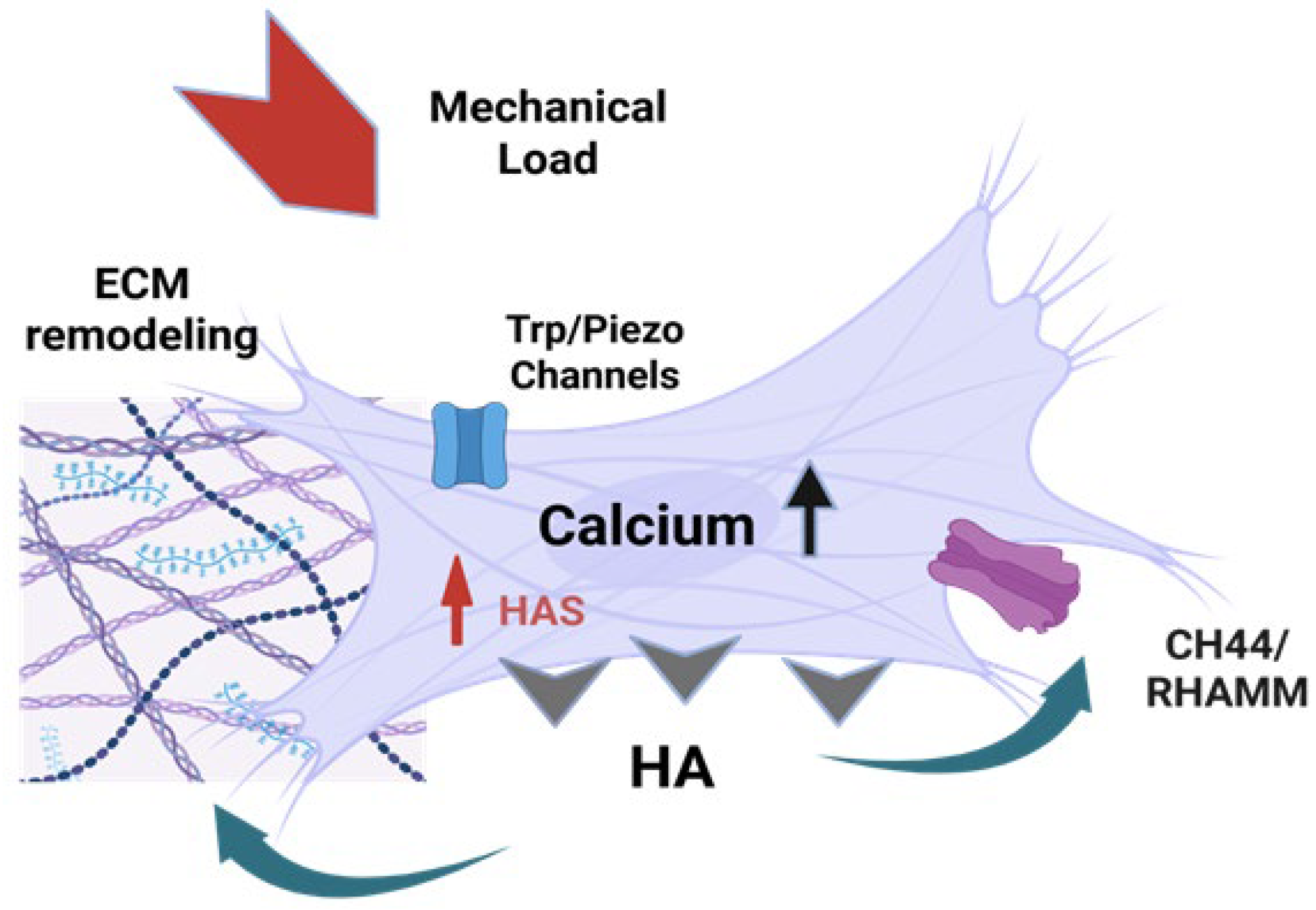
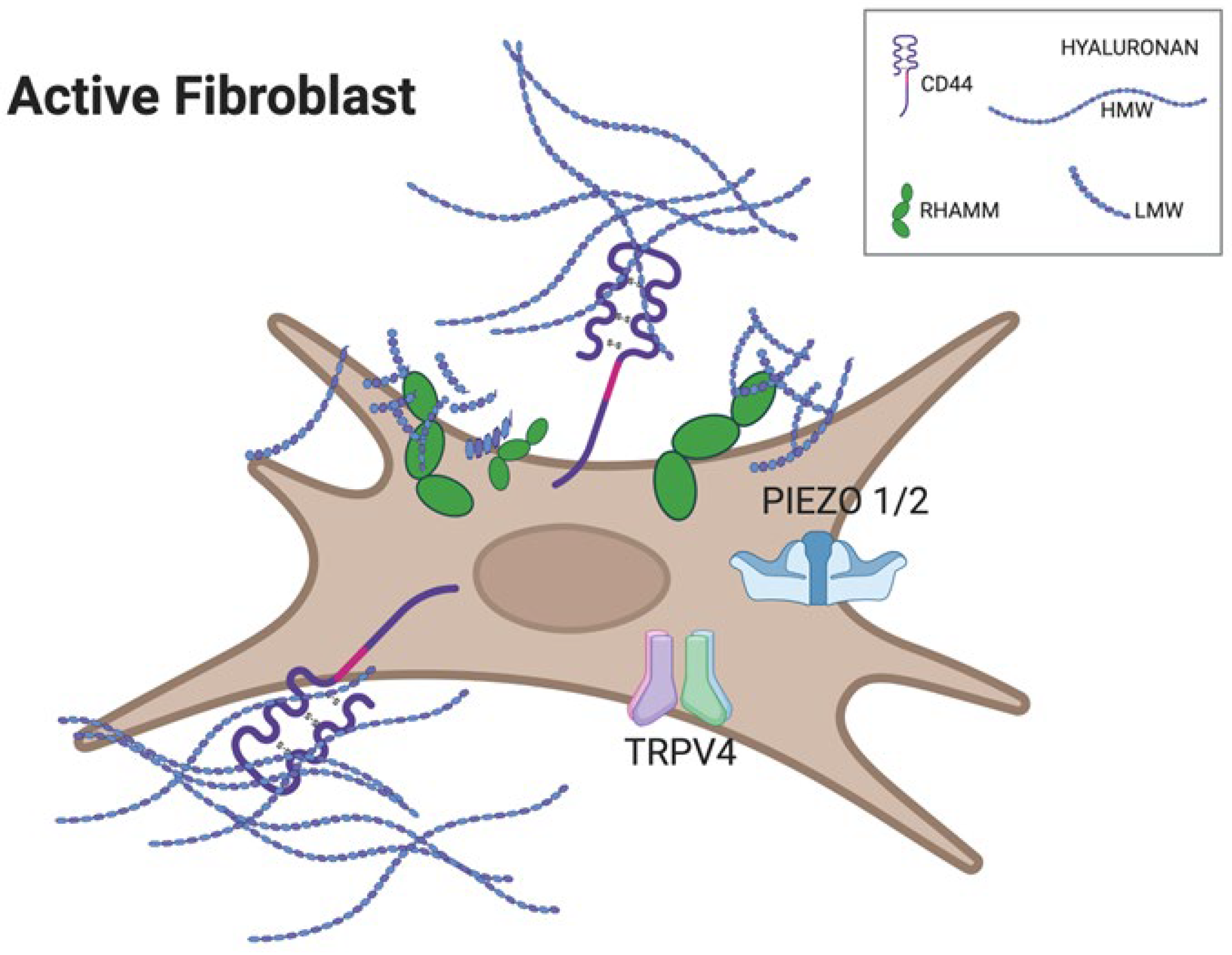
Despite extensive research on fascial mechanobiology, no unified mechanotransduction framework has been established to explain how mechanical forces translate into adaptive cellular responses in fascial tissue. This narrative review synthesizes evidence from mesenchymal cell and fibroblast research to propose the Ca2+–Hyaluronan (CHA) axis as a comprehensive mechanotransduction feedback loop for fascia phenomenology. The CHA framework describes how mechanical stress activates Ca2+ channels (Piezo1, TRPV4, P2Y2), triggering HAS2-mediated hyaluronan (HA) synthesis. The molecular weight of synthesized HA then determines receptor signaling outcomes: high-molecular-weight HA binds CD44 to promote tissue stability and quiescence, while low-molecular-weight HA fragments activate RHAMM to drive remodeling and repair—a dynamic oscillation termed “Quiet or Riot.” Three key conclusions emerge: First, the CHA framework is well supported by existing literature on mesenchymal cells, providing a testable model for fascial mechanobiology. Second, HA molecular weight dynamics and CD44/RHAMM oscillation have direct implications for optimizing movement, manual therapy, and rehabilitative interventions. Third, while HA-CD44/RHAMM signaling is broadly implicated in tissue remodeling, Ca2+-dependent regulatory mechanisms specific to fasciacytes require experimental validation. A critical translational gap remains: the absence of quantitative mechanical thresholds distinguishing beneficial from pathological loading limits clinical application. Future research should employ 3D matrix models, live imaging, receptor manipulation, and omics profiling to establish these thresholds and validate the CHA framework in fasciacytes. Understanding fascial mechanotransduction through the CHA loop may transform approaches to movement prescription, manual therapy, and treatment of fascial dysfunction.
Keywords: calcium signaling; HAS2; hyaluronic acid; fascia; mechanotransduction; extracellular matrix; tissue adaptation; morphogenetic field; CD44; fasciacytes calcium signaling; HAS2; hyaluronic acid; fascia; mechanotransduction; extracellular matrix; tissue adaptation; morphogenetic field; CD44; fasciacytes