Review

Triplexes Color the Chromaverse by Modulating Nucleosome Phasing and Anchoring Chromatin Condensates


Discovery, InsideOutBio, Charlestown, MA 02129, USA
Int. J. Mol. Sci. 2025, 26(9), 4032; https://doi.org/10.3390/ijms26094032
Submission received: 13 March 2025 / Revised: 16 April 2025 / Accepted: 22 April 2025 / Published: 24 April 2025
(This article belongs to the Collection Feature Papers in Molecular Genetics and Genomics)

Abstract

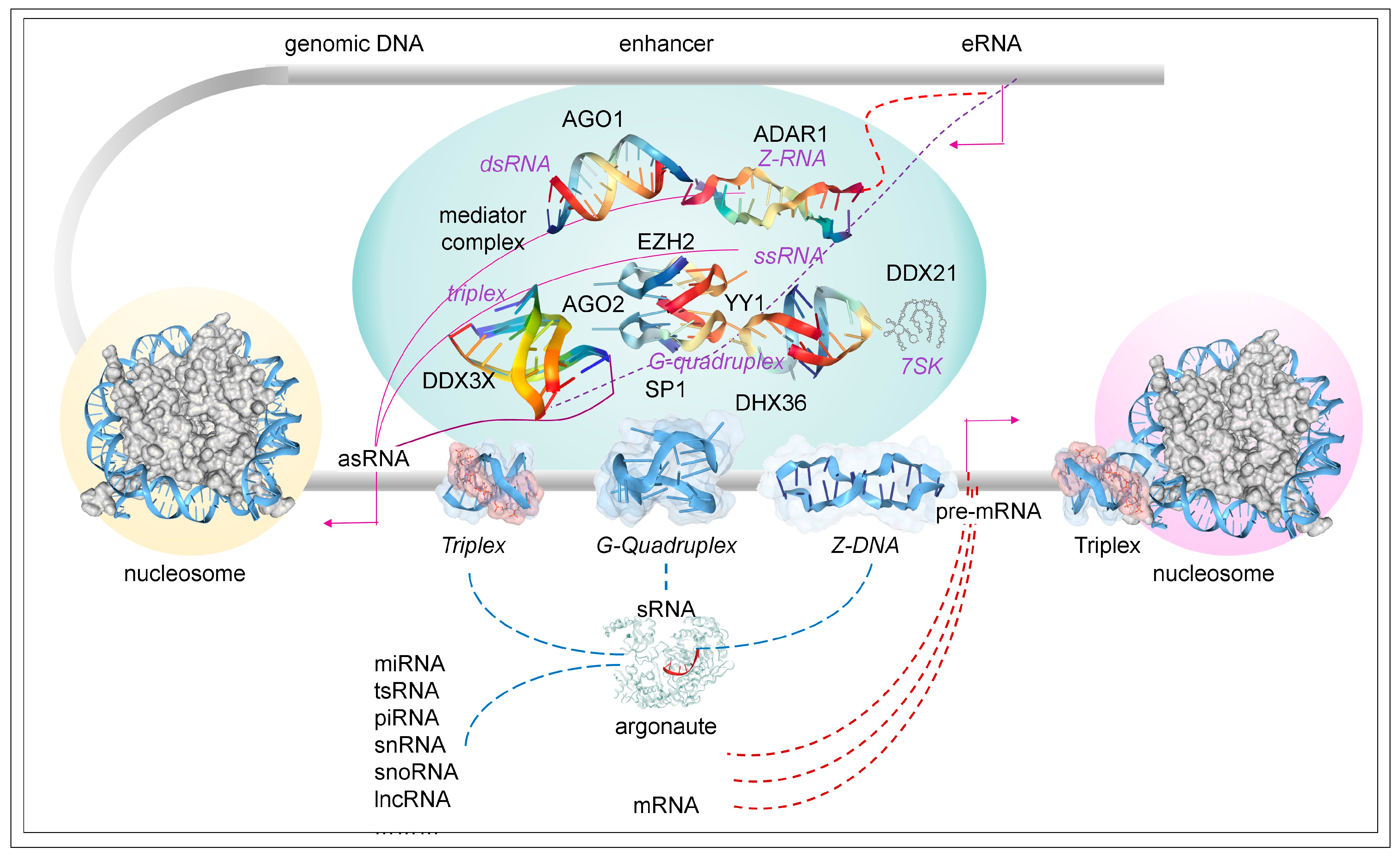
Genomic sequences that form three-stranded triplexes (TPXs) under physiological conditions (called T-flipons) play an important role in defining DNA nucleosome-free regions (NFRs). Within these NFRs, other flipon types can cycle conformations to actuate gene expression. The transcripts read from the NFR form condensates that engage proteins and small RNAs. The helicases bound then trigger RNA polymerase release by dissociating the 7SK ribonucleoprotein. The TPXs formed usually incorporate RNA as the third strand. TPXs made only from DNA arise mostly during DNA replication. Many small RNA types (sRNAs) and long noncoding (lncRNA) can direct TPX formation. TPXs made with circular RNAs have greater stability and specificity than those formed with linear RNAs. LncRNAs can affect local gene expression through TPX formation and transcriptional interference. The condensates seeded by lncRNAs are updated by feedback loops involving proteins and noncoding RNAs from the genes they regulate. Some lncRNAs also target distant loci in a sequence-specific manner. Overall, lncRNAs can rapidly evolve by adding or subtracting sequence motifs that modify the condensates they nucleate. LncRNAs show less sequence conservation than protein-coding sequences. TPXs formed by lncRNAs and sRNAs help place nucleosomes to restrict endogenous retroelement (ERE) expression. The silencing of EREs starts early in embryogenesis and is essential for bootstrapping development. Once the system is set, EREs play a different role, with a notable enrichment of Short Interspersed Nuclear Repeats (SINEs) in Enhancer–Promoter condensates. The highly programmable TPX-dependent processes create a chromaverse capable of many complexities.
Keywords: Triplex; G-quadruplex; Z-DNA; flipons; condensates; gene expression; nucleosome phasing; endogenous retroelements; embryonic development; helicase; microRNA; lncRNA; anti-sense RNA; argonaute; enhancer; promoter Triplex; G-quadruplex; Z-DNA; flipons; condensates; gene expression; nucleosome phasing; endogenous retroelements; embryonic development; helicase; microRNA; lncRNA; anti-sense RNA; argonaute; enhancer; promoter