Review

Understanding Susceptibility to Breast Cancer: From Risk Factors to Prevention Strategies

by
Natalia García-Sancha
1,2,*,
Roberto Corchado-Cobos
1,2 and
Jesús Pérez-Losada
1,2
1
Institute of Molecular and Cellular Biology of Cancer (IBMCC-CIC), CSIC-University of Salamanca, 37007 Salamanca, Spain
2
Institute of Biomedical Research of Salamanca (IBSAL), 37007 Salamanca, Spain
*
Author to whom correspondence should be addressed.
Int. J. Mol. Sci. 2025, 26(7), 2993; https://doi.org/10.3390/ijms26072993
Submission received: 5 February 2025 / Revised: 23 March 2025 / Accepted: 24 March 2025 / Published: 25 March 2025
(This article belongs to the Special Issue Advances and Mechanisms in Breast Cancer)

Abstract

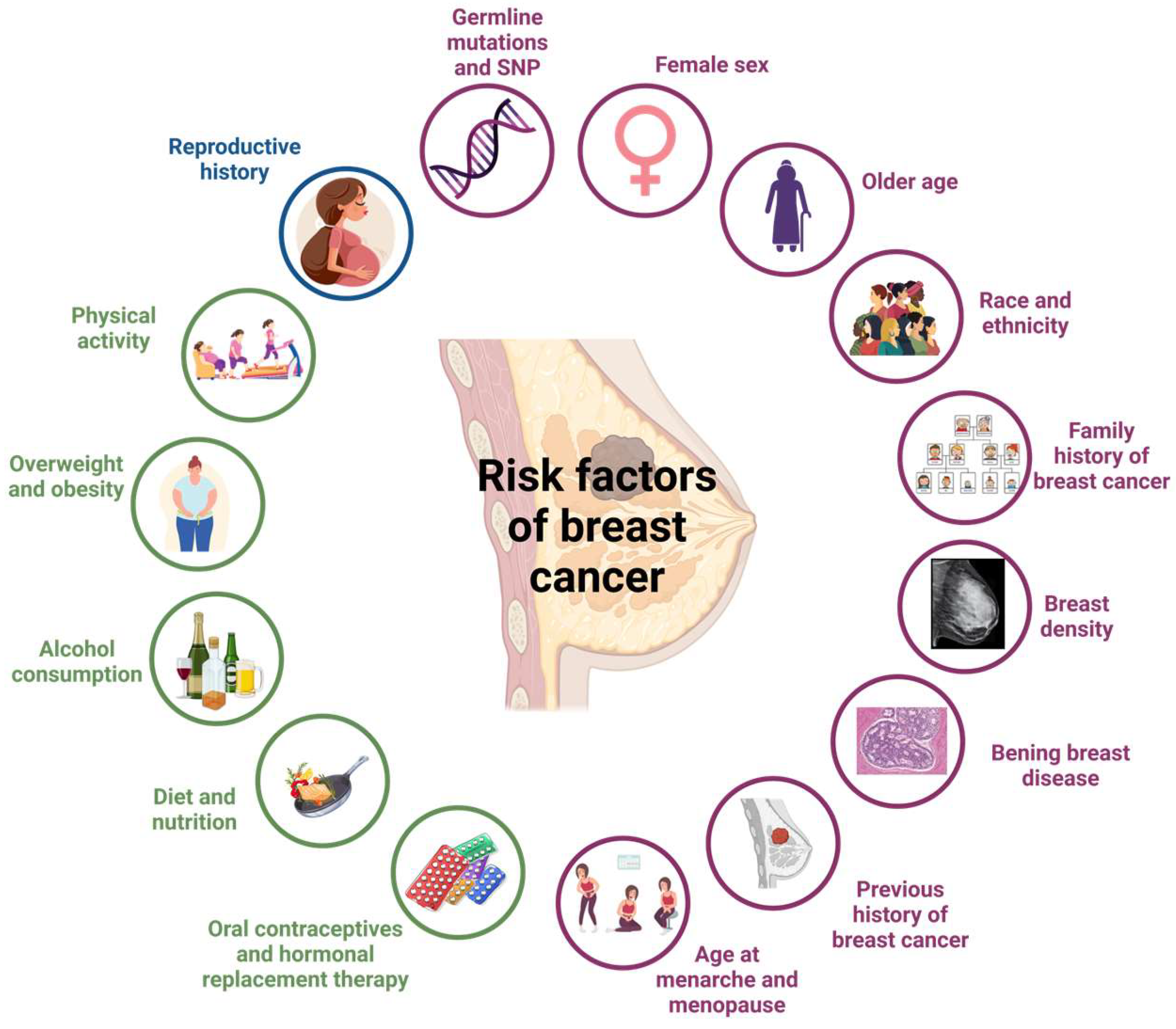
Breast cancer is the most common malignancy among women globally, with incidence rates continuing to rise. A comprehensive understanding of its risk factors and the underlying biological mechanisms that drive tumor initiation is essential for developing effective prevention strategies. This review examines key non-modifiable risk factors, such as genetic predisposition, demographic characteristics, family history, mammographic density, and reproductive milestones, as well as modifiable risk factors like exogenous hormone exposure, obesity, diet, and physical inactivity. Importantly, reproductive history plays a dual role, providing long-term protection while temporarily increasing breast cancer risk shortly after pregnancy. Current chemoprevention strategies primarily depend on selective estrogen receptor modulators (SERMs), including tamoxifen and raloxifene, which have demonstrated efficacy in reducing the incidence of estrogen receptor-positive breast cancer but remain underutilized due to adverse effects. Emerging approaches such as aromatase inhibitors, RANKL inhibitors, progesterone antagonists, PI3K inhibitors, and immunoprevention strategies show promise for expanding preventive options. Understanding the interactions between risk factors, hormonal influences, and tumorigenesis is critical for optimizing breast cancer prevention and advancing safer, more targeted chemopreventive interventions
Keywords: breast cancer; chemoprevention; risk factors; pregnancy; estrogens; tamoxifen; selective estrogen receptor modulators (SERMs) breast cancer; chemoprevention; risk factors; pregnancy; estrogens; tamoxifen; selective estrogen receptor modulators (SERMs)