Characterisation of the Novel Cutibacterium acnes Phage KIT09 and First Report of CRISPR-Cas-Independent Bacteriophage Resistance in Phylotype IA1

 ,
,  ,
, 
Abstract
1. Introduction
2. Results
2.1. Isolation and Characterisation of Phage KIT09
2.1.1. Morphology of Phage KIT09
2.1.2. Infectivity and Specificity of Phage KIT09
2.1.3. Infection Cycle and Stability of Phage KIT09
2.1.4. Genomic and Phylogenetic Characterisation of Phage KIT09
2.2. Phage KIT09 Resistance Characterisation
2.2.1. Generation of Phage-Resistant Bacterial Isolates During Coevolution with Phage KIT09
2.2.2. Characterisation of Phage-Resistant Isolates
3. Discussion
4. Materials and Methods
4.1. Materials
4.2. Phage KIT09 Isolation and Characterisation
4.2.1. Phage Enrichment and Isolation
4.2.2. Morphology and Host Specificity
4.2.3. One-Step Growth Curve
4.2.4. Adsorption Assay
4.2.5. Phage Stability
4.2.6. Bacteriolytic Activity
4.2.7. Genome Analysis
4.2.8. Phage-Resistance Induction
4.2.9. Phage-Resistance Characterisation
Supplementary Materials
Author Contributions
Funding
Institutional Review Board Statement
Informed Consent Statement
Data Availability Statement
Acknowledgments
Conflicts of Interest
Abbreviations
| NITE | National Institute of Technology and Evaluation |
| NBRC | NITE Biological Resources Center |
| CRISPR | Clustered Regularly Interspaced Short Palindromic Repeats |
| MOI | Multiplicity of Infection |
| SNP | Single-nucleotide polymorphism |
References
- Fitz-Gibbon, S.; Tomida, S.; Chiu, B.H.; Nguyen, L.; Du, C.; Liu, M.; Elashoff, D.; Erfe, M.C.; Loncaric, A.; Kim, J.; et al. Propionibacterium acnes strain populations in the human skin microbiome associated with acne. J. Investig. Dermatol. 2013, 133, 2152. [Google Scholar] [CrossRef]
- Barnard, E.; Nagy, I.; Hunyadkürti, J.; Patrick, S.; McDowell, A. Multiplex touchdown PCR for rapid typing of the opportunistic pathogen Propionibacterium acnes. J. Clin. Microbiol. 2015, 53, 1149–1155. [Google Scholar] [CrossRef]
- Dréno, B.; Pécastaings, S.; Corvec, S.; Veraldi, S.; Khammari, A.; Roques, C. Cutibacterium acnes (Propionibacterium acnes) and acne vulgaris: A brief look at the latest updates. J. Eur. Acad. Dermatol. Venereol. 2018, 32, 5–14. [Google Scholar] [CrossRef]
- Xia, X.; Li, Z.; Liu, K.; Wu, Y.; Jiang, D.; Lai, Y. Staphylococcal LTA-Induced miR-143 Inhibits Propionibacterium acnes-Mediated Inflammatory Response in Skin. J. Investig. Dermatol. 2016, 136, 621–630. [Google Scholar] [CrossRef] [PubMed]
- Cheung, C.T.; Lancien, U.; Corvec, S.; Mengeaud, V.; Mias, C.; Véziers, J.; Khammari, A.; Dréno, B. Pro-inflammatory activity of Cutibacterium acnes phylotype IA1 and extracellular vesicles: An in vitro study. Exp. Dermatol. 2024, 33, e15150. [Google Scholar] [CrossRef] [PubMed]
- Scott, E.; Burkhart, C. Cutibacterium Acnes as a Cause of Post-surgical Prosthesis Infection. Open Dermatol. J. 2025, 17, e187437222309130. [Google Scholar] [CrossRef]
- Shafiuddin, M.; Huang Wchi Prather, G.W.; Anton, J.R.; Martin, A.L.; Sillart, S.B.; Tang, J.Z.; Vittori, M.R.; Prinsen, M.J.; Ninneman, J.J.; Manithody, C.; et al. Cutibacterium Adaptation to Life on Humans Provides a Potential C acnes Infection Biomarker. J. Investig. Dermatol. 2025, 146, 198–213. [Google Scholar] [CrossRef]
- Lanter, B.B.; Davies, D.G. Propionibacterium acnes Recovered from Atherosclerotic Human Carotid Arteries Undergoes Biofilm Dispersion and Releases Lipolytic and Proteolytic Enzymes in Response to Norepinephrine Challenge In Vitro. Infect. Immun. 2015, 83, 3960. [Google Scholar] [CrossRef]
- Vilchez, H.H.; Escudero-Sanchez, R.; Fernandez-Sampedro, M.; Murillo, O.; Auñón, Á.; Rodríguez-Pardo, D.; Jover-Sáenz, A.; del Toro, M.D.; Rico, A.; Falgueras, L.; et al. Prosthetic Shoulder Joint Infection by Cutibacterium acnes: Does Rifampin Improve Prognosis? A Retrospective, Multicenter, Observational Study. Antibiotics 2021, 10, 475. [Google Scholar] [CrossRef]
- Reynolds, R.V.; Yeung, H.; Cheng, C.E.; Cook-Bolden, F.; Desai, S.R.; Druby, K.M.; Freeman, E.E.; Keri, J.E.; Gold, L.F.S.; Tan, J.K.; et al. Guidelines of care for the management of acne vulgaris. J. Am. Acad. Dermatol. 2024, 90, 1006.e1–1006.e30. [Google Scholar] [CrossRef]
- Alkhawaja, E.; Hammadi, S.; Abdelmalek, M.; Mahasneh, N.; Alkhawaja, B.; Abdelmalek, S.M. Antibiotic resistant Cutibacterium acnes among acne patients in Jordan: A cross sectional study. BMC Dermatol. 2020, 20, 17. [Google Scholar] [CrossRef]
- Zhu, T.; Zhu, W.; Wang, Q.; He, L.; Wu, W.; Liu, J.; Li, Y.; Sun, D. Antibiotic susceptibility of Propionibacterium acnes isolated from patients with acne in a public hospital in Southwest China: Prospective cross-sectional study. BMJ Open 2019, 9, e022938. [Google Scholar] [CrossRef]
- Rimon, A.; Rakov, C.; Lerer, V.; Sheffer-Levi, S.; Oren, S.A.; Shlomov, T.; Shasha, L.; Lubin, R.; Zubeidat, K.; Jaber, N.; et al. Topical phage therapy in a mouse model of Cutibacterium acnes-induced acne-like lesions. Nat. Commun. 2023, 14, 1005. [Google Scholar] [CrossRef] [PubMed]
- Brüggemann, H.; Lomholt, H.B.; Tettelin, H.; Kilian, M. CRISPR/cas loci of type II Propionibacterium acnes confer immunity against acquisition of mobile elements present in type I P. acnes. PLoS ONE 2012, 7, e34171. [Google Scholar] [CrossRef] [PubMed]
- Cobian, N.; Garlet, A.; Hidalgo-Cantabrana, C.; Barrangou, R. Comparative Genomic Analyses and CRISPR-Cas Characterization of Cutibacterium acnes Provide Insights Into Genetic Diversity and Typing Applications. Front. Microbiol. 2021, 12, 758749. [Google Scholar] [CrossRef]
- Knödlseder, N.; Nevot, G.; Fábrega, M.J.; Mir-Pedrol, J.; Sanvicente-García, M.; Campamà-Sanz, N.; Paetzold, B.; Lood, R.; Güell, M. Engineering selectivity of Cutibacterium acnes phages by epigenetic imprinting. PLoS Pathog. 2022, 18, e1010420. [Google Scholar] [CrossRef]
- Nguyen, P.D.; Nakanishi, K.; Hosokawa, C.; Han, N.S.; Kitao, M.; Yoshimoto, M.; Kamei, K. Characterization of the novel Cutibacterium acnes phage KIT08 and its associated pseudolysogenic bacterial isolate. Arch. Microbiol. 2025, 207, 261. [Google Scholar] [CrossRef]
- Wottrich, S.; Mendonca, S.; Safarpour, C.; Nguyen, C.; Marinelli, L.J.; Hancock, S.P.; Modlin, R.L.; Parker, J.M. Putative pseudolysogeny-dependent phage gene implicated in the superinfection resistance of Cutibacterium acnes. Microbiome Res. Rep. 2024, 3, 27. [Google Scholar] [CrossRef]
- Chen, B.; Chittò, M.; Tao, S.; Wagemans, J.; Lavigne, R.; Richards, R.G.; Metsemakers, W.-J.; Moriarty, T.F. Isolation and Antibiofilm Activity of Bacteriophages against Cutibacterium acnes from Patients with Periprosthetic Joint Infection. Viruses 2024, 16, 1592. [Google Scholar] [CrossRef] [PubMed]
- Liu, J.; Yan, R.; Zhong, Q.; Ngo, S.; Bangayan, N.J.; Nguyen, L.; Lui, T.; Liu, M.; Erfe, M.C.; Craft, N.; et al. The diversity and host interactions of Propionibacterium acnes bacteriophages on human skin. ISME J. 2015, 9, 2078–2093, Correction in ISME J. 2015, 9, 2116. https://doi.org/10.1038/ismej.2015.144. [Google Scholar] [CrossRef]
- Kutter, E. Phage Host Range and Efficiency of Plating. In Methods in Molecular Biology (Clifton, N.J.); Humana Press: Totowa, NJ, USA, 2009; Volume 501, pp. 141–149. [Google Scholar] [CrossRef]
- Mirouze, N.; Bergé, M.A.; Soulet, A.-L.; Mortier-Barrière, I.; Quentin, Y.; Fichant, G.; Granadel, C.; Noirot-Gros, M.-F.; Noirot, P.; Polard, P.; et al. Direct involvement of DprA, the transformation-dedicated RecA loader, in the shut-off of pneumococcal competence. Proc. Natl. Acad. Sci. USA 2012, 110, E1035–E1044. [Google Scholar] [CrossRef]
- Li, X.; Ding, W.; Li, Z.; Yan, Y.; Tong, Y.; Xu, J.; Li, M. vB_CacS-HV1 as a Novel Pahexavirus Bacteriophage with Lytic and Anti-Biofilm Potential against Cutibacterium acnes. Microorganisms 2024, 12, 1566. [Google Scholar] [CrossRef]
- Liu, Y.; Zhen, N.; Liao, D.; Niu, J.; Liu, R.; Li, Z.; Lei, Z.; Yang, Z. Application of bacteriophage φPaP11-13 attenuates rat Cutibacterium acnes infection lesions by promoting keratinocytes apoptosis via inhibiting PI3K/Akt pathway. Microbiol. Spectr. 2024, 12, e0283823. [Google Scholar] [CrossRef]
- Liao, D.; Zhang, J.; Liu, R.; Chen, K.; Liu, Y.; Shao, Y.; Shi, X.; Zhang, Y.; Yang, Z. Whole–genome sequencing, annotation, and biological characterization of a novel Siphoviridae phage against multi–drug resistant Propionibacterium acne. Front. Microbiol. 2023, 13, 1065386, Correction in Front. Microbiol. 2024, 15, 1390825. https://doi.org/10.3389/fmicb.2024.1390825. [Google Scholar] [CrossRef]
- Kim, S.; Song, H.; Jin, J.S.; Lee, W.J.; Kim, J. Genomic and Phenotypic Characterization of Cutibacterium acnes Bacteriophages Isolated from Acne Patients. Antibiotics 2022, 11, 1041. [Google Scholar] [CrossRef] [PubMed]
- Lam, H.Y.P.; Lai, M.J.; Chen, T.Y.; Wu, W.J.; Peng, S.Y.; Chang, K.C. Therapeutic effect of a newly isolated lytic bacteriophage against multi-drug-resistant Cutibacterium acnes infection in mice. Int. J. Mol. Sci. 2021, 22, 7031. [Google Scholar] [CrossRef] [PubMed]
- Kim, J.I.; Hasnain, M.A.; Moon, G.S. Expression of a recombinant endolysin from bacteriophage CAP 10-3 with lytic activity against Cutibacterium acnes. Sci. Rep. 2023, 13, 16430. [Google Scholar] [CrossRef]
- Marinelli, L.J.; Fitz-Gibbon, S.; Hayes, C.; Bowman, C.; Inkeles, M.; Loncaric, A.; A Russell, D.; Jacobs-Sera, D.; Cokus, S.; Pellegrini, M.; et al. Propionibacterium acnes bacteriophages display limited genetic diversity and broad killing activity against bacterial skin isolates. mBio 2012, 3, e00279-12. [Google Scholar] [CrossRef] [PubMed]
- Fang, Q.; Feng, Y.; McNally, A.; Zong, Z. Characterization of phage resistance and phages capable of intestinal decolonization of carbapenem-resistant Klebsiella pneumoniae in mice. Commun. Biol. 2022, 5, 48. [Google Scholar] [CrossRef]
- Lim, W.S.; Phang, K.K.S.; Tan, A.H.M.; Li, S.F.Y.; Ow, D.S.W. Small colony variants and single nucleotide variations in Pf1 region of Pb1 phage-resistant Pseudomonas aeruginosa. Front. Microbiol. 2016, 7, 282. [Google Scholar] [CrossRef]
- Bergé, M.J.; Mercy, C.; Mortier-Barrière, I.; Vannieuwenhze, M.S.; Brun, Y.V.; Grangeasse, C.; Polard, P.; Campo, N. A programmed cell division delay preserves genome integrity during natural genetic transformation in Streptococcus pneumoniae. Nat. Commun. 2017, 8, 1621. [Google Scholar] [CrossRef]
- Liu, S.; Wei, Y.; Zhou, X.; Zhang, K.; Peng, X.; Ren, B.; Chen, V.; Cheng, L.; Li, M. Function of alanine racemase in the physiological activity and cariogenicity of Streptococcus mutans. Sci. Rep. 2018, 8, 5984. [Google Scholar] [CrossRef] [PubMed]
- Walsh, C.T. Enzymes in the D-alanine branch of bacterial cell wall peptidoglycan assembly. J. Biol. Chem. 1989, 264, 2393–2396. [Google Scholar] [CrossRef]
- Bertozzi Silva, J.; Storms, Z.; Sauvageau, D. Host receptors for bacteriophage adsorption. FEMS Microbiol. Lett. 2016, 363, 2. [Google Scholar] [CrossRef]
- Ahsan, R.; Kifayat, S.; Pooniya, K.K.; Kularia, S.; Adimalla, B.S.; Sanapalli, B.K.R.; Sanapalli, V.; Sigalapalli, D.K. Bacterial Histidine Kinase and the Development of Its Inhibitors in the 21st Century. Antibiotics 2024, 13, 576. [Google Scholar] [CrossRef]
- Chen, H.; Yu, C.; Wu, H.; Li, G.; Li, C.; Hong, W.; Yang, X.; Wang, H.; You, X. Recent Advances in Histidine Kinase-Targeted Antimicrobial Agents. Front. Chem. 2022, 10, 866392. [Google Scholar] [CrossRef]
- Lucas-Elío, P.; Molina-Quintero, L.R.; Xu, H.; Sánchez-Amat, A. A histidine kinase and a response regulator provide phage resistance to Marinomonas mediterranea via CRISPR-Cas regulation. Sci. Rep. 2021, 11, 20564. [Google Scholar] [CrossRef]
- Xuan, G.; Lin, H.; Li, X.; Kong, J.; Wang, J. RetS Regulates Phage Infection in Pseudomonas aeruginosa via Modulating the GacS/GacA Two-Component System. J. Virol. 2022, 96, e0019722. [Google Scholar] [CrossRef] [PubMed]
- Schroven, K.; Putzeys, L.; Kerremans, A.; Ceyssens, P.-J.; Vallino, M.; Paeshuyse, J.; Haque, F.; Yusuf, A.; Koch, M.D.; Lavigne, R. The phage-encoded PIT4 protein affects multiple two-component systems of Pseudomonas aeruginosa. Microbiol. Spectr. 2023, 11, e02372-23. [Google Scholar] [CrossRef] [PubMed]
- Van Twest, R.; Kropinski, A.M. Bacteriophage enrichment from water and soil. In Methods in Molecular Biology (Clifton, N.J.); Humana Press: Totowa, NJ, USA, 2009; Volume 501, pp. 15–21. [Google Scholar] [CrossRef]
- Ackermann, H.W. Phage Classification and Characterization. In Methods in Molecular Biology (Clifton, N.J.); Humana Press: Totowa, NJ, USA, 2009; Volume 501, pp. 127–140. [Google Scholar] [CrossRef]
- Schindelin, J.; Arganda-Carreras, I.; Frise, E.; Kaynig, V.; Longair, M.; Pietzsch, T.; Preibisch, S.; Rueden, C.; Saalfeld, S.; Schmid, B.; et al. Fiji: An open-source platform for biological-image analysis. Nat. Methods 2012, 9, 676–682. [Google Scholar] [CrossRef]
- Hyman, P.; Abedon, S.T. Practical Methods for Determining Phage Growth Parameters. In Methods in Molecular Biology (Clifton, N.J.); Humana Press: Totowa, NJ, USA, 2009; Volume 501, pp. 175–202. [Google Scholar] [CrossRef]
- Foschino, R.; Perrone, F.; Galli, A. Characterization of two virulent Lactobacillus fermentum bacteriophages isolated from sour dough. J. Appl. Bacteriol. 1995, 79, 677–683. [Google Scholar] [CrossRef]
- Akhwale, J.K.; Rohde, M.; Rohde, C.; Bunk, B.; Spröer, C.; Boga, H.I.; Klenk, H.-P.; Wittmann, J. Isolation, characterization and analysis of bacteriophages from the haloalkaline lake Elmenteita, Kenya. PLoS ONE 2019, 14, e0215734. [Google Scholar] [CrossRef]
- Jakočiūnė, D.; Moodley, A. A Rapid Bacteriophage DNA Extraction Method. Methods Protoc. 2018, 1, 27. [Google Scholar] [CrossRef]
- Chen, S.; Zhou, Y.; Chen, Y.; Gu, J. fastp: An ultra-fast all-in-one FASTQ preprocessor. Bioinformatics 2018, 34, i884–i890. [Google Scholar] [CrossRef]
- Babraham Bioinformatics—FastQC A Quality Control Tool for High Throughput Sequence Data. Available online: https://www.bioinformatics.babraham.ac.uk/projects/fastqc/ (accessed on 14 June 2025).
- Song, L.; Florea, L.; Langmead, B. Lighter: Fast and memory-efficient sequencing error correction without counting. Genome Biol. 2014, 15, 509. [Google Scholar] [CrossRef] [PubMed]
- Magoč, T.; Salzberg, S.L. FLASH: Fast length adjustment of short reads to improve genome assemblies. Bioinformatics 2011, 27, 2957. [Google Scholar] [CrossRef]
- Zerbino, D.R.; Birney, E. Velvet: Algorithms for de novo short read assembly using de Bruijn graphs. Genome Res. 2008, 18, 821. [Google Scholar] [CrossRef] [PubMed]
- Walker, B.J.; Abeel, T.; Shea, T.; Priest, M.; Abouelliel, A.; Sakthikumar, S.; Cuomo, C.A.; Zeng, Q.; Wortman, J.; Young, S.K.; et al. Pilon: An Integrated Tool for Comprehensive Microbial Variant Detection and Genome Assembly Improvement. PLoS ONE 2014, 9, e112963. [Google Scholar] [CrossRef]
- Gurevich, A.; Saveliev, V.; Vyahhi, N.; Tesler, G. QUAST: Quality assessment tool for genome assemblies. Bioinformatics 2013, 29, 1072–1075. [Google Scholar] [CrossRef]
- Nayfach, S.; Camargo, A.P.; Schulz, F.; Eloe-Fadrosh, E.; Roux, S.; Kyrpides, N.C. CheckV assesses the quality and completeness of metagenome-assembled viral genomes. Nat. Biotechnol. 2021, 39, 578–585. [Google Scholar] [CrossRef]
- Md, V.; Misra, S.; Li, H.; Aluru, S. Efficient architecture-aware acceleration of BWA-MEM for multicore systems. In Proceedings of the 2019 IEEE 33rd International Parallel and Distributed Processing Symposium, IPDPS 2019, Rio de Janeiro, Brazil, 20–24 May 2019; pp. 314–324. [Google Scholar] [CrossRef]
- Danecek, P.; Bonfield, J.K.; Liddle, J.; Marshall, J.; Ohan, V.; Pollard, M.O.; Whitwham, A.; Keane, T.; McCarthy, S.A.; Davies, R.M.; et al. Twelve years of SAMtools and BCFtools. GigaScience 2021, 10, giab008. [Google Scholar] [CrossRef]
- Bouras, G.; Nepal, R.; Houtak, G.; Psaltis, A.J.; Wormald, P.J.; Vreugde, S. Pharokka: A fast scalable bacteriophage annotation tool. Bioinformatics 2023, 39, btac776. [Google Scholar] [CrossRef]
- Larralde, M. Pyrodigal: Python bindings and interface to Prodigal, an efficient method for gene prediction in prokaryotes. J. Open Source Softw. 2022, 7, 4296. [Google Scholar] [CrossRef]
- Terzian, P.; Olo Ndela, E.; Galiez, C.; Lossouarn, J.; Pérez Bucio, R.E.; Mom, R.; Toussaint, A.; Petit, M.-A.; Enault, F. PHROG: Families of prokaryotic virus proteins clustered using remote homology. NAR Genom. Bioinform. 2021, 3, lqab067. [Google Scholar] [CrossRef]
- Heinzinger, M.; Weissenow, K.; Sanchez, J.G.; Henkel, A.; Mirdita, M.; Steinegger, M.; Rost, B. Bilingual language model for protein sequence and structure. NAR Genom. Bioinform. 2024, 6, 150. [Google Scholar] [CrossRef] [PubMed]
- van Kempen, M.; Kim, S.S.; Tumescheit, C.; Mirdita, M.; Lee, J.; Gilchrist, C.L.M.; Söding, J.; Steinegger, M. Fast and accurate protein structure search with Foldseek. Nat. Biotechnol. 2024, 42, 243–246. [Google Scholar] [CrossRef] [PubMed]
- McGinnis, S.; Madden, T.L. BLAST: At the core of a powerful and diverse set of sequence analysis tools. Nucleic Acids Res. 2004, 32, W20–W25. [Google Scholar] [CrossRef] [PubMed]
- Söding, J.; Biegert, A.; Lupas, A.N. The HHpred interactive server for protein homology detection and structure prediction. Nucleic Acids Res. 2005, 33, W244–W248. [Google Scholar] [CrossRef]
- Alcock, B.P.; Huynh, W.; Chalil, R.; Smith, K.W.; Raphenya, A.R.; Wlodarski, M.A.; Edalatmand, A.; Petkau, A.; A Syed, S.; Tsang, K.K.; et al. CARD 2023: Expanded curation, support for machine learning, and resistome prediction at the Comprehensive Antibiotic Resistance Database. Nucleic Acids Res. 2023, 51, D690–D699. [Google Scholar] [CrossRef]
- Liu, B.; Zheng, D.; Zhou, S.; Chen, L.; Yang, J. VFDB 2022: A general classification scheme for bacterial virulence factors. Nucleic Acids Res. 2022, 50, D912–D917. [Google Scholar] [CrossRef]
- Bland, C.; Ramsey, T.L.; Sabree, F.; Lowe, M.; Brown, K.; Kyrpides, N.C.; Hugenholtz, P. CRISPR Recognition Tool (CRT): A tool for automatic detection of clustered regularly interspaced palindromic repeats. BMC Bioinform. 2007, 8, 209. [Google Scholar] [CrossRef] [PubMed]
- Laslett, D.; Canback, B. ARAGORN, a program to detect tRNA genes and tmRNA genes in nucleotide sequences. Nucleic Acids Res. 2004, 32, 11. [Google Scholar] [CrossRef] [PubMed]
- Garneau, J.R.; Depardieu, F.; Fortier, L.C.; Bikard, D.; Monot, M. PhageTerm: A tool for fast and accurate determination of phage termini and packaging mechanism using next-generation sequencing data. Sci. Rep. 2017, 7, 8292. [Google Scholar] [CrossRef]
- McNair, K.; Salamon, P.; Edwards, R.A.; Segall, A.M. PRFect: A tool to predict programmed ribosomal frameshifts in prokaryotic and viral genomes. BMC Bioinform. 2024, 25, 82. [Google Scholar] [CrossRef] [PubMed]
- Hancock Laboratory Methods. Department of Microbiology and Immunology, University of Bristish Columbia, Vancouver, Canada. Isolation of Phage Resistant Mutants-Hancock Lab. Available online: https://cmdr.ubc.ca/bobh/method/isolation-of-phage-resistant-mutants/ (accessed on 8 December 2025).
- Deatherage, D.E.; Barrick, J.E. Identification of mutations in laboratory-evolved microbes from next-generation sequencing data using breseq. Methods Mol. Biol. 2014, 1151, 165–188. [Google Scholar] [CrossRef]
- Blum, M.; Andreeva, A.; Florentino, L.C.; Chuguransky, S.R.; Grego, T.; Hobbs, E.; Pinto, B.L.; Orr, A.; Paysan-Lafosse, T.; Ponamareva, I.; et al. InterPro: The protein sequence classification resource in 2025. Nucleic Acids Res. 2025, 53, D444–D456. [Google Scholar] [CrossRef]
- Szklarczyk, D.; Kirsch, R.; Koutrouli, M.; Nastou, K.; Mehryary, F.; Hachilif, R.; Gable, A.L.; Fang, T.; Doncheva, N.T.; Pyysalo, S.; et al. The STRING database in 2023: Protein-protein association networks and functional enrichment analyses for any sequenced genome of interest. Nucleic Acids Res. 2023, 51, D638–D646. [Google Scholar] [CrossRef]
- Coppens, L.; Wicke, L.; Lavigne, R. SAPPHIRE.CNN: Implementation of dRNA-seq-driven, species-specific promoter prediction using convolutional neural networks. Comput. Struct. Biotechnol. J. 2022, 20, 4969–4974. [Google Scholar] [CrossRef]
- Jin, Y.; Cui, J.; Ma, H.; Gan, F.; Xu, Z.Z.; Lu, Z.J. Conserved 3′ Stem-Loop Structures Enable Comprehensive Analysis of Bacterial Transcription Termination in Metagenomes, Regardless of Rho Factor Dependency. bioRxiv 2024. [Google Scholar] [CrossRef]


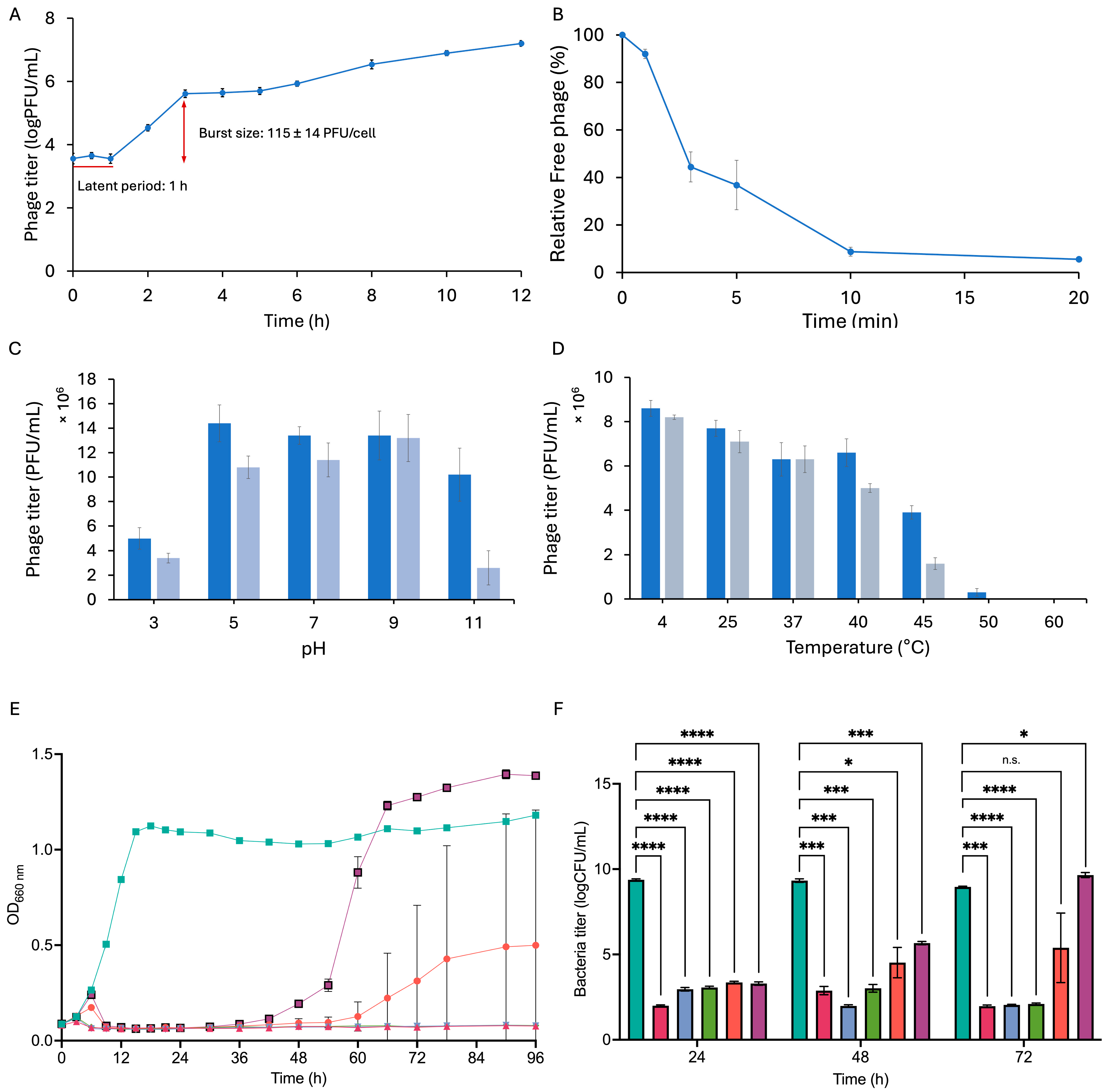
 , control (no infection);
  , MOI = 10;
  , MOI = 0.1;
  , MOI = 0.001. (E) AUC after 48 h culture, calculated from growth curves by Prism software, NBRC 107605 (green), R5 (blue), R6 (yellow), R8 (red). The experiments were performed in triplicate; data are presented as the mean ± standard deviation (SD). ****, p < 0.0001; n.s., not significant.
, control (no infection); , MOI = 10; , MOI = 0.1; , MOI = 0.001. (E) AUC after 48 h culture, calculated from growth curves by Prism software, NBRC 107605 (green), R5 (blue), R6 (yellow), R8 (red). The experiments were performed in triplicate; data are presented as the mean ± standard deviation (SD). ****, p < 0.0001; n.s., not significant.
, MOI = 0.001. (E) AUC after 48 h culture, calculated from growth curves by Prism software, NBRC 107605 (green), R5 (blue), R6 (yellow), R8 (red). The experiments were performed in triplicate; data are presented as the mean ± standard deviation (SD). ****, p < 0.0001; n.s., not significant.
, control (no infection); , MOI = 10; , MOI = 0.1; , MOI = 0.001. (E) AUC after 48 h culture, calculated from growth curves by Prism software, NBRC 107605 (green), R5 (blue), R6 (yellow), R8 (red). The experiments were performed in triplicate; data are presented as the mean ± standard deviation (SD). ****, p < 0.0001; n.s., not significant.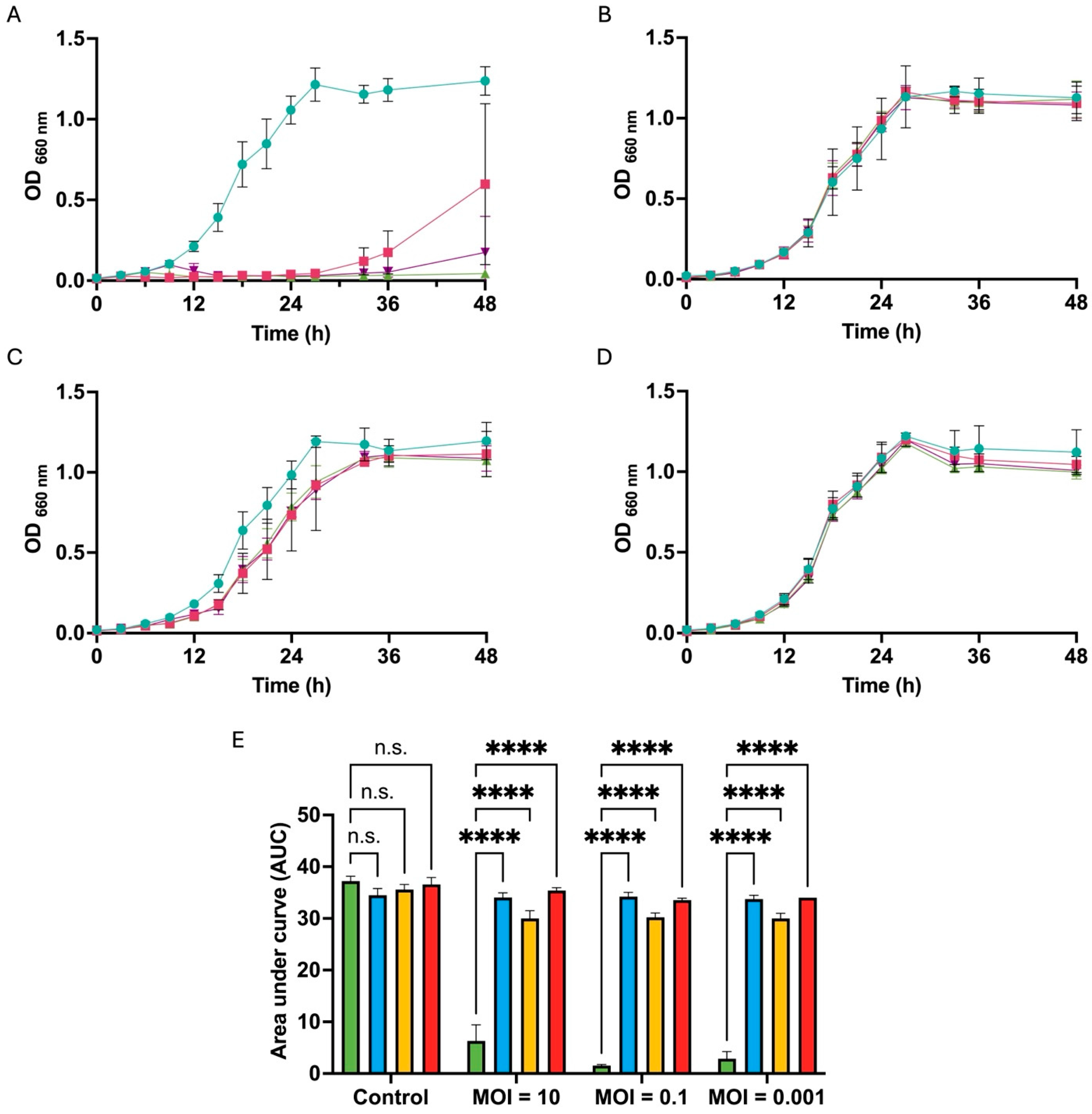

| NBRC No. | Phylotypes * (MLST **) | Source of Isolation * | Clarity Score † | EOP |
|---|---|---|---|---|
| 107605 | IA1 | Facial acne | 4 | 1.00 ± 0.18 |
| 113815 | IA2 | Human skin (glabella) of a 30-year-old female | 4 | 0.63 ± 0.04 |
| 113816 | IA2 | Human skin (back) of a 40-year-old male | 4 | 1.25 ± 0.03 |
| 113817 | IB | Human skin (cheek) of a 30-year-old female | 4 | 0.35 ± 0.07 |
| 113818 | IB | Human skin (chin) of a 40-year-old male | 0 | 0 |
| 113819 | II | Human skin (cheek) of a 40-year-old male | 4 | 0.36 ± 0.07 |
| 111530 | IB | Facial acne of a 35-year-old man | 0 | 0 |
| 113595 | IB | Human skin | 0 | 0 |
| 113869 | IA2 | Human skin (nasal area) of a 30-year-old female | 4 | 0.01 ± 0.004 |
| Phage Name (Accession) | Genome Size (nt) | Query Cover | E-Value | Per. Ident | ANIb |
|---|---|---|---|---|---|
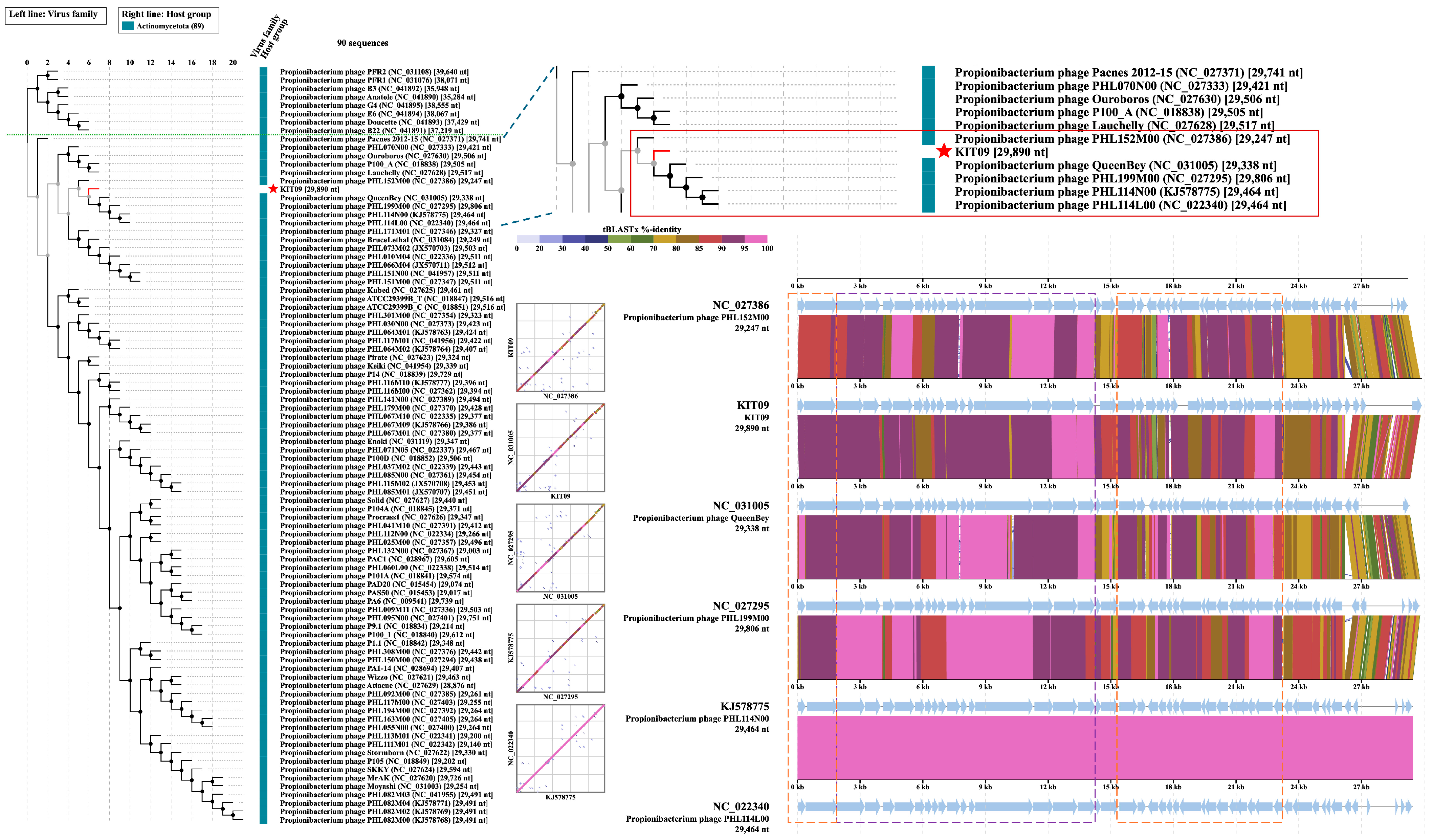
| Propionibacterium phage PHL152M00 (NC_027386) | 29,247 | 98% | 0 | 89.25% | 87.58% |
| Propionibacterium phage QueenBey (NC_031005) | 29,338 | 98% | 0 | 88.82% | 88.23% |
| Propionibacterium phage PHL199M00 (NC_027295) | 29,806 | 100% | 0 | 88.31% | 87.65% |
| Propionibacterium phage PHL114N00 (KJ578775) | 29,464 | 98% | 0 | 88.91% | 87.99% |
| Propionibacterium phage PHL114L00 (NC_022340) | 29,464 | 98% | 0 | 88.91% | 88.00% |
| Subculture (Passage) | R1 | R2 | R3 | R4 | R5 | R6 | R7 | R8 | ||||||||
|---|---|---|---|---|---|---|---|---|---|---|---|---|---|---|---|---|
| Experiment * | R | P | R | P | R | P | R | P | R | P | R | P | R | P | R | P |
| 1st | ◯ | ✕ | ✕ | ◯ | ✕ | ◯ | ✕ | ◯ | ✕ | ✕ | ✕ | ✕ | ◯ | ✕ | ✕ | ✕ |
| 2nd | – | – | – | – | – | – | – | – | ✕ | ✕ | ✕ | ✕ | – | – | ✕ | ✕ |
| 3rd | – | – | – | – | – | – | – | – | ✕ | ✕ | ✕ | ✕ | – | – | ✕ | ✕ |
| 4th | – | – | – | – | – | – | – | – | ✕ | ✕ | ✕ | ✕ | – | – | ✕ | ✕ |
| Properties | ||||||||||||||||
 No resistance;
  Pseudolysogeny-induced resistance;
  Resistance without pseudolysogeny.
| Position | Mutation | R5 | R6 | R8 | Annotation | Gene | Description (BlastP, HHPRED, InterPro) |
|---|---|---|---|---|---|---|---|
| 339,446 | C→T | √ | G298D (GGC→GAC) | CacPP4_02910 ← | two-component sensor Histidine kinase | ||
| 339,465 | C→G | √ | V292L (GTC→CTC) | ||||
| 339,726 | G→T | √ | L205I (CTC→ATC) | ||||
| 924,585 | G→A | √ | √ | √ | Intergenic (−134/+158) | CacPP4_08380 ←/← CacPP4_08390 | hypothetical protein/Tm-1-like protein |
| 1,007,908 | C→A | √ | R157S (CGT→AGT) | sdhA_1 → | succinate dehydrogenase flavoprotein subunit | ||
| 1,376,794 | T→G | √ | √ | √ | Intergenic (+755/+378) | CacPP4_12500 →/← ocd | hypothetical protein/2,3-diaminopropionate biosynthesis protein SbnB |
| 1,524,989 | T→C | √ | √ | √ | H37R (CAC→CGC) | dprA ← | putative DNA processing protein DprA |
| 1,987,014 | (C)12→14 | √ | √ | intergenic (−71/+204) | CacPP4_17970 ←/← CacPP4_17980 | adhesin/choice-of-anchor M domain-containing protein | |
| 1,987,014 | (C)12→15 | √ | Intergenic (−71/+204) | ||||
| 2,115,863 | T→C | √ | √ | √ | G26G (GGT→GGC) | oxyR → | LysR family transcriptional regulator |
| 2,173,362 | G→C | √ | √ | √ | S70W (TCG→TGG) | CacPP4_19570 ← | ThuA domain-containing protein |
| 2,488,946 | A→C | √ | √ | √ | Intergenic (−1723/+263) | CacPP4_22410 ←/← CacPP4_22420 | 16S rRNA (guanine(527)-N(7))-methyltransferase/alanine racemase |
Disclaimer/Publisher’s Note: The statements, opinions and data contained in all publications are solely those of the individual author(s) and contributor(s) and not of MDPI and/or the editor(s). MDPI and/or the editor(s) disclaim responsibility for any injury to people or property resulting from any ideas, methods, instructions or products referred to in the content. |
© 2025 by the authors. Licensee MDPI, Basel, Switzerland. This article is an open access article distributed under the terms and conditions of the Creative Commons Attribution (CC BY) license (https://creativecommons.org/licenses/by/4.0/).
Share and Cite
Nguyen, P.-D.; Nakanishi, K.; Nguyen, H.P.-K.; Nguyen, H.V.; Kitao, M.; Yoshimoto, M.; Kamei, K. Characterisation of the Novel Cutibacterium acnes Phage KIT09 and First Report of CRISPR-Cas-Independent Bacteriophage Resistance in Phylotype IA1. Int. J. Mol. Sci. 2025, 26, 12166. https://doi.org/10.3390/ijms262412166
Nguyen P-D, Nakanishi K, Nguyen HP-K, Nguyen HV, Kitao M, Yoshimoto M, Kamei K. Characterisation of the Novel Cutibacterium acnes Phage KIT09 and First Report of CRISPR-Cas-Independent Bacteriophage Resistance in Phylotype IA1. International Journal of Molecular Sciences. 2025; 26(24):12166. https://doi.org/10.3390/ijms262412166
Chicago/Turabian StyleNguyen, Phuoc-Dung, Koki Nakanishi, Huan Pham-Khanh Nguyen, Hoang Viet Nguyen, Masao Kitao, Masanao Yoshimoto, and Kaeko Kamei. 2025. "Characterisation of the Novel Cutibacterium acnes Phage KIT09 and First Report of CRISPR-Cas-Independent Bacteriophage Resistance in Phylotype IA1" International Journal of Molecular Sciences 26, no. 24: 12166. https://doi.org/10.3390/ijms262412166
APA StyleNguyen, P.-D., Nakanishi, K., Nguyen, H. P.-K., Nguyen, H. V., Kitao, M., Yoshimoto, M., & Kamei, K. (2025). Characterisation of the Novel Cutibacterium acnes Phage KIT09 and First Report of CRISPR-Cas-Independent Bacteriophage Resistance in Phylotype IA1. International Journal of Molecular Sciences, 26(24), 12166. https://doi.org/10.3390/ijms262412166