Article

LPS-Induced Neuroinflammation Increases Serotonin-Evoked Activity of Trigeminal Afferents and Aggravates Mechanical Allodynia and Photophobic Behavior in Rat Migraine Model


1
Department of Human and Animal Physiology, Institute of Fundamental Medicine and Biology, Kazan Federal University, 420008 Kazan, Russia
2
Petrovsky National Research Center of Surgery, 119435 Moscow, Russia
3
The Research and Educational Institute of Neurosurgery, Peoples’ Friendship University of Russia (RUDN), 117198 Moscow, Russia
4
Department of Pharmacology, Tyumen State Medical University, 625023 Tyumen, Russia
5
Laboratory of Experimental Biophysics, Centre for Advanced Technologies, Tashkent 100174, Uzbekistan
6
Division of Medical and Biological Sciences, Tatarstan Academy of Sciences, 420111 Kazan, Russia
7
Department of Gene and Cell Technology, Institute of Fundamental Medicine and Biology, Kazan Federal University, 420021 Kazan, Russia
8
Department of Pathophysiology, Kyrgyz State Medical Academy, Bishkek 720020, Kyrgyzstan
*
Authors to whom correspondence should be addressed.
These authors contributed equally to this work.
Int. J. Mol. Sci. 2025, 26(24), 11983; https://doi.org/10.3390/ijms262411983
Submission received: 5 November 2025 / Revised: 1 December 2025 / Accepted: 3 December 2025 / Published: 12 December 2025
(This article belongs to the Section Molecular Biology)

Abstract

Migraine is characterized by severe pain and somatic symptoms like allodynia and photophobia, driven by neuroinflammation that sensitizes the trigeminal vascular system (TVS). This study investigated how neuroinflammation induced by systemic lipopolysaccharide (LPS) affects migraine-related nociceptive signaling. Using a chronic migraine model in rats with nitroglycerin (NTG), we compared prenatal and acute postnatal LPS administration. Rats with prenatal LPS exhibited lower mechanical thresholds and enhanced allodynia and photophobia after NTG. Acute LPS also increased allodynia, but not photophobia. Both LPS groups showed increased mast cell degranulation in the dura mater. Plasma CGRP after NTG administration was elevated in the acute LPS group. Electrophysiology revealed enhanced trigeminal afferent responses to serotonin in both acutely and prenatally LPS-treated rats. Calcium imaging demonstrated increased neuronal responses to serotonin and capsaicin, suggesting an upregulation of serotonin and TRPV1 receptors. Our findings show that LPS-induced neuroinflammation, whether prenatal or acute, promotes sensitization of peripheral and central nociceptive pathways, involving serotoninergic mechanisms.

1. Introduction

Migraine is a heterogeneous disease characterized by recurrent intense headaches, which may be accompanied by neurological symptoms and changes in sensory perception (known as an aura), as well as various somatic symptoms [1,2,3]. Migraine affects 15–18% of the world’s population and is considered the most disabling neurological disorder, due to its significant negative impact on patients’ quality of life and ability to work [4,5]. The high prevalence of migraine among young people of working age, as well as the intensity of the pain syndrome, place a significant burden on the economy and healthcare system [5,6].
According to current knowledge, the mechanism of headache onset in migraine involves the activation of peripheral structures of the trigeminal vascular system (TVS), which includes the dura mater and the meningeal vessels innervated by nociceptive afferents of the trigeminal ganglion (TG) [1,3,7]. Various mediators, such as nitric oxide, calcitonin gene-related peptide (CGRP), extracellular adenosine triphosphate (ATP), serotonin, and others, can lead to the generation of pain signals [1,3,8,9]. The sources of pro-nociceptive mediators released in the TVS may be blood vessels, nerve fibers, and mast cells located in the dura mater, which are capable of forming the so-called neuro-immune synapse [10,11,12,13]. Moreover, the degranulation of mast cells in the dura mater (along with activation of microglia) may mediate the neuroinflammatory component of migraine pathogenesis, which is particularly pronounced in its chronic form [14,15]. Recent genetic findings suggest that alterations in the genes responsible for inflammation and metabolism are implicated in the pathogenesis of chronic migraine [16]. Neuroinflammation is an inflammatory process in the brain and spinal cord mediated by the production of cytokines, chemokines, reactive oxygen species, and secondary messengers [14,15,17,18,19]. Neuroinflammation is characterized by increased blood–brain barrier permeability, extravasation of immune cells into the brain parenchyma, and the activation of microglia. The role of neuroinflammation in the development of neurological diseases has been established: Alzheimer’s disease [20], Parkinson’s disease [21], lateral sclerosis [22], etc.
The role of neuroinflammation in migraine mechanisms is also under active investigation [11,12,13,14,15,23]. It is believed that mast cell degranulation in the dura mater is one of the factors contributing to the peripheral sensitization of trigeminal meningeal afferents [1,11,12,13,14,15]. The phenomenon of peripheral sensitization consists of the increased sensitivity of meningeal afferents resulting from the action of pro-nociceptive compounds, as well as cytokines and chemokines released from mast cells and macrophages [14,15]. Neuroinflammatory reactions play a key role in peripheral sensitization, creating a feedback loop of nociceptive signal amplification as a result of interactions between immune cells and nerve endings [10,11,12,14,15].
The most common somatic symptoms specific to migraine include hypersensitivity to light (photophobia), tactile allodynia, as well as nausea, vomiting, fatigue, and increased sleepiness [1,10,24,25]. It is believed that various somatic symptoms in migraine may be caused by both the activation of peripheral parts of the trigeminal vascular system and the involvement of central structures, such as the trigeminal nucleus caudalis (TNC), which has ascending and descending connections with the thalamic and cortical regions [1,10]. It is known that sensitization of the meningeal afferents of the trigeminal nerve may be followed by sensitization in the central structures, which mediates the amplification of nociceptive signals transmitted from the periphery and the manifestation or intensification of many somatic symptoms of migraine [1,14]. Currently, despite existing advances in understanding the fundamental mechanisms of migraine pathogenesis, the details of the molecular and cellular mechanisms of nociceptive signaling in the trigeminal vascular system remain poorly understood, complicating the development of new and more effective therapeutic agents for this disease.
Lipopolysaccharide (LPS, an endotoxin found in the cell wall of Gram-negative bacteria) administration is widely used to create a model of inflammatory, post-traumatic, postoperative, or neuropathic pain for further research into nociception-related molecular mechanisms and neuronal pathways [26,27,28,29]. However, to date, there are no experimental studies devoted to assessing the role of neuroinflammation caused by LPS administration on nociceptive processes in migraine, especially using an NTG-induced rodent migraine model, although a number of studies indicate that LPS administration may apparently contribute to the intensification of nociceptive responses [29], including the development of hyperalgesia [26,27,28,29,30,31,32,33,34], which can potentially worsen the course of migraine.
In this study, we used LPS administration during pregnancy for the first time to assess the effects of prenatally induced inflammation on offspring behavior in the migraine model, induced by nitroglycerine (NTG) administration, and on neuroinflammatory responses of mast cells in the dura mater. We further evaluated the role of the systemic inflammation induced by acute LPS administration on the behavioral correlates of migraine, as well as on the degranulation of meningeal mast cells. In addition, using an electrophysiological approach and Ca2+ imaging, we assessed the electrical activity of trigeminal afferents and Ca2+ signaling in isolated neurons of TG in response to LPS-induced neuroinflammation.

2. Results

2.1. Mechanical Sensitivity of Rats in Models of Prenatal and Acute LPS-Induced Inflammation Following Single NTG Administration

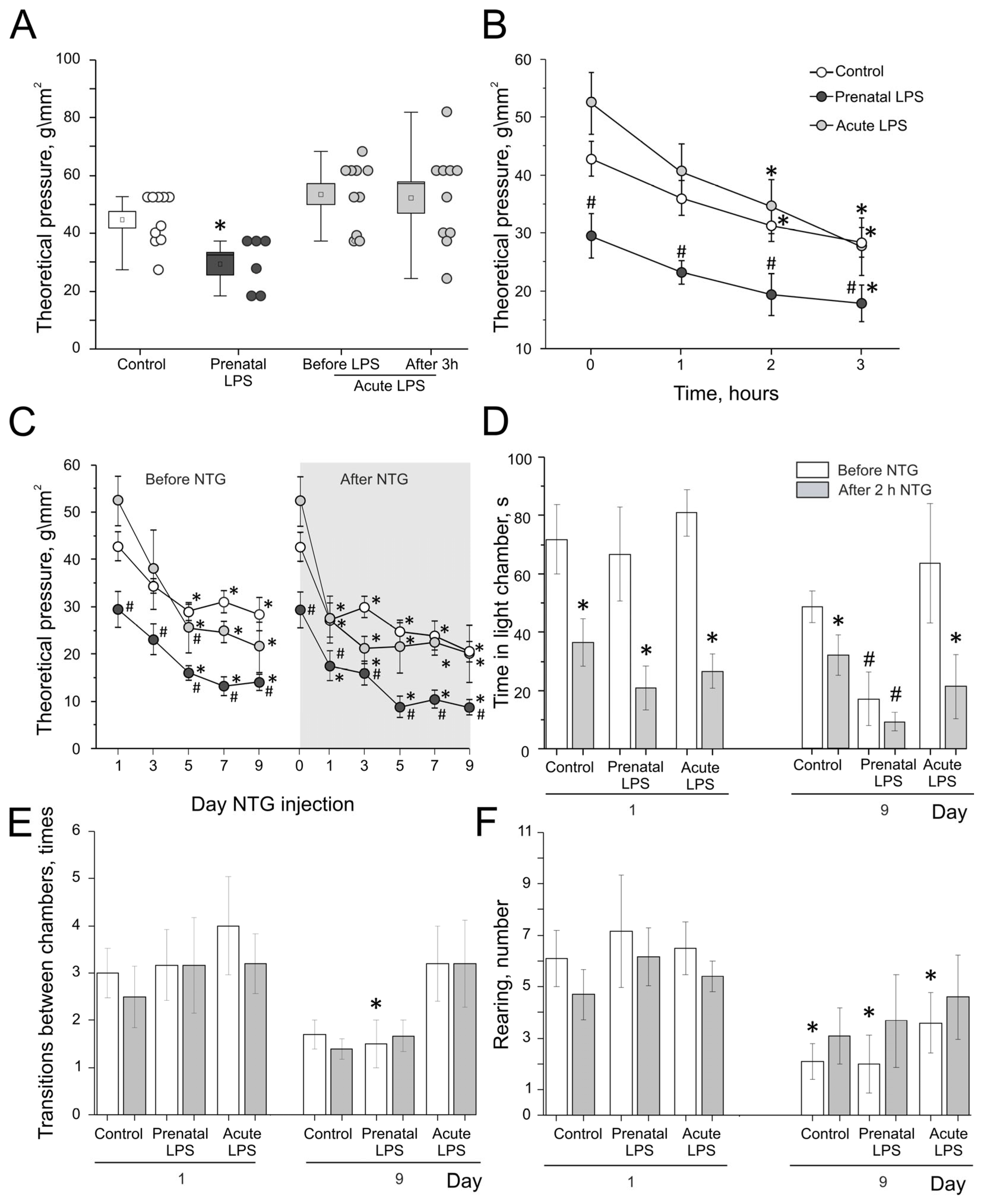
The initial mechanical threshold of the hind paw of control rats (n = 10) was 43.9 ± 3.3 g/mm2, while the mechanical threshold of rats from the prenatal LPS group (n = 6) was significantly lower—29.5 ± 3.8 g/mm2 (p = 0.008; Figure 1A). In rats with acute administration of LPS (n = 10), the initial threshold was 52.5 ± 4.2 g/mm2, and 3 h after LPS injection, it was 52.4 ± 5.3 g/mm2 (p = 0.9) and did not differ from the values of the control group (p = 0.2; Figure 1A).
A single administration of NTG widely used to model the behavioral correlates of episodic migraine, induced a decrease in the mechanical thresholds measured 1, 2, and 3 h after injection, which is consistent with the previously obtained data [35,36]. In the control group one hour after NTG administration, the mechanical threshold of the hind paws did not significantly differ (from 43.9 ± 3.3 g/mm2 to 37.2 ± 3.0 g/mm2; p = 0.2; Figure 1B). Two hours after NTG administration, the mechanical thresholds significantly decreased to 32.6 ± 2.8 g/mm2 (p = 0.03), and three hours after injection, they decreased to 27.4 ± 3.6 g/mm2 (p = 0.01).
In the sham group, the mechanical thresholds were measured after the injection of saline and did not change during 3 h. The initial value was 45 ± 4.4 g/mm2, one hour after injection, it was 64.7 ± 8.75 g/mm2, and it remained stable 2 and 3 h later (64.7 ± 8.75 g/mm2 and 64.7 ± 8.75 g/mm2, respectively).
In the prenatal LPS group, the mechanical thresholds significantly decreased after 3 h of NTG injections from 29.5 ± 3.8 g/mm2 to 17.8 ± 3.1 g/mm2 (p = 0.04; Figure 1B).
In the acute LPS group, the dynamics of the mechanical thresholds after NTG injection were similar to the control group, and a significant decrease was observed two hours after injection, from 52.4 ± 5.3 g/mm2 to 34.5 ± 4.7 g/mm2 (p = 0.02), and after 3 h, it was 27.6 ± 4.9 g/mm2 (p = 0.01; Figure 1B).

2.2. Pre-Injectional Mechanical Thresholds During Chronic NTG Administration

In the sham group (n = 4), the values of the mechanical threshold did not differ from the initial ones; on day 1 of saline injections, it was 45 ± 4.4 g/mm2, on day 3, it was 50.3 ± 6.6 g/mm2, on day 5, it was 42.6 ± 3.4 g/mm2, on day 7, it was 45.7 ± 4 g/mm2, and on day 9, it was 42.5 ± 8.6 g/mm2.
In the control group (n = 10), the initial value of the mechanical threshold was 52.4 ± 5.3 g/mm2. Before the second injection of NTG (on the day 3 of the experimental procedures), the basal threshold significantly decreased to 35.1 ± 4.5 g/mm2 (p = 0.03); on day 9, it was 31 ± 3.5 g/mm2 (p = 0.02; Figure 1C).
In the prenatal LPS group (n = 6), the pre-injection mechanical threshold before the second NTG administration decreased from 29.5 ± 3.8 g/mm2 (the initial basal threshold) to 23.1 ± 3.2 g/mm2 (p = 0.25); before the third injection, it was 16 ± 1.5 (p = 0.015), before the fourth injection, it was 13.2 ± 2 g/mm2 (p = 0.01), and before the fifth injection, it was 14 ± 1.7 g/mm2 (p = 0.001; Figure 1C).
In the acute LPS group (n = 5), the pre-injection mechanical thresholds decreased from 52.5 ± 4.2 g/mm2 to 37.8 ± 8.4 g/mm2 (p = 0.2) before the second NTG injection. Before the third NTG injection, the pre-injectional threshold was 21 ± 2.9 g/mm2 (p = 0.01), which was significantly lower than the control group (p = 0.008), and it remained at the same level before the fifth NTG injection—21.4 ± 5.3 g/mm2 (p = 0.01; Figure 1C).

2.3. Post-Injectional Mechanical Thresholds After Chronic Administration of NTG

Next, we analyzed the post-injection mechanical thresholds 3 h after NTG administration on days 3, 5, 7, and 9, and the obtained parameters were compared with the basal pre-injection thresholds before the first NTG injection.
In the sham group (n = 4), five injections of saline did not change mechanical thresholds significantly. The initial value was 45 ± 4.4 g/mm2, and the mechanical thresholds after the first, second, third, fourth, and fifth injections were 64.7 ± 8.75 40.3 ± 5 g/mm2; 42.6 ± 3.4 g/mm2, 42.6 ± 3.4 g/mm2, and 42.5 ± 8.6 g/mm2, respectively (all p > 0.05 compared to initial value).
In the control group (n = 10), after the first NTG administration, the mechanical thresholds decreased from 43.9 ± 3.3 g/mm2 to 27.4 ± 3.6 g/mm2 (p = 0.01); after the second injection, they were 31.9 ± 2.3 g/mm2 (p = 0.01); after the third injection, they decreased to 25.8 ± 2.4 g/mm2 (p = 0.002); after the fourth injection, they were 25.9 ± 2.9 g/mm2 (p = 0.003); and after the fifth injection, they decreased to 23.4 ± 1.4 g/mm2 (p = 0.003) (Figure 1C).
In the prenatal LPS group (n = 6), after the first day of NTG administration, the mechanical thresholds significantly decreased from 29.5 ± 3.8 g/mm2 to 17.8 ± 3.1 g/mm2 (p = 0.04); after the second injection, they decreased to 16.1 ± 2.5 g/mm2 (p = 0.02); after the third, they decreased to 8.9 ± 2.3 g/mm2 (p = 0.004); after the fourth, they were 10.6 ± 1.8 g/mm2 (p = 0.004); and after the fifth, they decreased to 8.8 ± 1.6 g/mm2 (p = 0.004) (Figure 1C).
In the acute LPS group (n = 10), after the first NTG injection, the mechanical threshold decreased from 52.4 ± 5.3 g/mm2 to 27.6 ± 4.9 g/mm2 (p = 0.02); after the second injection, it decreased to 24.6 ± 2.2 g/mm2 (n = 5, p = 0.01), and this value was significantly lower than the control group (p = 0.01). After the third, fourth, and fifth NTG injections, the mechanical thresholds were 22.3 ± 2.3 g/mm2 (p = 0.01), 26.9 ± 4.7 g/mm2 (p = 0.025), and 20.2 ± 6.1 g/mm2 (p = 0.01), respectively (Figure 1C).

2.4. Effects of Prenatal and Acute Administration of LPS on Photophobic Behavior and Locomotor Activity in the Light–Dark Transition Test in a Model of Episodic and Chronic Migraine

Light avoiding behavior (photophobia) is a specific behavioral sign of migraine. The amount of time spent in a light chamber was measured on days 1 and 9 of NTG administration (or saline in the sham group) before and 2 h after injection. In the sham group (n = 4), on day 1 of saline administration, animals spent 82.5 ± 9 s and 79 ± 43.1 s in the light chamber, respectively. On day 9 of saline administration, before injection, animals spent 57.5 ± 41.1 s in the light chamber and 88 ± 34.15 s 2 h after the injection. Thus, with the administration of saline, there was no decrease in the amount of time spent in the light chamber after the injection, indicating the absence of photophobic behavior. In the control group (n = 10), at day 1 of NTG administration, before injection, animals spent 71.8 ± 12 s in the light chamber and significantly less time, 36.5 ± 8.1 s 2 h, after the injection (p = 0.02; Figure 1D). On day 9 of NTG administration, before injection, animals spent 51.1 ± 5.1 s in the light chamber and significantly less time, 29.8 ± 7.2 s, 2 h after the injection (p = 0.01), which did not differ from values of first day before (p = 0.09) and after the injection (p = 0.8).
In the prenatal LPS group (n = 6), on day 1 of NTG administration, before injection, animals spent 66.7 ± 16.1 s in the light chamber, and significantly less time, 20.8 ± 7.4 s, 2 h after NTG injection (p = 0.004; Figure 1D). On day 9 of NTG administration, before injection, animals spent only 17 ± 9.2 s, which is significantly less than before injection at the day 1 (p = 0.045) and less than the animals in the control group (p = 0.02). Two hours after the injection, they spent less time, 9.2 ± 3.1 s, in the light chamber. This value is significantly lower than the control group (9.2 ± 3.1 s vs. 29.8 ± 7.2 s, p = 0.02).
In the acute LPS group (n = 10), on day 1 of NTG administration, before injection, animals spent 80.8 ± 8 s in the light chamber and significantly less time, 26.7 ± 5.9 s (p = 0.003), 2 h after NTG injection (Figure 1D). This post-injection indicator did not differ from the similar indicator in the control group (p = 0.4). On day 9 of NTG administration, before injection, animals (n = 5) spent 63.7± 20.5 s and significantly less time, 21.3 ± 11.1 s (p = 0.04), 2 h after the injection, which did not differ from the values of first day before (p = 0.7) and after the injection (p = 0.5).
Evaluation of the locomotor activity in each group showed that the NTG injections did not affect the rearing count and number of transitions between chambers. In the sham group (n = 4), on the first day of NaCl administration, we observed 5.5 ± 0.3 transitions between chambers, and 2 h after saline injection, the number of transitions was 4.25 ± 0.5. On day 9 of saline administration, before the injection, the number of transitions was 4.5 ± 0.9, and after the injection, it was 3.75 ± 0.5. In the control group (n = 10), on day 1 of NTG administration, before the injection, we observed 3 ± 0.5 transitions between chambers, and after the NTG injection, it was 2.5 ± 0.65 (p = 0.3 compared to the rearing count before injection; Figure 1E). On day 9 of NTG administration, before injection, the number of transitions was 1.7 ± 0.3, and after NTG administration, it was 1.4 ± 0.2. In the prenatal LPS group (n = 6), on day 1 of NTG administration, before the injection, the number of transitions was 3.2 ± 0.7, and after the injection, it was 3.2 ± 1.65 (p = 1 compared to the number of transitions before injection). On day 9 of NTG administration, before injection, the number of transitions was 1.5 ± 0.5 (p = 0.03 compared to the pre-injection transitions number on day 1; Figure 1E), and after NTG injection, it was 1.7 ± 0.3. In the acute LPS group (n = 10), on day 1 of NTG administration, before the injection, we observed 4 ± 1 transitions, and 2 h after injection, this parameter was 3.2 ± 0.6 (p = 0.8 compared to number of transitions before injection). On day 9 of NTG administration, before injection, the number of transitions was 3.2 ± 0.8, and after the injection, it was 3.2 ± 0.9.
In the sham group (n = 4), on the first day of NaCl administration, we observed an 11 ± 1.2 rearing count, and it was 8.5 ± 0.6 after the injection. On the ninth day of saline administration, before the injection, the rearing count was 7.5 ± 2.1, and after the injection, it was 7 ± 1.4. In the control group (n = 10), on day 1 of NTG administration, before injection, the rearing count was 6.1 ± 1.1, and after the NTG injection, it was 4.7 ± 1 (p = 0.4 compared to the rearing count before injection; Figure 1F). On day 9 of NTG administration, before injection, the rearing count was 2.1 ± 0.7 (p = 0.02 compared to the pre-injection rearing count on the first day; Figure 1F), and 2 h after NTG injection, it was 3.1 ± 1. In the prenatal LPS group (n = 6), on day 1 of NTG administration, before injection, the rearing count was 7.2 ± 2.2, and 2 h after the injection, it was 6.2 ± 1.1 (p = 0.7 compared to the rearing count before injection). On day 9 of NTG administration, the rearing count was 2 ± 1.1 (p = 0.01 compared to the pre-injection rearing count on the first day), and after the injection, it was 3.7 ± 1.8. In the acute LPS group (n = 10), on day 1 of NTG administration, before injection, the rearing count was 6.5 ± 1, and 2 h after the injection, the rearing count was 5.4 ± 0.6 (p = 0.85 compared to the rearing count before injection). On day 9 of NTG administration, the rearing count was 3.6 ± 1.2 (p = 0.04 compared to the pre-injection rearing count on the first day; Figure 1F), and 2 h after the injection, it was 4.6 ± 1.6.

2.5. Mast Cell Degranulation in the Dura Mater

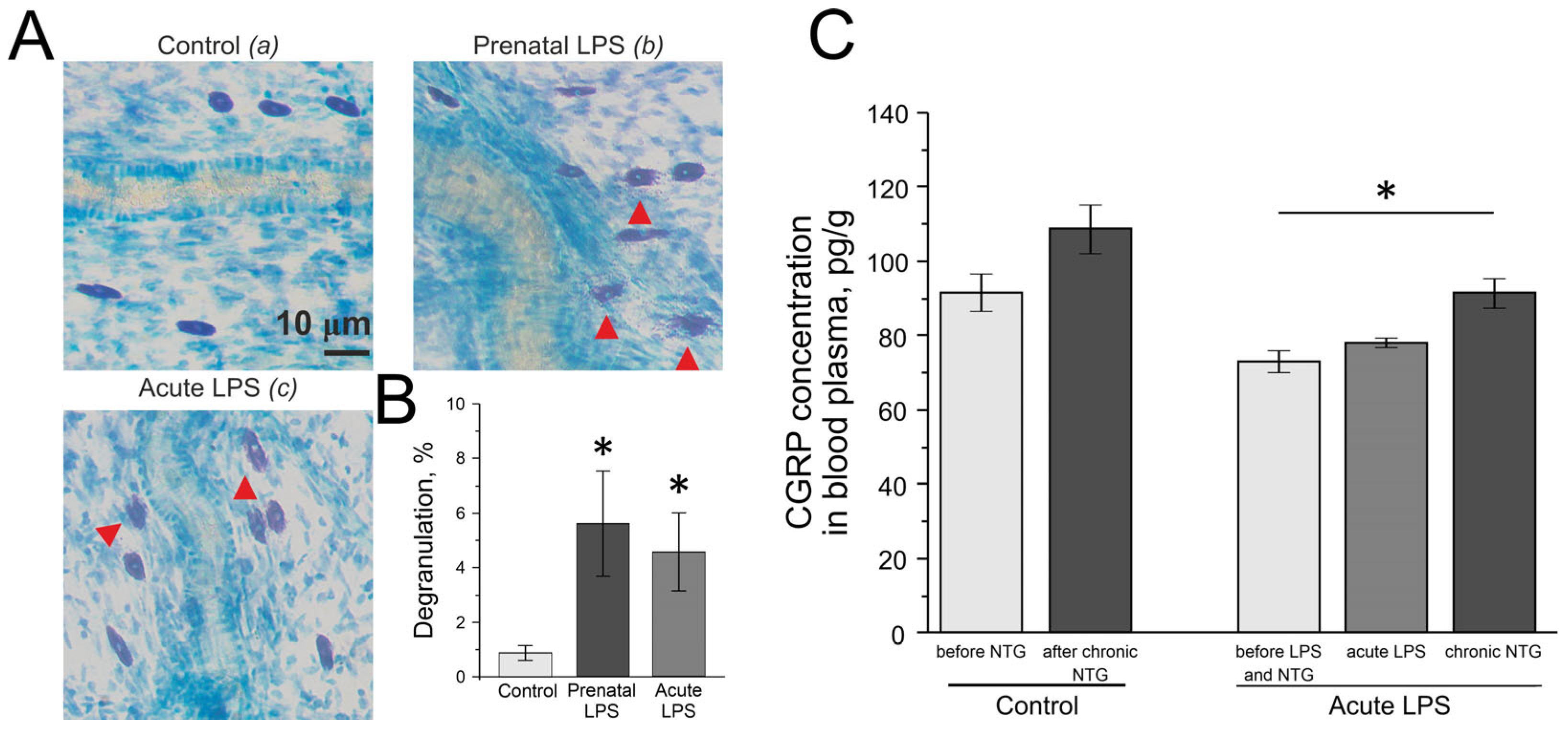
In the control group of rats (n = 10), the degranulation of meningeal mast cells was 0.88 ± 0.27%. In rats from the acute LPS group, the degranulation of meningeal mast cells was significantly higher compared to the control group—4.6 ± 1.4% (n = 5, p = 0.006; Figure 2A,B). In the prenatal LPS group, the meningeal mast cell degranulation was 5.6 ± 1.9% (n = 6, p = 0.005; Figure 2A,B).

2.6. Evaluation of CGRP Level in Blood Plasma of Rats with Model of Chronic Migraine and Acute or Postnatal LPS Administration

In the control group (n = 6), prior to NTG administration, the CGRP content in blood plasma was 91.5 ± 4.9 pg/mL, and after chronic NTG administration, the level of CGRP was 108.7 ± 6.5 pg/mL (p = 0.07), which was 119.5 ± 6.7% of the initial level (p = 0.06; Figure 2C).
In the acute LPS group (n = 5), the initial CGRP level in blood plasma was 73.1 ± 2.9 pg/mL. After LPS administration, this level did not change—77.9 ± 1.2 pg/mL (p = 0.1; Figure 2C). As a result of the five-time administration of NTG, the CGRP level increased to 91.3 ± 3.8 pg/mL (n = 5) and differed significantly from the initial CGRP level (p = 0.01). Compared to the initial level, the CGRP level increased to 125.6 ± 6.5% (p = 0.007).

2.7. Electrophysiological Recording of Action Potentials of Trigeminal Nerve Afferents in Acute LPS Group

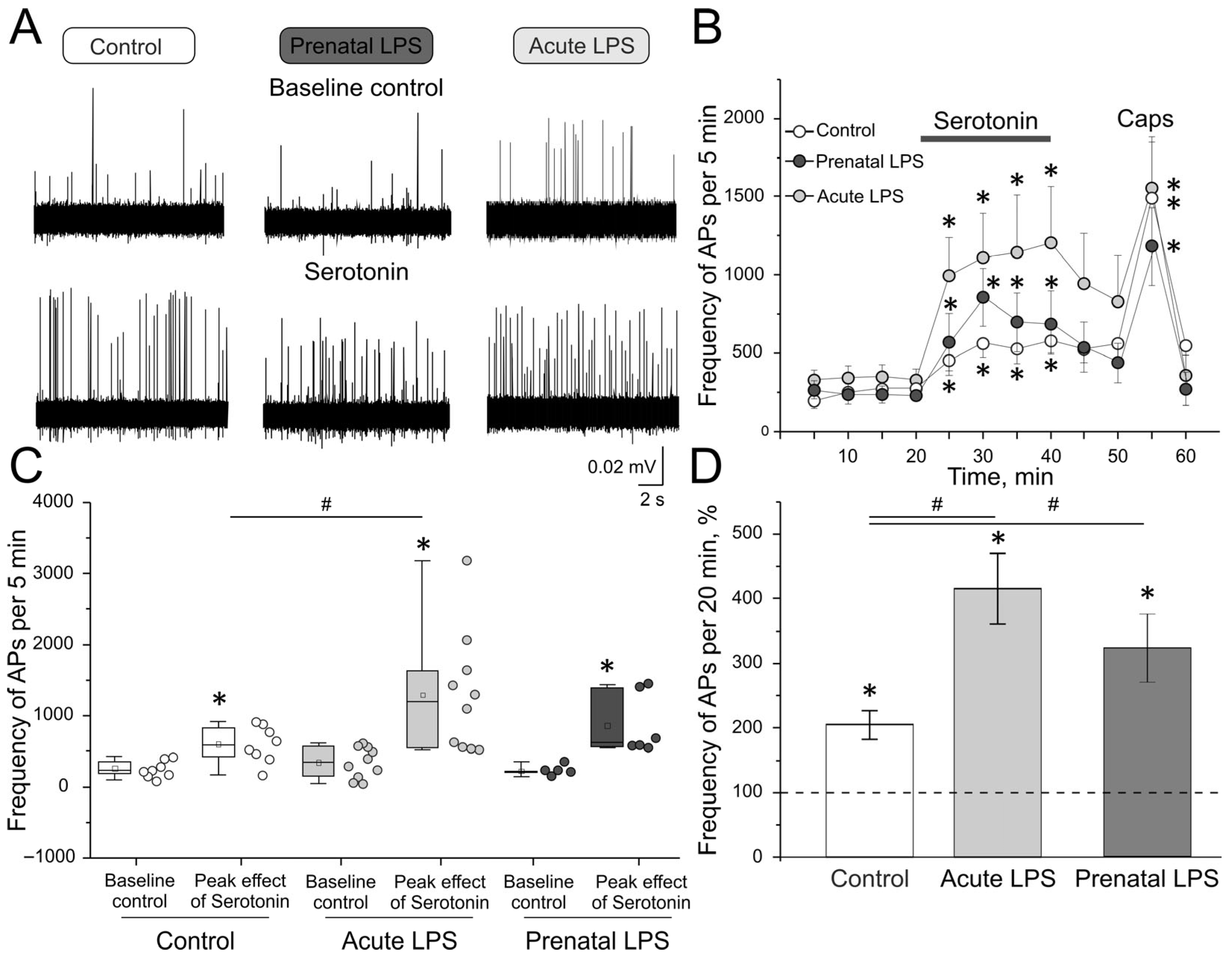
In the control group (n = 8), the initial number of APs was 246.7 ± 40.4 per 5 min. The application of serotonin (20 μM) led to a significant increase in the number of APs to 455.4 ± 97.3 per 5 min in the first 5 min of application (p = 0.03; Figure 3A,B). After 10 min of application, the number of APs was 567.8 ± 95.5 per 5 min (p = 0.01), after 15 min of serotonin application, the number of APs was 530.7 ± 99.7 per 5 min (p = 0.02), and after 20 min, it was 581.1 ± 89.7 per 5 min (p = 0.01). The application of capsaicin (1 μM), performed after a 10 min washout of the serotonin, led to an increase in APs frequency from 564.8 ± 91.4 per 5 min to 1495 ± 350.7 per 5 min (p = 0.001).
In rats from the acute LPS group (n = 10), the initial number of APs was 339.5 ± 68.9 per 5 min. When serotonin (20 μM) was applied, a significant increase in the number of APs was observed in the first 5 min of application, up to 997.7 ± 239.35 per 5 min (p = 0.005), similar to the control group (Figure 3A,B). After 10 min of application, the number of APs was 1113.5 ± 279.1 per 5 min (p = 0.005), after 15 min of application, the number of APs was 1147.2 ± 359.8 per 5 min (p = 0.005), and after 20 min of application, the number of APs was 1208.7 ± 352.4 per 5 min (p = 0.005). The application of capsaicin (1 μM), performed after a 10 min washout of the serotonin, led to an increase in number of APs from 831 ± 292.8 per 5 min to 1559.3 ± 321.6 per 5 min (p = 0.045).
In rats from the prenatal LPS group (n = 6) the initial number of APs was 211.2 ± 30.5 per 5 min. When serotonin (20 μM) was applied, a significant increase in the number of APs was observed in the first 5 min of application, up to 561.3 ± 184.8 per 5 min (p = 0.03) similar to the control group (Figure 3A,B). After 10 min of application, the number of APs was 848.2 ± 183.2 per 5 min (p = 0.03), after 15 min of application, the number of APs was 689.2 ± 184.7 per 5 min (p = 0.03), and after 20 min of applications, the number of APs was 678.5 ± 205.6 per 5 min (p = 0.03). The application of capsaicin (1 μM), performed after a 10 min washout of the serotonin, led to an increase in number of APs from 432.5 ± 125.3 per 5 min to 1168.3 ± 246.9 per 5 min (p = 0.03).
The maximum effect of serotonin in the acute LPS group was 1501.4 ± 432.7 APs in 5 min, which differed significantly from the maximum effect of serotonin in the control group—581.1 ± 89.7 APs in 5 min (p = 0.04; Figure 3C). In rats from the prenatal LPS group, the maximum effect was 837.7 ± 175.2 APs in 5 min and was not different from the control group (p = 0.3).
After that, we calculated the number of APs during 20 min of serotonin (20 μM) application and normalized it to 20 min of the recording of the initial activity (Figure 3D). In the control group, the number of APs before application of the substance was 986.7 ± 161.7 in 20 min; as a result of 20 min of serotonin application, the number of APs increased to 2022 ± 334.3 in 20 min (p = 0.01), which is an increase of 205.3 ± 22.2% relative to the number of APs before application (p = 0.01; Figure 3D).
In the acute LPS group, the number of APs before serotonin application was 1272.25 ± 325.3 per 20 min. As a result of 20 min of serotonin application, the number of APs increased to 4758.9 ± 1458.7 per 20 min (p = 0.006). After normalization, it was found that 20 min of serotonin application led to a significant increase in the number of APs by 415.9 ± 54.6% (p = 0.01), which was significantly different from the normalized number of APs in 20 min with serotonin application in the control group (p = 0.01; Figure 3D).
In the prenatal LPS group, the number of APs before serotonin application was 883.2 ± 246.5 per 20 min. As a result of 20 min of serotonin application, the number of APs increased to 2777.2 ± 336.5 per 20 min (p = 0.03). After normalization, it was found that 20 min of serotonin application led to a significant increase in the number of APs by 322.7 ± 53.1% (p = 0.03), which was significantly different from the normalized number of APs in 20 min with serotonin application in the control group (p = 0.02; Figure 3D).

2.8. Ca2+ Imaging in Trigeminal Ganglion Neurons

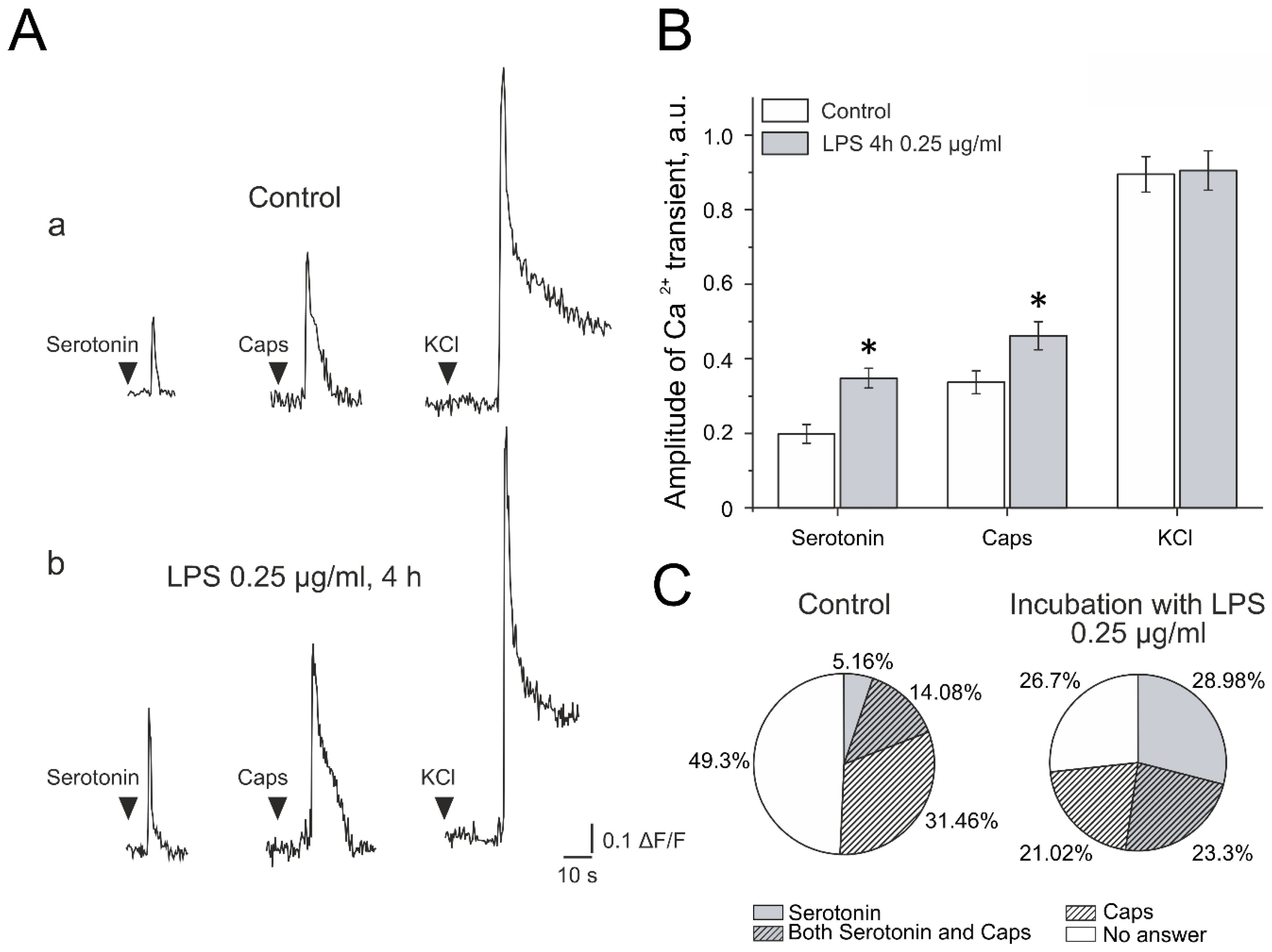
In our study, serotonin (30 μM) was used to activate 5-HT receptors, and capsaicin (1 μM) evoked responses mediated by TRPV-1 receptors (Figure 4A). Neurons were identified by their fluorescence response to KCl application (50 mM; 2 s). In control conditions, the application of serotonin (2 s) induced Ca2+ transients in 19% (41/213 cells, n = 4) of TG neurons, and capsaicin (2 s) induced Ca2+ transients in 46% (97/213 cells) of cells (Figure 4C). After 4 h incubation in F12 medium containing 0.25 μg/mL LPS, the percentage of capsaicin-responsive neurons did not change (44%, χ2 = 0.06, p = 0.806, 78/176 cells, n = 4). In contrast, the proportion of serotonin-responsive cells significantly increased to 52% (χ2 = 46.71, p = 0.0001, 92/176 cells). It was shown that 4 h of incubation in 0.25 μg/mL LPS significantly increased the mean amplitude of Ca2+ transients evoked by both agonists: serotonin (0.20 ± 0.03 a.u. in control vs. 0.35 ± 0.03 a.u. after incubation, p = 6.68) and capsaicin (0.34 ± 0.03 a.u. in control vs. 0.46 ± 0.04 a.u. after incubation, p = 0.002; Figure 4A,B). The mean amplitude of the response to KCl application did not change: 0.90 ± 0.05 in the control and 0.91 ± 0.05 after incubation with LPS (p = 0.91).
Furthermore, it was shown that, after incubation in LPS, the number of TG neurons sensitive to both agonists increased (30/213 vs. 41/176 cells, n = 4, χ2 = 5.48, p = 0.0192, Figure 4C); at the same time, the percentage of non-responsive cells decreased almost twice (105/213 vs. 47/176 cells, χ2 = 20.66, p = 0.00000548).

3. Discussion

According to the current understanding, the activation of the peripheral meningeal structures of the TVS is responsible for generating the nociceptive signal in migraine. The processing of this signal and the development of somatic symptoms (e.g., photophobia and skin allodynia) are caused by its transmission to the second-order neurons of the central trigeminal nucleus [1,3,7,37]. Unmyelinated C fibers, which are part of the meningeal afferents of the trigeminal nerve, can produce various pro-nociceptive agents (e.g., CGRP, PACAP, VIP, and substance P). These substances then bind to their respective receptors, primarily located within Aδ fibers. This leads to the initiation of secondary intracellular biochemical cascades, nerve fiber sensitization, and amplified action potential generation [1,37]. The nociceptive activation of nerve fibers and their release of CGRP can lead to vascular changes, activation of satellite glial cells, and the altered activity of meningeal immune cells such as mast cells and macrophages [12,14,37,38].
To date, no studies have been conducted on experimental animal models describing the changes in nociceptive signaling associated with migraine in the TVS under conditions of induced systemic inflammation, including immune system activation in the early stages of ontogenesis during the prenatal period. Therefore, modeling systemic inflammation could be a promising approach for studying both peripheral inflammation in the dura mater and, potentially, the effects of central neuroinflammation. This is due to the fact that pro-inflammatory mediators from the periphery can penetrate the brain and affect neurons, including nociceptive ones [39,40,41,42]. Investigating nociceptive processes in the context of systemic inflammation could reveal relationships between inflammation, neuroinflammatory reactions, and nociceptive signaling in migraine.
It is well-established that inflammatory processes during fetal development can lead to delayed neurological disorders accompanied by deficits in cognition and sensory processing [43,44]. Analysis of patient medical data in several studies has revealed a positive correlation between exposure to various stressful conditions in the prenatal period and the subsequent onset of migraine in adults and children [42,43,44]. Prenatal factors associated with the subsequent onset of migraine include exposure to bacterial infections, tobacco smoke, and ethanol. These factors cause the release of reactive oxygen species (ROS) and can trigger the development of hypersensitivity to neuroinflammation and oxidative stress in the fetal brain [45,46,47,48].
LPS administration to rodents during pregnancy leads to elevated levels of pro-inflammatory cytokines and oxidative stress markers in various areas of the offspring’s brain (including the cerebellum, hippocampus, and cortex), as well as the manifestation of an anxiety-like behavioral phenotype [49,50,51]. Furthermore, we have previously demonstrated that creating an inflammatory challenge during the prenatal period in the form of maternal hyperhomocysteinemia, achieved through dietary interventions, results in blood–brain barrier permeability disorders in offspring [52], as well as elevated plasma CGRP levels and increased excitability of meningeal afferents of the trigeminal nerve and pronounced neuroinflammatory reactions in the dura mater [53], alongside a decrease in the cortical spreading depression generation threshold in the sensomotor cortex and pronounced migraine-associated behavioral traits such as mechanical allodynia and photophobia [35].
The mechanism of such disorders in offspring under maternal immune activation (prenatal pro-inflammatory exposures) may involve the epigenetic regulation of gene transcription [44,54], disruption of the switch from excitatory to inhibitory gamma-aminobutyric acid (GABA) function in the early stages of postnatal ontogenesis (GABA shift) [55,56], abnormal expression of NMDA receptors, especially in the striatum and cortex [57], and the development of synaptic deficits (especially in the cortex) [58]. Within the TVS, maternal immune activation may lead to long-term sensitization and hyperactivity, possibly due to the enhanced expression of nociception-associated receptors (e.g., purinergic, TRPA1, and TRPV1) [59], changes in glial cells’ phenotype under the influence of pro-inflammatory mediators [60], and dysregulation of descending pain modulatory pathways (e.g., from the periaqueductal grey matter and the rostral ventromedial medulla), influencing second-order nociceptive neurons in the TNC [55,61].
The administration of LPS appears to amplify nociceptive behavioral responses. In a model of post-traumatic trigeminal neuropathy, for example, local administration of LPS has been shown to enhance orofacial nociceptive responses and increase IL-1 mRNA expression in the TG [29]. In a neuropathic pain model caused by sciatic nerve ligation, intrathecal administration of a selective toll-like receptor 4 (TLR-4) antagonist prevented the development of hyperalgesia and mechanical hypersensitivity [62]. In an orofacial postoperative pain model, injection of the TRR-4 antagonist into the TG prevented the development of facial heat and orofacial mechanical hyperalgesia [26]. Similarly, local administration of LPS to the joint area and paw pads has been shown to decrease the mechanical thresholds and cause hyperalgesia [30,31,32]. However, studies investigating the effect of LPS on nociceptive responses have mainly focused on models of inflammatory and post-traumatic pain. Conversely, no studies have assessed the impact of inflammation induced by LPS administration on nociceptive responses and the nociceptive process in migraine.
In our study, maternal immune activation via an LPS injection on day 15 of fetal development resulted in decreased mechanical sensitivity thresholds and more pronounced behavioral changes in response to chronic NTG administration (as part of a migraine model) in offspring aged 30–45 days. It also resulted in mast cell degranulation in the dura mater. When conducting the Light–Dark Transition test, aimed at identifying photophobic behavior, we found that, in the migraine model with acute LPS administration, the values of photophobic behavior did not differ from those of the control group. In contrast, in the migraine model with prenatally induced systemic inflammation caused by LPS administration, a significant reduction in the time spent in the light chamber before and after NTG injection was observed on day 9 of drug administration, compared to the control group, indicating more pronounced photophobia in the prenatal LPS group. Evaluation of the locomotor activity showed that in the experimental groups (control group, acute LPS, and prenatal LPS), the count of locomotor acts such as transitions between chambers and rearing tended to decrease by day 9 of NTG administration in a similar manner; however, the NTG injection itself did not lower the number of locomotor acts.
Administering LPS to rodents is a widely used and reliable approach for modeling systemic inflammation, local inflammatory syndromes, and neuroinflammatory processes [63,64,65]. In LPS-induced inflammation, LPS binds to TLR4, which is widely expressed in neurons, microglia, macrophages, astrocytes, and vascular endothelium, including the cerebral endothelium [64,66]. The binding of LPS to TLR4 leads to homodimerization, activating intracellular secondary mediator cascades and the subsequent transcription of genes encoding pro- and anti-inflammatory mediators (e.g., cytokines, chemokines, and prostaglandins) [64,66].
In response to LPS, a family of pro-inflammatory cytokines is synthesized and released (IL-1, IL-6, and TNF-α) [63,64,67]. The pro-inflammatory effect of LPS is assumed to be due to an intracellular increase in reactive oxygen species (ROS) through the activation of the NADPH oxidase enzyme. ROS then serve as secondary messengers, enhancing the expression of pro-inflammatory marker genes in microglia and other cell types [17,18,19]. TLR-4 expression has been detected in the TG and nociceptive afferents of the trigeminal nerve [68], indicating the potential for LPS-induced changes in nociceptive signaling associated with migraine.
To identify potential LPS-induced mechanisms contributing to the development of nociceptive behavior, we administered a single acute dose of LPS to adult rats. Then, we analyzed their nociceptive behavior and recorded the trigeminal nerve activity in rat hemiskull preparations. It was previously shown that a single postnatal administration of LPS leads to both immediate and long-term inflammatory reactions, including an increase in the TNF-α concentration in the brain 10 months after administration [69]; an increase in IL-18 in the hippocampus, frontal cortex, and cerebellum 10 months after administration; stable changes in exploratory behavior and cognitive functions [70,71]; and long-term activation of microglia [72]. Immediate inflammatory responses to LPS administration include increased concentrations of TNF-α, IL-1β, IL-6, IL-4, and NF-κB in various brain regions (hippocampus, substantia nigra, cortex, cerebellum, and striatum) several hours (3–6 h) after injection [70,73,74], as well as peripheral inflammatory responses [41,75,76]. Therefore, we performed an acute LPS injection and chose 3 h after LPS administration as the time point for further electrophysiological, histological, biochemical, and behavioral experiments.
CGRP is a key molecule in the formation of trigeminal nerve afferent sensitization and an increase in the nociceptive activity in migraine [1,9]. It has been shown that level of CGRP in plasma increases in patients with chronic migraine both during headache attacks and between attacks [77,78]. In the current study, we found that, in the control group of animals with chronic administration of NTG, the content of CGRP in blood plasma tended to increase. Meanwhile, in the acute LPS group, a significant increase in CGRP concentration was observed after chronic administration of NTG, compared to the baseline level.
Serotonin is a key player in peripheral nociceptive signaling during migraine. Its receptors in the meningeal endings of the trigeminal nerve contribute to peripheral sensitization and hyperalgesia development [11,79,80]. During mast cell degranulation, serotonin is released into the meningeal tissue, where it binds to ionotropic 5-HT3 serotonin receptors located in nerve endings, leading to the nociceptive activation of Aδ- and C-fibers [11,13,80]. Activation of these receptors also leads to the release of CGRP, which activates pro-nociceptive trigeminal afferent fibers and is thought to cause long-term headache in migraine [79,81].
Our data indicate that, in animals with systemic inflammation induced both by prenatal and by acute postnatal LPS injection, a more pronounced pro-nociceptive activation of trigeminal nerve afferents in response to serotonin application was observed, which potentially indicates the involvement of serotonergic mechanisms in the intensification of migraine with LPS-induced neuroinflammation.
The role of 5-HT3 receptors in the inflammatory process was demonstrated in a model of temporomandibular joint (TMJ) inflammation, where 5-HT3 receptor blockers reduced orofacial nociceptive behaviors evoked by formalin injection into the masseter muscle [82]. In a model of persistent TMJ inflammation evoked by the injection of complete Freund’s adjuvant, the expression of 5-HT2A and 5-HT3 receptors in TG increased during TMJ inflammation. It has been shown that these receptor mRNAs increase in primary sensory neurons after peripheral inflammation [83,84,85]. Inflammation in the TMJ can cause the increased excitability of TG neurons that receive incoming signals from the masticatory muscles, and it is assumed that increased peripheral expression of 5-HT2A and 5-HT3 during inflammation of the mandibular joint may play a role in increasing the excitability of primary sensory afferents [83].
In a human blood monocyte cell culture under conditions of preliminary LPS application, there was a serotonin-dependent increase in IL-1β, IL-6, and IL-8/CXCL8. Activation of other serotonin receptor subtypes (5-HT4 and 5-HT7) increased intracellular cyclic adenosine monophosphate levels and IL-1β, IL-6, and IL-12 secretion [86]. Meanwhile, creating an inflammation model by injecting bee venom into a rat’s paw surface led to the increased mRNA expression of 5-HT3, 5-HT4, 5-HT7, and 5-HT2 in dorsal root ganglion (DRG) neurons [85]. Interestingly, LPS can influence the activity of the serotonin transporter peripherally, as demonstrated in intestinal endothelial cells, and centrally, as demonstrated in the prefrontal cortex and adjacent nucleus. Thus, LPS can affect the rate of serotonin metabolism [87,88].
It was shown that LPS can directly affect neuronal and non-neuronal cells, causing the release of cytokines, mainly TNF-α, which has been demonstrated in numerous studies on DRG neurons, both in vitro and in vivo [89,90,91].
Studies on TG tissue have shown that local LPS administration leads to increased TNF-α and IL-1β levels and TRPV1 expression [29,92,93]. Studies using TG cell cultures indicate that LPS treatment leads to neuronal sensitization and the mobilization of intracellular and extracellular calcium in a TRPA1-dependent manner [94]. It also leads to increased CGRP release in response to capsaicin application, which indicates the LPS-induced sensitization of TRPV1 receptors in TG neurons [95,96]. Such sensitization of TG neurons is thought to involve the binding of LPS to its target receptor, TLR4. This leads to increased NFκB phosphorylation, affecting the activity of secondary intracellular mediators and modulating the activity of receptors [94,95,96,97]. Interestingly, in TG neuron cultures, the increased CGRP release induced by LPS was prevented by pretreatment with TRPA1 or TRPV1 antagonists [97]. However, no studies have analyzed the role of the serotonergic system in sensory ganglia in response to inflammation.
In our experiments on neurons isolated from the TG, LPS pretreatment increased calcium transients in response to serotonin and capsaicin application. We observed an increase in the number of neurons responding to serotonin by more than two-fold and in the number of neurons responding to both serotonin and capsaicin by 1.5-fold, which may indicate the upregulation of 5-HT3 receptors in TG during pro-inflammatory conditions [83,84,85]. The amplification of TRPV1-mediated calcium signals may be associated with the upregulation of TRPV1 receptors [28,92,93] and serotonin effects [98]. Additionally, 5-HT-induced sensitization of TRPV1 channels can lead to increased CGRP release from TG neurons [81], which may contribute to inflammatory pain upon LPS administration.
Furthermore, our study revealed an increased degranulation of mast cells in the meninges under conditions of prenatally induced inflammation and after acute LPS administration. This verifies both methods of LPS administration as effective approaches for investigating neuroinflammatory processes in the dura mater. Mast cells closely interact with the peripheral afferents of the trigeminal nerve to form a “neuroimmune synapse,” wherein the activation of trigeminal afferent fibers leads to the release of CGRP and the degranulation of mast cells, which in turn release pro-inflammatory cytokines and serotonin. These substances contribute to the additional activation of nerve fibers [12,13,39,99]. Neuroinflammatory reactions in the dura mater significantly contribute to peripheral sensitization by creating a “vicious circle” of nociceptive signal amplification via interaction between immune cells and nerve endings [11,12,14,15].
The mechanism of the LPS-dependent degranulation of meningeal mast cells may involve LPS-induced ATP release (as demonstrated in astrocytes) [100], which can lead to mast cell destabilization through P2X7 receptor activation, as previously demonstrated [11,12]. Our results are consistent with previous studies showing that LPS can affect non-neuronal cells and potentially alter the phenotype of nociceptive neurons, influencing the manifestations and intensity of pain syndromes [100,101].
Thus, our study for the first time evaluated LPS-dependent nociceptive mechanisms in migraine. We established that LPS enhances mechanical allodynia and photophobia in a chronic NTG-induced migraine model. We observed the LPS-induced enhancement of serotonergic pro-nociceptive effects in trigeminal nerve afferents and TG neurons, as well as the degranulation of meningeal mast cells, using different methods of LPS administration. These findings can contribute to our fundamental understanding of the molecular and cellular mechanisms of nociception associated with migraine and inflammatory orofacial pain syndromes.
This study has several limitations. First, animals of different ages were used for behavioral and electrophysiological experiments compared to Ca2+ imaging in cultured TG neurons. This discrepancy, necessitated by the technical requirements of each method, may introduce biological heterogeneity. Second, while our functional data suggest the involvement of specific receptors, molecular confirmation of 5-HT3 and TRPV1 receptor expression in the TG is required. This analysis is planned for future investigations.

4. Materials and Methods

4.1. Animals

The experiments were conducted on Wistar rats, aged 30–65 days (P30–65), obtained from the vivarium of the Department of Human and Animal Physiology, Kazan Federal University, Kazan, Russia. The animals were kept in a room with a 12 h light/12 h dark cycle, with the lights turned on every day at 6:00 a.m.; the room temperature was maintained at ~22 °C, and the air humidity was controlled. The animals had ad libitum access to water and food.
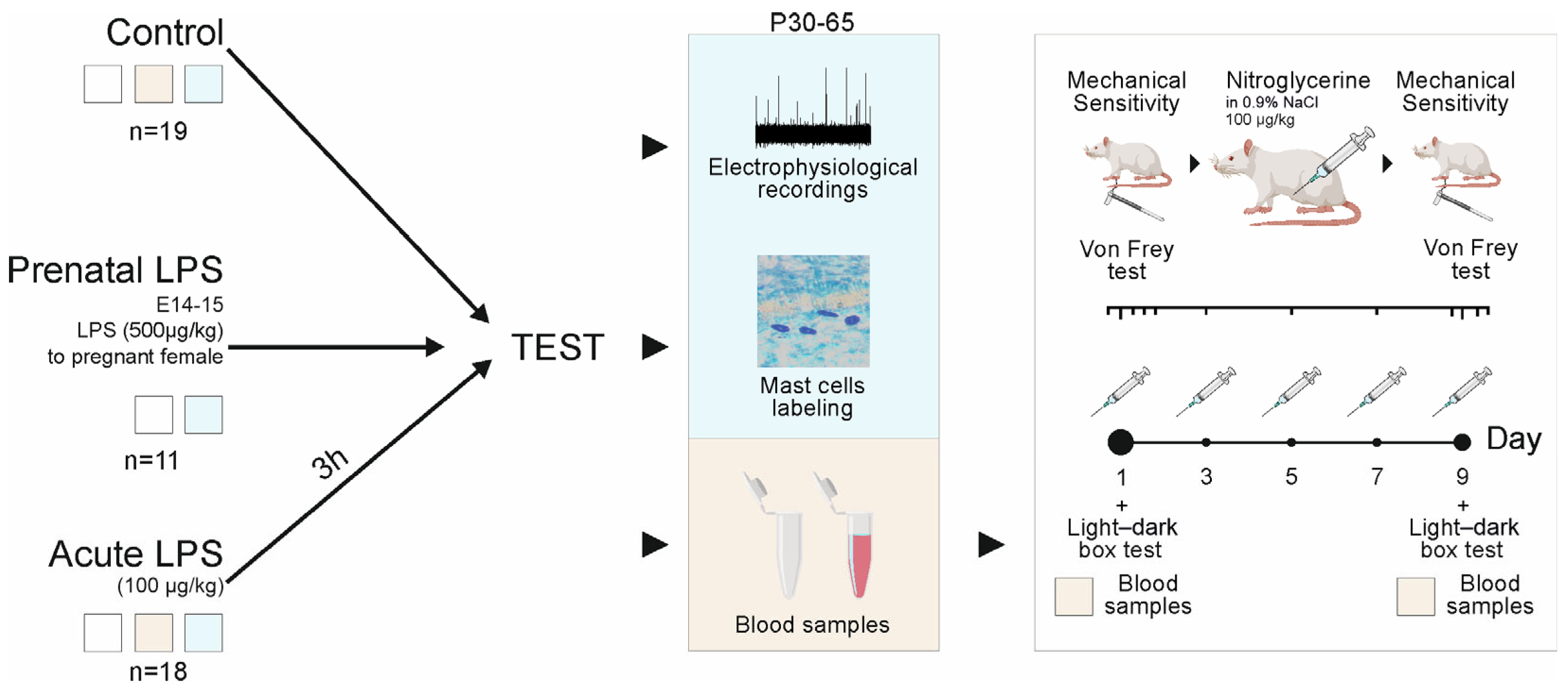
The study used the following experimental animal groups all consisting of Wistar rats: (1) sham group that did not receive any drugs; instead of nitroglycerin (NTG), they were injected with 0.9% NaCl (saline) (n = 4); (2) control group that did not receive LPS, (n = 19); (3) acute LPS group with a model of acute inflammation created by a single injection of LPS (i.p., 100 μg/kg, n = 18); (4) prenatal LPS group, including the offspring of females, who were exposed to LPS on days 14–15 of pregnancy (i.p., 500 μg/kg, n = 11) (Figure 5).
Male rats were used in the behavioral and electrophysiological experiments to avoid any instability induced by hormonal changes during the estrous cycle in females.
All experimental protocols were performed in accordance with the European Community Council Directive of 22 September 2010 (2010/63/EEC) and approved by the Local Ethical Committee of Kazan Federal University (protocol No. 56 of 19 September 2025). All efforts were made to minimize the number of animals used in the experiments.

4.2. A Model of Systemic Inflammation Induced by Injection of LPS

Maternal immune activation (MIA) appears to act as a “disease primer” [33] to make an individual more susceptible to the effects of genetic mutations and environmental exposures in triggering disease-related symptoms later in life [34]. In this study, MIA was utilized to create a greater susceptibility to migraine and promote migraine-related neuroinflammation and nociceptive behavior. Pregnancy was achieved by placing male rats with female rats at a ratio of 1:2 for a period of 7 days. Fertilization was confirmed by microscopy of a stained vaginal smear. To cause systemic inflammation leading to neuroinflammation, we used a validated LPS model on rodents [63,64,65]. LPS (trade name Pyrogenal, N. F. Gamaleya Research Institute of Epidemiology and Microbiology, Moscow, Russia) at a concentration of 500 μg/kg was administered intraperitoneally to pregnant rats [102] on the 15th day of pregnancy (GD 15), approximately corresponding to the second trimester of human pregnancy [34]. The dosage of LPS administered was selected based on an analysis of the literature to avoid spontaneous fetal loss and stillbirth [33,34,102,103,104]. Further studies were conducted on the male offspring at the age of P30–65 (prenatal LPS group).
In the acute LPS group, inflammation was induced by a single intraperitoneal injection of LPS (100 μg/kg) to rats in the postnatal period (P30–65). The dosage was selected based on an analysis of the literature to avoid pronounced toxic effects and severe symptoms of parkinsonism [105,106,107]. Three hours after LPS administration, behavioral, histological, or electrophysiological studies were performed.

4.3. Model of Episodic and Chronic Migraine

NTG (Ozon Pharmaceuticals, Zhigulevsk, Russia) was used to create a model of acute or chronic migraine in rats, testing the mechanical sensitivity and photophobia [32,105]. NTG (10 mg/kg in 0.9% NaCl solution) was repeatedly administered intraperitoneally (i.p.), five times every second day for nine days (days 1, 3, 5, 7, and 9). Mechanical hypersensitivity was measured 2 h before (pre-injection/basal response) and 2 h after (post-injection response) NTG injections [108,109]. The development of photophobia was assessed using the dark–light box test before and after the first and last injections of NTG. In the control group, 0.9% NaCl solution was introduced as a vehicle. All behavioral experiments were conducted at the same time and started at approximately 10 a.m.

4.4. Analysis of Mechanical Sensitivity Using Von Frey Test

Mechanical sensitivity was assessed with a series of calibrated von Frey filaments (Ugo Basile, Varese, Italy) with a range of 0.008 to 8 g of the target force, which corresponds to 2.53–61.7 g/mm2 pressure. First, 30 min before the test, the rat was placed in an individual transparent box with a mesh floor. The mechanical withdrawal thresholds were determined according to the up-and-down method [35,36,110]. Von Frey filaments were applied by approaching the plantar surface of the paw from the underside of the mesh stand. We always started by testing with a 0.4 g (3.61 g/mm2) filament. In all cases, the tip of the filament was pressed against the plantar surface of one hind paw and maintained for 1–3 s. A response was defined as withdrawal, shaking, or licking of the paw. In the absence of a response, a heavier filament (up) was tried after 10 s, and in the presence of a response, a lighter filament (down) was tested. This pattern was followed for a maximum of four filaments following the first response.
The mechanical sensitivity was measured 1 h before (pre-injection/baseline response) and 2 h after (post-injection response) NTG injections, except on the first day. On the first day of NTG administration, mechanical thresholds were measured 1, 2, and 3 h after injection for a detailed analysis of mechanical sensitivity in the episodic migraine model [108], while on days 3, 5, 7, and 9 of NTG administration, testing was performed only once, 3 h after injection. In addition, a separate group of animals (n = 4) received saline injections in the same manner to form a sham group, and the mechanical thresholds of the hind paws were also measured as described above.

4.5. Study of Photophobic Behavior

The Light–Dark Transition test was used to measure photophobia [36]. The light–dark box consists of two equally sized chambers: one illuminated (150 lux) and one darkened (1–2 lux) with a size of 40 cm × 20 cm × 40 cm/each connected with a passageway 7 cm × 7 cm (OpenScience, Moscow, Russia) equipped with a video system Sony SSC-G118 (Tokyo, Japan). The rats were placed in the light compartment and allowed to explore the apparatus for 3 min. We measured the time spent in the light chamber and the locomotor activity of animals (transitions between chambers and rearing).
Testing was performed prior to NTG administration (baseline, pre-injection value) and 2 h after injection (post-injection value) on days 1 and 9 of migraine modeling (after the first and fifth NTG injections).

4.6. Electrophysiological Recording of Action Potentials of Trigeminal Nerve Afferents

The activity of trigeminal afferents was recorded using isolated rat hemiskulls with intact dural innervation obtained from rats P40–45, as described previously [11,36,111]. Prior to decapitation, the animals were deeply anaesthetized using isoflurane (Abbott Laboratories, Chicago, IL, USA). The rat skull after decapitation was carefully cleaned of all cranial muscles; then, it was divided along the sagittal section into two hemiskulls, and the brain was removed from the skull. The distal part of the nervus spinosis that innervates the receptive field around the middle meningeal artery was isolated from the hemiskull and placed inside the recording electrode. The preparations were perfused with an artificial cerebrospinal fluid containing 120 mM NaCl, 2.5 mM KCl, 2 mM CaCl2, 1 mM MgCl2, 11 mM glucose, 1 mM NaHPO4, and 24 mM NaHCO3 under constant oxygenation at 95% O2/CO2, a pH range of 7.2–7.35, and at 20–25 °C. The action potentials (APs) of the trigeminal nerve were recorded using a DAM 80 amplifier and digitized on a PC with an NI PCI6221 board (National Instruments, Austin, TX, USA). The signals were visualized and analyzed using WinEDR v.3.2.7 software (University of Strathclyde, Glasgow, UK). The AP frequency was measured and analyzed using the DoClust application in the MATLABver. 9.8 (R2020a) package (MathWorks, Natick, MA, USA) and OriginPro 2015 (OriginLab Corporation, Northampton, MA, USA) software. We used native (control) animals as well as animals treated with acute LPS injection (100 μg/kg) in the electrophysiological experiments. First, the baseline control recordings were taken for 20 min previous to drug application. Then, serotonin 20 μM (Sigma-Aldrich, St. Louis, MO, USA) and capsaicin 1 μM (Sigma-Aldrich, St. Louis, MO, USA) were applied in separate experimental series to study the activity of meningeal trigeminal afferents. Substances were applied through gravitation-driven perfusion system at the receptive field of trigeminal afferents.

4.7. Toluidine Blue Staining of Meningeal Mast Cells

Mast cell degranulation was assessed using the histological method of staining for the hemiskull with Toluidine Blue [11,36,112]. Intact skulls were placed in paraformaldehyde (4% solution) for 12 h. Before isolating the meninges, the skulls were washed in a phosphate-buffered saline solution of the following composition (mM): 137 NaCl, 2.7 KCl, 10 Na2HPO4, 1.8 K2HPO4. The isolated meninges were fixed on a glass slide. Staining with Toluidine Blue lasted 10 min, and then the fixed preparations were washed with distilled water and dehydrated with ethyl alcohol (95–99%). Images were acquired with 20× magnification. The degree of degranulation was assessed visually; the calculation was carried out as the percentage of the total number of cells (at least 100).

4.8. Ca2+ Imaging of Trigeminal Ganglion Neuron Cultures

Primary culture of TG cells was prepared using TG of rats (P7-P12), as described previously [113]. The ganglia were removed after rat decapitation and placed in cold F12 medium. Cells were dissociated using an enzymatic cocktail containing 0.25 mg/mL trypsin, 1 mg/mL collagenase, and 0.2 mg/mL DNAse. The dissociation of TG was made in shaker at 37 °C for 25 min. Dissociated cells were placed on coverslips coated with poly-L-lysine and incubated for 24 h before the experiments.
To perform Ca2+ imaging, Fluo-4 AM (1 μM, Invitrogen, Carlsbad, CA, USA) was used, as described previously [53].
To detect and measure changes in intracellular calcium levels, cultured TG cells were stained using Fluo-4 AM dye (Invitrogen, Carlsbad, CA, USA) in the presence of pluoronic acid (0.02%) at 37 °C for 30 min in the absence of light. Before the experiments, the cells were washed out with an extracellular solution for 5–10 min.
Fluorescence visualization of stained cells was performed using an Axio Observer.D1 microscope (Carl Zeiss, Jena, Germany), an excitation filter (BP 450–490 nm), a beam splitter (FT 510 nm), and an emission filter (LP 555 nm). Fluorescence images were recorded using an AxioCam MRm high-speed camera (Carl Zeiss, Germany).
All substances were applied using a gravity-controlled perfusion system (ALA Scientific Instruments, Westbury, NY, USA). At the end of each experiment, KCl (50 mM, 2 s) was applied to initiate membrane depolarization and differentiate between neuronal and glial cells. Fluorescence images were converted into signals using ImageJ 1.52s software (NIH, Bethesda, MD, USA), and the fluorescence intensity was estimated in arbitrary units (a.u.). The peak fluorescence (amplitude) was expressed as the relative change in fluorescence (F − F0)/F0 for each cell of each frame, where F is the peak fluorescence of a cell, and F0 is the background fluorescence close to a given cell. Any changes in fluorescence intensity that were beyond the flat baseline at the time of agonist application and had a characteristic asymmetric shape with a rapid rise and slow decline were considered as Ca2+ responses. The fluorescent response to KCl was used to normalize the amplitudes of the responses of TG neurons for all substances used in the current study.

4.9. Plasma CGRP Concentration

Blood sampling in rats was performed using gum incision. The samples were then mixed with an anticoagulant in tubes and centrifuged at 1500 rpm for 15 min. The supernatant was separated and stored at −40 °C until ELISA analysis. In the control group, blood collection was performed before and after chronic NTG administration—at day 9 after the last injection. In the acute LPS group, the CGRP levels were measured before and 3 h after LPS administration and after chronic NTG injections.
The concentrations of CGRP were determined using a rat-specific ELISA kit (CEA876Ra ELISA Kit for Calcitonin Gene Related Peptide, CGRP, Cloud-Clone Corp., Katy, TX, USA), according to the manufacturer’s instructions, and the samples were added to the corresponding micro-ELISA strip-plate wells. Specific horseradish peroxidase (HRP)-conjugated antibodies were added to each sample for incubation, followed by chromogen solutions A and B for coloring, and finally, a stop solution was added to terminate the reaction, changing the visible color from blue to yellow. The amount of bound HRP conjugates and the intensity of the color are inversely proportional to the concentration of the CGRP in the sample. The optical density was calculated using a microplate spectrophotometer (Multiskan FS, Thermo Fisher Scientific, Waltham, MA, USA) at a wavelength of 450 nm. Each sample was analyzed through a calibration curve, and the mean concentrations were calculated and expressed as pg/mL.

4.10. Statistics

Data analysis was performed using the MATLAB package (MathWorks, Natick, MA, USA) and Origin Pro 2015 (OriginLab Corporation, Northampton, MA, USA). The Shapiro–Wilk test was used to determine the normality of the dataset. The nonparametric Mann–Whitney U-test was used to compare the two independent groups. The two-sided Wilcoxon rank sum test for paired samples or the paired t-test were used to assess the effect of the compounds in the same preparation. The chi-square test was used for Ca2+ imaging data to compare the percentage of the responding cells in the different groups. Differences were considered statistically significant at p < 0.05. All sample sizes were greater or equal to the suggested sample size calculated in Origin Pro (power and sample test for paired or two-sample data) for 0.8 desired power to avoid Type II error [114].

Author Contributions

Conceptualization, A.Y. and G.S.; data curation, O.Y. and A.B.; formal analysis, S.S., E.E., K.G., N.G., D.N., A.S., G.Z.S. and A.R.; funding acquisition, A.Y. and A.R.; investigation, S.S., E.E., K.G., K.B., N.G., D.N., E.N. and A.A.; methodology, G.S.; validation, G.S.; project administration, A.Y.; supervision, G.S.; visualization, K.S.; writing—original draft, S.S. and G.S.; writing—review and editing, S.S., A.Y. and G.S. All authors have read and agreed to the published version of the manuscript.

Funding

The study was supported by funding from the Ministry of Science and Higher Education of Russian Federation under grant agreement 075-15-2025-679.

Institutional Review Board Statement

The animal study protocol was approved by the Local Ethical Committee of Kazan Federal University (protocol No. 56 of 19 September 2025).

Informed Consent Statement

Not applicable.

Data Availability Statement

The original contributions presented in this study are included in the article. Further inquiries can be directed to the corresponding authors.

Conflicts of Interest

The authors declare no conflicts of interest.

Abbreviations

The following abbreviations are used in this manuscript:
TVStrigeminal vascular system
LPSLipopolysaccharide
NTGNitroglycerin
CGRPcalcitonin gene-related peptide
TRPV1transient receptor potential vanilloid 1
ATPadenosine triphosphate
TNCtrigeminal nucleus caudalis
APaction potential
5-HT5-hydroxytryptamine
PACAPpituitary adenylate cyclase-activating peptide
VIPvasoactive intestinal peptide
ROSreactive oxygen species
GABAgamma-aminobutyric acid
TLR-4toll-like receptor 4
TMJtemporomandibular joint
TGtrigeminal ganglion
DRGdorsal root ganglion
MIAmaternal immune activation
HRPhorseradish peroxidase
ELISAenzyme-linked immunosorbent assay

References

  1. Ashina, M.; Hansen, J.M.; Do, T.P.; Melo-Carrillo, A.; Burstein, R.; Moskowitz, M.A. Migraine and the trigeminovascular system-40 years and counting. Lancet Neurol. 2019, 18, 795–804. [Google Scholar] [CrossRef] [PubMed]
  2. Haanes, K.A.; Edvinsson, L. Pathophysiological Mechanisms in Migraine and the Identification of New Therapeutic Targets. CNS Drugs 2019, 33, 525–537. [Google Scholar] [CrossRef] [PubMed]
  3. Burstein, R.; Noseda, R.; Borsook, D. Migraine: Multiple processes, complex pathophysiology. J. Neurosci. 2015, 35, 6619–6629. [Google Scholar] [CrossRef] [PubMed]
  4. Steiner, T.J.; Stovner, L.J.; Jensen, R.; Uluduz, D.; Katsarava, Z. Migraine remains second among the world’s causes of disability, and first among young women: Findings from GBD2019. J. Headache Pain 2020, 21, 137. [Google Scholar] [CrossRef]
  5. Steiner, T.J.; Stovner, L.J. Global epidemiology of migraine and its implications for public health and health policy. Nat. Rev. Neurol. 2023, 19, 109–117. [Google Scholar] [CrossRef]
  6. Eltrafi, A.; Shrestha, S.; Ahmed, A.; Mistry, H.; Paudyal, V.; Khanal, S. Economic burden of chronic migraine in OECD countries: A systematic review. Health Econ. Rev. 2023, 13, 43, Correction in Health Econ. Rev. 2023, 13, 49. https://doi.org/10.1186/s13561-023-00461-8. [Google Scholar] [CrossRef]
  7. Olesen, J.; Burstein, R.; Ashina, M.; Tfelt-Hansen, P. Origin of pain in migraine: Evidence for peripheral sensitisation. Lancet Neurol. 2009, 8, 679–690. [Google Scholar] [CrossRef]
  8. Levy, D.; Moskowitz, M.A. Meningeal Mechanisms and the Migraine Connection. Annu. Rev. Neurosci. 2023, 46, 39–58. [Google Scholar] [CrossRef]
  9. Iyengar, S.; Johnson, K.W.; Ossipov, M.H.; Aurora, S.K. CGRP and the Trigeminal System in Migraine. Headache 2019, 59, 659–681. [Google Scholar] [CrossRef]
  10. Edvinsson, L.; Haanes, K.A.; Warfvinge, K. Does inflammation have a role in migraine? Nat. Rev. Neurol. 2019, 15, 483–490. [Google Scholar] [CrossRef]
  11. Koroleva, K.; Gafurov, O.; Guselnikova, V.; Nurkhametova, D.; Giniatullina, R.; Sitdikova, G.; Mattila, O.S.; Lindsberg, P.J.; Malm, T.M.; Giniatullin, R. Meningeal Mast Cells Contribute to ATP-Induced Nociceptive Firing in Trigeminal Nerve Terminals: Direct and Indirect Purinergic Mechanisms Triggering Migraine Pain. Front. Cell. Neurosci. 2019, 13, 195. [Google Scholar] [CrossRef] [PubMed]
  12. Nurkhametova, D.F.; Koroleva, K.S.; Gafurov, O.S.; Giniatullina, R.R.; Sitdikova, G.F.; Giniatullin, R.A. Mast Cell Mediators as Pain Triggers in Migraine: Comparison of Histamine and Serotonin in the Activation of Primary Afferents in the Meninges in Rats. Neurosci. Behav. Physiol. 2020, 50, 900–906. [Google Scholar] [CrossRef]
  13. Suleimanova, A.; Talanov, M.; Gafurov, O.; Gafarov, F.; Koroleva, K.; Virenque, A.; Noe, F.M.; Mikhailov, N.; Nistri, A.; Giniatullin, R. Modeling a Nociceptive Neuro-Immune Synapse Activated by ATP and 5-HT in Meninges: Novel Clues on Transduction of Chemical Signals into Persistent or Rhythmic Neuronal Firing. Front. Cell. Neurosci. 2020, 14, 135. [Google Scholar] [CrossRef] [PubMed]
  14. Biscetti, L.; Cresta, E.; Cupini, L.M.; Calabresi, P.; Sarchielli, P. The putative role of neuroinflammation in the complex pathophysiology of migraine: From bench to bedside. Neurobiol. Dis. 2023, 180, 106072. [Google Scholar] [CrossRef]
  15. Spekker, E.; Tanaka, M.; Szabó, Á.; Vécsei, L. Neurogenic Inflammation: The Participant in Migraine and Recent Advancements in Translational Research. Biomedicines 2021, 10, 76. [Google Scholar] [CrossRef]
  16. Yakubova, A.; Davidyuk, Y.; Tohka, J.; Khayrutdinova, O.; Kudryavtsev, I.; Nurkhametova, D.; Kamshilin, A.; Giniatullin, R.; Rizvanov, A. Searching for Predictors of Migraine Chronification: A Pilot Study of 1911A>G Polymorphism of TRPV1 Gene in Episodic Versus Chronic Migraine. J. Mol. Neurosci. 2021, 71, 618–624. [Google Scholar] [CrossRef]
  17. Escribano, B.M.; Medina-Fernández, F.J.; Aguilar-Luque, M.; Agüera, E.; Feijoo, M.; Garcia-Maceira, F.I.; Lillo, R.; Vieyra-Reyes, P.; Giraldo, A.I.; Luque, E.; et al. Lipopolysaccharide Binding Protein and Oxidative Stress in a Multiple Sclerosis Model. Neurotherapeutics 2017, 14, 199–211. [Google Scholar] [CrossRef]
  18. Kim, S.Y.; Lee, J.G.; Cho, W.S.; Cho, K.H.; Sakong, J.; Kim, J.R.; Chin, B.R.; Baek, S.H. Role of NADPH oxidase-2 in lipopolysaccharide-induced matrix metalloproteinase expression and cell migration. Immunol. Cell Biol. 2010, 88, 197–204. [Google Scholar] [CrossRef]
  19. Wang, T.; Qin, L.; Liu, B.; Liu, Y.; Wilson, B.; Eling, T.E.; Langenbach, R.; Taniura, S.; Hong, J.S. Role of reactive oxygen species in LPS-induced production of prostaglandin E2 in microglia. J. Neurochem. 2004, 88, 939–947. [Google Scholar] [CrossRef]
  20. Heneka, M.T.; Carson, M.J.; El Khoury, J.; Landreth, G.E.; Brosseron, F.; Feinstein, D.L.; Jacobs, A.H.; Wyss-Coray, T.; Vitorica, J.; Ransohoff, R.M.; et al. Neuroinflammation in Alzheimer’s disease. Lancet Neurol. 2015, 14, 388–405. [Google Scholar] [CrossRef]
  21. Hirsch, E.C.; Vyas, S.; Hunot, S. Neuroinflammation in Parkinson’s disease. Park. Relat. Disord. 2012, 18, S210–S212. [Google Scholar] [CrossRef]
  22. Liu, J.; Wang, F. Role of neuroinflammation in amyotrophic lateral sclerosis: Cellular mechanisms and therapeutic implications. Front. Immunol. 2017, 8, 1005. [Google Scholar] [CrossRef] [PubMed]
  23. Chaar, D.; Yakubova, A.; Jiang, C.; Hoffmann, T.; Pressman, A.; Plotnikov, D.; Choquet, H. Association between migraine and primary open-angle glaucoma: A two-sample Mendelian randomization study. Cephalalgia Rep. 2025, 8, 25158163251323245, Corrigendum to Cephalalgia Rep. 2025. https://doi.org/10.1177/25158163251331001. [Google Scholar] [CrossRef]
  24. Mínguez-Olaondo, A.; Quintas, S.; Morollón Sánchez-Mateos, N.; López-Bravo, A.; Vila-Pueyo, M.; Grozeva, V.; Belvís, R.; Santos-Lasaosa, S.; Irimia, P. Cutaneous Allodynia in Migraine: A Narrative Review. Front. Neurol. 2022, 12, 831035. [Google Scholar] [CrossRef] [PubMed]
  25. Artemenko, A.R.; Filatova, E.; Vorobyeva, Y.D.; Do, T.P.; Ashina, M.; Danilov, A.B. Migraine and light: A narrative review. Headache 2022, 62, 4–10. [Google Scholar] [CrossRef]
  26. Araya, E.I.; Barroso, A.R.; de Melo Turnes, J.; Radulski, D.R.; Jaganaught, J.R.A.; Zampronio, A.R.; Chichorro, J.G. Toll-like receptor 4 (TLR4) signaling in the trigeminal ganglion mediates facial mechanical and thermal hyperalgesia in rats. Physiol. Behav. 2020, 226, 113127. [Google Scholar] [CrossRef]
  27. Abbas, M.; Alzarea, S.; Papke, R.L.; Rahman, S. Effects of α7 nicotinic acetylcholine receptor positive allosteric modulator on BDNF, NKCC1 and KCC2 expression in the hippocampus following lipopolysaccharide-induced allodynia and hyperalgesia in a mouse model of inflammatory pain. CNS Neurol. Disord.-Drug Targets 2021, 20, 366–377. [Google Scholar] [CrossRef]
  28. Senol, S.P.; Temiz-Resitoglu, M.; Guden, D.S.; Sari, A.N.; Sahan-Firat, S.; Tunctan, B. Suppression of TLR4/MyD88/TAK1/NF-κB/COX-2 signaling pathway in the central nervous system by bexarotene, a selective RXR agonist, prevents hyperalgesia in the lipopolysaccharide-induced pain mouse model. Neurochem. Res. 2021, 46, 624–637. [Google Scholar] [CrossRef]
  29. Boucher, Y.; Moreau, N.; Mauborgne, A.; Dieb, W. Lipopolysaccharide-mediated inflammatory priming potentiates painful post-traumatic trigeminal neuropathy. Physiol. Behav. 2018, 194, 497–504. [Google Scholar] [CrossRef]
  30. Guerrero, A.T.; Pinto, L.G.; Cunha, F.Q.; Ferreira, S.H.; Alves-Filho, J.C.; Verri, W.A., Jr.; Cunha, T.M. Mechanisms underlying the hyperalgesic responses triggered by joint activation of TLR4. Pharmacol. Rep. 2016, 68, 1293–1300. [Google Scholar] [CrossRef]
  31. Calil, I.L.; Zarpelon, A.C.; Guerrero, A.T.; Alves-Filho, J.C.; Ferreira, S.H.; Cunha, F.Q.; Cunha, T.M.; Verri, W.A., Jr. Lipopolysaccharide induces inflammatory hyperalgesia triggering a TLR4/MyD88-dependent cytokine cascade in the mice paw. PLoS ONE 2014, 9, e90013. [Google Scholar] [CrossRef]
  32. Dos Santos, R.S.; Veras, F.P.; Netto, G.P.; Sorgi, C.A.; Faccioli, L.H.; Vilela, L.R.; Galdino, G. Cannabidiol reduces lipopolysaccharide-induced nociception via endocannabinoid system activation. Basic Clin. Pharmacol. Toxicol. 2023, 133, 16–28. [Google Scholar] [CrossRef]
  33. Meyer, U. Prenatal poly(i:C) exposure and other developmental immune activation models in rodent systems. Biol. Psychiatry 2014, 75, 307–315. [Google Scholar] [CrossRef] [PubMed]
  34. Simões, L.R.; Sangiogo, G.; Tashiro, M.H.; Generoso, J.S.; Faller, C.J.; Dominguini, D.; Mastella, G.A.; Scaini, G.; Giridharan, V.V.; Michels, M.; et al. Maternal immune activation induced by lipopolysaccharide triggers immune response in pregnant mother and fetus, and induces behavioral impairment in adult rats. J. Psychiatr. Res. 2018, 100, 71–83. [Google Scholar] [CrossRef] [PubMed]
  35. Gerasimova, E.; Yakovleva, O.; Enikeev, D.; Bogatova, K.; Hermann, A.; Giniatullin, R.; Sitdikova, G. Hyperhomocysteinemia Increases Cortical Excitability and Aggravates Mechanical Hyperalgesia and Anxiety in a Nitroglycerine-Induced Migraine Model in Rats. Biomolecules 2022, 12, 735. [Google Scholar] [CrossRef] [PubMed]
  36. Koroleva, K.; Svitko, S.; Ananev, A.; Buglinina, A.; Bogatova, K.; Yakovleva, O.; Nurmieva, D.; Shaidullov, I.; Sitdikova, G. Effects of Nitric Oxide on the Activity of P2X and TRPV1 Receptors in Rat Meningeal Afferents of the Trigeminal Nerve. Int. J. Mol. Sci. 2023, 24, 7519. [Google Scholar] [CrossRef]
  37. Iyengar, S.; Ossipov, M.H.; Johnson, K.W. The role of calcitonin gene-related peptide in peripheral and central pain mechanisms including migraine. Pain 2017, 158, 543–559. [Google Scholar] [CrossRef]
  38. Balcziak, L.K.; Russo, A.F. Dural Immune Cells, CGRP, and Migraine. Front. Neurol. 2022, 13, 874193. [Google Scholar] [CrossRef]
  39. Conti, P.; D’Ovidio, C.; Conti, C.; Gallenga, C.E.; Lauritano, D.; Caraffa, A.; Kritas, S.K.; Ronconi, G. Progression in migraine: Role of mast cells and pro-inflammatory and anti-inflammatory cytokines. Eur. J. Pharmacol. 2019, 844, 87–94. [Google Scholar] [CrossRef]
  40. Batista, C.R.A.; Gomes, G.F.; Candelario-Jalil, E.; Fiebich, B.L.; de Oliveira, A.C.P. Lipopolysaccharide-induced neuroinflammation as a bridge to understand neurodegeneration. Int. J. Mol. Sci. 2019, 20, 2293. [Google Scholar] [CrossRef]
  41. Skelly, D.T.; Hennessy, E.; Dansereau, M.A.; Cunningham, C. A systematic analysis of the peripheral and CNS effects of systemic LPS, IL-1β, TNF-α and IL-6 challenges in C57BL/6 mice. PLoS ONE 2013, 8, e69123, Correction to PLoS ONE 2013, 8. https://doi.org/10.1371/annotation/90c76048-2edd-4315-8404-4d9d8cbd411e. [Google Scholar] [CrossRef]
  42. Cazareth, J.; Guyon, A.; Heurteaux, C.; Chabry, J.; Petit-Paitel, A. Molecular and cellular neuroinflammatory status of mouse brain after systemic lipopolysaccharide challenge: Importance of CCR2/CCL2 signaling. J. Neuroinflamm. 2014, 11, 132. [Google Scholar] [CrossRef] [PubMed]
  43. Wischhof, L.; Irrsack, E.; Osorio, C.; Koch, M. Prenatal LPS-exposure—A neurodevelopmental rat model of schizophrenia—Differentially affects cognitive functions, myelination and parvalbumin expression in male and female offspring. Prog. Neuropsychopharmacol. Biol. Psychiatry 2015, 57, 17–30. [Google Scholar] [CrossRef] [PubMed]
  44. Yakovleva, O.V.; Bogatova, K.S.; Skripnikova, V.V.; Sitdikova, G.F. Effects of Moderate Chronic Stressing of Female Rats Before and During Pregnancy of Sensorimotor Development, Anxiety Levels, and Cognitive Functions in Their Offspring. Neurosci. Behav. Physiol. 2022, 52, 251–261. [Google Scholar] [CrossRef]
  45. Kobus, M.; Sitek, A.; Antoszewski, B.; Rożniecki, J.J.; Pełka, J.; Żądzińska, E. The impact of exposure to tobacco smoking and maternal trauma in fetal life on risk of migraine. Front. Neurosci. 2023, 17, 1191091. [Google Scholar] [CrossRef]
  46. Børte, S.; Winsvold, B.S.; Stensland, S.Ø.; Småstuen, M.C.; Zwart, J.A. The effect of foetal growth restriction on the development of migraine and tension-type headache in adulthood. The HUNT Study. PLoS ONE 2017, 12, e0175908. [Google Scholar] [CrossRef]
  47. Arruda, M.A.; Guidetti, V.; Galli, F.; Albuquerque, R.C.; Bigal, M.E. Prenatal exposure to tobacco and alcohol are associated with chronic daily headaches at childhood: A population-based study. Arq. Neuropsiquiatr. 2011, 69, 27–33. [Google Scholar] [CrossRef]
  48. Akhtar, F.; Rouse, C.A.; Catano, G.; Montalvo, M.; Ullevig, S.L.; Asmis, R.; Kharbanda, K.; Maffi, S.K. Acute maternal oxidant exposure causes susceptibility of the fetal brain to inflammation and oxidative stress. J. Neuroinflamm. 2017, 14, 195. [Google Scholar] [CrossRef]
  49. Al-Amin, M.M.; Alam, T.; Hasan, S.M.; Hasan, A.T.; Quddus, A.H. Prenatal maternal lipopolysaccharide administration leads to age- and region-specific oxidative stress in the early developmental stage in offspring. Neuroscience 2016, 318, 84–93. [Google Scholar] [CrossRef]
  50. Arsenault, D.; St-Amour, I.; Cisbani, G.; Rousseau, L.S.; Cicchetti, F. The different effects of LPS and poly I: C prenatal immune challenges on the behavior, development and inflammatory responses in pregnant mice and their offspring. Brain Behav. Immun. 2014, 38, 77–90. [Google Scholar] [CrossRef]
  51. Lin, Y.L.; Lin, S.Y.; Wang, S. Prenatal lipopolysaccharide exposure increases anxiety-like behaviors and enhances stress-induced corticosterone responses in adult rats. Brain Behav. Immun. 2012, 26, 459–468. [Google Scholar] [CrossRef]
  52. Yakovlev, A.V.; Detterer, A.S.; Yakovleva, O.V.; Hermann, A.; Sitdikova, G.F. H2S prevents the disruption of the blood-brain barrier in rats with prenatal hyperhomocysteinemia. J. Pharmacol. Sci. 2024, 155, 131–139. [Google Scholar] [CrossRef] [PubMed]
  53. Ermakova, E.; Svitko, S.; Kabirova, A.; Nevsky, E.; Yakovleva, O.; Gilizhdinova, K.; Shaidullova, K.; Hermann, A.; Sitdikova, G. The Role of Purinergic Mechanisms in the Excitability of Trigeminal Afferents of Rats with Prenatal Hyperhomocysteinemia. Biomolecules 2025, 15, 419. [Google Scholar] [CrossRef] [PubMed]
  54. Yakovleva, O.V.; Skripnikova, V.V.; Yakovlev, A.V.; Sitdikova, G.F. Assessment of Sensomotor Development, Behavioral Reactions, and Cognitive Functions in the Second-Generation Offspring of Rats with Hyperhomocysteinemia. Neurosci. Behav. Physiol. 2024, 54, 1277–1288. [Google Scholar] [CrossRef]
  55. Vasistha, N.A.; Pardo-Navarro, M.; Gasthaus, J.; Weijers, D.; Müller, M.K.; García-González, D.; Malwade, S.; Korshunova, I.; Pfisterer, U.; von Engelhardt, J.; et al. Maternal inflammation has a profound effect on cortical interneuron development in a stage and subtype-specific manner. Mol. Psychiatry 2020, 25, 2313–2329. [Google Scholar] [CrossRef] [PubMed]
  56. Fernandez, A.; Dumon, C.; Guimond, D.; Tyzio, R.; Bonifazi, P.; Lozovaya, N.; Burnashev, N.; Ferrari, D.C.; Ben-Ari, Y. The GABA developmental shift is abolished by maternal immune activation already at birth. Cereb. Cortex 2019, 29, 3982–3992. [Google Scholar] [CrossRef]
  57. Rahman, T.; Zavitsanou, K.; Purves-Tyson, T.; Harms, L.R.; Meehan, C.; Schall, U.; Todd, J.; Hodgson, D.M.; Michie, P.T.; Weickert, C.S. Effects of Immune Activation during Early or Late Gestation on N-Methyl-d-Aspartate Receptor Measures in Adult Rat Offspring. Front. Psychiatry 2017, 8, 77. [Google Scholar] [CrossRef]
  58. Cieślik, M.; Gąssowska-Dobrowolska, M.; Jęśko, H.; Czapski, G.A.; Wilkaniec, A.; Zawadzka, A.; Dominiak, A.; Polowy, R.; Filipkowski, R.K.; Boguszewski, P.M.; et al. Maternal Immune Activation Induces Neuroinflammation and Cortical Synaptic Deficits in the Adolescent Rat Offspring. Int. J. Mol. Sci. 2020, 21, 4097. [Google Scholar] [CrossRef]
  59. Fila, M.; Pawlowska, E.; Krekora, J.; Mitus-Kenig, M.; Blasiak, J. Exploring the epigenetic modifications of the RONS-TRPA1-CGRP axis in migraine pathophysiology. J. Headache Pain. 2025, 26, 191. [Google Scholar] [CrossRef]
  60. Gyllenhammer, L.E.; Rasmussen, J.M.; Bertele, N.; Halbing, A.; Entringer, S.; Wadhwa, P.D.; Buss, C. Maternal Inflammation During Pregnancy and Offspring Brain Development: The Role of Mitochondria. Biol. Psychiatry Cogn. Neurosci. Neuroimaging 2022, 7, 498–509. [Google Scholar] [CrossRef]
  61. Goldstein, J.M.; Cohen, J.E.; Mareckova, K.; Holsen, L.; Whitfield-Gabrieli, S.; Gilman, S.E.; Buka, S.L.; Hornig, M. Impact of prenatal maternal cytokine exposure on sex differences in brain circuitry regulating stress in offspring 45 years later. Proc. Natl. Acad. Sci. USA 2021, 118, e2014464118. [Google Scholar] [CrossRef]
  62. Jurga, A.M.; Rojewska, E.; Makuch, W.; Mika, J. Lipopolysaccharide from Rhodobacter sphaeroides (TLR4 antagonist) attenuates hypersensitivity and modulates nociceptive factors. Pharm. Biol. 2018, 56, 275–286. [Google Scholar] [CrossRef] [PubMed]
  63. Bohannon, J.K.; Hernandez, A.; Enkhbaatar, P.; Adams, W.L.; Sherwood, E.R. The immunobiology of toll-like receptor 4 agonists: From endotoxin tolerance to immunoadjuvants. Shock 2013, 40, 451–462. [Google Scholar] [CrossRef] [PubMed]
  64. Skrzypczak-Wiercioch, A.; Sałat, K. Lipopolysaccharide-Induced Model of Neuroinflammation: Mechanisms of Action, Research Application and Future Directions for Its Use. Molecules 2022, 27, 5481. [Google Scholar] [CrossRef] [PubMed]
  65. Catorce, M.N.; Gevorkian, G. LPS-induced Murine Neuroinflammation Model: Main Features and Suitability for Pre-clinical Assessment of Nutraceuticals. Curr. Neuropharmacol. 2016, 14, 155–164. [Google Scholar] [CrossRef]
  66. Leitner, G.R.; Wenzel, T.J.; Marshall, N.; Gates, E.J.; Klegeris, A. Targeting toll-like receptor 4 to modulate neuroinflammation in central nervous system disorders. Expert Opin. Ther. Targets 2019, 23, 865–882. [Google Scholar] [CrossRef]
  67. Kosyreva, A.M.; Diatropov, M.E. Morphological manifestations of systemic inflammatory response in the liver and the lungs in different stages of oestrous cycle. Immunology 2013, 34, 111–114. [Google Scholar]
  68. Wadachi, R.; Hargreaves, K.M. Trigeminal nociceptors express TLR-4 and CD14: A mechanism for pain due to infection. J. Dent. Res. 2006, 85, 49–53. [Google Scholar] [CrossRef]
  69. Qin, L.; Wu, X.; Block, M.L.; Liu, Y.; Breese, G.R.; Hong, J.S.; Knapp, D.J.; Crews, F.T. Systemic LPS causes chronic neuroinflammation and progressive neurodegeneration. Glia 2007, 55, 453–462. [Google Scholar] [CrossRef]
  70. Bossù, P.; Cutuli, D.; Palladino, I.; Caporali, P.; Angelucci, F.; Laricchiuta, D.; Gelfo, F.; De Bartolo, P.; Caltagirone, C.; Petrosini, L. A single intraperitoneal injection of endotoxin in rats induces long-lasting modifications in behavior and brain protein levels of TNF-α and IL-18. J. Neuroinflamm. 2012, 9, 101. [Google Scholar] [CrossRef]
  71. Ming, Z.; Sawicki, G.; Bekar, L.K. Acute systemic LPS-mediated inflammation induces lasting changes in mouse cortical neuromodulation and behavior. Neurosci. Lett. 2015, 590, 96–100. [Google Scholar] [CrossRef]
  72. Kondo, S.; Kohsaka, S.; Okabe, S. Long-term changes of spine dynamics and microglia after transient peripheral immune response triggered by LPS in vivo. Mol. Brain 2011, 4, 27. [Google Scholar] [CrossRef]
  73. Flores-Martinez, Y.M.; Fernandez-Parrilla, M.A.; Ayala-Davila, J.; Reyes-Corona, D.; Blanco-Alvarez, V.M.; Soto-Rojas, L.O.; Luna-Herrera, C.; Gonzalez-Barrios, J.A.; Leon-Chavez, B.A.; Gutierrez-Castillo, M.E.; et al. Acute Neuroinflammatory Response in the Substantia Nigra Pars Compacta of Rats after a Local Injection of Lipopolysaccharide. J. Immunol. Res. 2018, 2018, 1838921. [Google Scholar] [CrossRef] [PubMed]
  74. Sorrenti, V.; Contarini, G.; Sut, S.; Dall’Acqua, S.; Confortin, F.; Pagetta, A.; Giusti, P.; Zusso, M. Curcumin Prevents Acute Neuroinflammation and Long-Term Memory Impairment Induced by Systemic Lipopolysaccharide in Mice. Front. Pharmacol. 2018, 9, 183. [Google Scholar] [CrossRef] [PubMed]
  75. Thompson, W.L.; Karpus, W.J.; Van Eldik, L.J. MCP-1-deficient mice show reduced neuroinflammatory responses and increased peripheral inflammatory responses to peripheral endotoxin insult. J. Neuroinflamm. 2008, 5, 35. [Google Scholar] [CrossRef] [PubMed]
  76. Couch, Y.; Alvarez-Erviti, L.; Sibson, N.R.; Wood, M.J.; Anthony, D.C. The acute inflammatory response to intranigral α-synuclein differs significantly from intranigral lipopolysaccharide and is exacerbated by peripheral inflammation. J. Neuroinflamm. 2011, 8, 166. [Google Scholar] [CrossRef]
  77. Cernuda-Morollón, E.; Larrosa, D.; Ramón, C.; Vega, J.; Martínez-Camblor, P.; Pascual, J. Interictal increase of CGRP levels in peripheral blood as a biomarker for chronic migraine. Neurology 2013, 81, 1191–1196. [Google Scholar] [CrossRef]
  78. Greco, R.; De Icco, R.; Demartini, C.; Zanaboni, A.M.; Tumelero, E.; Sances, G.; Allena, M.; Tassorelli, C. Plasma levels of CGRP and expression of specific microRNAs in blood cells of episodic and chronic migraine subjects: Towards the identification of a panel of peripheral biomarkers of migraine? J. Headache Pain 2020, 21, 122. [Google Scholar] [CrossRef]
  79. Kilinc, E.; Guerrero-Toro, C.; Zakharov, A.; Vitale, C.; Gubert-Olive, M.; Koroleva, K.; Timonina, A.; Luz, L.L.; Shelukhina, I.; Giniatullina, R.; et al. Serotonergic mechanisms of trigeminal meningeal nociception: Implications for migraine pain. Neuropharmacology 2017, 116, 160–173. [Google Scholar] [CrossRef]
  80. Giniatullin, R. 5-hydroxytryptamine in migraine: The puzzling role of ionotropic 5-HT3 receptor in the context of established therapeutic effect of metabotropic 5-HT1 subtypes. Br. J. Pharmacol. 2022, 179, 400–415. [Google Scholar] [CrossRef]
  81. Loyd, D.R.; Weiss, G.; Henry, M.A.; Hargreaves, K.M. Serotonin increases the functional activity of capsaicin-sensitive rat trigeminal nociceptors via peripheral serotonin receptors. Pain 2011, 152, 2267–2276. [Google Scholar] [CrossRef] [PubMed]
  82. Okamoto, K.; Imbe, H.; Tashiro, A.; Kumabe, S.; Senba, E. Blockade of peripheral 5HT3 receptor attenuates the formalin-induced nocifensive behavior in persistent temporomandibular joint inflammation of rat. Neurosci. Lett. 2004, 367, 259–263. [Google Scholar] [CrossRef] [PubMed]
  83. Okamoto, K.; Imbe, H.; Morikawa, Y.; Itoh, M.; Sekimoto, M.; Nemoto, K.; Senba, E. 5-HT2A receptor subtype in the peripheral branch of sensory fibers is involved in the potentiation of inflammatory pain in rats. Pain 2002, 99, 133–143. [Google Scholar] [CrossRef] [PubMed]
  84. Wu, S.; Zhu, M.; Wang, W.; Wang, Y.; Li, Y.; Yew, D.T. Changes of the expression of 5-HT receptor subtype mRNAs in rat dorsal root ganglion by complete Freund’s adjuvant-induced inflammation. Neurosci. Lett. 2001, 307, 183–186. [Google Scholar] [CrossRef]
  85. Liu, X.Y.; Wu, S.X.; Wang, Y.Y.; Wang, W.; Zhou, L.; Li, Y.Q. Changes of 5-HT receptor subtype mRNAs in rat dorsal root ganglion by bee venom-induced inflammatory pain. Neurosci. Lett. 2005, 375, 42–46. [Google Scholar] [CrossRef]
  86. Dürk, T.; Panther, E.; Müller, T.; Sorichter, S.; Ferrari, D.; Pizzirani, C.; Di Virgilio, F.; Myrtek, D.; Norgauer, J.; Idzko, M. 5-Hydroxytryptamine modulates cytokine and chemokine production in LPS-primed human monocytes via stimulation of different 5-HTR subtypes. Int. Immunol. 2005, 17, 599–606. [Google Scholar] [CrossRef]
  87. Mendoza, C.; Matheus, N.; Iceta, R.; Mesonero, J.E.; Alcalde, A.I. Lipopolysaccharide induces alteration of serotonin transporter in human intestinal epithelial cells. Innate Immun. 2009, 15, 243–250. [Google Scholar] [CrossRef]
  88. Korte-Bouws, G.A.H.; van Heesch, F.; Westphal, K.G.C.; Ankersmit, L.M.J.; van Oosten, E.M.; Güntürkün, O.; Korte, S.M. Bacterial Lipopolysaccharide Increases Serotonin Metabolism in Both Medial Prefrontal Cortex and Nucleus Accumbens in Male Wild Type Rats, but Not in Serotonin Transporter Knockout Rats. Pharmaceuticals 2018, 11, 66. [Google Scholar] [CrossRef]
  89. Li, Y.; Ji, A.; Weihe, E.; Schäfer, M.K. Cell-specific expression and lipopolysaccharide-induced regulation of tumor necrosis factor alpha (TNFalpha) and TNF receptors in rat dorsal root ganglion. J. Neurosci. 2004, 24, 9623–9631. [Google Scholar] [CrossRef]
  90. David, S.; Kroner, A. Repertoire of microglial and macrophage responses after spinal cord injury. Nat. Rev. Neurosci. 2011, 12, 388–399. [Google Scholar] [CrossRef]
  91. Ren, K.; Dubner, R. Interactions between the immune and nervous systems in pain. Nat. Med. 2010, 16, 1267–1276. [Google Scholar] [CrossRef] [PubMed]
  92. Chen, Y.; Hu, J.; Qi, F.; Kang, Y.; Zhang, T.; Wang, L. Acute pulpitis promotes purinergic signaling to induce pain in rats via P38MAPK/NF-κB signaling pathway. Mol. Pain 2024, 20, 17448069241234451. [Google Scholar] [CrossRef] [PubMed]
  93. Chung, M.-K.; Lee, J.; Duraes, G.; Ro, J.Y. Lipopolysaccharide-induced Pulpitis Up-regulates TRPV1 in Trigeminal Ganglia. J. Dent. Res. 2011, 90, 1103–1107. [Google Scholar] [CrossRef] [PubMed]
  94. Michot, B.; Casey, S.M.; Lee, C.S.; Erdogan, O.; Basu, H.; Chiu, I.; Gibbs, J.L. Lipopolysaccharide-Induced TRPA1 Upregulation in Trigeminal Neurons is Dependent on TLR4 and Vesicular Exocytosis. J. Neurosci. 2023, 43, 6731–6744. [Google Scholar] [CrossRef]
  95. Ferraz, C.C.; Henry, M.A.; Hargreaves, K.M.; Diogenes, A. Lipopolysaccharide from Porphyromonas gingivalis sensitizes capsaicin-sensitive nociceptors. J. Endod. 2011, 37, 45–48. [Google Scholar] [CrossRef]
  96. Diogenes, A.; Ferraz, C.C.; Akopian, A.N.; Henry, M.A.; Hargreaves, K.M. LPS sensitizes TRPV1 via activation of TLR4 in trigeminal sensory neurons. J. Dent. Res. 2011, 90, 759–764. [Google Scholar] [CrossRef]
  97. Kaewpitak, A.; Bauer, C.S.; Seward, E.P.; Boissonade, F.M.; Douglas, C.W.I. Porphyromonas gingivalis lipopolysaccharide rapidly activates trigeminal sensory neurons and may contribute to pulpal pain. Int. Endod. J. 2020, 53, 846–858. [Google Scholar] [CrossRef]
  98. Simonetti, M.; Fabbro, A.; D’Arco, M.; Zweyer, M.; Nistri, A.; Giniatullin, R.; Fabbretti, E. Comparison of P2X and TRPV1 receptors in ganglia or primary culture of trigeminal neurons and their modulation by NGF or serotonin. Mol. Pain 2006, 2, 11. [Google Scholar] [CrossRef]
  99. Zhang, J.; Simoes, R.; Guo, T.; Cao, Y.Q. Neuroimmune interactions in the development and chronification of migraine headache. Trends Neurosci. 2024, 47, 819–833. [Google Scholar] [CrossRef]
  100. Kucher, B.M.; Neary, J.T. Bi-functional effects of ATP/P2 receptor activation on tumor necrosis factor-alpha release in lipopolysaccharide-stimulated astrocytes. J. Neurochem. 2005, 92, 525–535. [Google Scholar] [CrossRef]
  101. Ceruti, S.; Villa, G.; Fumagalli, M.; Colombo, L.; Magni, G.; Zanardelli, M.; Fabbretti, E.; Verderio, C.; van den Maagdenberg, A.M.; Nistri, A.; et al. Calcitonin gene-related peptide-mediated enhancement of purinergic neuron/glia communication by the algogenic factor bradykinin in mouse trigeminal ganglia from wild-type and R192Q CaV2.1 knock-in mice: Implications for basic mechanisms of migraine pain. J. Neurosci. 2011, 31, 3638–3649. [Google Scholar] [CrossRef]
  102. Lasala, N.; Zhou, H. Effects of maternal exposure to LPS on the inflammatory response in the offspring. J. Neuroimmunol. 2007, 189, 95–101. [Google Scholar] [CrossRef] [PubMed][Green Version]
  103. Dowling, O.; Chatterjee, P.K.; Gupta, M.; Tam Tam, H.B.; Xue, X.; Lewis, D.; Rochelson, B.; Metz, C.N. Magnesium sulfate reduces bacterial LPS-induced inflammation at the maternal-fetal interface. Placenta 2012, 33, 392–398. [Google Scholar] [CrossRef] [PubMed]
  104. Oskvig, D.B.; Elkahloun, A.G.; Johnson, K.R.; Phillips, T.M.; Herkenham, M. Maternal immune activation by LPS selectively alters specific gene expression profiles of interneuron migration and oxidative stress in the fetus without triggering a fetal immune response. Brain Behav. Immun. 2012, 26, 623–634. [Google Scholar] [CrossRef] [PubMed]
  105. Liu, M.; Bing, G. Lipopolysaccharide animal models for Parkinson′s disease. Park. Dis. 2011, 2011, 327089. [Google Scholar] [CrossRef]
  106. Fang, H.; Liu, A.; Chen, X.; Cheng, W.; Dirsch, O.; Dahmen, U. The severity of LPS induced inflammatory injury is negatively associated with the functional liver mass after LPS injection in rat model. J. Inflamm. 2018, 15, 21. [Google Scholar] [CrossRef]
  107. Yang, Q.Y.; Li, X.W.; Yang, R.; Qin, T.Y.; Long, H.; Zhang, S.B.; Zhang, F. Effects of intraperitoneal injection of lipopolysaccharide-induced peripheral inflammation on dopamine neuron damage in rat midbrain. CNS Neurosci. Ther. 2022, 28, 1624–1636. [Google Scholar] [CrossRef]
  108. Sureda-Gibert, P.; Romero-Reyes, M.; Akerman, S. Nitroglycerin as a model of migraine: Clinical and preclinical review. Neurobiol. Pain 2022, 12, 100105. [Google Scholar] [CrossRef]
  109. Kim, S.J.; Yeo, J.H.; Yoon, S.Y.; Kwon, S.G.; Lee, J.H.; Beitz, A.J.; Roh, D.H. Differential Development of Facial and Hind Paw Allodynia in a Nitroglycerin-Induced Mouse Model of Chronic Migraine: Role of Capsaicin Sensitive Primary Afferents. Biol. Pharm. Bull. 2018, 41, 172–181. [Google Scholar] [CrossRef]
  110. Moye, L.S.; Pradhan, A.A.A. Animal Model of Chronic Migraine-Associated Pain. Curr. Protoc. Neurosci. 2017, 80, 9.60.1–9.60.9. [Google Scholar] [CrossRef]
  111. Koroleva, K.; Mustafina, A.; Yakovlev, A.; Hermann, A.; Giniatullin, R.; Sitdikova, G. Receptor Mechanisms Mediating the Pro-Nociceptive Action of Hydrogen Sulfide in Rat Trigeminal Neurons and Meningeal Afferents. Front. Cell. Neurosci. 2017, 11, 226. [Google Scholar] [CrossRef]
  112. Shelukhina, I.; Mikhailov, N.; Abushik, P.; Nurullin, L.; Nikolsky, E.E.; Giniatullin, R. Cholinergic Nociceptive Mechanisms in Rat Meninges and Trigeminal Ganglia: Potential Implications for Migraine Pain. Front. Neurol. 2017, 8, 163. [Google Scholar] [CrossRef]
  113. Ermakova, E.; Shaidullova, K.; Gafurov, O.; Kabirova, A.; Nurmieva, D.; Sitdikova, G. Implications of High Homocysteine Levels in Migraine Pain: An Experimental Study of the Excitability of Peripheral Meningeal Afferents in Rats with Hyperhomocysteinemia. Headache 2024, 64, 533–546. [Google Scholar] [CrossRef]
  114. Serdar, C.; Cihan, M.; Yücel, D.; Serdar, M. Sample size, power and effect size revisited: Simplified and practical approaches in pre-clinical, clinical and laboratory studies. Biochem. Med. 2021, 31, 010502. [Google Scholar] [CrossRef]
Figure 1. Behavioral changes in episodic and chronic migraine model. (A) Mechanical thresholds in the control group (white) and prenatal LPS (dark gray), before and after LPS administration (acute LPS, light gray), small dots next to boxplots represent data for each experiment; (B) threshold of mechanical sensitivity before and after 1, 2, and 3 h of NTG administration in episodic migraine model of the control (white), prenatal LPS (dark gray), and acute LPS (light gray) groups; (C) pre- (before NTG) and post-injectional (after NTG) mechanical thresholds during chronic administration of NTG of the control (white), prenatal LPS (dark gray), and acute LPS (light gray) groups; (D) time spent in light chamber before (white columns) and 2 h after (gray columns) NTG administration on first and ninth days of chronic injections of the control, prenatal LPS, and acute LPS groups; (E) number of transitions between chambers before (white columns) and 2 h after (gray columns) NTG administration on first and ninth days of chronic injections of the control, prenatal LPS, and acute LPS groups; (F) rearing count before (white columns) and 2 h after (gray columns) NTG administration on first and ninth days of chronic injections of the control, prenatal LPS, and acute LPS groups. * p < 0.05 compared to initial value; # p < 0.05 compared to the control group.
Ijms 26 11983 g001
Figure 2. Mast cell degranulation in rat meninges and CGRP level in plasma. (A) Toluidine Blue staining of the meninges in the control (a), prenatal LPS (b), and acute LPS (c) groups; red arrow points to degranulated cells. (B) Percentage of degranulated mast cells in the control, acute LPS, and prenatal LPS groups. (C) CGRP level in blood plasma of the control group before (light gray) and after chronic administration of NTG (dark gray) and of the acute LPS group before (light gray) and after administration of LPS (medium gray) and LPS+NTG (dark gray). Mean ± SEM. * p < 0.05.
Ijms 26 11983 g002
Figure 3. Electrical activity of trigeminal afferents in rat hemiskull preparations. (A) Sample traces of APs recorded in the trigeminal nerve before (baseline control) and after the application of serotonin (20 μM) in the control group, acute LPS group, and prenatal LPS group. (B) The time course of AP frequency after the application of serotonin and capsaicin in the control group (white circles), acute LPS group (black circles), and prenatal LPS group (gray circles). (C) The maximum values of APs per 5 min (peak effect) during serotonin application in the control group, in the acute LPS group, and in the prenatal LPS group; small dots next to boxplot represent data for each experiment. (D) Normalized effect of 20 min of serotonin application (20 μM) on the control (light grey), acute LPS (medium gray), and prenatal LPS (dark gray) groups. Dotted line represents baseline activity (100%) for 20 min before application of serotonin. * p < 0.05 compared to initial value; # p < 0.05 compared to the control group.
Ijms 26 11983 g003
Figure 4. Effect of LPS on serotonin- and capsaicin-induced calcium signaling in rat trigeminal neurons. (A) Examples of recordings of fluorescence intensity (F − F0/F0) from Fluo-4 AM-stained TG neurons (a) in control conditions and (b) after 4 h of incubation in LPS-containing saline (0.25 μg/mL). (B) The mean amplitude of Ca2+ responses induced by applications (2 s) of 30 μM serotonin (Ser), 1 μM capsaicin (Caps), and 50 mM KCl in control conditions and after incubation with LPS. (C) The percentage of serotonin- and capsaicin-sensitive TG neurons in control conditions and after incubation with LPS. * p < 0.05 compared to initial value.
Ijms 26 11983 g004
Figure 5. Experimental protocol diagram. Three groups of animals were used in the study (control, prenatal LPS, acute LPS). The control group did not receive LPS, (n = 19); the prenatal LPS group contained a model of prenatal inflammation consisting of the male offspring from females exposed to LPS on days 14–15 of pregnancy (i.p., 500 μg/kg, n = 11); the acute LPS group contained a model of acute inflammation created by a single injection of LPS (i.p., 100 μg/kg, n = 18) 3 h before the experimental protocols. Some of the animals in each group were used for electrophysiological and histological studies (blue square). The other part, after blood sampling for biochemical studies (pink square), was used in a series of behavioral tests during episodic and chronic nitroglycerin administration. The color of the square indicates the tests that were performed in the presented group of animals. The age of the animals in the groups was P30–65, and the animals were male.
Ijms 26 11983 g005
Disclaimer/Publisher’s Note: The statements, opinions and data contained in all publications are solely those of the individual author(s) and contributor(s) and not of MDPI and/or the editor(s). MDPI and/or the editor(s) disclaim responsibility for any injury to people or property resulting from any ideas, methods, instructions or products referred to in the content.