Refining Mouse Models of Gaucher Disease: Advancing Mechanistic Insights, Biomarker Discovery, and Therapeutic Strategies

Abstract
1. Introduction
Scope and Purpose of This Review
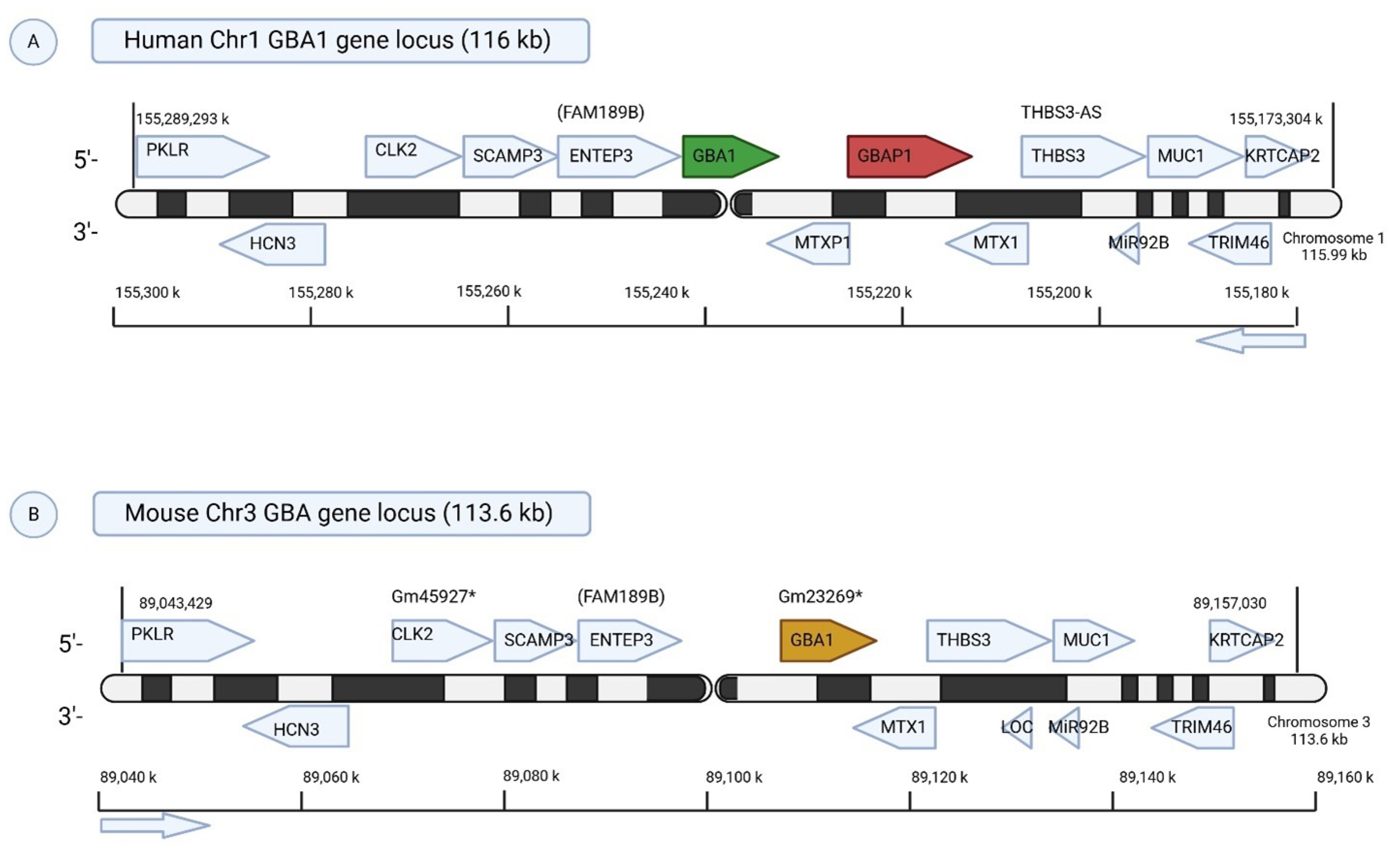
2. Genomic Landscape of the GBA1 Locus in Humans and Mice
3. Early Models: Chemically Induced Approaches
4. Gba1 Conditional Knockout Mouse Models in Hematopoietic Cells (Gba1fl/fl; Mx1-Cre+)
5. Modeling Hematopoietic and Immune Dysregulation in Gaucher Disease Using the Vav-Cre Gba1fl/fl Mouse
6. Genetic Models of Type 2 Gaucher Disease: From Germline Knockouts to Conditional and Therapeutic Platforms
7. Point Knock-in Mutation Gaucher Disease Mouse Models
8. Dissecting Cell-Type-Specific Roles in Neuronopathic GD: Neurons as Primary Drivers and Microglia as Modulators
9. Gba1 Conditional Knockout in Neuronal and Macroglial Cells (Gba1fl/fl Nestin-Cre)
10. Gba1 Conditional Rescue Mouse Models in Microglia and Neurons (nGDCx3cr1Cre/+ and nGDNesCre/+)
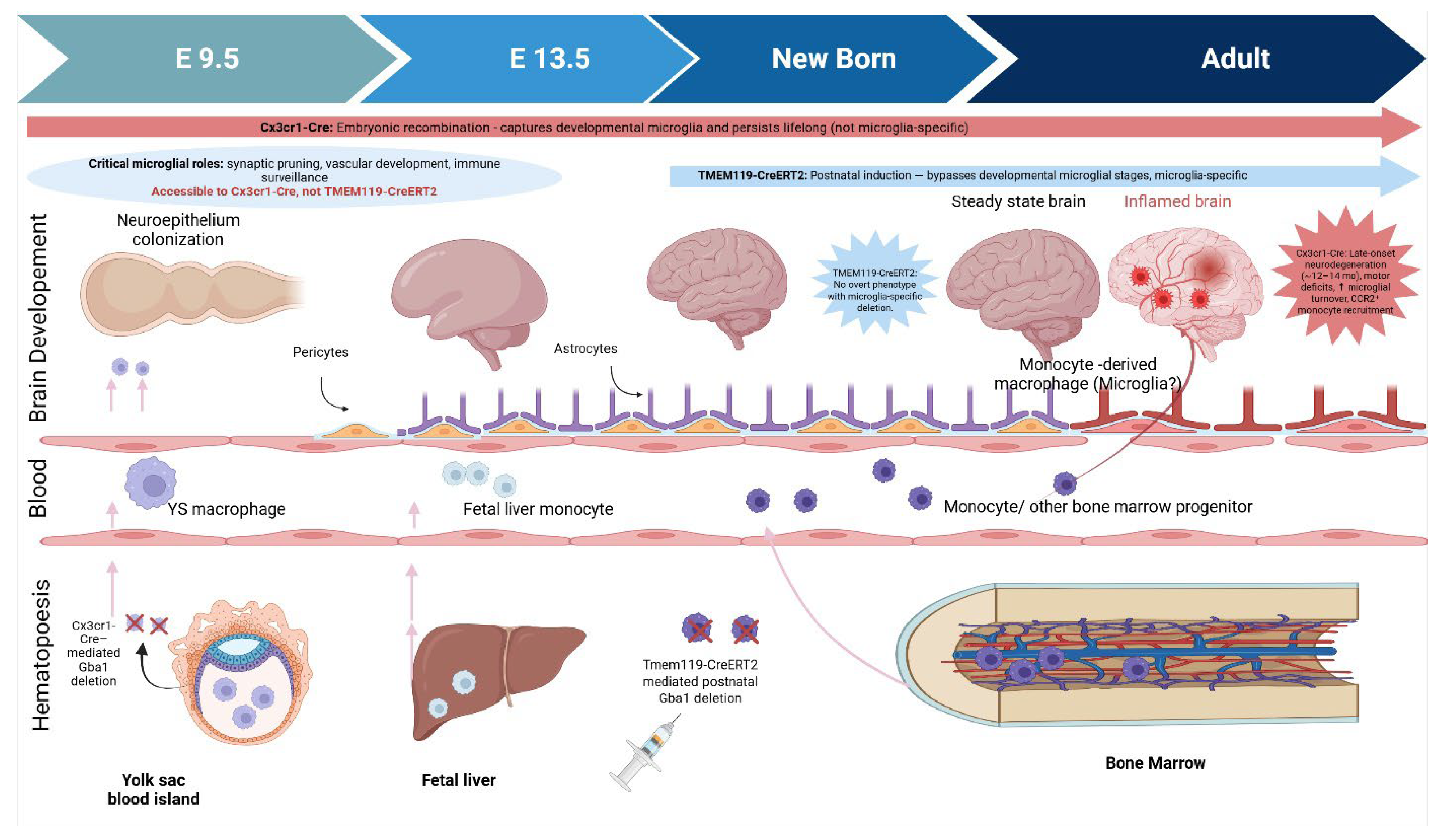
11. Cell-Type Specific Roles of GCase in Neurodegeneration: Insights from Microglial and Neuronal Deletion Models
12. Technical Safeguards and Best Practices—To Avoid Misinterpretation and to Maximize Translational Value, We Recommend That Investigators Using Lineage-Restricted Cre Systems Adopt the Following Standards
- Reporters and recombination validation: Always include Cre-reporter crosses (e.g., Ai9/tdTomato), genomic PCR, and quantitative GCase activity assays across multiple tissues (brain regions, spleen, liver, muscle, blood myeloid compartments) to document where and when recombination occurs.
- Temporal controls: If using inducible CreER drivers, carefully report tamoxifen dosing, age at induction, and repopulation dynamics. Where possible, compare embryonic (constitutive) and postnatal (inducible) strategies to separate developmental from maintenance roles.
- Peripheral checks: Because many “microglial” drivers are active in peripheral myeloid cells at some developmental stages (or after blood–brain barrier disruption), explicitly test for peripheral recombination and consider bone-marrow chimeras or parabiosis experiments to isolate CNS-intrinsic effects.
- Multiple drivers and rescue approaches: Use at least two independent drivers (e.g., Cx3cr1 and Tmem119, or Cx3cr1 and Sall1, where appropriate) or combine deletion with cell-type rescue experiments to strengthen causal inference.
- Single-cell and spatial molecular profiling: Integrate single-cell RNA-seq, spatial transcriptomics, and lipidomics to map cell-type–specific substrate accumulation and inflammatory responses; these approaches can reveal whether microglial phenotypes are primary or reactive.
- Functional readouts across the lifespan: Because microglial contributions may be age-dependent, include long-term behavioral, biomarker (e.g., NfL), and histopathological endpoints.
13. Chronic Neuronopathic Gaucher Disease Mouse Models
14. Modeling Complexities and Comorbidities
15. Phenotypic Variability and the Role of GBA2: Insights from Double Knockout Models
16. Gaucher Disease and Parkinson’s Disease Mouse Models
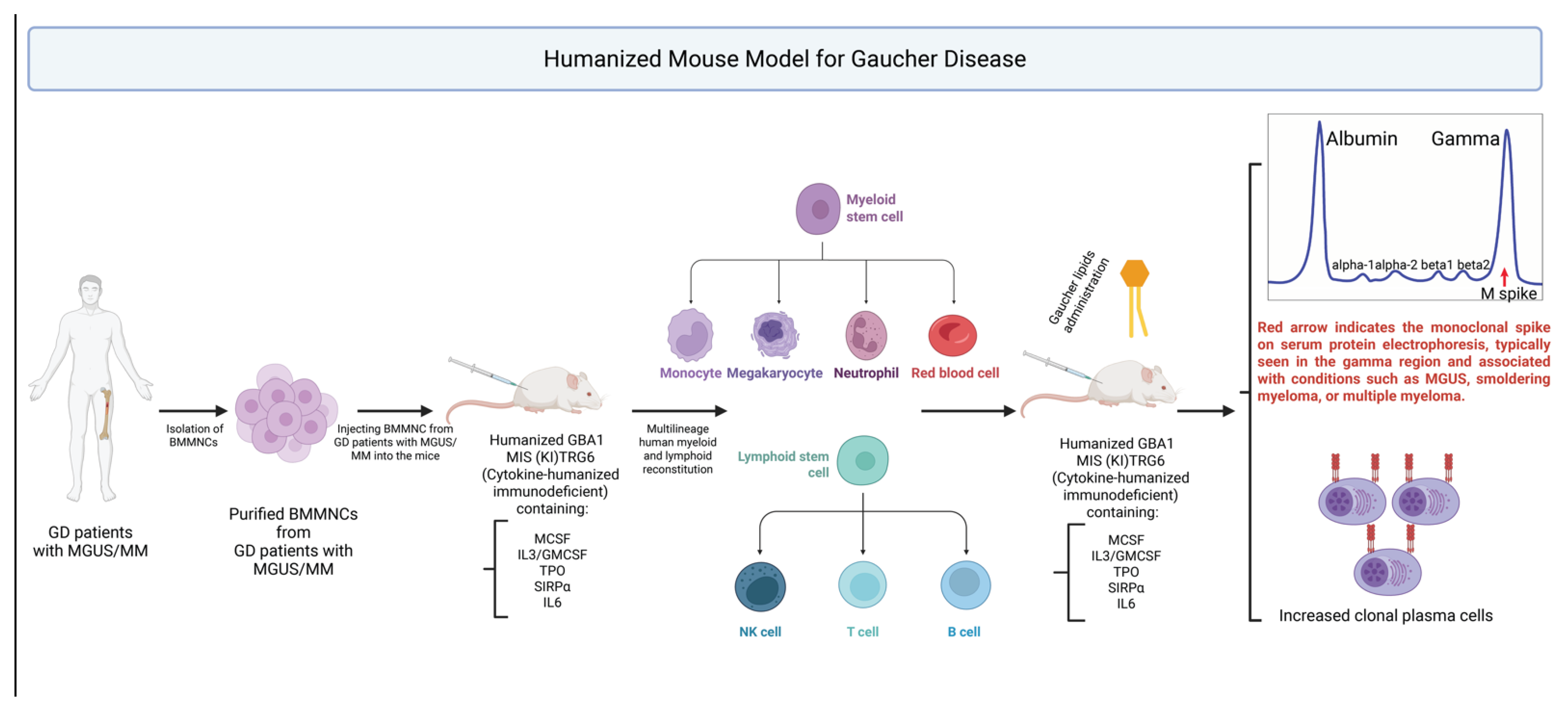
17. Humanized Mouse Model for Gaucher Disease
18. CRISPR/Cas9 in Gaucher Disease: Modeling Pathology and Correcting Mutations
AAV-Mediated Gene Therapy for Gaucher Disease
19. Challenges and Future Directions: Toward Predictive and Patient-Centric Models of Gaucher Disease
20. Genetic Background and Modifier Networks
21. The Microbiome: A Dynamic Modifier of CNS and Systemic Phenotypes
22. Bridging the Genomic Divide: Toward Humanized Mouse Models
23. A Call to Action: Defining the Next Generation of GD Models
- Humanized at the genomic level, incorporating the GBA1–GBAP1 locus.
- Genetically multiplexed, enabling the modeling of common and rare modifiers through CRISPR-based allelic series.
- Multi-omics-integrated, to capture the dynamic interplay between transcriptomic, lipidomic, and proteomic changes across tissues and developmental stages.
- Microbiome-aware, either through germ-free derivation, co-housing strategies, or defined microbial consortia.
- Mechanistically anchored, with lineage-specific, time-resolved Cre drivers and robust validation protocols.
Author Contributions
Funding
Institutional Review Board Statement
Informed Consent Statement
Data Availability Statement
Conflicts of Interest
References
- Grabowski, G.A.; Petsko, G.A.; Kolodny, E.H. Gaucher Disease. In The Online Metabolic and Molecular Bases of Inherited Disease; Valle, D.L., Antonarakis, S., Ballabio, A., Beaudet, A.L., Mitchell, G.A., Eds.; McGraw-Hill Education: New York, NY, USA, 2019. [Google Scholar]
- Mistry, P.K.; Liu, J.; Yang, M.; Nottoli, T.; McGrath, J.; Jain, D.; Zhang, K.; Keutzer, J.; Chuang, W.-L.; Mehal, W.Z.; et al. Glucocerebrosidase gene-deficient mouse recapitulates Gaucher disease displaying cellular and molecular dysregulation beyond the macrophage. Proc. Natl. Acad. Sci. USA 2010, 107, 19473–19478, Erratum in Proc. Natl. Acad. Sci. USA 2012, 109, 9220. [Google Scholar] [CrossRef] [PubMed] [PubMed Central]
- Ginhoux, F.; Lim, S.; Hoeffel, G.; Low, D.; Huber, T. Origin and differentiation of microglia. Front. Cell. Neurosci. 2013, 7, 45. [Google Scholar] [CrossRef] [PubMed]
- Boddupalli, C.S.; Nair, S.; Belinsky, G.; Gans, J.; Teeple, E.; Nguyen, T.-H.; Mehta, S.; Guo, L.; Kramer, M.L.; Ruan, J.; et al. Neuroinflammation in neuronopathic Gaucher disease: Role of microglia and NK cells, biomarkers, and response to substrate reduction therapy. Elife 2022, 11, e79830. [Google Scholar] [CrossRef] [PubMed]
- Tybulewicz, V.L.; Tremblay, M.L.; LaMarca, M.E.; Willemsen, R.; Stubblefield, B.K.; Winfield, S.; Zablocka, B.; Sidransky, E.; Martin, B.M.; Huang, S.P.; et al. Animal model of Gaucher’s disease from targeted disruption of the mouse glucocerebrosidase gene. Nature 1992, 357, 407–410. [Google Scholar] [CrossRef] [PubMed]
- Enquist, I.B.; Nilsson, E.; Ooka, A.; Mansson, J.E.; Olsson, K.; Ehinger, M.; Brady, R.O.; Richter, J.; Karlsson, S. Effective cell and gene therapy in a murine model of Gaucher disease. Proc. Natl. Acad. Sci. USA 2006, 103, 13819–13824. [Google Scholar] [PubMed] [PubMed Central]
- Enquist, I.B.; Lo Bianco, C.; Ooka, A.; Nilsson, E.; Mansson, J.E.; Ehinger, M.; Richter, J.; Brady, R.O.; Kirik, D.; Karlsson, S. Murine models of acute neuronopathic Gaucher disease. Proc. Natl. Acad. Sci. USA 2007, 104, 17483–17488. [Google Scholar] [PubMed] [PubMed Central]
- Pewzner-Jung, Y.; Joseph, T.; Blumenreich, S.; Vardi, A.; Ferreira, N.S.; Cho, S.M.; Eilam, R.; Tsoory, M.; Biton, I.E.; Brumfeld, V.; et al. Brain pathology and cerebellar purkinje cell loss in a mouse model of chronic neuronopathic Gaucher disease. Prog. Neurobiol. 2021, 197, 101939. [Google Scholar] [CrossRef] [PubMed]
- Grabowski, G.A.; Antommaria, A.H.M.; Kolodny, E.H.; Mistry, P.K. Gaucher disease: Basic and translational science needs for more complete therapy and management. Mol. Genet. Metab. 2021, 132, 59–75. [Google Scholar] [CrossRef] [PubMed] [PubMed Central]
- Woo, E.G.; Tayebi, N.; Sidransky, E. Next-Generation Sequencing Analysis of GBA1: The Challenge of Detecting Complex Recombinant Alleles. Front. Genet. 2021, 12, 684067. [Google Scholar] [CrossRef] [PubMed] [PubMed Central]
- O’Neill, R.R.; Tokoro, T.; Kozak, C.A.; Brady, R.O. Comparison of the chromosomal localization of murine and human glucocerebrosidase genes and of the deduced amino acid sequences. Proc. Natl. Acad. Sci. USA 1989, 86, 5049–5053. [Google Scholar] [CrossRef] [PubMed] [PubMed Central]
- Tayebi, N.; Stubblefield, B.K.; Park, J.K.; Orvisky, E.; Walker, J.M.; LaMarca, M.E.; Sidransky, E. Reciprocal and nonreciprocal recombination at the glucocerebrosidase gene region: Implications for complexity in Gaucher disease. Am. J. Hum. Genet. 2003, 72, 519–534. [Google Scholar] [CrossRef] [PubMed]
- Guo, J.N.; Guan, M.; Jiang, N.; Li, N.; Li, Y.J.; Zhang, J.; Ma, D. Establishment and Phenotypic Analysis of the Novel Gaucher Disease Mouse Model With the Partially Humanized Gba1 Gene and F213I Mutation. Front. Genet. 2022, 13, 892457. [Google Scholar] [CrossRef] [PubMed] [PubMed Central]
- Mistry, P.K. Genotype/phenotype correlations in Gaucher’s disease. Lancet 1995, 346, 982–983. [Google Scholar] [PubMed]
- Deen, M.C.; Zhu, Y.; Gros, C.; Na, N.; Gilormini, P.A.; Shen, D.L.; Bhosale, S.; Anastasi, N.; Wang, R.; Shan, X.; et al. A versatile fluorescence-quenched substrate for quantitative measurement of glucocerebrosidase activity within live cells. Proc. Natl. Acad. Sci. USA 2022, 119, e2200553119. [Google Scholar] [CrossRef] [PubMed] [PubMed Central]
- Abu-Remaileh, M.; Wyant, G.A.; Kim, C.; Laqtom, N.N.; Abbasi, M.; Chan, S.H.; Freinkman, E.; Sabatini, D.M. Lysosomal metabolomics reveals V-ATPase- and mTOR-dependent regulation of amino acid efflux from lysosomes. Science 2017, 358, 807–813. [Google Scholar] [PubMed] [PubMed Central]
- Capecchi, M.R. The origin and evolution of gene targeting. Dev. Biol. 2022, 481, 179–187. [Google Scholar] [PubMed]
- Gould, S.E.; Junttila, M.R.; de Sauvage, F.J. Translational value of mouse models in oncology drug development. Nat. Med. 2015, 21, 431–439. [Google Scholar] [CrossRef]
- Cabrera-Salazar, M.; Bercury, S.; Ziegler, R.; Marshall, J.; Hodges, B.; Chuang, W.-L.; Pacheco, J.; Li, L.; Cheng, S.; Scheule, R. Intracerebroventricular delivery of glucocerebrosidase reduces substrates and increases lifespan in a mouse model of neuronopathic Gaucher disease. Exp. Neurol. 2010, 225, 436–444. [Google Scholar] [CrossRef]
- Chang, M.; Cooper, J.D.; Sleat, D.E.; Cheng, S.H.; Dodge, J.C.; Passini, M.A.; Lobel, P.; Davidson, B.L. Intraventricular enzyme replacement improves disease phenotypes in a mouse model of late infantile neuronal ceroid lipofuscinosis. Mol. Ther. 2008, 16, 649–656. [Google Scholar] [CrossRef]
- Schiffmann, R.; Cox, T.M.; Dedieu, J.F.; Gaemers, S.J.M.; Hennermann, J.B.; Ida, H.; Mengel, E.; Minini, P.; Mistry, P.; Musholt, P.B.; et al. Venglustat combined with imiglucerase for neurological disease in adults with Gaucher disease type 3: The LEAP trial. Brain 2023, 146, 461–474. [Google Scholar] [CrossRef] [PubMed] [PubMed Central]
- Marshall, J.; Sun, Y.; Bangari, D.S.; Budman, E.; Park, H.; Nietupski, J.B.; Allaire, A.; Cromwell, M.A.; Wang, B.; Grabowski, G.A.; et al. CNS-accessible Inhibitor of Glucosylceramide Synthase for Substrate Reduction Therapy of Neuronopathic Gaucher Disease. Mol. Ther. 2016, 24, 1019–1029. [Google Scholar] [CrossRef] [PubMed] [PubMed Central]
- Mistry, P.K.; Lukina, E.; Ben Turkia, H.; Shankar, S.P.; Baris Feldman, H.; Ghosn, M.; Mehta, A.; Packman, S.; Lau, H.; Petakov, M.; et al. Clinical outcomes after 4.5 years of eliglustat therapy for Gaucher disease type 1: Phase 3 ENGAGE trial final results. Am. J. Hematol. 2021, 96, 1156–1165. [Google Scholar] [CrossRef] [PubMed] [PubMed Central]
- Sawkar, A.R.; Cheng, W.-C.; Beutler, E.; Wong, C.-H.; Balch, W.E.; Kelly, J.W. Chemical chaperones increase the cellular activity of N370S β-glucosidase: A therapeutic strategy for Gaucher disease. Proc. Natl. Acad. Sci. USA 2002, 99, 15428–15433. [Google Scholar] [CrossRef] [PubMed]
- Stephens, M.C.; Bernatsky, A.; Burachinsky, V.; Legler, G.; Kanfer, J.N. The Gaucher mouse: Differential action of conduritol B epoxide and reversibility of its effects. J. Neurochem. 1978, 30, 1023–1027. [Google Scholar] [CrossRef] [PubMed]
- Marshall, J.; McEachern, K.A.; Kyros, J.A.; Nietupski, J.B.; Budzinski, T.; Ziegler, R.J.; Yew, N.S.; Sullivan, J.; Scaria, A.; van Rooijen, N.; et al. Demonstration of feasibility of in vivo gene therapy for Gaucher disease using a chemically induced mouse model. Mol. Ther. 2002, 6, 179–189. [Google Scholar] [CrossRef] [PubMed]
- Vardi, A.; Zigdon, H.; Meshcheriakova, A.; Klein, A.D.; Yaacobi, C.; Eilam, R.; Kenwood, B.M.; Rahim, A.A.; Massaro, G.; Merrill, A.H.; et al. Delineating pathological pathways in a chemically induced mouse model of Gaucher disease. J. Pathol. 2016, 239, 496–509. [Google Scholar] [CrossRef] [PubMed]
- Klein, A.D.; Ferreira, N.S.; Ben-Dor, S.; Duan, J.; Hardy, J.; Cox, T.M.; Merril, A.H., Jr.; Futerman, A.H. Identification of Modifier Genes in a Mouse Model of Gaucher Disease. Cell Rep. 2016, 16, 2546–2553. [Google Scholar] [CrossRef]
- Sidransky, E.; Ginns, E.I. Gaucher’s disease: The best laid schemes of mice and men. Baillieres Clin. Haematol. 1997, 10, 725–737. [Google Scholar] [CrossRef] [PubMed]
- Holleran, W.M.; Ginns, E.I.; Menon, G.K.; Grundmann, J.U.; Fartasch, M.; McKinney, C.E.; Elias, P.M.; Sidransky, E. Consequences of beta-glucocerebrosidase deficiency in epidermis. Ultrastructure and permeability barrier alterations in Gaucher disease. J. Clin. Investig. 1994, 93, 1756–1764. [Google Scholar] [CrossRef] [PubMed] [PubMed Central]
- Farfel-Becker, T.; Vitner, E.B.; Futerman, A.H. Animal models for Gaucher disease research. Dis. Models Mech. 2011, 4, 746–752. [Google Scholar]
- Massaro, G.; Mattar, C.N.Z.; Wong, A.M.S.; Sirka, E.; Buckley, S.M.K.; Herbert, B.R.; Karlsson, S.; Perocheau, D.P.; Burke, D.; Heales, S.; et al. Fetal gene therapy for neurodegenerative disease of infants. Nat. Med. 2018, 24, 1317–1323. [Google Scholar] [CrossRef] [PubMed] [PubMed Central]
- Xu, Y.H.; Quinn, B.; Witte, D.; Grabowski, G.A. Viable mouse models of acid beta-glucosidase deficiency: The defect in Gaucher disease. Am. J. Pathol. 2003, 163, 2093–2101. [Google Scholar] [CrossRef] [PubMed] [PubMed Central]
- Sun, Y.; Quinn, B.; Witte, D.P.; Grabowski, G.A. Gaucher disease mouse models: Point mutations at the acid beta-glucosidase locus combined with low-level prosaposin expression lead to disease variants. J. Lipid Res. 2005, 46, 2102–2113. [Google Scholar] [CrossRef] [PubMed]
- Liu, Y.; Suzuki, K.; Reed, J.D.; Grinberg, A.; Westphal, H.; Hoffmann, A.; Döring, T.; Sandhoff, K.; Proia, R.L. Mice with type 2 and 3 Gaucher disease point mutations generated by a single insertion mutagenesis procedure (SIMP). Proc. Natl. Acad. Sci. USA 1998, 95, 2503–2508. [Google Scholar] [CrossRef]
- Kramer, G.; Wegdam, W.; Donker-Koopman, W.; Ottenhoff, R.; Gaspar, P.; Verhoek, M.; Nelson, J.; Gabriel, T.; Kallemeijn, W.; Boot, R.G.; et al. Elevation of glycoprotein nonmetastatic melanoma protein B in type 1 Gaucher disease patients and mouse models. FEBS Open Bio 2016, 6, 902–913. [Google Scholar] [CrossRef] [PubMed] [PubMed Central]
- Murugesan, V.; Liu, J.; Yang, R.; Lin, H.; Lischuk, A.; Pastores, G.; Zhang, X.; Chuang, W.-L.; Mistry, P.K. Validating glycoprotein non-metastatic melanoma B (gpNMB, osteoactivin), a new biomarker of Gaucher disease. Blood Cells Mol. Dis. 2018, 68, 47–53. [Google Scholar] [CrossRef] [PubMed] [PubMed Central]
- Moloney, E.B.; Moskites, A.; Ferrari, E.J.; Isacson, O.; Hallett, P.J. The glycoprotein GPNMB is selectively elevated in the substantia nigra of Parkinson’s disease patients and increases after lysosomal stress. Neurobiol. Dis. 2018, 120, 1–11. [Google Scholar] [CrossRef] [PubMed] [PubMed Central]
- Kurzawa-Akanbi, M.; Hanson, P.S.; Blain, P.G.; Lett, D.J.; McKeith, I.G.; Chinnery, P.F.; Morris, C.M. Glucocerebrosidase mutations alter the endoplasmic reticulum and lysosomes in Lewy body disease. J. Neurochem. 2012, 123, 298–309. [Google Scholar] [CrossRef] [PubMed] [PubMed Central]
- Panicker, L.M.; Srikanth, M.P.; Castro-Gomes, T.; Miller, D.; Andrews, N.W.; Feldman, R.A. Gaucher disease iPSC-derived osteoblasts have developmental and lysosomal defects that impair bone matrix deposition. Hum. Mol. Genet. 2018, 27, 811–822. [Google Scholar] [CrossRef] [PubMed] [PubMed Central]
- Mistry, P.K.; Weinreb, N.J.; Kaplan, P.; Cole, J.A.; Gwosdow, A.R.; Hangartner, T. Osteopenia in Gaucher disease develops early in life: Response to imiglucerase enzyme therapy in children, adolescents and adults. Blood Cells Mol. Dis. 2011, 46, 66–72. [Google Scholar]
- Liu, J.; Halene, S.; Yang, M.; Iqbal, J.; Yang, R.; Mehal, W.Z.; Chuang, W.-L.; Jain, D.; Yuen, T.; Sun, L.; et al. Gaucher disease gene GBA functions in immune regulation. Proc. Natl. Acad. Sci. USA 2012, 109, 10018–10023. [Google Scholar] [CrossRef] [PubMed] [PubMed Central]
- Ch’en, I.Y.; Lynch, D.A.; Shroyer, K.R.; Schwarz, M.I. Gaucher’s disease. An unusual cause of intrathoracic extramedullary hematopoiesis. Chest 1993, 104, 1923–1924. [Google Scholar] [CrossRef] [PubMed]
- Stein, P.; Malhotra, A.; Haims, A.; Pastores, G.M.; Mistry, P.K. Focal splenic lesions in type I Gaucher disease are associated with poor platelet and splenic response to macrophage-targeted enzyme replacement therapy. J. Inherit. Metab. Dis. 2010, 33, 769–774. [Google Scholar] [CrossRef] [PubMed] [PubMed Central]
- Mistry, P.K.; Taddei, T.; vom Dahl, S.; Rosenbloom, B.E. Gaucher disease and malignancy: A model for cancer pathogenesis in an inborn error of metabolism. Crit. Rev. Oncog. 2013, 18, 235–246. [Google Scholar] [CrossRef] [PubMed] [PubMed Central]
- Rosenbloom, B.E.; Cappellini, M.D.; Weinreb, N.J.; Dragosky, M.; Revel-Vilk, S.; Batista, J.L.; Sekulic, D.; Mistry, P.K. Cancer risk and gammopathies in 2123 adults with Gaucher disease type 1 in the International Gaucher Group Gaucher Registry. Am. J. Hematol. 2022, 97, 1337–1347. [Google Scholar] [CrossRef] [PubMed] [PubMed Central]
- Rosenbloom, B.E.; Weinreb, N.J.; Zimran, A.; Kacena, K.A.; Charrow, J.; Ward, E. Gaucher disease and cancer incidence: A study from the Gaucher Registry. Blood 2005, 105, 4569–4572. [Google Scholar] [CrossRef] [PubMed]
- Pavlova, E.V.; Wang, S.Z.; Archer, J.; Dekker, N.; Aerts, J.M.; Karlsson, S.; Cox, T. B cell lymphoma and myeloma in murine Gaucher’s disease. J. Pathol. 2013, 231, 88–97, Erratum in J. Pathol. 2013, 231, 544–545. [Google Scholar] [CrossRef] [PubMed]
- Nair, S.; Boddupalli, C.S.; Verma, R.; Liu, J.; Yang, R.; Pastores, G.M.; Mistry, P.K.; Dhodapkar, M.V. Type II NKT-TFH cells against Gaucher lipids regulate B-cell immunity and inflammation. Blood 2015, 125, 1256–1271. [Google Scholar] [CrossRef] [PubMed] [PubMed Central]
- Nair, S.; Branagan, A.R.; Liu, J.; Boddupalli, C.S.; Mistry, P.K.; Dhodapkar, M.V. Clonal Immunoglobulin against Lysolipids in the Origin of Myeloma. N. Engl. J. Med. 2016, 374, 555–561. [Google Scholar] [CrossRef] [PubMed] [PubMed Central]
- Belinsky, G.; Ruan, J.; Fattahi, N.; Mehta, S.; Boddupalli, C.S.; Mistry, P.K.; Nair, S. Modeling Bone Marrow Microenvironment and Hematopoietic Dysregulation in Gaucher Disease through Vav-Cre Mediated GBA1 Deletion. Hum. Mol. Genet. 2025, 34, 952–966. [Google Scholar] [CrossRef]
- Duffy, H.B.D.; Byrnes, C.; Zhu, H.; Tuymetova, G.; Lee, Y.T.; Platt, F.M.; Proia, R.L. Deletion of Gba in neurons, but not microglia, causes neurodegeneration in a Gaucher mouse model. JCI Insight 2024, 9. [Google Scholar] [CrossRef] [PubMed] [PubMed Central]
- Mistry, P.K.; Liu, J.; Sun, L.; Chuang, W.-L.; Yuen, T.; Yang, R.; Lu, P.; Zhang, K.; Li, J.; Keutzer, J.; et al. Glucocerebrosidase 2 gene deletion rescues type 1 Gaucher disease. Proc. Natl. Acad. Sci. USA 2014, 111, 4934–4939. [Google Scholar] [CrossRef] [PubMed]
- Mazzulli, J.R.; Xu, Y.H.; Sun, Y.; Knight, A.L.; McLean, P.J.; Caldwell, G.A.; Sidransky, E.; Grabowski, G.A.; Krainc, D. Gaucher disease glucocerebrosidase and alpha-synuclein form a bidirectional pathogenic loop in synucleinopathies. Cell 2011, 146, 37–52. [Google Scholar] [CrossRef] [PubMed] [PubMed Central]
- Sardi, S.P.; Clarke, J.; Kinnecom, C.; Tamsett, T.J.; Li, L.; Stanek, L.M.; Passini, M.A.; Grabowski, G.A.; Schlossmacher, M.G.; Sidman, R.L.; et al. CNS expression of glucocerebrosidase corrects alpha-synuclein pathology and memory in a mouse model of Gaucher-related synucleinopathy. Proc. Natl. Acad. Sci. USA 2011, 108, 12101–12106. [Google Scholar] [CrossRef] [PubMed] [PubMed Central]
- Taguchi, Y.V.; Liu, J.; Ruan, J.; Pacheco, J.; Zhang, X.; Abbasi, J.; Keutzer, J.; Mistry, P.K.; Chandra, S.S. Glucosylsphingosine Promotes alpha-Synuclein Pathology in Mutant GBA-Associated Parkinson’s Disease. J. Neurosci. 2017, 37, 9617–9631. [Google Scholar] [PubMed]
- Zunke, F.; Moise, A.C.; Belur, N.R.; Gelyana, E.; Stojkovska, I.; Dzaferbegovic, H.; Toker, N.J.; Jeon, S.; Fredriksen, K.; Mazzulli, J.R. Reversible Conformational Conversion of alpha-Synuclein into Toxic Assemblies by Glucosylceramide. Neuron 2018, 97, 92–107.e10. [Google Scholar] [CrossRef] [PubMed] [PubMed Central]
- Nair, S.; Bar, N.; Xu, M.L.; Dhodapkar, M.; Mistry, P.K. Glucosylsphingosine but not Saposin C, is the target antigen in Gaucher disease-associated gammopathy. Mol. Genet. Metab. 2020, 129, 286–291. [Google Scholar] [CrossRef] [PubMed] [PubMed Central]
- Nair, S.; Sng, J.; Boddupalli, C.S.; Seckinger, A.; Chesi, M.; Fulciniti, M.; Zhang, L.; Rauniyar, N.; Lopez, M.; Neparidze, N.; et al. Antigen-mediated regulation in monoclonal gammopathies and myeloma. JCI Insight 2018, 3, e98259. [Google Scholar] [CrossRef] [PubMed] [PubMed Central]
- Pavan, E.; Ormazabal, M.; Peruzzo, P.; Vaena, E.; Rozenfeld, P.; Dardis, A. CRISPR/Cas9 Editing for Gaucher Disease Modelling. Int. J. Mol. Sci. 2020, 21, 3268. [Google Scholar] [CrossRef] [PubMed] [PubMed Central]
- Scharenberg, S.G.; Poletto, E.; Lucot, K.L.; Colella, P.; Sheikali, A.; Montine, T.J.; Porteus, M.H.; Gomez-Ospina, N. Engineering monocyte/macrophage-specific glucocerebrosidase expression in human hematopoietic stem cells using genome editing. Nat. Commun. 2020, 11, 3327. [Google Scholar] [CrossRef] [PubMed] [PubMed Central]
- Ramalingam, S.; Kumar, A.; Krug, S.; Mohan, H.; Rao, D.N.; Bishai, W.R.; Chandrasegaran, S. CRISPR Correction of the GBA Mutation in Human-Induced Pluripotent Stem Cells Restores Normal Function to Gaucher Macrophages and Increases Their Susceptibility to Mycobacterium tuberculosis. J. Infect. Dis. 2023, 228, 777–782. [Google Scholar] [CrossRef] [PubMed] [PubMed Central]
- Du, S.; Ou, H.; Cui, R.; Jiang, N.; Zhang, M.; Li, X.; Ma, J.; Zhang, J.; Ma, D. Delivery of Glucosylceramidase Beta Gene Using AAV9 Vector Therapy as a Treatment Strategy in Mouse Models of Gaucher Disease. Hum. Gene Ther. 2019, 30, 155–167. [Google Scholar] [CrossRef] [PubMed]
- Lin, Y.; Zhao, X.; Liou, B.; Fannin, V.; Zhang, W.; Setchell, K.D.R.; Wang, X.; Pan, D.; Grabowski, G.A.; Liu, C.-J.; et al. Intrinsic link between PGRN and Gba1 D409V mutation dosage in potentiating Gaucher disease. Hum. Mol. Genet. 2024, 33, 1771–1788. [Google Scholar] [CrossRef] [PubMed] [PubMed Central]
- Yildiz, Y.; Matern, H.; Thompson, B.; Allegood, J.C.; Warren, R.L.; Ramirez, D.M.; Hammer, R.E.; Hamra, F.K.; Matern, S.; Russell, D.W. Mutation of beta-glucosidase 2 causes glycolipid storage disease and impaired male fertility. J. Clin. Investig. 2006, 116, 2985–2994. [Google Scholar] [CrossRef] [PubMed] [PubMed Central]
- Boot, R.G.; Verhoek, M.; Donker-Koopman, W.; Strijland, A.; van Marle, J.; Overkleeft, H.S.; Wennekes, T.; Aerts, J.M.F. Identification of the non-lysosomal glucosylceramidase as beta-glucosidase 2. J. Biol. Chem. 2007, 282, 1305–1312. [Google Scholar] [CrossRef] [PubMed]
- Hein, L.K.; Meikle, P.J.; Hopwood, J.J.; Fuller, M. Secondary sphingolipid accumulation in a macrophage model of Gaucher disease. Mol. Genet. Metab. 2007, 92, 336–345. [Google Scholar] [CrossRef] [PubMed]
- Marques, A.R.; Aten, J.; Ottenhoff, R.; van Roomen, C.P.; Herrera Moro, D.; Claessen, N.; Veloz, M.F.V.; Zhou, K.; Lin, Z.; Mirzaian, M.; et al. Reducing GBA2 activity ameliorates neuropathology in Niemann-Pick type C mice. PLoS ONE 2015, 10, e0135889. [Google Scholar] [CrossRef]
- Yildiz, Y.; Hoffmann, P.; Vom Dahl, S.; Breiden, B.; Sandhoff, R.; Niederau, C.; Horwitz, M.; Karlsson, S.; Filocamo, M.; Elstein, D.; et al. Functional and genetic characterization of the non-lysosomal glucosylceramidase 2 as a modifier for Gaucher disease. Orphanet J. Rare Dis. 2013, 8, 151. [Google Scholar] [CrossRef] [PubMed] [PubMed Central]
- Kim, S.; Kwon, S.H.; Kam, T.I.; Panicker, N.; Karuppagounder, S.S.; Lee, S.; Lee, J.H.; Kim, W.R.; Kook, M.; Foss, C.A.; et al. Transneuronal Propagation of Pathologic alpha-Synuclein from the Gut to the Brain Models Parkinson’s Disease. Neuron 2019, 103, 627–641.e7. [Google Scholar] [CrossRef] [PubMed] [PubMed Central]
- Gehin, M.; Melchior, M.; Welford, R.W.D.; Sidharta, P.N.; Dingemanse, J. Assessment of Target Engagement in a First-in-Human Trial with Sinbaglustat, an Iminosugar to Treat Lysosomal Storage Disorders. Clin. Transl. Sci. 2021, 14, 558–567. [Google Scholar] [CrossRef] [PubMed] [PubMed Central]
- Shiner, T.; Mirelman, A.; Gana Weisz, M.; Bar-Shira, A.; Ash, E.; Cialic, R.; Nevler, N.; Gurevich, T.; Bregman, N.; Orr-Urtreger, A.; et al. High Frequency of GBA Gene Mutations in Dementia With Lewy Bodies Among Ashkenazi Jews. JAMA Neurol. 2016, 73, 1448–1453. [Google Scholar] [CrossRef] [PubMed]
- Sidransky, E.; Lopez, G. The link between the GBA gene and parkinsonism. Lancet Neurol. 2012, 11, 986–998. [Google Scholar] [CrossRef] [PubMed] [PubMed Central]
- Gregorio, I.; Russo, L.; Torretta, E.; Barbacini, P.; Contarini, G.; Pacinelli, G.; Bizzotto, D.; Moriggi, M.; Braghetta, P.; Papaleo, F.; et al. GBA1 inactivation in oligodendrocytes affects myelination and induces neurodegenerative hallmarks and lipid dyshomeostasis in mice. Mol. Neurodegener. 2024, 19, 22. [Google Scholar] [CrossRef] [PubMed] [PubMed Central]
- Wallom, K.L.; Fernandez-Suarez, M.E.; Priestman, D.A.; Te Vruchte, D.; Huebecker, M.; Hallett, P.J.; Isacson, O.; Platt, F.M. Glycosphingolipid metabolism and its role in ageing and Parkinson’s disease. Glycoconj. J. 2022, 39, 39–53. [Google Scholar] [CrossRef] [PubMed] [PubMed Central]
- Wang, L.; Lin, G.; Zuo, Z.; Li, Y.; Byeon, S.K.; Pandey, A.; Bellen, H.J. Neuronal activity induces glucosylceramide that is secreted via exosomes for lysosomal degradation in glia. Sci. Adv. 2022, 8, eabn3326. [Google Scholar] [CrossRef] [PubMed] [PubMed Central]
- Yang, C.; Rahimpour, S.; Lu, J.; Pacak, K.; Ikejiri, B.; Brady, R.O.; Zhuang, Z. Histone deacetylase inhibitors increase glucocerebrosidase activity in Gaucher disease by modulation of molecular chaperones. Proc. Natl. Acad. Sci. USA 2013, 110, 966–971. [Google Scholar] [CrossRef] [PubMed] [PubMed Central]
- Morabito, G.; Giannelli, S.G.; Ordazzo, G.; Bido, S.; Castoldi, V.; Indrigo, M.; Cabassi, T.; Cattaneo, S.; Luoni, M.; Cancellieri, C.; et al. AAV-PHP.B-Mediated Global-Scale Expression in the Mouse Nervous System Enables GBA1 Gene Therapy for Wide Protection from Synucleinopathy. Mol. Ther. 2017, 25, 2727–2742. [Google Scholar] [CrossRef] [PubMed] [PubMed Central]
- Clough, B.; Finethy, R.; Khan, R.T.; Fisch, D.; Jordan, S.; Patel, H.; Coers, J.; Frickel, E.-M. C57BL/6 and 129 inbred mouse strains differ in Gbp2 and Gbp2b expression in response to inflammatory stimuli in vivo. Wellcome Open Res. 2019, 4, 124. [Google Scholar] [CrossRef] [PubMed] [PubMed Central]
- Sag, D.; Krause, P.; Hedrick, C.C.; Kronenberg, M.; Wingender, G. IL-10-producing NKT10 cells are a distinct regulatory invariant NKT cell subset. J. Clin. Investig. 2014, 124, 3725–3740. [Google Scholar] [CrossRef] [PubMed] [PubMed Central]
- Atilano, M.L.; Hull, A.; Romila, C.A.; Adams, M.L.; Wildfire, J.; Urena, E.; Dyson, M.; Ivan-Castillo-Quan, J.; Partridge, L.; Kinghorn, K.J. Autophagic dysfunction and gut microbiota dysbiosis cause chronic immune activation in a Drosophila model of Gaucher disease. PLoS Genet. 2023, 19, e1011063. [Google Scholar] [CrossRef] [PubMed] [PubMed Central]
- Gustavsson, E.K.; Sethi, S.; Gao, Y.; Brenton, J.W.; Garcia-Ruiz, S.; Zhang, D.; Garza, R.; Reynolds, R.H.; Evans, J.R.; Chen, Z.; et al. The annotation of GBA1 has been concealed by its protein-coding pseudogene GBAP1. Sci. Adv. 2024, 10, eadk1296. [Google Scholar] [CrossRef] [PubMed] [PubMed Central]



| Model | Strategy | Phenotype | Key Applications & Utility | Limitations | Strain Background | References |
|---|---|---|---|---|---|---|
| Chemically Induced (CBE) |
|
|
|
| C57BL/6J and other inbred strains used to study strain-specific effects | [25,26,27,28] |
| Gba1lnl/lnl (Conventional Knockout) |
|
|
|
| Developed by NIH (1992), typically on C57BL/6 background | [5,29,30] |
| Gba1lnl/lnl; K14-Cre (Epidermal-Rescued Conditional KO) |
|
|
|
| Primarily C57BL/6 background | [4,7,31,32] |
| Gba1Mut/Mut Point Knock-In Models (e.g., N370S, D409V, etc.) |
|
|
|
| NIH-developed, C57BL/6, 129Sv | [33,34,35] |
| Gba1flox/flox; Nestin-Cre (Neuronal & Macroglial KO) |
|
|
|
| C57BL/6 | [7] |
| Gba1flox/flox; Mx1-Cre (Hematopoietic Conditional KO) |
|
|
|
| C57BL/6 (Karlsson, Mistry) | [2,6,36] |
| Gba1lnl/lnl; K14-Cre/Nestin-Cre and Gba1 lnl/lnl; K14-Cre/Cx3cr1-Cre (Conditional Rescue Models—Neuronal & Microglial) |
|
|
|
| C57BL/6 | [4] |
| Model | Strategy | Phenotype | Key Applications & Utility | Limitations | Strain Background | References |
|---|---|---|---|---|---|---|
| Gba1flox/flox; Cx3cr1-Cre (Constitutive Microglial KO) |
|
|
|
| C57BL/6 and other strains used to assess background effects | [4] |
| Gba1flox/flox; TMEM119-CreERT2 (Inducible Microglia-Specific KO) |
|
|
|
| C57BL/6J and other CreERT2-compatible strains | [4,52] |
| Gba1flox/flox; Vav1-Cre (Hematopoietic-Specific KO) |
|
|
|
| 129X1/SvJ and C57BL/6J (notably different phenotypes) | [51] |
| Gba1−/−; Gbatg (Inducible Tet-On/Tet-Off Transgenic Model) |
|
|
|
| Mixed genetic background (doxycycline-inducible) | [8] |
| Gba1flox/flox; Mx1-Cre+; Gba2−/− (Double Knockout Model) |
|
|
|
| C57BL/6J; poly(I:C)-induced Mx1–Cre; strain-dependent effects reported | [53] |
| Gba1L444P; SNCA+ (GD–PD Dual Model) |
|
|
|
| C57BL/6J; mixed backgrounds depending on SNCA line | [54,55,56,57] |
| MIS(KI)TRG6 + BMMC (Humanized GD Mouse Model) |
|
|
|
| MIS(KI)TRG6 immunodeficient humanized mouse line | [13,50,58,59] |
| CRISPR/Cas9-Based GD Models and Therapeutics (In Vivo and In Vitro Systems) |
|
|
|
| Mice (e.g., F213I KI), zebrafish, Drosophila, THP-1, U87, human iPSC-derived cells | [60,61,62] |
Disclaimer/Publisher’s Note: The statements, opinions and data contained in all publications are solely those of the individual author(s) and contributor(s) and not of MDPI and/or the editor(s). MDPI and/or the editor(s) disclaim responsibility for any injury to people or property resulting from any ideas, methods, instructions or products referred to in the content. |
© 2025 by the authors. Licensee MDPI, Basel, Switzerland. This article is an open access article distributed under the terms and conditions of the Creative Commons Attribution (CC BY) license (https://creativecommons.org/licenses/by/4.0/).
Share and Cite
Fattahi, N.; Ruan, J.; Belinsky, G.; Xing, S.; Mistry, P.K.; Nair, S. Refining Mouse Models of Gaucher Disease: Advancing Mechanistic Insights, Biomarker Discovery, and Therapeutic Strategies. Int. J. Mol. Sci. 2025, 26, 11915. https://doi.org/10.3390/ijms262411915
Fattahi N, Ruan J, Belinsky G, Xing S, Mistry PK, Nair S. Refining Mouse Models of Gaucher Disease: Advancing Mechanistic Insights, Biomarker Discovery, and Therapeutic Strategies. International Journal of Molecular Sciences. 2025; 26(24):11915. https://doi.org/10.3390/ijms262411915
Chicago/Turabian StyleFattahi, Nima, Jiapeng Ruan, Glenn Belinsky, Shu Xing, Pramod K. Mistry, and Shiny Nair. 2025. "Refining Mouse Models of Gaucher Disease: Advancing Mechanistic Insights, Biomarker Discovery, and Therapeutic Strategies" International Journal of Molecular Sciences 26, no. 24: 11915. https://doi.org/10.3390/ijms262411915
APA StyleFattahi, N., Ruan, J., Belinsky, G., Xing, S., Mistry, P. K., & Nair, S. (2025). Refining Mouse Models of Gaucher Disease: Advancing Mechanistic Insights, Biomarker Discovery, and Therapeutic Strategies. International Journal of Molecular Sciences, 26(24), 11915. https://doi.org/10.3390/ijms262411915