Article

Copper(II) Complexes with 4-Substituted 2,6-Bis(thiazol-2-yl)pyridines—An Overview of Structural–Optical Relationships


1
Institute of Chemistry, University of Silesia, Szkolna 9, 40-006 Katowice, Poland
2
Department of Chemical Organic Technology and Petrochemistry, Silesian University of Technology, Krzywoustego 4, 44-100 Gliwice, Poland
3
Centre of Polymer and Carbon Materials, Polish Academy of Sciences, M. Curie-Skłodowska 34, 41-819 Zabrze, Poland
*
Authors to whom correspondence should be addressed.
Int. J. Mol. Sci. 2025, 26(24), 11868; https://doi.org/10.3390/ijms262411868
Submission received: 10 November 2025 / Revised: 1 December 2025 / Accepted: 2 December 2025 / Published: 9 December 2025
(This article belongs to the Section Physical Chemistry and Chemical Physics)

Abstract

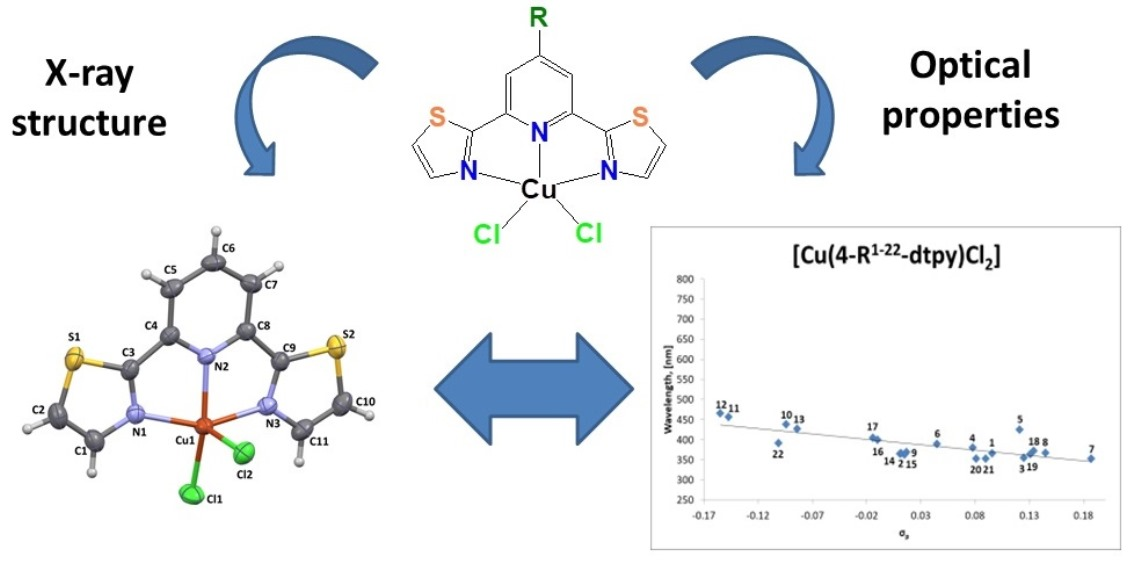
Copper(II) complexes with 2,2′:6′,2″-terpyridines (terpys) are promising candidates for anticancer therapy and catalysis. Their structural and optical properties can be tuned by modifying the terpy backbone, including a substitution at the 4′ position or the replacement of peripheral pyridines with thiazole rings, forming 2,6-bis(thiazol-2-yl)pyridines (dtpys). dtpy-based copper(II) complexes (Cu-dtpys), despite their applicative potential, are barely characterized in the literature. Here, the series of Cu-dtpys (113) was synthesised and characterized by FT-IR, HRMS, X-ray diffraction, and UV-Vis spectroscopy. Their structural and optical features were compared to previously studied Cu-dtpys (1424) and their terpy analogues (Cu-terpy-1 ÷ Cu-terpy-24). The detailed analysis revealed that five-coordinate Cu-dtpys complexes adopt a square pyramidal geometry comparable to that of Cu-terpys complexes but with markedly smaller deviations from the ideal square pyramid. Compared with Cu-terpys, Cu–Clapical bonds are shorter, while Cu–Ncentral bonds are elongated. The Cu-dtpy systems usually present the longest wavelength of the lowest energy absorption band in comparison to Cuterpys. The analysis of the relationship between Hammett’s constant and wavelength of absorption indicates that the most promising from the photophysical point of view are compounds 46, 1013, 1617, and 22, for which a newly formed intraligand charge transfer band is formed.

1. Introduction

Copper, after iron and zinc, is a key transition metal essential for the living body. It plays a role as a cofactor of many enzymes (e.g., cytochrome C oxidase, superoxide dismutase, tyrosinase) and is required for iron metabolism (in the form of ceruloplasmin), ATP production, and the formation of connective tissues and participates in the synthesis of neurotransmitters [1,2,3,4,5,6]. Moreover, copper-dependent enzymes are involved in white blood cell activity and are also responsible for oxygen stress reduction in living cells [3,7,8]. Five- and six-coordinate copper(II) complexes contribute significantly to anticancer drug development due to their oxidative, hydrolytic, and photolytic DNA-cleaving properties [9]. As an endogenous metal, the Cu(II) ion can create coordination compounds that are less toxic than platinum-based drugs and, owing to their selective permeability toward cancer cell membranes, can overcome drug transportation limitations [10]. Finally, copper(II) complexes are widely used as eco-friendly and versatile catalysts in oxidation, cross-coupling, radical polymerization, and biomimetic enzyme reactions [11,12,13].
Recently, our scientific attention was focused on five-coordinate copper(II) complexes with 2,2′:6′,2′′-terpyridine (terpy) derivatives as promising catalysts for oxidation of alkanes and alcohols with hydrogen peroxide and tert-butyl hydroperoxide (TBHP) and for use as antiproliferative drugs on A2780 ovarian and HCT116 human colorectal carcinoma cells [14,15,16]. Terpy and its derivatives, owing to their convenient synthesis via one-pot Kröhnke condensation, represent an ideal structural backbone for further modification, enabling systematic studies on the tuning of the biological, catalytic, and optical behavior of the resulting Cu(II) complexes.
One of the possible approaches for modulating the physicochemical properties of the resulting complexes is the substitution of peripheral pyridine rings of terpy with thiazole units, as in 2,6-bis(thiazol-2-yl)pyridine (dtpy). Compared to pyridines in the terpy framework, thiazole rings in dtpy differ in their σ-donor and π-acceptor abilities [17]. While terpyridyl Cu(II) coordination compounds (Cu-terpy) are among the most extensively studied systems, with successful applications in anticancer therapy and catalysis [18,19,20,21,22], Cu(II) complexes bearing dtpy derivatives (Cu-dtpy) remain exceedingly rare [14,15,16,23,24] (Scheme 1). Notably, preliminary investigations of this class of compounds indicate their promising potential for both anticancer and catalytic applications [14,15,16,23,24].
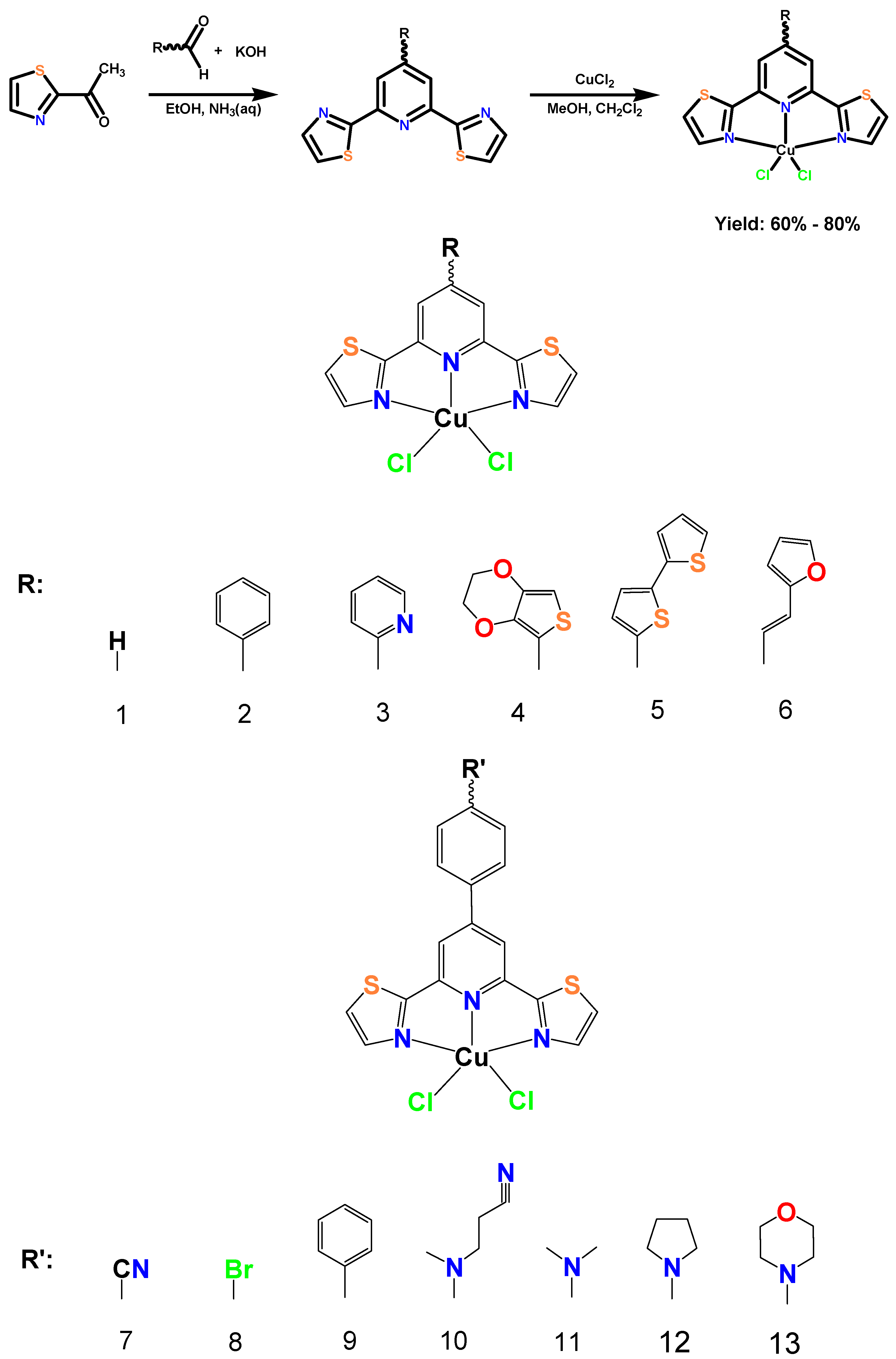
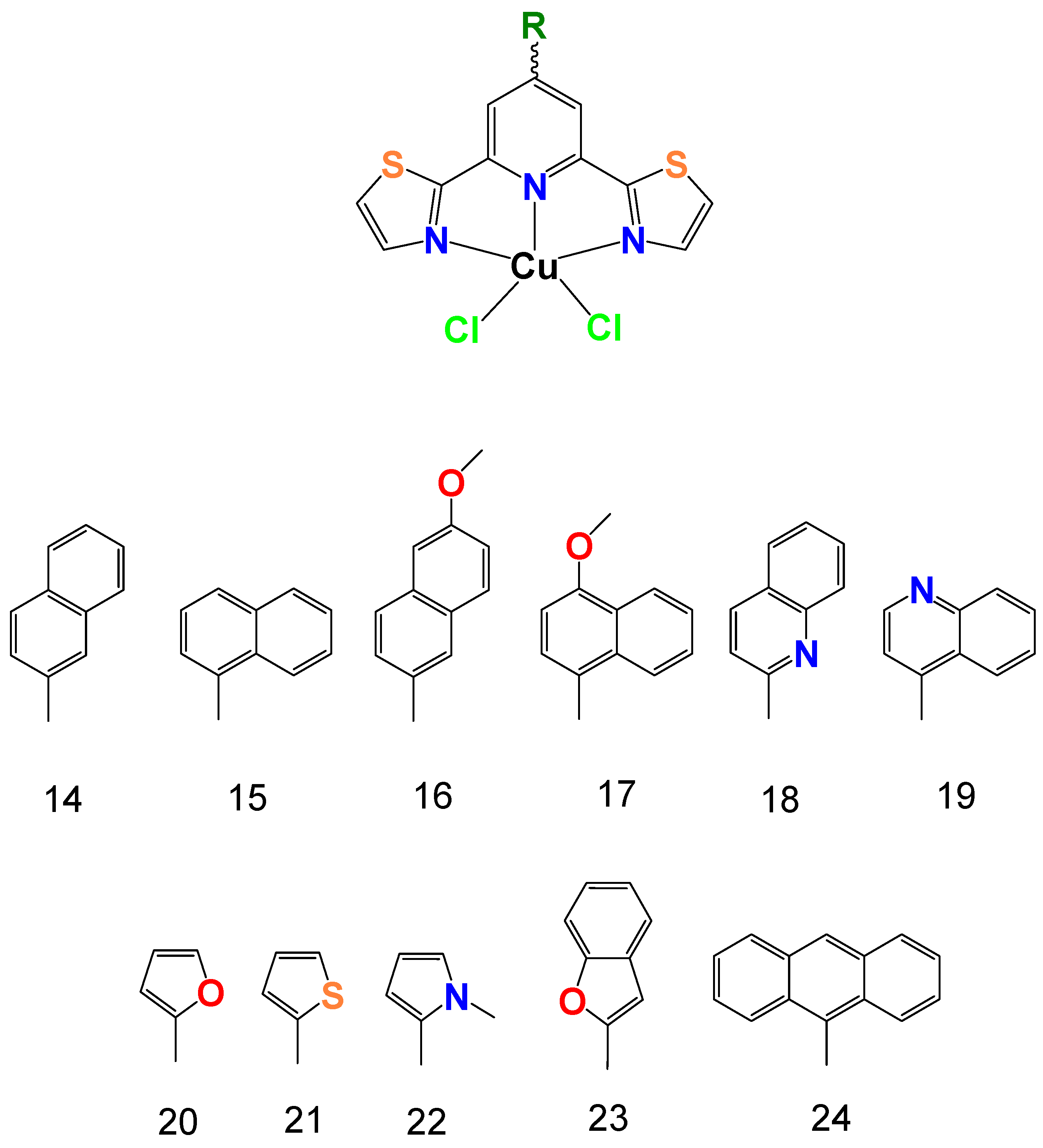
In the current work, we designed a new series of [CuCl2(R-dtpy)] (16) and [CuCl2(R′-Ph-dtpy)] (713) to explore the impact of different types of substituents attached to the central pyridine ring of the dtpy core on the structure and optical properties of the [CuCl2(R-dtpy)] and [CuCl2(R′-Ph-dtpy)] systems (Scheme 2). The R/R′ substituents introduced into the central pyridine or phenyl group differ in electron-donating or electron-withdrawing properties, and they also exhibit different steric effects. Furthermore, the structure–optical correlations of the newly synthesized Cu(II) complexes are discussed in comparison with those of the previously reported [CuCl2(R-dtpy)] (1424) analogues (Scheme 3) [14,15,16,23,24] and with the [CuCl2(R-terpy)] analogues (Cu-terpy-1 ÷ Cuterpy-24) [14,15,16,25,26,27,28,29,30,31,32,33,34,35,36,37,38,39,40,41,42,43,44]. To the best of our knowledge, the current work represents the first comprehensive investigation of the role of substituents in determining the structural and optical properties of [CuCl2(R-dtpy)] and [CuCl2(R′-Ph-dtpy)] complexes.

2. Results

2.1. Synthesis and General Characterization

The syntheses of 2,6-di(thiazol-2-yl)pyridine (L1) and its substituted derivatives (L2L13) were performed using the conventional one-pot Krönke method, which is based on the condensation of 2-acetylthiazole with the corresponding aldehyde and involves in situ pyridine ring closure in the presence of ammonia as a nitrogen donor source [45].
The copper(II) complexes (113) were isolated as green (14, 69) or greenish red (5, 1013) solids from the reactions of L1L13 with CuCl2 in CH3OH–CHCl3 solution. The molecular formulae of 113 were determined by elemental analysis, high-resolution mass spectrometry (HR-MS) (Figure S1, Supplementary Materials) and single crystal X-ray diffraction analysis (111). The mass spectra of all Cu(II) complexes were recorded in positive mode, and the base peak in the HR-MS spectra of 113 corresponded to [M−Cl]+, indicating high lability of one of the coordinated chloride ions, as expected for these systems [14,15].
FT-IR spectra of 113 confirmed the presence of the dtpy-based ligand in the coordination sphere. The characteristic peaks of R-dtpy/R′-Ph-dtpy appear in the ranges 3130–2850 cm–1 (aromatic C–H stretching vibrations), 1640–1510 cm–1(C=N) and ν(C=C) stretches), 1500–1000 cm–1(C–N) and ν(C–C) vibrations) and 850–600 cm–1(C–S) vibrations and aromatic C–H deformation vibrations). Stretching modes ν(C≡N) of the ligand in 7 and 10 are observed at 2228 cm–1 and 2247 cm–1, respectively. The absorptions in the higher-energy region of the infrared spectra of the Cu(II) complexes (3500–3200 cm–1) are attributed to the ν(O–H) stretching vibrations of lattice solvent molecules (Figure S2, Supplementary Materials).
Compared with the ν(C=N) and ν(C=C) stretching vibrations of the free ligands, the corresponding bands in the FT-IR spectra of the [CuCl2(R-dtpy)] and [CuCl2(R′-Ph-dtpy)] complexes appear at higher frequencies. A similar trend is observed for the [CuCl2(R-terpy)] and [CuCl2(R′-Ph-terpy)] systems. However, in the case of the Cu(II) complexes with dtpy derivatives, the shifts in the ν(C=N) and ν(C=C) stretching vibrations relative to those of the free ligands are slightly smaller [14,15,16,23,24,25,26,27,28,29,46,47,48,49,50,51] (Table S1, Supplementary Materials).

2.2. X-Ray Analysis

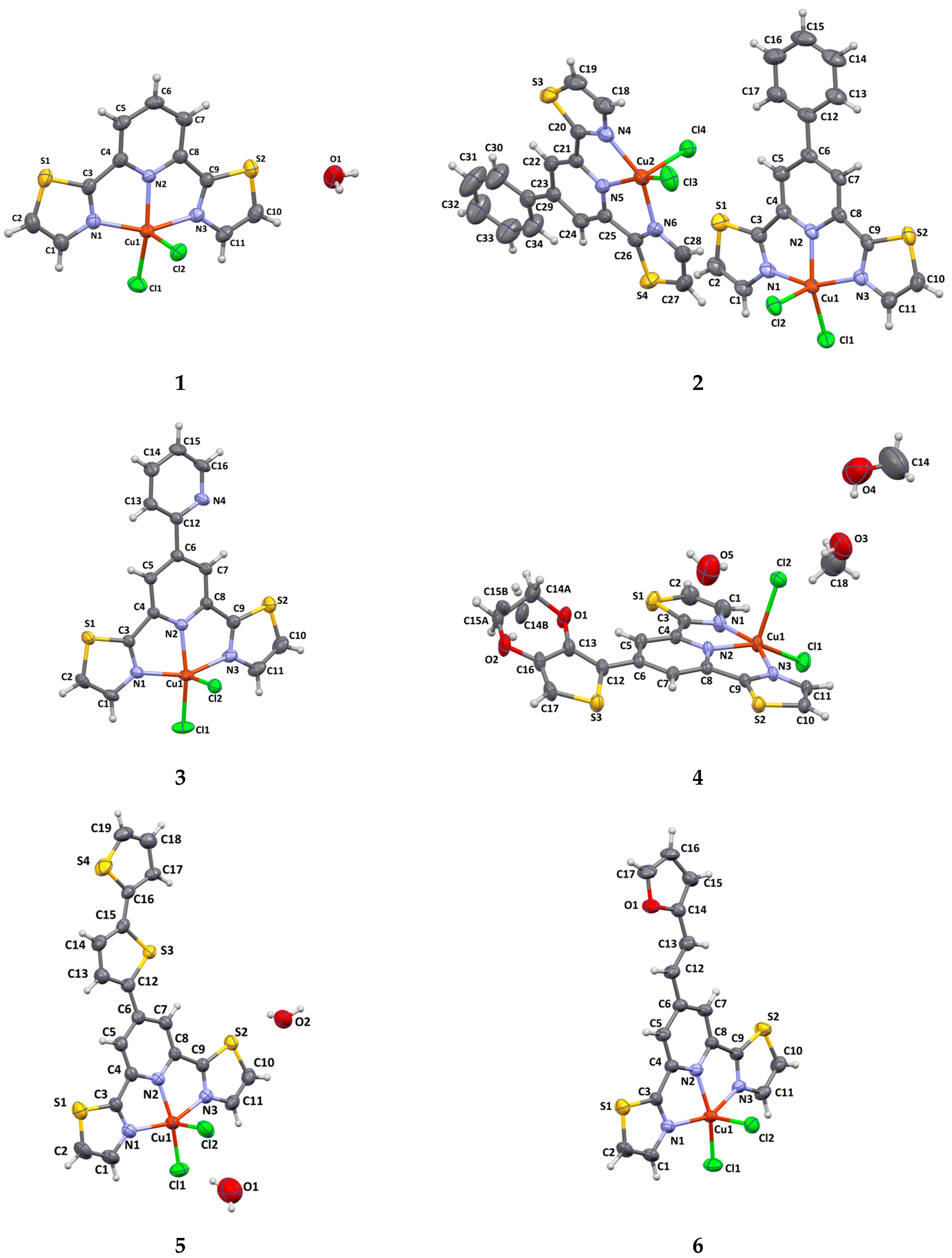
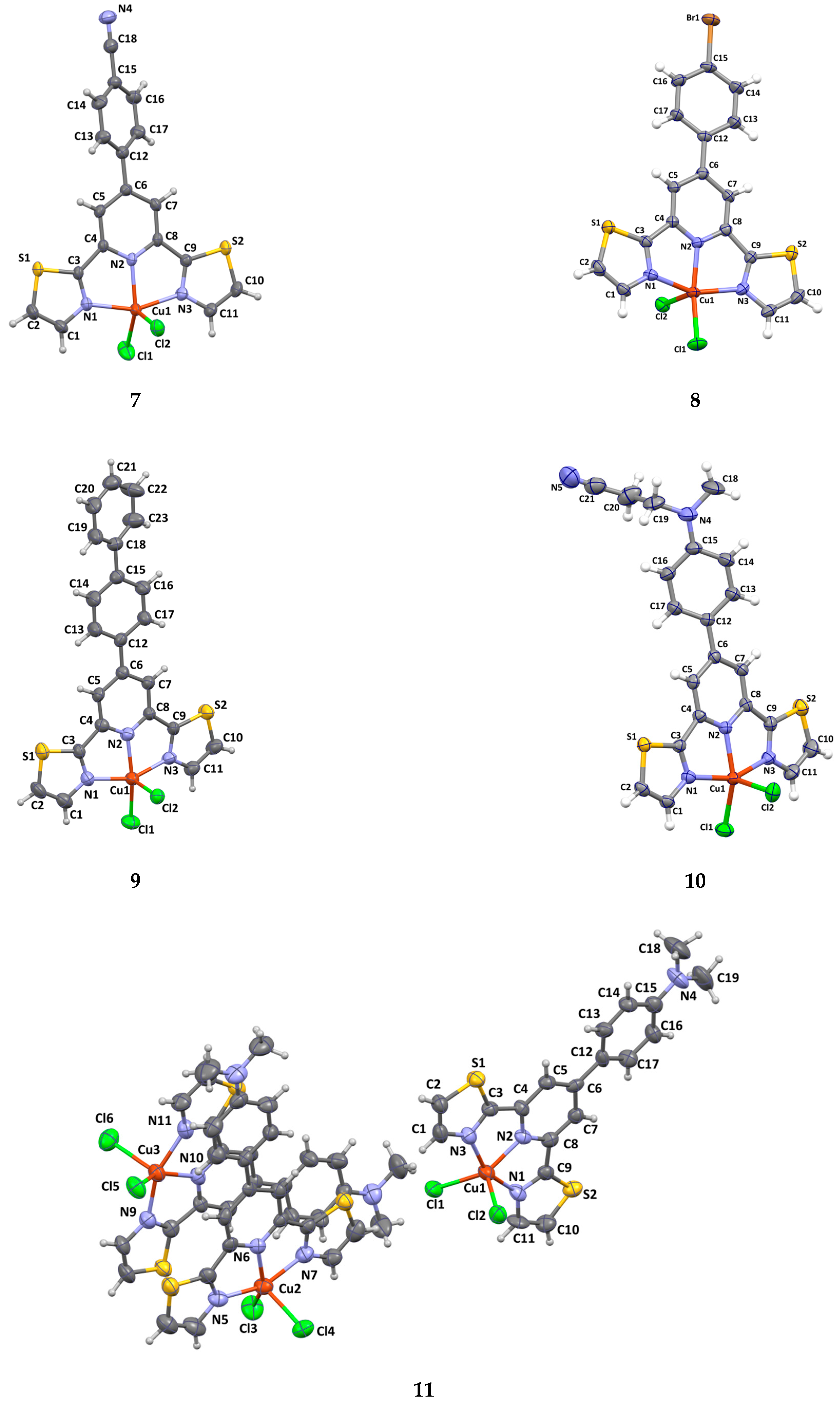
The crystallographic details (Tables S2 and S3), selected bond distances and angles (Tables S4–S14), and a summary of the intermolecular contacts detected in the structures of 111 (Tables S15–S30 and Figures S3–S13) are provided in Supplementary Materials. Perspective views of the asymmetric units of the structures of [CuCl2(R-dtpy)] (16) and [CuCl2(R′-Ph-dtpy)] (711), along with the atom numbering are given in Figure 1 and Figure 2, respectively.
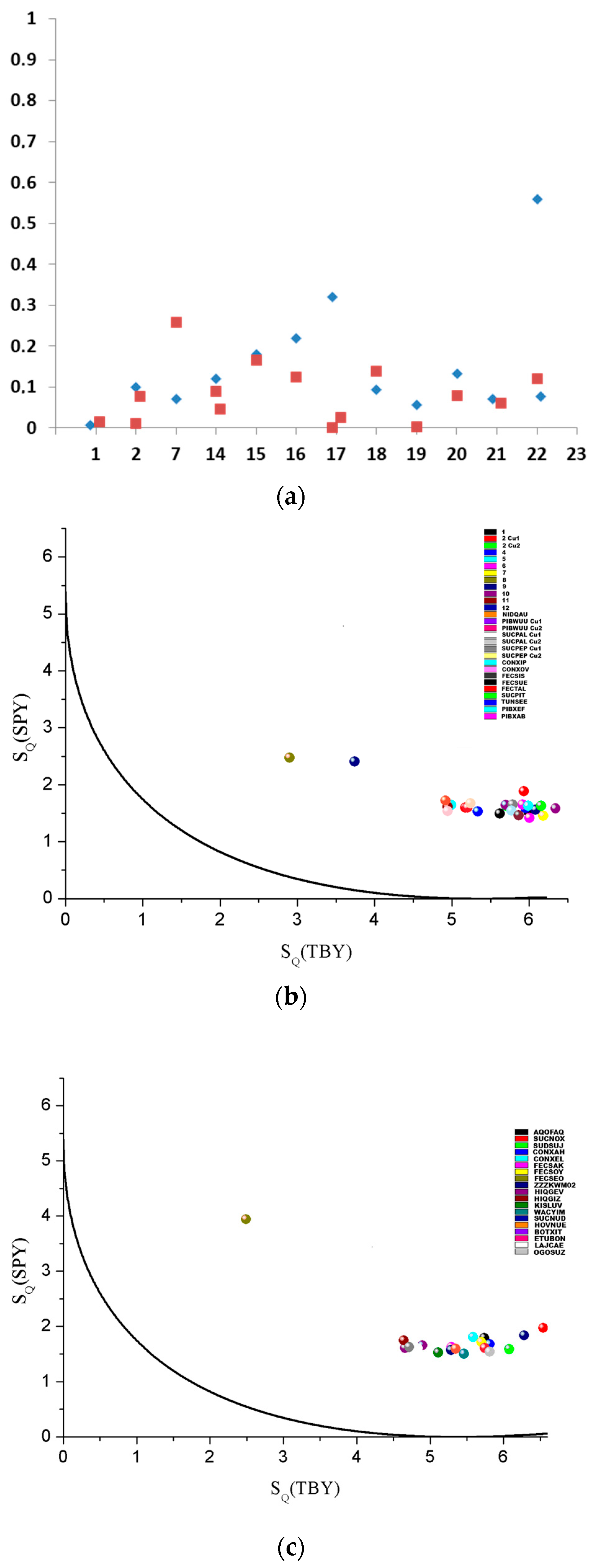
X-ray analysis confirmed the formulation of the examined complexes as pentacoordinated [CuCl2Ln], with the metal atom coordinated to three nitrogen donors of the 2,6-di(thiazol-2-yl)pyridine ligand and the two chlorine ions. The coordination geometry around the Cu(II) ion in all examined complexes is identical and can be best described as distorted square pyramidal, as supported by angular structural index parameter τ [52] and shape-measure SQ(P) parameters calculated with the SHAPE program based on Continuous Shape Measures (CShM) concept [53] (Table 1). For an ideal square pyramid (SPY) and trigonal bipyramid (TBY), the values of τ are 0 and 1, respectively. As far as SQ(P) parameters are concerned, the less distorted from the reference ideal shape, the smaller the SQ(P) value [54,55]. As shown in Table 1, a slightly greater deviation from the ideal square-pyramidal (SPY) geometry is observed for complexes 7 and 11, whereas the remaining complexes exhibit τ values below 0.125, with their SQ(SPY) parameters being significantly lower than the corresponding SQ(TBY) values.The angular distortion of the coordination sphere of the Cu(II) ions in examined complexes from an ideal square-pyramid can be attributed to the κ3N-coordination of the R-dtpy ligand and the formation of two fused five-member chelate rings upon coordination. As a result, the bite angles N–Cu–N are noticeably smaller than ideal value 90° [77.2(2)–78.90(12)°] (Tables S4–S14, Supplementary Materials). The dtpy framework is approximately planar, with the dihedral angles between the mean planes of the central pyridine and terminal aromatic rings ranging from 0.24° to 8.35° (Table 2). More noticeable differences among the examined structures concern the twisting of the pendant subsistent relative to the central pyridine ring of the dtpy ligand. The largest dihedral angle between the central pyridine and the appended group, 32.38°, was observed for 7, whereas the pendant substituent in complex 5 remains nearly coplanar with the central pyridine plane. In all examined complexes, the metal ion is displaced above the basal plane {Cl(1),N(1),N(2),N(3)} toward Cl(2) ranging from 0.269 Å in complex 5 to 0.465 Å in complex 7 (Table 2).
S Q ( P ) = min i = 1 n | q i p i | 2 i = 1 n | q i q 0 | 2 × 100
q i are N vectors that contain the 3N Cartesian coordinates of the problem structure Q, and p i contains the coordinates of the ideal polyhedron P and q 0 is the position vector of the geometric center that is chosen to be the same for the two polyhedral.
Minor differences are observed in the bond distances and angles around Cu(II) ion in the examined complexes, depending on the type of substituent (Table 2 and Table S4–S14, Supplementary Materials). As is typical for a square-pyramidal configuration, the apical Cu–Cl bond [2.4003(11)–2.5750(12) Å] is significantly longer than the basal Cu–Cl bond [2.2136(9)–2.265(2)Å], consistent with Jahn Teller distortion [31]. By analogy with related Cu(II) complexes containing terpy-like ligands [14,15,29,56], the Cu–Ncentral bond lengths [1.952(5)–1.991(3) Å] are noticeably shorter than those to the peripheral thiazolyl rings [2.032(6)–2.079(2) Å]. Based on the provided values, the largest variations in bond lengths as a function of the substituent are observed for the apical Cu–Cl distances. A noticeably elongated apical Cu–Cl bond is observed in complexes 4, 5, 8 and 9 (Table 2 and Tables S4–S14, Supplementary Materials).
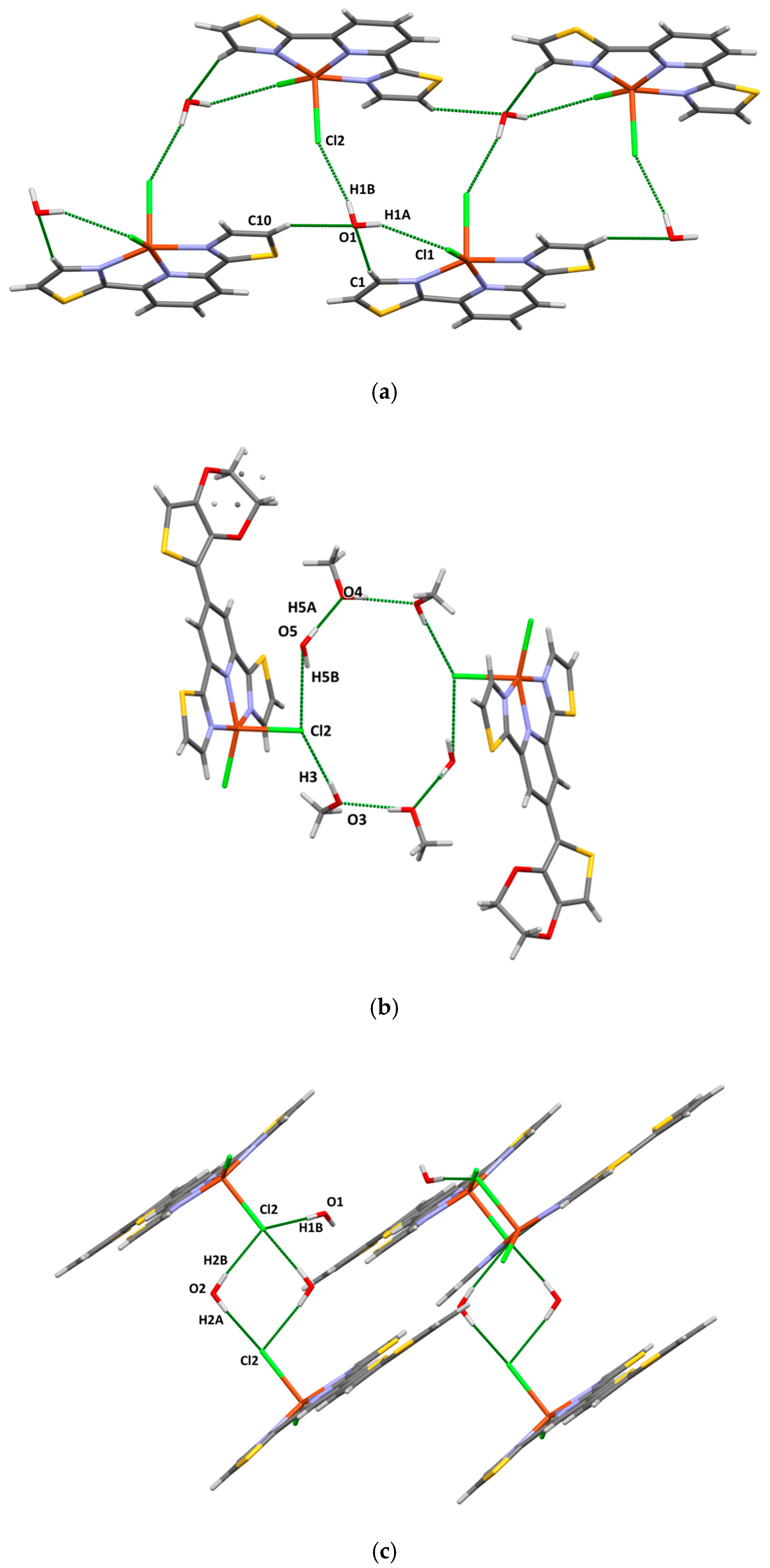
Regarding the packing arrangement, the crystal structures of complexes 2, 3, 6 and 9 are composed solely of mononuclear [CuCl2Ln] units. Crystal packing analysis (Mercury 4.0) [57] indicates that the dominant forces driving the self-aggregation of [CuCl2Ln] molecules in the crystal lattice are weak C–H•••Cl hydrogen bonds (Tables S15, S19 and S20, Supplementary Materials) and π•••π interactions (Tables S22 and S27, Supplementary Materials). The structures of the other compounds consist of [CuCl2Ln] units and co-crystallized solvent molecules. However, solvent molecules could be satisfactorily modeled only for complexes 1, 4, and 5. In the case of 7, 8, 10 and 11, solvent molecules were removed from the electron density map using the OLEX2 solvent mask command [58]. Water molecules (1, 4 and 5) and methanol molecules (4) participate in the formation of hydrogen bonds, as shown in Figure 3. Additionally, the crystal packing of compound 1, 4 and 5 is stabilized by non-classical intermolecular C–H•••Cl/C–H•••O and π•••π interactions. More pronounced differences in the Addison parameters are observed for complexes 7, 8, 17, 22 and their corresponding terpyridyl analogues. The terpy analogues of 8, 17, and 22 are characterized by markedly higher τ values compared to the corresponding [CuCl2(R-dtpy)] complexes. Among the terpyridyl Cu(II) complexes, those exhibiting the highest Addison parameters include [CuCl2(4-Mepyrrterpy)] (τ = 0.56) and [CuCl2(4-MeOnaphtterpy)] (τ = 0.32) [14,27].
To gain deeper insight into the structural features of the investigated compounds and to elucidate the influence of the R/R′ substituents and peripheral rings, the structural data of compounds 111 were compared with previously reported [CuCl2(R-dtpy)] (1423) and their [CuCl2(R-terpy)] analogues (Tables S31 and S32, Supplementary Materials) [14,15,16,23,24]. A comparative analysis of the Addison (τ) and SQ(P) parameters for the dtpy- and terpy-based five-coordinate Cu(II) complexes (Figure 4) suggests that the replacing the peripheral pyridine rings of terpy with thiazole units in dtpy generally does not induce significant changes in either the Addison (τ) or SQ(P) parameters. Both dtpy- and terpy-based Cu(II) complexes predominantly adopt a square pyramidal geometry, although the number of Cu(II) complexes with τ > 0.20 is higher among the terpyridyl systems. More pronounced differences in the Addison parameters are observed for compounds 7, 8, 17, 22 and their corresponding terpyridyl analogues. The terpy analogues of 8, 17, 22 are characterized by markedly higher values of τ values compared to the corresponding [CuCl2(R-dtpy)] complexes. Among the terpyridyl Cu(II) complexes, those exhibiting the highest Addison parameters include [CuCl2(4-Mepyrrterpy)] (τ = 0.56), [CuCl2(4-MeOnaphtterpy)] (τ = 0.32) [14,27].
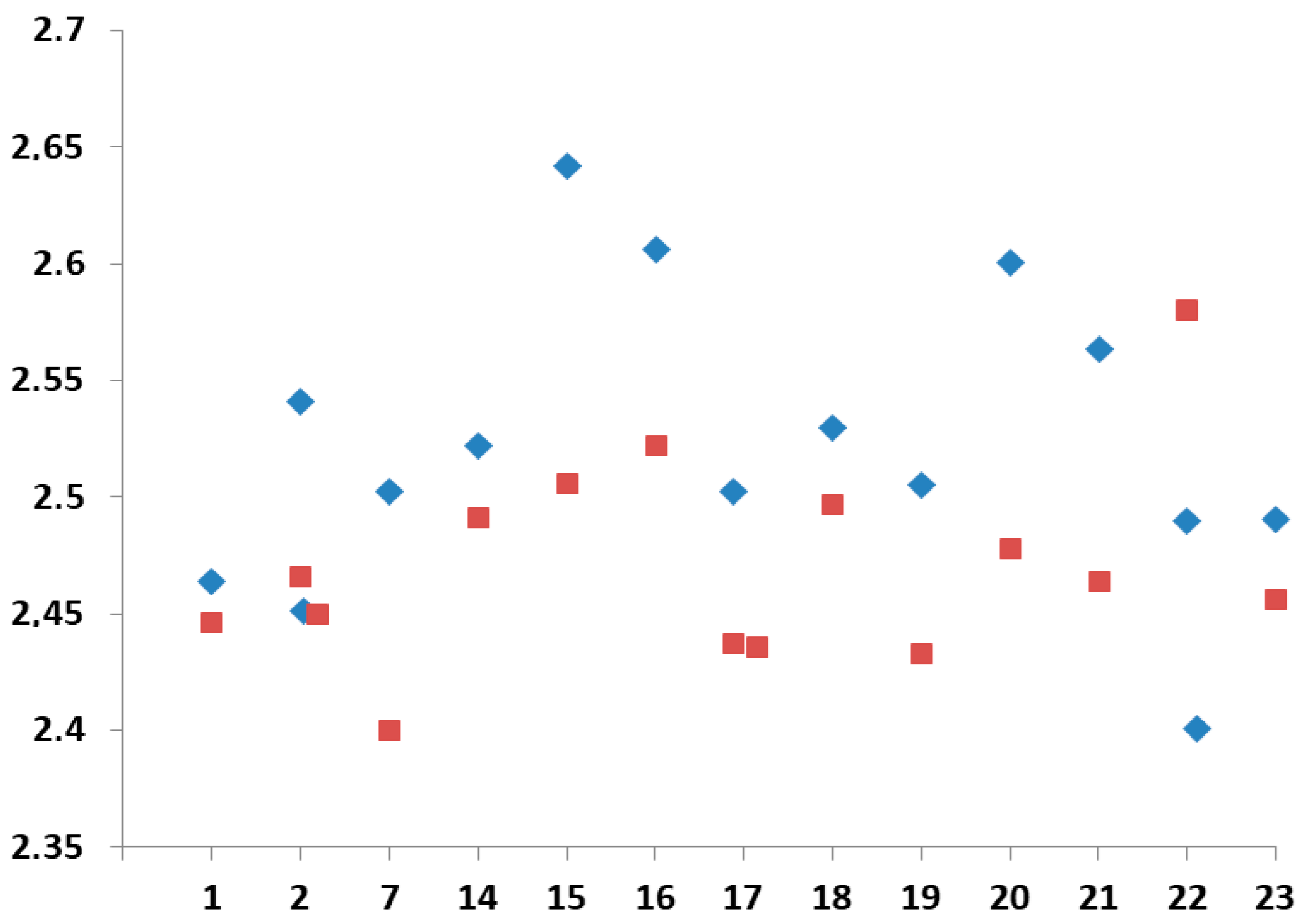
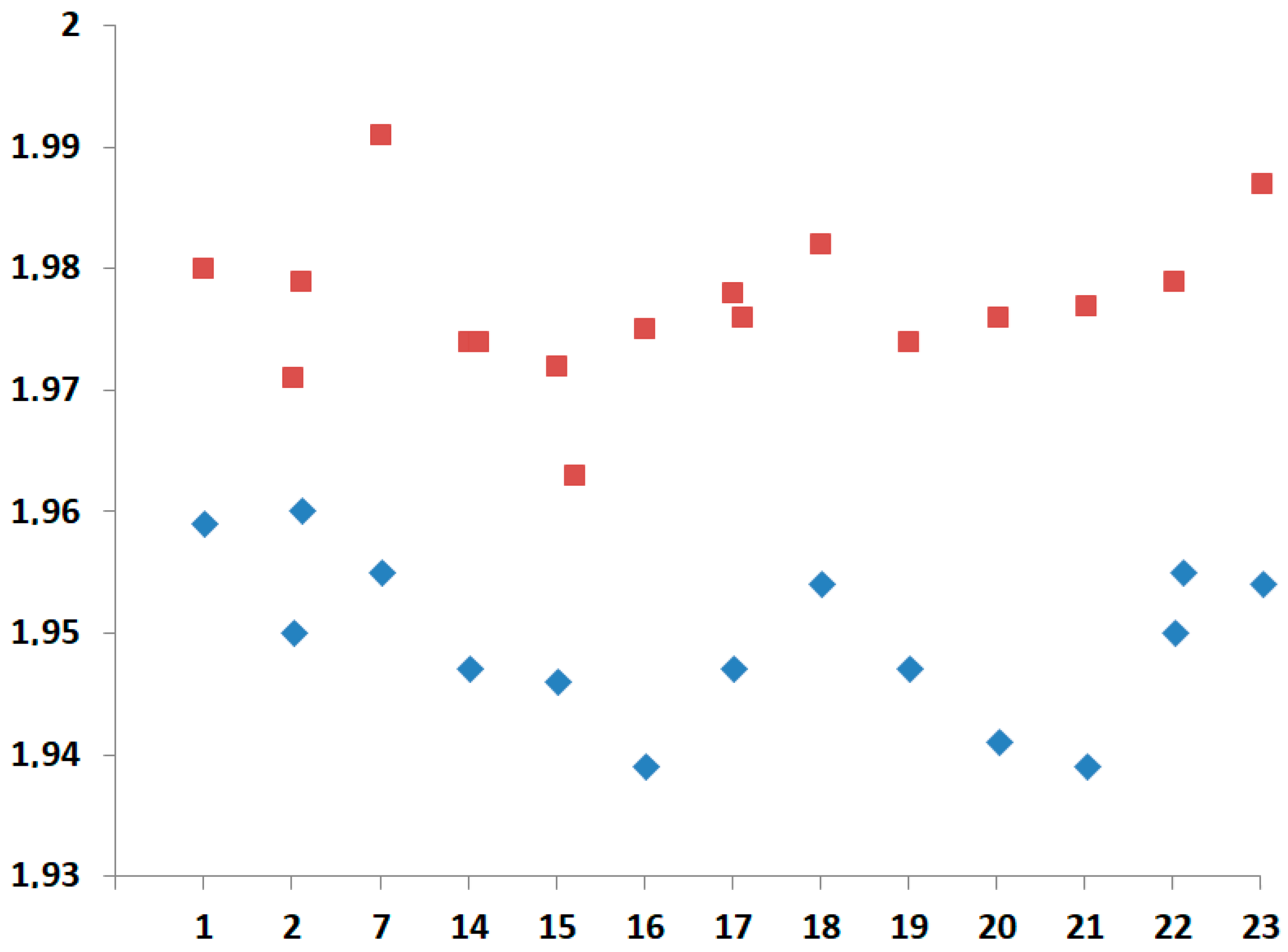
With respect to bond lengths, in the vast majority of the analyzed complexes, replacing terpy with dtpy results in a shortening of the apical Cu–Cl bond (Figure 5 and Tables S4–S14, S31 and S32, Supplementary Materials). Among the terpyridyl complexes, the longest apical Cu–Cl distances are observed for [CuCl2(1-naphtterpy)]∙2CH3OH (SUCNOX) [2.642(2) Å] [16], [CuCl2(4-furanterpy] (FECSAK) [2.6009(9) Å] [14] and [CuCl2(6-MeOnaphtterpy)] (SUCNUD) [2.6064(8) Å] [16]. In contrast, the bond lengths between the Cu(II) cation and nitrogen of the central pyridyl ring of dtpy framework in Cu-dtpys, varying between 1.96 Å and 2.00 Å, are markedly longer than the Cu-Npyridyl bond lengths in Cu-terpys (Cu-Npyridyl bond lengths in range 1.93–1.96 Å in Cu-terpys) (see Figure 6 and Tables S4–S14).
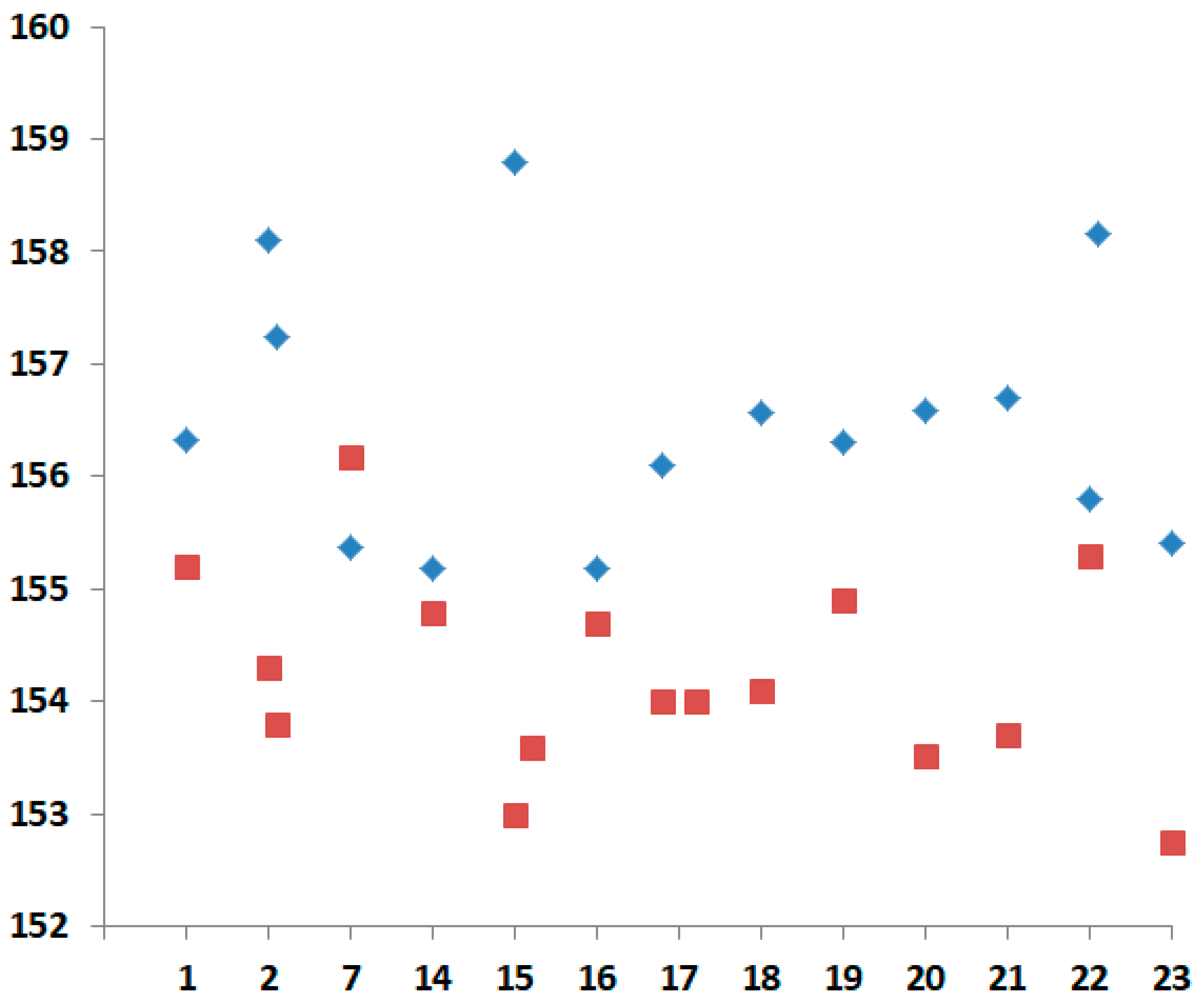
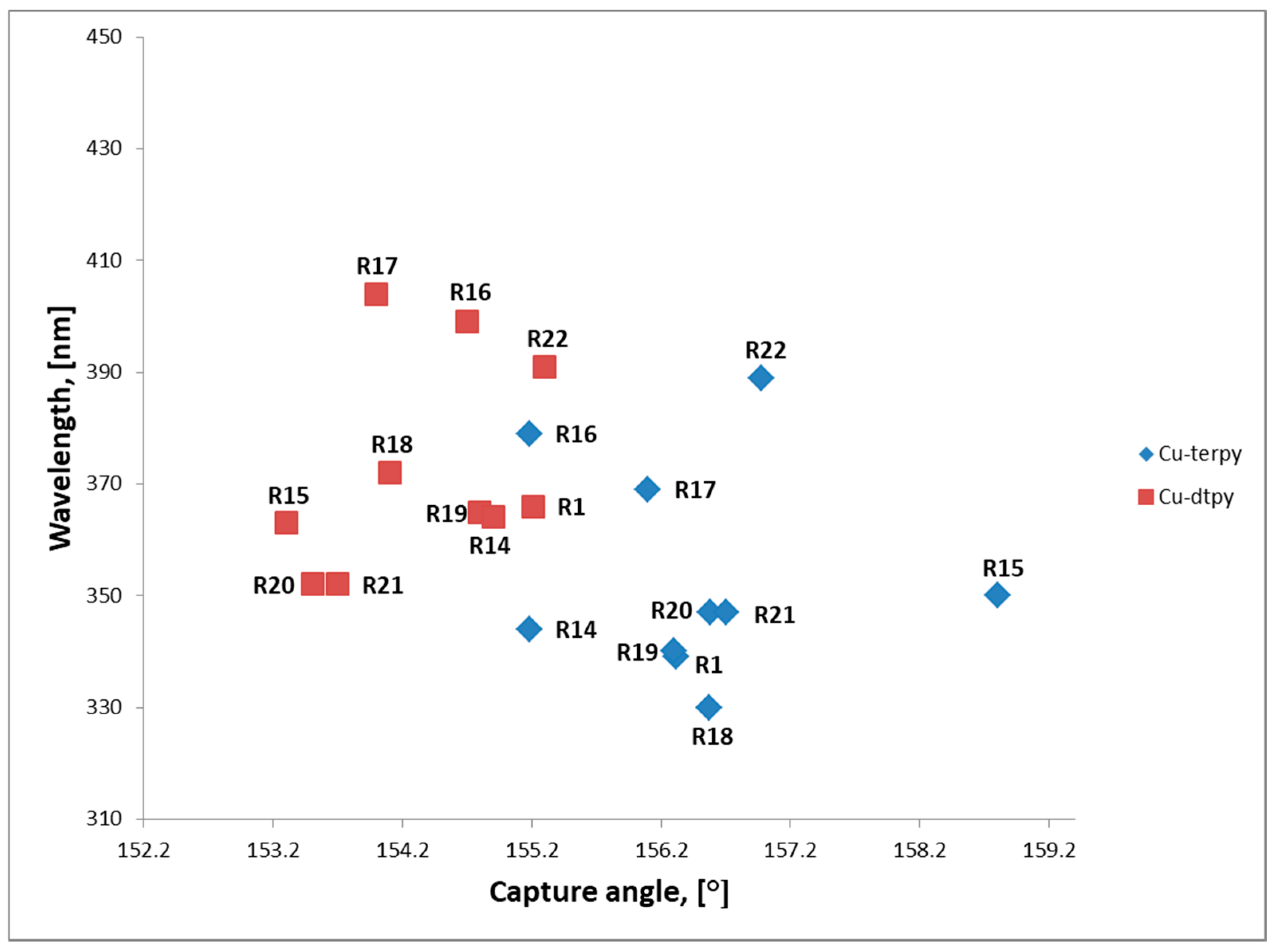
Noticeable differences between the Cuterpy and Cudtpy series are also evident when the bite and capture angles are considered. In general, the Cuterpy complexes exhibit larger bite angles (78.4–80.0°) than those observed for the Cudtpy analogues (77.9–78.9°) (see Figures S14 and S15; Supplementary Materials). Consequently, the capture angles follow the same structural relationship between the two families of complexes, with values of 155.4–158.8° for the Cuterpy series and 152.7–156.2° for the Cudtpy counterparts (Figure 7).

2.3. Optical Properties

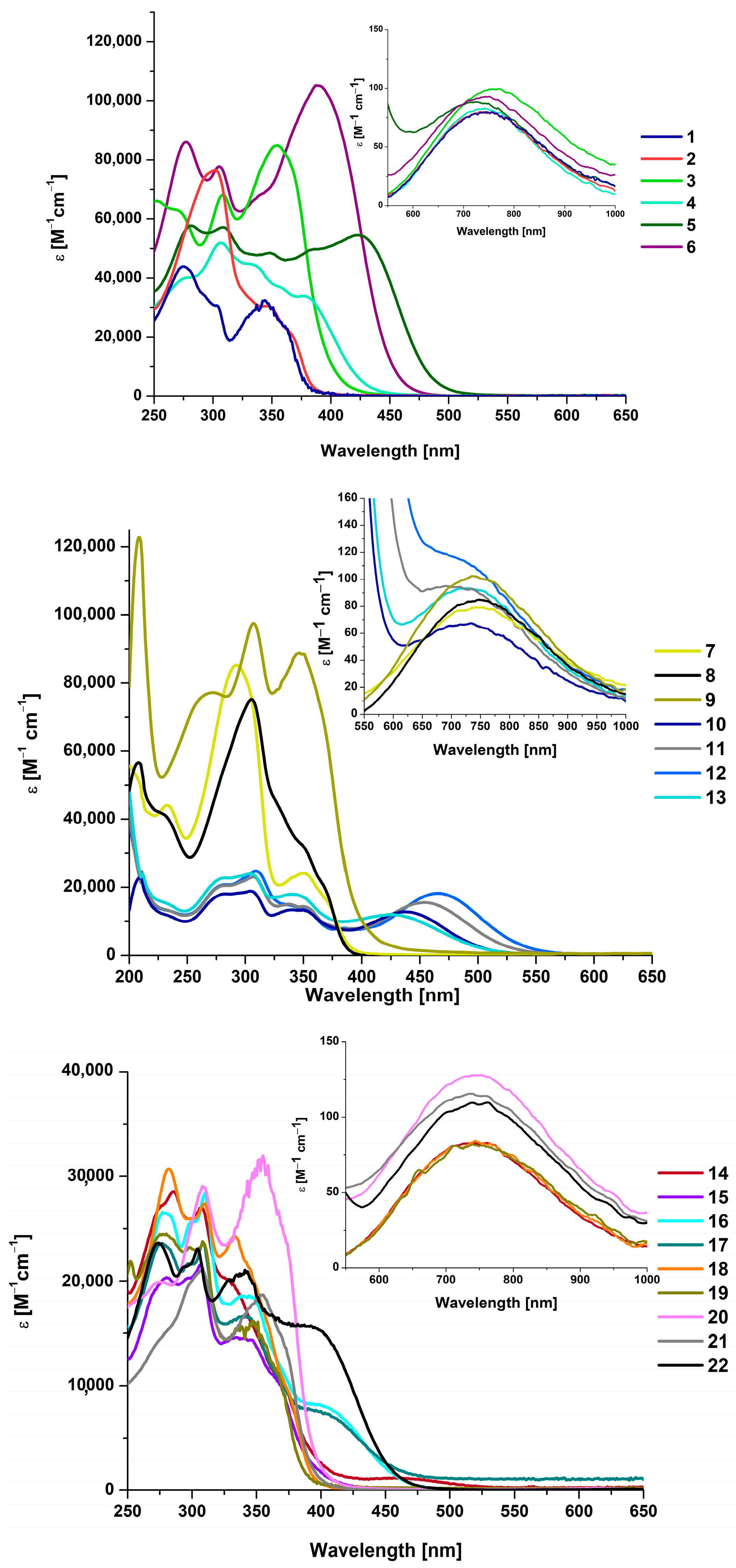
The optical properties of complexes 113 were investigated in methanolic solutions (c = 10 μM and c = 1 mM) and compared with those of complexes 1422 and their terpyridine Cu(II) analogues reported in the literature [14,15,16,25,27]. Consistent with our previous findings [16], the Cu-dtpy systems exhibit good stability in alcoholic solutions (ethanol or methanol), in contrast to DMSO and water medium. The UV-Vis absorption spectra of the investigated compounds are shown in Figure 8 (see also Figure S16 in Supplementary Materials). Additionally, the electronic absorption maxima of Cu-dtpys and Cu-terpys are summarized in Tables S33 and S34, Supplementary Materials. A comparison of the absorption spectra of the studied Cu-dtpy compounds (113) with those of the corresponding organic ligands (L1L13) is shown in Figure S17, Supplementary Materials. Notably, compounds 46 and 1014 exhibit the most pronounced spectral changes relative to their corresponding ligands, reflected in the appearance of a new absorption band in the visible region. The absorption onsets of these systems shift by more than 3800 cm−1 compared to the free ligand, resulting in visible-range absorptions with extinction coefficients of 33,000–110,000 M−1 cm−1 for 46 and 12,000–19,000 M−1 cm−1 for 1014. For complexes 13 and 79, the observed bathochromic shifts of the lowest in energy absorption relative to the free ligands are considerably smaller, ~2000 cm−1.
The substituent effect in compounds 113 and 1422, along with their corresponding Cu-terpy analogues, was analyzed using Hammett’s substituent constant σp values, which were calculated using Equation (1) and the Calculation of Hammett Sigma Constants v2024.02 tool [59].
σp = 2.0849 + 0.2074 q1 + 28.4679 qm + 28.9006 qp
q1—the charge on the atom to which the substituent is directly attached;
qm, qp—the charges on the carbons in the meta and para positions of the phenyl ring.
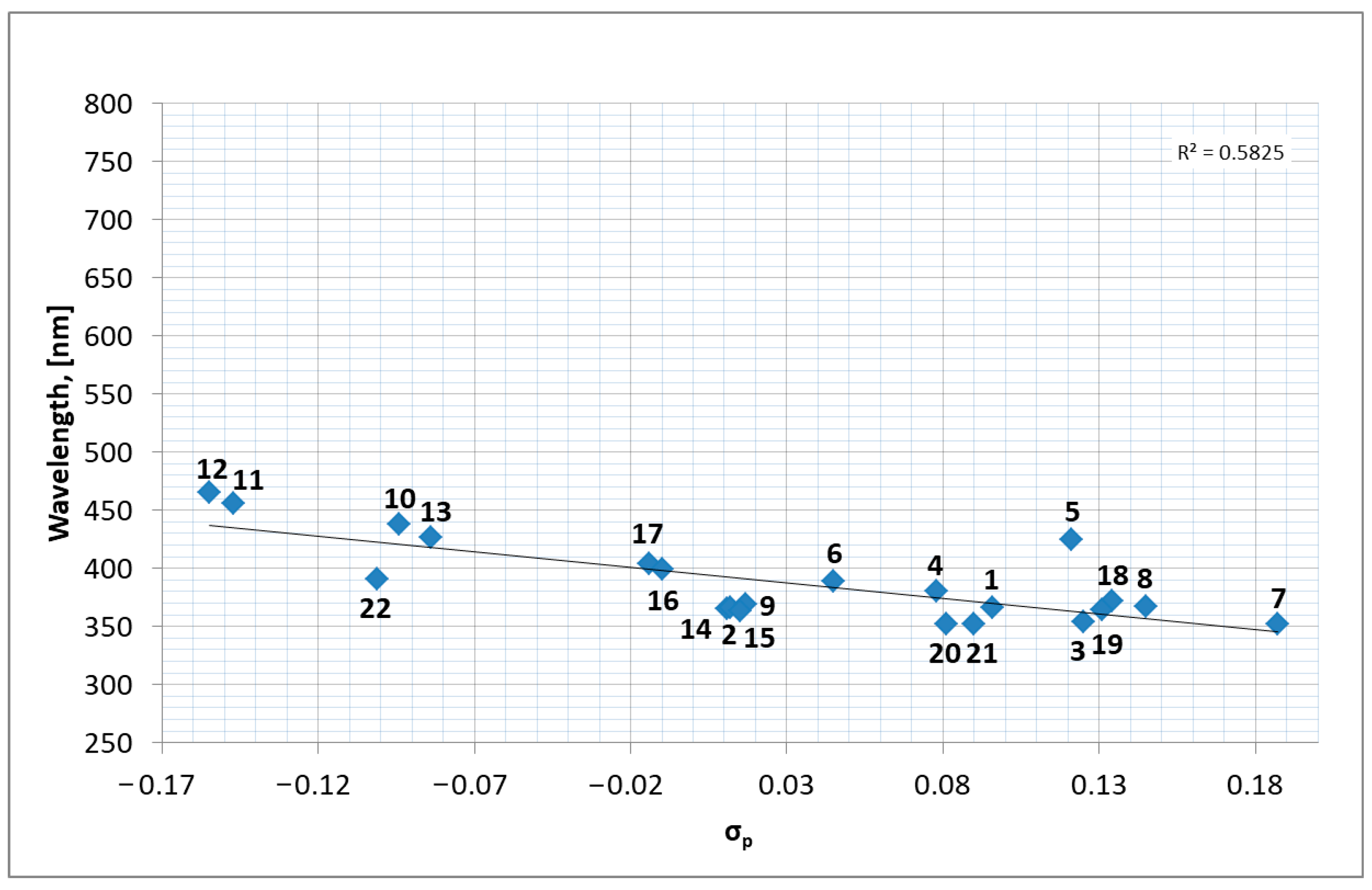
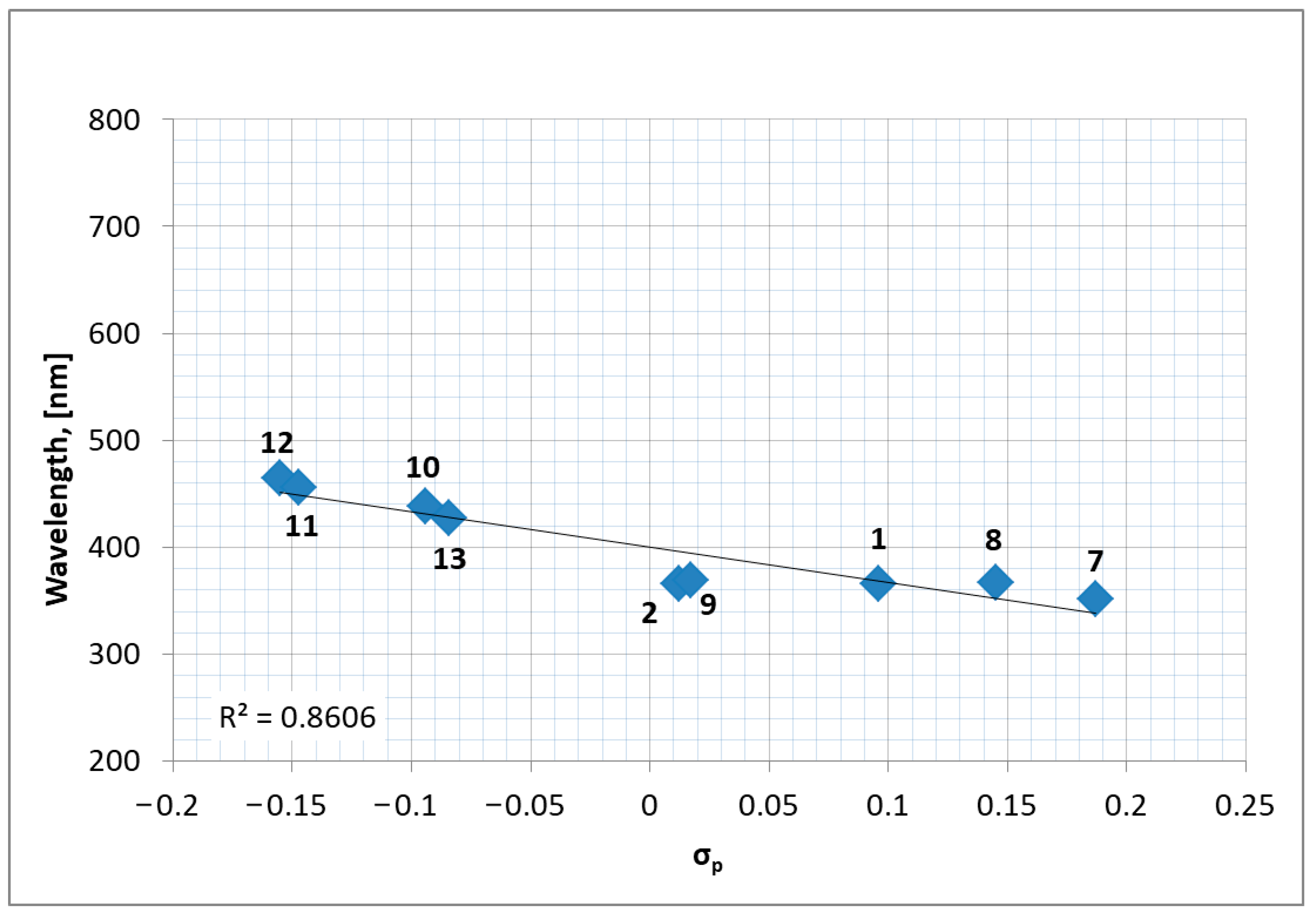
The calculated values of σp were then correlated with the longest-wavelength absorption maxima of dilute solutions of the respective compounds (see also Figure 9 and Figure 10 and Figure S18 in Supplementary Materials). Compounds 122 generally follow the trend in which a decrease in the Hammett’s σp value is accompanied by a bathochromic shift of the absorption maximum (Figure 9). Significant deviations from this correlation are observed for 2, 5, 9, 1415, and 2022. Notably, compared with their Cu-terpy analogues, the longest-wavelength absorption maxima of the [Cu(4-R-dtpy)] complexes are red-shifted (Figure S18, Supplementary Materials). Correlating the capture angles with the maxima of the lowest-energy absorption in dilute solutions for both Cu-terpy and Cu-dtpy systems reveals that the Cu-dtpys complexes follow a trend in which a smaller capture angle, Nperipheral-Cu-Nperipheral, is associated with a higher-wavelength absorption (see Figure 11).
The UV-Vis spectrum of complex 1 in dilute methanolic solution shows three bands in the UV-region, all of which are intraligand in nature (π→π* and n→π*). The lowest-energy band displays a vibronic structure with a maximum at 344 nm and two shoulders at 361 nm and 328 nm. The introduction of the phenyl (compound 2) and naphthyl substituents (compounds 14 and 15) into the dtpy framework results in a progressive decrease in the onset absorption energy of the corresponding [Cu(4-R-dtpy)Cl2] complexes, from 26,455 cm−1 (in 1) through 26,042 cm−1 (in 2) until 25,253 cm−1 (in 14) or 25,445 cm−1 (in 15) (see Figure 8 and Figure S16 in Supplementary Materials). This shift is accompanied by hyperchromism and broadening of the spectrum [16]. The spectra of compounds 1819 are similar in shape to those of 14 and 15 [15,16]. In contrast, the compounds 1617, bearing electron-donating methoxynaphthyl substituents, exhibit an additional absorption band in the range of 375–475 nm, which is likely attributable to an intraligand charge transfer (ILCT) transition [16].
For N/O/S-heterocyclic-substituted compounds 36, the lowest-energy absorption band shows a progressive red shift in the order 3465 relative to compounds 12. When comparing compounds 4 and 5 to compound 21, and compound 6 to compound 20, the absorption bands are bathochromically shifted by 2093 cm−1 for 4, 4880 cm−1 for 5, and 2702 cm−1 for 6 [14]. In fact, the spectral profiles of 20 and 21 more closely resemble that of 3 than those of 46. The latter three compounds (46) show greater similarity to 22, which contains an electron-donating substituent and exhibits the formation of an additional ILCT band [14,15,16] (Figure S16 in Supplementary Materials). In particular, compound 5 with the bithiophene substituent deviates significantly from the correlation between the calculated Hammett’s constant and the absorption wavelength. The calculated σp value for the bithiophene group indicates slightly electron-withdrawing properties, whereas the strong bathochromic shift observed experimentally suggests the opposite behavior. This apparent discrepancy most likely arises from two competing effects. The inductive effect, resulting from the electronegative sulfur atoms, appears to dominate in theoretical calculations, leading to the classification of bithiophene as an electron-accepting unit. In contrast, the resonance effect arising from the π-electron delocalization predominates experimentally and identifies bithiophene as a strong electron-donating substituent.
In the series of 713, compounds 7 and 8 exhibit UV-Vis spectra comparable to those of 1 and 2, respectively. For compound 9, which bears the biphenyl substituent, both hyperchromic and bathochromic effects are observed, although its spectral profile remains similar in shape to that of 1. Complexes 1013, containing electron-donating substituents, display a new band in the 400–550 nm range, which can be attributed to an ILCT transition originating from charge delocalization from the electron-rich substituent to dtpy acceptor moiety. Overall, complexes [CuCl2(R′-Ph-dtpy)] show a good correlation between the Hammett’s constants (σp) and the wavelength of the lowest-energy absorption (Figure 10).
In the UV-Vis spectra of concentrated samples (Figure 8 and Figure S16), all investigated Cu-dtpy complexes show a weak and very broad band in the 550–950 nm range, arising from overlapping d–d transitions (dxy→dx2-y2, dyz,dxz→dx2-y2 and dz2→dx2-y2) of the copper(II) ion. In comparison with terpirydyl Cu(II) systems, a pronounced red shift of this band is observed for the [Cu(R-dtpy)Cl2] compounds [14,15,16].

3. Materials and Methods

CuCl2·2H2O, 2-acetylthiazole, appropriate aldehydes and reagent-grade solvents for the synthesis were purchased from commercial suppliers (Sigma-Aldrich, Darmstadt, Germany; ABCR, St. Louis, MO, USA) and used as received. The 2,6-di(thiazol-2-yl)pyridine derivatives were obtained by condensation of 2-acetylthiazole with the corresponding aldehyde according to the procedure described in the literature, and their analytical data were in good agreement with those reported in refs. [23,45,46,60,61,62,63,64,65,66,67,68,69,70,71,72].

3.1. General Synthesis Procedure for [CuCl2Ln]

CuCl2·2H2O (0.17 g, 1 mmol) dissolved in methanol (30 mL) was added dropwise to a chloroform solution of the corresponding ligands L1–L13 (1 mmol). The resulting solution was stirred at room temperature for 12 h and then left to stand for slow solvent evaporation. After several days, a green (14, 69) or greenish-red (5, 1013) precipitate formed, which was collected by filtration, washed with small amounts of methanol and chloroform, and air-dried at room temperature. Crystals suitable for X-ray analysis were obtained by recrystallization from methanol or a methanol–chloroform mixture.
[CuCl2L1]·H2O (1·H2O): Yield 60%. HRMS (ESI): calcd for C11H7ClCuN3S2+ 342.9066; found 342.9068. Anal. calcd for C11H7Cl2N3S2Cu·H2O (397.77 g/mol): C 33.21, H 2.28 N 10.56%; found: 32.99, H 1.97, N 10.16%. IR (KBr, cm−1): 3425(m), 3121(w), 3099(s), 3068(s), 3009(w), 1812(w), 1613(m), 1598(s), 1563(m), 1497(s), 1477(s), 1460(s), 1396(w), 1371(s), 1329(w), 1302(w), 1254(s), 1195(s), 1156(m), 1087(w), 1066(m), 1029(w), 1014(w), 885(w), 855(w), 803(s), 786(s), 757(m), 732(m), 684(m), 638(s), 519(w). UV-Vis (MeOH, λmax/nm (ε/M−1 × cm−1)): 743 (78), 364sh (21,305), 344 (32,655), 304 (30,524), 274 (44,004) and 223 (30,893). Main crystallographic details: monoclinic, P21/n, Z = 4, a = 8.1922(5) Å, b = 11.1975(6) Å, c = 15.9212(10) Å, β = 104.569(7)°, V = 1413.52(15) Å3, Dc = 1.869 g/cm3, F(000) = 796, R indices (all data): R1 = 0.0529 and wR2 = 0.0819.
[CuCl2L2½H2O (2·½ H2O): Yield 75%. HRMS (ESI): calcd for C17H11ClCuN3S2+ 418.9379; found 418.9379. Anal. calcd for C17H13Cl2N3S2OCu·½H2O (464.87 g/mol): C 43.92, H 2.60, N 9.04%; found: C 43.95, H 2.41, N 9.01%. IR (KBr, cm−1): 3426(w), 3116(w), 3070(s), 3017(w), 1610(s), 1552(m), 1496(w), 1483(s), 1463(w), 1434(s), 1354(w), 1325(w), 1252(m), 1198(s), 1151(w), 1081(m), 1013(w), 919(w), 871 (m), 818 (w), 787(s), 765(s), 736(m), 682(m), 654(m), 630(m), 608(w), 503(w), 449(w). UV-Vis (MeOH, λmax/nm (ε/M−1 × cm−1)): 742 (80), 366sh (21,260), 349 (30,520), 301 (75,960) and 203 (64,240). Main crystallographic details: monoclinic, P21/n, Z = 8, a = 18.5235(10) Å, b = 8.4191(4) Å, c = 23.4437(12) Å, β = 102.266(5)°, V = 3572.6(3)Å3, Dc = 1.695 g/cm3, F(000) = 1832, R indices (all data): R1 = 0.0478 and wR2 = 0.0815.
[CuCl2L3] (3): Yield 70%. HRMS (ESI): calcd for C16H10ClCuN4S2+ 419.9331; found 419.9334. Anal. calcd for C16H10Cl2N4S2Cu (456.84 g/mol): C 42.07, H 2.21, N 12.26%; found: C 41.61, H 2.00, N 11.87%. IR (KBr, cm−1): 3425(m), 3129(m), 3110(w), 3093(m), 2996(m), 1612(s), 1584(m), 1557(m), 1494(m), 1486(m), 1470(s), 1430(s), 1354(m), 1324(m), 1311(w), 1253(s), 1224(m), 1191(s), 1169(w), 1077(m), 1061(w), 1020(m), 991(m), 930(w), 896(m), 829(w), 790(s), 754(m), 739(m), 666(m), 654(w), 642(w), 618(w), 608(w), 505(w). UV-Vis (MeOH, λmax/nm (ε/M−1 × cm−1)): 760 (100), 354 (84,895), 308 (68,145), 271 (63,030), 252 (66,145) and 207 (91,680). Main crystallographic details: monoclinic, P21/c, Z = 4, a = 14.1745(9) Å, b = 11.9978(6) Å, c = 10.4487(6) Å, β = 107.157(7)°, V = 1697.87(19)Å3, Dc = 1.787 g/cm3, F(000) = 916, R indices (all data): R1 = 0.0374 and wR2 = 0.0692.
[CuCl2L4] (4): Yield 65%. HRMS (ESI): calcd for C17H11ClCuO2N3S3+ 482.8998; found 482.8998. Anal. calcd for C17H11Cl2N3S2O2Cu (519,92 g/mol): C 39.27, H 2.13, N 8.08%; found: C 38.89, H 2.50, N 8.24%. IR (KBr, cm−1): 3472(m), 3383(m), 3100(m), 3077(m), 2936(w), 1602(s), 1571(w), 1537(m), 1488(s), 1439(s), 1358(m), 1288(w), 1251(m), 1203(s), 1203(s), 1149(w), 1062(s), 1022(m), 949(m), 914(m), 860(w), 838(w), 788(m), 736(m), 691(w), 608(m). UV-Vis (MeOH, λmax/nm (ε/M−1 × cm−1)): 737 (83), 380 (33,499), 359 (36,645), 335 (44,282), 306 (52,248) and 275 (40,021). Main crystallographic details: triclinic, P 1 ¯ , Z = 2, a = 7.5457(7) Å, b = 12.6550(10) Å, c = 13.2542(9) Å, α = 77.635(6)°, β = 86.523(6)°, γ = 80.957(7)°, V = 1220.45(17) Å3, Dc = 1.638 g/cm3, F(000) = 614, R indices (all data): R1 = 0.0748 and wR2 = 0.1140.
[CuL5Cl2]·2H2O (5·2H2O): Yield 65%. HRMS (ESI): calcd for C19H11ClCuN3S4+ 506.8820; found 506.8821. Anal. calcd for C19H11Cl2CuN3S4·2H2O (580,02 g/mol): C 39.34, H 2.61, N 7.24%; found: C 39.05, H 2.55, N 7.65%. IR (KBr, cm−1): 3495(s), 3101(w), 3068(w), 1606(vs), 1552(w), 1514(m), 1486(s), 1458(s), 1434(s), 1357(w), 1343(w), 1252(m), 1207(w), 1195(w), 1049(w), 1023(s), 855(w), 835(w), 821(w), 787(m), 760(w), 750(w), 728(m), 610(w), 527(w), 452(w). UV-Vis (MeOH, λmax/nm (ε/M−1 × cm−1)): 727 (88), 425 (54,509), 349 (48,544), 309 (57,361), 281 (57,918) and 208 (68,145). Main crystallographic details: monoclinic, P21/c, Z = 4, a = 9.7299(4) Å, b = 15.0039(6) Å, c = 15.6869(9) Å, β = 98.481(5)° V = 2265.03(19)Å3, Dc = 1.701 g/cm3, F(000) = 1172, R indices (all data): R1 = 0.0764 and wR2 = 0.1261.
[CuL6Cl2] (6): Yield 60%. HRMS (ESI): calcd for C17H11ClCuON3S3+ 434.9328; found 434.9330. Anal. calcd for C17H11Cl2N3S2OCu (471.87 g/mol): 43.27, H 2.35, N 8.91%; found: 43.54, H 2.42, N 9.18%. IR (KBr, cm−1): 3489(m), 3040(m), 1637(w), 1598(vs), 1544(m), 1475(s), 1454(m), 1393(w), 1357(w), 1306(m), 1253(w), 1197(s), 1082(w), 1019(s), 973(m), 880(m), 786(m), 759(s), 638(w), 615(s), 591(s). UV-Vis (MeOH, λmax/nm (ε/M−1 × cm−1)): 746 (90), 389 (105,610), 306 (77,780), 276 (86,300) and 208 (86,565). Main crystallographic details: triclinic, P 1 ¯ , Z = 2, a = 8.0883(5) Å, b = 10.1003(6) Å, c = 12.0986(7) Å, α = 65.536(5)°, β = 86.260(5)°, γ = 89.456(5)°, V = 897.57(10) Å3, Dc = 1.746 g/cm3, F(000) = 474, R indices (all data): R1 = 0.0743 and wR2 = 0.1245.
[CuL7Cl2]·½H2O (7·½H2O): Yield 75%. HRMS (ESI): calcd for C18H10ClCuN4S2+ 443.9331; found 443.9331. Anal. calcd for C18H10Cl2N4S2Cu·½H2O (489.89g/mol): C 44.13, H 2.26, N 11.44%; found: C 44.08, H 2.49, N 11.80%. IR (KBr, cm−1): 3471(s), 3090(s), 3072(s), 3048(s), 2228(s), 1607(s), 1547(m), 1493(m), 1483(s), 1449(s), 1405(m), 1353(m), 1253(m), 1197(s), 1098(w), 1081(w), 1020(w), 1011(w), 919(w), 896(m), 845(s), 830(m), 778(s), 753(s), 644(w), 612(w), 563(m), 548(w), 537(w), 497(w). UV-Vis (MeOH, λmax/nm (ε/M−1 × cm−1)): 742 (80), 352 (24,500), 292 (84,115) and 234 (44,375). Main crystallographic details: triclinic, P 1 ¯ , Z = 2, a = 8.0631(5) Å, b = 11.0698(10) Å, c = 12.7644(10) Å, α = 70.692(8)°, β = 85.962(6)°, γ = 69.087(7)°, V = 1002.94(15) Å3, Dc = 1.592 g/cm3, F(000) = 482, R indices (all data): R1 = 0.0493 and wR2 = 0.1024.
[CuL8Cl2] (8): Yield 75%. HRMS (ESI): calcd for C17H10ClCuBrN3S2+ 496.8484; found 496.8490. Anal. calcd for C17H10BrCl2N3S2Cu (534.75 g/mol): C 38.18, H 1.88, N 7.86%; found:C 37.92, H 2.13, N 7.41%. IR (KBr, cm−1): 3507(s), 3437(s) 3103(w), 3088(s), 3070(w), 3031(w), 1608(s), 1588(m), 1495(w), 1481(s), 1451(m), 1397(m), 1354(w), 1254(m), 1241(w), 1204(s), 1154(w), 1124(w), 1077(m), 1024(w), 1003(m), 910(w), 831(s), 819(m), 784(m), 770(m), 655(w), 608(w), 531(m), 470(w). UV-Vis (MeOH, λmax/nm (ε/M−1 × cm−1)): 742 (83), 367sh (20,746), 351sh (31,592), 306 (74,253), 233 (40,373) and 207 (56524). Main crystallographic details: monoclinic, P21/c, Z = 4, a = 13.3642(8) Å, b = 7.8994(6) Å, c = 22.1169(10) Å, β = 99.082(5)° V = 2305.6(2) Å3, Dc = 1.541 g/cm3, F(000) = 1052, R indices (all data): R1 = 0.0736 and wR2 = 0.1182.
[CuL9Cl2] (9): Yield 80%. HRMS (ESI): calcd for C23H15ClCuN3S2+ 494.9692; found 494.9697. Anal. calcd for C23H15Cl2N3S2Cu (531.94 g/mol): C 51.93, H 2.84, N 7.90%; found:C 52.09, H 2.87, N 8.34%. IR (KBr, cm−1): 3424(m), 3077(m), 2939(m), 1600(s), 1565(w), 1547(w), 1494(w), 1481(s), 1453(m), 1442(m), 1406(m), 1355(w), 1333(w), 1243(m), 1201(s), 1160(w), 1084(w), 1022(w), 1005(w), 877(w), 840(m), 828(w), 787(m), 766(s), 735(s), 693(m), 660(w), 610(m), 501(w). UV-Vis (MeOH, λmax/nm (ε/M−1 × cm−1)): 739 (100), 349 (89,440), 307 (97,925), 263 (76,290) and 208 (122,750). Main crystallographic details: triclinic, P 1 ¯ , Z = 2, a = 8.0603(7) Å, b = 8.9973(7) Å, c = 15.1195(12) Å, α = 80.145(6)°, β = 80.145(6)°, γ = 89.634(7)°, V = 1074.34(15) Å3, Dc = 1.644 g/cm3, F(000) = 538, R indices (all data): R1 = 0.0889 and wR2 = 0.1431.
[CuL10Cl2] (10): Yield 65%. HRMS (ESI): calcd for C21H17ClCuN5S2+ 500.9910 found 500.9913. Anal. calcd for C21H17Cl2N5S2Cu (537.97 g/mol): C 46.89, H 3.19, N 13.02%. Found:C 47.28, H 3.13, N 13.43%. IR (KBr, cm−1): 3431(m), 3098(w), 3014(w), 2247(w), 1587(vs), 1533(m), 1484(s), 1455(w), 1410(w), 1384(w), 1361(w), 1336 (w), 1251(m), 1200(s), 1117(w), 1081(w), 1015(w), 960(w), 880(w), 822(w), 787(w), 766(w), 609(w), 532(w).UV-Vis (MeOH, λmax/nm (ε/M−1 × cm−1)):732 (65), 438 (12,840), 347 (13,410), 304 (19,040), 278 (18,135) and 209 (22,850). Main crystallographic details: triclinic, P 1 ¯ , Z = 2, a = 7.7152(3) Å, b = 10.8824(5) Å, c = 14.8139(7) Å, α = 78.339(4)°, β = 84.515(3)°, γ = 82.548(3)°, V = 1204.72(9)Å3, Dc = 1.483 g/cm3, F(000) = 546, R indices (all data): R1 = 0.0489 and wR2 = 0.1052.
[CuL11Cl2]·H2O (11·H2O): Yield 60%. HRMS (ESI): calcd for C19H16ClCuN4S2+ 461.9801; found 461.9803. Anal. calcd for C19H16Cl2N4S2Cu·H2O (516.95g/mol): C 44.15, H 3.51, N 10.84%; found: C 44.50, H 3.75, N 10.45%. IR (KBr, cm−1): 3431(m), 3081(w), 2920(w), 2806(w), 1583(vs), 1539(m), 1484(s), 1440(w), 1410(w), 1377(m), 1337(w), 1252(m), 1212(m), 1171(m), 1081(w), 1012(m), 946(w), 820(w), 785(w), 754(w), 732(w), 608(w), 570(w), 513(w). UV-Vis (MeOH, λmax/nm (ε/M−1 × cm−1)): 724 (95), 456 (15,565), 350 (14,420), 337 (15,050), 309 (23,035) and 280 (20,440). Main crystallographic details: triclinic, P 1 ¯ , Z = 6, a = 10.9146(5) Å, b = 13.4961(8) Å, c = 24.4952(12) Å, α = 89.902(4)°, β = 84.135(4)°, γ = 76.982(5)°, V = 3496.3(3) Å3, Dc = 1.422 g/cm3, F(000) =1518, R indices (all data): R1 = 0.1392 and wR2 = 0.1996.
[CuL12Cl2]·H2O (12·H2O): Yield 65%. HRMS (ESI): calcd for C21H18ClCuN4S2+ 487.9957; found 487.9958. Anal. calcd for C21H18Cl2CuN4S2·H2O(542.99 g/mol): C 46.45, H 3.71, N 10.32%; found: C 46.80, H 3.87, N 9.97%. IR (KBr, cm−1): 3414(m), 3084(w), 2967(w), 2842(w), 1581(vs), 1537(m), 1481(s), 1449(m), 1400(s), 1335(m), 1249(s), 1209(s), 1082(w), 1010(m), 963(w), 866(w), 816(m), 785(w), 749(w), 641(m), 610(w), 511(w). UV-Vis (MeOH, λmax/nm (ε/M−1 × cm−1)): 734 (110), 465 (18,300), 383 (7,810), 355 (13,850), 309 (24,815) and 281 (20,500).
[CuL13Cl2]·H2O (13·H2O): Yield 60%. HRMS (ESI): calcd for C21H18ClCuON4S2+ 503.9907; found 503.9910. Anal. calcd for C21H18Cl2CuN4OS2·H2O(558.99 g/mol): C 45.12, H 3.61, N 10.02%; found: C 45.18, H 3.27, N 9.93%. IR (KBr, cm−1): 3413(m), 3089(w), 2939(w), 1587(vs), 1530(m), 1483(s), 1448(m), 1413(w), 1388(w), 1363(w), 1332(w), 1219(s), 1114(m), 1080(w), 1013(w), 927(m), 821(m), 788(m), 638(m), 522(w). UV-Vis (MeOH, λmax/nm (ε/M−1 × cm−1)): 734 (95), 427 (12,010), 340 (18,050), 304 (24,090) and 278 (22,770).

3.2. Instrumentation

High-resolution mass spectrometry analyses were performed on a Waters Xevo G2 Q-TOF mass spectrometer (Waters Corporation, Milford, MA, USA) equipped with an ESI source operating in positive-ion modes. Full-scan MS data were collected from 100 to 1000 Da in the positive-ion mode with a scan time of 0.5 s. To ensure accurate mass measurements, data were collected in centroid mode, and mass calibration was performed during acquisition using leucine enkephalin solution as an external reference (Lock-Spray™, Chattanooga, TN, USA), which generated reference ions at m/z 556.2771 Da ([M + H]+) in the positive ESI mode. The accurate mass and elemental composition for the molecular ion adducts were calculated using the MassLynx 4.2 software (Waters, Milford, MA, USA) incorporated with the instrument (Figure S1, Supplementary Materials). IR spectra were recorded on a Nicolet iS5 spectrophotometer in the spectral range 4000–400cm−1 with the samples in form of KBr pellets (Figure S2, Supplementary Materials). Electronic spectra were obtained on a Nicolet Evolution 220 in the range 250–1000 nm in methanol. The X-ray diffraction data were collected on an Oxford Diffraction four-circle diffractometer Gemini A Ultra with Atlas CCD detector, using graphite-monochromated Mo Kα radiation (λ = 0.71073 Å) at room temperature. Diffraction data collection, cell refinement, and data reduction were performed using the CrysAlisPro software (version 40) [73]. The structures were solved by direct methods using SHELXS and refined by full-matrix least-squares on F2 using SHELXL-2014 [74]. All non-hydrogen atoms were refined anisotropically, and hydrogen atoms were placed in calculated positions and refined using a riding model: d(C–H) = 0.93 Å, Uiso(H) = 1.2 Ueq(C) (for aromatic) and d(C–H) = 0.96 Å, Uiso(H) = 1.5 Ueq(C) (for methyl and water). The methyl groups were allowed to rotate about their local threefold axis. For compounds 7, 8, 10 and 11, solvent molecules (CH3OH or H2O), which could not be modelled satisfactorily, were removed from the electron density map using the OLEX2 solvent mask command [58]. Details of the crystallographic data collection, structural determination, and refinement for compounds 111 are given in Tables S2 and S3, Supplementary Materials.

4. Conclusions

In this study, a new series of Cu-dtpy complexes (113) was successfully synthesized and comprehensively characterized by FT-IR spectroscopy, high-resolution mass spectrometry (HRMS), single-crystal X-ray diffraction, and UV–Vis spectroscopy. Comparative analyses with previously reported Cu-dtpy analogues (1424) and related terpyridine-based complexes (Cu-terpy-1 ÷ Cu-terpy-24) revealed distinct structural and electronic trends. The five-coordinate Cu-dtpy complexes exhibit a stronger preference for square-pyramidal coordination geometry compared to their Cu-terpy counterparts. Within the series of Cu-dtpy compounds, only 7 and 11 display τ exceeding 0.20, while in the group of Cu-terpy, higher τ values are observed for Cu-terpy-8, Cu-terpy-16, Cuterpy-17 and Cu-terpy-22. Regarding structural features, the studies also revealed that the Cu–Clapical bonds in Cu-dtpy complexes are notably shorter, whereas the Cu–Ncentral bonds are relatively elongated. Spectroscopically, the Cu-dtpy series exhibits red-shifted lowest-energy absorption bands relative to the Cu-terpy analogues. Furthermore, correlation analyses between Hammett’s substituent constants and absorption maxima indicate that complexes 46, 1013, 1617, and 22 display the most favorable photophysical characteristics, attributed to the emergence of an additional intraligand charge-transfer (ILCT) transition. The Cu-dtpy compounds exhibiting strong visible ILCT absorption may be highly sensitive to environmental factors. Therefore, further studies on their responses to external stimuli, as well as their potential applications in sensing, biosensing, and catalysis (including photocatalysis and biocatalysis), could be of significant importance in the near future.

Supplementary Materials

The following supporting information can be downloaded at: https://www.mdpi.com/article/10.3390/ijms262411868/s1.

Author Contributions

Conceptualization, A.M.M., A.Ś., and B.M.; methodology, A.M.M., A.Ś., A.S.-K., B.M., M.S., and K.E.; software, A.Ś. and K.C.; validation, A.M.M., A.Ś., and B.M.; formal analysis, A.M.M. and A.Ś.; investigation, A.M.M., A.Ś., A.S.-K., B.M., M.S., and K.E.; resources, A.Ś., A.S.-K., K.C., B.M., M.S., and K.E.; data curation, A.Ś., A.S.-K., K.C., B.M., M.S., and K.E.; writing—original draft preparation, A.M.M., A.Ś., A.S.-K. and B.M.; writing—review and editing, A.M.M., A.Ś., K.C., and B.M.; visualization, A.M.M., A.Ś., and A.S.-K.; supervision, B.M.; project administration, A.M.M., A.Ś., and B.M.; funding acquisition, A.M.M., A.Ś., and B.M. All authors have read and agreed to the published version of the manuscript.

Funding

This research was funded by the National Science Centre of Poland, SONATA grant no. 2020/39/D/ST4/00286. The research activities were co-financed by the funds granted under the Research Excellence Initiative of the University of Silesia in Katowice.

Institutional Review Board Statement

Not applicable.

Informed Consent Statement

Not applicable.

Data Availability Statement

Data are contained within the article and Supplementary Materials. Crystallographic data for 111 were deposited with the Cambridge Crystallographic Data Center. CCDC Numbers 2500835–2500845 contain the supplementary crystallographic data for 111. Authors will release the atomic coordinates upon article publication. Copies of this information may be obtained free of charge from the Director, CCDC, 12 Union Road, Cambridge CB2 1EZ, UK (Fax: +44-1223-336033; e-mail: deposit@ccdc.cam.ac.uk or www.ccdc.cam.ac.uk (accessed on 6 November 2025)).

Conflicts of Interest

The authors declare no conflicts of interest. The funders had no role in the design of the study; in the collection, analyses, or interpretation of data; in the writing of the manuscript; or in the decision to publish the results.

References

  1. Tapiero, H.; Townsend, D.M.; Tew, K.D. Trace Elements in Human Physiology and Pathology. Copper. Biomed. Pharmacother. 2003, 57, 386–398. [Google Scholar] [CrossRef]
  2. Bhattacharya, P.T.; Misra, S.R.; Hussain, M. Nutritional Aspects of Essential Trace Elements in Oral Health and Disease: An Extensive Review. Scientifica 2016, 2016, 5464373. [Google Scholar] [CrossRef]
  3. Ruiz, L.M.; Libedinsky, A.; Elorza, A.A. Role of Copper on Mitochondrial Function and Metabolism. Front. Mol. Biosci. 2021, 8, 711227. [Google Scholar] [CrossRef]
  4. Tsang, T.; Davis, C.I.; Brady, D.C. Copper Biology. Curr. Biol. 2021, 31, R421–R427. [Google Scholar] [CrossRef]
  5. Garza, N.M.; Swaminathan, A.B.; Maremanda, K.P.; Zulkifli, M.; Gohil, V.M. Mitochondrial Copper in Human Genetic Disorders. Trends Endocrinol. Metab. 2023, 34, 21–33. [Google Scholar] [CrossRef] [PubMed]
  6. Gale, J.; Aizenman, E. The Physiological and Pathophysiological Roles of Copper in the Nervous System. Eur. J. Neurosci. 2024, 60, 3505–3543. [Google Scholar] [CrossRef] [PubMed]
  7. Cerone, S.I.; Sansinanea, A.S.; Streitenberger, S.A.; Garcia, M.C.; Auza, N.J. Cytochrome c Oxidase, Cu,Zn-Superoxide Dismutase, and Ceruloplasmin Activities in Copper-Deficient Bovines. Biol. Trace Elem. Res. 2000, 73, 269–278. [Google Scholar] [CrossRef] [PubMed]
  8. Muñoz, C.; Rios, E.; Olivos, J.; Brunser, O.; Olivares, M. Iron, Copper and Immunocompetence. Br. J. Nutr. 2007, 98, S24–S28. [Google Scholar] [CrossRef]
  9. Manikandamathavan, V.M.; Thangaraj, M.; Weyhermuller, T.; Parameswari, R.P.; Punitha, V.; Murthy, N.N.; Nair, B.U. Novel Mononuclear Cu (II) Terpyridine Complexes: Impact of Fused Ring Thiophene and Thiazole Head Groups towards DNA/BSA Interaction, Cleavage and Antiproliferative Activity on HepG2 and Triple Negative CAL-51 Cell Line. Eur. J. Med. Chem. 2017, 135, 434–446. [Google Scholar] [CrossRef]
  10. Graf, N.; Lippard, S.J. Redox Activation of Metal-Based Prodrugs as a Strategy for Drug Delivery. Adv. Drug Deliv. Rev. 2012, 64, 993–1004. [Google Scholar] [CrossRef]
  11. Petrenko, Y.P.; Piasta, K.; Khomenko, D.M.; Doroshchuk, R.O.; Shova, S.; Novitchi, G.; Toporivska, Y.; Gumienna-Kontecka, E.; Martins, L.M.D.R.S.; Lampeka, R.D. An Investigation of Two Copper(II) Complexes with a Triazole Derivative as a Ligand: Magnetic and Catalytic Properties. RSC Adv. 2021, 11, 23442–23449. [Google Scholar] [CrossRef]
  12. Fomenko, I.S.; Gongola, M.I.; Shul’pina, L.S.; Shul’pin, G.B.; Ikonnikov, N.S.; Kozlov, Y.N.; Gushchin, A.L. Copper(II) Complexes with BIAN-Type Ligands: Synthesis and Catalytic Activity in Oxidation of Hydrocarbons and Alcohols. Inorganica Chim. Acta 2024, 565, 121990. [Google Scholar] [CrossRef]
  13. Kumar, S.; Arora, A.; Maikhuri, V.K.; Chaudhary, A.; Kumar, R.; Parmar, V.S.; Singh, B.K.; Mathur, D. Advances in Chromone-Based Copper(II) Schiff Base Complexes: Synthesis, Characterization, and Versatile Applications in Pharmacology and Biomimetic Catalysis. RSC Adv. 2024, 14, 17102–17139. [Google Scholar] [CrossRef]
  14. Czerwińska, K.; Machura, B.; Kula, S.; Krompiec, S.; Erfurt, K.; Roma-Rodrigues, C.; Fernandes, A.R.; Shul’pina, L.S.; Ikonnikov, N.S.; Shul’pin, G.B. Copper(II) Complexes of Functionalized 2,2′:6′,2′′-Terpyridines and 2,6-Di(Thiazol-2-Yl)Pyridine: Structure, Spectroscopy, Cytotoxicity and Catalytic Activity. Dalton Trans. 2017, 46, 9591–9604. [Google Scholar] [CrossRef] [PubMed]
  15. Choroba, K.; Machura, B.; Kula, S.; Raposo, L.R.; Fernandes, A.R.; Kruszynski, R.; Erfurt, K.; Shul’pina, L.S.; Kozlov, Y.N.; Shul’pin, G.B. Copper(II) Complexes with 2,2′:6′,2′′-Terpyridine, 2,6-Di(Thiazol-2-Yl)Pyridine and 2,6-Di(Pyrazin-2-Yl)Pyridine Substituted with Quinolines. Synthesis, Structure, Antiproliferative Activity, and Catalytic Activity in the Oxidation of Alkanes and Alcohols with Peroxides. Dalton Trans. 2019, 48, 12656–12673. [Google Scholar] [CrossRef] [PubMed]
  16. Choroba, K.; Zowiślok, B.; Kula, S.; Machura, B.; Maroń, A.M.; Erfurt, K.; Marques, C.; Cordeiro, S.; Baptista, P.V.; Fernandes, A.R. Optimization of Antiproliferative Properties of Triimine Copper(II) Complexes. J. Med. Chem. 2024, 67, 19475–19502. [Google Scholar] [CrossRef]
  17. Cummings, S.D. Platinum Complexes of Terpyridine: Interaction and Reactivity with Biomolecules. Coord. Chem. Rev. 2009, 253, 1495–1516. [Google Scholar] [CrossRef]
  18. Wei, C.; He, Y.; Shi, X.; Song, Z. Terpyridine-Metal Complexes: Applications in Catalysis and Supramolecular Chemistry. Coord. Chem. Rev. 2019, 385, 1–19. [Google Scholar] [CrossRef]
  19. Winter, A.; Schubert, U.S. Metal-Terpyridine Complexes in Catalytic Application—A Spotlight on the Last Decade. ChemCatChem 2020, 12, 2890–2941. [Google Scholar] [CrossRef]
  20. Rani, J.J.; Roy, S. Recent Development of Copper (II) Complexes of Polypyridyl Ligands in Chemotherapy and Photodynamic Therapy. ChemMedChem 2023, 18, e202200652. [Google Scholar] [CrossRef]
  21. Gil-Moles, M.; Concepción Gimeno, M. The Therapeutic Potential in Cancer of Terpyridine-Based Metal Complexes Featuring Group 11 Elements. ChemMedChem 2024, 19, e202300645. [Google Scholar] [CrossRef]
  22. Rogalewicz, B.; Czylkowska, A. Recent Advances in the Discovery of Copper(II) Complexes as Potential Anticancer Drugs. Eur. J. Med. Chem. 2025, 292, 117702. [Google Scholar] [CrossRef]
  23. Li, L.; Du, K.; Wang, Y.; Jia, H.; Hou, X.; Chao, H.; Ji, L. Self-Activating Nuclease and Anticancer Activities of Copper(II) Complexes with Aryl-Modified 2,6-Di(Thiazol-2-Yl)Pyridine. Dalton Trans. 2013, 42, 11576–11588. [Google Scholar] [CrossRef]
  24. Li, G.-Y.; Du, K.-J.; Wang, J.-Q.; Liang, J.-W.; Kou, J.-F.; Hou, X.-J.; Ji, L.-N.; Chao, H. Synthesis, Crystal Structure, DNA Interaction and Anticancer Activity of Tridentate Copper(II) Complexes. J. Inorg. Biochem. 2013, 119, 43–53. [Google Scholar] [CrossRef]
  25. Hammam, A.M.; Ibrahim, S.A.; El-Gahami, M.A.; Fouad, D. Investigations of Co(II), Ni(II) and Cu(II) (2,2’:6’,2”2”-Terpyridine) Complexes With Sulfur Donor Ligands. J. Therm. Anal. Calorim. 2003, 74, 801–810. [Google Scholar] [CrossRef]
  26. Huang, T.-H.; Zhang, M.-H.; Gao, C.-Y.; Wang, L.-T. Synthesis, Structures and Characterization of Metal Complexes Containing 4′-Phenyl-2,2′:6′,2″-Terpyridine Ligands with Extended Π⋯π Interactions. Inorganica Chim. Acta 2013, 408, 91–95. [Google Scholar] [CrossRef]
  27. Maroń, A.; Czerwińska, K.; Machura, B.; Raposo, L.; Roma-Rodrigues, C.; Fernandes, A.R.; Małecki, J.G.; Szlapa-Kula, A.; Kula, S.; Krompiec, S. Spectroscopy, Electrochemistry and Antiproliferative Properties of Au(III), Pt(II) and Cu(II) Complexes Bearing Modified 2,2′:6′,2′′-Terpyridine Ligands. Dalton Trans. 2018, 47, 6444–6463. [Google Scholar] [CrossRef]
  28. Patel, P.N.; Desai, D.H.; Patel, N.C. Synthesis, Spectral, and Single Crystal XRD Studies of Novel Terpyridine Derivatives of Benzofuran-2-Carbaldehyde and Their Cu(II) Complex. Russ. J. Coord. Chem. 2021, 47, 909–914. [Google Scholar] [CrossRef]
  29. Li, J.; Yan, H.; Wang, Z.; Liu, R.; Luo, B.; Yang, D.; Chen, H.; Pan, L.; Ma, Z. Copper Chloride Complexes with Substituted 4′-Phenyl-Terpyridine Ligands: Synthesis, Characterization, Antiproliferative Activities and DNA Interactions. Dalton Trans. 2021, 50, 8243–8257. [Google Scholar] [CrossRef] [PubMed]
  30. Rojo, T.; Vlasse, M.; Beltran-Porter, D. The Structure of Dicholoro(2,2′:6′,2′′-Terpyridyl)Copper(II) Monohydrate, [Cu(C15H11N3)Cl2].H2O. Acta Cryst. C 1983, 39, 194–199. [Google Scholar] [CrossRef]
  31. Henke, W.; Kremer, S.; Reinen, D. Copper(2+) in Five-Coordination: A Case of a Pseudo-Jahn-Teller Effect. 1. Structure and Spectroscopy of the Compounds Cu(Terpy)X2.nH2O. Inorg. Chem. 1983, 22, 2858–2863. [Google Scholar] [CrossRef]
  32. Manikandamathavan, V.M.; Rajapandian, V.; Freddy, A.J.; Weyhermüller, T.; Subramanian, V.; Nair, B.U. Effect of Coordinated Ligands on Antiproliferative Activity and DNA Cleavage Property of Three Mononuclear Cu(II)-Terpyridine Complexes. Eur. J. Med. Chem. 2012, 57, 449–458. [Google Scholar] [CrossRef] [PubMed]
  33. Paraskevopoulos, J.N.; Smith, P.J.; Hoppe, H.C.; Chopra, D.; Govender, T.; Kruger, H.G.; Maguire, G.E.M. Terpyridyl Complexes as Antimalarial Agents. S. Afr. J. Chem. 2013, 66, 80–85. [Google Scholar]
  34. Pal, P.; Das, K.; Hossain, A.; Frontera, A.; Mukhopadhyay, S. Supramolecular and Theoretical Perspectives of 2,2′:6′,2′′-Terpyridine Based Ni(II) and Cu(II) Complexes: On the Importance of C–H⋯Cl and Π⋯π Interactions. New J. Chem. 2020, 44, 7310–7318. [Google Scholar] [CrossRef]
  35. Xiong, K.; Zhou, Y.; Karges, J.; Du, K.; Shen, J.; Lin, M.; Kou, J.; Chen, Y.; Chao, H. CCDC 2078509: Experimental Crystal Structure Determination; Cambridge Crystallographic Data Centre (CCDC): Cambridge, UK, 2021. [Google Scholar]
  36. Xiong, K.; Zhou, Y.; Karges, J.; Du, K.; Shen, J.; Lin, M.; Wei, F.; Kou, J.; Chen, Y.; Ji, L.; et al. Autophagy-Dependent Apoptosis Induced by Apoferritin–Cu(II) Nanoparticles in Multidrug-Resistant Colon Cancer Cells. ACS Appl. Mater. Interfaces 2021, 13, 38959–38968. [Google Scholar] [CrossRef] [PubMed]
  37. Ma, Z.; Wei, L.; Alegria, E.C.B.A.; Martins, L.M.D.R.S.; Silva, M.F.C.G.d.; Pombeiro, A.J.L. Synthesis and Characterization of Copper(II) 4′-Phenyl-Terpyridine Compounds and Catalytic Application for Aerobic Oxidation of Benzylic Alcohols. Dalton Trans. 2014, 43, 4048–4058. [Google Scholar] [CrossRef]
  38. Bhowmik, S.; Ghosh, B.N.; Rissanen, K. Transition Metal Ion Induced Hydrogelation by Amino-Terpyridine Ligands. Org. Biomol. Chem. 2014, 12, 8836–8839. [Google Scholar] [CrossRef]
  39. Karges, J.; Xiong, K.; Blacque, O.; Chao, H.; Gasser, G. Highly Cytotoxic Copper(II) Terpyridine Complexes as Anticancer Drug Candidates. Inorganica Chim. Acta 2021, 516, 120137. [Google Scholar] [CrossRef]
  40. Beves, J.E.; Constable, E.C.; Decurtins, S.; Dunphy, E.L.; Housecroft, C.E.; Keene, T.D.; Neuburger, M.; Schaffner, S.; Zampese, J.A. Structural Diversity in the Reactions of 4′-(Pyridyl)-2,2′:6′,2″-Terpyridine Ligands and Bis{4′-(4-Pyridyl)-2,2′:6′,2″-Terpyridine}iron(II) with Copper(II) Salts. CrystEngComm 2009, 11, 2406–2416. [Google Scholar] [CrossRef]
  41. Khavasi, H.R.; Esmaeili, M. Case Study of the Correlation between Metallogelation Ability and Crystal Packing. Cryst. Growth Des. 2019, 19, 4369–4377. [Google Scholar] [CrossRef]
  42. Schmitt, L.; Stoeckli-Evans, H. CCDC 679674: Experimental Crystal Structure Determination; Cambridge Crystallographic Data Centre (CCDC): Cambridge, UK, 2008. [Google Scholar]
  43. Patel, P.N.; Rajalakshmi, S.; Chadha, A. CCDC 1525024: Experimental Crystal Structure Determination; Cambridge Crystallographic Data Centre (CCDC): Cambridge, UK, 2020. [Google Scholar]
  44. Rawji, G.; Fritz, C.; Nguyen, T.; Lynch, V. CCDC 952841: Experimental Crystal Structure Determination; Cambridge Crystallographic Data Centre (CCDC): Cambridge, UK, 2017. [Google Scholar]
  45. Choroba, K.; Kula, S.; Maroń, A.; Machura, B.; Małecki, J.; Szłapa-Kula, A.; Siwy, M.; Grzelak, J.; Maćkowski, S.; Schab-Balcerzak, E. Aryl Substituted 2,6-Di(Thiazol-2-Yl)Pyridines –Excited-State Characterization and Potential for OLEDs. Dye. Pigment. 2019, 169, 89–104. [Google Scholar] [CrossRef]
  46. Choroba, K.; Machura, B.; Raposo, L.R.; Małecki, J.G.; Kula, S.; Pająk, M.; Erfurt, K.; Maroń, A.M.; Fernandes, A.R. Platinum(II) Complexes Showing High Cytotoxicity toward A2780 Ovarian Carcinoma Cells. Dalton Trans. 2019, 48, 13081–13093. [Google Scholar] [CrossRef]
  47. Zhao, Q.-Q.; Ren, N.; Zhang, J.-J. Syntheses, Crystal Structures, Luminescence and Thermal Properties of Three Lanthanide Complexes with 2-Bromine-5-Methoxybenzoate and 2,2:6′,2″-Terpyridine. Polyhedron 2018, 144, 1–5. [Google Scholar] [CrossRef]
  48. Mondal, P.C.; Manna, A.K. Synthesis of Heteroleptic Terpyridyl Complexes of Fe(II) and Ru(II): Optical and Electrochemical Studies. New J. Chem. 2016, 40, 5775–5781. [Google Scholar] [CrossRef]
  49. Bera, S.; Basu, S.; Jana, B.; Dastidar, P. Real-Time Observation of Macroscopic Helical Morphologies under Optical Microscope: A Curious Case of π–π Stacking Driven Molecular Self-Assembly of an Organic Gelator Devoid of Hydrogen Bonding. Angew. Chem. Int. Ed. 2023, 62, e202216447. [Google Scholar] [CrossRef]
  50. Zhang, Y.; Yu, W.-D.; Wang, F.-Q.; Wang, X.; Zhou, J.; Liu, C.; Yan, J. Four New Terpyridine Complexes Based Polyoxometalates with [W10O32]4– Anions as High-Efficiency Dual-Site Catalysis for Thioether Oxidation Reaction†. Chin. J. Chem. 2024, 42, 592–598. [Google Scholar] [CrossRef]
  51. Małecka, M.; Szlapa-Kula, A.; Maroń, A.M.; Ledwon, P.; Siwy, M.; Schab-Balcerzak, E.; Sulowska, K.; Maćkowski, S.; Erfurt, K.; Machura, B. Impact of the Anthryl Linking Mode on the Photophysics and Excited-State Dynamics of Re(I) Complexes [ReCl(CO)3(4′-An-Terpy-κ2N)]. Inorg. Chem. 2022, 61, 15070–15084. [Google Scholar] [CrossRef] [PubMed]
  52. Addison, A.W.; Rao, T.N.; Reedijk, J.; van Rijn, J.; Verschoor, G.C. Synthesis, Structure, and Spectroscopic Properties of Copper(II) Compounds Containing Nitrogen–Sulphur Donor Ligands; the Crystal and Molecular Structure of Aqua [1,7-Bis(N -Methylbenzimidazol-2′-Yl)-2,6-Dithiaheptane]Copper(II) Perchlorate. J. Chem. Soc. Dalton Trans. 1984, 1349–1356. [Google Scholar] [CrossRef]
  53. Llunell, M.; Casanova, D.; Cirera, J.; Alemany, P.; Gómez-Ruiz, S. SHAPE Program; University of Barcelona: Barcelona, Spain, 2010. [Google Scholar]
  54. Cirera, J.; Ruiz, E.; Alvarez, S. Continuous Shape Measures as a Stereochemical Tool in Organometallic Chemistry. Organometallics 2005, 24, 1556–1562. [Google Scholar] [CrossRef]
  55. Casanova, D.; Llunell, M.; Alemany, P.; Alvarez, S. The Rich Stereochemistry of Eight-Vertex Polyhedra: A Continuous Shape Measures Study. Chem. A Eur. J. 2005, 11, 1479–1494. [Google Scholar] [CrossRef]
  56. Yin, Z.; Zhang, G.; Phoenix, T.; Zheng, S.; Fettinger, J.C. Assembling Mono-, Di- and Tri-Nuclear Coordination Complexes with a Ditopic Analogue of 2,2′:6′,2′′-Terpyridine: Syntheses, Structures and Catalytic Studies. RSC Adv. 2015, 5, 36156–36166. [Google Scholar] [CrossRef]
  57. Macrae, C.F.; Bruno, I.J.; Chisholm, J.A.; Edgington, P.R.; McCabe, P.; Pidcock, E.; Rodriguez-Monge, L.; Taylor, R.; van de Streek, J.; Wood, P.A. Mercury CSD 2.0—New Features for the Visualization and Investigation of Crystal Structures. J. Appl. Cryst. 2008, 41, 466–470. [Google Scholar] [CrossRef]
  58. Spek, A.L. PLATON SQUEEZE: A Tool for the Calculation of the Disordered Solvent Contribution to the Calculated Structure Factors. Acta Cryst. C 2015, 71, 9–18. [Google Scholar] [CrossRef]
  59. Ertl, P. A Web Tool for Calculating Substituent Descriptors Compatible with Hammett Sigma Constants. Chem. Methods 2022, 2, e202200041. [Google Scholar] [CrossRef]
  60. Klemens, T.; Czerwińska, K.; Szlapa-Kula, A.; Kula, S.; Świtlicka, A.; Kotowicz, S.; Siwy, M.; Bednarczyk, K.; Krompiec, S.; Smolarek, K.; et al. Synthesis, Spectroscopic, Electrochemical and Computational Studies of Rhenium(I) Tricarbonyl Complexes Based on Bidentate-Coordinated 2,6-Di(Thiazol-2-Yl)Pyridine Derivatives. Dalton Trans. 2017, 46, 9605–9620. [Google Scholar] [CrossRef]
  61. Klemens, T.; Świtlicka, A.; Szlapa-Kula, A.; Krompiec, S.; Lodowski, P.; Chrobok, A.; Godlewska, M.; Kotowicz, S.; Siwy, M.; Bednarczyk, K.; et al. Experimental and Computational Exploration of Photophysical and Electroluminescent Properties of Modified 2,2′:6′,2″-Terpyridine, 2,6-Di(Thiazol-2-Yl)Pyridine and 2,6-Di(Pyrazin-2-Yl)Pyridine Ligands and Their Re(I) Complexes. Appl. Organomet. Chem. 2018, 32, e4611. [Google Scholar] [CrossRef]
  62. Klemens, T.; Świtlicka, A.; Szlapa-Kula, A.; Łapok, Ł.; Obłoza, M.; Siwy, M.; Szalkowski, M.; Maćkowski, S.; Libera, M.; Schab-Balcerzak, E.; et al. Tuning Optical Properties of Re(I) Carbonyl Complexes by Modifying Push–Pull Ligands Structure. Organometallics 2019, 38, 4206–4223. [Google Scholar] [CrossRef]
  63. Palion-Gazda, J.; Machura, B.; Klemens, T.; Szlapa-Kula, A.; Krompiec, S.; Siwy, M.; Janeczek, H.; Schab-Balcerzak, E.; Grzelak, J.; Maćkowski, S. Structure-Dependent and Environment-Responsive Optical Properties of the Trisheterocyclic Systems with Electron Donating Amino Groups. Dye. Pigment. 2019, 166, 283–300. [Google Scholar] [CrossRef]
  64. Klemens, T.; Świtlicka, A.; Machura, B.; Kula, S.; Krompiec, S.; Łaba, K.; Korzec, M.; Siwy, M.; Janeczek, H.; Schab-Balcerzak, E.; et al. A Family of Solution Processable Ligands and Their Re(I) Complexes towards Light Emitting Applications. Dye. Pigment. 2019, 163, 86–101. [Google Scholar] [CrossRef]
  65. Maroń, A.M.; Choroba, K.; Pedzinski, T.; Machura, B. Towards Better Understanding of the Photophysics of Platinum(II) Coordination Compounds with Anthracene- and Pyrene-Substituted 2,6-Bis(Thiazol-2-Yl)Pyridines. Dalton Trans. 2020, 49, 13440–13448. [Google Scholar] [CrossRef] [PubMed]
  66. Małecka, M.; Machura, B.; Świtlicka, A.; Kotowicz, S.; Szafraniec-Gorol, G.; Siwy, M.; Szalkowski, M.; Maćkowski, S.; Schab-Balcerzak, E. Towards Better Understanding of Photophysical Properties of Rhenium(I) Tricarbonyl Complexes with Terpy-like Ligands. Spectrochim. Acta Part A Mol. Biomol. Spectrosc. 2020, 231, 118124. [Google Scholar] [CrossRef]
  67. Zych, D.; Slodek, A.; Małecki, J.G. 2,2′:6′,2′′-Terpyridine Derivative with Tetrazole Motif and Its Analogues with 2-Pyrazinyl or 2-Thiazolyl Substituents—Experimental and Theoretical Investigations. J. Mol. Struct. 2020, 1205, 127669. [Google Scholar] [CrossRef]
  68. Zeng, L.; Chen, Y.; Huang, H.; Wang, J.; Zhao, D.; Ji, L.; Chao, H. Cyclometalated Ruthenium(II) Anthraquinone Complexes Exhibit Strong Anticancer Activity in Hypoxic Tumor Cells. Chem. A Eur. J. 2015, 21, 15308–15319. [Google Scholar] [CrossRef] [PubMed]
  69. Choroba, K.; Kotowicz, S.; Maroń, A.; Świtlicka, A.; Szłapa-Kula, A.; Siwy, M.; Grzelak, J.; Sulowska, K.; Maćkowski, S.; Schab-Balcerzak, E.; et al. Ground- and Excited-State Properties of Re(I) Carbonyl Complexes—Effect of Triimine Ligand Core and Appended Heteroaromatic Groups. Dye. Pigment. 2021, 192, 109472. [Google Scholar] [CrossRef]
  70. Nguyen, M.T.; Jones, R.A.; Holliday, B.J. Incorporation of Spin-Crossover Cobalt(II) Complexes into Conducting Metallopolymers: Towards Redox-Controlled Spin Change. Polymer 2021, 222, 123658. [Google Scholar] [CrossRef]
  71. Choroba, K.; Maroń, A.; Świtlicka, A.; Szłapa-Kula, A.; Siwy, M.; Grzelak, J.; Maćkowski, S.; Pedzinski, T.; Schab-Balcerzak, E.; Machura, B. Carbazole Effect on Ground- and Excited-State Properties of Rhenium(I) Carbonyl Complexes with Extended Terpy-like Ligands. Dalton Trans. 2021, 50, 3943–3958. [Google Scholar] [CrossRef] [PubMed]
  72. Malarz, K.; Zych, D.; Gawecki, R.; Kuczak, M.; Musioł, R.; Mrozek-Wilczkiewicz, A. New Derivatives of 4′-Phenyl-2,2′:6′,2′′-Terpyridine as Promising Anticancer Agents. Eur. J. Med. Chem. 2020, 212, 113032. [Google Scholar] [CrossRef]
  73. CrysAlis PRO, version 40; Oxford Diffraction/Agilent Technologies UK Ltd.: Yarnton, UK, 2014.
  74. Sheldrick, G.M. Crystal Structure Refinement with SHELXL. Acta Cryst. C 2015, 71, 3–8. [Google Scholar] [CrossRef]
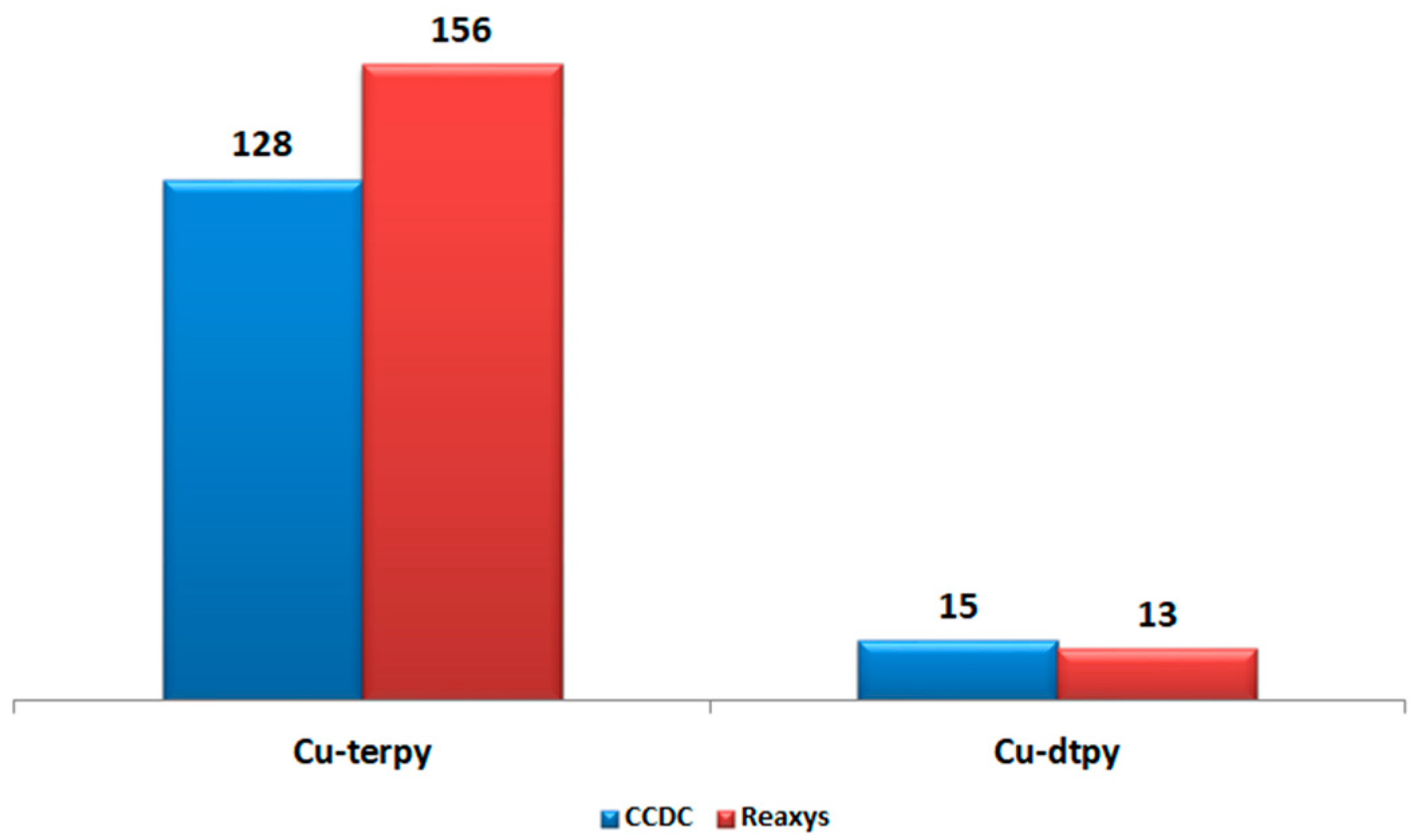
Scheme 1. A comparison of the number of Cu-terpy and Cu-dtpy compounds reported in the CCDC and Reaxys databases.
Ijms 26 11868 sch001
Scheme 2. Cu(II) complexes 113 investigated in this work.
Ijms 26 11868 sch002
Scheme 3. dtpy-based Cu(II) complexes 1424 previously reported in literature [14,15,16,23].
Ijms 26 11868 sch003
Figure 1. Perspective views showing the asymmetric unit of the structures of [CuCl2(R-dtpy)] (16) with the atom numbering. Displacement ellipsoids are drawn at the 50% probability level.
Ijms 26 11868 g001
Figure 2. Perspective views showing the asymmetric unit of the structures of [CuCl2(R′-Ph-dtpy)] (711) with the atom numbering. Displacement ellipsoids are drawn at the 50% probability level.
Ijms 26 11868 g002
Figure 3. Hydrogen bond formation in the structures of 1 (a), 4 (b) and 5 (c).
Ijms 26 11868 g003
Figure 4. (a) Addison’s parameter (τ) in groups of five-coordinate copper(II) compounds bearing terpy (blue diamonds) and dtpy (red squares) derivatives; for compounds 2, 13, 17 and 22, two crystallographicaly independent copper(II) ions have been determined. (b) Shape maps for the transformation of square pyramid (SPY) into trigonal bypiramid (TBY) for Cu(II) complexes with dtpy derivatives. (c) Shape maps for the transformation of square pyramid (SPY) into trigonal bypiramid (TBY) for Cu(II) complexes with terpy derivatives.
Ijms 26 11868 g004
Figure 5. Comparison of Cu-Clapical bond lengths [Å] in groups of copper(II) compounds constructed on terpy (blue diamonds) and dtpy (red squares) derivatives.
Ijms 26 11868 g005
Figure 6. Comparison of Cu-Ncentral bond lengths [Å] in groups of copper(II) compounds constructed on terpy (blue diamonds) and dtpy (red squares) derivatives.
Ijms 26 11868 g006
Figure 7. Comparison of the capture angles (°) in groups of copper(II) compounds constructed on terpy (blue diamonds) and dtpy (red squares) derivatives.
Ijms 26 11868 g007
Figure 8. UV-Vis absorption spectra of [CuCl2(R-dtpy)] (16) (top) and [CuCl2(R′-Ph-dtpy)] in MeOH (713) (middle) and [CuCl2(R-dtpy)] (1422) (bottom) [14,15,16] in methanolic * solutions (c = 10–50 μM; insert: c = 0.5–1 mM); * data for compounds 1417 refers to diluted ethanolic solutions; no data available in concentrated solutions [16].
Ijms 26 11868 g008
Figure 9. Wavelengths of the longest absorption bands vs. σp Hammett’s constants of substituents (R) for compounds 122 in diluted methanolic/ethanolic solutions.
Ijms 26 11868 g009
Figure 10. Wavelengths of the longest absorption bands vs. σp Hammett’s constants of substituents (R) for compounds 12 and 713 in diluted methanolic/ethanolic solutions.
Ijms 26 11868 g010
Figure 11. Wavelengths of the longest absorption bands ([nm]) vs. the capture angle ([°]) for Cu-terpy and Cu-dtpy systems in diluted methanolic/ethanolic solutions.
Ijms 26 11868 g011
Table 1. Distortion of the coordination sphere of Cu ions from ideal five-vertex polyhedral (square-pyramid (SPY) and trigonalbipyramid (TBY)) expressed by angular structural index parameter τ [52] and calculated using the SHAPE program [53].
CompoundτSQ(SPY)SQ(TBY)
10.1011.5225.990
20.012 (Cu1)
0.078 (Cu2)
1.598 (Cu1)
1.628 (Cu2)
5.171 (Cu1)
5.704 (Cu2)
30.1241.5945.955
40.0011.6474.990
50.1131.6515.914
60.1171.4556.180
70.2582.4752.900
80.1101.5596.084
90.1211.5816.340
100.0261.6124.946
110.230 (Cu1)
0.162 (Cu2)
0.194 (Cu3)
2.495 (Cu1)
2.423 (Cu2)
2.405 (Cu3)
3.512 (Cu1)
3.808 (Cu2)
3.738 (Cu3)
τ = β α 60 ° , where α and β are two largest angles; SQ(TBY)—distortion of the coordination sphere of Cu ion from ideal trigonal bipyramid, calculated using the SHAPE program [53]; SQ(SPY)—distortion of the coordination sphere of Cu ion from ideal square pyramid, calculated using the SHAPE program [53].
Table 2. Additional structural parameters of [CuCl2(R-dtpy) and [CuCl2(R′-Ph-dtpy)].
ComplexDihedral Angle Between Thiazole and Pyridine RingsDihedral Angle Between Substituent Plane and Pyridine RingsDistance of Cu(II) Ion to the Basal Plane
15.82/0.660.32
24.57/6.80 (Cu1)
1.65/4.86 (Cu2)
4.93 (Cu1)
9.96 (Cu2)
0.334 (Cu1)
0.360 (Cu2)
33.74/5.796.320.276
45.05/7.8125.370.348
52.41/8.353.33 0.269
60.88/5.295.240.331
74.83/5.8532.38 0.465
80.24/7.748.57 0.306
95.47/5.808.71 0.322
104.36/5.9923.020.407
110.99/2.47 (Cu1)
1.14/3.31 (Cu2)
2.18/2.38 (Cu2)
7.88
3.21
7.86
0.446 (Cu1)
0.414 (Cu2)
0.439 (Cu3)
Disclaimer/Publisher’s Note: The statements, opinions and data contained in all publications are solely those of the individual author(s) and contributor(s) and not of MDPI and/or the editor(s). MDPI and/or the editor(s) disclaim responsibility for any injury to people or property resulting from any ideas, methods, instructions or products referred to in the content.