From Inflammation to Malignancy: The Link Between Endometriosis and Gynecological Cancers
 , , , , ,
Abstract
1. Introduction
1.1. Definition and Prevalence of Endometriosis
1.2. Overview of Gynecological Cancers
1.3. Epidemiological Evidence and Link Between Endometriosis and Increased Cancer Risk
1.4. Rationale and Objective of the Review
2. Pathophysiology of Endometriosis
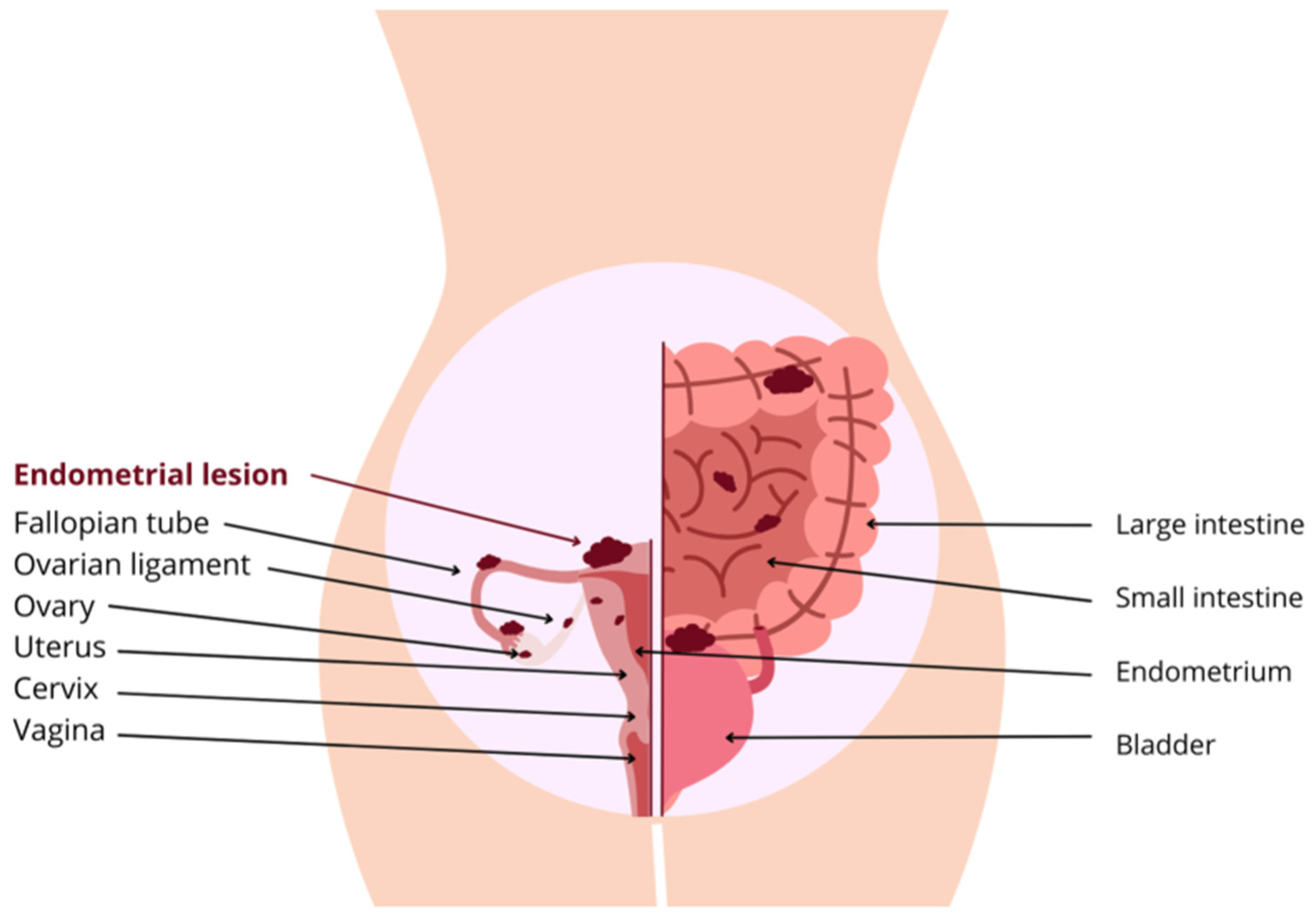
2.1. Theories on the Origin of Endometriosis
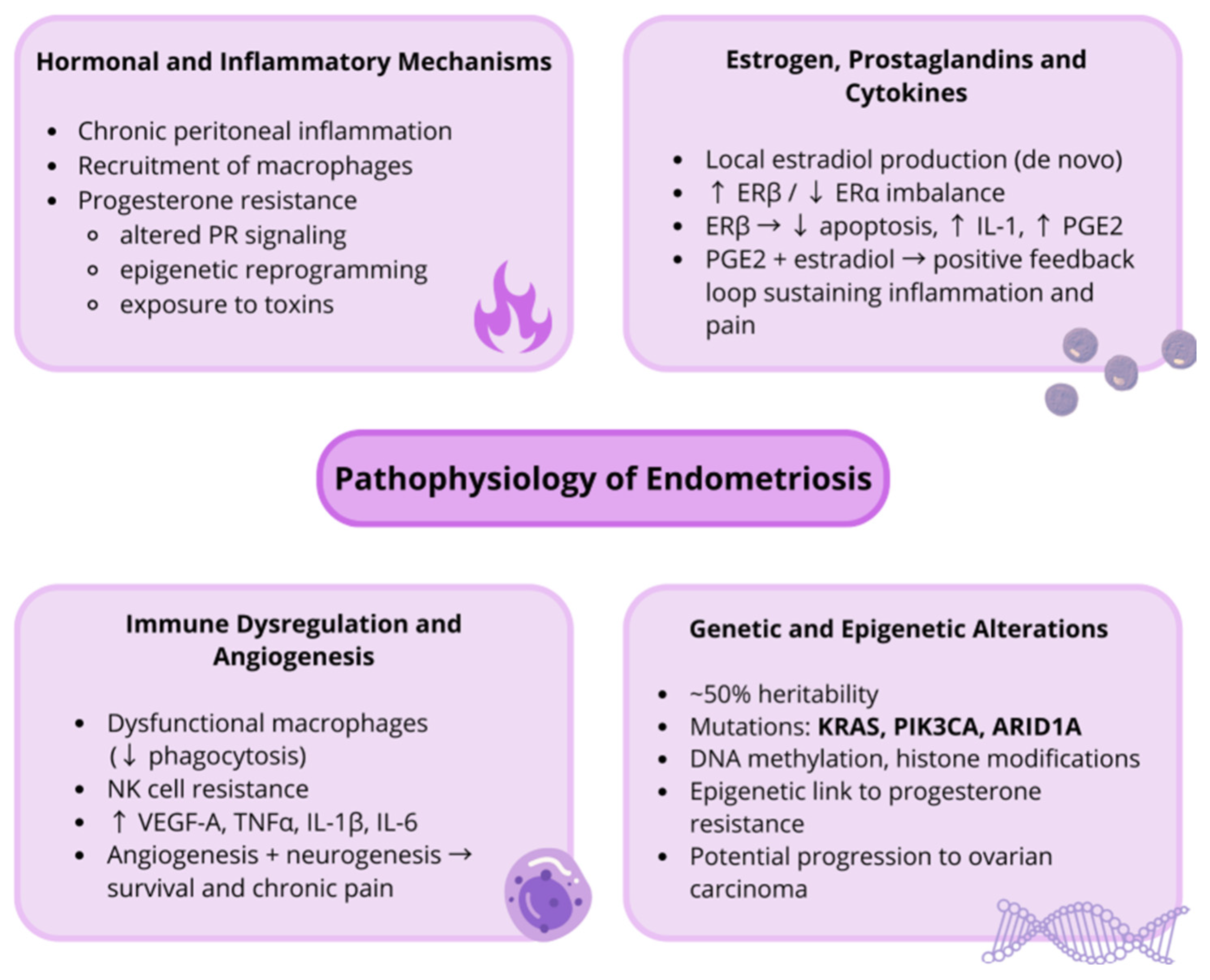
2.2. Hormonal and Inflammatory Mechanisms
2.3. Role of Estrogen, Prostaglandins, and Cytokines
2.4. Immune Dysregulation and Angiogenesis
2.5. Genetic and Epigenetic Alterations
2.6. The Relationship Between Vaginal Dysbiosis and Endometriosis and Related Cancers
3. Malignant Transformation of Endometriosis
4. Endometriosis and Ovarian Cancer
4.1. Strong Evidence of Association
4.2. Subtypes of Ovarian Cancer
4.3. Shared Molecular Pathways and Mechanisms
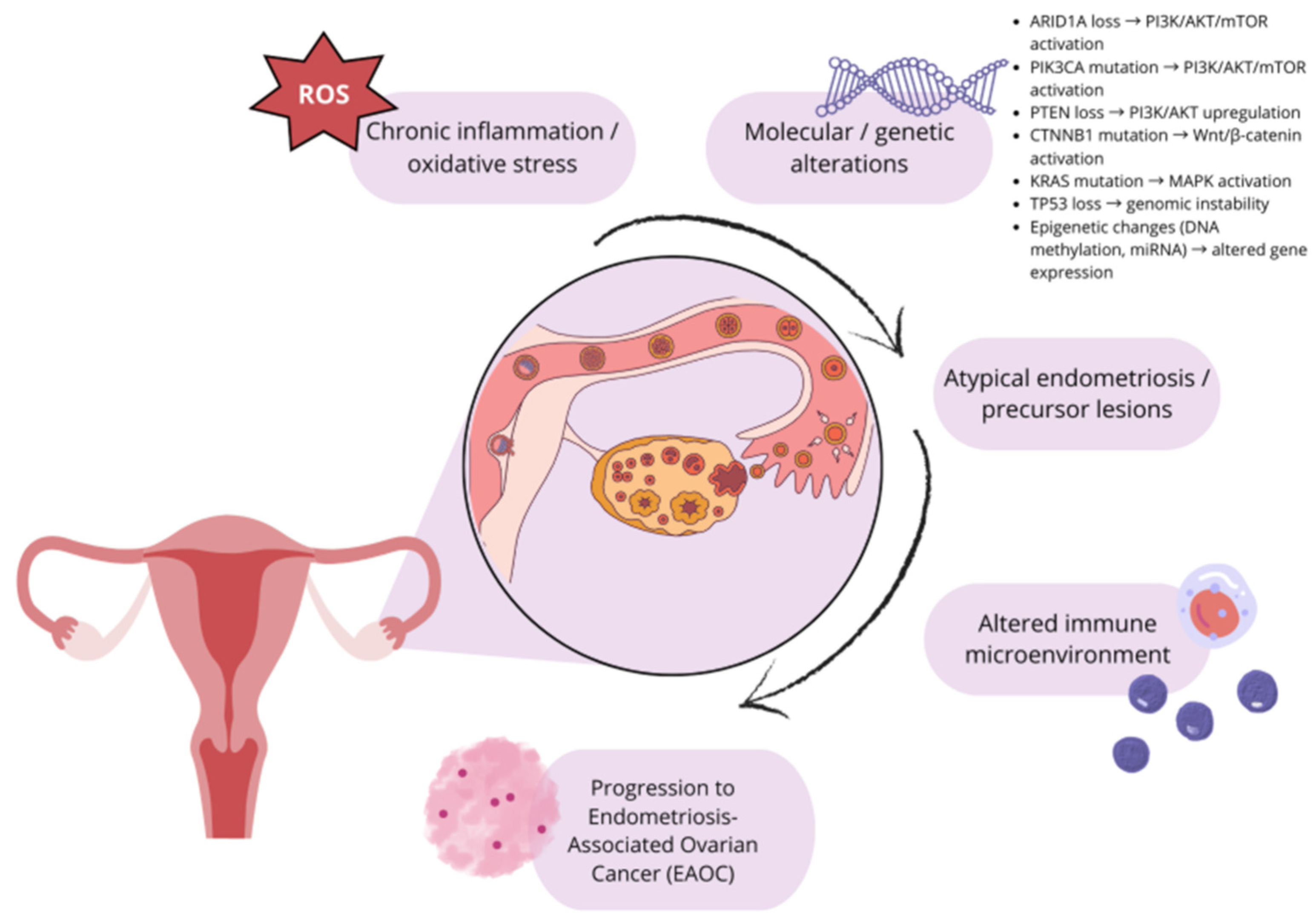
4.4. Mechanisms of Carcinogenesis
5. Endometriosis and Endometrial Cancer
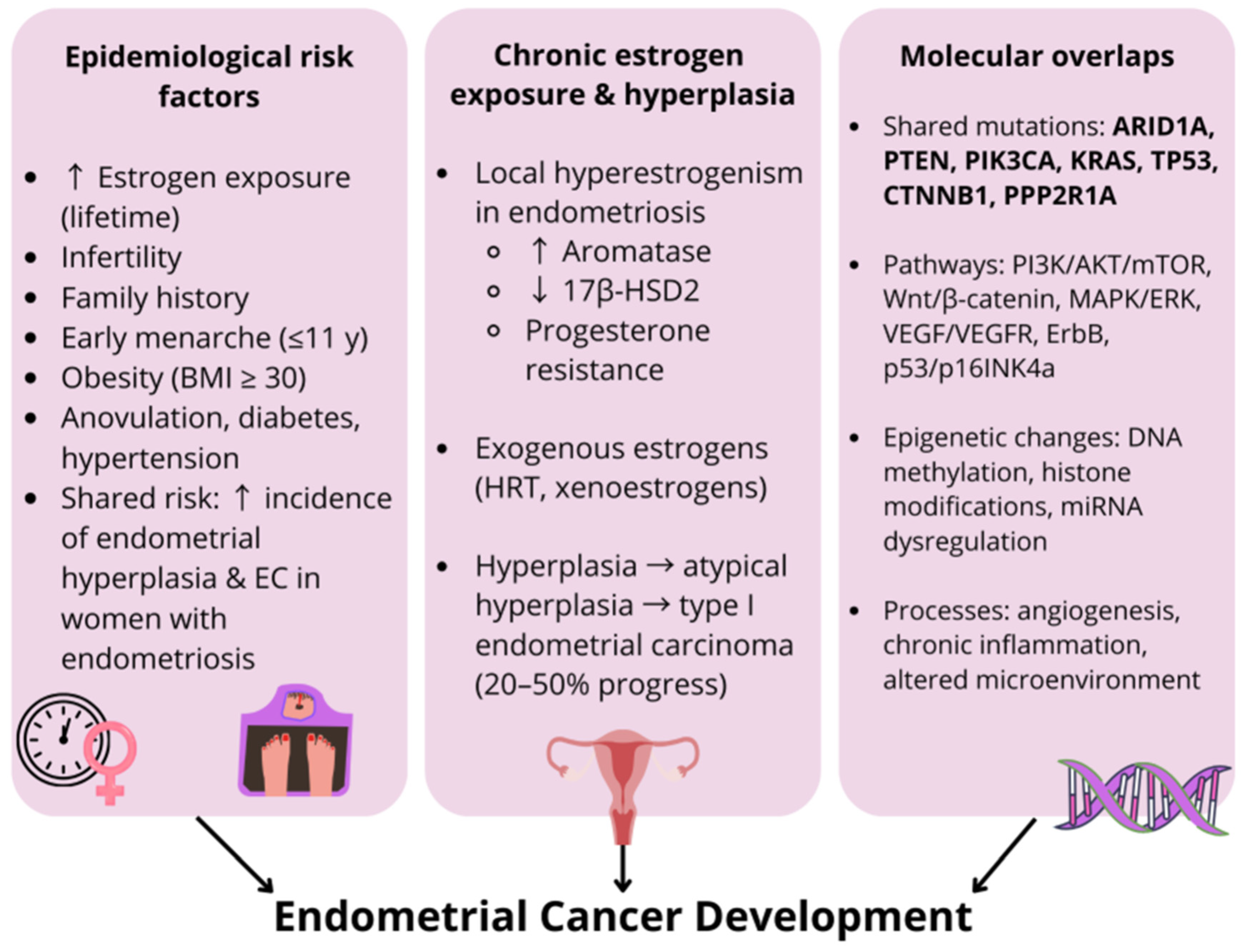
5.1. Summary of Epidemiological Studies
5.2. Chronic Estrogen Exposure and Hyperplasia
5.3. Possible Molecular Overlaps
6. Endometriosis and Cervical Cancer
7. Diagnostic and Clinical Implications
7.1. Importance of Differential Diagnosis
7.2. Challenges in Early Detection
7.3. Role of Imaging, Biomarkers, and Surgical Pathology
7.3.1. Imaging Techniques
7.3.2. Biomarkers

| Biomarker | Associated Condition(s) | Clinical Role | Specifity/Sensitivity | Remarks |
|---|---|---|---|---|
| CA-125 | Endometriosis, ovarian cancer | Diagnostic | Low specificity in endometriosis; ~78% specificity in ovarian cancer [277] | Elevated in menstruation, PID, pregnancy, and malignancies; limited diagnostic precision [274,275] |
| HE4 | Ovarian cancer | Diagnosis and monitoring | ~93% specificity [277] | Rarely elevated in benign conditions; detectable in urine [278] |
| ROMA (CA-125 + HE4 + menopausal status) | Ovarian cancer | Risk stratification (low/high) | Higher accuracy than single markers [277] | Used to evaluate adnexal masses |
| CA19-9 | Endometriosis, EAOC | Potential differential marker | No precise sensitivity data | Significantly different levels in EAOC vs. endometrioma [273] |
| CEA | EAOC | Tumor marker | No precise data | Often elevated in GI cancers, but also in EAOC [273] |
| SLX (Sialyl Lewis X) | EAOC | Supportive biomarker | No precise data | Shows differences between EAOC and endometrioma [273] |
| LDH | EAOC | Metabolic marker | No precise data | May indicate malignant transformation [273] |
| miR-200 family | Endometriosis, ovarian cancer | Differential diagnosis | Promising, needs clinical validation [281] | Involved in epithelial–mesenchymal transition (EMT) and tumor progression |
| miR-21, miR-145 | Endometriosis, EAOC | Molecular biomarkers | Dysregulated in both conditions [281] | May be involved in early neoplastic transformation |
| C9, Selenoprotein P, PON1, HBB | Endometriosis | Experimental biomarkers | No precise data | Reflect immune activation, oxidative stress, and metabolic alterations [274] |
| NSE (non-neuronal enolase) | Endometriosis | Differential diagnosis | No precise data | More effective than cytokeratin 19 in distinguishing endometriosis [272] |
| Vitamin D binding protein | Endometriosis | Diagnostic aid | No precise data | Promising urinary biomarker [272] |
| Cytokeratin 19 | Endometriosis | - | Not diagnostically relevant [272] | No significant difference between affected and unaffected women |
| Cancer Type | Risk Measure | Study Type | Key Findings | Evidence Quality |
|---|---|---|---|---|
| Ovarian cancer | 1.2–1.8 times higher risk ratio in the group of patients with endometriosis [139] | Systemic review, Narrative review, | Corelation with the mutations in ARID1A gene and PIK3CA activating mutations, PTEN loss, CTNNB1 mutations, KRAS mutations, TP53 loss [154,160,181,182], ARID1A mutations occur in 46–57% of CCOS [154], ARID1A mutations are absent in high-grade serous ovarian carcinomas [156] | High |
| Endometrial cancer | Risk may be higher due to elevated estrogen levels in group of women with endometriosis [197] | Systemic review, Meta-analysis, Literature review | PTEN, TP53, ARID1A, KRAS, PIK3CA and PPP2R1A are common mutations overlap between endometriosis and EC [211], Key pathways leading to EC development include Wnt/β-catenin, MAPK/ERK, PI3K/AKT/mTOR, VEGF/VEGFR and p53-p16INK4a [224] | Moderate |
| Cervical cancer | Endometriosis coexisted with cervical intraepithelial neoplasia (CIN) in 70% of patients [235] | Systemic review, Meta-analysis, Case report, Literature review | CA-125 is often elevated in endometriosis but also can be in other conditions decreasing its diagnostic value [274], CA 19-9, CEA, SLX and LDH present differing levels in endometriosis and ovarian cancer [276,277], HE4 is more specific comparing to CA-125, however is commonly not elevated in benign lesions [277] | Low |
7.3.3. Surgical Pathology
8. Future Directions and Research Gaps
9. Conclusions
Author Contributions
Funding
Data Availability Statement
Conflicts of Interest
Abbreviations
| CA-125 | Cancer Antigen 125 |
| CCOC | Clear Cell Ovarian Carcinoma |
| CEA | Carcinoembryonic Antigen |
| CIN | Cervical Intraepithelial Neoplasia |
| CT | Computed Tomography |
| DIE | Deep Infiltrating Endometriosis |
| EAOC | Endometriosis-Associated Ovarian Cancer |
| EC | Endometrial Cancer |
| EDC | Endometrioid Carcinoma |
| ENOC | Endometrioid Ovarian Carcinoma |
| ERβ | Estrogen Receptor Beta |
| ERs | Estrogen Receptors |
| GI | Gastrointestinal |
| HE4 | Human Epididymal Protein 4 |
| HPV | Human Papillomavirus |
| HRT | Hormone Replacement Therapy |
| LDH | Lactate Dehydrogenase |
| miRNAs | microRNAs |
| MRI | Magnetic Resonance Imaging |
| NK | Natural Killer |
| OMA | Ovarian Endometrioma |
| PGE2 | Prostaglandin E2 |
| REGE | Estrogen-Regulated Growth Inhibitor |
| ROMA | Risk of Ovarian Malignancy Algorithm |
| ROS | Reactive Oxygen Species |
| SLX | Sialyl-Lewis X |
| SUP | Superficial Peritoneal Endometriosis |
| TVS | Transvaginal Ultrasonography |
| USG | Ultrasonography |
References
- Crump, J.; Suker, A.; White, L. Endometriosis: A review of recent evidence and guidelines. Aust. J. Gen. Pract. 2024, 53, 11–18. [Google Scholar] [CrossRef] [PubMed]
- Pašalić, E.; Tambuwala, M.M.; Hromić-Jahjefendić, A. Endometriosis: Classification, pathophysiology, and treatment options. Pathol. Res. Pract. 2023, 251, 154847. [Google Scholar] [CrossRef]
- Adilbayeva, A.; Kunz, J. Pathogenesis of Endometriosis and Endometriosis-Associated Cancers. Int. J. Mol. Sci. 2024, 25, 7624. [Google Scholar] [CrossRef] [PubMed]
- Mohammed Rasheed, H.A.; Hamid, P. Inflammation to Infertility: Panoramic View on Endometriosis. Cureus 2020, 12, e11516. [Google Scholar] [CrossRef] [PubMed]
- Becker, C.M.; Bokor, A.; Heikinheimo, O.; Horne, A.; Jansen, F.; Kiesel, L.; King, K.; Kvaskoff, M.; Nap, A.; Petersen, K.; et al. ESHRE Endometriosis Guideline Group. ESHRE guideline: Endometriosis. Hum. Reprod. Open 2022, 2022, hoac009. [Google Scholar] [CrossRef]
- Saunders, P.T.K.; Whitaker, L.H.R.; Horne, A.W. Endometriosis: Improvements and challenges in diagnosis and symptom management. Cell Rep. Med. 2024, 5, 101596. [Google Scholar] [CrossRef]
- Griffiths, M.J.; Horne, A.W.; Gibson, D.A.; Roberts, N.; Saunders, P.T.K. Endometriosis: Recent advances that could accelerate diagnosis and improve care. Trends Mol. Med. 2024, 30, 875–889. [Google Scholar] [CrossRef]
- Caumo, W.; Deitos, A.; Carvalho, S.; Leite, J.; Carvalho, F.; Dussán-Sarria, J.A.; Lopes Tarragó Mda, G.; Souza, A.; Torres, I.L.; Fregni, F. Motor Cortex Excitability and BDNF Levels in Chronic Musculoskeletal Pain According to Structural Pathology. Front. Hum. Neurosci. 2016, 10, 357. [Google Scholar] [CrossRef]
- Prescott, J.; Farland, L.V.; Tobias, D.K.; Gaskins, A.J.; Spiegelman, D.; Chavarro, J.E.; Rich-Edwards, J.W.; Barbieri, R.L.; Missmer, S.A. A prospective cohort study of endometriosis and subsequent risk of infertility. Hum. Reprod. 2016, 31, 1475–1482. [Google Scholar] [CrossRef]
- Smolarz, B.; Szyłło, K.; Romanowicz, H. Endometriosis: Epidemiology, Classification, Pathogenesis, Treatment and Genetics (Review of Literature). Int. J. Mol. Sci. 2021, 22, 10554. [Google Scholar] [CrossRef]
- Bulun, S.E.; Yilmaz, B.D.; Sison, C.; Miyazaki, K.; Bernardi, L.; Liu, S.; Kohlmeier, A.; Yin, P.; Milad, M.; Wei, J. Endometriosis. Endocr. Rev. 2019, 40, 1048–1079. [Google Scholar] [CrossRef] [PubMed]
- Ottolina, J.; Villanacci, R.; D’Alessandro, S.; He, X.; Grisafi, G.; Ferrari, S.M.; Candiani, M. Endometriosis and Adenomyosis: Modern Concepts of Their Clinical Outcomes, Treatment, and Management. J. Clin. Med. 2024, 13, 3996. [Google Scholar] [CrossRef] [PubMed]
- Bourgioti, C.; Preza, O.; Panourgias, E.; Chatoupis, K.; Antoniou, A.; Nikolaidou, M.E.; Moulopoulos, L.A. MR imaging of endometriosis: Spectrum of disease. Diagn. Interv. Imaging 2017, 98, 751–767. [Google Scholar] [CrossRef]
- Zhang, Y.; Zhang, S.; Zhao, Z.; Wang, C.; Xu, S.; Wang, F. Impact of cystectomy versus ablation for endometrioma on ovarian reserve: A systematic review and meta-analysis. Fertil. Steril. 2022, 118, 1172–1182. [Google Scholar] [CrossRef]
- Hoyle, A.T.; Puckett, Y. Endometrioma. In StatPearls [Internet]; StatPearls Publishing: Treasure Island, FL, USA, 2025; Available online: https://www.ncbi.nlm.nih.gov/books/NBK559230/ (accessed on 28 September 2025).
- Gruber, T.M.; Mechsner, S. Pathogenesis of Endometriosis: The Origin of Pain and Subfertility. Cells 2021, 10, 1381. [Google Scholar] [CrossRef]
- Chapron, C.; Marcellin, L.; Borghese, B.; Santulli, P. Rethinking mechanisms, diagnosis and management of endometriosis. Nat. Rev. Endocrinol. 2019, 15, 666–682. [Google Scholar] [CrossRef]
- Del Forno, S.; Cocchi, L.; Arena, A.; Pellizzone, V.; Lenzi, J.; Raffone, A.; Borghese, G.; Paradisi, R.; Youssef, A.; Casadio, P.; et al. Effects of Pelvic Floor Muscle Physiotherapy on Urinary, Bowel, and Sexual Functions in Women with Deep Infiltrating Endometriosis: A Randomized Controlled Trial. Medicina 2023, 60, 67. [Google Scholar] [CrossRef]
- Fauconnier, A.; Chapron, C.; Dubuisson, J.B.; Vieira, M.; Dousset, B.; Bréart, G. Relation between pain symptoms and the anatomic location of deep infiltrating endometriosis. Fertil. Steril. 2002, 78, 719–726. [Google Scholar] [CrossRef]
- Rousset, P.; Florin, M.; Bharwani, N.; Touboul, C.; Monroc, M.; Golfier, F.; Nougaret, S.; Thomassin-Naggara, I.; ENDOVALIRM Group. Deep pelvic infiltrating endometriosis: MRI consensus lexicon and compartment-based approach from the ENDOVALIRM group. Diagn. Interv. Imaging 2023, 104, 95–112. [Google Scholar] [CrossRef]
- Cocomazzi, G.; Del Pup, L.; Contu, V.; Maggio, G.; Parmegiani, L.; Ciampaglia, W.; De Ruvo, D.; Faioli, R.; Maglione, A.; Baldini, G.M.; et al. Gynecological Cancers and Microbiota Dynamics: Insights into Pathogenesis and Therapy. Int. J. Mol. Sci. 2024, 25, 2237. [Google Scholar] [CrossRef] [PubMed]
- Yetkin-Arik, B.; Kastelein, A.W.; Klaassen, I.; Jansen, C.H.J.R.; Latul, Y.P.; Vittori, M.; Biri, A.; Kahraman, K.; Griffioen, A.W.; Amant, F.; et al. Angiogenesis in gynecological cancers and the options for anti-angiogenesis therapy. Biochim. Biophys. Acta Rev. Cancer. 2021, 1875, 188446. [Google Scholar] [CrossRef]
- Jayson, G.C.; Kohn, E.C.; Kitchener, H.C.; Ledermann, J.A. Ovarian cancer. Lancet 2014, 384, 1376–1388. [Google Scholar] [CrossRef]
- Tian, W.; Lei, N.; Zhou, J.; Chen, M.; Guo, R.; Qin, B.; Li, Y.; Chang, L. Extracellular vesicles in ovarian cancer chemoresistance, metastasis, and immune evasion. Cell Death Dis. 2022, 13, 64. [Google Scholar] [CrossRef]
- Nees, L.K.; Heublein, S.; Steinmacher, S.; Juhasz-Böss, I.; Brucker, S.; Tempfer, C.B.; Wallwiener, M. Endometrial hyperplasia as a risk factor of endometrial cancer. Arch. Gynecol. Obstet. 2022, 306, 407–421. [Google Scholar] [CrossRef] [PubMed]
- Oaknin, A.; Bosse, T.J.; Creutzberg, C.L.; Giornelli, G.; Harter, P.; Joly, F.; Lorusso, D.; Marth, C.; Makker, V.; Mirza, M.R.; et al. Endometrial cancer: ESMO Clinical Practice Guideline for diagnosis, treatment and follow-up. Ann. Oncol. 2022, 33, 860–877. [Google Scholar] [CrossRef] [PubMed]
- Bhatla, N.; Aoki, D.; Sharma, D.N.; Sankaranarayanan, R. Cancer of the cervix uteri: 2021 update. Int. J. Gynaecol. Obstet. 2021, 155 (Suppl. S1), 28–44. [Google Scholar] [CrossRef] [PubMed]
- Torre, L.A.; Bray, F.; Siegel, R.; Ferlay, J.; Lortet-Tieulent, J.; Jemal, A. Global cancer statistics, 2012. CA Cancer J. Clin. 2015, 65, 87–108. [Google Scholar] [CrossRef]
- Gopu, P.; Antony, F.; Cyriac, S.; Karakasis, K.; Oza, A.M. Updates on systemic therapy for cervical cancer. Indian J. Med. Res. 2021, 154, 293–302. [Google Scholar] [CrossRef]
- Jha, A.K.; Mithun, S.; Sherkhane, U.B.; Jaiswar, V.; Osong, B.; Purandare, N.; Kannan, S.; Prabhash, K.; Gupta, S.; Vanneste, B.; et al. Systematic review and meta-analysis of prediction models used in cervical cancer. Artif. Intell. Med. 2023, 139, 102549. [Google Scholar] [CrossRef]
- Gutiérrez-Hoya, A.; Soto-Cruz, I. NK Cell Regulation in Cervical Cancer and Strategies for Immunotherapy. Cells 2021, 10, 3104. [Google Scholar] [CrossRef]
- Wang, L.; Li, X.; Wang, Y.; Li, G.; Dai, S.; Cao, M.; Meng, Z.; Ren, S. Endometriosis and epithelial ovarian cancer: A two-sample Mendelian randomization analysis. Sci. Rep. 2023, 13, 21992. [Google Scholar] [CrossRef]
- Gadducci, A.; Multinu, F.; Cosio, S.; Carinelli, S.; Ghioni, M.; Aletti, G.D. Clear cell carcinoma of the ovary: Epidemiology, pathological and biological features, treatment options and clinical outcomes. Gynecol. Oncol. 2021, 162, 741–750. [Google Scholar] [CrossRef]
- Terzic, M.; Aimagambetova, G.; Kunz, J.; Bapayeva, G.; Aitbayeva, B.; Terzic, S.; Laganà, A.S. Molecular Basis of Endometriosis and Endometrial Cancer: Current Knowledge and Future Perspectives. Int. J. Mol. Sci. 2021, 22, 9274. [Google Scholar] [CrossRef] [PubMed]
- Munksgaard, P.S.; Blaakaer, J. The association between endometriosis and gynecological cancers and breast cancer: A review of epidemiological data. Gynecol. Oncol. 2011, 123, 157–163. [Google Scholar] [CrossRef] [PubMed]
- Ye, J.; Peng, H.; Huang, X.; Qi, X. The association between endometriosis and risk of endometrial cancer and breast cancer: A meta-analysis. BMC Womens Health 2022, 22, 455. [Google Scholar] [CrossRef]
- Huang, J.Y.; Ma, K.S.; Wang, L.T.; Chiang, C.H.; Yang, S.F.; Wang, C.H.; Wang, P.H. The Risk of Endometrial Cancer and Uterine Sarcoma Following Endometriosis or Pelvic Inflammatory Disease. Cancers 2023, 15, 833. [Google Scholar] [CrossRef]
- Buis, C.C.; van Leeuwen, F.E.; Mooij, T.M.; Burger, C.W.; OMEGA Project Group. Increased risk for ovarian cancer and borderline ovarian tumours in subfertile women with endometriosis. Hum. Reprod. 2013, 28, 3358–3369. [Google Scholar] [CrossRef] [PubMed]
- Renz, M.; Friedlander, M.; Berek, J.S. Cancer of the ovary, fallopian tube, and peritoneum: 2025 update. Int. J. Gynaecol. Obstet. 2025, 171 (Suppl. S1), 6–35. [Google Scholar] [CrossRef]
- Barnard, M.E.; Farland, L.V.; Yan, B.; Wang, J.; Trabert, B.; Doherty, J.A.; Meeks, H.D.; Madsen, M.; Guinto, E.; Collin, L.J.; et al. Endometriosis Typology and Ovarian Cancer Risk. JAMA 2024, 332, 482–489. [Google Scholar] [CrossRef]
- Saavalainen, L.; Lassus, H.; But, A.; Tiitinen, A.; Härkki, P.; Gissler, M.; Pukkala, E.; Heikinheimo, O. Risk of Gynecologic Cancer According to the Type of Endometriosis. Obstet. Gynecol. 2018, 131, 1095–1102. [Google Scholar] [CrossRef]
- Wang, Y.X.; Farland, L.V.; Gaskins, A.J.; Wang, S.; Terry, K.L.; Rexrode, K.M.; Rich-Edwards, J.W.; Tamimi, R.; Chavarro, J.E.; Missmer, S.A. Endometriosis and uterine fibroids and risk of premature mortality: Prospective cohort study. BMJ 2024, 387, e078797. [Google Scholar] [CrossRef] [PubMed]
- Bergmann, S.; Schindler, M.; Munger, C.; Penfold, C.A.; Boroviak, T.E. Building a stem cell-based primate uterus. Commun. Biol. 2021, 4, 749. [Google Scholar] [CrossRef]
- Smith, S.K. Regulation of angiogenesis in the endometrium. Trends Endocrinol. Metab. 2001, 12, 147–151. [Google Scholar] [CrossRef]
- Critchley, H.O.D.; Maybin, J.A.; Armstrong, G.M.; Williams, A.R.W. Physiology of the Endometrium and Regulation of Menstruation. Physiol. Rev. 2020, 100, 1149–1179. [Google Scholar] [CrossRef]
- Ang, C.J.; Skokan, T.D.; McKinley, K.L. Mechanisms of Regeneration and Fibrosis in the Endometrium. Annu. Rev. Cell Dev. Biol. 2023, 39, 197–221. [Google Scholar] [CrossRef]
- Koninckx, P.R.; Fernandes, R.; Ussia, A.; Schindler, L.; Wattiez, A.; Al-Suwaidi, S.; Amro, B.; Al-Maamari, B.; Hakim, Z.; Tahlak, M. Pathogenesis Based Diagnosis and Treatment of Endometriosis. Front. Endocrinol. 2021, 12, 745548. [Google Scholar] [CrossRef] [PubMed]
- Shah, R.; Jagani, R.P. Review of Endometriosis Diagnosis through Advances in Biomedical Engineering. Crit. Rev. Biomed. Eng. 2018, 46, 277–288. [Google Scholar] [CrossRef] [PubMed]
- Shafrir, A.L.; Farland, L.V.; Shah, D.K.; Harris, H.R.; Kvaskoff, M.; Zondervan, K.; Missmer, S.A. Risk for and consequences of endometriosis: A critical epidemiologic review. Best. Pract. Res. Clin. Obstet. Gynaecol. 2018, 51, 1–15. [Google Scholar] [CrossRef]
- Vercellini, P.; Viganò, P.; Somigliana, E.; Fedele, L. Endometriosis: Pathogenesis and treatment. Nat. Rev. Endocrinol. 2014, 10, 261–275. [Google Scholar] [CrossRef]
- Zondervan, K.T.; Becker, C.M.; Missmer, S.A. Endometriosis. N. Engl. J. Med. 2020, 382, 1244–1256. [Google Scholar] [CrossRef]
- Malvezzi, H.; Marengo, E.B.; Podgaec, S.; Piccinato, C.A. Endometriosis: Current challenges in modeling a multifactorial disease of unknown etiology. J. Transl. Med. 2020, 18, 311. [Google Scholar] [CrossRef]
- Konrad, L.; Dietze, R.; Kudipudi, P.K.; Horné, F.; Meinhold-Heerlein, I. Endometriosis in MRKH cases as a proof for the coelomic metaplasia hypothesis? Reproduction 2019, 158, R41–R47. [Google Scholar] [CrossRef]
- Zondervan, K.T.; Becker, C.M.; Koga, K.; Missmer, S.A.; Taylor, R.N.; Viganò, P. Endometriosis. Nat. Rev. Dis. Primers 2018, 4, 9. [Google Scholar] [CrossRef] [PubMed]
- Critchley, H.O.D.; Babayev, E.; Bulun, S.E.; Clark, S.; Garcia-Grau, I.; Gregersen, P.K.; Kilcoyne, A.; Kim, J.J.; Lavender, M.; Marsh, E.E.; et al. Menstruation: Science and society. Am. J. Obstet. Gynecol. 2020, 223, 624–664. [Google Scholar] [CrossRef] [PubMed]
- Mandai, M.; Osuga, Y.; Hirata, T.; Enomoto, T.; Nakai, H.; Honda, R.; Taniguchi, F.; Katabuchi, H. Cancers associated with extraovarian endometriosis at less common/rare sites: A nationwide survey in Japan. J. Obstet. Gynaecol. Res. 2020, 46, 917–923. [Google Scholar] [CrossRef]
- Signorile, P.G.; Baldi, A.; Viceconte, R.; Ronchi, A.; Montella, M. Pathogenesis of Endometriosis: Focus on Adenogenesis-Related Factors. In Vivo 2023, 37, 1922–1930. [Google Scholar] [CrossRef] [PubMed]
- Sampson, J.A. Peritoneal Endometriosis Due to the Menstrual Dissemination of Endometrial Tissue into the Peritoneal Cavity. Am. J. Obstet. Gynecol. 1927, 14, 442–469. [Google Scholar] [CrossRef]
- Symons, L.K.; Miller, J.E.; Kay, V.R.; Marks, R.M.; Liblik, K.; Koti, M.; Tayade, C. The Immunopathophysiology of Endometriosis. Trends Mol. Med. 2018, 24, 748–762. [Google Scholar] [CrossRef]
- Bonavina, G.; Taylor, H.S. Endometriosis-associated infertility: From pathophysiology to tailored treatment. Front. Endocrinol. 2022, 13, 1020827. [Google Scholar] [CrossRef]
- Sampson, J.A. Metastatic or Embolic Endometriosis, due to the Menstrual Dissemination of Endometrial Tissue into the Venous Circulation. Am. J. Pathol. 1927, 3, 93–110. [Google Scholar]
- Vinatier, D.; Orazi, G.; Cosson, M.; Dufour, P. Theories of endometriosis. Eur. J. Obstet. Gynecol. Reprod. Biol. 2001, 96, 21–34. [Google Scholar] [CrossRef]
- Lousse, J.C.; Van Langendonckt, A.; Defrere, S.; Ramos, R.G.; Colette, S.; Donnez, J. Peritoneal endometriosis is an inflammatory disease. Front. Biosci. (Elite Ed.) 2012, 4, 23–40. [Google Scholar] [CrossRef]
- Uzuner, C.; Mak, J.; El-Assaad, F.; Condous, G. The bidirectional relationship between endometriosis and microbiome. Front. Endocrinol. 2023, 14, 1110824. [Google Scholar] [CrossRef]
- Rolla, E. Endometriosis: Advances and controversies in classification, pathogenesis, diagnosis, and treatment. F1000Research 2019, 8, 529. [Google Scholar] [CrossRef]
- Klemmt, P.A.B.; Starzinski-Powitz, A. Molecular and Cellular Pathogenesis of Endometriosis. Curr. Womens Health Rev. 2018, 14, 106–116. [Google Scholar] [CrossRef]
- Capobianco, A.; Rovere-Querini, P. Endometriosis, a disease of the macrophage. Front. Immunol. 2013, 4, 9. [Google Scholar] [CrossRef]
- Somigliana, E.; Viganò, P.; Gaffuri, B.; Candiani, M.; Busacca, M.; Di Blasio, A.M.; Vignali, M. Modulation of NK cell lytic function by endometrial secretory factors: Potential role in endometriosis. Am. J. Reprod. Immunol. 1996, 36, 295–300. [Google Scholar] [CrossRef]
- Gibson, D.A.; Simitsidellis, I.; Collins, F.; Saunders, P.T.K. Androgens, oestrogens and endometrium: A fine balance between perfection and pathology. J. Endocrinol. 2020, 246, R75–R93. [Google Scholar] [CrossRef] [PubMed]
- Pavone, M.E.; Reierstad, S.; Sun, H.; Milad, M.; Bulun, S.E.; Cheng, Y.H. Altered retinoid uptake and action contributes to cell survival in endometriosis. J. Clin. Endocrinol. Metab. 2010, 95, E300–E309. [Google Scholar] [CrossRef] [PubMed]
- Pavone, M.E.; Dyson, M.; Reirstad, S.; Pearson, E.; Ishikawa, H.; Cheng, Y.H.; Bulun, S.E. Endometriosis expresses a molecular pattern consistent with decreased retinoid uptake, metabolism and action. Hum. Reprod. 2011, 26, 2157–2164. [Google Scholar] [CrossRef] [PubMed]
- Yilmaz, B.D.; Bulun, S.E. Endometriosis and nuclear receptors. Hum. Reprod. Update. 2019, 25, 473–485. [Google Scholar] [CrossRef]
- Houshdaran, S.; Oke, A.B.; Fung, J.C.; Vo, K.C.; Nezhat, C.; Giudice, L.C. Steroid hormones regulate genome-wide epigenetic programming and gene transcription in human endometrial cells with marked aberrancies in endometriosis. PLoS Genet. 2020, 16, e1008601. [Google Scholar] [CrossRef]
- Zhang, P.; Wang, G. Progesterone Resistance in Endometriosis: Current Evidence and Putative Mechanisms. Int. J. Mol. Sci. 2023, 24, 6992. [Google Scholar] [CrossRef]
- Reis, F.M.; Coutinho, L.M.; Vannuccini, S.; Batteux, F.; Chapron, C.; Petraglia, F. Progesterone receptor ligands for the treatment of endometriosis: The mechanisms behind therapeutic success and failure. Hum. Reprod. Update 2020, 26, 565–585. [Google Scholar] [CrossRef] [PubMed]
- Fuentes, N.; Silveyra, P. Estrogen receptor signaling mechanisms. Adv. Protein Chem. Struct. Biol. 2019, 116, 135–170. [Google Scholar] [CrossRef] [PubMed]
- Faltas, C.L.; LeBron, K.A.; Holz, M.K. Unconventional Estrogen Signaling in Health and Disease. Endocrinology. 2020, 161, bqaa030. [Google Scholar] [CrossRef] [PubMed]
- Chen, P.; Li, B.; Ou-Yang, L. Role of estrogen receptors in health and disease. Front. Endocrinol. 2022, 13, 839005. [Google Scholar] [CrossRef]
- Attar, E.; Tokunaga, H.; Imir, G.; Yilmaz, M.B.; Redwine, D.; Putman, M.; Gurates, B.; Attar, R.; Yaegashi, N.; Hales, D.B.; et al. Prostaglandin E2 via steroidogenic factor-1 coordinately regulates transcription of steroidogenic genes necessary for estrogen synthesis in endometriosis. J. Clin. Endocrinol. Metab. 2009, 94, 623–631. [Google Scholar] [CrossRef]
- Chantalat, E.; Valera, M.C.; Vaysse, C.; Noirrit, E.; Rusidze, M.; Weyl, A.; Vergriete, K.; Buscail, E.; Lluel, P.; Fontaine, C.; et al. Estrogen Receptors and Endometriosis. Int. J. Mol. Sci. 2020, 21, 2815. [Google Scholar] [CrossRef]
- Tang, Z.R.; Zhang, R.; Lian, Z.X.; Deng, S.L.; Yu, K. Estrogen-Receptor Expression and Function in Female Reproductive Disease. Cells 2019, 8, 1123. [Google Scholar] [CrossRef]
- Bulun, S.E.; Monsavais, D.; Pavone, M.E.; Dyson, M.; Xue, Q.; Attar, E.; Tokunaga, H.; Su, E.J. Role of estrogen receptor-β in endometriosis. Semin. Reprod. Med. 2012, 30, 39–45. [Google Scholar] [CrossRef]
- Khan, K.N.; Kitajima, M.; Inoue, T.; Fujishita, A.; Nakashima, M.; Masuzaki, H. 17β-estradiol and lipopolysaccharide additively promote pelvic inflammation and growth of endometriosis. Reprod. Sci. 2015, 22, 585–594. [Google Scholar] [CrossRef]
- García-Gómez, E.; Vázquez-Martínez, E.R.; Reyes-Mayoral, C.; Cruz-Orozco, O.P.; Camacho-Arroyo, I.; Cerbón, M. Regulation of Inflammation Pathways and Inflammasome by Sex Steroid Hormones in Endometriosis. Front. Endocrinol. 2020, 10, 935. [Google Scholar] [CrossRef]
- Burns, K.A.; Rodriguez, K.F.; Hewitt, S.C.; Janardhan, K.S.; Young, S.L.; Korach, K.S. Role of estrogen receptor signaling required for endometriosis-like lesion establishment in a mouse model. Endocrinology 2012, 153, 3960–3971. [Google Scholar] [CrossRef]
- Gałczyński, K.; Jóźwik, M.; Lewkowicz, D.; Semczuk-Sikora, A.; Semczuk, A. Ovarian endometrioma—A possible finding in adolescent girls and young women: A mini-review. J. Ovarian Res. 2019, 12, 104. [Google Scholar] [CrossRef]
- Hou, Z.; Sun, L.; Gao, L.; Liao, L.; Mao, Y.; Liu, J. Cytokine array analysis of peritoneal fluid between women with endometriosis of different stages and those without endometriosis. Biomarkers 2009, 14, 604–618. [Google Scholar] [CrossRef] [PubMed]
- Young, V.J.; Ahmad, S.F.; Brown, J.K.; Duncan, W.C.; Horne, A.W. Peritoneal VEGF-A expression is regulated by TGF-β1 through an ID1 pathway in women with endometriosis. Sci. Rep. 2015, 5, 16859. [Google Scholar] [CrossRef] [PubMed]
- Suryawanshi, S.; Huang, X.; Elishaev, E.; Budiu, R.A.; Zhang, L.; Kim, S.; Donnellan, N.; Mantia-Smaldone, G.; Ma, T.; Tseng, G.; et al. Complement pathway is frequently altered in endometriosis and endometriosis-associated ovarian cancer. Clin. Cancer Res. 2014, 20, 6163–6174. [Google Scholar] [CrossRef] [PubMed]
- Gogacz, M.; Gałczyński, K.; Wojtaś, M.; Winkler, I.; Adamiak, A.; Romanek-Piva, K.; Rechberger, T.; Kotarski, J. Fas-Related Apoptosis of Peritoneal Fluid Macrophages in Endometriosis Patients: Understanding the Disease. J. Immunol. Res. 2017, 2017, 3175394. [Google Scholar] [CrossRef]
- Ahn, S.H.; Monsanto, S.P.; Miller, C.; Singh, S.S.; Thomas, R.; Tayade, C. Pathophysiology and Immune Dysfunction in Endometriosis. Biomed. Res. Int. 2015, 2015, 795976. [Google Scholar] [CrossRef]
- Rahmioglu, N.; Mortlock, S.; Ghiasi, M.; Møller, P.L.; Stefansdottir, L.; Galarneau, G.; Turman, C.; Danning, R.; Law, M.H.; Sapkota, Y.; et al. The genetic basis of endometriosis and comorbidity with other pain and inflammatory conditions. Nat. Genet. 2023, 55, 423–436. [Google Scholar] [CrossRef]
- Daraï, E.; Ploteau, S.; Ballester, M.; Bendifallah, S. Endométriose: Physiopathologie, facteurs génétiques et diagnostic clinique [Pathogenesis, genetics and diagnosis of endometriosis]. Presse Med. 2017, 46, 1156–1165. (In French) [Google Scholar] [CrossRef]
- Vassilopoulou, L.; Matalliotakis, M.; Zervou, M.I.; Matalliotaki, C.; Krithinakis, K.; Matalliotakis, I.; Spandidos, D.A.; Goulielmos, G.N. Defining the Genetic Profile of Endometriosis (Review). Exp. Ther. Med. 2019, 17, 3267–3281. [Google Scholar] [CrossRef] [PubMed]
- Simpson, J.L.; Bischoff, F.Z.; Kamat, A.; Buster, J.E.; Carson, S.A. Genetics of endometriosis. Obstet. Gynecol. Clin. N. Am. 2003, 30, 21–40. [Google Scholar] [CrossRef]
- Hadfield, R.M.; Mardon, H.J.; Barlow, D.H.; Kennedy, S.H. Endometriosis in monozygotic twins. Fertil. Steril. 1997, 68, 941–942. [Google Scholar] [CrossRef]
- Deiana, D.; Gessa, S.; Anardu, M.; Daniilidis, A.; Nappi, L.; D’Alterio, M.N.; Pontis, A.; Angioni, S. Genetics of endometriosis: A comprehensive review. Gynecol. Endocrinol. 2019, 35, 553–558. [Google Scholar] [CrossRef]
- Koukoura, O.; Sifakis, S.; Spandidos, D.A. DNA methylation in endometriosis (Review). Mol. Med. Rep. 2016, 13, 2939–2948. [Google Scholar] [CrossRef]
- Bulun, S.E.; Wan, Y.; Matei, D. Epithelial Mutations in Endometriosis: Link to Ovarian Cancer. Endocrinology 2019, 160, 626–638. [Google Scholar] [CrossRef] [PubMed]
- França, P.R.C.; Lontra, A.C.P.; Fernandes, P.D. Endometriosis: A Disease with Few Direct Treatment Options. Molecules 2022, 27, 4034. [Google Scholar] [CrossRef]
- Kokcu, A. A current view of the role of epigenetic changes in the aetiopathogenesis of endometriosis. J. Obstet. Gynaecol. 2016, 36, 153–159. [Google Scholar] [CrossRef] [PubMed]
- Jaenisch, R.; Bird, A. Epigenetic regulation of gene expression: How the genome integrates intrinsic and environmental signals. Nat. Genet. 2003, 33, 245–254. [Google Scholar] [CrossRef]
- Moore, L.D.; Le, T.; Fan, G. DNA methylation and its basic function. Neuropsychopharmacology 2013, 38, 23–38. [Google Scholar] [CrossRef] [PubMed]
- Dyson, M.T.; Kakinuma, T.; Pavone, M.E.; Monsivais, D.; Navarro, A.; Malpani, S.S.; Ono, M.; Bulun, S.E. Aberrant expression and localization of deoxyribonucleic acid methyltransferase 3B in endometriotic stromal cells. Fertil. Steril. 2015, 104, 953–963. [Google Scholar] [CrossRef] [PubMed][Green Version]
- Condori-Catachura, S.; Ahannach, S.; Ticlla, M.; Kenfack, J.; Livo, E.; Anukam, K.C.; Pinedo-Cancino, V.; Collado, M.C.; Dominguez-Bello, M.G.; Miller, C.; et al. Diversity in women and their vaginal microbiota. Trends Microbiol. 2025, 33, 1163–1172. [Google Scholar] [CrossRef] [PubMed]
- Huang, B.; Fettweis, J.M.; Brooks, J.P.; Jefferson, K.K.; Buck, G.A. The changing landscape of the vaginal microbiome. Clin. Lab. Med. 2014, 34, 747–761. [Google Scholar] [CrossRef]
- Fuochi, V.; Cardile, V.; Petronio, G.; Furneri, P.M. Biological properties and production of bacteriocins-like-inhibitory substances by Lactobacillus sp. strains from human vagina. J. Appl. Microbiol. 2019, 126, 1541–1550. [Google Scholar] [CrossRef]
- Zizolfi, B.; Foreste, V.; Gallo, A.; Martone, S.; Giampaolino, P.; Di Spiezio Sardo, A. Endometriosis and dysbiosis: State of art. Front. Endocrinol. 2023, 14, 1140774. [Google Scholar] [CrossRef]
- Khan, K.N.; Kitajima, M.; Hiraki, K.; Yamaguchi, N.; Katamine, S.; Matsuyama, T.; Nakashima, M.; Fujishita, A.; Ishimaru, T.; Masuzaki, H. Escherichia coli contamination of menstrual blood and effect of bacterial endotoxin on endometriosis. Fertil. Steril. 2010, 94, 2860–2863.e1–3. [Google Scholar] [CrossRef]
- Cuffaro, F.; Russo, E.; Amedei, A. Endometriosis, Pain, and Related Psychological Disorders: Unveiling the Interplay among the Microbiome, Inflammation, and Oxidative Stress as a Common Thread. Int. J. Mol. Sci. 2024, 25, 6473. [Google Scholar] [CrossRef]
- Ustianowska, K.; Ustianowski, Ł.; Machaj, F.; Gorący, A.; Rosik, J.; Szostak, B.; Szostak, J.; Pawlik, A. The Role of the Human Microbiome in the Pathogenesis of Pain. Int. J. Mol. Sci. 2022, 23, 13267. [Google Scholar] [CrossRef]
- Jiang, I.; Yong, P.J.; Allaire, C.; Bedaiwy, M.A. Intricate Connections between the Microbiota and Endometriosis. Int. J. Mol. Sci. 2021, 22, 5644. [Google Scholar] [CrossRef]
- Khan, K.N.; Fujishita, A.; Hiraki, K.; Kitajima, M.; Nakashima, M.; Fushiki, S.; Kitawaki, J. Bacterial contamination hypothesis: A new concept in endometriosis. Reprod. Med. Biol. 2018, 17, 125–133. [Google Scholar] [CrossRef]
- Łaniewski, P.; Ilhan, Z.E.; Herbst-Kralovetz, M.M. The microbiome and gynaecological cancer development, prevention and therapy. Nat. Rev. Urol. 2020, 17, 232–250. [Google Scholar] [CrossRef] [PubMed]
- Alhamlan, F.S.; Albadawi, I.A.; Al-Qahtani, A.A.; Awartani, K.A.; Obeid, D.A.; Tulbah, A.M. Cervicovaginal and gastrointestinal microbiomes in gynecological cancers and their roles in therapeutic intervention. Front. Microbiol. 2024, 15, 1489942. [Google Scholar] [CrossRef]
- Giannini, A.; Massimello, F.; Caretto, M.; Cosimi, G.; Mannella, P.; Luisi, S.; Gadducci, A.; Simoncini, T. Factors in malignant transformation of ovarian endometriosis: A narrative review. Gynecol. Endocrinol. 2024, 40, 2409911. [Google Scholar] [CrossRef] [PubMed]
- Ñiguez Sevilla, I.; Machado Linde, F.; Marín Sánchez, M.D.P.; Arense, J.J.; Torroba, A.; Nieto Díaz, A.; Sánchez Ferrer, M.L. Prognostic importance of atypical endometriosis with architectural hyperplasia versus cytologic atypia in endometriosis-associated ovarian cancer. J. Gynecol. Oncol. 2019, 30, e63. [Google Scholar] [CrossRef]
- Bahall, V.; De Barry, L.; Rampersad, A. Clear cell carcinoma arising from abdominal wall endometriosis-a report on two cases and literature review. World J. Surg. Oncol. 2022, 20, 86. [Google Scholar] [CrossRef]
- Li, Q.; Sun, Y.; Zhang, X.; Wang, L.; Wu, W.; Wu, M.; Meng, C.; Liu, G. Endometriosis-associated ovarian cancer is a single entity with distinct clinicopathological characteristics. Cancer Biol. Ther. 2019, 20, 1029–1034. [Google Scholar] [CrossRef]
- Chiaffarino, F.; Cipriani, S.; Ricci, E.; Esposito, G.; Parazzini, F.; Vercellini, P. Histologic Subtypes in Endometriosis-Associated Ovarian Cancer and Ovarian Cancer Arising in Endometriosis: A Systematic Review and Meta-Analysis. Reprod. Sci. 2024, 31, 1642–1650, Erratum in Reprod. Sci. 2024, 31, 1768. https://doi.org/10.1007/s43032-024-01556-1. [Google Scholar] [CrossRef]
- Pejovic, T.; Cathcart, A.M.; Alwaqfi, R.; Brooks, M.N.; Kelsall, R.; Nezhat, F.R. Genetic Links between Endometriosis and Endometriosis-Associated Ovarian Cancer-A Narrative Review (Endometriosis-Associated Cancer). Life 2024, 14, 704. [Google Scholar] [CrossRef] [PubMed]
- Hollis, R.L. Molecular characteristics and clinical behaviour of epithelial ovarian cancers. Cancer Lett. 2023, 555, 216057. [Google Scholar] [CrossRef]
- Nezhat, F.R.; Pejovic, T.; Reis, F.M.; Guo, S.W. The link between endometriosis and ovarian cancer: Clinical implications. Int. J. Gynecol. Cancer 2014, 24, 623–628. [Google Scholar] [CrossRef] [PubMed]
- Ioannidou, A.; Sakellariou, M.; Sarli, V.; Panagopoulos, P.; Machairiotis, N. New Evidence About Malignant Transformation of Endometriosis-A Systematic Review. J. Clin. Med. 2025, 14, 2975. [Google Scholar] [CrossRef] [PubMed]
- Krawczyk, N.; Banys-Paluchowski, M.; Schmidt, D.; Ulrich, U.; Fehm, T. Endometriosis-associated Malignancy. Geburtshilfe Frauenheilkd. 2016, 76, 176–181. [Google Scholar] [CrossRef] [PubMed]
- Gaia-Oltean, A.I.; Braicu, C.; Gulei, D.; Ciortea, R.; Mihu, D.; Roman, H.; Irimie, A.; Berindan-Neagoe, I. Ovarian endometriosis, a precursor of ovarian cancer: Histological aspects, gene expression and microRNA alterations (Review). Exp. Ther. Med. 2021, 21, 243. [Google Scholar] [CrossRef]
- Gadducci, A.; Lanfredini, N.; Tana, R. Novel insights on the malignant transformation of endometriosis into ovarian carcinoma. Gynecol. Endocrinol. 2014, 30, 612–617. [Google Scholar] [CrossRef]
- Zhou, Y.; Hua, K.Q. Ovarian endometriosis: Risk factor analysis and prediction of malignant transformation. Prz. Menopauzalny. 2018, 17, 43–48. [Google Scholar] [CrossRef]
- Jung, K.J.; Park, C.; Yun, Y.D.; Jee, S.H. Duration of ovarian hormone exposure and gynecological cancer risk in Korean women: The Korean Heart Study. Cancer Epidemiol. 2016, 41, 1–7. [Google Scholar] [CrossRef]
- Gemmell, L.C.; Webster, K.E.; Kirtley, S.; Vincent, K.; Zondervan, K.T.; Becker, C.M. The management of menopause in women with a history of endometriosis: A systematic review. Hum. Reprod. Update 2017, 23, 481–500. [Google Scholar] [CrossRef]
- Magtibay, P.M.; Heppell, J.; Leslie, K.O. Endometriosis-associated invasive adenocarcinoma involving the rectum in a postmenopausal female: Report of a case. Dis. Colon. Rectum. 2001, 44, 1530–1533. [Google Scholar] [CrossRef]
- Tanase, Y.; Furukawa, N.; Kobayashi, H.; Matsumoto, T. Malignant Transformation from Endometriosis to Atypical Endometriosis and Finally to Endometrioid Adenocarcinoma within 10 Years. Case Rep. Oncol. 2013, 21, 480–484. [Google Scholar] [CrossRef] [PubMed]
- Arora, T.; Mullangi, S.; Vadakekut, E.S.; Lekkala, M.R. Epithelial Ovarian Cancer. In StatPearls; StatPearls Publishing: Treasure Island, FL, USA, 2025. [Google Scholar]
- Razaq, L.; Dhali, A.; Maity, R.; Faisal, A.R.; Hafeez, A.S.; Zaman, A.; Humayun, M.A.; Faizan, M.; Shahid, M.; Majeed, M.; et al. Demographic trends in mortality due to ovarian cancer in the United States, 1999–2020. World J. Clin. Oncol. 2025, 16, 108393. [Google Scholar] [CrossRef] [PubMed]
- Smolarz, B.; Biernacka, K.; Łukasiewicz, H.; Samulak, D.; Piekarska, E.; Romanowicz, H.; Makowska, M. Ovarian Cancer-Epidemiology, Classification, Pathogenesis, Treatment, and Estrogen Receptors’ Molecular Backgrounds. Int. J. Mol. Sci. 2025, 26, 4611. [Google Scholar] [CrossRef]
- Torre, L.A.; Trabert, B.; DeSantis, C.E.; Miller, K.D.; Samimi, G.; Runowicz, C.D.; Gaudet, M.M.; Jemal, A.; Siegel, R.L. Ovarian cancer statistics, 2018. CA Cancer J. Clin. 2018, 68, 284–296. [Google Scholar] [CrossRef]
- World Ovarian Cancer Coalition. 2024 Global Priority: Ovarian Cancer Data Briefing. Available online: https://worldovariancancercoalition.org/wp-content/uploads/2024/04/2024-Global-Priority.pdf (accessed on 7 September 2025).
- Zafrakas, M.; Grimbizis, G.; Timologou, A.; Tarlatzis, B.C. Endometriosis and ovarian cancer risk: A systematic review of epidemiological studies. Front. Surg. 2014, 1, 14. [Google Scholar] [CrossRef]
- Sun, Y.; Liu, G. Endometriosis-associated Ovarian Clear Cell Carcinoma: A Special Entity? J. Cancer 2021, 12, 6773–6786. [Google Scholar] [CrossRef]
- Kundur, M.; Bhati, P.; Girish, B.K.; Sheejamol, V.S.; Nair, I.R.; Pavithran, K.; Rajanbabu, A. Endometriosis in clear cell and endometrioid carcinoma ovary: Its impact on clinicopathological characteristics and survival outcomes. Ecancermedicalscience 2023, 17, 1591. [Google Scholar] [CrossRef]
- Younis, J.S. Endometriosis-Associated Ovarian Cancer: What Are the Implications for Women with Intact Endometrioma Planning for a Future Pregnancy? A Reproductive Clinical Outlook. Biomolecules 2022, 12, 1721. [Google Scholar] [CrossRef]
- Worley, M.J.; Welch, W.R.; Berkowitz, R.S.; Ng, S.W. Endometriosis-associated ovarian cancer: A review of pathogenesis. Int. J. Mol. Sci. 2013, 14, 5367–5379. [Google Scholar] [CrossRef]
- Hablase, R.; Kyrou, I.; Randeva, H.; Karteris, E.; Chatterjee, J. The “Road” to Malignant Transformation from Endometriosis to Endometriosis-Associated Ovarian Cancers (EAOCs): An mTOR-Centred Review. Cancers 2024, 16, 2160. [Google Scholar] [CrossRef]
- Cho, K.R.; Shih, I.-M. Ovarian cancer. Annu. Rev. Pathol. 2009, 4, 287–313. [Google Scholar] [CrossRef]
- Cheung, A.; Shah, S.; Parker, J.; Soor, P.; Limbu, A.; Sheriff, M.; Boussios, S. Non-Epithelial Ovarian Cancers: How Much Do We Really Know? Int. J. Environ. Res. Public Health 2022, 19, 1106. [Google Scholar] [CrossRef]
- Köbel, M.; Kang, E.Y. The Evolution of Ovarian Carcinoma Subclassification. Cancers 2022, 14, 416. [Google Scholar] [CrossRef] [PubMed]
- Kim, J.; Park, E.Y.; Kim, O.; Schilder, J.M.; Coffey, D.M.; Cho, C.H.; Bast, R.C., Jr. Cell Origins of High-Grade Serous Ovarian Cancer. Cancers 2018, 10, 433. [Google Scholar] [CrossRef] [PubMed]
- Saleh, A.; Perets, R. Mutated p53 in HGSC-From a Common Mutation to a Target for Therapy. Cancers 2021, 13, 3465. [Google Scholar] [CrossRef]
- Konishi, I.; Abiko, K.; Hayashi, T.; Yamanoi, K.; Murakami, R.; Yamaguchi, K.; Hamanishi, J.; Baba, T.; Matsumura, N.; Mandai, M.; et al. Peritoneal dissemination of high-grade serous ovarian cancer: Pivotal roles of chromosomal instability and epigenetic dynamics. J. Gynecol. Oncol. 2022, 33, e83. [Google Scholar] [CrossRef] [PubMed]
- Mori, H.; Nishida, H.; Kusaba, T.; Kawamura, K.; Oyama, Y.; Daa, T. Clinicopathological correlations of endometrioid and clear cell carcinomas in the uterus and ovary. Medicine 2023, 102, e35301. [Google Scholar] [CrossRef]
- Capozzi, V.A.; Scarpelli, E.; dell’Omo, S.; Rolla, M.; Pezzani, A.; Morganelli, G.; Gaiano, M.; Ghi, T.; Berretta, R. Atypical Endometriosis: A Comprehensive Systematic Review of Pathological Patterns and Diagnostic Challenges. Biomedicines 2024, 12, 1209. [Google Scholar] [CrossRef]
- Centini, G.; Schettini, G.; Pieri, E.; Giorgi, M.; Lazzeri, L.; Martire, F.G.; Mancini, V.; Raimondo, D.; Seracchioli, R.; Habib, N.; et al. Endometriosis-Related Ovarian Cancer: Where Are We Now? A Narrative Review towards a Pragmatic Approach. J. Clin. Med. 2024, 13, 1933. [Google Scholar] [CrossRef]
- Beddows, I.; Fan, H.; Heinze, K.; Johnson, B.K.; Leonova, A.; Senz, J.; Djirackor, S.; Cho, K.R.; Pearce, C.L.; Huntsman, D.G.; et al. Cell State of Origin Impacts Development of Distinct Endometriosis-Related Ovarian Carcinoma Histotypes. Cancer Res. 2024, 84, 26–38. [Google Scholar] [CrossRef]
- Takeda, T.; Banno, K.; Okawa, R.; Yanokura, M.; Iijima, M.; Irie-Kunitomi, H.; Nakamura, K.; Iida, M.; Adachi, M.; Umene, K.; et al. ARID1A gene mutation in ovarian and endometrial cancers (Review). Oncol. Rep. 2016, 35, 607–613. [Google Scholar] [CrossRef]
- Fontana, B.; Gallerani, G.; Salamon, I.; Pace, I.; Roncarati, R.; Ferracin, M. ARID1A in cancer: Friend or foe? Front. Oncol. 2023, 13, 1136248. [Google Scholar] [CrossRef]
- Kuroda, Y.; Chiyoda, T.; Kawaida, M.; Nakamura, K.; Aimono, E.; Yoshimura, T.; Takahashi, M.; Saotome, K.; Yoshihama, T.; Iwasa, N.; et al. ARID1A mutation/ARIDA loss is associated with a high immunogenic profile in clear cell ovarian cancer. Gynecol. Oncol. 2021, 162, 679–685. [Google Scholar] [CrossRef]
- Kearns, B.; McKell, A.; Steveson, I.; Worley, P.; Barton, B.; Bennett, J.; Anderson, D.; Harris, J.; Christensen, J.; Barrott, J.J. ARID1A and Its Impact Across the Hallmarks of Cancer. Int. J. Mol. Sci. 2025, 26, 4644. [Google Scholar] [CrossRef]
- Ribeiro-Silva, C.; Vermeulen, W.; Lans, H. SWI/SNF: Complex complexes in genome stability and cancer. DNA Repair 2019, 77, 87–95. [Google Scholar] [CrossRef]
- Driva, T.S.; Schatz, C.; Haybaeck, J. Endometriosis-Associated Ovarian Carcinomas: How PI3K/AKT/mTOR Pathway Affects Their Pathogenesis. Biomolecules 2023, 13, 1253. [Google Scholar] [CrossRef]
- Samartzis, E.P.; Labidi-Galy, S.I.; Moschetta, M.; Uccello, M.; Kalaitzopoulos, D.R.; Perez-Fidalgo, J.A.; Boussios, S. Endometriosis-associated ovarian carcinomas: Insights into pathogenesis, diagnostics, and therapeutic targets-a narrative review. Ann. Transl. Med. 2020, 8, 1712. [Google Scholar] [CrossRef]
- Samartzis, E.P.; Noske, A.; Dedes, K.J.; Fink, D.; Imesch, P. ARID1A mutations and PI3K/AKT pathway alterations in endometriosis and endometriosis-associated ovarian carcinomas. Int. J. Mol. Sci. 2013, 14, 18824–18849. [Google Scholar] [CrossRef] [PubMed]
- López-Reig, R.; López-Guerrero, J.A. The hallmarks of ovarian cancer: Proliferation and cell growth. EJC Suppl. 2020, 15, 27–37. [Google Scholar] [CrossRef] [PubMed]
- Leenen, S.; Hermens, M.; de Vos van Steenwijk, P.J.; Bekkers, R.L.M.; van Esch, E.M.G. Immunologic factors involved in the malignant transformation of endometriosis to endometriosis-associated ovarian carcinoma. Cancer Immunol. Immunother. 2021, 70, 1821–1829. [Google Scholar] [CrossRef] [PubMed]
- Scutiero, G.; Iannone, P.; Bernardi, G.; Bonaccorsi, G.; Spadaro, S.; Volta, C.A.; Greco, P.; Nappi, L. Oxidative Stress and Endometriosis: A Systematic Review of the Literature. Oxid Med Cell Longev. 2017, 2017, 7265238. [Google Scholar] [CrossRef]
- Fu, M.; Deng, F.; Chen, J.; Fu, L.; Lei, J.; Xu, T.; Chen, Y.; Zhou, J.; Gao, Q.; Ding, H. Current data and future perspectives on DNA methylation in ovarian cancer (Review). Int. J. Oncol. 2024, 64, 62. [Google Scholar] [CrossRef]
- Didziokaite, G.; Biliute, G.; Gudaite, J.; Kvedariene, V. Oxidative Stress as a Potential Underlying Cause of Minimal and Mild Endometriosis-Related Infertility. Int. J. Mol. Sci. 2023, 24, 3809. [Google Scholar] [CrossRef]
- Wyatt, J.; Fernando, S.M.; Powell, S.G.; Hill, C.J.; Arshad, I.; Probert, C.; Ahmed, S.; Hapangama, D.K. The role of iron in the pathogenesis of endometriosis: A systematic review. Hum. Reprod. Open. 2023, 2023, hoad033. [Google Scholar] [CrossRef]
- Kłodnicka, K.; Januszewski, J.; Forma, A.; Pająk, W.; Teresińska, B.; Baj, J. Iron in multiple sclerosis—From pathophysiology to disease progression—A narrative literature review. Acta Neurobiol. Exp. (Wars) 2025, 85, 75–93. [Google Scholar] [CrossRef] [PubMed]
- Clower, L.; Fleshman, T.; Geldenhuys, W.J.; Santanam, N. Targeting Oxidative Stress Involved in Endometriosis and Its Pain. Biomolecules 2022, 12, 1055. [Google Scholar] [CrossRef]
- Guo, S.W.; Ding, D.; Shen, M.; Liu, X. Dating Endometriotic Ovarian Cysts Based on the Content of Cyst Fluid and its Potential Clinical Implications. Reprod. Sci. 2015, 22, 873–883. [Google Scholar] [CrossRef]
- Tangudu, N.K.; Alan, B.; Vinchi, F.; Wörle, K.; Lai, D.; Vettorazzi, S.; Leopold, K.; Vujić Spasić, M. Scavenging Reactive Oxygen Species Production Normalizes Ferroportin Expression and Ameliorates Cellular and Systemic Iron Disbalances in Hemolytic Mouse Model. Antioxid. Redox Signal. 2018, 29, 484–499. [Google Scholar] [CrossRef]
- Maeda, D.; Shih, I.E.M. Pathogenesis and the role of ARID1A mutation in endometriosis-related ovarian neoplasms. Adv. Anat. Pathol. 2013, 20, 45–52. [Google Scholar] [CrossRef] [PubMed]
- Pizzino, G.; Irrera, N.; Cucinotta, M.; Pallio, G.; Mannino, F.; Arcoraci, V.; Squadrito, F.; Altavilla, D.; Bitto, A. Oxidative Stress: Harms and Benefits for Human Health. Oxid. Med. Cell Longev. 2017, 2017, 8416763. [Google Scholar] [CrossRef] [PubMed]
- Mieszczański, P.; Januszyk, S.; Zmarzły, N.; Ossowski, P.; Dziobek, K.; Sagan, D.; Boroń, D.; Opławski, M.; Grabarek, B.O. miRNAs Participate in the Regulation of Oxidative Stress-Related Gene Expression in Endometrioid Endometrial Cancer. Int. J. Mol. Sci. 2022, 23, 15817. [Google Scholar] [CrossRef]
- Nogueira, V.; Patra, K.C.; Hay, N. Selective eradication of cancer displaying hyperactive Akt by exploiting the metabolic consequences of Akt activation. Elife 2018, 7, e32213. [Google Scholar] [CrossRef]
- Khalique, S.; Lord, C.J.; Banerjee, S.; Natrajan, R. Translational genomics of ovarian clear cell carcinoma. Semin. Cancer Biol. 2020, 61, 121–131. [Google Scholar] [CrossRef] [PubMed]
- Jiang, M.; Zhang, K.; Zhang, Z.; Zeng, X.; Huang, Z.; Qin, P.; Xie, Z.; Cai, X.; Ashrafizadeh, M.; Tian, Y.; et al. PI3K/AKT/mTOR Axis in Cancer: From Pathogenesis to Treatment. MedComm 2020 2025, 6, e70295. [Google Scholar] [CrossRef] [PubMed]
- Özcan, P.; Varlı, B.; Sarıdoğan, E.; Oral, E.; Mabrouk, M.; Usta, T.; Constantin, A.S. Mechanisms of Endometrioma-Mediated Ovarian Damage: Myths and Facts. J. Clin. Med. 2025, 14, 2147. [Google Scholar] [CrossRef]
- Ajayi, A.F.; Oyovwi, M.O.; Akano, O.P.; Akanbi, G.B.; Adisa, F.B. Molecular pathways in reproductive cancers: A focus on prostate and ovarian cancer. Cancer Cell Int. 2025, 25, 33. [Google Scholar] [CrossRef]
- Zyla, R.E.; Olkhov-Mitsel, E.; Amemiya, Y.; Bassiouny, D.; Seth, A.; Djordjevic, B.; Nofech-Mozes, S.; Parra-Herran, C. CTNNB1 Mutations and Aberrant β-Catenin Expression in Ovarian Endometrioid Carcinoma: Correlation With Patient Outcome. Am. J. Surg. Pathol. 2021, 45, 68–76. [Google Scholar] [CrossRef] [PubMed]
- Condello, S.; Prasad, M.; Atwani, R.; Matei, D. Tissue transglutaminase activates integrin-linked kinase and β-catenin in ovarian cancer. J. Biol. Chem. 2022, 298, 102242. [Google Scholar] [CrossRef]
- Ferreira, A.; Pereira, F.; Reis, C.; Oliveira, M.J.; Sousa, M.J.; Preto, A. Crucial Role of Oncogenic KRAS Mutations in Apoptosis and Autophagy Regulation: Therapeutic Implications. Cells 2022, 11, 2183. [Google Scholar] [CrossRef] [PubMed]
- Bedrick, B.S.; Courtright, L.; Zhang, J.; Snow, M.; Amendola, I.L.S.; Nylander, E.; Cayton-Vaught, K.; Segars, J.; Singh, B. A Systematic Review of Epigenetics of Endometriosis. F S Rev. 2024, 5, 100070. [Google Scholar] [CrossRef]
- Guan, B.; Wang, T.L.; Shih, I.E.M. ARID1A, a factor that promotes formation of SWI/SNF-mediated chromatin remodeling, is a tumor suppressor in gynecologic cancers. Cancer Res. 2011, 71, 6718–6727, Erratum in Cancer Res. 2012, 72, 3116. [Google Scholar] [CrossRef]
- He, J.; Chang, W.; Feng, C.; Cui, M.; Xu, T. Endometriosis Malignant Transformation: Epigenetics as a Probable Mechanism in Ovarian Tumorigenesis. Int. J. Genomics 2018, 2018, 1465348. [Google Scholar] [CrossRef]
- Gołąbek-Grenda, A.; Olejnik, A. In vitro modeling of endometriosis and endometriotic microenvironment—Challenges and recent advances. Cell Signal. 2022, 97, 110375. [Google Scholar] [CrossRef]
- Bo, C.; Wang, Y. Angiogenesis signaling in endometriosis: Molecules, diagnosis and treatment (Review). Mol. Med. Rep. 2024, 29, 43. [Google Scholar] [CrossRef]
- Chung, M.S.; Han, S.J. Endometriosis-Associated Angiogenesis and Anti-angiogenic Therapy for Endometriosis. Front. Glob. Womens Health 2022, 3, 856316. [Google Scholar] [CrossRef]
- Ahn, S.H.; Edwards, A.K.; Singh, S.S.; Young, S.L.; Lessey, B.A.; Tayade, C. IL-17A Contributes to the Pathogenesis of Endometriosis by Triggering Proinflammatory Cytokines and Angiogenic Growth Factors. J. Immunol. 2015, 195, 2591–2600. [Google Scholar] [CrossRef]
- Crosbie, E.J.; Kitson, S.J.; McAlpine, J.N.; Mukhopadhyay, A.; Powell, M.E.; Singh, N. Endometrial cancer. Lancet 2022, 399, 1412–1428. [Google Scholar] [CrossRef] [PubMed]
- Raglan, O.; Kalliala, I.; Markozannes, G.; Cividini, S.; Gunter, M.J.; Nautiyal, J.; Gabra, H.; Paraskevaidis, E.; Martin-Hirsch, P.; Tsilidis, K.K.; et al. Risk factors for endometrial cancer: An umbrella review of the literature. Int. J. Cancer 2019, 145, 1719–1730. [Google Scholar] [CrossRef] [PubMed]
- Bougie, O.; Nwosu, I.; Warshafsky, C. Revisiting the impact of race/ethnicity in endometriosis. Reprod. Fertil. 2022, 3, R34–R41. [Google Scholar] [CrossRef] [PubMed]
- Kvaskoff, M.; Mahamat-Saleh, Y.; Farland, L.V.; Shigesi, N.; Terry, K.L.; Harris, H.R.; Roman, H.; Becker, C.M.; As-Sanie, S.; Zondervan, K.T.; et al. Endometriosis and cancer: A systematic review and meta-analysis. Hum. Reprod. Update 2021, 27, 393–420. [Google Scholar] [CrossRef]
- Farolfi, A.; Gentili, N.; Testoni, S.; Rusconi, F.; Massa, I.; Danesi, V.; Altavilla, A.; Cursano, M.C.; Gurioli, G.; Burgio, S.L.; et al. Endometriosis and endometrial cancer: A propensity score-adjusted real-world data study. iScience 2024, 27, 109680. [Google Scholar] [CrossRef]
- Li, J.; Liu, R.; Tang, S.; Feng, F.; Liu, C.; Wang, L.; Zhao, W.; Zhang, T.; Yao, Y.; Wang, X.; et al. Impact of endometriosis on risk of ovarian, endometrial and cervical cancers: A meta-analysis. Arch. Gynecol. Obstet. 2019, 299, 35–46. [Google Scholar] [CrossRef]
- Beral, V.; Bull, D.; Reeves, G.; Million Women Study Collaborators. Endometrial cancer and hormone-replacement therapy in the Million Women Study. Lancet 2005, 365, 1543–1551. [Google Scholar] [CrossRef]
- Drab, A.; Kanadys, W.; Malm, M.; Wdowiak, K.; Dolar-Szczasny, J.; Barczyński, B. Association of endometrial cancer risk with hypertension- an updated meta-analysis of observational studies. Sci. Rep. 2024, 14, 24884. [Google Scholar] [CrossRef]
- Kim, H.; Kim, H.J.; Ahn, H.S. Does endometriosis increase the risks of endometrial hyperplasia and endometrial cancer? Gynecol. Oncol. 2023, 169, 147–153. [Google Scholar] [CrossRef]
- Jedryka, M.; Chrobak, A.; Chelmonska-Soyta, A.; Fijalkowska, D.; Matkowski, R. Decreased expression of estrogen receptors alpha and beta in peripheral blood lymphocytes from the endometrial cancer patients and women with endometriosis. Eur. J. Gynaecol. Oncol. 2020, 41, 375–379. [Google Scholar] [CrossRef]
- Marquardt, R.M.; Kim, T.H.; Shin, J.H.; Jeong, J.W. Progesterone and Estrogen Signaling in the Endometrium: What Goes Wrong in Endometriosis? Int. J. Mol. Sci. 2019, 20, 3822. [Google Scholar] [CrossRef]
- Dias Da Silva, I.; Wuidar, V.; Zielonka, M.; Pequeux, C. Unraveling the Dynamics of Estrogen and Progesterone Signaling in the Endometrium: An Overview. Cells 2024, 13, 1236. [Google Scholar] [CrossRef] [PubMed]
- Singh, G.; Cue, L.; Puckett, Y. Endometrial Hyperplasia. In StatPearls [Internet]; StatPearls Publishing: Treasure Island, FL, USA, 2025; Available online: https://www.ncbi.nlm.nih.gov/books/NBK560728/ (accessed on 28 September 2025).
- Maia, H., Jr.; Haddad, C.; Casoy, J. Correlation between aromatase expression in the eutopic endometrium of symptomatic patients and the presence of endometriosis. Int. J. Womens Health 2012, 4, 61–65. [Google Scholar] [CrossRef] [PubMed][Green Version]
- Chan, H.J.; Petrossian, K.; Chen, S. Structural and functional characterization of aromatase, estrogen receptor, and their genes in endocrine-responsive and -resistant breast cancer cells. J. Steroid Biochem. Mol. Biol. 2016, 161, 73–83. [Google Scholar] [CrossRef]
- Mahdy, H.; Vadakekut, E.S.; Crotzer, D. Endometrial Cancer. In StatPearls [Internet]; StatPearls Publishing: Treasure Island, FL, USA, 2025; Available online: https://www.ncbi.nlm.nih.gov/books/NBK279031/ (accessed on 28 September 2025).
- Mazza, E.; Troiano, E.; Ferro, Y.; Lisso, F.; Tosi, M.; Turco, E.; Pujia, R.; Montalcini, T. Obesity, Dietary Patterns, and Hormonal Balance Modulation: Gender-Specific Impacts. Nutrients 2024, 16, 1629. [Google Scholar] [CrossRef]
- Liang, Y.; Jiao, H.; Qu, L.; Liu, H. Association Between Hormone Replacement Therapy and Development of Endometrial Cancer: Results from a Prospective US Cohort Study. Front. Med. 2022, 8, 802959. [Google Scholar] [CrossRef]
- Reddy, V.; McCarthy, M.; Raval, A.P. Xenoestrogens impact brain estrogen receptor signaling during the female lifespan: A precursor to neurological disease? Neurobiol. Dis. 2022, 163, 105596. [Google Scholar] [CrossRef] [PubMed]
- Chou, A.J.; Bing, R.S.; Ding, D.C. Endometrial Atypical Hyperplasia and Risk of Endometrial Cancer. Diagnostics 2024, 14, 2471. [Google Scholar] [CrossRef]
- Minamikawa, T.; Yachida, N.; Takahashi, K.; Saito, K.; Sekizuka, T.; Akashi, H.; Suzuki, M.; Mori, Y.; Yamawaki, K.; Suda, K.; et al. Endometrial Cancer with and without Endometriosis: Clinicopathological Differences. Cancers 2023, 15, 5635. [Google Scholar] [CrossRef] [PubMed]
- Guo, S.W. Cancer driver mutations in endometriosis: Variations on the major theme of fibrogenesis. Reprod. Med. Biol. 2018, 17, 369–397. [Google Scholar] [CrossRef]
- McConechy, M.K.; Ding, J.; Senz, J.; Yang, W.; Melnyk, N.; Tone, A.A.; Prentice, L.M.; Wiegand, K.C.; McAlpine, J.N.; Shah, S.P.; et al. Ovarian and endometrial endometrioid carcinomas have distinct CTNNB1 and PTEN mutation profiles. Mod. Pathol. 2014, 27, 128–134. [Google Scholar] [CrossRef]
- Kurnit, K.C.; Kim, G.N.; Fellman, B.M.; Urbauer, D.L.; Mills, G.B.; Zhang, W.; Broaddus, R.R. CTNNB1 (beta-catenin) mutation identifies low grade, early stage endometrial cancer patients at increased risk of recurrence. Mod. Pathol. 2017, 30, 1032–1041. [Google Scholar] [CrossRef] [PubMed]
- LaBuda, S.E.; Broaddus, R.R.; Gladden, A.B. ARID1A: Gene, protein, and function in endometrial cancer. Oncogene 2025, 44, 3273–3283. [Google Scholar] [CrossRef]
- Wiegand, K.C.; Lee, A.F.; Al-Agha, O.M.; Chow, C.; Kalloger, S.E.; Scott, D.W.; Steidl, C.; Wiseman, S.M.; Gascoyne, R.D.; Gilks, B.; et al. Loss of BAF250a (ARID1A) is frequent in high-grade endometrial carcinomas. J. Pathol. 2011, 224, 328–333. [Google Scholar] [CrossRef]
- Werner, H.M.; Berg, A.; Wik, E.; Birkeland, E.; Krakstad, C.; Kusonmano, K.; Petersen, K.; Kalland, K.H.; Oyan, A.M.; Akslen, L.A.; et al. ARID1A loss is prevalent in endometrial hyperplasia with atypia and low-grade endometrioid carcinomas. Mod. Pathol. 2013, 26, 428–434. [Google Scholar] [CrossRef] [PubMed]
- Jeong, Y.G.; Katuwal, N.B.; Kang, M.S.; Ghosh, M.; Hong, S.D.; Park, S.M.; Kim, S.G.; Kim, T.H.; Moon, Y.W. Combined PI3K Inhibitor and Eribulin Enhances Anti-Tumor Activity in Preclinical Models of Paclitaxel-Resistant, PIK3CA-Mutated Endometrial Cancer. Cancers 2023, 15, 4887. [Google Scholar] [CrossRef]
- Bredin, H.K.; Krakstad, C.; Hoivik, E.A. PIK3CA mutations and their impact on survival outcomes of patients with endometrial cancer: A systematic review and meta-analysis. PLoS ONE 2023, 18, e0283203. [Google Scholar] [CrossRef] [PubMed]
- Dobrzycka, B.; Terlikowski, S.J.; Mazurek, A.; Kowalczuk, O.; Niklińska, W.; Chyczewski, L.; Kulikowski, M. Mutations of the KRAS oncogene in endometrial hyperplasia and carcinoma. Folia Histochem. Cytobiol. 2009, 47, 65–68. [Google Scholar] [CrossRef]
- Kilowski, K.A.; Dietrich, M.F.; Xiu, J.; Baca, Y.; Hinton, A.; Ahmad, S.; Herzog, T.J.; Thaker, P.; Holloway, R.W. KRAS mutations in endometrial cancers: Possible prognostic and treatment implications. Gynecol. Oncol. 2024, 191, 299–306. [Google Scholar] [CrossRef]
- Lupini, L.; Scutiero, G.; Iannone, P.; Martinello, R.; Bassi, C.; Ravaioli, N.; Soave, I.; Bonaccorsi, G.; Lanza, G.; Gafà, R.; et al. Molecular biomarkers predicting early development of endometrial carcinoma: A pilot study. Eur. J. Cancer Care 2019, 28, e13137. [Google Scholar] [CrossRef]
- Dörk, T.; Hillemanns, P.; Tempfer, C.; Breu, J.; Fleisch, M.C. Genetic Susceptibility to Endometrial Cancer: Risk Factors and Clinical Management. Cancers 2020, 12, 2407. [Google Scholar] [CrossRef]
- Son, J.; Zhang, Y.; Lin, H.; Mirallas, O.; Alvarez Ballesteros, P.; Nardo, M.; Clark, N.; Hillman, R.T.; Campbell, E.; Holla, V.; et al. Clinical and Genomic Landscape of RAS Mutations in Gynecologic Cancers. Clin. Cancer Res. 2024, 30, 2986–2995. [Google Scholar] [CrossRef]
- Fatima, I.; Barman, S.; Rai, R.; Thiel, K.W.W.; Chandra, V. Targeting Wnt Signaling in Endometrial Cancer. Cancers 2021, 13, 2351. [Google Scholar] [CrossRef] [PubMed]
- Chandra, V.; Fatima, I.; Manohar, M.; Popli, P.; Sirohi, V.K.; Hussain, M.K.; Hajela, K.; Sankhwar, P.; Dwivedi, A. Inhibitory effect of 2-(piperidinoethoxyphenyl)-3-(4-hydroxyphenyl)-2H-benzo(b)pyran (K-1) on human primary endometrial hyperplasial cells mediated via combined suppression of Wnt/β-catenin signaling and PI3K/Akt survival pathway. Cell Death Dis. 2014, 5, e1380. [Google Scholar] [CrossRef]
- Wang, Y.; van der Zee, M.; Fodde, R.; Blok, L.J. Wnt/Β-catenin and sex hormone signaling in endometrial homeostasis and cancer. Oncotarget 2010, 1, 674–684. [Google Scholar] [CrossRef]
- Monteiro, J.B.; Colón-Díaz, M.; García, M.; Gutierrez, S.; Colón, M.; Seto, E.; Laboy, J.; Flores, I. Endometriosis is characterized by a distinct pattern of histone 3 and histone 4 lysine modifications. Reprod. Sci. 2014, 21, 305–318. [Google Scholar] [CrossRef]
- Favier, A.; Rocher, G.; Larsen, A.K.; Delangle, R.; Uzan, C.; Sabbah, M.; Castela, M.; Duval, A.; Mehats, C.; Canlorbe, G. MicroRNA as Epigenetic Modifiers in Endometrial Cancer: A Systematic Review. Cancers 2021, 13, 1137. [Google Scholar] [CrossRef]
- Kobayashi, H.; Imanaka, S.; Yoshimoto, C.; Matsubara, S.; Shigetomi, H. Rethinking the pathogenesis of endometriosis: Complex interactions of genomic, epigenetic, and environmental factors. J. Obstet. Gynaecol. Res. 2024, 50, 1771–1784. [Google Scholar] [CrossRef]
- Nousiainen, S.; Kuismin, O.; Reinikka, S.; Manninen, R.; Khamaiseh, S.; Kuivalainen, M.; Terho, A.; Koivurova, S.; Niinimäki, M.; Salokas, K.; et al. Whole-exome sequencing reveals candidate high-risk susceptibility genes for endometriosis. Hum. Genomics 2023, 17, 188. [Google Scholar] [CrossRef]
- Guidozzi, F. Endometriosis-associated cancer. Climacteric 2021, 24, 587–592. [Google Scholar] [CrossRef]
- Hakim, R.U.; Amin, T.; Ul Islam, S.M.B. Advances and Challenges in Cervical Cancer: From Molecular Mechanisms and Global Epidemiology to Innovative Therapies and Prevention Strategies. Cancer Control 2025, 32, 10732748251336415. [Google Scholar] [CrossRef] [PubMed]
- Tang, W.Z.; Cai, Q.Y.; Huang, K.J.; Xu, W.Z.; Li, J.Z.; Pan, Y.R.; Xu, H.Y.; Zhao, Y.F.; Sheng, T.H.; Li, Z.M.; et al. The global burden of polycystic ovary syndrome, endometriosis, uterine fibroids, cervical cancer, uterine cancer, and ovarian cancer from 1990 to 2021. BMC Public Health 2025, 25, 1774. [Google Scholar] [CrossRef] [PubMed]
- Al-Badawi, I.A.; Abu-Zaid, A.; Alomar, O.; Alsabban, M.; Alsehaimi, S.O.; Alqarni, S.M.S.; Alabdrabalamir, S.N.; Baradwan, S.; Al Baalharith, M.; AlOdaini, A.A.; et al. Association between Endometriosis and the Risk of Ovarian, Endometrial, Cervical, and Breast Cancer: A Population-Based Study from the U.S. National Inpatient Sample 2016–2019. Curr. Oncol. 2024, 31, 472–481. [Google Scholar] [CrossRef] [PubMed]
- Matalliotakis, M.; Matalliotaki, C.; Zervou, M.I.; Krithinakis, K.; Kalogiannidis, I.; Goulielmos, G.N. Coexistence of cervical endometriosis with premalignant and malignant gynecological pathologies: Report on a series of 27 cases. Women Health 2021, 61, 896–901. [Google Scholar] [CrossRef]
- Walker, J.L.; Manetta, A.; Mannel, R.S.; Berman, M.L.; DiSaia, P.J. The influence of endometriosis on the staging of cervical cancer. Obstet. Gynecol. 1990, 75, 543–555. [Google Scholar]
- Engel, J.B.; Heuer, S.; Segerer, S.; Rauthe, S.; Dietl, J.; Hönig, A. Cervical endometriosis associated with malignant pleural mesothelioma mimicking cervical cancer-Occam’s razor or the “third man”. Fertil. Steril. 2011, 95, 1787. [Google Scholar] [CrossRef]
- Martire, F.G.; Costantini, E.; D’Abate, C.; Schettini, G.; Sorrenti, G.; Centini, G.; Zupi, E.; Lazzeri, L. Endometriosis and Adenomyosis: From Pathogenesis to Follow-Up. Curr. Issues Mol. Biol. 2025, 47, 298. [Google Scholar] [CrossRef]
- Wang, M.; Xiao, Y.; Miao, J.; Zhang, X.; Liu, M.; Zhu, L.; Liu, H.; Shen, X.; Wang, J.; Xie, B.; et al. Oxidative Stress and Inflammation: Drivers of Tumorigenesis and Therapeutic Opportunities. Antioxidants 2025, 14, 735. [Google Scholar] [CrossRef]
- Hong, Y.S.; Park, J.; Kim, H. Association of endometriosis with genital human papillomavirus infection in US women: A national population-based study. Sci. Rep. 2023, 13, 8020. [Google Scholar] [CrossRef]
- Acién, P.; Velasco, I. Endometriosis: A disease that remains enigmatic. ISRN Obstet. Gynecol. 2013, 2013, 242149. [Google Scholar] [CrossRef] [PubMed]
- Kim, J.H.; Song, S.H.; Kim, G.; Kim, K.A.; Kim, W.R. The multistep process of vaginal cancer arising from deep infiltrating endometriosis: A case report. BMC Womens Health 2021, 21, 271. [Google Scholar] [CrossRef] [PubMed]
- Zaino, R.; Whitney, C.; Brady, M.F.; DeGeest, K.; Burger, R.A.; Buller, R.E. Simultaneously detected endometrial and ovarian carcinomas--a prospective clinicopathologic study of 74 cases: A gynecologic oncology group study. Gynecol. Oncol. 2001, 83, 355–362. [Google Scholar] [CrossRef]
- Gan, W.; Bian, C. The research progress on synchronous endometrial and ovarian carcinoma. Front. Oncol. 2023, 13, 1291602. [Google Scholar] [CrossRef] [PubMed]
- Zhu, H.Y.; Cheng, Y.; Wang, S.Y.; Shao, D. Urinary Endometriosis Misdiagnosed as Ureteral Malignant Tumor by PET/CT: A Case Study. Clin. Nucl. Med. 2024, 49, e129–e130. [Google Scholar] [CrossRef]
- Liang, Y.; Mei, L.; Ning, Q.; Zhang, J.; Fei, J.; Dong, J. A Case of Rectal Endometriosis Misdiagnosed as Rectal Malignancy on Three Colonoscopies and Biopsies Sharing a Combined Literature Review. Int. J. Womens Health 2024, 16, 163–174. [Google Scholar] [CrossRef]
- Tsamantioti, E.S.; Mahdy, H. Endometriosis. In StatPearls [Internet]; StatPearls Publishing: Treasure Island, FL, USA, 2025. [Google Scholar]
- Yazawa, H.; Yazawa, R.; Fukuda, K.; Ohara, M. A case of polypoid endometriosis mimicking advanced ovarian carcinoma with rapid growth, invasion, and dissemination. Fukushima J. Med. Sci. 2022, 68, 183–190. [Google Scholar] [CrossRef]
- Steinbuch, S.C.; Lüß, A.M.; Eltrop, S.; Götte, M.; Kiesel, L. Endometriosis-Associated Ovarian Cancer: From Molecular Pathologies to Clinical Relevance. Int. J. Mol. Sci. 2024, 25, 4306. [Google Scholar] [CrossRef]
- Hanáček, J.; Drahoňovský, J.; Heřman, H.; Eminger, M.; Křepelka, P.; Velebil, P.; Macková, K.; Dibonová, M. Endometriosis in postmenopause. Ceska Gynekol. 2022, 87, 427–431. [Google Scholar] [CrossRef]
- Liu, G.; Wang, Y.; Chen, Y.; Ren, F. Malignant transformation of abdominal wall endometriosis: A systematic review of the epidemiology, diagnosis, treatment, and outcomes. Eur. J. Obstet. Gynecol. Reprod. Biol. 2021, 264, 363–367. [Google Scholar] [CrossRef]
- Chan, J.K.; Tian, C.; Kesterson, J.P.; Monk, B.J.; Kapp, D.S.; Davidson, B.; Robertson, S.; Copeland, L.J.; Walker, J.L.; Wenham, R.M.; et al. Symptoms of Women With High-Risk Early-Stage Ovarian Cancer. Obstet. Gynecol. 2022, 139, 157–162. [Google Scholar] [CrossRef] [PubMed]
- Goff, B.A.; Mandel, L.S.; Drescher, C.W.; Urban, N.; Gough, S.; Schurman, K.M.; Patras, J.; Mahony, B.S.; Andersen, M.R. Development of an ovarian cancer symptom index: Possibilities for earlier detection. Cancer 2007, 109, 221–227. [Google Scholar] [CrossRef] [PubMed]
- Viganò, S.; Smedile, A.; Cazzella, C.; Marra, P.; Bonaffini, P.A.; Sironi, S. Abnormal Uterine Bleeding: A Pictorial Review on Differential Diagnosis and Not-So-Common Cases of Interventional Radiology Management. Diagnostics 2024, 14, 798. [Google Scholar] [CrossRef] [PubMed]
- Makker, V.; MacKay, H.; Ray-Coquard, I.; Levine, D.A.; Westin, S.N.; Aoki, D.; Oaknin, A. Endometrial cancer. Nat. Rev. Dis. Primers 2021, 7, 88. [Google Scholar] [CrossRef]
- Walker, S.; Hamilton, W. Risk of cervical cancer in symptomatic women aged ≥40 in primary care: A case-control study using electronic records. Eur. J. Cancer Care 2017, 26, e12706. [Google Scholar] [CrossRef]
- Overview: Cervical Cancer; Institute for Quality and Efficiency in Health Care (IQWiG): Cologne, Germany, 2006. Updated 25 March 2025. Available online: https://www.ncbi.nlm.nih.gov/books/NBK279259/ (accessed on 16 November 2025).
- Pang, L.; Shi, H.; Wang, T.; Zhu, L.; Lang, J.; Fan, Q.; Liu, H.; Yu, X.; Cao, Y.; Xiao, Y. Endometriosis on the surface of the uterus mimicking a malignant tumor: A case report with literature review. Medicine 2019, 98, e15741. [Google Scholar] [CrossRef]
- Reis-de-Carvalho, C.; Castro, C.; Osório, F. Unusual endometriosis mimicking disseminated cancer after hysterectomy in a young woman. BMJ Case Rep. 2021, 14, e241002. [Google Scholar] [CrossRef]
- Nezhat, C.; Vu, M.; Vang, N.; Ganjoo, K.; Karam, A.; Folkins, A.; Nezhat, A.; Nezhat, F. Endometriosis Malignant Transformation Review: Rhabdomyosarcoma Arising from an Endometrioma. JSLS: J. Soc. Laparoendosc. Surg. 2019, 23, e2019.00038. [Google Scholar] [CrossRef]
- Fischerova, D.; Smet, C.; Scovazzi, U.; Sousa, D.N.; Hundarova, K.; Haldorsen, I.S. Staging by imaging in gynecologic cancer and the role of ultrasound: An update of European joint consensus statements. Int. J. Gynecol. Cancer 2024, 34, 363–378. [Google Scholar] [CrossRef] [PubMed]
- Radzynski, L.; Boyer, L.; Kossai, M.; Mouraire, A.; Montoriol, P.F. Pictorial essay: MRI evaluation of endometriosis-associated neoplasms. Insights Imaging 2023, 14, 144. [Google Scholar] [CrossRef] [PubMed]
- Scioscia, M.; Virgilio, B.A.; Laganà, A.S.; Bernardini, T.; Fattizzi, N.; Neri, M.; Guerriero, S. Differential Diagnosis of Endometriosis by Ultrasound: A Rising Challenge. Diagnostics 2020, 10, 848. [Google Scholar] [CrossRef] [PubMed]
- Daniilidis, A.; Grigoriadis, G.; Dalakoura, D.; D’Alterio, M.N.; Angioni, S.; Roman, H. Transvaginal Ultrasound in the Diagnosis and Assessment of Endometriosis-An Overview: How, Why, and When. Diagnostics 2022, 12, 2912. [Google Scholar] [CrossRef]
- Yin, S.; Lin, Q.; Xu, F.; Xu, J.; Zhang, Y. Diagnosis of Deep Infiltrating Endometriosis Using Transvaginal Ultrasonography. Front. Med. 2020, 7, 567929. [Google Scholar] [CrossRef]
- Florkow, M.C.; Willemsen, K.; Mascarenhas, V.V.; Oei, E.H.G.; van Stralen, M.; Seevinck, P.R. Magnetic Resonance Imaging Versus Computed Tomography for Three-Dimensional Bone Imaging of Musculoskeletal Pathologies: A Review. J. Magn. Reson. Imaging 2022, 56, 11–34. [Google Scholar] [CrossRef]
- Patel, S.; Liyanage, S.H.; Sahdev, A.; Rockall, A.G.; Reznek, R.H. Imaging of endometrial and cervical cancer. Insights Imaging 2010, 1, 309–328. [Google Scholar] [CrossRef] [PubMed]
- Zhang, X.; Li, M.; Tang, Z.; Li, X.; Song, T. Differentiation between endometriosis-associated ovarian cancers and non- endometriosis-associated ovarian cancers based on magnetic resonance imaging. Br. J. Radiol. 2021, 94, 20201441. [Google Scholar] [CrossRef]
- Saida, T.; Mori, K.; Ishiguro, T.; Saida, Y.; Satoh, T.; Nakajima, T. Differences in the position of endometriosis-associated and non-associated ovarian cancer relative to the uterus. Insights Imaging 2023, 14, 136. [Google Scholar] [CrossRef]
- Lin, M.Y.; Dobrotwir, A.; McNally, O.; Abu-Rustum, N.R.; Narayan, K. Role of imaging in the routine management of endometrial cancer. Int. J. Gynaecol. Obstet. 2018, 143 (Suppl. S2), 109–117. [Google Scholar] [CrossRef]
- Phulia, A.; Sharma, A.; Sharma, J.B.; Singh, T.P.; Kumar, R. PET/CT imaging in invasive endometriosis: A way to minimize missed diagnosis and reduce invasive interventions. Nucl. Med. Commun. 2023, 44, 888–895. [Google Scholar] [CrossRef]
- Schoeman, E.M.; Bringans, S.; Peters, K.; Casey, T.; Andronis, C.; Chen, L.; Duong, M.; Girling, J.E.; Healey, M.; Boughton, B.A.; et al. Identification of plasma protein biomarkers for endometriosis and the development of statistical models for disease diagnosis. Hum. Reprod. 2025, 40, 270–279. [Google Scholar] [CrossRef]
- Rao, S.; Kapurubandara, S.; Anpalagan, A. Elevated CA 125 in a CASE of Leaking Endometrioma. Case Rep. Obstet. Gynecol. 2018, 2018, 2385048. [Google Scholar] [CrossRef] [PubMed]
- Karimi-Zarchi, M.; Dehshiri-Zadeh, N.; Sekhavat, L.; Nosouhi, F. Correlation of CA-125 serum level and clinico-pathological characteristic of patients with endometriosis. Int. J. Reprod. Biomed. 2016, 14, 713–718. [Google Scholar] [CrossRef] [PubMed]
- Shinmura, H.; Yoneyama, K.; Harigane, E.; Tsunoda, Y.; Fukami, T.; Matsushima, T.; Takeshita, T. Use of tumor markers to distinguish endometriosis-related ovarian neoplasms from ovarian endometrioma. Int. J. Gynecol. Cancer 2020, 30, 831–836. [Google Scholar] [CrossRef] [PubMed]
- Charkhchi, P.; Cybulski, C.; Gronwald, J.; Wong, F.O.; Narod, S.A.; Akbari, M.R. CA125 and Ovarian Cancer: A Comprehensive Review. Cancers 2020, 12, 3730. [Google Scholar] [CrossRef]
- Hanžek, A.; Siatka, C.; Duc, A.E. Diagnostic role of urine human epididymis protein 4 in ovarian cancer. Biochem. Med. 2024, 34, 030502. [Google Scholar] [CrossRef]
- Giampaolino, P.; Dell’Aquila, M.; Pallante, P. Endometriosis and endometriosis-associated ovarian cancer, possible connection and early diagnosis by evaluation of plasma microRNAs. Oncologie 2025, 27, 445–448. [Google Scholar] [CrossRef]
- Ma, H.; Sun, X.; Wang, Y.; Tian, H.; Lao, K.; Yan, J.; Diao, X. Integrated analysis identified novel miRNAs and mRNA in endometriosis. Ginekol. Polska 2024, 95, 857–869. [Google Scholar] [CrossRef] [PubMed]
- Kartikasari, A.E.R.; Michel-Lara, P.; Exton, H.; Tekin-Sari, K.; Alnefai, E.M.M.; Mitchell, A.; Sanchez-Huertas, C.; Plebanski, M. Circulating microRNAs as Diagnostic Biomarkers to Detect Specific Stages of Ovarian Cancer: A Comprehensive Meta-Analysis. Cancers 2024, 16, 4190. [Google Scholar] [CrossRef] [PubMed]
- Tian, Z.; Chang, X.H.; Zhao, Y.; Zhu, H.L. Current biomarkers for the detection of endometriosis. Chin. Med. J. 2020, 133, 2346–2352. [Google Scholar] [CrossRef]
- Nisenblat, V.; Bossuyt, P.M.; Farquhar, C.; Johnson, N.; Hull, M.L. Imaging modalities for the non-invasive diagnosis of endometriosis. Cochrane Database Syst. Rev. 2016, 2, CD009591. [Google Scholar] [CrossRef]
- Istrate-Ofiţeru, A.M.; Mogoantă, C.A.; Zorilă, G.L.; Roşu, G.C.; Drăguşin, R.C.; Berbecaru, E.I.; Zorilă, M.V.; Comănescu, C.M.; Mogoantă, S.Ș.; Vaduva, C.C.; et al. Clinical Characteristics and Local Histopathological Modulators of Endometriosis and Its Progression. Int. J. Mol. Sci. 2024, 25, 1789. [Google Scholar] [CrossRef]
- Shen, Y.; Yang, W.; Liu, J.; Zhang, Y. Minimally invasive approaches for the early detection of endometrial cancer. Mol. Cancer. 2023, 22, 53, Erratum in Mol. Cancer 2023, 22, 76. [Google Scholar] [CrossRef]
- Murakami, K.; Kotani, Y.; Nakai, H.; Matsumura, N. Endometriosis-Associated Ovarian Cancer: The Origin and Targeted Therapy. Cancers 2020, 12, 1676. [Google Scholar] [CrossRef]
- Liu, D.; Wu, Y.; Zhou, K. Endometriosis and Ovarian Cancer: Insights from NHANES and Mendelian Randomization Analysis. Reprod. Sci. 2025, 32, 2283–2294. [Google Scholar] [CrossRef]
- Kiani, A.K.; Naureen, Z.; Pheby, D.; Henehan, G.; Brown, R.; Sieving, P.; Sykora, P.; Marks, R.; Falsini, B.; Capodicasa, N.; et al. Methodology for clinical research. J. Prev. Med. Hyg. 2022, 63 (Suppl. S3), E267–E278. [Google Scholar] [CrossRef]
- Nisenblat, V.; Bossuyt, P.M.; Shaikh, R.; Farquhar, C.; Jordan, V.; Scheffers, C.S.; Mol, B.W.; Johnson, N.; Hull, M.L. Blood biomarkers for the non-invasive diagnosis of endometriosis. Cochrane Database Syst. Rev. 2016, 2016, CD012179. [Google Scholar] [CrossRef] [PubMed]
- Hormaty, S.; Seiwan, A.N.; Rasheed, B.H.; Parvaz, H.; Gharahzadeh, A.; Ghaznavi, H. A Review on Biomarker-Enhanced Machine Learning for Early Diagnosis and Outcome Prediction in Ovarian Cancer Management. Cancer Med. 2025, 14, e71224. [Google Scholar] [CrossRef] [PubMed]
- Stefanicka-Wojtas, D.; Kurpas, D. Personalised Medicine-Implementation to the Healthcare System in Europe (Focus Group Discussions). J. Pers. Med. 2023, 13, 380. [Google Scholar] [CrossRef] [PubMed]
- Fashoyin-Aje, L.; Sanghavi, K.; Bjornard, K.; Bodurtha, J. Integrating genetic and genomic information into effective cancer care in diverse populations. Ann. Oncol. 2013, 24 (Suppl. S7), vii4854. [Google Scholar] [CrossRef]
- Zhang, C.; Sheng, Y.; Sun, X.; Wang, Y. New insights for gynecological cancer therapies: From molecular mechanisms and clinical evidence to future directions. Cancer Metastasis Rev. 2023, 42, 891–925. [Google Scholar] [CrossRef]
- Ahmed, J.; Stephen, B.; Khawaja, M.R.; Yang, Y.; Salih, I.; Barrientos-Toro, E.; Raso, M.G.; Karp, D.D.; Piha-Paul, S.A.; Sood, A.K.; et al. A phase I study of temsirolimus in com-bination with metformin in patients with advanced or recurrent endometrial cancer. Gynecol. Oncol. 2025, 193l, 73–80. [Google Scholar] [CrossRef]
- Passarelli, A.; Carbone, V.; Pignata, S.; Mazzeo, R.; Lorusso, D.; Scambia, G.; Canova, S.; Di Palma, T.; Tasca, G.; Mantiero, M.; et al. Alpelisib for PIK3CA-mutated advanced gynecological cancers: First clues of clinical activity. Gynecol. Oncol. 2024, 183, 61–67. [Google Scholar] [CrossRef]
- Cao, W.; Ma, X.; Fischer, J.V.; Sun, C.; Kong, B.; Zhang, Q. Immunotherapy in endometrial cancer: Rationale, practice and perspectives. Biomark. Res. 2021, 9, 49. [Google Scholar] [CrossRef] [PubMed]
- Johnson, R.L.; Ganesan, S.; Thangavelu, A.; Theophilou, G.; de Jong, D.; Hutson, R.; Nugent, D.; Broadhead, T.; Laios, A.; Cummings, M.; et al. Immune Checkpoint Inhibitors Targeting the PD-1/PD-L1 Pathway in Advanced, Recurrent En-dometrial Cancer: A Scoping Review with SWOT Analysis. Cancers 2023, 15, 4632. [Google Scholar] [CrossRef]
- Liu, Y.L.; Zamarin, D. Combination Immune Checkpoint Blockade Strategies to Maximize Immune Response in Gynecological Cancers. Curr. Oncol. Rep. 2018, 20, 94. [Google Scholar] [CrossRef]
- Zajączkowska, W.; Buda, M.; Kędzia, W.; Kapczuk, K. Fertility Protection in Female Cancer Patients: From Molecular Mechanisms of Gonadotoxic Therapies to Pharmacotherapeutic Possibilities. Int. J. Mol. Sci. 2025, 26, 7314. [Google Scholar] [CrossRef] [PubMed]


| Feature | Benign Endometriosis | Malignant |
|---|---|---|
| Histological architecture | Glands and stroma outside uterus, no invasion [1,2,3,12,13,14] | Loss of architecture, presence of dysplasia and cellular atypia [32,33,34,38,39,40] |
| Presence of atypia | Absent or minimal [14,15] | Marked atypia and dysplastic changes [32,38,43] |
| Genetic mutations | Occasional somatic mutations [51] | Frequent mutations in ARID1A, PTEN, PIK3CA [34,38,40,92] |
| Inflammation | Chronic peritoneal inflammation [2,7,51,63,84,91] | Sustained inflammatory signaling, promoting carcinogenesis [67,68,84,91] |
| Angiogenesis | Increased VEGF levels in peritoneal fluid [20,88] | VEGF-driven neovascularization contributing to tumor progression [38,88] |
| Estrogen dependence | Estrogen-responsive tissue [48,50] | Estrogen promotes tumor growth via steroidogenic gene activation [80,82] |
| Progesterone resistance | May be present, variable [50,51] | Pronounced resistance linked to poor therapeutic response [74,75] |
| Immune dysfunction | Altered macrophage and NK cell activity [50,51] | Immune evasion mechanisms active in tumor microenvironment [67,84,91] |
| Risk of malignant transformation | Low, estimated ~1–2.5% in specific subtypes [56] | High in long-standing endometriosis with atypia or associated ovarian neoplasms [56,92] |
| Common associated cancers | None | CCOC, endometrioid carcinoma (EDC) of the ovary and genital tract [56,92] |
Disclaimer/Publisher’s Note: The statements, opinions and data contained in all publications are solely those of the individual author(s) and contributor(s) and not of MDPI and/or the editor(s). MDPI and/or the editor(s) disclaim responsibility for any injury to people or property resulting from any ideas, methods, instructions or products referred to in the content. |
© 2025 by the authors. Licensee MDPI, Basel, Switzerland. This article is an open access article distributed under the terms and conditions of the Creative Commons Attribution (CC BY) license (https://creativecommons.org/licenses/by/4.0/).
Share and Cite
Kłodnicka, K.; Michalska, A.; Januszewski, J.; Forma, A.; Teresiński, G.; Flieger, J.; Bogucki, J.; Maciejewski, M.; Syty, K.; Baj, J. From Inflammation to Malignancy: The Link Between Endometriosis and Gynecological Cancers. Int. J. Mol. Sci. 2025, 26, 11816. https://doi.org/10.3390/ijms262411816
Kłodnicka K, Michalska A, Januszewski J, Forma A, Teresiński G, Flieger J, Bogucki J, Maciejewski M, Syty K, Baj J. From Inflammation to Malignancy: The Link Between Endometriosis and Gynecological Cancers. International Journal of Molecular Sciences. 2025; 26(24):11816. https://doi.org/10.3390/ijms262411816
Chicago/Turabian StyleKłodnicka, Karolina, Aleksandra Michalska, Jacek Januszewski, Alicja Forma, Grzegorz Teresiński, Jolanta Flieger, Jacek Bogucki, Marcin Maciejewski, Kinga Syty, and Jacek Baj. 2025. "From Inflammation to Malignancy: The Link Between Endometriosis and Gynecological Cancers" International Journal of Molecular Sciences 26, no. 24: 11816. https://doi.org/10.3390/ijms262411816
APA StyleKłodnicka, K., Michalska, A., Januszewski, J., Forma, A., Teresiński, G., Flieger, J., Bogucki, J., Maciejewski, M., Syty, K., & Baj, J. (2025). From Inflammation to Malignancy: The Link Between Endometriosis and Gynecological Cancers. International Journal of Molecular Sciences, 26(24), 11816. https://doi.org/10.3390/ijms262411816