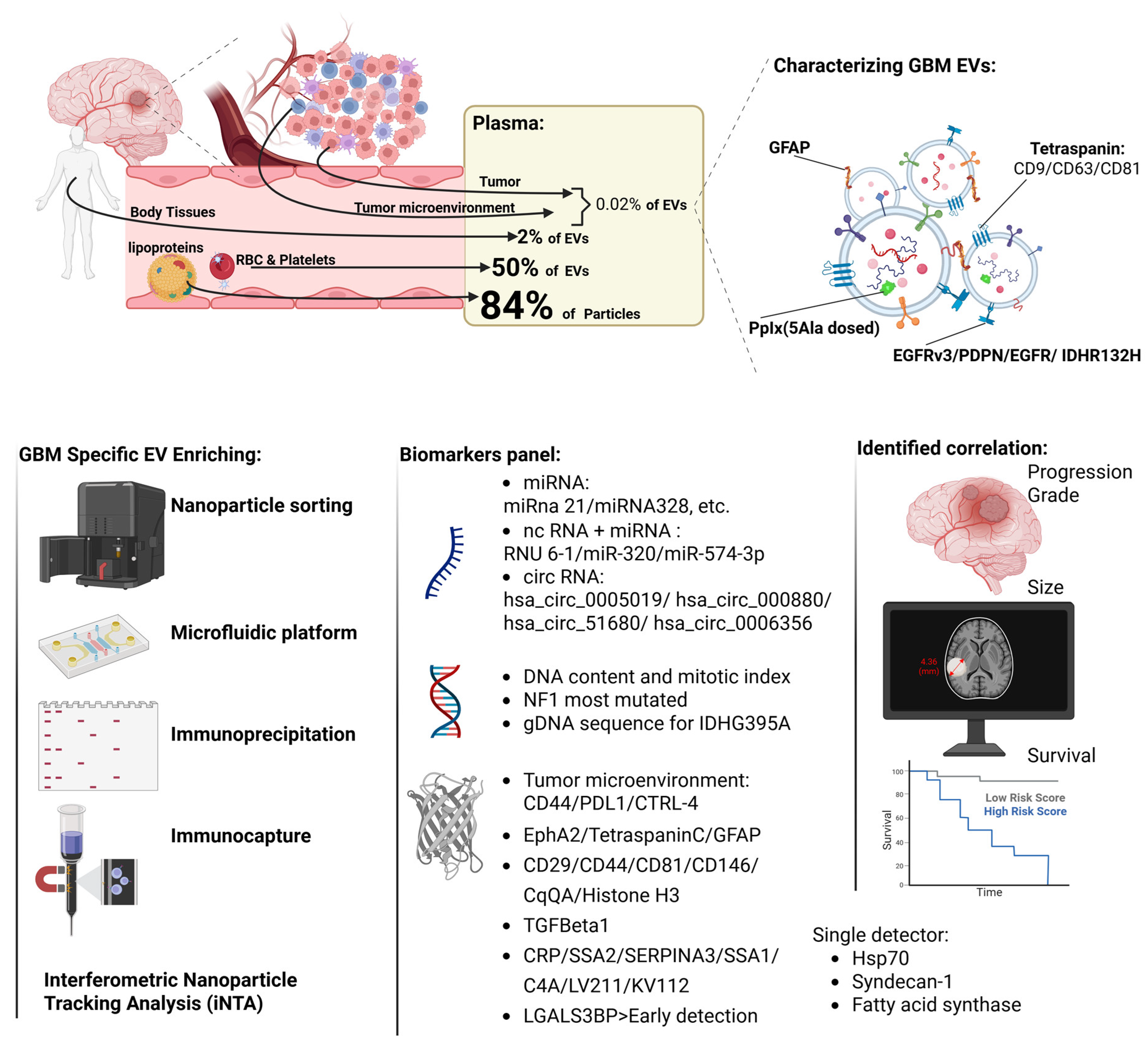
Plasma Extracellular Vesicles as Liquid Biopsies for Glioblastoma: Biomarkers, Subpopulation Enrichment, and Clinical Translation

 , ,
, ,  and
and
Abstract
1. Introduction
2. Part I—Extracellular-Vesicle-Based Liquid Biopsy for GBM Diagnosis and Monitoring
3. Part II—Identifying Tumor-Derived Extracellular Vesicles Among Non-Neoplastic EVs
4. Part III—Characterizing and Enriching Plasma EV Subpopulations Can Improve Downstream Plasma EV Analysis
5. Conclusions
Author Contributions
Funding
Institutional Review Board Statement
Informed Consent Statement
Data Availability Statement
Conflicts of Interest
Abbreviations
| GBM | Glioblastoma |
| EV | Extracellular Vesicle |
| MRI | Magnetic Resonance Imaging |
| CSF | Cerebrospinal Fluid |
| CNS | Central Nervous System |
| BBB | Blood–Brain Barrier |
| FUS | Focused Ultrasound |
| DEP | Dielectrophoretic |
| iNTA | Interferometric Nanoparticle Tracking Analysis |
| HA | Hyaluronic Acid |
References
- Grochans, S.; Cybulska, A.M.; Simińska, D.; Korbecki, J.; Kojder, K.; Chlubek, D.; Baranowska-Bosiacka, I. Epidemiology of Glioblastoma Multiforme—Literature Review. Cancers 2022, 14, 2412. [Google Scholar] [CrossRef] [Scilit]
- Brown, N.F.; Ottaviani, D.; Tazare, J.; Gregson, J.; Kitchen, N.; Brandner, S.; Fersht, N.; Mulholland, P. Survival Outcomes and Prognostic Factors in Glioblastoma. Cancers 2022, 14, 3161. [Google Scholar] [CrossRef] [Scilit]
- Delgado-López, P.D.; Corrales-García, E.M. Survival in glioblastoma: A review on the impact of treatment modalities. Clin. Transl. Oncol. 2016, 18, 1062–1071. [Google Scholar] [CrossRef] [Scilit]
- Tykocki, T.; Eltayeb, M. Ten-year survival in glioblastoma. A systematic review. J. Clin. Neurosci. 2018, 54, 7–13. [Google Scholar] [CrossRef] [Scilit] [PubMed]
- Hygino da Cruz, L.C., Jr.; Rodriguez, I.; Domingues, R.C.; Gasparetto, E.L.; Sorensen, A.G. Pseudoprogression and pseudoresponse: Imaging challenges in the assessment of posttreatment glioma. AJNR Am. J. Neuroradiol. 2011, 32, 1978–1985. [Google Scholar] [CrossRef] [Scilit] [PubMed]
- Kruser, T.J.; Mehta, M.P.; Robins, H.I. Pseudoprogression after glioma therapy: A comprehensive review. Expert Rev. Neurother. 2013, 13, 389–403. [Google Scholar] [CrossRef] [Scilit] [PubMed]
- Barkley, A.S.; Sullivan, L.T.; Gibson, A.W.; Camacho, D.; Barber, J.K.; Ko, A.L.; Silbergeld, D.L.; Ravanpay, A.C. Stereotactic Brain Biopsy Hemorrhage Risk Factors and Implications for Postoperative Care at a Single Institution: An Argument For Postoperative Imaging. World Neurosurg. 2020, 144, e807–e812. [Google Scholar] [CrossRef] [Scilit]
- Louis, D.N.; Perry, A.; Wesseling, P.; Brat, D.J.; Cree, I.A.; Figarella-Branger, D.; Hawkins, C.; Ng, H.K.; Pfister, S.M.; Reifenberger, G.; et al. The 2021 WHO Classification of Tumors of the Central Nervous System: A summary. Neuro. Oncol. 2021, 23, 1231–1251. [Google Scholar] [CrossRef] [Scilit]
- Lan, Z.; Li, X.; Zhang, X. Glioblastoma: An Update in Pathology, Molecular Mechanisms and Biomarkers. Int. J. Mol. Sci. 2024, 25, 3040. [Google Scholar] [CrossRef] [Scilit]
- Lane, R.; Simon, T.; Vintu, M.; Solkin, B.; Koch, B.; Stewart, N.; Benstead-Hume, G.; Pearl, F.M.G.; Critchley, G.; Stebbing, J.; et al. Cell-derived extracellular vesicles can be used as a biomarker reservoir for glioblastoma tumor subtyping. Commun. Biol. 2019, 2, 315. [Google Scholar] [CrossRef] [Scilit]
- Osti, D.; Del Bene, M.; Rappa, G.; Santos, M.; Matafora, V.; Richichi, C.; Faletti, S.; Beznoussenko, G.V.; Mironov, A.; Bachi, A.; et al. Clinical Significance of Extracellular Vesicles in Plasma from Glioblastoma Patients. Clin. Cancer Res. 2019, 25, 266–276. [Google Scholar] [CrossRef] [Scilit] [PubMed]
- Jones, J.; Nguyen, H.; Drummond, K.; Morokoff, A. Circulating Biomarkers for Glioma: A Review. Neurosurgery 2021, 88, E221–E230. [Google Scholar] [CrossRef] [Scilit] [PubMed]
- Cumba Garcia, L.M.; Bouchal, S.M.; Bauman, M.M.J.; Parney, I.F. Advancements and Technical Considerations for Extracellular Vesicle Isolation and Biomarker Identification in Glioblastoma. Neurosurgery 2023, 93, 33–42. [Google Scholar] [CrossRef] [Scilit] [PubMed]
- Zaborowski, M.P.; Balaj, L.; Breakefield, X.O.; Lai, C.P. Extracellular Vesicles: Composition, Biological Relevance, and Methods of Study. BioScience 2015, 65, 783–797. [Google Scholar] [CrossRef] [Scilit]
- Doyle, L.M.; Wang, M.Z. Overview of Extracellular Vesicles, Their Origin, Composition, Purpose, and Methods for Exosome Isolation and Analysis. Cells 2019, 8, 727. [Google Scholar] [CrossRef] [Scilit]
- Arraud, N.; Linares, R.; Tan, S.; Gounou, C.; Pasquet, J.M.; Mornet, S.; Brisson, A.R. Extracellular vesicles from blood plasma: Determination of their morphology, size, phenotype and concentration. J. Thromb. Haemost. 2014, 12, 614–627. [Google Scholar] [CrossRef] [Scilit]
- Garcia-Romero, N.; Carrion-Navarro, J.; Esteban-Rubio, S.; Lazaro-Ibanez, E.; Peris-Celda, M.; Alonso, M.M.; Guzman-De-Villoria, J.; Fernandez-Carballal, C.; de Mendivil, A.O.; Garcia-Duque, S.; et al. DNA sequences within glioma-derived extracellular vesicles can cross the intact blood-brain barrier and be detected in peripheral blood of patients. Oncotarget 2017, 8, 1416–1428. [Google Scholar] [CrossRef] [Scilit]
- Marchisio, M.; Simeone, P.; Bologna, G.; Ercolino, E.; Pierdomenico, L.; Pieragostino, D.; Ventrella, A.; Antonini, F.; Del Zotto, G.; Vergara, D.; et al. Flow Cytometry Analysis of Circulating Extracellular Vesicle Subtypes from Fresh Peripheral Blood Samples. Int. J. Mol. Sci. 2020, 22, 48. [Google Scholar] [CrossRef] [Scilit]
- Yang, C.; Wang, C.; Chen, X.; Chen, S.; Zhang, Y.; Zhi, F.; Wang, J.; Li, L.; Zhou, X.; Li, N. Identification of seven serum microRNAs from a genome-wide serum microRNA expression profile as potential noninvasive biomarkers for malignant astrocytomas. Int. J. Cancer 2013, 132, 116–127. [Google Scholar] [CrossRef] [Scilit]
- Manterola, L.; Guruceaga, E.; Gállego Pérez-Larraya, J.; González-Huarriz, M.; Jauregui, P.; Tejada, S.; Diez-Valle, R.; Segura, V.; Samprón, N.; Barrena, C.; et al. A small noncoding RNA signature found in exosomes of GBM patient serum as a diagnostic tool. Neuro. Oncol. 2014, 16, 520–527. [Google Scholar] [CrossRef] [Scilit]
- Tang, H.; Liu, Q.; Liu, X.; Ye, F.; Xie, X.; Xie, X.; Wu, M. Plasma miR-185 as a predictive biomarker for prognosis of malignant glioma. J. Cancer Res. Ther. 2015, 11, 630. [Google Scholar] [CrossRef] [Scilit]
- Zhi, F.; Shao, N.; Wang, R.; Deng, D.; Xue, L.; Wang, Q.; Zhang, Y.; Shi, Y.; Xia, X.; Wang, S. Identification of 9 serum microRNAs as potential noninvasive biomarkers of human astrocytoma. Neuro-oncology 2015, 17, 383–391. [Google Scholar] [CrossRef] [Scilit] [PubMed]
- Li, H.; Li, Y.; Li, Y.; Shi, X.; Chen, H. Circulating microRNA-137 is a potential biomarker for human glioblastoma. Eur. Rev. Med. Pharmacol. Sci. 2016, 20, 3599–3604. [Google Scholar] [PubMed]
- Ebrahimkhani, S.; Vafaee, F.; Hallal, S.; Wei, H.; Lee, M.Y.T.; Young, P.E.; Satgunaseelan, L.; Beadnall, H.; Barnett, M.H.; Shivalingam, B.; et al. Deep sequencing of circulating exosomal microRNA allows non-invasive glioblastoma diagnosis. NPJ Precis. Oncol. 2018, 2, 28. [Google Scholar] [CrossRef] [Scilit] [PubMed]
- Tzaridis, T.; Reiners, K.S.; Weller, J.; Bachurski, D.; Schäfer, N.; Schaub, C.; Hallek, M.; Scheffler, B.; Glas, M.; Herrlinger, U.; et al. Analysis of Serum miRNA in Glioblastoma Patients: CD44-Based Enrichment of Extracellular Vesicles Enhances Specificity for the Prognostic Signature. Int. J. Mol. Sci. 2020, 21, 7211. [Google Scholar] [CrossRef] [Scilit]
- Hsia, T.; Yekula, A.; Batool, S.M.; Rosenfeld, Y.B.; You, D.G.; Weissleder, R.; Lee, H.; Carter, B.S.; Balaj, L. Glioblastoma-derived extracellular vesicle subpopulations following 5-aminolevulinic acid treatment bear diagnostic implications. J. Extracell. Vesicles 2022, 11, e12278. [Google Scholar] [CrossRef] [Scilit]
- Gallo, A.; Tandon, M.; Alevizos, I.; Illei, G.G. The Majority of MicroRNAs Detectable in Serum and Saliva Is Concentrated in Exosomes. PLoS ONE 2012, 7, e30679. [Google Scholar] [CrossRef] [Scilit]
- Higginbotham, J.N.; Zhang, Q.; Jeppesen, D.K.; Scott, A.M.; Manning, H.C.; Ochieng, J.; Franklin, J.L.; Coffey, R.J. Identification and characterization of EGF receptor in individual exosomes by fluorescence-activated vesicle sorting. J. Extracell. Vesicles 2016, 5, 29254. [Google Scholar] [CrossRef] [Scilit]
- Morales-Kastresana, A.; Welsh, J.A.; Jones, J.C. Detection and Sorting of Extracellular Vesicles and Viruses Using nanoFACS. Curr. Protoc. Cytom. 2020, 95, e81. [Google Scholar] [CrossRef] [Scilit]
- Bauman, M.M.; Bouchal, S.M.; Monie, D.D.; Aibaidula, A.; Singh, R.; Parney, I.F. Strategies, considerations, and recent advancements in the development of liquid biopsy for glioblastoma: A step towards individualized medicine in glioblastoma. Neurosurg. Focus 2022, 53, E14. [Google Scholar] [CrossRef] [Scilit]
- Del Bene, M.; Osti, D.; Faletti, S.; Beznoussenko, G.V.; DiMeco, F.; Pelicci, G. Extracellular vesicles: The key for precision medicine in glioblastoma. Neuro-Oncology 2022, 24, 184–196. [Google Scholar] [CrossRef] [Scilit] [PubMed]
- Akers, J.C.; Ramakrishnan, V.; Kim, R.; Phillips, S.; Kaimal, V.; Mao, Y.; Hua, W.; Yang, I.; Fu, C.C.; Nolan, J.; et al. miRNA contents of cerebrospinal fluid extracellular vesicles in glioblastoma patients. J. Neurooncol. 2015, 123, 205–216. [Google Scholar] [CrossRef] [Scilit]
- Olioso, D.; Caccese, M.; Santangelo, A.; Lippi, G.; Zagonel, V.; Cabrini, G.; Lombardi, G.; Dechecchi, M.C. Serum exosomal microrna-21, 222 and 124-3p as noninvasive predictive biomarkers in newly diagnosed high-grade gliomas: A prospective study. Cancers 2021, 13, 3006. [Google Scholar] [CrossRef] [Scilit] [PubMed]
- Shao, N.; Xue, L.; Wang, R.; Luo, K.; Zhi, F.; Lan, Q. miR-454-3p Is an Exosomal Biomarker and Functions as a Tumor Suppressor in Glioma. Mol. Cancer Ther. 2019, 18, 459–469. [Google Scholar] [CrossRef] [Scilit] [PubMed]
- Zeng, A.; Wei, Z.; Yan, W.; Yin, J.; Huang, X.; Zhou, X.; Li, R.; Shen, F.; Wu, W.; Wang, X.; et al. Exosomal transfer of miR-151a enhances chemosensitivity to temozolomide in drug-resistant glioblastoma. Cancer Lett. 2018, 436, 10–21. [Google Scholar] [CrossRef] [Scilit]
- Deep, G.; He, Y.; Kumar, A.; Singh, S.; Kim, S.; Su, Y.; Herpai, D.; Fansler, A.; Whitlow, C.T.; Strowd, R.E.; et al. Small extracellular vesicles as a novel liquid biopsy approach for glioblastoma. J. Clin. Oncol. 2024, 42 (Suppl. S16), 2073. [Google Scholar] [CrossRef] [Scilit]
- Mut, M.; Adiguzel, Z.; Cakir-Aktas, C.; Hanalioğlu, Ş.; Gungor-Topcu, G.; Kiyga, E.; Isikay, I.; Sarac, A.; Soylemezoglu, F.; Strobel, T.; et al. Extracellular-Vesicle-Based Cancer Panels Diagnose Glioblastomas with High Sensitivity and Specificity. Cancers 2023, 15, 3782. [Google Scholar] [CrossRef] [Scilit]
- Reátegui, E.; van der Vos, K.E.; Lai, C.P.; Zeinali, M.; Atai, N.A.; Aldikacti, B.; Floyd, F.P., Jr.; Khankhel, A.H.; Thapar, V.; Hochberg, F.H.; et al. Engineered nanointerfaces for microfluidic isolation and molecular profiling of tumor-specific extracellular vesicles. Nat. Commun. 2018, 9, 175. [Google Scholar] [CrossRef] [Scilit]
- Batool, S.M.; Muralidharan, K.; Hsia, T.; Falotico, S.; Gamblin, A.S.; Rosenfeld, Y.B.; Khanna, S.K.; Balaj, L.; Carter, B.S. Highly Sensitive EGFRvIII Detection in Circulating Extracellular Vesicle RNA of Glioma Patients. Clin. Cancer Res. 2022, 28, 4070–4082. [Google Scholar] [CrossRef] [Scilit]
- Skog, J.; Wurdinger, T.; van Rijn, S.; Meijer, D.H.; Gainche, L.; Sena-Esteves, M.; Curry, W.T., Jr.; Carter, B.S.; Krichevsky, A.M.; Breakefield, X.O. Glioblastoma microvesicles transport RNA and proteins that promote tumour growth and provide diagnostic biomarkers. Nat. Cell Biol. 2008, 10, 1470–1476. [Google Scholar] [CrossRef] [Scilit]
- Li, P.; Xu, Z.; Liu, T.; Liu, Q.; Zhou, H.; Meng, S.; Feng, Z.; Tang, Y.; Liu, C.; Feng, J.; et al. Circular RNA Sequencing Reveals Serum Exosome Circular RNA Panel for High-Grade Astrocytoma Diagnosis. Clin. Chem. 2022, 68, 332–343. [Google Scholar] [CrossRef] [Scilit]
- Patnam, S.; Samal, R.; Koyyada, R.; Joshi, P.; Singh, A.D.; Nagalla, B.; Soma, M.R.; Sannareddy, R.R.; Ippili, K.; Raju, S.; et al. Exosomal PTEN as a Predictive Marker of Aggressive Gliomas. Neurol. India 2022, 70, 215–222. [Google Scholar] [CrossRef] [Scilit]
- Muller, L.; Muller-Haegele, S.; Mitsuhashi, M.; Gooding, W.; Okada, H.; Whiteside, T.L. Exosomes isolated from plasma of glioma patients enrolled in a vaccination trial reflect antitumor immune activity and might predict survival. Oncoimmunology 2015, 4, e1008347. [Google Scholar] [CrossRef] [Scilit]
- Piazza, A.; Rosa, P.; Ricciardi, L.; Mangraviti, A.; Pacini, L.; Calogero, A.; Raco, A.; Miscusi, M. Circulating Exosomal-DNA in Glioma Patients: A Quantitative Study and Histopathological Correlations. A Preliminary Study. Brain Sci. 2022, 12, 500. [Google Scholar] [CrossRef] [Scilit]
- Rosa, P.; De Falco, E.; Pacini, L.; Piazza, A.; Ciraci, P.; Ricciardi, L.; Fiorentino, F.; Trungu, S.; Miscusi, M.; Raco, A.; et al. Next-Generation Sequencing Comparative Analysis of DNA Mutations between Blood-Derived Extracellular Vesicles and Matched Cancer Tissue in Patients with Grade 4 Glioblastoma. Biomedicines 2022, 10, 2590. [Google Scholar] [CrossRef] [Scilit] [PubMed]
- Cilibrasi, C.; Simon, T.; Vintu, M.; Tolias, C.; Samuels, M.; Mazarakis, N.K.; Eravci, M.; Stewart, N.; Critchley, G.; Giamas, G. Definition of an Inflammatory Biomarker Signature in Plasma-Derived Extracellular Vesicles of Glioblastoma Patients. Biomedicines 2022, 10, 125. [Google Scholar] [CrossRef] [Scilit] [PubMed]
- Cumba Garcia, L.M.; Peterson, T.E.; Cepeda, M.A.; Johnson, A.J.; Parney, I.F. Isolation and Analysis of Plasma-Derived Exosomes in Patients With Glioma. Front. Oncol. 2019, 9, 651. [Google Scholar] [CrossRef] [Scilit] [PubMed]
- Tzaridis, T.; Weller, J.; Bachurski, D.; Shakeri, F.; Schaub, C.; Hau, P.; Buness, A.; Schlegel, U.; Steinbach, J.P.; Seidel, C.; et al. A novel serum extracellular vesicle protein signature to monitor glioblastoma tumor progression. Int. J. Cancer 2023, 152, 308–319. [Google Scholar] [CrossRef] [Scilit]
- Hallal, S.; Azimi, A.; Wei, H.; Ho, N.; Lee, M.Y.T.; Sim, H.-W.; Sy, J.; Shivalingam, B.; Buckland, M.E.; Alexander-Kaufman, K.L. A Comprehensive Proteomic SWATH-MS Workflow for Profiling Blood Extracellular Vesicles: A New Avenue for Glioma Tumour Surveillance. Int. J. Mol. Sci. 2020, 21, 4754. [Google Scholar] [CrossRef] [Scilit]
- Rana, R.; Chauhan, K.; Gautam, P.; Kulkarni, M.; Banarjee, R.; Chugh, P.; Chhabra, S.S.; Acharya, R.; Kalra, S.K.; Gupta, A.; et al. Plasma-Derived Extracellular Vesicles Reveal Galectin-3 Binding Protein as Potential Biomarker for Early Detection of Glioma. Front. Oncol. 2021, 11, 778754. [Google Scholar] [CrossRef] [Scilit]
- Andre-Gregoire, G.; Bidere, N.; Gavard, J. Temozolomide affects Extracellular Vesicles Released by Glioblastoma Cells. Biochimie 2018, 155, 11–15. [Google Scholar] [CrossRef] [Scilit] [PubMed]
- Bukva, M.; Dobra, G.; Gomez-Perez, J.; Koos, K.; Harmati, M.; Gyukity-Sebestyen, E.; Biro, T.; Jenei, A.; Kormondi, S.; Horvath, P.; et al. Raman spectral signatures of serum-derived extracellular vesicle-enriched isolates may support the diagnosis of CNS tumors. Cancers 2021, 13, 1407. [Google Scholar] [CrossRef] [Scilit] [PubMed]
- Graner, M.W.; Alzate, O.; Dechkovskaia, A.M.; Keene, J.D.; Sampson, J.H.; Mitchell, D.A.; Bigner, D.D. Proteomic and immunologic analyses of brain tumor exosomes. FASEB J. 2009, 23, 1541–1557. [Google Scholar] [CrossRef] [Scilit] [PubMed]
- Indira Chandran, V.; Welinder, C.; Mansson, A.-S.; Offer, S.; Freyhult, E.; Pernemalm, M.; Lund, S.M.; Pedersen, S.; Lehtio, J.; Marko-Varga, G.; et al. Ultrasensitive Immunoprofiling of Plasma Extracellular Vesicles Identifies Syndecan-1 as a Potential Tool for Minimally Invasive Diagnosis of Glioma. Clin. Cancer Res. 2019, 25, 3115–3127. [Google Scholar] [CrossRef] [Scilit]
- Werner, C.; Stangl, S.; Salvermoser, L.; Schwab, M.; Shevtsov, M.; Xanthopoulos, A.; Wang, F.; Dezfouli, A.B.; Tholke, D.; Ostheimer, C.; et al. Hsp70 in Liquid Biopsies-A Tumor-Specific Biomarker for Detection and Response Monitoring in Cancer. Cancers 2021, 13, 3706. [Google Scholar] [CrossRef] [Scilit]
- Dobra, G.; Bukva, M.; Szabo, Z.; Bruszel, B.; Harmati, M.; Gyukity-Sebestyen, E.; Jenei, A.; Szucs, M.; Horvath, P.; Biro, T.; et al. Small Extracellular Vesicles Isolated from Serum May Serve as Signal-Enhancers for the Monitoring of CNS Tumors. Int. J. Mol. Sci. 2020, 21, 5359. [Google Scholar] [CrossRef] [Scilit]
- Ricklefs, F.L.; Maire, C.L.; Matschke, J.; Duhrsen, L.; Sauvigny, T.; Holz, M.; Kolbe, K.; Peine, S.; Herold-Mende, C.; Carter, B.; et al. Fasn is a biomarker enriched in malignant glioma-derived extracellular vesicles. Int. J. Mol. Sci. 2020, 21, 1931. [Google Scholar] [CrossRef] [Scilit]
- Fraser, K.; Jo, A.; Giedt, J.; Vinegoni, C.; Yang, K.S.; Peruzzi, P.; Chiocca, E.A.; Breakefield, X.O.; Lee, H.; Weissleder, R. Characterization of single microvesicles in plasma from glioblastoma patients. Neuro-Oncology 2019, 21, 606–615. [Google Scholar] [CrossRef] [Scilit]
- Jones, P.S.; Yekula, A.; Lansbury, E.; Small, J.L.; Ayinon, C.; Mordecai, S.; Hochberg, F.H.; Tigges, J.; Delcuze, B.; Charest, A.; et al. Characterization of plasma-derived protoporphyrin-IX-positive extracellular vesicles following 5-ALA use in patients with malignant glioma. EBioMedicine 2019, 48, 23–35. [Google Scholar] [CrossRef] [Scilit]
- Maas, S.L.N.; van Solinge, T.S.; Schnoor, R.; Yekula, A.; Senders, J.T.; de Vrij, J.; Robe, P.; Carter, B.S.; Balaj, L.; Arkesteijn, G.J.A.; et al. Orally Administered 5-aminolevulinic Acid for Isolation and Characterization of Circulating Tumor-Derived Extracellular Vesicles in Glioblastoma Patients. Cancers 2020, 12, 3297. [Google Scholar] [CrossRef] [Scilit]
- Koch, C.J.; Lustig, R.A.; Yang, X.Y.; Jenkins, W.T.; Wolf, R.L.; Martinez-Lage, M.; Desai, A.; Williams, D.; Evans, S.M. Microvesicles as a biomarker for tumor progression versus treatment effect in radiation/temozolomide-treated glioblastoma patients. Transl. Oncol. 2014, 7, 752–758. [Google Scholar] [CrossRef] [Scilit]
- He, Y.; Kumar, A.; Singh, S.; Kim, S.; Su, Y.; Herpai, D.; Fansler, A.; Whitlow, C.; Strowd, R.; Debinski, W.; et al. BIOM-21. Small Extracellular Vesicles as a Novel Liquid Biopsy Approach for Glioblastoma. Neuro-Oncology 2024, 26, viii23–viii24. [Google Scholar] [CrossRef] [Scilit]
- Ricklefs, F.L.; Wollmann, K.; Salviano-Silva, A.; Drexler, R.; Maire, C.L.; Kaul, M.G.; Reimer, R.; Schüller, U.; Heinemann, S.; Kolbe, K.; et al. Circulating extracellular vesicles as biomarker for diagnosis, prognosis, and monitoring in glioblastoma patients. Neuro-Oncology 2024, 26, 1280–1291. [Google Scholar] [CrossRef] [Scilit]
- Manda, S.V.; Kataria, Y.; Tatireddy, B.R.; Ramakrishnan, B.; Ratnam, B.G.; Lath, R.; Ranjan, A.; Ray, A. Exosomes as a biomarker platform for detecting epidermal growth factor receptor-positive high-grade gliomas. J. Neurosurg. 2018, 128, 1091–1101. [Google Scholar] [CrossRef] [Scilit] [PubMed]
- Susa, K.J.; Kruse, A.C.; Blacklow, S.C. Tetraspanins: Structure, dynamics, and principles of partner-protein recognition. Trends Cell Biol. 2024, 34, 509–522. [Google Scholar] [CrossRef] [Scilit] [PubMed]
- Ricklefs, F.L.; Maire, C.L.; Reimer, R.; Duhrsen, L.; Kolbe, K.; Holz, M.; Schneider, E.; Rissiek, A.; Babayan, A.; Hille, C.; et al. Imaging flow cytometry facilitates multiparametric characterization of extracellular vesicles in malignant brain tumours. J. Extracell. Vesicles 2019, 8, 1588555. [Google Scholar] [CrossRef] [Scilit]
- Sartori, M.T.; Della Puppa, A.; Ballin, A.; Campello, E.; Radu, C.M.; Saggiorato, G.; d’Avella, D.; Scienza, R.; Cella, G.; Simioni, P. Circulating microparticles of glial origin and tissue factor bearing in high-grade glioma: A potential prothrombotic role. Thromb. Haemost. 2013, 110, 378–385. [Google Scholar] [CrossRef] [Scilit]
- Galbo, P.M., Jr.; Ciesielski, M.J.; Figel, S.; Maguire, O.; Qiu, J.; Wiltsie, L.; Minderman, H.; Fenstermaker, R.A. Circulating CD9+/GFAP+/survivin+ exosomes in malignant glioma patients following survivin vaccination. Oncotarget 2017, 8, 114722–114735. [Google Scholar] [CrossRef] [Scilit]
- Meng, Y.; Pople, C.B.; Suppiah, S.; Llinas, M.; Huang, Y.; Sahgal, A.; Perry, J.; Keith, J.; Davidson, B.; Hamani, C.; et al. MR-guided focused ultrasound liquid biopsy enriches circulating biomarkers in patients with brain tumors. Neuro-Oncology 2021, 23, 1789–1797. [Google Scholar] [CrossRef] [Scilit]
- Evans, S.M.; Putt, M.; Yang, X.Y.; Lustig, R.A.; Martinez-Lage, M.; Williams, D.; Desai, A.; Wolf, R.; Brem, S.; Koch, C.J. Initial evidence that blood-borne microvesicles are biomarkers for recurrence and survival in newly diagnosed glioblastoma patients. J. Neuro-Oncol. 2016, 127, 391–400. [Google Scholar] [CrossRef] [Scilit]
- Shao, H.; Chung, J.; Balaj, L.; Charest, A.; Bigner, D.D.; Carter, B.S.; Hochberg, F.H.; Breakefield, X.O.; Weissleder, R.; Lee, H. Protein typing of circulating microvesicles allows real-time monitoring of glioblastoma therapy. Nat. Med. 2012, 18, 1835–1840. [Google Scholar] [CrossRef] [Scilit] [PubMed]
- Traylor, J.I.; Pernik, M.N.; Sternisha, A.C.; McBrayer, S.K.; Abdullah, K.G. Molecular and Metabolic Mechanisms Underlying Selective 5-Aminolevulinic Acid-Induced Fluorescence in Gliomas. Cancers 2021, 13, 580. [Google Scholar] [CrossRef] [Scilit] [PubMed]
- Welsh, J.A.; Arkesteijn, G.J.A.; Bremer, M.; Cimorelli, M.; Dignat-George, F.; Giebel, B.; Görgens, A.; Hendrix, A.; Kuiper, M.; Lacroix, R.; et al. A compendium of single extracellular vesicle flow cytometry. J. Extracell. Vesicles 2023, 12, e12299. [Google Scholar] [CrossRef] [Scilit] [PubMed]
- Sódar, B.W.; Kittel, Á.; Pálóczi, K.; Vukman, K.V.; Osteikoetxea, X.; Szabó-Taylor, K.; Németh, A.; Sperlágh, B.; Baranyai, T.; Giricz, Z.; et al. Low-density lipoprotein mimics blood plasma-derived exosomes and microvesicles during isolation and detection. Sci. Rep. 2016, 6, 24316. [Google Scholar] [CrossRef] [Scilit]
- Brennan, K.; Martin, K.; FitzGerald, S.P.; O’Sullivan, J.; Wu, Y.; Blanco, A.; Richardson, C.; Mc Gee, M.M. A comparison of methods for the isolation and separation of extracellular vesicles from protein and lipid particles in human serum. Sci. Rep. 2020, 10, 1039. [Google Scholar] [CrossRef] [Scilit]
- Hsia, T.; You, D.G.; Politis, M.G.; Batool, S.M.; Ekanayake, E.; Lee, H.; Carter, B.S.; Balaj, L. Rigorous Comparison of Extracellular Vesicle Processing to Enhance Downstream Analysis for Glioblastoma Characterization. Adv. Biol. 2024, 8, e2300233. [Google Scholar] [CrossRef] [Scilit]
- Arroyo, J.D.; Chevillet, J.R.; Kroh, E.M.; Ruf, I.K.; Pritchard, C.C.; Gibson, D.F.; Mitchell, P.S.; Bennett, C.F.; Pogosova-Agadjanyan, E.L.; Stirewalt, D.L.; et al. Argonaute2 complexes carry a population of circulating microRNAs independent of vesicles in human plasma. Proc. Natl. Acad. Sci. USA 2011, 108, 5003–5008. [Google Scholar] [CrossRef] [Scilit]
- Hunter, M.P.; Ismail, N.; Zhang, X.; Aguda, B.D.; Lee, E.J.; Yu, L.; Xiao, T.; Schafer, J.; Lee, M.-L.T.; Schmittgen, T.D.; et al. Detection of microRNA Expression in Human Peripheral Blood Microvesicles. PLoS ONE 2008, 3, e3694, Correction in PLoS ONE 2010, 5, e3694. https://doi.org/10.1371/annotation/b15ca816-7b62-4474-a568-6b60b8959742. [Google Scholar] [CrossRef] [Scilit]
- Ivo D’Urso, P.; Fernando D’Urso, O.; Damiano Gianfreda, C.; Mezzolla, V.; Storelli, C.; Marsigliante, S. miR-15b and miR-21 as circulating biomarkers for diagnosis of glioma. Curr. Genom. 2015, 16, 304–311. [Google Scholar] [CrossRef] [Scilit]
- Inoue, A.; Ohnishi, T.; Nishikawa, M.; Ohtsuka, Y.; Kusakabe, K.; Yano, H.; Tanaka, J.; Kunieda, T. A Narrative Review on CD44’s Role in Glioblastoma Invasion, Proliferation, and Tumor Recurrence. Cancers 2023, 15, 4898. [Google Scholar] [CrossRef] [Scilit]
- Sabaté del Río, J.; Son, Y.; Park, J.; Sunkara, V.; Cho, Y.-K. Microfluidic Dielectrophoretic Purification of Extracellular Vesicles from Plasma Lipoproteins. Langmuir 2024, 40, 25772–25784. [Google Scholar] [CrossRef] [Scilit]
- Kashkanova, A.D.; Albrecht, D.; Küppers, M.; Blessing, M.; Sandoghdar, V. Measuring Concentration of Nanoparticles in Polydisperse Mixtures Using Interferometric Nanoparticle Tracking Analysis. ACS Nano 2024, 18, 19161–19168. [Google Scholar] [CrossRef] [Scilit] [PubMed]
- Maniya, N.H.; Kumar, S.; Franklin, J.L.; Higginbotham, J.N.; Scott, A.M.; Gan, H.K.; Coffey, R.J.; Senapati, S.; Chang, H.C. Detection of EGFR and its Activity State in Plasma CD63-EVs from Glioblastoma Patients: Rapid Profiling using an Anion Exchange Membrane Sensor. bioRxiv 2023. [Google Scholar] [CrossRef] [Scilit] [PubMed]
- Johnsen, K.B.; Gudbergsson, J.M.; Andresen, T.L.; Simonsen, J.B. What is the blood concentration of extracellular vesicles? Implications for the use of extracellular vesicles as blood-borne biomarkers of cancer. Biochim. Biophys. Acta Rev. Cancer 2019, 1871, 109–116. [Google Scholar] [CrossRef] [Scilit] [PubMed]
- Li, Y.; He, X.; Li, Q.; Lai, H.; Zhang, H.; Hu, Z.; Li, Y.; Huang, S. EV-origin: Enumerating the tissue-cellular origin of circulating extracellular vesicles using exLR profile. Comput. Struct. Biotechnol. J. 2020, 18, 2851–2859. [Google Scholar] [CrossRef] [Scilit]
- Barlin, M.; Erdmann-Gilmore, P.; Mudd, J.L.; Zhang, Q.; Seymour, R.W.; Guo, Z.; Miessner, J.R.; Goedegebuure, S.P.; Bi, Y.; Osorio, O.A.; et al. Proteins in Tumor-Derived Plasma Extracellular Vesicles Indicate Tumor Origin. Mol. Cell. Proteomics 2023, 22, 100476. [Google Scholar] [CrossRef] [Scilit]
- van der Vos, K.E.; Abels, E.R.; Zhang, X.; Lai, C.; Carrizosa, E.; Oakley, D.; Prabhakar, S.; Mardini, O.; Crommentuijn, M.H.; Skog, J.; et al. Directly visualized glioblastoma-derived extracellular vesicles transfer RNA to microglia/macrophages in the brain. Neuro-Oncology 2016, 18, 58–69. [Google Scholar] [CrossRef] [Scilit]
- Ibsen, S.D.; Wright, J.; Lewis, J.M.; Kim, S.; Ko, S.Y.; Ong, J.; Manouchehri, S.; Vyas, A.; Akers, J.; Chen, C.C.; et al. Rapid isolation and detection of exosomes and associated biomarkers from plasma. ACS Nano 2017, 11, 6641–6651. [Google Scholar] [CrossRef] [Scilit]
- Phillips, W.; Willms, E.; Hill, A.F. Understanding extracellular vesicle and nanoparticle heterogeneity: Novel methods and considerations. Proteomics 2021, 21, e2000118. [Google Scholar] [CrossRef] [Scilit]
- Smith, Z.J.; Lee, C.; Rojalin, T.; Carney, R.P.; Hazari, S.; Knudson, A.; Lam, K.; Saari, H.; Ibañez, E.L.; Viitala, T.; et al. Single exosome study reveals subpopulations distributed among cell lines with variability related to membrane content. J. Extracell. Vesicles 2015, 4, 28533. [Google Scholar] [CrossRef] [Scilit]
- Su, X.; Júnior, G.P.O.; Marie, A.L.; Gregus, M.; Figueroa-Navedo, A.; Ghiran, I.C.; Ivanov, A.R. Enhanced proteomic profiling of human plasma-derived extracellular vesicles through charge-based fractionation to advance biomarker discovery potential. J. Extracell. Vesicles 2024, 13, e70024. [Google Scholar] [CrossRef] [Scilit]
- Biernat, W.; Huang, H.; Yokoo, H.; Kleihues, P.; Ohgaki, H. Predominant expression of mutant EGFR (EGFRvIII) is rare in primary glioblastomas. Brain Pathol. 2004, 14, 131–136. [Google Scholar] [CrossRef] [Scilit]
- Parney, I.F.; Waldron, J.S.; Parsa, A.T. Flow cytometry and in vitro analysis of human glioma-associated macrophages. Laboratory investigation. J. Neurosurg. 2009, 110, 572–582. [Google Scholar] [CrossRef] [Scilit]
- Ayasoufi, K.; Pfaller, C.K.; Evgin, L.; Khadka, R.H.; Tritz, Z.P.; Goddery, E.N.; Fain, C.E.; Yokanovich, L.T.; Himes, B.T.; Jin, F.; et al. Brain cancer induces systemic immunosuppression through release of non-steroid soluble mediators. Brain 2020, 143, 3629–3652. [Google Scholar] [CrossRef] [Scilit] [PubMed]
- Himes, B.T.; Geiger, P.A.; Ayasoufi, K.; Bhargav, A.G.; Brown, D.A.; Parney, I.F. Immunosuppression in Glioblastoma: Current Understanding and Therapeutic Implications. Front. Oncol. 2021, 11, 770561. [Google Scholar] [CrossRef] [Scilit] [PubMed]
- Kremmidiotis, G.; Zola, H. Changes in CD44 expression during B cell differentiation in the human tonsil. Cell. Immunol. 1995, 161, 147–157. [Google Scholar] [CrossRef] [Scilit] [PubMed]
- Thakur, A.; Xu, C.; Li, W.K.; Qiu, G.; He, B.; Ng, S.-P.; Wu, C.-M.L.; Lee, Y. In vivo liquid biopsy for glioblastoma malignancy by the AFM and LSPR based sensing of exosomal CD44 and CD133 in a mouse model. Biosens. Bioelectron. 2021, 191, 113476. [Google Scholar] [CrossRef] [Scilit]
- Ishwar, D.; Haldavnekar, R.; Das, S.; Tan, B.; Venkatakrishnan, K. Glioblastoma Associated Natural Killer Cell EVs Generating Tumour-Specific Signatures: Noninvasive GBM Liquid Biopsy with Self-Functionalized Quantum Probes. ACS Nano 2022, 16, 10859–10877. [Google Scholar] [CrossRef] [Scilit]
- Daneman, R.; Prat, A. The blood-brain barrier. Cold Spring Harb. Perspect. Biol. 2015, 7, a020412. [Google Scholar] [CrossRef] [Scilit]
- Welsh, J.A.; Goberdhan, D.C.I.; O’Driscoll, L.; Buzas, E.I.; Blenkiron, C.; Bussolati, B.; Cai, H.; Di Vizio, D.; Driedonks, T.A.P.; Erdbrügger, U.; et al. Minimal information for studies of extracellular vesicles (MISEV2023): From basic to advanced approaches. J. Extracell. Vesicles 2024, 13, e12404, Correction in J. Extracell. Vesicles 2024, 13, e12451. [Google Scholar] [CrossRef] [Scilit]


| Biomarker | EV Isolation Method | Case (n) | Control (n) | Sensitivity | Specificity | References |
|---|---|---|---|---|---|---|
| miR-21, miR-222 and miR-124-3p | ExoQuick-TM | GBM (55); AA (5) | Patients served as their own internal controls | ROCAUC: 0.93 miR-21; 0.84 miR-222; and 0.88 miR-124-3p | Olioso, D. et al., 2021 [33] | |
| miR-454-3p | Ribo Exosome Isolation Reagent | Glioma (24) | Healthy donors (24) | 79.17% | 91.67% | Shao, N. et al., 2019 [34] |
| miR-21, miR-103, miR-24, and miR-125 | differential ultracentrifugation | GBM (9) | None | NR | NR | Akers, J. et al., 2015 [32] |
| let-7i, miR93 and miR-151a | differential ultracentrifugation | GBM (15) | GBM (No TMZ exposure) | NR | NR | Zeng, A. et al., 2018 [35] |
| miRNA profile | size-exclusion chromatography | GBM (55) | Healthy donors (10) | NR | NR | Tzaridis, T. et al., 2020 [25] |
| miRNA profile | Size exclusion chromatography | GBM (16, IDH wt), Grade II-III (10, IDH mut) | Healthy donors (25), non-glioma (10) | AUROC 0.84 | Ebrahimkhani, S. et al., 2018 [24] | |
| miRNA profile | modified ExoQuick with immunoprecipitation | GBM (31, Grade 3 and 4 GBM, grade 2 and 3 astrocytoma) | Healthy donors (9) | NR | NR | Deep et al., 2024 [36] |
| miRNA and non-coding RNA | ExoQuick precipitation solution | GBM (25 study set, 50 validation set) | Healthy donors (25) | 87% (cutoff value of 0.349 for the 3 sncRNAs) | 86% (cutoff value of 0.349 for the 3 sncRNAs) | Manterola, L. et al., 2014 [20] |
| miRNA and mRNA | ExoRNeasy Serum/Plasma Midi Kit | GBM (91) | Healthy donors (31) | 89–100% | 73–100% | Mut et al., 2023 [37] |
| EGFRvIII mRNA | microfluidic isolation | GBM (13) | Healthy donors (6) | NR | 94% tumor-EV specificity | Reátegui, E. et al., 2018 [38] |
| EGFRvIII mRNA | ExoRNeasy Maxi Kit | GBM (30, EGFRvIII) | GBM (10, EGFRwt), healthy donors (14) | 72.77% | 97.67% | Batool, S. et al., 2022 [39] |
| EGFRvIII mRNA | differential ultracentrifugation | GBM (30) | Healthy donors (30) | 7/25 detected EGFRvIII | NR | Skog, J. et al., 2008 [40] |
| circular RNA | Total Exosome Isolation | High grade astrocytoma (30) | Healthy donors (12) | hsa_circ_0075828 (96.67%) hsa_circ_0002976 (93.33%) hsa_circ_0003828 (73.33%) | hsa_circ_0075828 (99.92%) hsa_circ_0002976 (91.67%) hsa_circ_0003828 (83.33%) | Li, P. et al., 2022 [41] |
| Exosomal mRNA (PTEN, YAP1, LOX) | total Exosome Isolation Kit | Glioma (106, Grade IV 62, Grade III 14, Grade II 26, Grade I 4) | Healthy donors (20) | 71.6% (PTEN) | NR | Patnam, S. et al., 2022 [42] |
| Total protein level and mRNA expression levels for 24 genes | size exclusion columns followed by differential ultracentrifugation | GBM (13), AA (5), AO (3), AOA (1) | Healthy donors (10) | NR | NR | Muller, L. et al., 2015 [43] |
| Concentration of exosomal DNA | membrane-based affinity | GBM (10), Grade III (1), Grade II (3 IDH mut, 2 IDH wt) | Other neurologic diseases (10) | NR | NR | Piazza, A. et al., 2022 [44] |
| IDH1G395A gDNA sequence | differential ultracentrifugation, fast Cold PCR | Glioma (20), brain metastasis (1) | Intact BBB (3), disrupted BBB (18). No healthy donors. | NR | NR | Garcia-Romero et al., 2017 [17] |
| exosomal DNA (ATRX, CDKN2A, H3F3A, IDH1, IDH2, NF1, PTEN, TERT, and TP53) | differential ultracentrifugation followed by exoEasy maxi kit | GBM (10) | Healthy donors (5) | NR | NR | Rosa, P. 2022 [45] |
| Inflammatory biomarker signature | differential ultracentrifugation | GBM (15) | Healthy donors (10) | NR | NR | Cilibrasi, C. et al., 2022 [46] |
| Cytokine and checkpoint molecule arrays | density gradient ultracentrifugation | GBM (19) | Healthy donors (19) | NR | NR | Cumba Garcia, L. et al., 2019 [47] |
| Proteomic signature | modified ExoQuick with immunoprecipitation | GBM (31, Grade 3 and 4 GBM, grade 2 and 3 astrocytoma) | Healthy donors (9) | NR | NR | Deep et al., 2024 [36] |
| Proteomic signature | Exo-spin exosome purification kit | GBM (67, IDH wt) | Healthy donors (22) | AUROC 0.76 | Tzaridis et al., 2023 [48] | |
| Proteomic signature | size-exclusion chromatography | GBM (24 IDH wt, 2 IDH mut), Glioma Grade II–III (13 astrocytoma IDH mut; 4 oligodendroglioma IDH mut, 1p19q codeleted) | Meningioma (5, garde I), Healthy donors (6) | NR | NR | Hallal, S. et al., 2020 [49] |
| Proteomic signature | differential ultracentrifugation | Glioma (9, Grade I, II, or III, 3 in each group) | Healthy donors (3) | 77.8% (galectin-3 BP) | 35.5% (galectin-3 BP) | Rana, R. et al., 2021 [50] |
| Proteomic signature | differential ultracentrifugation | GBM (6) | Healthy donors (6) | NR | NR | André-Grégoire, G. et al., 2018 [51] |
| Raman spectra of plasma EVs | differential ultracentrifugation | GBM (46), brain metastasis (28), meningioma (28) | Lumbar disc herniation (36) | 80–95% | 80–90% | Bukva, M. et al., 2021 [52] |
| TGF-beta1 | differential ultracentrifugation | High grade glioma (12) | Healthy donors (12) | NR | NR | Graner, M. et al., 2009 [53] |
| Syndecan-1 | size exclusion chromatography | GBM (69), LGG (17) | Healthy donors (3) | 79% | 91% | Chandran, V.I. et al., 2019 [54] |
| HSP70 | differential ultracentrifugation | GBM (34), NSCLC (166) | Healthy donors (108) | 91% | 33% | Werner, C. et al., 2021 [55] |
| Protein marker panel (17 EV proteins and 10 whole serum proteins) | differential ultracentrifugation | GBM (24), brain metastasis (24), meningioma (24) | Healthy donors (24) | NR | NR | Dobra, G. et al., 2020 [56] |
| Fatty acid synthase (FASN) | differential ultracentrifugation | GBM (18) | Healthy donors (12) | NR | NR | Ricklefs et al., 2020 [57] |
| Frequency of CD9, CD63, CD81, TSG101, Alix, CD40, Arf6, VAMP-3, IDH1-WT, Integrin beta 1, EGFR, EGFRvIII, IDH1-R132H, EPCAM | differential ultracentrifugation | GBM (8) | Healthy donors (2) | NR | NR | Fraser, K. et al., 2019 [58] |
| Transcriptome profiles of EV subpopulations marked by PpIX, CD63, EFGR, CFDA | NanoFACS | GBM (8) | Healthy donors (2) | NR | NR | Hsia, T. et al., 2022 [26] |
| PpIX+ Evs | membrane-based affinity | GBM (6) | Same patients used as pre-dosing controls | NR | NR | Jones, P. et al., 2019 [59] |
| PpIX+ Evs | differential ultracentrifugation | GBM (30) | Same patients used as pre-dosing controls | NR | NR | Maas, S. et al., 2020 [60] |
| EV concentration and proteomic signature | differential ultracentrifugation | GBM (43) | Healthy donors (33), other CNS malignancies (25) | NR | NR | Osti et al., 2019 [11] |
| Quantity of microvesicles | differential ultracentrifugation | GBM (11) | Healthy donors (7) | NR | NR | Koch, C. et al., 2014 [61] |
| Biomarker | Survival | Reference |
|---|---|---|
| Total EVs in plasma | Higher levels associated with reduced survival | Ricklefs, F.L., et al 2024 [63] |
| miR-15b-3p, miR-21-3p, and miR-328-3p | Higher levels associated with reduced survival | Tzaridis et al., 2020 [25] |
| miR-106a-5p | Higher levels associated with increased survival | Tzaridis et al., 2020 [25] |
| Exosomal miRNA expression | Higher levels associated with reduced survival | Olioso et al., 2021 [33] |
| miR-9a-5p, miR-16-5p, miR-21-5p | Higher levels associated with reduced survival | Shao et al., 2019 [34] |
| miR-454-3p | Higher levels associated with reduced survival | Shao et al., 2019 [34] |
| EGFRvIII | Higher levels associated with reduced survival | Manda et al., 2018 [64] |
| hsa_circ_0005019, hsa_circ_0000880, hsa_circ_0051680, and hsa_circ_0006365 | Higher levels associated with increased survival | Li et al., 2022 [41] |
| Plasma EV Markers | EV Isolation Method | EV Concentration | EV Analysis Method | Case (n) | Control (n) | Sensitivity | Specificity | References |
|---|---|---|---|---|---|---|---|---|
| CD9, GFAP, survivin | differential ultracentrifugation | 3.68 × 10⁹ particles/mL (among CD9+ EVs, 22.8% GFAP+; 9.1% SVN+; 6.8% GFAP+/SVN+) | ImageStreamX Mark II Imaging Flow Cytometer | GBM (8) | Healthy donors (3) | NR | NR | Galbo, P., Jr. et al., 2017 [68] |
| GFAP, CD62E, AV, TF | platelet-free plasma; no further processing | (Approximations) CD62E+/AV− = 3000 MPs/mL; AV+/CD62E− = 3000 MPs/mL; CD62E+/AV+ = 700 MPs/mL; TF+/GFAP− = 200 MPs/mL; GFAP+/TF− = 200 MPs/mL; GFAP+/TF+ = 300 MPs/mL | Cytomics FC500, Beckman Coulter Flow cytometry | GBM (41) | Healthy donors (20) | NR | NR | Sartori, M. et al., 2013 [67] |
| CD9, CD63, CD81 | differential ultracentrifugation | (Median) GBM: CD81+ = 106 EVs/mL plasma; CD9+ = 107 EVs/mL plasma; CD63+ = 105–106 EVs/mL plasma. AA: CD81+ = 106 EVs/mL plasma; CD9+ = 107 EVs/mL plasma; CD63+ = 106 EVs/mL plasma | Imaging flow cytometry and quantitative PCR (qPCR) | GBM (22), AA (7) | Healthy donors (19) | NR | NR | Ricklefs, F. et al., 2019 [66] |
| Annexin V, CD41, anti-EGFR, CD235 | differential ultracentrifugation | Median: phosphatidyl-serine EVs = 1.08 × 10³; platelet EVs = 0.77 × 10³; EGFR EVs = 0.54 × 10³; RBC EVs= 0.67 × 10³ | FACS-Canto Flow cytometry | GBM (16) | None | NR | NR | Evans, S. et al., 2016 [70] |
| EGFR, EGFRvIII, PDPN and IDH1 R132H | differential ultracentrifugation | NR | fluorescence reader, micronuclear magnetic resonance (μNMR) detection with microfluidic chip | GBM (24) | Healthy donors (8) | >90% accuracy | >90% accuracy | Shao, H. et al., 2012 [71] |
| CD56, CD171 (Neuron-derived EVs) | platelet-free plasma; no further processing | 1000–10,000 particles/mL | nanoscale flow cytometry | GBM (9) | 2 control patients with Alzheimer’s disease | NR | NR | Meng, Y. et al., 2021 [69] |
| EGFRvIII, CD81 | total exosome isolation Kit | NR | BD FACSdiva flow cytometry | HGG (96) | Healthy donors (50), non-glioma (15) | 81.58% (95% CI 65.67–92.26%) | 79.31% (95% CI 66.65–88.83%) | Manda, S. et al., 2018 [64] |
| fatty acid synthase (FASN) | differential ultracentrifugation | Mean: FASN+ EVs 2.2 × 10⁶/mL; FASN+/CD63+ EVs 4.1 × 10⁵/mL; FASN+/CD81+ EVs 8.0 × 10⁵/mL | Imaging flow cytometry | GBM (18) | Healthy donors (12) | NR | NR | Ricklefs, F. et al., 2020 [57] |
| Samples | Enrichment Method | Downstream Analysis | Significant Findings | Reference |
|---|---|---|---|---|
| EVs collected from the U87-EGFRvIII cells spiked into plasma samples | Alternating current electrokinetic (ACE) microarray chip device | RT-RNA analysis |
| Ibsen et al., 2017 [88] |
| Plasma samples from GBM patients (n = 8) and healthy donors (n = 2) | Ultracentrifugation followed by biotinylated EVS captured by a streptavidin-coated coverslip Tumor EVs were labeled with EGFR, EGFRvIII, EpCAM, and IDH1-R132H | Image analysis for EV surface marker expression |
| Fraser et al., 2019 [58] |
| Plasma samples from GBM patients (n = 13) and healthy donors (n = 6) | Microfluidic platform (EVHB-Chip) with antibodies against EGFR, EGFRvIII, EphA2, podoplanin, PDGFR, and MCAM | Confocal microscopy and quantitative PCR. |
| Reategui et al., 2018 [38] |
| Serum from GBM patients (n = 55) and healthy donors (n = 10) | Size exclusion chromatography followed by CD44 immunoprecipitation | qRT-PCR analysis |
| Tzaridis, T. et al., 2020 [25] |
| Plasma samples from GBM patients (n = 20) and healthy donors (n = 5), spiked DiFi cell-derived EVs into healthy human plasma | Charge-gating with a hydrophilic anion exchange membrane and charged silica nanoparticle reporter functionalized with capture and detection antibodies | Surface Plasmon Resonance (SPR), high-performance liquid chromatograph (HPLC), other orthogonal validation |
| Maniya et al., 2023 [83] |
| GBM cell lines; plasma samples of GBM patients (n = 8) and healthy donors (n = 2) | Astrios NanoFacs Sorting (EV-PpIX, EV-CD63, EV-CD9, EV0-EGFR, EV-CFDA) | MiSeq sequencing |
| Hsia et al., 2022 [26] |
Disclaimer/Publisher’s Note: The statements, opinions and data contained in all publications are solely those of the individual author(s) and contributor(s) and not of MDPI and/or the editor(s). MDPI and/or the editor(s) disclaim responsibility for any injury to people or property resulting from any ideas, methods, instructions or products referred to in the content. |
© 2025 by the authors. Licensee MDPI, Basel, Switzerland. This article is an open access article distributed under the terms and conditions of the Creative Commons Attribution (CC BY) license (https://creativecommons.org/licenses/by/4.0/).
Share and Cite
Aibaidula, A.; Gharibi Loron, A.; Bouchal, S.M.; Bauman, M.M.J.; You, H.B.; Lucien, F.; Parney, I.F. Plasma Extracellular Vesicles as Liquid Biopsies for Glioblastoma: Biomarkers, Subpopulation Enrichment, and Clinical Translation. Int. J. Mol. Sci. 2025, 26, 11686. https://doi.org/10.3390/ijms262311686
Aibaidula A, Gharibi Loron A, Bouchal SM, Bauman MMJ, You HB, Lucien F, Parney IF. Plasma Extracellular Vesicles as Liquid Biopsies for Glioblastoma: Biomarkers, Subpopulation Enrichment, and Clinical Translation. International Journal of Molecular Sciences. 2025; 26(23):11686. https://doi.org/10.3390/ijms262311686
Chicago/Turabian StyleAibaidula, Abudumijiti, Ali Gharibi Loron, Samantha M. Bouchal, Megan M. J. Bauman, Hyo Bin You, Fabrice Lucien, and Ian F. Parney. 2025. "Plasma Extracellular Vesicles as Liquid Biopsies for Glioblastoma: Biomarkers, Subpopulation Enrichment, and Clinical Translation" International Journal of Molecular Sciences 26, no. 23: 11686. https://doi.org/10.3390/ijms262311686
APA StyleAibaidula, A., Gharibi Loron, A., Bouchal, S. M., Bauman, M. M. J., You, H. B., Lucien, F., & Parney, I. F. (2025). Plasma Extracellular Vesicles as Liquid Biopsies for Glioblastoma: Biomarkers, Subpopulation Enrichment, and Clinical Translation. International Journal of Molecular Sciences, 26(23), 11686. https://doi.org/10.3390/ijms262311686