The Pleiotropic Influence of Cannabidiol and Tetrahydrocannabinol on Inflammatory Biomarkers: A Systematic Review and Meta-Analytical Synthesis

 ,
,  ,
,  , ,
, ,  , , ,
, , , 
Abstract
1. Introduction
2. Materials and Methods
2.1. Protocol and Registration
2.2. Eligibility Criteria
- Study design (S). Non-randomized, randomized controlled trials (parallel or crossover, single- or double-blind) were suitable for this study. We likewise screened postgraduate theses and full-text articles from peer-reviewed scientific journals. Conference abstracts, case reports, descriptive studies, editorials, and reviews were omitted.
- Intervention (I). Administration of cannabidiol (CBD), Δ9-tetrahydrocannabinol (THC), or combinations thereof, by any route or formulation (e.g., oral, inhaled, sublingual, topical, or nanoformulation). Studies evaluating other cannabinoids (e.g., CBG and CBN) without CBD/THC, or synthetic cannabinoids not classified as phytocannabinoids, were omitted. In line with this criterion, lenabasum, being a synthetic cannabinoid rather than a phytocannabinoid, was reconsidered for exclusion, as its inclusion would violate the predefined eligibility framework. Although the majority of the included clinical trials investigated isolated cannabidiol, THC was retained in the eligibility criteria because both compounds share overlapping mechanistic pathways, particularly in modulating cytokine signaling via CB1/CB2 receptors, and because preclinical evidence indicates that their anti-inflammatory effects may be synergistic or divergent [19]. Including both cannabinoids allowed us to capture the full scope of phytocannabinoid-based interventions with potential immunomodulatory effects, avoid an unduly narrow search strategy, and reduce selection bias in accordance with systematic review methodological standards.
- Comparator (C). Placebo, no intervention, or an active anti-inflammatory comparator. Studies lacking a clearly defined control group were omitted.
- Outcomes (O). Quantitative measures of inflammatory biomarkers, including systemic biomarkers (e.g., circulating C-reactive protein [CRP]; serum or plasma interleukins such as IL-6, IL-1β, IL-10 and TNF-α) and tissue-specific biomarkers (e.g., cytokine expression assessed in localized tissue samples or biopsy-derived assays). Studies that did not report quantitative biomarker data in either systemic or tissue-specific form were omitted.
- Study design (S). Randomized controlled trials (parallel or crossover, single- or double-blind) were suitable for this study. We likewise screened postgraduate theses and full-text articles from peer-reviewed scientific journals. Conference abstracts, case reports, descriptive studies, editorials, and reviews were omitted.
2.3. Information Sources, Search Strategy, and Study Selection
2.4. Data Collection and Extraction
2.5. Data Items
2.6. Risk of Bias Assessment
2.7. Certainty of Evidence
2.8. Qualitative Synthesis
2.9. Quantitative Synthesis and Summary Measures
3. Results
3.1. Study Selection
3.2. Study Results
3.3. Risk of Bias
3.4. Synthesis of Results (Meta-Analyses)
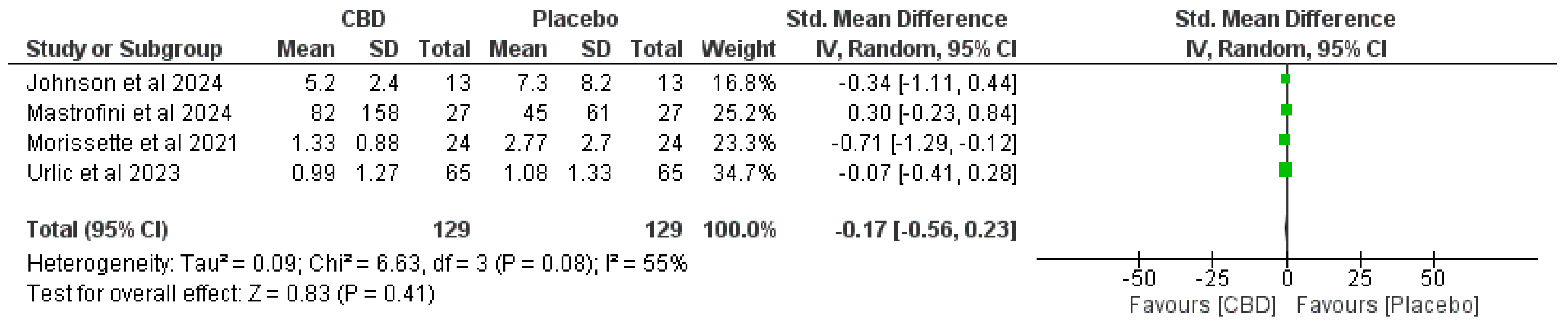
- IL-6. Four studies (total n = 129 per arm)—SMD −0.17 (95% CI −0.56 to 0.23), favoring CBD but not statistically significant (p = 0.41). Heterogeneity: I2 = 55% (Chi2 = 6.63, p = 0.08) (Figure 3).
- IL-10. Two studies (n = 92 per arm)—SMD −0.10 (95% CI −0.83 to 0.63), no significant effect (p = 0.79). Heterogeneity: I2 = 81% (Chi2 = 5.25, p = 0.02) (Figure 5).
- TNF-α. Three studies (n = 105 per arm)—SMD −0.09 (95% CI −0.45 to 0.27), no significant effect (p = 0.62). Heterogeneity: I2 = 33% (Chi2 = 3.01, p = 0.22) (Figure 6).
3.5. GRADE Assessment
- IL-6: Very low certainty—downgraded for risk of bias, inconsistency, and imprecision.
- IL-8: Moderate certainty—demoted one level for imprecision. No serious concerns for risk of bias, inconsistency, or indirectness.
- IL-10: Low certainty—lowered for inconsistency and imprecision.
- TNF-α: Moderate certainty—reduced one level for imprecision. No significant concerns about risk of bias, irregularity, or indirectness.
4. Discussion
4.1. Mechanistic Rationale and Translational Limits
4.2. Tissue Specificity and Route of Administration
4.3. Role of Advanced Formulations and Dermopharmacy
4.4. Systemic Exposure, Population Selection, and Dose
4.5. Limits of Current Clinical Trials and Implications for Interpretation
4.6. Heterogeneity Across Compounds and Assays
4.7. Practical Recommendations for Future Research
- Designing RCTs that include concurrent serial PK sampling (systemic and possibly local tissue or lesion sampling) to permit PK–PD linkage;
- Prioritizing clinical populations with elevated baseline inflammation or condition-specific endpoints where local delivery is feasible;
- Implementing dose-ranging and formulation-comparison arms to quantify exposure–response and safety;
- Including mechanistic immune-cell phenotyping and pre-specified biomarker panels (including inflammasome markers, e.g., IL-1β/IL-18) to test hypothesized pathways; and finally;
5. Conclusions
Supplementary Materials
Author Contributions
Funding
Data Availability Statement
Acknowledgments
Conflicts of Interest
Abbreviations
| ACR/EULAR | American College of Rheumatology/European Alliance of Associations for Rheumatology |
| ASC | Apoptosis-associated speck-like protein containing a CARD |
| BBC | Blood–brain barrier |
| CBC | Cannabichromene |
| CBD | Cannabidiol |
| CBN | Cannabinol |
| CB1/CB2 | Cannabinoid receptor type 1/type 2 |
| CD4+, CD25+, CD14+, CD16+ | Immune cell surface markers |
| CI | Confidence interval |
| CINAHL | Cumulative Index to Nursing and Allied Health Literature |
| CK | Creatine kinase |
| CRISS | Composite Response Index in Systemic Sclerosis |
| CRP | C-reactive protein |
| CXCL4 | Chemokine (C-X-C motif) ligand 4 |
| DBP | Diastolic blood pressure |
| EPA | Eicosapentaenoic acid |
| ERK | Extracellular signal-regulated kinase |
| FAAH | Fatty acid amide hydrolase |
| GRADE | Grading of Recommendations Assessment, Development, and Evaluation |
| HPLC | High-performance liquid chromatography |
| I-FABP | Intestinal fatty acid–binding protein |
| IL-1β | Interleukin-1 beta |
| IL-6 | Interleukin-6 |
| IL-8 | Interleukin-8 |
| IL-10 | Interleukin-10 |
| IL-18 | Interleukin-18 |
| ISGA | Investigator’s Static Global Assessment |
| I2 | Inconsistency (heterogeneity) statistic |
| JNK | c-Jun N-terminal kinase |
| LILACS | Latin American and Caribbean Health Sciences Literature |
| LOX-1 | Lectin-like oxidized low-density lipoprotein receptor-1 |
| MAPK | Mitogen-activated protein kinase |
| MBP | Mean blood pressure |
| MCT | Medium-chain triglycerides |
| MD | Mean difference |
| MRSS | Modified Rodnan Skin Score |
| NLRP3 | NOD-like receptor family pyrin domain containing 3 |
| NK cells | Natural killer cells |
| NLM | National Library of Medicine |
| P2X7 | Purinergic receptor P2X ligand-gated ion channel 7 |
| PAI-1 | Plasminogen activator inhibitor-1 |
| PBMC | Peripheral blood mononuclear cells |
| PD | Pharmacodynamics |
| PGE2 | Prostaglandin E2 |
| PI3K | Phosphoinositide 3-kinase |
| PK | Pharmacokinetics |
| PICOS | Population, Intervention, Comparison, Outcomes, Study design |
| PKB/mTOR | Protein kinase B/mammalian target of rapamycin |
| PPAR-γ | Peroxisome proliferator-activated receptor gamma |
| PRISMA | Preferred Reporting Items for Systematic Reviews and Meta-Analyses |
| RCT | Randomized controlled trial |
| RERmax | Maximum respiratory exchange ratio |
| RevMan | Review Manager |
| RoB-2 | Cochrane Risk of Bias tool version 2 |
| SBP | Systolic blood pressure |
| SD | Standard deviation |
| SE | Standard error |
| SMD | Standardized mean difference |
| SSC | Systemic sclerosis |
| STAT3 | Signal transducer and activator of transcription 3 |
| TID | Three times a day |
| THC | Δ9-tetrahydrocannabinol |
| THCV | Tetrahydrocannabivarin |
| TNF-α | Tumor necrosis factor-alpha |
| TRPV | Transient receptor potential vanilloid |
| UVB | Ultraviolet B |
| VEGF-A | Vascular endothelial growth factor A |
| VO2max/VO2peak | Maximal/peak oxygen consumption |
| WHO ICTRP | World Health Organization International Clinical Trials Registry Platform |
References
- da Silva, S.A.F.; Guida, H.L.; Dos Santos Antonio, A.M.; de Abreu, L.C.; Monteiro, C.B.M.; Ferreira, C.; Ribeiro, V.F.; Barnabe, V.; Silva, S.B.; Fonseca, F.L.A.; et al. Acute auditory stimulation with different styles of music influences cardiac autonomic regulation in men. Int. Cardiovasc. Res. J. 2014, 8, 105–110. [Google Scholar]
- Nascimento, M.M.P.; Azuelos, A.; Nóbrega, I.L.P.; Pitombeira, M.S.; Martinez, A.T.A.; de Carvalho, J.F.; Rodrigues, C.E.M. State of the Art in Novel Treatment Strategies in Rheumatoid Arthritis: A Brief Review. Mediterr. J. Rheumatol. 2025, 36, 149–158. [Google Scholar] [CrossRef] [PubMed]
- da Silva, A.G.; Guida, H.L.; Antônio, A.M.d.S.; Marcomini, R.S.; Fontes, A.M.; Carlos de Abreu, L.; Roque, A.L.; Silva, S.B.; Raimundo, R.D.; Ferreira, C.; et al. An exploration of heart rate response to differing music rhythm and tempos. Complement. Ther. Clin. Pract. 2014, 20, 130–134. [Google Scholar] [CrossRef] [PubMed]
- Meanti, R.; Bresciani, E.; Rizzi, L.; Molteni, L.; Coco, S.; Omeljaniuk, R.J.; Torsello, A. Cannabinoid Receptor 2 (CB2R) as potential target for the pharmacological treatment of neurodegenerative diseases. Biomed. Pharmacother. 2025, 186, 118044. [Google Scholar] [CrossRef]
- Mujahid, K.; Rasheed, M.S.; Sabir, A.; Nam, J.; Ramzan, T.; Ashraf, W.; Imran, I. Cannabidiol as an immune modulator: A comprehensive review. Saudi Pharm. J. 2025, 33, 11. [Google Scholar] [CrossRef]
- Morissette, F.; Mongeau-Pérusse, V.; Rizkallah, E.; Thébault, P.; Lepage, S.; Brissette, S.; Bruneau, J.; Dubreucq, S.; Stip, E.; Cailhier, J.F.; et al. Exploring cannabidiol effects on inflammatory markers in individuals with cocaine use disorder: A randomized controlled trial. Neuropsychopharmacology 2021, 46, 2101–2111. [Google Scholar] [CrossRef] [PubMed]
- Cásedas, G.; de Yarza-Sancho, M.; López, V. Cannabidiol (CBD): A Systematic Review of Clinical and Preclinical Evidence in the Treatment of Pain. Pharmaceuticals 2024, 17, 1438. [Google Scholar] [CrossRef]
- Ahmed, B.; Kaur, S.; Naryal, S.; Devi, A.; Kathpalia, M.; Shah, R.M.; Kaur, I.P. Nanoformulated cannabidiol for skin disorders: A GRADE-based systematic review of therapeutic evidence and efficacy. Eur. J. Pharm. Biopharm. 2025, 214, 114784. [Google Scholar] [CrossRef]
- Kuzumi, A.; Yoshizaki-Ogawa, A.; Fukasawa, T.; Sato, S.; Yoshizaki, A. The Potential Role of Cannabidiol in Cosmetic Dermatology: A Literature Review. Am. J. Clin. Dermatol. 2024, 25, 951–966. [Google Scholar] [CrossRef]
- Rusu, A.; Farcaș, A.M.; Oancea, O.L.; Tanase, C. Cannabidiol in Skin Health: A Comprehensive Review of Topical Applications in Dermatology and Cosmetic Science. Biomolecules 2025, 15, 1219. [Google Scholar] [CrossRef]
- Sterne, J.A.C.; Savović, J.; Page, M.J.; Elbers, R.G.; Blencowe, N.S.; Boutron, I.; Cates, C.J.; Cheng, H.Y.; Corbett, M.S.; Eldridge, S.M.; et al. RoB 2: A revised tool for assessing risk of bias in randomised trials. BMJ 2019, 366, l4898. [Google Scholar] [CrossRef]
- Rodrigues, F.D.S.; Newton, W.R.; Tassinari, I.D.; da Cunha Xavier, F.H.; Marx, A.; de Fraga, L.S.; Wright, K.; Guedes, R.P.; Bambini-Jr, V. Cannabidiol prevents LPS-induced inflammation by inhibiting the NLRP3 inflammasome and iNOS activity in BV2 microglia cells via CB2 receptors and PPARγ. Neurochem. Int. 2024, 177, 105769. [Google Scholar] [CrossRef]
- Martinez Naya, N.; Kelly, J.; Corna, G.; Golino, M.; Abbate, A.; Toldo, S. Molecular and Cellular Mechanisms of Action of Cannabidiol. Molecules 2023, 28, 5980. [Google Scholar] [CrossRef]
- Millar, S.A.; Stone, N.L.; Yates, A.S.; O’Sullivan, S.E. A Systematic Review on the Pharmacokinetics of Cannabidiol in Humans. Front. Pharmacol. 2018, 9, 1365. [Google Scholar] [CrossRef]
- Hansen, J.S.; Boix, F.; Hasselstrøm, J.B.; Sørensen, L.K.; Kjolby, M.; Gustavsen, S.; Hansen, R.M.; Petersen, T.; Sellebjerg, F.; Kasch, H.; et al. Pharmacokinetics and pharmacodynamics of cannabis-based medicine in a patient population included in a randomized, placebo-controlled, clinical trial. Clin. Transl. Sci. 2024, 17, e13685. [Google Scholar] [CrossRef]
- Yndart Arias, A.; Vadell, K.; Vashist, A.; Kolishetti, N.; Lakshmana, M.K.; Nair, M.; Liuzzi, J.P. Cannabidiol, a plant-derived compound, is an emerging strategy for treating cognitive impairments: Comprehensive review of randomized trials. Front. Pharmacol. 2024, 15, 1403147. [Google Scholar] [CrossRef]
- Isenmann, E.; Veit, S.; Flenker, U.; Lesch, A.; Lachenmeier, D.W.; Diel, P. Influence of short-term chronic oral cannabidiol application on muscle recovery and performance after an intensive training protocol—A randomized double-blind crossover study. J. Int. Soc. Sports Nutr. 2024, 21, 2337252. [Google Scholar] [CrossRef]
- Page, M.J.; McKenzie, J.E.; Bossuyt, P.M.; Boutron, I.; Hoffmann, T.C.; Mulrow, C.D.; Shamseer, L.; Tetzlaff, J.M.; Akl, E.A.; Brennan, S.E.; et al. The PRISMA 2020 statement: An updated guideline for reporting systematic reviews. BMJ 2021, 372, n71. [Google Scholar] [CrossRef]
- Anil, S.M.; Peeri, H.; Koltai, H. Medical Cannabis Activity Against Inflammation: Active Compounds and Modes of Action. Front. Pharmacol. 2022, 13, 908198. [Google Scholar] [CrossRef]
- Cohen, G.; Jakus, J.; Portillo, M.; Gvirtz, R.; Ogen-Shtern, N.; Silberstein, E.; Ayzenberg, T.; Rozenblat, S. In vitro, ex vivo, and clinical evaluation of anti-aging gel containing EPA and CBD. J. Cosmet. Dermatol. 2023, 22, 3047–3057. [Google Scholar] [CrossRef]
- Flores, V.A.; Kisiolek, J.N.; Ramani, A.; Townsend, R.; Rodriguez, E.; Butler, B.; Stewart, L.K. Effects of Oral Cannabidiol on Health and Fitness in Healthy Adults: An 8-Week Randomized Trial. Nutrients 2023, 15, 2664. [Google Scholar] [CrossRef]
- Gao, Y.; Li, Y.; Tan, Y.; Liu, W.; Ouaddi, S.; McCoy, J.; Kovacevic, M.; Situm, M.; Stanimirovic, A.; Li, M.; et al. Novel cannabidiol aspartame combination treatment (JW-100) significantly reduces ISGA score in atopic dermatitis: Results from a randomized double-blinded placebo-controlled interventional study. J. Cosmet. Dermatol. 2022, 21, 1647–1650. [Google Scholar] [CrossRef]
- Gurgenci, T.; Kijanka, G.; Greer, R.; Huggett, G.; Good, P.; Moniruzzaman, M.; Hardy, J. Exploring potential anti-inflammatory effects of medicinal cannabis. Support. Care Cancer 2023, 31, 629. [Google Scholar] [CrossRef]
- Jirasek, P.; Jusku, A.; Frankova, J.; Urbankova, M.; Diabelko, D.; Ruzicka, F.; Papouskova, B.; Chytilova, K.; Vrba, J.; Havlasek, J.; et al. Phytocannabinoids and gingival inflammation: Preclinical findings and a placebo-controlled double-blind randomized clinical trial with cannabidiol. J. Periodontal Res. 2024, 59, 468–479. [Google Scholar] [CrossRef]
- Johnson, D.A.; Cable, T.G.; Funnell, M.P.; Peden, D.L.; Thorley, J.; Cunha, M.F.D.; Reynolds, K.M.; Harris, L.; Wood, M.; Chavez-O’Reilly, T.; et al. Effects of Cannabidiol Ingestion on Thermoregulatory and Inflammatory Responses to Treadmill Exercise in the Heat in Recreationally Active Males. Med. Sci. Sports Exerc. 2025, 57, 413–424. [Google Scholar] [CrossRef]
- Mastrofini, G.F.; McFadden, B.A.; Chandler, A.J.; Lints, B.S.; Cintineo, H.P.; Rhoades, N.D.; Vincenty, C.S.; Stray-Gundersen, S.O.; Lane, A.D.; Arent, S.M. The effects of a brand-specific, hemp-derived cannabidiol product on physiological, biochemical, and psychometric outcomes in healthy adults: A double-blind, randomized clinical trial. J. Int. Soc. Sports Nutr. 2024, 21, 2370430. [Google Scholar] [CrossRef]
- Sahinovic, A.; Irwin, C.; Doohan, P.T.; Kevin, R.C.; Cox, A.J.; Lau, N.S.; Desbrow, B.; Johnson, N.A.; Sabag, A.; Hislop, M.; et al. Effects of Cannabidiol on Exercise Physiology and Bioenergetics: A Randomised Controlled Pilot Trial. Sports Med. Open 2022, 8, 27. [Google Scholar] [CrossRef]
- Spiera, R.; Hummers, L.; Chung, L.; Frech, T.M.; Domsic, R.; Hsu, V.; Furst, D.E.; Gordon, J.; Mayes, M.; Simms, R.; et al. Safety and Efficacy of Lenabasum in a Phase II, Randomized, Placebo-Controlled Trial in Adults with Systemic Sclerosis. Arthritis Rheumatol. 2020, 72, 1350–1360. [Google Scholar] [CrossRef]
- Urlic, H.; Kumric, M.; Dujic, G.; Vrdoljak, J.; Supe-Domic, D.; Dujic, Z.; Bozic, J. Antihypertensive effects of CBD are mediated by altered inflammatory response: A sub-study of the HYPER-H21-4 trial. J. Funct. Foods 2023, 110, 105873. [Google Scholar] [CrossRef]
- Utomo, W.K.; de Vries, M.; Braat, H.; Bruno, M.J.; Parikh, K.; Comalada, M.; Peppelenbosch, M.P.; van Goor, H.; Fuhler, G.M. Modulation of Human Peripheral Blood Mononuclear Cell Signaling by Medicinal Cannabinoids. Front. Mol. Neurosci. 2017, 10, 14. [Google Scholar] [CrossRef]
- Suryavanshi, S.V.; Kovalchuk, I.; Kovalchuk, O. Cannabinoids as Key Regulators of Inflammasome Signaling: A Current Perspective. Front. Immunol. 2021, 11, 613613. [Google Scholar] [CrossRef]
- Tomaszewska-Zaremba, D.; Gajewska, A.; Misztal, T. Anti-Inflammatory Effects of Cannabinoids in Therapy of Neurodegenerative Disorders and Inflammatory Diseases of the CNS. Int. J. Mol. Sci. 2025, 26, 6570. [Google Scholar] [CrossRef]
- Gojani, E.G.; Wang, B.; Li, D.P.; Kovalchuk, O.; Kovalchuk, I. Anti-Inflammatory Effects of Minor Cannabinoids CBC, THCV, and CBN in Human Macrophages. Molecules 2023, 28, 6487. [Google Scholar] [CrossRef]
- Carmona Rendón, Y.; Garzón, H.S.; Bueno-Silva, B.; Arce, R.M.; Suárez, L.J. Cannabinoids in Periodontology: Where Are We Now? Antibiotics 2023, 12, 1687. [Google Scholar] [CrossRef]
- Ferreira, B.P.; Costa, G.; Mascarenhas-Melo, F.; Pires, P.C.; Heidarizadeh, F.; Giram, P.S.; Mazzola, P.G.; Cabral, C.; Veiga, F.; Paiva-Santos, A.C. Skin applications of cannabidiol: Sources, effects, delivery systems, marketed formulations and safety. Phytochem. Rev. 2023, 22, 781–828. [Google Scholar] [CrossRef]
- Weber, I.; Zagona-Prizio, C.; Sivesind, T.E.; Adelman, M.; Szeto, M.D.; Liu, Y.; Sillau, S.H.; Bainbridge, J.; Klawitter, J.; Sempio, C.; et al. Oral Cannabidiol for Seborrheic Dermatitis in Patients with Parkinson Disease: Randomized Clinical Trial. JMIR Dermatol. 2024, 7, e49965. [Google Scholar] [CrossRef]
- Gu, Z.; Singh, S.; Niyogi, R.G.; Lamont, G.J.; Wang, H.; Lamont, R.J.; Scott, D.A. Marijuana-Derived Cannabinoids Trigger a CB2/PI3K Axis of Suppression of the Innate Response to Oral Pathogens. Front. Immunol. 2019, 10, 2288. [Google Scholar] [CrossRef]



| Database | Search Strategy |
|---|---|
| PUBMED | (“Cannabidiol”[MeSH] OR “Epidiolex” OR “1,3-Benzenediol, 2-(3-methyl-6-(1-methylethenyl)-2-cyclohexen-1-yl)-5-pentyl-, (1R-trans)-” OR “Tetrahydrocannabinol”[MeSH] OR “Dronabinol”[MeSH] OR “THC” OR “Marinol”) AND (“Inflammation”[MeSH] OR “Cytokines”[MeSH] OR “Interleukins”[MeSH] OR “Inflammation” OR “Cytokine” OR “Interleukin”) |
| EMBASE | (‘cannabidiol’/exp OR ‘epidiolex’ OR ‘1,3-benzenediol, 2-(3-methyl-6-(1-methylethenyl)-2-cyclohexen-1-yl)-5-pentyl-, (1R-trans)-‘ OR ‘tetrahydrocannabinol’/exp OR ‘dronabinol’/exp OR ‘THC’ OR ‘marinol’) AND (‘inflammation’/exp OR ‘cytokine’/exp OR ‘interleukin’/exp OR ‘inflammation’ OR ‘cytokine’ OR ‘interleukin’) |
| LILACS | (“Cannabidiol” OR “Epidiolex” OR “1,3-Benzenediol, 2-(3-methyl-6-(1-methylethenyl)-2-cyclohexen-1-yl)-5-pentyl-, (1R-trans)-” OR “Tetrahydrocannabinol” OR “Dronabinol” OR “THC” OR “Marinol”) AND (“Inflammation” OR “Cytokine” OR “Interleukin”) |
| Cochrane Library | (“Cannabidiol” OR “Epidiolex” OR “1,3-Benzenediol, 2-(3-methyl-6-(1-methylethenyl)-2-cyclohexen-1-yl)-5-pentyl-, (1R-trans)-” OR “Tetrahydrocannabinol” OR “Dronabinol” OR “THC” OR “Marinol”) AND (“Inflammation” OR “Cytokine” OR “Interleukin”) IN Title, Abstract, Keywords |
| SCOPUS | TITLE-ABS-KEY(“Cannabidiol” OR “Epidiolex” OR “1,3-Benzenediol, 2-(3-methyl-6-(1-methylethenyl)-2-cyclohexen-1-yl)-5-pentyl-, (1R-trans)-” OR “Tetrahydrocannabinol” OR “Dronabinol” OR “THC” OR “Marinol”) AND TITLE-ABS-KEY(“Inflammation” OR “Cytokine” OR “Interleukin”) |
| Web of Science | TS=(“Cannabidiol” OR “Epidiolex” OR “1,3-Benzenediol, 2-(3-methyl-6-(1-methylethenyl)-2-cyclohexen-1-yl)-5-pentyl-, (1R-trans)-” OR “Tetrahydrocannabinol” OR “Dronabinol” OR “THC” OR “Marinol”) AND TS=(“Inflammation” OR “Cytokine” OR “Interleukin”) |
| CINAHL | (MH “Cannabidiol” OR “Epidiolex” OR “1,3-Benzenediol, 2-(3-methyl-6-(1-methylethenyl)-2-cyclohexen-1-yl)-5-pentyl-, (1R-trans)-” OR MH “Tetrahydrocannabinol” OR MH “Dronabinol” OR “THC” OR “Marinol”) AND (MH “Inflammation” OR MH “Cytokines” OR MH “Interleukins” OR “Inflammation” OR “Cytokine” OR “Interleukin”) |
| Author/ Years | Study Design | Sample | Age (Years) | Intervention | Control | Outcomes |
|---|---|---|---|---|---|---|
| Cohen et al., 2023 [20] | Randomized, double-blind, placebo trial. | 33 healthy participants. | Between 45 and 65 years old. | Administration: Topical cream containing 0.1% CBD (Echo Pharmaceuticals) and 0.1% EPA (fish oil-derived), plus 0.1% Salvia miltiorrhiza extract applied to the face. Dose: 1.17 ± 0.34 g/day. Duration: 56 days. | Identical formulation without the active ingredients. | Reduction in wrinkle volume and red spot count/area. Improved skin hydration (+31.2%), elasticity (+25.6%), and firmness after 56 days. |
| Flores et al., 2023 [21] | Double-blind, randomized, placebo-controlled trial. | Non-specified. | Between 18 and 50 years old. | CBD group (CG): CBD supplementation. Dose: 50 mg/day, after dinner, before sleep. Duration: 8 weeks. | Placebo group (PG): Placebo supplement. Dose: 225 mg/day, after dinner, before sleep. Duration: 8 weeks. | Inflammatory marker assessed: C-reactive protein (CRP, mg/L). Before intervention: CBD Group (CG): 1.5 ± 2 mg/L; Placebo Group (PG): 1.3 ± 1.6 mg/L. After intervention: CBD Group (CG): 1.3 ± 1.6 mg/L; Placebo Group (PG): 1.6 ± 2 mg/L. There were no significant differences between the groups in terms of CRP concentrations. Total range of CRP values in the study: 0.1 to 8.8 mg/L. |
| Gao et al., 2021 [22] | Interventional, double-blind, placebo-controlled study. | 66 participants (57 completed the study) with atopic dermatitis involving >5% of the body surface (excluding the scalp). | Between 18 and 65 years old. | Group 1: JW-100 (pure hemp-derived CBD + aspartame). Group 2: Pure hemp-derived CBD. Group 3: Placebo. Administration: Topical application, at least twice a day, for 14 days. | Placebo group, which received a formulation without CBD. | The JW-100 group had the most significant reduction in ISGA score (1.28; p = 0.042) compared with placebo. In the subgroup of patients with an ISGA improvement of more than 2 points, 50% of the JW-100 group achieved “clear” or “almost clear” scores, compared with 15% in the placebo group (p = 0.028). No adverse events were reported in the treatment groups. |
| Gurgenci et al., 2023 [23] | Double-blind, randomized, placebo-controlled study. The MedCan-Infam study was a sub-study of MedCan-1. | MedCan-1: 141 participants with advanced cancer receiving palliative care. MedCan-Infam (sub-study): Convenience sample of 33 participants (15 in the CBD group, 17 in the placebo group). | Non-specified. | CBD oil, variable doses (50–600 mg/day), titrated according to tolerance. Administered orally. Duration: 28 days (dose escalation phase for the first 14 days). | Placebo (oil without CBD). | There was no significant difference in CRP (C-reactive protein) levels between the groups on day 14 or day 28. There was no difference in the trajectory of inflammatory cytokines between the CBD and placebo groups. The corticosteroids used by the patients did not significantly affect CRP levels. |
| Isenmann et al., 2024 [17] | Three-arm, double-blind, crossover study. | 17 subjects (m = 15, f = 2). | Between 22 and 31 years old. | Administration: Oral. Substances used: CBD oil, CBD solution, and placebo. Dose: 60 mg/day. Duration: 6 consecutive days, followed by a washout period of at least 4 weeks between intervention cycles. | Each individual underwent the six-day high-intensity training protocol three times. After each training session, each individual received either a placebo or a CBD product (60 mg oil or 60 mg solubilized). | CBD oil use was associated with reduced myoglobin levels, a marker of muscle damage. This suggests that CBD may help minimize post-exercise muscle damage, promoting faster recovery. On the other hand, there were no significant differences in creatine kinase (CK) levels, another marker of muscle damage, indicating that CBD did not affect this aspect. |
| Jirasek et al., 2023 [24] | Placebo-controlled, double-blind, randomized study. | The research involved 90 participants, divided into three groups of 30 individuals each. | Between 18 and 65 years old. | Administration: Oral. Substances used: CBD (1% w/w), placebo (without CBD), and chlorhexidine digluconate 1% (active comparator group). Dose: Dental gel and toothpaste with 1% CBD or placebo, applied twice a day. Duration: 56 days. | Administration method: Toothpaste, as in the CBD groups. Composition: Did not contain cannabidiol (CBD). Appearance: Had the same appearance, flavor, and texture as products containing CBD, so that neither the participants nor the researchers knew who was using the active ingredient. | The use of 1% CBD toothpaste and gel for 56 days significantly reduced gingival inflammation. Participants who used the CBD products showed improvements in gingival indices and less bleeding than the placebo group. |
| Johnson et al., 2024 [25] | Randomized, double-blinded. | 13 active males. | The average age of participants was 25 years. | Administration: Oral. Substances used: CBD and placebo. Dose: 298 mg of CBD. Duration: 105 min before exercise. | Ingested 298 mg CBD or placebo 105 min before 1 h treadmill exercise (60–65% VO2peak) in 32 °C and 50% relative humidity. | CBD caused a slight reduction in IL-6 concentration compared with placebo, suggesting a moderate decrease in the inflammatory response. In addition, CBD was associated with reduced monocyte activation, another inflammatory marker. |
| Mastrofini et al., 2024 [26] | Randomized, double-blind, placebo trial. | 54 healthy males and females. | Between 18 and 32 years old. | Administration: Double-blinded, with both given in liquid form containing medium-chain triglyceride oil, while the CBD product specifically contained 50 mg/mL of CBD. Dose: Duration: 30 ± 3, 60 ± 3, and 90 ± 3. | Liquid was administered identically to the cannabidiol (CBD) product. Both products were presented in liquid form with medium-chain triglyceride oil and natural flavorings and were indistinguishable in appearance, taste, and smell. | Found no significant effects of cannabidiol (CBD) on inflammation in healthy adults. Concentrations of C-reactive protein (CRP), a standard marker of systemic inflammation, did not differ between the CBD and placebo groups throughout the study. |
| Morissette et al., 2021 [6] | Single-site randomized controlled trial. | 48 participants. 83% of participants were men. | Between 18 and 65 years old. | Cannabidiol (CBD)—purified form (without THC), supplied by Tilray Inc. (New York, NY, USA) Administration: Oral, in gelatin capsules. Total daily dose of 800 mg, divided into two doses of 400 mg (morning and evening). 92 days (approximately 13 weeks) in total: Initial 10 days: Admission to a detox clinic. 12 weeks: Outpatient phase, with clinical monitoring and blood collections at 4 moments (baseline, day 8, week 4, and week 12). | Form: Gelatin capsules (same as those in the CBD group). Content: No active ingredient (no cannabidiol). Appearance and flavor: Identical to CBD capsules, to prevent participants from noticing any differences. Administration: Also in two daily doses (morning and evening), exactly imitating the protocol of the experimental group (800 mg/day in appearance). | CBD significantly reduced levels of interleukin-6 (IL-6) and VEGF-A, both of which are associated with chronic inflammation. In addition, it decreased the presence of pro-inflammatory immune cells, such as CD14+CD16+ monocytes and CD56−CD16+ NK cells, and increased the proportion of regulatory T cells (CD4+CD25+), which help control inflammation. These results suggest that CBD may modulate the immune system and attenuate the inflammatory response in this population. |
| Sahinovic et al., 2022 [27] | Randomized, double-blind design. | 24 healthy adults participated in the study: 12 men and 12 women. | Between 18 and 35 years old. | Cannabidiol (CBD) isolate (no THC). Delivered in oral oil form. Oral, single dose, self-administered under researcher supervision 300 mg CBD. Single dose (acute, not chronic, administration study) CBD was administered 2 h before exercise to ensure adequate time for absorption and action. | Form: Oral oil, same as CBD. Content: the placebo oil did not contain cannabidiol but used the same oil base as the CBD formulation. Appearance: Identical to CBD (same volume and color), so participants did not know whether they were receiving CBD or a placebo. | CBD helped reduce muscle soreness and oxidative stress post-exercise. These results suggest that CBD may aid recovery and reduce inflammatory processes associated with intense physical exertion. |
| Spiera et al., 2020 [28] | Randomized, placebo-controlled trial. | 42 subjects (27 in the lens group and 15 in the placebo group). | Between 18 and 69 years old; met the 2013 ACR/EULAR classification criteria for SSc. | Lenabasum-treated subjects received 5 mg once daily and placebo once daily; 20 mg once daily and placebo once daily; or 20 mg twice daily for the first 4 weeks. All subjects in the lenabasum group received 20 mg twice daily for the next 8 weeks. | Identical gelatin capsules in identical bottles, with similar labels and handling, but without the active ingredient. | Mean serum CRP, IL-6, and CXCL4 levels were comparable between treatment groups and within normal ranges. At baseline, CRP and IL-6 levels were each elevated in only 7 (17%) of 42 subjects. |
| Urlic et al., 2023 [29] | Randomized, double-blind, placebo-controlled, crossover study. | 65 patients with Grade 1 and Grade 2 primary hypertension (as defined by the contemporary guidelines of the European Society of Cardiology for the treatment of hypertension). | Between 40 and 70 years old. | The dose of CBD ranged from 225 to 300 mg during the first 2.5 weeks, followed by an increase to 375–450 mg in the next 2.5 weeks, depending on participants’ sex and weight. After 5 weeks of dosing and a subsequent 2-week washout period, the participants who previously received CBD in the first 5 weeks were given a placebo for 5 weeks, and vice versa. | The placebo capsules were filled with an organic substrate powder ingredient devoid of any CBD active drug substance, as verified by HPLC testing, and were similarly filled into matching size 00 vegan gel capsules for blinding purposes. | 5 weeks of oral CBD supplementation reduced serum levels of IL-8, IL-10, and IL-18. No significant dynamic in serum levels of PAI-1, LOX-1, and TNF-α was observed, whereas IL-1β and IL-6 reduced similarly after CBD and Placebo dosing. |
| Utomo et al., 2017 [30] | Randomized, double-blind, placebo-controlled, parallel design. | Patients suffering from chronic abdominal pain as a result of chronic pancreatitis or postsurgical pain. | 18 years or older. | The add-on treatment consisted of two phases: a step-up phase (day 1–5: 3 mg three times a day (TID); day 6–10: 5 mg TID) and a stable dose phase (day 11–52: 8 mg TID). The dosage was tapered to at least 5 mg TID when 8 mg was not tolerated. | Identical step-up approach to the Namisol arm. | Downregulation of pro-inflammatory signaling, in particular that mediated by the stress-activated kinases p38MAP kinase and JNK, deactivation of the PKB/mTOR signaling cascade, and Ca2+ signaling are how THC drastically reduces S6 phosphorylation in CD3+ T cells. |
| Outcome | No. of Studies | Risk of Bias | Inconsistency | Indirectness | Imprecision | Certainty of Evidence |
|---|---|---|---|---|---|---|
| IL-6 | 4 | Serious a | Serious b | Not serious | Serious c | Very low |
| IL-8 | 2 | Not serious | Not serious | Not serious | Serious d | Moderate |
| IL-10 | 2 | Not serious | Serious e | Not serious | Serious f | Low |
| TNF-alpha | 2 | Not serious | Not serious | Not serious | Serious g | Moderate |
Disclaimer/Publisher’s Note: The statements, opinions and data contained in all publications are solely those of the individual author(s) and contributor(s) and not of MDPI and/or the editor(s). MDPI and/or the editor(s) disclaim responsibility for any injury to people or property resulting from any ideas, methods, instructions or products referred to in the content. |
© 2025 by the authors. Licensee MDPI, Basel, Switzerland. This article is an open access article distributed under the terms and conditions of the Creative Commons Attribution (CC BY) license (https://creativecommons.org/licenses/by/4.0/).
Share and Cite
Candeloro, B.M.; de Oliveira, C.M.; Gimenez, F.V.M.; Barbosa, M.P.C.N.; Soares, B.P.; Ruiz, A.C.F.; Folegatti, D.R.M.A.; Barbalho, S.M.; Oliveira, N.S.; Porto, A.A.; et al. The Pleiotropic Influence of Cannabidiol and Tetrahydrocannabinol on Inflammatory Biomarkers: A Systematic Review and Meta-Analytical Synthesis. Int. J. Mol. Sci. 2025, 26, 11618. https://doi.org/10.3390/ijms262311618
Candeloro BM, de Oliveira CM, Gimenez FVM, Barbosa MPCN, Soares BP, Ruiz ACF, Folegatti DRMA, Barbalho SM, Oliveira NS, Porto AA, et al. The Pleiotropic Influence of Cannabidiol and Tetrahydrocannabinol on Inflammatory Biomarkers: A Systematic Review and Meta-Analytical Synthesis. International Journal of Molecular Sciences. 2025; 26(23):11618. https://doi.org/10.3390/ijms262311618
Chicago/Turabian StyleCandeloro, Bruno Moreira, Camila M. de Oliveira, Fabiana Veronez Martelato Gimenez, Marianne P. C. N. Barbosa, Beatriz Paiva Soares, Ana C. F. Ruiz, Derfel R. M. A. Folegatti, Sandra Maria Barbalho, Nancy S. Oliveira, Andrey A. Porto, and et al. 2025. "The Pleiotropic Influence of Cannabidiol and Tetrahydrocannabinol on Inflammatory Biomarkers: A Systematic Review and Meta-Analytical Synthesis" International Journal of Molecular Sciences 26, no. 23: 11618. https://doi.org/10.3390/ijms262311618
APA StyleCandeloro, B. M., de Oliveira, C. M., Gimenez, F. V. M., Barbosa, M. P. C. N., Soares, B. P., Ruiz, A. C. F., Folegatti, D. R. M. A., Barbalho, S. M., Oliveira, N. S., Porto, A. A., Garner, D. M., Sousa, F. H., & Valenti, V. E. (2025). The Pleiotropic Influence of Cannabidiol and Tetrahydrocannabinol on Inflammatory Biomarkers: A Systematic Review and Meta-Analytical Synthesis. International Journal of Molecular Sciences, 26(23), 11618. https://doi.org/10.3390/ijms262311618