Atherogenic Dyslipidemia and Its Association with FTO Gene Polymorphisms in Working Perimenopausal Women

Abstract
1. Introduction
2. Results
2.1. Patient Clinical and Sociodemographic Characteristics
2.2. Multivariable Logistic Regression Analysis
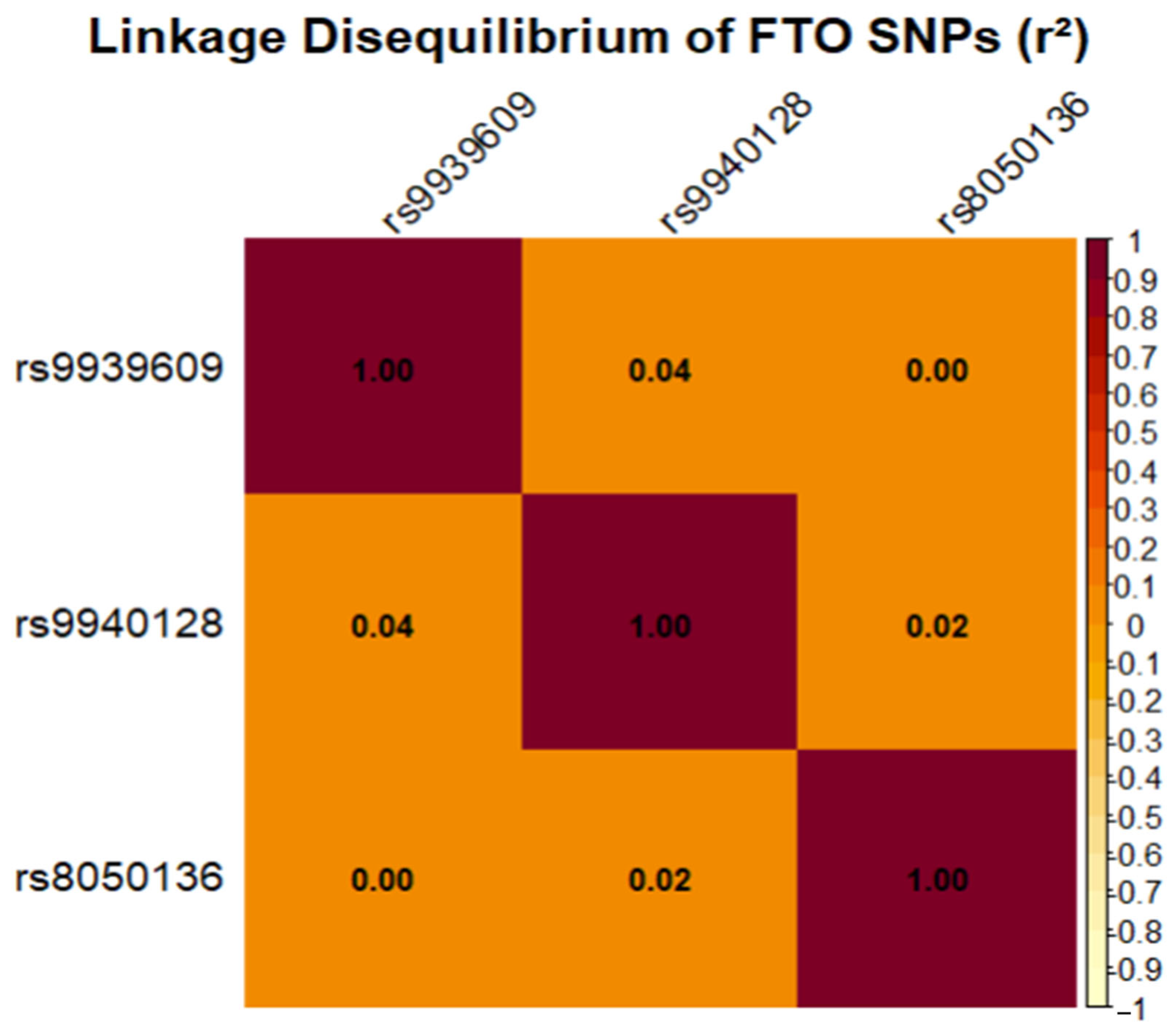
2.3. Linkage Disequilibrium Analysis of FTO SNPs
2.4. Individual Association of SNPs with AD
2.4.1. Gene–Environment Interaction Model
2.4.2. Distribution of Lipid Biomarkers by Genotype
2.5. Haplotype Analysis of FTO
2.5.1. Haplotype Frequencies
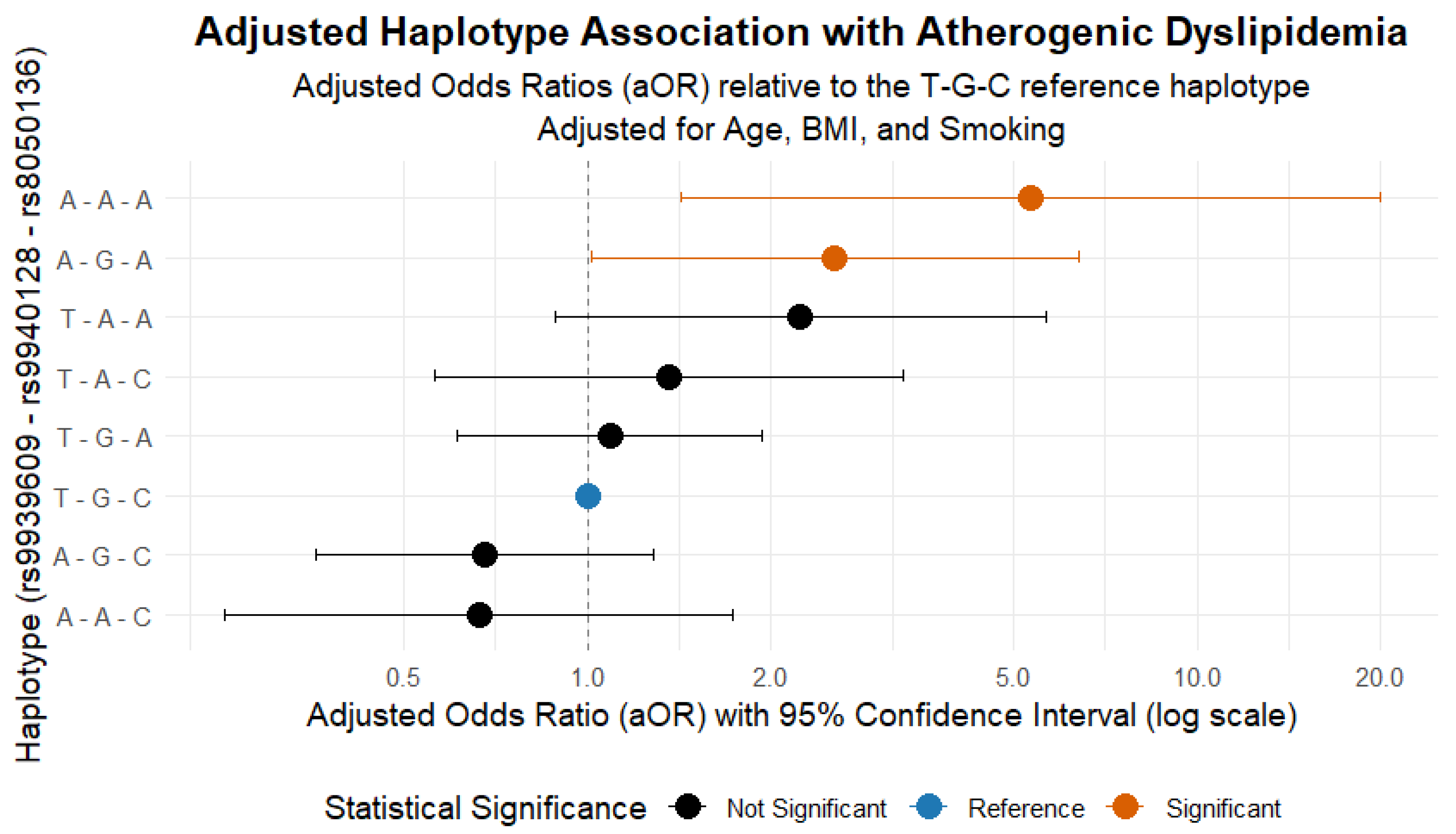
2.5.2. Haplotype Association with AD
3. Discussion
3.1. Sociodemographic and Clinical Characteristics
3.2. Multivariable Logistic Regression Model
3.3. Biological Mechanisms of the FTO Gene
3.4. Haplotype Associations with AD
3.5. Clinical and Public Health Implications
3.6. Integrating Clinical, Genetic, and Public Health Perspectives
3.7. Strengths, Limitations, and Future Directions
4. Materials and Methods
4.1. Study Design and Population
4.2. Inclusion and Exclusion Criteria
- Perimenopausal women, defined as those in the transitional stage toward menopause, exhibit irregular menstrual cycles according to established clinical criteria.
- Changes in cycle length
- The presence of vasomotor symptoms, including hot flashes and night sweats.
- Age between 40 and 55 years.
- Actively employed women.
- Provided informed consent for genetic, clinical, and paraclinical analyses.
- The exclusion criteria were as follows:
- Postmenopausal women (absence of menstruation for ≥12 consecutive months).
- Current pregnancy or lactation.
- Current or recent use (within the past 3 months) of medications affecting lipid or hormonal profiles (statins, fibrates, corticosteroids, hormone replacement therapy, hormonal contraceptives).
- History of ovarian surgery or hysterectomy.
- Participants with conditions causing significant systemic inflammation were excluded. This included autoimmune diseases (e.g., lupus, rheumatoid arthritis, multiple sclerosis, autoimmune thyroiditis), chronic inflammatory disorders (e.g., inflammatory bowel disease, severe psoriasis, psoriatic arthritis), and any active cancer.
- Non-acceptance of informed consent.
4.3. Data Collection
4.4. Cardiovascular Risk Factor Measurements
4.5. Genetic Data
4.6. Statistical Analysis and Data Visualization
5. Conclusions
Author Contributions
Funding
Institutional Review Board Statement
Informed Consent Statement
Data Availability Statement
Acknowledgments
Conflicts of Interest
References
- Wang, Y.; Wang, X.; Wang, C.; Zhou, J. Global, Regional, and National Burden of Cardiovascular Disease, 1990–2021: Results From the 2021 Global Burden of Disease Study. Cureus 2024, 16, e74333. [Google Scholar] [CrossRef]
- Pedro-Botet, J.; Ascaso, J.F.; Blasco, M.; Brea, Á.; Díaz, Á.; Hernández-Mijares, A.; Pintó, X.; Millán, J. Triglycerides, HDL Cholesterol and Atherogenic Dyslipidaemia in the 2019 European Guidelines for the Management of Dyslipidaemias. Clínica Investig. Arterioscler. 2020, 32, 209–218. [Google Scholar] [CrossRef]
- Jin, X.; Yang, S.; Lu, J.; Wu, M. Small, Dense Low-Density Lipoprotein-Cholesterol and Atherosclerosis: Relationship and Therapeutic Strategies. Front. Cardiovasc. Med. 2022, 8, 804214. [Google Scholar] [CrossRef]
- Gomez-Larrauri, A.; Larrea-Sebal, A.; Martín, C.; Gomez-Muñoz, A. The Critical Roles of Bioactive Sphingolipids in Inflammation. J. Biol. Chem. 2025, 301, 110475. [Google Scholar] [CrossRef] [PubMed]
- Stith, J.L.; Velazquez, F.N.; Obeid, L.M. Advances in Determining Signaling Mechanisms of Ceramide and Role in Disease. J. Lipid Res. 2019, 60, 913–918. [Google Scholar] [CrossRef] [PubMed]
- Aragón-Muriel, A.; Liscano, Y.; Morales-Morales, D.; Polo-Cerón, D.; Oñate-Garzón, J. A Study of the Interaction of a New Benzimidazole Schiff Base with Synthetic and Simulated Membrane Models of Bacterial and Mammalian Membranes. Membranes 2021, 11, 449. [Google Scholar] [CrossRef] [PubMed]
- Aragón-Muriel, A.; Liscano-Martínez, Y.; Rufino-Felipe, E.; Morales-Morales, D.; Oñate-Garzón, J.; Polo-Cerón, D. Synthesis, Biological Evaluation and Model Membrane Studies on Metal Complexes Containing Aromatic N,O-Chelate Ligands. Heliyon 2020, 6, e04126. [Google Scholar] [CrossRef]
- Ocampo-Ibáñez, I.D.; Liscano, Y.; Rivera-Sánchez, S.P.; Oñate-Garzón, J.; Lugo-Guevara, A.D.; Flórez-Elvira, L.J.; Lesmes, M.C. A Novel Cecropin D-Derived Short Cationic Antimicrobial Peptide Exhibits Antibacterial Activity Against Wild-Type and Multidrug-Resistant Strains of Klebsiella pneumoniae and Pseudomonas aeruginosa. Evol. Bioinform. Online 2020, 16, 1176934320936266. [Google Scholar] [CrossRef]
- Rivera-Sanchez, S.P.; Ocampo-Ibáñez, I.D.; Liscano, Y.; Martínez, N.; Muñoz, I.; Manrique-Moreno, M.; Martinez-Martinez, L.; Oñate-Garzon, J. Integrating In Vitro and In Silico Analysis of a Cationic Antimicrobial Peptide Interaction with Model Membranes of Colistin-Resistant Pseudomonas Aeruginosa Strains. Pharmaceutics 2022, 14, 1248. [Google Scholar] [CrossRef]
- Ponte-Negretti, C.I.; Isea-Perez, J.E.; Lorenzatti, A.J.; Lopez-Jaramillo, P.; Wyss-Q, F.S.; Pintó, X.; Lanas, F.; Medina, J.; Machado-H, L.T.; Acevedo, M.; et al. Atherogenic Dyslipidemia in Latin America: Prevalence, Causes and Treatment. Int. J. Cardiol. 2017, 243, 516–522. [Google Scholar] [CrossRef]
- Urbano-Cano, A.L.; Álvarez-Rosero, R.E.; Liscano, Y. Association of CETP, APOA5, IL6, and PON1 Gene Variants with Dyslipidemia and Cardiovascular Risk in a Population from Cauca Department, Colombia. Genes 2025, 16, 545. [Google Scholar] [CrossRef]
- Inaraja, V.; Thuissard, I.; Andreu-Vazquez, C.; Jodar, E. Lipid Profile Changes during the Menopausal Transition. Menopause 2020, 27, 780–787. [Google Scholar] [CrossRef]
- Evolahti, A.; Hultcrantz, M.; Collins, A. Psychosocial Work Environment and Lifestyle as Related to Lipid Profiles in Perimenopausal Women. Climacteric 2009, 12, 131–145. [Google Scholar] [CrossRef]
- Ryczkowska, K.; Adach, W.; Janikowski, K.; Banach, M.; Bielecka-Dabrowa, A. Menopause and Women’s Cardiovascular Health: Is It Really an Obvious Relationship? Arch. Med. Sci. 2023, 19, 458–466. [Google Scholar] [CrossRef]
- Verdonk, P.; Bendien, E.; Appelman, Y. Menopause and Work: A Narrative Literature Review about Menopause, Work and Health. Work 2022, 72, 483–496. [Google Scholar] [CrossRef]
- Bernal, J.V.M.; Sánchez-Delgado, J.C.; Jácome-Hortúa, A.M.; Veiga, A.C.; Andrade, G.V.; Rodrigues, M.R.; de Souza, H.C.D. Effects of Physical Exercise on the Lipid Profile of Perimenopausal and Postmenopausal Women: A Systematic Review and Meta-Analysis. Braz. J. Med. Biol. Res. 2025, 58, e14194. [Google Scholar] [CrossRef] [PubMed]
- Gluckman, P.D. Epigenetics, the Life-Course and Metabolic Disease. Nat. Rev. Endocrinol. 2012, 8, 74–76. [Google Scholar] [CrossRef] [PubMed]
- Li, Y.; Wu, K.; Quan, W.; Yu, L.; Chen, S.; Cheng, C.; Wu, Q.; Zhao, S.; Zhang, Y.; Zhou, L. The Dynamics of FTO Binding and Demethylation from the m(6)A Motifs. RNA Biol. 2019, 16, 1179–1189. [Google Scholar] [CrossRef] [PubMed]
- Kang, H.; Zhang, Z.; Yu, L.; Li, Y.; Liang, M.; Zhou, L. FTO Reduces Mitochondria and Promotes Hepatic Fat Accumulation through RNA Demethylation. J. Cell. Biochem. 2018, 119, 5676–5685. [Google Scholar] [CrossRef]
- Jalili, V.; Mokhtari, Z.; Rastgoo, S.; Hajipour, A.; Bourbour, F.; Gholamalizadeh, M.; Mosavi Jarrahi, A.; JavadiKooshesh, S.; Moslem, A.; Abdollahi, M.; et al. The Association between FTO Rs9939609 Polymorphism and Serum Lipid Profile in Adult Women. Diabetol. Metab. Syndr. 2021, 13, 138. [Google Scholar] [CrossRef]
- Bu, S.Y. Genetically Mediated Lipid Metabolism and Risk of Insulin Resistance: Insights from Mendelian Randomization Studies. J. Lipid Atheroscler. 2019, 8, 132. [Google Scholar] [CrossRef]
- Chmurzynska, A.; Muzsik, A.; Krzyżanowska-Jankowska, P.; Mądry, E.; Walkowiak, J.; Bajerska, J. PPARG and FTO Polymorphism Can Modulate the Outcomes of a Central European Diet and a Mediterranean Diet in Centrally Obese Postmenopausal Women. Nutr. Res. 2019, 69, 94–100. [Google Scholar] [CrossRef] [PubMed]
- Zhu, Y.; Shen, J.; Gao, L.; Feng, Y. Estrogen Promotes Fat Mass and Obesity-Associated Protein Nuclear Localization and Enhances Endometrial Cancer Cell Proliferation via the mTOR Signaling Pathway. Oncol. Rep. 2016, 35, 2391–2397. [Google Scholar] [CrossRef] [PubMed]
- Khella, M.S.; Hamdy, N.M.; Amin, A.I.; El-Mesallamy, H.O. The (FTO) Gene Polymorphism Is Associated with Metabolic Syndrome Risk in Egyptian Females: A Case- Control Study. BMC Med. Genet. 2017, 18, 101. [Google Scholar] [CrossRef]
- Mansoor, Q.; Ismail, M.; Ali Ul Qader, S. Linkage Disequilibrium Block Single-Nucleotide Polymorphisms in FTO Alpha Ketoglutarate Dependent Dioxygenase Gene Inference with Breast Cancer and Type II Diabetes in Pakistani Female Population. PLoS ONE 2023, 18, e0288934. [Google Scholar] [CrossRef]
- Ramos, R.B.; Casanova, G.K.; Maturana, M.A.; Spritzer, P.M. Variations in the Fat Mass and Obesity–Associated (FTO) Gene Are Related to Glucose Levels and Higher Lipid Accumulation Product in Postmenopausal Women from Southern Brazil. Fertil. Steril. 2011, 96, 974–979. [Google Scholar] [CrossRef]
- Caro-Gomez, M.A.; Naranjo-González, C.A.; Gallego-Lopera, N.; Parra-Marín, M.V.; Valencia, D.M.; Arcos, E.G.; Villegas-Perrasse, A.; Bedoya-Berrío, G. Association of Native American Ancestry and Common Variants in ACE, ADIPOR2, MTNR1B, GCK, TCF7L2 and FTO Genes with Glycemic Traits in Colombian Population. Gene 2018, 677, 198–210. [Google Scholar] [CrossRef]
- Ruiz Díaz, M.S.; Mena-Yi, D.; Gómez- Camargo, D.; Mora-García, G.J. Interaction Analysis of FTO and IRX3 Genes with Obesity and Related Metabolic Disorders in an Admixed Latin American Population: A Possible Risk Increases of Body Weight Excess. Colomb. Med. 2022, 53, e2044874. [Google Scholar] [CrossRef]
- Restrepo, J.C.; Martínez Guevara, D.; Pareja López, A.; Montenegro Palacios, J.F.; Liscano, Y. Identification and Application of Emerging Biomarkers in Treatment of Non-Small-Cell Lung Cancer: Systematic Review. Cancers 2024, 16, 2338. [Google Scholar] [CrossRef] [PubMed]
- Schaefer, E.J.; Ikezaki, H.; Diffenderfer, M.R.; Lim, E.; Liu, C.-T.; Hoogeveen, R.C.; Guan, W.; Tsai, M.Y.; Ballantyne, C.M. Atherosclerotic Cardiovascular Disease Risk and Small Dense Low-Density Lipoprotein Cholesterol in Men, Women, African Americans and Non-African Americans: The Pooling Project. Atherosclerosis 2023, 367, 15–23. [Google Scholar] [CrossRef]
- Yang, Y.; Yan, T.; Wang, Y.; Zhang, Z.; Li, L.; Zhang, C.; Cao, N.; Xia, Y.; Shen, Y.; Liu, K.; et al. Association of sdLDL-C/LDL-C Ratio with Atherosclerotic Cardiovascular Disease: A Case-Control Study. BMC Cardiovasc. Disord. 2025, 25, 430. [Google Scholar] [CrossRef]
- Hoogeveen, R.C.; Gaubatz, J.W.; Sun, W.; Dodge, R.C.; Crosby, J.R.; Jiang, J.; Couper, D.; Virani, S.S.; Kathiresan, S.; Boerwinkle, E.; et al. Small Dense Low-Density Lipoprotein-Cholesterol Concentrations Predict Risk for Coronary Heart Disease: The Atherosclerosis Risk in Communities (ARIC) Study. ATVB 2014, 34, 1069–1077. [Google Scholar] [CrossRef]
- Borghi, C.; Fogacci, F.; Agnoletti, D.; Cicero, A.F.G. Hypertension and Dyslipidemia Combined Therapeutic Approaches. High Blood Press. Cardiovasc. Prev. 2022, 29, 221–230. [Google Scholar] [CrossRef]
- Romero-Corral, A.; Somers, V.K.; Sierra-Johnson, J.; Korenfeld, Y.; Boarin, S.; Korinek, J.; Jensen, M.D.; Parati, G.; Lopez-Jimenez, F. Normal Weight Obesity: A Risk Factor for Cardiometabolic Dysregulation and Cardiovascular Mortality. Eur. Heart J. 2010, 31, 737–746. [Google Scholar] [CrossRef]
- Anagnostis, P.; Stevenson, J.C.; Crook, D.; Johnston, D.G.; Godsland, I.F. Effects of Menopause, Gender and Age on Lipids and High-Density Lipoprotein Cholesterol Subfractions. Maturitas 2015, 81, 62–68. [Google Scholar] [CrossRef]
- Ference, B.A.; Kastelein, J.J.P.; Ray, K.K.; Ginsberg, H.N.; Chapman, M.J.; Packard, C.J.; Laufs, U.; Oliver-Williams, C.; Wood, A.M.; Butterworth, A.S.; et al. Association of Triglyceride-Lowering LPL Variants and LDL-C–Lowering LDLR Variants With Risk of Coronary Heart Disease. JAMA 2019, 321, 364. [Google Scholar] [CrossRef]
- Paul, E.; Bu, F.; Fancourt, D. Loneliness and Risk for Cardiovascular Disease: Mechanisms and Future Directions. Curr. Cardiol. Rep. 2021, 23, 68. [Google Scholar] [CrossRef] [PubMed]
- Roeters Van Lennep, J.E.; Tokgözoğlu, L.S.; Badimon, L.; Dumanski, S.M.; Gulati, M.; Hess, C.N.; Holven, K.B.; Kavousi, M.; Kayıkçıoğlu, M.; Lutgens, E.; et al. Women, Lipids, and Atherosclerotic Cardiovascular Disease: A Call to Action from the European Atherosclerosis Society. Eur. Heart J. 2023, 44, 4157–4173. [Google Scholar] [CrossRef] [PubMed]
- Duran, E.K.; Aday, A.W.; Cook, N.R.; Buring, J.E.; Ridker, P.M.; Pradhan, A.D. Triglyceride-Rich Lipoprotein Cholesterol, Small Dense LDL Cholesterol, and Incident Cardiovascular Disease. J. Am. Coll. Cardiol. 2020, 75, 2122–2135. [Google Scholar] [CrossRef] [PubMed]
- He, Q.; Fang, Y.; Wang, L.; Liang, M.; Chen, X.; Hu, R.; Zhong, J. Determining the Status of Small Dense Low-Density Lipoprotein Cholesterol Level in Women Undergoing Menopausal Transition. Front. Endocrinol. 2025, 15, 1500712. [Google Scholar] [CrossRef]
- Park, B.; Jung, D.H.; Lee, H.S.; Lee, Y.J. Triglyceride to HDL-Cholesterol Ratio and the Incident Risk of Ischemic Heart Disease Among Koreans Without Diabetes: A Longitudinal Study Using National Health Insurance Data. Front. Cardiovasc. Med. 2021, 8, 716698. [Google Scholar] [CrossRef]
- El Khoudary, S.R.; Aggarwal, B.; Beckie, T.M.; Hodis, H.N.; Johnson, A.E.; Langer, R.D.; Limacher, M.C.; Manson, J.E.; Stefanick, M.L.; Allison, M.A.; et al. Menopause Transition and Cardiovascular Disease Risk: Implications for Timing of Early Prevention: A Scientific Statement From the American Heart Association. Circulation 2020, 142, e506–e532. [Google Scholar] [CrossRef]
- Timasheva, Y.; Kochetova, O.; Balkhiyarova, Z.; Korytina, G.; Prokopenko, I.; Nouwen, A. Polygenic Score Approach to Predicting Risk of Metabolic Syndrome. Genes 2024, 16, 22. [Google Scholar] [CrossRef] [PubMed]
- NCD Risk Factor Collaboration (NCD-RisC); Iurilli, M.L.; Zhou, B.; Bennett, J.E.; Carrillo-Larco, R.M.; Sophiea, M.K.; Rodriguez-Martinez, A.; Bixby, H.; Solomon, B.D.; Taddei, C.; et al. Heterogeneous Contributions of Change in Population Distribution of Body Mass Index to Change in Obesity and Underweight. eLife 2021, 10, e60060. [Google Scholar] [CrossRef] [PubMed]
- Mizuno, T.M. Fat Mass and Obesity Associated (FTO) Gene and Hepatic Glucose and Lipid Metabolism. Nutrients 2018, 10, 1600. [Google Scholar] [CrossRef] [PubMed]
- Iqbal, A.M.; Jamal, S.F. Essential Hypertension. In StatPearls; StatPearls Publishing: Treasure Island, FL, USA, 2025. [Google Scholar]
- Wu, Y.; Li, D.; Vermund, S.H. Advantages and Limitations of the Body Mass Index (BMI) to Assess Adult Obesity. Int. J. Environ. Res. Public Health 2024, 21, 757. [Google Scholar] [CrossRef]
- Miller, S.A.; Dykes, D.D.; Polesky, H.F. A Simple Salting out Procedure for Extracting DNA from Human Nucleated Cells. Nucl. Acids. Res. 1988, 16, 1215. [Google Scholar] [CrossRef]



| Variable | Case | Control | Total (n = 219) | p-Value |
|---|---|---|---|---|
| Age (Years) (Median ± IQR) | 46.4 ± 4.75 | 47.4 ± 4.62 | 48 ± 13 | 0.175 |
| Systolic Pressure (mmHg) (Median ± IQR) | 143 [120–170] | 122 [110–140] | 136 [120–140] | 0.011 |
| Diastolic Pressure (mmHg) (Median ± IQR) | 92 [70–99] | 87 [70–90] | 90 [70–100] | 0.060 |
| Glycemia (mmHg) (Median ± IQR) | 103 [89–115] | 101 [87–105] | 102 [88–108] | 0.247 |
| Cholesterol (mg/dL) (Median ± IQR) | 206 [168–236] | 200 [177–218] | 203 [176–224] | 0.719 |
| HDL (mg/dL) (Median ± IQR) | 44 [38–51] | 47 [37–53] | 45 [38–52] | 0.158 |
| Triglycerides (mg/dL) (Median ± IQR) | 172 [140–177] | 134 [105–150] | 151 [120–170] | <0.001 |
| LDL (mg/dL) IQR | 138 [117–150] | 118 [99–115] | 127 [107–150] | <0.001 |
| sdLDL-C (mg/dL) (Median ± IQR) | 42 [32–55] | 28 [20–30] | 35 [30–40] | <0.001 |
| VLDL (mg/dL) | 33 [24–40] | 31 [24–35] | 32 [24–40] | 0.331 |
| BMI (kg/m2) (Median ± IQR) | 26 [22–28] | 25 [22–28] | 27 [23–29] | 0.065 |
| Waist circumference (Median ± IQR) | 91 [83–99] | 91 [83–97] | 91 [83–90] | 0.804 |
| Body fat measurement (Median ± IQR) | 32 [23–40] | 31 [22–38] | 33 [24–41] | 0.121 |
| Hypertension (n, %) | Yes | Yes | 163 (74.4%) | 0.034 |
| 79 (81.4%) | 84 (68.9%) | |||
| No | No | 56 (25.6%) | ||
| 18 (18.6%) | 38 (31.1%) | |||
| Diabetes (n, %) | Yes | Yes | 67 (30.6%) | 0.493 |
| 32 (33.0%) | 35 (28.7%) | |||
| No | No | 152 (69.5%) | ||
| 67 (67.0%) | 87 (71.3%) | |||
| Area of Origin (n, %) | Urban: | Urban: | 182 (83.1%) | 0.709 |
| 80 (82.5%) | 102 (83.6%) | |||
| Rural: | Rural: | 37 (16.9%) | ||
| 17 (17.5%) | 20 (16.4%) | |||
| In a Relationship (n, %) | Yes | Yes | 104 (47.5%) | <0.001 |
| 38 (39.2%) | 77 (63.1%) | |||
| No | No | 115 (52.5%) | ||
| 59 (60.8%) | 45 (36.9%) | |||
| Educational Level (n, %) | Elementary school | Elementary school | 123 (56.2%) | 0.162 |
| 62 (64.0%) | 61 (50.0%) | |||
| Middle School/High School | Middle School/High School | 59 (26.9%) | ||
| 22 (22.7%) | 37 (30.3%) | |||
| Technical education | Technical education | 16 (7.3%) | ||
| 7 (7.2%) | 9 (7.4%) | |||
| College/University | College/University | 21 (9.6%) | ||
| 6 (6.2%) | 15 (12.3%) | |||
| Income (n, %) | <1 SMLV | <1 SMLV | 82 (37.4%) | 0.298 |
| 40 (41.2%) | 42 (34.4%) | |||
| 1 SMLV | 1 SMLV | 64 (29.2%) | ||
| 30 (30.9%) | 34 (27.9%) | |||
| >1 SMLV | >1 SMLV | 73 (33.3%) | ||
| 27 (27.8%) | 46 (37.7%) | |||
| Smokers (n, %) | Yes | Yes | 95 (43.4%) | 0.104 |
| 48 (49.5%) | 47 (38.5%) | |||
| No | No | 124 (56.6%) | ||
| 49 (50.5%) | 75 (61.5%) |
| Variable | OR | 95% CI | p-Value |
|---|---|---|---|
| Systolic Pressure (mmHg) | 2.59 | 1.286–5.254 | 0.008 |
| Diastolic Pressure (mmHg) | 4.57 | 2.575–8.112 | <0.001 |
| Glycemia (mg/dL) | 1.78 | 0.819–3.878 | 0.145 |
| Cholesterol (mg/dL) | 1.00 | 0.997–1.012 | 0.249 |
| HDL (mg/dL) | 1.01 | 0.993–1.040 | 0.169 |
| Triglycerides (mg/dL) | 3.14 | 1.802–5.471 | <0.001 |
| LDL (mg/dL) | 2.15 | 1.247–3.701 | 0.006 |
| sdLDL-C (mg/dL) | 2.63 | 1.505–4.602 | <0.001 |
| VLDL (mg/dL) | 2.57 | 1.484–4.467 | <0.001 |
| Educational Level | 1.71 | 1.027–3.057 | 0.040 |
| BMI (kg/m2) | 1.84 | 0.915–3.735 | 0.087 |
| FTO_rs9939609 T > A | 2.987 | 1.496–5.558 | 0.002 |
| FTO_rs9940128 G > A | 1.938 | 0.807–4.657 | 0.139 |
| FTO_rs8050136 C > A | 3.629 | 1.650–7.982 | <0.001 |
| Percentage Body Fat | 1.016 | 0.994–1.039 | 0.164 |
| Body Mass Index (kg/m2) | 1.051 | 0.994–1.111 | 0.082 |
| Waist Circumference Measurement | 1.001 | 0.981–1.022 | 0.927 |
| (A) | |||||
| Variables | Standard Error | OR | Wald | 95%CI (Lower–Upper) | p-value |
| Systolic Pressure (mmHg) | 0.283 | 1.835 | 4.618 | 1.055–3.193 | 0.032 |
| Diastolic Pressure (mmHg) | 0.289 | 2.060 | 6249 | 1.169–3.629 | 0.012 |
| Glycemia (mg/dL) | 0.294 | 0.817 | 0.470 | 0.459–1.455 | 0.493 |
| Cholesterol (mg/dL) | 0.004 | 1.004 | 1.330 | 0.997–1.012 | 0.249 |
| HDL (mg/dL) | 0.012 | 1.016 | 1.890 | 0.993–1.040 | 0.169 |
| Triglycerides (mg/dL) | 0.348 | 2.825 | 8.906 | 1.428–5.589 | 0.003 |
| LDL (mg/dL) | 0.551 | 7.92 | 14.087 | 2.688–23.233 | <0.001 |
| sdLDL-C (mg/dL) | 0.365 | 2.825 | 8.095 | 1.381–5.777 | 0.004 |
| VLDL (mg/dL) | 0.283 | 2.776 | 13.032 | 1.595–4.832 | <0.001 |
| Educational Level | 0.385 | 1.422 | 0.835 | 0.668–3.024 | 0.361 |
| BMI (kg/m2) | 0.029 | 1.051 | 3.031 | 0.994–1.111 | 0.082 |
| (B) | |||||
| Predictor | OR | 95% CI | p-value | ||
| Total Cholesterol (mg/dL) | 1.409 | 0.643- 3.086 | 0.391 | ||
| HDL-C (mg/dL) | 1.022 | 0.990–1.054 | 0.186 | ||
| Triglycerides (mg/dL) | 6.046 | 2.374–15.396 | <0.001 | ||
| LDL (mg/dL) | 8.298 | 2.425–28.390 | <0.001 | ||
| sdLDL-C (mg/dL) | 3.431 | 1.328–8.867 | 0.011 | ||
| VLDL (mg/dL) | 6.211 | 2.685–14.371 | <0.001 | ||
| FTO_rs9939609 T > A | 4.062 | 1.727–9556 | <0.001 | ||
| FTO_rs9940128 G > A | 1.687 | 0.545–5.219 | 0.364 | ||
| FTO_rs8050136 C > A | 3.741 | 1.454–9623 | 0.006 | ||
| (C) | |||||
| Predictor | OR | 95% CI | p-value | ||
| HDL-C (mg/dL) | 1.025 | 0.995–1.056 | 0.109 | ||
| Triglycerides (mg/dL) | 5.402 | 2.281–12.793 | <0.001 | ||
| LDL (mg/dL) | 7.315 | 2.280–23.467 | <0.001 | ||
| sdLDL-C (mg/dL) | 2.655 | 1.159–6.086 | 0.021 | ||
| VLDL (mg/dL) | 8.180 | 3.726–17.958 | <0.001 | ||
| Percentage Body Fat | 0.974 | 0.931–1.018 | 0.245 | ||
| Body Mass Index (kg/m2) | 1.118 | 0.994–1.257 | 0.063 | ||
| Waist Circumference Measurement | 0.989 | 0.958–1.021 | 0.490 | ||
| Educational Level (Sec./Tech. vs. Prof.) | 1.348 | 0.690–2.633 | 0.383 | ||
| FTO Polymorphism | Case n (%) | Control n (%) | OR (95% CI) | p-Value |
|---|---|---|---|---|
| rs9939609 T > A codominant | ||||
| TT | 58 (59.8) | 59 (48.4) | 1.0 | - |
| TA | 17 (17.5) | 50 (41.0) | 1.721(0.793–3.739) | 0.170 |
| AA | 22 (22.7) | 13 (10.7) | 4.977(2.066–11.990) | <0.001 |
| rs9939609 T > A Dominant | ||||
| TT | 58 (59.8) | 59 (48.4) | 1.0 | - |
| TA + AA | 39 (40.2) | 63 (51.6) | 1.588(0.926–2.723) | 0.093 |
| rs9939609 T > A Recessive | ||||
| TT + TA | 75 (77.31) | 109 (89.3) | 1.0 | - |
| AA | 22 (22.7) | 13 (10.7) | 2.459(1.166–5.186) | 0.018 |
| rs9940128 G > A codominant | ||||
| GG | 50 (51.5) | 82(67.2) | 1.0 | - |
| GA | 34 (35.1) | 29(23.8) | 1.938 (0.807–4.657) | 0.139 |
| AA | 13 (13.4) | 11(9.0) | 1.008 (0.392–2.590) | 0.987 |
| rs9940128 G > A Dominant | ||||
| GG | 50 (51.5) | 82(67.2) | 1.0 | |
| GG + GA | 47 (48.5) | 40(32.8) | 1.733 (0.907–3.657) | 0.119 |
| rs9940128 G > A Recessive | ||||
| GG + GA | 84 (86.6) | 111(91.0) | 1.0 | - |
| AA | 13 (13.4) | 11 (9.0) | 0.640 (0.273–1.500) | 0.305 |
| rs8050136 C > A codominant | ||||
| CC | 40 (41.2) | 67 (54.9) | 1.0 | - |
| CA | 31 (32.0) | 43 (35.2) | 3.629 (1.650–7.982) | p < 0.001 |
| AA | 26 (26.8) | 12 (9.8) | 3.005 (1.317–6.860) | 0.009 |
| rs8050136 C > A Dominant | ||||
| CC | 40 (41.2) | 67 (54.9) | 1.0 | |
| CA + AA | 57 (58.8) | 55 (45.1) | 0.936 (0.967–2.976) | 0.052 |
| rs8050136 C > A Recessive | ||||
| CC + CA | 71 (73.2) | 110 (90.2) | 1.0 | |
| AA | 26 (26.8) | 12 (9.8) | 1.562(0.667–3.659) | 0.305 |
| Variable | OR | 95% CI | p-Value |
|---|---|---|---|
| Systolic Pressure | 1.98 | 0.85–4.75 | 0.116 |
| Diastolic Pressure | 4.12 | 1.49–11.95 | 0.007 |
| Smoking | 2.33 | 1.03–5.44 | 0.045 |
| Age | 0.95 | 0.89–1.01 | 0.109 |
| BMI | 0.96 | 0.90–1.02 | 0.192 |
| Interaction CA × Smoking | 0.41 | 0.11–1.50 | 0.183 |
| Interaction AA × Smoking | 1.44 | 0.24–12.34 | 0.706 |
| Polymorphism | Primers (5′→3′) | Genotyping Method | Restriction Enzyme |
|---|---|---|---|
| rs9939609 (T > A) | External F: gttctacagttccagtcatttttgacagc External R: agcctctctaccatcttatgtccaaaca Internal F(A):000 taggtccttgcgactgctgtgaatata Internal R(T): gagtaacagagactatccaagtgcatctca | Tetra-Primer ARMS PCR | N/A |
| rs9940128 (G > A) | F: 5′AGGCCTCAGCTTCCCTGAACTGG3′ R: 5′TGCCATGGAAAATCTGGCTCATGGT3′ | PCR-RFLP | MspI |
| rs8050136 (C > A) | F: ATGCCAGTTGCCCACTGTGGGCATT R: GCAAAATTTCACACACCCAAGATGGTCCATG | PCR-RFLP | MseI |
Disclaimer/Publisher’s Note: The statements, opinions and data contained in all publications are solely those of the individual author(s) and contributor(s) and not of MDPI and/or the editor(s). MDPI and/or the editor(s) disclaim responsibility for any injury to people or property resulting from any ideas, methods, instructions or products referred to in the content. |
© 2025 by the authors. Licensee MDPI, Basel, Switzerland. This article is an open access article distributed under the terms and conditions of the Creative Commons Attribution (CC BY) license (https://creativecommons.org/licenses/by/4.0/).
Share and Cite
Urbano Cano, A.L.; Álvarez Rosero, R.E.; Liscano, Y. Atherogenic Dyslipidemia and Its Association with FTO Gene Polymorphisms in Working Perimenopausal Women. Int. J. Mol. Sci. 2025, 26, 10915. https://doi.org/10.3390/ijms262210915
Urbano Cano AL, Álvarez Rosero RE, Liscano Y. Atherogenic Dyslipidemia and Its Association with FTO Gene Polymorphisms in Working Perimenopausal Women. International Journal of Molecular Sciences. 2025; 26(22):10915. https://doi.org/10.3390/ijms262210915
Chicago/Turabian StyleUrbano Cano, Astrid Lorena, Rosa Elvira Álvarez Rosero, and Yamil Liscano. 2025. "Atherogenic Dyslipidemia and Its Association with FTO Gene Polymorphisms in Working Perimenopausal Women" International Journal of Molecular Sciences 26, no. 22: 10915. https://doi.org/10.3390/ijms262210915
APA StyleUrbano Cano, A. L., Álvarez Rosero, R. E., & Liscano, Y. (2025). Atherogenic Dyslipidemia and Its Association with FTO Gene Polymorphisms in Working Perimenopausal Women. International Journal of Molecular Sciences, 26(22), 10915. https://doi.org/10.3390/ijms262210915