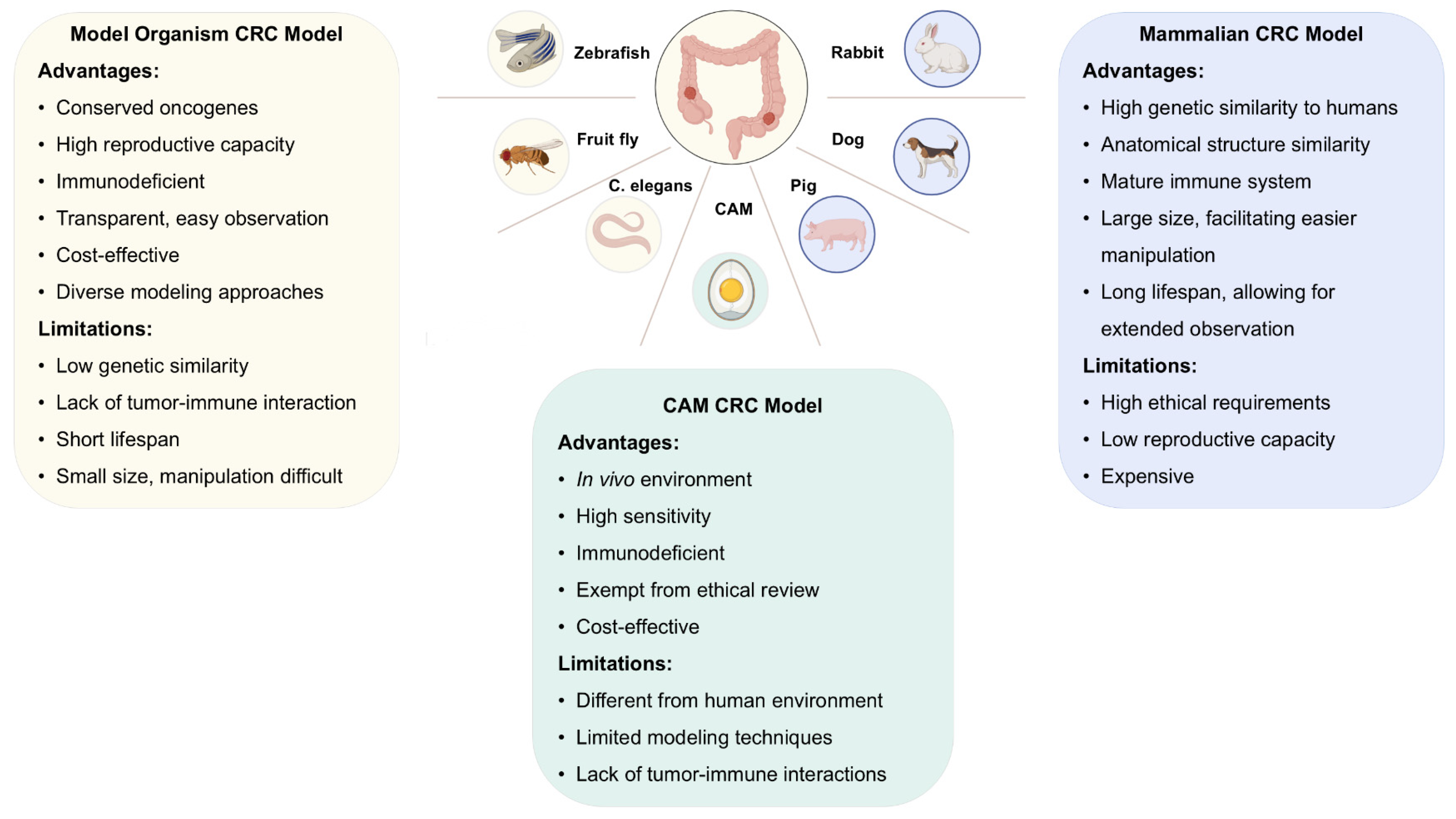
Beyond Rodents: Alternative Animal Models in Colorectal Cancer Research

 , ,
, ,  ,
, 
Abstract
1. Introduction
2. Application of Organism-Based Models in Colorectal Cancer
2.1. Zebrafish (Danio rerio)
2.2. Fruit Fly (Drosophila melanogaster)
2.3. Caenorhabditis elegans (C. elegans)
3. Application of the Chick Embryo Chorioallantoic Membrane (CAM) Model
4. Less Commonly Used Mammalian Models for CRC
4.1. Pet Rabbits (Oryctolagus cuniculus)
4.2. Pet Dog (Canine)
4.3. Domestic Pigs (Sus scrofa domesticus)
5. Advanced Engineering and Computational Approaches in CRC Modeling
6. Discussion
7. Future Directions
Author Contributions
Funding
Institutional Review Board Statement
Informed Consent Statement
Data Availability Statement
Acknowledgments
Conflicts of Interest
Abbreviations
| APC | adenomatous polyposis coli |
| BMP | bone morphogenetic protein |
| BMSC | brain metastasis stem cells |
| C. elegans | Caenorhabditis elegans |
| CAM | chorioallantoic membrane |
| COP | Comparative Oncology Program |
| CRC | colorectal cancer |
| DMBA | 7,12-dimethylbenzanthracene |
| DSS | dextran sodium sulfate |
| EGFR | epidermal growth factor receptor |
| EMT | epithelial–mesenchymal transition |
| ENU | N-ethyl-N-nitrosourea |
| EOCRC | early-onset colorectal cancer |
| FAP | familial adenomatous polyposis |
| FGF | fibroblast growth factor |
| ISC | intestinal stem cell |
| MMP | matrix metalloproteinases |
| PDX | patient-derived xenograft |
| RAG2 | recombination-activating gene 2 |
| SCID | severe combined immunodeficient |
| TNBS | 2,4,6-trinitrobenzene sulfonic acid |
| TP53 | tumor protein p53 |
| TUM-CAM | tumor chorioallantoic membrane |
| UPP1 | uridine phosphorylase 1 |
| 5-FU | 5-fluorouracil |
References
- Bray, F.; Laversanne, M.; Sung, H.; Ferlay, J.; Siegel, R.L.; Soerjomataram, I.; Jemal, A. Global cancer statistics 2022: GLOBOCAN estimates of incidence and mortality worldwide for 36 cancers in 185 countries. CA Cancer J. Clin. 2024, 74, 229–263. [Google Scholar] [CrossRef]
- Sabouni, E.; Nejad, M.M.; Mojtabavi, S.; Khoshduz, S.; Mojtabavi, M.; Nadafzadeh, N.; Nikpanjeh, N.; Mirzaei, S.; Hashemi, M.; Aref, A.R.; et al. Unraveling the function of epithelial-mesenchymal transition (EMT) in colorectal cancer: Metastasis, therapy response, and revisiting molecular pathways. Biomed. Pharmacother. 2023, 160, 114395. [Google Scholar] [CrossRef]
- Fidler, M.M.; Soerjomataram, I.; Bray, F. A global view on cancer incidence and national levels of the human development index. Int. J. Cancer 2016, 139, 2436–2446. [Google Scholar] [CrossRef]
- Siegel, R.L.; Torre, L.A.; Soerjomataram, I.; Hayes, R.B.; Bray, F.; Weber, T.K.; Jemal, A. Global patterns and trends in colorectal cancer incidence in young adults. Gut 2019, 68, 2179–2185. [Google Scholar] [CrossRef]
- Mauri, G.; Sartore-Bianchi, A.; Russo, A.G.; Marsoni, S.; Bardelli, A.; Siena, S. Early-onset colorectal cancer in young individuals. Mol. Oncol. 2019, 13, 109–131. [Google Scholar] [CrossRef]
- Fearon, E.R.; Vogelstein, B. A genetic model for colorectal tumorigenesis. Cell 1990, 61, 759–767. [Google Scholar] [CrossRef]
- Guinney, J.; Dienstmann, R.; Wang, X.; de Reyniès, A.; Schlicker, A.; Soneson, C.; Marisa, L.; Roepman, P.; Nyamundanda, G.; Angelino, P.; et al. The consensus molecular subtypes of colorectal cancer. Nat. Med. 2015, 21, 1350–1356. [Google Scholar] [CrossRef] [PubMed]
- American Cancer Society. Cancer Facts & Figures 2025; American Cancer Society: Atlanta, GA, USA, 2025; Available online: https://www.cancer.org/research/cancer-facts-statistics/all-cancer-facts-figures/2025-cancer-facts-figures.html (accessed on 3 October 2025).
- Cañellas-Socias, A.; Sancho, E.; Batlle, E. Mechanisms of metastatic colorectal cancer. Nat. Rev. Gastroenterol. Hepatol. 2024, 21, 609–625. [Google Scholar] [CrossRef] [PubMed]
- Neto, Í.; Rocha, J.; Gaspar, M.M.; Reis, C.P. Experimental Murine Models for Colorectal Cancer Research. Cancers 2023, 15, 2570. [Google Scholar] [CrossRef] [PubMed]
- Bürtin, F.; Mullins, C.S.; Linnebacher, M. Mouse models of colorectal cancer: Past, present and future perspectives. World J. Gastroenterol. 2020, 26, 1394–1426. [Google Scholar] [CrossRef]
- Morse, H.C. The Laboratory Mouse—A Historical Perspective. In The Mouse in Biomedical Research, 3rd ed.; Foster, H.L., Small, J.D., Fox, J.G., Eds.; Academic Press: New York, USA, 1981; Volume 1, pp. 1–16. Available online: https://agris.fao.org/search/en/providers/122535/records/65ddeef14c5aef494fd79123 (accessed on 2 November 2025).
- Oscar Hertwig (1849–1922). Nature 1949, 163, 596. Available online: https://www.nature.com/articles/163596a0 (accessed on 2 November 2025). [CrossRef]
- Howe, K.; Clark, M.D.; Torroja, C.F.; Torrance, J.; Berthelot, C.; Muffato, M.; Collins, J.E.; Humphray, S.; McLaren, K.; Matthews, L.; et al. The zebrafish reference genome sequence and its relationship to the human genome. Nature 2013, 496, 498–503. [Google Scholar] [CrossRef]
- Kimmel, C.B.; Ballard, W.W.; Kimmel, S.R.; Ullmann, B.; Schilling, T.F. Stages of embryonic development of the zebrafish. Dev. Dyn. 1995, 203, 253–310. [Google Scholar] [CrossRef]
- Parichy, D.M.; Elizondo, M.R.; Mills, M.G.; Gordon, T.N.; Engeszer, R.E. Normal table of postembryonic zebrafish development: Staging by externally visible anatomy of the living fish. Dev. Dyn. 2009, 238, 2975–3015. [Google Scholar] [CrossRef]
- Avdesh, A.; Chen, M.; Martin-Iverson, M.T.; Mondal, A.; Ong, D.; Rainey-Smith, S.; Taddei, K.; Lardelli, M.; Groth, D.M.; Verdile, G.; et al. Regular care and maintenance of a zebrafish (Danio rerio) laboratory: An introduction. J. Vis. Exp. 2012, 69, e4196. [Google Scholar] [CrossRef]
- Wallace, K.N.; Pack, M. Unique and conserved aspects of gut development in zebrafish. Dev. Biol. 2003, 255, 12–29. [Google Scholar] [CrossRef]
- Ng, A.N.; de Jong-Curtain, T.A.; Mawdsley, D.J.; White, S.J.; Shin, J.; Appel, B.; Dong, P.D.; Stainier, D.Y.; Heath, J.K. Formation of the digestive system in zebrafish: III. Intestinal epithelium morphogenesis. Dev. Biol. 2005, 286, 114–135. [Google Scholar] [CrossRef]
- Wallace, K.N.; Akhter, S.; Smith, E.M.; Lorent, K.; Pack, M. Intestinal growth and differentiation in zebrafish. Mech. Dev. 2005, 122, 157–173. [Google Scholar] [CrossRef]
- Wang, Z.; Du, J.; Lam, S.H.; Mathavan, S.; Matsudaira, P.; Gong, Z. Morphological and molecular evidence for functional organization along the rostrocaudal axis of the adult zebrafish intestine. BMC Genom. 2010, 11, 392. [Google Scholar] [CrossRef]
- Lickwar, C.R.; Camp, J.G.; Weiser, M.; Cocchiaro, J.L.; Kingsley, D.M.; Furey, T.S.; Sheikh, S.Z.; Rawls, J.F. Genomic dissection of conserved transcriptional regulation in intestinal epithelial cells. PLoS Biol. 2017, 15, e2002054. [Google Scholar] [CrossRef] [PubMed]
- Lam, S.H.; Chua, H.L.; Gong, Z.; Lam, T.J.; Sin, Y.M. Development and maturation of the immune system in zebrafish, Danio rerio: A gene expression profiling, in situ hybridization and immunological study. Dev. Comp. Immunol. 2004, 28, 9–28. [Google Scholar] [CrossRef] [PubMed]
- Lee, L.M.; Seftor, E.A.; Bonde, G.; Cornell, R.A.; Hendrix, M.J. The fate of human malignant melanoma cells transplanted into zebrafish embryos: Assessment of migration and cell division in the absence of tumor formation. Dev. Dyn. 2005, 233, 1560–1570. [Google Scholar] [CrossRef] [PubMed]
- Di Franco, G.; Usai, A.; Piccardi, M.; Cateni, P.; Palmeri, M.; Pollina, L.E.; Gaeta, R.; Marmorino, F.; Cremolini, C.; Dente, L.; et al. Zebrafish Patient-Derived Xenograft Model to Predict Treatment Outcomes of Colorectal Cancer Patients. Biomedicines 2022, 10, 1474. [Google Scholar] [CrossRef]
- Paquette, C.E.; Kent, M.L.; Buchner, C.; Tanguay, R.L.; Guillemin, K.; Mason, T.J.; Peterson, T.S. A retrospective study of the prevalence and classification of intestinal neoplasia in zebrafish (Danio rerio). Zebrafish 2013, 10, 228–236. [Google Scholar] [CrossRef]
- Fleming, A.; Jankowski, J.; Goldsmith, P. In vivo analysis of gut function and disease changes in a zebrafish larvae model of inflammatory bowel disease: A feasibility study. Inflamm. Bowel Dis. 2010, 16, 1162–1172. [Google Scholar] [CrossRef]
- Wirtz, S.; Neufert, C.; Weigmann, B.; Neurath, M.F. Chemically induced mouse models of intestinal inflammation. Nat. Protoc. 2007, 2, 541–546. [Google Scholar] [CrossRef]
- Spitsbergen, J.M.; Tsai, H.W.; Reddy, A.; Miller, T.; Arbogast, D.; Hendricks, J.D.; Bailey, G.S. Neoplasia in zebrafish (Danio rerio) treated with 7,12-dimethylbenz[a]anthracene by two exposure routes at different developmental stages. Toxicol. Pathol. 2000, 28, 705–715. [Google Scholar] [CrossRef]
- Oehlers, S.H.; Flores, M.V.; Hall, C.J.; Crosier, K.E.; Crosier, P.S. Retinoic acid suppresses intestinal mucus production and exacerbates experimental enterocolitis. Dis. Model. Mech. 2012, 5, 457–467. [Google Scholar] [CrossRef]
- He, Q.; Wang, L.; Wang, F.; Li, Q. Role of gut microbiota in a zebrafish model with chemically induced enterocolitis involving toll-like receptor signaling pathways. Zebrafish 2014, 11, 255–264. [Google Scholar] [CrossRef]
- Fearnhead, N.S.; Britton, M.P.; Bodmer, W.F. The ABC of APC. Hum. Mol. Genet. 2001, 10, 721–733. [Google Scholar] [CrossRef]
- Bisgaard, M.L.; Fenger, K.; Bülow, S.; Niebuhr, E.; Mohr, J. Familial adenomatous polyposis (FAP): Frequency, penetrance, and mutation rate. Hum. Mutat. 1994, 3, 121–125. [Google Scholar] [CrossRef]
- Haramis, A.P.; Hurlstone, A.; van der Velden, Y.; Begthel, H.; van den Born, M.; Offerhaus, G.J.; Clevers, H.C. Adenomatous polyposis coli-deficient zebrafish are susceptible to digestive tract neoplasia. EMBO Rep. 2006, 7, 444–449. [Google Scholar] [CrossRef]
- Le, X.; Langenau, D.M.; Keefe, M.D.; Kutok, J.L.; Neuberg, D.S.; Zon, L.I. Heat shock-inducible Cre/Lox approaches to induce diverse types of tumors and hyperplasia in transgenic zebrafish. Proc. Natl. Acad. Sci. USA 2007, 104, 9410–9415. [Google Scholar] [CrossRef]
- Berghmans, S.; Murphey, R.D.; Wienholds, E.; Neuberg, D.; Kutok, J.L.; Fletcher, C.D.; Morris, J.P.; Liu, T.X.; Schulte-Merker, S.; Kanki, J.P.; et al. tp53 mutant zebrafish develop malignant peripheral nerve sheath tumors. Proc. Natl. Acad. Sci. USA 2005, 102, 407–412. [Google Scholar] [CrossRef]
- White, R.M.; Sessa, A.; Burke, C.; Bowman, T.; LeBlanc, J.; Ceol, C.; Bourque, C.; Dovey, M.; Goessling, W.; Burns, C.E.; et al. Transparent adult zebrafish as a tool for in vivo transplantation analysis. Cell Stem Cell 2008, 2, 183–189. [Google Scholar] [CrossRef] [PubMed]
- Tang, Q.; Abdelfattah, N.S.; Blackburn, J.S.; Moore, J.C.; Martinez, S.A.; Moore, F.E.; Lobbardi, R.; Tenente, I.M.; Ignatius, M.S.; Berman, J.N.; et al. Optimized cell transplantation using adult rag2 mutant zebrafish. Nat. Methods 2014, 11, 821–824. [Google Scholar] [CrossRef]
- Markow, T.A.; O’Grady, P.M. Phylogenetic Relationships of Drosophilidae. In Drosophila; Markow, T.A., O’Grady, P.M., Eds.; Academic Press: London, UK, 2005; pp. 3–64. Available online: https://shop.elsevier.com/books/Drosophila/markow/978-0-12-473052-6 (accessed on 2 November 2025).
- Morgan, T.H. Sex Limited Inheritance in Drosophila. Science 1910, 32, 120–122. [Google Scholar] [CrossRef]
- Hales, K.G.; Korey, C.A.; Larracuente, A.M.; Roberts, D.M. Genetics on the Fly: A Primer on the Drosophila Model System. Genetics 2015, 201, 815–842. [Google Scholar] [CrossRef] [PubMed]
- Stark, M.B. An Hereditary Tumor in the Fruit Fly, Drosophila. J. Cancer Res. 1918, 3, 279–301. [Google Scholar]
- Pandey, U.B.; Nichols, C.D. Human disease models in Drosophila melanogaster and the role of the fly in therapeutic drug discovery. Pharmacol. Rev. 2011, 63, 411–436. [Google Scholar] [CrossRef] [PubMed]
- Khan, C.; Rusan, N.M. Using Drosophila to uncover the role of organismal physiology and the tumor microenvironment in cancer. Trends Cancer 2024, 10, 289–311. [Google Scholar] [CrossRef]
- Miguel-Aliaga, I.; Jasper, H.; Lemaitre, B. Anatomy and Physiology of the Digestive Tract of Drosophila melanogaster. Genetics 2018, 210, 357–396. [Google Scholar] [CrossRef]
- Micchelli, C.A.; Perrimon, N. Evidence that stem cells reside in the adult Drosophila midgut epithelium. Nature 2006, 439, 475–479. [Google Scholar] [CrossRef]
- Buchon, N.; Osman, D. All for one and one for all: Regionalization of the Drosophila intestine. Insect Biochem. Mol. Biol. 2015, 67, 2–8. [Google Scholar] [CrossRef] [PubMed]
- Ohlstein, B.; Spradling, A. Multipotent Drosophila intestinal stem cells specify daughter cell fates by differential notch signaling. Science 2007, 315, 988–992. [Google Scholar] [CrossRef]
- Jiang, H.; Grenley, M.O.; Bravo, M.J.; Blumhagen, R.Z.; Edgar, B.A. EGFR/Ras/MAPK signaling mediates adult midgut epithelial homeostasis and regeneration in Drosophila. Cell Stem Cell 2011, 8, 84–95. [Google Scholar] [CrossRef] [PubMed]
- Amcheslavsky, A.; Ito, N.; Jiang, J.; Ip, Y.T. Tuberous sclerosis complex and Myc coordinate the growth and division of Drosophila intestinal stem cells. J. Cell Biol. 2011, 193, 695–710. [Google Scholar] [CrossRef] [PubMed]
- Guo, Z.; Driver, I.; Ohlstein, B. Injury-induced BMP signaling negatively regulates Drosophila midgut homeostasis. J. Cell Biol. 2013, 201, 945–961. [Google Scholar] [CrossRef]
- Chen, D.; Roychowdhury-Sinha, A.; Prakash, P.; Lan, X.; Fan, W.; Goto, A.; Hoffmann, J.A. A time course transcriptomic analysis of host and injected oncogenic cells reveals new aspects of Drosophila immune defenses. Proc. Natl. Acad. Sci. USA 2021, 118, e2100825118. [Google Scholar] [CrossRef]
- Perochon, J.; Carroll, L.R.; Cordero, J.B. Wnt Signalling in Intestinal Stem Cells: Lessons from Mice and Flies. Genes 2018, 9, 138. [Google Scholar] [CrossRef]
- Wang, C.; Zhao, R.; Huang, P.; Yang, F.; Quan, Z.; Xu, N.; Xi, R. APC loss-induced intestinal tumorigenesis in Drosophila: Roles of Ras in Wnt signaling activation and tumor progression. Dev. Biol. 2013, 378, 122–140. [Google Scholar] [CrossRef]
- Suijkerbuijk, S.J.; Kolahgar, G.; Kucinski, I.; Piddini, E. Cell Competition Drives the Growth of Intestinal Adenomas in Drosophila. Curr. Biol. 2016, 26, 428–438. [Google Scholar] [CrossRef]
- Patel, P.H.; Dutta, D.; Edgar, B.A. Niche appropriation by Drosophila intestinal stem cell tumours. Nat. Cell Biol. 2015, 17, 1182–1192. [Google Scholar] [CrossRef] [PubMed]
- Takashima, S.; Mkrtchyan, M.; Younossi-Hartenstein, A.; Merriam, J.R.; Hartenstein, V. The behaviour of Drosophila adult hindgut stem cells is controlled by Wnt and Hh signalling. Nature 2008, 454, 651–655. [Google Scholar] [CrossRef] [PubMed]
- Bangi, E.; Murgia, C.; Teague, A.G.; Sansom, O.J.; Cagan, R.L. Functional exploration of colorectal cancer genomes using Drosophila. Nat. Commun. 2016, 7, 13615. [Google Scholar] [CrossRef]
- Nigon, V.M.; Félix, M.A. History of research on C. elegans and other free-living nematodes as model organisms. WormBook 2017, 2017, 1–84. [Google Scholar] [CrossRef]
- Brenner, S. The genetics of Caenorhabditis elegans. Genetics 1974, 77, 71–94. [Google Scholar] [CrossRef]
- C. elegans Sequencing Consortium. Genome sequence of the nematode, C. elegans: A platform for investigating biology. Science 1998, 282, 2012–2018. [Google Scholar] [CrossRef]
- Zheng, J.; Greenway, F.L. Caenorhabditis elegans as a model for obesity research. Int. J. Obes. 2012, 36, 186–194. [Google Scholar] [CrossRef]
- Derry, W.B.; Putzke, A.P.; Rothman, J.H. Caenorhabditis elegans p53: Role in apoptosis, meiosis, and stress resistance. Science 2001, 294, 591–595. [Google Scholar] [CrossRef] [PubMed]
- McCarter, J.; Bartlett, B.; Dang, T.; Schedl, T. On the control of oocyte meiotic maturation and ovulation in Caenorhabditis elegans. Dev. Biol. 1999, 205, 111–128. [Google Scholar] [CrossRef]
- Ziegler, K.; Pujol, N. Arche de Noé immunologique: Mécanismes de défense du nématode C. elegans (C. elegans defence mechanisms). Med. Sci. 2009, 25, 497–503. [Google Scholar] [CrossRef]
- Kyriakakis, E.; Markaki, M.; Tavernarakis, N. Caenorhabditis elegans as a model for cancer research. Mol. Cell. Oncol. 2014, 2, e975027. [Google Scholar] [CrossRef]
- Cerón, J. Caenorhabditis elegans for research on cancer hallmarks. Dis. Model. Mech. 2023, 16, dmm050079. [Google Scholar] [CrossRef] [PubMed]
- Saito, R.M.; Perreault, A.; Peach, B.; Satterlee, J.S.; van den Heuvel, S. The CDC-14 phosphatase controls developmental cell-cycle arrest in C. elegans. Nat. Cell Biol. 2004, 6, 777–783. [Google Scholar] [CrossRef] [PubMed]
- Burrows, A.E.; Sceurman, B.K.; Kosinski, M.E.; Richie, C.T.; Sadler, P.L.; Schumacher, J.M.; Golden, A. The C. elegans Myt1 ortholog is required for the proper timing of oocyte maturation. Development 2006, 133, 697–709. [Google Scholar] [CrossRef]
- Fay, D.S.; Keenan, S.; Han, M. fzr-1 and lin-35/Rb function redundantly to control cell proliferation in C. elegans as revealed by a nonbiased synthetic screen. Genes Dev. 2002, 16, 503–517. [Google Scholar] [CrossRef]
- Blelloch, R.; Kimble, J. Control of organ shape by a secreted metalloprotease in the nematode Caenorhabditis elegans. Nature 1999, 399, 586–590. [Google Scholar] [CrossRef]
- Nishiwaki, K.; Hisamoto, N.; Matsumoto, K. A metalloprotease disintegrin that controls cell migration in Caenorhabditis elegans. Science 2000, 288, 2205–2208. [Google Scholar] [CrossRef]
- Leung-Hagesteijn, C.; Spence, A.M.; Stern, B.D.; Zhou, Y.; Su, M.W.; Hedgecock, E.M.; Culotti, J.G. UNC-5, a transmembrane protein with immunoglobulin and thrombospondin type 1 domains, guides cell and pioneer axon migrations in C. elegans. Cell 1992, 71, 289–299. [Google Scholar] [CrossRef]
- Brady, S.C.; Zdraljevic, S.; Bisaga, K.W.; Tanny, R.E.; Cook, D.E.; Lee, D.; Wang, Y.; Andersen, E.C. A Novel Gene Underlies Bleomycin-Response Variation in Caenorhabditis elegans. Genetics 2019, 212, 1453–1468. [Google Scholar] [CrossRef]
- Tam, A.S.; Chu, J.S.; Rose, A.M. Genome-Wide Mutational Signature of the Chemotherapeutic Agent Mitomycin C in Caenorhabditis elegans. G3 2015, 6, 133–140. [Google Scholar] [CrossRef] [PubMed]
- Schmid, T.; Snoek, L.B.; Fröhli, E.; van der Bent, M.L.; Kammenga, J.; Hajnal, A. Systemic Regulation of RAS/MAPK Signaling by the Serotonin Metabolite 5-HIAA. PLoS Genet. 2015, 11, e1005236. [Google Scholar] [CrossRef]
- Reiner, D.J.; González-Pérez, V.; Der, C.J.; Cox, A.D. Use of Caenorhabditis elegans to evaluate inhibitors of Ras function in vivo. Methods Enzymol. 2008, 439, 425–449. [Google Scholar] [CrossRef]
- Maduro, M.F. Gut development in C. elegans. Semin. Cell Dev. Biol. 2017, 66, 3–11. [Google Scholar] [CrossRef] [PubMed]
- Diimov, I.; Maduro, M.F. The C. elegans intestine: Organogenesis, digestion, and physiology. Cell Tissue Res. 2019, 377, 383–396. [Google Scholar] [CrossRef] [PubMed]
- Wang, X.; Luo, Y.; He, S.; Lu, Y.; Gong, Y.; Gao, L.; Mao, S.; Liu, X.; Jiang, N.; Pu, Q.; et al. Age-, sex- and proximal-distal-resolved multi-omics identifies regulators of intestinal aging in non-human primates. Nat. Aging 2024, 4, 414–433. [Google Scholar] [CrossRef]
- Zhang, J.; Holdorf, A.D.; Walhout, A.J. C. elegans and its bacterial diet as a model for systems-level understanding of host-microbiota interactions. Curr. Opin. Biotechnol. 2017, 46, 74–80. [Google Scholar] [CrossRef]
- Berg, M.; Stenuit, B.; Ho, J.; Wang, A.; Parke, C.; Knight, M.; Alvarez-Cohen, L.; Shapira, M. Assembly of the Caenorhabditis elegans gut microbiota from diverse soil microbial environments. ISME J. 2016, 10, 1998–2009. [Google Scholar] [CrossRef]
- Kim, S.; Park, D.H.; Kim, T.H.; Hwang, M.; Shim, J. Functional analysis of pyrimidine biosynthesis enzymes using the anticancer drug 5-fluorouracil in Caenorhabditis elegans. FEBS J. 2009, 276, 4715–4726. [Google Scholar] [CrossRef]
- Ribatti, D. The chick embryo chorioallantoic membrane (CAM) assay. Reprod. Toxicol. 2017, 70, 97–101. [Google Scholar] [CrossRef] [PubMed]
- Rous, P.; Murphy, J.B. Tumor implantations in the developing embryo. JAMA 1911, 56, 741. [Google Scholar] [CrossRef]
- Janse, E.M.; Jeurissen, S.H. Ontogeny and function of two non-lymphoid cell populations in the chicken embryo. Immunobiology 1991, 182, 472–481. [Google Scholar] [CrossRef] [PubMed]
- Ribatti, D. The chick embryo chorioallantoic membrane (CAM). A multifaceted experimental model. Mech. Dev. 2016, 141, 70–77. [Google Scholar] [CrossRef]
- Delloye-Bourgeois, C.; Bertin, L.; Thoinet, K.; Jarrosson, L.; Kindbeiter, K.; Buffet, T.; Tauszig-Delamasure, S.; Bozon, M.; Marabelle, A.; Combaret, V.; et al. Microenvironment-driven shift of cohesion/detachment balance within tumors induces a switch toward metastasis in neuroblastoma. Cancer Cell 2017, 32, 427–443.e8. [Google Scholar] [CrossRef]
- Jarrosson, L.; Costechareyre, C.; Gallix, F.; Ciré, S.; Gay, F.; Imbaud, O.; Teinturier, R.; Marangoni, E.; Aguéra, K.; Delloye-Bourgeois, C.; et al. An avian embryo patient-derived xenograft model for preclinical studies of human breast cancers. iScience 2021, 24, 103423. [Google Scholar] [CrossRef]
- Miebach, L.; Freund, E.; Horn, S.; Niessner, F.; Sagwal, S.K.; von Woedtke, T.; Emmert, S.; Weltmann, K.D.; Clemen, R.; Schmidt, A.; et al. Tumor cytotoxicity and immunogenicity of a novel V-jet neon plasma source compared to the kINPen. Sci. Rep. 2021, 11, 136. [Google Scholar] [CrossRef]
- Chu, P.Y.; Koh, A.P.; Antony, J.; Huang, R.Y. Applications of the Chick Chorioallantoic Membrane as an Alternative Model for Cancer Studies. Cells Tissues Organs 2022, 211, 222–237. [Google Scholar] [CrossRef]
- National Institutes of Health (NIH), Division of Animal Welfare, Office for Protection from Research Risks. The Public Health Service Responds to Commonly Asked Questions. ILAR News 1991, 33, 68–70. Available online: http://grants.nih.gov/grants/olaw/references/ilar91.htm (accessed on 2 November 2025).
- International Society for Stem Cell Research. Guidelines for Stem Cell Research and Clinical Translation. 2016. Available online: https://www.isscr.org/policy/guidelines-for-stem-cell-research-and-clinical-translation (accessed on 1 January 2025).
- Fischer, D.; Fluegen, G.; Garcia, P.; Ghaffari-Tabrizi-Wizsy, N.; Gribaldo, L.; Huang, R.Y.-J.; Rasche, V.; Ribatti, D.; Rousset, X.; Pinto, M.T.; et al. The CAM Model—Q&A with Experts. Cancers 2023, 15, 191. [Google Scholar] [CrossRef]
- Miebach, L.; Berner, J.; Bekeschus, S. In ovo model in cancer research and tumor immunology. Front. Immunol. 2022, 13, 1006064. [Google Scholar] [CrossRef]
- Majerník, M.; Jendželovský, R.; Babinčák, M.; Košuth, J.; Ševc, J.; Tonelli Gombalová, Z.; Jendželovská, Z.; Buríková, M.; Fedoročko, P. Novel Insights into the Effect of Hyperforin and Photodynamic Therapy with Hypericin on Chosen Angiogenic Factors in Colorectal Micro-Tumors Created on Chorioallantoic Membrane. Int. J. Mol. Sci. 2019, 20, 3004. [Google Scholar] [CrossRef] [PubMed]
- Chou, P.H.; Luo, C.K.; Wali, N.; Lin, W.Y.; Ng, S.K.; Wang, C.H.; Zhao, M.; Lin, S.W.; Yang, P.M.; Liu, P.J.; et al. A chemical probe inhibitor targeting STAT1 restricts cancer stem cell traits and angiogenesis in colorectal cancer. J. Biomed. Sci. 2022, 29, 20. [Google Scholar] [CrossRef] [PubMed]
- Qin, X.; Liu, M.; Xu, C.; Xing, B.; Xu, X.; Wu, Y.; Ding, H.; Zhao, Q. ZDQ-0620, a Novel Phosphatidylinositol 3-Kinase Inhibitor, Inhibits Colorectal Carcinoma Cell Proliferation and Suppresses Angiogenesis by Attenuating PI3K/AKT/mTOR Pathway. Front. Oncol. 2022, 12, 848952. [Google Scholar] [CrossRef]
- Eder, S.; Arndt, A.; Lamkowski, A.; Daskalaki, W.; Rump, A.; Priller, M.; Genze, F.; Wardelmann, E.; Port, M.; Steinestel, K. Baseline MAPK signaling activity confers intrinsic radioresistance to KRAS-mutant colorectal carcinoma cells by rapid upregulation of heterogeneous nuclear ribonucleoprotein K (hnRNP K). Cancer Lett. 2017, 385, 160–167. [Google Scholar] [CrossRef]
- Desette, A.; Guichet, P.O.; Emambux, S.; Masliantsev, K.; Cortes, U.; Ndiaye, B.; Milin, S.; George, S.; Faigner, M.; Tisserand, J.; et al. Deciphering Brain Metastasis Stem Cell Properties From Colorectal Cancer Highlights Specific Stemness Signature and Shared Molecular Features. Cell. Mol. Gastroenterol. Hepatol. 2023, 16, 757–782. [Google Scholar] [CrossRef]
- Yamagiwa, K.; Ichikawa, K. Experimental Study on the Pathogenesis of Epithelial Tumors (First Report). Mitt. Med. Fak. Kais. Univ. Tokyo 1915, 15, 295–344. [Google Scholar]
- van Zeeland, Y. Rabbit Oncology: Diseases, Diagnostics, and Therapeutics. Vet. Clin. N. Am. Exot. Anim. Pract. 2017, 20, 135–182. [Google Scholar] [CrossRef]
- Bertram, C.A.; Bertram, B.; Bartel, A.; Ewringmann, A.; Fragoso-Garcia, M.A.; Erickson, N.A.; Müller, K.; Klopfleisch, R. Neoplasia and Tumor-Like Lesions in Pet Rabbits (Oryctolagus cuniculus): A Retrospective Analysis of Cases Between 1995 and 2019. Vet. Pathol. 2021, 58, 901–911. [Google Scholar] [CrossRef]
- Parvinian, A.; Casadaban, L.C.; Gaba, R.C. Development, growth, propagation, and angiographic utilization of the rabbit VX2 model of liver cancer: A pictorial primer and "how to" guide. Diagn. Interv. Radiol. 2014, 20, 335–340. [Google Scholar] [CrossRef]
- Kidd, J.G.; Rous, P. A transplantable rabbit carcinoma originating in a virus-induced papilloma and containing the virus in masked or altered form. J. Exp. Med. 1940, 71, 813–838. [Google Scholar] [CrossRef]
- Pascale, F.; Bédouet, L.; Fazel, A.; Namur, J.; Ghegediban, S.H.; Cornil, I.S.; Wassef, M.; Moine, L.; Laurent, A. Lymphatic Transport and Lymph Node Location of Microspheres Subcutaneously Injected in the Vicinity of Tumors in a Rabbit Model of Breast Cancer. Pharm. Res. 2018, 35, 191. [Google Scholar] [CrossRef] [PubMed]
- Zhang, H.; Xiong, F.; Qian, K.; Liu, Y.; Liang, B.; Xiong, B.; Yang, F.; Zheng, C. Transcatheter arterial embolization combined with hypoxia-replicative oncolytic adenovirus perfusion enhances the therapeutic effect of hepatic carcinoma. Cancer Manag. Res. 2019, 11, 981–996. [Google Scholar] [CrossRef]
- Liu, C.; Yang, Y.; Qiu, W.; Chen, Y.; Dai, J.; Sun, L. Quantitative characterization of the colorectal cancer in a rabbit model using high-frequency endoscopic ultrasound. Ultrasonics 2021, 110, 106289. [Google Scholar] [CrossRef]
- Sun, G.; Lu, F.; Zhang, Z.; Wu, D.; Ni, J.; Wu, X.; Zhang, R.; Huang, H. Comparative study of CT versus gross pathology in rabbit VX2 colorectal cancer model. Zhonghua Wei Chang Wai Ke Za Zhi 2016, 19, 798–803. (In Chinese) [Google Scholar]
- Gao, H.; Shi, X.F.; Jin, W. The treatment effect and adverse reactions of PDT on rabbits with rectal cancer in-situ. Int. J. Biomed. Eng. 2017, 40, 84–87. (In Chinese) [Google Scholar] [CrossRef]
- Oshiro, H.; Fukumura, H.; Nagahama, K.; Sato, I.; Sugiura, K.; Iobe, H.; Okiyama, E.; Nagao, T.; Nagashima, Y.; Aoki, I.; et al. Establishment of successively transplantable rabbit VX2 cancer cells that express enhanced green fluorescent protein. Med. Mol. Morphol. 2015, 48, 13–23. [Google Scholar] [CrossRef]
- Prieto, V.; Ludwig, J.M.; Farris, A.B.; Nagaraju, G.P.; Lawal, T.O.; El-Rayes, B.; Kim, H.S. Establishment of human metastatic colorectal cancer model in rabbit liver: A pilot study. PLoS ONE 2017, 12, e0177212. [Google Scholar] [CrossRef]
- London, C.A.; Gardner, H.; Zhao, S.; Knapp, D.W.; Utturkar, S.M.; Duval, D.L.; Chambers, M.R.; Ostrander, E.; Trent, J.M.; Kuffel, G. Leading the pack: Best practices in comparative canine cancer genomics to inform human oncology. Vet. Comp. Oncol. 2023, 21, 565–577. [Google Scholar] [CrossRef]
- Comparative Oncology Program. Available online: https://ccr.cancer.gov/comparative-oncology-program/about (accessed on 3 July 2025).
- Wang, J.; Wang, T.; Sun, Y.; Feng, Y.; Kisseberth, W.C.; Henry, C.J.; Mok, I.; Lana, S.E.; Dobbin, K.; Northrup, N.; et al. Proliferative and Invasive Colorectal Tumors in Pet Dogs Provide Unique Insights into Human Colorectal Cancer. Cancers 2018, 10, 330. [Google Scholar] [CrossRef]
- Adamovich-Rippe, K.N.; Mayhew, P.D.; Marks, S.L.; Selmic, L.E.; Culp, W.T.; Youello, A.M.; Runge, J.J.; Holt, D.E.; Kass, P.H.; Peauroi, J.R. Colonoscopic and histologic features of rectal masses in dogs: 82 cases (1995–2012). J. Am. Vet. Med. Assoc. 2017, 250, 424–430. [Google Scholar] [CrossRef] [PubMed]
- Sakthikumar, S.; Facista, S.; Whitley, D.; Byron, S.A.; Ahmed, Z.; Warrier, M.; Zhu, Z.; Chon, E.; Banovich, K.; Haworth, D.; et al. Standing in the canine precision medicine knowledge gap: Improving annotation of canine cancer genomic biomarkers through systematic comparative analysis of human cancer mutations in COSMIC. Vet. Comp. Oncol. 2023, 21, 482–491. [Google Scholar] [CrossRef]
- Sakthikumar, S.; Warrier, M.; Whitley, D.; Facista, S.; Adkins, J.; Aman, S.; Tsinajinnie, D.; Duran, N.; Siravegna, G.; Ahmed, Z.; et al. Genomic analysis across 53 canine cancer types reveals novel mutations and high clinical actionability potential. Vet. Comp. Oncol. 2024, 22, 30–41. [Google Scholar] [CrossRef] [PubMed]
- Herstad, K.M.V.; Gunnes, G.; Rørtveit, R.; Kolbjørnsen, Ø.; Tran, L.; Skancke, E. Immunohistochemical expression of β-catenin, Ki67, CD3 and CD18 in canine colorectal adenomas and adenocarcinomas. BMC Vet. Res. 2021, 17, 119. [Google Scholar] [CrossRef]
- Coelho, L.P.; Kultima, J.R.; Costea, P.I.; Fournier, C.; Pan, Y.; Czarnecki-Maulden, G.; Hayward, M.R.; Forslund, S.K.; Schmidt, T.S.B.; Descombes, P.; et al. Similarity of the dog and human gut microbiomes in gene content and response to diet. Microbiome 2018, 6, 72. [Google Scholar] [CrossRef]
- Cancer Genome Atlas Network. Comprehensive molecular characterization of human colon and rectal cancer. Nature 2012, 487, 330–337. [Google Scholar] [CrossRef]
- Walters, E.M.; Prather, R.S. Advancing swine models for human health and diseases. Mo. Med. 2013, 110, 212–215. Available online: https://pmc.ncbi.nlm.nih.gov/articles/PMC6179855/ (accessed on 2 November 2025).
- Walters, E.M.; Wolf, E.; Whyte, J.J.; Mao, J.; Renner, S.; Nagashima, H.; Kobayashi, E.; Zhao, J.; Wells, K.D.; Critser, J.K.; et al. Completion of the swine genome will simplify the production of swine as a large animal biomedical model. BMC Med. Genomics 2012, 5, 55. [Google Scholar] [CrossRef]
- Meurens, F.; Summerfield, A.; Nauwynck, H.; Saif, L.; Gerdts, V. The pig: A model for human infectious diseases. Trends Microbiol. 2012, 20, 50–57. [Google Scholar] [CrossRef] [PubMed]
- Grunwald, K.A.; Schueler, K.; Uelmen, P.J.; Lipton, B.A.; Kaiser, M.; Buhman, K.; Attie, A.D. Identification of a novel Arg→Cys mutation in the LDL receptor that contributes to spontaneous hypercholesterolemia in pigs. J. Lipid Res. 1999, 40, 475–485. Available online: https://www.sciencedirect.com/science/article/pii/S0022227520324524 (accessed on 2 November 2025). [CrossRef]
- Swanson, K.S.; Mazur, M.J.; Vashisht, K.; Rund, L.A.; Beever, J.E.; Counter, C.M.; Schook, L.B. Genomics and clinical medicine: Rationale for creating and effectively evaluating animal models. Exp. Biol. Med. 2004, 229, 866–875. [Google Scholar] [CrossRef] [PubMed]
- Flisikowska, T.; Kind, A.; Schnieke, A. Pigs as models of human cancers. Theriogenology 2016, 86, 433–437. [Google Scholar] [CrossRef]
- Li, X.; Zhou, X.; Guan, Y.; Wang, Y.X.; Scutt, D.; Gong, Q.Y. N-nitrosodiethylamine-induced pig liver hepatocellular carcinoma model: Radiological and histopathological studies. Cardiovasc. Intervent. Radiol. 2006, 29, 420–428. [Google Scholar] [CrossRef]
- Saalfrank, A.; Janssen, K.P.; Ravon, M.; Flisikowski, K.; Eser, S.; Steiger, K.; Flisikowska, T.; Müller-Fliedner, P.; Schulze, É.; Brönner, C.; et al. A porcine model of osteosarcoma. Oncogenesis 2016, 5, e210. [Google Scholar] [CrossRef] [PubMed]
- Selek, L.; Seigneuret, E.; Nugue, G.; Wion, D.; Nissou, M.F.; Salon, C.; Seurin, M.J.; Carozzo, C.; Ponce, F.; Roger, T.; et al. Imaging and histological characterization of a human brain xenograft in pig: The first induced glioma model in a large animal. J. Neurosci. Methods 2014, 221, 159–165. [Google Scholar] [CrossRef]
- Flisikowska, T.; Merkl, C.; Landmann, M.; Eser, S.; Rezaei, N.; Cui, X.; Kurome, M.; Zakhartchenko, V.; Kessler, B.; Wieland, H.; et al. A porcine model of familial adenomatous polyposis. Gastroenterology 2012, 143, 1173–1175.e7. [Google Scholar] [CrossRef] [PubMed]
- Schachtschneider, K.M.; Schwind, R.M.; Newson, J.; Kinachtchouk, N.; Rizko, M.; Mendoza-Elias, N.; Grippo, P.; Principe, D.R.; Park, A.; Overgaard, N.H.; et al. The Oncopig Cancer Model: An Innovative Large Animal Translational Oncology Platform. Front. Oncol. 2017, 7, 190. [Google Scholar] [CrossRef] [PubMed]
- Wang, K.; Jin, Q.; Ruan, D.; Yang, Y.; Liu, Q.; Wu, H.; Zhou, Z.; Ouyang, Z.; Liu, Z.; Zhao, Y.; et al. Cre-dependent Cas9-expressing pigs enable efficient in vivo genome editing. Genome Res. 2017, 27, 2061–2071, Correction in Genome Res. 2025, 35, 1472-2. [Google Scholar] [CrossRef]
- Powell, E.J.; Cunnick, J.E.; Tuggle, C.K. SCID pigs: An emerging large animal NK model. J. Rare Dis. Res. Treat. 2017, 2, 1–6. [Google Scholar] [CrossRef]
- Boettcher, A.N.; Loving, C.L.; Cunnick, J.E.; Tuggle, C.K. Development of Severe Combined Immunodeficient (SCID) Pig Models for Translational Cancer Modeling: Future Insights on How Humanized SCID Pigs Can Improve Preclinical Cancer Research. Front. Oncol. 2018, 8, 559. [Google Scholar] [CrossRef]
- Ran, F.A.; Hsu, P.D.; Wright, J.; Agarwala, V.; Scott, D.A.; Zhang, F. Genome engineering using the CRISPR-Cas9 system. Nat. Protoc. 2013, 8, 2281–2308. [Google Scholar] [CrossRef]
- Kemp, C.J. Animal Models of Chemical Carcinogenesis: Driving Breakthroughs in Cancer Research for 100 Years. Cold Spring Harb. Protoc. 2015, 2015, 865–874. [Google Scholar] [CrossRef]
- de Iongh, H.; Beerthuis, R.K.; Vles, R.O.; Barrett, C.B.; Ord, W.O. Investigation of the factor in groundnut meal responsible for "turkey X disease". Biochim. Biophys. Acta 1962, 65, 548–551. [Google Scholar] [CrossRef]
- Lannagan, T.R.M.; Lee, Y.K.; Wang, T.; Roper, J.; Bettington, M.L.; Fennell, L.; Vrbanac, L.; Jonavicius, L.; Somashekar, R.; Gieniec, K.; et al. Genetic editing of colonic organoids provides a molecularly distinct and orthotopic preclinical model of serrated carcinogenesis. Gut 2019, 68, 684–692. [Google Scholar] [CrossRef]
- Lorenzo-Martín, L.F.; Hübscher, T.; Bowler, A.D.; Broguiere, N.; Langer, J.; Tillard, L.; Nikolaev, M.; Radtke, F.; Lutolf, M.P. Spatiotemporally resolved colorectal oncogenesis in mini-colons ex vivo. Nature 2024, 629, 450–457. [Google Scholar] [CrossRef]
- Clinton, J.; McWilliams-Koeppen, P. Initiation, Expansion, and Cryopreservation of Human Primary Tissue-Derived Normal and Diseased Organoids in Embedded Three-Dimensional Culture. Curr. Protoc. Cell Biol. 2019, 82, e66. [Google Scholar] [CrossRef] [PubMed]
- Dao, V.; Yuki, K.; Lo, Y.H.; Nakano, M.; Kuo, C.J. Immune organoids: From tumor modeling to precision oncology. Trends Cancer 2022, 8, 870–880. [Google Scholar] [CrossRef] [PubMed]
- Tan, T.; Mouradov, D.; Lee, M.; Gard, G.; Hirokawa, Y.; Li, S.; Lin, C.; Li, F.; Luo, H.; Wu, K.; et al. Unified framework for patient-derived, tumor-organoid-based predictive testing of standard-of-care therapies in metastatic colorectal cancer. Cell Rep. Med. 2023, 4, 101335. [Google Scholar] [CrossRef]
- Vlachogiannis, G.; Hedayat, S.; Vatsiou, A.; Jamin, Y.; Fernández-Mateos, J.; Khan, K.; Lampis, A.; Eason, K.; Huntingford, I.; Burke, R.; et al. Patient-derived organoids model treatment response of metastatic gastrointestinal cancers. Science 2018, 359, 920–926. [Google Scholar] [CrossRef]
- Senthil Kumar, K.; Miskovic, V.; Blasiak, A.; Sundar, R.; Pedrocchi, A.L.G.; Pearson, A.T.; Prelaj, A.; Ho, D. Artificial Intelligence in Clinical Oncology: From Data to Digital Pathology and Treatment. Am. Soc. Clin. Oncol. Educ. Book. 2023, 43, e390084. [Google Scholar] [CrossRef]
- Fu, X.; Zhao, Y.; Lopez, J.I.; Rowan, A.; Au, L.; Fendler, A.; Hazell, S.; Xu, H.; Horswell, S.; Shepherd, S.T. Spatial patterns of tumour growth impact clonal diversification in a computational model and the TRACERx Renal study. Nat. Ecol. Evol. 2022, 6, 88–102. [Google Scholar] [CrossRef]
- Feng, B.; Liu, Z.; Huang, N.; Xiao, Z.; Zhang, H.; Mirzoyan, S.; Xu, H.; Hao, J.; Xu, Y.; Zhang, M.; et al. A bioactivity foundation model using pairwise meta-learning. Nat. Mach. Intell. 2024, 6, 962–974. [Google Scholar] [CrossRef]
- Kuenzi, B.M.; Park, J.; Fong, S.H.; Sanchez, K.S.; Lee, J.; Kreisberg, J.F.; Ma, J.; Ideker, T. Predicting Drug Response and Synergy Using a Deep Learning Model of Human Cancer Cells. Cancer Cell 2020, 38, 672–684.e6. [Google Scholar] [CrossRef] [PubMed]
- Manz, S.M.; Losa, M.; Fritsch, R.; Scharl, M. Efficacy and side effects of immune checkpoint inhibitors in the treatment of colorectal cancer. Therap Adv. Gastroenterol. 2021, 14, 17562848211002018. [Google Scholar] [CrossRef]
- Selby, M.J.; Engelhardt, J.J.; Johnston, R.J.; Lu, L.S.; Han, M.; Thudium, K.; Yao, D.; Quigley, M.; Valle, J.; Wang, C.; et al. Preclinical Development of Ipilimumab and Nivolumab Combination Immunotherapy: Mouse Tumor Models, In Vitro Functional Studies, and Cynomolgus Macaque Toxicology. PLoS ONE 2016, 11, e0161779, Correction in PLoS ONE 2016, 11, e0167251. [Google Scholar] [CrossRef]
- Pott, P. Chirugical Observations Relative to the Cataract, the Polypus of the Nose, the Cancer of the Scrotum, the Different Kinds of Ruptures, and the Mortification of the Toes and Feet; Hawkes, Clarke, and Collins: London, UK, 1775; pp. 15–35. Available online: https://archive.org/download/b3079044x/b3079044x.pdf (accessed on 2 November 2025).
- Yin, M.; Zhang, L. Hippo signaling: A hub of growth control, tumor suppression and pluripotency maintenance. J. Genet. Genomics 2011, 38, 471–481. [Google Scholar] [CrossRef]
- Briscoe, J.; Thérond, P.P. The mechanisms of Hedgehog signalling and its roles in development and disease. Nat. Rev. Mol. Cell Biol. 2013, 14, 416–429. [Google Scholar] [CrossRef] [PubMed]
- Garrido, A.; Guardiola, M.; Neira, L.M.; Sont, R.; Córdova, H.; Cuatrecasas, M.; Flisikowski, K.; Troya, J.; Sanahuja, J.; Winogrodzki, T.; et al. Preclinical Evaluation of a Microwave-Based Accessory Device for Colonoscopy in an In Vivo Porcine Model with Colorectal Polyps. Cancers 2023, 15, 3122. [Google Scholar] [CrossRef]


| Species | Spontaneous Model | Induced Models | Genetically Engineered Models | Transplant Models |
|---|---|---|---|---|
| Zebrafish | √ [32] | TNBS Induced Model [33] | APC Mutant Model [40] | hCRC Cell Line Model [31] |
| (Danio rerio) | DSS Induced Model [6] | K-RAS Transgenic Model [41] | PDX Model [31] | |
| DMBA Induced Model [34] | TP53 Mutant Model [42] | |||
| RAG2 Mutant Model [44] | ||||
| Black-bellied fruit fly | × | × | APC Mutant Model [60] | × |
| (Drosophila melanogaster) | Notch Deficiency Model [61] | |||
| HPZ multi-gene mutant Model [56] | ||||
| C. elegans | × | × | UPP-1 mutant Model [88] | × |
| (Caenorhabditis elegans) | ||||
| Chorioallantoic Membrane | × | × | × | mouse Cell Line Model [98] |
| (CAM) Model | hCRC Cell Line Model [102] | |||
| PDX Model [106] | ||||
| Pet Rabbits | √ [109] | × | × | VX2 Model [113] |
| (Oryctolagus cuniculus) | hCRC Cell Line Model [116] | |||
| Pet Dog | √ [125] | × | × | × |
| (Canine) | ||||
| Domestic Pigs | × | × | APC Mutant Model [137] | × |
| (Sus scrofa domesticus) | Oncopig Model [138] |
| Category | Parameter | Mouse | Rat | Hamster | Zebrafish | Dog | Pig | Non-Human Primate | Organoid Models | Digital Models |
|---|---|---|---|---|---|---|---|---|---|---|
| Genomic and Physiological | Genomic similarity to humans | ~85% | ~85% | ~84% | ~70% | ~94% | ~95% | ~98% | ≈100% (human-derived) | Model-dependent (data-driven) |
| Intestinal anatomy and physiology | Moderate, villus–crypt organization similar but shorter colon | Moderate, longer colon but physiological differences | Limited, thinner mucosa | Low, simple tubular gut, lacks colon | Similar, comparable epithelial cell types | Very similar, comparable colonic length, mucosal structure, mucus secretion | Very similar, conserved crypt–villus structure and mucus profile | Faithfully mimics epithelium; lacks vasculature/immune system | Can replicate systemic physiology virtually | |
| Experimental Practicality | Cost of maintenance | Moderate | Moderate | Moderate | Low | High | High | Very high | Moderate/High | High initial investment, Low marginal cost |
| Ease of genetic manipulation | High (e.g., ApcMin, Cdx2, P53 models) | Moderate (e.g., ENU and carcinogen models available) | Limited | High (e.g., CRISPR, transgenic lines) | Limited | Emerging (e.g., CRISPR, APC-mutant pigs) | Limited due to ethics | High (CRISPR editing, co-culture feasible) | Flexible (parameters easily modified) | |
| Availability of CRC models | Extensive (spontaneous, carcinogen-induced, PDX, GEMMs) | Well-established chemically induced models | Rare; limited spontaneous CRC | Chemical or transgenic tumor models in progress | Limited to spontaneous or induced adenomas | Expanding (APCΔ/Δ pigs, sporadic CRC models) | Few, but closest to human sporadic CRC | Partially recapitulates invasion; lacks circulation | Dependent on modeling accuracy | |
| Relevance to CRC Metastasis | Ability to mimic metastatic cascade | Well-established (liver, lung, lymphatic spread) | Established (liver, peritoneal) | Rare | Limited | Moderate | High translational potential (liver metastasis similar to humans) | Highly representative of human metastatic CRC | Contains only epithelial layer | Integrates virtual immune networks |
| Tumor microenvironment resemblance | Moderate, lacks human-like stromal composition | Moderate | Low | Low, lacks adaptive immunity | Moderate | High, immune and stromal cells similar to humans | Very high, highly similar immune–stromal interaction | Absent unless co-cultured | Model-dependent (data-driven) | |
| Immune System | Similarity to human immune response | Moderate | Moderate | Moderate | Low | High | High | Very high | Possible via immune co-culture | Depends on model design |
| Humanized models available | Yes | Partial | No | No | No | Emerging (immunocompetent models) | Limited | |||
| Ethical/Logistical | Ethical constraints | Low | Low | Low | Low | High | High | Very high | Very low (no animal use) | None |
| Housing and handling | Easy, small space | Easy | Easy | Simple | Complex | Complex; requires specialized facilities | Complex and expensive | Moderate (standard culture facilities) | Simple (platform-based) | |
| Suitable Research Applications | — | Mechanistic CRC studies, gene–environment interactions, immunotherapy | Carcinogen-induced CRC, chemoprevention, pharmacokinetics | Early tumorigenesis, infection-related CRC | High-throughput screening, angiogenesis | Toxicity and pharmacology | Translational CRC pathology, surgery, preclinical drug testing | Translational validation, immune and metastatic modeling | Precision oncology, drug response, patient stratification | Predictive modeling, drug discovery, clinical outcome simulation |
| Limitations vs. Human CRC | — | Small size, faster tumor progression, simplified microbiota | Limited genetic tools | Poor physiological similarity | Simplified gut structure, immunodeficiency | Cost, limited accessibility | High cost, ethical limits, limited resources | Ethical barriers, limited sample size | Lacks vascular, immune, and microbiota components | Abstracted biology, dependent on data quality |
Disclaimer/Publisher’s Note: The statements, opinions and data contained in all publications are solely those of the individual author(s) and contributor(s) and not of MDPI and/or the editor(s). MDPI and/or the editor(s) disclaim responsibility for any injury to people or property resulting from any ideas, methods, instructions or products referred to in the content. |
© 2025 by the authors. Licensee MDPI, Basel, Switzerland. This article is an open access article distributed under the terms and conditions of the Creative Commons Attribution (CC BY) license (https://creativecommons.org/licenses/by/4.0/).
Share and Cite
Xiong, W.; Favier, S.; Wu, T.; Ponce, F.; Dumontet, C.; Albaret, M.A.; Hollande, F.; Diaz, J.-J.; Mertani, H.C. Beyond Rodents: Alternative Animal Models in Colorectal Cancer Research. Int. J. Mol. Sci. 2025, 26, 10874. https://doi.org/10.3390/ijms262210874
Xiong W, Favier S, Wu T, Ponce F, Dumontet C, Albaret MA, Hollande F, Diaz J-J, Mertani HC. Beyond Rodents: Alternative Animal Models in Colorectal Cancer Research. International Journal of Molecular Sciences. 2025; 26(22):10874. https://doi.org/10.3390/ijms262210874
Chicago/Turabian StyleXiong, Wei, Solène Favier, Ting Wu, Frédérique Ponce, Charles Dumontet, Marie Alexandra Albaret, Frédéric Hollande, Jean-Jacques Diaz, and Hichem C. Mertani. 2025. "Beyond Rodents: Alternative Animal Models in Colorectal Cancer Research" International Journal of Molecular Sciences 26, no. 22: 10874. https://doi.org/10.3390/ijms262210874
APA StyleXiong, W., Favier, S., Wu, T., Ponce, F., Dumontet, C., Albaret, M. A., Hollande, F., Diaz, J.-J., & Mertani, H. C. (2025). Beyond Rodents: Alternative Animal Models in Colorectal Cancer Research. International Journal of Molecular Sciences, 26(22), 10874. https://doi.org/10.3390/ijms262210874