Review

Effects of Exercise Training on Cardiac Mitochondrial Functions in Diabetic Heart: A Systematic Review


1
PhD Program in Healthcare Science, China Medical University, Taichung 40402, Taiwan
2
Department of Physical Therapy, China Medical University, Taichung 40402, Taiwan
3
Department of Senior Citizen Service Management, National Taichung University of Science and Technology, Taichung 40343, Taiwan
*
Author to whom correspondence should be addressed.
These authors contributed equally to this work.
Int. J. Mol. Sci. 2025, 26(1), 8; https://doi.org/10.3390/ijms26010008
Submission received: 23 October 2024 / Revised: 21 November 2024 / Accepted: 2 December 2024 / Published: 24 December 2024
(This article belongs to the Special Issue Molecular Research on Diabetes and Obesity)

Abstract

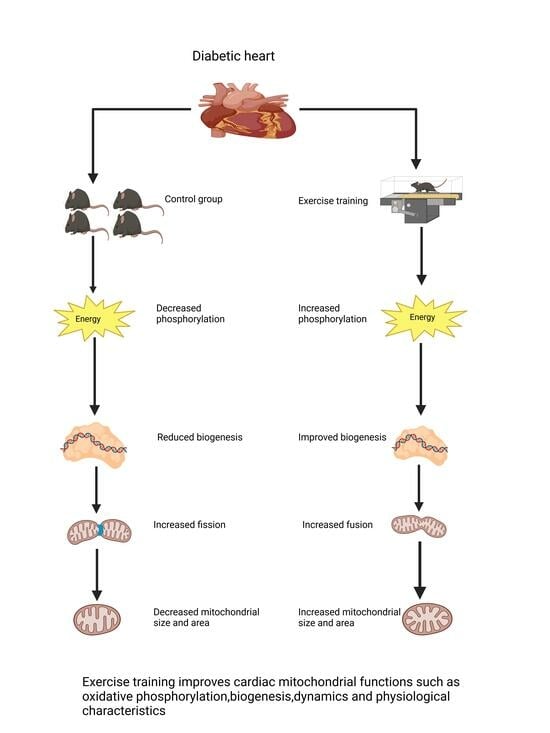
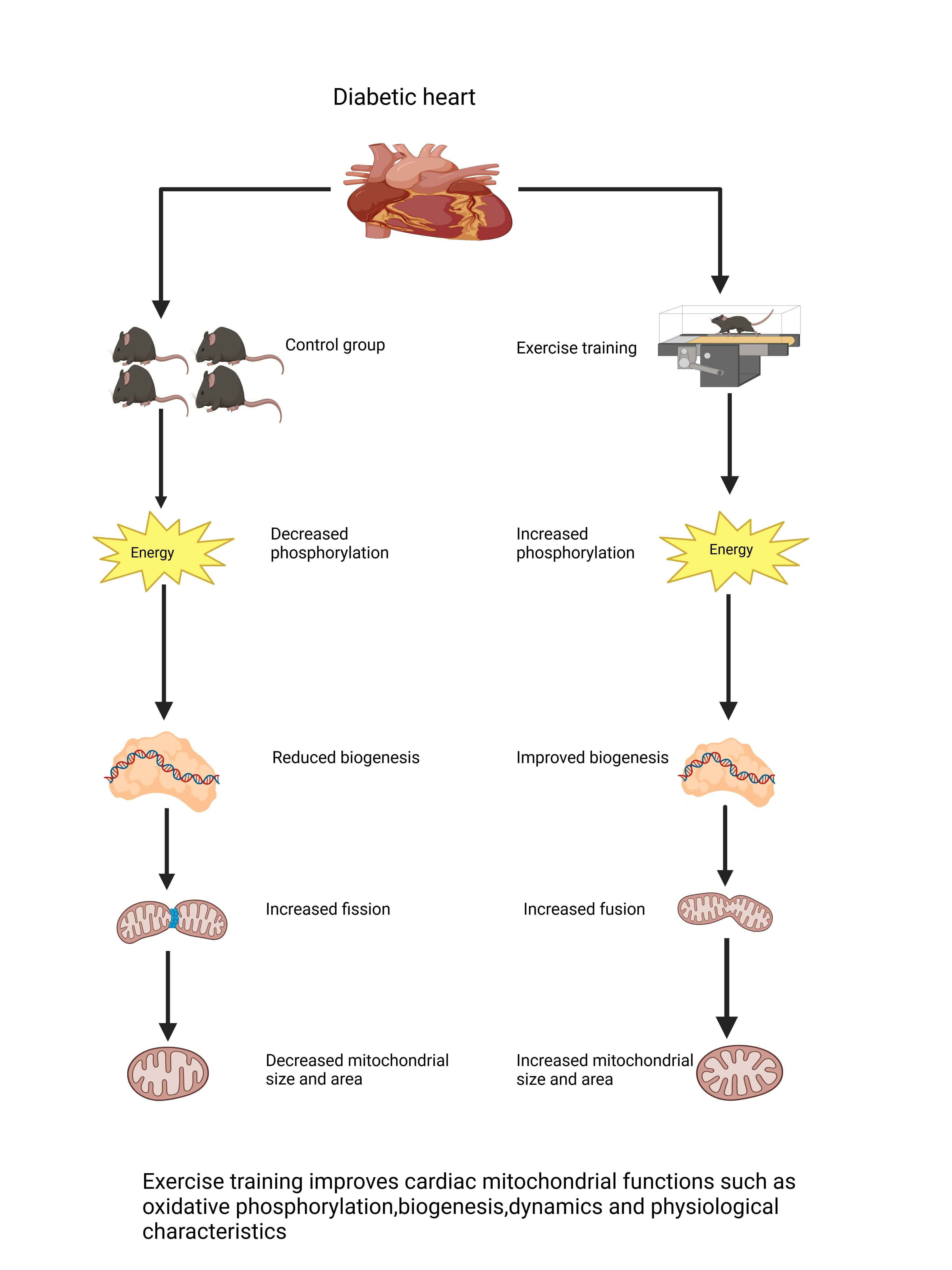
A diabetic heart is characterized by fibrosis, autophagy, oxidative stress, and altered mitochondrial functions. For this review, three databases (PubMed, EMBASE, and Web of Science) were searched for articles written in English from September 2023 to April 2024. Studies that used exercise training for at least 3 weeks and which reported positive, negative, or no effects were included. The CAMARADES checklist was used to assess the quality of the included studies, and ten studies (CAMARADES scores 4–7/10) were included. Nine studies showed that exercise training improved cardiac mitochondrial oxidative phosphorylation by decreasing ROS, increasing electron transport chain activity, and enhancing the production of ATP. Eight studies indicated that exercise training ameliorated mitochondrial biogenesis by increasing the levels of AMPK, PGC-1α, Akt, Irisin, and Sirtuin-III. Moreover, four studies focused on mitochondrial dynamics and concluded that exercise training helped decrease the levels of mitochondrial fission factor and dynamin-related protein- 1. Finally, six studies revealed improvements in mitochondrial physiological characteristics such as size, potential, and permeability. Our findings demonstrate the beneficial effects of exercise training on cardiac mitochondrial function in diabetic hearts. Exercise training improves cardiac mitochondrial physiological characteristics, oxidative phosphorylation, biogenesis, and dynamics.
Keywords: diabetic heart; exercise training; mitochondrial biogenesis; mitochondrial dynamics; mitochondrial function; mitochondrial oxidative phosphorylation diabetic heart; exercise training; mitochondrial biogenesis; mitochondrial dynamics; mitochondrial function; mitochondrial oxidative phosphorylation
Graphical Abstract