Article

The Interaction between CLSPN Gene Polymorphisms and Alcohol Consumption Contributes to Oral Cancer Progression


1
Oral Cancer Research Center, Changhua Christian Hospital, Changhua 500, Taiwan
2
Doctoral Program in Tissue Engineering and Regenerative Medicine, College of Medicine, National Chung Hsing University, Taichung 402, Taiwan
3
Graduate Institute of Biomedical Sciences, China Medical University, Taichung 404, Taiwan
4
Department of Otorhinolaryngology, Head and Neck Surgery, Changhua Christian Hospital, Changhua 500, Taiwan
5
Department of Post-Baccalaureate Medicine, College of Medicine, National Chung Hsing University, Taichung 402, Taiwan
*
Author to whom correspondence should be addressed.
Int. J. Mol. Sci. 2024, 25(2), 1098; https://doi.org/10.3390/ijms25021098
Submission received: 3 November 2023 / Revised: 15 January 2024 / Accepted: 15 January 2024 / Published: 16 January 2024

Abstract

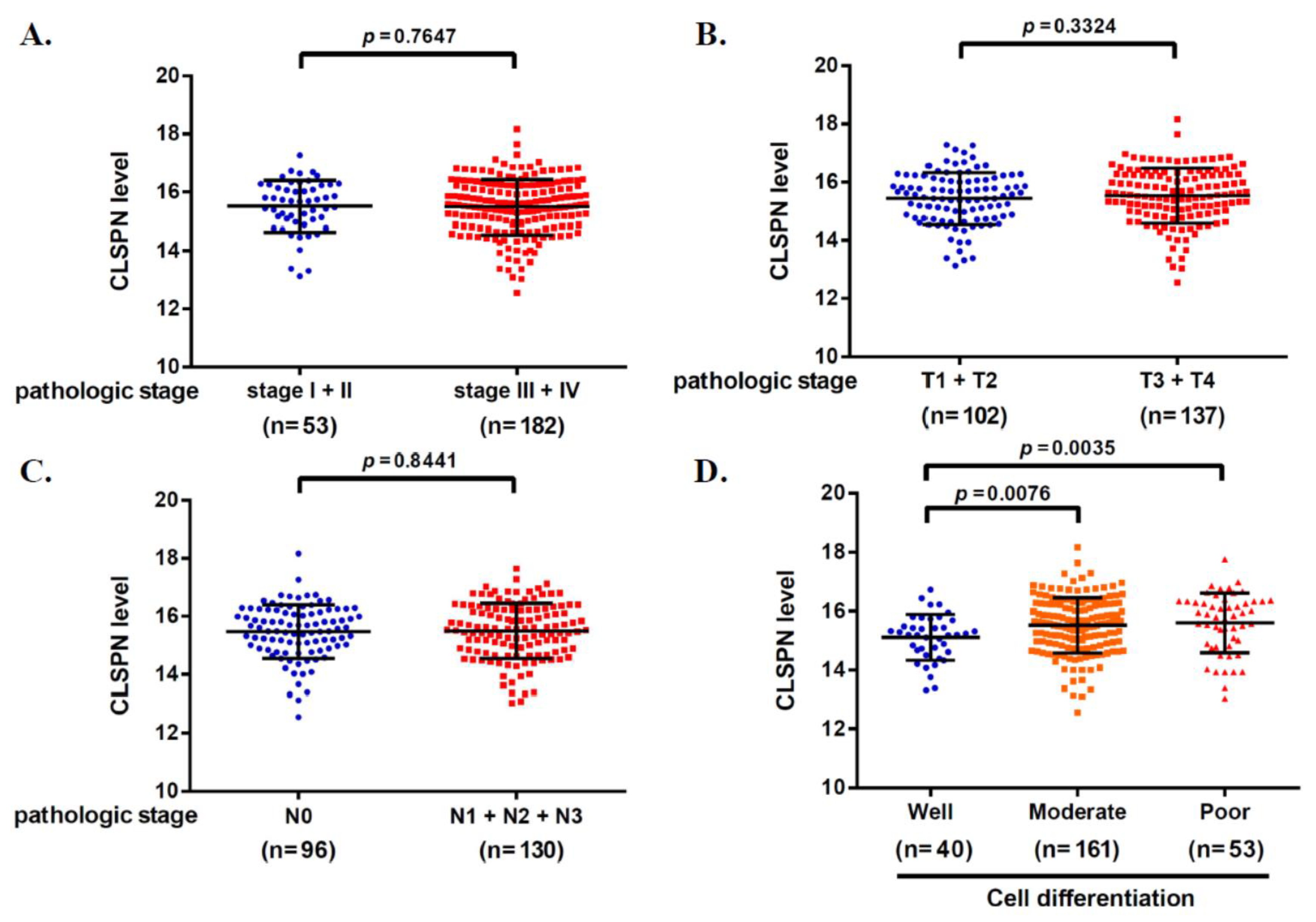
Most disease single nucleotide polymorphisms (SNPs) are regulatory and approximately half of heritability is occupied by the top 1% of genes, with the gene-level structure varying with the number of variants associated with the most common alleles. Cancer occurrence and progression are significantly affected by Claspin (CLSPN) gene polymorphism present in the population, which alters the expression, function, and regulation of the gene. CLSPN genotypes are associated with oral cancer, but the literature on this association is limited. As a result, the goal of this study is to investigate the correlation between CLSPN genotypes and oral cancers’ development. This study will explore the presence of four CLSPN SNPs including rs12058760, rs16822339, rs535638 and rs7520495 gene polymorphisms, and analyze the expression of these genes in 304 cancer-free controls and 402 oral squamous cell carcinoma (OSCC) cases. Attempts have been made to obtain insight into the role of CLSPN gene polymorphisms in oral cancer through the analysis of this study. We demonstrated that the OSCC risk of individuals with four CLSPN SNPs relative to the wild type did not differ significantly from that of the wild type when the polymorphisms are analyzed according to individual habits. We further studied the mechanism by which CLSPN polymorphisms affect the progression of clinicopathological features in OSCC patients. The results of the degree of cell differentiation showed that compared with patients of rs7520495 SNP carrying the CC genotype, the incidence of poor cell differentiation in patients carrying the CC + GG genotype was higher (AOR: 1.998-fold; 95% CI, 1.127–3.545; p = 0.018). In particular, patients with the G genotype of rs7520495 had increased poor cell differentiation compared with patients with the C genotype (AOR: 4.736-fold; 95% CI, 1.306–17.178; p = 0.018), especially in the drinking group. On the basis of our analysis of the Cancer Genome Atlas dataset, we found that higher CLSPN levels were associated with poorer cell differentiation in oral cancers. In this study, we provide the first evidence showing that CLSPN SNPs contribute to oral cancer. Whether or not rs7520495 can be used as a confirmatory factor in the future is uncertain, but it seems likely that it can be used as an important factor in predicting recurrence, response to treatment and medication toxicity to patients with oral cancer.
Keywords: single nucleotide polymorphisms; Claspin; oral cancer single nucleotide polymorphisms; Claspin; oral cancer