Review

The Wheel of p53 Helps to Drive the Immune System

by
Barbara Łasut-Szyszka
and
Marek Rusin
*
Center for Translational Research and Molecular Biology of Cancer, Maria Skłodowska-Curie National Research Institute of Oncology, Gliwice Branch, 44-101 Gliwice, Poland
*
Author to whom correspondence should be addressed.
Int. J. Mol. Sci. 2023, 24(8), 7645; https://doi.org/10.3390/ijms24087645
Submission received: 21 March 2023 / Revised: 18 April 2023 / Accepted: 18 April 2023 / Published: 21 April 2023
(This article belongs to the Special Issue State-of-the-Art Molecular Oncology in Poland)

Abstract

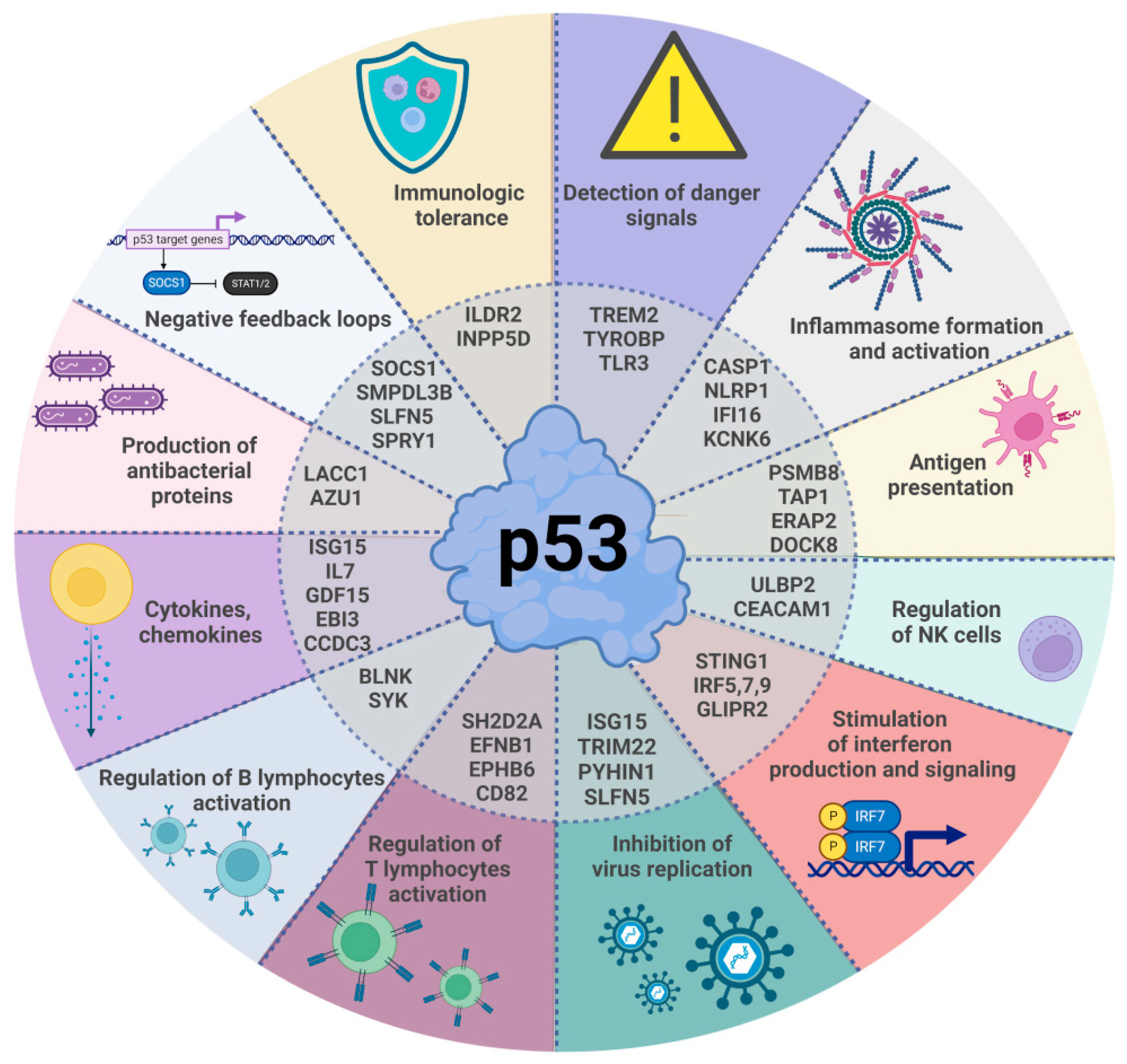
The p53 tumor suppressor protein is best known as an inhibitor of the cell cycle and an inducer of apoptosis. Unexpectedly, these functions of p53 are not required for its tumor suppressive activity in animal models. High-throughput transcriptomic investigations as well as individual studies have demonstrated that p53 stimulates expression of many genes involved in immunity. Probably to interfere with its immunostimulatory role, many viruses code for proteins that inactivate p53. Judging by the activities of immunity-related p53-regulated genes it can be concluded that p53 is involved in detection of danger signals, inflammasome formation and activation, antigen presentation, activation of natural killer cells and other effectors of immunity, stimulation of interferon production, direct inhibition of virus replication, secretion of extracellular signaling molecules, production of antibacterial proteins, negative feedback loops in immunity-related signaling pathways, and immunologic tolerance. Many of these p53 functions have barely been studied and require further, more detailed investigations. Some of them appear to be cell-type specific. The results of transcriptomic studies have generated many new hypotheses on the mechanisms utilized by p53 to impact on the immune system. In the future, these mechanisms may be harnessed to fight cancer and infectious diseases.
Keywords: p53; immunity; transcriptome; virus; negative-feedback loops p53; immunity; transcriptome; virus; negative-feedback loops