Review

Mechanisms of Demyelination and Remyelination Strategies for Multiple Sclerosis

Institute of Developmental Biology and Neurobiology, Faculty of Biology, Johannes-Gutenberg University, Hanns-Dieter-Hüsch-Weg 15, 55128 Mainz, Germany
*
Author to whom correspondence should be addressed.
Int. J. Mol. Sci. 2023, 24(7), 6373; https://doi.org/10.3390/ijms24076373
Submission received: 25 February 2023 / Revised: 19 March 2023 / Accepted: 25 March 2023 / Published: 28 March 2023

Abstract

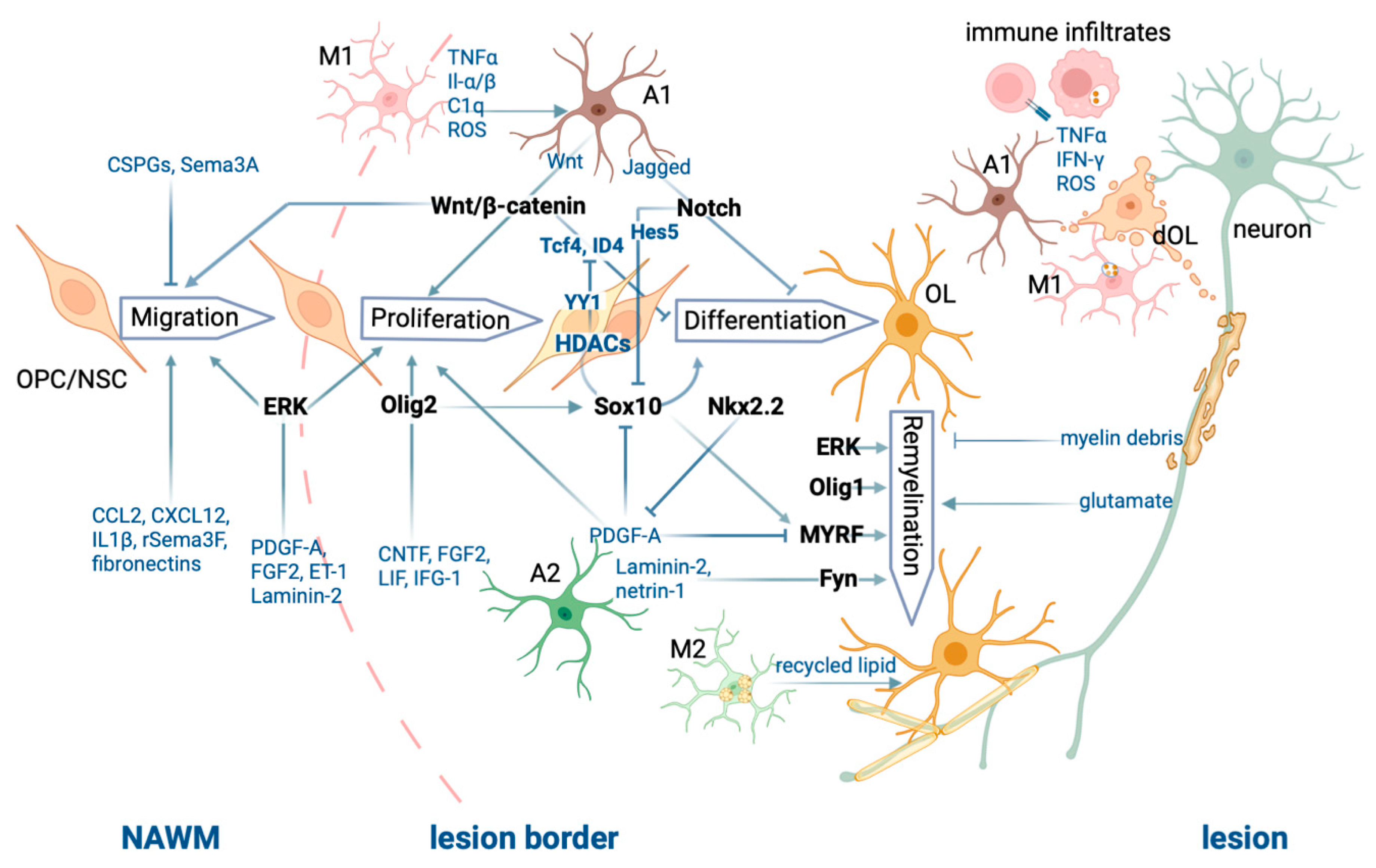
All currently licensed medications for multiple sclerosis (MS) target the immune system. Albeit promising preclinical results demonstrated disease amelioration and remyelination enhancement via modulating oligodendrocyte lineage cells, most drug candidates showed only modest or no effects in human clinical trials. This might be due to the fact that remyelination is a sophistically orchestrated process that calls for the interplay between oligodendrocyte lineage cells, neurons, central nervous system (CNS) resident innate immune cells, and peripheral immune infiltrates and that this process may somewhat differ in humans and rodent models used in research. To ensure successful remyelination, the recruitment and activation/repression of each cell type should be regulated in a highly organized spatio–temporal manner. As a result, drug candidates targeting one single pathway or a single cell population have difficulty restoring the optimal microenvironment at lesion sites for remyelination. Therefore, when exploring new drug candidates for MS, it is instrumental to consider not only the effects on all CNS cell populations but also the optimal time of administration during disease progression. In this review, we describe the dysregulated mechanisms in each relevant cell type and the disruption of their coordination as causes of remyelination failure, providing an overview of the complex cell interplay in CNS lesion sites.
Keywords: multiple sclerosis; remyelination; immune cells; oligodendrocytes; transcription factors; epigenetics multiple sclerosis; remyelination; immune cells; oligodendrocytes; transcription factors; epigenetics