Review

The Role of Physical Exercise in Opioid Substitution Therapy: Mechanisms of Sequential Effects

by
Alexandros Psarianos
1,
Costas Chryssanthopoulos
2,
Thomas Paparrigopoulos
1 and
Anastassios Philippou
2,*
1
1st Department of Psychiatry, Medical School, National and Kapodistrian University of Athens, 11528 Athens, Greece
2
Department of Physiology, Medical School, National and Kapodistrian University of Athens, 11527 Athens, Greece
*
Author to whom correspondence should be addressed.
Int. J. Mol. Sci. 2023, 24(5), 4763; https://doi.org/10.3390/ijms24054763
Submission received: 7 January 2023 / Revised: 21 February 2023 / Accepted: 24 February 2023 / Published: 1 March 2023
(This article belongs to the Special Issue Molecular Advances on Cannabinoid and Endocannabinoid Research)

Abstract

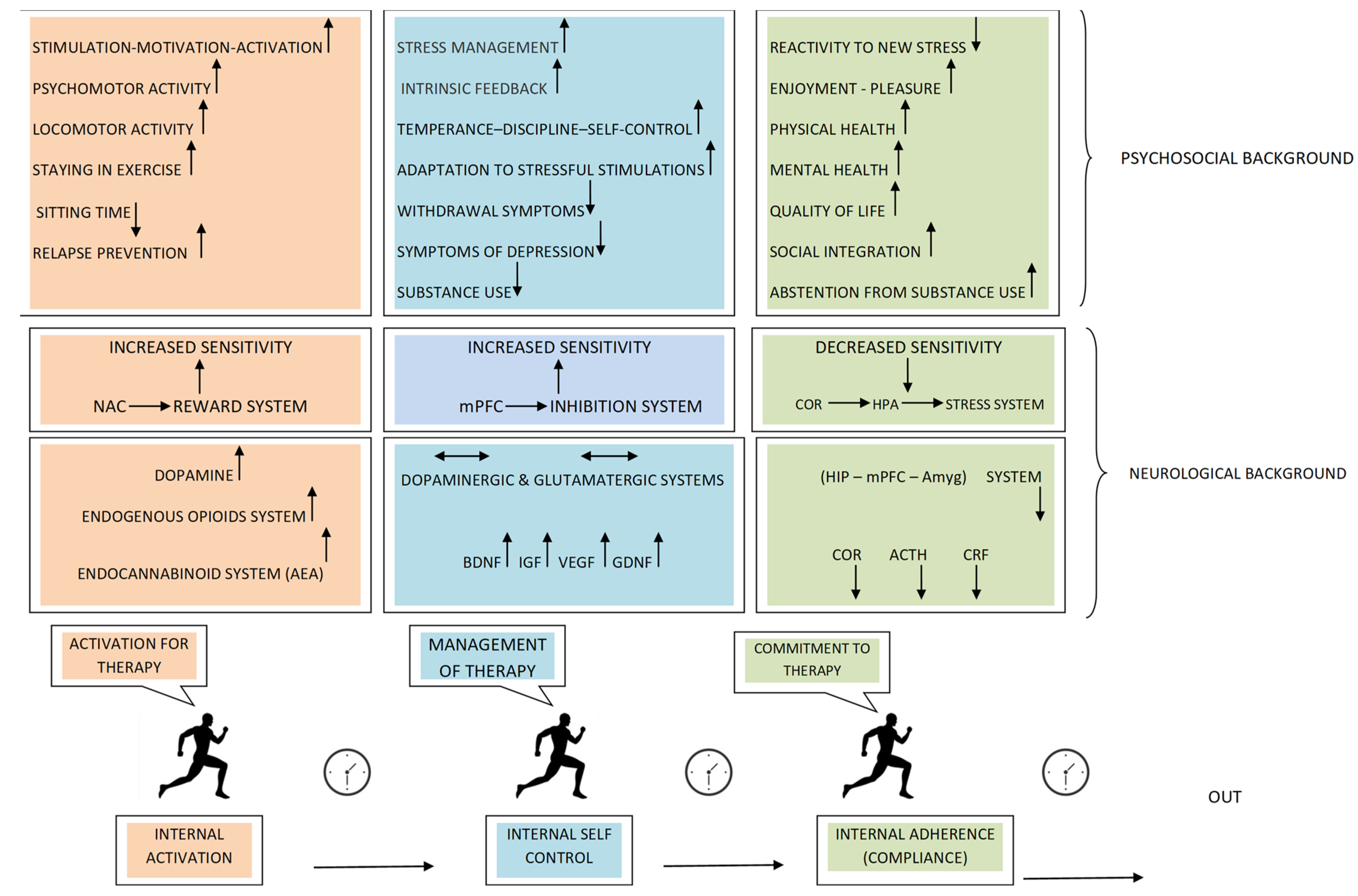
It is generally accepted that chronic opioid use is associated with structural and functional changes in the human brain that lead to an enhancement of impulsive behavior for immediate satisfaction. Interestingly, in recent years, physical exercise interventions have been used as an adjunctive treatment for patients with opioid use disorders (OUDs). Indeed, exercise has positive effects on both the biological and psychosocial basis of addiction, modifying neural circuits such as the reward, inhibition, and stress systems, and thus causing behavioral changes. This review focuses on the possible mechanisms that contribute to the beneficial effects of exercise on the treatment of OUDs, with emphasis placed on the description of a sequential consolidation of these mechanisms. Exercise is thought to act initially as a factor of internal activation and self-regulation and eventually as a factor of commitment. This approach suggests a sequential (temporal) consolidation of the functions of exercise in favor of gradual disengagement from addiction. Particularly, the sequence in which the exercise-induced mechanisms are consolidated follows the pattern of internal activation—self-regulation—commitment, eventually resulting in stimulation of the endocannabinoid and endogenous opioid systems. Additionally, this is accompanied by modification of molecular and behavioral aspects of opioid addiction. Overall, the neurobiological actions of exercise in combination with certain psychological mechanisms appear to promote its beneficial effects. Given the positive effects of exercise on both physical and mental health, exercise prescription is recommended as a complement to conventional therapy for patients on opioid maintenance treatment.
Keywords: opioid maintenance treatment; opioid users; exercise in opioid substitution treatment; exercise-induced mechanisms of sequential effects opioid maintenance treatment; opioid users; exercise in opioid substitution treatment; exercise-induced mechanisms of sequential effects