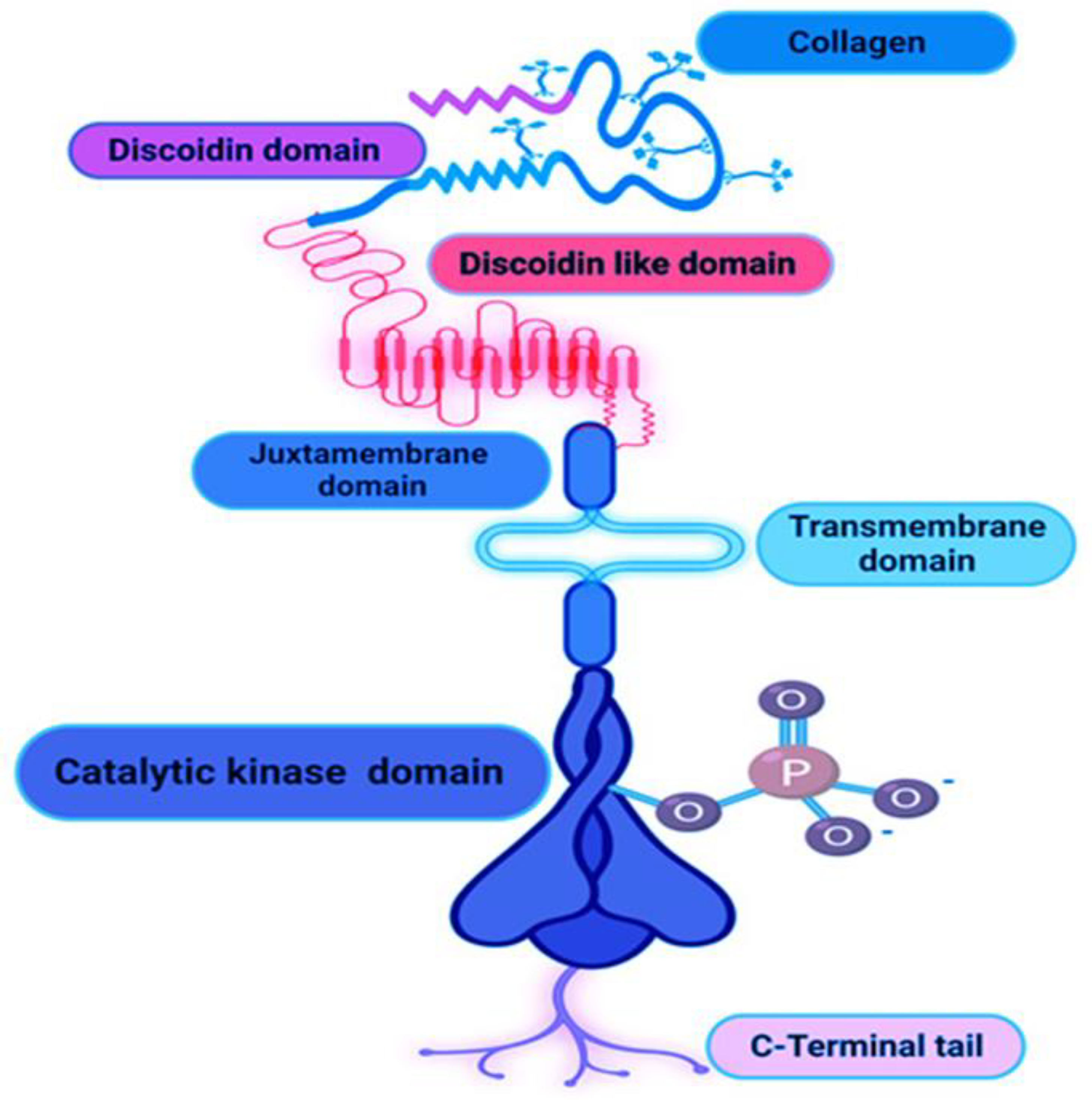
Exploring the Cellular and Molecular Mechanism of Discoidin Domain Receptors (DDR1 and DDR2) in Bone Formation, Regeneration, and Its Associated Disease Conditions


Abstract
1. Introduction
2. Discoidin in Various Genomes
3. Expression of DDRs and Related Proteins
4. Collagen: The Prime Activator of DDRs Signaling
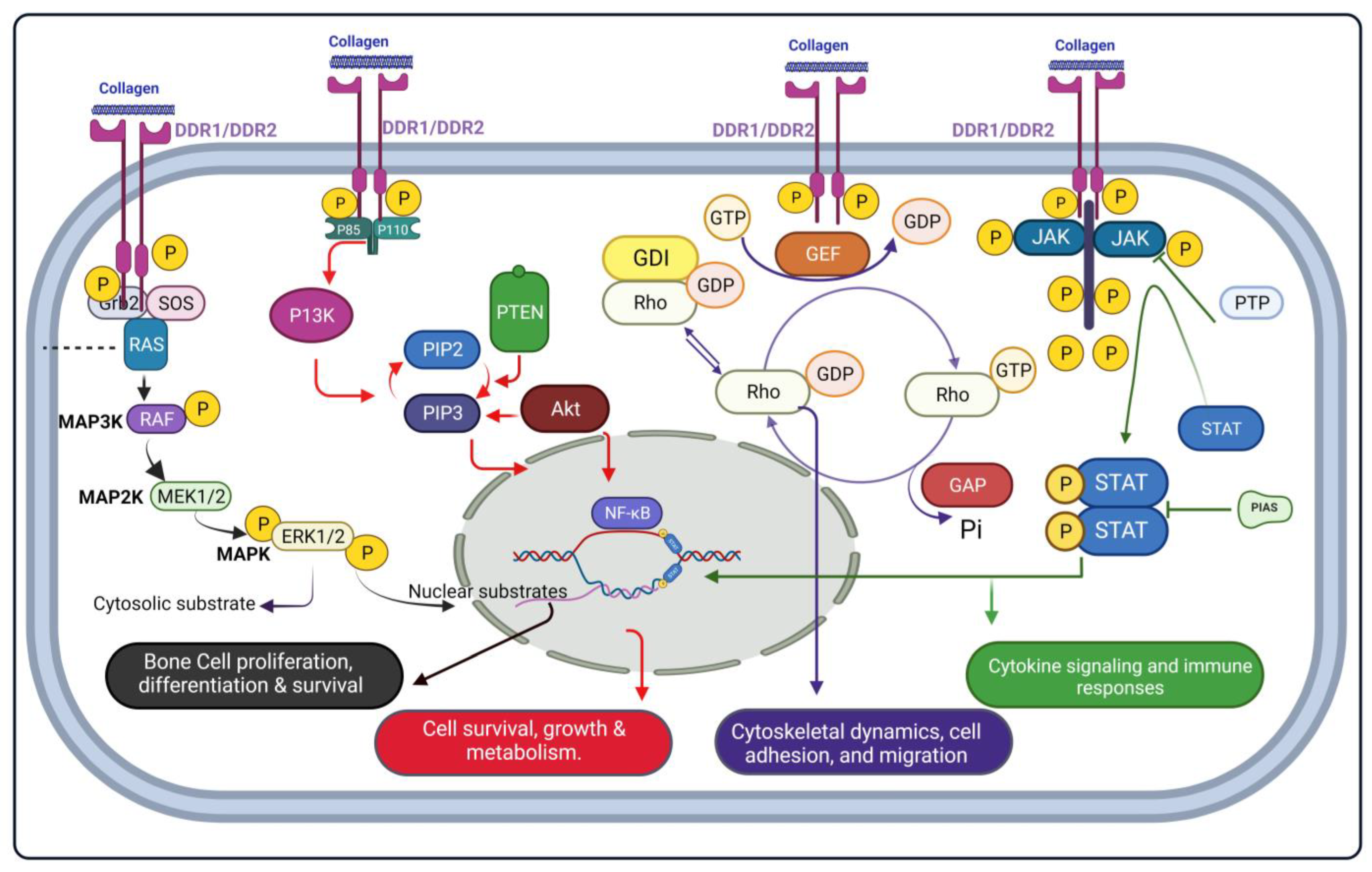
5. Molecular Signaling of DDRs in Bone and Cartilage
6. DDRs Expression in Bone and Tissue
7. DDRs as a Potential Therapeutic against OA and RA
8. Conclusions
Author Contributions
Funding
Institutional Review Board Statement
Informed Consent Statement
Data Availability Statement
Acknowledgments
Conflicts of Interest
References
- Hubbard, S.R.; Till, J.H. Protein tyrosine kinase structure and function. Annu. Rev. Biochem. 2000, 69, 373–398. [Google Scholar] [CrossRef] [Scilit]
- Zandi, R.; Larsen, A.B.; Andersen, P.; Stockhausen, M.-T.; Poulsen, H.S. Mechanisms for oncogenic activation of the epidermal growth factor receptor. Cell. Signal. 2007, 19, 2013–2023. [Google Scholar] [CrossRef] [Scilit] [PubMed]
- Lemmon, M.A.; Schlessinger, J. Cell signaling by receptor tyrosine kinases. Cell 1992, 25, 7. [Google Scholar] [CrossRef] [Scilit]
- Hachehouche, L.N.; Chetoui, N.; Aoudjit, F. Implication of discoidin domain receptor 1 in T cell migration in three-dimensional collagen. Mol. Immunol. 2010, 47, 1866–1869. [Google Scholar] [CrossRef] [Scilit]
- Afonso, P.V.; McCann, C.P.; Kapnick, S.M.; Parent, C.A. Discoidin domain receptor 2 regulates neutrophil chemotaxis in 3D collagen matrices. Blood J. Am. Soc. Hematol. 2013, 121, 1644–1650. [Google Scholar] [CrossRef] [Scilit]
- Vogel, W.F. Ligand-induced shedding of discoidin domain receptor 1. FEBS Lett. 2002, 514, 175–180. [Google Scholar] [CrossRef] [Scilit] [PubMed]
- Wang, C.-Z.; Su, H.-W.; Hsu, Y.-C.; Shen, M.-R.; Tang, M.-J. A discoidin domain receptor 1/SHP-2 signaling complex inhibits α2β1-integrin–mediated signal transducers and activators of transcription 1/3 activation and cell migration. Mol. Biol. Cell 2006, 17, 2839–2852. [Google Scholar] [CrossRef] [Scilit] [PubMed]
- Abdulhussein, R.; McFadden, C.; Fuentes-Prior, P.; Vogel, W.F. Exploring the collagen-binding site of the DDR1 tyrosine kinase receptor. J. Biol. Chem. 2004, 279, 31462–31470. [Google Scholar] [CrossRef] [Scilit]
- Chou, H.-C.; Lin, S.-Y.; Chou, L.-Y.; Ho, M.-L.; Chuang, S.-C.; Cheng, T.-L.; Kang, L.; Lin, Y.-S.; Wang, Y.-H.; Wei, C.-W. Ablation of discoidin domain receptor 1 provokes an osteopenic phenotype by regulating osteoblast/osteocyte autophagy and apoptosis. Biomedicines 2022, 10, 2173. [Google Scholar] [CrossRef] [Scilit]
- Chou, L.-Y.; Chen, C.-H.; Chuang, S.-C.; Cheng, T.-L.; Lin, Y.-H.; Chou, H.-C.; Fu, Y.-C.; Wang, Y.-H.; Wang, C.-Z. Discoidin domain receptor 1 regulates runx2 during osteogenesis of osteoblasts and promotes bone ossification via phosphorylation of p38. Int. J. Mol. Sci. 2020, 21, 7210. [Google Scholar] [CrossRef] [Scilit]
- Chou, H.-C.; Chen, C.-H.; Chou, L.-Y.; Cheng, T.-L.; Kang, L.; Chuang, S.-C.; Lin, Y.-S.; Ho, M.-L.; Wang, Y.-H.; Lin, S.-Y. Discoidin domain receptors 1 inhibition alleviates osteoarthritis via enhancing autophagy. Int. J. Mol. Sci. 2020, 21, 6991. [Google Scholar] [CrossRef] [Scilit] [PubMed]
- Hu, K.; Xu, L.; Cao, L.; Flahiff, C.M.; Brussiau, J.; Ho, K.; Setton, L.A.; Youn, I.; Guilak, F.; Olsen, B.R. Pathogenesis of osteoarthritis-like changes in the joints of mice deficient in type IX collagen. Arthritis Rheum. 2006, 54, 2891–2900. [Google Scholar] [CrossRef] [Scilit] [PubMed]
- Xu, L.; Peng, H.; Glasson, S.; Lee, P.L.; Hu, K.; Ijiri, K.; Olsen, B.R.; Goldring, M.B.; Li, Y. Increased expression of the collagen receptor discoidin domain receptor 2 in articular cartilage as a key event in the pathogenesis of osteoarthritis. Arthritis Rheum. 2007, 56, 2663–2673. [Google Scholar] [CrossRef] [Scilit] [PubMed]
- Sunk, I.G.; Bobacz, K.; Hofstaetter, J.G.; Amoyo, L.; Soleiman, A.; Smolen, J.; Xu, L.; Li, Y. Increased expression of discoidin domain receptor 2 is linked to the degree of cartilage damage in human knee joints: A potential role in osteoarthritis pathogenesis. Arthritis Rheum. Off. J. Am. Coll. Rheumatol. 2007, 56, 3685–3692. [Google Scholar] [CrossRef] [Scilit] [PubMed]
- Holt, D.W.; Henderson, M.L.; Stockdale, C.E.; Farrell, J.T.; Kooyman, D.L.; Bridgewater, L.C.; Seegmiller, R.E. Osteoarthritis-like changes in the heterozygous sedc mouse associated with the HtrA1–Ddr2–Mmp-13 degradative pathway: A new model of osteoarthritis. Osteoarthr. Cartil. 2012, 20, 430–439. [Google Scholar] [CrossRef] [Scilit] [PubMed]
- Xu, L.; Polur, I.; Servais, J.M.; Hsieh, S.; Lee, P.L.; Goldring, M.B.; Li, Y. Intact pericellular matrix of articular cartilage is required for unactivated discoidin domain receptor 2 in the mouse model. Am. J. Pathol. 2011, 179, 1338–1346. [Google Scholar] [CrossRef] [Scilit]
- Hou, G.; Vogel, W.; Bendeck, M.P. The discoidin domain receptor tyrosine kinase DDR1 in arterial wound repair. J. Clin. Investig. 2001, 107, 727–735. [Google Scholar] [CrossRef] [Scilit]
- Hou, G.; Wang, D.; Bendeck, M.P. Deletion of discoidin domain receptor 2 does not affect smooth muscle cell adhesion, migration, or proliferation in response to type I collagen. Cardiovasc. Pathol. 2012, 21, 214–218. [Google Scholar] [CrossRef] [Scilit]
- Ferri, N.; Carragher, N.O.; Raines, E.W. Role of discoidin domain receptors 1 and 2 in human smooth muscle cell-mediated collagen remodeling: Potential implications in atherosclerosis and lymphangioleiomyomatosis. Am. J. Pathol. 2004, 164, 1575–1585. [Google Scholar] [CrossRef] [Scilit]
- Franco, C.; Hou, G.; Ahmad, P.J.; Fu, E.Y.K.; Koh, L.; Vogel, W.F.; Bendeck, M.P. Discoidin domain receptor 1 (ddr1) deletion decreases atherosclerosis by accelerating matrix accumulation and reducing inflammation in low-density lipoprotein receptor–deficient mice. Circ. Res. 2008, 102, 1202–1211. [Google Scholar] [CrossRef] [Scilit]
- Franco, C.; Britto, K.; Wong, E.; Hou, G.; Zhu, S.-N.; Chen, M.; Cybulsky, M.I.; Bendeck, M.P. Discoidin domain receptor 1 on bone marrow–derived cells promotes macrophage accumulation during atherogenesis. Circ. Res. 2009, 105, 1141–1148. [Google Scholar] [CrossRef] [Scilit] [PubMed]
- Flamant, M.; Placier, S.; Rodenas, A.; Curat, C.A.; Vogel, W.F.; Chatziantoniou, C.; Dussaule, J.-C. Discoidin domain receptor 1 null mice are protected against hypertension-induced renal disease. J. Am. Soc. Nephrol. 2006, 17, 3374–3381. [Google Scholar] [CrossRef] [Scilit] [PubMed]
- Gross, O.; Girgert, R.; Beirowski, B.; Kretzler, M.; Kang, H.G.; Kruegel, J.; Miosge, N.; Busse, A.-C.; Segerer, S.; Vogel, W.F. Loss of collagen-receptor DDR1 delays renal fibrosis in hereditary type IV collagen disease. Matrix Biol. 2010, 29, 346–356. [Google Scholar] [CrossRef] [Scilit] [PubMed]
- Kerroch, M.; Guerrot, D.; Vandermeersch, S.; Placier, S.; Mesnard, L.; Jouanneau, C.; Rondeau, E.; Ronco, P.; Boffa, J.J.; Chatziantoniou, C. Genetic inhibition of discoidin domain receptor 1 protects mice against crescentic glomerulonephritis. FASEB J. 2012, 26, 4079–4091. [Google Scholar] [CrossRef] [Scilit] [PubMed]
- Avivi-Green, C.; Singal, M.; Vogel, W.F. Discoidin domain receptor 1–deficient mice are resistant to bleomycin-induced lung fibrosis. Am. J. Respir. Crit. Care Med. 2006, 174, 420–427. [Google Scholar] [CrossRef] [Scilit]
- Olaso, E.; Arteta, B.; Benedicto, A.; Crende, O.; Friedman, S.L. Loss of discoidin domain receptor 2 promotes hepatic fibrosis after chronic carbon tetrachloride through altered paracrine interactions between hepatic stellate cells and liver-associated macrophages. Am. J. Pathol. 2011, 179, 2894–2904. [Google Scholar] [CrossRef] [Scilit]
- Luo, Z.; Liu, H.; Sun, X.; Guo, R.; Cui, R.; Ma, X.; Yan, M. RNA interference against discoidin domain receptor 2 ameliorates alcoholic liver disease in rats. PLoS ONE 2013, 8, e55860. [Google Scholar] [CrossRef] [Scilit]
- Zhang, X.-H.; Yan, M.; Liu, L.; Wu, T.-J.; Ma, L.-L.; Wang, L.-X. Expression of discoidin domain receptors (DDR2) in alcoholic liver fibrosis in rats. Arch. Med. Res. 2010, 41, 586–592. [Google Scholar] [CrossRef] [Scilit]
- Ongusaha, P.P.; Kim, J.-i.; Fang, L.; Wong, T.W.; Yancopoulos, G.D.; Aaronson, S.A.; Lee, S.W. p53 induction and activation of DDR1 kinase counteract p53-mediated apoptosis and influence p53 regulation through a positive feedback loop. EMBO J. 2003, 22, 1289–1301. [Google Scholar] [CrossRef] [Scilit]
- Rikova, K.; Guo, A.; Zeng, Q.; Possemato, A.; Yu, J.; Haack, H.; Nardone, J.; Lee, K.; Reeves, C.; Li, Y. Global survey of phosphotyrosine signaling identifies oncogenic kinases in lung cancer. Cell 2007, 131, 1190–1203. [Google Scholar] [CrossRef] [Scilit]
- Ford, C.E.; Lau, S.K.; Zhu, C.Q.; Andersson, T.; Tsao, M.S.; Vogel, W.F. Expression and mutation analysis of the discoidin domain receptors 1 and 2 in non-small cell lung carcinoma. Br. J. Cancer 2007, 96, 808–814. [Google Scholar] [CrossRef] [Scilit] [PubMed]
- Miao, L.; Zhu, S.; Wang, Y.; Li, Y.; Ding, J.; Dai, J.; Cai, H.; Zhang, D.; Song, Y. Discoidin domain receptor 1 is associated with poor prognosis of non-small cell lung cancer and promotes cell invasion via epithelial-to-mesenchymal transition. Med. Oncol. 2013, 30, 626. [Google Scholar] [CrossRef] [Scilit]
- Valencia, K.; Ormazábal, C.; Zandueta, C.; Luis-Ravelo, D.; Antón, I.; Pajares, M.J.; Agorreta, J.; Montuenga, L.M.; Martínez-Canarias, S.; Leitinger, B. Inhibition of collagen receptor discoidin domain receptor-1 (DDR1) reduces cell survival, homing, and colonization in lung cancer bone metastasis. Clin. Cancer Res. 2012, 18, 969–980. [Google Scholar] [CrossRef] [Scilit] [PubMed]
- Zhang, K.; Corsa, C.A.; Ponik, S.M.; Prior, J.L.; Piwnica-Worms, D.; Eliceiri, K.W.; Keely, P.J.; Longmore, G.D. The collagen receptor discoidin domain receptor 2 stabilizes SNAIL1 to facilitate breast cancer metastasis. Nat. Cell Biol. 2013, 15, 677–687. [Google Scholar] [CrossRef] [Scilit] [PubMed]
- Ren, T.; Zhang, J.; Zhang, J.; Liu, X.; Yao, L. Increased expression of discoidin domain receptor 2 (DDR2): A novel independent prognostic marker of worse outcome in breast cancer patients. Med. Oncol. 2013, 30, 397. [Google Scholar] [CrossRef] [Scilit] [PubMed]
- Robinson, D.R.; Wu, Y.-M.; Lin, S.-F. The protein tyrosine kinase family of the human genome. Oncogene 2000, 19, 5548–5557. [Google Scholar] [CrossRef] [Scilit] [PubMed]
- Vogel, W.; Gish, G.D.; Alves, F.; Pawson, T. The discoidin domain receptor tyrosine kinases are activated by collagen. Mol. Cell 1997, 1, 13–23. [Google Scholar] [CrossRef] [Scilit]
- Vogel, W.F.; Abdulhussein, R.; Ford, C.E. Sensing extracellular matrix: An update on discoidin domain receptor function. Cell. Signal. 2006, 18, 1108–1116. [Google Scholar] [CrossRef] [Scilit]
- Leitinger, B. Discoidin domain receptor functions in physiological and pathological conditions. Int. Rev. Cell Mol. Biol. 2014, 310, 39–87. [Google Scholar]
- Curat, C.A.; Vogel, W.F. Discoidin domain receptor 1 controls growth and adhesion of mesangial cells. J. Am. Soc. Nephrol. 2002, 13, 2648–2656. [Google Scholar] [CrossRef] [Scilit]
- Ram, R.; Lorente, G.; Nikolich, K.; Urfer, R.; Foehr, E.; Nagavarapu, U. Discoidin domain receptor-1a (DDR1a) promotes glioma cell invasion and adhesion in association with matrix metalloproteinase-2. J. Neuro-Oncol. 2006, 76, 239–248. [Google Scholar] [CrossRef] [Scilit]
- Dorison, A. Le Récepteur à Domaine Discoïdine de type 1: Un acteur majeur des pathologies rénales chroniques et aiguës. Ph.D. Thesis, Sorbonne University, Paris, France, 2016. [Google Scholar]
- Curat, C.A.; Eck, M.; Dervillez, X.; Vogel, W.F. Mapping of epitopes in discoidin domain receptor 1 critical for collagen binding. J. Biol. Chem. 2001, 276, 45952–45958. [Google Scholar] [CrossRef] [Scilit] [PubMed]
- Kobayashi, N.; McClanahan, T.K.; Simon, J.R.; Treger, J.M.; McEntee, K. Structure and Functional Analysis of the Multistress Response GeneDDR2fromSaccharomyces cerevisiae. Biochem. Biophys. Res. Commun. 1996, 229, 540–547. [Google Scholar] [CrossRef] [Scilit] [PubMed]
- Labrador, J.P.; Azcoitia, V.; Tuckermann, J.; Lin, C.; Olaso, E.; Mañes, S.; Brückner, K.; Goergen, J.-L.; Lemke, G.; Yancopoulos, G. The collagen receptor DDR2 regulates proliferation and its elimination leads to dwarfism. EMBO Rep. 2001, 2, 446–452. [Google Scholar] [CrossRef] [Scilit]
- Leitinger, B.; Kwan, A.P.L. The discoidin domain receptor DDR2 is a receptor for type X collagen. Matrix Biol. 2006, 25, 355–364. [Google Scholar] [CrossRef] [Scilit] [PubMed]
- Geerts, A. On the origin of stellate cells: Mesodermal, endodermal or neuro-ectodermal? J. Hepatol. 2004, 40, 331–334. [Google Scholar] [CrossRef] [Scilit]
- Zurakowski, H. Expression of Discoidin Domain Receptors in 3T3-L1 Preadipocytes and Adipocytes. Ph.D. Thesis, University of Ottawa, Ottawa, ON, Canada, 2006. [Google Scholar]
- Desbaillets, I.; Ziegler, U.; Groscurth, P.; Gassmann, M. Embryoid bodies: An in vitro model of mouse embryogenesis. Exp. Physiol. 2000, 85, 645–651. [Google Scholar] [CrossRef]
- Unsoeld, T.; Park, J.-O.; Hutter, H. Discoidin domain receptors guide axons along longitudinal tracts in C. elegans. Dev. Biol. 2013, 374, 142–152. [Google Scholar] [CrossRef] [Scilit]
- Hisamoto, N.; Nagamori, Y.; Shimizu, T.; Pastuhov, S.I.; Matsumoto, K. The C. elegans Discoidin Domain Receptor DDR-2 Modulates the Met-like RTK–JNK Signaling Pathway in Axon Regeneration. PLoS Genet. 2016, 12, e1006475. [Google Scholar] [CrossRef] [Scilit]
- Müller, W.E.G.; Kruse, M.; Blumbach, B.; Skorokhod, A.; Müller, I.M. Gene structure and function of tyrosine kinases in the marine sponge Geodia cydonium: Autapomorphic characters of Metazoa. Gene 1999, 238, 179–193. [Google Scholar] [CrossRef] [Scilit]
- Grassot, J.; Gouy, M.; Perrière, G.; Mouchiroud, G. Origin and molecular evolution of receptor tyrosine kinases with immunoglobulin-like domains. Mol. Biol. Evol. 2006, 23, 1232–1241. [Google Scholar] [CrossRef] [Scilit]
- Reza, J.N.; Gavazzi, I.; Cohen, J. Neuropilin-1 is expressed on adult mammalian dorsal root ganglion neurons and mediates semaphorin3a/collapsin-1-induced growth cone collapse by small diameter sensory afferents. Mol. Cell. Neurosci. 1999, 14, 317–326. [Google Scholar] [CrossRef] [Scilit] [PubMed]
- Campos-Mora, M.; Morales, R.A.; Gajardo, T.; Catalán, D.; Pino-Lagos, K. Neuropilin-1 in transplantation tolerance. Front. Immunol. 2013, 4, 405. [Google Scholar] [CrossRef] [Scilit]
- Mathieu, S.V.; Aragão, K.S.; Imberty, A.; Varrot, A. Discoidin I from Dictyostelium discoideum and interactions with oligosaccharides: Specificity, affinity, crystal structures, and comparison with discoidin II. J. Mol. Biol. 2010, 400, 540–554. [Google Scholar] [CrossRef] [Scilit] [PubMed]
- Coelho, N.M.; Wang, A.; McCulloch, C.A. Discoidin domain receptor 1 interactions with myosin motors contribute to collagen remodeling and tissue fibrosis. Biochim. Et Biophys. Acta (BBA)-Mol. Cell Res. 2019, 1866, 118510. [Google Scholar] [CrossRef] [Scilit] [PubMed]
- Malloci, M.; Perdomo, L.; Veerasamy, M.; Andriantsitohaina, R.; Simard, G.; Martinez, M.C. Extracellular vesicles: Mechanisms in human health and disease. Antioxid. Redox Signal. 2019, 30, 813–856. [Google Scholar] [CrossRef] [Scilit]
- Ornitz, D.M.; Itoh, N. New developments in the biology of fibroblast growth factors. WIREs Mech. Dis. 2022, 14, e1549. [Google Scholar] [CrossRef] [Scilit]
- Ali, B.R.; Xu, H.; Akawi, N.A.; John, A.; Karuvantevida, N.S.; Langer, R.; Al-Gazali, L.; Leitinger, B. Trafficking defects and loss of ligand binding are the underlying causes of all reported DDR2 missense mutations found in SMED-SL patients. Hum. Mol. Genet. 2010, 19, 2239–2250. [Google Scholar] [CrossRef] [Scilit]
- Abou Neel, E.A.; Bozec, L.; Knowles, J.C.; Syed, O.; Mudera, V.; Day, R.; Hyun, J.K. Collagen—Emerging collagen based therapies hit the patient. Adv. Drug Deliv. Rev. 2013, 65, 429–456. [Google Scholar] [CrossRef] [Scilit]
- Amoah, B.P.; Yang, H.; Zhang, P.; Su, Z.; Xu, H. Immunopathogenesis of myocarditis: The interplay between cardiac fibroblast cells, dendritic cells, macrophages and CD4+T cells. Scand. J. Immunol. 2015, 82, 1–9. [Google Scholar] [CrossRef] [Scilit]
- Malcor, J.-D.; Mallein-Gerin, F. Biomaterial functionalization with triple-helical peptides for tissue engineering. Acta Biomater. 2022, 148, 1–21. [Google Scholar] [CrossRef] [Scilit] [PubMed]
- Ma, R.; Xie, X.; Zhao, L.; Wu, Y.; Wang, J. Discoidin domain receptors (DDRs): Potential implications in periodontitis. J. Cell. Physiol. 2022, 237, 189–198. [Google Scholar] [CrossRef] [Scilit]
- Leitinger, B.; Steplewski, A.; Fertala, A. The D2 period of collagen II contains a specific binding site for the human discoidin domain receptor, DDR2. J. Mol. Biol. 2004, 344, 993–1003. [Google Scholar] [CrossRef] [Scilit]
- Mohamed, F.F.; Ge, C.; Cowling, R.T.; Lucas, D.; Hallett, S.A.; Ono, N.; Binrayes, A.-A.; Greenberg, B.; Franceschi, R.T. The collagen receptor, discoidin domain receptor 2, functions in Gli1-positive skeletal progenitors and chondrocytes to control bone development. Bone Res. 2022, 10, 11. [Google Scholar] [CrossRef] [Scilit] [PubMed]
- Kumar, A.; Dutta Choudhury, M.; Ghosh, P.; Palit, P. Discoidin domain receptor 2: An emerging pharmacological drug target for prospective therapy against osteoarthritis. Pharmacol. Rep. 2019, 71, 399–408. [Google Scholar] [CrossRef] [Scilit] [PubMed]
- Zhao, H.; Bian, H.; Bu, X.; Zhang, S.; Zhang, P.; Yu, J.; Lai, X.; Li, D.; Zhu, C.; Yao, L. Targeting of discoidin domain receptor 2 (DDR2) prevents myofibroblast activation and neovessel formation during pulmonary fibrosis. Mol. Ther. 2016, 24, 1734–1744. [Google Scholar] [CrossRef] [Scilit] [PubMed]
- Luckman, S.P.; Rees, E.; Kwan, A.P.L. Partial characterization of cell-type X collagen interactions. Biochem. J. 2003, 372, 485–493. [Google Scholar] [CrossRef] [Scilit] [PubMed]
- Carafoli, F.; Hohenester, E. Collagen recognition and transmembrane signalling by discoidin domain receptors. Biochim. Et Biophys. Acta (BBA)-Proteins Proteom. 2013, 1834, 2187–2194. [Google Scholar] [CrossRef] [Scilit] [PubMed]
- Itoh, Y. Discoidin domain receptors: Microenvironment sensors that promote cellular migration and invasion. Cell Adhes. Migr. 2018, 12, 378–385. [Google Scholar] [CrossRef] [Scilit]
- Majkowska, I.; Shitomi, Y.; Ito, N.; Gray, N.S.; Itoh, Y. Discoidin domain receptor 2 mediates collagen-induced activation of membrane-type 1 matrix metalloproteinase in human fibroblasts. J. Biol. Chem. 2017, 292, 6633–6643. [Google Scholar] [CrossRef] [Scilit]
- Lund, A.W.; Stegemann, J.P.; Plopper, G.E. Mesenchymal stem cells sense three dimensional type I collagen through discoidin domain receptor 1. Open Stem Cell J. 2009, 1, 40. [Google Scholar] [PubMed]
- Yeh, Y.-C.; Lin, H.-H.; Tang, M.-J. A tale of two collagen receptors, integrin β1 and discoidin domain receptor 1, in epithelial cell differentiation. Am. J. Physiol. -Cell Physiol. 2012, 303, C1207–C1217. [Google Scholar] [CrossRef] [Scilit]
- Plotkin, L.I.; Bruzzaniti, A. Molecular signaling in bone cells: Regulation of cell differentiation and survival. Adv. Protein Chem. Struct. Biol. 2019, 116, 237–281. [Google Scholar]
- Elango, J.; Hou, C.; Bao, B.; Wang, S.; Maté Sánchez de Val, J.E.; Wenhui, W. The Molecular interaction of collagen with cell receptors for biological function. Polymers 2022, 14, 876. [Google Scholar] [CrossRef] [Scilit] [PubMed]
- Corcoran, D.S.; Juskaite, V.; Xu, Y.; Görlitz, F.; Alexandrov, Y.; Dunsby, C.; French, P.M.W.; Leitinger, B. DDR1 autophosphorylation is a result of aggregation into dense clusters. Sci. Rep. 2019, 9, 17104. [Google Scholar] [CrossRef] [Scilit]
- Gadiya, M.; Chakraborty, G. Signaling by discoidin domain receptor 1 in cancer metastasis. Cell Adhes. Migr. 2018, 12, 315–323. [Google Scholar] [CrossRef] [Scilit] [PubMed]
- Kothiwale, S.; Borza, C.M.; Lowe Jr, E.W.; Pozzi, A.; Meiler, J. Discoidin domain receptor 1 (DDR1) kinase as target for structure-based drug discovery. Drug Discov. Today 2015, 20, 255–261. [Google Scholar] [CrossRef] [Scilit]
- Li, Y.; Lu, X.; Ren, X.; Ding, K. Small Molecule Discoidin Domain Receptor Kinase Inhibitors and Potential Medical Applications: Miniperspective. J. Med. Chem. 2015, 58, 3287–3301. [Google Scholar] [CrossRef] [Scilit]
- Kumar, A.; Kumar, V.; Rattan, V.; Jha, V.; Bhattacharyya, S. Secretome proteins regulate comparative osteogenic and adipogenic potential in bone marrow and dental stem cells. Biochimie 2018, 155, 129–139. [Google Scholar] [CrossRef] [Scilit]
- Kang, J.-H.; Ko, H.M.; Moon, J.S.; Yoo, H.I.; Jung, J.Y.; Kim, M.S.; Koh, J.T.; Kim, W.J.; Kim, S.H. Osteoprotegerin expressed by osteoclasts: An autoregulator of osteoclastogenesis. J. Dent. Res. 2014, 93, 1116–1123. [Google Scholar] [CrossRef] [Scilit]
- Zhang, Y.; Su, J.; Yu, J.; Bu, X.; Ren, T.; Liu, X.; Yao, L. An essential role of discoidin domain receptor 2 (DDR2) in osteoblast differentiation and chondrocyte maturation via modulation of Runx2 activation. J. Bone Miner. Res. 2011, 26, 604–617. [Google Scholar] [CrossRef] [Scilit] [PubMed]
- Moll, S.; Desmoulière, A.; Moeller, M.J.; Pache, J.-C.; Badi, L.; Arcadu, F.; Richter, H.; Satz, A.; Uhles, S.; Cavalli, A. DDR1 role in fibrosis and its pharmacological targeting. Biochim. Et Biophys. Acta (BBA)-Mol. Cell Res. 2019, 1866, 118474. [Google Scholar] [CrossRef] [Scilit]
- Flynn, L.A.; Blissett, A.R.; Calomeni, E.P.; Agarwal, G. Inhibition of collagen fibrillogenesis by cells expressing soluble extracellular domains of DDR1 and DDR2. J. Mol. Biol. 2010, 395, 533–543. [Google Scholar] [CrossRef] [Scilit] [PubMed]
- Borochowitz, Z.; Langer Jr, L.O.; Gruber, H.E.; Lachman, R.; Katznelson, M.B.M.; Rimoin, D.L. Spondylo-meta-epiphyseal dysplasia (SMED), short limb-hand type: A congenital familial skeletal dysplasia with distinctive features and histopathology. Am. J. Med. Genet. 1993, 45, 320–326. [Google Scholar] [CrossRef] [Scilit] [PubMed]
- Sun, H.B. Mechanical loading, cartilage degradation, and arthritis. Ann. N. Y. Acad. Sci. 2010, 1211, 37–50. [Google Scholar] [CrossRef] [Scilit]
- Lee, J.-H.; Poudel, B.; Ki, H.-H.; Nepali, S.; Lee, Y.-M.; Shin, J.-S.; Kim, D.-K. Complement C1q stimulates the progression of hepatocellular tumor through the activation of discoidin domain receptor 1. Sci. Rep. 2018, 8, 4908. [Google Scholar] [CrossRef] [Scilit]
- Ripmeester, E.G.; Timur, U.T.; Caron, M.M.; Welting, T.J. Recent insights into the contribution of the changing hypertrophic chondrocyte phenotype in the development and progression of osteoarthritis. Front. Bioeng. Biotechnol. 2018, 6, 18. [Google Scholar] [CrossRef] [Scilit]
- Suutre, S.; Kerna, I.; Lintrop, M.; Tamm, H.; Aunapuu, M.; Arend, A.; Tamm, A. Evaluation of correlation of articular cartilage staining for DDR2 and proteoglycans with histological tissue damage and the results of radiographic assessment in patients with early stages of knee osteoarthritis. Int. J. Clin. Exp. Pathol. 2015, 8, 5658. [Google Scholar]
- Yang, X.; Meng, X.; Su, X.; Mauchley, D.C.; Ao, L.; Cleveland Jr, J.C.; Fullerton, D.A. Bone morphogenic protein 2 induces Runx2 and osteopontin expression in human aortic valve interstitial cells: Role of Smad1 and extracellular signal-regulated kinase 1/2. J. Thorac. Cardiovasc. Surg. 2009, 138, 1008–1015. [Google Scholar] [CrossRef] [Scilit]
- Wu, S.-C.; Hsiao, H.-F.; Ho, M.-L.; Hung, Y.-L.; Chang, J.-K.; Wang, G.-J.; Wang, C.-Z. Suppression of discoidin domain receptor 1 expression enhances the chondrogenesis of adipose-derived stem cells. Am. J. Physiol. -Cell Physiol. 2015, 308, C685–C696. [Google Scholar] [CrossRef] [Scilit]
- Chou, L.Y.; Chen, C.H.; Lin, Y.H.; Chuang, S.C.; Chou, H.C.; Lin, S.Y.; Fu, Y.C.; Chang, J.K.; Ho, M.L.; Wang, C.Z. Discoidin domain receptor 1 regulates endochondral ossification through terminal differentiation of chondrocytes. FASEB J. 2020, 34, 5767–5781. [Google Scholar] [CrossRef] [Scilit]
- Alberts, B.; Johnson, A.; Lewis, J.; Raff, M.; Roberts, K.; Walter, P. The extracellular matrix of animals. In Molecular Biology of the Cell, 4th ed.; Garland Science: New York, NY, USA, 2002. [Google Scholar]
- Zhang, Y.; Su, J.; Wu, S.; Teng, Y.; Yin, Z.; Guo, Y.; Li, J.; Li, K.; Yao, L.; Li, X. DDR2 (discoidin domain receptor 2) suppresses osteoclastogenesis and is a potential therapeutic target in osteoporosis. Sci. Signal. 2015, 8, ra31. [Google Scholar] [CrossRef] [Scilit]
- Franceschi, R.T.; Hallett, S.A.; Ge, C. Discoidin domain receptors; an ancient family of collagen receptors has major roles in bone development, regeneration and metabolism. Front. Dent. Med. 2023, 4, 1181817. [Google Scholar] [CrossRef] [Scilit]
- Xu, L.F.; Sun, W.Z. The expression and significance of DDR2 and MMP-13in human middle ear cholesteatoma. Lin Chuang Er Bi Yan Hou Tou Jing Wai Ke Za Zhi = J. Clin. Otorhinolaryngol. Head Neck Surg. 2016, 30, 938–941. [Google Scholar]
- Ge, C.; Wang, Z.; Zhao, G.; Li, B.; Liao, J.; Sun, H.; Franceschi, R.T. Discoidin receptor 2 controls bone formation and marrow adipogenesis. J. Bone Miner. Res. 2016, 31, 2193–2203. [Google Scholar] [CrossRef] [Scilit] [PubMed]
- Yang, X.; Li, J.; Zhao, L.; Chen, Y.; Cui, Z.; Xu, T.; Li, X.; Wu, S.; Zhang, Y. Targeting adipocytic discoidin domain receptor 2 impedes fat gain while increasing bone mass. Cell Death Differ. 2022, 29, 737–749. [Google Scholar] [CrossRef] [Scilit]
- Vogel, W.F.; Aszódi, A.; Alves, F.; Pawson, T. Discoidin domain receptor 1 tyrosine kinase has an essential role in mammary gland development. Mol. Cell. Biol. 2001, 21, 2906–2917. [Google Scholar] [CrossRef] [Scilit]
- Matsumura, H.; Kano, K.; de Evsikova, C.M.; Young, J.A.; Nishina, P.M.; Naggert, J.K.; Naito, K. Transcriptome analysis reveals an unexpected role of a collagen tyrosine kinase receptor gene, Ddr2, as a regulator of ovarian function. Physiol. Genom. 2009, 39, 120–129. [Google Scholar] [CrossRef] [Scilit]
- Khosravi, R.; Sodek, K.L.; Faibish, M.; Trackman, P.C. Collagen advanced glycation inhibits its Discoidin Domain Receptor 2 (DDR2)-mediated induction of lysyl oxidase in osteoblasts. Bone 2014, 58, 33–41. [Google Scholar] [CrossRef] [Scilit]
- Kawai, I.; Matsumura, H.; Fujii, W.; Naito, K.; Kusakabe, K.; Kiso, Y.; Kano, K. Discoidin domain receptor 2 (DDR2) regulates body size and fat metabolism in mice. Transgenic Res. 2014, 23, 165–175. [Google Scholar] [CrossRef] [Scilit]
- Schminke, B.; Muhammad, H.; Bode, C.; Sadowski, B.; Gerter, R.; Gersdorff, N.; Bürgers, R.; Monsonego-Ornan, E.; Rosen, V.; Miosge, N. A discoidin domain receptor 1 knock-out mouse as a novel model for osteoarthritis of the temporomandibular joint. Cell. Mol. Life Sci. 2014, 71, 1081–1096. [Google Scholar] [CrossRef] [Scilit] [PubMed]
- O’Driscoll, M.; Jeggo, P.A. The role of the DNA damage response pathways in brain development and microcephaly: Insight from human disorders. DNA Repair 2008, 7, 1039–1050. [Google Scholar] [CrossRef] [Scilit] [PubMed]
- Fowler, A.J.; Hebron, M.; Balaraman, K.; Shi, W.; Missner, A.A.; Greenzaid, J.D.; Chiu, T.L.; Ullman, C.; Weatherdon, E.; Duka, V. Discoidin Domain Receptor 1 is a therapeutic target for neurodegenerative diseases. Hum. Mol. Genet. 2020, 29, 2882–2898. [Google Scholar] [CrossRef] [Scilit] [PubMed]
- Faraci-Orf, E.; McFadden, C.; Vogel, W.F. DDR1 signaling is essential to sustain Stat5 function during lactogenesis. J. Cell. Biochem. 2006, 97, 109–121. [Google Scholar] [CrossRef] [Scilit]
- Goldsmith, E.C.; Zhang, X.; Watson, J.; Hastings, J.; Potts, J.D. The collagen receptor DDR2 is expressed during early cardiac development. Anat. Rec. Adv. Integr. Anat. Evol. Biol. 2010, 293, 762–769. [Google Scholar] [CrossRef] [Scilit]
- Morales, M.O.; Price, R.L.; Goldsmith, E.C. Expression of Discoidin Domain Receptor 2 (DDR2) in the developing heart. Microsc. Microanal. 2005, 11, 260–267. [Google Scholar] [CrossRef] [Scilit]
- Franco, C.; Ahmad, P.J.; Hou, G.; Wong, E.; Bendeck, M.P. Increased cell and matrix accumulation during atherogenesis in mice with vessel wall–specific deletion of discoidin domain receptor 1. Circ. Res. 2010, 106, 1775–1783. [Google Scholar] [CrossRef] [Scilit]
- Eswaramoorthy, R.; Wang, C.K.; Chen, W.C.; Tang, M.J.; Ho, M.L.; Hwang, C.C.; Wang, H.M.; Wang, C.Z. DDR1 regulates the stabilization of cell surface E-cadherin and E-cadherin-mediated cell aggregation. J. Cell. Physiol. 2010, 224, 387–397. [Google Scholar] [CrossRef] [Scilit]
- Wang, C.-Z.; Yeh, Y.-C.; Tang, M.-J. DDR1/E-cadherin complex regulates the activation of DDR1 and cell spreading. Am. J. Physiol. -Cell Physiol. 2009, 297, C419–C429. [Google Scholar] [CrossRef] [Scilit]
- Loeser, R.F.; Goldring, S.R.; Scanzello, C.R.; Goldring, M.B. Osteoarthritis: A disease of the joint as an organ. Arthritis Rheum. 2012, 64, 1697. [Google Scholar] [CrossRef] [Scilit]
- Manning, L.B.; Li, Y.; Chickmagalur, N.S.; Li, X.; Xu, L. Discoidin domain receptor 2 as a potential therapeutic target for development of disease-modifying osteoarthritis drugs. Am. J. Pathol. 2016, 186, 3000–3010. [Google Scholar] [CrossRef] [Scilit] [PubMed]
- Xu, L.; Peng, H.; Wu, D.; Hu, K.; Goldring, M.B.; Olsen, B.R.; Li, Y. Activation of the discoidin domain receptor 2 induces expression of matrix metalloproteinase 13 associated with osteoarthritis in mice. J. Biol. Chem. 2005, 280, 548–555. [Google Scholar] [CrossRef] [Scilit] [PubMed]
- Anderson, A.S.; Loeser, R.F. Why is osteoarthritis an age-related disease? Best Pract. Res. Clin. Rheumatol. 2010, 24, 15–26. [Google Scholar] [CrossRef] [Scilit]
- Shaw, A.T.; Gravallese, E.M. Mediators of Inflammation and Bone Remodeling in Rheumatic Disease; Elsevier: Amsterdam, The Netherlands, 2016; pp. 2–10. [Google Scholar]
- Ikeda, K.; Wang, L.-H.; Torres, R.; Zhao, H.; Olaso, E.; Eng, F.J.; Labrador, P.; Klein, R.; Lovett, D.; Yancopoulos, G.D. Discoidin domain receptor 2 interacts with Src and Shc following its activation by type I collagen. J. Biol. Chem. 2002, 277, 19206–19212. [Google Scholar] [CrossRef] [Scilit] [PubMed]
- Decker, R.S. Articular Cartilage and Joint Development from Embryogenesis to Adulthood; Elsevier: Amsterdam, The Netherlands, 2017; pp. 50–56. [Google Scholar]
- Guo, K.; Bu, X.; Yang, C.; Cao, X.; Bian, H.; Zhu, Q.; Zhu, J.; Zhang, D. Treatment effects of the second-generation tyrosine kinase inhibitor dasatinib on autoimmune arthritis. Front. Immunol. 2019, 9, 3133. [Google Scholar] [CrossRef] [Scilit]
- Mu, N.; Gu, J.T.; Huang, T.L.; Liu, N.N.; Chen, H.; Bu, X.; Zheng, Z.H.; Jia, B.; Liu, J.; Wang, B.L. Blockade of discoidin domain receptor 2 as a strategy for reducing inflammation and joint destruction in rheumatoid arthritis via altered interleukin-15 and dkk-1 signaling in fibroblast-like synoviocytes. Arthritis Rheumatol. 2020, 72, 943–956. [Google Scholar] [CrossRef] [Scilit]
- Liu, Q.; Wang, X.; Chen, Y.; Ma, X.; Kang, X.; He, F.; Feng, D.; Zhang, Y. Ablation of myeloid discoidin domain receptor 2 exacerbates arthritis and high fat diet induced inflammation. Biochem. Biophys. Res. Commun. 2023, 649, 47–54. [Google Scholar] [CrossRef] [Scilit]
- Ge, C.; Mohamed, F.; Binrayes, A.; Kapila, S.; Franceschi, R.T. Selective role of discoidin domain receptor 2 in murine temporomandibular joint development and aging. J. Dent. Res. 2018, 97, 321–328. [Google Scholar] [CrossRef] [Scilit]
- Li, B.; Guan, G.; Mei, L.; Jiao, K.; Li, H. Pathological mechanism of chondrocytes and the surrounding environment during osteoarthritis of temporomandibular joint. J. Cell. Mol. Med. 2021, 25, 4902–4911. [Google Scholar] [CrossRef] [Scilit]
- Day, E.; Waters, B.; Spiegel, K.; Alnadaf, T.; Manley, P.W.; Buchdunger, E.; Walker, C.; Jarai, G. Inhibition of collagen-induced discoidin domain receptor 1 and 2 activation by imatinib, nilotinib and dasatinib. Eur. J. Pharmacol. 2008, 59, 44–53. [Google Scholar] [CrossRef] [Scilit]
- Venuta, F.; Rendina, E.A. Combined pulmonary artery and bronchial sleeve resection. Oper. Tech. Thorac. Cardiovasc. Surg. 2008, 13, 260–273. [Google Scholar] [CrossRef] [Scilit]
- Nada, H.; Lee, K.; Gotina, L.; Pae, A.N.; Elkamhawy, A. Identification of novel discoidin domain receptor 1 (DDR1) inhibitors using E-pharmacophore modeling, structure-based virtual screening, molecular dynamics simulation and MM-GBSA approaches. Comput. Biol. Med. 2022, 142, 105217. [Google Scholar] [CrossRef] [Scilit] [PubMed]
- Kim, H.-G.; Tan, L.; Weisberg, E.L.; Liu, F.; Canning, P.; Choi, H.G.; Ezell, S.A.; Wu, H.; Zhao, Z.; Wang, J. Discovery of a potent and selective DDR1 receptor tyrosine kinase inhibitor. ACS Chem. Biol. 2013, 8, 2145–2150. [Google Scholar] [CrossRef] [Scilit] [PubMed]
- Hur, H.; Ham, I.-H.; Lee, D.; Jin, H.; Aguilera, K.Y.; Oh, H.J.; Han, S.-U.; Kwon, J.E.; Kim, Y.-B.; Ding, K. Discoidin domain receptor 1 activity drives an aggressive phenotype in gastric carcinoma. BMC Cancer 2017, 17, 87. [Google Scholar] [CrossRef] [Scilit] [PubMed]
- Kim, K.-I.; Jo, J.W.; Lee, J.-H.; Kim, C.D.; Yoon, T.-J. Induction of pigmentation by a small molecule tyrosine kinase inhibitor nilotinib. Biochem. Biophys. Res. Commun. 2018, 503, 2271–2276. [Google Scholar] [CrossRef] [Scilit]
- Troeberg, L.; Nagase, H. Proteases involved in cartilage matrix degradation in osteoarthritis. Biochim. Et Biophys. Acta (BBA)-Proteins Proteom. 2012, 1824, 133–145. [Google Scholar] [CrossRef] [Scilit]
- Martín-Márquez, B.T.; Sandoval-García, F.; Corona-Meraz, F.I.; Martínez-García, E.A.; Sánchez-Hernández, P.E.; Salazar-Páramo, M.; Fletes-Rayas, A.L.; González-Inostroz, D.; Vazquez-Del Mercado, M. Osteopontin: A Bone-Derived Protein Involved in Rheumatoid Arthritis and Osteoarthritis Immunopathology. Biomolecules 2023, 13, 502. [Google Scholar] [CrossRef] [Scilit]
- Assirelli, E.; Pulsatelli, L.; Dolzani, P.; Platano, D.; Olivotto, E.; Filardo, G.; Trisolino, G.; Facchini, A.; Borzì, R.M.; Meliconi, R. Human osteoarthritic cartilage shows reduced in vivo expression of IL-4, a chondroprotective cytokine that differentially modulates IL-1β-stimulated production of chemokines and matrix-degrading enzymes in vitro. PLoS ONE 2014, 9, e96925. [Google Scholar] [CrossRef] [Scilit]
- Goldring, M.B. Chondrogenesis, chondrocyte differentiation, and articular cartilage metabolism in health and osteoarthritis. Ther. Adv. Musculoskelet. Dis. 2012, 4, 269–285. [Google Scholar] [CrossRef] [Scilit]
- Xiao, L.; Liu, C.; Wang, B.; Fei, W.; Mu, Y.; Xu, L.; Li, Y. Targeting discoidin domain receptor 2 for the development of disease-modifying osteoarthritis drugs. Cartilage 2021, 13 (Suppl. 2), 1285S–1291S. [Google Scholar] [CrossRef] [Scilit]
- Xu, L.; Servais, J.; Polur, I.; Kim, D.; Lee, P.L.; Chung, K.; Li, Y. Attenuation of osteoarthritis progression by reduction of discoidin domain receptor 2 in mice. Arthritis Rheum. 2010, 62, 2736–2744. [Google Scholar] [CrossRef] [Scilit] [PubMed]
- Han, T.; Mignatti, P.; Abramson, S.B.; Attur, M. Periostin interaction with discoidin domain receptor-1 (DDR1) promotes cartilage degeneration. PLoS ONE 2020, 15, e0231501. [Google Scholar] [CrossRef] [Scilit] [PubMed]
- Mn, M.F.B.; Legeai-Mallet, L.; Gjvm, G.v.O. Tyrosine kinases regulate chondrocyte hypertrophy. Osteoarthr. Cartil. 2021, 29, 1389–1398. [Google Scholar]
- Di Nicola, V. Degenerative osteoarthritis a reversible chronic disease. Regen. Ther. 2020, 15, 149–160. [Google Scholar] [CrossRef] [Scilit]
- Binrayes, A.; Ge, C.; Mohamed, F.F.; Franceschi, R.T. Role of discoidin domain receptor 2 in craniofacial bone regeneration. J. Dent. Res. 2021, 100, 1359–1366. [Google Scholar] [CrossRef] [Scilit]
- Lino, M.; Ngai, D.; Liu, A.; Mohabeer, A.; Harper, C.; Caruso, L.-l.; Schroer, S.A.; Fu, F.; McKee, T.; Giacca, A. Discoidin domain receptor 1-deletion ameliorates fibrosis and promotes adipose tissue beiging, brown fat activity, and increased metabolic rate in a mouse model of cardiometabolic disease. Mol. Metab. 2020, 39, 101006. [Google Scholar] [CrossRef] [Scilit]
- Little, C.B.; Zaki, S. What constitutes an “animal model of osteoarthritis”—The need for consensus? Osteoarthr. Cartil. 2012, 20, 261–267. [Google Scholar] [CrossRef] [Scilit]
- Haase, T.; Sunkara, V.; Kohl, B.; Meier, C.; Bußmann, P.; Becker, J.; Jagielski, M.; von Kleist, M.; Ertel, W. Discerning the spatio-temporal disease patterns of surgically induced OA mouse models. PLoS ONE 2019, 14, e0213734. [Google Scholar] [CrossRef] [Scilit]
- Holt, D. Osteoarthritis-like Changes Involving DDR-2, MMP-13, and HtrA1 in the sedc Heterozygous Mouse: A new Animal Model. Cureus J. Med. Sci. 2012, 20, 430–439. [Google Scholar]
- Alcaide-Ruggiero, L.; Cugat, R.; Domínguez, J.M. Proteoglycans in Articular Cartilage and Their Contribution to Chondral Injury and Repair Mechanisms. Int. J. Mol. Sci. 2023, 24, 10824. [Google Scholar] [CrossRef] [Scilit]
- Chery, D.R.; Han, B.; Li, Q.; Zhou, Y.; Heo, S.-J.; Kwok, B.; Chandrasekaran, P.; Wang, C.; Qin, L.; Lu, X.L. Early changes in cartilage pericellular matrix micromechanobiology portend the onset of post-traumatic osteoarthritis. Acta Biomater. 2020, 111, 267–278. [Google Scholar] [CrossRef] [Scilit] [PubMed]
- Wilusz, R.E.; Sanchez-Adams, J.; Guilak, F. The structure and function of the pericellular matrix of articular cartilage. Matrix Biol. 2014, 39, 25–32. [Google Scholar] [CrossRef] [Scilit] [PubMed]
- Su, J.; Yu, J.; Ren, T.; Zhang, W.; Zhang, Y.; Liu, X.; Sun, T.; Lu, H.; Miyazawa, K.; Yao, L. Discoidin domain receptor 2 is associated with the increased expression of matrix metalloproteinase-13 in synovial fibroblasts of rheumatoid arthritis. Mol. Cell. Biochem. 2009, 330, 141–152. [Google Scholar] [CrossRef] [Scilit] [PubMed]


| Receptor | Disease/Disease Model | Clinical Significance | Reference |
|---|---|---|---|
| DDRI | Chondrocyte-specific DDR1 knockout mice | Controls chondrocyte activity during endochondral ossification | [8] |
| DDRI | Osteogenesis/Osteoblast-specific knockout mice | DDR1 controls osteoblast/osteocyte autophagy | [9] |
| DDRI | Osteogenesis/osteoblast-specific DDR1 knockout (OKOΔDdr1) mice | Osteogenesis is controlled by p38 phosphorylation, which also down-regulates the osteogenesis markers | [10] |
| DDRI | DDR1 inhibition on osteoarthritis | Injecting 7 rh intraarterially (IA) decreased chondrocyte apoptosis and boosted autophagy. | [11] |
| DDR2 | Osteoarthritis/Col9a1−/− mice | In the knee joints of Col9a1−/− mice, MMP-13 and DDR2 protein expression and the amount of type II collagen were degraded. | [12] |
| DDR2 | Osteoarthritis/human | Increased fragments of type II collagen produced from MMP-13, DDR2, and MMP-13 were seen in cartilage | [13,14] |
| DDR2 | Osteoarthritis/heterozygous sedc mouse | Expression of HtrA1, Mmp-13, and DDR2. Cartilage fissuring and erosion were observed | [15] |
| DDR2 | Osteoarthritis/transgenic Mice | Expression of DDR2 was increased in knee joints, and DDR2 accelerated OA progression | [16] |
| DDR1 | Atherosclerosis/DDR1-null SMC | Reduced expression of MMP2 and MMP9, decreased proliferative and migratory response | [17] |
| DDR2 | Carotid injury/DDR2 wild-type and knockout mice | Reduced SMC proliferation, MMP synthesis, and ECM synthesis. | [18] |
| DDR1 and DDR2 | atherosclerosis and lymphangioleiomyomatosis/ smooth muscle cells | Collagen expression is downregulated, while matrix metalloproteinase (MMP) is induced. | [19] |
| DDR1 | Atherosclerosis/Ldlr−/− mice | Development of atherosclerotic plaque, promoting inflammation and fibrosis | [20] |
| DDR1 | Atherogenesis/dr1+/+; ldlr−/− and DDR1−/−;Ldlr−/− | Macrophage infiltration and accumulation, decreased adhesion/chemotactic invasion of type IV collagen | [21] |
| DDR1 | Chronic renal failure/DDR1-deficient mice | Blunting of glomerular fibrosis and inflammation and prevention of proteinuria | [22] |
| DDR1 | Kidney fibrosis in Alport syndrome/DDR1 expression in Col4a3−/− mice | Improved kidney function and reduced inflammation and fibrosis | [23] |
| DDR1 | Glomerulonephritis/DDR1−/− mice | Protected the crescentic glomerulonephritis | [24] |
| DDR1and DDR2 | Bleomycin-induced lung fibrosis/mouse | inflammation and fibrosis | [25] |
| DDR2 | Chronic liver injury/DDR2+/+ and DDR2−/− mice | Enhanced the gelatinolytic activity, HSC density, and collagen deposition. | [26] |
| DDR2 | Alcoholic liver disease/rat | Silencing DDR2 prevent early stage alcoholic liver disease. | [27,28] |
| DDR1 | Cancer/MCF7 HCT116 cell line | DDR1 activates the MAPK, Ras/Raf/ERK signaling | [29] |
| DDR1 and DDR2 | Lung cancer/phosphoproteomic approach | Analyses of phosphotyrosine signaling profiles reveal novel ALK and ROS fusion proteins and oncogenic kinases, including EGFR and c-Met. | [30] |
| DDR1, DDR2 | Non-small cell lung carcinoma. | DDR1 is overexpressed. Collagen types I, II, III, IV, V, VIII, and XI encourage altered expression of DDRs, which aid in the malignant progression of NSCLC. | [31,32,33] |
| DDR2 | Breast cancer/human | Tumor cell invasion via collagen-I-rich extracellular matrices is assisted by maintaining the EMT phenotype, enhanced ERK2 activation, and phosphorylation of the transcription factor SNAIL1. | [34,35] |
Disclaimer/Publisher’s Note: The statements, opinions and data contained in all publications are solely those of the individual author(s) and contributor(s) and not of MDPI and/or the editor(s). MDPI and/or the editor(s) disclaim responsibility for any injury to people or property resulting from any ideas, methods, instructions or products referred to in the content. |
© 2023 by the authors. Licensee MDPI, Basel, Switzerland. This article is an open access article distributed under the terms and conditions of the Creative Commons Attribution (CC BY) license (https://creativecommons.org/licenses/by/4.0/).
Share and Cite
Mariadoss, A.V.A.; Wang, C.-Z. Exploring the Cellular and Molecular Mechanism of Discoidin Domain Receptors (DDR1 and DDR2) in Bone Formation, Regeneration, and Its Associated Disease Conditions. Int. J. Mol. Sci. 2023, 24, 14895. https://doi.org/10.3390/ijms241914895
Mariadoss AVA, Wang C-Z. Exploring the Cellular and Molecular Mechanism of Discoidin Domain Receptors (DDR1 and DDR2) in Bone Formation, Regeneration, and Its Associated Disease Conditions. International Journal of Molecular Sciences. 2023; 24(19):14895. https://doi.org/10.3390/ijms241914895
Chicago/Turabian StyleMariadoss, Arokia Vijaya Anand, and Chau-Zen Wang. 2023. "Exploring the Cellular and Molecular Mechanism of Discoidin Domain Receptors (DDR1 and DDR2) in Bone Formation, Regeneration, and Its Associated Disease Conditions" International Journal of Molecular Sciences 24, no. 19: 14895. https://doi.org/10.3390/ijms241914895
APA StyleMariadoss, A. V. A., & Wang, C.-Z. (2023). Exploring the Cellular and Molecular Mechanism of Discoidin Domain Receptors (DDR1 and DDR2) in Bone Formation, Regeneration, and Its Associated Disease Conditions. International Journal of Molecular Sciences, 24(19), 14895. https://doi.org/10.3390/ijms241914895