Article

Pharmacokinetic Model-Based Control across the Blood–Brain Barrier for Circadian Entrainment

by
Síofra Ó. Murdoch
1,
Eleonora M. Aiello
1,2 and
Francis J. Doyle III
1,2,*
1
Harvard John A. Paulson School of Engineering and Applied Sciences, Harvard University, Boston, MA 02134, USA
2
Sansum Diabetes Research Institute, Santa Barbara, CA 93105, USA
*
Author to whom correspondence should be addressed.
Int. J. Mol. Sci. 2023, 24(19), 14830; https://doi.org/10.3390/ijms241914830
Submission received: 30 August 2023 / Revised: 28 September 2023 / Accepted: 29 September 2023 / Published: 2 October 2023
(This article belongs to the Special Issue Metabolic Oscillations Controlled by the Biological Clock)

Abstract

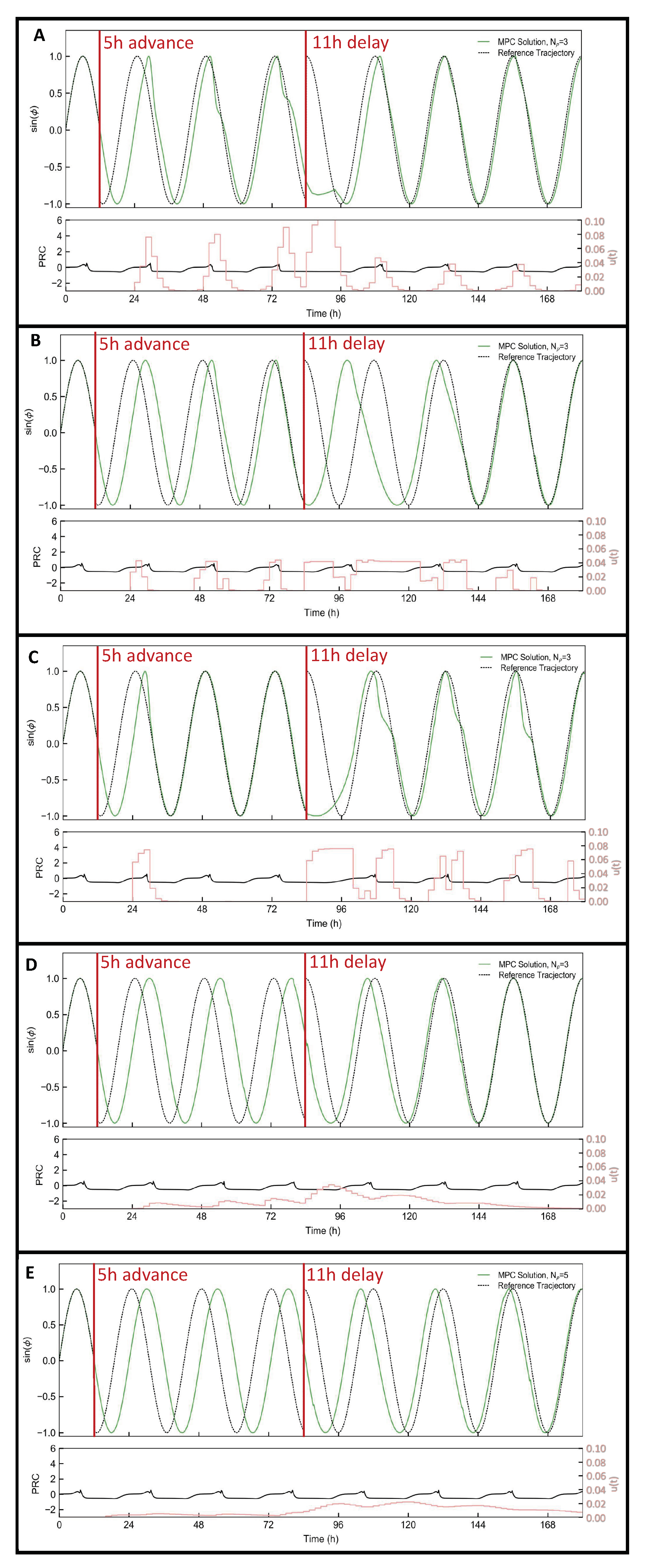
The ability to shift circadian phase in vivo has the potential to offer substantial health benefits. However, the blood–brain barrier prevents the absorption of the majority of large and many small molecules, posing a challenge to neurological pharmaceutical development. Motivated by the presence of the circadian molecule KL001, which is capable of causing phase shifts in a circadian oscillator, we investigated the pharmacokinetics of different neurological pharmaceuticals on the dynamics of circadian phase. Specifically, we developed and validated five different transport models that describe drug concentration profiles of a circadian pharmaceutical at the brain level under oral administration and designed a nonlinear model predictive control (MPC)-based framework for phase resetting. Performance of the novel control algorithm based on the identified pharmacokinetic models was demonstrated through simulations of real-world misalignment scenarios due to jet lag. The time to achieve a complete phase reset for 11-h phase delay ranged between 48 and 72 h, while a 5-h phase advance was compensated in 30 to 60 h. This approach provides mechanistic insight into the underlying structure of the circadian oscillatory system and thus leads to a better understanding of the feasibility of therapeutic manipulations of the system.
Keywords: circadian rhythm; model predictive control; pharmacockinetics; blood–brain barrier; circadian entrainment circadian rhythm; model predictive control; pharmacockinetics; blood–brain barrier; circadian entrainment