Review

Impact of Epithelial Cell Shedding on Intestinal Homeostasis
by
Phuong A. Ngo
1,2,
Markus F. Neurath
1,2 and
Rocío López-Posadas
1,2,*
1
Department of Medicine 1, Friedrich-Alexander-Universität Erlangen-Nürnberg, 91054 Erlangen, Germany
2
Deutsches Zentrum Immuntherapie (DZI), 91054 Erlangen, Germany
*
Author to whom correspondence should be addressed.
Int. J. Mol. Sci. 2022, 23(8), 4160; https://doi.org/10.3390/ijms23084160
Submission received: 6 March 2022 / Revised: 5 April 2022 / Accepted: 6 April 2022 / Published: 9 April 2022
(This article belongs to the Special Issue Regulation and Physiopathology of Gut Barrier)

Abstract

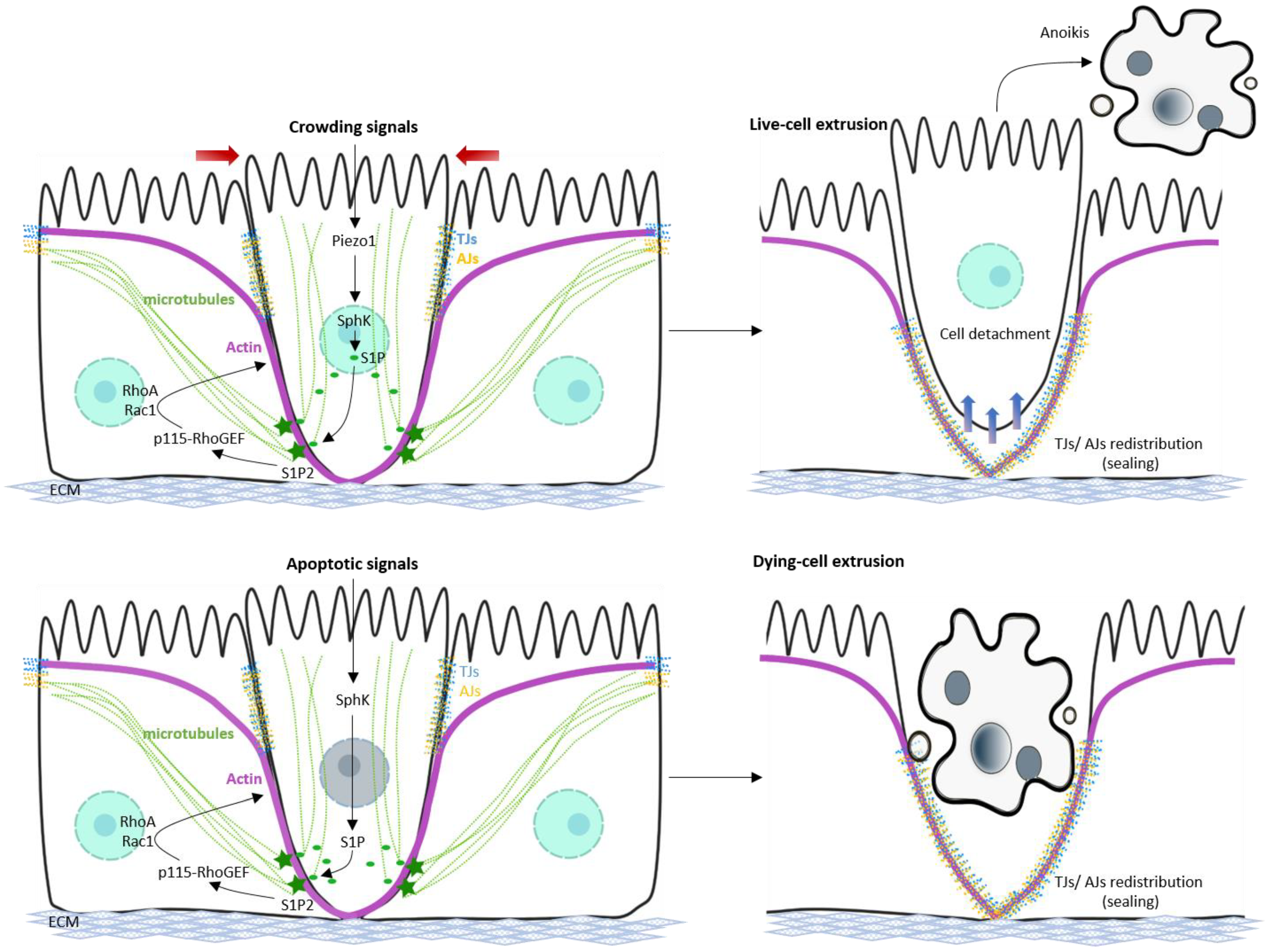
The gut barrier acts as a first line of defense in the body, and plays a vital role in nutrition and immunoregulation. A layer of epithelial cells bound together via intercellular junction proteins maintains intestinal barrier integrity. Based on a tight equilibrium between cell extrusion and cell restitution, the renewal of the epithelium (epithelial turnover) permits the preservation of cell numbers. As the last step within the epithelial turnover, cell shedding occurs due to the pressure of cell division and migration from the base of the crypt. During this process, redistribution of tight junction proteins enables the sealing of the epithelial gap left by the extruded cell, and thereby maintains barrier function. Disturbance in cell shedding can create transient gaps (leaky gut) or cell accumulation in the epithelial layer. In fact, numerous studies have described the association between dysregulated cell shedding and infection, inflammation, and cancer; thus epithelial cell extrusion is considered a key defense mechanism. In the gastrointestinal tract, altered cell shedding has been observed in mouse models of intestinal inflammation and appears as a potential cause of barrier loss in human inflammatory bowel disease (IBD). Despite the relevance of this process, there are many unanswered questions regarding cell shedding. The investigation of those mechanisms controlling cell extrusion in the gut will definitely contribute to our understanding of intestinal homeostasis. In this review, we summarized the current knowledge about intestinal cell shedding under both physiological and pathological circumstances.
Keywords: epithelial cell shedding; cell extrusion; leaky gut; inflammatory bowel disease (IBD); colorectal cancer epithelial cell shedding; cell extrusion; leaky gut; inflammatory bowel disease (IBD); colorectal cancer