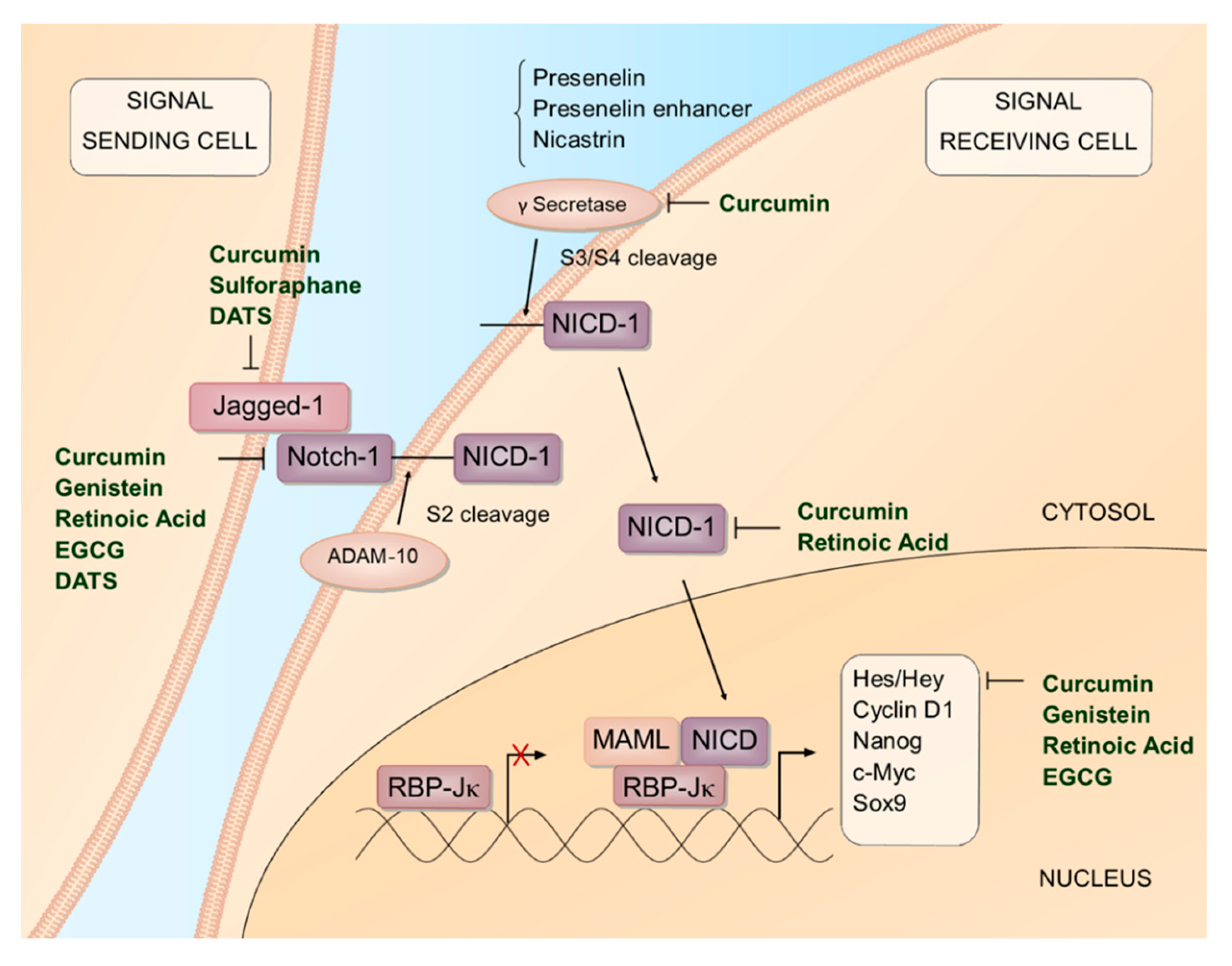
Modulation of Notch Signaling Pathway by Bioactive Dietary Agents
Abstract
1. Introduction
2. Notch Signaling
3. Modulation of Notch Pathway by Dietary Agents
3.1. Curcumin
3.2. Genistein
3.3. EGCG and Tea Polyphenols
3.4. Resveratrol
3.5. Retinoic Acid
3.6. Sulforaphane
3.7. Vitamin D
3.8. Other Agents
4. Conclusions
Author Contributions
Funding
Conflicts of Interest
References
- Falo-Sanjuan, J.; Bray, S.J. Decoding the Notch signal. Dev. Growth Differ. 2020, 62, 4–14. [Google Scholar] [CrossRef] [Scilit] [PubMed]
- Majumder, S.; Crabtree, J.S.; Golde, T.; Minter, L.M.; Osborne, B.A.; Miele, L. Targeting Notch in oncology: The path forward. Nat. Rev. Drug Discov. 2021, 20, 125–144. [Google Scholar] [CrossRef] [Scilit] [PubMed]
- Capaccione, K.M.; Pine, S.R. The Notch signaling pathway as a mediator of tumor survival. Carcinogenesis 2013, 34, 1420–1430. [Google Scholar] [CrossRef] [Scilit] [PubMed]
- Previs, R.A.; Coleman, R.L.; Harris, A.L.; Sood, A.K. Molecular pathways: Translational and therapeutic implications of the Notch signaling pathway in cancer. Clin. Cancer Res. 2015, 21, 955–961. [Google Scholar] [CrossRef] [Scilit]
- Kopan, R.; Ilagan, M.X.G. The canonical Notch signaling pathway: Unfolding the activation mechanism. Cell 2009, 137, 216–233. [Google Scholar] [CrossRef] [Scilit] [PubMed]
- Takebe, N.; Miele, L.; Harris, P.J.; Jeong, W.; Bando, H.; Kahn, M.; Yang, S.X.; Ivy, S.P. Targeting Notch, Hedgehog, and Wnt pathways in cancer stem cells: Clinical update. Nat. Rev. Clin. Oncol. 2015, 12, 445–464. [Google Scholar] [CrossRef] [Scilit]
- Reedijk, M.; Odorcic, S.; Chang, L.; Zhang, H.; Miller, N.; McCready, D.R.; Lockwood, G.; Egan, S.E. High-level coexpression of JAG1 and NOTCH1 is observed in human breast cancer and is associated with poor overall survival. Cancer Res. 2005, 65, 8530–8537. [Google Scholar] [CrossRef] [Scilit]
- Sugiyama, M.; Oki, E.; Nakaji, Y.; Tsutsumi, S.; Ono, N.; Nakanishi, R.; Sugiyama, M.; Nakashima, Y.; Sonoda, H.; Ohgaki, K.; et al. High expression of the Notch ligand Jagged-1 is associated with poor prognosis after surgery for colorectal cancer. Cancer Sci. 2016, 107, 1705–1716. [Google Scholar] [CrossRef] [Scilit]
- Li, W.; Liu, M.; Feng, Y.; Huang, Y.F.; Xu, Y.F.; Che, J.P.; Wang, G.C.; Zheng, J.H. High expression of Notch ligand Jagged2 is associated with the metastasis and recurrence in urothelial carcinoma of bladder. Int. J. Clin. Exp. Pathol. 2013, 6, 2430–2440. [Google Scholar] [PubMed]
- Monticone, G.; Miele, L. Notch pathway: A journey from notching phenotypes to cancer immunotherapy. Adv. Exp. Med. Biol. 2021, 1287, 201–222. [Google Scholar] [CrossRef] [Scilit] [PubMed]
- Bray, S.J. Notch signaling in context. Nat. Rev. Mol. Cell Biol. 2016, 17, 722–735. [Google Scholar] [PubMed]
- Palmer, W.H.; Deng, W.M. Ligand-independent mechanisms of Notch activity. Trends Cell Biol. 2015, 25, 697–707. [Google Scholar] [CrossRef] [Scilit] [PubMed]
- Bozkulak, E.C.; Weinmaster, G. Selective use of ADAM-10 and ADAM-17 in activation of Notch1 signaling. Mol. Cell. Biol. 2009, 29, 5679–5695. [Google Scholar] [CrossRef] [Scilit]
- Zhang, X.; Li, Y.; Xu, H.; Zhang, Y.W. The γ-secretase complex: From structure to function. Front. Cell. Neurosci. 2014, 8, 427. [Google Scholar] [CrossRef] [Scilit] [PubMed]
- Oswald, F.; Kovall, R.A. CSL-associated corepressor and coactivator complexes. In Molecular Mechanisms of Notch Signaling; Borggrefe, T., Giaimo, B., Eds.; Advances in Experimental Medicine and Biology; Springer: Cham, Switzerland, 2018; Volume 1066. [Google Scholar]
- Januchowski, R.; Wojtowicz, K.; Zabel, M. The role of aldehyde dehydrogenase (ALDH) in cancer drug resistance. Biomed. Pharmacother. 2013, 67, 669–680. [Google Scholar] [CrossRef] [Scilit] [PubMed]
- Korkaya, H.; Liu, S.; Wicha, M.S. Breast cancer stem cells, cytokine networks, and the tumor microenvironment. J. Clin. Investig. 2011, 121, 3804–3809. [Google Scholar] [CrossRef] [Scilit] [PubMed]
- D’Angelo, R.C.; Ouzounova, M.; Davis, A.; Choi, D.; Tchuenkam, S.M.; Kim, G.; Luther, T.; Quraishi, A.A.; Senbabaoglu, Y.; Conley, S.J.; et al. Notch reporter activity in breast cancer cell lines identifies a subset of cells with stem cell activity. Mol. Cancer Ther. 2015, 14, 779–787. [Google Scholar] [CrossRef] [Scilit]
- Grudzien, P.; Lo, S.; Albain, K.S.; Robinson, P.; Rajan, P.; Strack, P.R.; Golde, T.E.; Miele, L.; Foreman, K.E. Inhibition of Notch signaling reduces the stem-like population of breast cancer cells and prevents mammosphere formation. Anticancer Res. 2010, 30, 3853–3867. [Google Scholar] [PubMed]
- Kaushik, G.; Venugopal, A.; Ramamoorthy, P.; Standing, D.; Subramaniam, D.; Umar, S.; Jensen, R.A.; Anant, S.; Mammen, J.M.V. Honokiol inhibits melanoma stem cells by targeting Notch signaling. Mol. Carcinog. 2015, 54, 1710–1721. [Google Scholar] [CrossRef] [Scilit] [PubMed]
- Rizzo, P.; Osipo, C.; Foreman, K.; Golde, T.; Osborne, B.; Miele, L. Rational targeting of Notch signaling in cancer. Oncogene 2008, 27, 5124–5131. [Google Scholar] [CrossRef] [Scilit]
- Mittal, S.; Subramanyam, D.; Dey, D.; Kumar, R.V.; Rangarajan, A. Cooperation of Notch and Ras/MAPK signaling pathways in human breast carcinogenesis. Mol. Cancer 2009, 8, 128. [Google Scholar] [CrossRef] [Scilit] [PubMed]
- Rodilla, V.; Villanueva, A.; Obrador-Hevia, A.; Robert-Moreno, A.; Fernández-Majada, V.; Grilli, A.; López-Bigas, N.; Bellora, N.; Albà, M.M.; Torres, F.; et al. Jagged1 is the pathological link between Wnt and Notch pathways in colorectal cancer. Proc. Natl. Acad. Sci. USA 2009, 106, 6315–6320. [Google Scholar] [CrossRef] [Scilit]
- Jin, Y.H.; Kim, H.; Ki, H.; Yang, I.; Yang, N.; Lee, K.Y.; Kim, N.; Park, H.S.; Kim, K. Beta-catenin modulates the level and transcriptional activity of Notch-1/NICD through its direct interaction. Biochim. Biophys. Acta 2009, 1793, 290–299. [Google Scholar] [CrossRef] [Scilit] [PubMed]
- Osipo, C.; Golde, T.E.; Osborne, B.A.; Miele, L.A. Off the beaten pathway: The complex cross talk between Notch and NF-κB. Lab. Investig. 2008, 88, 11–17. [Google Scholar] [CrossRef] [Scilit]
- Zhou, W.; Wang, G.; Guo, S. Regulation of angiogenesis via Notch signaling in breast cancer and cancer stem cells. Biochim. Biophys. Acta 2013, 1836, 304–320. [Google Scholar] [CrossRef] [Scilit] [PubMed]
- Benetou, V.; Trichopoulou, A.; Orfanos, P.; Naska, A.; Lagiou, P.; Boffetta, P.; Trichopoulos, D. Greek EPIC cohort conformity to traditional Mediterranean diet and cancer incidence: The Greek EPIC cohort. Br. J. Cancer 2008, 99, 191–195. [Google Scholar] [CrossRef] [Scilit]
- Chen, Y.; Shu, W.; Chen, W.; Wu, Q.; Liu, H.; Cui, G. Curcumin, both histone deacetylase and p300/CBP-specific inhibitor, represses the activity of nuclear factor kappa B and Notch-1 in Raji cells. Basic Clin. Pharmacol. Toxicol. 2007, 101, 427–433. [Google Scholar] [CrossRef] [Scilit]
- Howells, L.M.; Sale, S.; Sriramareddy, S.N.; Irving, G.R.B.; Jones, D.J.L.; Ottley, C.J.; Pearson, D.G.; Mann, C.D.; Manson, M.M.; Berry, D.P.; et al. Curcumin ameliorates oxaliplatin-induced chemoresistance in HCT116 colorectal cancer cells in vitro and in vivo. Int. J. Cancer 2011, 129, 476–486. [Google Scholar] [CrossRef] [Scilit] [PubMed]
- Koprowski, S.; Sokolowski, K.; Kunnimalaiyaan, S.; Gamblin, T.C.; Kunnimalaiyaan, M. Curcumin-mediated regulation of Notch1/hairy and enhancer of split-1/survivin: Molecular targeting in cholangiocarcinoma. J. Surg. Res. 2015, 198, 434–440. [Google Scholar] [CrossRef] [Scilit] [PubMed]
- Li, Y.; Zhang, J.; Ma, D.; Zhang, L.; Si, M.; Yin, H.; Li, J. Curcumin inhibits proliferation and invasion of osteosarcoma cells through inactivation of Notch-1 signaling. FEBS J. 2012, 279, 2247–2259. [Google Scholar] [CrossRef] [Scilit] [PubMed]
- Lin, L.; Fuchs, J.; Li, C.; Olson, V.; Bekaii-Saab, T.; Lin, J. STAT3 signaling pathway is necessary for cell survival and tumorsphere forming capacity in ALDH+/CD133+ stem cell-like human colon cancer cells. Biochem. Biophys. Res. Commun. 2011, 416, 246–251. [Google Scholar] [CrossRef] [Scilit] [PubMed]
- Subramaniam, D.; Ponnurangam, S.; Ramamoorthy, P.; Standing, D.; Battafarano, R.J.; Anant, S.; Sharma, P. Curcumin induces cell death in esophageal cancer cells through modulating Notch signaling. PLoS ONE 2012, 7, e30590. [Google Scholar] [CrossRef] [Scilit]
- Sha, J.; Li, J.; Wang, W.; Pan, L.; Cheng, J.; Li, L.; Zhao, H.; Lin, W. Curcumin induces G0/G1 arrest and apoptosis in hormone independent cancer DU-145 cells by down regulating Notch signaling. Biomed. Pharmacother. 2016, 84, 177–184. [Google Scholar] [CrossRef] [Scilit] [PubMed]
- He, G.; Mu, T.; Yuan, Y.; Yang, W.; Zhang, Y.; Chen, Q.; Bian, M.; Pan, Y.; Xiang, Q.; Chen, Z.; et al. Effects of Notch signaling pathway in cervical cancer by curcumin mediated photodynamic therapy and its possible mechanisms in vitro and in vivo. J. Cancer 2019, 10, 4114–4122. [Google Scholar] [CrossRef] [Scilit] [PubMed]
- Prasad, S.; Tyagi, A.K.; Aggarwal, B.B. Recent developments in delivery, bioavailability, absorption, and metabolism of curcumin: The golden pigment from golden spice. Cancer Res. Treat. 2014, 46, 2–18. [Google Scholar] [CrossRef] [Scilit] [PubMed]
- Li, Y.; Zhang, J.; Zhang, L.; Si, M.; Yin, H.; Li, J. Diallyl trisulfide inhibits proliferation, invasion and angiogenesis of osteosarcoma cells by switching on suppressor microRNAs and inactivating of Notch-1 signaling. Carcinogenesis 2013, 34, 1601–1610. [Google Scholar] [CrossRef] [Scilit] [PubMed]
- Kiesel, V.A.; Stan, S.D. Diallyl trisulfide, a chemopreventive agent from Allium vegetables, inhibits alpha-secretases in breast cancer cells. Biochem. Biophys. Res. Commun. 2017, 484, 833–838. [Google Scholar] [CrossRef] [Scilit] [PubMed]
- So, J.Y.; Wahler, J.; Das Gupta, S.; Salerno, D.M.; Maehr, H.; Uskokovic, M.; Suh, N. HES1-mediated inhibition of Notch1 signaling by a Gemini vitamin D analog leads to decreased CD44+/CD24−/low tumor-initiating subpopulation in basal-like breast cancer. J. Steroid Biochem. Mol. Biol. 2015, 148, 111–121. [Google Scholar] [CrossRef] [Scilit] [PubMed]
- Jin, H.; Gong, W.; Zhang, C.; Wang, S. Epigallocatechin gallate inhibits the proliferation of colorectal cancer cells by regulating Notch signaling. OncoTargets Ther. 2013, 6, 145–153. [Google Scholar] [CrossRef] [Scilit]
- Lee, S.H.; Nam, H.J.; Kang, H.J.; Kwon, H.W.; Lim, Y.C. Epigallocatechin-3-gallate attenuates head and neck cancer stem cell traits through suppression of Notch pathway. Eur. J. Cancer 2013, 49, 3210–3218. [Google Scholar] [CrossRef] [Scilit] [PubMed]
- Hossain, M.M.; Banik, N.L.; Ray, S.K. Survivin knockdown increased anti-cancer effects of (−)-epigallocatechin-3-gallate in human malignant neuroblastoma SK-N-BE2 and SH-SY5Y cells. Exp. Cell Res. 2012, 318, 1597–1610. [Google Scholar] [CrossRef] [Scilit]
- Wei, H.; Ge, Q.; Zhang, L.Y.; Xie, J.; Gan, R.H.; Lu, Y.G.; Zheng, D.L. EGCG inhibits growth of tumoral lesions on lip and tongue of K-Ras transgenic mice through the Notch pathway. J. Nutr. Biochem. 2022, 99, 108843. [Google Scholar] [CrossRef] [Scilit] [PubMed]
- Pan, H.; Zhou, W.; He, W.; Liu, X.; Ding, Q.; Ling, L.; Zha, X.; Wang, S. Genistein inhibits MDA-MB-231 triple-negative breast cancer cell growth by inhibiting NF-κB activity via the Notch-1 pathway. Int. J. Mol. Med. 2012, 30, 337–343. [Google Scholar] [CrossRef] [Scilit]
- Zhou, P.; Wang, C.; Hu, Z.; Chen, W.; Qi, W.; Li, A. Genistein induces apoptosis of colon cancer cells by reversal of epithelial-to-mesenchymal via a Notch1/NF-κB/slug/Ecadherin pathway. BMC Cancer 2017, 17, 813. [Google Scholar] [CrossRef] [Scilit]
- Janardhanan, R.; Banik, N.L.; Ray, S.K. N-Myc down regulation induced differentiation, early cell cycle exit, and apoptosis in human malignant neuroblastoma cells having wild type or mutant p53. Biochem. Pharmacol. 2009, 78, 1105–1114. [Google Scholar] [CrossRef] [Scilit]
- Zhang, P.; Li, H.; Yang, B.; Yang, F.; Zhang, L.L.; Kong, Q.Y.; Chen, X.Y.; Wu, M.L.; Liu, J. Biological significance and therapeutic implication of resveratrol-inhibited Wnt, Notch and STAT3 signaling in cervical cancer cells. Genes Cancer 2014, 5, 154–164. [Google Scholar] [PubMed]
- Pinchot, S.N.; Jaskula-Sztul, R.; Ning, L.; Peters, N.R.; Cook, M.R.; Kunnimalaiyaan, M.; Chen, H. Identification and validation of Notch pathway activating compounds through a novel high-throughput screening method. Cancer 2011, 117, 1386–1398. [Google Scholar] [CrossRef] [Scilit] [PubMed]
- Lin, H.; Xiong, W.; Zhang, X.; Liu, B.; Zhang, W.; Zhang, Y.; Cheng, J.; Huang, H. Notch-1 activation-dependent p53 restoration contributes to resveratrol-induced apoptosis in glioblastoma cells. Oncol. Rep. 2011, 26, 925–930. [Google Scholar] [CrossRef] [Scilit]
- Zhong, L.X.; Li, H.; Wu, M.L.; Liu, X.Y.; Zhong, M.J.; Chen, X.Y.; Liu, J.; Zhang, Y. Inhibition of STAT3 signaling as critical molecular event in resveratrol-suppressed ovarian cancer cells. J. Ovarian Res. 2015, 8, 25. [Google Scholar] [CrossRef] [Scilit] [PubMed]
- Cecchinato, V.; Chiaramonte, R.; Nizzardo, M.; Cristofaro, B.; Basile, A.; Sherbet, G.V.; Comi, P. Resveratrol-induced apoptosis in human T-cell acute lymphoblastic leukaemia MOLT-4 cells. Biochem. Pharmacol. 2007, 74, 1568–1574. [Google Scholar] [CrossRef] [Scilit] [PubMed]
- Truong, M.; Cook, M.R.; Pinchot, S.N.; Kunnimalaiyaan, M.; Chen, H. Resveratrol induces Notch-2-mediated apoptosis and suppression of neuroendocrine markers in medullary thyroid cancer. Ann. Surg. Oncol. 2011, 18, 1506–1511. [Google Scholar] [CrossRef] [Scilit]
- Mezquita, B.; Mezquita, J.; Barrot, C.; Carvajal, S.; Pau, M.; Mezquita, P.; Mezquita, C. A truncated-Flt1 isoform of breast cancer cells is upregulated by Notch and downregulated by retinoic acid. J. Cell. Biochem. 2014, 115, 52–61. [Google Scholar] [CrossRef] [Scilit] [PubMed]
- Ying, M.; Wang, S.; Sang, Y.; Sun, P.; Lal, B.; Goodwin, C.R.; Guerrero-Cazares, H.; Quinones-Hinojosa, A.; Laterra, J.; Xia, S. Regulation of glioblastoma stem cells by retinoic acid: Role for Notch pathway inhibition. Oncogene 2011, 30, 3454–3467. [Google Scholar] [CrossRef] [Scilit] [PubMed]
- Mohan, N.; Banik, N.L.; Ray, S.K. Synergistic efficacy of a novel combination therapy controls growth of Bcl-x(L) bountiful neuroblastoma cells by increasing differentiation and apoptosis. Cancer Biol. Ther. 2011, 12, 846–854. [Google Scholar] [CrossRef] [Scilit] [PubMed]
- Young, M.J.; Wu, Y.H.; Chiu, W.T.; Weng, T.Y.; Huang, Y.F.; Chou, C.Y. All-trans retinoic acid downregulates ALDH1-mediated stemness and inhibits tumor formation in ovarian cancer cells. Carcinogenesis 2015, 36, 498–507. [Google Scholar] [CrossRef] [Scilit] [PubMed]
- Farhana, L.; Dawson, M.I.; Das, J.K.; Murshed, F.; Xia, Z.; Hadden, T.J.; Hatfield, J.; Fontana, J.A. Adamantyl retinoid-related molecules induce apoptosis in pancreatic cancer cells by inhibiting IGF-1R and Wnt/β-catenin pathways. J. Oncol. 2012, 2012, 796729. [Google Scholar] [CrossRef] [Scilit] [PubMed]
- Koschorke, A.; Faraci, S.; Giani, D.; Chiodoni, C.; Iorio, E.; Canese, R.; Colombo, M.P.; Lamolinara, A.; Iezzi, M.; Ladomery, M.; et al. Phenethyl isothiocyanate hampers growth and progression of HER2-positive breast and ovarian carcinoma by targeting their stem cell compartment. Cell. Oncol. 2019, 42, 815–828. [Google Scholar] [CrossRef] [Scilit]
- Stan, S.D.; Singh, S.V.; Whitcomb, D.C.; Brand, R.E. Phenethyl isothiocyanate inhibits proliferation and induces apoptosis in pancreatic cancer cells in vitro and in a MIAPaca2 xenograft animal model. Nutr. Cancer 2014, 66, 747–755. [Google Scholar] [CrossRef] [Scilit] [PubMed]
- Kallifatidis, G.; Labsch, S.; Rausch, V.; Mattern, J.; Gladkich, J.; Moldenhauer, G.; Büchler, M.W.; Salnikov, A.V.; Herr, I. Sulforaphane increases drug-mediated cytotoxicity toward cancer stem-like cells of pancreas and prostate. Mol. Ther. 2011, 19, 188–195. [Google Scholar] [CrossRef] [Scilit]
- Labsch, S.; Liu, L.; Bauer, N.; Zhang, Y.; Aleksandrowicz, E.; Gladkich, J.; Schönsiegel, F.; Herr, I. Sulforaphane and TRAIL induce a synergistic elimination of advanced prostate cancer stem-like cells. Int. J. Oncol. 2014, 44, 1470–1480. [Google Scholar] [CrossRef] [Scilit] [PubMed]
- Ponnurangam, S.; Mammen, J.M.V.; Ramalingam, S.; He, Z.; Zhang, Y.; Umar, S.; Subramaniam, D.; Anant, S. Honokiol in combination with radiation targets Notch signaling to inhibit colon cancer stem cells. Mol. Cancer Ther. 2012, 11, 963–972. [Google Scholar] [CrossRef] [Scilit]
- Hahm, E.R.; Chandra-Kuntal, K.; Desai, D.; Amin, S.; Singh, S.V. Notch activation is dispensable for D,L-sulforaphane-mediated inhibition of human prostate cancer cell migration. PLoS ONE 2012, 7, e44957. [Google Scholar] [CrossRef] [Scilit]
- Stuckey, A.; Fischer, A.; Miller, D.H.; Hillenmeyer, S.; Kim, K.K.; Ritz, A.; Singh, R.K.; Raphael, B.J.; Brard, L.; Brodsky, A.S. Integrated genomics of ovarian xenograft tumor progression and chemotherapy response. BMC Cancer 2011, 11, 308. [Google Scholar] [CrossRef] [Scilit]
- Su, Y.; Simmen, F.A.; Xiao, R.; Simmen, R.C.M. Expression profiling of rat mammary epithelial cells reveals candidate signaling pathways in dietary protection from mammary tumors. Physiol. Genom. 2007, 30, 8–16. [Google Scholar] [CrossRef] [Scilit]
- Kwak, T.W.; Park, S.B.; Kim, H.J.; Jeong, Y.I.; Kang, D.H. Anticancer activities of epigallocatechin-3-gallate against cholangiocarcinoma cells. OncoTargets Ther. 2016, 10, 137–144. [Google Scholar] [CrossRef] [Scilit]
- Toden, S.; Tran, H.M.; Tovar-Camargo, O.A.; Okugawa, Y.; Goel, A. Epigallocatechin-3-gallate targets cancer stem-like cells and enhances 5-fluorouracil chemosensitivity in colorectal cancer. Oncotarget 2016, 7, 16158–16171. [Google Scholar] [CrossRef] [Scilit] [PubMed]
- Gao, Y.; Rankin, G.O.; Tu, Y.; Chen, Y.C. Theaflavin-3, 3’-digallate decreases human ovarian carcinoma OVCAR-3 cell-induced angiogenesis via Akt and Notch-1 pathways, not via MAPK pathways. Int. J. Oncol. 2016, 48, 281–292. [Google Scholar] [CrossRef] [Scilit]
- Liu, X.; Zhang, D.Y.; Zhang, W.; Zhao, X.; Yuan, C.; Ye, F. The effect of green tea extract and EGCG on the signaling network in squamous cell carcinoma. Nutr. Cancer 2011, 63, 466–475. [Google Scholar] [CrossRef] [Scilit] [PubMed]
- Kunnimalaiyaan, M.; Chen, H. Tumor suppressor role of Notch-1 signaling in neuroendocrine tumors. Oncologist 2007, 12, 535–542. [Google Scholar] [CrossRef] [Scilit]
- Teodorczyk, M.; Schmidt, M.H.H. Notching on cancer’s door: Notch signaling in brain tumors. Front. Oncol. 2014, 4, 341. [Google Scholar] [CrossRef] [Scilit]
- Yu, X.M.; Jaskula-Sztul, R.; Ahmed, K.; Harrison, A.D.; Kunnimalaiyaan, M.; Chen, H. Resveratrol induces differentiation markers expression in anaplastic thyroid carcinoma via activation of Notch1 signaling and suppresses cell growth. Mol. Cancer Ther. 2013, 12, 1276–1287. [Google Scholar] [CrossRef] [Scilit] [PubMed]
- Wang, Q.; Li, H.; Liu, N.; Chen, X.Y.; Wu, M.L.; Zhang, K.L.; Kong, Q.Y.; Liu, J. Correlative analyses of Notch signaling with resveratrol-induced differentiation and apoptosis of human medulloblastoma cells. Neurosci. Lett. 2008, 438, 168–173. [Google Scholar] [CrossRef] [Scilit] [PubMed]
- Dong, J.; Yang, W.; Han, J.; Cheng, R.; Li, L. Effects of Notch signaling components from breast cancer cells treated in culture with resveratrol. Res. Vet. Sci. 2020, 132, 369–378. [Google Scholar] [CrossRef] [Scilit]
- Zanetti, A.; Affatato, R.; Centritto, F.; Fratelli, M.; Kurosaki, M.; Barzago, M.M.; Bolis, M.; Terao, M.; Garattini, E.; Paroni, G. All-trans-retinoic acid modulates the plasticity and inhibits the motility of breast cancer cells. J. Biol. Chem. 2015, 290, 17690–17709. [Google Scholar] [PubMed]
- Ferrari-Toninelli, G.; Bonini, S.A.; Uberti, D.; Buizza, L.; Bettinsoli, P.; Poliani, P.L.; Facchetti, F.; Memo, M. Targeting Notch pathway induces growth inhibition and differentiation of neuroblastoma cells. Neuro-Oncol. 2010, 12, 1231–1243. [Google Scholar] [CrossRef] [Scilit] [PubMed]
- Hooper, C.; Tavassoli, M.; Chapple, J.P.; Uwanogho, D.; Goodyear, R.; Melino, G.; Lovestone, S.; Killick, R. TAp73 isoforms antagonize Notch signalling in SH-SY5Y neuroblastomas and in primary neurones. J. Neurochem. 2006, 99, 989–999. [Google Scholar] [CrossRef] [Scilit] [PubMed]
- Reichrath, S.; Müller, C.S.L.; Gleissner, B.; Pfreundschuh, M.; Vogt, T.; Reichrath, J. Notch- and vitamin D signaling in 1,25(OH)2D3-resistant glioblastoma multiforme (GBM) cell lines. J. Steroid Biochem. Mol. Biol. 2010, 121, 420–424. [Google Scholar] [CrossRef] [Scilit] [PubMed]
- Reichrath, S.; Reichrath, J. No evidence for induction of key components of the Notch signaling pathway (Notch-1, Jagged-1) by treatment with UV-B, 1,25(OH)2D3, and/or epigenetic drugs (TSA, 5-Aza) in human keratinocytes in vitro. Dermato-Endocrinol. 2012, 4, 44–52. [Google Scholar] [CrossRef] [Scilit]
- Shan, N.L.; Wahler, J.; Lee, H.J.; Bak, M.J.; Gupta, S.D. Vitamin D compounds inhibit cancer stem-like cells and induce differentiation in triple negative breast cancer. J. Steroid Biochem. Mol. Biol. 2017, 173, 122–129. [Google Scholar] [PubMed]
- Kaushik, G.; Ramalingam, S.; Subramaniam, D.; Rangarajan, P.; Protti, P.; Rammamoorthy, P.; Anant, S.; Mammen, J.M.V. Honokiol induces cytotoxic and cytostatic effects in malignant melanoma cancer cells. Am. J. Surg. 2012, 204, 868–873. [Google Scholar] [CrossRef] [Scilit] [PubMed]
- Zhang, H.; Huo, M.; Jia, Y.; Xu, A. KRT6B, a key mediator of Notch signaling in honokiol-induced human hepatoma cell apoptosis. Int. J. Clin. Exp. Med. 2015, 8, 16880–16889. [Google Scholar] [PubMed]
- Lee, J.; Sehrawat, A.; Singh, S.V. Withaferin A causes activation of Notch-2 and Notch-4 in human breast cancer cells. Breast Cancer Res. Treat. 2012, 136, 45–56. [Google Scholar] [CrossRef] [Scilit] [PubMed]
- Kim, S.H.; Singh, S.V. Mammary cancer chemoprevention by Withaferin A is accompanied by in vivo suppression of self-renewal of cancer stem cells. Cancer Prev. Res. 2014, 7, 738–747. [Google Scholar] [CrossRef] [Scilit]
- Zhang, X.; Samadi, A.K.; Roby, K.F.; Timmermann, B.; Cohen, M.S. Inhibition of cell growth and induction of apoptosis in ovarian carcinoma cell lines CaOV3 and SKOV3 by natural withanolide Withaferin A. Gynecol. Oncol. 2012, 124, 606–612. [Google Scholar] [CrossRef] [Scilit] [PubMed]
- Koduru, S.; Kumar, R.; Srinivasan, S.; Evers, M.B.; Damodaran, C. Notch-1 inhibition by Withaferin-A: A therapeutic target against colon carcinogenesis. Mol. Cancer Ther. 2010, 9, 202–210. [Google Scholar] [CrossRef] [Scilit] [PubMed]
- Kakar, S.S.; Worth, C.A.; Wang, Z.; Carter, K.; Ratajczak, M.; Gunjal, P. DOXIL when combined with Withaferin A (WFA) targets ALDH1 positive cancer stem cells in ovarian cancer. J. Cancer Stem Cell Res. 2016, 4, e1002. [Google Scholar] [CrossRef] [Scilit] [PubMed]
- Patel, P.N.; Yu, X.M.; Jaskula-Sztul, R.; Chen, H. Hesperetin activates the Notch1 signaling cascade, causes apoptosis, and induces cellular differentiation in anaplastic thyroid cancer. Ann. Surg. Oncol. 2014, 21 (Suppl. S4), S497–S504. [Google Scholar] [CrossRef] [Scilit] [PubMed]


| ↑ | Induced | ↓ | Suppressed | ||||||
|---|---|---|---|---|---|---|---|---|---|
| Dietary Agent | Cancer Type | Notch-1 | Notch-2 | Notch-3 | Jagged-1 | Hes-1 | Hey-1 | References | |
| Curcumin | Cholangiocarcinoma | ↓ | ↓ | [30] | |||||
| Colorectal *, # | ↓ | ↓ | [29,32] | ||||||
| Esophageal | ↓ | ↓ | ↓ | [33] | |||||
| Lymphoma | ↓ | [28] | |||||||
| Osteosarcoma | ↓ | ↓ | ↓ | [31] | |||||
| Prostate | ↓ | ↓ | [34] | ||||||
| DATS | Osteosarcoma | ↓ | ↓ | [37] | |||||
| Breast | ↓ | [38] | |||||||
| Vitamin D | Breast * | ↓ | ↓ | ↓ | ↑ | [39] | |||
| EGCG | Colorectal | ↑ | ↓ | ↓ | [40] | ||||
| Head and Neck | ↓ | [41] | |||||||
| Neuroblastoma | ↓ | [42] | |||||||
| Tongue | ↓ | ↓ | ↓ | [43] | |||||
| Genistein | Breast | ↓ | [44] | ||||||
| Colon | ↓ | [45] | |||||||
| Neuroblastoma | ↓ | ↓ | [46] | ||||||
| Resveratrol | Cervical | ↓ | ↓ | ↓ | [47] | ||||
| Carcinoids | ↑ | [48] | |||||||
| Glioblastoma | ↑ | [49] | |||||||
| Ovarian | ↓ | ↓ | [50] | ||||||
| T-ALL | ↓ | ↓ | [51] | ||||||
| Thyroid | ↑ | ↑ | [52] | ||||||
| Retinoic Acid | Breast | ↓ | [53] | ||||||
| Glioblastoma | ↓ | ↓ | [54] | ||||||
| Neuroblastoma * | ↓ | [55] | |||||||
| Ovarian | ↓ | [56] | |||||||
| Pancreatic * | ↓ | [57] | |||||||
| PEITC | Breast | ↓ | ↓ | [58] | |||||
| Pancreatic | ↓ | ↓ | [59] | ||||||
| Sulforaphane | Pancreatic | ↓ | [60] | ||||||
| Prostate | ↓ | ↓ | [61] | ||||||
| ↑ | Induced | ↓ | Suppressed | |||||
|---|---|---|---|---|---|---|---|---|
| Dietary Agent | Concentration | Cancer Type | Effect | References | ||||
| Curcumin | 0.2% equivalent curcuminoids as Meriva®, # | Colorectal | ↓ | NICD-1, Ki67 | [29] | |||
| ↑ | cleaved Caspase 3 | |||||||
| ↓ | tumor volume; additive effect on tumor volume with oxaliplatin | |||||||
| Honokiol | 200 µg/kg body weight | Colorectal | ↓ | NICD-1, Jagged-1, Hes-1, Presenilin-1, Nicastrin | [62] | |||
| ↓ | tumor volume | |||||||
| Sulforaphane | 6 µmol SFN in 0.1 mL PBS | Prostate | ↓ | NICD-2 | [63] | |||
| EGCG | 25 mg/kg body weight | Lip, Tongue | ↓ | Notch-1, Notch-2, Hes1 | [43] | |||
| Vitamin D | 10 mg/kg body weight of MT19c * | Ovarian | ↓ | Notch signaling pathway | [64] | |||
| ↑ | DNA fragmentation | |||||||
| ↓ | tumor volume | |||||||
Publisher’s Note: MDPI stays neutral with regard to jurisdictional claims in published maps and institutional affiliations. |
© 2022 by the authors. Licensee MDPI, Basel, Switzerland. This article is an open access article distributed under the terms and conditions of the Creative Commons Attribution (CC BY) license (https://creativecommons.org/licenses/by/4.0/).
Share and Cite
Kiesel, V.A.; Stan, S.D. Modulation of Notch Signaling Pathway by Bioactive Dietary Agents. Int. J. Mol. Sci. 2022, 23, 3532. https://doi.org/10.3390/ijms23073532
Kiesel VA, Stan SD. Modulation of Notch Signaling Pathway by Bioactive Dietary Agents. International Journal of Molecular Sciences. 2022; 23(7):3532. https://doi.org/10.3390/ijms23073532
Chicago/Turabian StyleKiesel, Violet A., and Silvia D. Stan. 2022. "Modulation of Notch Signaling Pathway by Bioactive Dietary Agents" International Journal of Molecular Sciences 23, no. 7: 3532. https://doi.org/10.3390/ijms23073532
APA StyleKiesel, V. A., & Stan, S. D. (2022). Modulation of Notch Signaling Pathway by Bioactive Dietary Agents. International Journal of Molecular Sciences, 23(7), 3532. https://doi.org/10.3390/ijms23073532