Article

Anisotropic Elasticity of the Myosin Motor in Muscle
by
Marco Caremani
1,2 and
Massimo Reconditi
1,3,*
1
PhysioLab, Università di Firenze, 50019 Sesto Fiorentino, Italy
2
Dipartimento di Biologia, Università di Firenze, 50019 Sesto Fiorentino, Italy
3
Dipartimento di Medicina Sperimentale e Clinica, Università di Firenze, 50134 Firenze, Italy
*
Author to whom correspondence should be addressed.
Int. J. Mol. Sci. 2022, 23(5), 2566; https://doi.org/10.3390/ijms23052566
Submission received: 31 December 2021 / Revised: 8 February 2022 / Accepted: 23 February 2022 / Published: 25 February 2022
(This article belongs to the Special Issue Molecular Motors: Mechanical Properties and Regulation)

Abstract

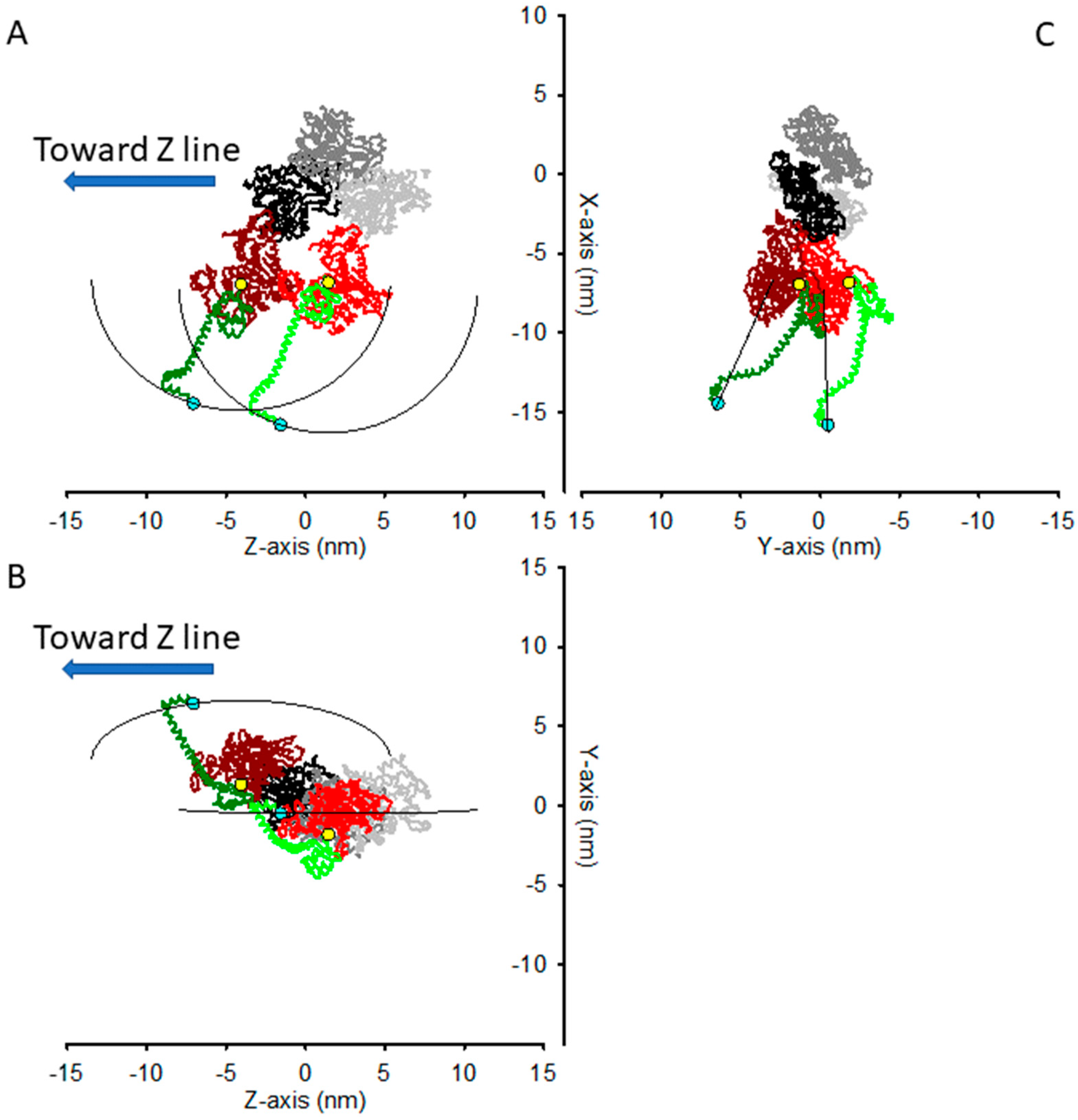
To define the mechanics and energetics of the myosin motor action in muscles, it is mandatory to know fundamental parameters such as the stiffness and the force of the single myosin motor, and the fraction of motors attached during contraction. These parameters can be defined in situ using sarcomere−level mechanics in single muscle fibers under the assumption that the stiffness of a myosin dimer with both motors attached (as occurs in rigor, when all motors are attached) is twice that of a single motor (as occurs in the isometric contraction). We use a mechanical/structural model to identify the constraints that underpin the stiffness of the myosin dimer with both motors attached to actin. By comparing the results of the model with the data in the literature, we conclude that the two-fold axial stiffness of the dimers with both motors attached is justified by a stiffness of the myosin motor that is anisotropic and higher along the axis of the myofilaments. A lower azimuthal stiffness of the motor plays an important role in the complex architecture of the sarcomere by allowing the motors to attach to actin filaments at different azimuthal angles relative to the thick filament.
Keywords: myosin; molecular motors; muscle mechanics; protein elasticity myosin; molecular motors; muscle mechanics; protein elasticity