Article

Transcriptomic Studies of Antidepressant Action in Rodent Models of Depression: A First Meta-Analysis


by
El Chérif Ibrahim
1,2,*,
Victor Gorgievski
3,4,
Pilar Ortiz-Teba
5,
Raoul Belzeaux
1,2,6,
Gustavo Turecki
7,
Etienne Sibille
8,
Guillaume Charbonnier
9 and
Eleni T. Tzavara
2,3,4,10,*
1
Aix-Marseille Univ, CNRS, INT, Inst Neurosci Timone, 13005 Marseille, France
2
Fondation FondaMental, 94000 Créteil, France
3
Université Paris Cité, CNRS, Integrative Neuroscience and Cognition Center, 75006 Paris, France
4
Sorbonne Université, INSERM, CNRS, Neuroscience Paris Seine, Institut de Biologie Paris Seine, 75005 Paris, France
5
Laboratory of Neuropharmacology, Department of Medicine and Life Sciences, Universitat Pompeu Fabra, 08002 Barcelona, Spain
6
Pôle Universitaire de Psychiatrie, CHU de Montpellier, 34295 Montpellier, France
7
Douglas Mental Health University Institute, McGill University, Montreal, QC H4H 1R3, Canada
8
Department of Psychiatry, University of Toronto, Toronto, ON M5T 1R8, Canada
9
Aix-Marseille Univ, INSERM, TAGC, 13009 Marseille, France
10
Hôpital Sainte Marguerite AP-HM, Pôle de Psychiatrie, 13274 Marseille, France
*
Authors to whom correspondence should be addressed.
Int. J. Mol. Sci. 2022, 23(21), 13543; https://doi.org/10.3390/ijms232113543
Submission received: 4 October 2022 / Accepted: 31 October 2022 / Published: 4 November 2022

Abstract

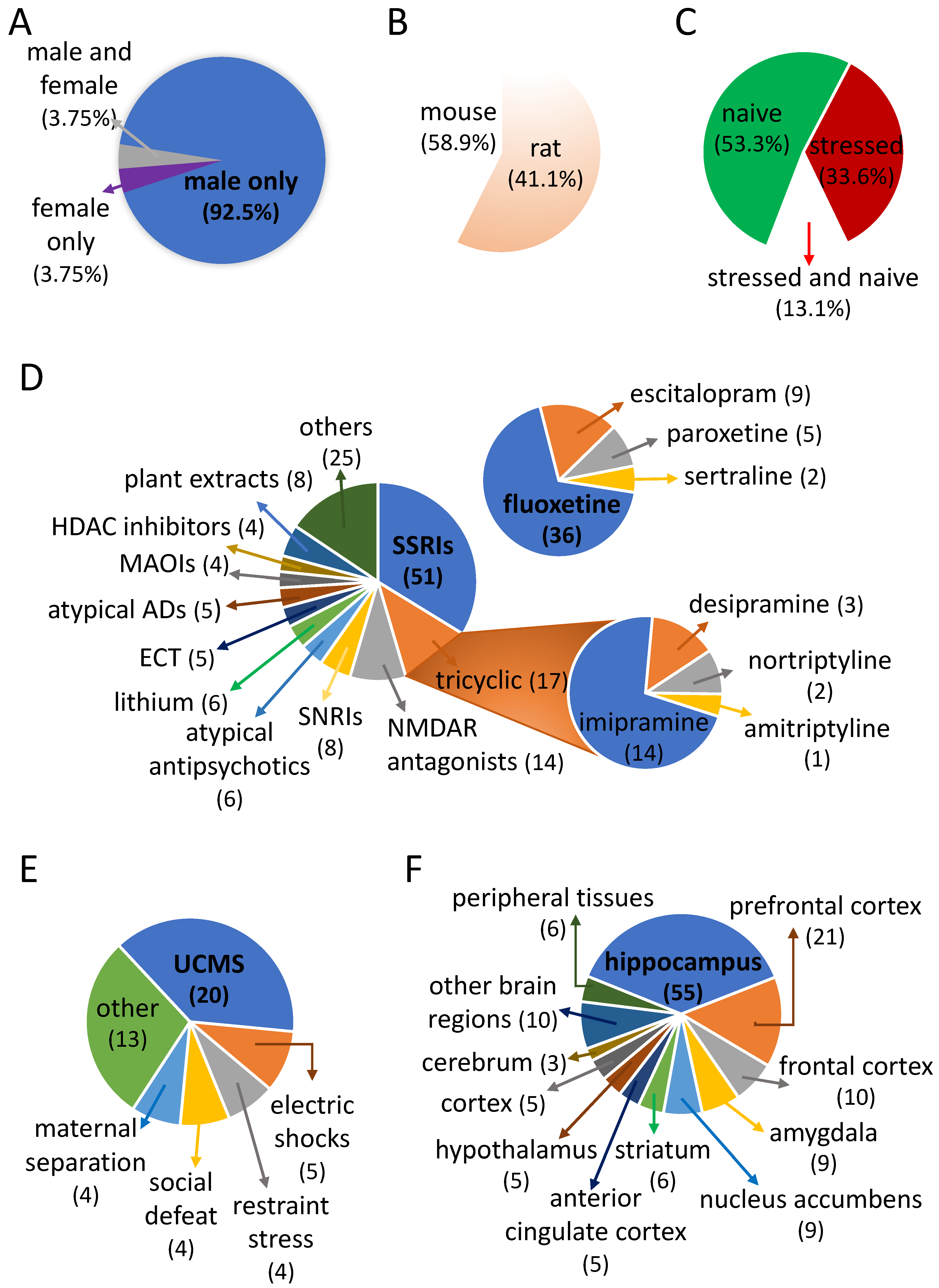
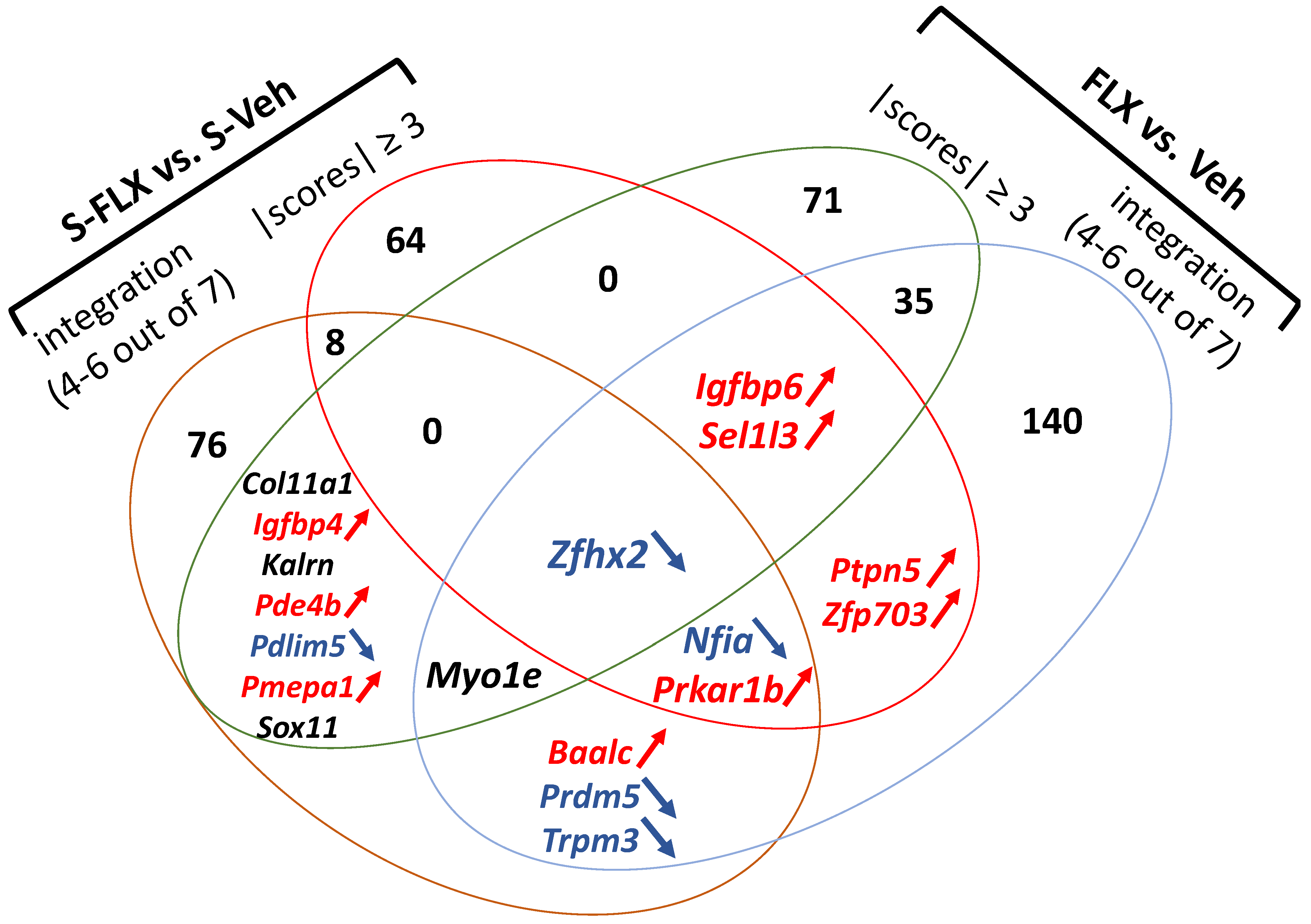
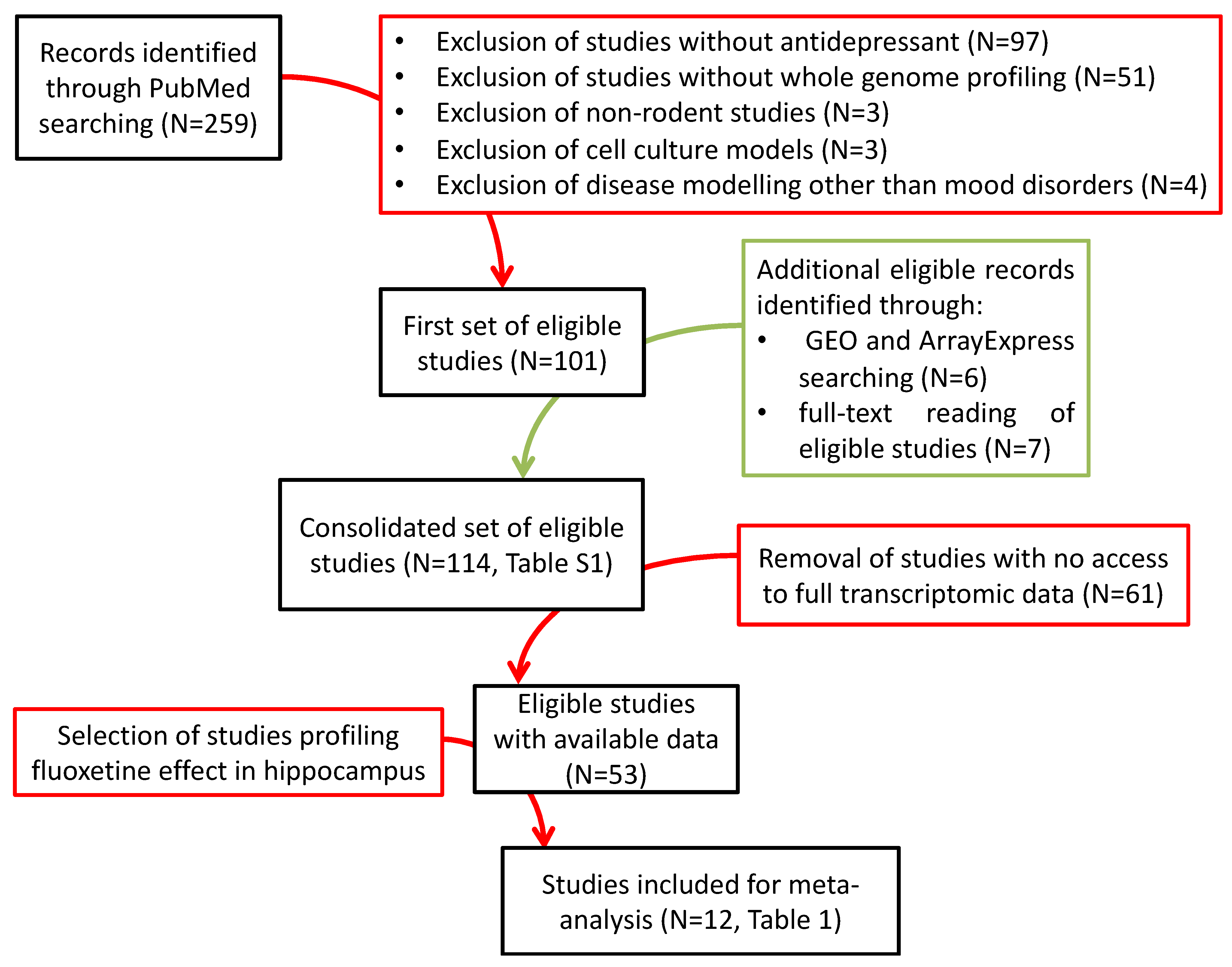
Antidepressants (ADs) are, for now, the best everyday treatment we have for moderate to severe major depressive episodes (MDEs). ADs are among the most prescribed drugs in the Western Hemisphere; however, the trial-and-error prescription strategy and side-effects leave a lot to be desired. More than 60% of patients suffering from major depression fail to respond to the first AD they are prescribed. For those who respond, full response is only observed after several weeks of treatment. In addition, there are no biomarkers that could help with therapeutic decisions; meanwhile, this is already true in cancer and other fields of medicine. For years, many investigators have been working to decipher the underlying mechanisms of AD response. Here, we provide the first systematic review of animal models. We thoroughly searched all the studies involving rodents, profiling transcriptomic alterations consecutive to AD treatment in naïve animals or in animals subjected to stress-induced models of depression. We have been confronted by an important heterogeneity regarding the drugs and the experimental settings. Thus, we perform a meta-analysis of the AD signature of fluoxetine (FLX) in the hippocampus, the most studied target. Among genes and pathways consistently modulated across species, we identify both old players of AD action and novel transcriptional biomarker candidates that warrant further investigation. We discuss the most prominent transcripts (immediate early genes and activity-dependent synaptic plasticity pathways). We also stress the need for systematic studies of AD action in animal models that span across sex, peripheral and central tissues, and pharmacological classes.
Keywords: major depression; antidepressant; fluoxetine; hippocampus; transcriptomics major depression; antidepressant; fluoxetine; hippocampus; transcriptomics