Review

COVID-19 Molecular Pathophysiology: Acetylation of Repurposing Drugs

1
Science and Research Center, Seoul National University College of Medicine, 103 Daehak-ro, Jongno-gu, Seoul 03080, Korea
2
Department of Intensive Care Unit and Neonatal Intensive Care, Hunt Regional Hospital, Greenville, 75401 TX, USA
3
Department of Health, Phutho Province, Tran Phu Str., Viet Tri City 227, Vietnam
4
IIAIGC Study Center, Burlington, VT 05408, USA
5
Department of Anesthesiology, Seoul National University Hospital, Seoul National University College of Medicine, Seoul 03080, Korea
6
Respiratory Epidemiology and Clinical Research Unit, McGill University Health Centre, Montréal, QC H4A 3S5, Canada
7
Department of Physical Medicine and Rehabilitation, Metropolitan Hospital, New York, NY 10029, USA
8
Division of Anatomical Pathology, Children’s Hospital of Eastern Ontario (CHEO), University of Ottawa, 401 Smyth Road, Ottawa, ON K1H 8L1, Canada
9
General Hospital of Phutho, Nguyen Tat Thanh, Str., Viet Tri City 227, Vietnam
10
Department of Food Engineering, Food Safety Laboratory, Memory Unit, Ewha Womans University, Seoul 03600, Korea
11
Department of Food Science, KyungHee University College of Life Science, Seoul 17104, Korea
12
College of Health and Life Sciences, Aston University, Birmingham B4 7ET, UK
*
Authors to whom correspondence should be addressed.
Int. J. Mol. Sci. 2022, 23(21), 13260; https://doi.org/10.3390/ijms232113260
Submission received: 4 October 2022 / Revised: 20 October 2022 / Accepted: 26 October 2022 / Published: 31 October 2022

Abstract

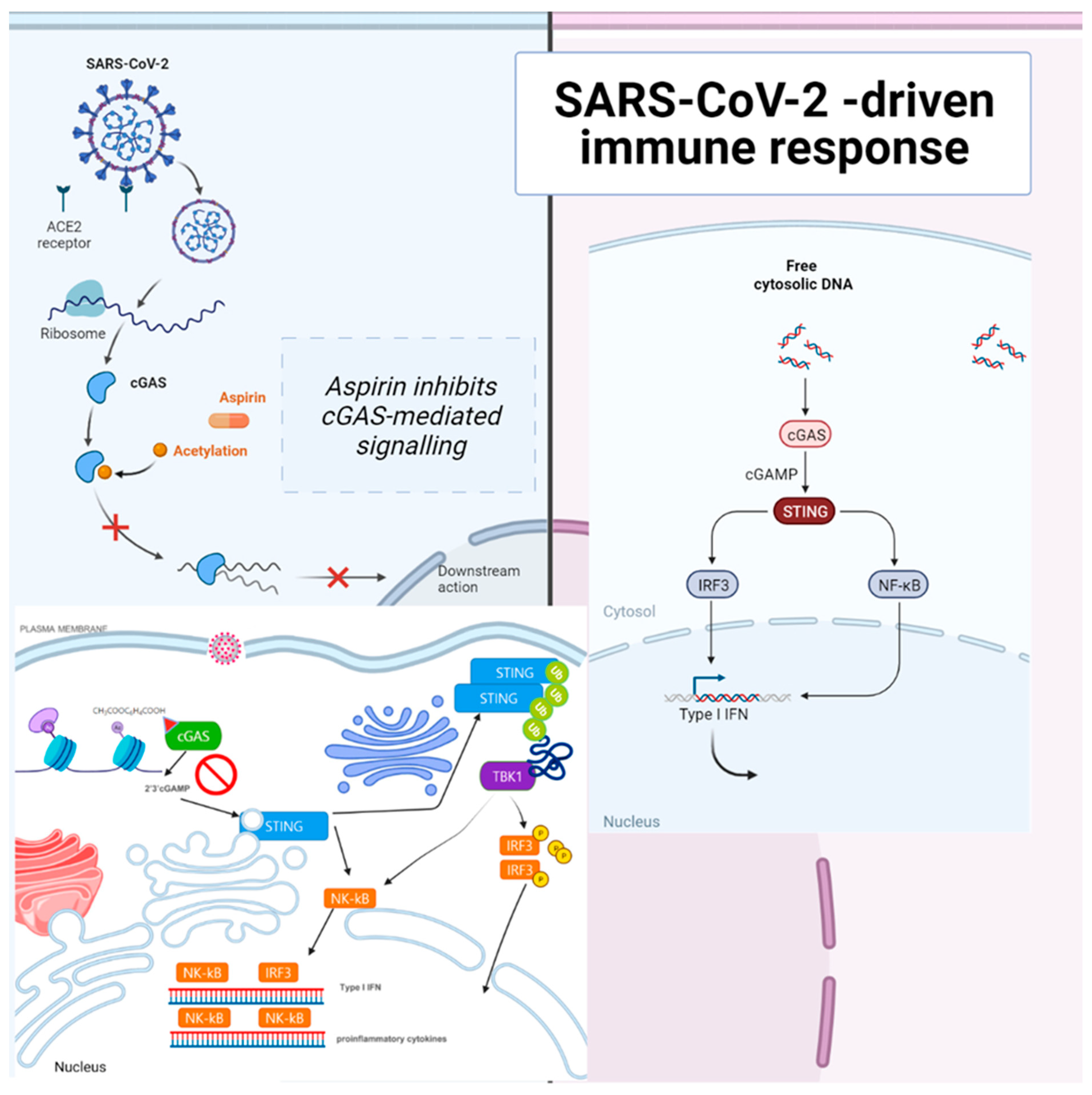
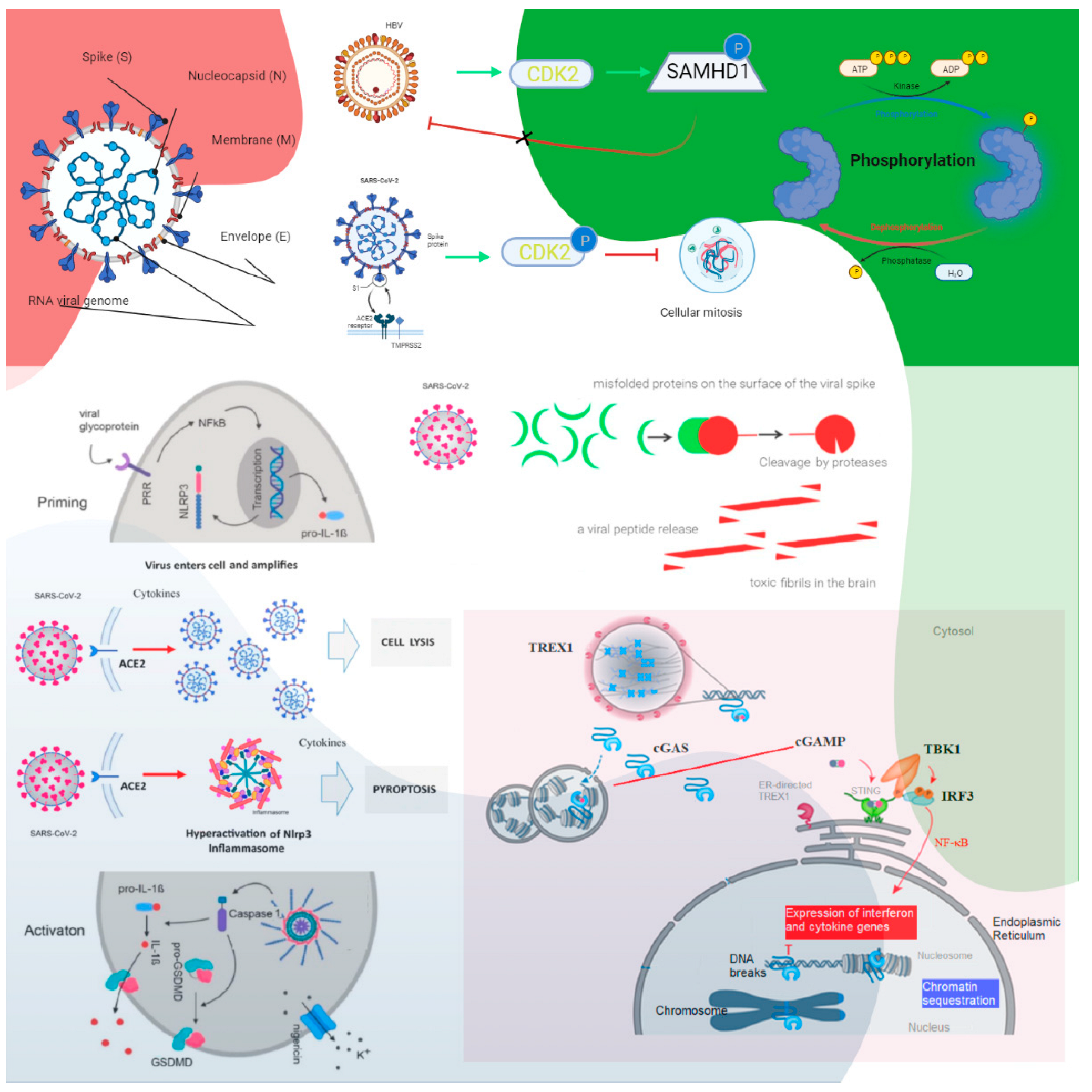
Severe acute respiratory syndrome coronavirus 2 (SARS-CoV-2) induces immune-mediated type 1 interferon (IFN-1) production, the pathophysiology of which involves sterile alpha motif and histidine-aspartate domain-containing protein 1 (SAMHD1) tetramerization and the cytosolic DNA sensor cyclic-GMP-AMP synthase (cGAS)–stimulator of interferon genes (STING) signaling pathway. As a result, type I interferonopathies are exacerbated. Aspirin inhibits cGAS-mediated signaling through cGAS acetylation. Acetylation contributes to cGAS activity control and activates IFN-1 production and nuclear factor-κB (NF-κB) signaling via STING. Aspirin and dapsone inhibit the activation of both IFN-1 and NF-κB by targeting cGAS. We define these as anticatalytic mechanisms. It is necessary to alleviate the pathologic course and take the lag time of the odds of achieving viral clearance by day 7 to coordinate innate or adaptive immune cell reactions.
Keywords: ACE2 (angiotensin-converting enzyme 2); aspirin; cGAS–STING (cyclic guanosine monophosphate (GMP)-adenosine monophosphate (AMP) synthase (cGAS)–stimulator of interferon genes (STING)); dapsone; dexamethasone; immunologic engram; inflammasome; SAMHD1 (sterile alpha motif and histidine-aspartate domain-containing protein 1); SARS-CoV-2 (severe acute respiratory syndrome coronavirus 2); spike protein; TLR4 (Toll-like receptor 4) ACE2 (angiotensin-converting enzyme 2); aspirin; cGAS–STING (cyclic guanosine monophosphate (GMP)-adenosine monophosphate (AMP) synthase (cGAS)–stimulator of interferon genes (STING)); dapsone; dexamethasone; immunologic engram; inflammasome; SAMHD1 (sterile alpha motif and histidine-aspartate domain-containing protein 1); SARS-CoV-2 (severe acute respiratory syndrome coronavirus 2); spike protein; TLR4 (Toll-like receptor 4)