Pharmacogenomic Profile and Adverse Drug Reactions in a Prospective Therapeutic Cohort of Chagas Disease Patients Treated with Benznidazole

 ,
,  ,
,
Abstract
1. Introduction
2. Results
2.1. Genome-Wide Association Study Results
2.2. Transcriptomic Results
3. Discussion
4. Material and Methods
4.1. Genomic and Transcriptomic Sample Extraction
4.2. Transcriptomic Processing and Analyses
4.3. Genomic Processing and Analyses
5. Conclusions
Supplementary Materials
Author Contributions
Funding
Institutional Review Board Statement
Informed Consent Statement
Data Availability Statement
Conflicts of Interest
References
- Rassi, A.; Marin-Neto, J.A. Chagas disease. Lancet 2010, 375, 1388–1402. [Google Scholar] [CrossRef] [Scilit]
- Rassi, A.; Marcondes de Rezende, J. American trypanosomiasis (Chagas disease). Infect. Dis. Clin. N. Am. 2012, 26, 275–291. [Google Scholar] [CrossRef] [Scilit]
- Chagas disease in Latin America: An epidemiological update based on 2010 estimates. Wkly. Epidemiol. Rec. 2015, 90, 33–43.
- Hotez, P.J.; Fujiwara, R.T. Brazil’s neglected tropical diseases: An overview and a report card. Microbes Infect. 2014, 16, 601–606. [Google Scholar] [CrossRef] [Scilit]
- Morillo, C.A.; Marin-Neto, J.A.; Avezum, A.; Sosa-Estani, S.; Rassi, A.; Rosas, F.; Villena, E.; Quiroz, R.; Bonilla, R.; Britto, C.; et al. Randomized Trial of Benznidazole for Chronic Chagas’ Cardiomyopathy. N. Engl. J. Med. 2015, 373, 1295–1306. [Google Scholar] [CrossRef] [Scilit]
- Molina, I.; Salvador, F.; Sánchez-Montalvá, A. The use of posaconazole against Chagas disease. Curr. Opin. Infect. Dis. 2015, 28, 397–407. [Google Scholar] [CrossRef] [Scilit]
- Molina, I.; Gómez i Prat, J.; Salvador, F.; Treviño, B.; Sulleiro, E.; Serre, N.; Pou, D.; Roure, S.; Cabezos, J.; Valerio, L.; et al. Randomized trial of posaconazole and benznidazole for chronic Chagas’ disease. N. Engl. J. Med. 2014, 370, 1899–1908. [Google Scholar] [CrossRef] [Scilit]
- Urbina, J.A. Recent clinical trials for the etiological treatment of chronic chagas disease: Advances, challenges and perspectives. J. Eukaryot. Microbiol. 2015, 62, 149–156. [Google Scholar] [CrossRef] [Scilit]
- Álvarez, M.G.; Hernández, Y.; Bertocchi, G.; Fernández, M.; Lococo, B.; Ramírez, J.C.; Cura, C.; Albizu, C.L.; Schijman, A.; Abril, M.; et al. New Scheme of Intermittent Benznidazole Administration in Patients Chronically Infected with Trypanosoma cruzi: A Pilot Short-Term Follow-Up Study with Adult Patients. Antimicrob. Agents Chemother. 2016, 60, 833–837. [Google Scholar] [CrossRef] [Scilit]
- Bustamante, J.M.; Craft, J.M.; Crowe, B.D.; Ketchie, S.A.; Tarleton, R.L. New, combined, and reduced dosing treatment protocols cure Trypanosoma cruzi infection in mice. J. Infect. Dis. 2014, 209, 150–162. [Google Scholar] [CrossRef] [Scilit]
- Pinazo, M.J.; Guerrero, L.; Posada, E.; Rodríguez, E.; Soy, D.; Gascon, J. Benznidazole-related adverse drug reactions and their relationship to serum drug concentrations in patients with chronic chagas disease. Antimicrob. Agents Chemother. 2013, 57, 390–395. [Google Scholar] [CrossRef] [Scilit]
- Sperandio da Silva, G.M.; Mediano, M.F.; Alvarenga Americano do Brasil, P.E.; da Costa Chambela, M.; da Silva, J.A.; de Sousa, A.S.; Xavier, S.S.; Rodrigues da Costa, A.; Magalhães Saraiva, R.; Hasslocher-Moreno, A.M. A clinical adverse drug reaction prediction model for patients with chagas disease treated with benznidazole. Antimicrob. Agents Chemother. 2014, 58, 6371–6377. [Google Scholar] [CrossRef] [Scilit]
- Salvador, F.; Sánchez-Montalvá, A.; Martínez-Gallo, M.; Sala-Cunill, A.; Viñas, L.; García-Prat, M.; Aparicio, G.; Sao Avilés, A.; Artaza, M.; Ferrer, B.; et al. Evaluation of cytokine profile and HLA association in benznidazole related cutaneous reactions in patients with Chagas disease. Clin. Infect. Dis. 2015, 61, 1688–1694. [Google Scholar] [CrossRef] [Scilit]
- Miller, D.A.; Hernandez, S.; Rodriguez De Armas, L.; Eells, S.J.; Traina, M.M.; Miller, L.G.; Meymandi, S.K. Tolerance of benznidazole in a United States Chagas Disease clinic. Clin. Infect. Dis. 2015, 60, 1237–1240. [Google Scholar] [CrossRef] [Scilit]
- Hasslocher-Moreno, A.M.; do Brasil, P.E.; de Sousa, A.S.; Xavier, S.S.; Chambela, M.C.; Sperandio da Silva, G.M. Safety of benznidazole use in the treatment of chronic Chagas’ disease. J. Antimicrob. Chemother. 2012, 67, 1261–1266. [Google Scholar] [CrossRef] [Scilit]
- Aldasoro, E.; Posada, E.; Requena-Méndez, A.; Calvo-Cano, A.; Serret, N.; Casellas, A.; Sanz, S.; Soy, D.; Pinazo, M.J.; Gascon, J. What to expect and when: Benznidazole toxicity in chronic Chagas’ disease treatment. J. Antimicrob. Chemother. 2018, 73, 1060–1067. [Google Scholar] [CrossRef] [Scilit]
- Wolk, K.; Kunz, S.; Witte, E.; Friedrich, M.; Asadullah, K.; Sabat, R. IL-22 increases the innate immunity of tissues. Immunity 2004, 21, 241–254. [Google Scholar] [CrossRef] [Scilit]
- Kumari, S.; Bonnet, M.C.; Ulvmar, M.H.; Wolk, K.; Karagianni, N.; Witte, E.; Uthoff-Hachenberg, C.; Renauld, J.C.; Kollias, G.; Toftgard, R.; et al. Tumor necrosis factor receptor signaling in keratinocytes triggers interleukin-24-dependent psoriasis-like skin inflammation in mice. Immunity 2013, 39, 899–911. [Google Scholar] [CrossRef] [Scilit]
- Deng, G.M.; Liu, L.; Kyttaris, V.C.; Tsokos, G.C. Lupus serum IgG induces skin inflammation through the TNFR1 signaling pathway. J. Immunol. 2010, 184, 7154–7161. [Google Scholar] [CrossRef] [Scilit]
- Schön, M.; Kähne, T.; Gollnick, H.; Schön, M.P. Expression of gp130 in tumors and inflammatory disorders of the skin: Formal proof of its identity as CD146 (MUC18, Mel-CAM). J. Investig. Derm. 2005, 125, 353–363. [Google Scholar] [CrossRef] [Scilit]
- Jensen, J.M.; Fölster-Holst, R.; Baranowsky, A.; Schunck, M.; Winoto-Morbach, S.; Neumann, C.; Schütze, S.; Proksch, E. Impaired sphingomyelinase activity and epidermal differentiation in atopic dermatitis. J. Investig. Derm. 2004, 122, 1423–1431. [Google Scholar] [CrossRef] [Scilit]
- Maddur, M.S.; Miossec, P.; Kaveri, S.V.; Bayry, J. Th17 cells: Biology, pathogenesis of autoimmune and inflammatory diseases, and therapeutic strategies. Am. J. Pathol. 2012, 181, 8–18. [Google Scholar] [CrossRef] [Scilit]
- Oestreicher, J.L.; Walters, I.B.; Kikuchi, T.; Gilleaudeau, P.; Surette, J.; Schwertschlag, U.; Dorner, A.J.; Krueger, J.G.; Trepicchio, W.L. Molecular classification of psoriasis disease-associated genes through pharmacogenomic expression profiling. Pharm. J. 2001, 1, 272–287. [Google Scholar] [CrossRef] [Scilit]
- Stumpf, A.M. Ichthyosis, Cyclic, with Epidermolytic Hyperkeratosis, # 607602. Online Mendelian Inheritance in Man® (OMIM). Available online: https://omim.org/entry/607602# (accessed on 7 January 2021).
- Wenzel, J.; Peters, B.; Zahn, S.; Birth, M.; Hofmann, K.; Küsters, D.; Tomiuk, S.; Baron, J.M.; Merk, H.F.; Mauch, C.; et al. Gene expression profiling of lichen planus reflects CXCL9+-mediated inflammation and distinguishes this disease from atopic dermatitis and psoriasis. J. Investig. Derm. 2008, 128, 67–78. [Google Scholar] [CrossRef] [Scilit]
- Marceková, Z.; Flaig, M.J.; Kekus, M.; Ruzicka, T.; Rupec, R.A. The potential role of c-Jun activation in patients with cutaneous lichen planus. Exp. Derm. 2010, 19, 74–80. [Google Scholar] [CrossRef] [Scilit]
- Cai, T.; Wang, Q.; Zhou, Q.; Wang, C.; Hou, S.; Qi, J.; Kijlstra, A.; Yang, P. Increased expression of IL-22 is associated with disease activity in Behcet’s disease. PLoS ONE 2013, 8, e59009. [Google Scholar] [CrossRef] [Scilit]
- McKusick, V.A. Erythroderma, Ichthyosiform, Congenital Reticular CRIE, # 609165. Online Mendelian Inheritance in Man® (OMIM). Available online: https://www.omim.org/entry/609165 (accessed on 7 January 2021).
- Bergheim, I.; Guo, L.; Davis, M.A.; Duveau, I.; Arteel, G.E. Critical role of plasminogen activator inhibitor-1 in cholestatic liver injury and fibrosis. J. Pharm. Exp. 2006, 316, 592–600. [Google Scholar] [CrossRef] [Scilit]
- Shackel, N.A.; McGuinness, P.H.; Abbott, C.A.; Gorrell, M.D.; McCaughan, G.W. Identification of novel molecules and pathogenic pathways in primary biliary cirrhosis: cDNA array analysis of intrahepatic differential gene expression. Gut 2001, 49, 565–576. [Google Scholar] [CrossRef] [Scilit]
- Skidmore-Roth, L. Mosby’s Drug Guide for Nursing Students, 13th ed.; Elsevier: Alpharetta, GA, USA, 2018. [Google Scholar]
- Goodman and Gilman’s. The Pharmacological Basis of Therapeutics, 9th ed.; McGraw-Hill: Chicago, IL, USA, 1996. [Google Scholar]
- Spierings, E.L.H. Treatment of Insomnia in Migraineurs With Eszopiclone (Lunesta™) and Its Effect on Sleep Time, Headache Frequency, and Daytime Functioning: A Randomized, Double-Blind, Placebo-Controlled, Parallel-Group Pilot Study; ClinicalTrials.gov: Bethesda, MD, USA, 2008.
- Dias, J.C.; Ramos, A.N.; Gontijo, E.D.; Luquetti, A.; Shikanai-Yasuda, M.A.; Coura, J.R.; Torres, R.M.; Melo, J.R.; Almeida, E.A.; Oliveira, W.; et al. Brazilian Consensus on Chagas Disease, 2015. Epidemiol. Serv. Saude 2016, 25, 7–86. [Google Scholar] [CrossRef] [Scilit]
- De Rezende, J.; Lauar, K.M.; de Oliveira, A. Clinical and radiological aspects of aperistalsis of the esophagus. Rev. Bras. Gastroenterol 1960, 12, 247–262. [Google Scholar]
- Harris, P.A.; Taylor, R.; Thielke, R.; Payne, J.; Gonzalez, N.; Conde, J.G. Research electronic data capture (REDCap)-A metadata-driven methodology and workflow process for providing translational research informatics support. J. Biomed. Inf. 2009, 42, 377–381. [Google Scholar] [CrossRef] [Scilit]
- Scientific, T.F. Ion Ampliseq Transcriptome Human GeneExpression Kit; Publication Number MAN0010742; Thermo Fisher Scientific: Waltham, MA, USA, 2017. [Google Scholar]
- Scientific, T.F. AxiomTM 2.0 Assay Manual Workflow User Guide; Publication Number 702990; Thermo Fisher Scientific: Waltham, MA, USA, 2017. [Google Scholar]


| Participant Characteristics | Had Adverse Drug Reaction (gADR) n = 73 n (%) or Median (IQR) | No Adverse Drug Reaction (gNADR) n = 29 n (%) or Median (IQR) | p-Value * |
|---|---|---|---|
| Sex | |||
| Female | 35 (47.9) | 9 (31.0) | |
| Male | 38 (52.1) | 20 (69.0) | 0.120 |
| Age, years | 53.0 (46–58) | 54 (48–59) | 0.535 ** |
| Skin color | |||
| Mixed | 41 (53.2) | 16 (55.2) | |
| White | 22 (30.1) | 9 (29) | |
| Black | 9 (12.3) | 4 (13.8) | |
| Indigenous | 1 (1.4) | 0 (0) | 0.932 |
| Literate (yes) | 65 (89.1) | 27 (93.1) | 0.534 |
| Alcohol use (yes) | 36 (49.3) | 18 (62.1) | 0.244 |
| Medication use (yes) | 47 (64.4) | 21 (72.4) | 0.438 |
| Medications by class | |||
| Diuretics | 19 (26.0) | 4 (13.8) | 0.182 |
| ACEi/ARB | 21 (28.8) | 10 (34.5) | 0.571 |
| Beta-blocker | 8 (11.0) | 2 (6.9) | 0.425 |
| Statins | 11 (15.1) | 5 (17.2) | 0.785 |
| PPI | 9 (12.3) | 6 (20.7) | 0.282 |
| Comorbidities | |||
| High blood pressure | 32 (43.8) | 10 (34.5) | 0.387 |
| Diabetes | 12 (16.4) | 5 (17.2) | 0.922 |
| Chronic kidney disease | 3 (4.1) | 1 (3.4) | 0.877 |
| Stroke | 1 (1.4) | 1 (3.4) | 0.495 |
| MI | 0 (0) | 1 (3.4) | 0.111 |
| Clinical forms | |||
| Indeterminate | 36 (49.3) | 10 (34.5) | |
| Cardiac | 11 (15.1) | 13 (44.8) | |
| Digestive | 17 (23.3) | 4 (13.8) | |
| Mixed | 9 (12.3) | 2 (18.2) | 0.016 |
| Completed benznidazole treatment | 51 (69.9) | 29 (6.9) | 0.001 |
| SNP | CHR | Position | Gene: Consequence | A1 | A2 | p-Value |
|---|---|---|---|---|---|---|
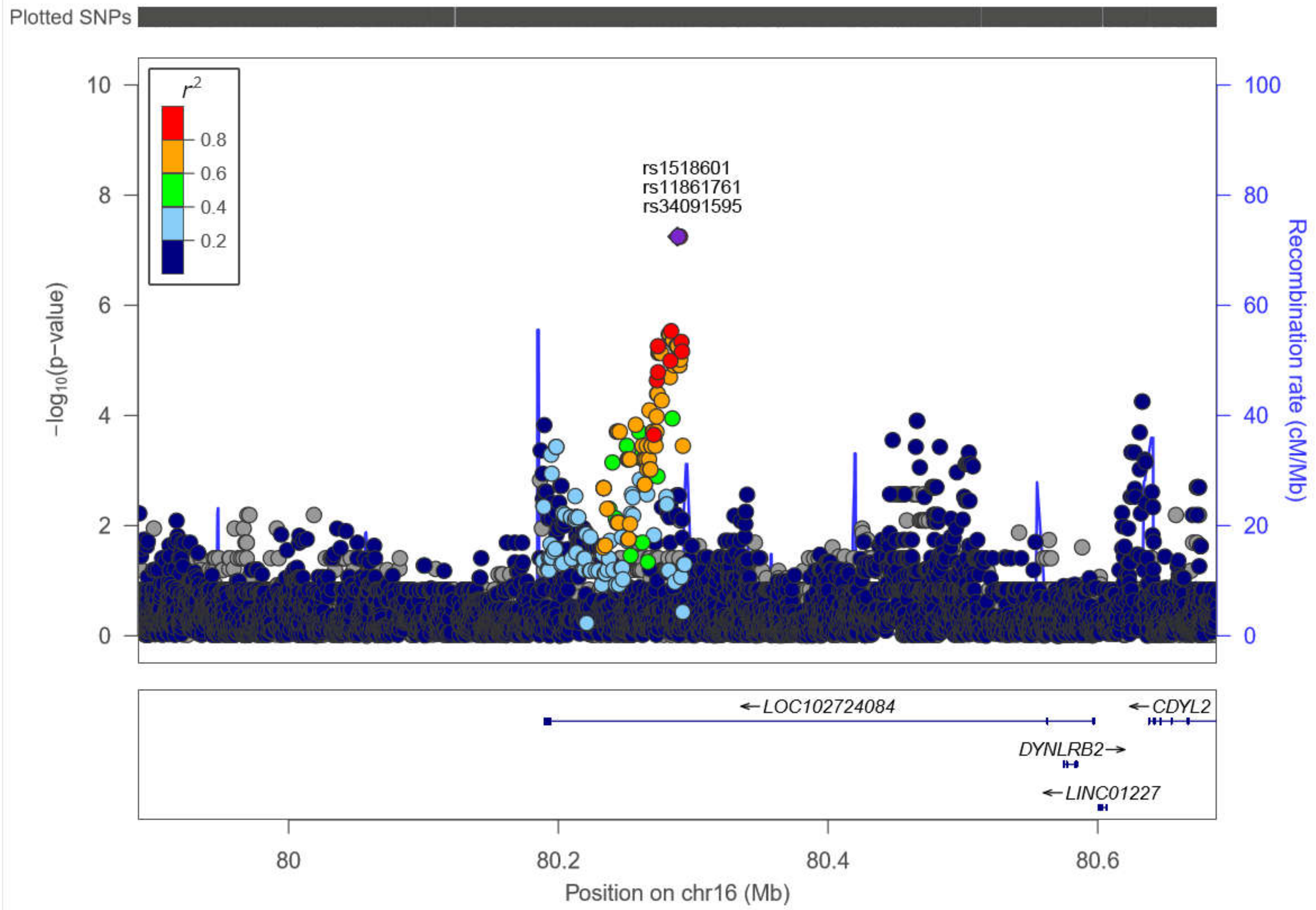
| rs1518601 | 16 | 80288258 | LOC102724084 Intron variant | A | G | 5.652 × 10⁻⁸ |
| rs11861761 | 16 | 80288963 | LOC102724084 Intron variant | A | G | 5.652 × 10⁻⁸ |
| rs34091595 | 16 | 80289643 | LOC102724084 Intron variant | T | C | 5.652 × 10⁻⁸ |
| rs3968927 | 3 | 69183404 | Leiomodin 3 (LMOD3)/FERM domain containing 4B (FRMD4B) Intergenic variant | T | C | 2.945 × 10⁻⁷ |
| rs6819334 | 4 | 165528432 | Membrane-associated ring finger 1 (MARCH1)/LOC100133261 Intergenic variant | C | T | 3.443 × 10⁻⁷ |
| rs62255473 | 3 | 69182711 | Leiomodin 3 (LMOD3)/FERM domain containing 4B (FRMD4B) Intergenic variant | C | T | 6.191 × 10⁻⁷ |
| rs1995665 | 3 | 69183140 | Leiomodin 3 (LMOD3) (fetal)/FERM domain containing 4B (FRMD4B) Intergenic variant | C | A | 6.191 × 10⁻⁷ |
| rs3097439 | 15 | 27871229 | Gamma-aminobutyric acid—A receptor, gamma 3 (GABRG3)/Oculocutaneous albinism II (OCA2) Intergenic variant | G | T | 6.896 × 10⁻⁷ |
| rs3098545 | 15 | 27871414 | Gamma-aminobutyric acid—A receptor, gamma 3 (GABRG3)/Oculocutaneous albinism II (OCA2) Intergenic variant | A | C | 6.896 × 10⁻⁷ |
| rs3097436 | 15 | 27872152 | Gamma-aminobutyric acid—A receptor, gamma 3 (GABRG3)/Oculocutaneous albinism II (OCA2) Intergenic variant | T | G | 6.896 × 10⁻⁷ |
| rs3097435 | 15 | 27872235 | Gamma-aminobutyric acid—A receptor, gamma 3 (GABRG3)/Oculocutaneous albinism II (OCA2) Intergenic variant | T | C | 6.896 × 10⁻⁷ |
| rs3098548 | 15 | 27873614 | Gamma-aminobutyric acid—A receptor, gamma 3 (GABRG3)/Oculocutaneous albinism II (OCA2) Intergenic variant | A | G | 6.896 × 10⁻⁷ |
| rs3097434 | 15 | 27873755 | Gamma-aminobutyric acid—A receptor, gamma 3 (GABRG3)/Oculocutaneous albinism II (OCA2) Intergenic variant | T | A | 6.896 × 10⁻⁷ |
| rs3098549 | 15 | 27874094 | Gamma-aminobutyric acid—A receptor, gamma 3 (GABRG3)/Oculocutaneous albinism II (OCA2) Intergenic variant | A | G | 6.896 × 10⁻⁷ |
| rs6026692 | 20 | 57661598 | SLMO2-ATP5E (SLMO2-ATP5E readthrough)/Mitochondrial ribosomal protein S16 pseudogene 2 (MRPS16P2) Intergenic variant | A | C | 6.896 × 10⁻⁷ |
| rs7563279 | 2 | 229499707 | LOC101928765 Intron variant | G | A | 6.915 × 10⁻⁷ |
| rs7610262 | 3 | 69169466 | Leiomodin 3 (LMOD3) Intron variant | C | A | 8.807 × 10⁻⁷ |
| rs9844987 | 3 | 69170012 | Leiomodin 3 (LMOD3) Intron variant | C | T | 9.211 × 10⁻⁷ |
| rs7963499 | 12 | 11917397 | Ets variant 6 (ETV6) Intron variant | T | C | 9.211 × 10⁻⁷ |
| rs2619732 | 5 | 153877722 | LOC100271907/Co-repressor interacting with RBPJ, 1 pseudogene 1 (CIR1P1) Intergenic variant | G | T | 1.392 × 10⁻⁶ |
| rs2612528 | 4 | 42721251 | LOC101927095/Glutaredoxin, cysteine rich 1 (GRXCR1) Intergenic variant | T | C | 1.441 × 10⁻⁶ |
| rs2569913 | 2 | 195964436 | LOC101927431/Solute carrier family 39, member 10 (SLC39A10) Intergenic variant | C | T | 1.457 × 10⁻⁶ |
| rs7620430 | 3 | 69169602 | Leiomodin 3 (LMOD3) Intron variant | A | G | 1.871 × 10⁻⁶ |
| rs2872690 | 3 | 69171803 | Leiomodin 3 (LMOD3)/ FERM domain containing 4B (FRMD4B) Intergenic variant | C | T | 1.949 × 10⁻⁶ |
| rs6464597 | 7 | 144323969 | Thiamin pyrophosphokinase 1 (TPK1) Intron variant | C | T | 2.367 × 10⁻⁶ |
| rs1496707 | 11 | 91882053 | Oxysterol-binding protein-like 9 pseudogene 3 (OSBPL9P3)/Ribosomal protein L7a pseudogene 57 (RPL7AP57) Intergenic variant | G | A | 2.367 × 10⁻⁶ |
| rs9931591 | 16 | 80283100 | LOC101928248/Dynein, light-chain, roadblock-type 2 (DYNLRB2) Intergenic variant | G | A | 2.948 × 10⁻⁶ |
| rs34880994 | 16 | 80281336 | LOC101928248/Dynein, light-chain, roadblock-type 2 (DYNLRB2) Intergenic variant | A | G | 3.38 × 10⁻⁶ |
| rs11648009 | 16 | 80282101 | LOC101928248/Dynein, light-chain, roadblock-type 2 (DYNLRB2) Intergenic variant | C | G | 3.38 × 10⁻⁶ |
| rs1435865 | 2 | 229480096 | Long intergenic nonprotein coding RNA 1807 (LINC01807)/LOC105373920 Intergenic variant | A | G | 3.573 × 10⁻⁶ |
Publisher’s Note: MDPI stays neutral with regard to jurisdictional claims in published maps and institutional affiliations. |
© 2021 by the authors. Licensee MDPI, Basel, Switzerland. This article is an open access article distributed under the terms and conditions of the Creative Commons Attribution (CC BY) license (http://creativecommons.org/licenses/by/4.0/).
Share and Cite
Franco, L.A.M.; Moreira, C.H.V.; Buss, L.F.; Oliveira, L.C.; Martins, R.C.R.; Manuli, E.R.; Lindoso, J.A.L.; Busch, M.P.; Pereira, A.C.; Sabino, E.C. Pharmacogenomic Profile and Adverse Drug Reactions in a Prospective Therapeutic Cohort of Chagas Disease Patients Treated with Benznidazole. Int. J. Mol. Sci. 2021, 22, 1960. https://doi.org/10.3390/ijms22041960
Franco LAM, Moreira CHV, Buss LF, Oliveira LC, Martins RCR, Manuli ER, Lindoso JAL, Busch MP, Pereira AC, Sabino EC. Pharmacogenomic Profile and Adverse Drug Reactions in a Prospective Therapeutic Cohort of Chagas Disease Patients Treated with Benznidazole. International Journal of Molecular Sciences. 2021; 22(4):1960. https://doi.org/10.3390/ijms22041960
Chicago/Turabian StyleFranco, Lucas A. M., Carlos H. V. Moreira, Lewis F. Buss, Lea C. Oliveira, Roberta C. R. Martins, Erika R. Manuli, José A. L. Lindoso, Michael P. Busch, Alexandre C. Pereira, and Ester C. Sabino. 2021. "Pharmacogenomic Profile and Adverse Drug Reactions in a Prospective Therapeutic Cohort of Chagas Disease Patients Treated with Benznidazole" International Journal of Molecular Sciences 22, no. 4: 1960. https://doi.org/10.3390/ijms22041960
APA StyleFranco, L. A. M., Moreira, C. H. V., Buss, L. F., Oliveira, L. C., Martins, R. C. R., Manuli, E. R., Lindoso, J. A. L., Busch, M. P., Pereira, A. C., & Sabino, E. C. (2021). Pharmacogenomic Profile and Adverse Drug Reactions in a Prospective Therapeutic Cohort of Chagas Disease Patients Treated with Benznidazole. International Journal of Molecular Sciences, 22(4), 1960. https://doi.org/10.3390/ijms22041960