


Epidermal Club Cells in Fishes: A Case for Ecoimmunological Analysis


Abstract
1. Introduction
2. Epidermal Club Cells in Fish
2.1. Phylogenetic Distribution of Epidermal Club Cells
2.2. Histochemical Characteristics of ECCs
3. An Overview of the Immune System in Fishes
3.1. Innate Immune System in Fish
3.2. Adaptive Immune System in Fish
3.3. Immunological Function of Epidermal Club Cells
4. Future Research Directions
4.1. Proposed Experimentation for Characterizing Club Cells’s Immune Functions
4.2. Ecological Trade-Offs with the Immune System: An Ecoimmunological Perspective on Epidermal Club Cells
5. ECCs as a Tool for Ecoimmunological Studies
Author Contributions
Funding
Institutional Review Board Statement
Informed Consent Statement
Acknowledgments
Conflicts of Interest
Abbreviation
| ECC | Epidermal club cell |
References
- Von Frisch, K. Zur Psychologie des Fisch-Schwarmes. Naturwissenschaften 1938, 26, 601–606. [Google Scholar] [CrossRef]
- Von Frisch, K. Die Bedeutung des Geruchsinnes im Leben der Fische. Naturwissenschaften 1941, 29, 321–333. [Google Scholar] [CrossRef]
- Von Frisch, K. Über einen Schreckstoff der Fischhaut und seine biologische Bedeutung. Z. Vgl. Physiol. 1942, 29, 46–145. [Google Scholar] [CrossRef]
- Pfeiffer, W. The Distribution of Fright Reaction and Alarm Substance Cells in Fishes. Copeia 1977, 1977, 653–665. [Google Scholar] [CrossRef]
- Smith, R.J.F. Alarm signals in fishes. Rev. Fish Biol. Fish. 1992, 2, 33–63. [Google Scholar] [CrossRef]
- Williams, G.C. Adaptation and Natural Selection. A Critique of Some Current Evolutionary Thought; Princeton University Press: Princeton, NJ, USA, 1996. [Google Scholar]
- Lönnstedt, O.M.; McCormick, M.I. Damsel in distress: Captured damselfish prey emit chemical cues that attract secondary predators and improve escape chances. Proc. R. Soc. B Biol. Sci. 2015, 282. [Google Scholar] [CrossRef]
- Chivers, D.P.; Brown, G.E.; Smith, R.J.F. The Evolution of Chemical Alarm Signals: Attracting Predators Benefits Alarm Signal Senders. Am. Nat. 1996, 148, 649–659. [Google Scholar] [CrossRef]
- Gould, S.J.; Vrba, E.S. Exaptation—A Missing Term in the Science of Form. Paleobiology 2016, 8, 4–15. [Google Scholar] [CrossRef]
- Ferrari, M.C.O.; Wisenden, B.D.; Chivers, D.P. Chemical ecology of predator–prey interactions in aquatic ecosystems: A review and prospectus. Can. J. Zool. 2010, 88, 698–724. [Google Scholar] [CrossRef]
- Wisenden, B.D.; Goater, C.; James, C. Behavioral Defenses against Parasites and Pathogens. In Fish Defenses: Pathogens, Parasites, Predators; Zaccone, G., Perrìère, C., Mathis, A., Kapoor, B.G., Eds.; Science Publishers: Enfield, NH, USA, 2009; Volume 2, pp. 151–168. [Google Scholar]
- Stumbo, A.D.; James, C.T.; Goater, C.P.; Wisenden, B.D. Shoaling as an antiparasite defence in minnows (Pimephales promelas) exposed to trematode cercariae. J. Anim. Ecol. 2012, 81, 1319–1326. [Google Scholar] [CrossRef]
- James, C.T.; Noyes, K.J.; Stumbo, A.D.; Wisenden, B.D.; Goater, C.P. Cost of exposure to trematode cercariae and learned recognition and avoidance of parasitism risk by fathead minnows Pimephales promelas. J. Fish Biol. 2008, 73, 2238–2248. [Google Scholar] [CrossRef]
- Bradbury, J.W.; Vehrencamp, S.L. Principles of Animal Communication, 2nd ed; Sinauer Associates: Sunderland, MA, USA, 2011; p. 697. [Google Scholar]
- Wisenden, B.D.; Chivers, D.P. The Role of Public Chemical Information in Antipredator Behaviour. In Fish Communication; Ladich, F., Collins, S.P., Moller, P., Kapoor, B.G., Eds.; Science Publisher: Enfield, NH, USA, 2006; pp. 259–278. [Google Scholar]
- Wisenden, B.D. The Cue–Signal Continuum. In Fish Pheromones and Related Cues; Sorensen, P.W., Wisenden, B.D., Eds.; John Wiley & Sons, Inc.: Hoboken, NJ, USA, 2014; pp. 149–158. [Google Scholar]
- Chivers, D.P.; Smith, R.J.F. Chemical alarm signalling in aquatic predator-prey systems: A review and prospectus. Écoscience 1998, 5, 338–352. [Google Scholar] [CrossRef]
- Wisenden, B.D. Chemical Cues That Indicate Risk of Predation. In Fish Pheromones and Related Cues; Sorensen, P.W., Wisenden, B.D., Eds.; Wiley-Blackwell Press: New York, NY, USA, 2014; pp. 131–148. [Google Scholar]
- Manek, A.K.; Ferrari, M.C.O.; Sereda, J.M.; Niyogi, S.O.M.; Chivers, D.P. The effects of ultraviolet radiation on a freshwater prey fish: Physiological stress response, club cell investment, and alarm cue production. Biol. J. Linn. Soc. 2012, 105, 832–841. [Google Scholar] [CrossRef]
- Manek, A.K.; Ferrari, M.C.O.; Niyogi, S.; Chivers, D.P. The interactive effects of multiple stressors on physiological stress responses and club cell investment in fathead minnows. Sci. Total Environ. 2014, 476–477, 90–97. [Google Scholar] [CrossRef] [PubMed]
- Carreau-Green, N.D.; Mirza, R.S.; MartÍnez, M.L.; Pyle, G.G. The ontogeny of chemically mediated antipredator responses of fathead minnows Pimephales promelas. J. Fish Biol. 2008, 73, 2390–2401. [Google Scholar] [CrossRef]
- Whitear, M.; Mittal, A.K. Fine structure of the club cells in the skin of ostariophysan fish. Z. Mikrosk. Anat. Forsch. 1983, 97, 141–157. [Google Scholar]
- Arratia, G.; Huaquin, L. Morphology of the lateral line system and of the skin of diplomystid and certain primitive loricarioid catfishes and systematic and ecological considerations. Bonn. Zool. Monogr. 1995, 36, 1–110. [Google Scholar]
- Blazer, V.S.; Fabacher, D.L.; Little, E.E.; Ewing, M.S.; Kocan, K.M. Effects of Ultraviolet-B Radiation on Fish: Histologic Comparison of a UVB-Sensitive and a UVB-Tolerant Species. J. Aquat. Anim. Health 1997, 9, 132–143. [Google Scholar] [CrossRef]
- Chivers, D.P.; Wisenden, B.D.; Hindman, C.J.; Michalak, T.A.; Kusch, R.C.; Kaminskyj, S.G.; Jack, K.L.; Ferrari, M.C.; Pollock, R.J.; Halbgewachs, C.F.; et al. Epidermal ‘alarm substance’ cells of fishes maintained by non-alarm functions: Possible defence against pathogens, parasites and UVB radiation. Proc. R. Soc. Ser. B 2007, 274, 2611–2619. [Google Scholar] [CrossRef]
- Whitear, M. Epidermis. In Biology of the Integument: 2 Vertebrates; Bereiter-Hahn, J., Matoltsy, A.G., Richards, K.S., Eds.; Springer: Berlin/Heidelberg, Germany, 1986; pp. 8–38. [Google Scholar]
- Snider, M.R. Antipredator Behavior and Morphology in Isolated Cyprinodont Fishes. Master’s Thesis, North Dakota State University, Fargo, ND, USA, 2018. [Google Scholar]
- Nelson, J.; Grande, T.; Wilson, M. Fishes of the World, 5th ed.; Wiley: Hoboken, NJ, USA, 2016. [Google Scholar]
- Fink, S.V.; Fink, W.L. Interrelationships of the ostariophysan fishes (Teleostei). Zool. J. Linn. Soc. 1981, 72, 297–353. [Google Scholar] [CrossRef]
- Wisenden, B.D.; Klitzke, J.; Nelson, R.; Friedl, D.; Jacobson, P.C. Predator-recognition training of hatchery-reared walleye (Stizostedion vitreum) and a field test of a training method using yellow perch (Perca flavescens). Can. J. Fish. Aquat. Sci. 2004, 61, 2144–2150. [Google Scholar] [CrossRef]
- Lane, E.B.; Whitear, M. Skein cells in lamprey epidermis. Can. J. Zool. 1980, 58, 450–455. [Google Scholar] [CrossRef]
- Meyer, W.; Seegers, U. Basics of skin structure and function in elasmobranchs: A review. J. Fish Biol. 2012, 80, 1940–1967. [Google Scholar] [CrossRef] [PubMed]
- Imaki Lamer, H.; Chavin, W. Ultrastructure of the integumental melanophores of the coelacanth, Latimeria chalumnae. Cell Tissue Res. 1975, 163, 383–394. [Google Scholar] [CrossRef]
- Tsutsui, S.; Komatsu, Y.; Sugiura, T.; Araki, K.; Nakamura, O. A unique epidermal mucus lectin identified from catfish (Silurus asotus): First evidence of intelectin in fish skin slime. J. Biochem. 2011, 150, 501–514. [Google Scholar] [CrossRef]
- Nakamura, O.; Watanabe, T.; Kamiya, H.; Muramoto, K. Galectin containing cells in the skin and mucosal tissues in Japanese conger eel, Conger myriaster: An immunohistochemical study. Dev. Comp. Immunol. 2001, 25, 431–437. [Google Scholar] [CrossRef]
- Arratia, G. The Skin of Catfishes—A Review. Available online: https://www.researchgate.net/profile/Gloria_Arratia/publication/258762963_The_Skin_of_Catfishes-A_Review/links/0deec52cee13d56a8c000000/The-Skin-of-Catfishes-A-Review.pdf (accessed on 20 December 2020).
- Ytteborg, E.; Hansen, Ø.J.; Høst, V.; Afanasyev, S.; Vieweg, I.; Nahrgang, J.; Krasnov, A. Morphology, Transcriptomics and In Vitro Model of Skin from Polar Cod (Boreogadus saida) and Atlantic Cod (Gadus morhua). Fishes 2020, 5, 34. [Google Scholar] [CrossRef]
- Bryant, P.B. A Study of the Alarm System in Selected Fishes of Northern Mississippi; University of Mississippi: Oxford, MS, USA, 1987. [Google Scholar]
- Kumari, U.; Yashpal, M.; Mittal, S.; Mittal, A.K. Histochemical analysis of glycoproteins in the secretory cells in the gill epithelium of a catfish, Rita rita (Siluriformes, Bagridae). Tissue Cell 2009, 41, 271–280. [Google Scholar] [CrossRef]
- Bonilla Lizarazo, R.J.; Quintero Virguez, M.; Gómez Ramírez, E.; Rodríguez Caicedo, D.; Hurtado Giraldo, H. Histología y morfometría de piel del pez Eremophilus mutisii (Trychomecteridae, Siluriformes). Rev. Biol. Trop. 2008, 56, 885–893. [Google Scholar] [CrossRef]
- Ralphs, J.R.; Benjamin, M. Chondroitin and keratan sulphate in the epidermal club cells of teleosts. J. Fish Biol. 1992, 40, 473–475. [Google Scholar] [CrossRef]
- Smith, M.E. Alarm Response of Arius felis to Chemical Stimuli from Injured Conspecifics. J. Chem. Ecol. 2000, 26, 1635–1647. [Google Scholar] [CrossRef]
- Shiomi, K.; Takamiya, M.; Yamanaka, H.; Kikuchi, T.; Suzuki, Y. Toxins in the skin secretion of the oriental catfish (Plotosus lineatus): Immunological properties and immunocytochemical identification of producing cells. Toxic. Off. J. Int. Soc. Toxinol. 1988, 26, 353–361. [Google Scholar] [CrossRef]
- Zaccone, G.; Tagliafierro, G.; Fasulo, S.; Contini, A.; Ainis, L.; Ricca, M.B. Serotonin-like immunoreactivity in the epidermal club cells of teleost fishes. Histochemistry 1990, 93, 355–357. [Google Scholar] [CrossRef] [PubMed]
- Damasceno, E.M.; Monteiro, J.C.; Duboc, L.F.; Dolder, H.; Mancini, K. Morphology of the Epidermis of the Neotropical Catfish Pimelodella lateristriga (Lichtenstein, 1823) with Emphasis in Club Cells. PLoS ONE 2012, 7, e50255. [Google Scholar] [CrossRef] [PubMed]
- Barbosa, A.; Alves, F.L.; Fim Pereira, A.d.S.; Ide, L.M.; Hoffmann, A. Behavioral characterization of the alarm reaction and anxiolytic-like effect of acute treatment with fluoxetine in piauçu fish. Physiol. Behav. 2012, 105, 784–790. [Google Scholar] [CrossRef] [PubMed]
- Alves, R.; Pereira, B.; Pitol, D.; Senhorini, J.; Alcântara-Rocha, R.; Caetano, F. Scale morphology of Prochilodus lineatus with emphasis on the scale epithelium. Braz. J. Biol. 2013, 73, 637–644. [Google Scholar] [CrossRef] [PubMed]
- Rincón Camacho, L.; Morandini, L.; Birba, A.; Cavallino, L.; Alonso, F.; LoNostro, F.L.; Pandolfi, M. The pineal complex: A morphological and immunohistochemical comparison between a tropical (Paracheirodon axelrodi) and a subtropical (Aphyocharax anisitsi) characid species. J. Morphol. 2016, 277, 1355–1367. [Google Scholar] [CrossRef]
- Ide, L.M.; Urbinati, E.C.; Hoffmann, A. The role of olfaction in the behavioural and physiological responses to conspecific skin extract in Brycon cephalus. J. Fish Biol. 2003, 63, 332–343. [Google Scholar] [CrossRef]
- Barreto, R.E.; Júnior, A.B.; Giassi, A.C.C.; Hoffmann, A. The ‘club’ cell and behavioural and physiological responses to chemical alarm cues in the Nile tilapia. Mar. Freshw. Behav. Physiol. 2010, 43, 75–81. [Google Scholar] [CrossRef]
- Henrikson, R.C.; Gedeon Matoltsy, A. The fine structure of teleost epidermis: I. Introduction and filament-containing cells. J. Ultrastruct. Res. 1967, 21, 194–212. [Google Scholar] [CrossRef]
- Iger, Y.; Abraham, M. The process of skin healing in experimentally wounded carp. J. Fish Biol. 1990, 36, 421–437. [Google Scholar] [CrossRef]
- Fast, M.D.; Sims, D.E.; Burka, J.F.; Mustafa, A.; Ross, N.W. Skin morphology and humoral non-specific defence parameters of mucus and plasma in rainbow trout, coho and Atlantic salmon. Comp. Biochem. Physiol. Part A Mol. Integr. Physiol. 2002, 132, 645–657. [Google Scholar] [CrossRef]
- Hawkes, J.W. The structure of fish skin. Cell Tissue Res. 1974, 149, 147–158. [Google Scholar] [CrossRef] [PubMed]
- Wisenden, B.D.; Karst, J.; Miller, J.; Miller, S.; Fuselier, L. Anti-predator behaviour in response to conspecific chemical alarm cues in an esociform fish, Umbra limi (Kirtland 1840). Environ. Biol. Fishes 2008, 82, 85–92. [Google Scholar] [CrossRef]
- Mokhtar, D. Comparative Structural Organization of Skin in Red-Tail Shark (Epalzeorhynchos bicolor) and Guppy (Poecilia reticulata). J. Aquac. Res. Dev. 2015, 06. [Google Scholar] [CrossRef]
- Smith, R.J.F. Alarm reaction of Iowa and johnny darters (Etheostoma, Percidae, Pisces) to chemicals from injured conspecifics. Can. J. Zool. 1979, 57, 1278–1282. [Google Scholar] [CrossRef]
- Solanki, T.G.; Benjamin, M. Changes in the mucous cells of the gills, buccal cavity and epidermis of the nine-spined stickleback, Pungitius pungitius L., induced by transferring the fish to sea water. J. Fish Biol. 1982, 21, 563–575. [Google Scholar] [CrossRef]
- Pūtys, Ž. Respiratory response to the chemical cues of injured conspecifics and histology of skin in round goby, Neogobius melanostomus (Actinopterygii: Perciformes: Gobiidae). Acta Ichthyol. Piscat. 2015, 45, 411–415. [Google Scholar] [CrossRef]
- Kristensen, E.A.; Closs, G.P. Anti-predator response of naïve and experienced common bully to chemical alarm cues. J. Fish Biol. 2004, 64, 643–652. [Google Scholar] [CrossRef]
- Thomson, D.A. Toxic stress secretions of the boxfish Ostracion meleagris Shaw. Copeia 1969, 1969, 335–352. [Google Scholar] [CrossRef]
- Karel, H.; Tomáš, V.; Lukáš, V.; Petr, S. Epidermis structure and blood parameter differences between sculpin Cottus gobio and Siberian sculpin Cottus poecilopus from the Morava watershed. Folia Zool. 2012, 61, 9–16. [Google Scholar] [CrossRef]
- Smith, R.J.F. Chemical communication as adaptation: Alarm substance of fish. In Chemical Signals in Vertebrates; Müller-Schwarze, D., Mozell, M.M., Eds.; Springer: Boston, MA, USA, 1977. [Google Scholar]
- Henrikson, R.C.; Gedeon Matoltsy, A. The fine structure of teleost epidermis: III. Club cells and other cell types. J. Ultrastruct. Res. 1967, 21, 222–232. [Google Scholar] [CrossRef]
- Whitear, M.; Zaccone, G. Fine structure and histochemistry of club cells in the skin of three species of eel. Z. Mikrosk. Anatom. Forsch. 1984, 98, 481–501. [Google Scholar]
- Døving, K.; Hamdani, E.H.; Höglund, E.; Kasumyan, A.; Tuvikene, A. A review on the chemical and physiological basis of alarm reactions in cyprinids. In Fish Chemosenses; Science Publishers: Enfield, NH, USA, 2005; pp. 133–163. [Google Scholar]
- Hüttel, R. Die chemische Untersuchung des Schreckstoffes aus Elritzenhaut. In Die Naturwissenschaften; Süffert, F., Ed.; Springer: Berlin/Hidelberg, Germany, 1941. [Google Scholar]
- Hüttel, R.; Sprengling, G. Über Ichthyopterin, einen blaufluorescierenden Stoff aus Fischhaut. Justus Lieb. Ann. Chem. 1943, 554, 69–82. [Google Scholar] [CrossRef]
- Argentini, M. Isolerung des Schreckstoffes aus der Haut der Elritze Phoxinus phoxinus L. Ph.D. Thesis, Universität Zürich, Zurich, Switzerland, 1976. [Google Scholar]
- Mathuru, A.S.; Kibat, C.; Cheong, W.F.; Shui, G.; Wenk, M.R.; Friedrich, R.W.; Jesuthasan, S. Chondroitin fragments are odorants that trigger fear behavior in fish. Curr. Biol. 2012, 22, 538–544. [Google Scholar] [CrossRef]
- Al-Hassan, J.M.; Thomson, M.; Ali, M.; Criddle, R.S. Toxic and Pharmacologically Active Secretions from the Arabian Gulf Catfish (Arius Thalassinus, Ruppell). J. Toxicol. Toxin Rev. 1987, 6, 1–43. [Google Scholar] [CrossRef]
- Wisenden, B.D.; Rugg, M.L.; Korpi, N.L.; Fuselier, L.C. Lab and field estimates of active time of chemical alarm cues of a cyprinid fish and an amphipod crustacean. Behaviour 2009, 146, 1423–1442. [Google Scholar]
- Chia, J.S.M.; Wall, E.S.; Wee, C.L.; Rowland, T.A.J.; Cheng, R.-K.; Cheow, K.; Guillemin, K.; Jesuthasan, S. Bacteria evoke alarm behaviour in zebrafish. Nat. Commun. 2019, 10, 3831. [Google Scholar] [CrossRef]
- Pfeiffer, W.; Riegelbauer, G.; Meier, G.; Scheibler, B. Effect of hypoxanthine-3(N)-oxide and hypoxanthine-1(N)-oxide on central nervous excitation of the black tetra Gymnocorymbus ternetzi (Characidae, Ostariophysi, Pisces) indicated by dorsal light response. J. Chem. Ecol. 1985, 11, 507–523. [Google Scholar] [CrossRef]
- Brown, G.E.; Adrian, J.C., Jr.; Naderi, N.T.; Harvey, M.C.; Kelly, J.M. Nitrogen oxides elicit antipredator responses in juvenile channel catfish, but not in convict cichlids or rainbow trout: Conservation of the ostariophysan alarm pheromone. J. Chem. Ecol. 2003, 29, 1781–1796. [Google Scholar] [CrossRef]
- Parra, K.V.; Adrian, J.C., Jr.; Gerlai, R. The synthetic substance hypoxanthine 3-N-oxide elicits alarm reactions in zebrafish (Danio rerio). Behav. Brain Res. 2009, 205, 336–341. [Google Scholar] [CrossRef] [PubMed]
- Hintz, H.A.; Weihing, C.; Bayer, R.; Lonzarich, D.; Bryant, W. Cultured fish epithelial cells are a source of alarm substance. MethodsX 2017, 4, 480–485. [Google Scholar] [CrossRef] [PubMed]
- Fasulo, S.; Mauceri, A.; Tagliafierro, G.; Ricca, M.B.; Cascio, P.L.; Ainis, L. Immunoreactivity to calcium-binding proteins (CaBPs) in the epithelia of skin and gill of the catfish, Heteropneustes fossilis. Ital. J. Zool. 1998, 65, 149–153. [Google Scholar] [CrossRef][Green Version]
- Lauriano, E.R.; Guerrera, M.C.; Laurà, R.; Capillo, G.; Pergolizzi, S.; Aragona, M.; Abbate, F.; Germanà, A. Effect of light on the calretinin and calbindin expression in skin club cells of adult zebrafish. Histochem. Cell Biol. 2020, 154, 495–505. [Google Scholar] [CrossRef] [PubMed]
- Caterson, B.; Melrose, J. Keratan sulfate, a complex glycosaminoglycan with unique functional capability. Glycobiology 2018, 28, 182–206. [Google Scholar] [CrossRef]
- Mellai, M.; Casalone, C.; Corona, C.; Crociara, P.; Favole, A.; Cassoni, P.; Schiffer, D.; Boldorini, R. Chondroitin sulphate proteoglycans in the tumour microenvironment. Adv. Exp. Med. Biol. 2020, 1272, 73–92. [Google Scholar] [CrossRef]
- Hatano, S.; Watanabe, H. Regulation of macrophage and dendritic cell function by chondroitin sulfate in innate to antigen-specific adaptive immunity. Front. Immunol. 2020, 11. [Google Scholar] [CrossRef]
- Miyata, S.; Kitagawa, H. Formation and remodeling of the brain extracellular matrix in neural plasticity: Roles of chondroitin sulfate and hyaluronan. Biochim. Biophy. Acta Gen. Subj. 2017, 1861, 2420–2434. [Google Scholar] [CrossRef]
- Valcarcel, J.; Novoa-Carballal, R.; Pérez-Martín, R.I.; Reis, R.L.; Vázquez, J.A. Glycosaminoglycans from marine sources as therapeutic agents. Biotechnol. Adv. 2017, 35, 711–725. [Google Scholar] [CrossRef]
- Slominski, A.T.; Zmijewski, M.A.; Skobowiat, C.; Zbytek, B.; Slominski, R.M.; Steketee, J.D. Sensing the environment: Regulation of local and global homeostasis by the skin’s neuroendocrine system. Adv. Anat. Embryol. Cell Biol. 2012, 212, 1–115. [Google Scholar] [CrossRef]
- König, D.; Dagenais, P.; Senk, A.; Djonov, V.; Aegerter, C.M.; Jaźwińska, A. Distribution and Restoration of Serotonin-Immunoreactive Paraneuronal Cells During Caudal Fin Regeneration in Zebrafish. Front. Mol. Neurosci. 2019, 12. [Google Scholar] [CrossRef] [PubMed]
- Heizmann, C.W. Calcium-binding proteins: Basic concepts and clinical implications. Gen. Physiol. Biophys. 1992, 11, 411–425. [Google Scholar] [PubMed]
- Fairless, R.; Williams, S.K.; Diem, R. Calcium-Binding Proteins as Determinants of Central Nervous System Neuronal Vulnerability to Disease. Int. J. Mol. Sci. 2019, 20, 2146. [Google Scholar] [CrossRef] [PubMed]
- Kovács-Öller, T.; Szarka, G.; Ganczer, A.; Tengölics, Á.; Balogh, B.; Völgyi, B. Expression of Ca(2+)-Binding Buffer Proteins in the Human and Mouse Retinal Neurons. Int. J. Mol. Sci. 2019, 20, 2229. [Google Scholar] [CrossRef]
- Tahir, D.; Shariff, M.; Syukri, F.; Yusoff, F.M. Serum cortisol level and survival rate of juvenile Epinephelus fuscoguttatus following exposure to different salinities. Vet. World 2018, 11, 327–331. [Google Scholar] [CrossRef]
- Xu, C.; Li, E.; Suo, Y.; Su, Y.; Lu, M.; Zhao, Q.; Qin, J.G.; Chen, L. Histological and transcriptomic responses of two immune organs, the spleen and head kidney, in Nile tilapia (Oreochromis niloticus) to long-term hypersaline stress. Fish Shellfish Immunol. 2018, 76, 48–57. [Google Scholar] [CrossRef]
- El-Leithy, A.A.A.; Hemeda, S.A.; El Naby, W.; El Nahas, A.F.; Hassan, S.A.H.; Awad, S.T.; El-Deeb, S.I.; Helmy, Z.A. Optimum salinity for Nile tilapia (Oreochromis niloticus) growth and mRNA transcripts of ion-regulation, inflammatory, stress- and immune-related genes. Fish Physiol. Biochem. 2019, 45, 1217–1232. [Google Scholar] [CrossRef]
- Milligan-Myhre, K.; Small, C.M.; Mittge, E.K.; Agarwal, M.; Currey, M.; Cresko, W.A.; Guillemin, K. Innate immune responses to gut microbiota differ between oceanic and freshwater threespine stickleback populations. Dis. Models Mech. 2016, 9, 187–198. [Google Scholar] [CrossRef]
- Rogowski, D.L.; Stockwell, C.A. Parasites and salinity: Costly tradeoffs in a threatened species. Oecologia 2006, 146, 615–622. [Google Scholar] [CrossRef]
- Stockwell, C.A.; Purcell, K.M.; Collyer, M.L.; Janovy, J. Effects of Salinity on Physa acuta, the Intermediate Host for the Parasite Posthodiplostomum minimum: Implications for the Translocation of the Protected White Sands Pupfish. Trans. Am. Fish. Soc. 2011, 140, 1370–1374. [Google Scholar] [CrossRef]
- Torraca, V.; Mostowy, S. Zebrafish Infection: From Pathogenesis to Cell Biology. Trends Cell Biol. 2018, 28, 143–156. [Google Scholar] [CrossRef] [PubMed]
- Flajnik, M.F.; Kasahara, M. Origin and evolution of the adaptive immune system: Genetic events and selective pressures. Nat. Rev. Genet. 2010, 11, 47–59. [Google Scholar] [CrossRef] [PubMed]
- Buchmann, K. Evolution of Innate Immunity: Clues from Invertebrates via Fish to Mammals. Front. Immunol. 2014, 5. [Google Scholar] [CrossRef] [PubMed]
- Flajnik, M.F. A cold-blooded view of adaptive immunity. Nat. Rev. Immunol. 2018, 18, 438–453. [Google Scholar] [CrossRef] [PubMed]
- Smith, N.C.; Rise, M.L.; Christian, S.L. A Comparison of the Innate and Adaptive Immune Systems in Cartilaginous Fish, Ray-Finned Fish, and Lobe-Finned Fish. Front. Immunol. 2019, 10. [Google Scholar] [CrossRef]
- Salinas, I. The Mucosal Immune System of Teleost Fish. Biology 2015, 4, 525–539. [Google Scholar] [CrossRef]
- Ángeles Esteban, M. An Overview of the Immunological Defenses in Fish Skin. ISRN Immunol. 2012, 2012, 853470. [Google Scholar] [CrossRef]
- Granja, A.G.; Leal, E.; Pignatelli, J.; Castro, R.; Abós, B.; Kato, G.; Fischer, U.; Tafalla, C. Identification of Teleost Skin CD8α+; Dendritic-like Cells, Representing a Potential Common Ancestor for Mammalian Cross-Presenting Dendritic Cells. J. Immunol. 2015, 195, 1825. [Google Scholar] [CrossRef]
- Zhang, J.; Kong, X.; Zhou, C.; Li, L.; Nie, G.; Li, X. Toll-like receptor recognition of bacteria in fish: Ligand specificity and signal pathways. Fish Shellfish Immunol. 2014, 41, 380–388. [Google Scholar] [CrossRef]
- Boudinot, P.; Zou, J.; Ota, T.; Buonocore, F.; Scapigliati, G.; Canapa, A.; Cannon, J.; Litman, G.; Hansen, J.D. A tetrapod-like repertoire of innate immune receptors and effectors for coelacanths. J. Exp. Zool. Part B Mol. Dev. Evol. 2014, 322, 415–437. [Google Scholar] [CrossRef]
- Wcisel, D.J.; Yoder, J.A. The confounding complexity of innate immune receptors within and between teleost species. Fish Shellfish Immunol. 2016, 53, 24–34. [Google Scholar] [CrossRef] [PubMed]
- Nakao, M.; Tsujikura, M.; Ichiki, S.; Vo, T.K.; Somamoto, T. The complement system in teleost fish: Progress of post-homolog-hunting researches. Dev. Comp. Immunol. 2011, 35, 1296–1308. [Google Scholar] [CrossRef] [PubMed]
- Bayne, C.J.; Gerwick, L. The acute phase response and innate immunity of fish. Dev. Comp. Immunol. 2001, 25, 725–743. [Google Scholar] [CrossRef]
- Petit, J.; Embregts, C.W.E.; Forlenza, M.; Wiegertjes, G.F. Evidence of Trained Immunity in a Fish: Conserved Features in Carp Macrophages. J. Immunol. 2019, 203, 216–224. [Google Scholar] [CrossRef] [PubMed]
- Netea, M.G.; Schlitzer, A.; Placek, K.; Joosten, L.A.B.; Schultze, J.L. Innate and Adaptive Immune Memory: An Evolutionary Continuum in the Host’s Response to Pathogens. Cell Host Microbe 2019, 25, 13–26. [Google Scholar] [CrossRef]
- Beemelmanns, A.; Roth, O. Biparental immune priming in the pipefish Syngnathus typhle. Zoology 2016, 119, 262–272. [Google Scholar] [CrossRef]
- Beemelmanns, A.; Roth, O. Grandparental immune priming in the pipefish Syngnathus typhle. BMC Evol. Biol. 2017, 17, 44. [Google Scholar] [CrossRef]
- Roth, O.; Beemelmanns, A.; Barribeau, S.M.; Sadd, B.M. Recent advances in vertebrate and invertebrate transgenerational immunity in the light of ecology and evolution. Heredity 2018, 121, 225–238. [Google Scholar] [CrossRef]
- Zhang, Z.; Chi, H.; Dalmo, R.A. Trained Innate Immunity of Fish Is a Viable Approach in Larval Aquaculture. Front. Immunol. 2019, 10. [Google Scholar] [CrossRef]
- Petit, J.; Wiegertjes, G.F. Long-lived effects of administering β-glucans: Indications for trained immunity in fish. Dev. Comp. Immunol. 2016, 64, 93–102. [Google Scholar] [CrossRef]
- Mashoof, S.; Criscitiello, M.F. Fish Immunoglobulins. Biology 2016, 5, 45. [Google Scholar] [CrossRef] [PubMed]
- Hohman, V.S.; Stewart, S.E.; Rumfelt, L.L.; Greenberg, A.S.; Avila, D.W.; Flajnik, M.F.; Steiner, L.A. J chain in the nurse shark: Implications for function in a lower vertebrate. J. Immunol. 2003, 170, 6016–6023. [Google Scholar] [CrossRef] [PubMed]
- Wilson, M.; Bengtén, E.; Miller, N.W.; Clem, L.W.; Du Pasquier, L.; Warr, G.W. A novel chimeric Ig heavy chain from a teleost fish shares similarities to IgD. Proc. Natl. Acad. Sci. USA 1997, 94, 4593–4597. [Google Scholar] [CrossRef] [PubMed]
- Ramirez-Gomez, F.; Greene, W.; Rego, K.; Hansen, J.D.; Costa, G.; Kataria, P.; Bromage, E.S. Discovery and Characterization of Secretory IgD in Rainbow Trout: Secretory IgD Is Produced through a Novel Splicing Mechanism. J. Immunol. 2012, 188, 1341–1349. [Google Scholar] [CrossRef] [PubMed]
- Zhang, Y.A.; Salinas, I.; Li, J.; Parra, D.; Bjork, S.; Xu, Z.; LaPatra, S.E.; Bartholomew, J.; Sunyer, J.O. IgT, a primitive immunoglobulin class specialized in mucosal immunity. Nat. Immunol. 2010, 11, 827–835. [Google Scholar] [CrossRef] [PubMed]
- Tacchi, L.; Musharrafieh, R.; Larragoite, E.T.; Crossey, K.; Erhardt, E.B.; Martin, S.A.M.; LaPatra, S.E.; Salinas, I. Nasal immunity is an ancient arm of the mucosal immune system of vertebrates. Nat. Commun. 2014, 5, 5205. [Google Scholar] [CrossRef]
- Fillatreau, S.; Six, A.; Magadan, S.; Castro, R.; Sunyer, J.O.; Boudinot, P. The astonishing diversity of Ig classes and B cell repertoires in teleost fish. Front. Immunol. 2013, 4. [Google Scholar] [CrossRef]
- Xu, Z.; Parra, D.; Gómez, D.; Salinas, I.; Zhang, Y.-A.; von Gersdorff Jørgensen, L.; Heinecke, R.D.; Buchmann, K.; LaPatra, S.; Sunyer, J.O. Teleost skin, an ancient mucosal surface that elicits gut-like immune responses. Proc. Natl. Acad. Sci. USA 2013, 110, 13097–13102. [Google Scholar] [CrossRef]
- Li, J.; Barreda, D.R.; Zhang, Y.-A.; Boshra, H.; Gelman, A.E.; LaPatra, S.; Tort, L.; Sunyer, J.O. B lymphocytes from early vertebrates have potent phagocytic and microbicidal abilities. Nat. Immunol. 2006, 7, 1116–1124. [Google Scholar] [CrossRef]
- Abós, B.; Castro, R.; González Granja, A.; Havixbeck, J.J.; Barreda, D.R.; Tafalla, C. Early Activation of Teleost B Cells in Response to Rhabdovirus Infection. J. Virol. 2015, 89, 1768–1780. [Google Scholar] [CrossRef]
- Zhu, L.-Y.; Lin, A.-F.; Shao, T.; Nie, L.; Dong, W.-R.; Xiang, L.-X.; Shao, J.-Z. B Cells in Teleost Fish Act as Pivotal Initiating APCs in Priming Adaptive Immunity: An Evolutionary Perspective on the Origin of the B-1 Cell Subset and B7 Molecules. J. Immunol. 2014, 192, 2699–2714. [Google Scholar] [CrossRef] [PubMed]
- Wu, L.; Qin, Z.; Liu, H.; Lin, L.; Ye, J.; Li, J. Recent Advances on Phagocytic B Cells in Teleost Fish. Front. Immunol. 2020, 11. [Google Scholar] [CrossRef] [PubMed]
- Zwollo, P.; Cole, S.; Bromage, E.; Kaattari, S. B Cell Heterogeneity in the Teleost Kidney: Evidence for a Maturation Gradient from Anterior to Posterior Kidney. J. Immunol. 2005, 174, 6608–6616. [Google Scholar] [CrossRef] [PubMed]
- Zwollo, P. Dissecting teleost B cell differentiation using transcription factors. Dev. Comp. Immunol. 2011, 35, 898–905. [Google Scholar] [CrossRef] [PubMed]
- Scapigliati, G.; Fausto, A.M.; Picchietti, S. Fish Lymphocytes: An Evolutionary Equivalent of Mammalian Innate-Like Lymphocytes? Front. Immunol. 2018, 9. [Google Scholar] [CrossRef] [PubMed]
- Wan, F.; Hu, C.B.; Ma, J.X.; Gao, K.; Xiang, L.X.; Shao, J.Z. Characterization of γδ T Cells from Zebrafish Provides Insights into Their Important Role in Adaptive Humoral Immunity. Front. Immunol. 2016, 7. [Google Scholar] [CrossRef] [PubMed]
- Kasheta, M.; Painter, C.A.; Moore, F.E.; Lobbardi, R.; Bryll, A.; Freiman, E.; Stachura, D.; Rogers, A.B.; Houvras, Y.; Langenau, D.M.; et al. Identification and characterization of T reg–like cells in zebrafish. J. Exp. Med. 2017, 214, 3519–3530. [Google Scholar] [CrossRef]
- Laing, K.J.; Hansen, J.D. Fish T cells: Recent advances through genomics. Dev. Comp. Immunol. 2011, 35, 1282–1295. [Google Scholar] [CrossRef]
- Rombout, J.H.W.M.; Yang, G.; Kiron, V. Adaptive immune responses at mucosal surfaces of teleost fish. Fish Shellfish Immunol. 2014, 40, 634–643. [Google Scholar] [CrossRef]
- Raida, M.K.; Buchmann, K. Bath vaccination of rainbow trout (Oncorhynchus mykiss Walbaum) against Yersinia ruckeri: Effects of temperature on protection and gene expression. Vaccine 2008, 26, 1050–1062. [Google Scholar] [CrossRef]
- Lorenzen, N.; Lorenzen, E.; Einer-Jensen, K.; LaPatra, S.E. Immunity induced shortly after DNA vaccination of rainbow trout against rhabdoviruses protects against heterologous virus but not against bacterial pathogens. Dev. Comp. Immunol. 2002, 26, 173–179. [Google Scholar] [CrossRef]
- Barreto, V.M.; Pan-Hammarstrom, Q.; Zhao, Y.; Hammarstrom, L.; Misulovin, Z.; Nussenzweig, M.C. AID from bony fish catalyzes class switch recombination. J. Exp. Med. 2005, 202, 733–738. [Google Scholar] [CrossRef] [PubMed]
- Wakae, K.; Magor, B.G.; Saunders, H.; Nagaoka, H.; Kawamura, A.; Kinoshita, K.; Honjo, T.; Muramatsu, M. Evolution of class switch recombination function in fish activation-induced cytidine deaminase, AID. Int. Immunol. 2006, 18, 41–47. [Google Scholar] [CrossRef]
- Patel, B.; Banerjee, R.; Samanta, M.; Das, S. Diversity of Immunoglobulin (Ig) Isotypes and the Role of Activation-Induced Cytidine Deaminase (AID) in Fish. Mol. Biotechnol. 2018, 60, 435–453. [Google Scholar] [CrossRef] [PubMed]
- Ye, J.; Kaattari, I.M.; Kaattari, S.L. The differential dynamics of antibody subpopulation expression during affinity maturation in a teleost. Fish Shellfish Immunol. 2011, 30, 372–377. [Google Scholar] [CrossRef]
- Cain, K.D.; Jones, D.R.; Raison, R.L. Antibody-antigen kinetics following immunization of rainbow trout (Oncorhynchus mykiss) with a T-cell dependent antigen. Dev. Comp. Immunol. 2002, 26, 181–190. [Google Scholar] [CrossRef]
- Star, B.; Jentoft, S. Why does the immune system of Atlantic cod lack MHC II? Bioessays News Rev. Mol. Cell. Dev. Biol. 2012, 34, 648–651. [Google Scholar] [CrossRef]
- Haase, D.; Roth, O.; Kalbe, M.; Schmiedeskamp, G.; Scharsack, J.P.; Rosenstiel, P.; Reusch, T.B. Absence of major histocompatibility complex class II mediated immunity in pipefish, Syngnathus typhle: Evidence from deep transcriptome sequencing. Biol. Lett. 2013, 9. [Google Scholar] [CrossRef]
- Yamasaki, M.; Araki, K.; Nakanishi, T.; Nakayasu, C.; Yamamoto, A. Role of CD4(+) and CD8α(+) T cells in protective immunity against Edwardsiella tarda infection of ginbuna crucian carp, Carassius auratus langsdorfii. Fish Shellfish Immunol. 2014, 36, 299–304. [Google Scholar] [CrossRef]
- Yamaguchi, T.; Quillet, E.; Boudinot, P.; Fischer, U. What could be the mechanisms of immunological memory in fish? Fish Shellfish Immunol. 2019, 85, 3–8. [Google Scholar] [CrossRef]
- Halbgewachs, C.F.; Marchant, T.A.; Kusch, R.C.; Chivers, D.P. Epidermal club cells and the innate immune system of minnows. Biol. J. Linn. Soc. 2009, 98, 891–897. [Google Scholar] [CrossRef]
- Adriano, E.A.; Carriero, M.M.; Maia, A.A.; Silva, M.R.; Naldoni, J.; Ceccarelli, P.S.; Arana, S. Phylogenetic and host-parasite relationship analysis of Henneguya multiplasmodialis n. sp. infecting Pseudoplatystoma spp. in Brazilian Pantanal wetland. Vet. Parasitol. 2012, 185, 110–120. [Google Scholar] [CrossRef] [PubMed]
- Pollock, R.J.; Pollock, M.S.; Ferrari, M.C.O.; Kaminskyj, S.G.W.; Chivers, D.P. Do fathead minnows, Pimephales promelas Rafinesque, alter their club cell investment in responses to variable risk of infection from Saprolegnia? J. Fish Dis. 2012, 35, 249–254. [Google Scholar] [CrossRef] [PubMed]
- Srivastava, A.; Mistri, A.; Mittal, S.; Mittal, A.K. Alterations in the epidermis of the carp, Labeo rohita (Cyprinidae: Cypriniformes), infected by the bacteria, Aeromonas hydrophila: A scanning electron microscopic, histopathological and immunohistochemical investigation. J. Fish Dis. 2020, 43, 941–953. [Google Scholar] [CrossRef] [PubMed]
- Manek, A.K.; Ferrari, M.C.; Chivers, D.P.; Niyogi, S. Dissolved organic carbon ameliorates the effects of UV radiation on a freshwater fish. Sci. Total Environ. 2014, 490, 941–946. [Google Scholar] [CrossRef]
- Sayed, A.H.; Abdel-Tawab, H.S.; Abdel Hakeem, S.S.; Mekkawy, I.A. The protective role of quince leaf extract against the adverse impacts of ultraviolet-A radiation on some tissues of Clarias gariepinus (Burchell, 1822). J. Photochem. Photobiol. B Biol. 2013, 119, 9–14. [Google Scholar] [CrossRef]
- Iger, Y.; Abraham, M.; Bonga, S.W.W. Response of club cells in the skin of the carp Cyprinus carpio to exogenous stressors. Cell Tissue Res. 1994, 277, 485–491. [Google Scholar] [CrossRef]
- Iger, Y.; Abraham, M.; Dotan, A.; Fattal, B.; Rahamim, E. Cellular responses in the skin of carp maintained in organically fertilized water. J. Fish Biol. 1988, 33, 711–720. [Google Scholar] [CrossRef]
- Mittal, A.K.; Garg, T.K. Effect of an anionic detergent—Sodium dodecyl sulphate exposure on club cells in the epidermis of Clarias batrachus. J. Fish Biol. 1994, 44, 857–875. [Google Scholar] [CrossRef]
- Srivastava, A.; Verma, N.; Mistri, A.; Ranjan, B.; Nigam, A.K.; Kumari, U.; Mittal, S.; Mittal, A.K. Alterations in the skin of Labeo rohita exposed to an azo dye, Eriochrome black T: A histopathological and enzyme biochemical investigation. Environ. Sci. Pollut. Res. Int. 2017, 24, 8671–8681. [Google Scholar] [CrossRef]
- Iger, Y.; Lock, R.A.C.; Jenner, H.A.; Wendelaar Bonga, S.E. Cellular responses in the skin of carp (Cyprinus carpio) exposed to copper. Aquat. Toxicol. 1994, 29, 49–64. [Google Scholar] [CrossRef]
- Smith, R.J.F. Testosterone eliminates alarm substance in male fathead minnows. Can. J. Zool. 1973, 51, 875–876. [Google Scholar] [CrossRef]
- Wisenden, B.D.; Smith, R.J.F. The effect of physical condition and shoalmate familiarity on proliferation of alarm substance cells in the epidermis of fathead minnows. J. Fish Biol. 1997, 50, 799–808. [Google Scholar] [CrossRef]
- Barreto, R.; Barbosa Júnior, A.; Hoffmann, A. Ventilatory responses to skin extract in catfish. Aquat. Biol. 2012, 15, 205–214. [Google Scholar] [CrossRef]
- James, C.T.; Wisenden, B.D.; Goater, C.P. Epidermal club cells do not protect fathead minnows against trematode cercariae: A test of the anti-parasite hypothesis. Biol. J. Linn. Soc. 2009, 98, 884–890. [Google Scholar] [CrossRef]
- Bereiter-Hahn, J. Epidermal Cell Migration and Wound Repair. In Biology of the Integument: 2 Vertebrates; Bereiter-Hahn, J., Matoltsy, A.G., Richards, K.S., Eds.; Springer: Berlin/Heidelberg, Germany, 1986; pp. 443–471. [Google Scholar]
- Anderson, C.D.; Roberts, R.J. A comparison of the effects of temperature on wound healing in a tropical and a temperate teleost. J. Fish Biol. 1975, 7, 173–182. [Google Scholar] [CrossRef]
- Sveen, L.R.; Timmerhaus, G.; Krasnov, A.; Takle, H.; Stefansson, S.O.; Handeland, S.O.; Ytteborg, E. High fish density delays wound healing in Atlantic salmon (Salmo salar). Sci. Rep. 2018, 8, 16907. [Google Scholar] [CrossRef]
- Wahli, T.; Verlhac, V.; Girling, P.; Gabaudan, J.; Aebischer, C. Influence of dietary vitamin C on the wound healing process in rainbow trout (Oncorhynchus mykiss). Aquaculture 2003, 225, 371–386. [Google Scholar] [CrossRef]
- Sveen, L.; Karlsen, C.; Ytteborg, E. Mechanical induced wounds in fish—A review on models and healing mechanisms. Rev. Aquac. 2020, 12, 2446–2465. [Google Scholar] [CrossRef]
- Trevisan, P.; Pederzoli, A. Differentiation, structure and histochemistry in the epidermis of the minnow Phoxinus phoxinus L. (Cyprinidae, Pisces). Zool. Jahrbücher. Abt. Anat. Ontog. Tiere 1984, 111, 245–253. [Google Scholar]
- Saadatfar, Z.; Shahsavani, D.; Fatemi, F.S. Study of Epidermis Development in Sturgeon (Acipenser persicus) Larvae. Anat. Histol. Embryol. 2010, 39, 440–445. [Google Scholar] [CrossRef] [PubMed]
- Skorić, S.; Rašković, B.; Poleksić, V.; Gačić, Z.; Lenhardt, M. Scoring of the extent and intensity of carp (Cyprinus carpio) skin changes made by cormorants (Phalacrocorax carbo sinensis): Relationship between morphometric and histological indices. Aquac. Int. 2012, 20, 525–535. [Google Scholar] [CrossRef]
- Meuthen, D.; Meuthen, I.; Bakker, T.C.M.; Thünken, T. Anticipatory plastic response of the cellular immune system in the face of future injury: Chronic high perceived predation risk induces lymphocytosis in a cichlid fish. Oecologia 2020, 194, 597–607. [Google Scholar] [CrossRef] [PubMed]
- Barkhymer, A.J.; Garrett, S.G.; Wisenden, B.D. Olfactorily-mediated cortisol response to chemical alarm cues in zebrafish Danio rerio. J. Fish Biol. 2019, 95, 287–292. [Google Scholar] [CrossRef] [PubMed]
- Khansari, A.R.; Balasch, J.C.; Vallejos-Vidal, E.; Parra, D.; Reyes-López, F.E.; Tort, L. Comparative Immune- and Stress-Related Transcript Response Induced by Air Exposure and Vibrio anguillarum Bacterin in Rainbow Trout (Oncorhynchus mykiss) and Gilthead Seabream (Sparus aurata) Mucosal Surfaces. Front. Immunol. 2018, 9. [Google Scholar] [CrossRef] [PubMed]
- Engelsma, M.Y.; Huising, M.O.; van Muiswinkel, W.B.; Flik, G.; Kwang, J.; Savelkoul, H.F.; Verburg-van Kemenade, B.M. Neuroendocrine-immune interactions in fish: A role for interleukin-1. Vet. Immunol. Immunopathol. 2002, 87, 467–479. [Google Scholar] [CrossRef]
- Niklasson, L.; Sundh, H.; Olsen, R.-E.; Jutfelt, F.; Skjødt, K.; Nilsen, T.O.; Sundell, K.S. Effects of Cortisol on the Intestinal Mucosal Immune Response during Cohabitant Challenge with IPNV in Atlantic Salmon (Salmo salar). PLoS ONE 2014, 9, e94288. [Google Scholar] [CrossRef]
- Alves, R.N.; Agustí, S. Effect of ultraviolet radiation (UVR) on the life stages of fish. Rev. Fish Biol. Fish. 2020, 30, 335–372. [Google Scholar] [CrossRef]
- Schaefer, A.L.; Ceesay, M.; Leier, J.A.; Tesch, J.; Wisenden, B.D.; Pandey, S. Factors Contributing to Sex Differences in Mice Inhaling Aspergillus fumigatus. Int. J. Environ. Res. Public Health 2020, 17, 8851. [Google Scholar] [CrossRef]
- vom Steeg, L.G.; Dhakal, S.; Woldetsadik, Y.A.; Park, H.-S.; Mulka, K.R.; Reilly, E.C.; Topham, D.J.; Klein, S.L. Androgen receptor signaling in the lungs mitigates inflammation and improves the outcome of influenza in mice. PLoS Pathog. 2020, 16, e1008506. [Google Scholar] [CrossRef]
- vom Steeg, L.G.; Klein, S.L. SeXX Matters in Infectious Disease Pathogenesis. PLoS Pathog. 2016, 12, e1005374. [Google Scholar] [CrossRef] [PubMed]
- Chaves-Pozo, E.; García-Ayala, A.; Cabas, I. Effects of Sex Steroids on Fish Leukocytes. Biology 2018, 7, 9. [Google Scholar] [CrossRef] [PubMed]
- Yamaguchi, T.; Watanuki, H.; Sakai, M. Effects of estradiol, progesterone and testosterone on the function of carp, Cyprinus carpio, phagocytes in vitro. Comp. Biochem. Physiol. Toxicol. Pharmacol. CBP 2001, 129, 49–55. [Google Scholar] [CrossRef]
- Cuesta, A.; Vargas-Chacoff, L.; García-López, A.; Arjona, F.J.; Martínez-Rodríguez, G.; Meseguer, J.; Mancera, J.M.; Esteban, M.A. Effect of sex-steroid hormones, testosterone and estradiol, on humoral immune parameters of gilthead seabream. Fish Shellfish Immunol. 2007, 23, 693–700. [Google Scholar] [CrossRef] [PubMed]
- Abo-Al-Ela, H.G. Hormones and fish monosex farming: A spotlight on immunity. Fish Shellfish Immunol. 2018, 72, 23–30. [Google Scholar] [CrossRef]
- Smith, R.J.F.; Murphy, B.D. Functional Morphology of the Dorsal Pad in Fathead Minnows (Pimephales promelas Rafinesque). Trans. Am. Fish. Soc. 1974, 103, 65–72. [Google Scholar] [CrossRef]
- Smith, R.J.F. Reduced alarm substance cell counts in male and androgen-treated zebra danios (Brachydanio rerio). Can. J. Zool. 1986, 64, 551–553. [Google Scholar] [CrossRef]
- Smith, R.J.F. Seasonal loss of alarm substance cells in North American cyprinoid fishes and its relation to abrasive spawning behaviour. Can. J. Zool. 1976, 54, 1172–1182. [Google Scholar] [CrossRef]
- Unger, L.M. Nest defense by deceit in the fathead minnow, Pimephales promelas. Behav. Ecol. Sociobiol. 1983, 13, 125–130. [Google Scholar] [CrossRef]
- Iger, Y.; Wendelaar Bonga, S.E. Cellular responses of the skin of carp (Cyprinus carpio) exposed to acidified water. Cell Tissue Res. 1994, 275, 481–492. [Google Scholar] [CrossRef]
- Chapman, G.B.; Johnson, E.G. An electron microscope study of intrusions into alarm substance cells of the channel catfish. J. Fish Biol. 1997, 51, 503–514. [Google Scholar] [CrossRef]
- El-Sayyad, H.I.; Zaki, V.H.; Shebly, A.M.E.; El-Badry, D.A. Studies on the effects of bacterial diseases on skin and gill structure of Clarias gariepinus in Dakahlia Provinence, Egypt. Ann. Biol. Res. 2010, 1, 106–118. [Google Scholar]
- Alves, R.M.; Pereira, B.F.; Ribeiro, R.G.; Pitol, D.L.; Ciamarro, C.M.; Valim, J.R.; Caetano, F.H. The scale epithelium as a novel, non-invasive tool for environmental assessment in fish: Testing exposure to linear alkylbenzene sulfonate. Ecotoxicol. Environ. Saf. 2016, 129, 43–50. [Google Scholar] [CrossRef] [PubMed]
- Downs, C.J.; Adelman, J.S.; Demas, G.E. Mechanisms and Methods in Ecoimmunology: Integrating Within-Organism and Between-Organism Processes. Integr. Comp. Biol. 2014, 54, 340–352. [Google Scholar] [CrossRef]
- Petitjean, Q.; Jean, S.; Gandar, A.; Côte, J.; Laffaille, P.; Jacquin, L. Stress responses in fish: From molecular to evolutionary processes. Sci. Total Environ. 2019, 684, 371–380. [Google Scholar] [CrossRef]
- Rossnerova, A.; Izzotti, A.; Pulliero, A.; Bast, A.; Rattan, S.I.S.; Rossner, P. The Molecular Mechanisms of Adaptive Response Related to Environmental Stress. Int. J. Mol. Sci. 2020, 21, 7053. [Google Scholar] [CrossRef]
- Reverter, M.; Tapissier-Bontemps, N.; Lecchini, D.; Banaigs, B.; Sasal, P. Biological and Ecological Roles of External Fish Mucus: A Review. Fishes 2018, 3, 41. [Google Scholar] [CrossRef]
- Stearns, S.C. Trade-Offs in Life-History Evolution. Funct. Ecol. 1989, 3, 259–268. [Google Scholar] [CrossRef]
- Brosset, P.; Lloret, J.; Muñoz, M.; Fauvel, C.; Van Beveren, E.; Marques, V.; Fromentin, J.-M.; Ménard, F.; Saraux, C. Body reserves mediate trade-offs between life-history traits: New insights from small pelagic fish reproduction. R. Soc. Open Sci. 2016, 3. [Google Scholar] [CrossRef]
- Kacelnik, A.; El Mouden, C. Triumphs and trials of the risk paradigm. Anim. Behav. 2013, 86, 1117–1129. [Google Scholar] [CrossRef]
- Magnhagen, C. Predation risk as a cost of reproduction. Trends Ecol. Evol. 1991, 6, 183–186. [Google Scholar] [CrossRef]
- Giery, S.T.; Layman, C.A. Interpopulation Variation in a Condition-Dependent Signal: Predation Regime Affects Signal Intensity and Reliability. Am. Nat. 2015, 186, 187–195. [Google Scholar] [CrossRef] [PubMed]
- Olendorf, R.; Rodd, F.H.; Punzalan, D.; Houde, A.E.; Hurt, C.; Reznick, D.N.; Hughes, K.A. Frequency-dependent survival in natural guppy populations. Nature 2006, 441, 633–636. [Google Scholar] [CrossRef] [PubMed]
- Kolluru, G.R.; Grether, G.F.; Dunlop, E.; South, S.H. Food availability and parasite infection influence mating tactics in guppies (Poecilia reticulata). Behav. Ecol. 2009, 20, 131–137. [Google Scholar] [CrossRef]
- Clotfelter, E.D.; Ardia, D.R.; McGraw, K.J. Red fish, blue fish: Trade-offs between pigmentation and immunity in Betta splendens. Behav. Ecol. 2007, 18, 1139–1145. [Google Scholar] [CrossRef]
- Collyer, M.L.; Stockwell, C.A. Experimental evidence for costs of parasitism for a threatened species, White Sands pupfish (Cyprinodon tularosa). J. Anim. Ecol. 2004, 73, 821–830. [Google Scholar] [CrossRef]
- Lee, K.A.; Klasing, K.C. A role for immunology in invasion biology. Trends Ecol. Evol. 2004, 19, 523–529. [Google Scholar] [CrossRef]
- Poirier, M.-V. A trade-off model for immunocompetence: The potential contribution of immunological regulation in invasive vertebrate success. J. Exp. Zool. Part A Ecol. Integr. Physiol. 2019, 331, 478–484. [Google Scholar] [CrossRef]
- Archie, E.A. Wound healing in the wild: Stress, sociality and energetic costs affect wound healing in natural populations. Parasite Immunol. 2013, 35, 374–385. [Google Scholar] [CrossRef]
- Manek, A.K.; Ferrari, M.C.O.; Pollock, R.J.; Vicente, D.; Weber, L.P.; Chivers, D.P. Within and between Population Variation in Epidermal Club Cell Investment in a Freshwater Prey Fish: A Cautionary Tale for Evolutionary Ecologists. PLoS ONE 2013, 8, e56689. [Google Scholar] [CrossRef]
- Irving, P.W. Sexual dimorphism in club cell distribution in the European minnow and immunocompetence signaling. J. Fish. Biol. 1996, 48, 80–88. [Google Scholar] [CrossRef]
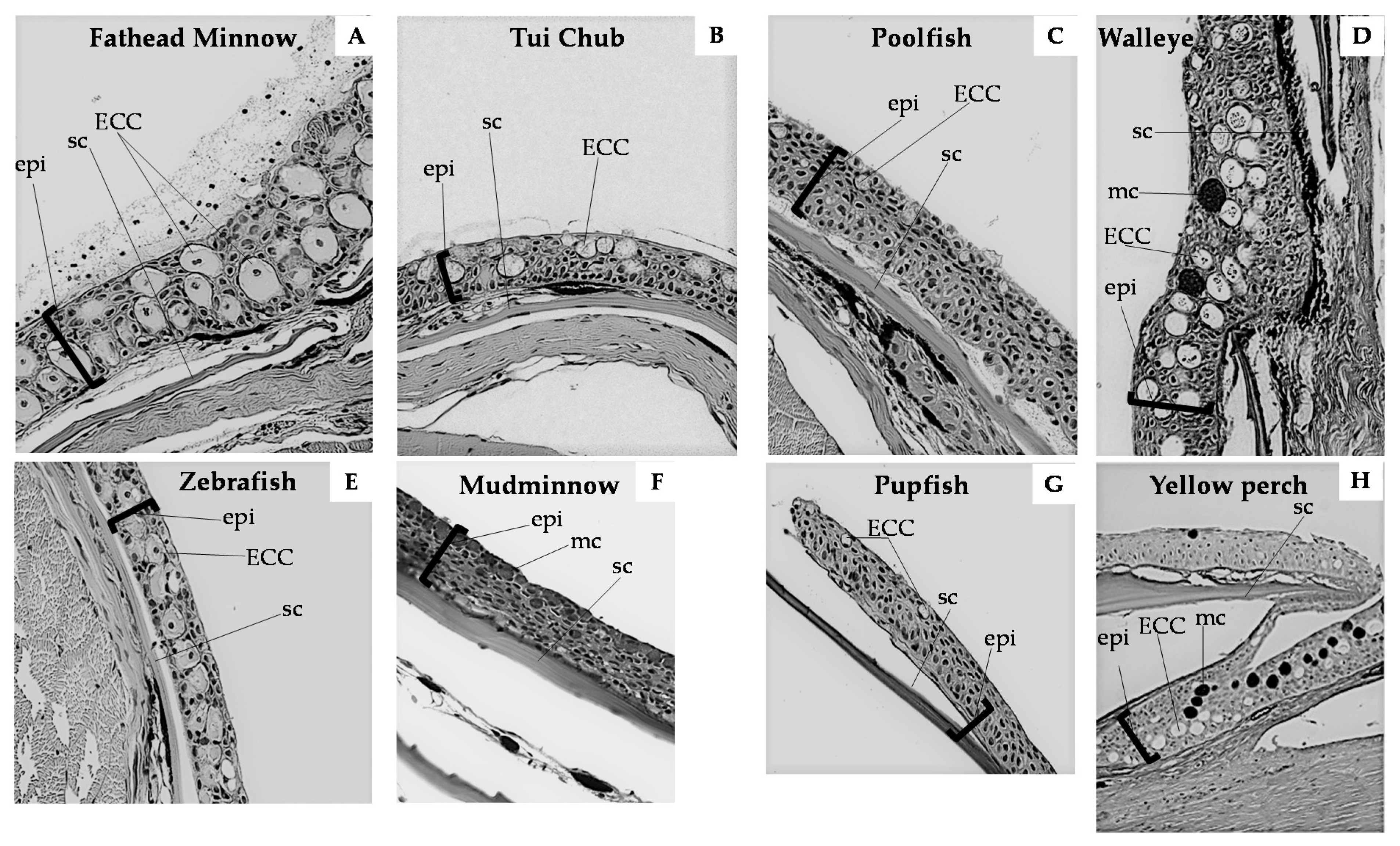

| Superclass | Class | Subclass | Infraclass/Division | Superorder | Order | Common Name | ECCs |
|---|---|---|---|---|---|---|---|
| Agnatha | Lamprey | Skein cells, which are distinct from club cells [31] | |||||
| Gnathostoma | Chondrichthyes | Sharks, rays | Skein cells [32] | ||||
| Osteichthyes | Sarcopterygii | Coelacanth | Absent [33] | ||||
| Actinopterygii | Chondrostei | Polypteriformes | Reed fish | Present [34] | |||
| Teleostei | Elopomorpha | Anguilliformes | Eels | Present [35] | |||
| Ostariophysi | Gymnotiformes | Electric fishes | Secondary loss of ECCs due to electric sense [4,36] | ||||
| Gonorynchiformes | Milkfish | All possess ECCs [37] | |||||
| Siluriformes | Catfish | All possess ECCs [4,34,38,39,40,41,42,43,44,45,46] | |||||
| Characiformes | Characins | Most possess ECCs [4,47,48,49,50], absent in others [4] | |||||
| Cypriniformes | Minnows, zebrafish | All possess ECCs [4,24,41,51,52] | |||||
| Protacanthopterygii | Salmoniformes | Salmon, trout, charr | Possess ECCs [53], absent in others [24,54] | ||||
| Esociformes | Mudminnows, pike | Absent [55] | |||||
| Paracanthopterygii | Ophidiiformes | Pearlfish | Possess ECCs [44] | ||||
| Gadiformes | Cod | Possess ECCs [37] | |||||
| Protacanthopterygii * | Cyprinodontiformes | Pupfish, poolfish, mosquitofish | ECCs in low density [27,38], others lack them [56] | ||||
| Perciformes | Perch, walleye, darters, cichlids, sunfish | Some species have them, others lack them [25,50,55,57] | |||||
| Gasterosteiformes | Stickleback | Absent [4,58] | |||||
| Gobiiformes | Gobies | Some species have ECCs [59,60] | |||||
| Tetraodontiformes | Pufferfish | Some species have ECCs [61] |
| Environmental Stressor | Club Cell Measurement and Observed Effect | Fish Species | Reference |
|---|---|---|---|
| Predation | |||
| (a) Skin extracts | Club cell density—no effect | Fathead minnows | Chivers et al., 2007 [25] |
| (b) Hypoxanthine-3-N-oxide | Club cell density—no effect | Fathead minnows | Chivers et al., 2007 [25] |
| (c) Cortisol | Club cell density—decrease, individual club cell area—unchanged | Fathead minnows | Halbgewachs et al., 2009 [146] |
| (d) Euthanizing agent—MS222 or Aquacalm | No effect | Fathead minnows | Manek et al., 2014 [20] |
| Parasites | |||
| (a) Uvulifer ambloplites (black spot disease) | Club cell density—positive correlation | Yellow perch | Chivers et al., 2007 [25] |
| (b) Metacercariae of the trematode (Teleorchis sp.) | Club cell density—increase | Fathead minnows | Chivers et al., 2007 [25] |
| (c) Cercariae of the trematode (Ornithodiplostomum spp.) | Club cell density—no effect | Fathead minnows | James et al., 2009 [160] |
| (d) Henneguya multiplasmodialis | Observational study—club cells in gills were found in close contact with the parasite | Catfish (Pseudoplatystoma spp.) | Adriano et al., 2012 [147] |
| Infections | |||
| (a) Saprolegnia ferax, S. parasitica | Club cell numbers—increase | Fathead minnows | Chivers et al., 2007 [25] |
| (b) S. ferax in presence of Cadmium (Cd) | Club cell numbers—increase with no or low dose Cd but remain unchanged with high dose Cd | Fathead minnows | Chivers et al., 2007 [25] |
| (c) S. ferax and S. parasitica | Smaller club cells with high (but not low) concentrations of the pathogens | Fathead minnows | Pollock et al., 2012 [148] |
| (d) Aeromonas hydrophila | Club cell density—decrease Club cell degeneration following extensive vacuolization | Indian carp, Labeo rohita | Srivastava et al., 2020 [149] |
| (e) Various bacteria | Club cell degeneration following extensive vacuolization—positive association | Catfish (Clarias gariepinus) | El-Sayyada et al., 2010 [188] |
| Radiations and light | |||
| (a) Ultraviolet (UV)-B radiations | Club cells—hypertrophy and hyperplasia | Razorback suckers | Blazer et al., 1997 [24] |
| (b) UV rays | Club cell density—decrease | Fathead minnows | Manek et al., 2012 [19] |
| (c) UV rays | Club cell density—decrease, club cell area—no effect | Fathead minnows | Manek et al., 2014 [20] |
| (d) UV-A rays | Club cell hypertrophy | Catfish (Clarias gariepinus) | Sayed et al., 2013 [151] |
| (e) UV-rays with or without dissolved organic carbon (DOC) | Club cell density decrease, and area is unchanged with UV rays, club cell density unchanged with UV rays in presence of DOC | Fathead minnows | Manek et al., 2014 [150] |
| (f) White light with 34.8% of blue light emission and white-blue light with 54.6% of blue light emission | Club cell numbers increase, expression and colocalization of calbindin and calretinin proteins in club cells | Zebrafish, Danio rerio | Lauriano et al., 2020 [79] |
| Water pollutants | |||
| (a) Acidified water (pH 5 or 6) | Club cell size, number, showed upward migration towards the skin surface, rough endoplasmic reticulum, Golgi membranes, and leucocyte incorporation—increase | Juvenile carp, Cyprinus carpio | Iger et al., 1994 [152], [186], Iger et al., 1988 [153] |
| (b) Brackish water | |||
| (c) Chicken Manure | |||
| (d) Detergent—sodium dodecyl sulphate | Club cell degeneration following extensive vacuolization | Catfish (Clarias batrachus) | Mittal et al., 1994 [154] |
| (e) Detergent—linear alkylbenzene sulfonate | Club cell density—decrease | Prochilodus lineatus | Alves et al., 2016 [189] |
| (f) Azo dye—Eriochrome black T. | Club cell degeneration following extensive vacuolization, club cell density—increase | Carp, Labeo rohita | Srivastava et al., 2017 [155] |
| Heavy metals | |||
| (a) Cadmium | Club cell size, number, upward migration, rough endoplasmic reticulum, Golgi membranes, and leucocyte incorporation—increase | Juvenile carp, Cyprinus carpio | Iger et al., 1994 [152] |
| (b) Lead | |||
| (c) Cadmium (+UV rays) | No effect | Fathead minnows | Manek et al., 2014 [20] |
| (d) Copper | Club cells—elongated, showed upward migration towards the skin surface, cytoplasm contained extensive rough endoplasmic reticulum, Golgi system and free ribosomes, lysosomes and phagosomes present, newly differentiated cells located in the mid-epidermis | Juvenile carp, Cyprinus carpio | Iger et al., 1994 [156] |
| Mechanical injury | |||
| (a) Needle poke | Club cell numbers—no effect | Yellow perch | Chivers et al., 2007 [25] |
| (b) Wounding | Club cell size, number, upward migration, rough endoplasmic reticulum, Golgi membranes, and leucocyte incorporation—increase | Juvenile carp, Cyprinus carpio | Iger et al., 1994 [152] |
| (c) Experimental wounds | Similar numbers in wounded and normal tissue, last cell type to differentiate from filament cells | Mirror carp, Cyprinus carpio | Iger et al., 1990 [52] |
| (d) Wounds caused by aquatic bird—great cormorant | Increased club cells in 75% of the specimens | Mirror and scaly carp, Cyprinus carpio | Skorić et al., 2012 [168] |
| Sex hormones | |||
| (a) Testosterone | Club cell density—decrease | Fathead minnows | Smith, 1973 [157] |
| (b) 17α-methyltestosterone | Club cell numbers—decrease | Zebra danios | Smith, 1986 [183] |
| (c) Breeding males | Temporary loss of club cells | Fathead minnows | Smith et al., 1974 [182] |
| Food ration | |||
| (a) High food ration | Club cell density increase | Fathead minnows | Wisenden et al., 1997 [158] |
| (b) Food ration | Club cell density—no effect | Catfish (Pseudoplatystoma corruscans) | Barreto et al., 2012 [159] |
Publisher’s Note: MDPI stays neutral with regard to jurisdictional claims in published maps and institutional affiliations. |
© 2021 by the authors. Licensee MDPI, Basel, Switzerland. This article is an open access article distributed under the terms and conditions of the Creative Commons Attribution (CC BY) license (http://creativecommons.org/licenses/by/4.0/).
Share and Cite
Pandey, S.; Stockwell, C.A.; Snider, M.R.; Wisenden, B.D. Epidermal Club Cells in Fishes: A Case for Ecoimmunological Analysis. Int. J. Mol. Sci. 2021, 22, 1440. https://doi.org/10.3390/ijms22031440
Pandey S, Stockwell CA, Snider MR, Wisenden BD. Epidermal Club Cells in Fishes: A Case for Ecoimmunological Analysis. International Journal of Molecular Sciences. 2021; 22(3):1440. https://doi.org/10.3390/ijms22031440
Chicago/Turabian StylePandey, Sumali, Craig A. Stockwell, Madison R. Snider, and Brian D. Wisenden. 2021. "Epidermal Club Cells in Fishes: A Case for Ecoimmunological Analysis" International Journal of Molecular Sciences 22, no. 3: 1440. https://doi.org/10.3390/ijms22031440
APA StylePandey, S., Stockwell, C. A., Snider, M. R., & Wisenden, B. D. (2021). Epidermal Club Cells in Fishes: A Case for Ecoimmunological Analysis. International Journal of Molecular Sciences, 22(3), 1440. https://doi.org/10.3390/ijms22031440

