Review

Improvement of Glucose Tolerance by Food Factors Having Glucagon-Like Peptide-1 Releasing Activity
1
Research Faculty of Agriculture, Hokkaido University, Sapporo 060-8589, Japan
2
Graduate School of Agriculture, Hokkaido University, Sapporo 060-8589, Japan
3
School of Agriculture, Hokkaido University, Sapporo 060-8589, Japan
4
Department of Food Science and Human Nutrition, Fuji Women’s University, Ishikari-shi 061-320, Japan
*
Author to whom correspondence should be addressed.
Int. J. Mol. Sci. 2021, 22(12), 6623; https://doi.org/10.3390/ijms22126623
Submission received: 25 May 2021 / Revised: 17 June 2021 / Accepted: 17 June 2021 / Published: 21 June 2021
(This article belongs to the Special Issue The Effect of Phytochemicals and Food Bioactive Compounds on Diabetes)

Abstract

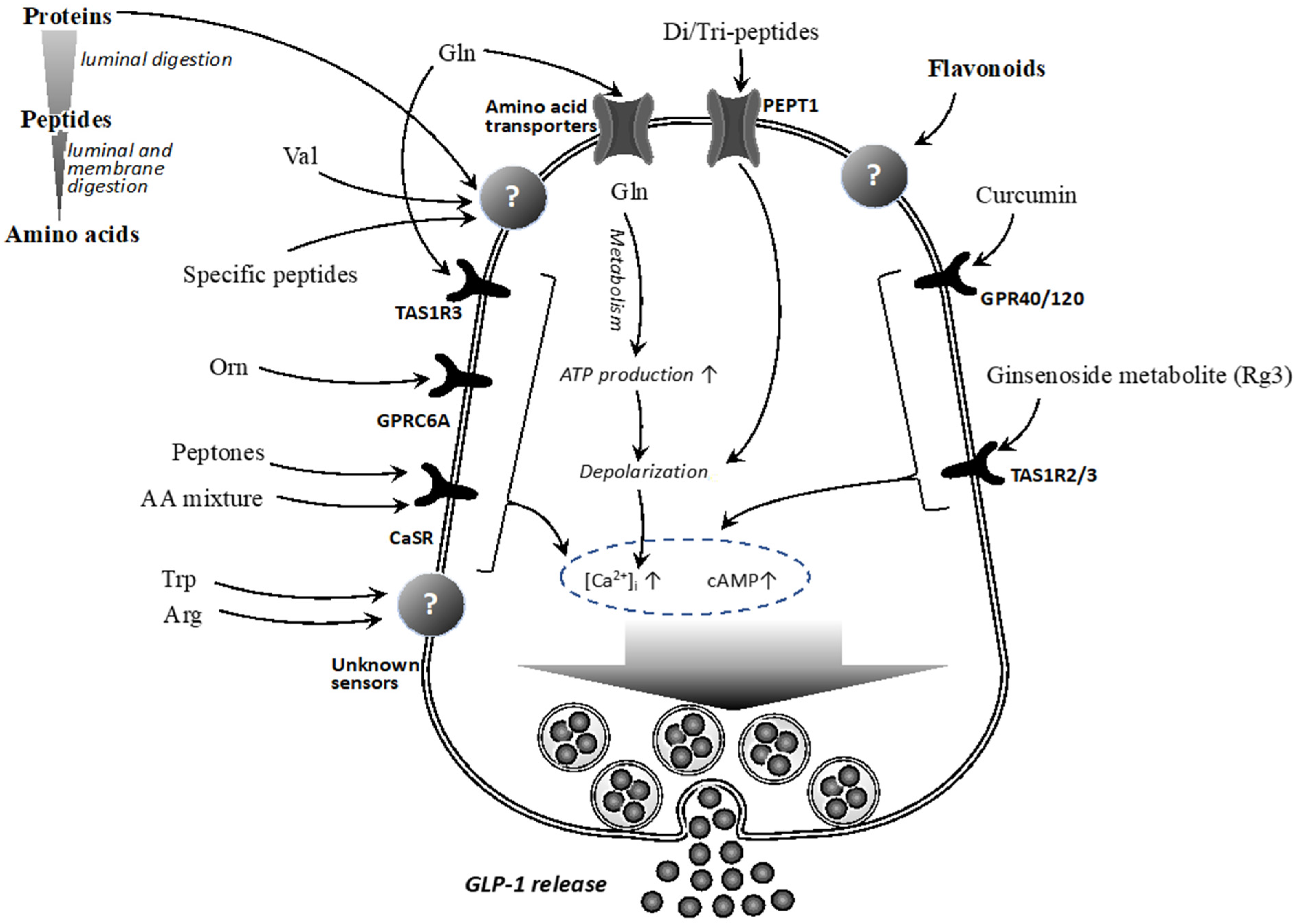
Glucagon-like peptide-1 (GLP-1) is a gastrointestinal hormone released from enteroendocrine L cells in response to meal ingestion. GLP-1 receptor agonists and GLP-1 enhancers have been clinically employed to treat diabetes owing to their glucose-dependent insulin-releasing activity. The release of GLP-1 is primarily stimulated by macronutrients such as glucose and fatty acids, which are nutritionally indispensable; however, excessive intake of sugar and fat is responsible for the development of obesity and diabetes. Therefore, GLP-1 releasing food factors, such as dietary peptides and non-nutrients, are deemed desirable for improving glucose tolerance. Human and animal studies have revealed that dietary proteins/peptides have a potent effect on stimulating GLP-1 secretion. Studies in enteroendocrine cell models have shown that dietary peptides, amino acids, and phytochemicals, such as quercetin, can directly stimulate GLP-1 secretion. In our animal experiments, these food factors improved glucose metabolism and increased GLP-1 secretion. Furthermore, some dietary peptides not only stimulated GLP-1 secretion but also reduced plasma peptidase activity, which is responsible for GLP-1 inactivation. Herein, we review the relationship between GLP-1 and food factors, especially dietary peptides and flavonoids. Accordingly, utilization of food factors with GLP-1-releasing/enhancing activity is a promising strategy for preventing and treating obesity and diabetes.
Keywords: GLP-1; dietary peptides; flavonoids GLP-1; dietary peptides; flavonoids