Review

All Good Things Must End: Termination of Receptor Tyrosine Kinase Signal
by
Azzurra Margiotta
1,2
1
Department of Biology, Faculty of Medicine, Masaryk University, 62500 Brno, Czech Republic
2
International Clinical Research Center, St. Anne’s University Hospital, 65691 Brno, Czech Republic
Int. J. Mol. Sci. 2021, 22(12), 6342; https://doi.org/10.3390/ijms22126342
Submission received: 17 May 2021 / Revised: 10 June 2021 / Accepted: 11 June 2021 / Published: 14 June 2021
(This article belongs to the Special Issue 25th Anniversary of IJMS: Advances in Biochemistry)

Abstract

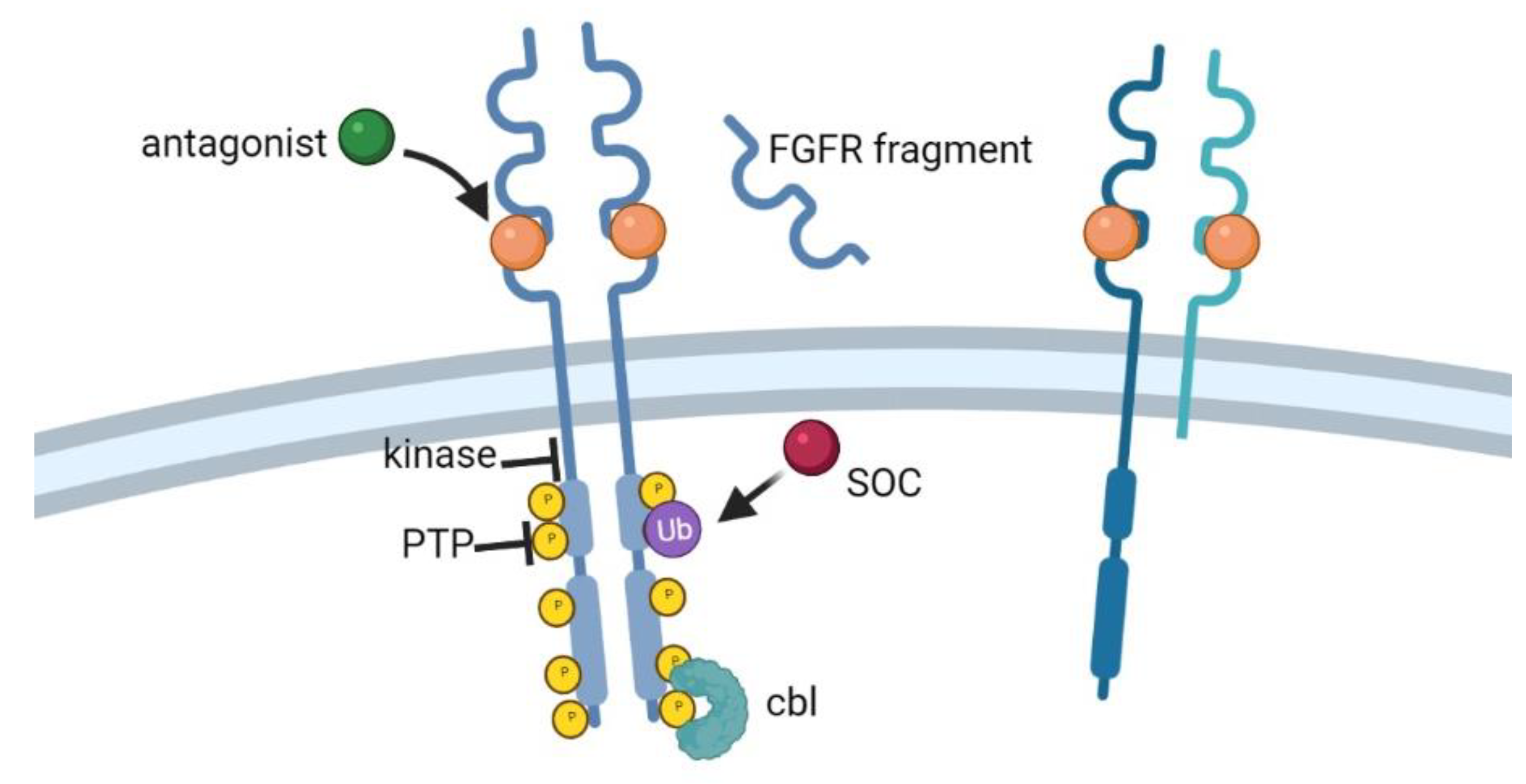
Receptor tyrosine kinases (RTKs) are membrane receptors that regulate many fundamental cellular processes. A tight regulation of RTK signaling is fundamental for development and survival, and an altered signaling by RTKs can cause cancer. RTKs are localized at the plasma membrane (PM) and the major regulatory mechanism of signaling of RTKs is their endocytosis and degradation. In fact, RTKs at the cell surface bind ligands with their extracellular domain, become active, and are rapidly internalized where the temporal extent of signaling, attenuation, and downregulation are modulated. However, other mechanisms of signal attenuation and termination are known. Indeed, inhibition of RTKs’ activity may occur through the modulation of the phosphorylation state of RTKs and the interaction with specific proteins, whereas antagonist ligands can inhibit the biological responses mediated by the receptor. Another mechanism concerns the expression of endogenous inactive receptor variants that are deficient in RTK activity and take part to inactive heterodimers or hetero-oligomers. The downregulation of RTK signals is fundamental for several cellular functions and the homeostasis of the cell. Here, we will review the mechanisms of signal attenuation and termination of RTKs, focusing on FGFRs.
Keywords: RTKs; FGFRs; termination of signaling; degradation; ubiquitination; PTPs; kinases RTKs; FGFRs; termination of signaling; degradation; ubiquitination; PTPs; kinases