Review

RNA-Binding Proteins as Important Regulators of Long Non-Coding RNAs in Cancer


1
Division of Oncology, Department of Internal Medicine, Medical University of Graz (MUG), 8036 Graz, Austria
2
Research Unit for Non-Coding RNAs and Genome Editing, Medical University of Graz (MUG), 8036 Graz, Austria
3
Department of Experimental Therapeutics, The University of Texas MD Anderson Cancer Center, Houston, TX 77030, USA
*
Author to whom correspondence should be addressed.
Int. J. Mol. Sci. 2020, 21(8), 2969; https://doi.org/10.3390/ijms21082969
Submission received: 6 April 2020 / Revised: 20 April 2020 / Accepted: 21 April 2020 / Published: 23 April 2020
(This article belongs to the Special Issue RNA-Binding Proteins in Human Diseases—from Mechanisms to Therapies)

Abstract

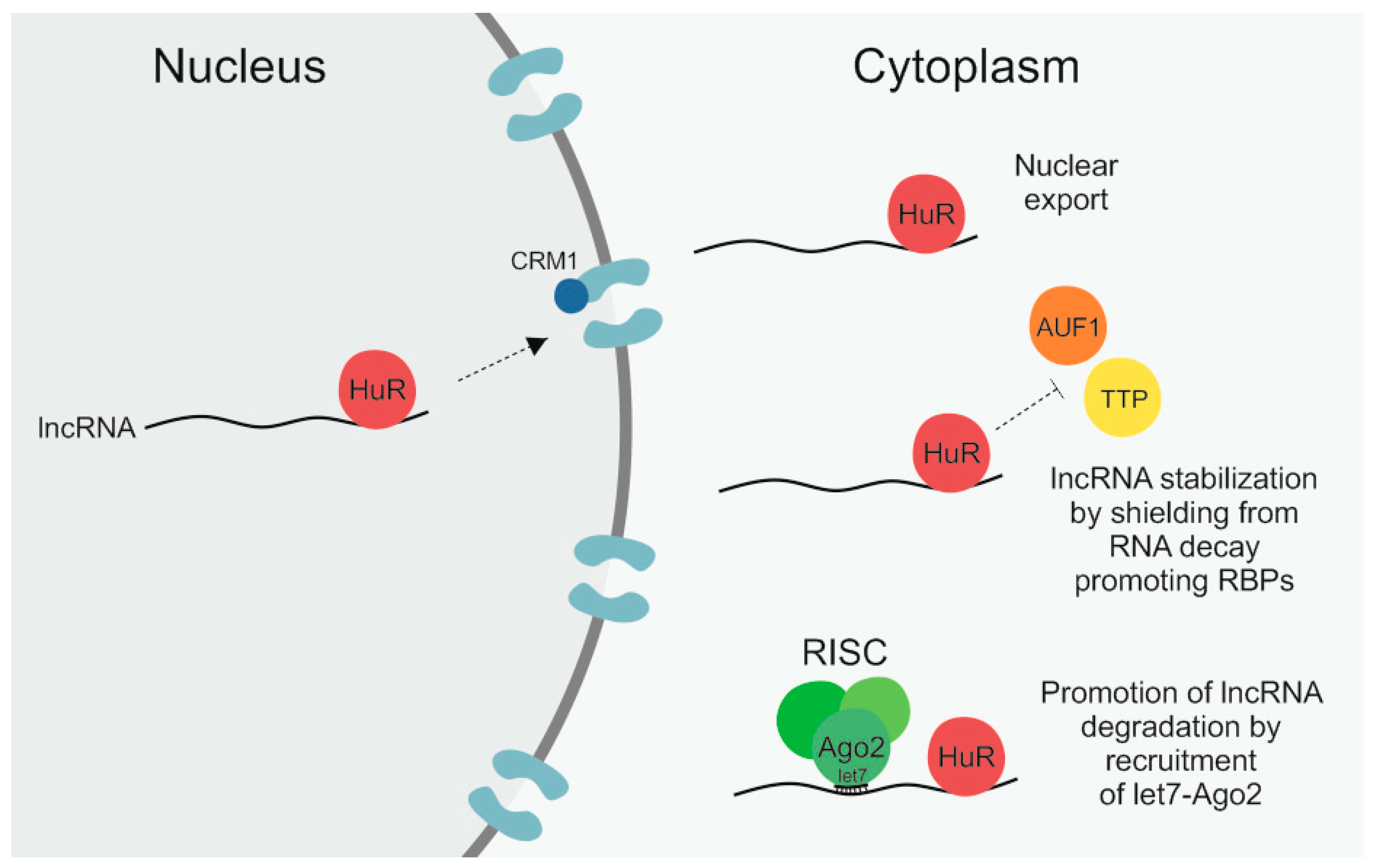
The majority of the genome is transcribed into pieces of non-(protein) coding RNA, among which long non-coding RNAs (lncRNAs) constitute a large group of particularly versatile molecules that govern basic cellular processes including transcription, splicing, RNA stability, and translation. The frequent deregulation of numerous lncRNAs in cancer is known to contribute to virtually all hallmarks of cancer. An important regulatory mechanism of lncRNAs is the post-transcriptional regulation mediated by RNA-binding proteins (RBPs). So far, however, only a small number of known cancer-associated lncRNAs have been found to be regulated by the interaction with RBPs like human antigen R (HuR), ARE/poly(U)-binding/degradation factor 1 (AUF1), insulin-like growth factor 2 mRNA-binding protein 1 (IGF2BP1), and tristetraprolin (TTP). These RBPs regulate, by various means, two aspects in particular, namely the stability and the localization of lncRNAs. Importantly, these RBPs themselves are commonly deregulated in cancer and might thus play a major role in the deregulation of cancer-related lncRNAs. There are, however, still many open questions, for example regarding the context specificity of these regulatory mechanisms that, in part, is based on the synergistic or competitive interaction between different RBPs. There is also a lack of knowledge on how RBPs facilitate the transport of lncRNAs between different cellular compartments.
Keywords: long non-coding RNAs (lncRNAs); RNA-binding proteins (RBPs); cancer; post-transcriptional regulation; RNA stability long non-coding RNAs (lncRNAs); RNA-binding proteins (RBPs); cancer; post-transcriptional regulation; RNA stability