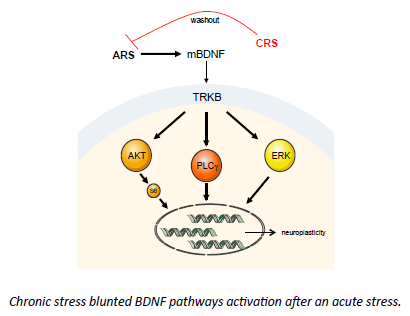
Chronic Restraint Stress Inhibits the Response to a Second Hit in Adult Male Rats: A Role for BDNF Signaling

 ,
, 
Abstract
Share and Cite
Brivio, P.; Sbrini, G.; Corsini, G.; Paladini, M.S.; Racagni, G.; Molteni, R.; Calabrese, F. Chronic Restraint Stress Inhibits the Response to a Second Hit in Adult Male Rats: A Role for BDNF Signaling. Int. J. Mol. Sci. 2020, 21, 6261. https://doi.org/10.3390/ijms21176261
Brivio P, Sbrini G, Corsini G, Paladini MS, Racagni G, Molteni R, Calabrese F. Chronic Restraint Stress Inhibits the Response to a Second Hit in Adult Male Rats: A Role for BDNF Signaling. International Journal of Molecular Sciences. 2020; 21(17):6261. https://doi.org/10.3390/ijms21176261
Chicago/Turabian StyleBrivio, Paola, Giulia Sbrini, Giulia Corsini, Maria Serena Paladini, Giorgio Racagni, Raffaella Molteni, and Francesca Calabrese. 2020. "Chronic Restraint Stress Inhibits the Response to a Second Hit in Adult Male Rats: A Role for BDNF Signaling" International Journal of Molecular Sciences 21, no. 17: 6261. https://doi.org/10.3390/ijms21176261
APA StyleBrivio, P., Sbrini, G., Corsini, G., Paladini, M. S., Racagni, G., Molteni, R., & Calabrese, F. (2020). Chronic Restraint Stress Inhibits the Response to a Second Hit in Adult Male Rats: A Role for BDNF Signaling. International Journal of Molecular Sciences, 21(17), 6261. https://doi.org/10.3390/ijms21176261