

Protective Effects of Melatonin on Neurogenesis Impairment in Neurological Disorders and Its Relevant Molecular Mechanisms

Abstract
1. Introduction
2. Roles of Melatonin in Modulation of Neurogenesis
2.1. In Vitro Model
2.2. In Vivo Models
3. Melatonin and Depression
4. Melatonin, Aging, and Neurodegenerative Diseases
5. Melatonin and Central Nervous System (CNS) Injury
6. Melatonin and Sleep Deprivation
7. Melatonin, Inflammation, and Oxidative Stress
8. Melatonin and Neurogenesis Impairment Caused by Environmental Factors
9. Melatonin and Other Diseases That Are Related to Neurogenesis Impairment
10. Melatonin and Peripheral Nerve Impairment
11. Conclusions
Author Contributions
Funding
Conflicts of Interest
References
- Altman, J.; Das, G.D. Postnatal neurogenesis in the guinea-pig. Nature 1967, 214, 1098–1101. [Google Scholar] [CrossRef]
- Malberg, J.E.; Eisch, A.J.; Nestler, E.J.; Duman, R.S. Chronic antidepressant treatment increases neurogenesis in adult rat hippocampus. J. Neurosci. 2000, 20, 9104–9110. [Google Scholar] [CrossRef]
- Ming, G.-L.; Song, H. Adult neurogenesis in the mammalian brain: Significant answers and significant questions. Neuron 2011, 70, 687–702. [Google Scholar] [CrossRef]
- Alvarez-Buylla, A.; Garcia-Verdugo, J.M. Neurogenesis in adult subventricular zone. J. Neurosci. 2002, 22, 629–634. [Google Scholar] [CrossRef]
- Sakamoto, M.; Imayoshi, I.; Ohtsuka, T.; Yamaguchi, M.; Mori, K.; Kageyama, R. Continuous neurogenesis in the adult forebrain is required for innate olfactory responses. Proc. Natl. Acad. Sci. USA 2011, 108, 8479–8484. [Google Scholar] [CrossRef]
- Balu, D.T.; Lucki, I. Adult hippocampal neurogenesis: Regulation, functional implications, and contribution to disease pathology. Neurosci. Biobehav. Rev. 2009, 33, 232–252. [Google Scholar] [CrossRef]
- Sahay, A.; Scobie, K.N.; Hill, A.S.; O’Carroll, C.M.; Kheirbek, M.A.; Burghardt, N.S.; Fenton, A.A.; Dranovsky, A.; Hen, R. Increasing adult hippocampal neurogenesis is sufficient to improve pattern separation. Nature 2011, 472, 466–470. [Google Scholar] [CrossRef]
- Leung, J.W.-H.; Lau, W.; Lau, B.W.-M.; Yee, B. A Commentary on the Therapeutic Potential of Melatonin and Its Analogues in CNS Conditions: From Translational Research to a Humanistic Approach—Volume III; Springer: Cham, Switzerland, 2019; pp. 177–186. ISBN 978-3-319-95359-5. [Google Scholar]
- Tan, D.-X.; Manchester, L.C.; Liu, X.; Rosales-Corral, S.A.; Acuna-Castroviejo, D.; Reiter, R.J. Mitochondria and chloroplasts as the original sites of melatonin synthesis: A hypothesis related to melatonin’s primary function and evolution in eukaryotes. J. Pineal Res. 2013, 54, 127–138. [Google Scholar] [CrossRef]
- Tan, D.-X.; Reiter, R.J. Mitochondria: The birth place, battle ground and the site of melatonin metabolism in cells. Melatonin Res. 2019, 2, 44–66. [Google Scholar] [CrossRef]
- Reiter, R.J.; Tan, D.X.; Rosales-Corral, S.; Galano, A.; Zhou, X.J.; Xu, B. Mitochondria: Central Organelles for Melatonin’s Antioxidant and Anti-Aging Actions. Molecules 2018, 23, 509. [Google Scholar] [CrossRef]
- Li, D.Y.; Smith, D.G.; Hardeland, R.; Yang, M.Y.; Xu, H.L.; Zhang, L.; Yin, H.D.; Zhu, Q. Melatonin receptor genes in vertebrates. Int. J. Mol. Sci. 2013, 14, 11208–11223. [Google Scholar] [CrossRef] [PubMed]
- Stein, R.M.; Kang, H.J.; McCorvy, J.D.; Glatfelter, G.C.; Jones, A.J.; Che, T.; Slocum, S.; Huang, X.-P.; Savych, O.; Moroz, Y.S.; et al. Virtual discovery of melatonin receptor ligands to modulate circadian rhythms. Nature 2020, 579, 609–614. [Google Scholar] [CrossRef] [PubMed]
- González-Arto, M.; Aguilar, D.; Gaspar-Torrubia, E.; Gallego, M.; Carvajal-Serna, M.; Herrera-Marcos, L.V.; Serrano-Blesa, E.; Hamilton, T.R.D.S.; Pérez-Pé, R.; Muiño-Blanco, T.; et al. Melatonin MT1 and MT2 Receptors in the Ram Reproductive Tract. Int. J. Mol. Sci. 2017, 18, 662. [Google Scholar] [CrossRef] [PubMed]
- Masana, M.I.; Doolen, S.; Ersahin, C.; Al-Ghoul, W.M.; Duckles, S.P.; Dubocovich, M.L.; Krause, D.N. MT(2) melatonin receptors are present and functional in rat caudal artery. J. Pharmacol. Exp. Ther. 2002, 302, 1295–1302. [Google Scholar] [CrossRef] [PubMed]
- Carrillo-Vico, A.; Lardone, P.J.; Alvarez-Sánchez, N.; Rodríguez-Rodríguez, A.; Guerrero, J.M. Melatonin: Buffering the immune system. Int. J. Mol. Sci. 2013, 14, 8638–8683. [Google Scholar] [CrossRef] [PubMed]
- Monteiro, M.C.; Coleman, M.D.; Hill, E.J.; Prediger, R.D.; Maia, C.S.F. Neuroprotection in Neurodegenerative Disease: From Basic Science to Clinical Applications. Oxid. Med. Cell. Longev. 2017, 2017, 2949102. [Google Scholar] [CrossRef]
- Vincent, B. Protective roles of melatonin against the amyloid-dependent development of Alzheimer’s disease: A critical review. Pharmacol. Res. 2018, 134, 223–237. [Google Scholar] [CrossRef]
- Alghamdi, B.S. The neuroprotective role of melatonin in neurological disorders. J. Neurosci. Res. 2018, 96, 1136–1149. [Google Scholar] [CrossRef]
- Suofu, Y.; Li, W.; Jean-Alphonse, F.G.; Jia, J.; Khattar, N.K.; Li, J.; Baranov, S.V.; Leronni, D.; Mihalik, A.C.; He, Y.; et al. Dual role of mitochondria in producing melatonin and driving GPCR signaling to block cytochrome c release. Proc. Natl. Acad. Sci. USA 2017, 114, E7997–E8006. [Google Scholar] [CrossRef]
- Sarlak, G.; Jenwitheesuk, A.; Chetsawang, B.; Govitrapong, P. Effects of melatonin on nervous system aging: Neurogenesis and neurodegeneration. J. Pharmacol. Sci. 2013, 123, 9–24. [Google Scholar] [CrossRef]
- Ghareghani, M.; Sadeghi, H.; Zibara, K.; Danaei, N.; Azari, H.; Ghanbari, A. Melatonin increases oligodendrocyte differentiation in cultured neural stem cells. Cell. Mol. Neurobiol. 2017, 37, 1319–1324. [Google Scholar] [CrossRef]
- Li, X.; Chen, X.; Zhou, W.; Ji, S.; Li, X.; Li, G.; Liu, G.; Wang, F.; Hao, A. Effect of melatonin on neuronal differentiation requires CBP/p300-mediated acetylation of histone H3 lysine 14. Neuroscience 2017, 364, 45–59. [Google Scholar] [CrossRef]
- Figueiro-Silva, J.; Antequera, D.; Pascual, C.; de la Fuente Revenga, M.; Volt, H.; Acuña-Castroviejo, D.; Rodríguez-Franco, M.I.; Carro, E. The Melatonin Analog IQM316 May Induce Adult Hippocampal Neurogenesis and Preserve Recognition Memories in Mice. Cell Transpl. 2018, 27, 423–437. [Google Scholar] [CrossRef]
- Liu, Y.; Zhang, Z.; Lv, Q.; Chen, X.; Deng, W.; Shi, K.; Pan, L. Effects and mechanisms of melatonin on the proliferation and neural differentiation of PC12 cells. Biochem. Biophys. Res. Commun. 2016, 478, 540–545. [Google Scholar] [CrossRef] [PubMed]
- Sharma, R.; Ottenhof, T.; Rzeczkowska, P.A.; Niles, L.P. Epigenetic targets for melatonin: Induction of histone H3 hyperacetylation and gene expression in C17.2 neural stem cells. J. Pineal Res. 2008, 45, 277–284. [Google Scholar] [CrossRef]
- Kong, X.; Li, X.; Cai, Z.; Yang, N.; Liu, Y.; Shu, J.; Pan, L.; Zuo, P. Melatonin regulates the viability and differentiation of rat midbrain neural stem cells. Cell. Mol. Neurobiol. 2008, 28, 569–579. [Google Scholar] [CrossRef] [PubMed]
- Moriya, T.; Horie, N.; Mitome, M.; Shinohara, K. Melatonin influences the proliferative and differentiative activity of neural stem cells. J. Pineal Res. 2007, 42, 411–418. [Google Scholar] [CrossRef] [PubMed]
- Phonchai, R.; Phermthai, T.; Kitiyanant, N.; Suwanjang, W.; Kotchabhakdi, N.; Chetsawang, B. Potential effects and molecular mechanisms of melatonin on the dopaminergic neuronal differentiation of human amniotic fluid mesenchymal stem cells. Neurochem. Int. 2019, 124, 82–93. [Google Scholar] [CrossRef] [PubMed]
- Shu, T.; Wu, T.; Pang, M.; Liu, C.; Wang, X.; Wang, J.; Liu, B.; Rong, L. Effects and mechanisms of melatonin on neural differentiation of induced pluripotent stem cells. Biochem. Biophys. Res. Commun. 2016, 474, 566–571. [Google Scholar] [CrossRef]
- Domínguez-Alonso, A.; Ramírez-Rodríguez, G.; Benítez-King, G. Melatonin increases dendritogenesis in the hilus of hippocampal organotypic cultures. J. Pineal Res. 2012, 52, 427–436. [Google Scholar] [CrossRef] [PubMed]
- Domínguez-Alonso, A.; Valdés-Tovar, M.; Solís-Chagoyán, H.; Benítez-King, G. Melatonin stimulates dendrite formation and complexity in the hilar zone of the rat hippocampus: Participation of the Ca++/Calmodulin complex. Int. J. Mol. Sci. 2015, 16, 1907–1927. [Google Scholar] [CrossRef] [PubMed]
- Ramírez-Rodríguez, G.; Klempin, F.; Babu, H.; Benítez-King, G.; Kempermann, G. Melatonin modulates cell survival of new neurons in the hippocampus of adult mice. Neuropsychopharmacology 2009, 34, 2180–2191. [Google Scholar] [CrossRef]
- Sotthibundhu, A.; Phansuwan-Pujito, P.; Govitrapong, P. Melatonin increases proliferation of cultured neural stem cells obtained from adult mouse subventricular zone. J. Pineal Res. 2010, 49, 291–300. [Google Scholar] [CrossRef] [PubMed]
- Sotthibundhu, A.; Ekthuwapranee, K.; Govitrapong, P. Comparison of melatonin with growth factors in promoting precursor cells proliferation in adult mouse subventricular zone. EXCLI J. 2016, 15, 829–841. [Google Scholar] [CrossRef]
- Tocharus, C.; Puriboriboon, Y.; Junmanee, T.; Tocharus, J.; Ekthuwapranee, K.; Govitrapong, P. Melatonin enhances adult rat hippocampal progenitor cell proliferation via ERK signaling pathway through melatonin receptor. Neuroscience 2014, 275, 314–321. [Google Scholar] [CrossRef]
- Yu, S.; Zhang, X.; Xu, Z.; Hu, C. Melatonin promotes proliferation of neural stem cells from adult mouse spinal cord via the PI3K/AKT signaling pathway. FEBS Lett. 2019, 593, 1751–1762. [Google Scholar] [CrossRef]
- Ramirez-Rodriguez, G.; Ortíz-López, L.; Domínguez-Alonso, A.; Benítez-King, G.A.; Kempermann, G. Chronic treatment with melatonin stimulates dendrite maturation and complexity in adult hippocampal neurogenesis of mice. J. Pineal Res. 2011, 50, 29–37. [Google Scholar] [CrossRef]
- Ramírez-Rodríguez, G.B.; Olvera-Hernández, S.; Vega-Rivera, N.M.; Ortiz-López, L. Melatonin influences structural plasticity in the axons of granule cells in the dentate gyrus of Balb/C mice. Int. J. Mol. Sci. 2018, 20, 73. [Google Scholar] [CrossRef]
- Rennie, K.; De Butte, M.; Pappas, B.A. Melatonin promotes neurogenesis in dentate gyrus in the pinealectomized rat. J. Pineal Res. 2009, 47, 313–317. [Google Scholar] [CrossRef]
- Motta-Teixeira, L.C.; Machado-Nils, A.V.; Battagello, D.S.; Diniz, G.B.; Andrade-Silva, J.; Silva, S.; Matos, R.A.; do Amaral, F.G.; Xavier, G.F.; Bittencourt, J.C.; et al. The absence of maternal pineal melatonin rhythm during pregnancy and lactation impairs offspring physical growth, neurodevelopment, and behavior. Horm. Behav. 2018, 105, 146–156. [Google Scholar] [CrossRef]
- Ramírez-Rodríguez, G.; Vega-Rivera, N.M.; Benítez-King, G.; Castro-García, M.; Ortíz-López, L. Melatonin supplementation delays the decline of adult hippocampal neurogenesis during normal aging of mice. Neurosci. Lett. 2012, 530, 53–58. [Google Scholar] [CrossRef] [PubMed]
- Ramírez-Rodríguez, G.; Gómez-Sánchez, A.; Ortíz-López, L. Melatonin maintains calcium-binding calretinin-positive neurons in the dentate gyrus during aging of Balb/C mice. Exp. Gerontol. 2014, 60, 147–152. [Google Scholar] [CrossRef] [PubMed]
- Liu, J.; Somera-Molina, K.C.; Hudson, R.L.; Dubocovich, M.L. Melatonin potentiates running wheel-induced neurogenesis in the dentate gyrus of adult C3H/HeN mice hippocampus. J. Pineal Res. 2013, 54, 222–231. [Google Scholar] [CrossRef]
- Ortiz-López, L.; Pérez-Beltran, C.; Ramírez-Rodríguez, G. Chronic administration of a melatonin membrane receptor antagonist, luzindole, affects hippocampal neurogenesis without changes in hopelessness-like behavior in adult mice. Neuropharmacology 2016, 103, 211–221. [Google Scholar] [CrossRef] [PubMed]
- Liao, L.-Y.; Lau, B.W.-M.; Sánchez-Vidaña, D.I.; Gao, Q. Exogenous neural stem cell transplantation for cerebral ischemia. Neural Regen. Res. 2019, 14, 1129–1137. [Google Scholar] [CrossRef] [PubMed]
- Miller, B.R.; Hen, R. The current state of the neurogenic theory of depression and anxiety. Curr. Opin. Neurobiol. 2015, 30, 51–58. [Google Scholar] [CrossRef]
- Chan, J.N.-M.; Lee, J.C.-D.; Lee, S.S.P.; Hui, K.K.Y.; Chan, A.H.L.; Fung, T.K.-H.; Sánchez-Vidaña, D.I.; Lau, B.W.-M.; Ngai, S.P.-C. Interaction effect of social isolation and high dose corticosteroid on neurogenesis and emotional behavior. Front. Behav. Neurosci. 2017, 11, 18. [Google Scholar] [CrossRef]
- Santarelli, L.; Saxe, M.; Gross, C.; Surget, A.; Battaglia, F.; Dulawa, S.; Weisstaub, N.; Lee, J.; Duman, R.; Arancio, O.; et al. Requirement of hippocampal neurogenesis for the behavioral effects of antidepressants. Science 2003, 301, 805–809. [Google Scholar] [CrossRef]
- Ramírez-Rodríguez, G.B.; Palacios-Cabriales, D.M.; Ortiz-López, L.; Estrada-Camarena, E.M.; Vega-Rivera, N.M. Melatonin modulates dendrite maturation and complexity in the dorsal- and ventral- dentate gyrus concomitantly with its antidepressant-like effect in male Balb/C mice. Int. J. Mol. Sci. 2020, 21, 1724. [Google Scholar] [CrossRef]
- Crupi, R.; Mazzon, E.; Marino, A.; La Spada, G.; Bramanti, P.; Cuzzocrea, S.; Spina, E. Melatonin treatment mimics the antidepressant action in chronic corticosterone-treated mice. J. Pineal Res. 2010, 49, 123–129. [Google Scholar] [CrossRef] [PubMed]
- Hoehn, R.; Monse, M.; Pohl, E.; Wranik, S.; Wilker, B.; Keitsch, S.; Soddemann, M.; Kornhuber, J.; Kohnen, M.; Edwards, M.J.; et al. Melatonin acts as an antidepressant by inhibition of the acid sphingomyelinase/ceramide system. Neurosignals 2016, 24, 48–58. [Google Scholar] [CrossRef] [PubMed]
- Stefanovic, B.; Spasojevic, N.; Jovanovic, P.; Jasnic, N.; Djordjevic, J.; Dronjak, S. Melatonin mediated antidepressant-like effect in the hippocampus of chronic stress-induced depression rats: Regulating vesicular monoamine transporter 2 and monoamine oxidase A levels. Eur. Neuropsychopharmacol. 2016, 26, 1629–1637. [Google Scholar] [CrossRef] [PubMed]
- Ramírez-Rodríguez, G.; Vega-Rivera, N.M.; Oikawa-Sala, J.; Gómez-Sánchez, A.; Ortiz-López, L.; Estrada-Camarena, E. Melatonin synergizes with citalopram to induce antidepressant-like behavior and to promote hippocampal neurogenesis in adult mice. J. Pineal Res. 2014, 56, 450–461. [Google Scholar] [CrossRef] [PubMed]
- Morley-Fletcher, S.; Mairesse, J.; Soumier, A.; Banasr, M.; Fagioli, F.; Gabriel, C.; Mocaer, E.; Daszuta, A.; McEwen, B.; Nicoletti, F.; et al. Chronic agomelatine treatment corrects behavioral, cellular, and biochemical abnormalities induced by prenatal stress in rats. Psychopharmacology 2011, 217, 301–313. [Google Scholar] [CrossRef] [PubMed]
- Yucel, A.; Yucel, N.; Ozkanlar, S.; Polat, E.; Kara, A.; Ozcan, H.; Gulec, M. Effect of agomelatine on adult hippocampus apoptosis and neurogenesis using the stress model of rats. Acta Histochem. 2016, 118, 299–304. [Google Scholar] [CrossRef]
- AlAhmed, S.; Herbert, J. Effect of agomelatine and its interaction with the daily corticosterone rhythm on progenitor cell proliferation in the dentate gyrus of the adult rat. Neuropharmacology 2010, 59, 375–379. [Google Scholar] [CrossRef]
- Soumier, A.; Banasr, M.; Lortet, S.; Masmejean, F.; Bernard, N.; Kerkerian-Le-Goff, L.; Gabriel, C.; Millan, M.J.; Mocaer, E.; Daszuta, A. Mechanisms contributing to the phase-dependent regulation of neurogenesis by the novel antidepressant, agomelatine, in the adult rat hippocampus. Neuropsychopharmacology 2009, 34, 2390–2403. [Google Scholar] [CrossRef]
- Yoo, D.Y.; Kim, W.; Lee, C.H.; Shin, B.N.; Nam, S.M.; Choi, J.H.; Won, M.-H.; Yoon, Y.S.; Hwang, I.K. Melatonin improves D-galactose-induced aging effects on behavior, neurogenesis, and lipid peroxidation in the mouse dentate gyrus via increasing pCREB expression. J. Pineal Res. 2012, 52, 21–28. [Google Scholar] [CrossRef]
- Takeda, T.; Hosokawa, M.; Higuchi, K. Senescence-accelerated mouse (SAM): A novel murine model of accelerated senescence. J. Am. Geriatr. Soc. 1991, 39, 911–919. [Google Scholar] [CrossRef]
- Gutierrez-Cuesta, J.; Tajes, M.; Jiménez, A.; Coto-Montes, A.; Camins, A.; Pallàs, M. Evaluation of potential pro-survival pathways regulated by melatonin in a murine senescence model. J. Pineal Res. 2008, 45, 497–505. [Google Scholar] [CrossRef]
- Singhakumar, R.; Boontem, P.; Ekthuwapranee, K.; Sotthibundhu, A.; Mukda, S.; Chetsawang, B.; Govitrapong, P. Melatonin attenuates methamphetamine-induced inhibition of neurogenesis in the adult mouse hippocampus: An in vivo study. Neurosci. Lett. 2015, 606, 209–214. [Google Scholar] [CrossRef] [PubMed]
- Mendivil-Perez, M.; Soto-Mercado, V.; Guerra-Librero, A.; Fernandez-Gil, B.I.; Florido, J.; Shen, Y.-Q.; Tejada, M.A.; Capilla-Gonzalez, V.; Rusanova, I.; Garcia-Verdugo, J.M.; et al. Melatonin enhances neural stem cell differentiation and engraftment by increasing mitochondrial function. J. Pineal Res. 2017, 63, e12415. [Google Scholar] [CrossRef] [PubMed]
- Sharma, R.; McMillan, C.R.; Niles, L.P. Neural stem cell transplantation and melatonin treatment in a 6-hydroxydopamine model of Parkinson’s disease. J. Pineal Res. 2007, 43, 245–254. [Google Scholar] [CrossRef] [PubMed]
- Kim, W.; Hahn, K.R.; Jung, H.Y.; Kwon, H.J.; Nam, S.M.; Kim, J.W.; Park, J.H.; Yoo, D.Y.; Kim, D.W.; Won, M.-H.; et al. Melatonin ameliorates cuprizone-induced reduction of hippocampal neurogenesis, brain-derived neurotrophic factor, and phosphorylation of cyclic AMP response element-binding protein in the mouse dentate gyrus. Brain Behav. 2019, 9, e01388. [Google Scholar] [CrossRef] [PubMed]
- Song, C.; Li, M.; Xu, L.; Shen, Y.; Yang, H.; Ding, M.; Liu, X.; Xie, Z. Mitochondrial biogenesis mediated by melatonin in an APPswe/PS1dE9 transgenic mice model. Neuroreport 2018, 29, 1517–1524. [Google Scholar] [CrossRef]
- Olson, M.; Lockhart, T.E.; Lieberman, A. Motor Learning Deficits in Parkinson’s Disease (PD) and Their Effect on Training Response in Gait and Balance: A Narrative Review. Front. Neurol. 2019, 10, 62. [Google Scholar] [CrossRef]
- Ekthuwapranee, K.; Sotthibundhu, A.; Govitrapong, P. Melatonin attenuates methamphetamine-induced inhibition of proliferation of adult rat hippocampal progenitor cells in vitro. J. Pineal Res. 2015, 58, 418–428. [Google Scholar] [CrossRef]
- Chern, C.-M.; Liao, J.-F.; Wang, Y.-H.; Shen, Y.-C. Melatonin ameliorates neural function by promoting endogenous neurogenesis through the MT2 melatonin receptor in ischemic-stroke mice. Free Radic. Biol. Med. 2012, 52, 1634–1647. [Google Scholar] [CrossRef]
- Zhao, Y.; Wang, H.; Chen, W.; Chen, L.; Liu, D.; Wang, X.; Wang, X. Melatonin attenuates white matter damage after focal brain ischemia in rats by regulating the TLR4/NF-κB pathway. Brain Res. Bull. 2019, 150, 168–178. [Google Scholar] [CrossRef]
- Kilic, E.; Kilic, U.; Bacigaluppi, M.; Guo, Z.; Abdallah, N.B.; Wolfer, D.P.; Reiter, R.J.; Hermann, D.M.; Bassetti, C.L. Delayed melatonin administration promotes neuronal survival, neurogenesis and motor recovery, and attenuates hyperactivity and anxiety after mild focal cerebral ischemia in mice. J. Pineal Res. 2008, 45, 142–148. [Google Scholar] [CrossRef]
- Rennie, K.; de Butte, M.; Fréchette, M.; Pappas, B.A. Chronic and acute melatonin effects in gerbil global forebrain ischemia: Long-term neural and behavioral outcome. J. Pineal Res. 2008, 44, 149–156. [Google Scholar] [CrossRef] [PubMed]
- Tang, Y.; Cai, B.; Yuan, F.; He, X.; Lin, X.; Wang, J.; Wang, Y.; Yang, G.-Y. Melatonin pretreatment improves the survival and function of transplanted mesenchymal stem cells after focal cerebral ischemia. Cell Transpl. 2014, 23, 1279–1291. [Google Scholar] [CrossRef] [PubMed]
- Lee, Y.; Lee, S.; Lee, S.-R.; Park, K.; Hong, Y.; Lee, M.; Park, S.; Jin, Y.; Chang, K.-T.; Hong, Y. Beneficial effects of melatonin combined with exercise on endogenous neural stem/progenitor cells proliferation after spinal cord injury. Int. J. Mol. Sci. 2014, 15, 2207–2222. [Google Scholar] [CrossRef] [PubMed]
- Wang, Z.; Liu, D.; Zhan, J.; Xie, K.; Wang, X.; Xian, X.; Gu, J.; Chen, W.; Hao, A. Melatonin improves short and long-term neurobehavioral deficits and attenuates hippocampal impairments after hypoxia in neonatal mice. Pharmacol. Res. 2013, 76, 84–97. [Google Scholar] [CrossRef] [PubMed]
- Csernansky, J.G.; Martin, M.V.; Czeisler, B.; Meltzer, M.A.; Ali, Z.; Dong, H. Neuroprotective effects of olanzapine in a rat model of neurodevelopmental injury. Pharmacol. Biochem. Behav. 2006, 83, 208–213. [Google Scholar] [CrossRef]
- Fu, J.; Zhao, S.-D.; Liu, H.-J.; Yuan, Q.-H.; Liu, S.-M.; Zhang, Y.-M.; Ling, E.-A.; Hao, A.-J. Melatonin promotes proliferation and differentiation of neural stem cells subjected to hypoxia in vitro. J. Pineal Res. 2011, 51, 104–112. [Google Scholar] [CrossRef]
- Li, Z.; Li, X.; Bi, J.; Chan, M.T.V.; Wu, W.K.K.; Shen, J. Melatonin protected against the detrimental effects of microRNA-363 in a rat model of vitamin A-associated congenital spinal deformities: Involvement of Notch signaling. J. Pineal Res. 2019, 66, e12558. [Google Scholar] [CrossRef]
- Guzman-Marin, R.; Suntsova, N.; Methippara, M.; Greiffenstein, R.; Szymusiak, R.; McGinty, D. Sleep deprivation suppresses neurogenesis in the adult hippocampus of rats. Eur. J. Neurosci. 2005, 22, 2111–2116. [Google Scholar] [CrossRef]
- Hairston, I.S.; Little, M.T.M.; Scanlon, M.D.; Barakat, M.T.; Palmer, T.D.; Sapolsky, R.M.; Heller, H.C. Sleep restriction suppresses neurogenesis induced by hippocampus-dependent learning. J. Neurophysiol. 2005, 94, 4224–4233. [Google Scholar] [CrossRef]
- Hinojosa-Godinez, A.; Jave-Suarez, L.F.; Flores-Soto, M.; Gálvez-Contreras, A.Y.; Luquín, S.; Oregon-Romero, E.; González-Pérez, O.; González-Castañeda, R.E. Melatonin modifies SOX2+ cell proliferation in dentate gyrus and modulates SIRT1 and MECP2 in long-term sleep deprivation. Neural Regen. Res. 2019, 14, 1787–1795. [Google Scholar] [CrossRef]
- López-Armas, G.; Flores-Soto, M.E.; Chaparro-Huerta, V.; Jave-Suarez, L.F.; Soto-Rodríguez, S.; Rusanova, I.; Acuña-Castroviejo, D.; González-Perez, O.; González-Castañeda, R.E. Prophylactic Role of Oral Melatonin Administration on Neurogenesis in Adult Balb/C Mice during REM Sleep Deprivation. Oxid. Med. Cell. Longev. 2016, 2016, 2136902. [Google Scholar] [CrossRef] [PubMed]
- Sompol, P.; Liu, X.; Baba, K.; Paul, K.N.; Tosini, G.; Iuvone, P.M.; Ye, K. N-acetylserotonin promotes hippocampal neuroprogenitor cell proliferation in sleep-deprived mice. Proc. Natl. Acad. Sci. USA 2011, 108, 8844–8849. [Google Scholar] [CrossRef]
- Iggena, D.; Winter, Y.; Steiner, B. Melatonin restores hippocampal neural precursor cell proliferation and prevents cognitive deficits induced by jet lag simulation in adult mice. J. Pineal Res. 2017, 62, e12397. [Google Scholar] [CrossRef] [PubMed]
- Reiter, R.J.; Tan, D.X.; Cabrera, J.; D’Arpa, D.; Sainz, R.M.; Mayo, J.C.; Ramos, S. The oxidant/antioxidant network: Role of melatonin. Biol. Signals Recept 1999, 8, 56–63. [Google Scholar] [CrossRef]
- Tan, D.X.; Manchester, L.C.; Reiter, R.J.; Plummer, B.F.; Limson, J.; Weintraub, S.T.; Qi, W. Melatonin directly scavenges hydrogen peroxide: A potentially new metabolic pathway of melatonin biotransformation. Free Radic. Biol. Med. 2000, 29, 1177–1185. [Google Scholar] [CrossRef]
- Aydogan, S.; Yerer, M.B.; Goktas, A. Melatonin and nitric oxide. J. Endocrinol. Investig. 2006, 29, 281–287. [Google Scholar] [CrossRef]
- Cuzzocrea, S.; Zingarelli, B.; Gilad, E.; Hake, P.; Salzman, A.L.; Szabó, C. Protective effect of melatonin in carrageenan-induced models of local inflammation: Relationship to its inhibitory effect on nitric oxide production and its peroxynitrite scavenging activity. J. Pineal Res. 1997, 23, 106–116. [Google Scholar] [CrossRef]
- Bilici, D.; Akpinar, E.; Kiziltunç, A. Protective effect of melatonin in carrageenan-induced acute local inflammation. Pharmacol. Res. 2002, 46, 133–139. [Google Scholar] [CrossRef]
- Koh, P.-O. Melatonin regulates nitric oxide synthase expression in ischemic brain injury. J. Vet. Med. Sci. 2008, 70, 747–750. [Google Scholar] [CrossRef]
- Song, J.; Kang, S.M.; Lee, K.M.; Lee, J.E. The protective effect of melatonin on neural stem cell against LPS-induced inflammation. Biomed Res. Int. 2015, 2015, 854359. [Google Scholar] [CrossRef]
- Shu, T.; Fan, L.; Wu, T.; Liu, C.; He, L.; Pang, M.; Bu, Y.; Wang, X.; Wang, J.; Rong, L.; et al. Melatonin promotes neuroprotection of induced pluripotent stem cells-derived neural stem cells subjected to H2O2-induced injury in vitro. Eur. J. Pharmacol. 2018, 825, 143–150. [Google Scholar] [CrossRef] [PubMed]
- Li, Z.; Li, X.; Chan, M.T.V.; Wu, W.K.K.; Tan, D.; Shen, J. Melatonin antagonizes interleukin-18-mediated inhibition on neural stem cell proliferation and differentiation. J. Cell. Mol. Med. 2017, 21, 2163–2171. [Google Scholar] [CrossRef] [PubMed]
- Chen, B.H.; Ahn, J.H.; Park, J.H.; Choi, S.Y.; Lee, Y.L.; Kang, I.J.; Hwang, I.K.; Lee, T.-K.; Shin, B.-N.; Lee, J.-C.; et al. Effects of scopolamine and melatonin cotreatment on cognition, neuronal damage, and neurogenesis in the mouse dentate gyrus. Neurochem. Res. 2018, 43, 600–608. [Google Scholar] [CrossRef] [PubMed]
- Sirichoat, A.; Suwannakot, K.; Chaisawang, P.; Pannangrong, W.; Aranarochana, A.; Wigmore, P.; Welbat, J.U. Melatonin attenuates 5-fluorouracil-induced spatial memory and hippocampal neurogenesis impairment in adult rats. Life Sci. 2020, 248, 117468. [Google Scholar] [CrossRef] [PubMed]
- Aranarochana, A.; Chaisawang, P.; Sirichoat, A.; Pannangrong, W.; Wigmore, P.; Welbat, J.U. Protective effects of melatonin against valproic acid-induced memory impairments and reductions in adult rat hippocampal neurogenesis. Neuroscience 2019, 406, 580–593. [Google Scholar] [CrossRef]
- Sirichoat, A.; Krutsri, S.; Suwannakot, K.; Aranarochana, A.; Chaisawang, P.; Pannangrong, W.; Wigmore, P.; Welbat, J.U. Melatonin protects against methotrexate-induced memory deficit and hippocampal neurogenesis impairment in a rat model. Biochem. Pharmacol. 2019, 163, 225–233. [Google Scholar] [CrossRef]
- Ruksee, N.; Tongjaroenbuangam, W.; Mahanam, T.; Govitrapong, P. Melatonin pretreatment prevented the effect of dexamethasone negative alterations on behavior and hippocampal neurogenesis in the mouse brain. J. Steroid Biochem. Mol. Biol. 2014, 143, 72–80. [Google Scholar] [CrossRef]
- Rozisky, J.R.; Scarabelot, V.L.; de Oliveira, C.; de Macedo, I.C.; Deitos, A.; Laste, G.; Caumo, W.; Torres, I.L.S. Melatonin as a potential counter-effect of hyperalgesia induced by neonatal morphine exposure. Neurosci. Lett. 2016, 633, 77–81. [Google Scholar] [CrossRef]
- Choudhury, A.; Singh, S.; Palit, G.; Shukla, S.; Ganguly, S. Administration of N-acetylserotonin and melatonin alleviate chronic ketamine-induced behavioural phenotype accompanying BDNF-independent and dependent converging cytoprotective mechanisms in the hippocampus. Behav. Brain Res. 2016, 297, 204–212. [Google Scholar] [CrossRef]
- Han, J.; Ji, C.; Guo, Y.; Yan, R.; Hong, T.; Dou, Y.; An, Y.; Tao, S.; Qin, F.; Nie, J.; et al. Mechanisms underlying melatonin-mediated prevention of fenvalerate-induced behavioral and oxidative toxicity in zebrafish. J. Toxicol. Environ. Health Part A 2017, 80, 1331–1341. [Google Scholar] [CrossRef]
- Pipová Kokošová, N.; Kisková, T.; Vilhanová, K.; Štafuriková, A.; Jendželovský, R.; Račeková, E.; Šmajda, B. Melatonin mitigates hippocampal and cognitive impairments caused by prenatal irradiation. Eur. J. Neurosci. 2020. [Google Scholar] [CrossRef]
- Naseri, S.; Moghahi, S.M.H.N.; Mokhtari, T.; Roghani, M.; Shirazi, A.R.; Malek, F.; Rastegar, T. Radio-Protective Effects of Melatonin on Subventricular Zone in Irradiated Rat: Decrease in Apoptosis and Upregulation of Nestin. J. Mol. Neurosci. 2017, 63, 198–205. [Google Scholar] [CrossRef] [PubMed]
- Manda, K.; Ueno, M.; Anzai, K. Space radiation-induced inhibition of neurogenesis in the hippocampal dentate gyrus and memory impairment in mice: Ameliorative potential of the melatonin metabolite, AFMK. J. Pineal Res. 2008, 45, 430–438. [Google Scholar] [CrossRef] [PubMed]
- Manda, K.; Ueno, M.; Anzai, K. Cranial irradiation-induced inhibition of neurogenesis in hippocampal dentate gyrus of adult mice: Attenuation by melatonin pretreatment. J. Pineal Res. 2009, 46, 71–78. [Google Scholar] [CrossRef] [PubMed]
- Altun, G.; Kaplan, S.; Deniz, O.G.; Kocacan, S.E.; Canan, S.; Davis, D.; Marangoz, C. Protective effects of melatonin and omega-3 on the hippocampus and the cerebellum of adult Wistar albino rats exposed to electromagnetic fields. J. Microsc. Ultrastruct. 2017, 5, 230–241. [Google Scholar] [CrossRef] [PubMed]
- Ekthuwapranee, K.; Sotthibundhu, A.; Tocharus, C.; Govitrapong, P. Melatonin ameliorates dexamethasone-induced inhibitory effects on the proliferation of cultured progenitor cells obtained from adult rat hippocampus. J. Steroid Biochem. Mol. Biol. 2015, 145, 38–48. [Google Scholar] [CrossRef]
- Liu, C.; Zhou, W.; Li, Z.; Ren, J.; Li, X.; Li, S.; Liu, Q.; Song, F.; Hao, A.; Wang, F. Melatonin protects neural stem cells against tri-ortho-cresyl phosphate-induced autophagy. Front. Mol. Neurosci. 2020, 13, 25. [Google Scholar] [CrossRef]
- Wongchitrat, P.; Lansubsakul, N.; Kamsrijai, U.; Sae-Ung, K.; Mukda, S.; Govitrapong, P. Melatonin attenuates the high-fat diet and streptozotocin-induced reduction in rat hippocampal neurogenesis. Neurochem. Int. 2016, 100, 97–109. [Google Scholar] [CrossRef]
- Li, H.; Zhang, Y.; Liu, S.; Li, F.; Wang, B.; Wang, J.; Cao, L.; Xia, T.; Yao, Q.; Chen, H.; et al. Melatonin enhances proliferation and modulates differentiation of neural stem cells via autophagy in hyperglycemia. Stem Cells 2019, 37, 504–515. [Google Scholar] [CrossRef]
- Liu, S.; Guo, Y.; Yuan, Q.; Pan, Y.; Wang, L.; Liu, Q.; Wang, F.; Wang, J.; Hao, A. Melatonin prevents neural tube defects in the offspring of diabetic pregnancy. J. Pineal Res. 2015, 59, 508–517. [Google Scholar] [CrossRef]
- Corrales, A.; Vidal, R.; García, S.; Vidal, V.; Martínez, P.; García, E.; Flórez, J.; Sanchez-Barceló, E.J.; Martínez-Cué, C.; Rueda, N. Chronic melatonin treatment rescues electrophysiological and neuromorphological deficits in a mouse model of Down syndrome. J. Pineal Res. 2014, 56, 51–61. [Google Scholar] [CrossRef] [PubMed]
- Corrales, A.; Parisotto, E.B.; Vidal, V.; García-Cerro, S.; Lantigua, S.; Diego, M.; Wilhem Filho, D.; Sanchez-Barceló, E.J.; Martínez-Cué, C.; Rueda, N. Pre- and post-natal melatonin administration partially regulates brain oxidative stress but does not improve cognitive or histological alterations in the Ts65Dn mouse model of Down syndrome. Behav. Brain Res. 2017, 334, 142–154. [Google Scholar] [CrossRef] [PubMed]
- Uyanikgil, Y.; Turgut, M.; Ateş, U.; Baka, M.; Yurtseven, M.E. Beneficial effects of melatonin on morphological changes in postnatal cerebellar tissue owing to epileptiform activity during pregnancy in rats: Light and immunohistochemical study. Brain Res. Dev. Brain Res. 2005, 159, 79–86. [Google Scholar] [CrossRef]
- Turgut, M.; Uyanikgil, Y.; Ateş, U.; Baka, M.; Yurtseven, M.E. Pinealectomy stimulates and exogenous melatonin inhibits harmful effects of epileptiform activity during pregnancy in the hippocampus of newborn rats: An immunohistochemical study. Childs Nerv. Syst. 2006, 22, 481–488. [Google Scholar] [CrossRef] [PubMed]
- Cercós, M.G.; Galván-Arrieta, T.; Valdés-Tovar, M.; Solís-Chagoyán, H.; Argueta, J.; Benítez-King, G.; Trueta, C. Abnormally increased secretion in olfactory neuronal precursors from a case of schizophrenia is modulated by melatonin: A pilot study. Int. J. Mol. Sci. 2017, 18, 1439. [Google Scholar] [CrossRef]
- Liu, C.-H.; Chang, H.-M.; Yang, Y.-S.; Lin, Y.-T.; Ho, Y.-J.; Tseng, T.-J.; Lan, C.-T.; Li, S.-T.; Liao, W.-C. Melatonin promotes nerve regeneration following end-to-side neurorrhaphy by accelerating cytoskeletal remodeling via the melatonin receptor-dependent pathway. Neuroscience 2020, 429, 282–292. [Google Scholar] [CrossRef] [PubMed]
- Chang, H.-M.; Liu, C.-H.; Hsu, W.-M.; Chen, L.-Y.; Wang, H.-P.; Wu, T.-H.; Chen, K.-Y.; Ho, W.-H.; Liao, W.-C. Proliferative effects of melatonin on Schwann cells: Implication for nerve regeneration following peripheral nerve injury. J. Pineal Res. 2014, 56, 322–332. [Google Scholar] [CrossRef]
- Chang, H.M.; Ling, E.A.; Lue, J.H.; Wen, C.Y.; Shieh, J.Y. Melatonin attenuates neuronal NADPH-d/NOS expression in the hypoglossal nucleus of adult rats following peripheral nerve injury. Brain Res. 2000, 873, 243–251. [Google Scholar] [CrossRef]
- Chang, H.-M.; Huang, Y.-L.; Lan, C.-T.; Wu, U.-I.; Hu, M.-E.; Youn, S.-C. Melatonin preserves superoxide dismutase activity in hypoglossal motoneurons of adult rats following peripheral nerve injury. J. Pineal Res. 2008, 44, 172–180. [Google Scholar] [CrossRef]
- Borsani, E.; Buffoli, B.; Bonazza, V.; Reiter, R.J.; Rezzani, R.; Rodella, L.F. Single Administration of Melatonin Modulates the Nitroxidergic System at the Peripheral Level and Reduces Thermal Nociceptive Hypersensitivity in Neuropathic Rats. Int. J. Mol. Sci. 2017, 18, 2143. [Google Scholar] [CrossRef]
- Areti, A.; Komirishetty, P.; Akuthota, M.; Malik, R.A.; Kumar, A. Melatonin prevents mitochondrial dysfunction and promotes neuroprotection by inducing autophagy during oxaliplatin-evoked peripheral neuropathy. J. Pineal Res. 2017, 62, e12393. [Google Scholar] [CrossRef] [PubMed]
- Sayan, H.; Ozacmak, V.H.; Ozen, O.A.; Coskun, O.; Arslan, S.O.; Sezen, S.C.; Aktas, R.G. Beneficial effects of melatonin on reperfusion injury in rat sciatic nerve. J. Pineal Res. 2004, 37, 143–148. [Google Scholar] [CrossRef] [PubMed]
- Kaya, Y.; Sarıkcıoğlu, L.; Aslan, M.; Kencebay, C.; Demir, N.; Derin, N.; Angelov, D.N.; Yıldırım, F.B. Comparison of the beneficial effect of melatonin on recovery after cut and crush sciatic nerve injury: A combined study using functional, electrophysiological, biochemical, and electron microscopic analyses. Childs Nerv. Syst. 2013, 29, 389–401. [Google Scholar] [CrossRef] [PubMed]
- Turgut, M.; Uysal, A.; Pehlivan, M.; Oktem, G.; Yurtseven, M.E. Assessment of effects of pinealectomy and exogenous melatonin administration on rat sciatic nerve suture repair: An electrophysiological, electron microscopic, and immunohistochemical study. Acta Neurochir. 2005, 147, 67–77. [Google Scholar] [CrossRef] [PubMed]
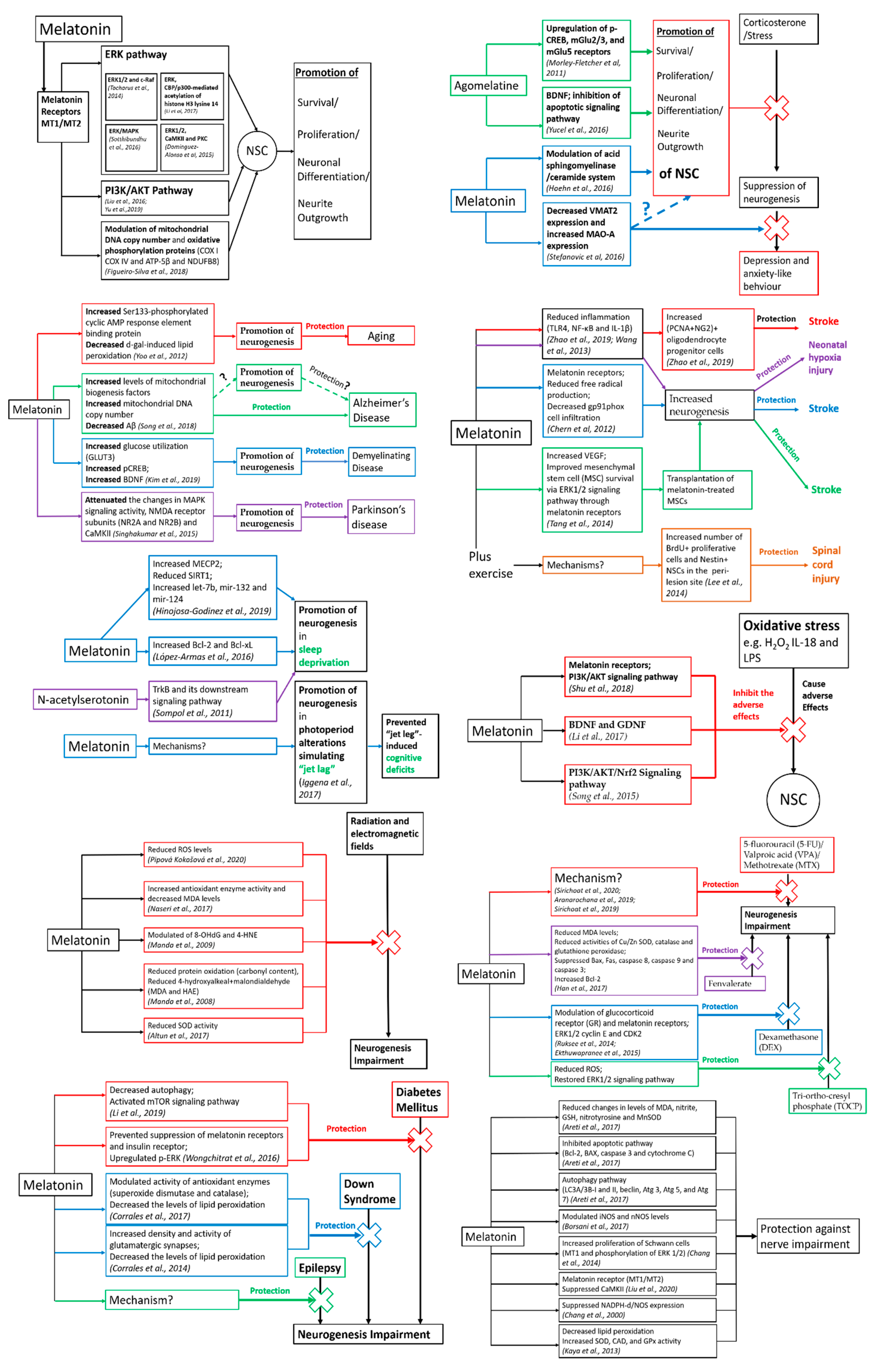

| Cells | Lowest Dosage Causing an Observable Effect | Main Findings | Molecular Mechanisms | References |
|---|---|---|---|---|
| Mouse cortical NSCs (E14) | 0.05 μM, 28-h treatment of melatonin | Increased NSC viability and proliferation Enhanced glial and oligodendrocyte differentiation | Not examined in the study | Ghareghani et al., 2017 [22] |
| Mouse cortical NSCs (E12.5) | 100 nM melatonin, 3-day treatment of melatonin | Promoted neuronal differentiation | Melatonin receptor MT1; ERK signaling pathway; CBP/p300-mediated acetylation of histone H3 lysine 14 | Li et al., 2017 [23] |
| Mouse cortical NSCs (E14) | 10−3 µM, 48-h treatment of melatonin or its analog IQM316 | Increased neuronal precursor marker expression (DCX) | Melatonin receptors (for the actions of melatonin but not the actions of IQM316) | Figueiro-Silva et al., 2018 [24] |
| Rat PC12 cells | 10 μM, 24-h treatment of melatonin | Enhanced cell proliferation Induced neurite outgrowth Promoted neuronal differentiation | Melatonin receptors MT1/MT2; MEK/ERK and PI3K/AKT signaling pathways | Liu et al., 2016 [25] |
| Mouse C17.2 cells | 0.05 nM, 24-h treatment | Increased neuronal differentiation | Melatonin receptor MT1; Histone H3 acetylation | Sharma et al., 2008 [26] |
| Rat midbrain NSCs (E14) | 1 nM, 3-day treatment of melatonin | Increased NSC viability Promoted dopaminergic neuronal differentiation and decreased astrocyte production | Melatonin receptors MT1/MT2; BDNF and GDNF | Kong et al., 2008 [27] |
| Mouse NSCs (E15.5; from ganglionic eminence) | 5 μM, 4-day treatment of melatonin | Suppressed epidermal growth factor (EGF)-stimulated NSC proliferation Treatment during the proliferation period promoted 1% FBS-induced neural differentiation of NSCs Treatment during the differentiation period decreased neural differentiation of the NSCs | Not examined in the study | Moriya et al., 2007 [28] |
| Human amniotic fluid mesenchymal stem cells (16 to 20 week of pregnancy) | 0.1 μM, 2-day treatment of melatonin | Increased levels of dopaminergic neuron markers (TH and NURR1) Increased levels of neuronal protein marker (βIII-tubulin) Decreased levels of glial fibrillary acidic protein markers (GFAP) | ERK phosphorylation; CaMKII signaling pathway | Phonchai et al., 2019 [29] |
| Mouse-induced pluripotent stem cells | 1 μM, 7-day treatment of melatonin | Improved the differentiation of iPSCs into NSCs Promoted the differentiation of iPSC-derived NSCs into neurons | Melatonin receptors MT1/MT2; PI3K/AKT signaling pathway | Shu et al., 2016 [30] |
| 52–56-day-old adult rat hippocampal organotypic culture | 10−11 M, 6-h treatment of melatonin | Stimulated dendrite growth and dendrite formation Increased dendrite complexity | Not examined in the study | Domínguez-Alonso et al., 2012 [31] |
| 52–56-day-old adult rat hippocampal organotypic culture | 100 nM, 6-h treatment of melatonin | Stimulated dendritogenesis | Melatonin receptors MT1/MT2; CaMKII and PKC ERK1/2 | Domínguez-Alonso et al., 2015 [32] |
| Mouse adult hippocampal NSCs | 10−8 μM, 48-h treatment of melatonin | Increased neuronal differentiation Promoted NSC survival | Melatonin receptors MT1/MT2 | Ramírez-Rodríguez et al., 2009 [33] |
| Mouse adult subventricular zone NSCs (8-week-old mice) | 0.001 μM, 7-day treatment of melatonin | Increased NSC proliferation Promoted neuronal differentiation | Melatonin receptor MT1 | Sotthibundhu et al., 2010 [34] |
| Mouse adult subventricular zone NSCs (8-week-old mice) | 100 µM, 7-day treatment of melatonin | Increased NSC proliferation | Melatonin receptors MT1/MT2; ERK/MAPK signaling pathway | Sotthibundhu et al., 2016 [35] |
| Rat adult hippocampal NSCs (2-month-old rat) | 0.5 μM, 3-day treatment of melatonin | Increased NSC proliferation | Melatonin receptors MT1/MT2; phosphorylation of ERK1/2 and c-Raf | Tocharus et al., 2014 [36] |
| Mouse adult spinal cord stem/progenitor cells (6-week-old mice) | 0.01 μM, 7-day treatment of melatonin | Promoted proliferation and maintenance of NSCs | Melatonin receptors MT1/MT2; PI3K/AKT signaling pathway | Yu et al., 2019 [37] |
| Animals | Treatment Timeline and Dosage | Brain Regions | Main Findings | Behavioral Outcomes | Molecular Mechanisms | References |
|---|---|---|---|---|---|---|
| 3-month-old male C57BL/6j mice | 2 mg/kg BW melatonin or its analog IQM316, administered daily for 7 days or 28 days | Dentate gyrus | Melatonin and IQM316 increased BrdU+/NeuN+ cells | IQM316 improved memory | Modulation of mitochondrial DNA copy number and oxidative phosphorylation proteins (COX I, COX IV, ATP-5β, and NDUFB8) | Figueiro-Silva et al., 2018 [24] |
| Adult C57BL/6 mice | 8 mg/kg BW melatonin, intraperitoneally injected daily for 14 days | Dentate gyrus | Increased number of DCX+ neuronal precursor cells Promoted dendritic maturation of immature neurons | Not examined in the study | Not examined in the study | Ramirez-Rodriguez et al., 2011 [38] |
| 8-week-old male BALB/c mice | ≈8 mg/kg BW melatonin, via drinking water for 1 or 6 months | Dentate gyrus | Modulated structural plasticity of mossy fiber projection | N/A | Not examined in the study | Ramírez-Rodríguez et al., 2018 [39] |
| 1-month-old male SD rats | Rats were pinealectomized and treated with 6mg/L melatonin in drinking water starting from 1 week after surgery for 2, 4, 6, 8, 10, or 17 months | Dentate gyrus | Promoted neurogenesis in the pinealectomized rats | Not examined in the study | Not examined in the study | Rennie et al., 2009 [40] |
| Pregnant rats’ offspring (PND35-77) | 8-week-old female pregnant rats subjected to pinealectomy and allowed to mate with adult males 30 days after surgery | Subgranular zone | Male offspring with no melatonin treatment showed lower number of Ki-67+-proliferative cells when compared to the offspring which received melatonin treatment during gestation and lactation period | Male offspring showed deficits in righting reflex, free-fall righting and walking Spatial reference and working memory were disrupted But melatonin alleviated the behavioral deficits | Not examined in the study | Motta-Teixeira et al., 2018 [41] |
| Female 8-week-old C57BL/6 mice | 8 mg/kg BW melatonin, intraperitoneally injected daily for 7 or 14 days | Dentate gyrus | Increased survival of new-born neurons and increased the number of intermediate neuronal progenitor cells and immature post-mitotic neurons | Reduced antidepressant-like behavior (Porsolt forced swim test) | Not examined in the study | Ramírez-Rodríguez et al., 2009 [33] |
| Adult male BALB/c mice | 8 mg/kg BW melatonin, orally administered daily for 3, 6, 9, or 12 months | Dentate gyrus | Increased proliferation and survival of new cells and increased number of DCX+ cells | Not examined in the study | Not examined in the study | Ramírez-Rodríguez et al., 2012 [42] |
| 8-week-old male BALB/c mice | 8 mg/kg BW melatonin, orally administered every 3 days for 1, 3, or 6 months | Dentate gyrus | Increased number of calretinin+ neurons | Not examined in the study | Not examined in the study | Ramírez-Rodríguez, et al., 2014 [43] |
| 2–3-month-old male C3H/HeN mice | 0.02 mg/mL melatonin in drinking water for 12 days | Dentate gyrus | Potentiated running-wheel activity-induced cell survival and neurogenesis | Not examined in the study | Not examined in the study | Liu, et al., 2013 [44] |
| Female C57BL/6 mice | 10 mg/kg BW luzindole, administered daily for 14 days | Subgranular zone | Decreased DCX+ neuronal precursor cells and decreased Ki-67+ proliferative-cells; increased GFAP+/Sox2+ neural stem cells | No effect on the hopeless behavior | Melatonin receptors MT1/MT2 | Ortiz-López et al., 2016 [45] |
| Animals | Treatment Timeline and Dosage | Brain Regions | Main Findings | Behavioral Outcomes | Molecular Mechanisms | References |
|---|---|---|---|---|---|---|
| Male BALB/c mice | 0.5, 1.0, 2.5, 5.0, and 10 mg/kg BW melatonin, intraperitoneally injected once daily for 14 days | Dentate gyrus | Increased number of DCX+ neuronal precursor cells Modulated dendrite maturation and complexity of new-born neurons | Decreased depression-like behavior (forced swim test) | Not examined in the study | Ramírez-Rodríguez et al., 2020 [50] |
| 7–8-week-old male CD1 mice subjected to corticosterone for 7 weeks | 10 mg/kg BW melatonin, intraperitoneally injected for 3 weeks | Dentate gyrus | Prevented corticosterone-induced reduction in cell proliferation | Reduced depression- and anxiety-like behavior (forced swim test, open field test, and novelty suppressed feeding test) | Not examined in the study | Crupi et al., 2010 [51] |
| 6-week-old mice with C57BL/6H background subjected to corticosterone via drinking water for 14 days | 10 mg/kg BW melatonin, intraperitoneally injected twice daily for 12 days | Hippocampus | Increased neurogenesis | Improvement in depression- and anxiety-like behavior (dark–light box and novelty suppressed feeding tests) | Acid sphingomyelinase/ceramide system | Hoehn et al., 2016 [52] |
| 11-week-old male Wistar rat subjected to chronic unpredictable mild stress for 28 days | 10 mg/kg BW melatonin, intraperitoneally injected daily for 4 weeks | Hippocampus | Effects on neurogenesis were not examined in the study | Decreased depression-like behavior (forced swim test) | Decreased VMAT2 expression and increased MAO-A expression | Stefanovic et al., 2016 [53] |
| 8-week-old male BALB/c mice | 1.28, 2.57, 5.13, and 10.26 mg/kg BW combination of melatonin plus citalopram, intraperitoneally injected once daily for 14 days | Dentate gyrus | Increased cell proliferation and survival Increased number of DCX+ neuronal precursor cells | Decreased depression-like behavior (forced swim test) | Not examined in the study | Ramírez-Rodríguez et al., 2014 [54] |
| Female SD rats subjected to prenatal restraint stress (starting from E11 until giving birth) (Bright light (650 Lux)) | 2–3-month-old male offspring were treated with 10–50 mg/kg BW agomelatine, intraperitoneally injected once daily for 3 or 6 weeks | Dentate gyrus | Increased survival of the proliferative cells Increased neurogenesis | Reduced depression- and anxiety-like behavior (forced swim test and elevated plus maze) | Increased p-CREB, mGlu2/3, and mGlu5 receptor levels | Morley-Fletcher et al., 2011 [55] |
| 12-week-old female Wistar rats subjected to light stress for 1 week | 10 and 40 mg/kg BW agomelatine, intraperitoneally injected once daily for 15 days | Hippocampus | Increased neurogenesis | Not examined in the study | BDNF; apoptotic signaling pathway (Bcl-2 and caspase 3) | Yucel et al., 2016 [56] |
| 8-week-old male SD rats | 40 mg/kg BW agomelatine, intraperitoneally injected once daily for 14 days | Dentate gyrus | Increased number of Ki 67+ cells No effect on cell proliferation in rats which were implanted with corticosterone pellet with addition of corticosterone injection | Not examined in the study | 5HT2C receptor | AlAhmed et al., 2010 [57] |
| 7-week-old male Wistar rats | 40 mg/kg BW agomelatine, intraperitoneally injected once daily for 8, 15, or 21 days | Hippocampus | Increased neuronal maturation, cell survival, and cell proliferation | Not examined in the study | BDNF; ERK1/2, AKT, and GSK3β signaling pathways | Soumier et al., 2009 [58] |
| Animals | Treatment Timeline and Dosage | Brain Regions | Main Findings | Behavioral Outcomes | Molecular Mechanisms | References |
|---|---|---|---|---|---|---|
| Male C57BL/6 mice subjected to d-galactose (d-gal) for 7 weeks (animal model of aging) | 6 mg/mL melatonin in drinking water for 3 weeks | Dentate gyrus | Restored d-gal-induced reduction of Ki67+ proliferative cells and DCX+ neuronal precursor cells | Improved spatial memory (Morris water maze) | Increased Ser133-phosphorylated cyclic AMP response element binding protein; decreased d-gal-induced lipid peroxidation | Yoo et al., 2012 [59] |
| 10-month-old senescence-accelerated mice (SAMP8) (animal model of aging) | ≈10 mg/kg BW melatonin, via drinking water (from 1 month old to 10 months old) | Brain | Effects on neurogenesis were not examined in the study | Not examined in the study | Decreased acetylated p53 and NF-κB; increased α-secretase; decreased amyloid β (Aβ); increased Bcl-2XL levels | Gutierrez-Cuesta et al., 2008 [61] |
| 8-week-old male C57BL/6 mice treated with methamphetamine (METH) (animal model of Parkinson’s disease) | 5 mg/kg BW melatonin, subcutaneously injected for 7 days | Hippocampus | Increased expressions of Nestin, DCX, and Beta-III tubulin | Not examined in the study | Attenuated the METH-induced change in MAPK signaling activity, NMDA receptor subunits (NR2A and NR2B) and CaMKII | Singhakumar et al., 2015 [62] |
| B6C3-Tg (APPswe, PSEN1dE9)85Dbo/Mmjax transgenic male mice (animal model of Alzheimer’s disease) or mice subjected to 10 doses of 1-methyl-4-phenyl-1,2,3,6-tetrahydropyridine (MPTP) and probenecid over 5 weeks (animal model of Parkinson’s disease) | Transplanting 25 μM melatonin-pretreated SVZ NSCs in both disease models | Hippocampus or striatum | Effects on neurogenesis were not examined in the study | Reduced Aβ plaques in the AD transgenic mouse model Improved neuronal restoration in the PD mouse model | Not examined in the study | Mendivil-Perez et al., 2017 [63] |
| Adult male SD rats subjected to 6-hydroxydopamine (6 OHDA) in the striatum by stereotaxic injection (animal model of Parkinson’s disease) | 4.0 μg/mL melatonin in drinking water for 39 days or 4.0 μg/mL melatonin in drinking water for 39 days, plus C17.2 NSC transplantation | Striatum and substantia nigra | Combination treatments preserved tyrosine hydroxylase (TH) immunoreactivity | Reduced apomorphine-induced rotations | Not examined in the study | Sharma et al., 2007 [64] |
| 8-week-old male C57BL/6 mice given 0.2% cuprizone in the chow diets (animal model of demyelinating disease) | 6 mg/L melatonin in drinking water for 6 weeks | Dentate gyrus | Ameliorated cuprizone-induced reduction of DCX+ neuronal precursor cells and Ki-67 proliferating cells | Not examined in the study | Increased glucose utilization (GLUT3); increased pCREB; increased BDNF | Kim et al., 2019 [65] |
| APP/PS1 mice (animal model of Alzheimer’s disease) | ≈0.1 mg/kg BW melatonin, via drinking water (starting from 4 to 8 months of age) | Cortex and the hippocampus | Effects on neurogenesis were not examined in the study | Reduced spatial learning and memory deficits | Increased levels of mitochondrial biogenesis factors; enhanced mitochondrial DNA copy number; reduced Aβ | Song et al., 2018 [66] |
| Cells | Lowest Dosage Causing an Observable Effect | Main Findings | Molecular Mechanisms | References |
|---|---|---|---|---|
| Rat adult hippocampal NSCs treated with 500 μM METH for 2 days (Parkinson’s disease) | 1 μM, 2-day treatment of melatonin (starting from 30 min prior to the METH treatment) | Reversed METH-induced inhibition of NSC proliferation | Reversed METH-induced changes in tumor suppressor p53, cycle inhibitor p21CIP, NMDA receptor subunits (NR2A and NR2B), and CaMKII | Ekthuwapranee et al., 2015 [68] |
| Animals | Treatment Timeline and Dosage | Brain Regions | Main Findings | Behavioral Outcomes | Molecular Mechanisms | References |
|---|---|---|---|---|---|---|
| Male ICR mice subjected to middle cerebral ischemic/reperfusion injury (CI/R) | 5 or 10 mg/kg melatonin, intraperitoneally injected once daily (starting from 2 h after CI/R) or 10 mg/kg melatonin, 30 min before CI/R, and then intraperitoneally injected daily | Cortex | Melatonin increased DCX+ and ki67+ cells The ki67+ cells were Nestin+ and NG2+ and expressed neurodevelopmental proteins (adam11 and adamts20) | Improved survival Reduced cerebral infarction Improved neural functions | Melatonin receptors; preserved blood–brain barrier (BBB) integrity; reduced free radical production; decreased gp91phox cell infiltration | Chern et al., 2012 [69] |
| Male SD rats subjected to middle cerebral artery occlusion (MCAO) (focal cerebral ischemia) | 5 mg/kg BW melatonin, intraperitoneally injected 30 min before and after ischemia/reperfusion (I/R) | Subventricular zone and white matter areas | Melatonin increased (PCNA+NG2) + oligodendrocyte progenitor cells after MCAO | Reduction in infarct volume and white matter damage | TLR4, NF-κB, and IL-1β | Zhao et al., 2019 [70] |
| Adult male C57Bl6/j mice subjected to mild focal cerebral ischemia | 4 mg/kg BW melatonin, single i.p. bolus injection at 24 h after reperfusion, plus 0.025 mg/mL melatonin in drinking water (starting from 24 h after reperfusion and continued for 29 days) | Striatum, cortex, and lateral ventricle | Melatonin increased neuronal survival and enhanced neurogenesis | Improvement in motor and coordination deficits (grip strength and rotarod tests) Attenuated hyperactivity and anxiety (open field test) | Not examined in the study | Kilic et al., 2008 [71] |
| 3- to 4-month-old Mongolian gerbils subjected to global forebrain ischemia | 10 mg/kg BW melatonin, intraperitoneally injected 30 min prior ischemia followed by injections at 1, 2, and 6 h after occlusion (acute treatment) or 0.6mg/kg BW melatonin daily, via drinking water (starting from 2 weeks before ischemia until the end of experiment) (chronic treatment) | Dentate gyrus and CA1 hippocampus | DCX+ neuronal precursor cells increased after ischemia, and acute and chronic melatonin treatment reduced the number of DCX+ cells | Chronic but not acute melatonin attenuated ischemia-induced hyperactivity 3 days after occlusion (open field test) | Not examined in the study | Rennie et al., 2008 [72] |
| Adult male SD rats subjected to MCAO | Mesenchymal stem cells (MSCs) were pretreated with 5 mM melatonin for 24 h and were transplanted into the striatum of the ipsilateral hemisphere | Subventricular zone, striatum, and cortex | Melatonin increased angiogenesis and neurogenesis after MCAO | Improved behavioral outcomes (neurological scores, rotarod test, and elevated body swing test) | Increased VEGF; improved MSC survival via ERK1/2 signaling pathway through melatonin receptors | Tang et al., 2014 [73] |
| 8-week-old SD rats subjected to spinal cord injury (SCI) | 10 mg/kg BW melatonin, subcutaneously injected twice daily (starting from 1 day after SCI until the end of experiment) or melatonin treatment plus treadmill exercise | Peri-lesion site | Combination treatment increased numbers of BrdU+ proliferative cells and Nestin+ NSCs after SCI | Combination treatment improved hindlimb function Melatonin treatment alone or combination treatment increased dendritic spine density | Not examined in the study | Lee et al., 2014 [74] |
| Postnatal day (PND1) mice subjected to hypoxia (5% oxygen and 95% nitrogen) for 2 h | 10 mg/kg BW melatonin, intraperitoneally injected 1 h before hypoxia and then daily for 3 days | Hippocampus | Melatonin increased BrdU+ proliferating cells and DCX+ neuronal precursor cells after hypoxia Reduced cell death | Attenuated neurobehavioral deficits (sensorimotor performance, locomotor functions, and hyperactivity) Improved learning and memory performance (Morris water test) | Reduced microglial activation; reduced TNFα, interleukin-1β, and nitric oxide; inhibited NF-κB activation | Wang et al., 2013 [75] |
| PND7 SD rats subjected to kainic acid (KA)-induced neurodevelopmental injury | 10 mg/kg BW melatonin, intraperitoneally injected daily for 6 days (starting at 4 h after KA administration) | Hippocampus | Melatonin prevented hippocampal neuronal loss but had no effect on neurogenesis | Not examined in the study | Not examined in the study | Csernansky et al., 2006 [76] |
| Cells | Lowest Dosage Causing an Observable Effect | Main Findings | Molecular Mechanisms | References |
|---|---|---|---|---|
| Mouse cortical NSCs (E12.5) subjected to hypoxia (95% N2 and 5% CO2) for 12 h | 100 nM melatonin, treated before hypoxia | Melatonin increased proliferation and neuronal differentiation of NSCs during hypoxia | MT1 receptor; phosphorylation of ERK1/2 | Fu et al., 2011 [77] |
| Rat NSCs (E13.5) transfected with miR-363 (vitamin A deficiency (VAD)-induced congenital spinal deformities model) | 1 ng/mL melatonin, treated for 24 h | Melatonin promoted proliferation, increased Nestin expression, and promoted neuronal differentiation in miR-363-transfected NSCs | Notch signaling | Li et al., 2019 [78] |
| Animals | Treatment Timeline and Dosage | Brain Regions | Main Findings | Behavioral Outcomes | Molecular Mechanisms | References |
|---|---|---|---|---|---|---|
| PND 60 male BALB/c mice subjected to sleep deprivation (SD) for 96 h | 10 mg/kg BW melatonin, intraperitoneally injected daily for 4 days | Dentate gyrus | Restored the reduction in the number of Sox2+/BrdU+ NSCs | Not examined in the study | Increased MECP2; reduced SIRT1; increased let-7b, mir-132, and mir-124 | Hinojosa-Godinez et al., 2019 [81] |
| Adult male BALB/c mice subjected to SD for 96 h | 10 mg/kg BW melatonin, via drinking water (for 14 days before SD, and during SD until the end of the experiment) | Subgranular zone | Increased BrdU/Nestin+ NSCs | Not examined in the study | Increased Bcl-2 and Bcl-xL | López-Armas et al., 2016 [82] |
| 2-to 3-month-old C57BL/6 mice or C3Hf (+/+) mice subjected to SD for 96 h | 20 mg/kg BW N-acetylserotonin (NAS) (immediate precursor of melatonin), intraperitoneally injected every 12 h during SD | Dentate gyrus | Protected SD-induced suppression of NSC proliferation | Not examined in the study | TrkB and its downstream signaling pathway | Sompol et al., 2011 [83] |
| 6-week-old female C57Bl/6N mice subjected to 3 weeks of photoperiod alterations simulating “jet lag” | 10 mg/kg BW melatonin, intraperitoneally injected daily until the end of experiment (2.5 weeks or 4 weeks) | Dentate gyrus | Prevented the reduction of cell proliferation | Prevented cognitive deficits | Not examined in the study | Iggena et al., 2017 [84] |
| Cells | Lowest Dosage Causing an Observable Effect | Main Findings | Molecular Mechanisms | References |
|---|---|---|---|---|
| Mice cortical NSCs (E14) exposed to 100 ng/mL or 1 μg/mL LPS | 100nM melatonin, treated before and 1 day after LPS exposure | Suppressed LPS-induced inflammation and nitric oxide (NO) production Prevented LPS-induced cell death and apoptosis Increased SOX2 expression | PI3K/Akt/Nrf2 signaling | Song et al., 2015 [91] |
| iPSC-derived NSCs pretreated with 500 μM H2O2 | 1 μM melatonin, treated for 3 days | Increased proliferation of iPSC-derived NSCs Stabilized the mitochondrial membrane potential Prevented H2O2-induced apoptosis | Melatonin receptors; PI3K/AKT signaling pathway | Shu et al., 2018 [92] |
| Rat NSCs (E13.5) treated with IL-18 | 10 ng/mL melatonin, treated for 3 days | Reduced IL-18-induced inhibition of proliferation, neurosphere formation, and neuronal differentiation | BDNF and GDNF | Li et al., 2017 [93] |
| Animals | Treatment Timeline and Dosage | Brain Regions | Main Findings | Behavioral Outcomes | Molecular Mechanisms | References |
|---|---|---|---|---|---|---|
| Male 8-week-old ICR mice subjected to scopolamine (Sco) for 2 or 4 weeks | 10 mg/kg melatonin, intraperitoneally injected for 2 or 4 weeks | Dentate gyrus | Restored the decrease in DCX+ neuronal precursor cells and Ki67+ proliferative cells | Improved spatial learning and short-term memory impairment (Morris water maze test and passive avoidance test) | Not examined in the study | Chen et al., 2018 [94] |
| 4–5-week-old male SD rats exposed to 5-fluorouracil (5-FU) | 8 mg/kg BW melatonin, intraperitoneally injected for 21 or 42 days | Subgranular zone | Ameliorated the reduction in neurogenesis | Reversed spatial memory deficits | Not examined in the study | Sirichoat et al., 2020 [95] |
| 4–5-week-old rats exposed to valproic acid (VPA) | 8 mg/kg BW melatonin, intraperitoneally injected once daily for 14 days after VPA exposure or 28 days during and after VPA exposure | Subgranular zone | Prevented VPA-induced neurogenesis impairment | Prevented impairment in spatial and non-spatial memory (novel object location (NOL) test) | Not examined in the study | Aranarochana et al., 2019 [96] |
| 4–5-week-old male SD rats exposed to methotrexate (MTX) | 8 mg/kg BW melatonin, intraperitoneally injected for 15 days before and during MTX treatment or 15 days after MTX treatment, or 30 days during and after MTX treatment | Subgranular zone | Prevented MTX-induced inhibition of cell proliferation Increased cell survival rate after MTX exposure Reversed the decrease in the number of immature neurons caused by MTX | Ameliorated MTX-induced spatial memory impairment (novel object recognition (NOR) test) | Not examined in the study | Sirichoat et al., 2019 [97] |
| 8-week-old male ICR mice exposed to dexamethasone (DEX) | 8 mg/kg BW melatonin, intraperitonially injected 30 min before DEX exposure | Dentate gyrus | Restored the DEX-induced reduction in DCX and BrdU expression | Reversed DEX-induced depressive-like behavior (forced swim test) | Prevented DEX-induced reduction in glucocorticoid receptor (GR); ERK1/2 | Ruksee et al., 2014 [98] |
| PND8 male Wistar rats exposed to morphine sulfate | 50 mg/kg BW melatonin, intraperitoneally injected 30 min before the formalin test at PND30 and 60 | Only effects on behavioral outcomes were measured. Effects on the brain were not examined in the study | Effects on neurogenesis were not examined in the study | Reversed the nociceptive response induced by morphine | Not examined in the study | Rozisky et al., 2016 [99] |
| Swiss albino mice and C57BL/6 mice strains exposed to ketamine | 1 mg/kg BW melatonin or 20 mg/kg BW N-acetylserotonin (NAS), intraperitonially injected 30 min before ketamine exposure | Hippocampus | Effects on neurogenesis were not examined in the study | Attenuated the ketamine-induced immobility in the forced swim test (FST) | MEK-ERK and PI3K-AKT pathways; BDNF | Choudhury et al., 2016 [100] |
| Zebrafish exposed to fenvalerate (FEN) 5 h after fertilization | 10–9 mol/L melatonin, treated 3 h prior to FEN exposure for 120 hpf | Whole zebrafish | Reduced oxidative stress and apoptotic responses induced by FEN Suppressed the changes in the expression of neurogenesis-related genes (Dlx2, Shha, Ngn1, Elavl3, and Gfap) caused by FEN | Ameliorated FEN-induced abnormality in swimming behavior | Reduced malondialdehyde levels and activities of Cu/Zn superoxide dismutase (Cu/Zn SOD), catalase, and glutathione peroxidase; suppressed pro-apoptotic genes (Bax, Fas, caspase 8, caspase 9, and caspase 3); increased expression of anti-apoptotic gene (Bcl-2) | Han et al., 2017 [101] |
| Male offspring of female rats which were exposed to a single dose of 1 Gy 60 Co gamma rays (Gy) during pregnancy | 4 mg/kg BW melatonin, via drinking water (PND14–20), or 20 mg/L/day melatonin, via drinking water (from PND 28–55) | Hilus, granular cell layer (GCL), and CA1 region of hippocampus | Melatonin increased number of BrdU+ proliferative cells in the hilus and increased number of NeuN+ neurons in the hilus and GCL in the irradiated PND21 rats Melatonin also increased number of NeuN+ neurons in the CA1 region of the irradiated PND 56 rats | Improved spatial memory (Morris water maze) | Reduced ROS levels in irradiated PND56 rats | Pipová Kokošová et al., 2020 [102] |
| 6–8-month-old rats exposed to a single dose of 25 Gy | 100 mg/kg BW melatonin, intraperitoneally injected 60 min before radiation exposure | Subventricular zone | Prevented cell apoptosis and reduced the decrease in Nestin+ cells | Not examined in the study | Increased antioxidant enzyme activity and decreased MDA levels | Naseri et al., 2017 [103] |
| Male 6-week-old C57BL mice exposed to 2 Gy of whole-body Fe irradiation | 10 mg/kg BW N1-acetyl-N2-formyl-5-methoxykynuramine (AFMK), intraperitoneally injected 30 min before radiation exposure | Dentate gyrus | Prevented the loss of DCX+ neuronal precursor cells and Ki-67 proliferative cells | Improved spatial memory impairment | Reduced protein oxidation (carbonyl content); reduced 4-hydroxyalkeal + malondialdehyde (MDA+HAE) | Manda et al., 2008 [104] |
| 6-week-old male C57BL mice exposed to 6 Gy of cranial X-ray | 10 mg/kg BW melatonin, intraperitoneally injected 30 min before radiation exposure | Dentate gyrus | Prevented radiation-induced reduction in DCX+ neuronal precursor cells and Ki-67+ proliferative cells | Not examined in the study | 8-OHdG 4-HNE | Manda et al., 2009 [105] |
| Male 12-week-old Wistar albino rats exposed to a 900 MHz electromagnetic fields (EMF) | 50 mg/kg BW melatonin, intraperitoneally injected daily during EMF exposure | Hippocampus and cerebellum | Prevented EMF-induced cell loss | Prevented cognitive impairment (passive avoidance test) | Reduced SOD activity | Altun et al., 2017 [106] |
| Cells | Lowest Dosage Causing an Observable Effect | Main Findings | Molecular Mechanisms | References |
|---|---|---|---|---|
| Adult hippocampal NSCs (from 8-week-old rats) exposed to dexamethasone (DEX) | 1 μM melatonin, treated 30 min before 1 μM DEX treatment, for 5 days | Prevented DEX-induced reduction in Ki67 and Nestin expression in the neurosphere | Melatonin receptors and glucocorticoid receptor; reversed the DEX-induced changes in ERK1/2, cyclin E, and CDK2 | Ekthuwapranee et al., 2015 [107] |
| Mouse NSCs (E12.5) exposed to tri-ortho-cresyl phosphate (TOCP) | 40 μM melatonin, treated before TOCP exposure for 24 h | Prevented the decrease in cell viability after TOCP exposure Prevented TOCP-induced autophagy | Reduced production of ROS; restored ERK1/2 signaling pathway | Liu et al., 2020 [108] |
| Animals | Treatment Timeline and Dosage | Brain Regions | Main Findings | Behavioral Outcomes | Molecular Mechanisms | References |
|---|---|---|---|---|---|---|
| Six-week-old male Wistar rats were fed with a high fat diet (HFD) and subjected to STZ (diabetes mellitus) | 10 mg/kg BW melatonin, subcutaneously injected for 4 weeks | Hippocampus | Reversed HFD + STZ-induced neurogenesis and synaptogenesis impairment | Reversed HFD+ STZ-induced spatial memory impairment | Prevented suppression of melatonin receptor and insulin receptor; upregulated p-ERK | Wongchitrat et al., 2016 [109] |
| E11.5 and E17.5 embryos from 8-week-old pregnant Kunming mice subjected to streptozotocin (STZ) (diabetes mellitus) | 10 mg/kg BW melatonin, intraperitoneally injected into the pregnant mice (starting from E0.5 to the end of experiment) | Cortex | Prevented STZ-induced inhibition of NSC proliferation; Decreased STZ-induced premature differentiation of NSCs | Not examined in the study | Decreased autophagy | Li et al., 2019 [110] |
| E11.5 embryos from 8-week-old pregnant ICR mice which were subjected to STZ (diabetes mellitus) | 10 mg/kg BW melatonin, intraperitoneally injected into pregnant mice (starting from E0.5 to the end of the experiment) | Forebrain | Prevented STZ-induced reduction in proliferation of NSCs Reduced STZ-induced apoptosis | Not examined in the study | Not examined in the study | Liu et al., 2015 [111] |
| 6–6.5-month-old Ts65Dn (TS) mice (Down syndrome) | 100 mg/L melatonin, via drinking water from 6–6.5 months old to 11–12 months old | Hippocampus | Reversed neurogenesis impairment Decreased reduction in the density of hippocampal granule cells Reduced synaptic inhibition Recovered hippocampal LTP | Not examined in the study | Increased density and activity of glutamatergic synapses; decreased the levels of lipid peroxidation | Corrales et al., 2014 [112] |
| Ts65Dn (TS) mice (Down syndrome) | 100 mg/L melatonin, treated via drinking water from the time of conception of the mouse mothers to the age of 5 months of the offspring | Hippocampus and cortex | Did not reverse the decrease in cell proliferation in the TS mice But regulated brain oxidative stress | No effects on behavioral outcomes | Modulated the activity of antioxidant enzymes (superoxide dismutase and catalase); decreased the levels of lipid peroxidation | Corrales et al., 2017 [113] |
| PND 0 rats from rat mothers subjected to seizures induction on E13 of the pregnancy (epilepsy) | 30 μg/100 g BW melatonin, intraperitoneally injected into the rat mothers for 2 months | Cerebellum | Inhibited epilepsy-induced increase in Nestin expression | Not examined in the study | Not examined in the study | Uyanikgil et al., 2005 [114] |
| PND 0 rats from rat mothers subjected to seizure induction on E13 of the pregnancy and pinealectomy 1 month before seizures induction (epilepsy) | 30 μg/100 g BW melatonin, subcutaneously injected into the rat mothers for 2 months (starting from the date of pinealectomy surgery) | CA1 region of the hippocampus | Inhibited pinealectomy-stimulated increase in Nestin expression | Not examined in the study | Not examined in the study | Turgut et al., 2006 [115] |
| Cells | Lowest Dosage Causing an Observable Effect | Main Findings | Molecular Mechanisms | References |
|---|---|---|---|---|
| Mouse cortical NSCs (E12.5) subjected to hyperglycemia | 10 nM melatonin, treated for 24 h | Promoted proliferation and self-renewal of NSCs in hyperglycemia Prevented hyperglycemia-induced premature differentiation of NSCs | Decreased autophagy; activated mTOR signaling pathway | Li et al., 2019 [110] |
| Mouse telencephalon NSCs (E11.5) subjected to hyperglycemia | 100 nM melatonin, treated for 3 days | Prevented hyperglycemia-induced inhibition of NSC proliferation Prevented hyperglycemia-induced cell death and apoptosis | ERK signaling pathway | Liu et al., 2015 [111] |
| Olfactory NSCs from a 28-year-old male patient diagnosed with schizophrenia (SCZ) | 10–5 M melatonin, treated for 12 h | Attenuated the SCZ induced-abnormal increase in potassium-evoked secretion | Not examined in the study | Cercós et al., 2017 [116] |
| Animals | Treatment Timeline and Dosage | Targets | Main Findings | Behavioral Outcomes | Molecular Mechanisms | References |
|---|---|---|---|---|---|---|
| Young adult male Wistar rats subjected to PNI (ESN) | 1 mg/kg BW melatonin, intraperitoneally injected daily for 1 month after ESN | Peripheral nerve tissue | Enhanced expression of GAP43 and β3-tubulin | Enhanced upper limb functional recovery Increased number of re-innervated motor end plates on the target muscle | Melatonin receptors (MT1/MT2) Suppressed CaMKII | Liu et al., 2020 [117] |
| Young adult male Wistar rats subjected to peripheral nerve injury (PNI), which was performed by end-to-side neurorrhaphy (ESN) | 1 and 10 mg/kg BW melatonin, intraperitoneally injected daily for 30 days | Nerves on target muscle | Improved nerve regeneration | Not examined in the study | Increased proliferation of Schwann cells (MT1 and phosphorylation of ERK 1/2) | Chang et al., 2014 [118] |
| Adult male Wistar subjected to hypoglossal nerve transection (PNI) | 5 or 100 mg/kg BW melatonin, intraperitoneally injected daily for 3, 7, 14, 21, and 30 days | Hypoglossal nucleus | Increased number of motoneurons in the hypoglossal nucleus | Not examined in the study | Suppressed NADPH-d/NOS expression | Chang et al., 2000 [119] |
| Adult male Wistar rats subjected to hypoglossal nerve transection (PNI) | 5 or 100 mg/kg BW melatonin, intraperitoneally injected daily for 3, 7, 14, 30, or 60 days | Hypoglossal motoneurons | Preserved activities of Mn-SOD, Cu/Zn-SOD, and ChAT | Promoted functional recovery | Suppressed nNOS augmentation | Chang et al., 2008 [120] |
| SD rats subjected to chronic constriction injury | 5 mg/kg and 10 mg/kg melatonin, intraperitoneally injected on the 14th day after surgery | Dorsal root ganglia | Modulation of the nitroxidergic system | Improvement in thermal hyperalgesia | Modulated iNOS and nNOS levels | Borsani et al., 2017 [121] |
| SD rats exposed to oxaliplatin (peripheral neuropathy) | 3 or 10 mg/kg BW melatonin, intraperitoneally injected for 28 days | Sciatic nerve and dorsal root ganglia | Ameliorated oxidative/nitrosative stress mediated by oxaliplatin Induced autophagy and inhibited apoptosis | Alleviated oxaliplatin-induced pain behavior and neuropathic deficits (cold chemical allodynia, mechanical allodynia, and mechanical hyperalgesia) | Reduced the changes in the levels of MDA nitrite, GSH, nitrotyrosine, and MnSOD Inhibited apoptotic pathway (Bcl2, BAX, caspase 3, and cytochrome C) Autophagy pathway (LC3A/3B-I and II, beclin, Atg 3, Atg 5, and Atg 7) | Areti et al., 2017 [122] |
| Adult male Wistar rats subjected to ischemia–reperfusion (R/I injury) | 10 mg/kg BW melatonin, injected via tail vein immediately before the reperfusion period | Sciatic nerve | Salvaged the nerve fibers from ischemic degeneration Decreased edema and damage in the myelin sheaths and axons | Not examined in the study | Reversed the I/R-induced increase in MDA levels Increased SOD levels | Sayan et al., 2004 [123] |
| Female Wistar rats subjected to cut or crush injury | 50 mg/kg BW melatonin, intraperitoneally injected after sciatic nerve injury | Sciatic nerve | Preserved myelin sheath | Not examined in the study | Decreased lipid peroxidation Increased SOD, CAD, and GPx activity | Kaya et al., 2013 [124] |
| Adult male Wistar rats subjected to pinealectomy 3 weeks before surgical intervention consisting of bilateral sciatic nerve section and primary suture repair | 30 mg/100 g BW melatonin, subcutaneously injected after pinealectomy | Sciatic nerve/ epineurium | Increased collagen content of the sciatic nerve and macroscopic neuroma formation after pinealectomy but the elevation was reversed by the melatonin treatment Melatonin treatment reduced stimulus intensities required to excite a NAP response after pinealectomy Melatonin treatment reduced the elevation of Type I collagen and Type III collagen in epineurium after pinealectomy | Not examined in the study | Not examined in the study | Turgut et al., 2005 [125] |
© 2020 by the authors. Licensee MDPI, Basel, Switzerland. This article is an open access article distributed under the terms and conditions of the Creative Commons Attribution (CC BY) license (http://creativecommons.org/licenses/by/4.0/).
Share and Cite
Leung, J.W.-H.; Cheung, K.-K.; Ngai, S.P.-C.; Tsang, H.W.-H.; Lau, B.W.-M. Protective Effects of Melatonin on Neurogenesis Impairment in Neurological Disorders and Its Relevant Molecular Mechanisms. Int. J. Mol. Sci. 2020, 21, 5645. https://doi.org/10.3390/ijms21165645
Leung JW-H, Cheung K-K, Ngai SP-C, Tsang HW-H, Lau BW-M. Protective Effects of Melatonin on Neurogenesis Impairment in Neurological Disorders and Its Relevant Molecular Mechanisms. International Journal of Molecular Sciences. 2020; 21(16):5645. https://doi.org/10.3390/ijms21165645
Chicago/Turabian StyleLeung, Joseph Wai-Hin, Kwok-Kuen Cheung, Shirley Pui-Ching Ngai, Hector Wing-Hong Tsang, and Benson Wui-Man Lau. 2020. "Protective Effects of Melatonin on Neurogenesis Impairment in Neurological Disorders and Its Relevant Molecular Mechanisms" International Journal of Molecular Sciences 21, no. 16: 5645. https://doi.org/10.3390/ijms21165645
APA StyleLeung, J. W.-H., Cheung, K.-K., Ngai, S. P.-C., Tsang, H. W.-H., & Lau, B. W.-M. (2020). Protective Effects of Melatonin on Neurogenesis Impairment in Neurological Disorders and Its Relevant Molecular Mechanisms. International Journal of Molecular Sciences, 21(16), 5645. https://doi.org/10.3390/ijms21165645

