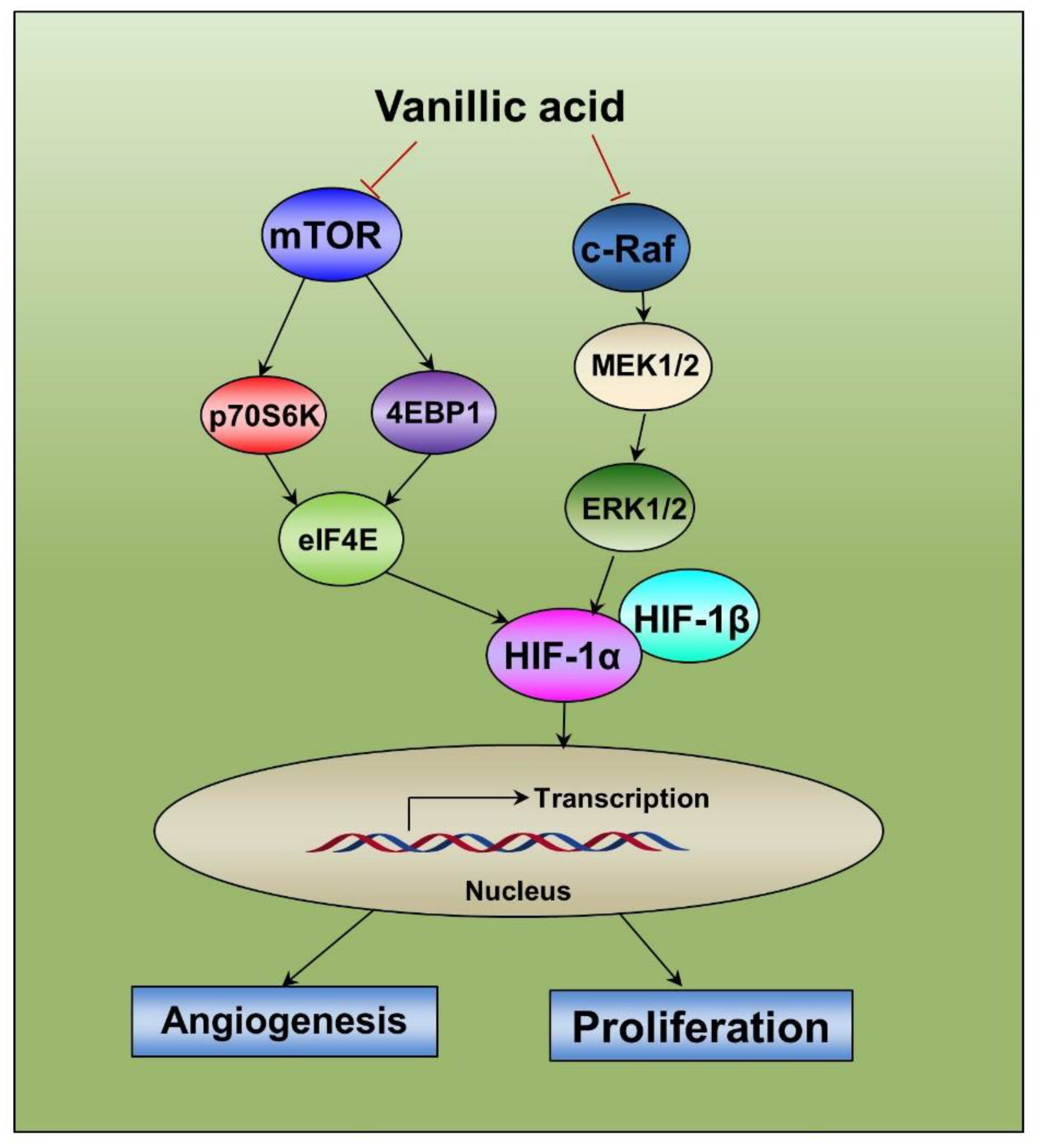
Vanillic Acid Suppresses HIF-1α Expression via Inhibition of mTOR/p70S6K/4E-BP1 and Raf/MEK/ERK Pathways in Human Colon Cancer HCT116 Cells

Abstract
Share and Cite
Gong, J.; Zhou, S.; Yang, S. Vanillic Acid Suppresses HIF-1α Expression via Inhibition of mTOR/p70S6K/4E-BP1 and Raf/MEK/ERK Pathways in Human Colon Cancer HCT116 Cells. Int. J. Mol. Sci. 2019, 20, 465. https://doi.org/10.3390/ijms20030465
Gong J, Zhou S, Yang S. Vanillic Acid Suppresses HIF-1α Expression via Inhibition of mTOR/p70S6K/4E-BP1 and Raf/MEK/ERK Pathways in Human Colon Cancer HCT116 Cells. International Journal of Molecular Sciences. 2019; 20(3):465. https://doi.org/10.3390/ijms20030465
Chicago/Turabian StyleGong, Jingli, Shengxue Zhou, and Shihai Yang. 2019. "Vanillic Acid Suppresses HIF-1α Expression via Inhibition of mTOR/p70S6K/4E-BP1 and Raf/MEK/ERK Pathways in Human Colon Cancer HCT116 Cells" International Journal of Molecular Sciences 20, no. 3: 465. https://doi.org/10.3390/ijms20030465
APA StyleGong, J., Zhou, S., & Yang, S. (2019). Vanillic Acid Suppresses HIF-1α Expression via Inhibition of mTOR/p70S6K/4E-BP1 and Raf/MEK/ERK Pathways in Human Colon Cancer HCT116 Cells. International Journal of Molecular Sciences, 20(3), 465. https://doi.org/10.3390/ijms20030465