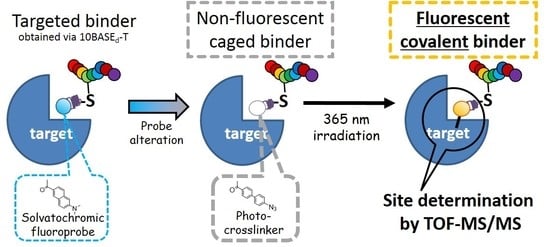
A Cysteine-Reactive Small Photo-Crosslinker Possessing Caged-Fluorescence Properties: Binding-Site Determination of a Combinatorially-Selected Peptide by Fluorescence Imaging/Tandem Mass Spectrometry


Abstract
Share and Cite
Yatabe, K.; Hisada, M.; Tabuchi, Y.; Taki, M. A Cysteine-Reactive Small Photo-Crosslinker Possessing Caged-Fluorescence Properties: Binding-Site Determination of a Combinatorially-Selected Peptide by Fluorescence Imaging/Tandem Mass Spectrometry. Int. J. Mol. Sci. 2018, 19, 3682. https://doi.org/10.3390/ijms19113682
Yatabe K, Hisada M, Tabuchi Y, Taki M. A Cysteine-Reactive Small Photo-Crosslinker Possessing Caged-Fluorescence Properties: Binding-Site Determination of a Combinatorially-Selected Peptide by Fluorescence Imaging/Tandem Mass Spectrometry. International Journal of Molecular Sciences. 2018; 19(11):3682. https://doi.org/10.3390/ijms19113682
Chicago/Turabian StyleYatabe, Kazuki, Masaru Hisada, Yudai Tabuchi, and Masumi Taki. 2018. "A Cysteine-Reactive Small Photo-Crosslinker Possessing Caged-Fluorescence Properties: Binding-Site Determination of a Combinatorially-Selected Peptide by Fluorescence Imaging/Tandem Mass Spectrometry" International Journal of Molecular Sciences 19, no. 11: 3682. https://doi.org/10.3390/ijms19113682
APA StyleYatabe, K., Hisada, M., Tabuchi, Y., & Taki, M. (2018). A Cysteine-Reactive Small Photo-Crosslinker Possessing Caged-Fluorescence Properties: Binding-Site Determination of a Combinatorially-Selected Peptide by Fluorescence Imaging/Tandem Mass Spectrometry. International Journal of Molecular Sciences, 19(11), 3682. https://doi.org/10.3390/ijms19113682